Introduction
The characteristic features of schizophrenia include a range of symptoms routinely measured in contemporary clinical trials of antipsychotics by the Positive and Negative Syndrome Scale (PANSS), which comprises 3 subscales: Positive, Negative, and General Psychopathology.Reference Kay, Fiszbein and Opler 1 The focus of many treatment approaches is to decrease the frequency and intensity of positive symptoms, although it is known that negative and cognitive symptoms independently contribute to poor quality of life and significant disability in patients with schizophrenia.Reference Carbon and Correll 2 – Reference Mohamed, Rosenheck, Swartz, Stroup, Lieberman and Keefe 5 Thus, examining outcomes on each of the PANSS subscales is useful for fully characterizing the potential effectiveness of interventions. In addition, 5- factor solutions for the PANSS have been investigatedReference Lehoux, Gobeil and Lefèbvre 6 and used to further appraise study outcomes in terms of positive and negative symptoms as well as disorganized thought, uncontrolled hostility/excitement, and anxiety/depression.Reference Marder, Davis and Chouinard 7
Although the routine primary outcome measure in clinical trials of antipsychotics is the change in PANSS Total score from baseline to endpoint, and placebo-subtracted differences of this measure provide an estimate of the size of the treatment effect, this is not always easy to interpret clinically. More intuitive are responder rates such as the proportion of patients who achieve an improvement of ≥20% or ≥ 30% from baseline on the PANSS Total score and/or the proportion of patients with scores of “very much improved” or “much improved” on a global assessment measure, such as the Clinical Global Impression–Improvement (CGI-I) scale.Reference Guy 8
Aripiprazole lauroxil (AL) is a long-acting injectable antipsychotic administered via intramuscular route and indicated for the treatment of schizophrenia. The primary report describing efficacy, safety, and tolerability has been published elsewhere,Reference Meltzer, Risinger and Nasrallah 9 with additional information available in the product labeling. 10 The present exploratory analyses of the Phase 3 study examined the effects of AL on protocol-specified and post hoc supportive efficacy endpoints, including the Clinical Global Impression-Severity (CGI-S) scale, PANSS subscale scores, and different definitions of treatment response and the PANSS Marder factor analysis (post hoc), in patients experiencing an acute relapse of schizophrenia.
Methods
The study design and methods were previous publishedReference Meltzer, Risinger and Nasrallah 9 and are summarized briefly. The study was conducted in accordance with the Declaration of Helsinki, 1964, and Good Clinical Practice principles. The study protocol, all amendments, and informed consent documents were approved by a qualified institutional review board at each study site, and all participants completed written informed consent before participating in any study procedures. Eligible patients were enrolled in 7 countries during the period December 2011–March 2014. The study was registered at clinicaltrials.gov (NCT01469039); EudraCT number: 2012-003445-15.
Study design
This was a Phase 3, randomized, double-blind, placebo-controlled study of AL 441 mg and AL 882 mg monthly in patients experiencing an acute relapse of schizophrenia. All patients were admitted to an inpatient unit, and current antipsychotics were discontinued.
Patient selection
Patients were aged 18–70 years, with a body mass index of 18.5–40 kg/m2, and must have been willing to participate in an inpatient unit study for ≥ 2 weeks. Patients were eligible if they were experiencing a current acute exacerbation or relapse of schizophrenia with an onset<2 months before screening (<2 weeks for the current exacerbation if hospitalized), and ≥ 2 years had elapsed since the initial onset of symptoms. Patients were also required to have a clinically significant beneficial response to treatment with an antipsychotic medication other than clozapine and to have been an outpatient for >3 months during the past year. At screening and baseline, a PANSS TotalReference Kay, Fiszbein and Opler 1 score of 70–120, a score of ≥ 4 for ≥ 2 of the Positive subscale items (Item 1: delusions; Item 2: conceptual disorganization; Item 3: hallucinatory behavior; Item 6: suspiciousness/persecution), and a CGI-SReference Guy 8 score of ≥ 4 were required. Patients with a poor or inadequate response, hypersensitivity, or history of treatment resistance to aripiprazole were excluded. Also excluded were those with hypersensitivity to other antipsychotics or fat emulsion (used for the placebo injection); those with other clinically significant neuropsychiatric disorder, medical illness, or laboratory abnormality that would interfere with the conduct of the study; and women who were pregnant, lactating, or breastfeeding. Use of a long-acting antipsychotic within 60 days of screening or current involuntary hospitalization or prior psychiatric hospitalization for>30 days in the 90 days before screening were additional reasons for exclusion.
After a test of oral aripiprazole 5 mg to assess tolerability in those with no history of aripiprazole treatment, eligible patients received double-blind oral aripiprazole 15 mg/day or oral placebo daily for the first 3 weeks after randomization. On Day 1, patients were randomly assigned to an IM dose of AL 441 mg or AL 882 mg or placebo, and 2 subsequent doses were administered on Days 29 and 57. Patients remained in the inpatient study unit for at least 2 weeks after administration of the first dose of IM study drug.
Study endpoints
The primary endpoint (change in PANSS Total score from baseline to Day 85) and secondary endpoint (proportion of patients by CGI-I scale category at Day 85) are reported elsewhere.Reference Meltzer, Risinger and Nasrallah 9 The present exploratory analyses focused on protocol-specified and post hoc supportive efficacy endpoints to assess symptom response.
Protocol-specified supportive efficacy endpoints included the change from baseline to each post-baseline visit in the PANSS subscale scores (Positive, Negative, and General Psychopathology) and CGI-S scores. Additionally, treatment response was defined as a ≥ 30% reduction in the baseline PANSS Total score at each post-baseline visit. Overall response was defined as ≥ 30% decrease (improvement from baseline) in PANSS Total score or a CGI-I score of 2 (much improved) or 1 (very much improved) at each post-baseline visit.
The PANSS Marder factor modelReference Marder, Davis and Chouinard 7 consisted of the following 5 factors: negative symptoms (blunted affect, emotional withdrawal, poor rapport, passive social withdrawal, lack of spontaneity, motor retardation, active social avoidance), positive symptoms (delusions, hallucinatory behavior, grandiosity, suspiciousness, stereotyped thinking, somatic concern, unusual thought content, lack of judgment and insight), disorganized thought (conceptual disorganization, difficulty in abstract thinking, mannerisms and posturing, poor attention, disturbance of volition, preoccupation, disorientation), uncontrolled hostility/excitement (excitement, hostility, uncooperativeness, poor impulse control), and anxiety/depression (anxiety, guilt, tension, depression).
Statistical analysis
For the PANSS subscale scores and Marder factor scores, treatment comparisons at each visit were analyzed with an analysis of covariance model using the last observation carried forward (LOCF) approach, in which the dependent variable was the mean change from baseline for each endpoint at each visit, with study region and treatment group as fixed effects and baseline score as a covariate.
For the PANSS response rate and overall response rate, treatment comparisons at each visit were made with a logistic regression model based on LOCF that included study region and treatment group as factors and baseline PANSS Total score as a covariate.
Data were analyzed using the full analysis set (FAS) population, which included all randomized patients who received at least 1 dose of IM study drug and had at least one primary efficacy assessment after administration of IM study drug. All statistical tests were 2-sided at the α=0.05 level and were not adjusted for multiple comparisons.
Results
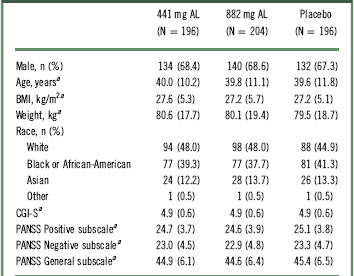
Of 848 patients screened for the study, 622 were randomized and 596 met the criteria for efficacy analysis of having received the study drug along with at least 1 follow-up efficacy assessment. For the 3 treatment groups included in the efficacy analysis, baseline demographic and clinical characteristics were comparable across treatment groups (Table 1). The mean CGI-S score at baseline was 4.9 (markedly ill). The discontinuation rate during the treatment period was 54.1% for placebo, 37.2% for AL 441 mg, and 35.1% for AL 882 mg. The most common reasons for discontinuation were withdrawal by patient (13.8%), lack of efficacy (10.3%), and adverse event (9.0%), with discontinuation for lack of efficacy (18.4%) and adverse events (17.4%) more common in the placebo group.
Baseline demographic and clinical characteristics (full analysis set population)

a Mean (standard deviation).
Abbreviations: BMI, body mass index; CGI-S, Clinical Global Impression–Severity; PANSS, Positive and Negative Syndrome Scale.
Efficacy
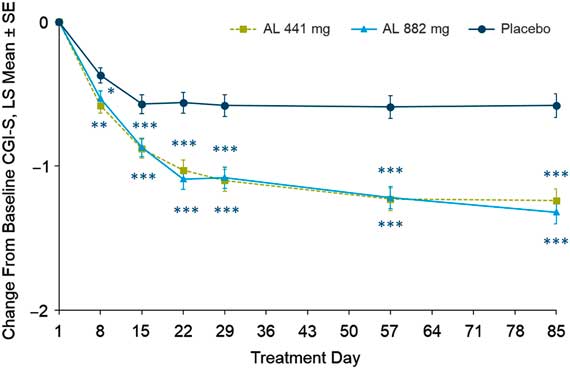
The mean change from baseline to Day 85 in CGI-S was significantly (p<0.001) greater with both doses of AL vs placebo (Figure 1). The decrease in mean severity score was numerically greater for the AL 882 mg dose compared to the AL 441 mg dose at Day 85. A significant treatment effect was observed with both doses of AL vs placebo beginning at Day 8 (p=0.002 and p=0.018 for AL 441 mg and AL 882 mg, respectively). The least squares (LS) mean change from baseline (standard error [SE]) at Day 85 was –1.24 (0.08) and –1.32 (0.08) for AL 441 mg and AL 882 mg, respectively (p<0.001 for both groups, with Cohen’s d values of 0.57 and 0.64), and –0.58 (0.08) for placebo.
Mean change from baseline by study visit for CGI-S scores (LOCF, FAS population). *p<0.002, **p<0.018, ***p<0.001. Abbreviations: AL, aripiprazole lauroxil; CGI-S, Clinical Global Impression–Severity; FAS, full analysis set; LOCF, last observation carried forward; LS, least squares; SE, standard error.

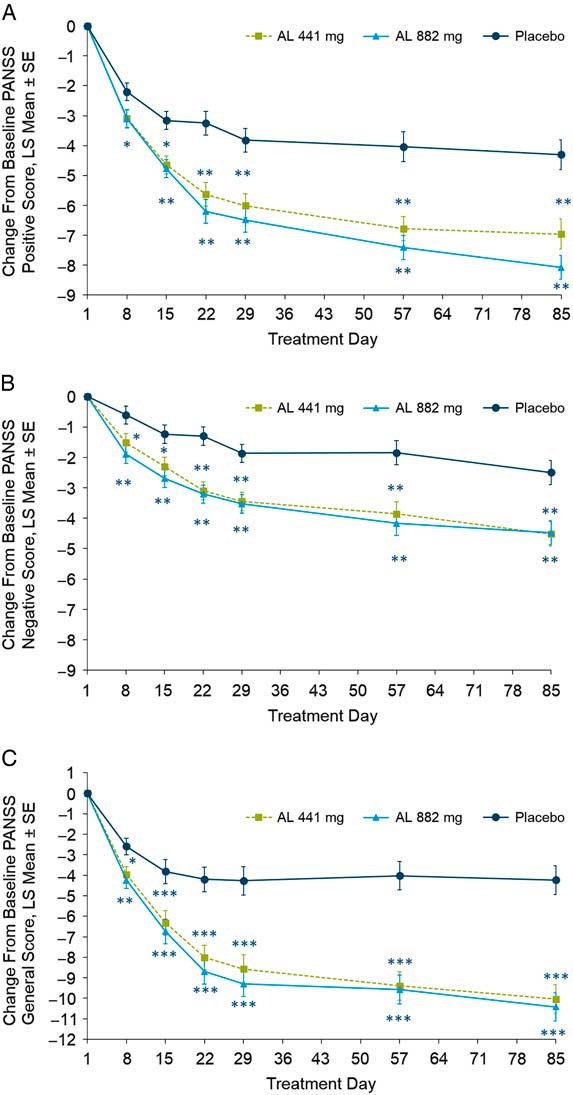
The mean change from baseline to Day 85 in all PANSS subscale scores was significantly (p<0.001) greater with both doses of AL vs placebo (Figure 2). The decrease in mean score at the different time points was generally numerically greater for each subscale with the AL 882 mg dose compared to the AL 441 mg dose. A significant (p<0.05) treatment effect was observed with both doses of AL beginning at Day 8 and at each subsequent time point assessed for all 3 PANSS subscales. For the PANSS Positive subscale, the LS mean difference between each AL dose and placebo was –3.23 and –3.72 for AL 441 mg and AL 882 mg at Day 85, respectively (p<0.001 for both groups, with Cohen’s d values of 0.51 and 0.59). For the PANSS Negative subscale, the LS mean difference was –2.23 and –2.35 for AL 441 mg and AL 882 mg at Day 85, respectively (p<0.001 for both groups, with Cohen’s d values of 0.42 and 0.45). For the PANSS General Psychopathology subscale, the LS mean difference was –5.82 and –6.19 for AL 441 mg and AL 882 mg at Day 85, respectively (p=0.001 for both groups, with Cohen’s d values of 0.59 and 0.63).
Mean change from baseline by study visit for PANSS subscale scores (LOCF, FAS population). (A) PANSS Positive score. *p<0.01; **p<0.001. (B) PANSS Negative score. *p<0.01; **p<0.001. (C) PANSS General score. *p=0.016; **p=0.004; ***p<0.001. All values are statistically significant for AL vs placebo (ANCOVA). Abbreviations: AL, aripiprazole lauroxil; ANCOVA, analysis of covariance; FAS, full analysis set; LOCF, last observation carried forward; LS, least squares; PANSS, Positive and Negative Syndrome Scale; SE standard error.

Similar results were observed for the PANSS Marder factors, although not all factors were significantly different from placebo at Day 8. Mean (SE) changes from baseline to Day 85 in all 5 PANSS Marder factor scores for AL 441 mg and AL 882 mg were each significantly improved vs placebo (p<0.001): negative symptoms (–4.3 [0.38], –4.4 [0.37], –2.2 [0.38] for AL 441 mg, AL 882 mg, and placebo, respectively), positive symptoms (–7.8 [0.48], –7.8 [0.47], –4.1 [0.48] for AL 441 mg, AL 882 mg, and placebo, respectively), disorganized thought (–4.3 [0.33], –4.6 [0.33], –1.7 [0.34] for AL 441 mg, AL 882 mg, and placebo, respectively), uncontrolled hostility/excitement (–1.8 [0.26], –2.0 [0.25], –0.2 [0.26] for AL 441 mg, AL 882 mg, and placebo, respectively), and anxiety/depression (–3.2 [0.25], –3.4 [0.24], –1.8 [0.25] for AL 441 mg, AL 882 mg, and placebo, respectively).
Response rates
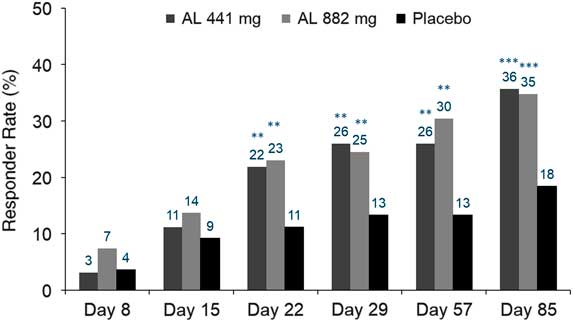
The PANSS response rate, as defined by a ≥ 30% improvement from baseline in PANSS Total score, was significantly (p<0.01) greater for both doses of AL compared to placebo beginning at Day 22 (Figure 3). At Day 85, the response rate for both doses of AL was up to 2-fold greater than that for placebo, with a number needed to treat (NNT) of 6 (95% confidence interval [CI]: 4–12) for AL 441 mg vs placebo and 7 (95% CI: 5–13) for AL 882 mg vs placebo.
PANSS response rate (LOCF, FAS population; ≥ 30% improvement in total score from baseline to Day 85). p values are for AL vs placebo (logistic regression). *p<0.05; **p<0.01; ***p<0.001. Abbreviations: AL, aripiprazole lauroxil; FAS, full analysis set; LOCF, last observation carried forward; PANSS, Positive and Negative Syndrome Scale.

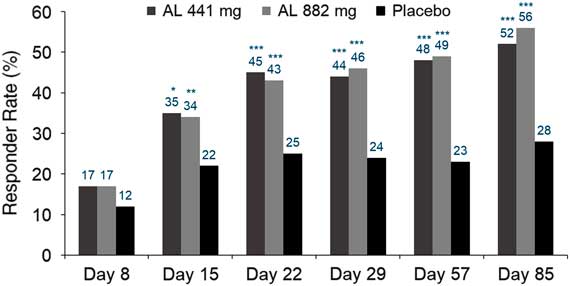
Overall response, as defined as a ≥30% decrease from baseline in PANSS Total score or a CGI-I score of 1 or 2, was significantly (p<0.05) greater for both doses of AL vs placebo from Day 15 onward (Figure 4). By Day 22 onward, the response rate for both doses of AL was up to 2-fold greater than that for placebo at each time point. At Day 85, the NNT was 5 (95% CI: 3–7) for AL 441 mg vs placebo and 4 (95% CI: 3–6) for AL 882 mg vs placebo.
Overall response rate (LOCF, FAS population; ≥ 30% improvement in PANSS total score or a CGI-I score of 1 or 2 at Day 85). p values are for AL vs placebo (logistic regression). *p<0.05; **p<0.01; ***p<0.001. Abbreviations: AL, aripiprazole lauroxil; CGI-I, Clinical Global Impression–Improvement; FAS, full analysis set; LOCF, last observation carried forward; PANSS, Positive and Negative Syndrome Scale.

Discussion
Results from these exploratory analyses of a Phase 3 study in patients experiencing an acute exacerbation of schizophrenia demonstrated improvement in several supportive efficacy outcomes across a broad range of symptoms and impairments. This improvement was clinically and statistically significant for both doses of AL using a variety of criteria. These analyses show significant improvement from baseline to Day 85 for all PANSS subscales, with an onset of effect by Day 8 for Positive, Negative, and General Psychopathology subscale scores, as well as significant improvement by Day 85 in CGI-S score for both doses of AL compared to placebo. In a post hoc analysis, the mean (SE) changes from baseline to Day 85 in all 5 PANSS Marder factor scores for AL 441 mg and AL 882 mg were each significantly improved vs placebo (p<0.001). In addition, the analysis of response rates using 2 different definitions of response further support efficacy of both doses of AL compared with placebo as early as Day 15, although patients receiving AL also received oral aripiprazole for 21 days after the initial injection.
The results reported in the present analysis are comparable to those from earlier acute studies of oral aripiprazole and aripiprazole monohydrate once-monthly.Reference Kane, Carson and Saha 11 – Reference Potkin, Saha and Kujawa 13 These exploratory analyses of supportive endpoints reported here may provide more intuitive clinical information than absolute point changes on clinical rating scales on the relative efficacy of AL vs. placebo. Using the definition of overall response of a ≥30% decrease from baseline for PANSS Total score or a CGI-I score of 1 or 2, responder rates at 12 weeks were 56% for AL 882 mg, 52% for AL 441 mg, and 28% for placebo, resulting in NNT values vs placebo of 4 (95% CI: 3–6) and 5 (95% CI: 3–7) for AL 882 mg and AL 441 mg, respectively; responder rates at 4 weeks were 46% for AL 882 mg, 44% for AL 441 mg, and 24% for placebo, resulting in NNT values vs placebo of 5 (95% CI: 4–8) and 5 (95% CI: 4–9) for AL 882 mg and AL 441 mg, respectively. As originally reported in the primary article,Reference Meltzer, Risinger and Nasrallah 9 early and durable improvement from baseline as determined by a score of 1 (very much improved) or 2 (much improved) in the CGI-I was more frequent in the aripiprazole lauroxil groups compared to placebo. Pooling data from the 4 positive, pivotal, short-term (4–6 week), acute schizophrenia trials in adults as enumerated in the oral aripiprazole product label, 14 and using the same definition of response, response rates were 38% for oral aripiprazole 10–30 mg/day vs 24% for placebo, resulting in an NNT of 8 (95% CI: 6–13).Reference Citrome 15 AL has a general effect on the broad symptoms of schizophrenia, and notably does not worsen negative symptoms —an issue sometimes brought up with the use of first- generation, long-acting, injectable antipsychotics and the presence of secondary negative symptoms attributable to drug-induced parkinsonian symptoms.
Results from this supportive analysis are also consistent with findings for other long-acting antipsychotics, including aripiprazole monohydrate.Reference Citrome 16 A 12-week study of aripiprazole once-monthly (AOM) reported mean reductions in PANSS Positive and Negative subscale scores of 5 and 2.5 points, respectively, and a decrease in mean CGI-S score of 0.8 points.Reference Kane, Peters-Strickland and Baker 12 Similar results were observed with AL for both PANSS Positive and Negative subscales and for CGI-S score. In addition, response rates at Week 12, as defined as a ≥30% improvement in PANSS Total score, were 35% for AL 882 mg, 36% for AL 441 mg, and 18% for placebo, resulting in NNT values vs placebo of 7 (95% CI: 5–13) and 6 (95% CI: 4–12) for AL 882 mg and AL 441 mg, respectively. For AOM, using the same definition of response, response rates at Week 12 were 35% for AOM 400 mg and 16% for placebo,Reference Kane, Peters-Strickland and Baker 12 resulting in an NNT of 6 (95% CI: 4–11). A meta-analysis of studies of other atypical antipsychotics reported an overall mean response rate for long-acting injectables of 47% vs 24% for placebo (NNT: 5) based on a ≥ 20% improvement in PANSS Total score.Reference Fusar-Poli, Kempton and Rosenheck 17 Thus, both doses of AL demonstrated efficacy using supportive measures that were comparable to other long-acting injectable antipsychotics.
Limitations of the present analysis include the brief duration of the acute trial (12 weeks). The study also used fixed doses and monthly schedule of AL injections, which limited the opportunity to examine the effects of dosage adjustment and extended dose intervals (eg, 882 mg every 6 weeks). Because a fixed dose of 15 mg/day was used for oral aripiprazole in the first 3 weeks of treatment, this did not allow for individualized initial oral dosing for efficacy and safety considerations. Longer-term studies are under way to evaluate clinical outcomes and assess safety and tolerability of AL for patients with schizophrenia.
Overall, the results of this exploratory analysis of supportive efficacy outcomes provide further evidence for the efficacy of AL at doses of 441 mg and 882 mg once monthly for treating patients experiencing an acute episode of schizophrenia. Significant reductions in CGI-S and PANSS subscale scores as early as Day 8, as well as similar results for the PANSS Marder factor scores, suggest that both doses of AL were able to sustain the early response through 12 weeks. These results provide support for the use of AL as an option when a long-acting injectable antipsychotic is needed. Results from additional studies will help to clarify the effects of AL on long-term outcomes.
Conclusions
Statistically significant and clinically meaningful improvements relative to placebo were observed for both doses of AL studied. Consistent efficacy was observed across different scales and domains of psychotic symptoms. The nominally greater improvements observed for AL 882 mg may suggest potential additional benefit in some patients, such as those experiencing more severe symptoms, but these preliminary findings should be further evaluated in a prospectively designed study.
Disclosures
Leslie Citrome reports nonfinancial support from Alkermes, Inc. during the conduct of the study; personal fees from Acadia, Alexza, Alkermes, Allergan, AstraZeneca, Avanir, Boehringer Ingelheim, Bristol-Myers Squibb, Eli Lilly, Forum, Genentech, Janssen, Jazz, Lundbeck, Merck, Medivation, Mylan, Neurocrine, Novartis, Noven, Otsuka, Pfizer, Reckitt Benckiser, Reviva, Shire, Sunovion, Takeda, Teva, Valeant, and Vanda outside the submitted work. Yangchun Du, and Bernard Silverman are employees and stockholders of Alkermes, Inc. Jacqueline Zummo and Robert Risinger were employees of Alkermes Inc. and owned stock in the company at the time the study was conducted and when the analyses were completed. Henry Nasrallah reports personal fees from Acadia, Alkermes, Allergan, Boehringer-Ingelheim, Janssen, Lundbeck, Neurocrine, Otsuka, Sunovion, Teva, and Vanda outside the submitted work. Andrew Cutler reports grants and personal fees from Acadia, Alkermes, Allergan, Lundbeck, Neurocrine, Otsuka, Sunovion, and Takeda; personal fees from AstraZeneca and Teva; and grants from IntraCellular Therapeutics outside the submitted work.