Introduction
The soil seed-bank is an important component of vegetation dynamics. Its presence affects both ecosystem resistance and resilience (Thompson, Reference Thompson1987; Davies and Waite, Reference Davies and Waite1998; Bakker and Berendse, Reference Bakker and Berendse1999; Funes et al., Reference Funes, Basconcelo, Diaz and Cabido2001). Seed-bank floristic composition is both a product of the species composition of the current vegetation and a record of the long-term substitution of species (Falińska, Reference Falińska1999). Furthermore, the seeds dispersed from nearby populations persist in the soil and may serve to predict successional tendencies (Major and Pyott, Reference Major and Pyott1966; Soons and Bullock, Reference Soons and Bullock2008). Seed-bank composition and density vary among seasons as well as years (Thompson and Grime, 1979; Ortega et al., Reference Ortega, Levassor and Peco1997; Gutiérrez and Meserve, Reference Gutiérrez and Meserve2003). Information about the types and dynamics of seed banks is needed to assess the role of seed banks in vegetation recolonization and in community restoration (Luzuriaga et al., Reference Luzuriaga, Escudero, Olano and Loidi2005).
Seeds disperse from the mature plants and are deposited on the soil, where they experience different fates (Chambers and MacMahon, Reference Chambers and MacMahon1994). The seeds deposited on the soil may germinate immediately, may be removed by water flow or wind, may die from biotic or abiotic causes, or may be buried and persist in the soil, to germinate in the future under suitable conditions. Based on seed longevity in the soil, soil seed-banks are divided into two types: transient and persistent (Thompson and Grime, Reference Thompson and Grime1979). Seed size and shape have been proposed as indicators for predicting seed persistence in the soil for British herbaceous plant species (Thompson et al., Reference Thompson, Band and Hodgson1993). In general, small, round and compact seeds are always buried easily in the soil and can persist for a long time (Thompson, Reference Thompson1987; Thompson et al., Reference Thompson, Band and Hodgson1993; Bekker et al., Reference Bekker, Bakker, Grandin, Kalamees, Milberg, Poschlod, Thompson and Willems1998; Funes et al., Reference Funes, Basconcelo, Díaz and Cabido1999; Zhao et al., Reference Zhao, Wu and Cheng2011). In addition, gradients of habitat disturbance accompanied by parallel shifts in population composition influence the longevity of seeds in the soil. The species having persistent diaspores are more common in frequently disturbed habitats and are annuals or biennials (Thompson et al., Reference Thompson, Band and Hodgson1993; Bakker et al., Reference Bakker, Poschlod, Strykstra, Bekker and Thompson1996; Ortega et al., Reference Ortega, Levassor and Peco1997; Kleyer, Reference Kleyer1999).
The reappearance of plant species may depend on their persistence in the soil seed-bank as a ‘memory’ of the original plant community (Bakker et al., Reference Bakker, Poschlod, Strykstra, Bekker and Thompson1996). In today's increasingly fragmented environments, knowledge of seed reservoirs in the soils of natural communities should provide useful tools for conservation and restoration efforts (Bekker et al., Reference Bekker, Bakker, Grandin, Kalamees, Milberg, Poschlod, Thompson and Willems1998; Bakker and Berendse, Reference Bakker and Berendse1999). The semi-arid, hilly-gullied Loess Plateau region in north-western China has suffered serious soil erosion for a long time (Zhang et al., Reference Zhang, Shao, Li and Peng2004b; Wei et al., Reference Wei, Zhou, Tian, He and Tang2006). The increase in Chinese population after the 1950s had particularly severe consequences for the region. More natural vegetation was destroyed, and part of the slope grassland was turned into farmland. These changes aggravated soil erosion and ecological degradation (Zhang et al., Reference Zhang, Fu, Chen, Zhao, Yang, Liu and Gulinck2004a; Zheng, Reference Zheng2006; Zhou et al., Reference Zhou, Shangguan and Zhao2006). In the late 1990s, the Chinese Central Government implemented the policy of ‘Replacing Farmland with Forest or Grass’ for the control of soil erosion and large-scale ecological–environmental restoration. However, these afforestation efforts have not been entirely satisfactory. Owing to water shortages, many of the trees that were planted died or did not grow well (Zhang, Reference Zhang2005; Cao et al., Reference Cao, Chen and Yu2009). As a result, many slopes are still suffering intensive erosion and support only sparse vegetation. Natural re-vegetation is an alternative (Kirmer and Mahn, Reference Kirmer and Mahn2001). Soil seed-banks could potentially be used to accelerate the development of native vegetation and, thus, prevent soil erosion (Uhl et al., Reference Uhl, Clark, Clark and Murphy1981; Tekle and Bekele, Reference Tekle and Bekele2000; Tischew and Kirmer, Reference Tischew and Kirmer2007).
Harsh environmental conditions are expected to favour persistent seed-banks (Bakker et al., Reference Bakker, Poschlod, Strykstra, Bekker and Thompson1996; Thompson et al., Reference Thompson, Bakker, Bekker and Hodgson1998; Thompson, Reference Thompson and Fenner2000). In the study region, eroded slopes with sparse vegetation are exposed to intense solar radiation at the soil surface. This exposure produces extreme fluctuations in soil temperature and a rapid drying of surface soils (Chen, Reference Chen2003). Additionally, the precipitation is heterogeneous in time, such that drought conditions persist in the topsoil. The main factor limiting plant colonization in badland areas is that soil water is available only over very short time spans (García-Fayos et al., Reference García-Fayos, García-Ventoso and Cerdà2000; Cipriotti et al., Reference Cipriotti, Flombaum, Sala and Aguiar2008). For this reason, a persistent soil seed-bank is very important to support vegetation recruitment during periods when soil water is available. The aim of this study was to identify the species that can form persistent soil seed-banks in the eroded habitat and to investigate the relationship of seed-bank persistence to the seed size/shape and life history of individual species. To achieve this aim, an integrated measure of the depth distribution of the soil seed-bank and the seasonal dynamics of seed banks were used to analyse the persistence of the soil seed-bank.
Materials and methods
Study site
Zhifanggou watershed is located in An'sai county, in the Loess Plateau region (109°19′30″E, 36°51′30″N) at 1010–1431 m above sea level. The watershed has a semi-arid climate with an average annual precipitation of 504 mm (1970–2006). Over 60% of the precipitation falls during the rainy season (July–September), usually in the form of storms. The annual evaporation is over 1460 mm, and the mean temperature is approximately 8.8°C ( − 11°C to 30°C). Within the study region, the landscape includes inter-gully slopes and gully slopes, and the land surface is fragmented by deeply incised and densely distributed gullies (gully density 8.06 km km− 2). Loessial soil is the main soil type in this region. It has a homogeneous texture, is poor in organic components and is susceptible to erosion. Although this area is located in the forest–steppe region, natural forest is almost absent and has been replaced by typical steppe as a result of long-term human activity. The main native species in the different successional stages and landscapes include Artemisia scoparia, Artemisia gmelinii, Artemisia giraldii, Lespedeza davurica, Stipa bungeana and Bothriochloa ischaemun and a few native shrubs such as Rosa xanthina, Sophora viciifolia, Syringa julianae and Ostryopsis davidiana.
Soil samples
The soil samples prepared for the germination experiments were collected in two different habitats. Twenty-one plots, each 5 m × 5 m, were located on abandoned slopes in a relatively early successional stage (habitat 1) with vegetation coverage ranging from 10 to 40%. In this habitat, the dominant herbaceous species were the pioneer species A. scoparia and the succession species Heteropappus altaicus, S. bungeana, L. davurica, A. gmelinii and B. ischaemun. Twelve 5 m × 5 m plots were located on gully slopes without farm activity and with better native vegetation (habitat 2), where vegetation coverage ranged from 40 to 70%. The dominant species in this habitat were the perennial herbs A. gmelinii and A. giraldii and the shrubs Sophora davidii and Periploca sepium. At each plot, 20 soil cores (diameter 4.8 cm) were collected in the 0–2-cm, 2–5-cm and 5–10-cm soil layers. The soil samples were collected in April, July and October in 2008 and in 2009. In the study region, Artemisia species constitute a large proportion of the standing vegetation. Seeds of these species and of some grasses are always released during the late autumn and winter. The soil samples collected in April, before the seeds germinated, included the fresh seeds of these species. Moreover, the precipitation in the study region generally occurs from July through September, and seedling emergence is always related to the timing of the precipitation in arid and semi-arid regions (Schwinning and Sala, Reference Schwinning and Sala2004). Most of the seeds found in the soil samples collected in July are therefore like those found in the April samples. In addition, the July samples contain fresh seeds released during the spring and summer. The soil collected in October, after the period of seedling emergence, include the constituents of the main persistent seed-banks and some fresh seeds released during the autumn.
Germination experiments
The soil seed-bank was identified using the germination method. TerHeerdt et al. (Reference TerHeerdt, Verweij and Bekker1996) reported that concentrating soil samples by washing and sieving improved the germination of most species. Concentrating soil samples can also save emergence time and space. Accordingly, the air-dried soil samples were sieved using a pore size of 0.15 mm. The size of the sieve was determined by passing the soil through a size-graded series of sieves, from large to small, and then germinating the soil passed through each sieve. The smallest sieve that passed soil without seedling emergence was chosen for use. The germination experiment was conducted in a greenhouse with controlled illumination, temperature and moisture. The concentrated soil samples were distributed over a 2-cm-deep perlite layer in 24 × 15 × 5-cm plastic trays and the soil-sample layer was kept to 0.5 cm of this set-up. Simultaneously, six trays with a perlite layer were put in different positions in the greenhouse as a control to monitor any seeds dispersed through the air. During the experiments, the germination trays were watered regularly. The temperature in the greenhouse varied from 11 to 35°C, with a mean value of 25°C. The seedlings were identified and removed or replanted for later identification. If no seedlings emerged within 2 weeks after the peak of seedling emergence, the soil was then dried and thoroughly stirred for the second germination period, and a gibberellin solution (1 g l− 1) was applied to break the dormancy of the seeds. The germination experiment was terminated when there was no seedling emergence for 4 weeks, and the germination continued for approximately 4 months (15 March to 15 July in 2009 and 2010, respectively). Although sieved soil samples can improve the germination of most species, the germination method determines only the ‘readily germinable’ component of the soil seed-bank and thus may not detect all of the species present in the seed banks (TerHeerdt et al., Reference TerHeerdt, Verweij and Bekker1996; Thompson, Reference Thompson and Fenner2000). In the wild, these ‘readily germinable’ seeds are most likely to determine the recruitment of vegetation after a disturbance (Davies and Waite, Reference Davies and Waite1998). No attempt was made to assess the number of non-germinated seeds remaining in the samples.
Standing vegetation investigation and seed collection
The standing vegetation was investigated in July of each study year. Three 1 m × 1 m quadrats were surveyed in each sampling plot. The species composition was studied by recording the species that grew in the quadrat or that had shoots present in the quadrat. The density of a given species was calculated as the number of that species per square metre. The coverage of the vegetation was recorded by measuring the ratio of the area shaded by a given species to the total area of the quadrat. Two expert researchers performed this measurement jointly. The mature seeds were collected in the experimental watershed. After being air dried, the collected seeds were weighed and their shapes were observed.
Seed longevity index
Thompson et al. (Reference Thompson, Band and Hodgson1993) classified the seeds in the soil into three classes: transient, persisting in the soil for less than 1 year; short-term persistent, persisting for more than 1 but less than 5 years; and long-term persistent, persisting for at least 5 years. It is difficult to distinguish between short-term persistent and long-term persistent categories. We, therefore, distinguished only between ‘transient’ and ‘persistent’ (including both short-term persistent and long-term persistent). The persistence of seeds was estimated using an integrated measure of the depth distribution of seeds [viable seeds deep in the soil are older than those nearer the surface (Bekker et al. (Reference Bekker, Bakker, Grandin, Kalamees, Milberg, Poschlod, Thompson and Willems1998)], the dynamics of soil seed-banks in different seasons and the vegetation composition. The species that had small seed-banks or that were rarely found in the soil samples were excluded. The species with significant seed-banks but little or no standing vegetation were classified as having persistent seeds. The species having relatively high-standing vegetation cover but no seeds or few seeds in the soil were considered to have transient seeds. The longevity index was calculated using the following formula:

where P represent the total number of persistent records and T the total number of transient records. The longevity index ranges from 0 (strictly transient) to 1 (strictly persistent) (Bekker et al., Reference Bekker, Bakker, Grandin, Kalamees, Milberg, Poschlod, Thompson and Willems1998). Species that were rare in the seed bank and in the standing vegetation were not classified.
Seed attributes
The seed dimensions and mass were used as seed attributes and measured after the seeds were air dried. Seed mass was defined as the average of 100 seeds per species unless the seeds were large (>100 mg). The average of ten seeds was used to determine seed mass for these larger seeds. Simultaneously, seed length, width and height were measured (to micrometer precision using Vernier calipers) on 10 seeds/species. Seed dimension variance was then calculated following the methods of Thompson et al. (Reference Thompson, Band and Hodgson1993). The variance of seed length, width and height were calculated after first transforming all values so that length is unity. The seed dimension variance of a perfectly spherical seed would be zero, the minimum value possible. Needle-shaped and disc-shaped seeds would have larger values.
Importance value index (I v) of standing vegetation
To compare individual species between standing vegetation and the soil seed-bank, and to contrast the vegetation structure in the different habitats, the importance value index (I v) of the individual species in standing vegetation was calculated as follows:

where D r is the relative density index (density of a particular species/the summed density of all species), P r is the relative coverage index (coverage of a particular species/the summed coverage of all species), and F r is the relative frequency index (frequency of a particular species/the summed frequency of all species).
Statistical analysis
The dynamics of the soil seed-bank density and species richness over the different sampling times within years were analysed using ANOVA. The data were obtained by averaging of 2 years, and seed density was transformed using log (x+1) to satisfy the homogeneity of variance assumption. The dominant species in the soil seed-bank and the standing vegetation were species with a relatively high density and frequency in the seed bank and a relatively large importance value index in the vegetation. The dynamics of the soil seed-bank density [transformed to log (x+1)] of individual dominant species were also analysed using ANOVA. The Pearson correlation of seed longevity with seed attributes and vegetation life history attributes was analysed. The life history attributes considered were vegetation longevity (annuals/biennials or perennials) and propagation traits (with or without vegetative propagation). In this analysis, annuals/biennials were indicated by the value 0, and perennials were indicated by 1; species without vegetative propagation were indicated by 0, and species with vegetative propagation were indicated by 1.
Results
Soil seed-bank dynamics
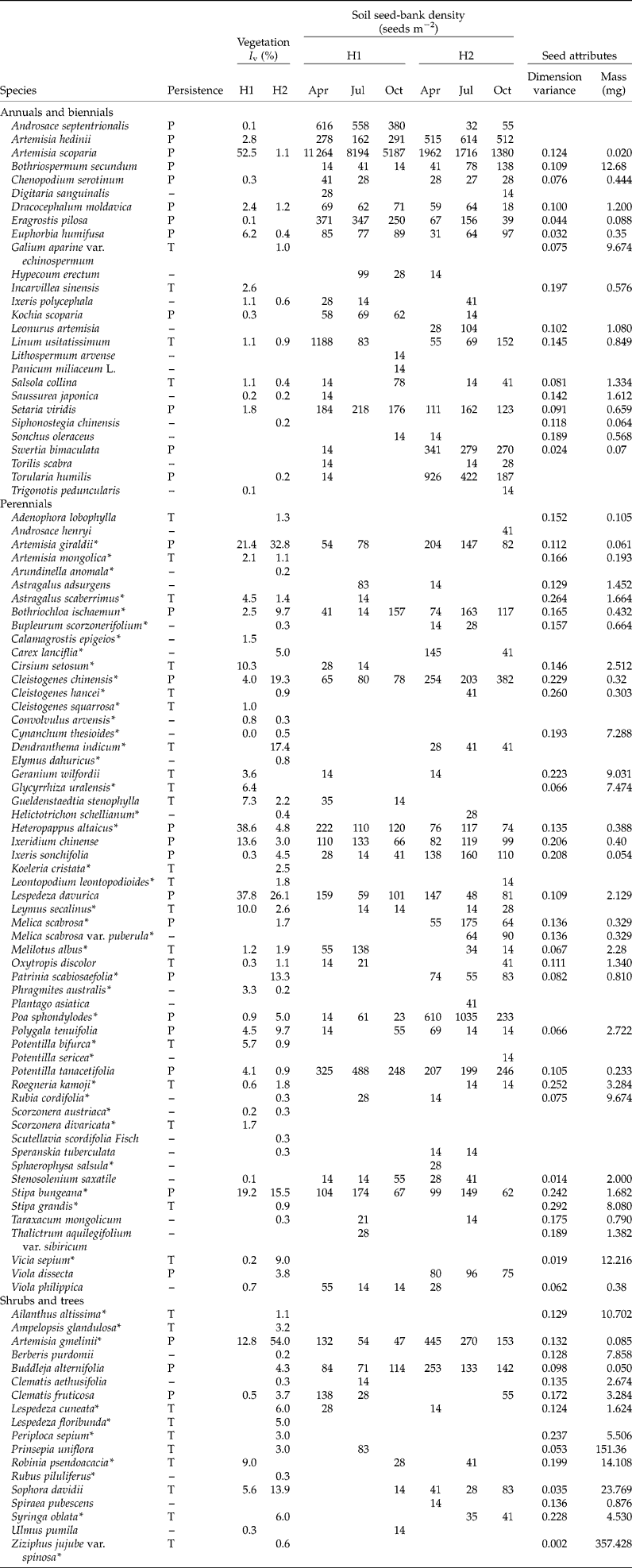
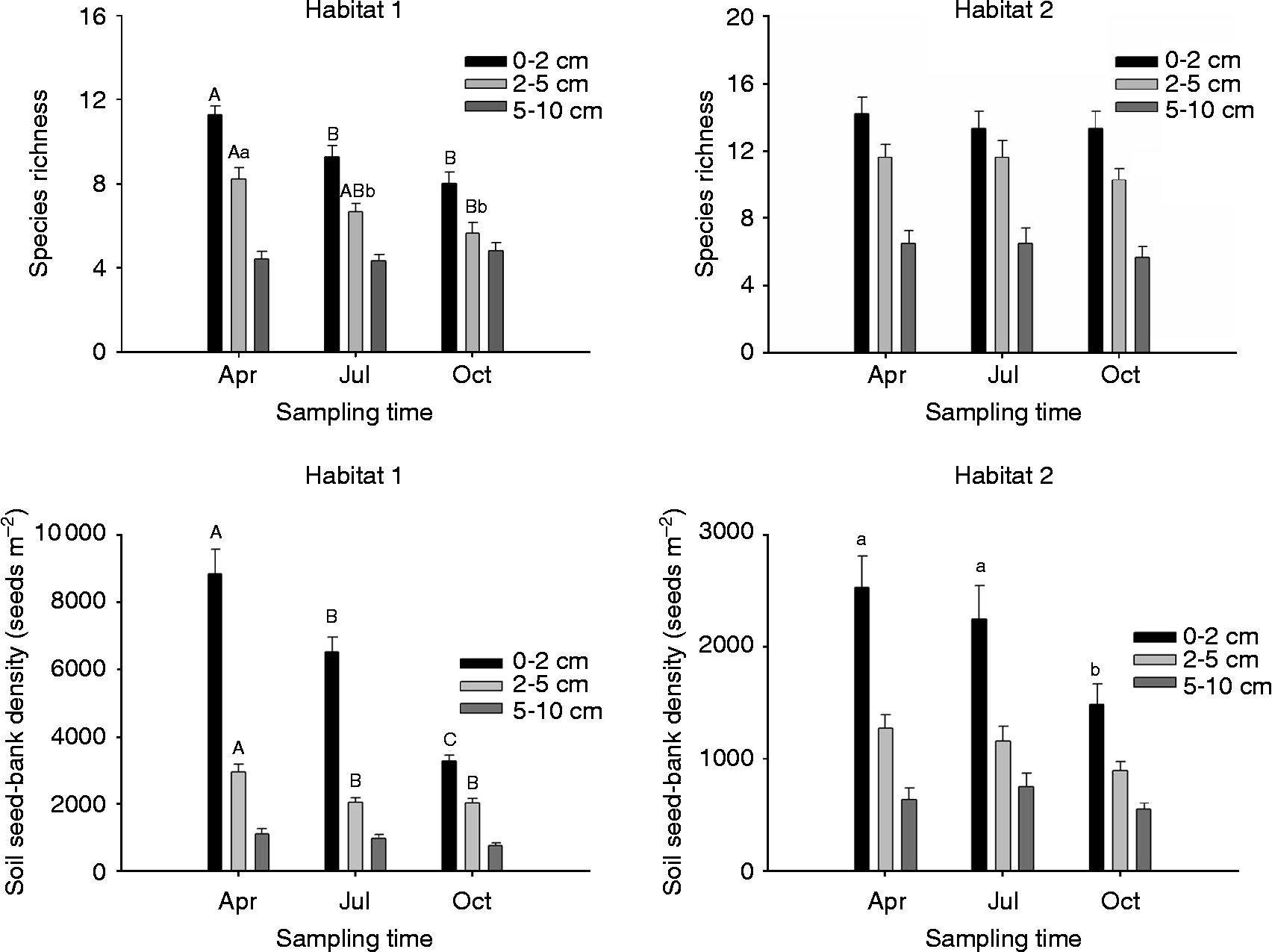
The seedlings emerging in the germination experiment belonged to 76 species (Table 1). Both species richness and seed-bank density varied across the sampling times (Fig. 1). Most of the seeds (more than 50%) were found in the 0–2-cm soil layer. This layer, the most active portion of the soil seed-bank, showed significant seasonal variation. The largest seed-banks were present in April, after the dispersal of many species' seeds during winter and before seedling germination. After the germination that occurred during the rainy season (July to September), the smallest seed-banks were found in the October samples.
The traits of seeds, the soil seed-bank and the standing vegetation of all the observed species in the study plots (P, persistent seed-bank; T, transient seed-bank; ‘–’, species was not defined due to it is rarity in the soil seed-bank and standing vegetation; ‘*’, species capable of vegetative propagation)

The dynamics of seed-bank species richness and density across different sampling times in the soil profile in different habitats (the letter above the error bar indicates the level of difference across different sampling times at the same soil layer, capital letters indicate a significant difference at the 0.001 level and lowercase letters indicate a significant difference at the 0.05 level).

The density of individual species also exhibited varying patterns within the year (Table 1). The dynamics of the soil seed-bank density of individual dominant species were analysed (16 species: A. scoparia, Artemisia hedinii, Setaria viridis, Dracocephalum moldavica, Eragrostis pilosa, L. davurica, H. altaicus, S. bungeana, Ixeridium chinense, Ixeris sonchifolia, Potentilla tanacetifolia, A. gmelinii, Poa sphondylodes, Cleistogenes chinensis, A. giraldii, B. ischaemun). On the abandoned slope (habitat 1), A. scoparia was the most common species found in the seed bank and exhibited significant changes across different seasons, especially in the 0–2-cm soil layer (P < 0.001). However, on the slope with better native vegetation cover (habitat 2) the density of A. scoparia was lower and did not change significantly across different seasons. The seed-bank density of other species was relatively small. Only L. davurica and A. gmelinii in habitat 1 and A. gmelinii and P. sphondylodes in habitat 2 had significant seasonal changes (P < 0.05) in the 0–2-cm soil layer.
Relationships between seed persistence and seed attributes/vegetation species attributes
A total of 102 species were found in the study area. Of these species, 76 were recorded in seed banks, 85 in standing vegetation, and 60 in both seed banks and vegetation. At least 29 species had persistent seed-banks, and 34 species had transient seed-banks. The status of the other species was not clear because little standing vegetation or few seeds were present in the study plots (Table 1).
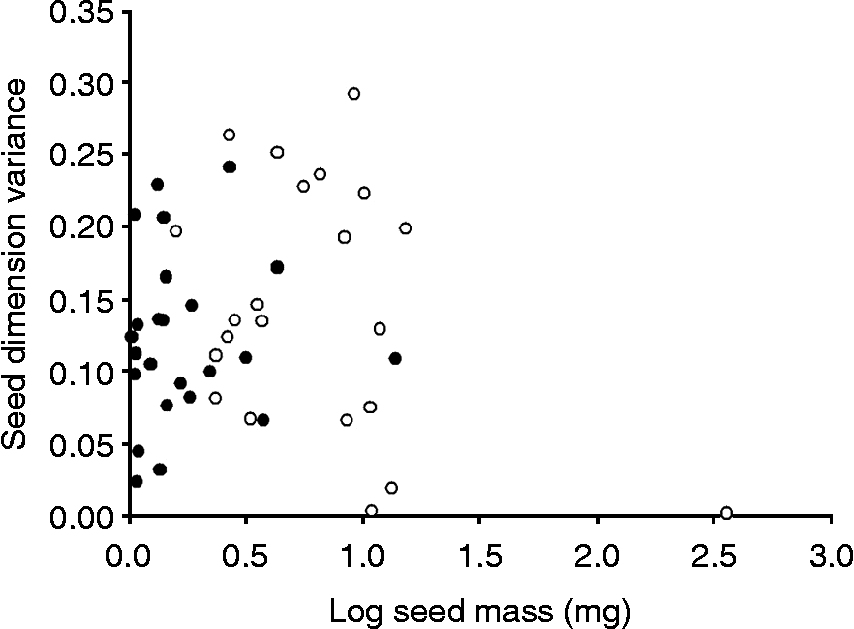
The mean seed mass ranged from 0.020 to 357.43 mg, the mean seed dimensions ranged from 0.193 to 19.9 mm, and the seed dimension variance ranged from 0.002 to 0.292 (Table 1). The relationship of seed persistence and seed attributes is shown in Fig. 2. The persistent seeds were mainly small and had a mass of less than 1 mg. Seed longevity and seed mass showed a significant negative correlation (R = − 0.334, P = 0.005), but no significant correlation was found between seed longevity and seed dimension variance (R = − 0.116, P = 0.453). There was a significant negative correlation between seed longevity and vegetation longevity (R = − 0.406, P = 0.006) and between seed longevity and vegetative propagation (R = − 0.400, P = 0.007). These results indicated that the perennials and the species capable of vegetative propagation produced more transient seed banks.
The relationship of seed persistence and seed mass (transformed to log (x+1)) and shape (solid circles indicate the persistent seeds and the open circles indicate the transient seeds).

Discussion
The species composition and density of the soil seed-bank varied between seasons. However, in both habitats the dominant species occurred at every sampling time at a frequency>30% and a relatively high density. These results indicated that the seed bank maintained a steady species composition with a fluctuation in density. Similar conclusions have emerged from a study of a gypsum system in central Spain with a semi-arid mesomediterranean climate and vegetation composed of shrubs and tussocks (Caballero et al., Reference Caballero, Olano, Luzuriaga and Escudero2005). In the present study, on the abandoned slope, the pioneer species A. scoparia persisted in the entire soil profile at all sampling times. The mean seed density ranged from 5187 to 11,264 seeds m− 2. The other species did not have as high a density, but they were also present at high frequencies in time and space. These species included L. davurica, H. altaicus, A. gmelinii, Buddleja alternifolia, A. hedinii, I. chinense, E. pilosa, S. viridis, D. moldavica, P. tanacetifolia, Androsace septentrionalis and Euphorbia humifusa. In habitat 2 with remnant native vegetation, the observed changes in the species composition and density of the seed bank included some contrasts with habitat 1. The density of A. scoparia decreased significantly. Likewise, other annuals also decreased in density and frequency. However, in contrast, perennials such as P. sphondylodes, S. bungeana, C. chinensis, A. giraldii, I. sonchifolia and B. ischaemun increased in density and frequency, both in time and in space. An investigation involving 174 sites by Jiao et al. (Reference Jiao, Zhang, Jia, Wang and Bai2008) found that in the hilly-gullied Loess Plateau region, the dominant species in the successional process were L. davurica, H. altaicus, S. bungeana, A. scoparia, A. gmelinii and B. ischaemun, and these species were dominant both in frequency and in coverage. These results suggested that the dominant species at different successional stages can form a persistent soil seed-bank.
The seed-bank density of individual species fluctuated owing to seed dispersal by different species at different times of the year. Thompson and Grime (Reference Thompson and Grime1979) investigated seed-bank dynamics and classified seed banks into four types. In the area examined by the present study, the greatest numbers of species germinated during the rainy season (July to September) in the field. The seeds of the dominant species always persisted in the soil over the three sampling times within the year. This pattern matched the description of type III of the Thompson and Grime (Reference Thompson and Grime1979) classification: species mainly germinating in the autumn but maintaining a small persistent seed-bank. Furthermore, the pioneer species A. scoparia had a large seed-bank during the year in the abandoned slope land and persisted in the remnant habitat without producing standing vegetation. This species resembled type IV of the classification: annual and perennial herbs with large persistent seed-banks.
Seed mass and shape have been reported to be the main factors influencing the persistence of seeds in the soil (Thompson et al., Reference Thompson, Band and Hodgson1993; Bekker et al., Reference Bekker, Bakker, Grandin, Kalamees, Milberg, Poschlod, Thompson and Willems1998; Cerabolini et al., Reference Cerabolini, Ceriani, Caccianiga, Andreis and Raimondi2003; Peco et al., Reference Peco, Traba, Levassor, Sánchez and Azcárate2003; Yu et al., Reference Yu, Sternberg, Kutiel and Chen2007). During the past decades, several studies conducted in different parts of the world have addressed this question and have contributed to the debate regarding this problem. The results of these studies fall into several general categories. Some studies have suggested that the persistence of seeds has a significant relationship with seed mass and seed shape, and that small and compact seeds are frequently persistent in the soil (Bekker et al., Reference Bekker, Bakker, Grandin, Kalamees, Milberg, Poschlod, Thompson and Willems1998; Funes et al., Reference Funes, Basconcelo, Díaz and Cabido1999; Cerabolini et al., Reference Cerabolini, Ceriani, Caccianiga, Andreis and Raimondi2003; Zhao et al., Reference Zhao, Wu and Cheng2011). Another view holds that only seed mass is significant for the persistence of seeds, and that species with persistent seeds have smaller seeds than species with transient seeds (Moles et al., Reference Moles, Hodson and Webb2000; Thompson et al., Reference Thompson, Jalili, Hodgson, Hamzeh'ee, Asri, Shaw, Shirvany, Yazdani, Khoshnevis, Zarrinkamar, Ghahramani and Safavi2001; Peco et al., Reference Peco, Traba, Levassor, Sánchez and Azcárate2003). It has also been claimed that larger seeds persist in the soil (Leishman and Westoby, Reference Leishman and Westoby1998; Yu et al., Reference Yu, Sternberg, Kutiel and Chen2007). Additionally, in arid parts of the world like Australia, most persistent seeds are of the hard-seeded type, and there is no relationship between seed size and persistence (Leishman and Westoby, Reference Leishman and Westoby1998). Generally, seed mortality decreases with increasing seed-coat thickness (Gardarin et al., Reference Gardarin, Duerr, Mannino, Busset and Colbach2010). In the present study, the persistent seeds were always smaller than the transient seeds. However, some species with elongated or flattened seeds also persisted in the soil. This result resembles previous findings for the New Zealand flora (Moles et al., Reference Moles, Hodson and Webb2000) and for dry Mediterranean grass and scrublands in Spain (Peco et al., Reference Peco, Traba, Levassor, Sánchez and Azcárate2003). These persistent seeds with elongated or flattened shapes are especially capable of being buried in the soil. For instance, the seeds of S. bungeana can bury themselves in the presence of moisture or water.
Seed persistence is also influenced by the adult longevity and the habitat. Thompson et al. (Reference Thompson, Bakker, Bekker and Hodgson1998) have studied the flora of north-western Europe and have found that shorter life histories are correlated with increased seed persistence. Especially in disturbed habitats, the vegetation is dominated by monocarpic species and produces abundant persistent seeds of small size. In the present study, annuals and biennials also had more persistent seeds than the perennials, and the species having the capability to propagate vegetatively always had more transient seeds.
In the region of this study, soil erosion is frequent and intensive in the sloping terrain. Because of the low canopy, intense radiation at the soil surface results in extreme fluctuations in soil temperature and a rapid drying of surface soils (Chen, Reference Chen2003). The very short span of time during which water is available in the soil becomes the main factor limiting plant colonization in badland areas (García-Fayos et al., Reference García-Fayos, García-Ventoso and Cerdà2000; Cipriotti et al., Reference Cipriotti, Flombaum, Sala and Aguiar2008). Moreover, seed germination and emergence and seedling establishment are susceptible to environmental conditions (Harper, Reference Harper1977; Fenner, Reference Fenner2000). The persistent seed-banks can offset the mortality associated with these stages of the life history (Ortega et al., Reference Ortega, Levassor and Peco1997; Stöcklin and Fischer, Reference Stöcklin and Fischer1999; Thompson, Reference Thompson and Fenner2000; Funes et al., Reference Funes, Basconcelo, Diaz and Cabido2001). In the study region, the pioneer species A. scoparia can produce a very large persistent seed-bank and can thus provide germinable seeds when the environment is suitable for germination. During succession, the main perennial species can also form persistent seed-banks. These species, including L. davurica, H. altaicus, S. bungeana. A. gmelinii, C. chinensis, A. giraldii and B. ischaemun, can replace the pioneer species and gradually come to dominate the community (Du et al., Reference Du, Shao, Shan, Liang and Shao2007; Jiao et al., Reference Jiao, Tzanopoulos, Xofis, Bai, Ma and Mitchley2007, Reference Jiao, Zhang, Jia, Wang and Bai2008). Furthermore, the number of germinable seeds in the soil shows a seasonal pattern, with a maximum in spring and a minimum in autumn. The seeds accumulate in the soil after the autumn production peak and germinate during the rainy season. This dynamic pattern depends on the occurrence of favourable weather for germination and on the time that seeds can remain viable in the soil (Ortega et al., Reference Ortega, Levassor and Peco1997). These results suggest that the persistent soil seed-bank can play a role in the vegetation recolonization of eroded habitats.
Acknowledgements
We thank the Key NSFC projects (41030532), the Knowledge Innovation Program of the Chinese Academy of Sciences (KZCX2-EW-406), and the innovation project of Northwest A & F University (CX200906) for funding this research. We acknowledge the assistance of the Ansai Ecological Experimental Station for Soil and Water Conservation (CAS). We acknowledge the assistance of the State Key Laboratory of Soil Erosion and Dryland Farming on the Loess Plateau. Appreciation is due to Dr Ken Thompson for his valuable suggestions and comments.