When Victorian Literature and Culture (VLC) featured “Victorian cosmopolitanisms” as the focus of an editor's selection in 2010, ecocriticism was not represented among the approaches to the topic. As guest editors Tanya Agathocleous and Jason R. Rudy emphasized, the opening position papers—as well as the broader cluster—“illuminate how cosmopolitanism acts as a touchstone for issues recently at the heart of Victorian studies: the intersection of ethics and liberalism; nationalism and gender; imperialism and capitalism.”Footnote 1 The absence of ecocriticism in that collection and at that time is not surprising, for a number of complex reasons. One reason was surely the dearth of ecocriticism as a significant area within Victorian studies. As late as 2015, also in the pages of VLC, Jesse Oak Taylor announced bluntly, “The most striking thing about . . . the field of Victorian ecocriticism is that there is so little of it.”Footnote 2 Another reason perhaps lay in the emphasis—especially in the American academy and the environmental movement—on regionalism and an affective, localized sense of place as the motivating focus of both literary ecocriticism and the broader environmental movement. As Ursula Heise put it just two years before the VLC cosmopolitan issue, this “ethic of proximity” often leads environmentalists, activists, and scholars alike either to “reject globalism outright” or to “perceive it as a seamless extension of the local.”Footnote 3 Construed in this way, ecocriticism would seemingly have little to contribute to discussions of cosmopolitanism, Victorian or otherwise.
Both conditions—the paucity of ecocriticism in Victorian studies and its abiding localism—are changing rapidly. In the ten years since Heise's Sense of Place and Sense of Planet appeared, long-standing preferences for the local have begun to shift significantly toward a more globalized ecocriticism. Spurred in part by influential studies such as Jason Moore's Capitalism in the Web of Life: Ecology and the Accumulation of Capital, an emerging and sophisticated body of work in Victorian studies has taken into account not only the global reach and undeniably ecological effects of imperialist and capitalist systems but also the nineteenth-century planetary advancement of the Anthropogenic era.Footnote 4 This new work, however, has not yet explicitly returned to the question of cosmopolitanism, a challenge this essay takes up. My goal is not primarily to close the gap in the previous VLC cosmopolitan issue nor simply to return to the idea itself to broaden the surge it experienced in the 1990s and early 2000s. I have been prompted instead by the Victorians’ own understanding of the nonhuman world as “cosmopolitan,” specifically the botanical world. Already in the 1850s and 1860s, botanists were speaking of global plant distributions as “cosmopolitan” and understanding plants as diasporic entities that traversed national boundaries. At the same time, the idea of botanical “invasion” was beginning to emerge. Both terms have endured in ecology and plant studies: “cosmopolitan” is often used today in opposition to the discipline of “invasion biology,” the study of both plants and animals that have traveled far from their “native” territories and thus (presumably) threaten global biodiversity. The loose parallels of these ideas and ideologies with scholarship on human diasporas are probably immediately discernible to anyone reading this journal. The implications, however, are more complex and further reaching than these most conspicuous parallels suggest.
If we include nonhuman life in our considerations of the “cosmopolitan,” how does it gain new significance in Victorian studies? These questions suggest processes of displacement: displacing settled ways of thinking with new ways of framing older terms or questions.—Lynn Voskuil
Turning an ecological lens on cosmopolitanism has important ramifications not only for our historical knowledge of Victorian Britain but also for our theoretical command of the methods we use to study it. “Cosmopolitanism” has become a concept that we draw on frequently, implicitly as well as explicitly, to denote various versions of cultural belonging and global citizenship. “Whatever the ultimate value of the term cosmopolitan, pluralized to account for a range of uneven affiliations,” James Clifford observes, “it points . . . toward alternative notions of ‘cultural’ identity.”Footnote 5 As Clifford's words attest, the emphasis here is on culture, with attention to how humans perceive and fashion their cultural subjectivities and collectivities—an emphasis that has characterized virtually all scholarship on cosmopolitanism in recent decades in the humanities and social sciences. Thinking horticulturally rather than merely culturally complicates this emphasis on humans. The Latin word for garden, hortus, describes a cultivated mix of plants, often from different regions of the world—signifying an idea, in other words, that demands attention if we are to widen our disciplinary focus on cosmopolitanism.
It's no coincidence that in taking these two terms—“transatlantic” and “cosmopolitan”—we draw on their roots in geographic width as a means of turning inward, asking for a reckoning that does not take place in a spatial or geographic elsewhere but right here, in the heart, not even of Victorian studies, but subgroups of Victorian studies.—Jessie Reeder
In this essay I thus incorporate plants, in a manifest reach toward the nonhuman, and I consider their (often assertively) diasporic habits. My point, however, is not to argue for a broader form of inclusiveness, as if plants and humans should be accorded the same ethical status. Instead, this essay explores the intellectual repercussions of introducing so-called natural entities into our discussions of cosmopolitanism and argues that, without plants and other nonhumans, the theoretical paradigms we use to study Victorian literature and culture—including “empire,” “subjectivity,” and “capitalism” as well as “cosmopolitanism”—will become untenably narrow. The concept of “width” is thus not only geographically far-reaching but also methodologically consequential and forward-looking, with the potential to instigate revision of our ideas of culture as well as nature. As I argue here, the activities and representations of nonhuman nature—especially, in this case, the global movements of plants—are fundamental to the (re)definition of our field.
Cosmopolitan Plants
As recent scholarship has demonstrated, the social, cultural, and political history of nineteenth-century cosmopolitanism is shifting and complex. Affiliated with individual figures, with political ideologies, or with social movements and events, the idea of cosmopolitanism and the term “cosmopolitan” were capaciously flexible and could serve a variety of ends in disparate contexts. The newly solidifying nineteenth-century medical profession, for instance, prided itself on the cosmopolitan connections that linked men of science and medicine the world over. At the same time, they described newly global diseases as fearsome cosmopolitan scourges.Footnote 6 Political cosmopolitanism was comparably mutable, as the career of Benjamin Disraeli and the cause of Italian nationalism both demonstrate.Footnote 7 Marking these examples of nineteenth-century cosmopolitanism, their multifariousness notwithstanding, is the effort to grasp the bonds that connect, for either good or ill, the individual (British) person or the singular (British) nation to other peoples and nations the world over. The term “cosmopolitan” was usually invoked in circumstances where connections were not local, interpersonal, or intimately known—in circumstances, that is, where firsthand observation and experiential knowledge were not in play because the scope of the linkage was global. How were these larger connections imagined and valued? In some cases, cosmopolitanism was perceived as dangerous, gaining entrance into Britain by stealth—as the disease of cholera did, for instance—without invitation or even notice and despite efforts to curtail it. In other cases, the term “cosmopolitan” was used to characterize the affective bonds of sociability and fellowship that linked people around the globe. In some ways, then, nineteenth-century ideas of cosmopolitanism resemble the recent version that Bruce Robbins describes as “actually existing,” a version that “is a reality of (re)attachment, multiple attachment, or attachment at a distance.”Footnote 8 Crucial to many nineteenth-century discussions of cosmopolitanism are the particular representations of those attachments and what they entailed in moral, political, or ideological terms. What matters, in other words, is the stories Britons crafted about the newly expansive, cosmopolitan world they inhabited.
The idea of botanical cosmopolitanism emerged, also at midcentury, in this increasingly globalized cultural context. It received a significant intellectual impetus from the work of Joseph Dalton Hooker, one of the foremost Victorian botanists, who also shaped national and imperial science policy when he followed his father, William Hooker, as the long-term director of the Royal Botanical Gardens at Kew. Throughout his career, Hooker was eager to elevate the study of botany from the collection and study of individual specimens to a systematic study of plants and their global distribution.Footnote 9 Early in his career, while leading an expedition to the Himalayas, he began tabulating physical data—climatic, geological, and geographical data as well as botanical data—and using his compilations to group plants into what he called “zones” and “belts” that looped across several nations and continents, ignoring national and political boundaries.Footnote 10 Developing these ideas further, he also imagined a region he called the “botanical province” and divided the Himalayan territory he had investigated into dozens of such provinces that once again disregarded the boundaries of British colonial holdings and those of neighboring nations and tribes.Footnote 11 The resulting botanical zones spanned national and even some natural boundaries (mountain ranges, for example), drawing the plant world together in what he called “large cosmopolitan families” that extended far beyond the localized species groups identified by many botanists.Footnote 12
How do we think about the zone as a different framework for understanding space and place? How does it allow us to understand and work across scales, from the particular to the global? How does it create space for the differently and differentially relational (the ecological and the intercultural)?—Ryan D. Fong
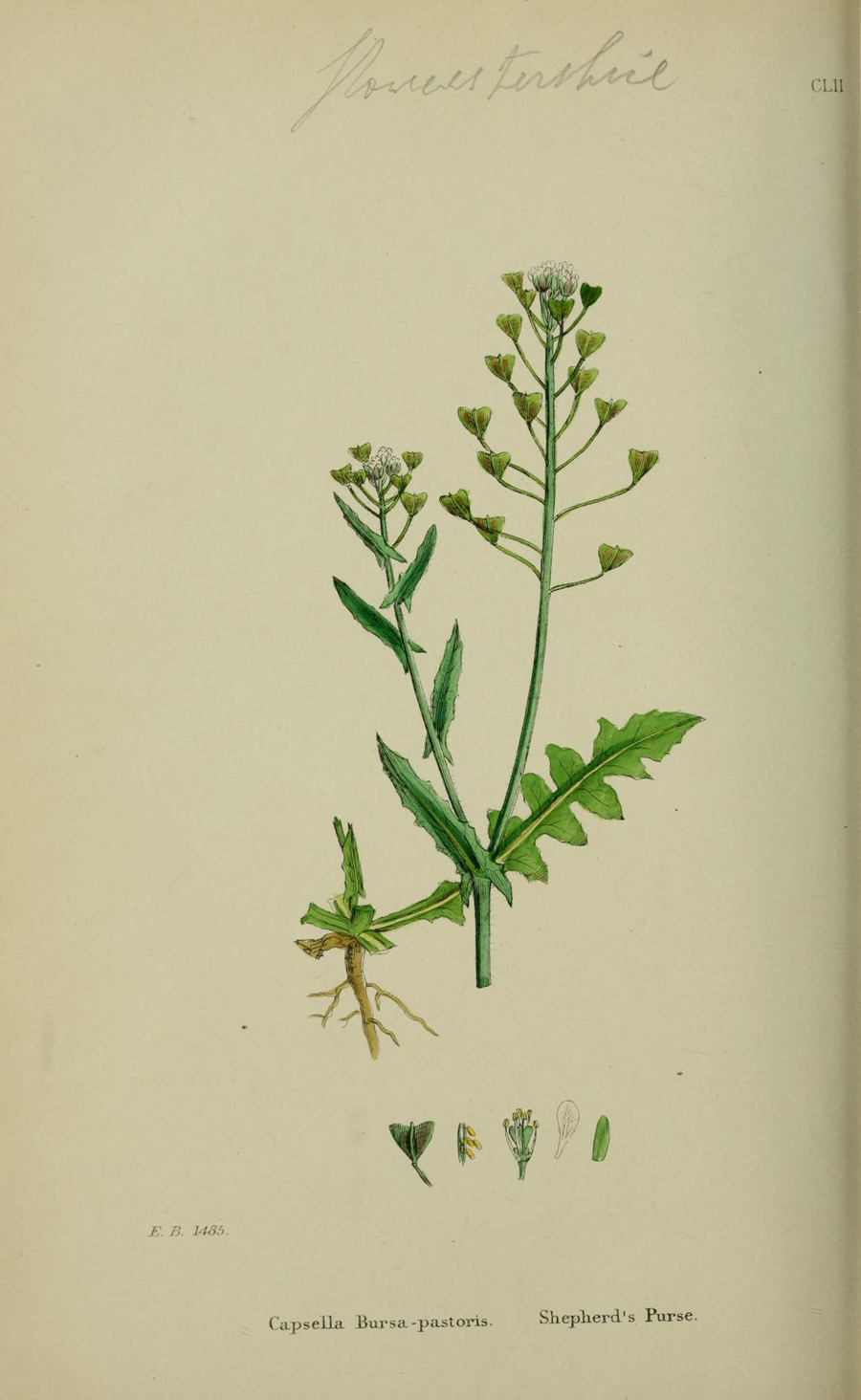
Capsella bursa-pastoris, from English Botany, or Coloured Figures of British Plants, vol. 1, ed. John T. Boswell Syme, figures by J. Sowerby, J. de C. Sowerby, J. W. Salter, and John Edward Sowerby (London: R. Hardwicke, 1863), plate 152.

The methods Hooker used to theorize and visualize these vast, heterogeneous botanical families are significant. Hooker himself, of course, could not observe firsthand all the global ecosystems that his botanical subjects occupied in order to verify their cosmopolitan habits. Instead, he had to rely on the validity of his data to theorize and imagine their cosmopolitanism. By tabulating and comparing data points, Hooker brought distant regions of the globe together and grouped the botanical species that occupied those regions.Footnote 13 The “large cosmopolitan families” of plants he envisioned are linked not by affective or even sensory bonds but by their shared physiological tendencies to occupy certain geographical territory, to thrive in certain soils, and to require similar amounts of rainfall, all of which Hooker carefully charted. Such data, dissociated from the singular plant observed by an individual naturalist, gardener, or botanist, produced an abstract notion of cosmopolitanism seemingly devoid of both the threatening and promising features of other nineteenth-century cosmopolitanisms. While Hooker mined the data of biogeographical distribution with the goal of elevating botany as a scientific discipline, the apparent detachments of his data also contributed to a notion of cosmopolitanism that was perceived as neither menacing nor sociable but as (horti)culturally and scientifically neutral.
At the same time, however, Hooker invoked the bonds of sociability that characterized some nineteenth-century cosmopolitanism. He claimed, for example, that the process of regrouping plants in these ways would address one of his larger goals: to “banish prejudice from the domain of Systematic Botany” (Flora Indica, 88). While this statement was meant in a scientific rather than a cultural sense, he was alert to the human tendency to regard unfamiliar people and things as strange or alien, a tendency that was arguably exacerbated among Victorians by their beliefs in British exceptionalism and its civilizing mission. Hooker argued that even the observation of plants was shaped by “a proneness of the human mind to regard everything from an unknown country, or that is seen surrounded with foreign associations, as itself unknown” (87). In botanical terms, this perception of strangeness, he thought, often led amateur natural historians and even professional botanists to proclaim a new species whenever they found an unfamiliar plant, a tendency he called “hair-splitting” (13). In contrast to the impulse to see dozens of new species in every new locale, Hooker assumed that an unfamiliar plant probably had relatives elsewhere in the world, and he searched for them among his own data and the findings of other botanists. In the process, he naturalized the idea of heterogeneous botanical groups and downplayed species purity. In Hooker's mind, plants were well-traveled cosmopolites, forming mixed, serendipitous communities around the globe wherever conditions were favorable for growth and reproduction. Their nation and region of origin mattered little in this process.
The two qualities that mark Hooker's botanical cosmopolitanism—the qualities of abstraction and sociability—testify to the difficulty of grasping planet-sized entities. Like other nineteenth-century Britons who drew on the discourse of cosmopolitanism, Hooker was forced to develop methods for visualizing the conditions that brought plants together in the global groupings he called “cosmopolitan families” (Flora Indica, 90) These methods involved not only charts and numbers but also aesthetic devices that could mediate the experience of globalized, cosmopolitan attachments in familiar ways. In Himalayan Journals, his popular account of his botanical expedition in the Himalayas, he develops just such a device in the tiny figure of Capsella bursa-pastoris (shepherd's purse), a species of weed widespread in the English countryside. When he stumbles upon a specimen of the small plant high in the Himalayas, he almost fails to recognize it without the context of the British landscape to frame his identification. This sighting surprises Hooker the botanist but delights Hooker the homesick traveler. Persistently absent from Hooker's perception of cosmopolitan plants is the supposition that they don't belong where he finds them. Even the humble shepherd's purse, in addition to assuaging his homesickness, spurred thoughts of cosmopolitan plant distribution in Hooker's mind, not displacement, invasion, or colonial occupation. The weed, he theorized, “had evidently been imported by man and yaks [to the Himalayan region] and as they do not occur in India, I could not but regard these little wanderers . . . with the deepest interest.”Footnote 14 Hooker may have reached instinctively for the sentimental singularity of the shepherd's purse as a rhetorical tool that could mitigate the abstractions of his cosmopolitan groupings and their planet-sized scale. This small device makes such groupings graspable on an individual level, connecting large systems to a familiar, ordinary plant that many readers, like Hooker himself, would regard with familiarity and affection. In addition, the diminutive specimen evokes the image of a sociably heterogeneous global community that included a mix of both flora and fauna. The narrative of Capsella's migration, as Hooker tells it, involves people, plants, and animals in a shared journey between different global regions.Footnote 15
More localized terms such as the “zone” or the “Pacific Coast” capture the widening forces of Victorian culture without succumbing to the danger of universalizing categories. Botanical zones simultaneously challenge the rigidity of national borders and make clear that inroads into them can come in many forms, even those produced by the seemingly apolitical act of gardening.—Robert D. Aguirre
The methods Hooker uses to theorize his “cosmopolitan families” of plants, and the aesthetic devices he uses to make them accessible, anticipate what Ursula Heise calls “eco-cosmopolitanism.” This concept, she writes, “is an attempt to envision individuals and groups as part of planetary ‘imagined communities’ of both human and nonhuman kinds”—an attempt that is paralleled by Hooker's vision of plants, people, and animals wandering the world together.Footnote 16 Heise builds on plural and particular cosmopolitanisms of the sort that Robbins develops in order to avoid an eco-cosmopolitanism that could easily become abstract and distant; while she aims to complicate the preference for the local that is widespread among many environmentalists, she nevertheless values the multiple ways that specific communities interact with the nonhuman world on a global plane. “The point of an eco-cosmopolitan critical project,” she writes, “would be to go beyond the . . . ‘ethic of proximity’ so as to investigate by what means individuals and groups in specific cultural contexts have succeeded in envisioning themselves in . . . concrete fashion as part of the global biosphere, or by what means they might be enabled to do so.” For Heise, an ecocriticism that is valuably cosmopolitan would explore a range of cultural strategies and expressions—especially including narrative—“by means of which Planet Earth has become perceivable and experienceable as a complex set of ecosystems.”Footnote 17
To some degree Heise's goals parallel those of Lauren Goodlad, a scholar of specifically Victorian cosmopolitanism. Goodlad aims to delineate a critical practice that “reads cultural expressions such as literature and ethical discourse as ‘methodologically inseparable’ from overarching geohistorical structures”—imperialism and capitalism, for example, in Goodlad's framework.Footnote 18 As she notes (in concert with Palumbo-Liu et al.), “The analysis of [such structures as] global capital, a topic that invites macrosociological methodologies, can pose significant challenges for the humanistic study of cultures.”Footnote 19 Like Goodlad, Heise grapples with such ineffably large structures as species extinction and climate change; these structures—related to (but not identical with) what Timothy Morton calls “hyperobjects”—are difficult to perceive and grasp on a subjective level.Footnote 20 For Goodlad, who develops Fredric Jameson's notion of a “geopolitical aesthetic,” Victorian literature—most notably the realist novel—registers an aesthetic awareness of large-scale geopolitics and imperialist-capitalist systems. Heise is similarly interested in showing how narrative perceives, captures, and addresses impossibly large, planet-sized environmental issues, while Hooker provides an early instance of how such mediations might function in aesthetic and scientific writings.
The concept of botanical cosmopolitanism I am sketching here entails not only a global sensibility but, more notably, an emphasis on how, in aesthetic or methodological terms, large global entities might be mediated and how the diasporic movements of plants might thereby be imagined. Driven by a commitment to the kinds of measuring and counting that Mary Poovey has analyzed as an aspect of what she calls “the problem of induction,” Hooker cataloged specimens and calculated the data of their physical environments in order to demonstrate the diffusive global spread of his “cosmopolitan families” of plants.Footnote 21 These facts and figures led him to imagine enormous, mixed groups of plants that mingled freely, while his uses of aesthetic devices—figures of individual specimens, for instance—cast a sentimental aura around his plant narratives and emphasized how his botanical subjects worked together with human and animal ones in global communities. Hooker's methods thus demonstrate how analytical and computational methods wielded by humans might be used to understand and thereby manage the plant kingdom, even as they also highlight the unpredictable migrations of his nomadic botanical subjects and their wayward collaborations with human and animal fellow travelers. The variable methods Hooker used to explore cosmopolitan plants, in other words, underscore not only how humans manage plants but also how plants manage humans (and animals) by using their own nonhuman methods. For Hooker, the migratory tendencies of plants to roam the earth and gather in miscellaneous groups, without regard for their presumable point of origin, was intriguing rather than threatening—something to be studied rather than feared. The nineteenth century, however, was also a century of invasions, which likewise came into play as a representational framework for making sense of peripatetic plants.
Invasive Plants
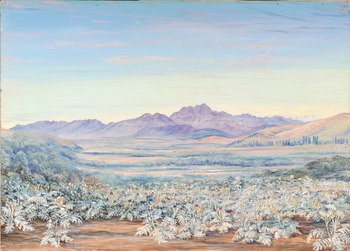
A few decades before Hooker set out for the Himalayas, Charles Darwin noticed something strange: a profusion of the European species Cynara cardunculus—a thistle plant commonly called the “cardoon” or “globe artichoke”—in the South American landscape. “Over the undulating plains, where these great beds [of cardoon] occur,” he noted, “nothing else can live. . . . I doubt whether any case is on record, of an invasion on so grand a scale of one plant over the aborigines.”Footnote 22 Darwin's description is one of the earliest uses of “invasion” in this ecological sense. In the same portion of text, he mentions the “invasions” of other plants as well as some animals into this region of the world. He returns momentarily to the concept of ecological invasion later in The Origin of Species, where he references the South American example again and also briefly discusses “invasions” by “naturalised” species that might have overcome “natives” during the glacial period.Footnote 23
Marianne North, View of the Bell Mountain of Quillota, Chili [sic], with Colonized Cardoons in the Foreground, ca. 1873. Used with kind permission of the Board of Trustees, Royal Botanical Gardens at Kew.

By the mid-nineteenth century, Victorian Britons were extremely familiar with exotic species that were thriving in Britain as luxuriantly as Hooker's nomadic shepherd's purse was apparently growing in its Himalayan habitat. They did not yet, however, express active concern about “invasions” of exotic plants, Darwin's terminology notwithstanding. Transported by means of new technologies at ever greater speeds, nonnative botanical species had already been flowing into Britain for decades by the 1830s, when Darwin undertook his Beagle expedition, and in even larger numbers by the 1850s, when Hooker published several of the volumes that resulted from his Himalayan expeditions. Victorians were thus accustomed to the presence of nonnative plants in their daily lives. Nurtured by new horticultural methods and knowledge, moreover, these plants were thriving in many parts of Britain; tropical and subtropical species were even grown successfully outdoors in Cornwall, without greenhouse protection, and in other regions with subtropical climate zones. Victorian horticulturists certainly recognized habits of growth in tropical plants that differed from what they observed in British species. Indeed, the expression of astonishment at exotic fecundity was a staple of nature writing about tropical regions: it is a prominent feature of Alexander von Humboldt's work, for example, and is also evident in Hooker's own writing about the tropical forests in the Himalayan foothills.Footnote 24 But these biomes obviously did not exist on domestic British soil. Throughout the century, in fact, some horticulturists argued for the introduction of more exotic plant species into Britain. Horticulturist J. C. Loudon, for example, urged the exchange of many plants, especially trees, with other nations, a process he considered to be “the beautiful work of civilisation, of patriotism, and of adventure.”Footnote 25 At midcentury, then, Victorian botanists and horticulturists were far more likely to think of plants as flourishing in “large cosmopolitan families,” as Hooker had described them, than as invading each other's “native” territory.
By the end of the nineteenth century, however, there was at least incipient awareness that exotic plants could pose an ecological problem. Influential publications like Nature began to feature accounts of botanical “aliens” that wreaked havoc on native landscapes and sometimes suggested that such overwhelming fecundity should be met with “complete extirpation.”Footnote 26 The late nineteenth-century decades were, of course, an era of aggressive imperialism, with Western powers contesting one another to annex potentially lucrative territories around the world and seize valuable resources. It is unsurprising that tropes of invasion and extirpation would move beyond military discourses and themselves invade other cultural spheres at this fin de siècle moment. Invasion narratives, after all, became a staple of popular fiction in these years; that such narratives would also shape the stories botanists told about the global movements of plants is perhaps to be expected.Footnote 27 What is surprising is the enduring legacy of such tropes in our ecological imagination and the presumption that plants can be easily curbed, contained, or even prohibited from entering certain regions. This abiding expectation that nature, while assertive, behaves compliantly under human control still influences not only ecological fields and policy but also humanist ones, now no less than in fin de siècle Britain.
Worth exploring in this context is one of the first, and most famous, invasive species that registered in the popular consciousness: the Martian red weed featured in H. G. Wells's dystopian novel The War of the Worlds. A trained biologist, Wells was also a social critic with a global vision—and plants appear in his work in various, often frightening, forms with global implications. In the red weed he portrays the typical growth habits of what we now call an “invasive species.” First glimpsed as “a number of red masses” that the narrator spies “floating down the stream”—significantly, in Richmond, near Kew Gardens—the red weed soon takes over the British countryside. Like the tropical species whose fecundity amazed Hooker in the Himalayan foothills, it “grew with astonishing vigour and luxuriance,” its “swiftly-growing and Titanic water-fronds” flourishing with “unparalleled fecundity” whenever they encountered water. The difference between Hooker's prolific South Asian plants and the red weed, of course, is that Wells's nonnative plant has no competitors in Britain. When the narrator finally emerges from his hideaway, after the Martians have succumbed to a bacterium, he finds an iconic Surrey landscape overcome by the predatory plant. “Now,” the narrator laments, “I stood on a mound of smashed brickwork, clay, and gravel, over which spread a multitude of red cactus-shaped plants, knee-high, without a solitary terrestrial growth to dispute their footing. The trees near me were dead and brown, but further a network of red thread scaled the still living stems.”Footnote 28
Width as “threat”? Encroaching modernity seems to be a threat in Robert D. Aguirre's paper, a threat to indigenous cultures and peoples. Invasive plants are, from some points of view, threatening in my paper. Both range widely, change landscapes, change cultures.—Lynn Voskuil
The red weed, like the Martians who planted it, is literally an invader, exhibiting none of the cooperative traits that characterize Hooker's cosmopolitan botanical families. In Wells's larger-than-life invasion novel, plants have the potential to overwhelm the British nation and are almost as threatening as the beings who cultivate them; it is not a stretch to imagine them as agents in the forms of reverse colonization that Stephen Arata and others have discussed.Footnote 29 Indeed, their role in The War of the Worlds may reflect not only Wells's knowledge of biology and evolution but also the perception of a culture in decline and thus open to invaders, botanical and otherwise.Footnote 30 These very Victorian concepts, however—cosmopolitanism, invasion, colonization—persisted long beyond the Victorian period itself in the fields of botany, horticulture, ecology, and biology more generally, giving eventual rise to the scientific field of “invasion biology.” The rampant, almost savagely fecund red weed, I would thus like to suggest here, captures a larger point: the point that nature, no less than culture, is not only mobile and mutable but assertive and insistent, even imperialistic and violent. If the red weed was transported to the planet Earth with Martian technology, it takes advantage of the disturbed Surrey soil with natural aggression; it is finally killed, moreover, by means of another natural agent: a terrestrial pathogen.
Wells anticipated the field of “invasion biology” or “invasion ecology” by over fifty years. Usually tied to the seminal publication, in 1958, of Charles S. Elton's The Ecology of Invasion by Animals and Plants, the field didn't really take off until the 1980s and is conventionally understood as the study of “biological invasions—the entry, establishment and spread of non-native species—as a major cause of human-induced environmental change.”Footnote 31 Often, the policy thrust of invasion biology as a field is to prevent new, nonnative introductions and restore “native” ecosystems to the extent possible. This field has, in turn, given rise to opposing scientific methods and discourses, including the idea of “recombinant ecology” and the recognition of “novel ecosystems.” Recombinant ecologists study communities that are constituted by plants and animals from various global locations, while novel ecosystems are ecological communities with combinations not seen before in a specific biome; these newer approaches are distinguished from invasion biology by their insistence that mixed, fluctuating ecologies are inevitable and unavoidable in a global world. Such approaches question the assumption that so-called native ecosystems should always be protected or restored as a matter of policy—and even that there is such a thing as a “native” plant or ecological community.Footnote 32 These overlapping ecological subfields have also been riven by disputes about rhetoric and terminology, some scientists upholding and others fiercely challenging the use of ideologically freighted concepts like “invasion,” “natural enemies,” and “natives.”Footnote 33 These debates, and the practices of “invasion biology” and related ecological fields, are far too vast and complex to explore in depth here, not to mention beyond the immediate disciplinary concerns of this piece. Views of invasion and cosmopolitanism that prevail in these fields have wider currency, however, betraying certain assumptions that can prevail in the humanities as well, most notably with respect to the relations between our categories of nature and culture. The assumptions we hold and the arguments we craft about these massive entities are methodologically significant.
From Moore and Morton to Heise, recent ecological writers interested in world systems and planet-sized structures have repeatedly problematized the long-standing dualism between nature and culture. While the imperative to dissolve this persistent dualism is a self-declared goal of ecocritical fields, its significance for Victorian studies is also pronounced. If many of the most intractable global problems (environmental and otherwise) emerged in the nineteenth century as a partial effect of this conceptual dualism, Victorians also advanced methods that recognized and began solving the very problems they created. How we conceptualize the nature/culture dichotomy is thus a living and pertinent question for our field as well as our current political and planetary reality. The overarching philosophical issue is—of course—too enormous to address here in any systematic or even partial way, but a few central tendencies are pivotal to my goals in this piece. One crucial move is to trouble the long-standing, entrenched separation between nature and culture by demonstrating the intricately entangled relations of the two entities and thereby challenge the notion of a transcendent nature. This approach, for example, is the thrust of Morton's Ecology without Nature, which draws on Derridean theory to question the idea of an essentialized nature that is “out there”—that “surrounds” us—and to promulgate the fundamental rhetoricity of nature. “‘Nature’ is an arbitrary rhetorical construct,” he writes, “empty of independent, genuine existence behind or beyond the texts we create about it.”Footnote 34 Morton is right: we experience nature mostly by means of our own discursive, rhetorical representations. Nonhuman nature, as we know it, is inseparable from human cultures and media; critics like Morton who emphasize this fundamental point have prompted ecocriticism to move in sophisticated new directions, away from the naïve thematic practices that bedeviled its early years. As this essay has itself already pointed out, in concert with ecotheorists like Morton and Heise, the questions of how those mediations are performed and how a mobile, globalized nature is thereby imagined—whether (in this case) we think of it as cosmopolitan or invasive—are crucial questions to explore.
At the same time, by emphasizing our own rhetorical media so insistently, we paradoxically risk isolating humans from nonhuman nature once again, at the very moment when we are most insistent about their inseparability. This tendency is manifest particularly in our representations of nature's global migrations. To counter it, Nigel Clark has suggested, environmentalists need to take the assertiveness of “mobile, opportunistic biological matter” much more seriously.Footnote 35 Clark identifies the same problem with certain species of environmentalism that Heise does: its preference for groundedness, a local sense of place, the “planet-scale projection of qualities of homeliness and rootedness.”Footnote 36 Such valuations, he suggests, are linked to the portrayal of “bio-invasions” from diasporic, globally other flora and fauna that are vilified and viewed with disgust, even repulsion, as extrinsic elements that endanger the integrity of coherent, stable, “native” ecosystems. Grounding much environmental thinking, he elaborates, is the assumption that nature, when left alone, seeks equilibrium, stasis, and rootedness; culture, in contrast, is fundamentally vital and cosmopolitan, ceaselessly moving about the globe and constantly reinventing itself. Those same ecologists and environmentalists who demonize bio-invasion often simultaneously embrace human cosmopolitanism and usually depict it in progressive terms. “Native” ecosystems, then, remain closed, their integrity maintained and nature preserved by human management, while a vibrant, hybrid openness is cultivated and celebrated in human culture.
Such assumptions leave the nature/culture dualism intact, Clark argues, to the point that nature's instability and degradation is attributed almost solely to human intervention and its ongoing viability to human management. Culture, in other words, exerts its inherent inventiveness and creativity on biophysical nature, that “other,” compliant entity which is separate from culture.Footnote 37 In Clark's view, if the boundary between nature and culture should be considered porous, as many ecologically minded people believe, then it should be viewed as porous in both directions, from nature to culture as well as from culture to nature. Instead, he argues, the opposite effect has materialized: the interest in cultural mobility has solidified the sense of a natural immobility. He attributes this effect, moreover, to the humanist interest in culture and, especially, cosmopolitanism that surged in the 1990s and early 2000s. These shifts in “the humanities and social sciences,” he suggests (amplifying Vicki Kirby), “[have] tacitly bolstered western thought's timeworn binary of active, articulate culture and silent, docile nature.”Footnote 38
This point is both significant and controversial. It is significant because it underscores ontological differences between nature and culture, differences that have been at least partially blunted in some recent materialist theory. We have become accustomed to global degrees of cosmopolitan inclusion, to the point of collapsing many of the differences between human and nonhuman nature. If nature is as mobile and dynamic as we believe culture to be, then we should also imagine an unpredictable natural excess not subsumed by the human—and capable of escaping our notice, our intervention, and our management. And if that is the case, “Where does this leave worldly contingencies and ambivalences which may not be of our own making?” Clark asks. “Are there not also forces and processes with the potential to escape the closure of a fully subsumed nature, we might ask? Can we be so sure that there is no unassimilated materiality capable of veering in or rearing up and catching us unaware?”Footnote 39 If we assent to Clark's suggestion that culture is at least as open to nature's interventions as nature is to culture's, then many of our assumptions—about linguistic and textual mediations of nature, for example, or about the fundamental rhetoricity of nature—are subject to modification. Clark's argument is controversial as well as significant because it places some of the responsibility for maintaining certain nature/culture binaries on the humanities and on his own field of the social sciences. I have just suggested how the sense of a natural realm that at least partially eludes the cultural realm might modify our philosophical and conceptual notions of nature. If, however, we take Clark's argument seriously—at least (right now) for the sake of argument—then our notions of human culture and systems must change as well. Developing insights from ecological fields, we might think of our own current methods as invading, colonizing, or manipulating nature in ways that prevent us from developing new methods of study. This is not to say that there is a “nature” out there, separate from us. It is to say, along with Clark, that current methodological premises in the humanities and related fields (still) often lead us to function as if nature is separate from us, as if it surrounds us as a distinct, unmediated entity open to our intellectual exploitation, our protestations to the contrary notwithstanding. What happens to our idea of culture if we imagine it as open to the interventions, interference, or mediation by nature?
If we include nonhuman life in our considerations of the cosmopolitan, how does it gain new significance in Victorian studies? These questions suggest processes of displacement: displacing settled ways of thinking with new ways of framing older terms or questions.—Lynn Voskuil
One response to this question might be formulated by looking again at the predations and ultimate fate of Wells's red weed. Viewing it from the standpoint of invasion ecology, we might interpret its spread as a reticulated inscription of natural invasion and degeneration, the blood-red mark of an intact, native ecosystem that has been overrun by a marauding botanical invader. In this scenario we might assume that Wells is warning his readers to be vigilant in both national and botanical matters: ecosystems, like nations, must be contained, their borders guarded and their native purity maintained. When humans introduce nonnative botanical material, it alters familiar landscapes no less thoroughly than military firepower does; careful management is thus essential on a number of fronts. Viewing it from the standpoint of recombinant ecology, however, yields a different interpretation. Trained in biology, Wells remained alert to the vital, dynamic, cosmopolitan qualities of biophysical matter, most notably its capacity to elude human cultural control. The red weed is not, after all, introduced by humans; it engulfs many man-made structures, growing “tumultuously” in the “roofless rooms” of Surrey homes and demonstrating just how quickly human communities might fall to the opportunistic insinuations of plants.Footnote 40 Although the weed is not ultimately able to sustain its life on planet Earth, its aggressive spread offers a transitory glimpse of how a plant could change a landscape and thus a culture—much as the rapidly multiplying cardoon did change the South American plains and thus also that human culture. In the end, of course, the red weed is finally defeated not by human conquest or management but by a natural pathogen, a solution itself beyond human impetus or control. The greatest empire on earth is thus powerless to defend itself against a plant's assertive, dynamic mobility. While that outcome did not eventuate in Wells's novel, the very suggestion shows how plants might exploit and change human culture every bit as thoroughly as we think we exploit them.
Opportunistic Plants
Like Hooker's charts and numbers, Wells's weed is a rhetorical construct, mediating nature in many of the ways that Morton theorizes. Introducing ecological concepts into the humanities, however, frames these constructs in ways that challenge our notions of both media and the processes of mediation. How does nature function as a medium? What happens to culture when it is mediated by nature? What happens to nature? What I am suggesting here is the need for a disciplinary flexibility about methodological questions, an openness to framing such questions in ways that oblige us to return to them and rethink them—in short, to widen them methodologically. The plants I have examined here are subjects that widen and complicate our disciplinary ecosystem in such ways. At the very least, a recognition of their cosmopolitanism illuminates a certain narrowness in the methods we have used to frame cosmopolitanism for over two decades.
Victorians were very skilled at this kind of disciplinary flexibility because they practiced their vocations and avocations during a time when many academic disciplines, as we know them now, had not yet been categorically narrowed. Hooker, as we have seen, used both quantitative and aesthetic methods to discuss his botanical subjects, while Wells brought his training as a biologist to bear upon his practices as a novelist. These hybrid methods, characterized by the tensions between different ways of perceiving plants, complicate our categories of nature and culture, posing questions that we may have forgotten how to ask under the disciplinary pressures of today. Interacting with plants far more than most of us do in daily life, ordinary Victorians as well as professional botanists had a far more diverse set of tools, both material and discursive, for imagining the movements of migratory plants as well as their relationships with them. That diversity perhaps enabled them to imagine plants as variably nomadic and not as either cosmopolitan or invasive. As Hooker argued, globally disparate plants often come together in successfully mixed, cosmopolitan assemblages. At the same time, as Darwin and Wells both suggested, some plants under certain circumstances can occasionally thrive in new landscapes to the extent that they overwhelm existing species. Victorians, clearly, tended not to categorize plants in the starkly absolutist terms entailed by ongoing ecological debates about migratory plants; invasion ecology as a separate field, after all, did not emerge until the 1950s, by which time many of our disciplinary categories had been narrowed and hardened. By avoiding such categorically insistent distinctions, Victorians perhaps imagined a more complex mutual infusion of nature and culture than we often do today. There is much we can learn, in other words, from Victorian ecological imaginations of the cosmopolitan, the invasive, and the global more generally.
Victorians were practiced, however, not only at developing the plant sciences but also at expanding their empire and the capitalist structures that are entwined with it. The growth of nineteenth-century botany, agriculture, and plant sciences contributed significantly to those expansions and benefited from them, while today we continue both to endure the effects of these nineteenth-century expansions and to further their current growth.Footnote 41 This legacy raises important ethical questions about building on Victorian principles and practices of cosmopolitanism as well as invasion, whether people or plants are at stake. For some recent scholars, the idea of cosmopolitanism is too bound up with imperial ideology and economic inequality to remain a viable concept.Footnote 42 Similar uneasiness has been expressed about recent developments in posthumanism, a rubric that arguably includes critical plant studies.Footnote 43 Gilbert Caluya, for example, has lamented the universal Enlightenment category of the “human” that he believes has reemerged in posthuman studies. “Just as the category of the human is (reluctantly) opening to incorporate non-normative genders, sexuality, and racialized (and less successfully differently-abled) people,” he argues, “the human is once again returned to a universal category under the rubric of climate change, global warming and/or the Anthropocene.”Footnote 44 These are fair and persuasive critiques, suggesting that however we construe the related concepts of cosmopolitanism, globalization, and posthumanism, it is imperative that we remain alert to recent arguments and advances made in gender studies, postcolonial studies, and related fields.
Along with such cautions, however, it is worth noting that the incorporation of nonhumans into our scholarship does not entail a necessary, cavalier neglect of racial, gender, and economic inequalities. Indeed, sound ecocritique (to use Morton's term) often reinforces the conclusions of such scholarship—and illuminates new inequalities—by exploring the unexpected interactions and mutual mediations of asymmetrical elements, including nature and culture, humans, and nonhuman organisms.Footnote 45 The effect of embracing such elements is not simply that they unsettle older taxonomies whose moment has arguably passed. More significantly, they prompt different perspectives for framing our objects of study more widely. A frame that is noticeably wider not only takes in more subjects, be they human or nonhuman; it also enables us to reimagine the interactions of those very subjects. In our study of Victorian literature and culture, wider methods might involve a recognition of the global zones and related geographical spaces that traverse the categories of nation and national identity prevalent in our field for so long—and thus, potentially, help us rethink the category of empire as well. Embracing ecological zones, for example, could foster awareness not only of the deleterious environmental effects of empire—the kind of “slow violence” that Rob Nixon analyzes so persuasively—but also of the creative effects that might materialize in the aftermath of empire, both now and in the nineteenth century.
Thinking about such effects in botanical terms for just a moment clarifies this point. Some botanical species occupy and thrive in disturbed environments—in the mowed grasslands beside highways, for example, in the chaos of construction sites, or in similar spaces that mark the advance of human-made, often empire-driven environments. Sometimes, these species “invade” a region and overwhelm existing species, much as the Martian red weed engulfed English plants in the Surrey countryside. More frequently, however, opportunistic plants interact with other species in such sites to create fluctuating, ephemeral ecosystems that are phases in the emergence of newly diverse plant communities.Footnote 46 While the initial, human practices of mowing or building assault existing ecosystems, the disturbance-based ecosystems that emerge in the wake of these practices (but not necessarily as a direct result of them) showcase diversity as well as adaptability. While plants and people are not fungible, of course, a focus on the cross-species interactions that constitute disturbance-based ecosystems could foster new ways of viewing empire and invasion as well as cosmopolitanism, those concepts that have so insistently prevailed in Victorian studies. Anthropologist Anna Lowenhaupt Tsing puts this conceptual and ethical paradox in direct terms: “The diversity that allows us to enter collaborations [with both humans and nonhumans] emerges from histories of extermination, imperialism, and all the rest.”Footnote 47
Such openness to the variable effects of empire and capitalism, and to our inescapable complicity with them, does not obscure either the fast or slow violence that imperial and capitalist systems have inflicted on both people and plants the world over. Instead, a focus on disturbance enables us to see not only invasions—military, imperial, and economic as well as ecological—but also the collaborations that sometimes emerge in their wake. And it helps us see collaborations themselves not only as cooperative and synergistic but also as tense, unruly, and even unmanageable. All of these collaborations, whatever their tenor, can be productive. Such collaborations might include the novel ecosystems that Hooker observed (long before the term “ecosystem” was in use) in his “large cosmopolitan families” of plants—and in the disturbance-based ecosystems many ecologists study today. They might also involve tensions between text-based methodologies and matter-based methodologies, tensions with the potential to produce new ways of imagining, describing, analyzing, or aestheticizing our objects of study.
Both [Jessie and Lynn] speak directly to Victorian Studies. [. . .] Both ask questions about the usefulness of the term—“transatlantic” in Jessie's case, “cosmopolitan” in Lynn's—to widening Victorian studies. Both suggest a productive return rather than a dismissal of flawed but useful words.—Helena Michie
In 2010 Agathocleous and Rudy argued in Victorian Literature and Culture that “cosmopolitanism should be seen as a methodology as well as a set of ideas, for investigating its incarnations transforms our methodologies as researchers.” I affirm their point wholeheartedly and hope that this essay has taken it one step further, beyond simply an understanding of our work as a “cosmopolitan juggling act, in which we strive to close-read the aesthetic qualities of literary texts within an increasingly far-reaching historical and geographical frame.”Footnote 48 Including migratory plants in our notions of cosmopolitanism and invasion does indeed extend the historical and geographical width that Agathocleous and Rudy extol. In addition, though, plants and other nonhuman species have the potential to promote newly expansive methods for studying our Victorian subjects, methods that exceed the practices of close-reading texts even when we do that in a wider geographical frame. Nature is not the docile, harmonious entity to which humans apply their scientific, rhetorical, or aesthetic expertise. And plants are not easily managed organisms that can be controlled in the interests of inscribing or maintaining (inter)national borders of various sorts—something the world should have learned long ago from the actions of decolonizing human populations. Those two observations alone should prompt new approaches to perceiving and understanding plants and their roles in our methods of study. With their power to move ceaselessly about the earth, eluding human restraint and dominion, plants are ecological experts in the creation of disturbance-based cosmopolitan communities—communities that we cannot even imagine using conventional methods, much less manage. It is instructive to remind ourselves that only some of these communities include us.