Introduction
Carnival is the most dramatic proclamation of community. … It is virtually impossible to be alone during the week of major celebrations. (Harris Reference Harris, Bloch and Parry1982, pp. 57–8)
The moveable feast of Carnival, which falls in February or March, marks the culmination of the rains and growing season, when the first fruits of the year may be tasted. It is the collective celebration of ayllu (ethnic community) production, resulting from harnessing ancestral power, community labour, and the fecundity of the earth (Stobart Reference Stobart2006b, p. 248). For the rural communities of Northern Potosí, in the Bolivian Andes, Carnival is widely considered the year's liveliest and most important feast. Through the week of festivities wayñu music and dancing is almost constant and involves an intense sense of collective participation and social interaction.
Videos: To be a good spectator one has to abandon oneself to the rhythm and enjoy the ephemeral sights. … They are cold, indirect dramatizations that do not require the personal presence of interlocutors. The world is seen as a discontinuous effervescence of images, art as fast food. (García Canclini Reference García Canclini, Chiappari and López1995, pp. 225–6)
In the poorer market sectors of the larger towns and cities of the region, over the weeks preceding Carnival, the sounds and images of Carnival music and dance pour out of television sets linked up to VCD (video compact disc) players. In Sucre's Mercado Campesino (‘Peasant Market’), for example, they emerge from the stalls of street vendors, and passers-by stop to watch and listen. As Carnival moves from ‘public space to teleparticipation’ (García Canclini Reference García Canclini, Chiappari and López1995, p. 207), participation transforms into presentation (Turino Reference Turino2008b, p. 26). Vendors call such products cultura (‘culture’) to distinguish them from popular entertainment genres, such as huayño and cumbia. Buyers are mostly low-income urban migrants or seasonal labourers from rural Northern Potosi – individuals who identify with this heritage and its strident pinkillu flute sounds (Stobart Reference Stobart2006b, p. 214), an aesthetic that seems unlikely to capture the international world music market. Such music also largely passes unnoticed by (or attracts the disdain of) the city's middle classes; hence these discs are not stocked by the music stalls they frequent in Sucre's historic centre. These digitised sounds and images, then, stand in a complex relationship to the intense social experience of rural Carnival. They also circulate in specific circuits of culture, mapping out the city and its uneven social terrains, while perhaps creating ‘imagined communities’ connected though the communitas (Turner Reference Turner1974, p. 237) of Carnival.
In part, the attraction of indigeneity and its success as a political force might be seen to build on its association with the notion of ‘community’: a concept, according to Rapport (Reference Rapport, Barnard and Spencer2002, p. 117), ‘of always positive evaluation and evocation’. Notwithstanding ongoing anxieties about how media can alienate or rupture such communities (Ginsburg Reference Ginsburg1991, p. 96; Miller Reference Miller and Miller1995, p. 18), several scholars have charted the indigenous use of audiovisual media as a political tool (Conklin Reference Conklin1997; Turner Reference Turner, Ginsburg, Abu-Lughod and Larkin2002) and as a means to ‘strengthen culture’ (Ginsburg 2002; Schiwy 2009, p. 8). Much of this sometimes advocacy-orientated research has focused on externally funded projects which have provided indigenous people with equipment and varying levels of technical training and support (Turner Reference Turner, Ginsburg, Abu-Lughod and Larkin2002, p. 78; Deger Reference Deger2006). To date, however, less attention has been paid to the ways in which indigenous people, often with limited technical expertise, have independently grasped the entrepreneurial and creative opportunities offered by cheap audiovisual digital technologies. The ubiquity, affordability and user-friendliness of these media have grown exponentially since the turn of the millennium, as have local markets for the consumption of the resulting products (Stobart Reference Stobart2010).
This paper explores some of the processes and issues surrounding the production of a VCD of rural Carnival music by the singer-songwriter and originario (‘indigenous’) activist Gregorio Mamani Villacorta. It reflects on the tension between the individualistic market-orientated motivations of the ‘artist’ entrepreneur and the widespread associations of indigeneity with community – an association which is frequently invoked and celebrated in such videos. It also considers the question of creativity and the sets of values, cultural traditions and legal mechanisms that respectively lead this to be identified with the individual or the collective. Although in the popular imagination the ‘indigenous entrepreneur’ might emerge as a contradiction in terms, in the case of the Andes there is ample evidence, dating from early colonial times, of indigenous participation in markets (Larson and Harris Reference Larson and Harris1995). Indeed, access to money to pay tax was critical to the very maintenance of originario status (Platt Reference Platt1982; Rivera Reference Rivera Cusicanqui1992, pp. 97–8) and musical employment by the church sometimes enabled the avoidance of tax (Baker Reference Baker2008, p. 203).Footnote 1 In short, there is nothing new about indigenous people exploiting economic opportunities – including as musicians – but the potential for an individual to do so often needs to be negotiated in the context of deeply held values relating to the collective and pervasive local discourses of community and equality (Harris Reference Harris, Larson and Harris1995, p. 367).Footnote 2 In the light of these challenges it is notable that all the successful indigenous recording artists I have encountered in Bolivia have migrated away from their communities of origin to live permanently in the city. Yet these individuals, despite often complex relations with their communities of origin, are often behind the creation and circulation of influential sounds and images of indigeneity.
Research context
This paper draws on research conducted as part of an 11-month project (2007–2008) based in the city of Sucre, Bolivia's constitutional capital, but is also informed by many years of fieldwork (since 1990) in the rural community of Kalankira, ayllu Macha, Northern Potosí, Bolivia (Stobart Reference Stobart2006b). My more recent project, entitled Digital Indigeneity (the theme of a forthcoming book), examines the impact of cheap digital technology, music piracy and cultural politics on the production, consumption and representation of indigenous music in the context of the MAS (‘Movement Towards Socialism’) government of Evo Morales, widely hailed as the first indigenous head of state in the Americas. This research project began about 20 months into Morales' presidency and focused, in particular, on the work of Gregorio Mamani, a regionally renowned recording artist and cultural activist (hereafter referred to as Gregorio, to reflect the informality of our friendship). Gregorio was closely involved in Morales' election campaign, releasing a widely circulated VCD of campaign songs and performing at many rallies (see Video link 1). This indirectly led to his selection by Chuquisaca Department's MAS leadership for a high ranking post in the region's Prefecture in Sucre, which he held for around one year before resigning and returning to his career as a musician.
This resignation took place shortly before I commenced my research, and in order to rekindle his reputation as an ‘artist’, Gregorio almost immediately embarked on the production of a series of VCD music videos. These were the first music videos he had produced entirely independently in his own home studio, where he controlled every aspect of the production process. I was fortunate to have the opportunity to closely observe this process and to participate in a variety of support roles, such as filming video shoots under Gregorio's direction or acting as chauffeur for location filming. (I provided minimal technical support as my knowledge was limited.) The Carnival video discussed in this paper was the first of these three productions, but also the one most closely connected with indigenous rural values and practices and community-based celebrations. It was, in addition, the most constrained in its aesthetic appeal, potential audience size and marketing opportunities; its sale was limited to a four-week window in the lead-up to Carnival 2008. Sales, totalling around 2000, were further reduced due to ‘piracy’. Some two weeks after its release, copies of the disc were available in market stalls presented with a new colour-printed cover and labelled ‘special edition’ (Stobart Reference Stobart2010, p. 44).
During the same period that this Carnival music video was being created in Sucre, this usually tranquil city, with its beautiful colonial architecture and historic university, entered an especially turbulent and ugly phase of its history. To simplify an immensely complex situation, Sucre became a key focus for the expression of opposition, motivated by historically privileged sectors of the population, to the pro-indigenous government of Evo Morales. This was played out in the form of violent resistance to the creation of a new national constitution and demands that the seat of government should be moved from La Paz to Sucre. In short, over the period that this Carnival video was being created, it became dangerous in Sucre to publicly express sympathy for the MAS government and their pro-indigenous politics; indeed local politicians who did so found themselves branded as traitors to the city and their photographs were displayed in the central square. Although support for the Morales government was robustly confirmed in the August 2008 recall elections (by over 60 per cent of the vote) and in his re-election in December 2009 (with 64 per cent), the perception in Sucre and more generally from the national media during the months surrounding the anniversary of Morales' second year of office was that his grip on power was extremely fragile.
Given the tumultuous political context from which it emerged, Gregorio's Carnival video is perhaps striking for its lack of explicit reference to politics. It might be tempting to assume that Gregorio avoided politics for his own safety, but it must be stressed that politics infuses many of his other productions. Rather, there is a sense that, for the rural people who make and identify with this music at least, the sensory exuberance of Carnival is seen to eclipse the whims of politics; the (Quechua language) song texts burst with references to colours, tastes, flowers, lovemaking, Carnival devils and sirens (sirinus). Although rural Carnival festivities include opportunities for social critique, parody and reversals, in this Andean context they are arguably secondary to Carnival's significance as the annual festival of natural abundance (Gérard Reference Gérard2010). While transcending politics to stress local cultural values and community appears to be a feature of the Carnival music video genre more generally, I will nonetheless argue that political ideology most certainly lies behind Gregorio's seemingly apolitical productions of such music.
Biography and the politics of culture
Gregorio Mamani Villacorta (born 1959) was brought up and spent the first part of his adult life in the rural herding and agricultural community of Tomaykuri, over six hours drive from the city of Sucre where he now lives. Like the neighbouring community of Kalankira (Stobart Reference Stobart2006b), Tomaykuri forms part of ayllu Macha, an ethnic group of Northern Potosí with roots dating back to prehispanic times (Platt Reference Platt, Murra, Wachtel and Revel1986, p. 230), an indigenous cultural heritage of which Gregorio is deeply proud. However, like many other highland Bolivians, he prefers to refer to this heritage by the term originario (‘original’), the meaning of which (from a broader international perspective and the purposes of this paper at least) is essentially interchangeable with ‘indigenous’.Footnote 3 Gregorio is a long-established recording artist, having made his first cassette of popular charango songs in 1986 with the Cochabamba-based label Borda. These early recordings, principally of huayño songs accompanied by charango and Spanish guitar, feature the type of music popular among the mestizo or cholo populations of the towns and villages of Bolivia's central highlands. Such music is in many respects distinct from the seasonally alternated genres and instruments of rural communities such as Tomaykuri and Kalankira, and for a rural peasant to play it would often have been interpreted as aspiring to mestizo status (Turino Reference Turino1984; Stobart Reference Stobart2006b, p. 62). This sense of social boundary crossing is also evident in the way that certain urban mestizo musicians referred to Gregorio as indio (‘Indian’), implying inferior class and ethnicity (Van Vleet Reference Van Vleet and Canessa2005, p. 111). Ironically, however, with the rise of indigenous politics and the presidency of Evo Morales, some of these same mestizo musicians, who formerly downplayed their indigeneity, are now self-identifying as originario (Canessa Reference Canessa2006).
Even if certain mestizo artists invoked superiority through dubbing him indio, in my own conversations with Gregorio about his childhood experiences of living in Tomaykuri, he sometimes distanced his family's more cosmopolitan attitudes and ‘mestizo-like’ ways from those of the community. For example, he explained that his father had worked in the mines, near the town of Ocuri, and his sisters wore mestizo-style polleras (bunched skirts) and were able to speak Spanish in addition to Quechua, the language in which Gregorio continues to feel most at home. While ambiguous and context-sensitive alternations between identification as a community insider and as a cosmopolitan outsider are commonplace in the Andes (Abercrombie Reference Abercrombie1998, pp. 46–7; Van Vleet Reference Van Vleet and Canessa2005, p. 119), they are particularly significant for individuals such as Gregorio since his status as a culture bearer is critical to his identity as both an indigenous activist and an originario artist.
In 1990, having achieved considerable success as a recording artist and while still living in Tomaykuri, Gregorio pioneered one of the first commercial cassette recordings of rural music, aimed at an emergent low-income indigenous rural and urban migrant market. This and many subsequent recordings of Carnival music were released under the group name Zura zura. The cassette covers feature photographs of Gregorio and other performers wearing Macha dress, highlighting and celebrating ayllu Macha cultural identity. While the recording of this music was clearly a successful entrepreneurial project, Gregorio insisted that it strengthened and conferred value upon ‘autochthonous’ originario culture. Indeed, the covers of his 2004 and 2005 Carnival VCDs respectively proclaim (in Spanish): ‘With pride since 1990, 14 years of disseminating culture’ and ‘Strengthening culture for 15 years’. In our conversations, he also often stressed how recordings of autochthonous rural music challenged the stylised folkloric versions presented by urban mestizo musicians. Thus, even if not explicitly political, Gregorio's Carnival music productions were implicitly political in the ways they gave importance to rural culture and confronted its former invisibility/inaudibility (cf. Conklin Reference Conklin1997, p. 724).
In this context, it is notable that Gregorio's early recordings of rural music in the early 1990s coincided with his entry into the political arena and the rise of Bolivian indigenous politics more generally (Himpele Reference Himpele2008, p. 196). After holding several positions of authority in Tomaykuri, Gregorio became involved in reviving certain prehispanic positions of authority, briefly occupying the role of kuraka for the Majasaya (upper moiety) of ayllu Macha. This involved him in a violent struggle to defend the indigenous ayllu from replacement by the peasant union or sindicato (Rivera Reference Rivera Cusicanqui1992; Molina Rivero Reference Molina Rivero2006, p. 293), leading him to flee Tomaykuri and to base himself permanently in the city.
Gregorio was quick to exploit the creative opportunities of the VCD format following its explosion in popularity in Bolivia from around 2003 (Stobart Reference Stobart2010, pp. 28–9). His first Zura zura VCD of rural Carnival music appeared in 2004, and was mainly filmed in rural locations surrounding the city of Cochabamba. However, his 2005 Zura zura Carnival video was entirely filmed in Tomaykuri. It shows a large and lively group of community members wearing Carnival dress (which is closely associated with Macha ethnic identity), and engaged in – occasionally slightly staged – Carnival music, dancing and ceremonies (see Video link 2). The images, which are coordinated with music tracks recorded in the studio, show Gregorio as a well integrated participant in this collective performance. Acquiring community consent for filming undoubtedly involved complex negotiations and expectations of reciprocity. Although Gregorio was under the impression that he had fulfilled his duties of reciprocity, several people to whom I spoke in Tomaykuri in 2008 were less than satisfied. Space does not permit me to explain the complexities of this specific situation, but the sense of resentment I encountered can in part be explained by the unrealistic expectations of high profitability, even though such projects are usually far from lucrative. This resentment also helps to explain why Gregorio avoided community involvement in his 2008 Carnival video, as discussed below.
Creative individuals and imagined communities
Besides confronting the former invisibility of rural culture, Gregorio's recordings of Carnival music engage with originario culture in another more locally specific way; they respond to an annual requirement for new wayñu melodies. Tunes from previous years are considered q'ayma (‘insipid, tasteless’) and ‘unable to do anything’ (Stobart Reference Stobart2006b, p. 245). Many rural people told me how men used to visit a waterfall or spring – usually at an isolated location in the landscape – where spirit beings called sirinu or sirena were said to reside and, while listening to the sound of the flowing water, a new wayñu melody would enter their head, as if in a dream (Stobart Reference Stobart, Austern and Naroditskaya2006a, p. 119). Although knowledge of this practice is widespread, it is often presented as a vanishing tradition; few individuals actually claim to collect or acquire wayñu melodies in this way. Aware of this requirement for new Carnival melodies, Gregorio timed his recordings of new wayñus to appear four or five weeks before Carnival. This gave people enough time to learn the new melodies from the recording and then to play them on their own instruments during Carnival festivities. Thus, technology and oral tradition began to intersect and, although diminishing the immediacy of the landscape as a source of music, may arguably be seen to have contributed to the maintenance of sirinu traditions (Solomon Reference Solomon1997, p. 268; Stobart Reference Stobart, Austern and Naroditskaya2006a, p. 121).Footnote 4 These recordings' connection with the sirinu tradition was further highlighted by the way Gregorio named his ‘group’ Zura zura, a reference to a place inhabited by a sirinu called Zurapalka near his house in Tomaykuri; the suffix palka refers to the confluence of two rivers. In addition, he claims to be ‘enchanted’, one of those very few people of Tomaykuri who can communicate with the sirinus. As he explains below, this inspires him in his composing, and – even while based in Sucre – he travels in his imagination to the sirinu at Zurapalka:
… about me they say ‘that Gregorio Mamani is enchanted, he speaks with the sirinus’. For example, sometimes things for composing – for compositions – come into my head. There are certain lyrics which I write down and from that point I work with them.
It is artistic work composing and for this I always go [in my imagination] to my village; the cultures, practices, customs I have. I have a sirinu place … there is really a sirinu in these places of mine. It can be heard in the air, in the river, in the wind and it comes to me. Thus, in some of the places I live, there truly are sirinus. [The place in Tomaykuri] is called Zurapalqa, hence [the name] Zura zura … it is only about 100 metres from my house. (Gregorio Mamani, interview,Footnote 5 28 October 2007)
Even if this account might be interpreted as a claim to authenticity, it must be stressed that few successful recording artists have such deep knowledge and experience of rural traditions as Gregorio. Even compared to rural people permanently living in the Tomaykuri region he emerges as very well informed, reminding us that in indigenous communities, as elsewhere, knowledge is unequally distributed.
A notable aspect of the above quotation is the way that Gregorio distinguishes himself from other community members, identifying his success as an artist with his ‘enchantment’. This complicates notions of creativity: should we think of his ‘artistic work’ as the result of human agency (i.e. composing) or, as in many ethnomusicological descriptions from around the world, as the acquisition or revelation of music from non-human sources (Seeger Reference Seeger, Frith and Marshall2004, p. 161)? In other conversations, Gregorio presented this singling out by the demonic sirinus as a double-edged sword; it made him ‘different’ from other people, an individuality which he greatly valued as key to his identity and success as an artista (‘artist’), but it also had the downside of making him ‘a bit mad’. Gregorio regularly reiterated ‘soy diferente’ (‘I'm different’) and clearly prided himself on standing out from the group and going against the grain, thereby contesting a tendency in Andean rural society to ‘stress the collective over the individual’ (Turino Reference Turino1993, p. 23) and Leuthold's observation that ‘the [native] artist is not above or separate from society (not “different” or eccentric)’ (Leuthold Reference Leuthold1998, p. 7). He also insisted that only one or two people in any community are the actual composers, a claim that challenges the presentation of Andean rural musics as collective expressions:
Many say that native music is the property of the community or ayllu … Clearly it represents the ayllu or community, but in any community the author or composer is just one or two people. Not everybody is the absolute owner. … These artists lack recognition; I'm one of these. (Gregorio Mamani: round table presentation, ‘Music piracy and the fair use of native music’, La Paz, 18 June 2008)
This assertion is evidently, in part, a claim to authorship rights, which reflect the exclusive recognition of the individual in national and international copyright law (Malm Reference Malm2006). However, in the current crisis in intellectual property legislation, as proposals abound for the recognition of collective rights (Malm Reference Malm2006), this voice – which defies commonplace assumptions about creative process among indigenous peoples – should perhaps be heard. It also challenges what Michelle Bigenho has called the ‘ideological framework of modernity’ which denies individual creatorship and ownership of indigenous cultural works. ‘To state the prevailing logic in its blunt and admittedly oversimplified terms, Western individuals produce art and collective Others produce culture’ (Bigenho Reference Bigenho2002, p. 200). Such constructions also tend to be accompanied by essentialised notions of culture and to present communities as somehow static, unified and ahistorical (Wolf Reference Wolf1983).
On the one hand, creative and idiosyncratic individuals – like Gregorio – have always existed in indigenous cultures; their innovations, whether adopted and resulting in stylistic transformation or rejected and provoking resistance, have been important in keeping cultural expressions alive, dynamic and meaningful.Footnote 6 On the other hand, defining individual creativity in, for example, the pinkillu flute melodies of Carnival is problematic as these pieces follow a standard formula, leaving little space for innovation – a key notion of European constructions of the ‘artist’ with which Gregorio appears to identify. What is distinctive about pinkillu music is far less the characteristics of a given melody than the broader culturally embedded parameters of the genre, such as its timbre, form, performance gestures, interaction between the parts, characteristic song text formulas, and associated choreography. Thus, a given pinkillu melody might be characterised as a momentary instantiation within the genre's broader cultural and historical matrix, resembling the retelling of a well known oral account.Footnote 7 It is the product of both individual and collective creativity and as such remains unproblematic unless ownership is claimed or such music is appropriated by persons with greater cultural capital and thus ‘better positioned than their indigenous counterparts to reap financial reward’ (Brown Reference Brown2003, p. 236).
In the case of pinkillu flute melodies, claiming authorship did not seem to be an important issue for Gregorio (although it was for other genres). Instead, evoking the experience and feeling of Carnival was prioritised as a kind of nostalgic return to and celebration of ancestral practices and values. I was told that the final kacharpaya (‘despatch’) of Carnival, enacted through music and dance, is the one rite in the year in which every member of the community (except those too old and infirm to leave their homes) should participate. However, this imagined and nostalgic communitas of Carnival, even if evoked musically through Gregorio's VCD, does not necessarily reflect the reality of community relations. Even so, it may indeed help people to temporarily forget conflict and believe in a harmonious community (Attali Reference Attali and Massumi1985, p. 19). In the context of such imaginaries, it is significant that Gregorio sold a large proportion of his 2008 Carnival VCDs in the lowland city of Santa Cruz and the Chapare region, homes to many migrants from rural Northern Potosí. The demand for these recordings is evidence of a desire among such people to maintain a connection, however nostalgic and imaginary, with this rural heritage. This suggests that we might conceive of the urban consumers of such rural Carnival videos as a kind of ‘imagined community’ (Anderson Reference Anderson1991), a scattered collectivity connected by their shared identification with this distinctive rural music and associated cultural practices.Footnote 8 This tendency for urban migrants to proudly identify with rural origins, rather than shamefully conceal them, is a striking aspect of Bolivia's political climate under the presidency of Evo Morales.
In short, Gregorio's productions of Carnival music may be seen, on the one hand, as self-interested entrepreneurial and artistic endeavours, involving both the commodification of indigenous culture and close engagement with its meanings. On the other hand, they can be seen as political projects reaching out to wider circuits of culture and dedicated to the struggle for indigenous visibility, agency and emancipation. However, his desire to promote ‘autochthonous’ Macha culture also, perhaps, betrays a sense of cultural objectification and self-awareness symptomatic of his relative cosmopolitanism.
The home studio: ‘an isolated form of activity’?
As an indigenous studio owner, largely dedicated to producing his own music, Gregorio was in many respects exceptional and, as he put it, ‘a leader’. In 2008, at least, originario musicians usually paid commercial studios such as Banana or CG Records in Cochabamba to produce their recordings. The other Sucre-based artists who owned studios were mainly urban mestizo performers of neo-folklore music who acquired the necessary capital through touring in Europe (e.g. Julio Portillo, and the groups Los Masis and Cantosur). Although the two second-hand computers, software, microphones and video cameras which made up Gregorio's digital home studio were inexpensive by most standards, for a person of his background and economic means they represented a major investment (probably US$3,000–4,000). Apparently, most of this capital was raised from a concert tour of Peru, Argentina and Bolivia, which built on the popularity and widespread circulation, primarily through piracy, of a VCD featuring Gregorio's son Davíd, the child star Vichito Mamani. (Several tracks of this VCD are available on YouTube, e.g. Video link 3). The production of this VCD was directed by Gregorio, who composed and played most of the music, and who also appears on the video alongside his wife, Cinthia Caisina Ramos. This and his many other earlier VCDs highlight how, before embarking on his 2008 productions, Gregorio had many opportunities to closely observe, direct and acquire knowledge from recording technicians and video editors working on his productions.
In Gregorio's house, two very small rooms on the lower ground floor served respectively as a recording studio and control room. Their location between the kitchen and main living room, which also acted as Gregorio and Cinthia's bedroom, meant that they were positioned at the heart of domestic space – these various rooms opening directly onto a small concrete patio. In striking contrast to Paul Théberge's characterisation of the North American home studio as ‘an isolated form of activity, separate from family life in almost every way’ (Théberge Reference Théberge1997, p. 234), life in the Mamani household revolved around and was often dominated by the spaces allocated to the studio and video editing. Rather than being ‘a private space … far from the main traffic of everyday life’ (Théberge Reference Théberge1997), the Mamanis' VCD production regularly spilled out into other areas of family space and activities. The patio was often used for chroma-key (green screen) filming, and for several months during the rainy season the main living room/master bedroom was transformed into a film studio with high-power lighting.
In many respects Gregorio's home-based VCD production more resembled a cottage industry than the kind of home studio described by Théberge. Productive activity dominated family life in much the same way as it does in Andean rural communities where full family participation is periodically expected, for example, with planting, harvesting or herding. This continuity with the lifestyles of the Andean countryside was also evident from a range of domestic practices, priorities and protocols. For example, the main living room contained little furniture, besides a double bed, a few broken chairs and a small television. More generally, Gregorio regularly applied rural-style ingenuity, practicality and pragmatism to his studio practices and his engagement with digital technology. He was deeply proud of this sense of self-sufficiency and his ability to independently complete all the various stages involved in the production and distribution of a VCD. The key stages in this process consisted of:
1. Composition of the music and song texts, recording of the various instruments and vocal parts – mostly performed by Gregorio and Cinthia – and the mixing and mastering of the audio recording.
2. Direction and filming of the video. This featured performers miming to the musical soundtrack or acting out planned or spontaneous routines, either on location or at home in front of a green or blue screen. This latter technique (chroma-key), although rarely used by other small-scale Bolivian producers, enabled Gregorio to superimpose video images over existing still shots or video footage.
3. Editing the video using Pinnacle editing software. This involved placing selected video footage and stills onto the music soundtrack of each song. These were then compiled as tracks for a VCD (using Nero software).
4. Burning multiple copies of the master VCD onto blank CD discs (initially using two computers, but later using a multiple disc burner which could copy ten discs in three minutes).
5. Screen printing the CEMBOL logo onto each disc,Footnote 9 a strategy to identify the discs as genuine and to combat piracy.
6. Creating the cover image for the VCD presentation case. This was sometimes created by Gregorio using PowerPoint software. The file was then taken to a commercial printer for colour printing.
7. Distribution over a single weekend to flood the market before pirate editions could be created. Gregorio travelled to Cochabamba, Santa Cruz and the Chapare region to personally distribute his VCDs to street vendors. Meanwhile, Cinthia distributed in Oruro and Llallagua (the market centre of Northern Potosí), and his eldest daughter distributed in Potosí, where she lived and ran a small record shop.
I have above outlined the contrast between Théberge's characterisations of the North American home studio, as isolated from family life, with the central place it occupied in the Mamani household. Nonetheless, from another perspective, I will argue that Gregorio's studio was indeed ‘an isolated form of activity’. Its very location in urban Sucre, over six hours drive from rural Tomaykuri, isolated it both physically and socially from the community-based Carnival traditions represented on the VCD it produced.
Gregorio Mamani's 2008 Carnival video
In this section I look more closely at the production of Gregorio's 2008 Carnival VCD, examining a few of the ways that he used digital technology to overcome physical and cultural isolation to construct an audiovisual evocation of community. The production process took almost precisely two months from the composition of the first new songs (28 October 2007) to the distribution of the completed VCD, over the weekend of 29 December 2007. This permitted just over one month of sales before the start of Carnival on Saturday 2 February 2008. For reasons of space, my discussion here is restricted to the pinkillu flute tracks which feature strident-sounding wooden flutes, resembling a consort of rustic Renaissance recorders of four to six sizes (Stobart Reference Stobart1996). On this form of Carnival VCD, flute tracks are alternated with guitar songs (e.g. Video link 4), featuring distinctive local forms of guitar (qunquta or kitarra).
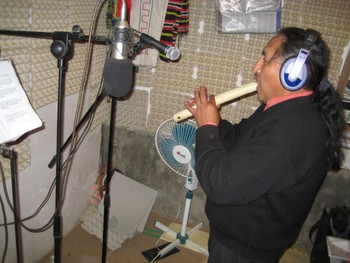
Although for his first Zura zura cassette recordings Gregorio played the pinkillu flutes in consort with other rural players, performing in horseshoe formation around a single microphone, several factors now made this impractical. He was not on good terms with any competent and reliable players living in Sucre, and time, distance, travel costs and poor relations with the community ruled out bringing players from Tomaykuri. Accordingly, he chose to multi-track all the instrumental parts himself. Although pinkillu flute performance stresses social interaction between players, involving varying degrees of interlocking and overlapping between parts, Gregorio considered multi-tracking unproblematic. Using 24-track Cubase software on his computer, he recorded each pinkillu part in turn in his tiny recording studio, his son David operating the computer and shouting un, dos, tres (‘one, two, three’) through the wall of the control room at the start of each take (Figure 1). To the six flute tracks he added one featuring the deep burbling sound of a pututu trumpet, with its strong Carnival associations, and a so-called ‘animation’ (animación) track. This includes high-spirited exclamations in Quechua, encouragements to dance, and lively whooping and burbling cries, evoking the participatory exuberance of rural Carnival and a sense of ‘liveness’.
Gregorio Mamani recording the first multi-tracked part (the q'iwita flute) of the pinkillu flute consort in his small recording studio. Photograph by Henry Stobart.

A key aspect of this music is the sound of young women's voices, their highly distinctive timbre and gestures seemingly almost impossible for non-rural singers to adequately reproduce. From early on in the production process, Gregorio sought out rural girls with strong voices, who were undaunted by the microphone and were prepared to travel to Sucre to record in his studio. Following a fruitless search, he eventually recorded his wife Cinthia, who is in her mid-40s. This was clearly not an ideal choice in terms of vocal quality and youthfulness of sound, but having been partly raised in ayllu Macha she was at least able to approximate the style. To evoke the sound of the group of young women who typically sing along with pinkillu flutes during Carnival, Gregorio recorded three vocal tracks, one sung in the lower octave and two in the upper. Although the audio recording involved the musical contribution of just two people, the various multi-tracked elements (especially in the flute wayñus) effectively convey a sense of festivity, collective participation and communitas. Rather than being some kind of ‘fake’, his creation of such a recording highlights Gregorio's deep knowledge and experience of rural Macha culture and aesthetics.Footnote 10 Nonetheless, it was also evident that Gregorio built on conventions and values developed in the recording studio which give rise to particular working practices and conceptions of musical products and artists. These do not always sit easily with the values surrounding participatory performance (Turino Reference Turino2008b).
Completing the audio recording and mixing on 26 November, Gregorio then turned his attention to the video. Technical problems surrounded our two location filming expeditions. On the first expedition to Chataquila, a mountainous site with spectacular views some 40 minutes northwest of Sucre, the brand new batteries of the family's portable CD player went flat almost immediately, precluding us from filming close-up shots, which demand close coordination or lip-synching with the music. For the second visit to Siete Cascadas (‘Seven Waterfalls’), a location stressing the connection between waterfalls and sirinus, the demonic spirits associated with Carnival (Video link 5), we carried a heavy car battery along the precipitous path to the waterfall to ensure that the CD player did not fail us again. However, after many exhausting hours of filming, we discovered that nothing had recorded on Gregorio's video camera. All we had to show for our efforts was a sequence of the waterfall I had made with my own video camera.
The very limited footage resulting from these two frustrating filming expeditions led Gregorio to rely heavily on green-screen (Chroma-key) footage filmed at his house. This enabled him to superimpose these video images over other video footage or still landscape images (including a number of my photographs and others that his son David had downloaded from the internet). Gregorio was forced to draw on a range of video footage shot at events and on location over the previous few years, including Carnival in Tomaykuri (from his 2005 production), and Macha style music played in various urban festival contexts. This included the ayllu Macha delegation in Sucre's 2007 Carnival parade, which was led by a giant model of a llama on wheels made by his son David. This is also featured on the back cover of the VCD, which is subtitled La llama de Oro (‘The Golden Llama’). The inclusion of a variety of video footage, showing multiple performers in various festive contexts, reinforces the aural illusion of collective performance. Similarly, green-screen (Chroma-key) shots of Gregorio superimposed over video from these festive contexts highlight his identity as both a star and as a participant in the action (Video link 6).
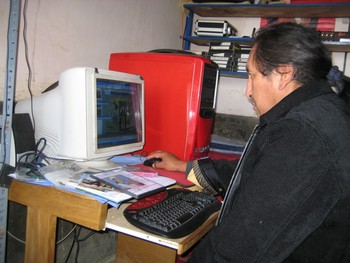
It was as a video editor of his 2008 Carnival VCD that Gregorio entered new territory and was most proud of his artistic achievement (Figure 2). Despite the constant technical challenges and limited footage he had to work with (due to our disastrous location filming expeditions), he was immensely excited by the creative possibilities video editing offered. Indeed, he presented these new opportunities as a logical extension of his creative work as an artist/composer, a new dimension to his holistic vision of ‘the artist’. In this respect he presented himself as a ‘leader’ and innovator. While undoubtedly exceptional, he nonetheless followed many of the standard practices and conventions of generic music video production, such as the use of multiple unprepared changes of clothing and location. These are seen to enhance the visual richness and quirkiness of music video, the narrative being carried by the music (Vernallis Reference Vernallis2004). However, Gregorio's inclusion of video footage from urban contexts (albeit a pragmatic necessity) suggests a rather more relaxed attitude to cultural authenticity than is evident among urban mestizo video editors working in commercial studios, such as CG Records of Cochabamba. As outsiders to rural culture, these editors told me that it was paramount to maintain the ‘originality of the place’ and to avoid ‘mixing something autochthonous with something modern’. Nonetheless, compared to the later productions on which we worked, Gregorio used far fewer special effects (such as stock transitions) and remained relatively faithful to the festive communitas of Carnival's rural imaginary. His video editing also enabled him to frame, reconfigure and bring out particular themes in his representation of Macha ‘culture’, alongside attempting to protect his economic interests by incorporating numerous screen text warnings against piracy.
Gregorio Mamani in the process of video editing. Photograph by Henry Stobart.

A notable aspect of Gregorio's Carnival 2008 video, which marks it out from other productions of rural Carnival music, is its frequent and explicit references to sirinus or serenos, the demonic spirit beings associated with Carnival and musical enchantment or creativity. On several occasions Gregorio uses screen text to label images of himself playing a giant pinkillu flute beside a large boulder or emerging from a waterfall as Sereno (‘Siren’) or Sereno Carnaval (‘Carnival Siren’), invoking these beings' association with waterfalls or rocks (Stobart Reference Stobart, Austern and Naroditskaya2006a, pp. 121–4). Also labelled sereno, he sometimes appears in a gorilla suit or playing a qunquta guitar in a monkey mask, a comic effect which provoked much hilarity during production.Footnote 11 These various personifications play with and give tangible form to local imaginaries; for example, various rural people told me that sirinus resemble humans in Carnival dress or transform into all manner of animals, which presumably does not rule out a gorilla. Most strikingly, the screen text El que cree en sereno es ARTISTA (‘He who believes in the sirinu is an ARTIST’) appears in the final credits of the video alongside Cinthia dancing in front of the waterfall wearing an almilla dress (Video link 7). This is followed a little later by a close-up image of a waterfall and the words Mira la FAJCHA Footnote 12Carnaval (‘Watch the Carnival WATERFALL’) and then Supay FANTASMA (‘Supay [Andean devil] PHANTOM’). The sequence ends with Gregorio, in a monkey mask, singing to the qunquta guitar, gradually disappearing into the waterfall. In these various examples, Gregorio creatively exploits digital technology to reproduce, play with, and resignify local ideas about musical enchantment. This includes reference to the way that ‘phantom melodies’ are claimed to enter the mind, ‘as if in a dream’, while contemplating waterfalls (Mercado Reference Mercado1996, p. 49; Stobart Reference Stobart, Austern and Naroditskaya2006a, pp. 119–20). In turn, Gregorio's use of these images and text enables him to assert his authenticity as an ‘artist’ and medium of the sirinu's inspiration; a claim to a kind of exclusive indigenous identity. Such meanings would be lost on a wider national or international audience, who would perhaps be more concerned with – and disappointed by – the video's technical quality and the (lack of) perceived cultural authenticity, based on ‘the narrow imaginative space allowed for [indigenous people] in Western popular imaginations’ (Conklin Reference Conklin1997, p. 728).
Conclusion
In this essay I have shown how, from the isolation of his home studio in urban Sucre, Gregorio Mamani used digital technology to evoke a sense of communitas in his 2008 Zura zura Carnival music video. The artifice and individual creativity involved in the multi-tracking and video editing of this commodified product contrasts strikingly with the associations of rural Andean music and dance with ‘heightened social interaction’ and ‘a social tendency to emphasise the collective over the individual’ (Turino Reference Turino2008a, pp. 23, 25). But even if it is not the fruit of group collaboration and participation, this VCD is nonetheless seen to reflect Gregorio's deep knowledge and experience of Macha culture and aesthetics. His decision to work in isolation and independently was in large part pragmatic; it enabled him to speed up the production process, retain artistic and economic control, greatly reduce costs, and avoid undue reliance on reciprocal relationships, especially with his rural community of origin in ayllu Macha.
I estimate that from the 2,000 VCDs Gregorio produced and sold in 2008, before the disc was pirated, his total profits (after direct costs) for his two months of work amounted to around 4,000 Bs or £260Footnote 13 (that is, 2 Bs or £0.13 per disc).Footnote 14 Although by Bolivian standards such a level of income is not particularly low, VCD production – especially when aimed at a low-income market and competing with pirate prices – is certainly not lucrative. As is increasingly the case in the music business elsewhere, music recordings and videos primarily serve to promote the artist rather than as a source of income. Indeed, Gregorio often told me that he relied financially on his live performance engagements. Even though few and far between, he could command around 2,000 Bs for an evening (divided 50/50 between himself and his two accompanists). However, he does not perform Carnival pinkillu music at such engagements (and does not even own a set of flutes). Although his Zura zura Carnival music production was certainly entrepreneurial in intent, it also needs to be understood in the context of Gregorio's cultural activism and political aspirations.
Gregorio explicitly presented his Zura zura productions as a means to ‘strengthen’ and ‘disseminate’ cultura (specifically meaning autochthonous rural traditions), and to challenge its appropriation and ‘distortion’ by others (especially urban mestizos). While there is little doubt that such productions have raised the profile of rural music and engendered a sense of pride among people who identify with this heritage, they may also be seen to promote Gregorio's identity and legitimacy as a culture bearer, authority and spokesperson for originario culture. While it might be tempting to interpret this as an opportunistic response to Bolivia's pro-indigenous government, it has been shown that Gregorio was producing recordings of indigenous Carnival music long before Evo Morales came to power in 2006. Indeed, it might even be argued that such initiatives helped create the conditions which enabled an ‘indigenous’ president to be elected.
While following a standard and conservative format shaped by recording industry practices, Gregorio's Carnival VCD occupies a curious middle ground between entertainment and cultural representation. Yet it also engages directly with local oral tradition, indigenous reproduction, and perceptions of identity; these recordings act as a source of new wayñu melodies for live performance. This was brought home to me when I briefly visited Kalankira during the feast of Carnival, just over a month after the video's release. A group of young lads of the community, who work for most of the year as builders' labourers in the city of Potosí, arrived at my host family's corral – decked out in local Carnival dress – playing one of the melodies from the video on pinkillu flutes for a ritual dedicated to the fertility of the llama herd. Could the sight of the video being played in Potosi's market stalls or on television have engendered a sense of pride and contemporary relevance among these lads for their rural heritage, encouraging them to maintain such traditions rather than shun them as shameful?
This commodified and technological product may also have helped rekindle interest in the vanishing traditions surrounding the sirinus, albeit resignifying local imaginaries of these enchanting but dangerous spirit beings connected with musical creativity. But is the explicit visual representation of these mysterious beings, and the increased cultural currency that results, likely to heighten their potency or to reduce them to harmless figures of fun? This leads to more general questions about the impact of such kinds of digital audiovisual productions. What is the balance, then, between their contribution to the fixing, essentialising and commodification of cultural practices and their potential to engender creativity, contemporary relevance and communities of participation? Certainly, such videos do connect many urban migrants with the cultural expressions – however essentialised – of their rural origins, connections that have grown in significance with the rise of a national political discourse of indigeneity (Canessa Reference Canessa2006).
Finally, this paper explored the tension between individual and collective creativity. It is easy to be cynical about the way Gregorio asserted proprietary interests by claiming that only one or two individuals in an indigenous community are truly composers. However, why is it perfectly acceptable for individuals in, for example, the UK to be presented as composers, whereas indigenous people are expected to submit creativity to the community? It would seem that neither of these extremes adequately represents the kinds of social processes and relationships underlying musical or other forms of creativity. Just as individual authorship may fail to recognise broader collective and cultural contributions (Barthes Reference Barthes and Heath1977; Becker Reference Becker1982), popular conceptions of indigenous culture tend to reify and romanticise the idea of ‘community’ and underplay the creative role of particular individuals. Although indigenous video makers who work within frameworks that provide external technical and economic support are able to closely integrate communities in their work, presenting themselves as ‘social communicators’ rather than producers or authors (Himpele Reference Himpele2008, p. 206), Gregorio's entrepreneurial and idiosyncratic productions have not benefited from the luxury of such support. Even if fulfilling a political role, his music videos need to be economically viable and able to promote his reputation as an ‘artist’, with the cultural baggage and tensions this entails.
Acknowledgements
Special thanks are due to Gregorio Mamani, his family, and the many other friends in Bolivia who so generously gave of their time towards this research. The Museum of Ethnography and Folklore (MUSEF), La Paz – especially Varinia Oros and director Ramiro Molina – have also been wonderfully supportive. The astute and helpful comments on earlier versions of this essay by Hettie Malcomson, Barbara Bradby and Jan Fairley are warmly appreciated, as is Jan's patience! Finally, the support of the British Academy (http://www.britac.ac.uk) and the UK Arts and Humanities Research Council (http://www.ahrc.ac.uk) is gratefully acknowledged.