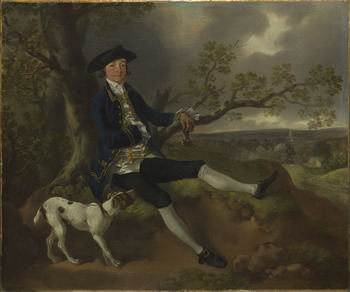
In Thomas Gainsborough's painting of ca. 1752, John Plampin (ca. 1727–1805) (figure 1) reclines atop a grassy mound, supported by a mature sycamore tree. He is groomed and sleek. From his left hand, covered with a soft leather glove, dangles the right glove. His right hand is tucked firmly into his white satin waistcoat. No skin is visible apart from his dignified, youthful, pink round face. The eager and ready stance of his hound hints that he could rise at a moment's notice, if he so wished. But for now, Plampin the hunter—in his fitted black breeches, knitted white stockings, and legs falling slightly apart—stretches his legs out ahead of him and relaxes with easy confidence.
Thomas Gainsborough, John Plampin, ca. 1752. Oil on canvas, 50.2 × 60.3 cm. © The National Gallery, London.

As it is represented in the painting, Plampin's form reflects not only Gainsborough's visual style and the conventions of portraiture, but also changing fashions in men's clothing. Beginning in the Middle Ages, and particularly for men, looser clothing was gradually replaced with tighter garments that, by the Renaissance, presented “newly accentuated sexual differences as embodied.”Footnote 1 But it was the court of Charles II that introduced a template that would be long lasting for men of all social groups: a three-piece suit comprising plain, narrow and tapered breeches, topped with a vest or waistcoat and coat;Footnote 2 bifurcated garments became synonymous with masculinity.Footnote 3 Projection had long been “the fundamental principle of masculinity”; changes in clothing that allowed for greater accentuation of the male form resulted, by the mid-eighteenth century, in the leg becoming the object of projection, forming a synecdochic relationship to the longer-lined and closely wrapped male silhouette.Footnote 4 Plampin's apparent ease belies the tight fastenings that clothe his body from neck to toe, exposing the distinctive male shape of that body.
Historians' understanding of the history of men's dress remains shaped by what J. C. Flugel, in The Psychology of Clothes, characterized as “the Great Masculine Renunciation.” Flugel saw the simplification of men's dress from the late eighteenth century producing uniformity and decorative reduction, and contrasting with the “erotic exposure” of women's dress. “Man abandoned his claim to be considered beautiful,” Flugel argued, leading to a “repression of phallicism” and “an abhorrence of the male genitals” by the early twentieth century.Footnote 5 Both Flugel's interpretation and his emphasis on the way clothes worked as signifiers is characteristic of the history of men's dress, including the only thorough-going history of English men's clothing during the eighteenth century, David Kuchta's The Three-Piece Suit and Modern Masculinity.Footnote 6 Kuchta traces the Great Male Renunciation back to the late seventeenth and eighteenth centuries. Aristocratic men's claims to political legitimacy in this period, Kuchta argues, were based on a renunciation of the feminizing world of fashion and the deployment of a masculinist discourse of “inconspicuous consumption,” which he tracks as a shift away from flamboyance and towards darkness and simplicity. From 1750 it was middle-class men who appropriated this discourse.Footnote 7 Kuchta's account of the Great Male Renunciation has been criticized, not least on the grounds that men continued to engage with fashion well into the nineteenth century and beyond.Footnote 8 However, as I argue here, the public authority that accrued to men through their clothing was based not on a new image of a rational disembodied man but instead on an emphasis on male anatomy and on masculinity as intrinsically embodied. Central to this was clothing and the exposure of the male form this allowed.
In examining the ways in which changing fashions contributed to new ideas about the male body, I engage work on sexual difference, including debates on when and in what ways such differences changed, as well as how historians should study them. Clothing is tied closely to categories of sexual difference. As Thomas King puts it, “the ‘great masculine renunciation’ made men and women.”Footnote 9 Historians debate precisely when men and women were “made.”Footnote 10 Randolph Trumbach locates the shift in 1700, connecting changes in categories of sex with those of gender and sexuality to argue for a new heterosexual masculine identity.Footnote 11 Thomas Laqueur envisaged a more sudden shift from a “one-sex” (vertical) model of sexual difference to a “two-sex” (horizontal) model in medical writing at the end of the eighteenth century, a chronology that matches more closely with Kuchta's finding that the renunciation became widespread among men after 1750.Footnote 12 I agree with Kuchta's and Laqueur's view, and suggest that widespread change happened after mid-century. Yet I also engage critically with the discursive or constructionist approaches that are foundational to their work by combining them with other approaches that consider the materiality of both clothing and the body.
Dror Wahrman has called for “a corporealist critique” of cultural histories of gender and Lyndal Roper has insisted that historians develop tools that acknowledge the “embodied subjects” of the past.Footnote 13 Indeed, scholars in several disciplines counsel that cognition, language, and human culture are embodied.Footnote 14 Historians have subjected the concept of embodiment to cultural-historical analysis. Laqueur argued that it was in the late eighteenth century that the body was naturalized as a precultural truth and sex became embodied as an ontological, not sociological, category.Footnote 15 Other historians, informed by the work of feminist philosophers who explore the social or lived body as constructed or performed, have examined medical and social practices around the physical body, including the materiality of clothing.Footnote 16 Yet thinking about the body as an instrument that performs socially or culturally constructed sexed or gendered identities is not the same as examining the physical body as a material agent in creating sexed and gendered experiences, nor even probing the “relationship between the body's cultural construction and its corporeal experience,” as Laura Gowing has done for seventeenth-century women.Footnote 17
Exploring the possibility of analyzing sex and gender as embodied, not simply performed, I suggest that historians can study the lived, embodied experience of gender—in this case masculinity—by adopting an interdisciplinary approach to material culture that combines the materiality of men's clothing with the representational.Footnote 18 I use a variety of sources to reconstruct men's experiences of their dress and, in particular, the dressing of the leg, combining visual representations with writing on aesthetics and dance and from the genres of erotica, political satire, and pornography, as well as a small sample of the accounts, receipts, bills, miscellanea, and letters that include information on the clothing of six men dating from 1701 to 1830. In contrast to probate inventories, accounts are rarely used in large-scale systematic studies of consumption because of the enormous variety of forms these documents take. Yet even this small selection provides evidence of the range of clothing goods purchased and the variety of meanings they held for consumers. I also integrate examples of male legwear, dating from ca. 1738 to ca. 1825, drawn from the collections of the Fashion Museum in Bath, the Manchester Gallery of Costume (Platt Hall), the Museum of London, the National Maritime Museum, and the Victoria and Albert Museum.Footnote 19 Historians have shown that the long eighteenth century saw dramatic changes in sex and gender identities and that changing ideals of manhood and forms of dress accrued to men a new authority in the public sphere. I argue, further, that these identities were created and experienced materially, affording clothing a principal role in the story. I begin by examining the production and consumption of, and men's comments on, dress, integrating the visual and material record. In contrast to semiotic accounts of male dress that focus on a narrow range of meanings for the dominant template, I argue that there was a wide range of meanings attached to male dress. Differences in men's clothing connoted social rank and stage of life, but men also associated their dress with values such as thrift, decency, benevolence, and homosocial bonds. In stark contrast to accounts of a male renunciation, we find a particularly powerful constellation of meanings pertaining to male beauty and power that accrued to the leg in particular. I explore this in some detail, arguing that this cultural context combined with the increased exposure of the male body through legwear to create an increasing consciousness of the male form.
I close with an exploration of how the leg connoted not just male beauty and strength but specifically reproductive power. I argue that the changing material experience of the clothed male body had a direct impact on masculinity as embodied identity, interacting with the body and changing the way men experienced those bodies, and I end with an exploration of the emergence of a new form of citizenship based on the body in the late eighteenth century.
PRODUCTION, CONSUMPTION, AND MEANINGS
Within the overall template of coat, waistcoat, and breeches, new production methods and textiles allowed for considerable variety in the quantity and quality, cut, color, and fabric within the template of the three-piece suit, thereby providing eighteenth-century men with considerable diversity of clothing choices. The single greatest change in the use of textiles during the early modern period was the replacement of heavy and dark wools by lighter linen and cotton, ultimately transforming even plebeian wardrobes.Footnote 20 Prices of woolens and worsteds declined while those of linens and cottons stabilized, and in some cases rose;Footnote 21 new textiles were used by people of varying social rank but in different quantities and qualities, and were not accessible to all.
This was true for both breeches and stockings. Cotton became a widely used textile for breeches but only began to replace the traditional leather breeches for laboring men in the final two decades of the eighteenth century.Footnote 22 Cotton had an enormous impact on the stocking industry: 22 percent of domestic cotton workers in 1795 were framework knitters in the hosiery industry.Footnote 23 Prior to the eighteenth century, fine knitted silk or jersey stockings with stretch and translucence were available only to the very wealthy. After William Lee invented the stocking frame in 1589, other men wore stockings made from stitched linen or hand- or frame-knitted from wool or worsted, which, regardless of how rough or fine they were, tended to sag.Footnote 24 Following the adaptation of Lee's knitting-frame for cotton in Nottingham in 1732 and later changes that enabled ribbing for elasticity in the stocking, cheaper knitted and fitted white cotton stockings became more widely available.Footnote 25 More men now enjoyed access to the sleek, pale look previously achieved only in knitted silk and modeled by John Plampin. As with cotton breeches, it took some time before the poor wore white cotton hose. Cotton still only accounted for 15 percent of stockings mentioned in newspaper advertisements for runaways after 1770, while most remaining were worsteds of varying colors.Footnote 26 In the Suffolk village of Brandon in 1789, the postmaster owned at least twenty-one pairs, of which fifteen were cotton; the tailor sixteen, the blacksmith eleven, of which eight were worsted, and a servant only three.Footnote 27 While all fit within the template of the three-piece suit, these men's legs would nevertheless have cut contrasting figures in texture, fit, and color.
Men's clothing purchases were conditioned by rank and wealth, though this was perhaps attenuated by secondhand and, from the second half of the eighteenth century, inexpensive ready-to-wear clothes.Footnote 28 Within this general picture, microcommunities developed their own sartorial codes. Lemire notes that young working men in late eighteenth-century London, for example, purposefully adopted a style of dress that was quite distinct from the somber template and mimicked earlier aristocratic style. These men announced their youthful, working, and urban identity through dress that disrupted “ancient hierarchies and marked the modern era.”Footnote 29 The variety in men's clothing allowed for multiple meanings that outstripped modesty, sobriety, and the rise of middle-class manly hegemony; for men, sartorial style was combined with personal decency, thriftiness, benevolence, deference, and male homosocial bonds. While discourses of luxury had long associated conspicuous or excessive consumption with effeminacy and lack of economy, advice counseled men to spend proportionately more on clothing than women.Footnote 30 One contemporary recommendation for laborers' budgets instructed husbands to take 42 percent of the annual household clothing budget (compared to the 28 percent taken by the wife), partly because men's shoes and clothing were more expensive than women's.Footnote 31 One of the most striking features of men's accounts is the remarkable frequency with which they record small items of clothing. This underlines the regularity of men's consumption of relatively modest goods and services, as opposed to the expensive and dynastic items with which they have sometimes been associated.Footnote 32 Indeed, virtually any page of a man's eighteenth-century account book belies “renunciation.”
Men's consumption of clothing was no doubt driven by personal taste and body shape. Yet even in the small sample I examined there are some noticeable patterns in both the nature of men's purchasing and the meanings of their consumption, particularly with regards to the life cycle. Young men's accounts—especially those of bachelors—show new acquisitions, the building up of a wardrobe, and relatively few repairs. While a student at Cambridge, for example, the young Daniel Baker wrote a thank-you letter to his parents in 1706, listing the items they had sent to him. “A new suit of brown color cloaths” and a “pair of breeches Norway Doe” were included: just two pairs, then, to accompany the four new shirts, four pairs of stockings, and five new pairs of gloves.Footnote 33 At a similar stage in life though with greater independence, the apprentice grocer George Newton amassed an extensive wardrobe in the first six years of his apprenticeship and particularly in the months just before and after he took up that apprenticeship in Darlington. He made entries for thirty-three new clothing items from two different tailors in 1774 and 1775.Footnote 34 He bought a pair of leather breeches for 7 shillings in 1775 and another in 1776, though for more than double the previous price.Footnote 35 As he grew into his newfound independence, the descriptions of clothing change: “plated buttons,” “superfine claret cloth,” and “shalloon” appear in 1776.Footnote 36 By 1781 he was doing what men invariably did with their most valuable possessions: he made lists of them. One such list, dated 18 February 1781, includes nine shirts, thirteen pairs of stockings (six blue, one black, three unbleached, one bleached, one white worsted, and one white cotton), a red-and-white spotted neck cloth, and three pairs of breeches (one black, one “rib de leur,” one leather).Footnote 37 Older, particularly married, men tended to make fewer new purchases, and their accounts included more entries for repairs. Two-thirds of the smaller weekly items in the accounts Sir Richard Brooke, 6th Baronet, of Norton Priory in Cheshire, had with his tailor for the year 1815 were for “Sundry Repairs.”Footnote 38
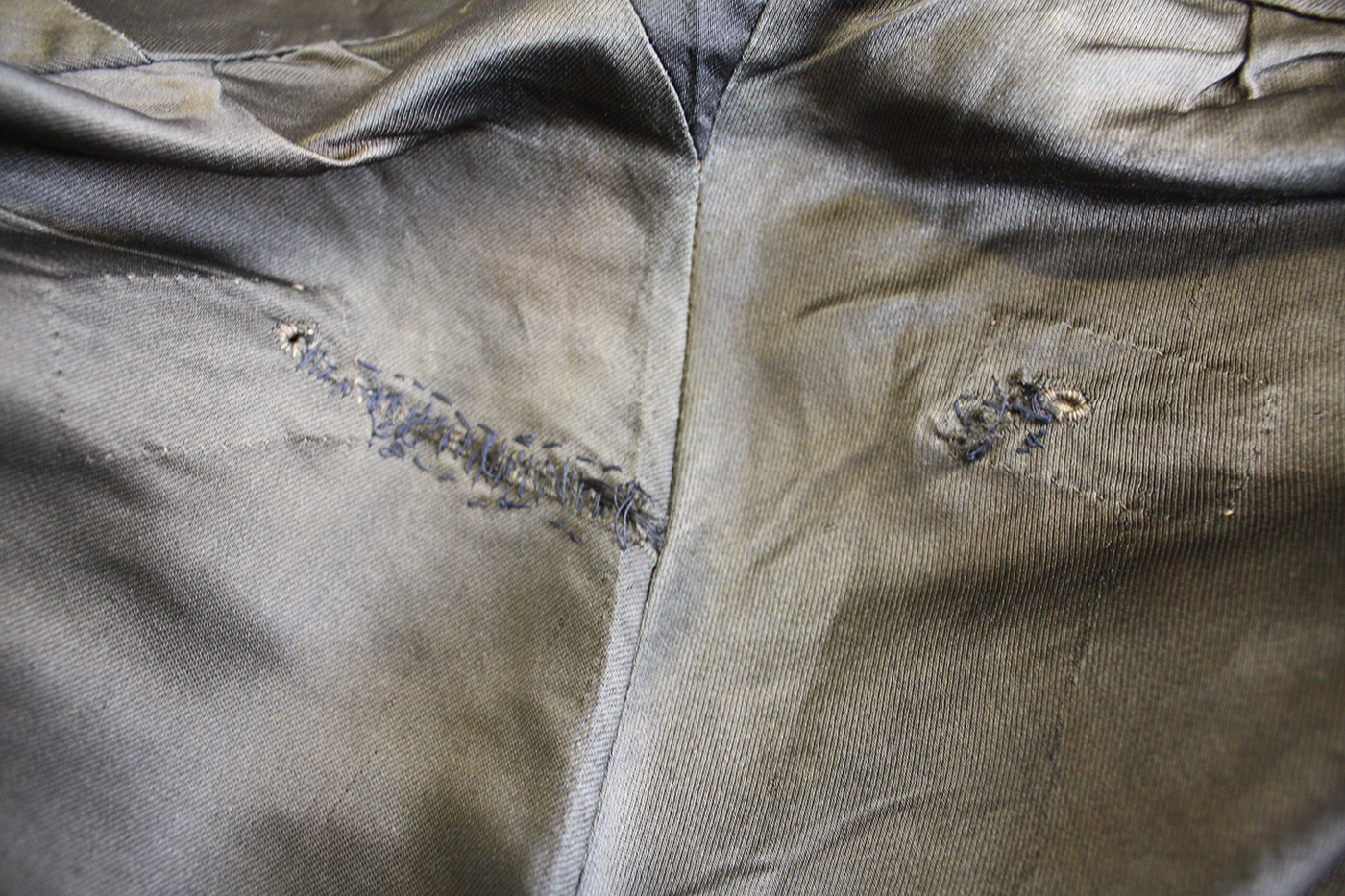
The practice of regular clothing repairs evident in the manuscript sources is also palpable in the many fine extant examples of eighteenth-century men's legwear. Most items that survive in museum collections are, naturally, high-end items in good condition, carefully preserved for their quality and style. This makes the visible signs of wear all the more remarkable. A large proportion of breeches in particular contain holes.Footnote 39 Many such breeches were kept in use by repeated repairs, a surprising number of which are of a very poor standard.
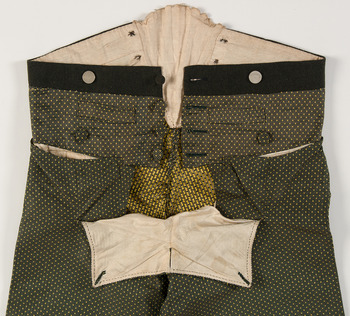
This is the case for these late eighteenth-century breeches in olive brown (originally black) twilled silk (figure 2).Footnote 40 It is difficult to be certain about who undertook these repairs and when, yet we can be sure that they were not undertaken by a competent seamstress; while many men could sew well, we might be witnessing the quick, essential repairs carried out by the male owner or late owner of this garment. Repairs suggest thriftiness as well as a possible attachment to particular garments. This was evidently the case for Robert Sharp, a schoolteacher and shopkeeper, who not only had clothes repaired but made new clothes out of old garments. Being smaller than his son William, Sharp had made a pair of black breeches and a waistcoat out of some trousers and a coat that William sent in 1825, while in 1827 he planned again to get “excellent waistcoats” out of some secondhand trousers he received.Footnote 41 This circulation of garments between men comes out strongly from their accounting of clothes. It echoes the aging of men's bodies, as sons passed up their clothes to their shrinking fathers. As George Newton dressed one morning in 1779, his reaction to finding his clothes too small was instinctive: “Stockings too little: resolv'd to send them to my Father.”Footnote 42
Breeches, black twilled silk with linen (exterior of rear seat), second half of eighteenth century. © Gallery of Costume, Platt Hall, Manchester City Galleries, 1954.1107.

The homosocial circulation of clothes also traced the contours of the social hierarchy, as clothes were passed down from master to servant or workman. A poacher's son was rewarded with “a Pair of Breeches & a Coat of something of that Sort that wou'd be of use to Him,”Footnote 43 and a new courier who complained that he had no breeches was given a leather pair to enable him to carry out his duties.Footnote 44 Francis Bull thanked his benefactor in the most effusive terms on receiving a present of old clothes. “Reverend & worthy, indulgent & compassionate bounteous & ever valuable Sir,” he began,
I would give you as many thanks as the clothes contain threads. I thank you dear Sir for the handsome and very valuable black coat. I thank you for the genteel blue coat, I thank you for the neat cloth breeches. I thank you for the pieces you sent to repair them with. I thank you for the beautiful wig, and I thank you for paying the carriage of the whole.
In haste, Bull had shaved off his hair to don the wig but then realized he could not wear a wig at all times. So he weakly asked, “as I have cut off my hair am at a loss for a cap: if you have one to dispose of, silk or velvet, should be glad of it.” It did not end there. The coat and breeches were all very well but did not make an outfit: “I am ashamed to speak, yet must own that your present would have been rather more complete if you had obliged me with a waistcoat along with it.”Footnote 45 Here was a script of benevolence and gratitude, even if the breeches were full of holes, yet Bull's dutiful gratitude did not quash his equally strong sense of fashion and decency.
Decency was a palpable motivation in the repairs to breeches. These garments were particularly prone to damage given their tight fit over body parts that rubbed incessantly on seating and, for some, horses; all holes had to be stitched and sealed. Breeches marked the male leg as decent but also adult, signaling a boy's transition from incontinence to mastery of his bowel control.Footnote 46 The loosening, loss, or fall of stockings also suggested a worrying degeneration or regression from self-control.Footnote 47 Conversely, neat and closer-fitting garments avoided imputations of being “ragged,” a term used to describe both clothing and people.Footnote 48 Francis Bull likened the change wrought by his new clothes from his “dirty ragged apparel two years ago” to “the reality of some of Ovid's Metamorphoses.”Footnote 49 Dress was profoundly transformative for a man and clothing was discussed in the context of not one but several different lexicons of masculinity.
THE GENTLEST WAVE AND THE MEMBER OF STRENGTH
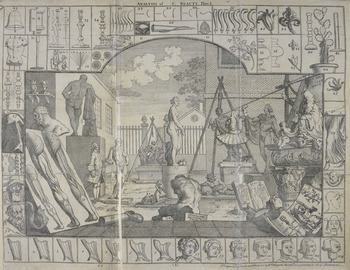
The social practices surrounding men's clothing suggest a range of meanings for men's dress and legwear. Yet cultural representations reveal yet other meanings attached to the male leg: those of beauty, power, and sensuality. When authors wanted to depict beauty, they used both the female and the male form to do so. In William Hogarth's The Analysis of Beauty, for example, the serpentine line of beauty formed around women's bodies at the waist and in men's along the legs (figure 3).
Plate I in William Hogarth, The Analysis of Beauty: Written with a view of Fixing the fluctuating ideas of Taste (London, 1753). © British Library Board, 562.b.19.

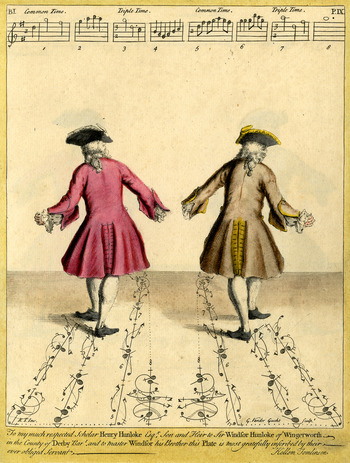
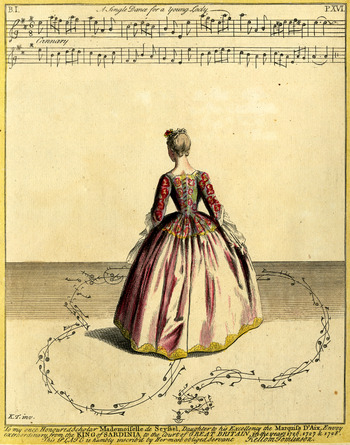
This perfect curve was best represented in a man's “muscular leg and thigh,” in which the waves and twists of the lower leg in particular had the greater variety and beauty.Footnote 50 The serpentine line curved around the male leg, in a “flow from muscle to muscle along the elastic skin, as pleasantly as the lightest skiff dances over the gentlest wave.”Footnote 51 Dance was not just a metaphor but a practice that exemplified Hogarth's aesthetic vision of the body; it was central to polite male comportment and showed the strong and beautiful male body in action.Footnote 52 Its techniques were even adopted in military drilling, both practices producing social harmony and consolidating “the strength, agility and grace of the male body.”Footnote 53 The male leg was particularly important to eighteenth-century dance, in which the male dancer was required to execute fast, repeated, and high but graceful jumps. More generally, the legs provided the foundation for all dance. In Kellom Tomlinson's The Art of Dancing, it was upon the legs that, “the Perfection of Dancing so much depends.”Footnote 54 The illustrations in figures 4 and 5 show the movements being performed by the male leg, though, while the female leg remains hidden. Certainly, the relative compactness of men's lower garments made their walking easier, while more generally movement of the body was profoundly gendered.Footnote 55 Though both men and women had legs, it seems only men were taught to use them. This movement was not only an expression of strength and sometimes, latent violence, but also embodied the highest standards of beauty.
Plate 9 from Kellom Tomlinson, The Art of Dancing Explained by Reading and Figures, 2nd ed. (London, 1724). © William Andrews Clark Memorial Library, University of California, Los Angeles.

Plate 16 from Kellom Tomlinson, The Art of Dancing Explained by Reading and Figures, 2nd ed. (London, 1724). © William Andrews Clark Memorial Library, University of California, Los Angeles.

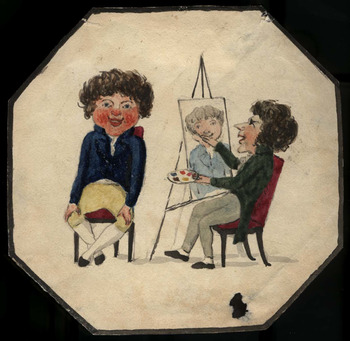
The exposure and accentuation of the lower half of the male body in light-colored breeches became more widespread in visual culture in the second half of the eighteenth century and contrasts sharply with the emphasis on decency in men's discussions of clothing. The amateur sketch in figure 6 demonstrates this exposure, showing the male groin full frontal, yet also oddly vacant. The result impresses upon the viewer the physical presence of the man's body, hiding in plain sight. The spread of these lighter breeches reflects both technological and cultural change. They were made possible by the new lighter textiles but were also popularized by the emerging fashionable figure of the “dandy” and the more established appeal of military wear.Footnote 56
Unknown artist, Caricature of a Portrait Sitting, undated. Pen and watercolor on paper, 9.5 × 9.5 cm. © Courtesy of the Huntington Art Collections, 82–78.

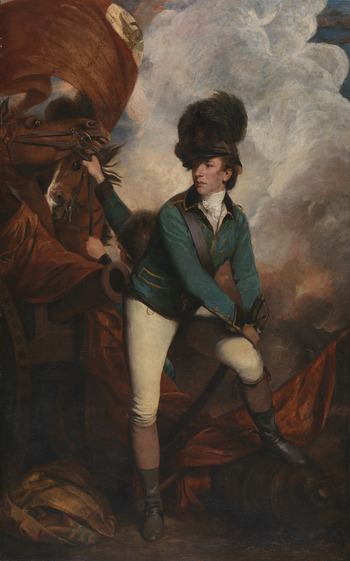
In the full-length portrait by Joshua Reynolds shown in figure 7, Colonel Banastre Tarleton dons white breeches as part of his uniform for the cavalry section of the British Legion. Tarleton was the legion's lieutenant colonel during the war with America, during which he became infamous for severe treatment of enemy combatants.Footnote 57 He was also known for his sexual indiscretions. This is why newspaper reports of an American assassination plot to kill Tarleton included superfluous descriptions of his appearance, maintaining that he “has a strong resemblance to the immortal Wolfe,”Footnote 58 another war hero who personified “British patriotism and manliness.”Footnote 59 Reynolds depicts Tarleton in the midst of the war: He is relaxed momentarily but remains standing and alert to his surroundings, rather than the viewer. He carries a weapon and his potential for action, or perhaps his ability to subdue, is signaled by the wild-eyed horses barely restrained by a second figure in the background. Reynolds depicts the famous Tarleton in “absolute authority and martial command,” though certain elements of the painting (such as the unmistakably phallic gun) serve to satirize him.Footnote 60 His right leg is centrally placed and prominent. Legs were a sign of men's fighting strength; Irish herald painter Aaron Crossly thought that of the parts of a man to be included in heraldry, the leg was “the Member of Strength, Stability, Expedition and Obedience.” Tarleton's pale, firmly erect right leg thus grounds the image and represents some of the principal components of the military masculinity being depicted, even as the painting might be inviting a critique of this.Footnote 61
Sir Joshua Reynolds, Colonel Tarleton, 1782. Oil on canvas, 236 × 145.5 cm. © The National Gallery, London.

Tarleton's pale and tight breeches also suggest full exposure of the undressed male leg. The ambivalence surrounding naked legs was nowhere clearer than in English images of Scottish legs. These prints after 1745 traded in the prejudice that Scottish men were mean, uncivilized, and bare-legged, but at the same time great Scots with high-skirted tartans and low-hanging stockings reflected the “noble virtue and martial prowess” of the Highlands.Footnote 62 As a series of wars—and losses—threatened the British nation during the final third of the eighteenth century, a manly military persona developed as one element of a reinvigoration a rough and tough masculine ideal. A heroic figure in tight-fitting breeches had become the model for “modern masculinity” by the nineteenth century, but this figure was taking shape decades before.Footnote 63 And this connection between physical prowess and masculinity was reflected in other sartorial changes, as young gentry men simplified their dress to emulate sportsmen and all men's legwear was eventually modelled on working men's trousers by the nineteenth century.Footnote 64
Tight, pale legwear was a significant change in men's dress for the fact that it mimicked skin pulled tight across muscles, the marker of a particularly manly kind of strength.Footnote 65 It also underscored European men's whiteness and visibly marked the absence of the coarse skin and hair associated with black men.Footnote 66 Indeed, in many cases these breeches were skin, being made from varieties of leather.Footnote 67 At the same time that clothing tightened around the male body, a shift of emphasis from humors to muscles and nerves in medical writing represented the body as more clearly self-contained.Footnote 68 Borrowing from a neoclassical emphasis on the body's borderlines, medical and philosophical writings theorized the body's edges and skin was redefined as the sensitive boundary to a newly individualized body.Footnote 69 According to Anne Hollander, this neoclassical aesthetic drove sartorial changes for men in ways that echoed nude sculpture and appeared to reveal ‘“natural’ anatomical facts.”Footnote 70 By the end of the eighteenth century, these newly outlined male bodies exemplified toughness and grace. Even in sports such as boxing, strength and aggression were polished off by politeness as brawny fighters stripped to the waist but retained their breeches, black leather shoes, and silver buckles.Footnote 71 The physical power of the male body had to be kept under effective self-control and this manly restraint—central, as Flugel, Kuchta, and others have argued, to bourgeois men's claims to citizenship—had to be accompanied by the physical charms of the male body. Here was a potent and distinctively eighteenth-century alignment of beauty, power, and gentility in the male body, expressed in clothed but simultaneously exposed legs. The distinctiveness of the male body was more clearly defined, as that body—and the legs in particular—became more, not less, exposed.
JUDGING WITH GREAT ACCURACY
In this cultural and material context, there was an increasing consciousness of the male form. Man's legs were scrutinized, and frequent jibes in print culture poked fun at a man's “spindle leg.”Footnote 72 No doubt an emerging ideal of a classically contoured male body gave rise to anxiety and for some men in particular. There were, for example, a large number of men who suffered impairments of the lower limbs, some produced by the very conflicts that drove the heroic ideal. Literary treatments of such characters as affecting objects of benevolent sensibility were a far cry from the experiences of the damaged returning soldier.Footnote 73 Men constituted 81 percent of those who appeared with a disability at the Old Bailey between 1675 and 1775, and of the impairments noted in trials, leg impairments were the largest single category, accounting for 39.6 percent. Significantly, trials involving disabled people increased considerably after midcentury, particularly so for men.Footnote 74 More common ailments such as gout clearly affected men's use of their legs, while the leaner male silhouette, as Hollander put it, would have been “undeniably hard on the truly fat.”Footnote 75
Some writers suggested that the attention men gave to their legs had simply gone too far: “'Tis not thy leg that God rejoices in,” warned Matthew Towle in 1770, “no, ’tis thy Soul.”Footnote 76 How justified a criticism this was we cannot know, though some men were ridiculed for their vanity in the matter of their legs. John Stuart, 3rd Earl of Bute, controversial head of government in 1762–63, was later remembered by a political rival as a vain man obsessed with his legs. In a singeing satire, a young Bute, “took the resolution neither to use a looking glass, indulge himself with one fine attitude, nor contemplate the beauties of his admirable legs, ’til he had made himself a perfect master of all Classical learning.”Footnote 77 Men's legs were surely also judged by women. Hogarth implied coyly that the new white cotton stockings enabled women's forensic examination of men's lower limbs: “as stockings are so close and thin a covering, every one judges of the different shapes and proportions of legs with great accuracy. The ladies always speak skilfully of necks, hands, and arms; and often will point out such particular beauties or defects in their make, as might easily escape the observation of a man of science.”Footnote 78 Kaja Silverman has noted that the relative richness of male dress before the alleged Great Male Renunciation puts paid to the idea that women have been the ones on display.Footnote 79 But men's bodies were objects of erotic beauty in the eighteenth century and beyond.Footnote 80
New, fitted legwear allowed men's bodies to be closely observed by men and women. Men also clearly recognized their own—not just each other's—bodies as sexualized objects of display. The Birmingham bookbinder and bookseller William Hutton remembered awakening to his potential sexual attractiveness as a sixteen-year-old in 1739. He was, he says, “arriving at that age when the two sexes begin to look at each other, consequently wish to please: and a powerful mode to win is that of dress.”Footnote 81 It is worth noting Randolph Trumbach's finding that in London during the 1720s it was tailors, with their interest in clothing, who were—after gentleman—the second most common group of men found engaging with prostitutes in the “practical male libertinism” through which men now proved their heterosexual identity.Footnote 82 Hutton was evidently seeking to consciously manipulate his own appearance through clothing as part of a heterosexual identity. The attention that the young grocer George Newton gave to his body suggests the effort involved morning and night. Newton recorded these details in his account book:
September 12th 1779 Sunday
Rose at ½ past 6: cleaned my head with Bran, com'd it well out.
7. Wash'd my Hands & Neck; went to the Barber; waited near an hour
8. Hair dress'd. & shav'd. return'd …
9. dress'd my self. mem. not a fine shirt clean. …
8. Shut up Shop, got myself shav'd, got my supper, clean'd my shoes, wash'd myself.
At 10 p.m., Newton went to bed, exhausted not by his extensive ablutions but by writing: “Mem. Tired of keeping a Journal.”Footnote 83
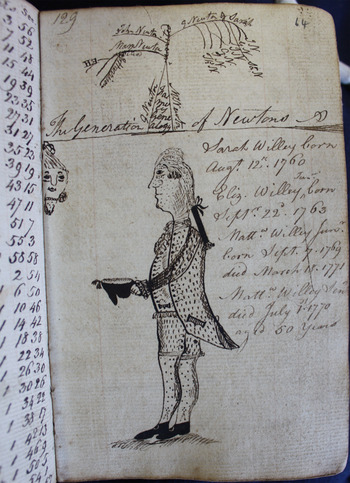
The significance of clothing to George Newton is perhaps best captured in the sketch that he made in his account book (see figure 8).Footnote 84 It does not show any particular artistic talent: the head is as long as the calf, for example. Yet Newton paid very close attention to the detail of the cut, trim, pattern, and texture of the man's outfit. The persistent marks are not a pattern of dots—this is not a polka-dotted suit—but are Newton's attempt to show the weave of the cloth. He has inserted delicate buttonholes on the coat, breeches, and waistcoat; his heavily filled-in ribbon and hat suggest the rich texture of velvet; his buckles are tiny slivers of paper around which he has colored in the shoes. Finally, his crosshatch shading at the back of the calves gives the figure a shapely pair of legs. All this is in stark contrast to the literally disembodied woman to whom the man—perhaps Newton himself—seems to be gesturing. George Newton's accounting, inventorying, and sketching must be placed in the context of other men, such as Francis Place, the London breeches maker, and James Lackington, the London shoemaker, for whom clothing was a sign of respectability, moral worth, and financial success.Footnote 85 The sketch further shows how Newton objectified the male form and relished the dressing of it.
Sketch from Account and memo book of George Newton, late eighteenth century. © Sheffield Archives, TR753.

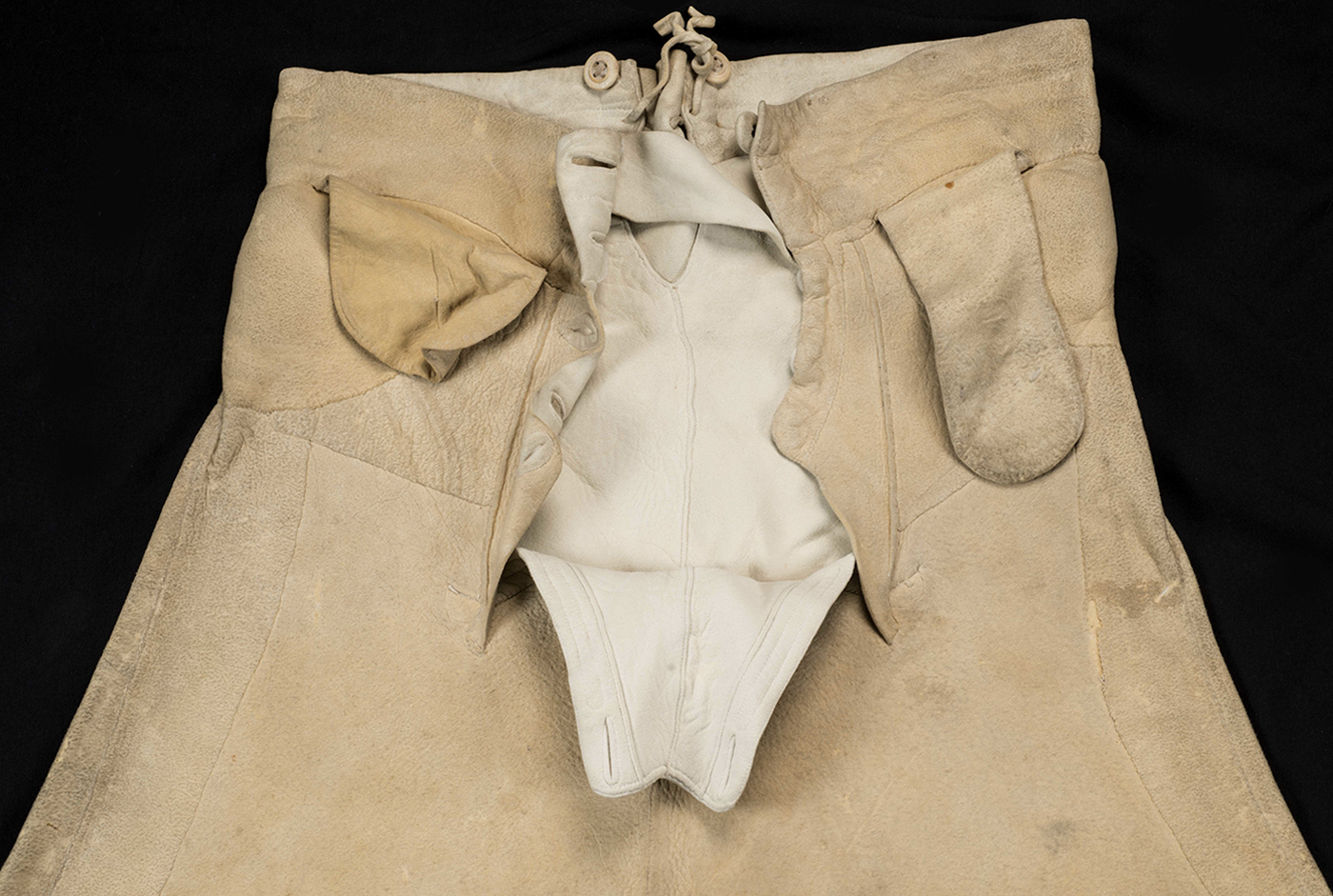
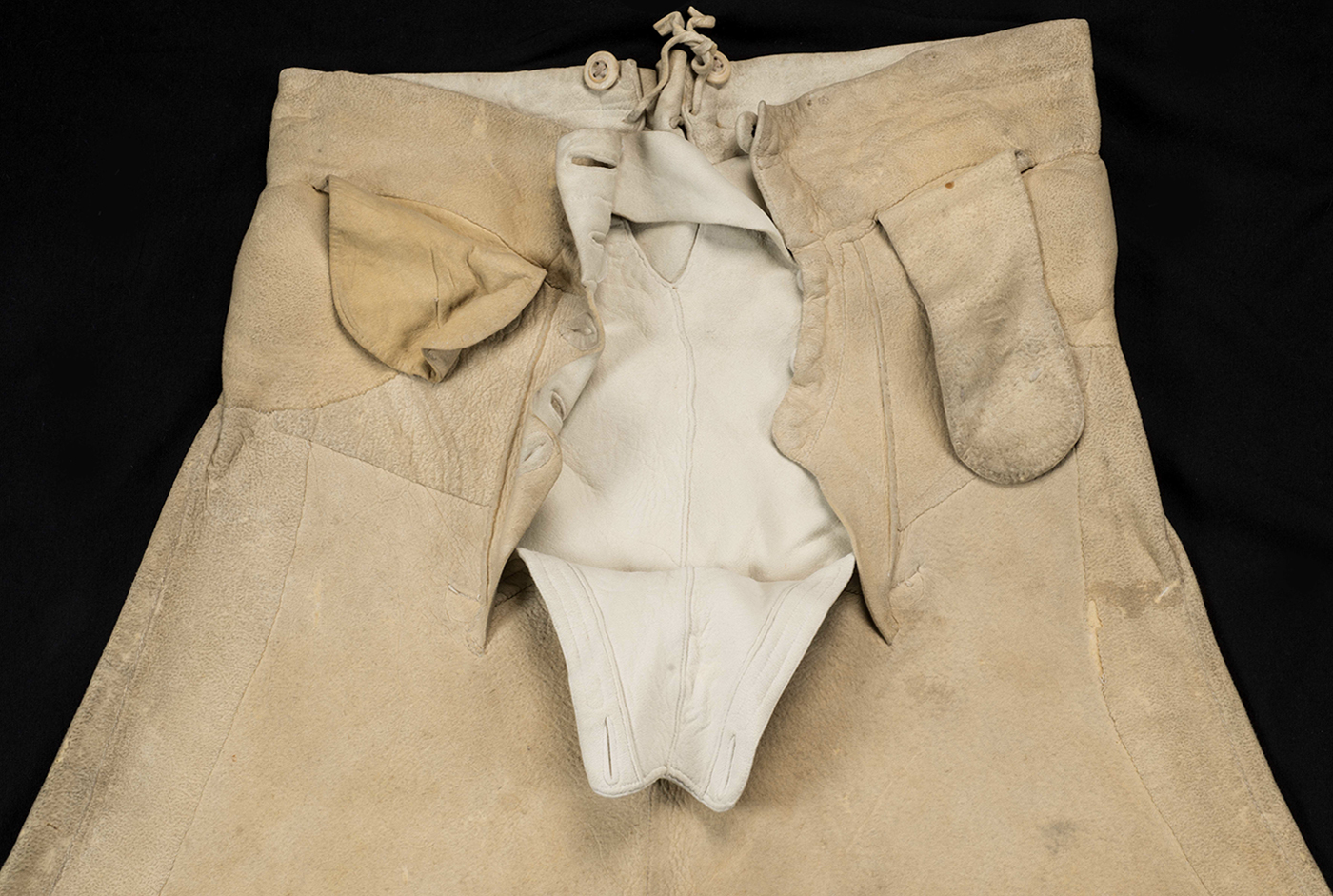
Such evidence suggests that men reflected upon their own bodies as objects of attention, and opens up the possibility that men experienced these bodies as sensual things. At the same time that changes in the shaping of women's stays at the end of the century, wrought by women's entry into the trade, were emphasizing the curved female form as erotic, the male body was also being exposed by new clothing.Footnote 86 While the male form had been regarded as beautiful before the late eighteenth century, new textiles and new styles must have affected men's experience of their own bodies. For men (and women) stockings were increasingly made of lighter and smoother fibers with stretch, likely to encourage a feeling of movement and liberty. Some silk suits were known to constrict men, yet fabrics used for breeches were softer and, particularly if unlined, would move with the body, not against it.Footnote 87 Handling eighteenth-century breeches reveals that many had a surprising degree of elasticity. If good quality and kept in the right conditions, leather breeches remained supple and sleek. Breeches were the interface between the body's interior and exterior; blurring the line between clothing and skin brought breeches to the center of the sensual experience of the body. In some cases, this was further enhanced by a construction in which the legs were each made from one panel, with the seams on the outside leg, and sharply shaped around the calf.Footnote 88Figure 9 shows such a pair of breeches that have been stored at the Museum of London inside out, preserving their dazzling whiteness.Footnote 89 Padding above the upper hip gives a straight line through the leg and torso, creating a columnar effect that evokes the classical silhouette. Such a close fit makes the physical properties of the garment—rather than simply its look—particularly significant. They are lined with soft buckskin and with a good fit, there would have been virtually no friction: the wearer would have experienced these breeches as a proverbial “second skin.”
Buckskin breeches, 1801–1825. © Museum of London, 37.5.
There is always an unstable boundary between person and clothing, such that we might see the person as both a body and its clothing.Footnote 90 While some historians see the intimate role of clothing in defining the self as declining in the early modern period, others suggest that the dressed body became more significant to gender identity during the eighteenth century.Footnote 91 Linzy Brekke locates a new “masculine idiom of material selfhood” in America and McCormack notes the “specific corporeal masculinity” valued in the British militia.Footnote 92 Clothing had a significant role to play in this. By the mid-nineteenth century, as Leonore Davidoff and Catherine Hall have noted, new pantaloons in particular, “showed off men's limbs and sexual parts, making them conscious of the way they stood.”Footnote 93 Christopher Breward has gone so far as to suggest that the mid-nineteenth-century male wardrobe was “more embodied” than women's, which flies in the face of the “masculine myth of disembodiment.”Footnote 94 Recognition of how clothing embodied the male in this way also balances Laqueur's focus on how, as a result of the new significance of the body to categories of gender, “[w]omen were too bound to their bodies.”Footnote 95 We can observe a new public role for the male body and arguably a new self-consciousness among the men whose bodies were increasingly on show. The new, tight-fitting breeches would have given men an acute sense of the surface, shape, position, and feel of their own body, as well as its exposure. Yet in stark contrast to women's embodiment, masculine embodiment empowered and liberated.
TWENTY BOYS IN HIS CALVES
The sensuality we find suggested in representations, men's commentaries, and in the clothing itself takes us some way from modesty and sobriety. Indeed, the eroticism of the male form was often focused on the male leg. As Hollander has noted, late eighteenth-century clothing for men produced, “a lean, well-muscled and very sexy body with long legs.”Footnote 96 Pornographic writing is helpful in reconstructing eighteenth-century ideas of “sexiness.” In John Cleland's Memoirs of a Woman of Pleasure, the narrator, Fanny Hill, describes the legs of her “shapely, healthy, country lad” as objects of her sexual desire: “new buck-skin breeches, that clipping close, shew'd the shape of a plump well made thigh, white stockings, garter-laced livery, shoulder-knot, altogether compos'd a figure in which the beauties of pure flesh and blood, appear'd under no disgrace from the lowness of a dress, to which a certain spruce neatness seems peculiarly fitted.”Footnote 97 As the encounter progresses, these “clipping close” breeches struggle to contain the young man's excitement:
I stole my hand upon his thighs, down one of which, I could both see and feel a stiff hard body, confin'd by his breeches, that my fingers could discover no end: curious then and eager to unfold so alarming a mystery, playing as it were with his buttons, which were bursting ripe from the active force within, those of his waist-band and foreflap flew open at a touch, when out it started; and now, disengag'd from the shirt, I saw with wonder and surprise, what? not the play-thing of a boy, not the weapon of a man, but a may-pole.Footnote 98
Erotic writing allowed male readers a space in which to admire male bodies as powerful, hard, mobile, strong, and vigorous but also as sensitive, responsive, flaccid, and vulnerable; imaginary female viewers, such as the narrator Fanny Hill, served as a device that disarmed accusations of same-sex desire that such representations of male bodies might provoke.Footnote 99 Fanny Hill thus articulates a male viewpoint.Footnote 100 Cleland's description revels in the physical pleasure derived from wearing men's clothes; the sensuality of the “clipping close,” new, and therefore soft and light colored, buckskin breeches against the skin of the wearer is palpable. The adjective “confined” and the verb “bursting” describe his sensations, not hers.
In its explicitness, Memoirs of a Woman of Pleasure is atypical of English literature of the mid-eighteenth century, but some evidence suggests that men may have escaped their foreflaps more commonly than we might expect. An episode in Laurence Sterne's The Life and Opinions of Tristram Shandy depicts the burning pain in the groin experienced by the character of Phutatorius when a hot chestnut rolls off the dinner table into his lap: he had neglected to fasten his front fall.Footnote 101 The material culture of men's breeches provides further suggestive evidence. While the lining of each of the eighteenth-century breeches I examined was plain and undecorative, there was one significant exception: the lining to the front fall (see figure 10). Medical writers suggested that men's health required clothing made of wool and cotton because they could be kept easily clean, yet, perhaps in the absence of underpants and often only linen shirts to cover the groin, silk lining was chosen to rest softly against the sensitive skin.Footnote 102 Other fabrics could provide this comfort, however. Silk was for display, and its use on the inner side of a man's fly suggests that men did indeed allow their front flaps to fall in public.
Breeches, silk with linen, ca. 1770–1780, Fashion Museum, Bath and North East Somerset Council, BATMC II.24.4.B.

This possible exposure of the male genitalia in public gives a new twist to what Anne Hollander identified as “a new genital emphasis” in late eighteenth-century men's clothing.Footnote 103 We could link the presence of the male leg, thigh, and groin to a specifically heterosexual form of masculinity, drawing upon Trumbach's account of an emerging heterosexual masculinity as opposed to a sodomitical and effeminate other. Yet this is too schematic a treatment of the way that gender interacted with people's sexual desires and also neglects the complexity of effeminacy, a discourse that far exceeded the sexual.Footnote 104 An emphasis on the male genitalia and body in general, created in part by new clothing, was not necessarily an expression of heterosexuality, though it does concur neatly with Tim Hitchcock's argument that eighteenth-century English culture was increasingly phallocentric.Footnote 105 This phallocentrism was manifest in the closely dressed male leg that connoted not just beauty and strength but male reproductive power. A striking example appears in the erotic book A Spy on Mother Midnight. “Mother Midnight” was a term for a midwife, and early in the story the women at a lying-in begin to sing the praises of Mr. Richard to their friend, Sukey: “Mr. Richard is a rare well-made Man, he's strong built and stout limb'd; I warrant you there are twenty Boys in his Calves; he's none of your Spindle-shanks: He has a hardy Complexion, a Pair of wanton Eyes, and a Nose! Ah! Sukey, such a Nose! You Jade, you, that's a promising Member; I warrant it would do a Woman's Heart good to measure the Length of it.”Footnote 106 Mr. Richard's nose is the “promising member” or penis but his calves are the measure of his fertility. If the seeds of boys were found in men's calves, then men's reproductive potency and Britain's fighting strength rested firmly upon the lower leg. This casts a new light on the close-fitting legwear of this period and, in particular, the padded stockings or artificial calves that some men wore.Footnote 107 It may also explain why men strove to improve and display their calves. A “Receipt for making the Limbs thick & strong” gave men tips on how to improve their calves but perhaps because of its link to fertility was designed “only for young Men.” Old men's bodies—as well as women's—were widely ridiculed in the eighteenth century for their lack of vigor as reproductive potency came to play an increasingly important role in representations of masculinity.Footnote 108 One wonders in this context whether George Newton's father enjoyed receiving cast-off stockings from his flourishing son. Yet young men were advised to strengthen their calves, in the case of this recipe by wearing shoes with heels no higher than a quarter of an inch.Footnote 109 This would “have the admirable effect of thickning the calves of the legs” by exercising the muscles. The evidence, the author noted, could be found among the low-heeled but strong-legged Highlanders, as well as the right arms “of workmen & most of all Labouring persones.”Footnote 110 Notably, arms represented labor, but legs were the part suited for elite display.Footnote 111 Now the most exposed part of the male body, they were physical evidence of a man's status as well as his virility. As a book of maxims informed its readers in 1753, “It is natural for a man, even for an Englishman to have a certain serenity settled in his eyes, when there is no further doubt about the fine shape of his leg.”Footnote 112
CONCLUSION
Sex and gender are thoroughly embodied identities, both in their construction and experience. Historians' work on these identities must integrate both the discursive and the physical because how things looked and felt were fundamental to what things meant. To this end, I have drawn together disparate sources of representations, archival records, and material objects—each suggesting different interpretations of clothing that broaden our understanding of men's experience. I have tried in particular to use the material culture of clothing to generate new insights into the embodied experience of masculinity. Dressing is not just “picture-making,” as Hollander remarked, because the distinctive feature of clothing as representation is that it is worn on the body.Footnote 113 As such, it has a crucial role to play in historians' engagement with corporealist accounts of human emotion, sensation, and experience. Clothing is both physical and representational: it is worn, felt, and depicted. Adopting an interdisciplinary approach to the material culture of clothing allows us to explore sensation and meaning making together, ensuring that we retain an emphasis on culture, ideology, and power even as some of the work on corporeality threatens to write these out.Footnote 114
In her discussion of the early roots of the Great Male Renunciation in early eighteenth-century periodicals, Erin Mackie asks, “how did this absence of display come to mark the presence of masculinity and power?”Footnote 115 If there was an absence of display in men's clothing, it only served to foreground the male body underneath. Changes in eighteenth-century clothing did not disguise the male body but brought it forth. In the process, men were increasingly differentiated from women and defined by their bodily form, showing “the mystery, the enigma, the unspoken of the male body” to be a historical fiction.Footnote 116 Men's own experiences of these changes were important. As John Harvey notes, “power-dressing” works in an “inward and intimate way”: “if clothes ‘mean,’ it is in the first place to ourselves.”Footnote 117 Men could enjoy the brush of soft and supple fabric on their skin and—as the century wore on—the way tight clothes empowered and enlivened. If ready-made clothing in late eighteenth- and nineteenth-century America connoted democracy without social divisions and clothing reforms in late eighteenth-century France asserted a vision of the liberated citizen's body, Kuchta proposed that in England there was a pairing of “modest masculinity with political legitimacy.”Footnote 118 By contrast, I argue that the new claims to power that nonlanded men made in this period were based not on a renunciation of the male body but were instead an example of claims to a corporeal or “embodied citizenship.”Footnote 119 Clothes meant many things to men; they also established the male body as not just different but newly embodied as beauty and power through a fusion of flesh and fabric.