Peoples’ identity and culture are intimately tied to language (Cahill, Reference Cahill2004). Local languages are valuable because they promote community cohesion and vitality, foster pride in a culture, and give a community self-confidence (Crystal, Reference Crystal2000). Yet over half of the world's languages will become extinct by the end of this century (Hinton & Hale, Reference Hinton and Hale2001; McCarty, Skutnabb-Kangas, & Magga, Reference McCarty, Skutnabb-Kangas, Magga, Spolsky and Hult2010). Currently, approximately one language dies every two weeks (Dalby, Reference Dalby2002; UNESCO, 2004; Wamalwa & Oluoch, Reference Wamalwa and Oluoch2013). Australian Indigenous languages are disappearing rapidly (Aboriginal and Torres Strait Islander Commissioner, 2009; Fishman, Reference Fishman1991; Wurm, 2001). An estimated 90 per cent of the original ~250 Indigenous Australian languages are near extinction or are extinct. Approximately 160 of the 250 languages have died out completely (Schmidt, Reference Schmidt1990; Walsh, Reference Walsh, Walsh and Yallop2005). Thirteen Indigenous languages are currently regarded as strong, five fewer than in 2005 (AIATSIS & FATSIL, 2005; Marmion, Obata, and Troy, Reference Marmion, Obata and Troy2014). Even though these languages are in remote areas experiencing less pressure from the dominant language, current trends suggest that no Australian language will be spoken in Australia by 2050 (Caffery, Reference Caffery2003:3; Caffery, Reference Caffery2010; McConvell & Thieberger, Reference McConvell and Thieberger2001:2).
Given that Australian Indigenous languages are rapidly disappearing, yet are relatively undocumented (Dixon, Reference Dixon, Robins and Uhlenbeck1991), it is vital for the general wellbeing (Biddle & Swee, Reference Biddle and Swee2012), and ‘social, emotional, employment, cognitive and health’ benefits (Aboriginal and Torres Strait Islander Commissioner, 2009) of Indigenous people that the remaining languages are maintained or documented before they disappear. In addition, Indigenous language speakers would like their languages spoken by future generations (Caffery, Reference Caffery2008; Marmion et al., Reference Marmion, Obata and Troy2014). For this, Indigenous languages need to be adequately documented; it is recognised that one of the best ways to achieve documentation is for Indigenous language speakers to document and maintain their own traditional languages (Ober, Reference Ober2003). To do this, Indigenous language speakers need the appropriate and relevant linguistic skills; however, despite the existence of formal training courses, there are concerns that these may not be meeting the needs of Indigenous Language Researchers (ILRs). This paper tests whether current training is delivering the needed skills by exploring whether and how these needs vary by context, and asking whether the diversity of needs is being met by the current standardised approach to training. Much of this paper may also apply to language documentation and maintenance programmes around the world.
Research Design
The qualitative data for this research project came from face-to-face, one-on-one or small group interviews with Indigenous Australians in rural and remote areas across the northern half of Australia, as part of a wider study on linguistic training (Caffery, Reference Caffery2008). The terms documentation and maintenance refer here to any language work at all that is written, visual or oral at any linguistic level; it does not necessarily mean a deep linguistic analysis of aspects of the language. Also, the term ‘ILR’ is used for any Indigenous Australian trained to work on their own traditional language and includes people who have undertaken formal training, in any relevant course, through a Registered Training Organisation or have been trained on-the-job. The term ILR encompasses the terms language worker, Indigenous linguists, community linguists and any other term locally used to refer to Indigenous people working on their traditional language.
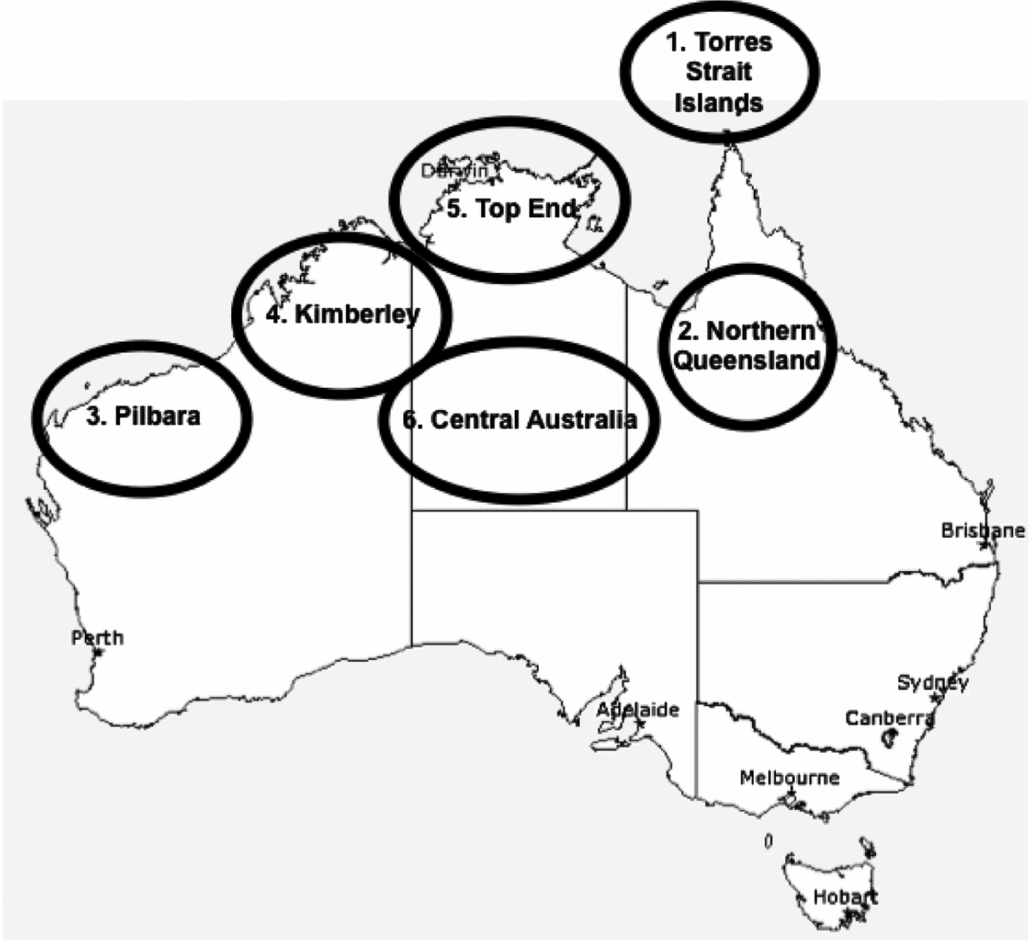
Indigenous linguistics graduates from participating educational institutions were spread across the three States/Territory of the northern half of Australia, representing many language groups. The impact of linguistics training was therefore assessed with graduates and their communities in each State/Territory. The six study regions (Map 1) were the Torres Strait in Northern Queensland (region 1); the mainland of Northern Queensland (region 2); the Pilbara in northern Western Australia (region 3); the Kimberley in far northern Western Australia (region 4); Central Australia in the Northern Territory (region 5), and the Top End of the Northern Territory (region 6).
The six main regions of study across northern Australia.

Participants were interviewed from 13 remote Australian Indigenous communities and 9 urban communities across these regions, representing a diversity of participants and their communities. In addition to the effects of remote and urban settings, this diversity included linguistic, social, geographical and political environments in order to explore whether the linguistic skills, community desires and needs and the available linguistic supports significantly differed in each setting.
During 2004 and 2005, a total of 74 confidential interviews with 98 people (70 Indigenous and 28 non-Indigenous participants) from 32 language groups were conducted across the 22 communities. Forty-four Indigenous participants were working in the field of linguistics at the time of interview, having been either formally trained or trained on-the-job. The other 26 Indigenous participants included trained ILRs not working in the field of linguistics at that time, Elders, language centre employees and other interested members of the community. Fifteen of these community members had undertaken some prior linguistics training. The non-Indigenous participants had experience documenting and maintaining Australian Indigenous languages and had worked with ILRs on language projects or taught linguistics to Indigenous adults. They were included to ascertain their views on the effectiveness of the linguistics training of ILRs.
Participants were interviewed using standardised open-ended questions (Patton, Reference Patton2002: 344–347). These were designed to stimulate discussion on topics relating to linguistics courses and the effectiveness of such training across a diversity of communities in northern Australia. The topics covered the training of ILRs, what graduates do with their linguistic skills after graduation, and what effect their skills had on the documentation or maintenance of Australia's endangered languages. The interviews explored factors that enhance or constrain an ILR when working in the field. For consistency in interview style and discussion, all interviews were conducted and analysed by the author (see Caffery, Reference Caffery2008 for full details on the methodology and benefits of one person conducting and analysing the interviews and how bias was avoided).
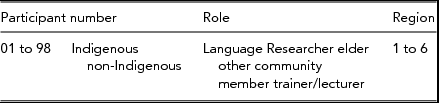
This paper presents the attitudes, practices and beliefs of Indigenous Australians regarding their traditional language maintenance and documentation activities, so their voices are used at times in this paper, along with those of others working remotely. The language used in these quotations is that of the participant in the interview. For many, English is a second, third or fourth language. As all interviews are confidential, participants’ quotations are cited using a reference system (Table 1) that provides relevant details of each individual participant but also protects their identity. An example of use of this code is ‘13IL1’, which refers to the 13th person interviewed, who is an Indigenous person, was a Language Researcher at time of participation and is from region 1. Similarly, 60NO6 was the 60th person interviewed, who is a non-Indigenous other community member from region 6.
Codes Used to Refer to Research Participants. The Characters in Bold are Those Used to Refer to that Identifying Feature of the Participant. Participants are Not Identified to Maintain Confidentiality

Findings
ILRs work in a variety of different environments across northern Australia. This section explores how work environments and consequent skill needs differ across States/Territories and within regions: The types of training undertaken by ILRs in each region: The associated issues and gaps between the skills taught in formal training programmes and what is required in the field, before discussing participants' views on their targeted training needs.
Work Environments Across the Regions
ILRs work in a diversity of workplaces across northern Australia. The types of linguistics training they undertake also differ according to their workplace. While some ILRs are trained either on-the-job or through an accredited training course, others received a mix of both types of training. As the work environments differ, so do many of the skills required for the job, as demonstrated in this section. The employment context differed significantly between the States so the results are summarised by State/Territory.
Queensland
In the north Queensland and Torres Strait Islands regions, most language work is undertaken by interested individuals and usually through their own initiative. At the time of interview, there were no language centres or other language environments where ILRs could be employed or receive on-the-job training or support. ILRs in the Queensland regions generally undertake formal linguistics training. These ILRs usually work independently or in small groups, are generally self-supporting, self-funding and require their own resources. They are required to take full responsibility for a project, including applying for funding, engaging and paying for, informants and buying the necessary equipment. They require the skills to know what equipment they need and how to use it: for example, digital recorders, computers, printers and transcription software. They need to manage funds, people and the project's day-to-day operations. They need to undertake the necessary negotiations with their community on the language work required and desired by the community. They need to do the data collection and analysis themselves as well as write up the project for community use. ILRs in Queensland generally need as many individual linguistic and administrative skills as possible since they work away from language centres where the necessary skills, support and equipment are generally available.
Western Australia
In the Western Australian regions, most language work is done through a language centre, where ILRs are part of a team and different people in that team have different but complementary skills. ILRs have a specific role to play in a language project that requires specific skills. For example, an ILR working with a Pilbara language centre needs the skills to undertake fieldwork, to collect data and to some extent analyse their data and insert it into a specific computer programme, such as Shoebox. Many of the ILRs interviewed in this region had undertaken both formal and on-the-job training and had been strongly encouraged to do both.
In the Kimberley region, the types of training differed in each community or regional town but the only employment available for an ILR was within a language centre. In one particular Kimberley language centre, the ILRs require the skills to assist a remote community in doing a language project. That is, they needed to be able to guide the community through the process, rather than do the data collection and analysis themselves. An ILR in this language centre required basic linguistic skills but also required good project management skills. Participating ILRs in this language centre only did on-the-job training. This was not because the language centre was against formal training but because the few people in this region who had undertaken formal training were unavailable for employment.
Another language centre in this region required ILRs to work on linguistics projects independently, but under the direct supervision of the language centre's non-ILR. Each ILR in this language centre worked on different projects requiring each ILR to have a different set of skills. One ILR generally collected language data from Elders while another collected similar data but mainly prepared vernacular language lessons and taught oral language skills to local schoolchildren.
Language centres across Western Australia employed the majority of their ILRs through the Community Development Employment Programme (CDEP) (a Commonwealth Government Indigenous employment initiative that provided funds to Indigenous communities and organisations in remote regions to employ unemployed Indigenous people). CDEP language researchers were called in on a needs basis. Some of them were undertaking a linguistics course at the time of interview rather than through their own funding due to financial constraints. ILRs in these regions are generally assigned language-specific linguistic tasks and are generally very well supported in all aspects of their linguistics work by non-ILRs and other staff within the workplace.
Northern Territory
In the Northern Territory, the work and training environments of ILRs differed from region to region and community to community. Many of the participating ILRs in the Top End of the Northern Territory were employed by their local community primary school. In mainstream Australia, trained teachers would normally undertake the classroom teaching and assessments of vernacular literacy programmes. However, this is not the case in many Northern Territory Indigenous schools. Usually the schoolteacher does not know the local language, so the ILR is expected to develop the vernacular literacy material and teach the programme to the schoolchildren. ILRs who teach in the classroom also assess students’ language skills according to the Northern Territory Department of Employment, Education and Training benchmarks. School-based ILRs were usually trained on-the-job as literacy workers but many had undertaken some short formal training some 25 years earlier.
The roles of ILRs in participating language centres in the Northern Territory were also diverse. Some ILRs provided oral or written information for children's storybooks or oral histories. Some went out to remote communities to record histories. Others developed vernacular literacy courses for their local school and taught the courses to the school's children. Unlike those employed in schools, these ILRs were not expected to assess the children. ILRs in these language centres were usually trained on-the-job but a few did have prior formal training.
Other participating ILRs in the Northern Territory worked with non-ILRs on independent projects. These ILRs provided specific information on a language they knew well for a specific project. They were not involved in any of the administrative or analytical aspects of the project. ILRs working on these types of projects were generally trained on-the-job and were paid through the project. Other ILRs worked in Bible study teams to translate the Bible into their traditional language. Many of these ILRs undertook on-the-job and or formal linguistic training and few were paid to work on the project. In two particular communities, ILRs who were working on Bible translation projects had been doing so for over 10 years without pay, usually working in the evenings or weekends, and thoroughly enjoyed doing so.
Types of Training Undertaken
At the time of this research two types of linguistics training were generally available to Indigenous Australians: formal training through a Registered Training Organisation or on-the-job training – there could also be a combination of both. Up to the time of this research six Registered Training Organisations offered accredited linguistics courses specifically designed for traditional remote Indigenous Australian adults: School of Australian Linguistics; Centre for Australian Languages and Linguistics, Bachelor Institute; Summer Institute of Linguistics; Pilbara TAFE; Cairns TAFE; and the Institute of Aboriginal Development. The courses these institutions offered were generally designed for graduates to work on their traditional languages in their home community and targeted specific skills. Many of the participating workplaces offered on-the-job training and this training was usually provided by the non-ILRs employed in the workplace.
At the time of this study the training institutions usually worked with language centres and Indigenous peoples to develop the formal courses and it was not unusual for students undertaking formal training to undertake work experience in their local language centre. In addition, staff from the institutions often worked closely with local language centres to support students and to ensure the relevance of their course. This, however, could not happen in areas where there were no language centres. In such cases education institution staff would put measures in place to support their students; for example, regular phone calls, Skype meetings or visits to the communities.
Whilst the relationships between the education institutions and language centres were strong and supportive of one another's students, one language centre did not encourage ILRs to attend formal training. The coordinator of this centre argues that ILRs learn more linguistic skills from the Elders in the communities and that any skills that the Elders cannot teach them are taught in-house by visiting linguists and area specialists. Some specialists are brought in from time to time to teach specific skills but at the time educational institutions did not meet their specific needs.
. . . the old people that own the language, they're kind of more your better teachers. We encourage that. Even if [Indigenous Language Researchers] are just sitting around or doing fieldtrips, the more they talk the language, the more they communicate, the better skills they've got . . . To be honest I think they (Indigenous Language Researchers) learn a lot more when the linguists come to visit and see how they do it . . . Everything's done in house, like a lot of the training. We bring in specialised trainers a lot. But that's, um, it may change when we start to get the universities and that to adapt classes towards what we need. Like, it may be a certificate course but they'll [Indigenous Language Researchers] do bits and pieces of the certificate. They don't need all of the certificate, they only need bits and pieces of it. (44IO5)
ILRs who have the opportunity to undertake both on-the-job training and formal training argue that these two methods complement each other. On-the-job training builds on the skills taught during formal training and provides them with the necessary skills to work within their particular environment.
I picked up more skills here at [the language centre] even though I did stuff at [college]. During the course, it was just basically showing me how to put it on computer and writing it and reading. It was just mainly reading, writing and sounds and when I came here [to the language centre] I learned more, like how to put it, using modern technology, how to put it on tape using Dictaphones and all that. So, I learnt more here, it's more hands on. . . (18IL3)
ILRs who work in the field with non-ILRs on a specific project are generally trained on-the-job for that project, such as developing vernacular dictionaries, grammars or Bible translation. ILRs working on such projects generally learn the necessary skills to complete their role in the project. They were usually trained by the project's non-ILR. Such training has proved quite successful when targeted to a specific project because the ILRs gain a deeper linguistic understanding of their language and skills for the job.
. . . Those who worked closely on Bible translation (and related work) became, I think, the best trained of any in language work, specifically, but not only, translation work, particularly in being able to discuss meaning. I don't think this resulted from formal or classroom training. (40NL5)
Indigenous Australians who only undertook formal linguistic training had standardised or general linguistic skills to apply in the workplace, whereas those who were trained on-the-job often had a mix of skills that were more relevant to their roles in the workplace.
Skills Required and Acquired for the Workplace
Each region across northern Australia required ILRs to have skills specific to their region and workplace. The skills required depend on the region's human and physical resources and the community's support and attitudes. Each graduate of a formal linguistics course receives the basic linguistic and analytical skills required for linguistic documentation and language maintenance programmes at various levels.
Participants across northern Australia argued that the skills needed by ILRs differed depending on the role of the ILR, the skills of others available to support that ILR, and the region they were in. One participant argued that ILRs in her region needed additional skills to meet the developing needs of their communities. She argued that language work in their region is no longer just about collecting language data before it died out, even though that is vital. She argued that it is now also about producing materials wanted or needed by the community.
Also, the expectation of the community of what we're creating with their language is different. Fifteen years ago it was just recording the languages. Now it's record our languages, put them in to a dictionary, want a morphology, make a couple of books and help us develop a LOTE programme for the school . . . (19NL3)
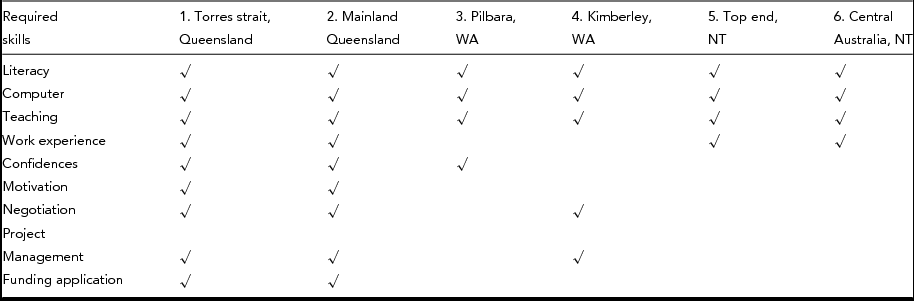
When participants were asked if they thought there were any skills that they, or ILRs, should have been taught whilst undertaking formal linguistics training, there was a large range of responses about everything from academic to personal skills. Whilst some of these varied from region to region and within regions, there were also some universal needs. Table 2 shows the main skills, in addition to the linguistic skills, that more than one participant in the region stated that ILRs required. Skills identified in only a subset of regions are discussed in Needs for Targeted Training.
Additional Skills Required by Region, as Recommended by Participants
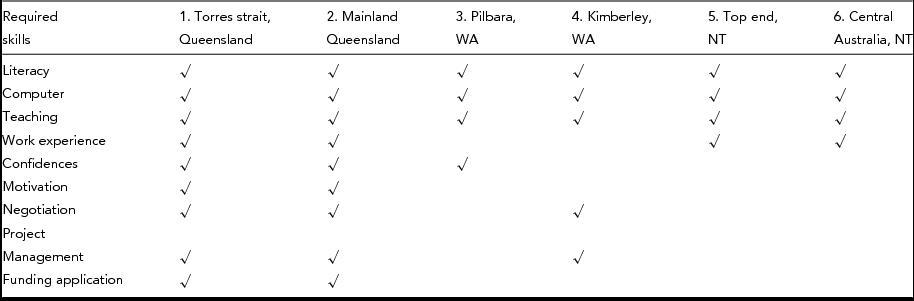
Participants argue that ILRs need better literacy, computer and teaching skills in all regions. It is notable that participants throughout Queensland argued that ILRs needed more skills in all of the areas identified in Table 2; this is also the region that has the least linguistic support from non-ILRs and linguistics organisations.
Needs for Targeted Training
The possibility that there would be a difference between rural and urban language documentation and maintenance activities and needs was not supported. In fact, the evidence indicates that there are significant differences between workplaces regardless of rural or remote communities.
Participants in the Torres Strait region argued that ILRs in their region needed the skills to work independently so they could develop and manage language projects from the beginning to the end. Such management includes applying for funding and managing any successful funding.
. . . we have to make sure they know how to work independently . . . how to look for funding, get funding, and then how to set up projects independently, you know, to set up their own projects. And be able to find out what areas they need to have projects on, like language maintenance projects. You know, identify what is going on in their community like language loss and so on. So they're able to set programmes up. So, these are the sorts of things they need to know.
And they are the sorts of things . . . they need to learn during their training? (interviewer)
Yeah, during their training. (63IL/T5)
It also requires ILRs to have negotiation skills so they can negotiate with their community about the sorts of language projects needed, and why they need that particular project rather than another. They also need to be able to advise and negotiate these needs with Elders, community council members and other community members. Participants in the Torres Strait thus emphasised the need for good negotiation, management and financial skills on top of the linguistic, literacy and computer skills needed to document or maintain their traditional language. ILRs here needed to negotiate projects with funding bodies, community councils, Elders and other interested or relevant parties. Negotiation, confidence, motivation and literacy skills go hand in hand. ILRs in regions where there is no linguistic support, regardless of region, need all of these skills to be successful in their projects.
You also have people outside the community to negotiate with. So you have to be literate. You have to write . . . when you are talking about something you need to know how to write. If you are writing a letter to a funding body you have to know how address them and you have to know how to write the submission. You have to know how to speak with them, using different terminology . . . All of this you have to know. You have to deal with people outside the community. You have to be confident in that as well because you're like the middle person between your community and the outside world. So, you have to have all these skills, you know, how you record, whether you are computer literate so you need to know all these things. You need to be confident and motivated. (04IL/T1)
Skills to apply for funding were not only a concern for ILRs in the Torres Strait region but in other areas that are not supported by language centres or other linguistics supports. Participants in these areas argued that ILRs should be taught the skills to know how to write funding applications and the administrative skills to manage any successful applications during their formal training.
Skills like negotiating with people and how to get funding and so on. How to apply for the funding, where the fundings are, you know, where you can get funding from. Ah, these are things they need to know. (63IL/T6)
Participants, particularly in Queensland and Western Australia, argued that ILRs lacked the motivation and confidence that are vital for ILRs to succeed and that these skills should be taught during their linguistics course. ILRs in these regions work in isolated areas and usually work on language projects by themselves; even if they work for a language centre they may need to travel to remote areas without the support of a non-ILR and need these skills. They rarely have the linguistic support that language centres, or non-ILRs, offer to ILRs. Participants argued that motivation and confidence should be taught during their formal linguistics training as they cannot learn how to be motivated or confident in their home community as there is nowhere for them to learn it.
. . . you need to know how to work on your own. You need confidence. You need to be motivated, you need to know how to be motivated, how to be confident. When you are on your own you haven't got lecturers directing you to say this is what we will do next . . . You know when speaking in public, with council, you need to be able to stand up and be able to talk to them at a different level, not just someone from off the streets. Maybe the course could address that. Make a unit up giving people, maybe public speaking skills. (04IL/T1)
. . . they lack this drive to work independently. They finish here and they thought they still be guided by the [college], by the lecturers when they go home. They are not confident on leaving the institute. Even though they learn the skills they're not confident enough to use them in the community. That's what I found . . . Yeah, I think it is the responsibility of the trainers as well. Whether you incorporate those things in the course or [the] Institute actually guide them in the communities. (63IL/T6)
. . . and also they need to be motivated because, you know . . . particularly the people from the remote communities or from traditional communities coming here. Those skills they are learning the first time and their parents don't have those skills for them to learn from at home when growing up . . . The other skills they probably, you know, making sure they know how their language works and also be literate in their language. (63IL/T6)
Participants raised the need several times for continued support of lecturers for graduates when they finished their formal training. This was a sign that graduates did not have the confidence to use their linguistic skills when they completed their formal training.
Yeah, but it's good to have your lecturer around so you can ask them ‘Oh, am I doing it the right way’ or ‘what's this word you can put in here’ because they know the words, the big words . . . Especially when you're writing reports and stuff. Yeah, I like my lecturers around. (09IL2)
In one Western Australian language centre, ILRs must be Elders of the community and fluent in their traditional language to work on their traditional language. These ILRs usually work on a specific language project that the centre has been funded to do, such as identifying traditional names for landmarks in the local area. In addition, one of these ILRs also taught vernacular oral skills to children from local schools. In another Western Australian language centre, ILRs required the skills to support and guide community members with their language work to ensure that projects develop in the way the community wants to see them developed.
So they (Indigenous Language Researchers) help to develop projects and support projects, language projects, so that they can develop, um, and their work is based in the community . . . They don't initiate the project. The project is initiated by the project. Then they respond as a staff, and that's their work that is to provide the support that's needed to assist the language group in the community who might be the project team in the community . . . They support the people from that language community whose language it is and who's identified the project, support those people to ensure that the project develops in the way they want to see it developed. And they as language speakers in their own right may be involved in projects within their own language community. So then they take up a different kind of role there. (27IO4)
In another Western Australian language centre ILRs work directly on linguistics projects, both in remote communities and within the centre, and each ILR works on a different language – usually their own traditional language. ILRs in this language centre do fieldwork to collect linguistic data. To do this they require advanced technological skills to use computers for communication purposes, usually e-mail, and use digital recorders and download the recordings on to a computer. They also need the skills to analyse the data using various linguistic analytical software packages and transcription programmes. Employers at this centre argue that both ILRs and non-ILRs now need more technological skills in their training and that the educational institutions that deliver linguistics courses need to include such skills in the training. This language centre relied heavily on the use of computers for all aspects of language work, including compiling dictionaries, developing teaching materials and producing various books on oral histories. They also use computer technology to communicate with one another when out in the field. They argued that, with the changes in technology and in their clientele's expectations, their ILRs need different skills from other ILRs and what is taught in the educational institutions.
. . . what they were trained with fifteen years ago to what they are expected to do now has changed . . . Aside from the fact that technology has changed and people need to be massively much more computer literate than what they were fifteen years ago, the clientele we work with has become much more sophisticated, so the way we approach language work has changed. . . . People in the communities, say about fifteen years ago, didn't have television or telephone, only a two-way radio, so there was a whole culture to do with keeping in touch with a two way radio. Now people, even out in communities, have got computers in their home, e-mails, and there is a whole different culture and different way of using language. There is this massive change that has happened in [our region]. I think the language workers fifteen years ago were trained to sit down under a tree, pencil and paper, working with people recording stories; now it's using digital recorders, transcribing it on to computers, interlinearise the Shoebox and going back and checking. So, the whole way the workers need to work has changed. (19NL3)
The need for good technological skills also applied to ILRs in all regions of northern Australia, as noted in Table 2. In summary, participants in regions where there are no linguistic supports required skills not delivered by current formal courses in all of the areas discussed above – funding application, project management and technological skills, as well as motivation, confidence and negotiation skills to carry out the required language projects. It would be unusual for anyone in any discipline to have all of the skills required to run an entire large project successfully. However, in other regions, ILR do not need to have all of the project initiation and management skills to run a language project. ILRs, other than those in Queensland and some parts of the Northern Territory, usually have the support of a language centre or other organisation at least for project and funding management. ILRs in these unsupported areas urgently need support to run language documentation and maintenance projects.
All participating ILRs who were employed by a language centre, with the exception of some of those who work in the language centre that does not encourage formal training, argue that they want more formal training. In addition, they want that training in the workplace with an education institution brought in to their workplace to give intensive targeted lessons on a regular basis. ILRs interviewed in this research project stated that both formal and on-the-job training was the best way of learning, as long as the training ‘can be flexible’ (45IL5). Such flexible training, or targeted training, can accommodate the specific requirements within a specific workplace.
Discussion
Indigenous Australians come from quite different areas across the vast continent of Australia. They live diverse lifestyles and have access to a range of resources and supports to meet their linguistic goals of documenting or maintaining their language and culture.
As a result, ILRs across northern Australia work in different environments; each work environment is different and each workplace requires ILRs to perform different duties. Some work in language centres, some in community schools and some on independent one-off linguistic projects. This study also found that ILRs undertake different types of linguistics training depending on their work environment. In some areas, Queensland for example, ILRs generally only undertake formal training; they generally do not have the support of language centres or any other linguistics organisation where they can receive employment or on-the-job training. In contrast, in Western Australia, ILRs usually only work for language centres and most are encouraged to undertake formal training. ILRs in some language centres have the opportunity to receive both formal and on-the-job training. In other language centres, ILRs can only undertake formal or on-the-job-training. In the Northern Territory, many ILRs work in local schools or language centres to develop vernacular literacy materials. Many of these ILRs are also required to teach the courses to primary school children. Each work environment generally performs different types of linguistic activities. Therefore, the skills needed varied according to the ILRs’ workplace, duties required and support available.
At the time the participants were interviewed it was evident that their linguistics training at various institutions had not given them all the skills they needed to work in their particular region or workplace. Some ILRs, particularly those who have the support of a language centre, can learn some of the required skills on-the-job but others cannot, and therefore they cannot meet the needs of the job. This in turn leaves them feeling inadequate and in many cases causes them to stop working as an ILR (Caffery, Reference Caffery2008).
Although few graduates of formal linguistic courses are employed as ILRs working directly on language documentation and maintenance projects, there are many Indigenous people working as ILRs who have been trained on-the-job. From interviews with them it is clear that the linguistic skills ILRs need to do language work across northern Australia differed depending on their work environment. Those who work within a language centre work as part of a team, which requires them to have specific skills to do the required linguistic tasks. Non-ILRs and other employees of the language centre generally support these ILRs. They also have access to all of the resources needed to complete the task, and support if they need to ask any questions or need additional help.
ILRs who work in regions where there are no linguistic supports generally need to have all the skills within themselves that would otherwise be provided by various employees in language centres. To do any language work in regions without linguistic support, ILRs need to provide their own resources and generally work on their own, initiating and managing projects, funds and complex project issues themselves. They need the linguistic skills to collect and analyse data as well as to produce the required materials. These ILRs usually receive very little support and are generally not paid to work on language projects, unlike those in language centres and schools who are usually paid through CDEP.
Other ILRs work in schools where they need computer and vernacular literacy skills to produce literacy materials for various year levels at the school. These ILRs are also often required to teach vernacular literacy and oral skills to classes; they also need to assess children according to the State or Territory's education benchmarks. Most of these skills are not taught in linguistics courses in any of the participating educational institutions. In addition, due to accreditation requirements of VET, TAFE and University courses, it is unlikely that any one course could offer such a diverse and open-ended array of skills as the field demands.
As a consequence of these factors, in regions where there are linguistic supports, such as the presence of language centres or dedicated individuals or organisations, more ILRs are working on documenting or maintaining their languages and are supported where needed. In contrast, in regions where there were no language centres there are few ILRs working directly on language projects, even though some do work in their community schools developing literacy materials. This study found that there are significant differences in the skills needed by ILRs depending on their work environment and whether they worked in linguistically supported or linguistically unsupported areas. These differences demonstrate that matching linguistic training with the individual needs of the community and ILR is vital to the documentation and maintenance of Australia's Indigenous languages and cultures.
Whilst no one course, whether VET, TAFE or university course, can teach the diversity of skills needed in such diverse workplaces, more linguistic support could be provided to ILRs working in the field. For example, graduating students could be encouraged to be more proactive in contacting previous lecturers for support or advice on a needs basis; lecturers are usually willing to keep in touch with students once the course is finished, and such contact could be encouraged during the student's final year of study. Other supports could be provided through the establishment of more Regional Indigenous Language Centres across northern Australia. Additional Regional Indigenous Language Centres could support communities, not currently supported, in achieving their linguistic goals and work closely with educational institutions that deliver the required training to provide work experience and employment opportunities. Such centres could also contribute valuable information on the linguistics training needs of specific regions to assist in the development of appropriate and relevant curriculum developed for linguistics courses in education institutions so that graduates are more prepared for their workplace/region upon graduation (Caffery, Reference Caffery2008). As well as providing technical support to ILRs and communities, the Regional Indigenous Language Centres, as recommended in the NILS Report (AIATSIS and FATSIL, 2005) could also provide infrastructure, assistance with resources and direct financial support to community language projects. Such additional supports could improve the current status of Australia's endangered languages whilst providing more support for ILRs working in the field.
Although the interviews for this research were carried out in 2004–2005, there has been little change in the nature of available training courses. Linguistics training in Indigenous adult education could be reviewed and adjusted to meet the specific requirements and needs of each community and most importantly those of the ILR working in that community. No one individual can do the work necessary to maintain or document an endangered language by themselves; they need the skills that are appropriate to their community and language situation as well as the support of their community and a linguistics organisation. A key solution would be to provide targeted training through a mix of on-the-job and formal training, in all regions, to support ILRs, whether they are working in language centres, on individual projects or through community projects.
About the Author
Dr Jo Caffery has worked with remote Indigenous adults across northern Australia over the last 20 years. She has taught Indigenous people linguistics skills so that they can document and maintain their own traditional languages. Jo has also taught linguistics at the Australian National University before joining University of Canberra where she teaches preservice teachers the skills to embed Indigenous and EAL/D perspectives in their unit and lesson plans. Jo's research interests include linguistic and cultural diversity and bilingual education.