Over the past 40 years, Mesoamerican archaeologists have studied craft production as a means to understand pre-Hispanic economies. One particularly important craft activity in this area was the production of obsidian prismatic blades. Because of their extremely sharp edges and efficiency of production, obsidian blades became the cutting tool of choice throughout many areas of Mesoamerica (Healan Reference Healan2009). The available archaeological evidence suggests that obsidian prismatic blades were produced by specialized artisans for distribution to consumer households and for use in craft activities that required sharp cutting tools. Specialized obsidian blade production appeared early in Mesoamerica and spread throughout the region between 1000 and 500 b.c. (Boksenbaum et al. Reference Boksenbaum, Tolstoy, Harbottle, Kimberlin and Nievens1987; Clark Reference Clark, Johnson and Morrow1987). Even though archaeologists have recognized that the control of obsidian may have been important in the development of early chiefdom and state societies (Clark Reference Clark, Johnson and Morrow1987; Rathje Reference Rathje1971; Sanders and Santley Reference Sanders, Santley, Vogt and Leventhal1983; Santley Reference Santley and Miller1983, Reference Santley and Hirth1984; Spence Reference Spence1967, Reference Spence1996), little research has focused on understanding the manufacturing contexts in which blades were produced. As a result, there has been a tendency to lump all forms of blade production together under a single category: the production of obsidian blades for export (Clark Reference Clark and Issac1986, Reference Clark, Sugiura and Serra1990).
Fundamental to understanding the importance of obsidian blade production in Mesoamerica is distinguishing between workshops that produced obsidian blades as finished tools for distribution or sale and workshops that manufactured other goods and produced obsidian blades for their own consumption in that craft activity. Although Clark (Reference Clark, Gaxiola and Clark1989a) suggested a number of archaeological signatures to aid investigators in distinguishing between production and consumption contexts, actual past production behavior probably did not fit neatly into these dichotomous categories. One confounding factor was the tendency of artisans to make their own tools, resulting in the production of obsidian blades as an adjunct activity for many crafts where sharp cutting tools were required. This should compel investigators to consider tool production as a dimension of craft consumption and the role that craft consumption played in producing evidence for obsidian blade production in the archaeological record.
This paper examines one facet of this problem, namely the archaeological identification of obsidian blade manufacture associated with craft activity. Its goal is to contribute to the development of archaeological signatures for obsidian use in craft activities. It addresses this issue by examining a craft workshop where obsidian blades were used to perform different cutting tasks. It does not question the importance of obsidian craft specialization in pre-Hispanic Mesoamerica, but rather calls for greater precision in identifying the types of obsidian craft production loci found in Mesoamerican society. The study uses materials from a lithic workshop midden (46-32-094) at Kaminaljuyu, Guatemala, where obsidian blades were manufactured and employed in processing organic materials, possibly cacao (Michels Reference Michels1979:173–182; Overholt Reference Overholt1976), gourds (Hay Reference Hay1978:34–36), or reeds (Hirth Reference Hirth and Hirth2003). Although the specific tasks remain unidentified and are beyond the scope of this paper, the use wear on lithic tools indicates a concentrated, systematic, and repetitive use of obsidian blades in processing other goods.
The discussion will proceed in four steps. We begin with a presentation of the craft consumption model and how it should look in archaeological context. This is followed by a brief summary of the 46-32-094 workshop midden at Kaminaljuyu that was excavated as part of Pennsylvania State University excavations there in 1969 (Fitting Reference Fitting and Michels1979a). The lithic materials and their respective technology are then described and compared with other obsidian blade production contexts found at Kaminaljuyu. Finally, the use wear analysis is discussed along with the implications that this assemblage has for distinguishing craft consumption of obsidian blades from production for exchange.
MODELING OBSIDIAN USE IN CRAFT ACTIVITY
It is useful to think of any production process as a chaîne opératoire consisting of a series of inputs leading to a finished product. In this sense, the finished product reflects the artisan's production goals and the intermediate steps involving the resources, tools, work, skill, and other dependent activities associated with the production process (Lemonnier Reference Lemonnier1986). Obsidian prismatic blades can, therefore, represent either the finished product (i.e., the production output) or an input as a tool in another production process. We refer to the manufacture of obsidian cores or blades as finished products for distribution or sale outside the workshop as “production for exchange.” Conversely, the use of obsidian blades as tools for cutting, scraping, splitting, notching, or shaping materials in a specialized manufacturing task is “craft consumption” (Hirth Reference Hirth and Hirth2006b:7). The production of obsidian blades for craft consumption within the same workshop is “production for use.”
Formal technological analysis and replication experimentation have provided archaeologists with accurate means of identifying loci of prismatic blade production (Burton Reference Burton and Grove1987; Clark Reference Clark1982, Reference Clark, Gaxiola and Clark1989b, Reference Clark, Gaxiola and Clark1989c, Reference Clark, Hester and Shafer1991a, Reference Clark, Staski and Sutro1991b, Reference Clark1997; Clark and Bryant Reference Clark and Bryant1997; Crabtree Reference Crabtree1968, Reference Crabtree1972; Sheets Reference Sheets1975; Sheets and Muto Reference Sheets and Muto1972; Titmus and Clark Reference Titmus, Clark and Hirth2003). Research has lagged behind in the evaluation of production objectives, that is, whether production was for internal consumption or external distribution. As a general rule, archaeologists have taken evidence for blade production at face value and assumed that it represented production for exchange (Clark Reference Clark, Sugiura and Serra1990:505). Nowhere is this anomaly more evident than at Teotihuacan, located in the Basin of Mexico, where most Middle Horizon obsidian workshop locales were initially argued to have been oriented toward production for exchange on the basis of surface assemblages (Sanders and Santley Reference Sanders, Santley, Vogt and Leventhal1983; Santley Reference Santley and Hirth1984:78–80; Spence Reference Spence1967). Subsequent excavation and reexamination of the data revealed that many of these locales contained large proportions of artifacts with use wear, suggesting that they represented craft consumption contexts, not production for exchange (Spence Reference Spence, Tapia and Rattray1987:430–432, Table 1). Use wear analysis is well suited for this purpose and has been used since the 1960s to investigate tool function (Hayden Reference Hayden1979; Keeley Reference Keeley1980; Lewenstein Reference Lewenstein1981; Semenov Reference Semenov and Thompson1964; Tringham et al. Reference Tringham, Cooper, Odell, Voytek and Whitman1974; Vaughan Reference Vaughan1985), to characterize craft consumption contexts (Aoyama Reference Aoyama1995, Reference Aoyama2007), and to make inferences about access to raw material (Nance and Kirk Reference Nance and Kirk1991). Only rarely, however, have use wear studies been applied to workshop contexts to identify whether obsidian tool production was intended for internal consumption within the same workshop (i.e., production for use) or for exchange outside the workshop as finished tools (Clark Reference Clark1988; Hirth and Castanzo Reference Hirth, Castanzo and Hirth2006).
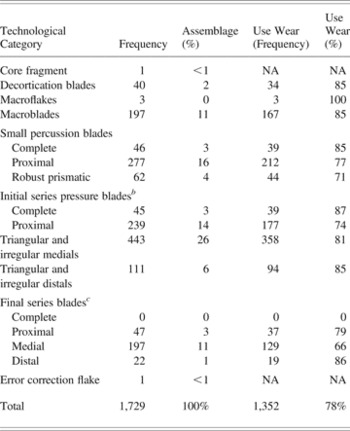
Technological categories, artifact frequencies/percentages of artifacts, and frequencies/percentages of artifacts with use weara

Notes:
a The artifacts analyzed to produce this table came from the following bag numbers: KJ69-5384, KJ69-5414, KJ69-5996, KJ69-6051, KJ69-6064, KJ69-6111, KJ69-6597, KJ69-6598, KJ69-6879, KJ69-6905, KJ69-6907, KJ69-6918, KJ69-6919, KJ69-6940, KJ69-7132, KJ69-7364, KJ69-7446, KJ69-7464, KJ69-7466, KJ69-7501, KJ69-8038, KJ69-8170, KJ69-8221, KJ69-8418, and KJ69-9043.
bThese are comparable to Clark and Bryant's (1997) second series blades. Note that first series blades are not present because of differences in core reduction technology at Kaminaljuyu.
cThese are the same as Clark and Bryant's (1997) final series blades.
The consumption of obsidian blades in craft activities where cutting tasks were important should result in a high incidence of patterned use wear on their working edges. This is the logic that Clark (Reference Clark, Gaxiola and Clark1989a) proposed for identifying craft consumption workshops, and it is the rationale followed here. There is no “magic” percentage of use wear that would allow archaeologists a priori to separate craft consumption workshops from those that engaged in production for exchange. Nevertheless, the few empirical studies conducted on obsidian artifacts from consumption contexts provide an indication of what we should expect. Spence's “blade use sites” at Teotihuacan had use wear rates that ranged between 42.6% and 88.2% (Spence Reference Spence, Tapia and Rattray1987:Table 1). The artifacts from Unit 26 at La Libertad, Chiapas, a small assemblage thought to be from a wood working activity area, had use wear rates of 95%, of which 48.8% exhibited microstriations (Clark Reference Clark1988:41). Aoyama (Reference Aoyama2007:10) found an 88.7% overall use wear rate in elite houses engaged in craft production at Aguateca, Guatemala. In general, we can expect repetitive craft activities to produce a restricted range of patterned use wear as the same tasks were performed over and over again with the same materials. The type, frequency, and patterning of use wear must be established empirically for archaeological collections recovered from workshop contexts.
We noted earlier that investigators routinely characterize Mesoamerican craft activity in terms of the dichotomous categories of production and consumption. Archaeologists rarely consider explicitly the possibility that both activities could have been carried out in the same craft context in a complementary fashion. We suspect that craftsmen often made their own tools, especially in relatively simple economic systems in which procuring tools from external sources could have resulted in undesirable delays. Even in more complex systems in which ready-made implements could be obtained from specialized producers, craftsmen would have had incentive to economize, especially if the necessary tools did not require a high level of skill or time investment to make. These could have been either expedient or formal tools, depending on the tasks that regularly needed to be completed. This means that some artisans that used obsidian blades in craft activities likely also produced them. Unfortunately, this kind of behavior is undetectable if archaeologists assume absolute categories of production and consumption when characterizing workshop or workshop refuse contexts.
Finally, it is important to remember that Mesoamerican craftsmen were often multicrafters (Hirth Reference Hirth and Hirth2006a, Reference Hirth2007) rather than specialists in just one activity. This means that obsidian blademakers could be simultaneously engaged in production for use, craft consumption, and production for exchange, producing some blades for use in craft activities within the same workshop while producing others for distribution outside the workshop. Investigating the archaeological signatures of these activities is a task that archaeologists must undertake if they hope to understand fully the structure and operation of pre-Hispanic craft production. It is to the establishment of useful empirical guidelines that we now turn, using a case example from the Maya site of Kaminaljuyu, Guatemala.
BACKGROUND
Kaminaljuyu is located in the largest valley in highland Guatemala. During the last five centuries b.c., it was an early center of Maya sociopolitical development with significant population growth, monumental construction, and elite tombs. These trends continued through the first four centuries a.d. when the center established ties with Teotihuacan in the Basin of Mexico around a.d. 350/400 (Sanders and Michels Reference Sanders and Michels1977).
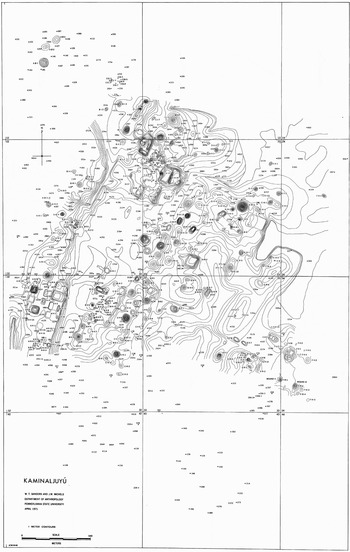
Kaminaljuyu came to the attention of archaeologists when Manuel Gamio conducted the first systematic excavations at the site in 1925 (Gamio Reference Gamio1926, Reference Gamio1927). Gamio's work was followed by more intensive investigations in the 1930s undertaken by Alfred Kidder, Jesse Jennings, and Edwin Shook under the auspices of the Carnegie Institution of Washington (Kidder et al. Reference Kidder, Jennings and Shook1946; see Michels Reference Michels1979 for a full summary). Intensive salvage investigations were subsequently conducted at the site by Pennsylvania State University between 1968 and 1970 in response to the urban expansion of Guatemala City (Michels Reference Michels1979). These investigations included a 276 km2 settlement pattern survey in the Valley of Guatemala and adjacent areas (Sanders Reference Sanders, Sanders, Mastache and Cobean2010), the systematic excavation of two large mound structures (Cheek Reference Cheek, Sanders and Michels1977), and the excavation of 520 test pits across the site to define its growth and development (Figure 1) (Fitting Reference Fitting and Michels1979a, Reference Fitting and Michels1979b). It was in one of these test excavations (46-32-094) that a high concentration of obsidian debitage was recovered and subsequently identified as a refuse dump from a craft workshop (Hay Reference Hay1978:29–37).
Pennsylvania State University survey map with locations of 520 test excavations.

The 46-32-094 workshop remains were located within the Mirador Plaza at the base of structure B-V-7, along the southern reaches of a former lagoon (Popenoe de Hatch et al. Reference Popenoe de Hatch, , Brenner and Ortloff2002:Figure 3). The deposit was located within three artificial strata (levels 7 through 10 at 140–170 cm below ground surface) and was described by the excavators as a midden, “jammed full” of ceramics and containing “many thousands” of obsidian flakes and “a smaller number” of blades (Fitting Reference Fitting and Michels1979a:487). Analysis of the ceramic material dated the deposit to the Early Classic period (a.d. 200–400). This date is supported by a radiocarbon date of a.d. 1 ± 93 from level 10 and four obsidian hydration dates from within the deposit (levels 9 and 10; a.d. 105 ± 102, a.d. 167 ± 100, a.d. 267 ± 97, and a.d. 276 ± 97) (Michels and Wetherington Reference Michels, Wetherington and Michels1979). The location and concentration of obsidian suggested that it had been dumped there in several basket loads. A high incidence of use wear was observed on artifacts during excavation, which suggested they were spent tools associated with some kind of manufacturing activity (Fitting Reference Fitting and Michels1979a).
The obsidian from Kaminaljuyu was analyzed by Conran Hay (Reference Hay1978) as part of his Ph.D. dissertation. Hay's use wear and cluster analyses of Kaminaljuyu assemblages revealed a high percentage of spent tools in the 46-32-094 deposit with a combination of edge crushing, microflaking, and microstriation. Although the results indicated heavy use wear, his analysis contained neither a technological description of obsidian artifacts nor the rates of use wear found on different artifact categories (e.g., flakes, blades, etc.). The present analysis has been undertaken to provide a more complete picture of how a refuse assemblage from a workshop context should look where obsidian blades were both produced and consumed in craft activity.
TECHNOLOGICAL ANALYSIS OF OBSIDIAN FROM THE 46-32-094 WORKSHOP MIDDEN
Although the excavators reported many thousands of obsidian blades and flakes from this context (Fitting Reference Fitting and Michels1979a), the field techniques they employed did not permit the recovery of all materials. Rather than sieving deposits through fine mesh screens, artifacts were collected by hand selection. The result is a collection of all of the flakes and blades contained in the deposit but none of the microdebitage. Although a complete technological analysis is not possible under these conditions, we believe the sample is representative of the types of materials recovered there.
The lithic collection from the 46-32-094 workshop midden consists of 1,729 obsidian flakes and blades. The technological categories are summarized in Table 1 and reinforce what we know about obsidian blade production sequences at Kaminaljuyu (Hirth Reference Hirth and Hirth2003). Several things are evident from the technological categories represented in these collections. First, obsidian was imported into Kaminaljuyu as large percussion cores and core preforms. Few macroflakes and no decortication flakes were recovered, indicating that most of the cortex was already removed and percussion cores were already shaped with roughly parallel arris by the time they entered workshop areas.
One of the most salient features of the Kaminaljuyu production sequence was the removal of percussion blades in the earliest part of the production sequence when percussion cores were shaped. This aspect of the blade reduction sequence is represented by the presence of decortication blades in the collections. Planar surfaces with a thin cortex apparently were not an impediment for craftsmen. Instead of removing the cortex as a separate step in core shaping, craftsmen removed it with small percussion blades as they created parallel arris on cores (Hirth Reference Hirth and Hirth2003:173–174). Decortication blades have been observed in other obsidian workshops, indicating that the removal of blades in the earliest stages of the core shaping was a widespread practice at Kaminaljuyu (Hirth Reference Hirth and Hirth2003:Figure 12.4).
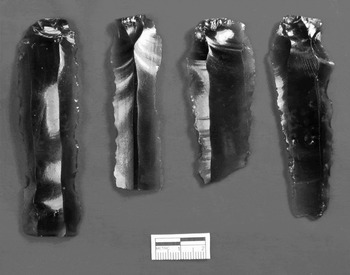
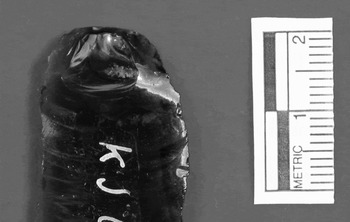
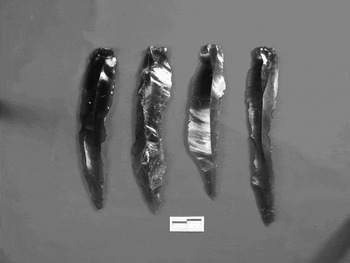
Unlike other places in Mesoamerica, obsidian blade production at Kaminaljuyu does not separate neatly into a two-stage sequence of irregular percussion blading and regular pressure blading. Instead, some well-formed prismatic blades resembling final series pressure blades were produced that have wide platforms and heavy percussion bulbs on their ventral surfaces (Figures 2 and 3). These blades are referred to here as robust percussion blades (Table 1), which Hirth (Reference Hirth and Hirth2003) believes were produced using indirect percussion where a punch of antler, bone, or hard wood was used along with a hammerstone or billet to remove flakes and blades. Indirect percussion appears to have been widely employed in blade removal because blades with the wide platforms and ventral features (pronounced bulb of force, eraillure scar) characteristic of indirect percussion are common occurrences in all Kaminaljuyu obsidian workshops. Although the production sequence moves from irregular percussion blades to increasingly regular pressure blades, the boundary between the cessation of percussion removals and the beginning of pressure removals is difficult to draw with a high degree of precision.
Robust prismatic blades.

Close-up shot of ventral characteristics of a robust prismatic blade; note pronounced eraillure scar.

One interesting feature of this assemblage is the high percentage of debris associated with core shaping and early pressure blade removal in the collection. Although initial core shaping was done before cores entered the workshop, a few decortication blades, macroflakes, and macroblades were recovered that were produced while bringing the macrocore to its final form (Table 1). From there, small percussion blades (Figure 4) in the form of narrow irregular prismatic or triangular percussion blades and robust percussion blades were removed to produce a polyhedral core ready for pressure blade removal; these small percussion blades constitute 23% of the total workshop assemblage (Table 1). The switch to pressure techniques was necessary for craftsmen to create regular, parallel ridges on cores needed for producing final series prismatic blades. The artifacts produced in this final core shaping included both triangular pressure blades and irregular, initial series pressure blades that together represent 49% of the assemblage. It was at this point that final series prismatic blades could be produced. The final series prismatic blades represent only 15% of the obsidian artifacts recovered from the 46-32-094 workshop midden.
Small percussion blades.

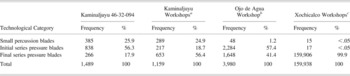
What is particularly noteworthy about these materials is that the number of artifacts associated with final prismatic blade production is far lower than that found in blade workshops where blades were produced for export. Table 2 summarizes relative percentages of selected blade categories found in excavated pressure blade workshops at Kaminaljuyu, Ojo de Agua, Chiapas, and Xochicalco, Morelos. Final series prismatic blades in the 46-32-094 workshop midden represent 17.9% of the assemblage, which is less than that found in other workshops at Kaminaljuyu (56.4%), where obsidian blades were produced for distribution outside of the workshop (Hirth 2003). Although it is difficult to compare sites using different production technologies, it is also much lower than what is reported for either Ojo de Agua (41.4%) or Xochicalco (99.9%), both of which were oriented to the production of final series blades (Clark and Bryant Reference Clark and Bryant1997; Hirth et al. 2006). Although there is evidence for the production of final series blades in the 46-32-094 workshop midden, it is scarcer than what we might expect if cores were produced and reduced solely in order to produce finished blades. Our current impression is that pressure cores were shaped and a few finished pressure blades were removed from them before blade production ceased. It is possible that cores left the workshop at this point.
Comparison of Kaminaljuyu 46-32-094 workshop midden with other obsidian blade workshops from that site and with assemblages from other sites

Notes: Information for workshop dump 46-32-094 is taken from Table 1. The other information is from the following sources: aHirth Reference Hirth and Hirth2003:Table 12.1; bClark and Bryant Reference Clark and Bryant1997:Table 1; cHirth and Andrews 2003:Table 13.2.
USE WEAR ANALYSIS
All of the obsidian artifacts in the 46-32-094 obsidian deposit were examined for use wear. Two types of use wear were observed and recorded: edge crushing/microflaking and microstriation.
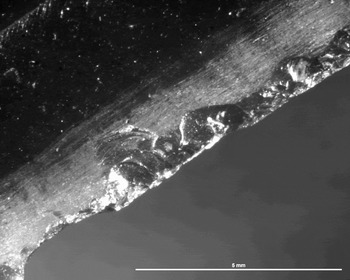
Microflaking consists of small, lunate flake scars less than 3 mm in diameter located along blade edges. Forceful usage led to edge crushing and heavy concentrations of microflakes obliterating the outer 1–3 mm of the cutting edge of the blade or flake (see Clark Reference Clark1988:73, Figure B-1). Blades appear to have been handheld and used without hafting, resulting in identical, bifacial, bilateral damage along both blade edges. Microflaking and edge crushing are visible macroscopically and were recorded through visual inspection of artifact edges (Figure 5).
Use wear: edge crushing/microflaking and microstriation; note absence of microstriation within microflake scars.

Microstriation refers to microscopic scratches along the edge of a flake or blade. Microstriations are always oriented parallel to the axis of the cutting edge, indicating use of the blade in sawing tasks (Figure 5). These are often visible macroscopically as a dull, matte finish that contrasts with the shiny, vitreous surface of the obsidian and runs in a strip or band along the artifact edge. This band can be as much as 5-mm wide along the edge of a blade, suggesting that whatever material or object was being worked to produce this use wear was fibrous, but soft enough to allow the blades to cut deeply into it. To ensure that no microstriation went undetected, in addition to macroscopic inspection, each blade or flake was examined with an Olympus SZ-PT stereomicroscope at 20×–80× magnification to detect microstriations that the naked eye might miss. Note that microscopic examination was intended as a “check” to back up macroscopic observation to detect presence or absence of use wear, not to characterize the use wear with regard to type of material worked and so forth, for which stronger magnification would have been necessary.
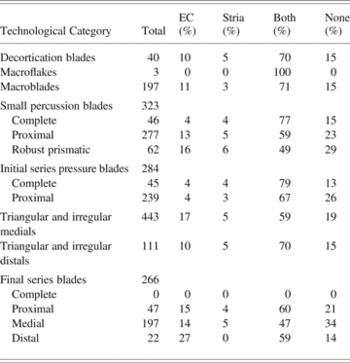
The most striking feature of this analysis is the high incidence of use wear found on obsidian artifacts in this assemblage. Fully 78% of all obsidian artifacts from the 46-32-094 workshop midden exhibit some form of use wear. Table 1 provides a summary of the number of artifacts in each technological category with use wear. What is immediately apparent is that all technological categories had incidences of use wear of 66% or more. It is interesting that the lowest amount of use wear is found among medial sections of final series (also called third series or 3s) blades. This is surprising because we usually assume that the regular, standardized final series blade was the preferred form for cutting implements in Mesoamerica. Although it is not yet clear what this means in terms of behavior, it is clear that final series blades were not being used in the same quantities as other types of tools. This is underscored by lower numbers of fine blades than what one should expect if all by-products of core reduction were used in craft consumption within the workshop.
Table 3 presents artifact categories by technological groups and summarizes the percentages of different combinations of edge crushing/microflaking and microstriation found in the collection. Use wear is separated into four categories: (1) artifacts with edge crushing/microflaking only, (2) artifacts with microstriation only, (3) artifacts with both edge crushing/microflaking and microstriation, and (4) artifacts without any evidence for use wear. Artifacts in all categories tend to exhibit the same trends. What is particularly noticeable is that edge crushing and microstriation usually occur together rather than alone. Artifacts with only edge crushing/microflaking range from 4% to 17%, and those with only striations constitute 3% to 6% of the collection.
Percentages of artifacts exhibiting edge crushing/microflaking, microstriation, both kinds of use wear, or no use wear

Note: EC = edge crushing/microflaking; Stria = microstriation.
Close inspection of artifact edges reveals evidence for staged, sequential use wear. Our reconstruction suggests that obsidian artifacts were used first to cut a relatively soft material producing striations on artifact edges, which was followed by cutting a hard substance, resulting in heavy edge crushing and microflaking along artifact edges. Two lines of evidence support this conclusion.
First, a considerable number of edges have striations that are truncated by edge crushing and microflakes (Figure 5). Because striations can take a longer time to form than microflakes, it appears that most blades were used for heavy work after striations were already formed along artifact edges. Second, microflake scars were examined under 20×–80× magnification to identify whether microstriations had formed across the surfaces or edges of these flake scars (Figure 5). The presence of microstriations in flake scars would indicate that striations, edge crushing, and microflaking would have occurred at the same time as the result of a single processing activity. No cases of this pattern were observed. Given these two lines of evidence, it is possible that the artifacts with only edge crushing and microflaking had already removed microstriations as artifact edges were obliterated. While there is no way to positively confirm this inference, it is logical given the other evidence for staged artifact use. While it is possible that artifacts with edge crushing and microflaking were only used for heavy cutting, the high percentage of artifacts with both edge crushing/microflaking and microstriation indicates that it was more common to use artifacts in both activities.
Although the form of microflaking and the orientation of striations indicate that these tools were used in sawing activity, we do not know what craft was realized or what types of materials were processed with these tools. Hay (Reference Hay1978:Appendix A) conducted use wear experiments and was able to reproduce the type but not the intensity of wear found on these obsidian tools. Hay reports that even with 30 to 60 minutes of tool use on hard materials, his experimental tools showed wear only like the most lightly used archaeological artifacts. We know that the materials processed were a combination of semisoft and hard substances. The materials that have been proposed include cacao pods (Michels Reference Michels1979:173–182; Overholt Reference Overholt1976), gourds (Hay Reference Hay1978:34–36), and reeds from nearby Lake Miraflores (Hirth Reference Hirth and Hirth2003).
DISCUSSION
The materials recovered in the 46-32-094 workshop assemblage provide new insights into obsidian prismatic blade production in particular and the organization of Mesoamerican craft activity in general. The goal of this analysis was to develop a better understanding of craft consumption and the archaeological signatures with which to identify it. It highlights the need to evaluate whether blades were produced in workshops for internal craft consumption or for exchange outside the workshop. Both technological and use wear analyses were conducted. Viewed together, the results suggest that the artisans who produced the 46-32-094 refuse assemblage may have been involved in production for exchange, craft consumption, and production for use.
The high incidence of use wear in the assemblage was particularly striking and reinforces the original interpretation that the assemblage represents refuse produced in a craft consumption context. Fully 78% of the artifacts in the 46-32-094 refuse assemblage have clear indications of use wear. This use wear consisted of edge crushing/microflaking and microstriation oriented parallel to blade edges as a result in their use in cutting activities. The superposition of microflaking patterns on and through zones of microstriation suggest that use wear was staged, with blades used to cut soft material first, followed by rapid dulling as they were used to work harder materials.
Use wear is uniformly high across all technological categories from macroblades and small percussion blades to final series pressure blades, and even some complete blades. This suggests that sharp edges were all that were required for the work undertaken, rather than a standardized obsidian blade. That use wear was a product of specialized craft activity rather than intensive household utilization is evident in both the intensity of use and the highly patterned use wear types represented in the collection (Hay Reference Hay1978; Hirth and Castanzo Reference Hirth, Castanzo and Hirth2006). The objective of these artisans was not to produce fine pressure blades. The goal seems to have been the production of utilitarian cutting tools for immediate use, rather than standardized blades for external exchange.
Technological analysis revealed broad similarities with other obsidian workshops at Kaminaljuyu in the technological categories present. Most of the materials were irregular percussion and pressure blades associated with shaping the core and preparing it for final pressure blade removal. From this we know that all obsidian workshops possessed the same technological knowledge irrespective of whether they were producing blades for export or for internal consumption.
A major feature of the 46-32-094 workshop midden is the very low ratio of final pressure blades (n = 47) to initial series pressure blades (n = 239) found in the assemblage. This ratio is 1:5.1. This is the exact opposite of what we would expect if all the blades produced under normal core reduction circumstances were used in craft production. Under these circumstances, the number of final series blades should be much higher, with a final series blade to initial series blade ratio of about 4:1, depending on core diameter (Hirth Reference Hirth and Hirth2006a:336, footnote 28). This is certainly not the pattern in this assemblage.
The low number of final series pressure blades in the collection could be the result of two alternative causes. One possibility is that cores were reduced until they were fully formed pressure cores, at which time they left the workshops as finished items. In this scenario, using by-products of initial core reduction in craft activities would have been an adjunct activity to the production of polyhedral obsidian cores for exchange. A second possibility is that obsidian pressure blades were also produced and exported as finished items in this workshop. The low incidence of core fragments and flakes that could be reliably interpreted as error correction or core maintenance (only one from each category was recovered) (see Table 1) suggests that the former case is more likely. Whichever scenario is correct, the evidence suggests that the line separating craft consumption from production for exchange is not as hard and fast as is often supposed.
CONCLUSIONS
The results presented here indicate that it is possible to distinguish multifarious obsidian blade production goals with archaeological evidence. The task for archaeologists is to recognize the different archaeological signatures for each kind of production. However, because they may not be separate economic activities, signatures for more than one goal may be present in the same assemblage. The patterns observed in the 46-32-094 workshop assemblage conform closely to what we would expect for domestic multicrafting, where artisans combine and integrate multiple production tasks within their annual production cycle (Hirth Reference Hirth and Hirth2006a, Reference Hirth2007). The use wear percentages and production technology recovered here constitute combined signatures for production for use, craft consumption, and production for exchange. Unfortunately, the nature of artifact recovery during excavation makes us unable to state unequivocally that the used blades found in this deposit were produced in exactly the same place that they were employed in the craft activity for which they were destined. Without screening, it was impossible for excavators to collect the microdebitage that would have enabled this determination. As one reviewer rightly pointed out, it is equally possible that the artisans who used these blades procured them as cheap or free castoffs from blademakers who were engaged in production for exchange. The inclusion of used, fine blades in the assemblage argues against this hypothesis. Moreover, in settling on that explanation and rejecting alternatives, we would run the risk of again allowing our dichotomous theoretical constructs of production and consumption to tempt us to squeeze our empirical data into preconceived notions of past behavior. Rather than accepting or rejecting one or the other explanation (i.e., cast-offs vs. production for consumption), we feel it is more responsible to allow the empirical data to enrich and diversify our theoretical categories.
This study underscores the need for archaeologists to be sensitive to the way that the tool requirements of craft activity influenced the objectives of blade production and its highly distinctive production sequences. Our goal was to contribute to the development of better archaeological signatures for craft consumption and production for exchange. In general, our results agree with other studies of consumption contexts in terms of high expected frequencies of use wear. However, they also indicate that the situation is more complicated than investigators ordinarily conceive it to be. Although craft consumption and production for exchange may occur separately, under the right conditions they can be complementary and simultaneous craft activities. Future research should view specialized craft production in a more nuanced fashion, recognizing that artisans often had multiple production objectives and developing the archaeological signatures to detect them. We hope that this research is a small step in that direction.
RESUMEN
Por 40 años, los arqueólogos en Mesoamérica han estudiado la producción artesanal para entender mejor la economía prehispánica. Una actividad de alta importancia fue la producción de navajas prismáticas de obsidiana. Aunque muchos investigadores hayan reconocido que su control pudo ser importante en el desarrollo de sociedades tempranas como cacicazgos y estados (Clark 1987; Rathje 1971; Sanders and Santley 1983; Santley 1984; Spence 1967, 1996), hasta ahora se han realizado pocas investigaciones enfocadas en entender los contextos de talleres de producción de navajas prismáticas. Como resultado de ello se han agregado todas las formas de producción de navajas en una sola categoría de “producción para exportación” (Clark 1986, 1990).
Para comprender mejor la producción de navajas de obsidiana en Mesoamérica es necesario distinguir entre: 1) talleres que produjeron navajas como herramientas terminadas para su distribución o venta a la sociedad, y 2) talleres que produjeron navajas requeridas en la manufactura de otros bienes artesanales. El presente trabajo investiga la evidencia de dos tipos de comportamiento a través del estudio de una colección de 1,729 lascas y navajas de obsidiana proveniente de un basurero de taller en Kaminaljuyu, Guatemala. Los análisis de uso y tecnología demuestran que el comportamiento de los artesanos en el pasado probablemente no restringió a las categorías teóricas dicótomas de producción y consumo que normalmente emplean los arqueólogos.
El análisis tecnológico demuestra que están presentes todos los productos derivados de la reducción del núcleo de obsidiana. Se identificaron y registraron artefactos como navajas pequeñas de percusión, navajas de serie inicial manufacturadas mediante la técnica de presión, y navajas finas. Además se encontró que la secuencia de producción en Kaminaljuyu difiere a la observada en otros lugares como Ojo de Agua, Chiapas (Clark and Bryant 1997) y Xochicalco, Morelos (Hirth 2006a). Al parecer, los artesanos utilizaron técnicas de presión mucho más temprano en la secuencia de reducción en relación a lo que se ha reportado en otros sitios; el mismo patrón ocurre en otros contextos de producción en Kaminaljuyu (Hirth 2003). Hay que señalar que en la colección hubo una marcada carencia de navajas finas, lo que indica que éstas fueron exportadas o que lo núcleos fueron vendidos como pre-formas para producir navajas finas.
El análisis de uso demostró que el 78% de todos los artefactos mostraron al menos un tipo de huellas de uso. Esto indica que probablemente hubo dos tareas artesanales realizadas en secuencia, aunque todavía no se sabe cuáles fueron ni que productos se elaboraron en el taller. Los tipos de evidencia fueron micro-estriaciones y desgaste del filo/micro-lasqueo que indican un uso rudo y repetitivo como cortar o serrar. Cada categoría tecnológica mostró altos porcentajes de artefactos con este tipo uso. El 66% de las secciones mediales de las navajas finas tuvo este tipo de uso, lo cual representa el porcentaje más bajo de la colección.
Los resultados indican que la colección proviene de un taller que manufacturó navajas prismáticas para su uso en una actividad artesanal. Por el contrario, la baja presencia de navajas finas indica éstas por lo regular no fueron utilizadas en el taller y que probablemente fueron intercambiadas o vendidas. Ello refleja un tipo de producción multi-artesanal en la que los artesanos participaron en el intercambio de navajas finas o núcleos poliédricos preparados para producir navajas finas. Ello significa que el comportamiento de los artesanos del pasado probablemente fue más complejo que las categorías de ‘producción’ y ‘consumo’ que normalmente usamos.
ACKNOWLEDGMENTS
We would like to thank all those who participated in a Fall 2007 paper publication seminar at Pennsylvania State University who kindly read several drafts of this paper and offered their comments and constructive criticism. We are also grateful to David Carballo, Philip J. Wilke, and Thomas R. Hester, who provided indispensable comments and suggestions on the submitted draft, though any lingering mistakes are solely attributable to us. Thanks to Margaret Ford, who assisted ably with the analysis and to Aurelio López Corral who helped with the Spanish summary.