INTRODUCTION
The first authentic list of the deep-sea fish from India was compiled by Alcock (Reference Alcock1891) which includes the fish collected by the R.I.M.S Investigator in his book ‘Indian deep-sea fishes in the Indian museum’. Surveys targeting deep-sea fish in the depth zone 100–200 m of the Indian Exclusive Economic Zone (EEZ) were carried out by the Fisheries Survey of India. Reports on diversity of deep-sea fish fauna in the depth zone 300–1000 m are scarce and the only available information is from the fishing cruises of the Indian research ship FORV ‘Sagar Sampada’ as part of the National Stock Assessment Programme of deep-sea biological resources. Recent research cruises of the FORV ‘Sagar Sampada’ resulted in the collection of many poorly known deep-sea fish of the order Ophidiiformes, thus strengthening the knowledge of deep-sea ichthyofaunal biodiversity of India.
Ophidiids are predominant members of deep-sea demersal icthyofauna from the continental slope to the abyssal plain (Haedrich & Merrett, Reference Haedrich and Merrett1988; Merrett & Haedrich, Reference Merrett and Haedrich1997). The first catalogue of Ophidiiform fish was published by Cohen & Nielsen (Reference Cohen and Nielsen1978) which mainly focused on genus level and species classifications were not complete. Subsequently, Nielsen et al. (Reference Nielsen, Cohen, Markle and Robins1999) published a world catalogue of fish belonging to the order Ophidiiformes, which included 48 genera and 218 species of deep-sea fish under the family Ophidiidae. Genus Glyptophidium has been revised by Nielsen & Machida (Reference Nielsen and Machida1988) who described seven confirmed species falling into two well-defined groups: argentium species group which includes G. argentium Alcock, Reference Alcock1889; G. effulgens Nielsen & Machida, Reference Nielsen and Machida1988; G. lucidum Smith & Radcliffe, Reference Smith and Radcliffe1913; and macropus species group which includes the remaining four species G. macropus, Reference Alcock1894; G. longipes Norman, Reference Norman1939; G. oceanium Smith & Radcliffe, Reference Smith and Radcliffe1913 and G. japonicum Kamohara, Reference Kamohara1936.
In the present paper, Glyptophidium specimens collected by the FORV ‘Sagar Sampada’ were subjected to very detailed systematic studies which resulted in the confirmation of G. oceanium, whose presence in the Indian Ocean is uncertain (see Nielsen & Machida, Reference Nielsen and Machida1988; Neilsen et al., 1999). Since the species is not described in the recent past, an attempt to re-describe this deep-sea fish is also made. The morphomeristics and meristics were also compared with the holotype of G. oceanium which helped in the positive confirmation of the species without any ambiguity.
MATERIALS AND METHODS
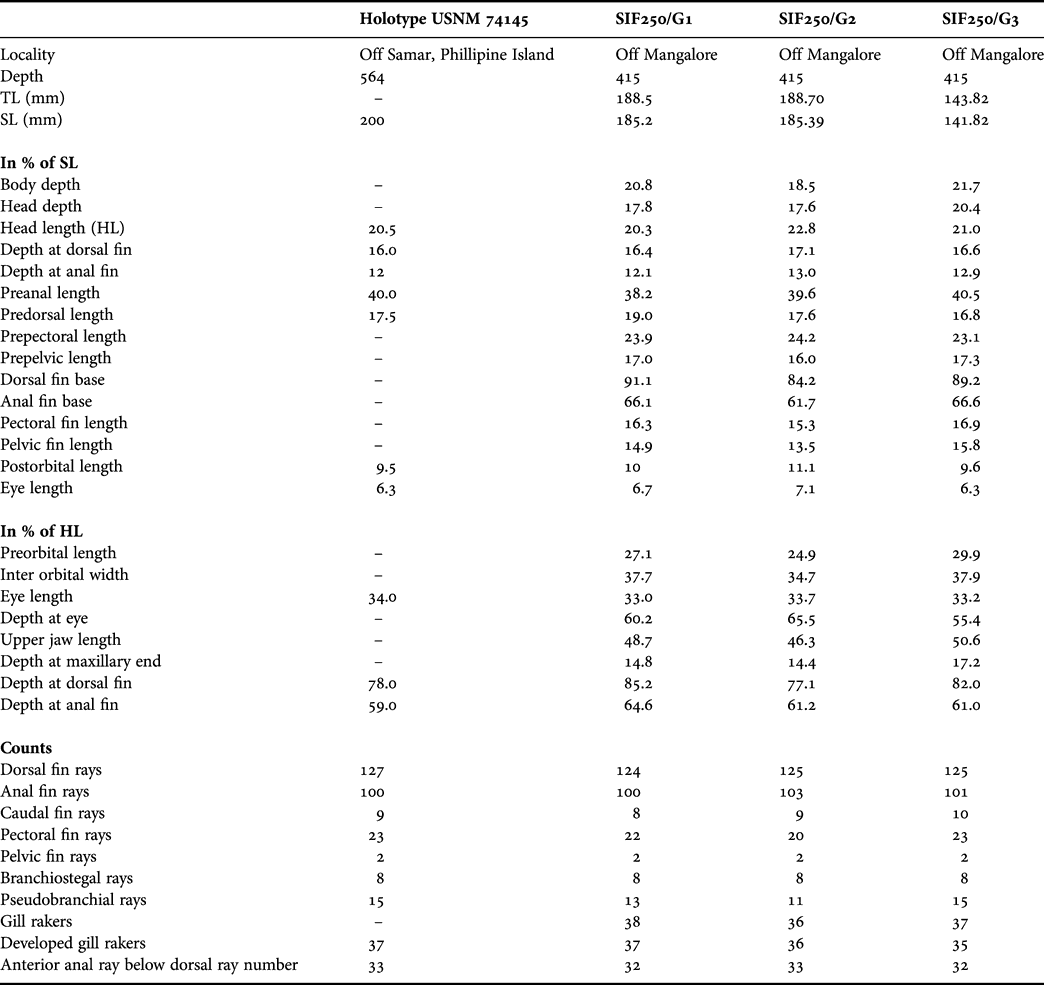
This study was carried out as part of the Ministry of Earth Sciences (MoES), Government of India funded research project on ‘Resource assessment and biology of deep-sea fish along the continental slope of the Indian EEZ’. The fish were caught during cruise no. 250 of FORV ‘Sagar Sampada’ (Figure 1), from Station no. 11 (12°28′2″N and 74°09′5″E) using HSDT fish-version (high speed demersal trawl) net. All specimens were identified following Nielsen & Machida (Reference Nielsen and Machida1988) and deposited in the Fish Museum of the School of Industrial Fisheries (SIF), Cochin University of Science and Technology, India. Morphometric measurements were taken following Smith & Heemstra (Reference Smith and Heemstra1986) to the nearest millimetre (mm) using a dialed Vernier caliper following. Body proportions were expressed in terms of standard length (SL: length from snout tip to base of caudal fin) and head length (HL: length of snout tip to the posterior margin of opercle). Meristic counts were made following Nielsen & Machida (Reference Nielsen and Machida1988). Meristic counts and proportional measurements of G. oceanium from Indian waters were compared with those of its holotype (see Table 1). Measurements of the holotype were archived from Nielsen & Machida (Reference Nielsen and Machida1988).
Locality of capture (•) of Glyptophidium oceanium from the Indian Ocean.

Meristic counts and proportional measurements of Glyptophidium oceanium with it's holotype.

Source: Nielsen & Machida (Reference Nielsen and Machida1988).
SYSTEMATICS
TYPE MATERIAL
Glyptophidium oceanium Smith & Radcliffe, Reference Smith and Radcliffe1913.
Holotype: USNM74145 (SL 200 mm, male) ‘Albatross’ Station no. D-5444 (12°43′15″N 124°58′50″E), collected at 564 m depth with bottom trawl, 3 June 1909.
Glyptophidium oceanium Smith & Radcliffe in Radcliffe, Reference Radcliffe1913: 162, pl. 12, figure 4, (type locality off Samar, Philippine Island).
COMPARATIVE MATERIAL EXAMINED
Glyptophidium oceanium Matsubara, Reference Matsubara1943: 54; Kamohara, Reference Kamohara1954: 6, figure 4.
Glyptophidium oceanicum (misspelling): Cohen & Nielsen, Reference Cohen and Nielsen1978: 32; Nolf, Reference Nolf1980: 87, pl. 8, figure 14 (now referred to as G. japonicum); Gleorfelt-Trap & Kailolo, Reference Gleorfelt-Trap and Kailola1984: 87, figure (now referred to as G. japonicum); Machida, Reference Machida, Okamura and Kitajima1984a: 255, figure and Reference Machida and Amaoka1984b: 100, pl. 85-B (now referred to as G. japonicum).
MATERIAL EXAMINED
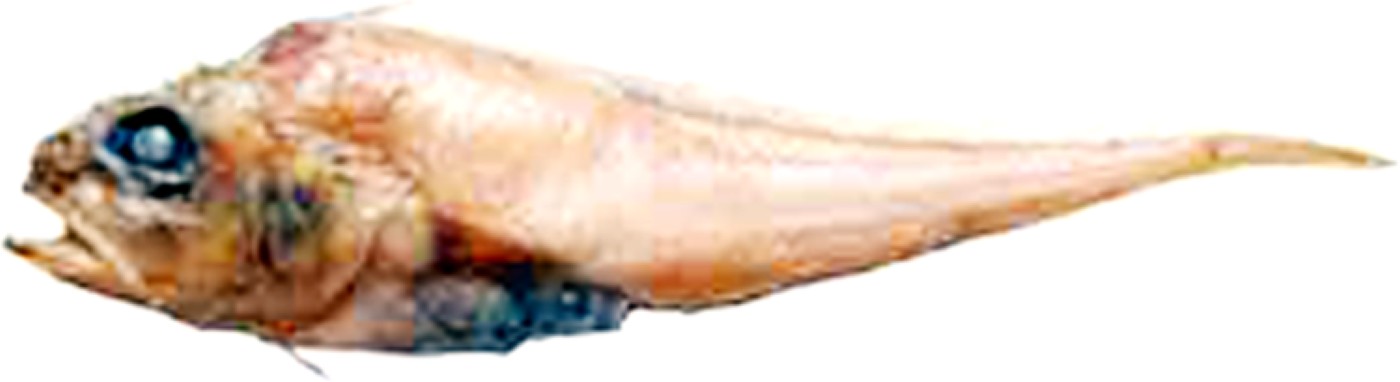
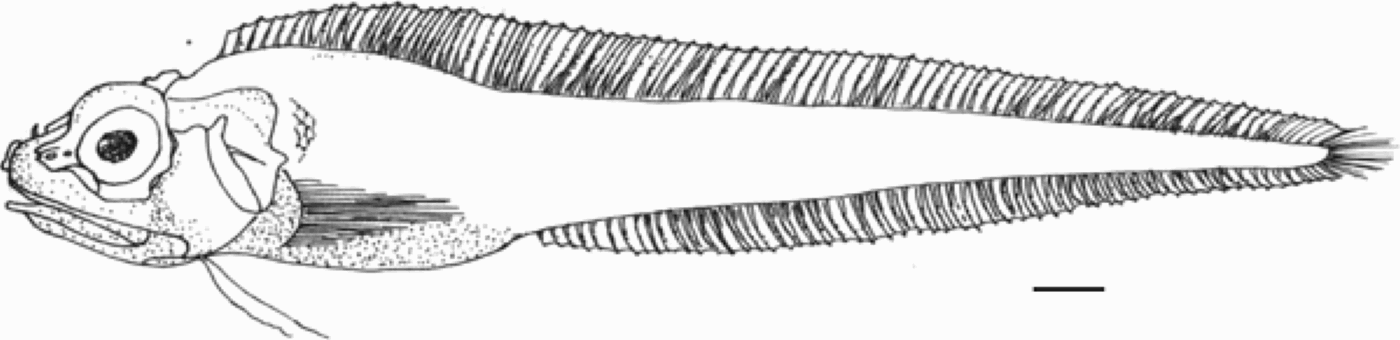
SIF250/G1, SIF250/G2, SIF250/G3 (Figures 2 & 3); 185.2 mm SL, 185.39 mm SL; 141.82 mm SL: off Kannur, south-western coast of India, 12°282″N and 74°095″E; collected with HSDT net at 415 m depth; 8 November 2006.
Glyptophidium oceanium, SIF250/G1, 185.2 mm SL, off Mangalore south-western coast of India.
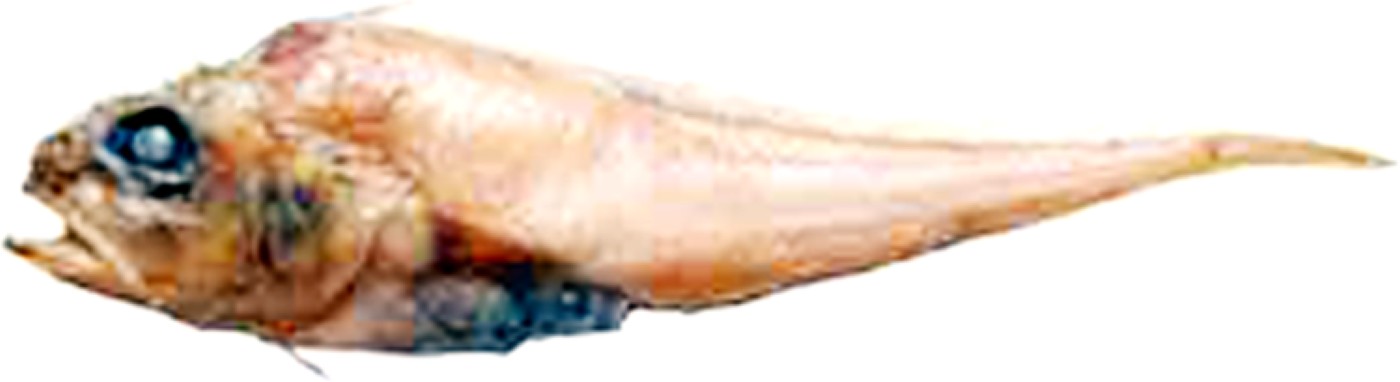
Drawing of Glyptophidium oceanium SIF250/G2, Mangalore, south-western coast of India. Scale bar: 1 cm.

DIAGNOSIS
Glyptophidium oceanium differs from other species in the macropus species group by the following combination of characters: long gill rakers 35–37, depth at anterior end of dorsal and anal fins 16.4–17.1% and 12.1–13% of SL respectively and horizontal orbit 34.7–37.9 % of head length.
DESCRIPTION
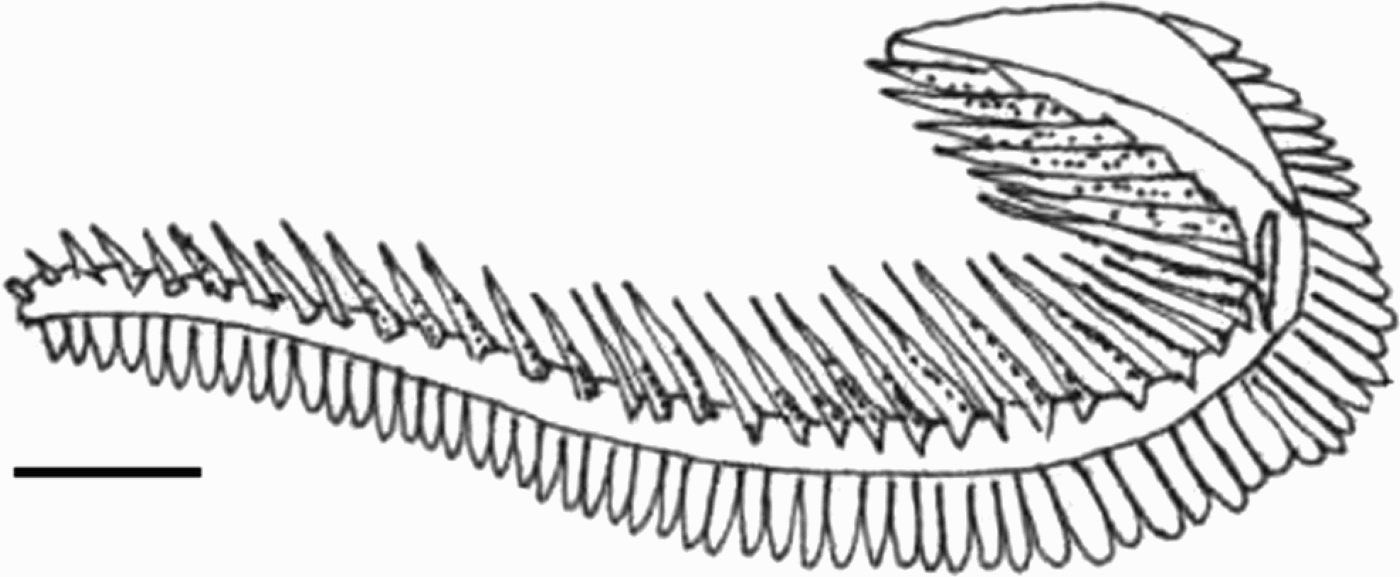
Origin of dorsal fin close to head; dorsal fin rays 2–3 times as long as corresponding anal fin rays; pectoral fins placed below midline of body; caudal fin small with 8–10 rays. Scales cycloid and deciduous, head without scales. Lateral line indistinct. Mouth large with maxillary reaching posterior margin of orbit, numerous irregular rows of granular shape teeth in dentary, premaxillary, vomer and palatine. Vomerine teeth somewhat longer than those on other bones, dentigerous part V-shaped. Anterior nostril placed midway between upper lip and orbit; posterior nostril larger. Anterior gill arch with many long rakers, the longest of which are 2–3 times length of gill filaments (Figure 4). Basibranchial with two median and a pair of tooth patches (Figure 5). Pseudobranchial filaments 11–15.
Anterior gill arch of Glyptophidium oceanium SIF250/G2 from Mangalore, south-western coast of India. Scale bar: 5 mm.

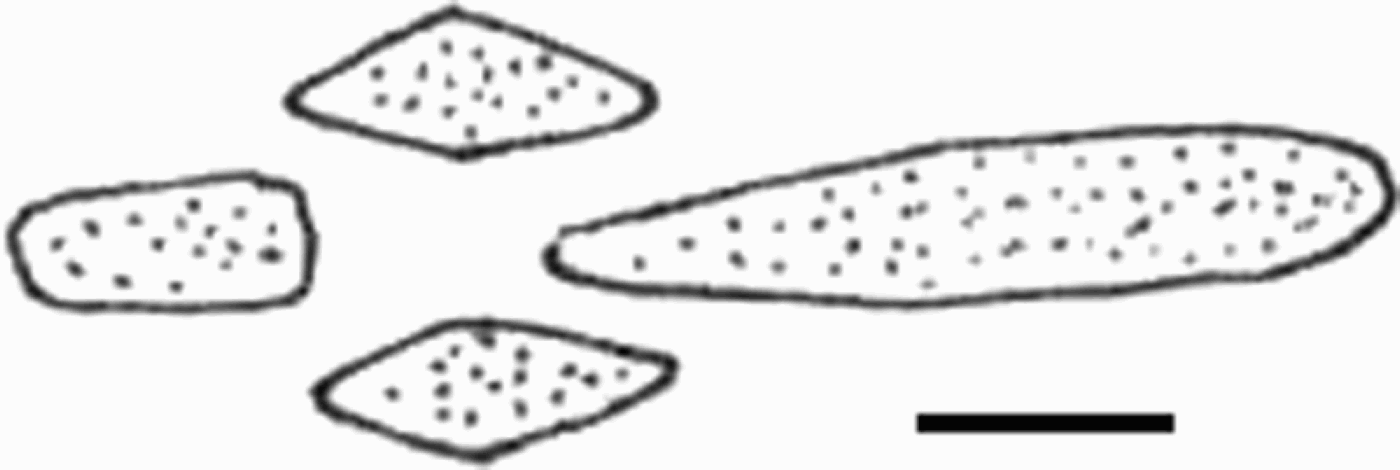
Basibranchial tooth patch of Glyptophidium oceanium. Scale bar: 2 mm.

RELATIONSHIP
The closest relative of G. oceanium is G. japonicum with which it shares characters such as, pectoral fin rays 20–23 and pseudobranchial filaments 10–15. It differs from G. japonicum by having a higher number of long gill rakers (35–37 vs 21–26), a larger orbit (34.7–37.9% vs 28.5–33% of HL) and a more slender body: depth at anterior end of dorsal fin 16.4–17.1% in G. oceanium versus 15–19.5% of SL in G. japonicum and depth at anterior end of anal fin 12.1–13% versus 11.5–14.5% of SL in the former and latter species respectively.
DISTRIBUTION
Type locality of G. oceanium is off Samar, Philippine Island at a depth of 564 m (Radcliffe, Reference Radcliffe1913). Nielsen & Machida (Reference Nielsen and Machida1988) reported G. oceanium from off the north-western coast of Australia, off the south-western coast of Indonesia, East China Sea, and also at Tosa Bay (Japan) at a depth of 200–400 m. This species is uncertainly reported from off Madagascar (see Nielsen & Machida, Reference Nielsen and Machida1988: Neilsen et al., 1999). Thus the present report is the first documented record of G. oceanium from the Indian Ocean.
REMARKS
Generic diagnosis of Glyptophidium based on Nielsen & Machida (Reference Nielsen and Machida1988) was following three diagnostic characters such as: ventral fin rays 2, median basibranchial tooth patches 2, developed rakers on anterior gill arch 21–26. The meristic counts of anal–caudal, pectoral and pelvic fin rays, pseuodobranchial rays and the position of anterior anal fin ray below dorsal fin rays of SIF 250/G1–G3 concurs with the holotype (see Table 1). Depth at dorsal fin and anal fin in % of HL was found to be greater in comparison to the holotype. Nielsen & Merrett (Reference Nielsen and Merrett1999) have suggested that morphometric characters could show negative allometric growths in ophidiids, and materials examined in the present study were smaller than the holotype (see Table 1). Thus, we could identify SIF250/G1–G3 as G. oceanium, which was known only from the north-western Pacific at depths between 400 and 700 m. The report of G. oceanium in the Indian EEZ assumes significance in the geographical distributional range of this species to the Indian Ocean which was hitherto unknown.
ACKNOWLEDGEMENTS
The Captain, Technical Officers and crew of FORV ‘Sagar Sampada’ and the Chief Scientist of the cruise no. 250 are duly thanked. We gratefully thank Dr Doi Wataru (Tokyo University of Marine Science & Technology) for making available to us the references for the study. The Ministry of Earth Sciences (MoES), Government of India is gratefully acknowledged for financial assistance.