Individual dispositions and group identities shape how individuals engage with their political and social worlds. For example, women tend to be more conflict and risk avoidant than men (Francis Reference Francis1997; Collett and Lizardo Reference Collett and Lizardo2009). Generally, the risk associated with conflict leads cautious individuals to seek out religious communities for assurance (Miller and Stark Reference Miller and Stark2002) and avoid politics (Kam Reference Kam2012; Schneider et al. Reference Schneider, Holman, Diekman and McAndrew2016). In many ways, the discussion of risk, political participation, and religiosity represents a key set of findings on how individual characteristics shape religious and political behaviors.
And yet, these reliable findings are largely built on the experiences of white men and women. Research in political science, psychology, and religious studies points out the necessity of considering how identities shape social behavior (Hancock Reference Hancock2007; Gerber et al. Reference Gerber, Huber, Doherty, Dowling, Raso and Ha2011; Philpot Reference Philpot2017; Huckle and Silva Reference Huckle and Silva2020). Yet, identities cannot be considered in isolation, as they interact to create unique experiences for members of groups (Crenshaw Reference Crenshaw1989; Cassese, Barnes, and Branton Reference Cassese, Barnes and Branton2015; Brown and Gershon Reference Brown and Gershon2016; Carlson, Abrajano, and Bedolla Reference Carlson, Abrajano and Bedolla2019). Religious and political behaviors are highly racialized and gendered (Brown Reference Brown2014; Butler-Barnes et al. Reference Butler-Barnes, Martin, Copeland-Linder, Seaton, Matusko, Caldwell and Jackson2018; Phoenix Reference Phoenix2019a; Silva and Skulley Reference Silva and Skulley2019), demanding that we consider the ways that these identities interact when we evaluate how personalities shape social behavior. We respond to this call, theorizing that race and gender should shape the risk-religion-politics model. Surveying a nationally representative sample of respondents in 2016, we examine how race and gender interactively shape the relationship between risk, religion, and politics. Our research demonstrates the importance of considering how identities interact in shaping social and political experiences. Though religiosity is correlated with political engagement, and gender and race impact both religion and politics, work integrating gender, race, risk, and religiosity with political behavior is scarce. For example, we do not know how the risk tolerance and religiosity relationship (where lower risk tolerance = higher religiosity) impacts political participation together, particularly since both of these domains can have opposing effects (lower risk tolerance = lower participation but higher religiosity = higher participation). Research has also wholescale ignored the possibility that these reliable relationships could be, in fact, only reliable for white men's and women's experiences.
We select for our case a comparison between white and African American men and women, the latter of which are some of the most religiously devout and politically active citizens in the United States (Shelton and Cobb Reference Shelton and Cobb2017). Yet, race and gender do not operate individually. Intersectionality research points to the importance of considering not just how individual identities (such as gender or race) shape the behavior and experiences of individuals, but instead how these identities interact to produce unique experiences for intersectional groups, such as Black women (Crenshaw Reference Crenshaw1989; McCall Reference McCall2005). For example: while political engagement contains risk for most people (regardless of race and gender, see Kam Reference Kam2012), historic and current patterns of racism and sexism mean that it is more risky for Black Americans and particularly Black women (Alex-Assensoh and Assensoh Reference Alex-Assensoh and Assensoh2001; Harris-Perry Reference Harris-Perry2011; DeSante and Smith Reference DeSante and Smith2020). Given that environment and group status shapes personality traits (Levin Reference Levin2004), the high risk for Black women's political participation suggests that risk acceptance may play a particularly important role in their political participation. We posit and find evidence for a stronger correlation between risk and political participation among Black women than for white women or men or Black men.
The risk-religion relationship is also both highly gendered and highly racialized. Indeed, many of the patriarchal structures that encourage women's risk avoidance and increased religiosity are less present among African Americans (Blee and Tickamyer Reference Blee and Tickamyer1995; Rogers, Sperry, and Levant Reference Rogers, Sperry and Levant2015). And, the risk-conscientiousness link (Friesen and Djupe Reference Friesen and Djupe2017) that serves as a core element of women's increased religiosity may be limited to white men and women. Given that the relationship between personality traits and social behaviors are influenced by race and gender (Foldes, Duehr, and Ones Reference Foldes, Duehr and Ones2008; Schneider and Bos Reference Schneider and Bos2019), we argue that the risk-religion relationship should be intersectional in nature. And, indeed, we find that risk appears to be unrelated to religiosity for Black women, while positively correlated for white women and men.
Our results speak to the importance of considering how intersectionality shapes both personalities and core religious and political activities in the United States. In their meta-analysis of race and personality traits, Foldes, Duehr, and Ones note the “limited number of studies that explicitly sought to compare racial groups on personality traits” (Reference Foldes, Duehr and Ones2008, 587). Our work attempts a remedy of this by examining the ways that race and gender shape the relationship between risk and religion and political participation. Building on scholarship that demonstrates the importance of intersectionality, including work that centers Black women's experiences as unique, our results demonstrate the importance of considering whose experiences are driving theory development and the degree to which white experiences apply to other groups.
Risk and Religion
Risk management or tolerance can be a trait- or state-based measurement, capturing an individual's propensity to take chances or act cautiously. Religion has been connected to risk tolerance both by scholars seeking to understand the persistent gender differences in religiosity as well as psychologists positing what schemas people use to mitigate the risk in their lives. For the purposes of our study, we are interested in the rich literature that examines how risk explains the widespread, consistent gender differences in religious belief and behavior. Whether it be to ease the anxiety of and hedge against eternal damnation or to seek social support for general worries, social scientists contend women seek religious communities and belief in an omnipotent god for their comfort (Miller and Stark Reference Miller and Stark2002; Collett and Lizardo Reference Collett and Lizardo2009). That is, rejecting belief or faith carries existential and social risks that women are more likely than men to avoid, whether it be due to socialization or biologically instantiated risk aversion (for a helpful discussion on the findings and challenges to this literature, see Holman and Podrazik Reference Holman and Podrazik2018). Looking at beliefs in heaven and/or hell (e.g., the afterlife risk theory) do not consistently explain gender differences in religious behavior like service attendance or the importance of God in one's life, across samples in more than 70 countries (Freese and Montgomery Reference Freese, Montgomery and Correll2007). Yet, general risk tolerance continues to explain part of the gender gap in religious belief and behavior (Hoffmann Reference Hoffmann2019), though the effects are much smaller and less consistent than the original studies established (Miller and Hoffmann Reference Miller and Hoffmann1995).
Religiosity in the United States is highly gendered; women are more likely to say that religion is important to them, to attend church services, and to practice religion privately (Trzebiatowska and Bruce Reference Trzebiatowska and Bruce2012; Holman and Podrazik Reference Holman and Podrazik2018). In fact, among U.S. Christians, women are more likely than men to have read the Bible in the past year and to have read it significantly more days when asked about their reading habits from the past month (Friesen Reference Friesen, Goff, Farnsley and Theusen2017). What makes this behavior particularly salient for the current study is that when asked why they read the Bible, women are more likely than men to report higher levels of reading for “as a matter of personal prayer and devotion,” suggesting an internal use of religion for private and not necessarily public purposes.
Other scholars have argued that the risk-religion connection for women may be less about the riskiness of non-religion and more about socially constructed gender norms (Francis Reference Francis1997; Collett and Lizardo Reference Collett and Lizardo2009). Collett and Lizardo (Reference Collett and Lizardo2009) argue that in patriarchal families, parents try to control their daughters' behavior more so than their sons' behavior. In turn, this socializes women to be more risk averse. In more egalitarian households, the gap in religiosity declines between men and women (Collett and Lizardo Reference Collett and Lizardo2009; but see Hoffmann Reference Hoffmann2009; Hartman Reference Hartman2016). Gendered socialization patterns that train women to be more sensitive to the social costs attached to nonreligious beliefs may also encourage the risk-religion relationship (Edgell, Frost, and Stewart Reference Edgell, Frost and Stewart2017). Djupe and Friesen (Reference Djupe and Friesen2017) find that women high in the Big Five trait of conscientiousness (which has also been linked to risk aversion, see Martin, Friedman, and Schwartz Reference Martin, Friedman and Schwartz2007), channel their sense of obligation into religious activities, and unlike for men, these activities do not result in the development of civic skills for women.
The Racial Limits of the Risk and Religion Model
Religious experiences in the United States are racialized; most churches are racially segregated, with varying religious experiences within denominations (Gershon, Pantoja, and Taylor Reference Gershon, Pantoja and Taylor2016; Huckle and Silva Reference Huckle and Silva2020). Indeed, as we detail in the “Risk and Politics” section, the Black church often serves a different function for its members, as compared to white churches in the United States. Scholarship on the Black church identify this set of institutions as “a central feature of the Black experience by helping African Americans navigate the hardships of slavery and segregation” and politically mobilize through this solidarity (Shelton and Cobb Reference Shelton and Cobb2017, 737). Tucker Edmonds (Reference Tucker Edmonds2018) takes this a step further and suggests that African American churches and religious movements are direct responses to assault and surveillance of the “Black body.”
And yet, as Nguyen et al. (Reference Nguyen, Taylor, Chatters and Hope2019, 1,044) note, “Despite the centrality of the Black Church in African American communities, the academic literature has given only sporadic attention to examining the potential strengths and resources that exist within religious communities.” One particularly less explored path is the role that gender and race play in religiosity. The patriarchal structures and conscientiousness that may shape the risk-religiosity link for women are highly racialized (Blee and Tickamyer Reference Blee and Tickamyer1995; Rogers, Sperry, and Levant Reference Rogers, Sperry and Levant2015), which suggests that the risk-religion link may be less likely to apply among Black women.
The centrality of the church in Black society creates particular complications for Black women; though they are the majority and key participators in the activities of the church, they are largely excluded from leadership (Baer Reference Baer1993). Rather than be a space of belonging and edification, the Black church also can be a space where Black women feel further surveillance and neglect toward their gender and sexuality. For this reason, some Black feminist theologians and thinkers have made the case for Black women to leave the church (Douglas Reference Douglas2012; Williams Reference Williams2013), while others suggest the church continues to have resources that Black women can access for personal and even financial success (Frederick Reference Frederick2003; Day Reference Day2012). In sum, the relationship between gender, race, and religiosity is complicated. An intersectional approach demonstrates the need for better understanding of whether dispositional characteristics might influence religious participation for what has historically been one of the most religiously committed groups in the United States. Because of this, we expect risk tolerance to be unrelated to religiosity for Black women.
Risk and Politics
Risk-taking typically suppresses political participation because the risk associated with conflict leads cautious individuals to avoid certain political situations or politics altogether (Kam Reference Kam2012; Schneider et al. Reference Schneider, Holman, Diekman and McAndrew2016). Research on gender and risk behaviors demonstrates clear differences in risk-taking related to violence and thrill-seeking (Cross, Copping, and Campbell Reference Cross, Copping and Campbell2011), with less clear tolerance disparities in non-physical domains. For example, meta-analyses reveal that financial risk-taking may be related more to status than gender (Finucane et al. Reference Finucane, Slovic, Mertz and Flynn2000; Nelson Reference Nelson2015).
Research on gender and political participation documents women's lower level of participation in most forms of politics (Coffé and Bolzendahl Reference Coffé and Bolzendahl2010). Researchers points to a wide set of potential sources of women's lower engagement, ranging from a limited access to resources associated with political participation to additional time burdens to seeing the political environment as a masculine domain (Burns, Schlozman, and Verba Reference Burns, Schlozman and Verba2001; Bernhard, Shames, and Teele Reference Bernhard, Shames and Teele2021; Schneider and Bos Reference Schneider and Bos2019). However, research on populations of color suggest very different motivating factors for engaging with politics, particularly for Black women (Brown Reference Brown2014; Farris and Holman Reference Farris and Holman2014; Holman Reference Holman, Brown and Gershon2016).
Personality and psychological factors also shape participation by gender; among these, women's reduced tolerance of risk or lower interest in conflict both translate into a lower level of engagement with politics (Ulbig and Funk Reference Ulbig and Funk1999; Schneider et al. Reference Schneider, Holman, Diekman and McAndrew2016; Wolak Reference Wolak2020). Indeed, women are more likely than men to avoid conflict, and the presence of this conflict in the form of political disagreement can reduce women's political engagement (but see Djupe, Mcclurg, and Sokhey Reference Djupe, Mcclurg and Sokhey2018). And American politics (like the financial sector) is a white, male-dominated enterprise where engagement by women and racial and ethnic minorities may feel particularly risky.
The Racial Limits of the Risk and Politics Model
The studies on risk and politics rely largely on majority white samples and tend to treat gender as two exclusive categories. Some of the blanket-approach of evaluating the risk-politics relationship relates to underlying assumptions that evolutionary forces shaped women to be naturally more risk averse than men for the purposes of protection during pregnancy and childrearing (Miller and Hoffmann Reference Miller and Hoffmann1995; Miller and Stark Reference Miller and Stark2002). If evolutionary and biological causes undergird the risk-politics relationship, then risk would be likely to exert the same type of influence on all women, regardless of race. But financial risk studies demonstrate that caution in our current complex social systems may have more to do with institutional power than instinct (Nelson Reference Nelson2015), which would then suggest that risk differences are partially the product of one' position of power in society. Indeed, African American women tend to exhibit opposite personality traits in the face of male structures. From the board room to the ballot box to running for office, Black women are more likely to demonstrate ambition, assertiveness, and conflict tolerance than their white female peers (Hewlett and Green Reference Hewlett and Green2015; Silva and Skulley Reference Silva and Skulley2019).
One reason for this against-gender-type behavior among African American women may relate to women identifying more with their race than their gender; in fact, both white and Black women see their fate linked to that of the men of their race (Junn Reference Junn, Cohen, Jones and Tronto1997; Gay and Tate Reference Gay and Tate1998). This is particularly true for white women, whose voting and political participation behavior is just as much (if not more so) influenced by their race as by their gender (Cassese and Barnes Reference Cassese and Barnes2018). In addition, research on linked fate among Black women suggests that race is a stronger—and yet interactive—factor in shaping political behavior, as compared to gender (Stout and Tate Reference Stout and Tate2013).
Other scholars successfully argue for the necessity of including evaluations of race and gender together, in an intersectional approach (Crenshaw Reference Crenshaw1989). Black women's unique socialization, politicization and lived experience make their political activity exceptional (Stokes-Brown and Dolan Reference Stokes-Brown and Dolan2010; Brown Reference Brown2014) precisely because of their intersectional experiences. Intersectionality is both a normative and empirical approach (Hancock Reference Hancock2007), focusing on how lives, social environments, and political power are shaped by “categories of difference,” including race, class, gender, and sexual orientation (McCall Reference McCall2005; Hancock Reference Hancock2007). Using an intersectional approach has shown that Black women participate in politics at unexpectedly high rates, especially given the class and gender limitations placed on the group (Junn Reference Junn, Cohen, Jones and Tronto1997; Alex-Assensoh and Assensoh Reference Alex-Assensoh and Assensoh2001). Normal “resource” models do not apply evenly across race and gender groups because white experiences have driven theory and empirical study, and much of what we know about political participation does not fit well with Black experiences (Silva and Skulley Reference Silva and Skulley2019).
Risk may play a particularly salient role in Black women's political engagement. For most of U.S. history, participation in politics for African Americans was, at its core, a risky endeavor, in that there could be financial, emotional, and physical penalties (including death) for participation (Dawson Reference Dawson1994; Chafe, Gavins, and Korstad Reference Chafe, Gavins and Korstad2011; Harris-Perry Reference Harris-Perry2011). Black women have borne particular burdens and costs for participating and “face unique expectations as citizens,” essentialized by what Harris-Perry calls the strong Black woman who is expected to demonstrate an “irrepressible spirit that is unbroken by a legacy of oppression, poverty, and rejection” (Reference Harris-Perry2011, 21). At the same time, not participating in politics may also be seen as inherently risky (Phoenix Reference Phoenix2019b), in that political leaders can strip rights from Black women and have done so in the past (Francis Reference Francis2014). Indeed, research suggests that Black men and women process and experience risk in unique ways—ways that differ from how white women and men are shaped by risk (Finucane et al. Reference Finucane, Slovic, Mertz and Flynn2000; Woods-Giscombé and Lobel Reference Woods-Giscombé and Lobel2008). Within the racialized and gender experiences of Black women in the United States, we might expect that the risk-politics model would be more successful in explaining Black political participation than white political participation, such that Black women who are risk-seeking will participate at an accelerated rate in politics, compared to the effects of risk on white men and women, or even on Black men. Taken together with differences in how Black and white Americans engage in religion, we wish to explore an integrated, intersectional model of the relationships between race, gender, risk tolerance, religion and politics.
Samples and Methods
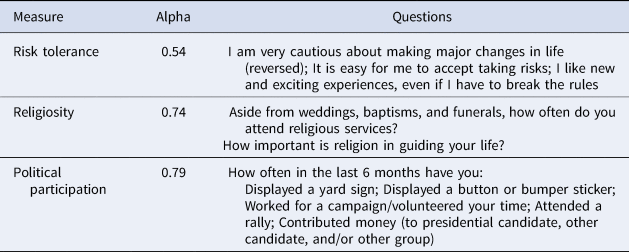
To test these relationships, we rely on an original dataset collected during the 2016 U.S. presidential election.Footnote 1 Unfortunately, no national large-N studies regularly ask questions about risk tolerance; those that do are plagued by small numbers of non-white respondents. As a result, we are dependent on a dataset that we collected. In September 2016, we administered an online survey to 2,572 American adults through Qualtrics Panels and re-interviewed 957 in mid-November that same year. Approximating the U.S. adult population recorded by census.gov, our original sample was 51.8% female, 77% white, 33% with a college degree, and a mean age of 49.5. The sample also included 183 Black women and 148 Black men. Regarding political representativeness, the sample was 46% Democrat (with leaners), 19% independent, and 35% Republican (with leaners), which is quite similar to the partisan distribution in the 2016 CCES (45% Democrat with leaners, 16.5% independent, and 35% Republican). Table 1 provides our key measures, which are standardized to have a mean of zero and a standard deviation of 1.
Key measures

All three of our core measures, risk, religiosity, and participation, rely on multiple items that we combine into single scales. We use a three-item measure of risk taken from the general risk trait scale developed by Kam (Reference Kam2012).Footnote 2 Our measures of religiosity include religious belonging (how frequently someone attends religious services) and self-reports of religious importance (Friesen and Wagner Reference Friesen and Wagner2012). Political participation is measured through a standardized measure of engagement in a wide set of political activities, consistent with much of the work on political participation (i.e., Farris and Holman Reference Farris and Holman2014).
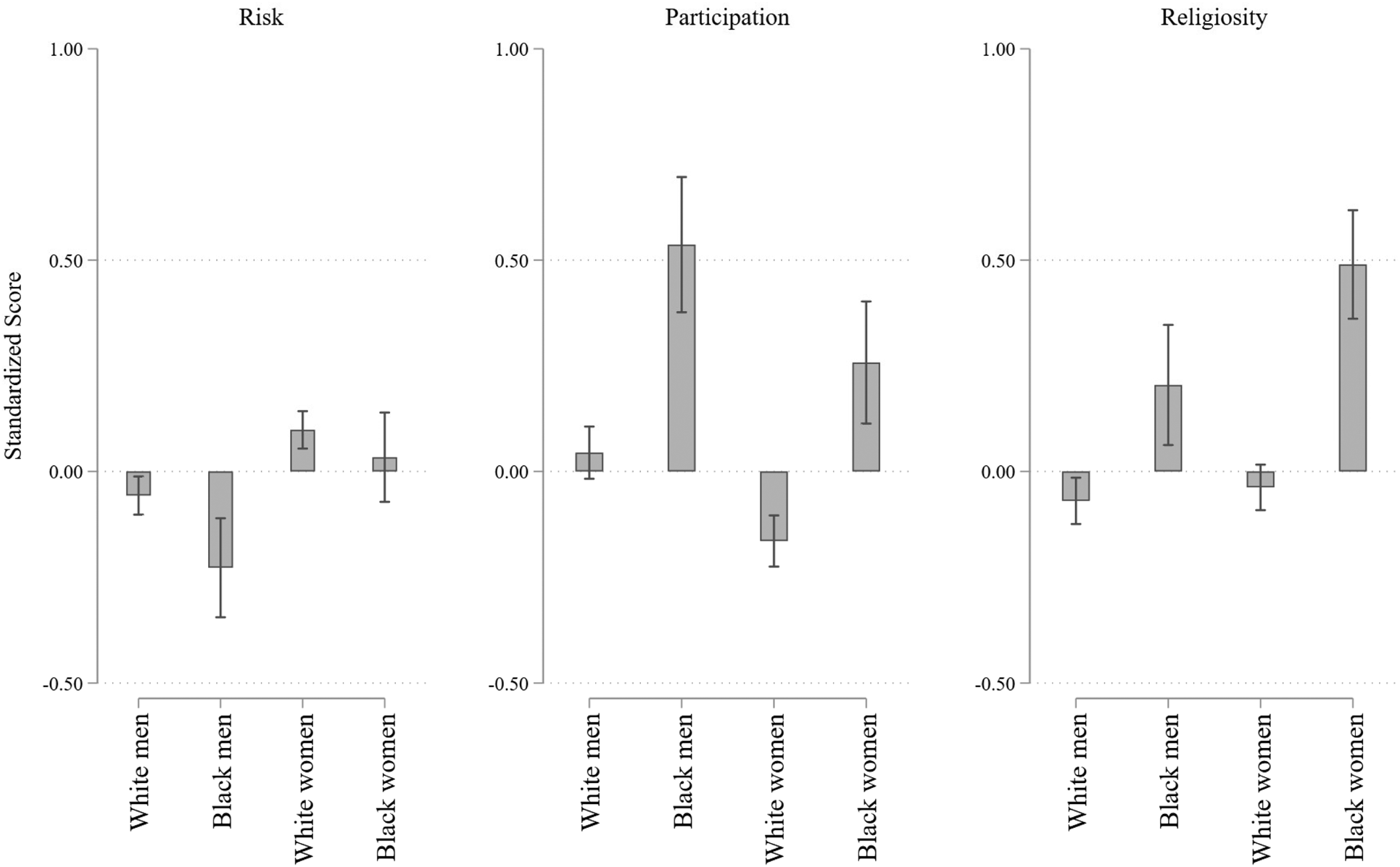
Figure 1 displays the standardized means by race and gender. Because we have four groups to compare, we provide three sets of statistical comparisons: ANOVA of differences across the four groups (white women, Black women, white men, Black men), and then within gender, cross-race comparisons and within race, cross-gender comparisons. This intercategorical approach (McCall Reference McCall2005) allows us to evaluate whether race and gender are shaping risk, participation, and religious experiences.
Risk, participation and religiosity means, by race and gender
Note: Figure presents standardized scores for batteries of risk, participation, and religiosity for race-gender groups.

We start with cross-group comparisons, looking at whether there are differences across Black men and women and white men and women. Moving from left to right on Figure 1, we find significant differences across our four race-gender groups on each of our three measures of interest. On risk aversion, there are significant differences (F = 19.24, p = 0.000), with Black men as least risk averse and white women as most risk averse. For political participation, there are again significant differences (F = 28.65, p = 0.000) and Black men report the highest levels of political activities, while white women report the lowest levels. And on religiosity, race-gender groups report significant differences (F = 23.99, p = 0.000). Black women report the highest levels of religious behavior, while white men report the lowest levels.
We next look at levels of risk aversion within gender, cross-race comparisons (i.e., are there significant race gaps within men and women) and within race, cross-gender (i.e., are there significant gender gaps within white and Black participants). Black men are less risk averse than white men (F = 23.22, p = 0.000); and Black women less so than white women, though not at a statistically significant level (F = 13.31, p = 0.222). White men are significantly less risk averse than white women (F = 16.70, p = 0.000), with the same pattern holding for Black men over Black women (F = 4.93, p = 0.02). This pattern of results generally follows the extant literature on risk tolerance and gender, though the higher risk tolerance of Black men over white men suggests perhaps this general risk battery is not related to financial risk or other “systems” risk in which white men are at the top of the hierarchy.
Black men and women participate significantly more in politics than white men and women (F = 27.16, p = 0.000; F = 33.12, p = 0.000, respectively). Black women and men participate at similar levels (F = 4.58, p = 0.0630), but white men report more political activities than do white women (F = 24.09; p = 0.002). These results both conform to and diverge from the existing scholarship, which finds consistent patterns of white women's lower participation (Coffé and Bolzendahl Reference Coffé and Bolzendahl2010), but has often found that Black women participate at exceptionally high rates (Brown Reference Brown2014; Farris and Holman Reference Farris and Holman2014; Herrick and Pryor Reference Herrick and Pryor2020).
When we examine religiosity, we again find significant race-gender differences. In the sample, Black men report higher levels of religiosity than white men (F = 11.74, p = 0.001) and Black women compared to white women (F = 54.52, p = 0.000, respectively). Black women are significantly more likely than Black men to attend church and believe that religion is important (F = 9.28, p = 0.0025), whereas there is no mean difference in the religiosity of white men and women (F = 0.66; p = 0.418).
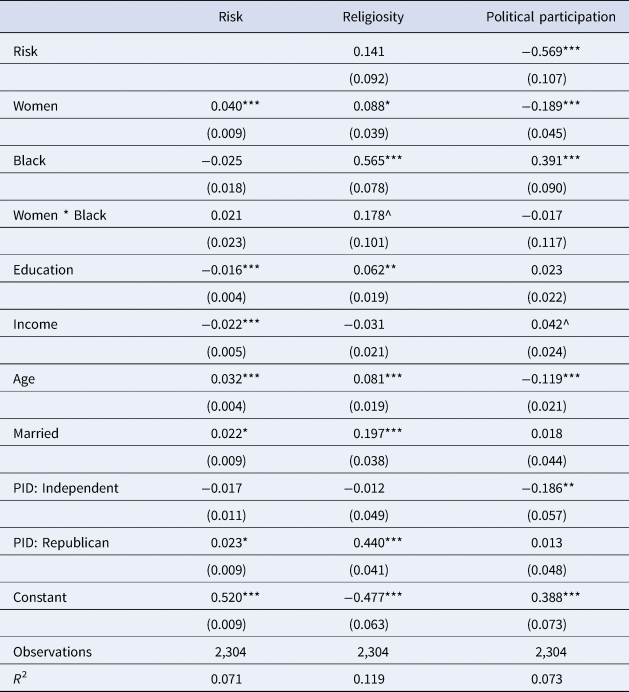
We next use risk, religiosity, and political participation as dependent variables for ordinary least-squares models that include gender and race and demographic controls, displayed in Table 2. We find that gender is associated with higher levels of risk and religiosity and lower participation, but only among white women (our gender variable). Black identity is associated with slightly lower risk, increased religiosity, and increased political participation. And yet, the gendered patterns look different for Black women, where gender does not increase risk or decrease political participation, demonstrating the importance of considering intersectional identities when evaluating models of personality and social participation.
Gender, race, risk, religion, and participation

Note: Qualtrics Panel sample of 2,572 American adults in September 2016. Ordinary Least Squares regression. All dependent variables standardized, with a mean of zero and standard deviation of 1. Standard errors in parentheses. ^ p < 0.10, * p < 0.05, ** p < 0.01, *** p < 0.001.
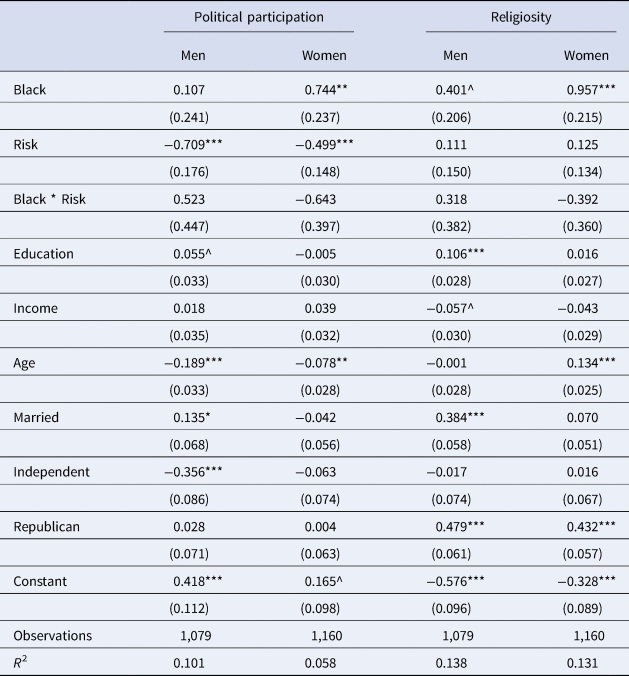
We next look at separate models of women and men, evaluating the effect of risk on each group's religiosity and participation, with controls for race and an interaction between race and risk; these results are available in Table 3. We find again, strong evidence for an intersectional approach to studying the relationship between personality and political and religious behavior. As Table 3 shows, race is associated with higher participation and religiosity, but only among women. And, risk is generally associated with lower levels of political participation, with an additional effect among Black women (but not Black men). In the religiosity models, the racial difference among women again stands out, especially as compared to men, where there are no racial differences.
Risk and religiosity by gender

Note: Ordinary least squares regression. All dependent variables standardized, with a mean of zero and standard deviation of 1. Qualtrics Panel sample of 2,572 American adults in September 2016. Standard errors in parentheses. ^ p < 0.10, * p < 0.05, ** p < 0.01, *** p < 0.001. Results for each race-gender group individually as well as triple-interactions are available in the appendix.
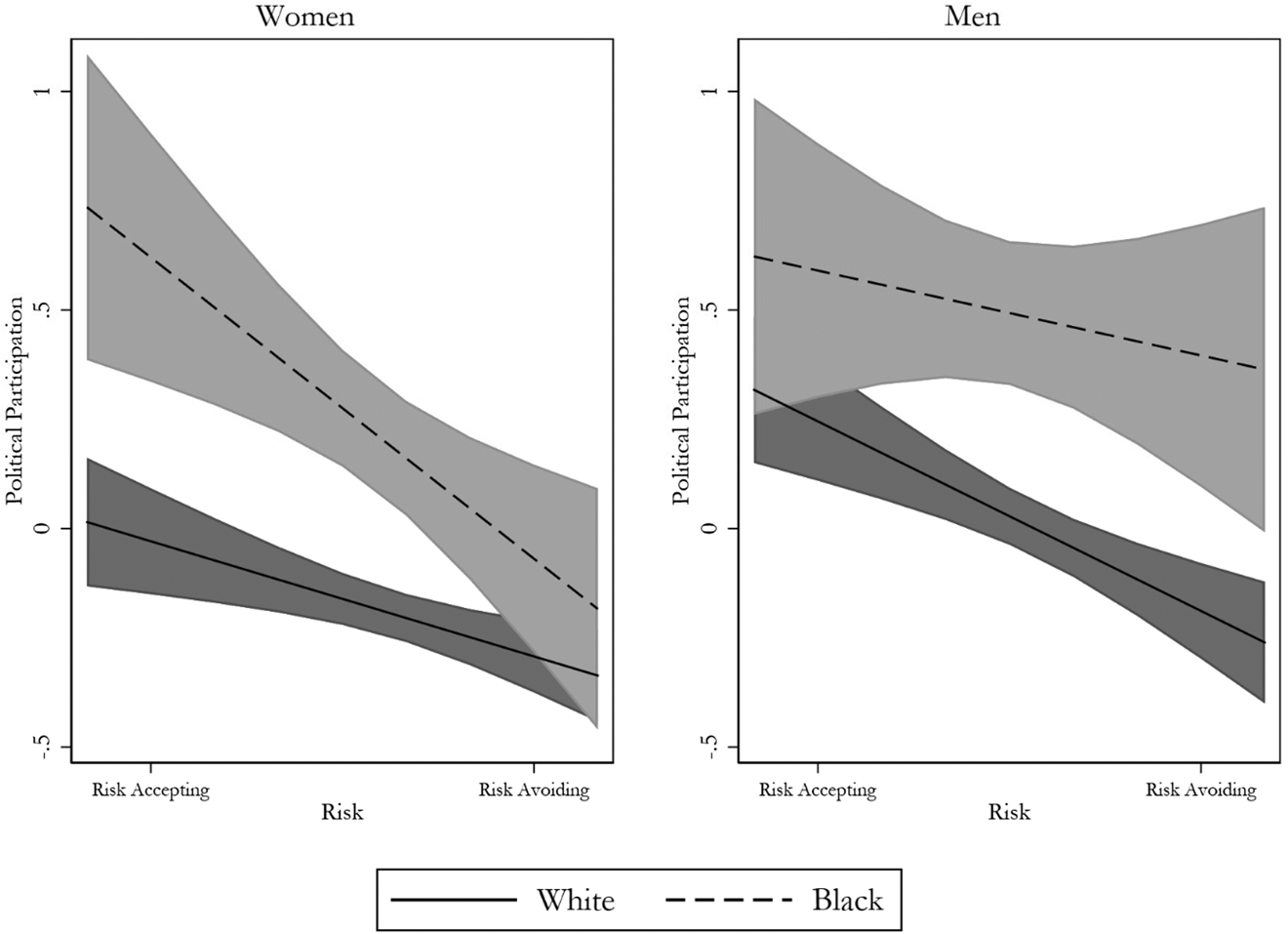
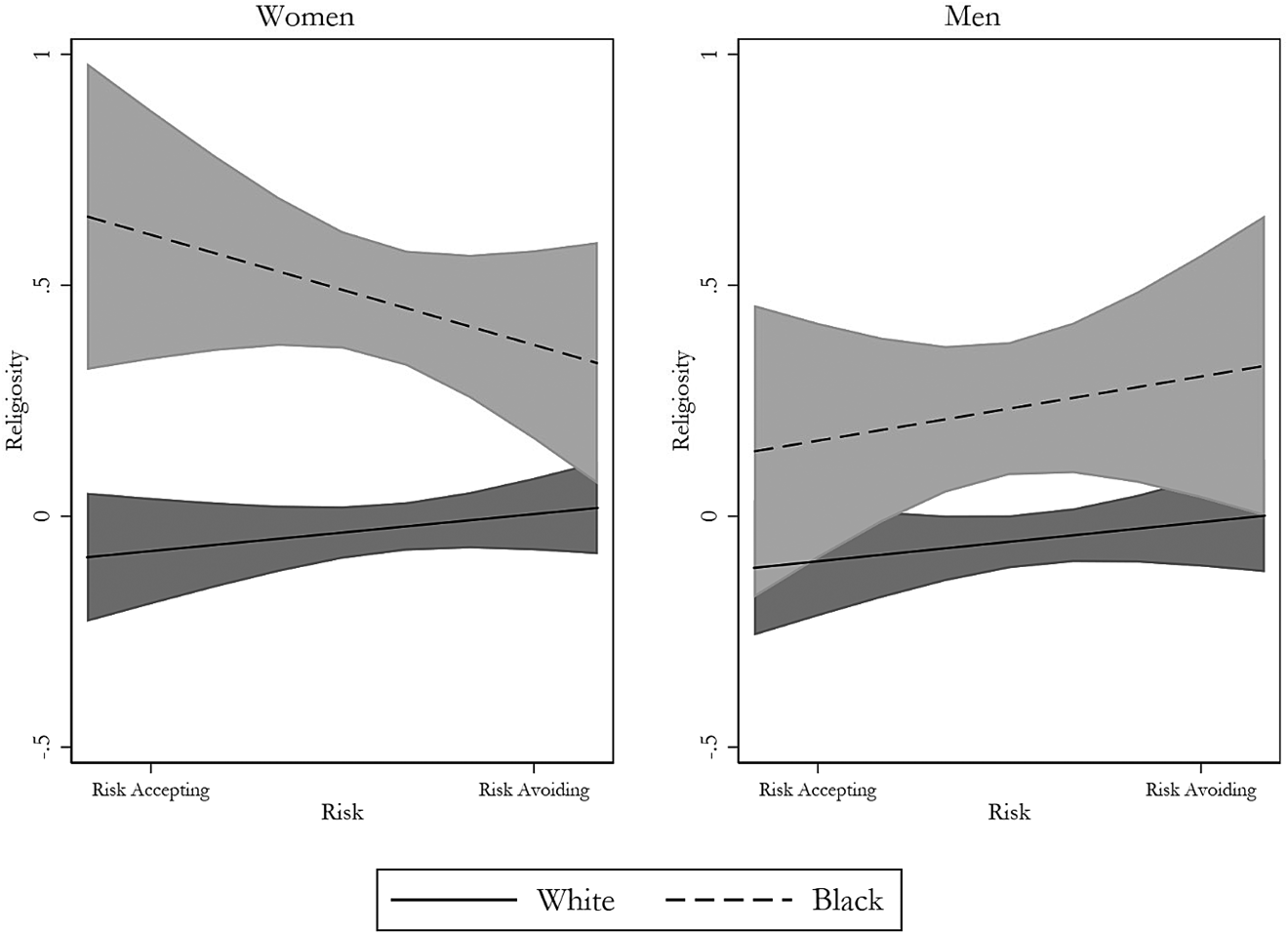
An intersectional approach calls for both intercategorical evaluations, as are presented here and in earlier results, and intracategorical, where we examine within an intersectional category (McCall Reference McCall2005; Hancock Reference Hancock2007). To evaluate both how race-gender categories shape risk, participation, and religiosity, we next visually display these results in Figure 2 (participation) and 3 (religiosity). Doing so lets us both compare the behavior of, say, Black women who are risk averse to white women who are also risk averse (intercategorical), but also Black women who are risk averse to Black women who are risk acceptant (intracategorical).
Risk and political participation by race and gender
Note: Dependent variable is the standardized count of the number of political acts each individual reported engaging in the last 12 months. Results calculated post-estimation for separately estimated models, plotted using post-estimation margins in Stata. Controls include education, age, income, married and are restricted to Black and white respondents. Model displays truncated results given small numbers of observations at tails of risk measure; the possible range of risk is from 0 to 1 and the plot truncates to 0.1–0.9. Figures comparing within race by gender (instead of within gender by race) are available in the appendix.

Starting with an evaluation of risk and political participation, the left panel of Figure 2 shows a much stronger correlation between risk and participation for Black women than for white women, such that risk tolerant Black women participate politically at a far higher rate than risk tolerant white women, but risk averse Black and white women participate at similarly low levels. The pattern differs for men, where the slope of the relationship between Black men's risk and political participation is nearly flat, while white men who are risk accepting participate at a higher rate than white men who are risk avoiding. As a result, risk-avoiding Black men participate at a higher rate than do risk-avoiding white men, but race differences disappear among risk tolerant men.
We next look at these same comparisons for religiosity in Figure 2. Here, we again find divergent effects within race-gender groups for the effect of risk on religiosity. White women, white men, and Black men's risk all positively correlate with their religiosity, with higher risk aversion associated with higher levels of religiosity. Black women diverge: risk is uncorrelated with religiosity, with a slightly negative slope. These findings suggest significant differences in how race and gender interact to shape how risk promotes religiosity, and the role religion and religious institutions play in the lives of these Americans Figure 3.
Risk and religiosity by race and gender
Note: Dependent variable is the standardized measure of the combination of church attendance and importance of religion. Results from separately estimated models, plotted using post-estimation margins in Stata. Controls include education, age, income, married and are restricted to Black and white respondents. Model displays truncated results given small numbers of observations at tails of risk measure; the possible range of risk is from 0 to 1 and the plot truncates to 0.1–0.9. Figures comparing within race by gender (instead of within gender by race) are available in the appendix.

Integrating the Risk, Religion, and Political Models
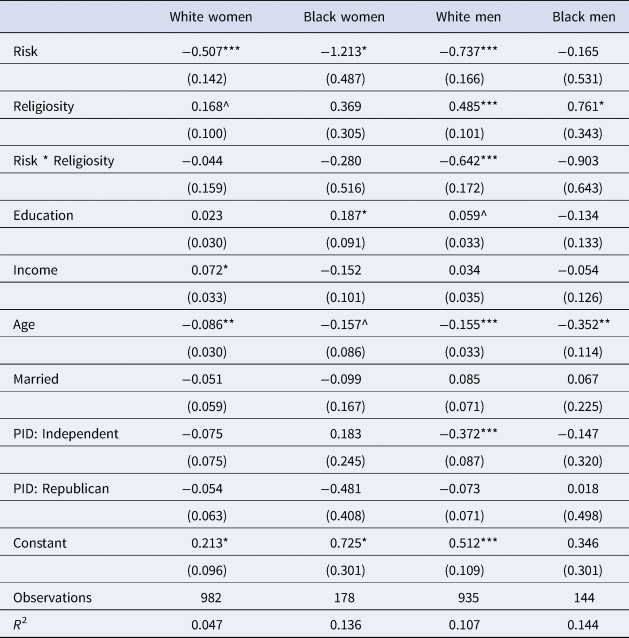
How does risk, religion, and participation relate to each other across and within gender and race groups? Religiosity is generally associated with increased political participation in the United States (Djupe and Gilbert Reference Djupe and Gilbert2006; Lim and Putnam Reference Lim and Putnam2010; Verba, Schlozman and Brady Reference Verba, Lehman Schlozman and Brady1995), but this body of research often only looks at white respondents or implicitly assumes that findings from majority white samples apply to other racial-ethnic groups and apply evenly across genders (but see McClerking and McDaniel Reference McClerking and McDaniel2005 and Gershon, Pantoja, and Taylor Reference Gershon, Pantoja and Taylor2016). We examine how risk and religion might covary in ways that shape political participation, with the assumption that these relationships also vary across race and gender groups. To test this relationship, we first estimate separate models for white women, Black women, white men, and Black men that include an interaction between risk and religiosity; these results are presented in Table 4.
Intercategorical models of political participation

Note: Dependent variable is standardized political participation measure. Standard errors are within parentheses. ^ p < 0.10, * p < 0.05, ** p < 0.01, *** p < 0.001.
Looking first at separate models, or an approach consistent with the intercategorical analysis often suggested by intersectional theorists, we can see how our key variables of interest vary in their significance and effect across the groups of interest and the varying effects of the control variables. Starting with risk, we see that it has the substantively largest effect for Black women, with similar effects for white women and men and no significant effect for Black men. And while religiosity is associated with increased participation for white women and men and Black men, it is not for Black women. We see some interesting patterns in our control variables; while age is often associated with increased voting, we actually find a curvilinear relationship (across all four groups) with our participation measure, where the highest participation levels in 2016 were among those at the middle of our age scale (45–65).
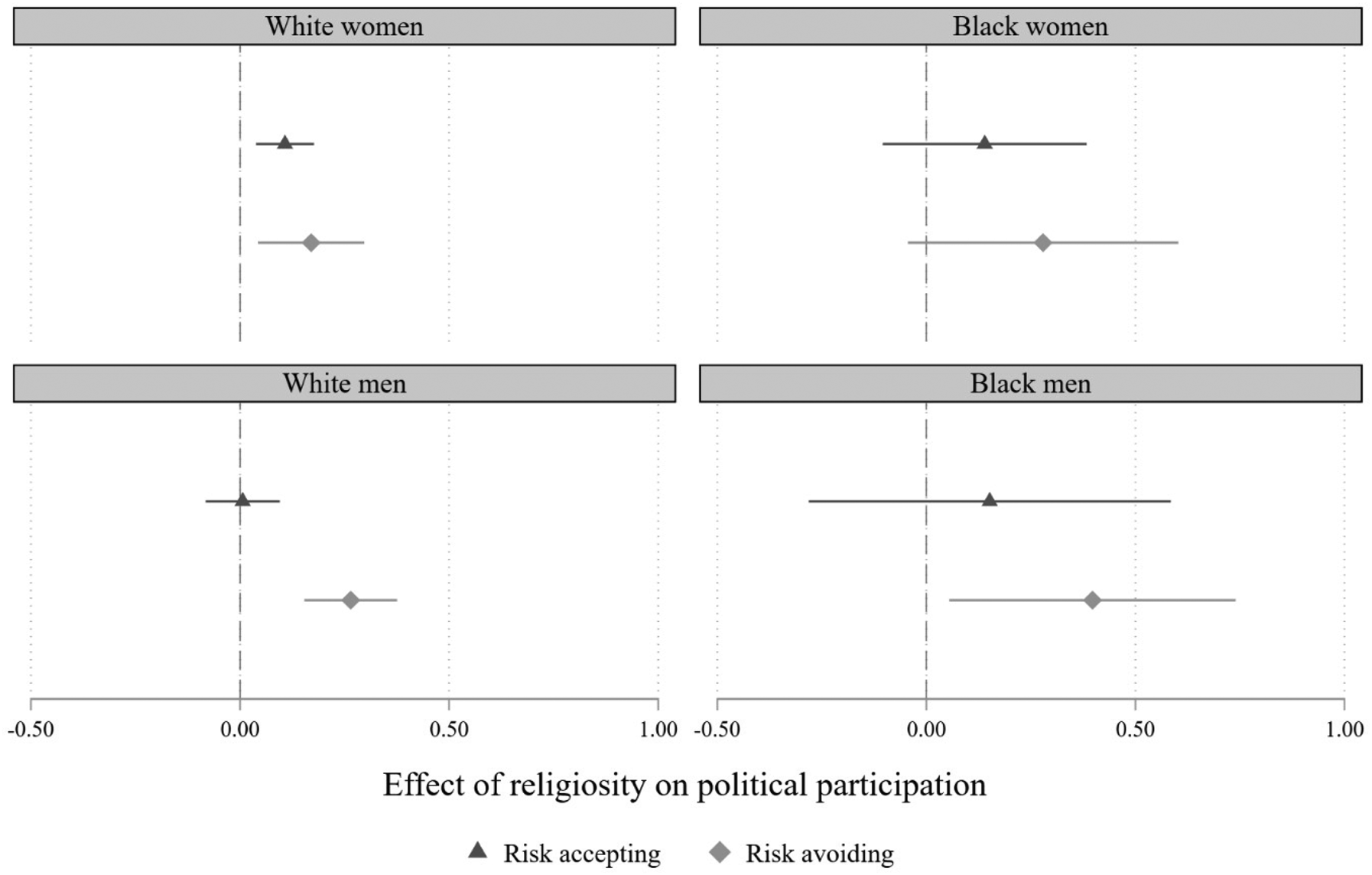
What about the full interaction between risk and religiosity? We argue that these are best explained graphically given the complexities of interactive relationships. To evaluate the substantive effects of these relationships, we generate a dichotomous variable of risk, truncating risk levels at under (low) and over (high) the median point of the risk distribution. We then estimate separate models for each race-gender group at high and low levels of risk to demonstrate how risk and religiosity collectively shape participation. These results are presented in Figure 4.
Religion and political participation among risk accepting and avoiding individuals
Note: Dependent variable is the standardized measure of political participation. Risk accepting/avoiding are individuals under/over the median point on the standardized risk scale. Results from separately estimated model for white women, Black women, white men, and Black men. Controls include education, age, income, married and political party.

As Figure 4 shows, there are clear race, gender, and race-gender differences in these relationships, also reflected in Table 4. White women's religiosity is associated with more participation among both risk avoiding and risk accepting individuals. For Black women, religiosity is not associated with more participation among risk avoiding or accepting individuals. Men's behavior is different: for both white and Black men, among risk avoiding individuals, religiosity is not associated with increased participation. However, among risk-accepting individuals, religiosity is associated with more participation.
Conclusion
“The most neglected person in America is the Black woman.”—Malcolm X, 1962 “… the internal, psychological, emotional, and personal experiences of Black women are inherently political.”—Harris-Perry Reference Harris-Perry2011, 5.
We present here a complication to two central findings of the risk and social engagement literature: that the theory built to explain women's low political participation and increased religiosity via risk works really well for white women and men, but does not neatly apply to Black men's and especially and Black women's experiences. Our research provides more evidence for the key arguments of scholars of intersectionality: that “people's lives and the organization of power in a given society are better understood as being shaped by not a single axis of social division, be it race or gender or class, but by many axes that work together and influence each other” (Collins and Bilge Reference Collins and Bilge2016, 2). By using intersectionality as an analytic tool, we look both across and within gender-race groups to better understand our social and political worlds.
Black women's and men's lives are inherently more risky that white Americans' lives, whether from threats of police violence (Eckhouse Reference Eckhouse2019), substandard medical care (Michener Reference Michener2019), or reduced provision of public goods in majority-Black cities (Trounstine Reference Trounstine2018; Nickels Reference Nickels2019). But gender also shapes these risks. The racialized and gendered nature of modern life in America demands that we consider whether risk might play a different role across races in shaping religiosity and political participation. Our work suggests that investigations of risk require a thoughtful consideration of the ways that race and gender shape risk-taking behavior across the population.
In the examination of when, why, and under what conditions Black American women seek and stay in religious communities, accounting for approaches to risk-taking may be a useful piece of the puzzle in future research. Nguyen and colleagues (Reference Nguyen, Taylor, Chatters and Hope2019) note that, for African Americans, church membership provides an “integral component” of access to support networks, but that this support varies by demographic factors including gender. Uncovering these dispositional differences also may contribute to conversations around Black women's roles and approaches to religion in a culture and institution that often does not center their experiences or promote their leadership (Douglas Reference Douglas2012; Williams Reference Williams2013). This data was collected before the Trump administration took power, capturing a moment before the Women's March and mobilization of previously less engaged women. With increases in political awareness, interest and participation—particularly among white women—we might expect that trait-based risk tolerance will play less of a role in today's American political landscape. Alternatively, Trump's policies, SCOTUS appointments, and Congressional Republican acquiescence may now shift white women's perception of state-based risk in that not voting or participating poses a greater threat than staying uninvolved. In addition, the widespread mobilization around Black Lives Matter, particularly following the deaths of George Floyd and Breonna Taylor, could shape the way all women and some men think about the risks of political engagement. Organizations and movements also may stand in for the community ties and capital that churches once held in the Black community, disrupting the gendered leadership structure of these groups. That is, Black women are at the forefront of many of the social movement organizations for Black lives, positions they have not held in Black churches historically.
The long line of scholarship on gender, race, and political participation (Dawson Reference Dawson1994; Gay and Tate Reference Gay and Tate1998; Burns, Schlozman, and Verba Reference Burns, Schlozman and Verba2001) provides substantial evidence of the need for work that acknowledges intersectionality (Brown Reference Brown2014). The results here suggest that adding an intersectional evaluation of personality to these discussions is important and may help scholars understand why some groups participate more or less in the political process. Our research demonstrates the importance of both understanding the role of race and gender in shaping political and religious engagement, but also acknowledging the role that white-centered, and student-based analysis play in our disciplines' theory development. By assuming that a key aspect of personality—risk acceptance or avoidance—operates in the same way across all racial groups, scholars have missed key types of variation within race-gender groups that help us understand the causal links between risk and political and religious engagement.
While we push the scholarship on personality, political participation, and religiosity forward, there are clear gaps in our approach. We focused on the differences between Black and white participants' risk and political and religious engagement, but research would certainly suggest that Latinx and Asian American engagement would operate in unique ways (Pantoja and Gershon Reference Pantoja and Gershon2006; Cargile Reference Cargile, Gershon and Brown2015; Lemi Reference Lemi2018). Future research evaluating the types of political participation that might be more or less risky would help tease out the theoretical links between risk and participation among and between white and Black women. Similarly, examining specific religious behaviors and beliefs (such as reading the Bible and endorsement of masculine images of God; see Cassese and Holman Reference Cassese and Holman2017) might help untangle the risk-religion relationship across race-gender groups as well as giving consideration to the variation in religious belief and practice among Black congregations (Shelton and Cobb Reference Shelton and Cobb2017). For this study, we have measured gender as binary sex, which may be too blunt of a measure to capture the variance in risk tolerance and political or religious engagement. We anticipate that including a measure of gender identity on a continuous scale (Bittner and Goodyear-Grant Reference Bittner and Goodyear-Grant2017; Gidengil and Stolle Reference Gidengil and Stolle2020) and gender consciousness may uncover the effects of masculinity on increased political engagement and femininity on religiosity, mediated by risk tolerance. Similarly, measures of linked fate and racial consciousness could moderate the relationship between risk-taking and religious and political participation. We hope religion, politics, and personality scholarship in the future will consider the roles of identities and intersectionality in evaluating these and other questions.
Financial support
Funding for the research came from internal grants from the Center for the Study of Religion & American Culture at IUPUI, University of Colorado-Boulder and Denison University. Institutional Review Board approval was obtained through Denison University. Data are available upon request.
Supplementary material
The supplementary material for this article can be found at https://doi.org/10.1017/S1755048321000250.
Amanda Friesen is an Associate Professor of Political Science at Western University, London, ON. She is a political psychologist interested in social identities, dispositions, and political engagement.
Mirya R. Holman is an Associate Professor of Political Science at Tulane University, New Orleans, LA. She studies gender and politics, local politics, and research methods, with a focus on understanding how historically excluded groups engage in politics.