Klebsiella pneumoniae (K. pneumoniae, KP) is an important opportunistic pathogen that can cause bloodstream infection (BSI) with high mortality, Reference Navon-Venezia, Kondratyeva and Carattoli1 ranging from 20% to 60% in different studies. Reference Lou, Du and Zhang2–Reference Meatherall, Gregson, Ross, Pitout and Laupland5 The dissemination of antibiotic-resistant strains, especially carbapenem-resistant KP (CRKP), Reference Liu, Dong, Chan, Chen and Zhang6 further complicates management of these infections.
Infection control measures and active surveillance are in place to prevent nosocomial spread and potential outbreaks of CRKP worldwide. Quantifying the benefits of such a strategy by analyzing the attributable mortality that reflect the additional disease burden of CRKP infection is essential. In gram-negative bacteremia, the third-generation cephalosporin-resistant (3GC-R) mortality attribution has been well explored and is associated with increased mortality. Reference Rottier, Deelen and Caruana7 The burden of carbapenem resistance in KP BSI on mortality has not been quantified.
However, measuring the impact of antimicrobial resistance is challenging because antibiotic-resistant infections are more likely to develop in severely ill patients, and the severity of the condition may be independently associated with poor outcomes. These potential cofounders and/or the methods used for statistical analysis are largely responsible for the difference of carbapenem resistance-associated mortality in KP BSI between studies. Reference Lou, Du and Zhang2,Reference Li, Li, Hu, Hu, Song and Zhang8–Reference Zheng, Cao and Xu10 However, randomization to the exposure before infection to ensure the same baseline characteristics is not feasible. Propensity score analyses with stabilized inverse probability of treatment weighting (IPTW-S) is a robust statistical method appropriate for adjusting the selection bias of control and exposure groups in observational studies. This method is now increasingly used to study infections and to attributable mortality. Reference Brouwer, Duran, Kuijper and Ince11–Reference Tafish, Alkhaldi, Bourghli and Althunian13 However, such matching has rarely been used to study the impacts of antimicrobial resistance on clinical outcomes.
Here, we conducted an observational study to identify the key factors associated with the development and outcomes of CRKP BSI, focused particularly on the impact of carbapenem resistance on mortality in KP BSI using propensity score–based IPTW-S.
Methods
Setting and patients
This retrospective observational study was conducted at a 2,500-bed tertiary-care teaching hospital in Guangzhou, Guangdong Province, in southern China. The number of admissions to this hospital is nearly 90,000 per year. The study protocol was approved by the Institutional Review Board of Zhujiang Hospital. Informed consent was not obtained due to the retrospective nature of the study.
A team of infectious diseases physicians and microbiologists identified all patients aged ≥18 years between January 1, 2015, and December 31, 2020, who had KP BSI. Only the first KP isolate from blood for each patient was included. Data were extracted from medical records, including age, sex, comorbidities, and past medical and treatment histories. All patients were followed until 30 days after diagnosis or death.
Microbiological studies
Species confirmation and antibiotic susceptibility testing were performed in the microbiology laboratory of the hospital using the Vitek 2 automated system (bio-Mérieux, Marcy-l’Étoile, France) using the broth microdilution and disk diffusion methods. Antimicrobial susceptibilities were interpreted following Clinical and Laboratory Standards Institute (CLSI) guidelines. K. pneumoniae that displayed resistance to 1 or more carbapenem agents, such as ertapenem (MICs ≥ 2 mg/L), meropenem (MICs ≥ 4 mg/L), or imipenem (MICs ≥ 4 mg/L), were defined as CRKP. Otherwise, they were defined as carbapenem-susceptible KP (CSKP). Reference Magiorakos, Srinivasan and Carey14
Definitions
BSI was defined as the isolation of KP from the blood culture with or without infection symptoms (fever or hypothermia). The onset of BSI was considered the date of collection of the first positive blood-culture sample. The probable sources of BSI (eg, pneumonia, genitourinary infection, intra-abdominal infection, intravascular catheter–related, skin and soft-tissue infection, intracranial infection) were assessed according to the National Healthcare Safety Network definitions. Primary BSI was defined as BSI without an identified site of infection. 15 The definitions of hospital-acquired, healthcare-associated, and community-acquired KP BSI were based on previously described criteria. Reference Le, Wang, Zeng, Fu, Liu and Hu16 For each BSI patient, we calculated a Charlson comorbidity index score (CCI).Reference Charlson, Pompei, Ales and MacKenzie 17
Statistical analysis
All statistical analyses were performed using SPSS version 25.0 software (IBM, Armonk, NY) and R software version 4.1.3 (R Foundation for Statistical Computing, Vienna, Austria). Continuous variables with a normal distribution are expressed as the mean ± standard deviation (SD) and were analyzed using the Student t test. Continuous variables with a nonnormal distribution are expressed as the median and interquartile range (IQR) and were analyzed using the Mann–Whitney U test. Categorical variables are reported as frequencies and were compared using the χ2 or Fisher exact test. Multivariate logistic regression was used to investigate the independent risk factors for infection and mortality. The Box–Tidwell test was used to assess the assumption of linearity in the logit for the continuous variable. Multicollinearity was examined by checking the variance inflation factor on a multiple regression model with the same dependent and independent variables. Odds ratios (ORs) with associated 95% confidence intervals (CIs) and corresponding P values are presented using forest plots. P < .05 was considered statistically significant.
A propensity score analysis with IPTW-S was performed to balance the distribution of potential confounders between the CRKP BSI and CSKP BSI groups. Compared with classical propensity-score matching, the stabilization feature of IPTW-S methods has the advantage of preserving the size of the study population, not only avoiding the need for adjustment of standard errors in an inflated sample but also preventing study participants from dropping and statistical power from being lost. Reference Austin18,Reference Xu, Ross, Raebel, Shetterly, Blanchette and Smith19 All potential confounders associated with CRKP BSI or death with P values ≤ .20 in the univariate analysis were included for IPTW-S calculation in R software. Any covariates with a standardized mean difference (SMD) < 0.20 were considered balanced. The Kaplan–Meier method was used to plot survival curves, and the differences were compared via the log-rank test. Hazard ratios (HRs) and 95% confidence intervals (CIs) were calculated using Cox regression to estimate the strength of the impact of carbapenem resistance on 30-day mortality.
Results
Study subjects
Between 2015 and 2020, some 782 nonrepetitive KP strains were isolated from blood samples. In total, 408 adult patients with KP BSI were included in the study according to the enrolment criteria: 87 (21.3%) with CRKP BSI and 321 (78.7%) with CSKP BSI. All CRKP isolates were resistant to imipenem and/or meropenem.
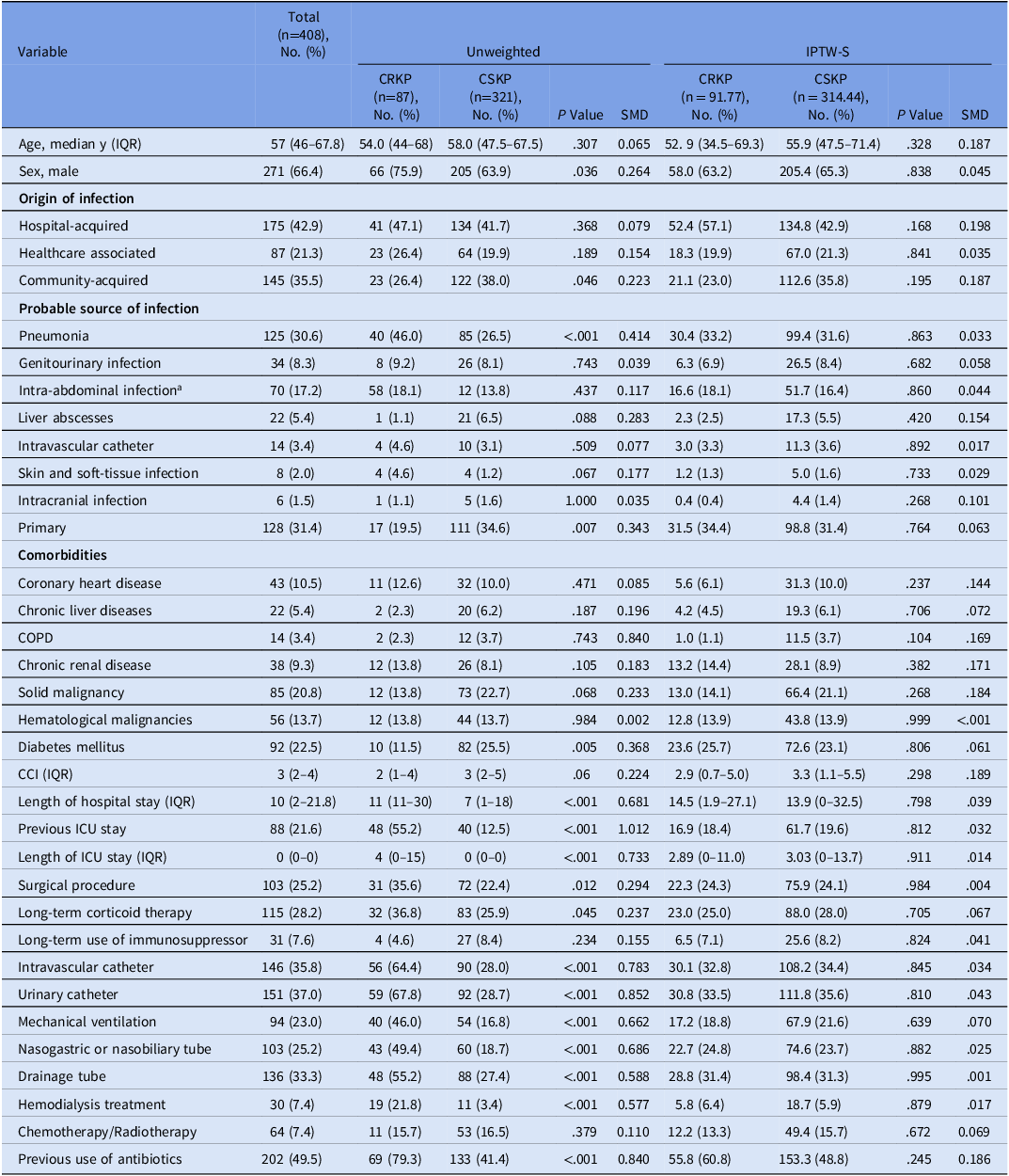
The characteristics of patients are described in Table 1. Overall, the median age of these 408 patients was 57.0 (IQR, 46.0–67.8) years, and 66.4% (271 of 408) of them were male. The most frequent source was primary bloodstream infection (31.4%), followed by pneumonia (30.4%), intra-abdominal infection (17.2%), genitourinary infection (8.3%), liver abscesses (5.4%), and intravascular catheter (3.4%) infections.
Observed and Weighted Baseline Characteristics of Study Patients

Note. CRKP, carbapenem-resistant Klebsiella pneumoniae; CSKP, carbapenem-susceptible Klebsiella pneumoniae; IPTW-S, stabilized inverse probability of treatment weighting; SMD, standardized mean differences; IQR, interquartile range; COPD, chronic obstructive pulmonary disease; CCI, Charlson comorbidity index score; ICU, intensive care unit.
a Excluding liver abscesses.
Factors associated with CRKP BSI
The following factors were associated with carbapenem-resistance in KP isolates from patients with KP BSI: male sex, pneumonia infection, longer hospitalization stay or intensive care unit (ICU) stay, history of ICU stay, long-term corticoid therapy, previous exposure to antimicrobial therapy, exposure to invasive procedures such as surgical procedure, intravascular catheter, urinary catheter, mechanical ventilation, drainage tube, nasogastric or nasobiliary tube, and receipt of hemodialysis treatment in the past 30 days (P < .05) (Table 1). Community-acquired infection, primary BSI and underlying diabetes mellitus were more common in the CSKP group (P < .05) (Table 1).
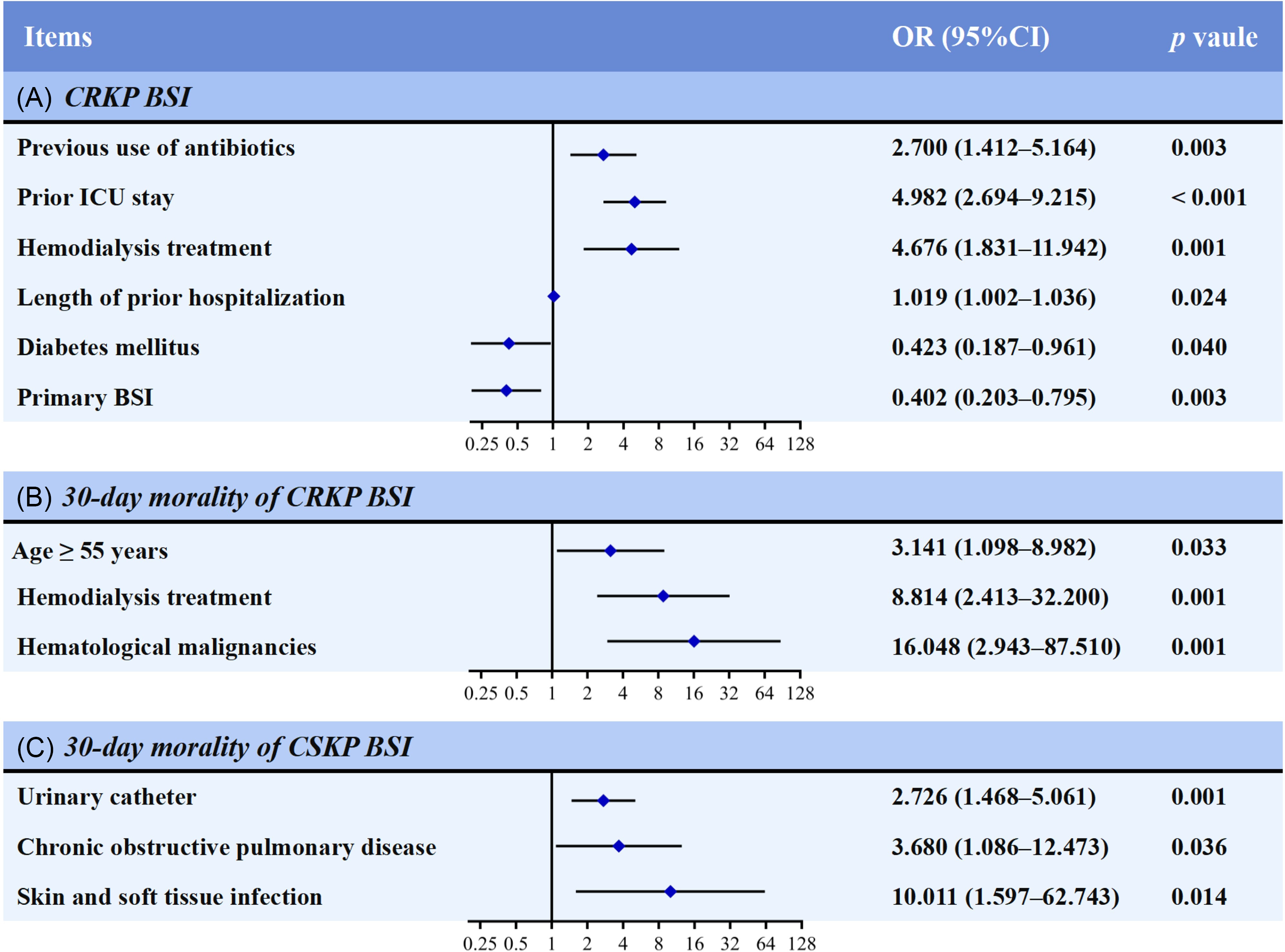
In the multivariate logistic analysis, patients with a longer hospitalization time (OR, 1.019; 95% CI, 1.002–1.036, P = .024), history of ICU stay (OR, 4.982; 95% CI, 2.694–9.215; P < 0.001), receipt of hemodialysis treatment (OR, 4.676; 95% CI, 1.831–11.942; P = .001) and previous exposure to antibiotics (OR, 2.700; 95% CI, 1.412–5.164; P = .003) were more likely to have CRKP BSI. Primary BSI (OR, 0.402; 95% CI, 0.203–0.795; P = .003) and diabetes mellitus (OR, 0.423; 95% CI, 0.187–0.961; P = .040) were associated with reduced odds of CRKP BSI compared to CSKP BSI (Fig. 1A).
Multivariate logistic regression analysis of (A) risk factors for CRKP BSI and 30-day crude morality of (B) CRKP BSI and (C) CSKP BSI. Note. CRKP, carbapenem-resistant Klebsiella pneumoniae; CSKP, carbapenem-susceptible Klebsiella pneumoniae; BSI, bloodstream infection; ICU, intensive care unit; OR, odds ratio; 95% CI, 95% confidence interval.

Outcomes and risk factors for mortality in CRKP BSI and CSKP BSI
During the 30 days following KP BSI onset, 95 (23.3%) of these 408 patients died. The crude 30-day mortality was higher in patients with CRKP BSI (43.7%, 38 of 87) than in those with CSKP BSI (17.8%, 57 of 321; P < .001).
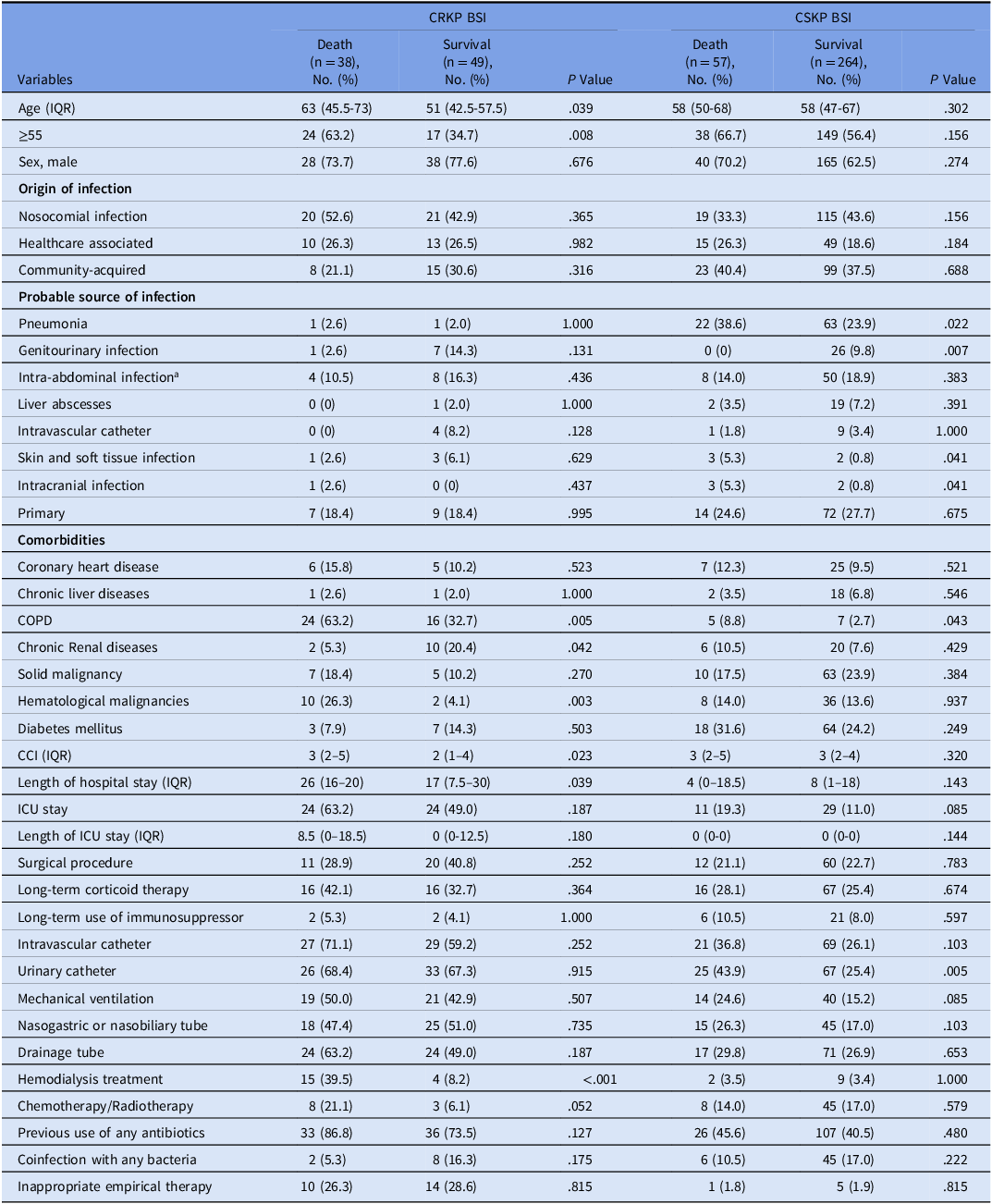
Factors associated with crude mortality among CRKP BSI patients included age (≥55 years), chronic obstructive pulmonary disease (COPD), chronic renal diseases, hematological malignancies, higher CCI, longer hospital stay and receipt of hemodialysis treatment in the past 30 days before CRKP BSI onset (P < .05) (Table 2). Multivariable logistic regression showed that age ≥ 55 years (OR, 3.141; 95% CI, 1.098–8.982; P = .033), accompanying hematological malignancies (OR, 16.048; 95% CI, 2.943–87.510; P = .001), and receipt of hemodialysis treatment (OR, 8.814; 95% CI, 2.413–32.200; P = .001) were independent risk factors for crude 30-day mortality in CRKP BSI (Fig. 1B).
Univariate Analysis of Risk Factors Associated With 30-Day Mortality of CRKP and CSKP BSI

Note. CRKP, carbapenem-resistant Klebsiella pneumoniae; BSI, bloodstream infection; IQR, interquartile range; COPD, chronic obstructive pulmonary disease; CCI, Charlson comorbidity index score; ICU, intensive care unit.
a Excluding liver abscesses.
For CSKP BSI patients, the following factors were associated with crude 30-day mortality: BSI source from pneumonia, genitourinary, skin and soft-tissue or intracranial infection, accompanying COPD, and exposure to a urinary catheter in the past 30 days before CSKP BSI onset (P < .05) (Table 2). On multivariate logistic analysis, the following factors were independently associated with crude 30-day mortality in CSKP BSI: skin and soft tissue infection source (OR, 10.011; 95% CI, 1.597–62.743; P = .014), exposure to urinary catheters (OR, 2.726; 95% CI, 1.468–5.061; P = .001), and COPD (OR, 3.680; 95% CI, 1.086–12.473; P = .036) (Fig. 1C).
Propensity score-based IPTW-S and the impact of carbapenem resistance on mortality for KP BSI
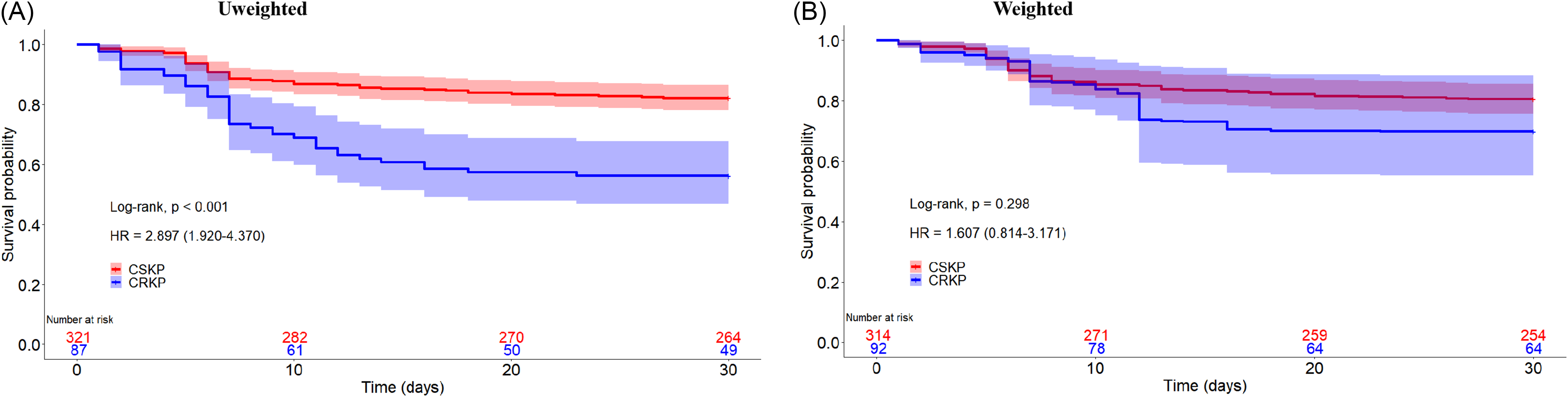
Before weighting, 21 of 34 characteristics had an SMD >0.2. The survival analysis showed that the 30-day survival probability of patients with CRKP BSI was significantly worse than that of those with CSKP BSI (HR, 2.897; 95% CI, 1.920–4.370; P < .001) (Fig. 2A). After adjusting for IPTW-S, the CRKP BSI (n = 91.77) and CSKP (n = 314.44) groups had similar characteristics, with SMD < 0.2 for each (Table 1). The survival analysis of weighted groups showed that the 30-day survival probability of patients with CRKP BSI was worse than that of those with CSKP BSI, but the difference was not significant (HR, 1.607; 95% CI, 0.814–3.171; P = .298) (Fig. 2B).
Crude mortality (A) and weighted mortality (B) of CRKP BSI and CSKP BSI. Note. CRKP, carbapenem-resistant Klebsiella pneumoniae; CSKP, carbapenem-susceptible Klebsiella pneumoniae; HR, hazard ratio.

Discussion
Carbapenem-resistant K. pneumoniae is typically resistant to many first- and second-line antibiotics and is an emergent threat to public health. The rapid recognition of patients with CRKP infection is critical for early appropriate empirical regimen selection and source control of nosocomial dissemination. At present, several published works have focused on the potential risk factors for CRKP BSI infection, but the results vary, Reference Lou, Du and Zhang2,Reference Tian, Tan and Chen4,Reference Li, Li, Hu, Hu, Song and Zhang8,Reference Zheng, Cao and Xu10 possibly due to different sample sizes, selection bias, and differences among bacterial strains causing infection. The current analysis showed that a longer hospital stay, history of ICU stay, exposure to antibiotics, and receipt of hemodialysis prior to bacteremia were independently associated with BSI due to CRKP rather than CSKP. Hospitalization increases the risk of acquisition and colonization of antibiotic-resistant bacteria, as ∼75% of healthcare-associated infections are caused by organisms that are resistant to first-line antimicrobial therapy. Reference Lautenbach and Perencevich20 In particular, the ICU has been increasingly reported as a severe source of creating, spreading and amplifying antimicrobial resistance due to a diversity of complex infections in critically ill patients, the frequent performance of invasive procedures, and the high consumption of first-line antimicrobials. Reference Li, Shen, Zhu and Yu21 Selective pressures exerted by using various classes of antibiotics for treatment in the ICU could result in the selection of strains that are resistant to these antibiotics. Hemodialysis treatment was also associated with CRKP infection, possibly due to greater exposure to invasive procedures and the hospital environment. All of these risk findings strongly suggest that infection control policies involving the environment, healthcare personnel, and antimicrobial prescribing are needed to prevent nosocomial and nosocomial-community dissemination of antibiotic-resistant strains.
Interestingly, among patients with KP BSI, those with diabetes mellitus were more likely to be infected with carbapenem-susceptible strains. This result is similar to the findings of previous studies that have described diabetes mellitus as a risk factor for various infections, including those due to hypervirulent KP (hvKP), Reference Tian, Tan and Chen4,Reference Russo and Marr22 which is typically susceptible to most firstline antibiotics except for a natural resistance to ampicillin. The gut is currently considered an important source of primary BSI caused by KP. Reference Gorrie, Mirceta and Wick23,Reference Martin, Cao and Brisse24 Approximately half of nosocomial KP BSIs are primary infections and are associated with intestinal colonization. Reference Meatherall, Gregson, Ross, Pitout and Laupland5 The characteristics that differentiate hvKP from non-hvCRKP that might have contributed to the higher proportion of primary BSI observed among patients with CSKP BSI, as compared to CRKP BSI, include excessive capsule production and high production of multiple siderophores and are considered critical factors for initial invasion at the colonization site of gut and subsequent bloodstream survival and dissemination. Reference Holmes, Anderson, Mobley and Bachman25
In this study, we identified several risk factors for 30-day crude mortality among cases of CRKP BSI and CSKP BSI: older age (≥55 years), accompanying hematological malignancies, and history of hemodialysis treatment for CRKP BSI, and the skin and soft-tissue infection source, exposure to urinary catheters, and COPD for CSKP BSI. Consistent with previous studies, Reference Zhao, Lin and Liu26 older age has been noted as a risk factor associated with death from CRKP infection as well as other pathogens. The further stratified analysis of age showed that patients aged ≥55 years had a 3.1-fold increased risk for mortality compared with those <55 years. Hematological malignancies, such as leukemia and lymphoma, can affect the immune system directly, resulting in an increased risk for infection. Most patients who received hemodialysis treatment had renal failure and shock in our study; they were vulnerable to CRKP infection and died due to treatment failure. Fewer studies have reported the factors related to mortality in CSKP BSI. In our study, 4 of the 5 patient who died had underlying COPD, and all 3 patients who died who had an infection source from skin and soft-tissue died due to septic shock. This finding shows that preventing the development of respiratory failure in COPD patients in the early stage of septic shock and protecting the integrity of skin and mucosal barriers from persistent infection is vital.
The crude 30-day mortality among CRKP BSI patients in our study was 43.7%, similar to other areas of China, Reference Lou, Du and Zhang2,Reference Li, Li, Hu, Hu, Song and Zhang8,Reference Xu, Sun and Ma27 which was much higher than the 17.8% of CSKP BSI patients. As our results and those of other studies indicate, Reference Wang, Earley and Chen9 these 2 groups of patients had significantly different baseline characteristics, which partly contributed to the risk of infection and outcomes. This fact obscures how and to what extent carbapenem resistance impacts the mortality of KP BSI. To address this problem, we applied propensity scores with IPTW-s to adjust for potential confounders. The 30-day mortality was higher in the CRKP BSI group than in the CSKP BSI group after weighting, but the confidence intervals indicated nonstatistical significance, suggesting that patient and disease factors, such as those identified in our study, are the primary determinants of outcome. These findings contrast with those of several prior studies that reported markedly increased mortality attributed to ESBL-producing or 3GC-R in Enterobacterales infections. Reference Rottier, Ammerlaan and Bonten28–Reference de Kraker, Wolkewitz and Davey30 Our findings are more consistent with other recent studies on 3GC-R Enterobacteriaceae bloodstream infections in South Africa Reference Dramowski, Aiken and Rehman31 and 3GC-R gram-negative infections in the Netherlands, Reference Rottier, Deelen and Caruana7 which also reported that antibiotic resistance did not increase 30-day mortality. Accurate evaluations of the impact of carbapenem-resistance on outcomes of KP BSI have rarely been conducted. Similar to our findings, a recent meta-analysis showed increased mortality from CRKP infection when associated with comorbidities. Reference Goncalves Barbosa, Silva, Bordoni, Barbosa and Carneiro32
The absence of a statistically significant impact of carbapenem resistance on mortality in KP BSI could be due to a higher portion of hvKP among CSKP than CRKP, Reference Russo and Marr22 with the attributed mortality of carbapenem resistance being offset by higher virulence. Assessment for hvKP among BSI isolates was not performed in this study. Liver abscess is a common complication of hvKP infections and should raise suspicion of hvKP strains, Reference Russo and Marr22 but liver abscess was not more common among CRKP BSIs than CSKP BSIs and was not associated with mortality in this study, suggesting that hvKP is not the primary driver of our findings. Nevertheless, infection with hvKP should be considered as a potential contributor to the mortality observed in patients with CSKP BSI, and this should be specifically evaluated in future studies. Notably, this balance might be tipped along with the global emergence of CR-hvKP that has evolved from the confluence of carbapenem resistance determinants of CRKP and the virulence genes of hvKP on the same or coexisting plasmids.
Outcomes of CRKP infection may vary based on the mechanism of carbapenem resistance (eg, carbapenemase production versus other mechanisms of resistance such as AmpC beta-lactamase in combination with a porin mutation). Reference Tamma, Goodman and Harris33 The retrospective design of this study did not allow for the determination of the mechanism of carbapenem resistance among included isolates. However, all CRKP strains in this study were resistant to imipenem or meropenem. Based on the knowledge that non–carbapenemase-producing organisms are often resistant to ertapenem but susceptible to other carbapenems, we suspected that all CRKP strains in this study were carbapenemase producing and that the balanced distribution of KPC would not contribute to the difference in outcomes. Indeed, most of the KP isolates in China may have been KPC producers. Reference Wang, Wang and Wang34
In addition to the patient and isolate factors, the local practices of treating hospitalized patients should be considered, such as empirical antibiotic therapy. Our findings are in line with other studies that have reported no impact of inappropriate initial therapy on outcome. Reference Rottier, Deelen and Caruana7,Reference Fitzpatrick, Biswas and Edgeworth35 Given the potential limitations including the single-center retrospective nature of the study and the modest sample size, a larger, multicenter study is needed for a more precise assessment of the impact of carbapenem resistance on mortality.
Even though there was no obvious impact on mortality, antibiotic-resistant pathogens increase the burden of disease by replacing their antibiotic-susceptible counterparts and increasing the total number of infections. Antibiotic-resistant infections may increase mortality among critically ill patients with comorbidities and may increase costs due to frequent healthcare exposure and usage of expensive antimicrobials that may further select for antimicrobial-resistant pathogens. Thus, early recognition and effective control measures are needed to minimize the potential impact and mortality risk of CRKP BSI.
In conclusion, our study used propensity-score–based IPTW-S to produce an unbiased estimate of the impact of carbapenem resistance on outcomes of KP BSI. Carbapenem resistance was not an independent predictor of 30-day mortality, and outcomes appear to be determined primarily by patient and disease factors.
Acknowledgments
Financial support
This work was supported by the Guangdong Basic and Applied Basic Research Foundation (grant no. 2020A1515010333).
Conflicts of interest
All authors declare no conflict of interest related to this research.