1. Introduction
The Sapir-Whorf hypothesis proposes that language strongly influences or even fully determines an individual's world view and mindset (Hussein, Reference Hussein2012; Whorf, Reference Whorf1956). Under this hypothesis, the language being used by an individual frames, not just the options for the decision problem, but also the underlying behavioral processes as well as the subsequent preference. With globalization, the number of bilinguals is increasing rapidly (Zeigler & Camarota, Reference Zeigler and Camarota2019), and people are now more likely to be presented with decisions framed in their second language. Does this simple linguistic modulation impact the way people make important decisions?
Intertemporal decisions involve trade-offs between smaller-sooner (SS) rewards and larger-later (LL) rewards (Frederick, Loewenstein & O'Donoghue, Reference Frederick, Loewenstein and O'Donoghue2002). These types of decisions can be pivotal, not only to the health, wealth and well-being of individuals, but also to the economic prosperity of nations (Frederick et al., Reference Frederick, Loewenstein and O'Donoghue2002). When making intertemporal decisions, people generally show a tendency to undervalue larger but delayed rewards, a phenomenon known as temporal discounting. For instance, they may prefer to gain $100 today rather than wait a week to gain $110. A broad array of models, such as the discounted utility model (Samuelson, Reference Samuelson1937) and hyperbolic model (Mazur, Reference Mazur1987), have been developed to understand the mechanisms underlying such a preference. Although significant progress has been made in this endeavor, neither normative nor heuristic models have addressed the plausible impact that different languages may exert on intertemporal preference.
The existing research that has explored the effect of language on intertemporal decisions falls within two distinct pathways. The first pathway highlights how the linguistic features of a first language (L1) can bring about a long-term impact on intertemporal preference. The Linguistic-Savings Hypothesis (LSH), for example, focuses on effects caused by differences in future-time reference (FTR). A language with a strong FTR, which makes grammatical distinctions between the present and the future, is associated with a tendency for less future-oriented behaviors (e.g., saving less) (M. K. Chen, Reference Chen2013). The second pathway, the foreign language effect (FLE), explores the short-term effects that can be brought about by a foreign/second language (L2) on decision-making. For example, using L2 has been shown to lead to a “debiasing” effect on risky decisions (Keysar, Hayakawa & An, Reference Keysar, Hayakawa and An2012). Very few studies have attempted to merge these two pathways. Consequently, we know little about whether the features of a particular language, such as its FTR, may exert short-term effects on the decisions of an L2 speaker.
1.1. The LSH and intertemporal decision-making
When making intertemporal decisions about the future (e.g., when planning for future events), different languages may vary in their grammatical forms (see Dahl, Reference Dahl and Dahl2000). A key difference is that some languages obligatorily require a specific grammatical form or mark for the given future context (i.e., strong-FTR languages), while some languages do not (i.e., weak-FTR languages). For example, as a strong-FTR language, English typically requires speakers to add a “will” or “be going to” into sentences when referring to the future (e.g., I will save money in the next month). Chinese, on the other hand, is a weak-FTR language since it does not require obligatory grammatical changes when referring to the future tense (e.g., 我下个月存钱, which is translated as “I next month save [present tense] money”). It is important to note the presence of within-language variation as to the obligatory nature of FTR in a given contextFootnote 1. Thus, rather than a binary categorization, the FTR of languages is more likely a continuum that ranges from weak to strong (Thieroff, Reference Thieroff and Dahl2000; Thoma & Tytus, Reference Thoma and Tytus2018).
Based on differences in FTR between languages, M. K. Chen (Reference Chen2013) analyzed the panel survey of 34 OECD countries and proposed the LSH. The LSH suggests that, by making an explicit grammatical distinction between present and future, L1 speakers of a language with a strong FTR are discouraged from engaging in future-oriented intertemporal behaviors such as saving (M. K. Chen, Reference Chen2013). Thus, we can infer that individuals speaking strong-FTR languages (e.g., English) may discount delayed rewards more steeply and have a higher temporal discount rate than those speaking weak-FTR languages (e.g., German, Chinese).
Several recent studies showed support for the LSH theory. For example, using the World Values Survey dataset, Pérez and Tavits (Reference Pérez and Tavits2017) replicated the association between strong-FTR L1 languages and lower rates of saving. L1 speakers of strong-FTR languages have also been shown to be less prepared for old age (another future-oriented behavior) (A. Chen & Fung, Reference Chen and Fung2019). Previous research comparing monolingual with bilingual speakers has produced similar results (Sutter, Angerer, Rützler & Lergetporer, Reference Sutter, Angerer, Rützler and Lergetporer2015). That is, compared with monolingual children who use a strong-FTR language and bilingual children who use languages with a mix weak and strong FTRs, monolingual children who use a weak-FTR language are more likely to engage in future-oriented intertemporal behaviors such as delaying gratification.
Two intertemporal-related variables – namely, future orientation and subjective future perception, may explain the indirect effect of FTR in L1 language speakers. Future orientation refers to the extent that an individual's thinking and behavior refers to the future (Gjesme, Reference Gjesme1979; X. Liu, Huang, Pu & Bi, Reference Liu, Huang, Pu and Bi2010), and as such is inextricably related to one's intertemporal decision (r = 0.272) (Da Ugherty & Brase, Reference Da Ugherty and Brase2010; Guo, Chen & Feng, Reference Guo, Chen and Feng2017). A previous study has shown that a strong-FTR language (i.e., Russian) could make speakers less future-oriented and less supportive towards future-oriented policy (Pérez & Tavits, Reference Pérez and Tavits2017). Moreover, subjective future perception is one of the essential drivers of temporal discounting (Zauberman, Kyu, Selin, Malkoc & Bettman, Reference Zauberman, Kyu, Selin, Malkoc and Bettman2008). Despite lacking evidence, the LSH also proposes that L1 speakers of a strong-FTR language may have a more distant subjective future perception (M. K. Chen, Reference Chen2013). That is, by requiring speakers to pay extra attention to time in the future in order to ensure grammatical accuracy, a strong-FTR language may incidentally bring attention to the distance between present and future events.
However, given that the LSH bases its proposals on surveys and panel data, it has been criticized for its non-experimental approach. These methods limit its potential to establish a causal relationship between language and future-oriented intertemporal behavior. For instance, the correlation between the FTR and future-oriented intertemporal behavior is weakened once the relatedness of the different language has been controlled for (Roberts, Winters & Chen, Reference Roberts, Winters and Chen2015). Indeed, when the LSH has been tested experimentally in the laboratory, no causality has been detected (J. I. Chen, He & Riyanto, Reference Chen, He and Riyanto2019). These results suggests that the LSH may be unstable or even a statistical artifact (Thoma & Tytus, Reference Thoma and Tytus2018).
1.2. The FLE and intertemporal decision-making
In addition to the long-term effects exerted by the linguistic features of L1, recent studies have begun to argue for short-term effects of a second language on decision-making. The FLE suggests that using L2 may lead to a reduced influence of irrational decision biases on decision-making. These biases include the well-known framing effect (Keysar et al., Reference Keysar, Hayakawa and An2012), loss aversion (Costa, Foucart, Arnon, Aparici & Apesteguia, Reference Costa, Foucart, Arnon, Aparici and Apesteguia2014a), superstition (Hadjichristidis, Geipel & Surian, Reference Hadjichristidis, Geipel and Surian2019), causality bias (DãAz-Lago & Matute, Reference Dã-Az-Lago and Matute2018) and hot-hand bias (Gao, Zika, Rogers & Thierry, Reference Gao, Zika, Rogers and Thierry2015). The FLE has been found to be stable across a variety of foreign languages (including Spanish, English, German, Italian, etc.) and paradigms (e.g., survey and experimental task) (Costa et al., Reference Costa, Foucart, Arnon, Aparici and Apesteguia2014a; Hadjichristidis et al., Reference Hadjichristidis, Geipel and Surian2019; Keysar et al., Reference Keysar, Hayakawa and An2012).
The Dual-Process Theory (De Neys & Pennycook, Reference De Neys and Pennycook2019; Evans & Stanovich, Reference Evans and Stanovich2013; Kahneman, Reference Kahneman2011) has been used to explain the FLE (Białek, Muda, Stewart, Niszczota & Pieńkosz, Reference Białek, Muda, Stewart, Niszczota and Pieńkosz2020). While making decisions using L1, individuals are thought to recruit a system that is more emotion- and intuition-centered (System 1), thus leading to more irrational biases. In contrast, while using a less familiar L2, the influence of emotional resonance appears to be reduced (Keysar et al., Reference Keysar, Hayakawa and An2012). This effect of emotion may be explained by two alternative mechanisms. First, L2 may contain less affective and emotional information (Fan et al., Reference Fan, Xu, Wang, Zhang, Yang and Liu2016; Pavlenko, Reference Pavlenko2012). Or, while using L2, the increased cognitive load may restrict cognitive resources available for processing emotion, thus reducing the intensity of emotional reaction thereafter (Thoma & Baum, Reference Thoma and Baum2019). As a result, using L2 may lead individuals to rely more on a system that is rational (System 2), thus leading to more rational decisions (McFarlane, Cipolletti Perez & Weissglass, Reference McFarlane, Cipolletti Perez and Weissglass2020).
According to the FLE, the use of a second language would lead people to exert improved control over their emotions, thus leading to a lower temporal discount rate during intertemporal decision-making. However, whether this is the case remains unclear. To the best of our knowledge, the only related study did not support such a prediction (Białek, Domurat, Paruzel-Czachura & Muda, Reference Białek, Domurat, Paruzel-Czachura and Muda2021). Instead, they found that participants speaking a second language did not change or even slightly increase their temporal discount rate. They also proposed that using a second language may only have an indirect effect on intertemporal decision through cognitive reflection – namely, the ability or willingness to override intuition (De Neys, Reference De Neys2014). Previous studies suggest that cognitively reflective individuals may have a lower discount rate (Białek & Sawicki, Reference Białek and Sawicki2018). Białek et al. (Reference Białek, Domurat, Paruzel-Czachura and Muda2021) report a marginally significant (p = .077) interaction between second language and cognitive reflection on the decision consistency. Although the FLE may not impact cognitive reflection (Białek et al., Reference Białek, Domurat, Paruzel-Czachura and Muda2021; Costa et al., Reference Costa, Foucart, Arnon, Aparici and Apesteguia2014a), Białek et al. (Reference Białek, Domurat, Paruzel-Czachura and Muda2021) suggest that using a second language may disable the ability to use cognitive reflection to guide intertemporal decision. However, given that the FTRs of languages in their studies were not matched, it is difficult to determine whether there was an alternative effect of FTR on discounting.
1.3. The current study
Previous studies have investigated either the long-term effect of FTR on decision-making or the short-term effect of second language on decision-making. Although these separate pathways are valid when only one language feature is involved, there is a gap in interpretation by failing to address the common instance of when both features mix (e.g., when weak-FTR L1 speakers must use a strong-FTR L2). Thus, the primary motivation of the current study was to investigate the direct effect of the FTR of a second language on temporal discounting. We also aimed to clarify the potential effect of language to several variables related to intertemporal decision behavior (i.e., future-orientation, subjective future perception).
Here, we selected English and Chinese as two languages with distinct FTRs: English typifies a strong-FTR, while Chinese typifies a weak-FTR. According to the LSH, we can hypothesize that when Chinese L1 speakers use English as L2, the strong-FTR element in English may lead them to discount the value of a delayed reward to a greater extent. We also hypothesized that this effect of language on intertemporal discounting is mediated by two indirect variables, future orientation and subjective future perception. That is, using English as L2 may lead Chinese L1 speakers to show less future-orientation and perceive future events as more distant.
To this aim, we used three between-group studies (one pre-registered) and an internal meta-analysis study to investigate whether the use of high-FTR L2 (English) impacts intertemporal decision behavior in weak-FTR L1 (Chinese) speakers. In Study 1, we tested the effect of second language on intertemporal decision behavior variables. We collected a sample of college students to compare discount rates and the future-orientation of participants using Chinese and English. In Study 2, we replicated the original study in a more representative sample and added subjective future perception as a new dependent variable. In the pre-registered Study 3, we replicated our main results using two different measurements of temporal discounting to ensure the reliability of our findings. Finally, in the internal meta-analysis study, we combined the evidence of the language effect on temporal discounting, future orientation and subjective future perception across three studies. All the materials, data and code are available at https://doi.org/10.57760/sciencedb.psych.00105.
2 Study 1
In Study 1, we tested the effect of second language on future-time reference by comparing discount rates and future-orientation in Chinese or English language group.
2.1. Participants
Using G-power, we computed that at least 78 participants in each group would ensure 80% statistical power for an independent t-test, when d = 0.40. We recruited a total of 213 college undergraduate or graduate students through advertisements on social media within campus groups at Shanghai, China. All participants were: 1) Chinese L1 speakers; 2) had learned English as a second language and passed the CET-4 (a standardized English test for Chinese college students); 3) had not resided in an English-speaking country for more than 6 months; 4) had not taken part in any experiments on decision-making before. Participants completed questionnaires through the WJX platform (www.wjx.cn) and received 15 RMB as payment after the experiment.
All participants in the three studies signed a written informed consent prior to the experiment. All three studies were approved by the Institutional Review Board (IRB, No. H21057) committees at the Chinese Academy of Sciences.
2.2. Procedures and measurements
After signed informed consent was given, all participants firstly completed a screening questionnaire. Any participants failing to meet the inclusion criteria were excluded automatically by the WJX platform. Then, participants were randomly allocated to answer a Chinese-version or an English-version questionnaire. In the Chinese group, the entire questionnaire was in Chinese; while in the English group, except for the informed consent form and demographic questionnaires, the entire questionnaire was in English. All the participants in both groups then answered an intertemporal decision questionnaire, the Future-oriented Coping Inventory, and a post-test questionnaire, respectively. The questionnaires were listed as follows:
Monetary Choice Questionnaire (MCQ) and the post-test questionnaire
To measure intertemporal preference in participants, we used the widely-used Chinese version of Monetary-choice Questionnaire (Kirby & MarakoviĆ, Reference Kirby and MarakoviĆ1996; L.-L. Liu et al., Reference Liu, Chen, Cui, Wang, Zhang, Neumann and Chan2016; Peng, Zhang, Liao, Zhang & Zhu, Reference Peng, Zhang, Liao, Zhang and Zhu2019). The translation was double-checked by two Chinese–English bilinguals (Psychology graduate students). MCQ comprises 21 pairs of bi-option intertemporal choices. Each pair of options includes a small but immediate reward (ranged in value from 30 RMB to 166 RMB) and a larger but delayed reward (ranged in value from 60 RMB to 170 RMB) with delays ranging from 10 to 75 daysFootnote 2. Participants were required to choose between the two options according to their own preferences. An automatic scoring tool (Kaplan, Amlung, Reed, Jarmolowicz & Lemley, Reference Kaplan, Amlung, Reed, Jarmolowicz and Lemley2016) was used to calculate the overall temporal discount rates for each participant (a higher discount rate signifies steep discounting of future rewards, for detailed scoring of MCQ see Supplementary materials). In Study 1, the Cronbach α of MCQ was 0.93, and 95% of the choices were consistent with the calculated discount rate. An example question was as follows:
Which one do you prefer (你更倾向于选择下列选项中的)?
A. I get 60 yuan immediately (我立即得到 60 元).
B. 14 days later, I will get 170 yuan (14 天后,我得到 170 元).
Participants in the English group also completed a post-test questionnaire to rate how well they understood the Monetary-Choice Questionnaire (0%, understand nothing; 100%, understand every word). Participants in the English group reported a mean average of 92.01 ± 11.64% in their self-rated understanding of decision questions, showing that their English ability was of a sufficient level to understand the questionnaires.
English ability questionnaire
Participants in the English group were also asked to fill a self-rated English Ability Questionnaire. This English ability questionnaire (EAQ) was revised from Keysar et al. (Reference Keysar, Hayakawa and An2012). Participants self-rated their English ability across four dimensions (written comprehension, written production, oral comprehension and oral production) on a 7-point Likert scale (1, extremely poor; 7, extremely good). The mean score of EAQ in Study 1 was 4.36 ± 0.97, with a Cronbach α of 0.88.
Future-oriented coping inventory
We used the Future-oriented Coping Inventory (FCI) (Gan, Yang, Zhou & Zhang, Reference Gan, Yang, Zhou and Zhang2007) to measure individual difference on future-oriented behaviors of participants. This FCI consists of 16 self-rated questions (e.g., “I try to manage my money well in order to avoid being destitute in old age”) on a 4-point Likert scale (1, completely disagree; 4, completely agree). A higher score implied a higher tendency to act out a future-oriented behavior. The overall mean scores of each participant were used for later analysis. The Cronbach α of FCI in Study 1 was 0.84.
Cognitive reflection test and Berlin numeracy test
We used these two tests to control for cognitive and mathematical abilities of participants. The cognitive reflection test (CRT) (Frederick, Reference Frederick2005) contains three questions which are easy to mistake when using automatic intuition (e.g., “A bat and a ball cost $1.10. The bat costs $1.00 more than the ball. How much does the ball cost?”). The Berlin Numeracy Test (Cokely, Galesic, Schulz, Ghazal & Garcia-Retamero, Reference Cokely, Galesic, Schulz, Ghazal and Garcia-Retamero2012) contains four questions which require participants to use their mathematical ability. Both tests were scored based on the number of correct answers – a higher score implied a higher cognitive or mathematical ability.
2.3. Analysis
We analyzed the data in two ways. First, based on the aggregation of data-points, we conducted ANCOVAs to compare group difference in temporal discounting (aggregated by overall discount rates) and future-orientation (aggregated by mean rating scores) between two language groups, after controlling for gender, age, CRT and BNT scores (or without controlling, for results see Supplementary materials 3.1). We also conducted Bayesian ANCOVAs using JASP (Love et al., Reference Love, Selker, Marsman, Jamil, Dropmann, Verhagen and Wagenmakers2019), with the default prior (r scale fixed effect = 0.5; for the robustness check with different prior widths, see Supplementary materials 3.4). In addition, we tested the indirect mediating effect of future orientation on temporal discounting.
Second, considering the systematic variation on the individual and item levels, we conducted mixed-effect models to ensure the stability of our results. In detail, using R package brms (Bürkner, Reference Bürkner2017), we fit a Bayesian mixed-effect ordinal regression model (thresholded-cumulative) (Veríssimo, Reference Veríssimo2021) for future-orientation (rating scales) and a Bayesian mixed-effect Logistic regression model for temporal discounting (binary choice, 1 = choosing the delayed option; 0 = choosing the immediate option). For both mixed-effect models, the language group and all control variables were set as predictors, and participants and items were set as random intercepts.
2.4. Results
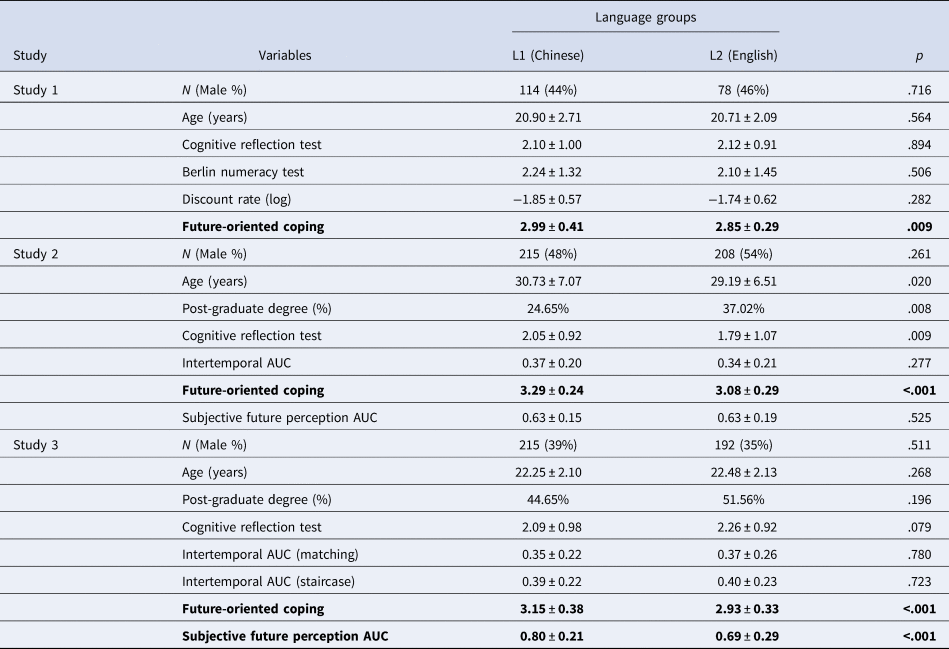
Consistent with the exclusion criteria of previous studies (Costa, Foucart, Hayakawa, Aparici, Apesteguia, Heafner & Keysar, Reference Costa, Foucart, Hayakawa, Aparici, Apesteguia, Heafner and Keysar2014b; Geipel, Hadjichristidis & Surian, Reference Geipel, Hadjichristidis and Surian2015a, Reference Geipel, Hadjichristidis and Surian2015b), 21 participants were excluded from further analysis: 15 for a low level of questionnaire comprehension (less than 50%); 1 for an extremely poor self-rating of English ability; 5 for low consistencies in their responses to the MCQ. Thus, we included a final sample of 192 valid participants (Chinese group: n = 114; English group: n = 78) for subsequent analysis (see Table 1). No significant differences or interactions were found on the main control variables (ps > .05) between the two language groups, or between control variables and the group (ps > .05, see Supplementary materials 3.2), suggesting a high degree of homogeneity in our sample (see Table 1).
All measured variables for Chinese and English groups across all studies (M ± SD).

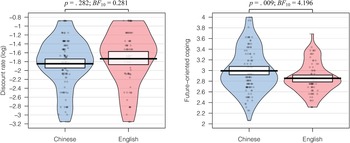
Our results (see Figure 1) did not show a significant language effect on temporal discount rate. The ANCOVA suggested that participants using English or Chinese were not significantly different in their overall discount rates (log transformed), F (1, 186) = 1.166, p = .282, Cohen's f = 0.078. The Bayes factors provided moderate evidence for the null hypothesis, BF10 = 0.281, suggesting that using English did not impact participants’ temporal discount rate. The Bayesian mixed-effect Logistic regression model also provided consistent results, estimating a non-significant effect on discounting as −0.636, with a 95% CI including zero, [−1.787, 0.503].
The distribution of temporal discount rate (left) and future-oriented coping (right) between English and Chinese groups in Study 1.

However, results showed that using English as L2 decreased future-orientation among Chinese L1 speakers. Participants using English showed significantly lower future-orientation than those using Chinese, F (1, 186) = 6.991, p = .009, Cohen's f = 0.193, with a moderate evidence of Bayes factors, BF10 = 4.196. The Bayesian mixed-effect ordinal models (see the trace plot in Supplementary materials 3.5, Figure S3 & S4) also estimated a significant language effect as −0.347, 95% CI = [−0.571, −0.122]. However, the indirect effect of future-orientation on discount rate was not significant, β = −0.005, 95% CI = [−0.037, 0.029], p = .762.
These results suggest that a strong-FTR L2 (English) may lead speakers of a weak-FTR L1 (Chinese) to become less future-oriented, but does not exert any impact on intertemporal preference. These results are partially consistent with predictions of the LSH.
3. Study 2
3.1. Participants
To improve the external validity of our findings, we used the WJX platform to recruit a more representative sample of Chinese participants consisting of college students as well as adults in the workforce. We applied the same inclusion criterion as Study 1. To ensure an acceptable quality of online responding, we included three questions to check attention (e.g., “Please choose disagree for this item”) in the questionnaire. Participants who failed to respond correctly on these questions were excluded from subsequent data collection.
Using G-power and a smaller effect size than Study 1 (d = 0.30), we required at least 382 participants to ensure a statistical power of 90% for an independent t-test. We recruited 472 valid participants for Study 2 all of whom received a payment (about RMB 15) via the WJX platform.
3.2. Procedures and measurements
The experimental procedure and measurements for Study 2 were essentially the same as those of Study 1, except for the following elements. We used a matching-based scenario to measure intertemporal preference. We added a measure of participants’ subjective perception of the future and deleted the Berlin Numeracy Test in order to shorten the duration of responding by participants.
Matching-based intertemporal decision task
In this scenario, six pairs of choices were presented each with an immediate reward of 100 RMB and a delayed reward at a given time point (1, 7, 15, 30, 80, and 140 days). Participants were asked to decide the equivalent amount of money after a certain delay with an immediate reward of 100 RMB on a 100-1000 RMB slider scale. Filling in a larger money amount indicates a higher discount rate. Questions read as follows:
If you have the following two options, please fill in the blank so that Option A is equally as good as Option B.
A: I get 100 RMB immediately.
B: 1/7/15/30/80/140 day/s later, I will get _______ RMB.
Subjective future perception questionnaire
Participants were asked to rate how they perceived each delayed event (i.e., “After 1/7/15/30/80/140 days, I will get 100 RMB.”) in the matching-based intertemporal decision task on an 11-point Likert scale (1 = extremely close; 11 = extremely far / distant).
The question is:
Compared with “I get 100 RMB immediately”, how far do you think the following events are? A larger number means longer duration, 1 = the two events are extremely close, 11 = the two events are extremely distant or far.
After 1/7/15/30/80/140 day/s, I will get 100 RMB. ____________
Other questionnaires
The Cronbach α of questionnaires in Study 2 were: αFCI = 0.67, αEAQ = 0.79. Participants in the English group rated their English ability to be above-mean level (M ± SD, 4.85 ± 0.90), and indicated a high level of understanding of the decision questions and subjective future perception questions: 93.08 ± 10.45% and 91.46 ± 11.49%, respectively. These results indicate that their English ability was sufficient to understand the questionnaires.
3.3. Analysis
We adopted a method of analysis that was broadly similar to that of Study 1. First, we conducted an ANCOVA to compare differences of future-orientation, temporal discounting, and subjective future perception between two language groups. In contrast to Study 1, in Study 2, we followed recommendations from Białek et al. (Reference Białek, Domurat, Paruzel-Czachura and Muda2021) and used area under the curve (AUC) as an aggregated index to measure both temporal discounting (Myerson, Green & Warusawitharana, Reference Myerson, Green and Warusawitharana2001) and subjective future perception (Jiang & Dai, Reference Jiang and Dai2021). The AUC can measure intertemporal preference flexibly and sensitively with the advantage of reducing skewness in data distributions and being free from any restricts by specific theoretical framework (Myerson et al., Reference Myerson, Green and Warusawitharana2001; detailed introduction sees Supplementary Materials, Section 2). A smaller intertemporal AUC indicates a higher discount rate, while a larger subjective future perception AUC indicates a more distant perception to future events.
Second, we also used mixed-effect models to re-examine the effect of language group. The ordinal model was conducted for future-orientation and subjective future perception (rating scales), while the linear model was conducted for temporal discounting (matching task with continuous responses). Similar to Study 1, the language group and control variables were set as predictors, and participants and items were set as random intercepts.
3.4. Results
A total of 49 participants were excluded from further analysis: 37 for rating their understanding of questions at less than 50%, and 12 due to missing data because of a WJX network error. Thus, a valid sample of 423 participants was included in further analysisFootnote 3.
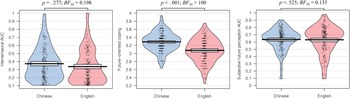
Consistent with Study 1, Study 2 did not show a significant language effect on intertemporal preference. From the ANCOVA, we found no significant difference between the two language groups on the intertemporal AUC: F (1, 417) = 1.186, p = .277, Cohen's f = 0.055. Given the non-normality of AUC, a Bootstrap analysis was conducted to check robustness (see Supplementary Materials 4.5, Figure S5): based on 2500 Bootstrap replications, the language effect on intertemporal AUC was still not significant, with a 95% CI contained zero, [−0.299, 0.100]. The Bayesian ANCOVA also provided moderate evidence for supporting this null hypothesis, suggesting the absence of any language effect on temporal discounting (BF10 = 0.198). Not completely consistent with ANCOVA results, the mixed-effect linear model found that participants in the English group discounted future reward more steeply, the estimated language effect was 0.161, 95% CI = [0.014, 0.307] – however, its effect size was still quite small given that the lower CI was close to zero.
Consistent with Study 1, Study 2 replicated a significant language effect on future-orientation (see Figure 2), suggesting a lower future-orientation in the English group than the Chinese group. That is, ANCOVA suggest that participants in the English group became less future-oriented than those in the Chinese group, F (1, 417) = 58.669, p < .001, Cohen's f = 0.375. The Bayesian ANCOVA provided strong evidence for this effect, BF10 > 100. The Bayesian mixed-effect ordinal models also estimated a significant language effect (−0.293, 95% CI = [−0.384, −0.198]). However, there was no significant indirect effect of future-orientation on temporal discount rate (β = 0.096, 95% CI = [−0.071, 0.275], p = .281).
The distribution of intertemporal AUC (left), future-oriented coping (middle), and subjective future perception AUC (right) between English and Chinese groups in Study 2.

Results in Study 2 also suggest a non-significant language effect on subjective future perception. From the ANCOVA, the group difference on the subjective future perception AUC failed to reach significance: F (1, 417) = 0.405, p = .525, Cohen's f = 0.031. The 95% Bootstraps CI ([−0.046, 0.025]) of the language effect for subjective future perception included zero. The Bayesian ANCOVA provided moderate evidence for the null hypothesis, BF10 = 0.135. In addition, the mixed-effect model also showed similar non-significant results, with an estimated effect of 0.118, 95% CI = [−0.026, 0.263]. Again, the indirect effect of subjective future perception on temporal discount rate was not significant (β = 0.001, 95% CI = [−0.003, 0.006], p = .656).
In sum, our findings from Study 2 duplicated most of the results of Study 1. That is, for weak-FTR L1 speakers (Chinese), using a strong-FTR L2 (English) may decrease their tendency to act out a future-oriented behavior. However, using a strong-FTR L2 (English) may only have an unstable and small effect on the intertemporal preference of individuals.
Moreover, we did not observe any effect of using a strong-FTR language on subjective future perception. This may be due in part to an inappropriate subjective future perception questionnaire design. Specifically, in Study 2, participants simultaneously answered the subjective future perception questionnaire for all the 6 delays conditions (1/7/15/30/80/140 day/s later) at the same page. Under such a design, judgements related to previous delays may act as an anchor for the later judgements of participants. Thus, in Study 3, we adjusted the designs for measuring both subjective time perception and temporal discounting.
4. Study 3
To ensure the stability and replicability of our results, we pre-registered Study 3 at OSF Footnote 4 (https://osf.io/zj5th).
4.1. Participants
Power analysis using G-power, as with Study 2, indicated that at least 382 participants (191 participants in each group) were required in total to ensure statistical power of 90% for an independent t-test. Thus, our final sample included 487 Chinese college students. Participants received 10 RMB as payment after experiment.
4.2. Procedures and measurements
The design and procedure were essentially the same as the Study 2. The differences were: 1) to precisely assess intertemporal preference we used two measures: a staircase questionnaire and a matching-based task; 2) we adjusted the design of the subjective future perception questionnaire such that, under each delayed day condition, participants completed the staircase questionnaire, matching task, and subjective future perception questionnaire respectively (e.g., participants completed the intertemporal decision task and subjective future perception questionnaire for 1-day delayed condition at the same page, and then at the next page, for 7-day delayed condition).
Intertemporal decision task
We used a matching-based task and a staircase questionnaire (Cornsweet, Reference Cornsweet1962; Hardisty, Fox-Glassman, Krantz & Weber, Reference Hardisty, Fox-Glassman, Krantz and Weber2011) to measure participants’ intertemporal preference. Immediate outcomes (100 yuan) and delays (1, 7, 15, 30, 80, and 140 days) of the matching-based task were all the same as Study 2.
In the staircase questionnaire, participants were asked to make several choices between immediate and delayed rewards. Delays were the same as those in the matching-based task. The SS reward was constantly “get 100 yuan immediately”, whereas the LL reward was dynamically generated using bisection. The maximum (1000 yuan) and minimum (100 yuan) of each staircase were set to be the same as the matching-based task.
Other questionnaires
The Cronbach's α of the two questionnaires in Study 3 were: αFCI = 0.85 and αEAQ = 0.84. Participants in the English group rated their English ability as above-mean level (M ± SD, 4.18 ± 1.00), and indicated high levels of understanding decision questions (M ± SD, 91.92 ± 9.45%), thus implying that their English ability was sufficient to understand the questionnaires.
4.3. Analysis
All analysis was the same as Study 2.
4.4. Results
A total of 80 participants were excluded from further analysis: 67 for ratings of their understanding of the questions less than 50%; 8 for failing to pass the attention test; 5 for residing in an English-speaking country for more than 6 months. This gave a final valid sample of 407 participants.
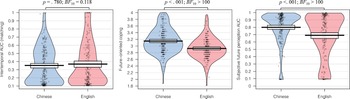
Consistent with Study 1 and 2, Study 3 suggested that using a strong-FTR language did not affect intertemporal decision preference (see Figure 3). From the ANCOVA, the difference of intertemporal AUCs between the two groups was not found to be significant, neither for the staircase measurement, F (1, 401) = 0.126, p = .723, Cohen's f = 0.017; nor for the matching-based measurement, F (1, 401) = 0.078, p = .780, Cohen's f = 0.014. The Bayesian ANCOVA provided moderate evidence to support the null effect, BF10 = 0.115 and 0.118. The Bootstrap analysis (95% CI = [−0.038, 0.057]) and the mixed-effect models (95% CI = [−0.150, 0.162]) also showed similar results, with both the 95% CI containing zero (see detailed results in Supplementary Materials 5.4 and 5.5).
Data distribution of intertemporal AUC (left), future-oriented coping (middle), and subjective future perception AUC (right) between English and Chinese groups in Study 3.

Again, Study 3 replicated the finding that using a strong-FTR language (English) was associated with a lower level of future orientation. From the ANCOVA, results suggest that participants in the English group were less future orientated, F (1, 401) = 41.865, p < .001, Cohen's f = 0.324, and the Bayesian ANCOVA provided extreme evidence to support this effect, BF10 > 100. The mixed-effect model provided similar results, estimating language effect as −0.529 with a 95% CI = [−0.667, −0.382]. Here, the indirect effect of future orientation on discounting reached significance, β = 0.020, 95% CI = [0.004, 0.040], p = .024.
Surprisingly, results from the ANCOVA suggest that participants in the English group perceived future events as less distant than those in Chinese group, F (1, 401) = 18.985, p < .001, Cohen's f = 0.217. The Bayes analysis provided extreme evidence for the language effect on the subjective future perception, BF 10 > 100. The Bootstrap analysis estimated the language effect as −0.110 with a 95% CI = [−0.157, −0.060]. The mixed-effects model estimated a significant language effect as −0.607 with a 95% CI = [−1.013, −0.191]. The indirect effect of subjective future perception also reached significance, β = 0.013, 95% CI = [0.002, 0.027], p = .050.
Here, Study 3 replicated most of the main results of Study 1 and 2, providing more evidence to support a significant language effect on future orientation but not intertemporal preference. However, based on the small effect size and the inconsistent results across studies, the indirect effect of future orientation and subjective time perception may still be too unstable to reach an informative conclusion.
5. Internal meta-analysis
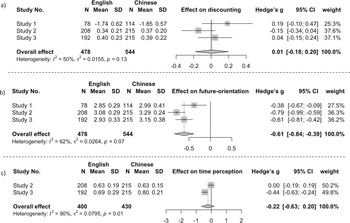
To combine results from our three studies, we conducted an internal mini meta-analysis (Goh, Hall & Rosenthal, Reference Goh, Hall and Rosenthal2016). The language effect was estimated by Hedge's g based on the group difference (Chinese vs. English group) of temporal discounting, and also future-orientation and future time perception. Following the suggestion of Plonsky, Sudina, and Hu (Reference Plonsky, Sudina and Hu2021), a random-effect model was run with the R package meta (Schwarzer, Reference Schwarzer2007), and the CI was calculated based on the widely-used DerSimonian-Laird method (DerSimonian & Laird, Reference DerSimonian and Laird1986).
Across three studies, the meta-analysis only revealed a significant language effect on future-orientation (g = -0.61, see the forest plot in Figure 4). However, the overall language effect on discounting was estimated as near-to-zero (g = 0.01). We also found the overall language effect on future time perception to be non-significant (g = -0.22).
Forest plot of the internal meta-analysis results: a) language effect on temporal discounting; b) language effect on future-orientation; c) language effect on future time perception. The pooled effect size with confidence interval is reported at the bottom of each panel.

6. General Discussion
Across three studies (including one pre-registered, N = 1022) and an internal meta-analysis, we investigated whether using a high-FTR L2 (English) would impact the intertemporal decision of weak-FTR L1 speakers (Chinese). Our results did not support the hypothesis of a language effect on intertemporal preference. We consistently observed the absence of either a direct effect of using strong-FTR L2 or an indirect effect of two mediators: future-orientation and subjective future perception. However, partially consistent with our hypothesis, we did consistently find that when speakers of a weak-FTR L1 (Chinese) used a strong-FTR L2 (English), their future orientation decreased.
6.1. When languages impact intertemporal decision: A holistic perspective
The present study contributes to our understanding of the effect of language on intertemporal decision by adopting a more holistic perspective to previous studies. This was achieved in the following three ways.
Merging the effect of FTR and L2 on intertemporal decision
This study merged the effect of two language features (FTR and L2) on intertemporal decision, by using weak-FTR L1 and strong-FTR L2 as two language conditions. Prior to this study, most studies only investigated the effect of a single language feature on intertemporal decision, either overlooking the effect of FTR or using L2. For example, the pioneering work by Białek et al. (Reference Białek, Domurat, Paruzel-Czachura and Muda2021) found a higher discount rate in the L2 group in their Study 2. However, their participants (Polish L1 speakers, a high-FTR language) used three different L2s embedded with different FTR characteristics (English and Spanish as strong-FTR languages, but German as a weak-FTR language)Footnote 5. Such a mixed-FTR design means that it would be difficult to determine whether any differences in discount rate are attributable to the effect of using L2 or the strong FTR. Hence, it is impossible to precisely examine the predictions of LSH or FLE.
Although our cross-FTR design (a weak-FTR L1 vs. a strong-FTR L2) for controlling the FTR of L2 was able to directly test the merged effect of L2 and FTR, it was still unable to exclusively distinguish between the FLE or LSH hypotheses. The current study found no language effect on intertemporal preference, which did not support the prediction of either LSH or FLE. This finding is consistent with studies manipulating language-type (Białek et al., Reference Białek, Domurat, Paruzel-Czachura and Muda2021) or grammatical structure (J. I. Chen et al., Reference Chen, He and Riyanto2019), as well as the recent study reporting no impact of verb tense on individual's inferences about time when there are explicit timing cues (e.g., a delayed time in the intertemporal decision) (Banerjee & Urminsky, Reference Banerjee and Urminsky2022). To disentangle the FLE or LSH hypotheses, more work is required to determine which language features (FTR or L2, or both) contribute to intertemporal preference and its related mediators. Specifically, the future studies would benefit from including a different language pair with a strong-FTR L1 and a weak-FTR L2.
Including a package of intertemporal-related variables
Next, for the outcome variables, this study included a package of variables to examine the process of intertemporal decision more comprehensively. In addition to the temporal discounting variable per se, the current study expanded the range of intertemporal-related variables to two potential mediators proposed by LSH, i.e., future orientation and subjective future perception. This was built on the finding in previous studies that, even though temporal discounting preferences can remain unchanged, changes in indirect factors (e.g., subjective future perception) can still exert an influence to produce impatient decisions (Laube & van den Bos, Reference Laube and van den Bos2020). In contrast to the above-mentioned null language effect on intertemporal decision, we identified a consistent strong-FTR L2 effect on weak-FTR L1 users’ future orientation, as well as an unstable effect on their future perception.
Our finding of an inconsistent language effect on a series of intertemporal-related variables may be interpreted as the indication of a potential gap between intention and behavior with respect to temporal orientation and intertemporal behavior (van Baal, Walasek, García & Hohwy, Reference van Baal, Walasek, García and Hohwy2022). Such a gap may mix the potential effect of other unmeasured variables (e.g., self-control), thus uncovering the indirect effect of those intention level variables. In the current study, future orientation was measured by the intention towards a series of future-oriented behaviors, while intertemporal preference (MCQ or staircase questionnaire) was measured by the actual choice behavior between immediate vs. delayed rewards. Here, this gap might capture a potential boundary of the language effect on intertemporal decision. That is, the use of L2 may only be capable of impacting proximal and intention-level variables (i.e., future orientation), but not be robust enough to impact distal and behavior-level variables (i.e., discounting).
Our results revealed that using a strong-FTR L2 consistently decreased weak-FTR future orientation of L1 users. This result was consistent with the work of Pérez and Tavits (Reference Pérez and Tavits2017) who showed that using a strong-FTR language during an interview led participants to adopt a less future-oriented time perspective. Both LSH and FLE can explain such a pattern. 1) Language could be an effective cue to activate different mindsets. For example, using Cantonese instead of English may promote a Hong Kong citizen to behave more like a Chinese citizen (Briley, Morris & Simonson, Reference Briley, Morris and Simonson2005; Ji, Zhang & Nisbett, Reference Ji, Zhang and Nisbett2004). Thus, from the perspective of the LSH, the linguistic features of English (i.e., strong-FTR) in our study may act as a cognitive cue to encourage behavior that is more characteristic of strong-FTR language speakers with less future orientation. 2) From the perspective of FLE, using L2 could reduce emotional arousal (Thoma & Baum, Reference Thoma and Baum2019). Given the correlation between temporal orientation and emotion state (Kamila, Hasanuzzaman, Ekbal & Bhattacharyya, Reference Kamila, Hasanuzzaman, Ekbal and Bhattacharyya2022), using L2 may downregulate emotional reactions towards some future-orientation items, thus leading to a lower score on future orientation.
We also found that individuals using a strong-FTR L2 did not perceive future events as more distant (Study 2), or perceived future events as closer compared to the weak-FTR language (Study 3). Here, the FLE, rather than the LSH, may offer a better explanation for this effect of language on subjective future perception. Previous studies show that using a L2 can weaken emotional responses during decision-making (Hayakawa, Tannenbaum, Costa, Corey & Keysar, Reference Hayakawa, Tannenbaum, Costa, Corey and Keysar2017; Pavlenko, Reference Pavlenko2012). Moreover, stronger emotional arousal may lengthen subjective perception towards a future event, e.g., an affect-rich context may lead people to judge future durations as longer (Laube & van den Bos, Reference Laube and van den Bos2020; Zhou et al., Reference Zhou, Zou, Zhang, Lin, Zhang and Liang2021). As a consequence, reduced emotional arousal as caused by the use of a L2 (Pavlenko, Reference Pavlenko2012) may have the effect of shortening subjective future perception towards future events.
Adopting a multi-measure approach
Finally, from the perspective of methodology, the present study adopted a multi-measure approach for the dependent variables. Several studies have pointed out that language may impact response styles on different measurement tools (De Langhe, Puntoni, Fernandes & Van Osselaer, Reference De Langhe, Puntoni, Fernandes and Van Osselaer2011). Thus, to control such a measurement bias, we used multiple measurements techniques, especially for the main dependent variable, intertemporal preference. Compared with using a single index to measure intertemporal preference (e.g., J. I. Chen et al., Reference Chen, He and Riyanto2019), the current study used measurements with diverse response modes: binary choice (MCQ, Study 1), matching-based task (Study 2) and staircase questionnaires (Study 3). By combining these with corresponding multiple statistical methods (ANCOVA, mixed effect model or meta-analysis), as well as independent samples from three studies, our results provided more robust evidence for a negligible language effect on intertemporal preference across different measurements, statistical analyses, and samples.
This multi-measure approach may also lead to concerns regarding the measurement bias underlying the language effect, and, as such, some caution is required when interpreting certain subtle differences in our results. For example, when comparing the significant language effect on future orientation with the null effect on intertemporal decision, it is also important to note the differences in response scale between the two measures. That is, the former variable was measured by rating scales (5-point or more), while the latter variable was primarily measured using binary choice (or matching task). Given the reported small to medium effect (Hedge's g = 0.22) of using L2 on decision-making (Circi, Gatti, Russo & Vecchi, Reference Circi, Gatti, Russo and Vecchi2021) in a previous meta-analysis, a forced binary scale may be not sensitive enough to capture the subtle differences in this small effect. Even for the classical ordinal scales (for example, FCI in our study, measuring future orientation), the response pattern may also be impacted by using L2 (e.g., the anchor contraction effect) (De Langhe et al., Reference De Langhe, Puntoni, Fernandes and Van Osselaer2011). A lower score may also be the product of a measurement bias or artifact. A design with homogeneous measurement and continuous response patterns may ensure more consistent results in future studies.
6.2. Implications
In sum, by adopting a holistic perspective to the effect of language on intertemporal decision, our work may contribute to the field in following ways.
By considering the effect of FTR and using L2 conjunctively, our study may help to close a gap between two separate pathways testing the language effect on intertemporal decision. This may provide an access point from which to integrate theories related to the effect of language or L2 on decision making, as well as the disparate results in the literature.
We also extend the scope of the LSH through solid causal evidence based on three perspectives: from a monolingual context to a bilingual context, from the long-term effect to the short-term effect of language FTR, and from the direct effect on temporal discounting to the indirect effect on future orientation or subjective future perception.
Finally, our results shed new light on the FLE on intertemporal decision, giving a reminder that the effect of some language features (e.g., FTR) should be concurrently considered. Thus, against the notion that the FLE can be used as a beneficial debiasing effect or a new nudge strategy (McFarlane et al., Reference McFarlane, Cipolletti Perez and Weissglass2020), we call for caution while using a second language as a potential nudge to encourage more rational intertemporal decision-making.
6.3. Limitations and Future directions
Some limitations of the current study should be noted. First, by using Chinese–English bilinguals as participants, we only investigated the language effect on discounting with a weak-FTR L1 and a high-FTR L2, and therefore did not succeed in disentangling the effect of FTR and FLE. Further studies may add strong-FTR L1 and weak-FTR L2 language pairs –for instance, English–Chinese bilinguals, to systematically test the two theories. That is, if using a weak-FTR L2 also decreases the future-orientation of strong-FTR L1 users more than in weak-FTR L2 (same as the language effect in current study), the FLE can be the dominant mechanism; or, if the language effect turned to insignificant or reversed in direction, the FTR of L2 may play a central role.
Our study also cannot provide any evidence for the effect of language on emotion, thus leaving an open question as to whether the effect of language on future-orientation is caused by a cognitive cue related to FTR or an emotion reduction related to FLE. Future studies may also measure emotional responses involved in an intertemporal decision by using physiological measurements such as pupil response (Thoma & Baum, Reference Thoma and Baum2019) or neurophysiological elements (Moreira, Azeredo, Barros & Barbosa, Reference Moreira, Azeredo, Barros and Barbosa2022).
Further studies may also take some covariates of the language effect into account. For example, although we controlled English ability for all three studies, it was difficult to balance familiarity between Chinese and English. While measuring intertemporal choice, a less hypothetical paradigm (Thoma & Tytus, Reference Thoma and Tytus2018), e.g., with real waiting time or delayed payment (Patt, Hunsberger, Jones, Keane & Verfaellie, Reference Patt, Hunsberger, Jones, Keane and Verfaellie2021; Xu, González-Vallejo & Vincent, Reference Xu, González-Vallejo and Vincent2020), may lead participants to become more emotionally involved in the intertemporal context, thus providing a more sensitive and ecologically valid measurement.
7. Conclusion
In the present study, we tested the combined effect of two language features, i.e., the future-time reference (FTR) and using a second language (L2), on intertemporal decision and its indirect mediators, i.e., future orientation and subjective future perception. We found that for L1 speakers of a weak-FTR language, using a strong-FTR L2 did not affect their intertemporal preference, but decreased their future-orientation. We highlight a holistic perspective for the language effect on intertemporal decision, which is reflected by merging the effect of different language features (FTR and L2), including a package of intertemporal-related mediators, and adopting a multi-measure approach.
Acknowledgments
We appreciate the contributions of Michał Białek and anonymous reviewers for their constructive comments on the previous version of the manuscript. We thank Yi-Qun Gan for providing Chinese version FCI, Li-Lin Rao for constructive comments, Yan-Yan Chen for proofreading, Xin Liu for help with meta-analysis, Ya Li for her enlightening ideas, and DOC Academic Editing Services for English language editing.
This work was funded by the National Natural Science Foundation of China (72271230, 71701117, 71471171), Open Research Fund of CAS Key Laboratory of Behavioral Science, Institute of Psychology (Y5CX052003), Scientific Foundation of Institute of Psychology, Chinese Academy of Sciences (Y9CX303008), and CAS Engineering Laboratory for Psychological Service (KFJ-PTXM-29).
Competing interests
The authors declare none.
Data availability
The data that support the findings of this study are openly available at https://doi.org/10.57760/sciencedb.psych.00105.
Supplementary Material
For supplementary material accompanying this paper, visit https://doi.org/10.1017/S1366728923000184