Introduction
Unlike traditional phased array radar, multiple input multiple output (MIMO) radar not only improves the reliability of target detection and the ability to detect stealth targets, but also has the advantages of high resolution, high target parameter estimation accuracy, anti-interference, and better target recognition capabilities. Antonik first proposed the concept of frequency diverse array (FDA) radar at the IEEE International Radar Conference [Reference Antonik, Wicks and Griffiths1]. The beampattern of FDA radar is range-angle-dependent, which provides the possibility for joint positioning of the target's range and angle parameters. Integrating the system characteristics of frequency diverse array and MIMO radar, frequency diversity array MIMO (FDA-MIMO) radar [Reference Sammartino, Baker and Griffiths2–Reference Xiong, Wang and Gao5], a new type of radar system, has attracted widespread attention.
FDA-MIMO radar can form an equivalent transmit beampattern, so that the transmission information can be integrated into the receiving end. It achieves a more flexible use of the range-dimensional freedom and improves the capability of range-angle two-dimensional joint signal processing. Making full use of the characteristics of FDA-MIMO can achieve range-angle two-dimensional target localization [Reference Xu, Liao, Zhu, Huang and So6] and anti-mainlobe false target interference [Reference Xu, Liao and Zhu7]. The influence of frequency offset error on the beamforming and target positioning performance of FDA-MIMO radar is analyzed in [Reference Gao, Shao and Chen8]. In [Reference Gao, Wang and Cai9], the Cramer–Rao Lower Bound (CRLB) of the FDA-MIMO radar was derived, and the transmitter was designed to minimize the CRLB of the system on this basis. The target detection performance of the FDA-MIMO system radar was analyzed in [Reference Zhu, Liu and Lu10]. The performance of moving target parameter estimation of frequency diverse array radar was analyzed in [Reference Wang11] and compared with the performance of phased array radar. In [Reference Wang and Shao12], a double-pulse parameter estimation method based on frequency diverse array radar was proposed. In [Reference Khan, Qureshi and Basit13], the double-pulse method was extended to the FDA-MIMO radar system, which further improved the target range-angle localization performance. A precise response control algorithm was proposed in [Reference Lan, Xu and Liao14] to achieve precise control of the range-angle beampattern to enhance the robustness of the FDA-MIMO radar system. Based on the generalized likelihood ratio test criterion, the method of designing an FDA-MIMO adaptive detector was studied in [Reference Lan, Marino and Aubry15]. In [Reference Wang, Huang and Li16], a range-dimensional interference suppression adaptive beamforming method based on the FDA-MIMO radar system was proposed to further improve the target positioning performance. In [Reference Gao, Shao and Cai17], the method of using FDA-MIMO range-dependent adaptive beamforming to achieve range-dependent interference suppression in target positioning was analyzed. The FDA-MIMO anti-jamming algorithm based on eigenvalue projection and block matrix processing was proposed in [Reference Wang, So and Farina18]. Based on the coherent frequency diversity array system, [Reference Wang, Liao and Xu19] designed a space-time filter for interference suppression. In [Reference Wang and Zhu20], the simulated annealing algorithm of the FDA-MIMO system was proposed to combat the deception interference of the mainlobe range dimension. Combining polarization characteristics, frequency diverse array and MIMO system, [Reference Zhang, Cao and Xu21] explored ways to increase the output signal-to-interference and noise ratio to enhance the radar's anti-jamming performance. The time-invariant problem of the beampattern during target indication is also of interest. In [Reference Yao, Wu and Fang22], a leading group proposed two types of time-modulated frequency diverse arrays to achieve time-invariant focusing of multiple targets in space. Similarly, the concentration of energy at single or multiple target locations was achieved in [Reference Yao, Rocca, Wu, Massa and Fang23] by optimizing the time-modulated frequency offset. However, the above method is designed with the idea of obtaining a stable gain at the target position only, with the gain remaining time-varying at other positions. Thus, [Reference Tan, Wang and Li24] conducted a reasonable analysis of the time parameters in the FDA system based on the principle of wave propagation, which provide guidance for the expansion of FDA-MIMO applications under consideration of time parameters.
As a form of data representation, tensor is provided with rich theoretical connotation by multilinear algebra theory. One of the most important applications is the development of effective tensor decomposition methods under the framework of multilinear theory. In the past 10 years or so, two typical decompositions of tensors, CPD and HOSVD, have been extensively studied in array signal processing [Reference Bro25, Reference De Lathauwer, De Moor and Vandewalle26]. As early as 2000, a DOA estimation algorithm based on a uniform linear array in [Reference Sidiropoulos, Bro and Giannakis27] was first proposed in combination with CPD. In [Reference Nion and Sidiropoulos28], CPD was extended to DOA estimation based on MIMO radar, and the identification and estimation performance of the algorithm were discussed under different transmission modes and different signal models. Tensor decomposition was applied to MIMO radar angle estimation in [Reference Zhang, Xu and Xu29], which realizes an algorithm that does not require spectral peak search and angles are automatically paired. In [Reference Wen, Zhang and Zhang30], the DOA was solved by modeling the MIMO radar covariance tensor. Recently, the trilinear model in tensor theory has been introduced in [Reference Xu, Yang and Huang31] for monostatic FDA-MIMO radar to achieve range and angle parameter estimation. This is a good example of the promising application of tensor theory in FDA radar.
In this paper, a double-pulse target localization scheme based on canonical polyadic decomposition (CPD-DP-FDA) is proposed by introducing tensor decomposition into FDA-MIMO. After receiving the data containing the target information, the tensor signal model is used to replace the traditional signal model for processing. By using the correspondence of the factor matrix in tensor decomposition, the problem of ambiguity in multi-target localization in traditional double-pulse FDA is effectively solved [Reference Wang and Shao12]. Finally, a stepped frequency pulse target localization scheme based on tensor decomposition (CPD-SP-FDA) is proposed. Finally, the effects of the two CPD-based schemes and the traditional double-pulse scheme are compared, and the numerical simulation demonstrates the superiority of the proposed scheme.
Notation: Boldfaced lowercase letters, such as l, represent vectors, and boldfaced uppercase letters, such as L, denote matrixes. The letter variants, such as ℓ, represent tensors. ° denotes the outer product operation on the vector, while ${\odot}$ denotes the Hadamard product. The transpose, conjugate, and conjugate transpose of a matrix or a vector are denoted by ( ⋅ )T, ( ⋅ )*, and ( ⋅ )H, respectively, while ⊗ denotes the Kronecker product.
Mechanism of tensor decomposition
The target information is implicit in the received sample, and the received sample or sample covariance needs to be decomposed. Tensor decomposition is a means to achieve low-rank approximation of tensors. Compared with matrix factorization, the difference is: because tensor factorization mines the structure information of the data more, it has better identification or achieves more accurate decomposition. These advantages make it be introduced into the field of array signal processing to improve the performance of DOA estimation. The canonical polyadic decomposition (CPD) used in this paper is introduced below.
Consider a tensor ℓ with rank K and dimension R.

where ${\bf l}_r^k$ is the kth component k = 1, 2, …, K corresponding to the rth dimension.
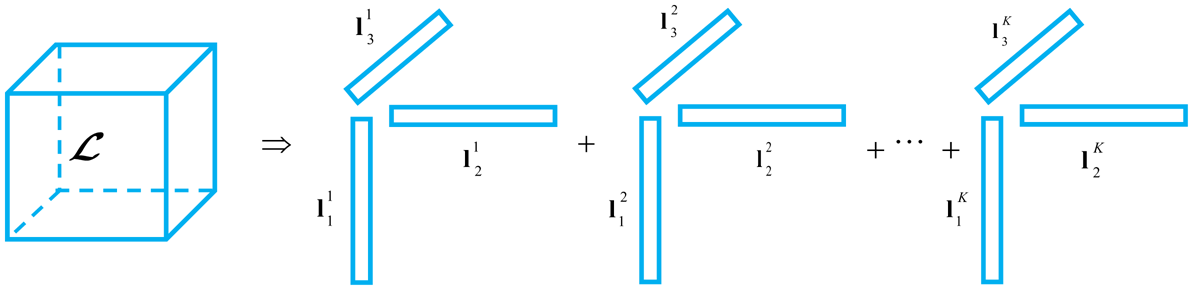
The purpose of CPD is to represent a tensor as a sum of rank 1 tensors. The number of rank 1 tensors is the rank of the entire tensor. The schematic diagram of CPD based on the third-order tensor is shown in Fig. 1.
Schematic diagram of the third-order tensor CPD.

CPD directly decomposes the tensor into the sum of each rank 1 tensor, and uses the structural information of the tensor to decompose it into the various factors themselves. Taking a third-order tensor as an example, if it can be expressed by (1), then the r-module matrix expansion along the three dimensions can be expressed as


where ${\bf L}_1 = [ {{\bf l}_1^1 , \;{\bf l}_1^2 , \;\ldots , \;{\bf l}_1^K } ] , \;{\bf L}_2 = [ {{\bf l}_1^1 , \;{\bf l}_2^2 , \;\ldots , \;{\bf l}_2^K } ] , \;{\bf L}_3 = [ {{\bf l}_3^1 , \;{\bf l}_3^2 , \ldots , {\bf l}_3^K } ]$ are the matrix factors that constitute the tensor. Equation (2) shows the relationship between the tensor and the matrix factors obtained after the modulus r is expanded. For the received sample of the multi-dimensional array, assuming that the array size is I 1 × I 2 × ⋅ ⋅ ⋅ × I R, the sample received by an element in the array at time t can be expressed as [Reference Cheng, Wu and Poor32]

where l ir denotes the i rth element in the rth dimension in the array, sk(t) denotes the sampling at the time t of the kth signal, n(t) denotes the noise item received at the time t, and μ k denotes the parameter vector of the kth signal. The specific form is decided. The steering vector of the kth signal corresponding to the rth dimension of the array is lr(μ r,k). Then the sample vector ${\boldsymbol x}( t) \in {\mathbb C}^{\Pi _{i = 1}^R I_i \times 1}$ received by the entire array at time t can be expressed as

The steering vector of the entire array can be expressed by the Khatri–Rao product of the steering vectors of each dimension as

where lr is the steering vector ${\bf l}_r\in {\mathbb C}^{I_r \times 1}$ corresponding to the kth signal in the rth dimension of the multi-dimensional array, I r is the size of the rth dimensional array, and μ r,k denotes the parameter of the kth signal in the rth dimension of the multi-dimensional array.
The received data of the entire array can be expressed as a tensor form ${\cal X} ( t) \in {\mathbb C}^{I_1 \times I_2 \times \cdots \times I_R}$ . For a total of T time samples, the tensor mode of the array received data can be expressed by the cascade of sub-tensors at each time as

where ${\cup} _{R + 1}$ denotes that two tensors are concatenated along the rth dimension. Thus, the received data can be constructed as

where ${\cal X}$ is the sample tensor form ${\cal X}\in {\mathbb C}^{I_1 \times I_2 \times \cdots \times I_R \times T}$
 of the multi-dimensional array, ${\cal L}$
 is the steering tensor of the multi-dimensional array, whose dimension is ${\cal L}\in {\mathbb C}^{I_1 \times I_2 \times \cdots \times I_R \times K}$
 , S denotes the signal matrix, and ${\cal N}$
 denotes the noise contained in the T samples received by the multi-dimensional array. Then the steering tensor of the kth signal can be expressed by the outer product of the steering vectors of each dimension as

Thus, the estimation of the array steering vector can be obtained by CPD.
Signal model of FDA-MIMO radar
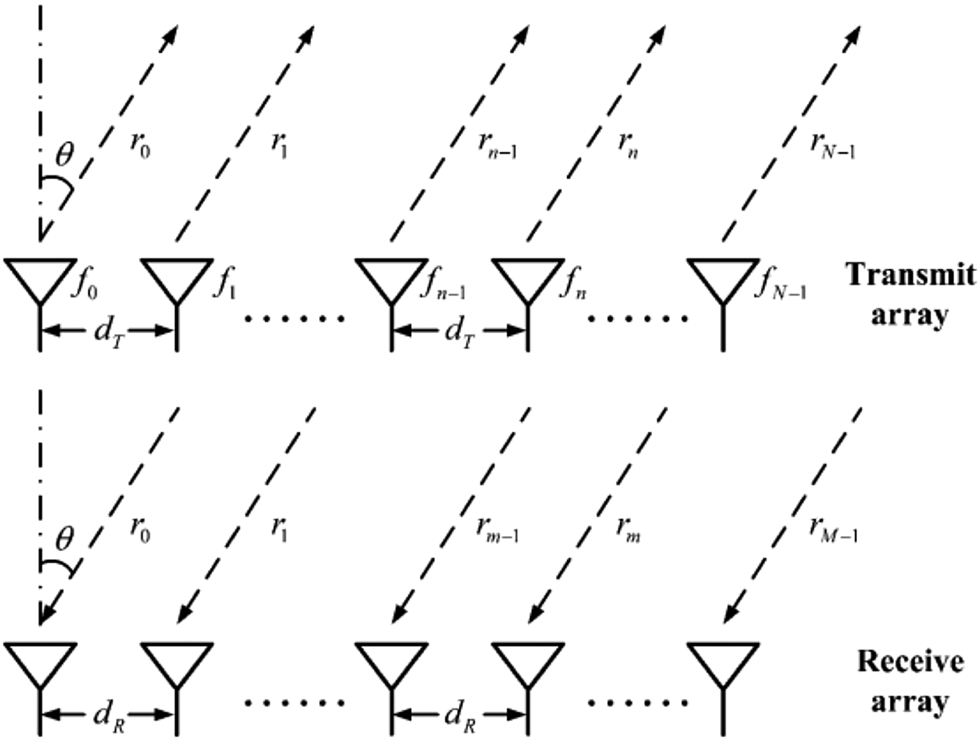
Consider an FDA-MIMO scheme in which both transmit and receive arrays are uniform linear arrays, as shown in Fig. 2. The transmitted carrier frequency is f 0, and the transmitted frequency of the nth array element can be expressed as

Schematic diagram of FDA-MIMO radar.

The transmitted signal of the nth element can be expressed as

where T p is the pulse width, ψ n(t) is the baseband envelope of the nth transmitting array element signal, which satisfies the orthogonality condition as

Assuming that there are K targets in the far field, the signal returned from the position (r, θ) and received by the mth received element can be expressed as

where τ n,m is the propagation delay from the nth transmitted element to the mth received element, which can be expressed as

Thus, after signal processing at the receiving end, the output signal is obtained as

where ξ s is the signal complex coefficient after matched filtering. When only considering the equivalent transmit beampattern, the above formula can be simplified as

Then the transmit steering vector can be expressed as

When the frequency increment Δf = 0 is considered, the transmit steering vector is simplified to

Double-pulse scheme for the localization of targets
A method for target localization using a double pulse frequency diverse array is proposed in [Reference Wang and Shao12]. In this method, two steps are required to separately estimate the angle and range parameters of the target.
The first step is to use the FDA pulse with Δf = 0 to estimate the target angle parameter. In this case, the data model of the received signal can be written as

where α 0 represents the complex amplitude of the signal, and ${\bf \boldsymbol n}$ is the additive white noise vector. The weight vector using non-adaptive beamforming is expressed as

Thus, the formula used to estimate the angle parameter of the target is

The second step is to estimate the range parameter based on the angle parameter information of the first step. The data model of the received signal can be written as

The weight vector of beamforming can be expressed as

Therefore, the formula that can be used to solve the target parameter is

Double-pulse localization scheme based on CPD
The data model of the double pulses signal of the lth snapshot can be written as

where ${\boldsymbol s}( l) = [ {s_1( l) , \;s_2( l) , \;\ldots , \;s_K( l) } ] ^T$ is composed of the amplitude and phase generated by the K targets in the lth pulse. The noise vector ${\bf n}( l)$
 obeys the Gaussian distribution whose mean value is zero and the variance is σ 2INN. The entire array flow matrix can be further expressed as

Considering that the total sampling times is L, the data matrix form outputted by matched filtering can be expressed as

where X = [x(1), x(2), …, x(L)] ∈ ℂNN×L, S = [s(1), s(2), …, s(L)] ∈ ℂL×K and noise matrix N ∈ ℂNN×L.
Since (26) satisfies the modulo n expansion form of the tensor third-order PARAFAC model, canonical polyadic decomposition (CPD) can be introduced to achieve target localization. The third-order tensor constructed by the array received data represented by (26) can be expressed as

where g = 1, 2, …, G, h = 1, 2, …, H, l = 1, 2, …, L. S t0(g, k) represents the element at position (g, k) of the factor matrix St0, S t(h, k) represents the element at position (h, k) of the factor matrix St, and S(l, k) represents the element at position (l, k) of the factor matrix $\boldsymbol{S}$ . η is the third-order tensor representation of additive white noise.
In the first step, since there is a coupling of range and angle in the FDA's equivalent transmit steering vector, it is necessary to estimate the target angle parameter first. The CPD directly decomposes the tensor into the sum of each rank-1 tensor, which can use the structural information of the tensor to decompose it into the various factors. Considering that the kth column vector of the factor matrix St0 is $\varsigma _{tk}$ , the phase obtained after normalization to eliminate scale scaling can be expressed as

The weight vector of beamforming can be expressed as

Thus, the formula that can be used to estimate the angle parameter of the target can be written as

The second step is to combine the factor matrix St and μ tk in the first step to estimate the range parameter. The kth column vector of the factor matrix St is ξ tk. The phase obtained after normalization to eliminate scale scaling can be expressed as


Thus, the weight vector of beamforming can be obtained as

The formula for solving the target parameter can be written as

Stepped frequency pulses localization scheme based on CPD
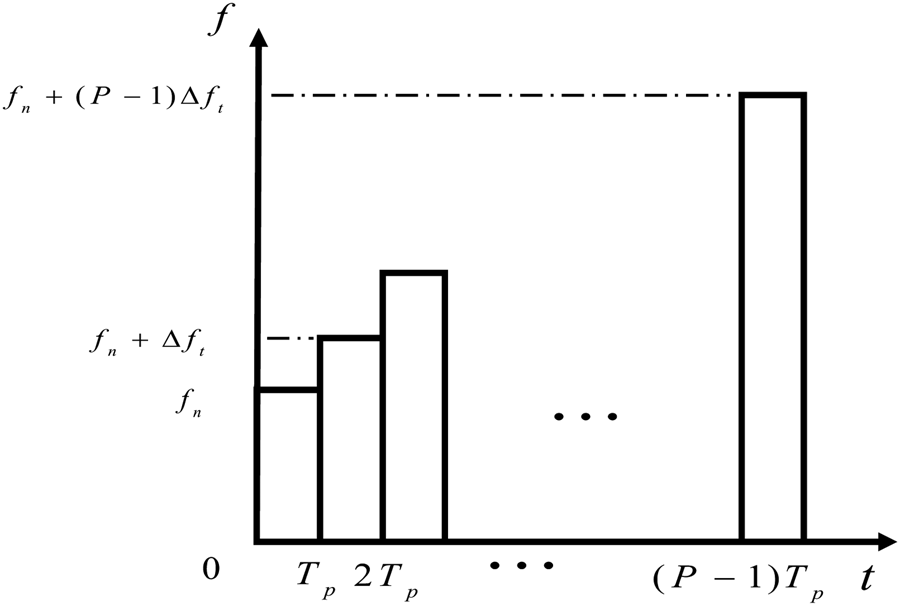
The time frequency schematic diagram of the stepped frequency pulses localization scheme is shown in Fig. 3. The total number of pulses is P. The frequency of the pth pulse of the nth element can be expressed as

where Δf t is the unit increment of frequency between pulses.
Schematic diagram of stepped frequency pulse.

Thus, the transmitted signal of the nth element can be expressed as

When observing a target point at (r, θ), the received signal related to the nth transmit array element and the mth receive array element can be expressed as

Thus, after signal processing and matched filtering at the receiver, the approximate signal can be expressed as

The array factor can be expressed as

Thus, the steering vector of the entire array can be written as

where ${\bf a}( r, \;\theta )$ , p(r), and ${\bf b}( \theta )$
 can be denoted as


The transmit steering vector can be expressed as

To ensure the fairness of the comparison, according to the analysis in [Reference Wang and Shao12], the equivalent transmit beampattern is still analyzed here. The data model of the received signal can be expressed as

After matched filtering, the data model of the lth snapshot equivalent transmitter signal can be rewritten as

where ${\bf s}( l) = [ {s_1( l) , \;s_2( l) , \;\ldots , \;s_K( l) } ] ^T$ is composed of the amplitude and phase generated by the K targets in the lth pulse. The noise vector ${\boldsymbol n}( l)$
 obeys the Gaussian distribution whose mean value is zero and the variance is $\sigma ^2{\bf I}_{NN}$
 . Thus the array flow matrix can be further expressed as

To introduce tensor operations, the above formula can be rewritten in the form of the Khatri–Rao product as

Considering that the total number of samples is L, the data matrix form outputted by matched filtering can be expressed as

where ${\boldsymbol X} = [ {x( 1) , \;x( 2) , \;\ldots , \;x( L) } ] \in {\mathbb C}^{NN \times L}, \;{\boldsymbol S} = [ {s( 1) , \;s( 2) , \;\ldots , s( L) } ] \in {\mathbb C}^{L \times K}$ and noise matrix ${\boldsymbol N}\in {\mathbb C}^{NN \times L}$
 .
Using CPD to obtain localization of the targets, the third-order tensor generated from the data received by the array of (46) can be constructed as

where i = 1, 2,.…, I, j = 1, 2, …, J, l = 1, 2, …, L. a(i, k) represents the element at position (i, k) of the factor matrix ${\bf a}$ , p(j, k) represents the element at position (j, k) of the factor matrix ${\bf p}$
 , and S(l, k) represents the element at position (l, k) of the factor matrix ${\boldsymbol S}$
 . η is the third-order tensor representation of additive white noise.
In the first step, due to the coupling of range and angle equivalent transmit steering vector in FDA, it is necessary to estimate the target range parameter first. Considering that the kth column vector of the factor matrix ${\bf p}$ is ϕ k, the phase obtained after normalization to eliminate scale scaling can be expressed as

The weight vector of beamforming can be expressed as

Then the formula that can be used to estimate the range parameter of the target can be written as

The second step is to estimate the angle parameter based on the factor matrix a and φk in the first step. The kth column vector of the factor matrix a is φk. Thus, the phase obtained after normalization to eliminate scale scaling can be expressed as


The weight vector of beamforming can be obtained as

The formula for solving the target parameter can be written as

CPD-based localization methods have an additional step of tensor decomposition compared to the traditional method. Its complexity is mainly reflected in iteratively solving the three factor matrices in equations (27) and (47). Assuming that the number of signals is K, the total number of iterations is Q and the number of stepped frequency pulses is L. Then the total computational complexity of the three factor matrices after one iteration in two CPD-based methods are O(3K 3 + 3KN 2Q + K(N 2 + 2NQ) + 2K 2(N 2 + 2NQ)) and O(3K 3 + 3KNLQ + K(NL + NQ + LQ) + 2K 2(NL + NQ + LQ)), respectively. Finally, all three of the methods require a one-dimensional search. Assuming that the step size of the search is γ, the computational complexity of the search step is O(γ[N 2(N 2 − K) + N 2 − K]). It indicates that the effect of the variation in the number of array elements on the computational complexity of the CPD algorithm is extremely obvious, and the performance advantage of the method is derived from the higher computational complexity. Thus, it is important to explore the low computational complexity of the decomposition algorithm for the real-time implementation of the method in this paper.
CRLB
Equation (42) can be rewritten as

where SNR is the signal-to-noise power ratio. The mean and variance of the noise vector ${\bf n}$ denote all-zero vector and the identity matrix, respectively. When the double pulses FDA scheme in [Reference Wang and Shao12] is adopted, ${\bf u}( r, \;\theta )$
 can be expressed as

When the stepped frequency pulses FDA scheme is adopted, ${\bf u}( r, \;\theta )$ can be denoted as

where


The mean ${\bf \mu }$ and variance ${\bf \Gamma }$
 of the data model xu can be expressed as


Thus, the Fisher information matrix (FIM) can be obtained as

where ${\mathop{\rm Re}\nolimits} [{\cdot} ]$ stands for real value operation, ${\it \beta } = [ {r, \;\theta } ] ^T$
 . Thus, the FIM of stepped frequency pulses FDA scheme can be written as

where


Then the inverse matrix of the FIM can be expressed as

Thus, the CRLB of the angle dimension and the range dimension can be solved, which are expressed as


where [ ⋅ ]i,j represents the element in the ith row and jth column of the matrix.
Simulation results
In this section, the performance of proposed target localization scheme is verified by numerical simulation. Both single-target and dual-target situations are considered, and a comparison with the traditional double pulse FDA localization effects is provided.
Simulation parameters are considered as follows: the number of radar elements is N = 16, the reference frequency of the FDA transmit signal is f 0 = 6 GHz, the frequency offset increment between elements is Δf = 2 kHz, and the frequency increment between pulses is Δf t = 2 kHz. In the simulation, Gaussian white noise with the same variance and zero mean is used.
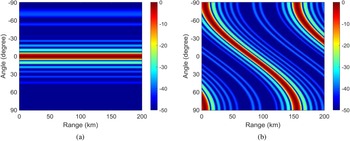
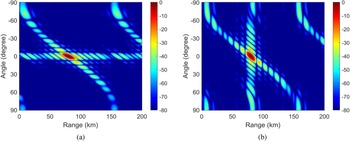
Detecting a single target is considered first. Assuming that the target's position information is $( r_1, \;\theta _1) = ( 80\,{\rm km}, \;0^\circ )$ under the condition of a signal-to-noise ratio (SNR) of −10 dB. The equivalent transmit beampattern of the traditional double-pulse FDA (DP-FDA) is shown in Fig. 4. It can be seen that the first step of DP-FDA is to use the phased array with Δf = 0 to estimate the angle parameters of the target. Since the transmit beampattern during Δf ≠ 0 is coupled with range and angle parameters, the angle parameter from the first step is used as the prior information to estimate the range parameters of the target.
Traditional double-pulse FDA equivalent transmit beampattern. (a) The first step. (b) The second step.

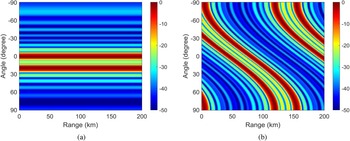
Figure 5 shows the equivalent transmit beampattern of CPD-based double-pulse FDA (CPD-DP-FDA) and CPD-based stepped frequency pulses FDA (CPD-SP-FDA). CPD-DP-FDA can decouple the range and angle of the equivalent transmit beampattern according to the data received by the radar. Thus, the maximum peak position of the beam can be used to locate the target. Since the radar's multi-carrier frequency time-division transmission provides a higher degree of freedom, the CPD-SP-FDA can form an equivalent beampattern of decoupling range and angle. Thus, the range parameter and angle parameter of the target can be estimated directly according to the maximum peak position of the beam.
FDA equivalent transmit beampattern based on CPD. (a) CPD-DP-FDA. (b) CPD-SP-FDA.

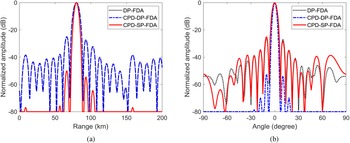
Figure 6 shows the range and angle dimension beampatterns for parameter estimation with the three schemes. It can be observed that in the range dimension, the mainlobe of the CPD-SP-FDA is narrower and the sidelobes are lower, which is more conducive to the estimation of range parameters. In the angle dimension, the tensor decomposition effectively extracts the target angle information in the double pulse data, which achieve the selectivity in the angle dimension. Thus, the mainlobe of range-angle decoupling is formed in the beampattern, which shows that CPD-DP-FDA has certain advantages in angle parameter estimation. By deriving CRLB, it can be found that the number of pulses P, the number of array elements N, the frequency offset increment between array elements Δf, and the frequency increment between pulses Δf t will all affect the estimation accuracy of the range parameter.
Comparison of beam performance. (a) Range dimension. (b) Angle dimension.

Next, parameter estimation for multiple targets is considered. Assuming that the coordinates of the two targets are $( r_1, \;\theta _1) = ( 70\,{\rm km}, \;20^\circ )$ and $( r_2, \;\theta _2) = ( 80\,{\rm km}, \;0^\circ )$
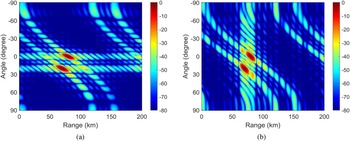
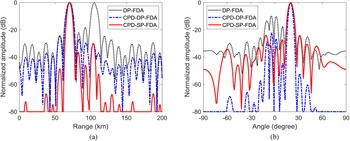
 respectively. Figures 7 and 8 show the equivalent transmit beampatterns of the three schemes when two targets are considered. Since the two targets have different angle parameters, two angle parameters will be obtained in the first step of the traditional double pulse processing, as shown in Fig. 7(a). In the second step of estimating the range parameter, it cannot be used as a priori information to estimate the range parameter directly because the angle dimension peak information is not unique, as shown in Fig. 7(b). In Fig. 8(a), since the factor matrix containing the target information after CPD is corresponding, CPD-DP-FDA realizes the automatic matching of the two target parameter estimates. Thus, there is no problem of ambiguity in parameter estimates. CPD-SP-FDA can also correspond to the positions of the two targets to the peak points, as shown in Fig. 8(b), which is conducive to parameter estimation of multiple targets.
Traditional double-pulse FDA equivalent transmit beampattern. (a) The first step. (b) The second step.

FDA equivalent transmit beampattern based on CPD. (a) CPD-DP-FDA. (b) CPD-SP-FDA.

DP-FDA will obtain two angle parameters $\hat{\theta }_1 = 0^\circ$ and $\hat{\theta }_2 = 20^\circ$
 in the first step, and obtain four target points $( 45\,{\rm km}, \;0^\circ ) , \;( 70\,{\rm km}, \;20^\circ ) , \;( 80\,{\rm km}, \;0^\circ ) , \;( 105\,{\rm km}, \;20^\circ )$
 in the subsequent parameter estimation in the second step. Thus, neither the number of real targets nor the position information under this scheme can be effectively distinguished. When CPD-DP-FDA scheme is used, automatic matching of target parameters is achieved during the solution process so that the parameters of the two targets can be estimated. CPD-SP-FDA realizes the decoupling of the beampattern by time-division transmission. Thus, it can also estimate the parameters of the two targets. Figure 9 is a schematic diagram of the estimation effect of the first target. It can be found that the two CPD-based schemes have a unique mainlobe in both the range dimension and the angle dimension, which can directly estimate the range and angle parameters of the first target.
Performance comparison of the first target beampattern. (a) Range dimension $( \theta = 20^\circ )$ . (b) Angle dimension (r = 70 km).

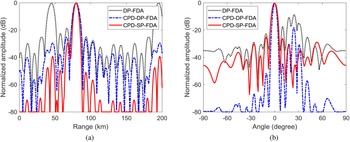
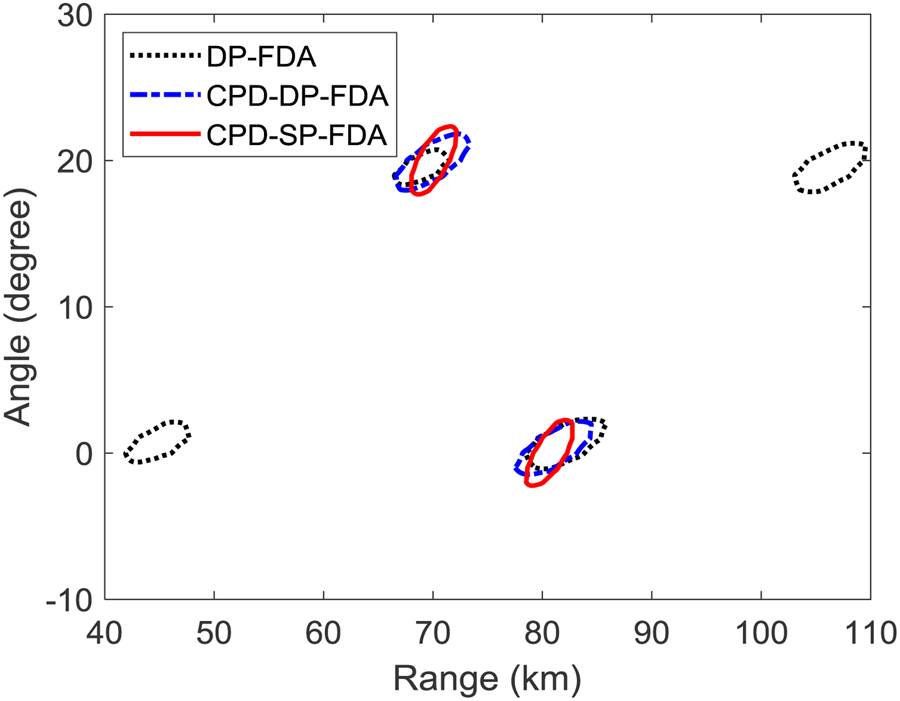
Figure 10 shows a schematic diagram of the estimation effect of the second target. Similarly, the two CPD-based schemes have a unique mainlobe in the range dimension and the angle dimension, which have lower sidelobe levels. Thus, CPD-DP-FDA can effectively solve the problem of unclear target indication in DP-FDA. Then CPD-SP-FDA can also effectively estimate the range and angle parameters of multiple targets. Moreover, the half-power (−3 dB) contours of the equivalent target indication patterns corresponding to DP-FDA, CPD-DP-FDA, and CPD-SP-FDA are compared in Fig. 11. It is clearly shown that the scheme based on tensor decomposition can effectively solve the problem of uncertain multi-target parameter estimation, and the improvement of target parameter estimation performance brought by the stepped frequency pulse is also indicated. Table 1 shows the performance of beampattern in range and angle dimensions with different FDA methods. It can be seen from Table 1 that CPD-DP-FDA has the same BW with DP-FDA due to the same parameter while it can accomplish the discrimination of multiple targets. The BW r of CPD-SP-FDA is 3.1 km, which is much better than that of other methods. In addition, due to the complex solution of factor matrices, the solution time of the CPD-based methods also grow.
Performance comparison of the second target beampattern. (a) Range dimension $( \theta = 0^\circ )$ . (b) Angle dimension (r = 80 km).

Comparison of the −3 dB profile indicated by the equivalent beampattern.

Comparison of different FDA methods

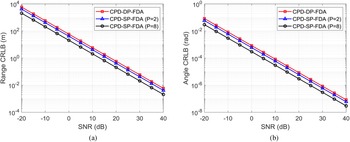
Finally, Fig. 12 shows the CRLB performance comparison between the range dimension and the angle dimension. Because the traditional DP-FDA has ambiguity in multi-target parameter estimation, the two CPD-based schemes are compared in the figure. It can be seen that the parameter estimation effect of CPD-SP-FDA in the range dimension and the angle dimension is better than that of CPD-DP-FDA. Considering that SP-FDA uses two pulses, the performance of CRLB is still better than DP-FDA due to the higher degree of freedom provided by multiple carrier frequencies. As the number of pulses increases to 8, the selectivity of SP-FDA in the range dimension is further improved, and CRLB performance is further optimized. However, it should be noted that the increase in the number of pulses increases the computational complexity of tensor decomposition, which means that the number of pulses needs to be reasonably selected according to the calculation ability in the actual application of the solution.
Performance comparison of CRLB. (a) Range dimension. (b) Angle dimension.

Although the proposed method is superior to other methods, the paper only considers scenarios with static targets. It means that extending the model to moving target scenarios requires the incorporation of new techniques. The introduction of cognitive radar ideas into FDA radar has recently attracted scholarly attention [Reference Wang33–Reference Basit, Wang and Nusenu36]. The cognitive-based processing model enables the detection and tracking of dynamic targets. Thus, it provides a reference for extending the model to dynamic target scenarios, which is the next research focus of system applicability enhancement.
Conclusion
In this paper, two new methods combined with tensor decomposition are presented for the two-dimensional parameter estimation of FDA-MIMO radar. The methods transform the traditional expression form of received data into the expression form of three-order tensor canonical polyadic decomposition, then the signal model of CPD-DP-FDA is established. With the help of the corresponding relationship of the factor matrix in the parallel factorization, the problem of ambiguity in the target indication of double pulse FDA is solved. To make full use of the advantages of multi-dimensional signal processing of tensor decomposition, a CPD-SP-FDA signal model based on stepped frequency pulses is established. In this way, the decoupling of the range and angle of the equivalent transmitting beam is realized, and the effectiveness of the proposed method is verified by numerical simulation. Compared with the performance of the traditional DP-FDA, the results show that the newly proposed scheme has better performance in terms of target indication and parameter estimation accuracy.
Moreover, the use of stepped frequency pulses for target localization results in high computational complexity. Thus, reasonable selection of the number of pulses and research on more efficient target parameter estimation methods become important factors that need to be considered in the future. In future work, applying the advantages of tensor signal processing to other radar research directions also should be considered.
Acknowledgement
This work was supported by the National Natural Science Foundation of China under Grant no. 61601502 and the China Postdoctoral Science Foundation under Grant no. 2019M662257.
 Yibin Liu received his B.E. degree in electronic engineering from Air Force Engineering University, Xi'an, China, in 2020. Now he is a postgraduate student in Air Force Engineering University. His current research interests include radar signal processing and robust adaptive beamforming.
 Chunyang Wang received the Master's degree and Doctor's degree in Electromagnetic Field and Microwave Technique from Air Force Engineering University, Xi'an, China, in 1991 and 2004, respectively. He is currently a professor in the Air and Missile Defense College, Air Force Engineering University, Xi'an, China. His current research interests include radar signal processing, radar jamming, and anti-jamming technologies.
 Jian Gong received his M.S. degree in circuits and systems from Air Force Engineering University, Xi'an, China, in 2009. He received his Ph.D. in pattern recognition and intelligent systems from Xidian University, Xi'an, China, in 2018. His research interests include signal detection and parameter estimation in array signal processing.
 Ming Tan received the M.S. and Ph.D. degrees from Air Force Engineering University, Xi'an, China, in 2016 and 2020, respectively. He is currently a lecturer at the National University of Defense Technology (NUDT). His research interests include array signal processing, waveform diverse array, and electronic countermeasure.