


When citizens with common interests seek influence over policy outcomes in the United States, an ideal venue for advocacy is the filing of an amicus curiae brief. These briefs represent the most common approach for group participation at the Court, due to its relative affordability compared with other forms of advocacy at the Court and beyond (Caldeira and Wright Reference Caldeira and Wright1988, Reference Caldeira and Wright1990). Indeed the volume of briefs has increased over time (Collins Reference Collins2008). It is also clear that litigants who are supported by more amici than their opposition are more likely to emerge victorious, ceteris paribus (Collins Reference Collins2008; Kearney and Merrill Reference Kearney and Merrill2000).
It is doubtful, however, that the influence of each of the amici is equal. Groups are heterogeneous; their different identities and amounts of power send different signals to justices. These differences have dramatic ramifications for the allocation of political benefits to various groups in society. In addition, certain types of organizations participate more frequently in the governmental process (Olson Reference Olson1965). Since the rate of participation is not equivalent across all groups, it is likely that policy outcomes will disproportionately favor those interests who are able to mobilize and participate in government, to the detriment of other segments of society (Schattschneider Reference Schattschneider1960). Inequality of outcomes, based solely on the ability of groups to effectively participate in the governing process, violates basic norms of representative government. This inequality results in the disproportionate allocation of benefits to the small, tightly organized groups over the large, disparate groups (Olson Reference Olson1965), and the wealthy, elite groups over poor, marginalized groups (Schattschneider Reference Schattschneider1960). As such, it is crucial that we fully understand how it is that different kinds of groups achieve greater policy success in elite venues such as the U.S. Supreme Court.
Take, for example, the recent decision on Knox v. SEIU Local 1000 (No. 10-1121, slip op., U.S. June 21, 2012),Footnote 1 in which the Court weakened the ability of labor unions to operate and collect funds via a reconsideration of the “opt-out” procedures. Public sector labor unions in the United States often operate under “agency shop clauses,” where employees who are not members of the union must pay a certain percentage of union dues towards supporting the benefits provided to all employees, preventing free rider problems. A California union failed to send out these notices when it assessed a temporary fee increase expressly for political purposes, which was then challenged by about 28,000 nonmembers. When the case reached the Supreme Court, neither the union nor the nonmembers argued that the Supreme Court should reconsider its precedent that opt-out procedures such as the “Hudson notice” were sufficient to protect the First Amendment rights of nonmembers. Legal scholarship analyzing the case after the Court agreed to hear it, but before the decision was published, does not mention the possibility of the Court deeming for the first time that an opt-out procedure is insufficient constitutional protection for nonmembers (Marcantonio Reference Marcantonio2011).
Two briefs amicus curiae were filed in support of the union, while just one brief was filed in support of the nonmembers. But the latter brief, by the Pacific Legal Foundation and cosigned by the Mountain States Legal Foundation and the Cato Institute, argued for an overthrow of Court precedent. Holding all else equal, existing scholarship on the influence of interest groups at the Court would suggest that the union would be more likely to prevail, as more groups supported it (Collins Reference Collins2008; Kearney and Merrill Reference Kearney and Merrill2000). Yet not only did the Court find against the union, five justices took the arguments of the Pacific Legal Foundation to their conclusion, deciding that under some circumstances opt-out procedures are not sufficient to protect nonmembers’ First Amendment rights. This decision overturned established precedent even though the litigants in the case did not argue for such bold action, infuriating the dissenting justices.Footnote 2 Why then did a small group of powerful interests before the Court prevail? Undoubtedly, justices’ ideologies and various case factors affected their decisions, but we contend that the relative influence of groups on each side of the argument is also part of the story.
Prior work conjectures that more prestigious groups have a greater effect on the justices (Collins Reference Collins2004; McGuire Reference McGuire1994). Further, groups with more resources can engage more expensive and experienced counsel than other groups (Johnson, Wahlbeck, and Spriggs II Reference Johnson, Wahlbeck and Spriggs II2006); it is reasonable to think that better counsel produces better briefs. Indeed, Simard (Reference Simard2007) shows that appellate judges are more likely to value and respond to the arguments of an amici when the judge perceives the amici as prestigious. Not all groups share a constant level of prestige with the Court. Group influence seems likely to vary with the relative level of the group's importance.
We seek an accurate and more complete representation of the groups’ relative activity, reputation, and resources over time in order to measure the heterogenous impact of amici at the Court. In short, we want to assess who files a brief not just how many file briefs. Failing to account for the heterogeneity among groups overestimates the influence of some briefs, while underestimating the influence of others. Reliance on a count necessarily bars any inference about how groups might vary in their ability to influence the justices; that is, there is an averaging effect where all briefs or groups filing the briefs are considered equal. If certain kinds of groups are more influential on the justice's decision-making than others, then we can better understand one avenue through which some groups in society are winners and others losers in achieving legal and policy goals.
In this article, we contribute to three subfields in political science. First, we apply the tools of modern network analysis to present a novel method for measuring the relative power of interest groups. While our application is to the Supreme Court, this methodology can be used in other situations wherein groups collaborate in pursuit of a shared policy objective and measuring the relative power of the different groups or factions is desirable.
Second, the literature on interest groups makes theoretical distinctions between different kinds of organized interest groups and we expand and capitalize on this distinction (Olson Reference Olson1965; Schattschneider Reference Schattschneider1960). Resources, organizational prowess, and status can all theoretically explain why some groups can successfully obviate the need for electoral victories, and achieve policy gains that may not be supported by a majority of citizens. Here, we define and utilize a novel metric of group power, and demonstrate the circumstances under which powerful groups are able to influence the policy process. Thus we show empirically what has long been theoretically claimed: there are differences in interest groups, and these differences are important for understanding why some groups are more successful than others in their political objectives.
Third, we address a fundamental question of judicial scholars: what are the determinants of judicial decision making? While there are a host of factors partially answering this question, here we advance understanding of judicial behavior by showing the conditions under which powerful interest groups influence the votes of justices. Further, we show that justices respond to the briefs of powerful groups in heterogenous ways. Thus, we demonstrate that judges can respond to external influences and information differently, providing a more nuanced view of how judges decide than is frequently seen in the literature.
1 HETEROGENEITY IN AMICI
Experienced advocates demonstrate greater success at the Court (McAtee and McGuire Reference McAtee and McGuire2007; McGuire Reference McGuire1994, Reference McGuire1995, Reference McGuire1998; Szmer, Johnson, and Sarver Reference Szmer, Johnson and Sarver2007). Scholars speculate that experience is a proxy for a latent skill for advocacy, a stronger understanding of the Court's norms, and preferences (and how to satisfy them), or the possession of a strong reputation for reliability and credibility that the justices trust. Whatever the precise causal mechanism, it is obvious that experienced advocates perform considerably better. Corley (Reference Corley2008) shows that the Court's written opinions draw their language more heavily from higher quality/more experienced advocates. These differences show that written advocacy on the behalf of the litigants affects justice behavior. Further, it shows that there exists heterogeneity in the effectiveness of litigant attorneys to influence the justices, motivating the search for similar heterogeneity in the influence of amicus curiae.Footnote 3
Additionally, it is established that the solicitor general's briefs have a potent impact on the Court's decision-making, irrespective of how many other briefs have been filed in a given case (Caldeira and Wright Reference Caldeira and Wright1988; Corley Reference Corley2008; Kearney and Merrill Reference Kearney and Merrill2000; McGuire Reference McGuire1998).Footnote 4 Whether it is due to the lofty reputation of the solicitor general's office, respect for the executive branch in a separation of powers system, or simply the vast experience of attorneys advocating on behalf of the federal government (McGuire Reference McGuire1998), these briefs have a powerful impact on the justices’ votes. Taken together, the findings regarding both the party's counsel and the Solicitor General as amicus suggest that not all actors advocating at the Court should be treated as having an equal impact. Given this fact, the logic for treating nonsolicitor general amici as if the impact of any given group's brief is interchangeable with any others’ is unclear, yet this constant effect is implicitly assumed in research that measures the influence of amici as a raw count of the number of briefs supporting the liberal or conservative position in a given case. While all advocates, both for the parties and the amici, seek to influence the Court, not all are equally capable of doing so.
Generally, efforts by actors to exert influence on the decisions of others increase significantly when the persuader is perceived as an expert. In the case of interactions between justices and interests before the Court, expert power effectively influences the decision making if two conditions are met: (1) the justice thinks that the interest group knows the facts, and (2) the justice has confidence that the group is telling the truth, i.e., the group is credible (French and Raven Reference French, Raven and Cartwright1959, 163). Thus, groups that exhibit both higher informational resources and greater credibility should be more likely to persuade the Court and emerge victorious on the merits. Given these conditions, it is clear why the solicitor general's amicus briefs exhibit such a dominant effect on the Court: the solicitor general's office has greater informational resources and enjoys higher credibility with the Court than the average filer. But the solicitor general is unique; the thousands of other filers do not share the privileged institutional role of the solicitor general's office. As such, while other filers must vary in their ability to exert expert influence, conventional metrics thus far incorporated in the literature, i.e., counts, cannot explain variance in groups’ power.
Further, exploring and leveraging heterogeneity in groups sheds light on a fundamental question in judicial politics: How do judges on collegial courts make their choices? That is, this study may also lend some support to one of two contrasting theories of judicial decision making, the legal and attitudinal models (Baum Reference Baum1997; Epstein and Kobylka Reference Epstein and Kobylka1992; Richards and Kritzer Reference Richards and Kritzer2002; Segal and Spaeth Reference Segal and Spaeth1993, Reference Segal and Spaeth2002). Attitudinal and legal models of judicial decision making offer strikingly different predictions about the relative influence of amici (Collins Reference Collins2008). Attitudinal models predict that briefs and other forms of advocacy should have a nonconstant effect on the justices’ behavior (e.g., Segal and Spaeth Reference Segal and Spaeth2002). For instance, motivated reasoning may influence liberal (conservative) justices to support litigants supported by prominent liberal (conservative) groups. Justices might use the presence of these groups as a heuristic to suggest that their preferred position is also preferred by society.
Conversely, theories recognizing that legal factors play a role alongside judicial ideology predict that additional argumentation should lead justices to support positions they otherwise might not (e.g., Epstein and Kobylka Reference Epstein and Kobylka1992). Influence stems from the informational character of legal advocacy like amicus briefs. As Collins (Reference Collins2008, 83) notes: “. . . for the justices to reach a decision they believe to be correct, they must be persuaded as to which outcome is the correct one.” Persuasion is the heart of this legal account of judicial decision making. The justices should favor the advocacy that lays out novel legal arguments, but not extralegal information, like social science data, in the manner most persuasive to the justices. Further, groups that are recognized as experts by the Court are considerably more likely to be taken seriously, and thus influence the justices. In our case, then, observing justices voting contrary to their attitudinal predispositions due to amicus involvement would suggest support for the legal model. Of course, for such a finding to be fully supportive of the legal model, we would have to be sure that the content of persuasive briefs was legal, not extralegal, in character, which is beyond the scope of this study.
What is missing from prior work is the notion that groups differ in their ability to engage in effective, persuasive advocacy. Extending Collins’ (Reference Collins2008) argument, we claim that the influence of amici is not fully captured in the number of briefs supporting one position or the other. Rather, well-connected and powerful groups are considerably more likely to have the experience, name recognition, and resources necessary to be recognized as experts in a given policy area by the Court, and thus exert a greater influence on the final decision on the merits. Prior work posits that one mechanism by which experienced, connected litigants succeed at greater rates than other litigants is enhanced credibility with the justices. Since the stakes in any one case are necessarily lower for a repeat player, the repeat player has an incentive to maintain credibility with the justices by providing accurate, novel information in order to be taken seriously in future cases (Galanter Reference Galanter1974; Lazarus Reference Lazarus2007; McGuire Reference McGuire1995, Reference McGuire1998). Given that amici must compete to even be read by the law clerks, it seems natural that particularly powerful interest groups would be especially likely to influence outcomes, given their credibility. As such, the influential groups in the network of amici coming before the Court are considerably more likely to be associated with the winning party on the merits than isolated, peripheral groups, ceteris paribus. The central actors in the amicus network are groups whom many other groups desire to be affiliated with. We argue that the justices and clerks will also recognize these groups as the pivotal actors and respond accordingly.
Indeed, the act of producing an amicus brief is not an isolated procedure. Typically, groups cosign briefs, indicating their joint advocacy for the policy position of the brief. This sharing of opinion, information, and resources is absent from many contemporary accounts of group involvement at the Court. Hula (Reference Hula1999) argues that interest groups form coalitions to pursue their strategic goals at reduced costs, shape public debate by influencing a broader platform, gather information, and receive symbolic benefits. Groups with common policy interests and shared ideological values can cosign briefs together, sharing resources and signaling to the Court the wide constellation of interests supporting a particular outcome.Footnote 5
Amici who are central to the network of groups before the Court over time, establishing many connections between disparate groups, should be considerably more likely to exert expert power under French and Raven's (Reference French, Raven and Cartwright1959) classic definition. Friedkin (Reference Friedkin1993) demonstrates that actors with higher centrality in a given network are significantly more likely to influence the decisions of other actors. Friedkin's findings are in an educational context, far removed from the formal structure of the Supreme Court. However, network theory and prior work strongly suggest that in a network of actors with heterogeneous capabilities, centrality is a key variable associated with greater influence on the decision making of political actors. Thus we test below whether groups that hold more influential positions in the interest group network have a stronger impact on judicial decision making. We expect that groups who are the most central are more likely to influence the Court's decision-making behavior.
2 JUDICIAL DECISION MAKING
There is an important and extensive literature on explaining individual judicial voting behavior (e.g., Rohde and Spaeth Reference Rohde and Spaeth1976; Segal and Spaeth Reference Segal and Spaeth1993, Reference Segal and Spaeth2002; Sunstein et al. Reference Sunstein, Schkade, Ellman and Sawicki2006). We reexamine this classic question in the judicial politics literature, but with a unique focus on the influence of interest groups based on their network positions. The pathways for group influence on justice voting typically follow one of two possibilities: the affected groups hypothesis or the information hypothesis.
The affected groups hypothesis states that amicus briefs are influential because they send a signal to the Court of how many groups and individuals are potentially affected by the decision (Collins Reference Collins2004; Spriggs and Wahlbeck Reference Spriggs and Wahlbeck1997). It is measured by the number of groups that file briefs. Contrarily, the information hypothesis says that amicus curiae briefs are effective because they provide the Court with added information, which is typically measured as the number of briefs filed (Collins Reference Collins2008).
We propose an alternative hypothesis to the study of the effect of amicus briefs on judicial decision making: the influence hypothesis. For an amicus brief to influence a justice, two conditions must be met: first, the brief must attract the attention of the justice and her clerks enough to merit a close reading; second, the brief must contain novel, high-quality information and advocacy which does not replicate the arguments of the litigants’ briefs (Lynch Reference Lynch2004).
The influence hypothesis posits that groups’ statuses should matter to justices. High status groups likely satisfy the conditions of the influence hypothesis for two reasons. First, while law clerks give at least a cursory skimming to most amicus briefs (Lynch Reference Lynch2004, 45), not all briefs are read by all justices (Lynch Reference Lynch2004; Rozen Reference Rozen2011). Groups with high status earn a reputation for presenting high-quality briefs that provide useful new information to the justices, and thus earn a closer initial screening by law clerks (Lynch Reference Lynch2004, 50). Thus, a brief from a high status group is given more attention, all else equal, than a brief from a low status group. Second, amicus briefs are expensive to produce (Caldeira and Wright Reference Caldeira and Wright1988; Lynch Reference Lynch2004), and are only useful to the justices when they provide novel advocacy, social science data, and/or factual information not contained in the litigants’ briefs (Lynch Reference Lynch2004). A high status group, given its greater financial and other resources, can retain the best counsel and support the necessary research needed to produce high quality amicus briefs. Why would groups go to the expense and trouble of producing these briefs, and why would justices welcome these briefs (as evidenced by the fact that no limits have been placed on amici despite the huge growth in briefs), if the final decisions of the Court did not at times incorporate the views of high quality amicus briefs?
Given that clerks report that many briefs are poorly written and are not particularly informative (Lynch Reference Lynch2004), it is natural to posit that groups with lower status may be much more likely to produce low quality briefs which are not read closely or perhaps even considered by the justices. The influence hypothesis therefore suggests that litigants supported by briefs from high status groups should be more likely to prevail on the merits, as these briefs are both more likely to be closely read by the justices, and more likely to contain novel advocacy which impacts justices’ decision making.
We believe that a different signal and interpretation is given to a brief depending on who signed the brief. Contrary to the information and affected hypotheses, all cosigners are not equal.Footnote 6 For example, does it matter that the National Wildlife Federation, one of the most powerful groups by a variety of network measures, signed a brief in a case, versus the Beer Institute, one of the least powerful groups? The influence hypothesis implies that we can gain a better understanding of amicus influence by looking at who is signing the brief, not just how many signed.
The motivation for our work is aptly captured by Collins's (Reference Collins2008) review of the literature. He points out that a “growing body of scholarship, predicated on Galanter's (Reference Galanter1974) seminal study of repeat players, indicates that the quality of argumentation and the status of litigants (and perhaps amici) can shape judicial choice (Johnson, Wahlbeck, and Spriggs II Reference Johnson, Wahlbeck and Spriggs II2006; McAtee and McGuire Reference McAtee and McGuire2007; McGuire Reference McGuire1998)” (Collins Reference Collins2008, 183). Collins goes on to posit that “as applied to amicus briefs, this implies that Courts might be particularly attentive to the arguments advanced by highly experienced advocates, giving those briefs favorable attention (Samuels Reference Samuels2004).” We test whether groups that hold more powerful positions in the amicus network have an impact in the various models of judicial decision making that previous scholars have laid out. We build on Collins (Reference Collins2008) insights by bringing evidence to bear with our measure of interest group power that comes from network theory and methodology. As such we begin to address important questions posited by judicial scholars that have heretofore been unanswered, such as whether and how certain interests are more influential than others before the Supreme Court.
We examine whether who wrote and signed the brief matters; that is, whether interest groups with more power make a difference in judicial behavior.Footnote 7 Are justices more likely to join or author an opinion on the side of a powerful group, and, if so, under what conditions? Who writes may matter because justices and clerks pay uneven attention to briefs from different groups and power may be a heuristic for taking a brief more seriously and considering it more fully.Footnote 8 Network centrality indicates which groups to pay attention to when studying briefs.
When might the presence of a single, highly influential group as a cosigner make a difference on the votes of the justices? If one litigant is supported by many more briefs overall than their opponent, extant literature demonstrates that the side with many more briefs is more likely to prevail, without having to consider the types of organizations filing these briefs (Collins Reference Collins2007, Reference Collins2008; Kearney and Merrill Reference Kearney and Merrill2000). But these large disparities are rare empirically. In the far more common situation, where the number of briefs on either side is well balanced, many voices compete for the justice's attention, and many groups in society signal their interest in the case to the justices. Thus, when the count of briefs on either side is balanced (the modal situation), a brief by a dominant group is more likely to be noticed and read carefully by the justices, which may exert a greater influence, compared to the briefs of less powerful organizations. It is under these conditions that organizations are most likely to be influential.
Subsequently we explore whether it is the content of the brief or the signaling of which outcome political interests in society support that causes changes in behavior. While it may be a combination of the two, if it is a signal about political interests, then the relationship between interest group power and voting should be negative for some justices and we should expect judicial ideology to moderate the effect of amicus briefs. For example, for conservative justices the appearance of a highly central liberal interest group may signal that they should vote against the side supported by the liberal interest group, if briefs serve to inform the justices of which groups in society support which litigant. Indeed, Bailey, Kamoie and Maltzman (Reference Bailey, Kamoie and Maltzman2005) shows that justices’ probability of supporting the solicitor general's (SG) position decreases as the ideological distance between the SG and the justice increases. Their findings suggest that a prominent actor taking an ideological stance in a case can serve as a negative heuristic for justices. We investigate whether this pattern holds more generally for powerful groups.
3 JUSTICE VOTE AND AMICI POWER DATA
We analyze whether amici characteristics have an effect on justice votes, controlling for a standard slate of covariates that have also been shown to correlate with justice voting behavior (Collins Reference Collins2007, Reference Collins2008; Kearney and Merrill Reference Kearney and Merrill2000). We build our data set from the traditional data on U.S. Supreme Court behavior, the Spaeth Database, later utilized and amended by Collins (Reference Collins2007). Specifically, we use the justice centered data format, which contains information on the cases, party resources, and how each justice voted. We control for justice ideology, lower court decision direction, litigant resources, and the presence of the solicitor general as amicus, as in prior literature.
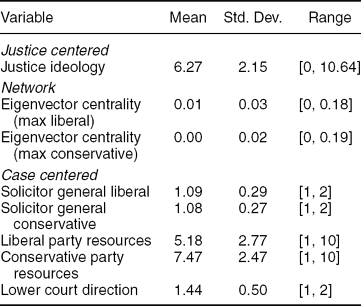
Table 1 presents a basic description of the key independent variables. The first set of variables correspond to the justice centered data. Of the well-known covariates of judicial decision making, one of the strongest relationships involves a justice's ideology (Segal and Spaeth Reference Segal and Spaeth2002). Justices who are already ideologically inclined to rule in a certain way are unlikely to be influenced by amici activity urging the decision they were already inclined to make. As such, it is the interaction of our measures of network influence with justice ideology, as measured by Martin and Quinn (Reference Martin and Quinn2002), which is a focal point of interest here. If groups have an influence, then the marginal effect of briefs should be positive when the justice's baseline proclivity to support the group's side is low. We see from the table that the central tendency of ideology on the Court is 6.27. The range is from 0 to 10.64, where higher values signify a more conservative justice.
Summary Statistics

In addition to controlling ideology at the justice level, we include several case-level control variables. The influence of the solicitor general as amicus on the votes of the justices is well documented (Collins Reference Collins2004, Reference Collins2008; McGuire Reference McGuire1998; Nicholson and Collins Reference Nicholson and Collins2008); as such we control for the presence of the solicitor general as either a liberal or conservative amicus. The solicitor general participated in about 9% of cases as a liberal amicus, and about 8% of cases as a conservative amicus. Further, since the ability of the litigants themselves to employ highly experienced counsel varies, and since counsel experience also has a clear influence on the justices’ votes (Johnson, Wahlbeck, and Spriggs II Reference Johnson, Wahlbeck and Spriggs II2006; McGuire Reference McGuire1995, Reference McGuire1998), we control for the resources of the liberal and conservative litigants. We use the litigant resource typology of Sheehan, Mishler, and Songer (Reference Sheehan, Mishler and Songer1992), which ranges from 1 to 10.Footnote 9 Table 1 shows that the typical resources of conservative litigants are considerably higher than that of liberal litigants. About 46% of liberal litigants are individuals, compared to 16% of conservative litigants. Finally, it is well established that the Court tends to accept cases that it intends to reverse (Caldeira and Wright Reference Caldeira and Wright1988), so we include the ideological direction of the lower court decision. This variable is equal to 1 if the lower court ruled in a liberal direction. The sign of this variable is expected to be negative, as the Court is anticipated to rule in a conservative direction if it accepts a case that was decided in a liberal direction in the lower courts (Collins Reference Collins2007, 60).
In order to test if particularly influential groups exhibit an effect, we operationalize interest group power in this political arena via a foundational network centrality statistic, and augment the justice vote data with this measure. In constructing the measure we rely on interest group network data from Box-Steffensmeier and Christenson (N.d., Reference Box-Steffensmeier and Christenson2012).Footnote 10 The data allow us to create a network of amici cosigners from 1930 to the present.Footnote 11 We then use a measure of the relative position of the interest group within the network, or centrality, as a measure of the group's power.
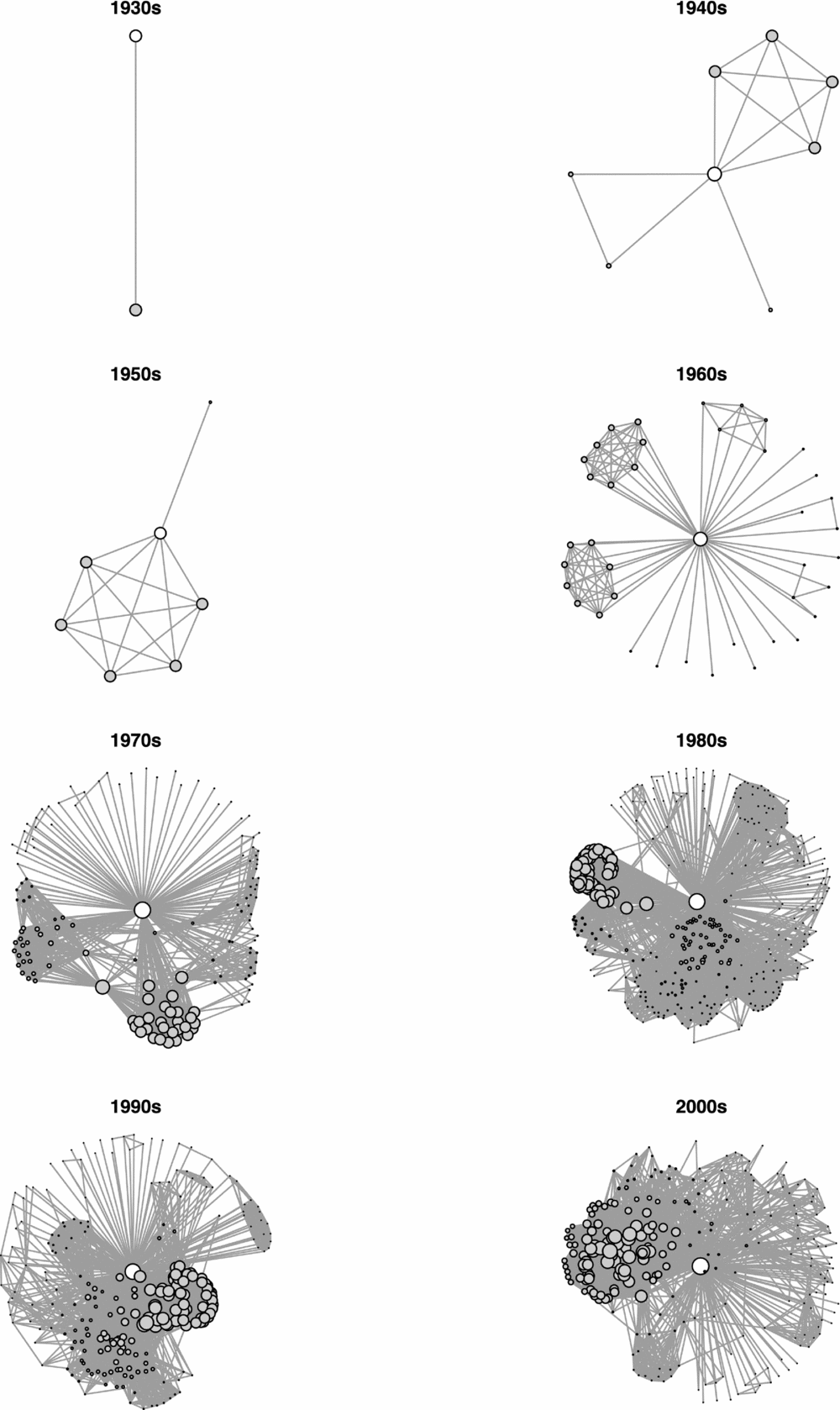
Each group that cosigns a brief, regardless of whether they are the sole signatory or part of a larger group of cosigners, is a node in the network of amici. Whenever two groups cosign a brief together, an edge or tie is created between them and centrality refers to the relative position of the node within the network.Footnote 12 Consider, for example, the American Civil Liberties Union (ACLU). The ACLU participated as amicus for each decade under analysis here (1946–2001), thus we have a nonzero centrality score for each decade in the justice vote data. Figure 1 illustrates the change in size and shape of the egocentric network of the ACLU for each decade in the data. The ACLU's node is white and its cosigners are gray with the size of the node referring to the relative power of the organization in the egocentric network (i.e., eigenvector centrality). The most obvious feature of the network is the increasing number of cosigners over time. In the 1930s the ACLU cosigned a brief with one organization, by the 1960s that had increased to 39, and by the 1990s it was up to 233, which is smaller than the ACLU's decade high cosigning in the 1980s of 368. This mirrors the larger trend in the network of cosigners, which increased from 194 in the 1930s to 674 in the 1960s to 4,349 in the 1990s. In the full network, however, cosigning has increased each decade with the largest number of cosigners in the 2000s at 5,291.
ACLU Egocentric Networks by Decade
Notes: White nodes refer to the ACLU. Gray nodes refer to other organizations in the ACLU's egocentric network. The size of the node is proportional to the eigenvector centrality of the organization in the egocentric network.

Also apparent from the egocentric graphs are the overtime changes in the network density, which is the sum of the number of cosigned connections in the network divided by the total number of possible connections. Such a measure gives us a rough idea of how well connected all the cosigners in the egocentric network are to each other. This is of particular interest to us because it suggests that the ACLU was a part of different kinds of networks in each decade. While the 1930s through 1950s had very high densities due to a low numerator, since the 1960s the density has remained fairly steady near 0.1. Over the last five decades, the sparsest decade for the ACLU was the 1980s, with a density of 0.086, and the highest the 1990s with 0.141.
We use eigenvector centrality (Bonacich Reference Bonacich1972) to capture the notion that groups best positioned in the network are pivotal actors before the Court. Eigenvector centrality is one of several possible measures of network power. It is particularly appropriate for our case because it delineates global power in the network from more local power structures. Eigenvector centrality refers to the value of the first eigenvector of the network with respect to the sum of the interest groups to which it is connected in every decade. Formally, the eigenvector centrality of a group is
 \lambda x_i = \sum _{j=1}^n a_{ij}x_j,
Thus a benefit of eigenvector centrality over degree centrality is that “The centrality of a vertex is proportional to the sum of the centralities of the vertices to which it is connected” (Bonacich Reference Bonacich2007, 556). That is, it weights relationships between nodes according to their centralities, not just the number of connections, which means that both direct and indirect relationships are accounted for with this measure.Footnote 13 In the context of our interest group network, measuring power with eigenvector centrality suggests that the quality of ties are an important consideration, not just the number of them. Interest groups that are tied to well connected groups are taken to be more powerful than groups who have a similar number of connections to less connected groups.
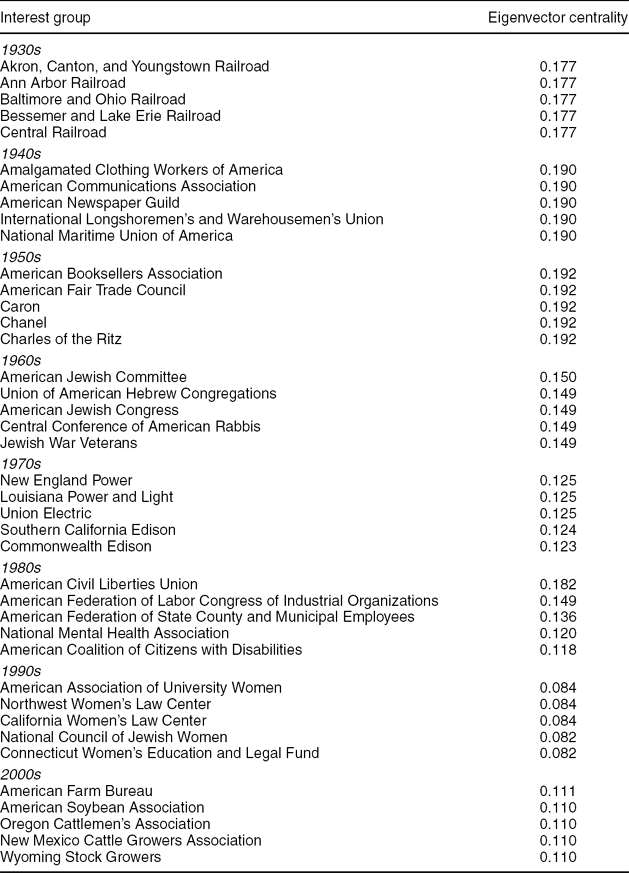
The five groups with the highest eigenvector centrality scores for each decade are listed in Table 2. While the top five groups do not represent anywhere near all of the coalitional activity, they suggest substantial variation in the kinds of groups that are most powerful within and across the decades. For example, railroads dominate the 1930s, utilities the 1970s, unions the 1980s, and farm associations the 2000s. Other groups are more consistently prominent, like our egocentric network example, the ACLU. The eigenvector centrality for the ACLU ranges from a high of 0.182 in the 1980s, when it was among the top 1% most central groups, to a low of nearly zero in the first few decades of data. Relative to the 1980s, the ACLU had less power in the 1990s with an eigenvector centrality score of 0.016 and even less in the 2000s at 2.108e −7. However, relative to all groups in the data, the ACLU has remained among the most powerful groups, consistently in the top 25% since the 1940s, and in the top 10% since the 1970s.
Most Powerful Interest Groups

An appropriate measure of interest group power should therefore take into account this longitudinal variance. We break up the network into decade-long windows in order to account for the fact that some interest groups were extremely powerful in one period but not in the next. Thus our measure of power for each interest group is not a single score across the entire 54 year period in study, but a different score for each decade in which there is a relevant case. This windowing process makes an important distinction: political and economic climates change, and thus several groups are more powerful and more present in some periods than others.
In the analyses that follow, the basic measure of interest group power is presented in terms of liberal and conservative ideological direction on the case. To test the impact of network centrality on Court outcomes, we need to summarize the interest group power in favor of the liberal/conservative side for each case. We do so by identifying the maximum eigenvector centrality for all cosigners on the amicus briefs supporting both parties in cases before the Court between 1946 and 2001.Footnote 14 The result is a continuous variable of the maximum power of interest groups that signed briefs on each side of a case (see Table 1).
We use the maximum and not an additive or summary measure because our hypothesis is concerned with “who signs,” and not “how many sign.” For example, if there is one brief for the liberal side, cosigned by three highly central groups, and on the conservative side there are 20 briefs, all with a few relatively unconnected cosigners, the sheer volume of briefs could overwhelm the high centrality of a few signers on the other side if an additive index was used. The average reduces that complication, but has the downside of washing away the impact that an extremely well connected group can have. Thus, like Anderson and Habel (Reference Anderson and Habel2008) we chose a measure that is not susceptible to biases created by averaging. Using the highest centrality for a single group on each side of a case tests whether having a highly central group join the brief influences the justices. Given that when groups collaborate on a brief, clerks tend to consider the identities of the cosigners more than the raw number of cosigners (Lynch Reference Lynch2004, 59), focusing on the power of the most central group cosigning a brief, as opposed to a metric which incorporates all cosigners, is the appropriate strategy. The alternative hypothesis suggests that justices will be more likely to vote for the litigant whose amici exhibit the greater power. In the next section we test these hypotheses with the judicial vote and amici network data.
4 RESULTS
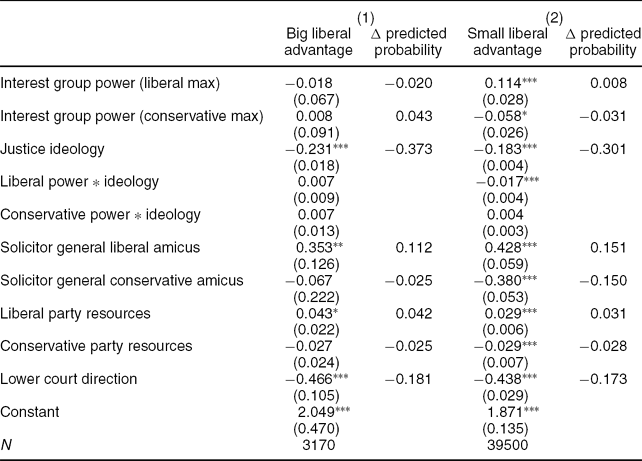
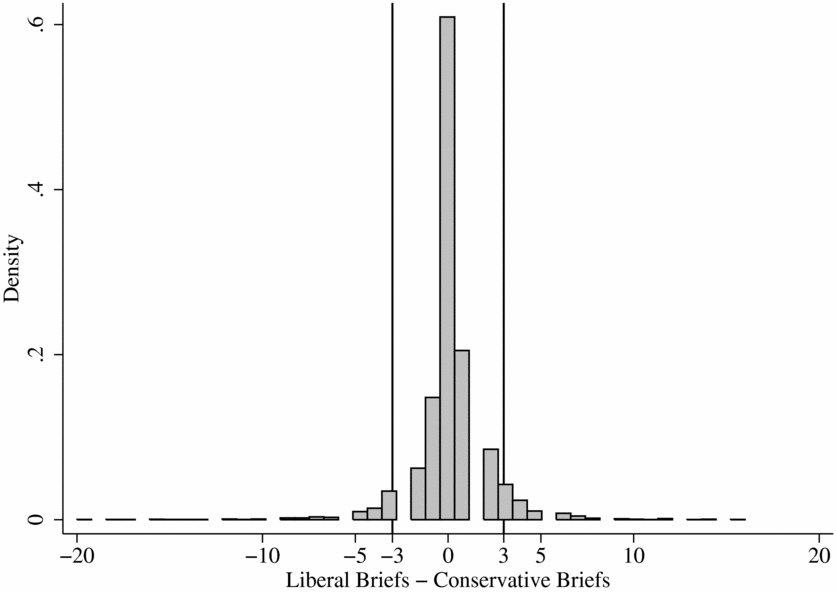
We estimate probit models of a justice's propensity to support the liberal side in a case. In order to model the high correlation of votes between justices on the same case, we cluster by case and calculate robust standard errors for these models.Footnote 15 Table 3 shows the results from two models of our stated hypotheses: model (1) estimates the effect of the covariates on supporting the liberal party when there is a large liberal advantage in the briefs, while model (2) does the same for cases that have a small to nonexistent liberal advantage. Prior work showed that the marginal effect of a 3-, 6-, 9-, or 12-brief advantage on justice behavior is statistically significant (Collins Reference Collins2004, Reference Collins2008), and Collins (Reference Collins2004, 824) focuses specifically on three-brief disparities in his exploration of the effect of brief counts on the predicted probability of the petitioner prevailing. However, (as we show below) there are few cases with disparities larger than 3. As such we use the most conservative specification of a “large” advantage seen in the literature, and present model 1 only on cases where there are at least three or more liberal briefs than conservative, which highlights the contribution of our work in light of previous findings.
Probit Estimates of Justice Probability of Supporting Liberal Litigant

Notes: Clustered standard errors, by case, in parentheses. A “big” liberal advantage is any case with at least three more liberal briefs filed than conservative. Changes in the predicted probability of a liberal vote are calculated for a two standard deviation increase (for continuous variables) or a one unit increase (binary variables), holding all other variables at their mean (continuous variables) or mode (binary variables). *(p < 0.05), **(p < 0.01), ***(p < 0.001).
The results suggest that when there is a big (at least three-brief) liberal advantage, interest group power has little direct relation to justice vote.Footnote 16 The power variables for both conservative and liberal amici are statistically insignificant. In other words, on cases with heavily weighted support for one side or the other, the relative power of interest groups, either conservative or liberal, is not meaningful.
As expected, justice ideology is negative and statistically significant. The more conservative a justice is, the less likely they are to side in favor of the liberal litigant. This result is strong and consistent across both big and small liberal advantages. Contrarily, when the two sides of a case are equal, both of the power measures are statistically significant. As expected, when there is a powerful liberal interest group involved in the case, the justices are more likely to vote with the liberal side and vice versa when there is a powerful conservative interest group involved. Likewise, when interacted with justice ideology, the effects are attenuated in the expected direction. The results are similar when examining cases where there is a large conservative advantage or simply a small to no conservative advantage.Footnote 17
When there is no advantage or just a small one for the liberal litigant, and the two sides are roughly balanced in terms of the number of amici, then liberal amicus centrality is significantly associated with increased probabilities of liberal votes by justices, and conservative amicus centrality is significantly associated with increased probabilities of conservative votes. As Figure 2 shows, the vast bulk of cases exhibit neither a large liberal nor conservative advantage in terms of the number of briefs filed. As such, the finding that “who” matters when there is no noticeable advantage in terms of briefs filed is substantively important for understanding how interest groups influence the Court in the vast majority of its cases.
Density of Disparity between Liberal and Conservative Amicus Briefs

Given that cases with a relative balance in the count of briefs is by far the modal situation, it is instructive to focus on exactly what the substantive impact of interest group power is on justice behavior, and the implications of these results for our understanding of judicial decision making. First, recall that our measure of judicial ideology places the most liberal justices at the low end of the scale. Thus, the results of model 2 in Table 3 shows that the change in predicted probability for a two standard deviation increase in the maximum conservative power is about a 3% decrease in the probability of a liberal vote, holding all other variables at their mean (continuous variables) or mode (binary variables). Conversely, the change for a two standard deviation increase in liberal group power is a 1% increase in the probability of a liberal vote.
The 3% decrease in predicted probability of a liberal vote for a two standard deviation increase in conservative interest group power deserves context: two standard deviation increases in litigant resources for liberal and conservative litigants carries changes in predicted probability of 3.1% and 2.8%, respectively. The well-known effect of litigant resources on justice behavior (Galanter Reference Galanter1974) thus carries a similar effect to that of group power.
However, the effects of group power are not constant across all levels of justice ideology. The interaction between liberal amicus power and justice ideology is negative and statistically significant, making interpretation of changes in predicted probability associated with varying levels of liberal group power more complex. The significant interaction result implies that for more conservative justices, the presence of a powerful liberal amicus decreases their probability of casting a liberal vote. A justice who is one standard deviation above the mean of conservatism exhibits about a 46% (95% CI: 44–47%)Footnote 18 probability of a liberal vote, if we hold all values at their mean (for continuous variables) or mode (for binary variables) and set liberal group power to its minimum. Keeping all values constant, that same conservative justice exhibits a 39% probability of a liberal vote if liberal group power is at its maximum (95% CI: 34–43%). This 7% reduction in predicted probability when going from minimum to maximum liberal group power among conservative justices is about half the reduction in predicted probability obtained when the Solicitor General files an amicus brief supporting the conservative party.
But, for the exact same set of index values (all control variables at their mean or mode), a justice who is one standard deviation below the mean conservatism exhibits a 74% (95% CI: 73–75%) probability of voting for the liberal party when liberal group power is at its minimum.Footnote 19 When liberal group power is set at its maximum, a liberal justice's probability of a liberal vote increases to 83% (95% CI: 79–86%). So, while dominant liberal groups can increase their likelihood that the Court's liberal wing will support their favored litigant through amicus activity, they do so at the cost of reducing the probability that the Court's conservatives will join their liberal brethren. Interestingly, conservative groups do not pay a similar cost; a one standard deviation increase in conservative group power decreases the predicted probability of a liberal vote by 2.5% for even the most liberal justices in the data.
Our findings do not suggest a dispositive answer to one of the central debates in judicial politics: whether judicial behavior is motivated by law or policy preferences. Taken with other works that directly consider the content of effective amicus briefs (e.g., Lynch (Reference Lynch2004) and Rossotti, Natelson, and Tatalovich (Reference Rossotti, Natelson and Tatalovich1997)), however, our findings do suggest that when powerful amici influence justices, this influence is at least partly extralegal. The significant interaction between centrality and ideology in our findings shows that for some justices, the presence of a powerful interest group can act as a signal to vote against the litigant supported by a group, suggesting that signalling theories of group influence—which assume that groups function to signal to the justices the positions of relevant interests in society—are supported by these results.
It seems unlikely that a purely legal model of judicial decision-making could predict that conservative justices would respond to the presence of a powerful liberal group as amicus with a decreased propensity to vote in favor of the litigant supported by the liberal amicus, as we show above. If justices respond to legal arguments in an ideologically neutral way, how could it be that more powerful liberal groups are less successful in persuading conservative justices than less powerful liberal groups? An attitudinal understanding could, however, suggest that some justices use the presence of a powerful, well-known amicus as a heuristic for identifying the policy position they disagree with, and vote accordingly (e.g., Bailey, Kamoie, and Maltzman (Reference Bailey, Kamoie and Maltzman2005) demonstrate that the probability a justice votes for the position advocated by the Solicitor General is decreasing in the ideological distance between the justice and SG).
Our influence hypothesis posited that high status groups affect the justices by first attracting attention and then engaging in persuasive advocacy. Therefore, if amici have an effect, as we show they do here, previous findings suggest that the mechanism for this effect is more often extralegal than legalistic (Lynch Reference Lynch2004; Rossotti, Natelson, and Tatalovich Reference Rossotti, Natelson and Tatalovich1997).Footnote 20 Our results, taken both directly and in light of previous research, provide some evidence that when groups influence the Court it is often through extralegal advocacy. Future work building on our results should directly analyze brief content to interrogate more deeply the causal mechanisms by which powerful groups influence the votes of justices.
If amicus briefs merely provided doctrinal analysis, appealing solely to legalistic concerns, the interactive relationships between centrality and justice ideology shown in model (2) of Table 3 would be difficult to understand. Alternatively, if group activity can serve as a heuristic to the justices for identifying the liberal and conservative litigant in a case, then the interactive results of model (2) make perfect sense. The most influential groups are well connected and participate frequently with many other interest groups; their position and arguments are likely to overlap in similar types of cases over time. Thus, the presence of a highly influential liberal group signals to liberal justices that their attitudinal preferences are best served by voting in favor of the litigant supported by the group; further, the liberal group may provide novel extralegal information to buttress the opinions of the liberals and perhaps change the votes of moderates. However, the liberal group's presence also serves as an unavoidable negative signal to the conservative justices that a vote in favor of the litigant supported by the influential liberal amicus would likely not satisfy conservative ideological goals, and thus more conservative justices are less likely to support liberal litigants supported by highly central liberal amici.
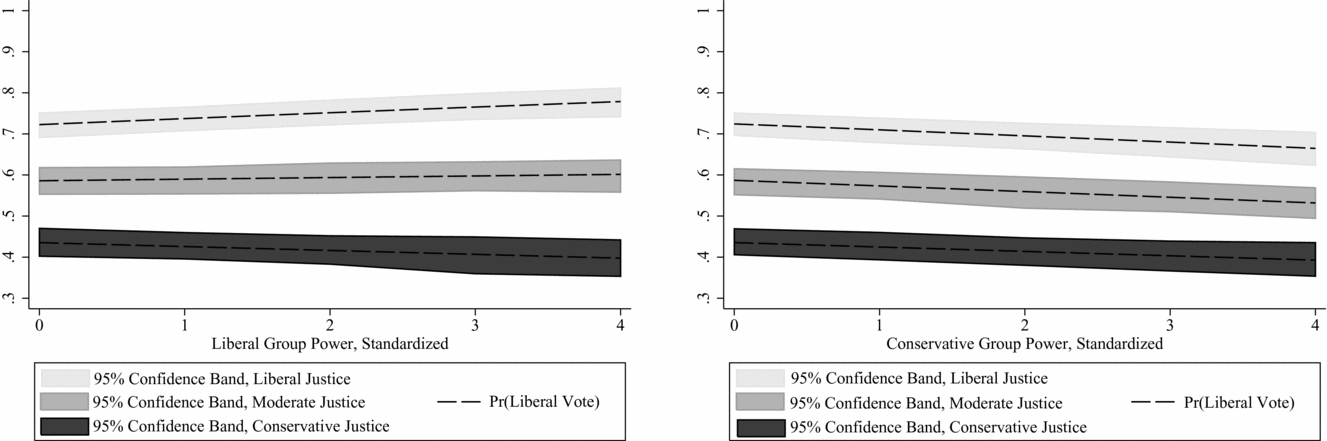
The key independent variable is our measure of eigenvector centrality, which when interacted with justice ideology (where higher values indicate a more conservative justice, one whose baseline probability of voting liberal would be lower) informs us about the conditional impact of organization strength on decisions across judges of varying ideology. Because the sign and significance of interaction terms in nonlinear models can be misleading (Ai and Norton Reference Ai and Norton2003), Figure 3 shows the probability of a justice voting in favor of the liberal party for various standardized values of centrality, and for a liberal, moderate, and conservative justice. In Figure 3, a liberal is a justice who is one standard deviation below the ideology mean, a conservative is one standard deviation above, and a moderate is at the mean.
Interactive Effect of Justice Ideology and Amicus Centrality
(a) Liberal Amicus Interaction (b) Conservative Amicus Interaction

As there are no significant effects of group centrality when the liberal advantage is large, Figure 3 only presents results for the subset of cases with no large liberal advantage. As suggested above, the “who” appears to matter a great deal more when there is not a preponderance of amici supporting one side or the other. When there is a small to no large advantage, the slope on the interactive effect of liberal centrality and ideology for conservative justices (Figure 3(a)) is negative. Clearly, the influence of the highly central liberal amicus is minimal for a moderately conservative justice. Conversely, note that even moderately liberal justices exhibit a lessened probability of voting for the liberal plaintiff when faced with a highly central conservative amicus.Footnote 21
Figure 3 suggests that liberal and conservative justices respond differently to the presence of the influential interest groups from the opposing side of the ideological spectrum. While conservative justices exhibit a flat to negative relationship to increasing liberal group centrality, liberal justices exhibit the opposite relationship, holding all else equal. The results are suggestive of a more nuanced understanding of judicial decision-making than previously encountered in the literature. Perhaps susceptibility to informational persuasion is conditional on ideological priors, where more liberal justices are more prone to consider (even to the point of changing a vote) the arguments of influential outside groups. Indeed, Collins and Martinek (N.d.) show that conservative judges respond favorably to increases in raw counts of both liberal and conservative briefs (a “more is better” heuristic), while liberal judges do not exhibit this pattern. Their results suggest that liberal justices process briefs amicus curiae in a more cognitively complex way and respond not to raw counts, but rather to the expertise and credibility of amici on both sides of the case. Conversely, it appears that conservative justices use the presence of influential liberal amici as a heuristic to vote against the litigant supported by the pivotal liberal group.
5 CONCLUSION
Competition between factions for favorable policy outcomes embodies the political process the world over. Representative democracies purportedly exist to serve the general welfare and the interests of a majority of citizens. However, organized groups seek to influence outcomes at every level of governance, and the aims of these groups are in no way assured to be concordant with the aims of a majority of citizens. The extent to which different factions achieve their goals is the extent to which some minority subsets of democratic societies enjoy better policy outcomes than would likely be ratified by a majoritarian process. Moreover, rarely does antidemocratic group victory come without a cost to other groups in the form of policy which leaves the losing factions of society worse off than they would have been if the winning group had never influenced the process. Therefore, it is critical to understand which groups win their political battles, and why some groups succeed more often than others. These differential rates of success imply policy outcomes that may circumvent the will of the majority and the democratic process.
We find that not all interest groups are equal before the Court. Our evidence suggests that interest groups exhibit heterogenous influence on the votes of Supreme Court justices. Groups who are more connected with other interest groups and collaborate with other well-connected groups, i.e., more central groups, have a greater effect on the probability that a justice votes in their favor, compared to groups who participate on their own or collaborate with less well-connected groups. Groups who are more connected with other interest groups and participate more frequently at the Court have a greater effect on the probability that a justice votes in their favor, compared to infrequent participants and groups who participate on their own.
The heterogenous influence of groups is pronounced in cases where group participation is balanced between the liberal and conservative litigants, which is the typical scenario. When the competing interests in society are balanced, and groups compete for the justices’ (and their clerks’) limited attention and resources, the most central groups outflank organizations the justices may be less familiar with, and their presence in the case is significantly associated with differences in the justices’ voting patterns. Groups who are seen as desirable collaborators by other groups (and by the litigants themselves (McGuire Reference McGuire1994)) are also perceived as pivotal and influential by the justices.
The pathway by which this influence takes place is not answered dispositively by this research, but our results are more suggestive of one pathway than others: interest groups influence justices by signaling to the Court which litigant is aligned with which broader ideological viewpoints in society. The relationship between justice ideology and group centrality is different for conservative justices considering conservative briefs than for conservative justices considering liberal briefs. The negative relationship between ideology and group centrality for conservative justices suggests that when a highly influential liberal group files a brief, they also send a negative signal to the Court's most conservative justices to vote the other way. This result is more suggestive of the signalling pathway of group influence over any theory that involves justices acquiring information from the briefs themselves.
However, liberal justices do not exhibit an identical pattern to conservative justices: they support liberal litigants less frequently when faced with highly central conservative interest groups. This behavior is more consistent with the influence hypothesis posited above—when a powerful conservative group files a brief, the group's status earns its brief a closer reading by the justices, and the group has the resources to present a novel, persuasive argument. Could it be that the informational pathway of persuasion suggested by the influence hypothesis operates for some justices but not others? Given the heterogeneity in the justices’ work practices, especially in the use of clerks (Peppers Reference Peppers2006), it is entirely possible that novel legal arguments and additional research by groups with many resources could play an informational role in the decision behavior of some justices, but not others. There is evidence that lower court judge responses to counts of amici are conditional on ideology Collins and Martinek (N.d.). Our results are a preliminary suggestion that perhaps liberal justices respond to amici arguments based on their perception of the amici's expertise and credibility, while conservative justices use a simpler heuristic (influential liberal groups signal which litigant to vote against). Future work should explore this connection. Nonetheless, the overall patterns are interesting and insightful.
The questions addressed above are implicitly tied to important debates about the nature of interest group influence on the Courts—debates that date back to the founding of our country and the Federalist Papers—debates that are found in seminal works of the field (Dahl Reference Dahl1961; Schattschneider Reference Schattschneider1960; Truman Reference Truman1951). Groups who are able to attract many collaborators (particularly other influential collaborators) and participate frequently at the Court have an impact on policy outcomes that eludes groups in society incapable of this type of political participation. We find that more central groups have more influence when the number of briefs is approximately the same. They may be more influential for a number of reasons, including because they have a broad membership or more resources. We simply show that the most central groups do have more influence, which points to new directions for future research.
To the extent that the network of amicus brief cosigning is indicative of activity beyond the Court, this research may also add to our understanding of how politics is conducted in the U.S. political system at large. While our results here only speak to the Court, they are suggestive about the need to test this model of influence elsewhere and the data with which to do so. Amicus brief cosigning may be considered an indicator of political ties and collaborative activity that carries over to activities aimed at influencing political actors across all branches of government.Footnote 22 In this manner, the network of lobbyists exposed here and the disproportionate influence of the well-connected groups may suggest a larger perspective on interest group influence and mobilization.



Comments
No Comments have been published for this article.