


Resilience is both the capacity of individuals to navigate their way to the psychological, social, cultural and physical resources that sustain their wellbeing, and their capacity individually and collectively to negotiate for these resources to be provided in culturally meaningful ways. (Ungar, 2019). From an interpersonal aspect, children can exhibit cognitive strategies that can be either adaptive or maladaptive forms of coping (Skinner & Zimmer-Gembeck, Reference Skinner and Zimmer-Gembeck2016).
Encouraging the attributes of resilience in children as part of an early intervention and prevention approach is well supported by the literature, to not only safeguard against the effects of adversity and mental illness, but also enable individuals to adapt and thrive in challenging circumstances (Masten & Coatsworth, Reference Masten and Coatsworth1998; Rutter, Reference Rutter2008; Ungar, Reference Ungar2006; Werner, Reference Werner1997). Facilitating children to adopt resilience-based attributes early in life may mitigate the growing statistics of mental health. For instance, in 2013–2014, the Australian Institute of Health and Welfare (AIHW) discussed that 10% of children aged 4–12 years self-reported attributes that challenged their social and emotional wellbeing, and almost one in seven (13.9%) of children and adolescents aged 4–17 years reported issues that aligned with poor mental health (AIHW, 2017). If learning resilience-based attributes early can mitigate the effects of stress and provide children with tools that they can use to help them navigate the difficulties of their lives in an adaptive way, this would be considered a worthy investment. Over the course of a lifetime, exposure to stress and adversity is inevitable. However, some key indicators may provide awareness into how resilience training can intervene when risk is identified.
Challenges that Influence the Development of Resilience
The development of resilience-based attributes offers many opportunities to facilitate an individual’s ability to cope when adversity arises. The level of interpersonal resilience is comparable to the coping mechanism applied to not only face but to successfully manage challenges. Resilience is as much about predicting, understanding and managing risk as it is about recovery from adversity. However, certain stressors pose more risk than others to the notion of coping.
The development of resilience is multifactorial, and seemingly influenced by environmental, familial, biological, interpersonal, cultural and community factors (Garmezy, Reference Garmezy1991a, Reference Garmezy1991b; Masten & Coatsworth, 1988; Masten & Tellegen, Reference Masten and Tellegen2012; Rutter, Reference Rutter1998, Reference Rutter2013; Ungar, Reference Ungar2004). For example, factors such as family and/or environmental challenges such as divorce in the family, poor parental involvement or leadership, negative home or school environments, being bullied by peers, personal illness, death of a family member or close friend, and/or exposure to violence can provoke significant feelings of stress, and consequently challenge or impede the adaptive response (Hjemdal et al., Reference Hjemdal, Friborg, Stiles, Martinussen and Rosenvinge2006).
Examples of resilience in terms of poor social, emotional and interpersonal skills can be exhibited through low or lack of self-esteem or confidence, impulsivity in behavioural reactions, giving up easily, excessive avoidance and blame or displacement of emotions, poor emotional regulation, low conflict resolution skills, gossiping, continuous self-pity and cheating. These are examples of behaviours that demonstrate maladaptive coping mechanisms adopted to deal with stress and considered behavioural traits that impede or hinder development of resilience (Dweck et al., Reference Dweck, Chiu and Hong1995; Hong et al., Reference Hong, Dweck, Chiu, Lin and Wan1999; KidsMatter, n.d., Shean, 2015; Zhao et al., Reference Zhao, Dweck and Mueller1998).
Stress and the Effects on the Brain
The development of resilience relies upon strong connections between the prefrontal cortex and executive function area (metacognition). These are known as adaptive responses, discussed in the section below. When children experience episodes of severe stress early in life this can cause a dysregulation of the hypothalamic pituitary-adrenal (HPA) function, compromising the executive functions of the brain responsible for effective problem solving, decision making and memory function (Nicoll, Reference Nicoll2014).
In turn, this creates hypervigilance, inability to sleep and decreased capacity to concentrate (Nicoll, Reference Nicoll2014). In this respect, those executive functions that support the development of resilience can be significantly compromised, making it very difficult for a child to recover or apply resilience-based skills without support or expert intervention. This leaves the child predisposed to forming maladaptive ways of coping with adverse effects (Skinner & Zimmer-Gembeck, Reference Skinner and Zimmer-Gembeck2016). Furthermore, adverse childhood experiences have been linked with higher rates of learning difficulties, mental disorders and personal behavioural adjustment problems, which can affect adult life.
Understanding the risks and/or impact that early trauma and adversity can have on a developing brain can facilitate the intervention of techniques that support recovery from trauma, and in addition promote resilience-based behaviour change. (Berson & Baggerly, Reference Berson and Baggerly2009; Garmezy, Reference Garmezy1991a, Reference Garmezy1991b; Masten & Tellegen, Reference Masten and Tellegen2012; Nicoll, Reference Nicoll2014; Werner, Reference Werner1989).
Age, Learning and Resilience
Emotional knowledge (EK) incorporates the ability to express emotions, understand the motivational drivers behind emotions and apply that knowledge in social settings (Davidson & McEwen, Reference Davidson and McEwen2012; Seidenfeld et al., Reference Seidenfeld, Johnson, Cavadel and Izard2014). In terms of EK, children of preschool age have the capacity to acknowledge emotions and label them. By the end of preschool, and continuing into kindergarten, children can identify causes of behavioural consequences and emotional states (Berson & Baggerly, Reference Berson and Baggerly2009; Seidenfeld et al., Reference Seidenfeld, Johnson, Cavadel and Izard2014). From the age of four through to seven years, children use increasingly more references to beliefs and thoughts in their explanation of emotions as they show a deeper application of EK. Therefore, children of this age group maintain the ability to successfully learn social and emotional competence (Seidenfeld et al., Reference Seidenfeld, Johnson, Cavadel and Izard2014). Research investigating resilience in the early years confirms the importance of parental involvement or positive role modelling in providing children with cognitively stimulating activities that build resilience and support coping mechanisms for the future (Grotberg, Reference Grotberg1995; Nolan et al., Reference Nolan, Taket and Stagnitti2014). Skills that enable children to self-regulate and manage emotions while building healthy interpersonal relationships are some examples that aid and reflect resilience attributes (Nolan et al., Reference Nolan, Taket and Stagnitti2014).
Children who have experienced early trauma are considered high risk; however, developing the skills of resilience at any age takes time, diligence and daily practice (Seidenfeld et al., Reference Seidenfeld, Johnson, Cavadel and Izard2014).
Teaching programs that encompass resilience and social-emotional wellbeing practices have a positive impact on early neural development (Goleman et al., Reference Goleman, Bennett and Barlow2012; Seidenfeld et al., Reference Seidenfeld, Johnson, Cavadel and Izard2014) and may have sustainable outcomes that can enhance children’s wellbeing. Children who learn and exercise the core skills of resilience are less likely to exhibit symptoms of anxiety and depression or engage in antisocial behaviour and more likely to manage adversity and engage in learning (Skinner & Zimmer-Gembeck, Reference Skinner and Zimmer-Gembeck2016). Given that repeated experiences shape the way the brain is wired, supported with knowledge from studies of neuroplasticity, the more a child can practise resilience-based skills such as self-discipline, empathy and cooperation, the stronger the underlying circuits become for reinforcing these essential life skills (Goleman et al., Reference Goleman, Bennett and Barlow2012).
Adaptive Stress Responses
Protective factors, in the context of resilience, are considered to be those that may reduce or mitigate the negative impact stressors and enable a person to cope with and implement cognitive strategies in responses to stress (Masten & Tellegen, Reference Masten and Tellegen2012; Skinner & Zimmer-Gembeck, Reference Skinner and Zimmer-Gembeck2016). Protective factors can be multifaceted, drawing from individual, family and community determinants (Rutter, Reference Rutter1979; Werner, Reference Werner1989).
Adaptive behavioural traits that support the development of resilience can be recognised through the ability to control temperament, exhibit friendliness, elicit positive attention from family members, and maintain a positive self-concept and self-esteem (Mayr & Ulich, Reference Mayr and Ulich2009; Reavley et al., Reference Reavley, Bassilios, Ryan, Schlichthorst and Nicholas2015).
Other adaptive traits are initiating autonomy with tasks, developing independence, taking a proactive approach to problem solving, maintaining persistence and concentration with jobs and taking pleasure in novel experiences (Skinner & Zimmer-Gembeck, Reference Skinner and Zimmer-Gembeck2016; Ungar, Reference Ungar2004; Werner, Reference Werner1997)
Children with high levels of resilience exhibit curiosity and have an exploratory drive, maintain alertness, empathy and prosocial orientation, develop positive social relationships, have the ability to delay gratification and maintain positive processing and restructuring of negative experiences, and have the ability to regulate their emotions. Resilient children have adequate expression of feelings and demands, have hobbies and interests in life, and have the ability to recover from distressing experiences (Garmezy, Reference Garmezy1987; Mayr & Ulich, Reference Mayr and Ulich2009; Rutter, Reference Rutter1998; Shean, Reference Shean2010; Werner, Reference Werner1997).
In gaining a perspective about protective resilience attributes, it is important to note that the child’s ability to apply resilience-based tools can vary depending upon the circumstance. Rutter (Reference Rutter2007) discusses how a child can demonstrate resilience in one instance but may show low resilience attributes in another.
Much of the research and resilience attributes described have synergy with findings from the Grotberg Resilience Framework (GRF). Grotberg’s (Reference Grotberg1995) research outcomes (Figure 1) were formulated based on one the largest international resilience studies that examined the multidimensional (interpersonal, social and environmental factors) that inform the desirable behavioural responses underpinning and supporting the development of resilience in children.
Core traits of the Grotberg Resilience Project: (adapted from Grotberg, Reference Grotberg1995).

As a result of the research, Grotberg (Reference Grotberg1995) deduced that the factors framed under ‘I HAVE, I AM and I CAN’ to be protective attributes that support the development of resilience. When a child is able to adopt and sustain these supportive behavioural characteristics, coupled with supportive environmental factors, they tend to have optimal outcomes in terms of wellbeing.
Resilience Theory
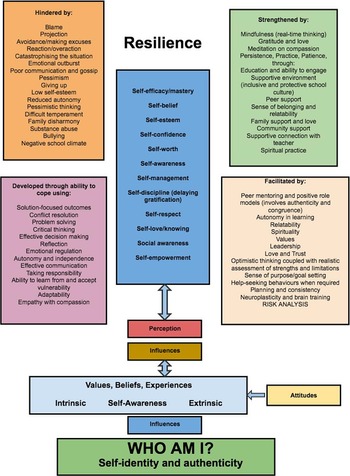
The theoretical resilience framework (Figure 2) represents a collaboration of the seminal works of resilience researchers, which captures and consolidates the essence of their research findings. These findings have been constructed into resilience-building attributes (coping and/or adaptive behavioural traits), attributes that reduce or hinder resilience-building capacity (maladaptive behavioural traits), and other environmental or external factors that the researchers deduced to be either supportive or hindering to the development of resilience. The seminal works that have been incorporated into this framework are by Dweck (Reference Dweck1999), Grotberg (Reference Grotberg1997), Masten and Tellegen (Reference Masten and Tellegen2012), Rutter (Reference Rutter1998), Skinner and Zimmer-Gembeck (Reference Skinner and Zimmer-Gembeck2016), Ungar (Reference Ungar2004, 2014), and Werner (Reference Werner1997).
Theoretical constructs underpinning resilience (Tillott, Reference Tillott2019).

At the core of the framework is the pillar of ‘Self’. The self-aspect represents those facets that draw from self-esteem, self-confidence, self-belief, self-management and so on. The figure represents those behavioural traits that can be strengthened or challenged by our past social conditioning of experiences and role models in our life and may also determine how we respond or react to our environment (through the adaptive and maladaptive sections). For example, if someone feels like their sense of self has been challenged through a situation that provokes conflict, they may choose to defend themselves through a maladaptive response such as reacting impulsively with anger or blame, or they may use critical thought and emotional regulation (which is considered an adaptive response) to review the situation before they respond.
Within this study, the researcher used storytelling with a resilience-focused resource to unpack resilience theory (inclusive of the adaptive and maladaptive behaviours) and challenge the way children manage their behaviours with respect to the adaptive and maladaptive responses highlighted in Figure 2.
Resilience and Storytelling
One of the salient factors of teaching resilience characteristics to children is the consideration of appropriate pedagogy. Children, in particular in their younger years enjoy learning through song, poetry, puppetry, storytelling and dance (Cahill et al., Reference Cahill, Beadle, Farrelly, Forster and Smith2015).
Storytelling, commonly referred to as bibliophagy, is an effective way to deliver messages to children in a fun and engaging manner (Bouchard et al., Reference Bouchard, Gervais, Gagnier and Loranger2013). Bibliotherapy provides opportunities for development of insight into personal problems and facilitates emotional healing (Heath et al., Reference Heath, Sheen, Leavy, Young and Money2005).
Storytelling can encourage the sharing of ideas from observing a common dialogue, which can facilitate integration and learning of the context being delivered. Storybooks that display the characters and their emotional reactions or responses can demonstrate positive interventions, which facilitates a safe environment for learning (Bouchard et al., Reference Bouchard, Gervais, Gagnier and Loranger2013).
For children, learning occurs when they feel safe and when positive emotions are evoked. Enjoyment can broaden a child’s ability to think creatively and problem-solve more efficiently (NSW Department of Education and Communities, 2015; Seligman, Reference Seligman1995).
Early intervention and prevention initiatives that consider the interpersonal and educational constructs that form resilience may act as a protective aid to mitigate against the adverse stress (Cahill et al., Reference Cahill, Beadle, Farrelly, Forster and Smith2015).
Program, Content and Structure
Game ON is a storybook that uses colourful, engaging, relatable characters that encourage children (aged 4–8 years) to consider the adaptive and maladaptive behaviours of resilience represented in Figure 2 (Hinder and Cope strategies) in a simplified way. The Game ON storybook was used in this intervention program to explore whether children (aged 4–8 years) could observe the characters’ behavioural responses and assess how the characters were managing their reactions to certain stressors. In the study, sports officers read the story to children, while the teachers observed and noticed the children’s responses. Teachers and sports officers were asked to consider whether Game ON, as a storybook, enabled opportunities for children aged 4–8 years to explore the maladaptive and adaptive traits of resilience in accordance with the GRF.
The research aims were to: (1) examine whether story telling supports resilience learning in primary school children; (2) examine whether Game ON enabled resilience teaching opportunities; (3) provide practical recommendations to teachers and community groups who work with children on how to use (evidence-informed and tested) storybooks to support resilience learning.
Methods
Participants
The participants in this study involved children aged 4–8 years (N = 60) from independent, Catholic and public schools. These children were enrolled in Kindergarten (first year of formal schooling (n = 20), Year 1 (n = 20), and Year 2 (n = 20) from three schools. The demographics of the schools were from lower, middle and higher socio-economic areas within New South Wales (NSW), Australia. The study also included three teachers (n = 3) who observed the delivery, and two sports deployment officers, who delivered the storybook.
Materials
A storybook was developed and designed to contain key aspects of resilience theory targeted to children aged 4–8 years. The book was designed to capture the imagination, emotions and attention of children using colourful and relatable characters (age, context, linguistic appropriateness and gender-neutral qualities) that serve as learning role models. Through the story, the characters exhibit the adaptive and maladaptive behavioural traits of resilience theory (see Figure 2).
Procedure
Ethical approval to conduct the research was obtained from the Human Research Ethics Committee at the University of Wollongong (UOW 2014/446) and the NSW State Education Research Approvals Process (SERAP-2014262). The inclusion criteria for the participants required the children to be enrolled in Kindergarten, Year 1 or Year 2 at the attending school, with permission sought from parents and schools to take part in the project. This study encompassed a qualitative study featuring semistructured interviews consisting of a series of questions informed by the international Grotberg Resilience Project (Grotberg, Reference Grotberg1995) and Bloom’s Taxonomy of Learning. The project was also influenced by a modified version of the Gibbs reflective cycle to evoke reflection of behavioural interventions. Semistructured interviews were based on the observed lesson (teachers’ experience), delivery of the lesson (sport deployment officers’ experience) and the receivers (children’s experience); see Figure 3).
Modified version of the Gibbs (Reference Gibbs1988) reflective cycle, for child-friendly use.

Two weeks prior to the research project, the teachers and deployment officers were provided with information about the Grotberg Resilience Project (Figure 1) and were required to familiarise themselves with the concepts of resilience embedded in the project. The data collection procedure took place over two separate rounds.
Round 1 entailed one peer mentored session (for each class, Kindergarten, Year 1 and Year 2), with the deployment officers reading the book to the children. From this, the teachers were asked to engage in activities that involved either storytelling or other creative activities related to Game ON, with the option of repeating this session as many times as they desired with their class over a 4-week period. Round 2 entailed one peer-mentored session reflecting on Round 1 and the learnings of the resources over the course of the 4 weeks for each class (Kindergarten, Year 1 and Year 2).
In Round 1, the deployment officers read Game ON to Kindergarten, Year 1 and Year 2 on separate occasions. Throughout this process, teachers from each year were asked to observe the children and listen to the children’s answers from the structured questions, Teachers were asked to take notes as the session evolved, which examined children’s overall learnings from the book, how the difficult character in the book affected others, whether they could personally relate to this character, and if so, how and why, In addition, children were asked to examine the personal consequence when making poor choices (as exhibited by the characters in the book). The areas shown below in italics show the link back to the modified version of the Gibbs Reflective Cycle used in the study (see Figure 3), which in addition have been reflected in the questions structured below.
1. How do you think Alex (the angry character) is affecting other characters in the book? (Awareness)
2. Can you remember a time when your behaviour was like Alex? (Problem)
3. Can you tell me what happened when you behaved like this? (Action/consequence)
4. Now that you have read the book, how do you think you could change the behaviour? (Solution/reflection).
The purpose of the questions was to determine whether the children’s answers had any relatability back to the GRF. Therefore, this data was audio-recorded to capture the children’s responses and coded according to its relevance to the GRF using NVIVO and Braun and Clarke’s (Reference Braun and Clarke2006) thematic analysis (Table 1).
Coding Responses

Note: Data analysis used Braun and Clarke’s (Reference Braun and Clarke2006) method and NVIVO framework answers from participants using the Grotberg Resilience Framework.
After the initial reading of the of the storybook by the sports officers, the resource was left with the teachers for a period of 4 weeks, and a second round of interviews (within week 5) examined how frequently the book was read to the children, with further examination of the children’s understanding and practical use of the resilience strategies within the book. Teachers and children were asked to answer the questions framed in Round 1 to determine any change in responses, and in addition were asked how many times the book was used in class. Teachers were free to use the GRF to guide their answers, but were also freely able to comment on the book and its potential learning opportunities outside of the guidance of the GRF. This proved to be an important aspect of identifying further opportunities of using Game ON as a learning resource as discussed in the results.
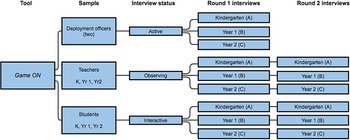
The participants’ responses were coded to the GRF (See Figure 1.) using NVIVO and Braun and Clarke’s (Reference Braun and Clarke2006) thematic analysis. Using three different perspectives (teacher, sports officer and the children) enabled the data to be triangulated and to demonstrate strong themes in the dataset across a broad range of participants. Figure 3 represents the flow chart of the data collection procedure.
In Round 2 (see Figure 4), only data from teachers and children were recorded to determine how much of the book they remembered and whether any of the strategies suggested in the book had been independently adopted by the children or reinforced by the teacher in class time. In addition, teachers were asked whether children displayed any of the strategies mentioned in the book within school hours in response to managing a situation.
Flow chart of data collection.

Results
Kindergarten children (first year of formal schooling) read the book once per week, followed up with a self-initiated activity to colour in the characters of the book. Year 1 children were read the story twice in the 4 weeks, and in the first week conducted a self-initiated creative writing activity. Year 2 read the story more than four times (exact amount unknown) and conducted several self-initiated activities.
The coding process was analysed by two independent reviewers (as represented by Figure 4), revealing synergy between Game ON and the Grotberg Resilience Project outcomes, and in addition, some other potential opportunities that Game ON offered outside of the GRF.
Table 1 demonstrates how many sources (either the students, deployment officers or the teachers) made reference to aspects within the GRP threads and how many times this occurred (references; see Table 1 coding). An example of how the questions were coded is as follows.
Children were asked: ‘Can you remember a time when your behaviour was like Alex?’ (the poor resilience role model in the book). Some children answered this question with examples such as, ‘One time I pulled my friends hair’, or ‘I got so mad I broke my friend’s toy’, ‘I punched my friend in the chest’. The children were then asked to reflect upon that action and outline or explain the consequence to their choice. Examples of children’s responses were ‘I got into a lot of trouble’, ‘I got sent to my room’ or ‘I got detention’.
Children were asked to consider how they could change their behaviour; in particular, using the book Game ON to guide them with some solutions. The children provided answers such as ‘I could walk away and take three deep breaths’ (as per the example provided by the character in the book).
The participant’s answer provided above was coded as a ‘reference’ to ‘I can understand my temperament’ (in comparison to the GRF) and the source was noted as a child/children response.
However, in Round 2, children were able to take the strategies suggested in the book and use them in real-life situations that evoked conflict. For example, a child would say: ‘My sister made me very angry, but instead of fighting with her, I just walked away and went and got a drink of water.’
In this instance, if children were able to provide real examples of when they changed their behaviour, their response was coded under ‘I can manage my feelings’.
Other examples were provided by children, such as: ‘I should have done what Dusty did; I should have walked away and thought about my anger. My anger is my responsibility.’ This quote provides an example that the characters in the book acted as role models for the children. Therefore, a reference would be made to ‘Role models’, and ‘I am responsible’ would be coded in this instance under the GRF (see Figure 1).
As indicated by the results, understanding temperament, self-managing feelings, solving problems and communication were strong themes that emerge from Game ON, in comparison to the GRF. Figure 1 (shaded in blue) represents the areas of the GRF that have been identified as teaching opportunities when using Game ON as a resilience resource for children. In addition, the results demonstrated other learning opportunities for using Game ON that are not mentioned in the GRF, but have emerged as important skills evident in contemporary resilience theory, such as the importance of using self-reflection to highlight the importance of using relatable learning tools to enhance children’s engagement with the context of the learning.
Discussion
Teaching Resilience in the Classroom
The results of the study indicated that Game ON provided children with several opportunities to unpack resilience theory, or examine their own behaviour and compare it to examples of resilience-based behaviour demonstrated in the book. The teachers commented that the resource was engaging and purposeful (Tillott, Reference Tillott2019).
The teachers indicated that they have many resources to choose from in the wellbeing space; however, they mentioned how difficult it can be to ascertain which resource will best serve the purpose of use, which can also be a time-consuming exercise (Cahill et al., Reference Cahill, Beadle, Farrelly, Forster and Smith2015). Teachers in this study found Game ON to be a purposeful and useful book to assist with resilience-building exercises. The resource seemed to support teachers’ confidence with unpacking and delivering resilience theory in class, and supported the intervention of self- initiated activities around the book.
At the completion of this project, all teachers mentioned that they had learnt a lot about the behavioural attributes that facilitate the development of resilience. In addition, one of the teachers enquired about which trait of resilience is more important than others. The discussion below offers one aspect in accordance with how the executive functions of the brain complement resilience-based behaviour development.
Game ON leads with emotional regulation and temperament control for the purpose and application of conflict resolution. The theory underpinning this is that the executive functions that support the development of resilience resides in the prefrontal cortex. This is the area of the brain that supports the development and application of resilience behaviour for children. Children who exhibit high levels of emotion and negative behavioural reactivity appear to have less ability to control their temperament, with an associated impairment of the executive functions vital for developing positive cognitive coping strategies (Taylor et al., Reference Taylor, Eisenberg, VanSchyndel, Eggum-Wilkens and Spinrad2014). When the executive functions are impaired, children exhibit lower levels of ego-resiliency (those behaviours that hinder resilience — see Figure 2) and may be more inclined to act before they think, with difficulty in recovering leading to antisocial behaviour. This could challenge social competence skills (Taylor et al., Reference Taylor, Eisenberg, VanSchyndel, Eggum-Wilkens and Spinrad2014).
Conversely, it would appear that when a child can regulate their emotions and calm their minds, they create more opportunities to gain a broader perspective of the situation, by seeing situations through a calm and clear lens, which may optimise critical thinking and evaluation, solution-focused outcomes, problem solving and reflection ability. When the fight and flight response is activated through conflict, trauma or adversity, the executive functions of the brain responsible for decision making, critical thinking and solution-focused outcomes can become compromised. This can lead to poor problem-solving abilities in both the short and long term, due to an underfunctioning or underdeveloped prefrontal cortex (Fernandez-Duque et al., Reference Fernandez-Duque, Baird and Posner2000; Skinner & Zimmer-Gembeck, Reference Skinner and Zimmer-Gembeck2016).
Therefore, it would appear imperative that while all aspects of resilience theory are important, an argument could be made to lead with implementing emotional regulation and conflict resolution skills as a primary step in the development of resilience-based behaviours. The theory underpinning this is that emotional regulation can facilitate calmness, which then enables the prefrontal cortex to have a broader perspective of the situation, which then promotes optimal decision-making capability with the potential for more favourable outcomes (Garaigordobil & Machimbarrena, Reference Garaigordobil and Machimbarrena2017).
Limitations
The creator of Game ON was the primary investigator of the research project. To reduce researcher bias, triangulation was introduced in the methods, and the data were analysed by two independent persons. Another limitation may be seen as the small sample size. While the data collected did show data saturation, a larger sample size would help to deepen the findings discussed in this article.
Recommendations for Practice
Some recommendations for practice were based around the teachers’ experience with a resilience-based resource. It became clear through discussions that while teachers were required to unpack resilience theory with children in class, there was a shortfall in some teachers’ knowledge with regard to resilience theory, and therefore, without support, a potential lack of confidence to teach resilience theory and practice in class. Therefore, a need for teacher training about resilience theory was evident. Overall, this resource was a popular method of teaching resilience theory for both teachers and children. This could also be extended to parents and carers in the home, accompanied by a support guide that helps to unpack Game ON and its links or opportunities that support the development of resilience-based behaviours.