An acute justice gap exists in the United States with many people not receiving the help they need with justiciable problems (Legal Services Corporation (LSC) 2022). The legal community has long characterized the justice gap as one of unmet legal needs and recommended more lawyers and legal services as a solution (Sandefur Reference Sandefur2019; Selbin et al. Reference Selbin2012; Shanahan et al. Reference Shanahan, Carpenter and Mark2016; Statz et al. Reference Statz, Friday and Bredeson2021). This framing equates access to justice with access to a lawyer or legal services. It reflects the traditional belief that lawyers facilitate justice by counselling their clients and helping them to navigate legal processes (Felstiner Reference Felstiner2001; Sandefur Reference Sandefur2015; Scheingold and Sarat Reference Scheingold and Sarat2004). This view focuses on how attorneys assist clients to obtain just results, or the lawful resolution of justiciable problems. It assumes that individuals accept the legal system as able to resolve their issues and provide them with justice (Ashar and Lai Reference Ashar and Lai2019).
Many people, however, do not feel that they get justice even when they have had legal representation or their day in court (Merry Reference Merry1990; Rhode Reference Rhode2003; Statz et al. Reference Statz, Friday and Bredeson2021). The justice system fails to address their underlying concerns or needs – even when the law converts their problems into legally cognizable ones (Merry Reference Merry1990; Sandefur Reference Sandefur2019). Clients, especially socially, economically, and racially marginalized ones, often express dissatisfaction with lawyers, who they perceive to be more aligned with the system than interested in resolving their problems (Clair Reference Clair2021; Lopez-Espino Reference Lopez-Espino2024b; Sarat Reference Sarat1990). They voice concerns about whether the legal system dispenses justice or simply reiterates existing structural and unequal distributions of social, economic, and political power.
The legal community remains ambivalent about what justice is and the role lawyers play in helping their clients access it. The conventional logic of procedural justice maintains that lawyers enhance the legitimacy of the legal system by enabling meaningful participation (Statz et al. Reference Statz, Friday and Bredeson2021; Zimerman and Tyler Reference Zimerman and Tyler2010). Individuals are more satisfied with their lawyer and view the process as more legitimate if they are treated fairly. Yet critics have long identified legal services lawyers as the least able to empower their clients due to a lack of time and resources (Alfieri Reference Alfieri1990; Mather Reference Mather2003). These institutional and systemic constraints press the hardest on the lawyers serving the most marginalized, namely communities that face social, economic, and racial disparities enforced through law. They limit the access that marginalized individuals have to representation and justice because lawyers often have to provide limited advice and counsel rather than full representation (LSC 2024; Sandefur Reference Sandefur2008). These constraints undermine lawyers’ abilities to listen to, educate, support, and empower their clients so they feel dignified and heard and thus, affect the quality of representation lawyers provide.
This conventional view emphasizing lawyers and institutions obscures how representation and attorney–client relationships are socially constructed through interactions between lawyers and their clients (Mather Reference Mather2003). It may thwart opportunities for understanding how clients experience representation, legal processes, and justice more generally. In contrast, people-centered approaches to access to justice, seeking to elevate the experiences of ordinary people, provide new insights into access to justice problems (MacDonald Reference MacDonald2021; Sandefur Reference Sandefur2008; Sandefur, Burnett, and Drummond Reference Sandefur, Burnett and Drummond2023). Client experiences and their perceptions of them can impact access to legal services, confidence in justice systems, and access to justice more broadly (Gleeson Reference Gleeson2021; Selbin et al. Reference Selbin2012). They can also provide insights into how improving access to and the quality of legal representation may lead to innovative solutions to the access to justice crisis plaguing the United States.
This study examines how Natives experience legal services delivery in Michigan. Legal services delivery in Indian Country is a particularly rich setting for investigating how clients construct attorney–client relationships, value representation, and experience justice. As the most impoverished group in the United States, American Indians face a justice gap similar to other marginalized Americans yet they remain absent from many access to justice studies (Carlson Reference Carlson2024; Young and Billings Reference Young and Billings2023). Settler colonialism with its imposition of unfamiliar laws and adversarial legal processes affects how, when, and the extent to which Natives access representation and justice (Carlson Reference Carlson2024). The legal issues individual Natives face often extend beyond commonly reported problems, such as housing and finances, to complicated questions of jurisdiction and treaty rights (Dahlstrom and Barnhouse Reference Dahlstrom and Barnhouse1999; NAILS 2008). The resolution of these legal issues may require engagement with the courts and agencies of tribal, state and federal governments (Kickingbird and Sepulvado Reference Kickingbird and Sepulvado1988; Wolf and Statz Reference Wolf and Statz2018). As a result, many Native people interact with multiple lawyers and justice systems as they navigate myriad civil and criminal legal problems throughout their lives.
Examining the experiences that Natives have accessing and receiving legal representation primarily in parental termination and criminal cases, this study investigates how they value representation and experience justice more generally. It explores two central questions: first, how do Anishinaabek experience the legal services they receive? And second, what do their experiences with lawyers tell us about legal representation and access to justice? Based on 65 in-depth interviews with low income Anishinaabek litigants and their relatives, tribal judges, magistrates, court administrators, health or social services providers, and attorneys, this study reveals that Anishinaabek evaluations of their lawyers reflected the cultural importance of relational dynamics. Consistent with Anishinaabek traditional worldviews, they valued lawyers based on their ability to develop intimate, reciprocal relationships with them by fostering human connection, respect, and a mutual sense of being in a difficult situation together. The analysis uses the Native concept of caretaking or paying close attention to relationships in the present and over time to describe these relationships (TallBear Reference TallBear2019).
This article argues that caretaking informs how clients value legal representation and experience justice. Beyond the listening, investigating, and communicating identified as important to clients’ satisfaction with their lawyers (Boccaccini et al. Reference Boccaccini, Boothby and Brodsky2002; Davidson et al. Reference Davidson, Ostrom and Kleiman2022; Pruss et al. Reference Pruss, Sandys and Walsh2022), Anishinaabek identified and valued the intangible, psychosocial benefits (Selbin et al. Reference Selbin2012) provided by lawyers engaged in caretaking. They used caretaking to distinguish their experiences with their lawyers from the legal system in which they operated. Not conflating lawyers with the justice system allowed Anishinaabek to value lawyers engaged in caretaking even when the legal system felt oppressive and unfair. This differentiation indicates the value that caretaking has to clients even in a legal system they perceive to be unjust.
Despite the promise of procedural justice, my research shows that caretaking does not always mitigate the alienation of legal processes, especially for low income, marginalized clients caught in a justice system imposed on them. The limits of procedural justice’s promise that fair treatment enhances perceptions of justice overall manifested in clients’ simultaneous expressions of frustration with a legal system they perceive as unjust and deep appreciation of the caretaking provided by their lawyers. Clients emphasized how lawyers could lighten their burdens but not prevent injustices in legal systems not designed for them. My findings are illustrative rather than generalizable. They illuminate how lawyers cannot always alter the legal system or provide just results for their clients, but can build caretaking relationships with clients that sustain them through difficult times in their lives. Clients greatly appreciate lawyers when they do that.
At its core, this study furthers existing understandings of the complicated relationship between access to representation and access to justice. More concretely, it extends scholarly research on how clients experience legal representation; how lawyers facilitate the justice experiences of their clients; and how marginalized groups experience justice.
Accessing justice through legal representation
The pursuit of justice is at the core of the American legal system. Yet access to justice remains out of reach for millions of Americans (Legal Services Corporation (LSC) 2024). Moreover, definitions of justice remain elusive and contested (Avineri et al. Reference Avineri, Graham, Johnson, Riner and Rosa2018; Sandefur Reference Sandefur2019). Lawyers generally see justice in legal terms, as the lawful resolution of a problem. Research links procedural justice (e.g., the fairness of people’s experiences with legal processes) to substantive justice, finding that individuals perceive legal processes as more legitimate if they are treated fairly by lawyers, judges and law enforcement (Statz et al. Reference Statz, Friday and Bredeson2021; Tyler Reference Tyler1990; Zimmerman and Tyler Reference Zimerman and Tyler2010).
On this view, an individual’s experience with their lawyer informs their justice experiences and may affect whether they feel that they have accessed and received justice (Statz et al. Reference Statz, Friday and Bredeson2021; Zimerman and Tyler Reference Zimerman and Tyler2010). Lawyers facilitate justice through their legal expertise, which helps clients navigate the procedural complexity of the legal system (Poppe and Rachlinski Reference Poppe and Rachlinski2016; Shanahan et al. Reference Shanahan, Carpenter and Mark2016; Sandefur Reference Sandefur2015). Research on how attorneys make a difference to case outcomes affirms the link between representation and procedural justice, finding that attorneys’ most meaningful impact may be their familiarity with procedure rather than substance (Sandefur Reference Sandefur2015).
The procedural justice tradition also suggests that the quality of the attorney–client relationship informs clients’ views of justice (Felstiner Reference Felstiner2001; Statz et al. Reference Statz, Friday and Bredeson2021; Zimerman and Tyler Reference Zimerman and Tyler2010). Lawyers that treat their clients with dignity by listening, being accessible, responsive, communicative, and empathetic foster just experiences (Felstiner Reference Felstiner2001; Statz et al. Reference Statz, Friday and Bredeson2021). A just experience with a lawyer contributes to “building trust and confidence in legal processes” (Statz et al. Reference Statz, Friday and Bredeson2021, 371) and overall satisfaction with the justice system (Davidson et al. Reference Davidson, Ostrom and Kleiman2022).
Yet critics question whether marginalized people access and experience justice when legal resolution brings temporary relief to an individual without reconfiguring power or fundamentally changing life conditions (Akbar Reference Akbar2023; Ashar and Lai Reference Ashar and Lai2019). Research on peoples’ legal consciousness has identified class, race, and gender as shaping how individuals experience the law and justice (Ewick and Sibley Reference Ewick and Sibley1998; Greene Reference Greene2016; Hernandez Reference Hernandez2010). These differences affect individuals’ views of access to justice (Greene Reference Greene2016; Sandefur Reference Sandefur2008) and legal representation (Gleeson Reference Gleeson2021; Greene Reference Greene2016; Hernandez Reference Hernandez2010). Research on attorney–client relationships affirms that experiences with lawyers and the justice system vary by the client’s particular situation (Berrey, Nelson, and Nielsen Reference Ellen, Nelson and Nielsen2017; Gleeson Reference Gleeson2021; Mather Reference Mather2003; Pruss, Sandys, Walsh Reference Pruss, Sandys and Walsh2022) but often “relies on observations or interviews only with the lawyer, not the client” (Mather Reference Mather2003, 1071). Issues of confidentiality and attorney–client privilege chill researchers’ access to clients and make research on client constructions of the attorney–client relationship difficult (Crooke Reference Crooke2024; Felstiner Reference Felstiner2001; Sarat and Felstiner Reference Sarat and Felstiner1995). Based primarily on lawyer’s accounts, the conditions that may affect the relationship include examination of “emotional and financial stress, the stakes and complexity of the conflict, relations between opposing parties, and a client’s view of law and her lawyer” (Mather Reference Mather2003, 1065).
Within the legal services context, research on attorney–client relationships questions whether lawyers facilitate just experiences for their clients. Lawyers exercise more control over poorer clients (Felstiner Reference Felstiner2001; Mather, McEwen, Maiman Reference Lynn, McEwen and Maiman2001; Southworth Reference Southworth1996). Differences in class, race and gender among lawyers and the communities they serve affect attorneys’ ability to hear and represent their clients (Lopez-Espino Reference Lopez-Espino2024a, Reference Lopez-Espino2024b). Low income and marginalized clients often express dissatisfaction with or, at best, ambivalence towards their lawyers (Clair Reference Clair2021; Lopez-Espino Reference Lopez-Espino2024b; Mather Reference Mather2003; Sarat Reference Sarat1990).Footnote 1
Clients in child welfare, criminal, immigration and welfare cases often view their lawyers skeptically (Clair Reference Clair2021; Gleeson Reference Gleeson2021; Lopez-Espino Reference Lopez-Espino2024b; Sarat Reference Sarat1990). They experience lawyers as part of the system rather than as advocates for them (Clair Reference Clair2021; Lopez-Espino Reference Lopez-Espino2024a; Sarat Reference Sarat1990). Criminal defendants and parents in child welfare cases frequently report that attorneys fail to listen to or hear them (Clair Reference Clair2021; Davidson, Ostrom, Kleiman Reference Davidson, Ostrom and Kleiman2022; Lopez-Espino Reference Lopez-Espino2024b). Clients’ dissatisfaction with their lawyer often reflects and taints their view of the legal system more generally. Research documents some of the reasons that clients dislike their attorneys, including perceptions of lawyers as professionally compromised due to social and professional interactions with other attorneys and judges, high caseloads, cultural differences, and prior negative experiences with legal authorities, including lawyers meant to defend them (Clair Reference Clair2021).
Less is known about the experiences of Natives with their lawyers but most accounts suggest that tribal governments and Native individuals regularly express dissatisfaction with their lawyers. Federal Indian law scholars have described the fraught relationships that tribal governments have had with their attorneys since the Cherokee Nation sued Georgia in the U.S. Supreme Court in 1831 (Carpenter and Wald Reference Carpenter and Wald2013). Lawyers have not always represented tribal interests leading to contempt towards lawyers in some Native communities (Ibid.; Fletcher Reference Fletcher2015).
Scholars often attribute Native distrust of lawyers to Western-trained lawyers’ unwillingness to understand Native communities’ distinct cultures and histories (Carpenter and Wald Reference Carpenter and Wald2013; Cruz Reference Cruz1999). A legalized framework of settler colonialism shapes Natives’ relationships with legality, lawyers and legal systems (Carlson Reference Carlson2024; Miller Reference Miller2001; Nesper Reference Nesper2007). The United States used the law to perpetrate enduring harms on Native peoples by depriving their sovereign governments of power and fostering disconnection, dispossession, and the demise of their traditional ways (Carlson Reference Carlson2024; Van Schilfgaarde Reference Van Schilfgaarde2023). It legally abolished tribal governments (including seven in Michigan), dispossessed Indians of their lands, limited tribal authority and jurisdiction, abrogated tribal treaty rights, undermined Native cultural and religious practices, and coerced Native communities into adopting Anglo-American adversarial systems and views of justice (Carlson Reference Carlson2024; Carpenter and Wald Reference Carpenter and Wald2013).
The Anglo-American laws and justice systems imposed on Native communities differed significantly from Native ones (Fletcher Reference Fletcher2011; Melton Reference Melton1995; Nesper Reference Nesper2007; Simpson Reference Simpson2016; Stark Reference Stark2021). Western-style justice is not a traditional Native concept (Simpson Reference Simpson2016). Native scholars have expressed concerns about the punitive nature of Anglo-American justice, which is antithetical to the respect, reciprocity, interdependent relationships, and balance central to many Native cultures (Dumont Reference Dumontn.d., 97). Most relevant here, traditional Anishinaabek worldviews are relational and centered on a respect for all living beings as interrelated (Benton-Banai Reference Benton-Banai1988; Borrows Reference Borrows2016; Simpson Reference Simpson2008; Stark Reference Stark2021). This interrelatedness informs Anishinaabek law (Borrows Reference Borrows2010; Stark Reference Stark2021), including how Anishinaabek live a good life in harmony with others (mino bimaadiziwin) based on their reciprocal kinship relations with all of creation (Simpson Reference Simpson2014; Dumont Reference Dumontn.d.; Benton-Banai Reference Benton-Banai1988). Law is “lived and practiced relationally” as Anishinaabek “learn to treat each other with wisdom, respect, love, bravery, truth, humility, and honesty” (Borrows Reference Borrows2016, 2). Justice occurs when people live in a good way by “[paying] attention to [their] relations and obligations here and now … [and] across the generations, or over time” (TallBear Reference TallBear2019, 25; Simpson Reference Simpson2016; Barsh Reference Barsh1999). It requires people to take responsibility for their actions and inactions on the surrounding world, to act accordingly, and to maintain healthy relationships. This responsibility extends beyond the individual because “[t]he well-being of individuals is directly linked to the well-being of collectives” (Simpson Reference Simpson2014, 23). When something goes wrong, the focus is on “repairing and regenerating relationships” (Ibid.). Justice flows from caring for one another as relations.
Indian law scholars advocate for more community-centered approaches and cultural competence among lawyers serving Native communities (Borrows Reference Borrows2016; Carpenter and Wald Reference Carpenter and Wald2013; Cruz Reference Cruz1999). They build on client-centered approaches to lawyering, which maintain that attorneys can and should facilitate relationships with clients to ensure that they feel heard, supported and empowered (Kruse Reference Kruse2006). Extending the insights of empirical studies on attorney–client relationships, which show that clients value having a lawyer that cares about (Boccaccini et al. Reference Boccaccini, Boothby and Brodsky2002; Campbell et al. Reference Campbell, Moore, Maier and Gaffney2015; Pruss et al. Reference Pruss, Sandys and Walsh2022) and connects emotionally with them (Elbers et al. Reference Elbers, van Wees, Akkermans, Cuijpers and Bruinvels2012; Ellen et al. Reference Ellen, Nelson and Nielsen2017; Des Rosiers, Feldthausen and Hankivsky Reference Nathalie, Feldthusen and Hankivsky1998; Sarat Reference Sarat1991), they identify culture, community, and history as also affecting the relational dynamics in attorney–client relationships (Borrows Reference Borrows2016; Carpenter and Wald Reference Carpenter and Wald2013; Cruz Reference Cruz1999).
Indian law scholars maintain that effective representation of Native clients requires the lawyer to consider the client’s culture and position in their community (Cruz Reference Cruz1999). Legal representation affects the community as well as the individual client, making the community’s traditions and laws relevant to Native evaluations of lawyers (Ibid.; Borrows Reference Borrows2016). The relational worldview of most Native communities (Deloria Reference Deloria1999) suggests the importance of relational dynamics, or how the attorney acts with the client and in the community, to evaluations of legal representation (Cruz Reference Cruz1999). Early Indian legal services lawyers affirmed the importance of culture, history and community to representation by emphasizing that successful attorneys lived in the Native community and built personal rapport and trust with their clients (Getches Reference Getches1972).
Research on how groups uniquely experience access to justice and representation accentuate the need for more data on legal services delivery in Native communities (Statz Reference Statz2024; Young and Billings Reference Young and Billings2023). The National Association of Indian Legal Services issued the last major report studying access to justice in Native communities in 2008 (National Association of Indian Legal Services (NAILS) 2008). Recent research on access to justice often subsumes Natives with other groups (Statz Reference Statz2024; Statz et al. Reference Statz, Friday and Bredeson2021) and provides few insights into Native experiences with lawyers and justice systems. Data collection in Native communities raises particular challenges, including a lack of data collected or available (Young and Billings Reference Young and Billings2023) and a general skepticism towards researchers (Deloria Reference Deloria1988; Kovach Reference Kovach2021).
Taken together the scholarship discussed in this section sets up the questions that motivate this article. Past scholarship theorizes that individuals’ group identity and positionality within the legal system affects how they perceive access to justice, representation, and their relationships with lawyers (Gleeson Reference Gleeson2021; Greene Reference Greene2016; Sandefur Reference Sandefur2008; Young and Billings Reference Young and Billings2023); it also suggests that clients value lawyers who listen and support them – tasks that may prove challenging for legal services lawyers constrained by time and resources. Federal Indian law scholars stress the importance of culture, community and history to effective legal representation in Native communities (Borrows Reference Borrows2016; Carpenter and Wald Reference Carpenter and Wald2013; Cruz Reference Cruz1999). Yet little is known about how Natives experience the legal services they receive and what their perceptions tell us about legal representation and access to justice more broadly. How do Natives experience the legal services they receive? How do attorney–client relationships affect clients’ views of representation, constructions of justice, and their perceptions of the legal system more generally? If representation is central to access to justice for marginalized communities, it is essential to understand how client communities experience their lawyers, the law, and justice systems. To that end, this article offers a descriptive account of how Anishinaabek access justice through their constructions and experiences with legal representation. Extending important debates about access to justice and attorney–client relationships, it explores how marginalized communities make sense of and value the legal services they receive.
Legal services in native communities
Natives face unmet legal needs similar to other poor and marginalized Americans but also contend with complicated questions of jurisdiction, Indian status under federal laws, and treaty rights (Dahlstrom and Barnhouse Reference Dahlstrom and Barnhouse1999; NAILS 2008). They often reside in rural communities with few lawyers. Michigan, the site of this study, faces an acute attorney shortage (State Bar of Michigan 2023). The difficulties that Native individuals and tribal governments encounter in finding legal representation remain an important justification for the separate Indian Legal Services programs funded by the Legal Services Corporation (LSC) (Dahlstrom and Barnhouse Reference Dahlstrom and Barnhouse1999; National Association of Indian Legal Services (NAILS) 2008). Indian legal services programs address the unique unmet legal needs in Native communities by providing legal services to reduce poverty and empower Native peoples (Dahlstrom and Barnhouse Reference Dahlstrom and Barnhouse1999; National Association of Indian Legal Services (NAILS) 2008). Consistent with this mission, Indian legal services programs use different metrics than other LSC funded programs when determining what types of cases to take or how to provide legal services to potential clients and tribal communities. They set priorities and select cases based on their long-term commitment to tribal communities rather than the likelihood that they will prevail in any given case. Even though expenditures for these programs are considerably lower than for other programs (Legal Services Corporation (LSC) 2024), they provide important legal services to low income Natives in many Native communities.
Many Anishinaabek experience justice and the law through adversarial style courts even though their communities maintain their own traditions, values, and worldviews. As separate sovereigns, federally recognized tribal governments provide a range of social services, including law enforcement, health care, housing, and child and family services. Tribal justice systems resolve civil disputes, including employment, child welfare, housing, torts and contracts and prosecute Natives and non-Natives for specified crimes occurring on tribal lands (Getches et al. Reference Getches, Wilkinson, Robert, Williams and Carpenter2017; Nesper Reference Nesper2007). Tribal justice systems vary but many tribal governments have adversarial systems that resemble their state and federal counterparts (Fletcher Reference Fletcher2024; Van Schilfgaarde Reference Van Schilfgaarde2023). Many tribal judges are revitalizing their courts and tribal laws to reflect traditional customs and practices (Jones Reference Jones1997; Melton Reference Melton1995; Van Schilfgaarde and Shelton Reference Van Schilfgaarde and Shelton2021). For example, some Anishinaabek judges believe in the interrelatedness of all beings and actions over time and thus, ask parties to go beyond the pleadings and explain the origins of the dispute (Fletcher Reference Fletcher2016). Others engage in peacemaking from the bench, which seeks to bring the parties together to find a mutually acceptable solution to the issue (Interview, tribal judge, July 17, 2023; Interview, tribal judge, January 31, 2024). The slow nature of institutional evolution, however, means that not all tribal justice systems incorporate their traditions into their substantive laws and procedural practices. The legacy of colonialism is that Natives may not find justice on their own terms even within their own courts.
Many Anishinaabek, however, do not even have access to tribal courts. Limitations placed by federal law on tribal justice systems means that many Natives find themselves in state or federal rather than tribal court (Carlson Reference Carlson2024; Van Schilfgaarde Reference Van Schilfgaarde2023). Nationwide, a majority of tribal citizens now live off tribal lands and are subject to state laws and court systems. Federal laws restricting tribal jurisdiction, thus, prevent tribal governments with little trust land, like the Sault Sainte Marie Band of Chippewa Indians and the Pokagon Band of Potawatomi in Michigan, from providing their communities with access to their justice systems.
Case selection, methods, data, and positionality
This study investigates legal services delivery in the Native community in Michigan. Its principal analytical goal is not to generalize but to increase empirical understandings of access to justice and legal services delivery in Native communities by describing how Anishinaabek individuals experience and value legal representation. Centralization of legal services delivery in one LSC funded Indian legal services program in Michigan facilitated the study, making it easy to identify the primary legal services provider, the community served, and potential participants. The Indian legal services program serves all Natives in the state, which has twelve federally recognized tribal governments and several non-federally recognized tribal communities (Michigan Health and Human Services, n.d.). These communities share similar cultures, histories, and languages and collectively refer to themselves as Anishinaabek (Odawa, Ojibwe, and Potawatomi). They face many of the same challenges as they provide services to and develop justice systems for their communities. Moreover, they experience a high degree of fluidity as many Anishinaabek maintain relationships across them and migrate in and out of them based on these relationships.
The study is based on 65 in-depth interviews with individuals in the LSC funded legal services program’s client community conducted in 2023–2024. Aware of the history of exploitation and misuse of Native information by non-Natives (Deloria Reference Deloria1988, Reference Deloria1999), I pursued an ethic of non-exploitation (Cruz Reference Cruz1999), seeking only information that participants were willing to share and avoiding invasive questioning.Footnote 2 I protected participants’ privacy and confidentiality by limiting the personally identifying information collected about them, using pseudonyms, and making slight changes to the details of their stories.
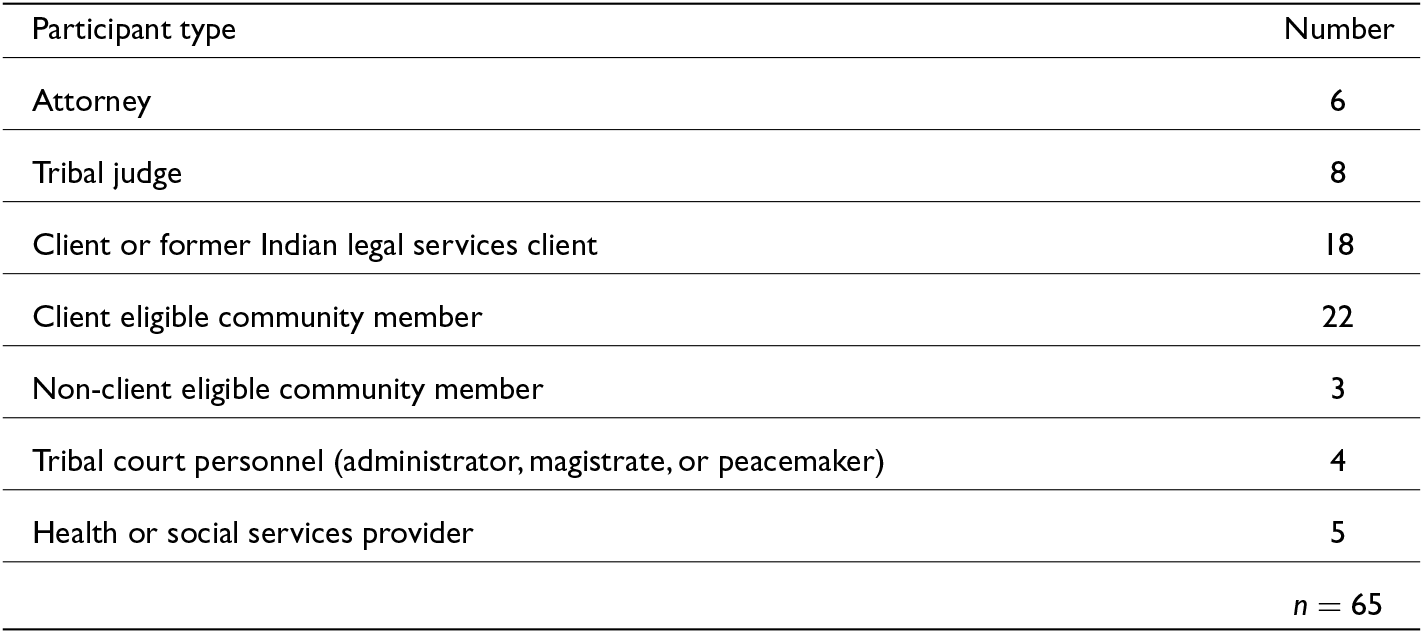
The client community includes client-eligible individuals and their relatives, tribal judges, magistrates, and administrators, social services workers, and attorneys. I gained access to the client community through my association with the Indian legal services organization. I have volunteered with them as a board member since 2021. They arranged interviews with their attorneys, former clients, and client-eligible community members, who met me at the Indian legal services office. To address the potential selection bias in relying on the Indian legal services office for participants, I reached out to tribal lawyers, tribal judges, social services workers, and additional community members to supplement these interviews with a broader range of participants (McMillan Reference McMillian2011; Miller Reference Miller2001).Footnote 3 Table 1 displays the range of participants interviewed. My goal was not a representative sample but a cross-section of individuals in the client community, who varied in their legal education, socioeconomic status, tribal status, family histories, gender, age, and personal experiences with federal, state, and tribal justice systems.Footnote 4 A limitation of this approach is that the findings are instructive rather than generalizable.
Descriptive statistics on interview participants in raw numbers

Table 1 Long description
Counts of interview participants are listed by participant type, with a total sample size of 65. The largest groups were client eligible community members (22) and clients or former Indian legal services clients (18). Smaller groups included tribal judges (8), attorneys (6), health or social services providers (5), and tribal court personnel such as administrators, magistrates, or peacemakers (4). Non-client eligible community members were the smallest group (3). Categories are presented as single assignments even though many participants fit more than one role, so the counts should not be interpreted as mutually exclusive in real life.
Note: Participants were assigned only one category, but many fell into more than one category. For example, all the tribal judges were also lawyers and almost all the tribal court personnel and health or social services providers were community members. Thirty-one participants spoke about their personal experiences as clients with lawyers, including the 18 current or former Indian legal services clients.
I chose interviewing because it aligns well with Anishinaabek epistomologies (Simpson Reference Simpson2008, Reference Simpson2011). I wanted my research methods to show respect for and facilitate working with the community “in a good way” (Kovach Reference Kovach2021, 35). Interviews reflect traditional Anishinaabek worldviews, which are relational, or centered on a respect for all living beings as interrelated (Benton-Banai Reference Benton-Banai1988; Simpson Reference Simpson2008; Stark Reference Stark2021). They generate knowledge through the relationship between the interviewer and interviewee. This aligns with Anishinaabek knowledge creation, which perceives knowledge as intimate and interpretive, meaning that “individuals have the responsibility for generating meaning in their lives” through the way that they think and live (Simpson Reference Simpson2011, 43). The interviews allowed me to discover and respect (rather than judge) each individual’s perspective or interpretation (Simpson Reference Simpson2016).
I used a conversational, semi-structured, open-ended format preferred by many Native scholars in the interviews (Kovach Reference Kovach2021) and well-suited to Native communities (Ibid.; Deloria Reference Deloria1999). Interviews ranged in duration from 45 minutes to 3 hours. My intent was to hear Anishinaabek, as they told their stories and give them control over what they wanted to share. I asked all participants to speak from their first-hand experiences with lawyers. I encouraged participants to talk freely. I actively listened to the emphasis that individuals placed on elements of their own stories and felt the emotions they held about their experiences with various lawyers and justice systems. I asked them for clarification in identifying key insights about their experiences but did not press them if they shifted the direction of the conversation or expressed discomfort with a line of questioning. My personal experiences as a lawyer and the mother of Anishinaabek tribal citizens allowed me to connect with participants in an empathetic and understanding manner.
The interviews included discussions about the participant’s background (e.g., where they live, relationship with the community, family, etc.) and the experiences that they or their family have had with the law, lawyers, or legal systems. I asked them to describe and elaborate on experiences with lawyers and justice systems, including the justice or fairness of their experiences. Participants were asked to clarify the kinds of lawyers they worked with (e.g., court-appointed, legal aid, for hire), the legal issues they faced (e.g., criminal, child welfare, housing), and the justice systems (tribal, state, federal) in which the experiences occurred. This allowed for comparisons across kinds of lawyers, legal issues, and jurisdictions.
Following data collection, I imported the transcripts of the interviews into Atlas.ti for analysis. The analysis here emerges primarily from the interviews with the 31 participants, who shared their direct personal experiences with attorneys representing them. Consistent with Anishinaabek epistemologies, I used an interpretative approach to analyze the interviews (Simpson Reference Simpson2011, Reference Simpson2016). An interpretive approach helped me to develop a deeper understanding of the participants’ experiences with and perceptions of attorneys, justice, and the various justice systems (Kovach Reference Kovach2021). I compared the experiences individuals had with different kinds of attorneys within and across justice systems, how those experiences varied by justiciable issue, and how they informed the individual’s perceptions of attorneys and reactions to the justice system (Yanow Reference Yanow2000). I used a reflexive and iterative process.Footnote 5 I read the transcripts closely to identify recurrent themes, then used the themes to code the interviews and to develop theories from the data (Birks and Mills Reference Birks and Mills2015). This process allowed me to reflect critically about what I was finding and check my assumptions about the data as I theorized about legal representation and access to justice.
My personal lens shapes my interpretation of the data. As the mother of Anishinaabek tribal citizens, I bring familiarity with these communities, including their histories, language and traditions. As a lawyer practicing federal Indian law, I have observed the challenges faced by tribal governments, Native communities and individual Natives and how settler colonialism has imposed Anglo-American justice and justice systems on Native communities. Following Anishinaabek protocols, the perspectives in this article are my own interpretations of the stories shared with me (Simpson Reference Simpson2008).
Participants varied in their legal education, socioeconomic status, tribal status, family histories, gender, age, religion, cultural connectedness, and personal experiences with federal, state, and tribal justice systems.Footnote 6 Just over half, 60 percent, were women. The participants ranged in age from their early 20s to their 70s. The majority, 72 percent, lived on or near tribal lands in the northern part of the lower peninsula of Michigan but many had lived in various tribal communities throughout the state. Sixty-eight percent were citizens of or descended from tribes within Michigan.Footnote 7
Thirty-one participants, all Anishinaabek, shared direct experiences with lawyers representing them, usually due to criminal charges, child welfare investigations or both. Some were repeat players, having gained tremendous experiences with lawyers and justice systems as they navigated criminal charges, child welfare services, and housing insecurity throughout their lives (Interview, litigant, July 20, 2023; Interview, litigant, July 15, 2024). The majority, 87 percent, worked in low income jobs or received disability benefits. A few were or had experienced homelessness (Interview, litigant, July 20, 2023; Interview, litigant, December 6, 2023). Almost every participant had experienced intergenerational or historical trauma, including attendance at a Native boarding school, removal from their family of origin, housing insecurity, substance use or interpersonal violence.
Anishinaabek access to and experiences with legal representation
For the legal community, representation has value because lawyers provide clients with just results based on their legal expertise (Sandefur Reference Sandefur2015) or contribute to justice by treating their clients with respect and increasing faith in the justice system (Felstiner Reference Felstiner2001; statz et al. Reference Statz, Friday and Bredeson2021). My research shows that Anishinaabek value attorneys that engage in caretaking even when they do not experience justice in the legal system. The Native concept of caretaking refers to developing reciprocal relationships based on human connection, respect, and a mutual sense of being in a difficult situation together. It reflects the importance of relationships to Anishinaabek culture and law. Caretaking emerges as essential to how lawyers help their clients navigate confusing legal processes during difficult times in their lives even if they cannot ensure a just result.
The first part of this analysis illustrates the reasons why Natives seek legal representation. Next the analysis explores how the Anishinaabek community values legal services based on the caretaking relationships they develop with individual lawyers. Then it demonstrates how Anishinaabek use caretaking to differentiate among lawyers in evaluating the quality of the representation provided by them. Finally, the analysis considers clients’ experiences with caretaking and justice as they move through the legal system. It shows how Anishinaabek use caretaking to distinguish their lawyers from and value them in spite of perceptions that they operate in an unjust legal system.
I got in trouble so I need a lawyer
People hire lawyers to represent them in divorces, accidents, contract disputes, employment problems and more. Yet few Anishinaabek in the study were active court users, seeking legal representation because they felt entitled to use the law and courts to their benefit (Ewick and Sibley Reference Ewick and Sibley1998; Merry Reference Merry1990).Footnote 8 Instead, many did not enter the justice system by choice. The law disrupted their lives, and they found themselves in a tribal, state or federal court. Similar to other disadvantaged minorities, they “got in trouble” (Hernandez Reference Hernandez2010, 106). Their trouble served as an entryway into the justice system (Interview, litigant, December 6, 2023). The use of alcohol or drugs often contributed to this “trouble” – usually either a criminal charge, a child protective services investigation, or both. Social needs or problems, rather than a legal dispute with a private party, pushed them into a court or administrative process as the government intervened in their lives based on some behavior it deemed necessary to regulate (Hostiska Reference Hosticka1979). Some had long histories of state intervention in their lives, having experienced removal from their family as a child (either to boarding school or a foster home) (Interview, litigant, July 23, 2023; Interview, litigant, December 6, 2023). Others felt like they ended up in the justice system because they could not get help when they sought it from social services (Interview, litigant, December 8, 2023; Interview, litigant, July 20, 2023).
Some Anishinaabek received court-appointed attorneys in criminal or parental termination cases. State, federal and tribal courts appoint counsel to indigent defendants in criminal cases.Footnote 9 Despite this, some participants confided that they ended up with criminal convictions because they did not ask for a lawyer and immediately confessed when confronted by law enforcement (Interview, litigant, June 26, 2024; Interview, litigant, December 5, 2023). A few opted against using court-appointed attorneys. They either contacted Indian legal services for representation or hired a lawyer, usually when they sought to avoid a felony conviction (Interview, litigant, December 8, 2023; Interview, litigant, December 6, 2023).
Some tribal and all state courts in Michigan also appoint lawyers to parents facing a termination of their parental rights. Some tribal courts use Indian legal services lawyers as well as local attorneys in termination cases (Interview, tribal court administrator, July 21, 2023; Interview, tribal court administrator, March 12, 2024). Tribal governments also refer their citizens to the Indian legal services program in termination, eviction and other legal matters. Some participants knew to call the local Indian legal services program when they got in trouble because they had friends or relatives that had used them (Interview, litigant, December 6, 2023; Interview, litigant, July 20, 2023).
Representation as caretaking
In the U.S. legal system, lawyers are often valued for their legal expertise, which leads to better outcomes for their clients (Poppe and Rachlinski Reference Poppe and Rachlinski2016; Shanahan et al. Reference Shanahan, Carpenter and Mark2016; Sandefur Reference Sandefur2015). Yet Anishinaabek did not emphasize outcomes or legal expertise in their explanations of what they valued in a lawyer. Early on in my interviews, a litigant, who had experiences with several different lawyers, stressed the importance of “being treated like you want to be treated” (Interview, litigant, July 19, 2023). This attention to how lawyers interact with their clients reflects traditional Anishinaabek worldviews and laws.
Anishinaabek “exist as a part of creation” and the essence of this existence is to live in harmony with all creation (Stark Reference Stark2021, 303). For Anishinaabek, the act of relating is reciprocal and mutually shared by all involved (Stark Reference Stark2021; Simpson Reference Simpson2014). Anishinaabek elder Onaybinisay (James Dumont) explains, “Respect is understood as an honoring of the harmonious interconnectedness of all life which is a relationship that is reciprocal and interpersonal” (Dumont Reference Dumontn.d., 37). Anishinaabek extended this relational view of the world to their evaluations of their experiences with lawyers.
Anishinaabek identified reciprocal relationships based on humility, respect and honesty as central to successful legal representation. I use the Native concept of caretaking, or paying close attention to relationships in the present and over time, in describing these relationships (TallBear Reference TallBear2019). Caretaking attorneys adopt a client-centered approach to lawyering in that they facilitate relationships with clients to ensure that they feel heard, supported, and empowered (Kruse Reference Kruse2006). On an individual level, caretaking builds on the physical copresence of being there (Crooke Reference Crooke2024; Reuter et al. Reference Reuter, Rosenbaum and Duryea2019) and involves a person’s willingness to connect with another as a human and to respond to their needs in a way that makes them feel seen and valued (Gerdy Reference Gerdy2008). An Anishinaabe woman described caretaking as involving the lawyer being “emotional[ly], physically, and mentally supportive of what’s going on in [their] life” (Interview, litigant, July 19, 2023). At its core, caretaking includes a sense of reciprocity or mutuality of being in something together. This togetherness extends beyond the individual because interconnectedness means that what happens to an individual affects their family and community (Simpson Reference Simpson2014). Caretaking, thus, augments and enhances client-centered lawyering because it includes connecting with and respecting the community as well as the individual client. Ideally, caretaking “mitigates the alienation” of the legal process (Crooke Reference Crooke2024, 286).
Evidence of the importance of caretaking to Anishinaabek evaluations of their lawyers emerged in the emphasis they placed on the relationships they developed with lawyers. They valued lawyers to the extent to which they felt that the lawyer made them feel like someone cared for them and wanted to help them through a difficult time in their life. Like clients in employment, personal injury, sexual violence and divorce cases, Anishinaabek appreciated lawyers that connected with them emotionally (Elbers et al. Reference Elbers, van Wees, Akkermans, Cuijpers and Bruinvels2012; Ellen et al. Reference Ellen, Nelson and Nielsen2017; Nathalie et al. Reference Nathalie, Feldthusen and Hankivsky1998; Sarat Reference Sarat1991). Anishinaabek litigants identified and valued court-appointed, legal services and hired attorneys that engaged in caretaking relationships with them (Interview, litigant, July 15, 2024; Interview, litigant, December 6, 2023; Interview, litigant, December 8, 2023). As the following examples show, they often talked about the non-material benefits of the representation they received as well as the specific actions lawyers took that they felt demonstrated caretaking.
David, an elder who had attended an Indian boarding school and struggled with addiction, violence and homelessness throughout his life, identified the emotional, physical, and legal support he received as central to why he repeatedly sought legal assistance from lawyers at the local Indian legal services program, often in criminal matters. He explained, “Not to hope that you’re going to win or lose. It’s just a hope that somebody’s there for you. Knowing that means a lot” (Interview, litigant, July 20, 2023). He distinguished between the material benefit of getting the outcome desired from the psychosocial benefits of legal representation, which he felt were equally, if not more, important. He elaborated,
They helped me with understanding my legal issues, understanding what I was looking at. That support has been overwhelming. The people who work here will go out of their way for you. This building and the courthouse, they’ll get you a ride, they’ll try and help you. Listen to your problems and help you. … Basically for me, it was the relief of knowing that I wasn’t just going to be swept under because I’m poor, or I don’t have the means or support to afford a lawyer (Ibid.).
David valued his lawyer because they demonstrated their caretaking of him by offering overwhelming support, including picking him up for court – an act beyond the listening, investigating, and communicating previously identified as central to client-centered lawyering (Kruse Reference Kruse2006) and important to clients’ positive impressions of their lawyers (Boccaccini et al. Reference Boccaccini, Boothby and Brodsky2002; Campbell et al. Reference Campbell, Moore, Maier and Gaffney2015). David appreciated his lawyer for those qualities but the respect and support that they offered him assured him that they were on his side even though he was skeptical of the justice system more generally, which he feared would sweep him under because he was poor.
Other Anishinaabek reiterated the importance of having a lawyer invested in them and their families. Esther praised her Indian legal services attorney even though she had her parental rights terminated because of the tremendous support he provided her. She recalled, “he’d bring up like I said, positives about me when I didn’t see the positive in me” (Interview, litigant, July 21, 2023). She continued, “I just remember them [social services] just making me look like the [most] awful parent ever. Just degrading you and just feel like you’re just the worst parent. I can remember with him that, like I said, just bringing up the positives” (Ibid.). Esther’s lawyer later hired her to do office work. She served as a valuable link to the community and the job helped her to maintain her sobriety. Years later, she returned to the lawyer to obtain a guardianship of her grandchild. Esther’s experience demonstrates the reciprocity and long-term commitment that caretaking lawyers incorporate into attorney–client relationships.
Jason, a former client in his sixties, also emphasized how his Indian legal services lawyer developed a long-standing relationship with him and his family over time. He recalled seeking assistance from an Indian legal services lawyer because they had represented and supported his family in the past (Interview, litigant, December 6, 2023). An Indian legal services attorney had helped him with criminal issues, most recently his ongoing efforts to get his driver’s license reinstated. He explained the relationship he had developed with the lawyer,
They have helped me with legal issues that I’ve been – how do you say this? For the lack of a better term, I have a mentality of a child. Things had to be repeated to me simpler and simpler and simpler until I get it. Working with [Indian legal services] I have built a relationship that they know who I am and my capacity of what I can or cannot do (Ibid.).
In Jason’s view, the Indian legal services attorney engaged in caretaking by recognizing his mental challenges and tailoring their interactions to accommodate them. Jason observed how the attunement of the lawyer to his needs helped facilitate a successful relationship between them.
Riley, a young mother with several children, described the caretaking she received from her Indian legal services lawyer in a child protective services (CPS) case as involving tremendous emotional, legal and other support. CPS opened a case against her after her youngest child lost consciousness and was rushed to the hospital. She called the Indian legal services program when she realized that CPS wanted to place her kids in foster care. Her lawyer guided her through the CPS investigation, which lasted over eighteen months. “[The lawyer] just helped me through every single way, with parenting classes, the counseling. She helped me shut down the case,” she said (Interview, litigant, December 4, 2023). The caretaking Riley experienced included the innovative solution her Indian legal services lawyer devised to her legal problem. Her lawyer recommended a lie detector test, which confirmed that Riley was telling the truth about finding her child unconscious and ended the investigation.
The lawyer’s caretaking went beyond this legal innovation as Riley emphasized the emotional support she received. She explained, “[The lawyer] made me feel really good about everything. She explained everything to me that needed to be explained or if I didn’t understand, she would explain it to me where I would understand. I was able to call and text her about anything that was changed (Ibid.).” The attorney comforted Riley, easing her burden and making sure that Riley “didn’t really have to worry when we went into court because [she] already knew what was going to be said or what was going to happen (Ibid.).” Riley expressed tremendous appreciation for the lawyer, who believed in her from the start, sharing, “I got my kids back and I just remember giving her a hug. She told me ‘See, I told you, I knew you could do it (Ibid.).’”
David, Esther, Jason, and Riley valued lawyers, who they felt went above and beyond to support them and their families. These lawyers invested in their clients over time, believing in them even when faced with a justice system that discounted their experiences and judged them based on misperceptions and stereotypes (Lopez-Espino Reference Lopez-Espino2024a, Reference Lopez-Espino2024b). Their stories illuminate aspects of the caretaking they appreciated, including a lawyer’s belief in the client, an ability to see and respect the client’s concerns and limits, the capacity to use their legal expertise innovatively, a long-term commitment to the relationship and community, and a willingness to witness and affirm the client’s experience as real and collaborate with the client to get through it. They connected emotionally with their lawyers, felt completely supported by them, and viewed their lawyers as aligned with them rather as part of the justice system.
Anishinaabek experienced their lawyers taking actions on their behalf that went beyond what client-centered lawyers normally do in terms of listening to, believing in, and communicating effectively with the client (Kruse Reference Kruse2006). For David, it was a ride to the courthouse so he did not have to worry about whether he would be late due to an extensive bus route with multiple, often unreliable, connections. For Esther, it was her lawyer always seeing the positives in her as she struggled with alcoholism. For Jason, it was developing a long-term relationship with him and his family.
Another indicator of the importance of caretaking to Anishinaabek emerges in their use of familial terms in talking about their relationships with lawyers (Interview, litigant, July 19, 2023). Anishinaabek use familial terms to relate to others and refer to extended relations or even people that they have an intimate, if not blood relation to, as relatives (Stark Reference Stark2021). This Native practice is often referred to as kinmaking or “making people into familiars in order to relate” (TallBear Reference TallBear2019, 37). My interview with Amy documents how she engaged in this practice with her Indian legal services lawyer. Amy talked at length about the lawyer who represented her in a parental termination case (Interview, litigant, July 19, 2023). Amy lost the case but referred to her attorney as like a sister to her. She explained, “Family doesn’t require blood. Family is for being there no matter what” (Ibid). Amy identified her Indian legal services attorney as kin because her attorney made her feel valued, cared for, and respected as a person. Their relationship extended beyond a single instance of representation as Amy returned to her legal services lawyer for help with other issues. In contrast, Amy recalled liking another lawyer who successfully defended her in a criminal case but did not refer to him as her kin or develop a long-term relationship with him.
The daughter of another former client also engaged in kinmaking by referring to her mother’s former Indian legal services attorney as her second mother years after the attorney had helped the young woman when her mother went to jail (Interview, litigant, July 20, 2023). Other former clients explained that what they appreciated most about Indian legal services lawyers was that they treated them “like family” (Interview, litigant, July 19, 2023).
Further evidence of how caretaking lawyers build relationships with their clients and the community emerged in the stories Anishinaabek told about the long-term relationships that they developed with attorneys. Some explained that they sought representation from an Indian legal services lawyer because they had taken care of other members of their family (Interview, litigant, December 6, 2023; Interview, litigant, July 20, 2023; Interview, litigant, December 4, 2023). They shared stories about how Indian legal services lawyers had helped members of their families over several generations. Others referred family members and low income Natives with legal problems to lawyers based on their positive experiences (Interview, litigant, July 20, 2023; Interview, litigant, July 21, 2023).
Community members often confirmed this perception of caretaking as important to Native litigants (Interview, tribal judge, January 17, 2024; Interview, tribal judge, January 31, 2024). Speaking based on her observations of and experiences with attorneys within her court room, one tribal judge explained,
Anishinaabe people have to have a relationship in order to build trust. If you really want to know them and want them to open up and to hear how they really feel in terms of getting to an issue, they have to trust you. They have to have some relationship (Interview, tribal judge, July 17, 2023).
She used Indian legal services lawyers to show how she perceived lawyers as developing relationships within the community, stating,
When [the Indian legal services program] is out there providing that kind of service, it’s showing the community that, oh, they’re more than just representing or they have, like what we talked about, a vested interest because tribal people know certain people come work for the tribe, but they never see them in the community… .
The community can see they’re [Indian legal services is] vested in their community. They care about the community, and that means a lot. Then they know that they can go to [the Indian legal services program] to ask questions or if they need representation and that they understand who they are (Ibid.).
The judge emphasized how Indian legal services lawyers did not merely provide representation but interacted in the community to foster relationships beyond their individual clients. They have hired community members, held office hours at tribal government offices, and offered free legal education programs at tribal community centers. Some regularly attended community events, including pow wows, language camps, and funerals. These interactions signaled to the community that they were not just there to benefit from the community, but to contribute to and participate in it. The development of mutually benefiting relationships with the community diminished the social, cultural and economic differences that sometimes exist between attorneys and the communities they serve (Getches Reference Getches1972). Further, connecting with the community showed clients that Indian legal services attorneys are part of the community, not aligned with an outside system. As another tribal judge observed, a commitment to the community “makes for better client relationships” (Interview, tribal judge, July 18, 2023).
In contrast, and contrary to the conventional legal wisdom (Ellen et al. Reference Ellen, O’Regan, House and Brenner2021; Monsma and Lempert Reference Monsma and Lempert1992; Poppe and Rachlinski Reference Poppe and Rachlinski2016), clients were less likely to identify material outcomes as central to their evaluations of their experiences with their lawyers or to feel like they experienced justice through the system. Like plaintiffs in employment discrimination cases, they struggled to define outcomes as wins or losses (Berrey, Nelson and Nielson Reference Ellen, Nelson and Nielsen2017). Some mentioned how lawyers kept their families together, prevented them from going to jail, or helped them meet their most basic needs, including food, shelter, clothing and counseling, during a time of crisis (Interview, litigant, July 21, 2023; Interview, litigant, July 20, 2023; Interview, litigant, July 19, 2023). These tangible outcomes, however, were often not the focus of their reflections on their experiences with their lawyers.
Anishinaabek often expressed ambivalence about outcomes and the role, if any, that lawyers played in facilitating positive or negative outcomes in their cases. Some seemed more appreciative of their lawyer if they prevailed in their case. A few hypothesized that hiring a lawyer had increased their likelihood of beating a criminal charge, but most that did questioned the outcome because often hired lawyers garnished their per capita payments, leaving them impoverished or fighting the lawyer in court (Interview, litigant, December 8, 2023; Interview, litigant, July 16, 2024).
Often, Anishinaabek attributed negative outcomes to biases within the system or the actions of social workers, law enforcement or judges (Interview, litigant, December 7, 2023; Interview, litigant, December 8, 2023; Interview, litigant, July 15, 2024). Some identified the legal system as about money with only the rich prevailing (Interview, litigant, December 8, 2023; Interview, litigant, December 6, 2023) while others felt that race, poverty or reputation influenced their treatment in court (Interview, litigant, December 6, 2023; Interview, litigant, December 7, 2023). When I asked a former Indian legal services client how she felt about the justice system after the termination of her parental rights, she explained, “I was angry for a long time. Maybe I still am. I still don’t feel like there’s any justice at all in the system. It’s just the system. I don’t think there’s any justice no matter which way you come out” (Interview, litigant, July 16, 2024). This deep skepticism of the system may partially explain the lack of emphasis on case outcomes. Belief that the system, itself, is, at worst rigged, and at best, not designed for them, may have shaped Anishinaabek’s low expectations, both of tangible outcomes and of the system’s ability to provide just outcomes generally.
Caretaking as a way to differentiate among lawyers
Not all Anishinaabek loved their lawyer. Many complained about lawyers they had – whether court-appointed (Interview, litigant, July 16, 2024; Interview, litigant, July 15, 2024), hired (Interview, litigant, December 8, 2023; Interview, litigant, July 16, 2024), or legal services (Interview, litigant, December 8, 2023; Interview, litigant, December 6, 2023). Comparisons of how Anishinaabek talked about their relationships with the lawyers they liked and those they did not like provide further evidence of the value they placed on caretaking in attorney–client relationships. Anishinaabek differentiated among lawyers based on the quality of their relationships. They assessed the coerciveness of the relationship, the level of care offered by the attorney, and the perceived alignment of the lawyer with the justice system.
Similar to defendants in criminal cases (Campbell et al. Reference Campbell, Moore, Maier and Gaffney2015; Clair Reference Clair2021; Davidson et al. Reference Davidson, Ostrom and Kleiman2022), Anishinaabek viewed attorneys they perceived as engaged in coercion rather than caretaking as problematic. Perceived coercion by an attorney often emerged in criminal proceedings when a court-appointed attorney pushed their client to accept a plea. Paul, who had experiences with several lawyers and spent 35 years in prison for various alcohol-related offenses at different times in his life, described his coercive experiences with court-appointed attorneys as the lawyer “in there trying to make deals for you already to take a cop to this or take a cop to that so they go onto the next case” (Interview, litigant, July 15, 2024).Footnote 10 He reflected on how he went to prison even though he was innocent because the court-appointed lawyer “didn’t want to do that little extra job, that little extra work” to investigate and prove his innocence (Ibid.). Other participants also disparaged lawyers that compelled them to take pleas or suggested that if they did not do what the lawyer said they’d go “to jail for a longer time” (Interview, litigant, Dec. 6, 2023).
Sharon, a middle-aged woman, with a history of alcohol-related offenses, shared how her court-appointed attorney was pressuring her to accept a plea in a recent DUI case. She explained:
I have an open case now. My attorney does not seem to be pulling in his whatever. I haven’t heard from him. When I do hear from him, he’s right at the court, and it’s right before my hearing. I don’t know.
Interviewer: How do you feel about that?
Sharon: I don’t like it because it takes me a minute to absorb information. When they’re just throwing it at me when I’m standing in front of the judge, I don’t know what’s – We didn’t even talk about anything. I don’t even know what really is what, and then they’re telling me what plea I should take and I didn’t even have time to think (Interview, litigant, December 8, 2023).
Sharon complained about the lack of respect shown to her by her court-appointed attorney, who did not meet with her before court, would not explain her options to her, and refused to even give her time to process the little information she had about her legal situation. She elaborated, “He’s not telling me anything. He’s just saying, no, just go this, just take this plea because it’s all that you can do. No, it’s not all I can do. I know there is something else” (Ibid.).
Paul and Sharon’s experiences exemplify a reality that low income and marginalized clients often confront. Their experiences speak to the coercion that clients face in a justice system that silences the voices of the accused and other marginalized people (Campbell et al. Reference Campbell, Moore, Maier and Gaffney2015; Lopez-Espino Reference Lopez-Espino2024b; Riner and Vartkessian Reference Riner, Vartkessian, Avineri, Graham, Johnson, Riner and Rosa2018). This coercion experienced by litigants as perpetrated by attorneys exists in stark contrast to the respect and reciprocity central to Anishinaabek worldviews and the care many Anishinaabek identified as invaluable in their relationships with other attorneys.
Similar to other litigants (Campbell et al. Reference Campbell, Moore, Maier and Gaffney2015; Clair Reference Clair2021; Davidson et al. Reference Davidson, Ostrom and Kleiman2022), many Anishinaabek expressed dissatisfaction with attorneys that they felt did not do much for them as clients. Wenona’s experiences trying to encourage her court-appointed attorney to take action on her behalf in a domestic violence case documents the lack of caretaking she experienced and how it affected her relationship with her attorney (Interview, litigant, July 16, 2024). She contacted the attorney after tribal police responded to a noise complaint and she ended up in jail for what she identified as a miscommunication with her partner. She explained:
I called the attorney they assigned me, and when I called him, he asked me what my income was and what my job situation was, if I had any family that could post bond. He was trying to help me get out of jail. He’s asking me all these questions and I told him, “I have nothing.”
Then he goes, “I don’t know what you expect me to do for you.” That’s what he said… . I was like, “I want, instead of a $2,000 bond,” I was like, “Just flip it to a PR bond.” He stuttered on the phone like I wasn’t supposed to know what a PR bond was. He’s like, “Oh, well, I’ll try to submit that, but I don’t think it’ll go through,” he said. I said, “If it does or doesn’t, that’s my only option. I don’t have any money” (Ibid).
In her view, her attorney did not offer her any support or even suggest a well-known possible way to get her out of jail. Wenona had to propose a solution and then push her court-appointed attorney to do it.
Wenona’s exasperation with the lack of effort on the part of her attorney did not end there. She described a second encounter, in which she needed a no contact order lifted due to a medical emergency because she is her partner’s next of kin, stating:
I called the attorney and told him the situation and asked if he could do an emergency motion to have the no contact lifted per his health. He goes, “Oh, no, I don’t think they’re going to do that.” I said, “They have to. It’s his health and it’s in jeopardy. I’m his next of kin.”
He was hesitant. I really had to be forceful, I guess. About three hours later, they did hold an emergency hearing and they said I could have contact with him [the partner] while he’s in the hospital. The no contact was lifted for the time he was in the hospital (Ibid.).
From her perspective, Wenona had to give her attorney legal advice not once, but twice, to get him to engage in very basic advocacy on her behalf.
Other Anishinaabek disparaged experiences with lawyers based on behaviors that sounded antithetical to caretaking. They disliked lawyers that left them to defend themselves (Interview, litigant, December 8, 2023), lied to them about their options in a legal proceeding (Ibid.; Interview, litigant, December 8, 2023), refused to believe them (Interview, litigant, July 15, 2024), assumed they were guilty of the allegations against them (Ibid.), acted like they did not want to represent them (Ibid.), violated confidentiality (Interview, litigant, December 6, 2023), garnished their per capita payments (Ibid.) or failed to communicate with them (Interview, litigant, December 6, 2023).
Another contrast that Anishinaabek drew between attorneys had to do with the attorney’s relationship with the justice system. Similar to other marginalized clients (Clair Reference Clair2021; Davidson et al. Reference Davidson, Ostrom and Kleiman2022; Lopez-Espino Reference Lopez-Espino2024b; Sarat Reference Sarat1990), some Anishinaabek disliked their attorney because they perceived the attorney to be closely aligned with the justice system and not fully committed to representing them as a client. Paul’s experience in federal court with a court-appointed attorney illuminates this view. He expressed utter disbelief when he shared that after his court appearance, his court-appointed attorney went over, shook the prosecutor’s hand, and they walked out together (Interview, litigant, July 15, 2024). His experience seemed to confirm his intuition that the court-appointed attorney valued his relationship with the other attorneys and his own status within the justice system more than his relationship with his client.
Paul, Sharon and Wenona’s stories illustrate how Anishinaabek differentiated their experiences with attorneys based on whether they formed caretaking relationships with them. Anishinaabek expressed much more satisfaction with lawyers, who built intimate, long-standing relationships with them based on human connection, respect, and a mutual sense of being together in a difficult situation. In contrast, their disappointment in other lawyers stemmed from their sense that they did not see, respect or listen to the client but judged them based on their past mistakes and thus, failed to advocate on their behalf. They identified alignment with the justice system as another source of dissatisfaction because they felt the lawyer privileged their own status and position within the system above their client’s interests.
Dissatisfaction of another kind: access issues
Aside from the quality of representation offered by lawyers to their clients, Anishinaabek, even those satisfied with their attorneys, often complained about the lack of access to legal services. Some, who had not had representation, mentioned that they did not realize that they could or should have had a lawyer (Interview, community member, July 21, 2023; Interview, litigant, June 24, 2024). Others lamented that they could not afford to hire a lawyer, relegating them to court-appointed attorneys uninterested in representing them (Interview, litigant, December 6, 2023; Interview, litigant, July 15, 2024; Interview, litigant, July 16, 2024). Still others saw the Indian legal services program as providing quality legal services to Natives who would not otherwise have any legal representation (Interview, litigant, July 20, 2023). Yet they emphasized the limited legal services that the Indian legal services organization could provide. Some wanted Indian legal services lawyers to do more for them in a specific case, such as offer full representation rather than only give them advice and counsel on how to represent themselves (Interview, litigant, December 8, 2023; Interview, litigant, July 20, 2023). For example, one former client had reached out to Indian legal services while in prison due to concerns about state prisons inhibiting the free exercise of traditional religious practices and was disappointed that the attorney could only provide advice because of LSC restrictions on representing incarcerated persons (Interview, litigant, December 8, 2023). Others indicated that there were not enough lawyers because the Indian legal services program could not take every case. They talked about how they had come to the legal services office only to find that they could not represent them (Interview, litigant, December 6, 2023; Interview, litigant, December 8, 2023). Some knew that the Indian legal services office only took specific kinds of cases and could only represent low income Natives (Interview, litigant, July 20, 2023; Interview, litigant, July 19, 2023). That knowledge, however, rarely ameliorated their disappointment or frustration with the limits placed on Indian legal services or the lack of access to representation more generally.
Anishinaabek seemed to know that they could not entirely avoid the justice system, but they wanted more assistance navigating the various courts and governmental agencies they encountered. Their experiences confirm the reality at the heart of the access to justice crisis, namely that people need more legal services than they can access (LSC 2022; Sandefur Reference Sandefur2016).
Linking representation to justice: caretaking lawyers in an unjust system
Conventional views of procedural justice posit that dignified treatment by a lawyer improves both client satisfaction and a client’s perceptions of the justice system (Statz et al. Reference Statz, Friday and Bredeson2021; Zimerman and Tyler Reference Zimerman and Tyler2010). Yet Anishinaabek experiences with caretaking lawyers demonstrate the limits of these promises of procedural justice, which are premised on the idea that lawyers serve their clients by aligning with the system and enhancing their client’s belief in it.
Often a positive experience with a lawyer did not translate into a sense that the client had received justice in their case or improve the client’s general outlook on the justice system. Many Anishinaabek expressed low expectations of justice systems that were not designed for them and had been frequently used against Natives in the past. Several bluntly told me that they did not trust the justice system (Interview, litigant, December 6, 2023; Interview, litigant, July 15, 2024; Interview, litigant, December 6, 2023; Interview, litigant, December 8, 2023; Interview, litigant, July 16, 2024). As one elder observed of the Anishinaabek community more generally, “We don’t believe it’s justice for us at all… . We feel like if we get in the system, then we’ll stay in the system. They don’t let us out” (Interview, elder, December 7, 2023). Negative perceptions of the justice system informed Anishinaabek expectations (if not their evaluations) of their lawyers. Many seemed aware of the constraints lawyers faced in the system and realized that lawyers could not always overcome systemic injustice or transform a seemingly unjust legal system into a just one (Interview, litigant, December 7, 2023; Interview, litigant, December 8, 2023). Yet they valued their lawyers when they did their best to take care of them as together they navigated confusing legal processes during difficult times in their lives.
Jennifer’s story demonstrates how clients could condemn a legal system as unjust and simultaneously value a lawyer that cared about them. The tribal government terminated her parental rights to her children about a decade ago, when the children were in middle and high school. She recounted a heart-wrenching tale about how she repeatedly met every requirement to get her kids back only to go to tribal court and have CPS and the court add more requirements (Interview, litigant, December 8, 2023). Her case dragged on for over two years until completely worn out by what seemed like an impossible system,Footnote 11 she finally gave up. In her words, the system “was just so unfair” (Ibid.).
Yet when I asked her about her Indian legal services lawyer, she told me about the caretaking she had received and the difference it made for her:
There’s even times when she could see that I was giving up, She would call me and she would encourage me to come to some date, some of our appointments. She would tell me, “Well, [name redacted], even though they’re going to get guardianship of your kids, still doesn’t make – You’ll always be their mother.” She would always try to make things better for me.
She continued,
[The attorney], she was good. She was really good. She tried, she, like I said, she went to battle with me. She was right by my side. I never once felt like she didn’t do her job, because she tried to, she did voice for me when it was time for her to say what she needed to say (Ibid.).
Jennifer’s heartfelt account of her experiences illustrates how Anishinaabek praised their lawyers even when they lost their cases because they felt grateful for the caretaking that the lawyer provided them through a difficult time in their lives. They appreciated the legal and emotional support they received, especially when they felt that courts, police and social workers did not hear much less respect them.
Trapped in adversarial systems imposed on their communities and inadequate to address pressing social problems (Shanahan et al. Reference Shanahan, Steinberg, Mark and Carpenter2022), Anishinaabek did not feel like they received procedural due process or had an opportunity to tell their stories to a decision-maker that listened to them. Like other marginalized litigants (Lopez-Espino Reference Lopez-Espino2024a, Reference Lopez-Espino2024b), few thought that the judge heard them. Many found courts scary. A positive experience with a lawyer did not change these views. The system remained foreign and unfair. Despite the promises of procedural justice, even the best caretaking could not mitigate the alienation of the legal process for low income, marginalized clients caught in a justice system imposed on them. Even with a lawyer, they could not alter the justice system in which they found themselves.
Yet Anishinaabek distinguished some lawyers from the crushing system within which they worked and from other lawyers that they felt privileged their place in the system above their clients. The lawyer’s relationship with the client, their caretaking, differentiated them. This differentiation among lawyers enabled Anishinaabek to decouple their experiences with their lawyers from their experiences with the system. As a result, Anishinaabek could and did express profound appreciation for the legal representation they received even if they lost their cases and doubted the justice system’s ability to provide justice. They identified the intangible, psychosocial benefits of legal representation (Selbin et al. Reference Selbin2012) and expressed tremendous gratitude for the caretaking their lawyers provided to them (Interview, litigant, July 20, 2023).
Anishinaabek experiences speak to clients’ awareness of the limits of the system as well as the constrained role that attorneys play within it. Like defendants in public defender studies, they separated the institution from the actors operating within it and evaluated them separately (Pruss et al. Reference Pruss, Sandys and Walsh2022). This differentiation between lawyers and the justice system indicates the value that caretaking has to clients even when they find themselves in a legal system they perceive as unjust and not designed for them.
Conclusion
This article enriches conventional legal narratives about how lawyers promote justice for their clients by illuminating the value Anishinaabek communities place on legal representation based on the caretaking abilities of the lawyer. Anishinaabek litigants and community members appreciated lawyers, who created caretaking relationships with them based on human connection, respect, and a mutual sense of being together in a difficult situation. Although the legal community often equates access to justice with legal representation, this study affirms that marginalized communities may not experience justice even when they appreciate their legal representation. It cautions against conflating legal representation with justice because it may oversimplify marginalized peoples’ experiences both with lawyers and justice systems. This conflation overlooks clients’ abilities to differentiate between the system and the actors operating within it and to evaluate them separately. In doing so, it obscures the non-material value of lawyers as caretakers, providing their clients with important psychosocial benefits. As this article shows, solutions to the access to justice crisis must integrate client perspectives and extend beyond calls for more legal representation to systemic reforms of the power inequities inherent in existing systems.
This study contributes to multiple theoretical conversations about how law relates to justice. First, it enriches sociolegal research on how clients contribute to the construction of attorney–client relationships (Mather Reference Mather2003). Its empirical insights confirm prior findings that clients do not evaluate or determine the value of legal representation in the same way as lawyers (Ellen et al. Reference Ellen, Nelson and Nielsen2017; Sarat Reference Sarat1991). The study demonstrates the importance of relational dynamics to client evaluations of legal services and how culture affects those dynamics. Importantly, it affirms and illuminates an overlooked aspect of attorney–client relationships by showing how clients emphasize caretaking, which requires lawyers to be present, believe in their clients, and connect with them emotionally. Despite an increasing awareness of empathy as an important lawyering skill (Gerdy Reference Gerdy2008; Reuter et al. Reference Reuter, Rosenbaum and Duryea2019), attorneys have historically excluded it from their views of legal professionalism and sometimes even resisted emotional connection with their clients (Ellen et al. Reference Ellen, Nelson and Nielsen2017; Lynn et al. Reference Lynn, McEwen and Maiman2001; Sarat Reference Sarat1991). By contemplating how caretaking affects client evaluations of legal representation, this research enhances empirical understandings of how client communities value human connection in their constructions of attorney–client relations and evaluations of legal representation.
Second, the study intervenes in ongoing debates about the relationship between access to counsel and access to justice (Rhode Reference Rhode2003; Sandefur Reference Sandefur2019; Shanahan et al. Reference Shanahan, Carpenter and Mark2016). It deepens empirical understandings of how clients define just experiences by adding richness and nuance to theories about how lawyers facilitate just experiences when they treat their clients with dignity (Felstiner Reference Felstiner2001; Statz et al. Reference Statz, Friday and Bredeson2021). This article places its findings about the importance of caretaking in dialogue with conventional views about procedural justice, which argue that lawyers can increase just experiences by hearing and listening to their clients (Statz et al. Reference Statz, Friday and Bredeson2021; Zimerman and Tyler Reference Zimerman and Tyler2010). Contrary to these views, Anishnaabek valued the tremendous legal and emotional support provided by caretaking lawyers, which helped them cope with systemic injustices, but they did not report experiencing the justice promised by procedural justice. Rather, they felt the unfairness of justice systems that reinforce social, racial, and economic disparities through law. The case of legal services delivery in the Michigan Native community thus contains lessons about the limits lawyers face as well as the potential disconnect between procedural justice’s promises and clients’ experiences of injustice in legal systems that subordinate them.
Third, the study contributes to important policy discussions about how to provide access to justice at a moment when the value of legal services as a public good is under threat. The importance of caretaking observed here confirms that people-centered approaches may lead to more informed and innovative access to justice solutions (MacDonald Reference MacDonald2021; Sandefur, Burnett, and Drummond Reference Sandefur, Burnett and Drummond2023). In particular, it emphasizes the non-tangible benefits of legal representation experienced by clients. It affirms that access to justice solutions that overlook clients’ preferences for personal connection may fall short (Rhode et al. Reference Rhode, Eaton and Porto2018; Statz et al. Reference Statz, Friday and Bredeson2021). Technological substitutes that replace human connection and interaction, such as legal help websites and AI-generated forms, may undercut individual’s justice experiences and offer false hope in resolving the access to justice crisis.
As an examination of legal services delivery in a Native community, this study is instructive rather than generalizable. It has not attempted a representative sample but presented a cross-section of experiences among low income Anishinaabek litigants in criminal and parental termination of rights cases to provide insights into how marginalized people socially construct their experiences with representation and justice. This approach has limits, and thus, leaves open important questions for future research. Existing studies indicate that marginalized communities in other spaces face similar challenges accessing and experiencing representation and justice (Clair Reference Clair2021; Gleeson Reference Gleeson2021; Lopez-Espino Reference Lopez-Espino2024a, Reference Lopez-Espino2024b; Sarat Reference Sarat1990). Thus, future research should assess whether and how client experiences with legal services delivery and justice explored here extend more generally to other Native and non-Native communities. In particular, the links identified among culture, law, and justice as experienced by clients deserve further investigation, especially as they may indicate or explain differences in marginalized groups’ experiences with representation and justice (Greene Reference Greene2016; Hernandez Reference Hernandez2010). Relatedly, this article inadequately accounts for differences in experiences across tribal, state and federal justice systems and kinds of justice fora (e.g., Healing-to-Wellness, adversarial, peacemaking), which can vary tremendously in their procedural and substantive law. Research producing a nuanced understanding of similarities and differences in client experiences with legal representation and justice across judicial systems and dispute resolution fora would augment its analysis. Moreover, this research has focused narrowly on direct representation in specific kinds of cases to the exclusion of other forms of legal assistance. Future research should examine client experiences and satisfaction with other kinds of lawyers (e.g., non-specialized legal services lawyers, pro bono, public defenders) and non-lawyers (e.g., lay advocates, community justice workers, peacemakers) providing assistance across a wide range of justiciable issues.
Supplementary material
The supplementary material for this article can be found at https://doi.org/10.1017/lsr.2025.10079.
Acknowledgements
I am extremely grateful to the Anishinaabek who shared their experiences with lawyers and the legal system with me. I also thank the LSR editors and anonymous reviewers for their active engagement with this article; Alyx Mark, Rebecca Sandefur, Michelle Statz, Nickole Nelson, Shannon Gleeson, Robert Law, Matthew Burnett, Chiara Galli, Claire Johnson Raba, Nylca Munoz, Neel Sukhatme and Maureen Waller for asking hard questions about and providing thought-provoking insights into this research; and my Cherokee, Creek, Choctaw and Anishnaabek relatives for inspiring my work. Previous versions of the article benefited greatly from valuable input at the 2023 International Access to Justice Conference and the University of Michigan Law School Legal Theory Workshop. The ABF/JPB Access to Justice Scholars Program and The Humanities Center at Wayne State University generously funded this research.
Conflict of interest
The author declares that she has no known competing financial interests or personal relationships that could have appeared to influence the research in this paper.