Between milkings the milk accumulates first in the alveolar tissue then in the cisternal compartment of the udder. After more than 10 h from the previous milking the milk in the cistern compartment amounts to <30% while most of the milk (>70%) is stored in the alveolar tissue of the udder. Only the cisternal milk is immediately available for milk removal (Knight et al. Reference Knight, Hirst and Dewhurst1994; Pfeilsticker et al. Reference Pfeilsticker, Bruckmaier and Blum1996; Ayadi et al. Reference Ayadi, Caja, Such, Rovai and Albanell2004; Belo et al. Reference Belo, Schlegel, Moll, Möstl and Bruckmaier2009) whereas the alveolar milk is only available for the milking machine after milk ejection which occurs in response to tactile teat stimulation and oxytocin (OT) release. The lag time from the start of stimulation until the onset of milk ejection usually lasts for 1–2 min (Bruckmaier et al. Reference Bruckmaier, Schams and Blum1994; Bruckmaier & Hilger, Reference Bruckmaier and Hilger2001). Timing of OT release and milk ejection before the start of milk removal is crucial for subsequent milking performance (Bruckmaier et al. Reference Bruckmaier, Macuhova and Meyer2001). Delayed milk ejection at the start of milking is indicated by transiently reduced or interrupted milk flow after removal of the cisternal milk (Bruckmaier & Blum, Reference Bruckmaier and Blum1996) or by a period of totally lacking milk flow at low udder filling if no cisternal milk is available before milk ejection commences (Bruckmaier & Hilger, Reference Bruckmaier and Hilger2001). Delayed milk ejection can have negative effects on milking efficiency causing a prolonged machine-on time (Bruckmaier & Blum, Reference Bruckmaier and Blum1996). Pre-milking teat stimulation, either manual or by the milking machine, causes induction of alveolar milk ejection before the start of milking (Bruckmaier & Blum, Reference Bruckmaier and Blum1998; Bruckmaier, Reference Bruckmaier2001).
Pre-stimulation before the start of milk removal induces an early release of OT and improves the milking characteristics during subsequent machine milking because milk ejection has already commenced when the withdrawal of milk starts (Rasmussen et al. Reference Rasmussen, Frimer and Galton1992; Bruckmaier et al. Reference Bruckmaier, Schams and Blum1994; Bruckmaier & Blum, Reference Bruckmaier and Blum1996; Weiss & Bruckmaier Reference Weiss and Bruckmaier2005; Tancin et al. Reference Tancin, Ipema, Hogewerf and Macuhova2006). A pre-stimulation for 30–60 s before milking has been recommended to ensure immediate and continuous milk flow after cluster attachment (Mayer et al. Reference Mayer, Worstorff, Schams and Klein1985; Rasmussen et al. Reference Rasmussen, Frimer, Horvath and Jensen1990, Reference Rasmussen, Frimer and Galton1992). It has been shown that the occurrence of milk ejection is mainly a matter of duration of stimulation whereas the intensity of stimulation is of low importance (Weiss et al. Reference Weiss, Dzidic and Bruckmaier2003). The lag time from the start of stimulation until the occurrence of milk ejection depends on the degree of udder filling (Bruckmaier & Hilger, Reference Bruckmaier and Hilger2001). While the release of OT from the pituitary is independent of udder filling, milk ejection in response to the released OT at the level of the udder is delayed at low udder filling (Bruckmaier et al. Reference Bruckmaier, Schams and Blum1994; Bruckmaier & Hilger, Reference Bruckmaier and Hilger2001). The actual degree of udder filling increases with an increasing interval since the previous milking and decreases in later stages of lactation owing to a reduced milk secretion (Bruckmaier & Hilger, Reference Bruckmaier and Hilger2001). The optimal duration of pre-stimulation to get milk ejection started before the start of milking was shown to be up to 90 s in udders containing small amounts of milk, whereas in well-filled udders 20 s was sufficient (Weiss & Bruckmaier, Reference Weiss and Bruckmaier2005).
Very few studies show that it can be advantageous for the subsequent milk removal if, instead of continuous stimulation, the time from the start of teat stimulation until cluster attachment is divided into a period of stimulation and a short latency period (Rasmussen et al. Reference Rasmussen, Frimer and Galton1992). A pre-stimulation for 30 s followed by a latency time of 30 s before cluster attachment has positively affected both milk flow and evacuation of the udder (Bruckmaier et al. Reference Bruckmaier, Macuhova and Meyer2001). For practical milking management, a short latency period between udder preparation and start of milking can be advantageous because several animals (e.g. 3) can be prepared in a row before clusters are attached.
However, it has been shown that a latency period of 2 min or more between pre-stimulation and start of milking influences the course of milk removal negatively, i.e. causes slow and incomplete udder emptying (Mayer et al. Reference Mayer, Schams, Prokopp and Worstorff1984; Bruckmaier et al. Reference Bruckmaier, Macuhova and Meyer2001). Thus, if a combination of tactile stimulation and latency period should be applied, a precise adjustment of both stimulation and latency period seems to be crucial for successful milk removal.
The goal of this study was to determine optimal combinations of pre-stimulation and latency periods under consideration of the degree of udder filling, i.e. stage of lactation, under practical milking conditions. Two experiments were conducted to evaluate OT profiles and milk flow patterns at different combinations of short manual pre-stimulation and latency periods up to 1 min before cluster attachment.
Materials and Methods
Animals and milking
The dairy cows used in this study were of the Holstein (HF), Brown Swiss (BS) and Simmental (SI) breeds. The average lactational milk yield of the experimental herd was 8600 kg. Experimental milkings were performed during routine milking times at 5·00 and at 16·00. During routine milkings and similarly during the experiments machine milking was performed after manual pre-stimulation which consisted of fore-stripping of one or two squirts of milk from each teat, washing teats with wetted single-use paper towels, and massage of teats and udder. Milkings were performed in a 2×3 tandem milking parlour at a vacuum of 42 kPa, a pulsation rate of 60 cycles/min and a pulsation ratio of 60/40. To adapt the animals to the combination of pre-stimulation and latency period, cows were milked with a combination of 30 s pre-stimulation and 30 s latency period before cluster attachment during 3 d before the start of the experiment.
All experimental cows were clinically healthy and in particular free of clinical mastitis. During the experimental period in September and October the cows were full-time grazed on pasture except for the milking periods. During 1 h after each milking time the animals received concentrates according to their individual production levels beyond 24 kg/d provided by automatic feeders in the loose housing barn close to the milking parlour.
During all experimental milkings milk flow curves were recorded with a mobile device (Lactocorder, WMB, 9436 Balgach, Switzerland) as previously described (Bruckmaier et al. Reference Bruckmaier, Schams and Blum1993). During all experimental milkings the milking characteristics as calculated by the LactoPro Software (Version 5.2.0 Beta 49 software; WMB, 9436 Balgach, Switzerland) were used for evaluation of the milk flow curves. The parameters used were total milk yield (TMY), main milking time (MMT, time from milk flow >0·5 kg/min at the start of milking until <0·2 kg/min at the end of milking) and average milk flow during MMT (AMF).
Experiment 1
Seven cows in mid lactation (100–200 DIM) in their second to forth lactation were used to investigate the patterns of OT before and during milking after six different combinations of manual pre-stimulation and latency periods between pre-stimulation and cluster attachment. Each treatment was performed once in each animal at either morning or evening milking during three consecutive days. The sequence of treatments was randomly chosen for each animal to avoid confounding effects of specific milking times. The treatments were either 15, 30 or 45 s of manual pre-stimulation (P), all combined with either 30 s or 45 s of latency period (L) before cluster attachment.
Indwelling catheters (Cavafix Certo Splittocan 338, Braun, 34212 Melsungen, Germany) were inserted into one jugular vein for blood sampling on the day before the start of the milking experiments. Blood samples were taken at −60, 0 (immediately before stimulation started), 30, 60, 90, 120 s relative to the start of pre-stimulation and further in 1-min intervals until the end of milking. To facilitate blood sampling, Experiment 1 was performed in a stanchion barn after adaptation to the different milking environment for 3 d. All milking machine specifications were identical to those in the milking parlour.
Blood samples were prevented from coagulation by adding Na-EDTA, cooled on ice, and centrifuged at 4°C and 3000 g for 15 min. The obtained plasma was stored at −20°C until analysis. OT concentrations were measured by radioimmunoassay according to Schams (Reference Schams1983).
Experiment 2
Milking characteristics at different combinations of pre-stimulation and latency periods before cluster attachment were investigated in twenty-one healthy cows in different lactational stages. The animals were in their second to sixth lactation. At the start of the trial, seven animals each were in early (<100 DIM, 54±5 DIM), mid (100–200 DIM, 160±34 DIM) and late (>200 DIM, 236±22 DIM) lactation. Twelve different treatments were performed with a pre-stimulation (P) of 15, 30, or 45 s combined with latency periods (L) of 0, 30, 45, or 60 s. The sequence of treatments was randomly assigned to each animal; however, the treatment remained the same for two consecutive milkings (morning and evening). In order to avoid influences of the lactation persistency of individual milkings, cows were classified based on the degree of udder filling at the respective milking for statistical evaluations (20–40, 40–60, 60–80 and 80–100%, respectively). Udder filling was estimated as previously described (Bruckmaier & Hilger, Reference Bruckmaier and Hilger2001; Weiss et al. Reference Weiss, Hilger, Meyer and Bruckmaier2002; Weiss & Bruckmaier, Reference Weiss and Bruckmaier2005). Maximum storage capacity of the mammary gland (100%) was estimated as half of the maximum daily milk yield in month 2 of the current lactation. Because of different milking intervals between morning and evening milkings each animal was classified twice, separately for morning and evening milkings.
Statistical analyses
Results are presented as means±sem. For statistical testing, the SAS program package release 8.02 (SAS Institute, 1999) was used. Treatment effects of pre-stimulation time and latency period were tested for significance (P<0·05) using the MIXED procedure in SAS. For Experiment 1 the model included pre-stimulation, latency period, the interaction between pre-stimulation with latency period and animal as repeated subject. For Experiment 2 the model included effects of pre-stimulation time, latency period, udder filling class, repeated effect of cow within pre-stimulation time, and repeated effect of cow within latency period. Significant differences (P<0·05) of milk flow parameters were localized by using Bonferroni's t test.
Results
Experiment 1
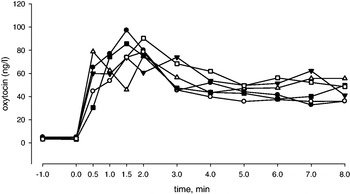
As shown in Fig. 1 baseline OT concentrations before the start of milking were similarly low in all treatments. Already at 30 s after the start of stimulation, OT has significantly increased in all treatments (P<0·05), but did not differ between treatments. OT remained elevated without any transient decrease during the latency period similarly in all treatments until the end of milking. Highest OT concentrations as means of 7 animals were reached between 0·5 and 2 min after the start of stimulation, and did not differ between treatments. Thus, OT continued to increase during the latency period after the end of pre-stimulation, and after cluster attachment. OT concentration was elevated as compared with baseline in each single experimental cow at latest at 1 min after the start of pre-stimulation. The means of individual peak OT concentrations (independent of time of occurrence) did not differ between treatments (data not shown).
Mean plasma concentration of oxytocin (ng/l) before stimulation (−1 to 0), during 6 different combinations of pre-stimulation (P) and latency (L) periods, and during subsequent machine milking. ● P15/L30, ○ P15/L45, ▾ P30/L30, ▵ P30/L45, ▪ P45/L30, □ P45/L45.

Milking characteristics in Experiment 1 (TMY, MMT, AMF) did not differ between treatments (data not shown), i.e. a pre-stimulation of 15, 30 or 45 s combined with latency periods of 30 s or 45 s resulted in similar milking characteristics in these mid-lactating dairy cows which corresponds with the results of Experiment 2.
Experiment 2
Cows at three different lactational stages were classified based on their degree of udder filling during the actual milking, separately for morning and evening milkings. From the early lactation cows, 5 were in class 80–100%, and 2 in class 60–80%, respectively, both for morning and evening milking. Of the mid-lactation cows at morning milking, 3 were in class 60–80% and 4 in class 40–60%, while for evening milkings 3 cows were in class 60–80%, and 2 each in classes 40–60% and 20–40%, respectively. Of the late lactation cows 5 were in class 40–60% for the morning milkings, and 2 in class 20–40% while at morning milkings 3 animals were in class 40–60% and 4 animals in class 20–40%, respectively.
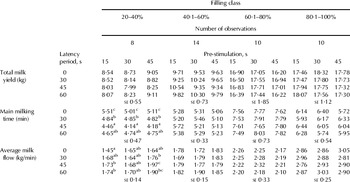
TMY (Table 1) did not differ between treatments in any udder filling class, i.e. the quality of udder emptying was similar independent of pre-stimulation time or latency period.
Total milk yield (TMY), main milking time (MMT), and average milk flow (AMF) at different degrees of udder filling and different combinations of pre-stimulation and latency period (Experiment 2)

a, b, c Means without a common superscript letter within filling class and parameter are significantly different (P<0·05)
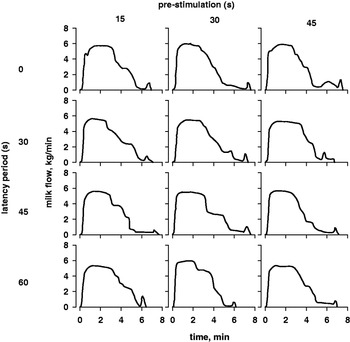
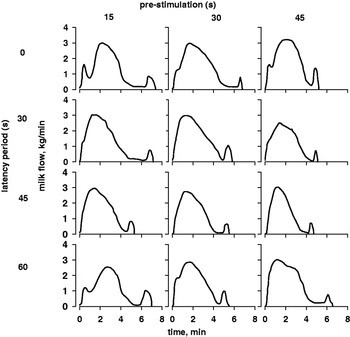
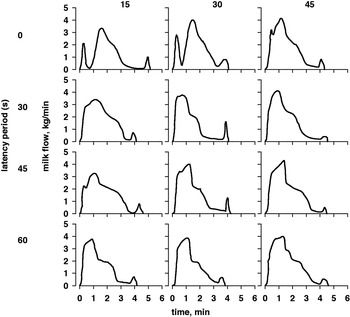
MMT and AMF (Table 1) did not differ between treatments in the filling classes 40–60, 60–80, and 80–100%, respectively, i.e. at all milkings when the degree of udder filling was >40%. This finding was confirmed by the exemplary early-lactation cow (Fig. 2) where independent of treatment the milk flow curves were similar and non-bimodal. In the exemplary mid-lactation cow (Fig. 3) the milk flow curves were only bimodal if milking was started immediately after a 15-s pre-stimulation without a latency period, and after a latency period of 60 s following a pre-stimulation of 15 s. However, treatment differences (P<0·05) were observed for these parameters in the filling class 20–40%. MMT in class 20–40% (Table 1) was shortest at a latency period of 45 s, independent of duration of pre-stimulation. Numerically the shortest MMT was observed after a 30-s pre-stimulation combined with a 45-s latency period. The longest MMT was observed if the cluster was attached immediately after pre-stimulation, and the numerically longest MMT was observed at a 15-s pre-stimulation without an additional latency period. AMF in class 20–40% (Table 1) was highest after a pre-stimulation of 45 s, followed by a latency period of another 45 s. In contrast, AMF reached its lowest values at a pre-stimulation of 15 s without additional latency period. However, AMF after a 15-s pre-stimulation increased with increasing latency period following the pre-stimulation. The exemplary milk flow curves from a cow in late lactation (Fig. 4) demonstrates that delayed milk ejection as represented by bimodal milk flow curves occurred at a pre-stimulation of 15 s or 30 s, if the cluster was attached immediately without additional latency period. Bimodal milk flow was not observed if the pre-stimulation was followed by a latency period of minimum 30 s.
Milk flow curves of one exemplary cow in early lactation (month 2, degree of udder filling 90–95%) during milking in 12 different combinations of pre-stimulation and latency period.

Milk flow curves of one exemplary cow in mid lactation (month 5, degree of udder filling 46–51%) during milking in 12 different combinations of pre-stimulation and latency period.

Milk flow curves of one exemplary cow in late lactation (month 8, degree of udder filling 23–27%) during milking in 12 different combinations of pre-stimulation and latency period.

Discussion
The results of the present study demonstrate that pre-stimulation before cluster attachment does not need to be continuous. Instead, a combination of a short pre-stimulation followed by a short latency period is suitable to induce milk ejection. It is generally accepted that complete udder emptying at milking requires OT release and alveolar milk ejection at the start of milking usually induced by pre-stimulation (Bruckmaier & Blum, Reference Bruckmaier and Blum1998). Because the shift of milk from the alveoli into the cistern before the start of milking is incomplete owing to the limited storage capacity of the cistern, the stimulatory effect must be maintained until the end of milking because milk ejection is a process that continues while milk is removed (Bruckmaier et al. Reference Bruckmaier, Schams and Blum1994). Therefore, it is important that alveolar contraction is maintained during an interruption of the stimulatory effect between pre-stimulation and stimulation by the pulsating liner. A latency period of more than 2 min between a 1-min pre-stimulation and cluster attachment has been shown to be disadvantageous for udder emptying and milking characteristics (Mayer et al. Reference Mayer, Schams, Prokopp and Worstorff1984; Bruckmaier et al. Reference Bruckmaier, Macuhova and Meyer2001). However, only little information is available about the suitability of a shorter latency period up to 1 min following a short pre-stimulation. The few previous studies indicated that a short latency period before cluster attachment after a short pre-stimulation instead of continuous pre-stimulation causes normal or even improved milk removal (Rasmussen et al. Reference Rasmussen, Frimer and Galton1992; Bruckmaier et al. Reference Bruckmaier, Macuhova and Meyer2001). The present study demonstrated that a teat-stimulation of 15 s is sufficient to induce OT release which is maintained without interruption until the end of milking if the cluster is attached no later than 45 s after the end of this 15-s teat-stimulation. The previously shown negative effects of longer latency periods >2 min (Mayer et al. Reference Mayer, Schams, Prokopp and Worstorff1984) are obviously due to a decrease of OT based on the short bio-disponibility in blood (2–3 min) of this hormone (Wachs et al. Reference Wachs, Gorewit and Currie1984; Belo & Bruckmaier, Reference Belo and Bruckmaier2010). However, this study showed that a pre-stimulation as short as only 15 s requires a latency period to allow the occurrence of milk ejection before cluster attachment. Corresponding with earlier results, an immediate attachment after 15 s of pre-stimulation was only possible at a very high degree of udder filling, i.e. if a high amount of cisternal milk can bridge the short time until the early occurrence of milk ejection in well-filled udders (Bruckmaier & Hilger, Reference Bruckmaier and Hilger2001; Weiss & Bruckmaier, Reference Weiss and Bruckmaier2005). Thus, no significant differences between the used treatments on milk yield and milking characteristics were observed for well-filled udders. At low udder filling the stimulation of 15 s was sufficient, however only in combination with a latency period of at least 30 s. If milking in udders with low degree of filling was started immediately after a 15-s manual teat stimulation the milk flow curves showed a clear transient decrease between the removal of the cisternal milk and the availability of the alveolar milk. In some cases milk flow curves at milking after a latency period of 60 s following a 15-s stimulation showed a transient depression after removal of available milk and before a renewed milk ejection (e.g. Fig. 3). Thus a latency period following a stimulation of 15 s should not be longer than 45 s. If a longer time to induce milk ejection is needed, the pre-stimulation period should be increased to 30 s which allows also a combination with a subsequent latency period of up to 60 s (Fig. 4) or even a bit longer (not tested). Interestingly, pre-term cluster attachment after short pre-stimulation but without latency period did not affect milk yield but only caused a prolonged course of milk removal as shown by elevated main milking time and reduced average milk flow. This finding confirms our previous studies where omitting pre-stimulation caused only a delayed milk removal but not a reduced milk yield (Bruckmaier et al. Reference Bruckmaier, Rothenanger and Blum1995; Weiss & Bruckmaier, Reference Weiss and Bruckmaier2005). The possibility to bridge the time until the occurrence of milk ejection by a latency period instead of continuing stimulation can cause a reduced mechanical load on the teat tissue and a relaxation of teat smooth muscles while milk ejection occurs. Therefore it is even possible that milk flow rates are higher if continuous stimulation is partially replaced by a latency period (Rasmussen et al. Reference Rasmussen, Frimer and Galton1992; Bruckmaier et al. Reference Bruckmaier, Macuhova and Meyer2001). In practical milking, depending on the available milking system, this allows a short teat preparation in several animals in sequence, mainly consisting of pre-stripping and teat cleaning before the clusters are attached to these animals. In automatic milking systems a short interruption between teat cleaning (which has a strong stimulatory effect on milk ejection) and attachment of teat cups can usually not be avoided (Dzidic et al. Reference Dzidic, Weiss and Bruckmaier2004a,Reference Dzidic, Macuhova and Bruckmaierb). Based on the results of the present study this interruption is rather an advantage than a disadvantage. Teat cleaning can be restricted to the time which is necessary to achieve clean teats while additional action of the teat cleaning device until occurrence of milk ejection is not required, thus also reducing the mechanical load on the teat tissue.
In conclusion, a combination of a short pre-stimulation with a short latency period instead of continuous stimulation before cluster attachment is suitable to induce milk ejection. However, it needs to be considered that the period until occurrence of milk ejection depends on the degree of udder filling. This period needs to be covered by the time of stimulation and latency period, i.e. the latency period is necessary if teat stimulation is short. A pre-stimulation of only 15 s allows a subsequent latency period of up to 45 s. If milk ejection requires a longer period than 1 min e.g. at very low udder filling the duration of stimulation must be increased to 30 s to allow a subsequent latency period of up to 1 min.
The expert performance of the radioimmunoassay for oxytocin by Mrs Yolande Zbinden, Veterinary Physiology, is gratefully acknowledged. This study was supported by the Swissmilk (SMP), Bern, Switzerland. The sabbatical stay of S Kaskous at the University of Bern was supported by a grant from the University of Damascus, Syria.