I. INTRODUCTION
Spinel aluminum oxynitride (γ-AlON) is a solid solution centered around Al23O27N5 (9Al2O3•5AlN) in the Al2O3–AlN pseudobinary system, which can be made into a polycrystalline ceramic material with high strength and hardness simply by conventional sintering or hot pressing of a powder compact. Owing to its cubic structure, fully dense AlON ceramic materials are visually highly transparent. Its transmitting wave lengths can be extended from the ultraviolet (UV, ∼0.2 μm) to the infrared (IR, ∼6.0 μm) regions. The combination of its outstanding optical and mechanical properties enable its wide application as missile domes, transparent armor, optical windows, high-temperature lenses, semiconductor processing substrates, and packages Reference McCauley1–Reference McCauley, Patel, Chen, Gilde, Strassburger, Paliwal, Ramesh and Dandekar5.
The two-step preparation of AlON transparent ceramics consists of the following steps: (i) synthesizing high purity and ultrafine AlON powder and (ii) molding to different shapes and sizes and sintering to full density and highly transparent ceramics using different sintering methods. Preparation of AlON powders and dopants in the sintering process are very important to the development of AlON ceramics. Different powder synthesis pathways have been developed and reported to produce fine, single-phase AlON powders.Reference Corbin2,Reference Willems, Hendrix, Metselaar and de With6–Reference Miao15 Two of them have significant advantages compared to the others, since they are able to synthesize high-quality AlON powders, which are necessary for the AlON ceramic preparation. One of them is the direct reaction between AlN and Al2O3Reference Willems, Hendrix, Metselaar and de With6–Reference Wang, Lu, Gong, Qi, Wen, Yu, Pan, Yu and Wei8 and the other is the carbothermal reduction reaction of carbon and Al2O3.Reference Zheng and Forslund9–Reference Li, Li and Yuan11 However, the high cost of high-quality AlN powder limits the industrial application of the first method.Reference Miao15 For the second approach, it is extremely difficult to obtain single-phase AlON, since the carbon found in the product usually presents as an impurity, resulting in poor reproducibility.Reference Li, Li and Yuan11,Reference Miao15 Therefore, it is crucial to lower the calcining temperature for the single-phase AlON synthesis, which can increase the quality of the powder (particle distribution) and reduce the production cost.Reference Willems, Hendrix, Metselaar and de With6,Reference Bandyopadhyay, Rixecker, Aldinger, Pal, Mukherjee and Maiti7,Reference Zheng and Forslund9–Reference Li, Li and Yuan11 To fabricate high-quality single-phase AlON, the aluminothermic reduction and nitridation method using Al and Al2O3 as raw materials has been attempted.Reference Corbin2 The general preparation routes including the combustion reaction with a high aluminum ratio in the raw materials were reported.Reference Zientara, Bucko and Lis16–Reference Lee, Lee, Chung, Ahn, Kim and Kim18 It was developed by MiaoReference Miao15 and studied in detail in our recent work.Reference Wang, Lu, Yu, Qi, Wen, Wang, Xiao, Yang, Yu, Wen and Wei12
The sintering process for AlON usually includes elevated temperatures and long sintering durations, even with high pressure to achieve full density and optical transparency. And dopants are often introduced to control the microstructural evolution and lower the sintering temperature.Reference McCauley, Patel, Chen, Gilde, Strassburger, Paliwal, Ramesh and Dandekar5 In this work, using the powder obtained from the aluminothermic reduction and nitridation method, and adding different amounts of Y2O3 as the sintering additive, transparent AlON ceramic sintering was investigated and reported for the first time, in which the optimal amount of Y2O3 doping was identified and the sintering promoting mechanism of Y2O3 was interpreted and discussed in detail.
II. EXPERIMENTAL METHODS
Al powder (∼2 um, >99.9% purity, Yuanyang Aluminum Industry Co., Ltd, Henan China) and γ-Al2O3 powder (∼20 nm, >99.99% purity, Luming nanomaterials Co., Ltd, Liaoning China) with an Al/γ-Al2O3 ratio of 11–89 wt% were ball milled and mixed in a polyurethane bottle with ZrO2 balls in N2 atmosphere for 24 h. The AlON powder was obtained by calcination of the Al/γ-Al2O3 mixtures in a graphite furnace (Model ZT-40-20Y, Shanghai Chenxin Electric Furnace Co., Ltd, Shanghai China) at 1700 °C for 3 h with a flowing nitrogen stream. Then the AlON powder was ground and screened through a 250-mesh sieve followed by the addition of specific amounts of Y2O3. This mixture was ball milled for another 24 h under the same condition. Then 2.33 g the powder was uniaxially compacted into a pellet at 20 MPa using polyvinyl alcohol as the binder. The pellets were treated under cold isostatic pressing (CIP) at 250 MPa and calcined at 650 °C for 5 h in air to remove the binder and possible carbon residues from it before pressureless sintering at 1860 and 1880 °C in flowing N2 gas for 10 h. The sintering temperature was monitored and controlled by a W–Re thermocouple with a heating or cooling rate of 5 °C/min.
X-ray diffraction patterns (Model Dx-2500, Dandong Fangyuan Instrument Co., Ltd, Liaoning China) were collected to identify the phase compositions of the product powder. The morphologies of the powder and ceramic sections were identified by scanning electron microscopy (SEM, Model 4800, Hitachi, Japan). The particle size distribution profile of the powder was analyzed according to SEM micrographs using the Nano Measurer Software.19 The samples were double-face polished and their transmittances in infrared regions were determined by the Fourier transform infrared (FTIR) spectrometer (Model WQF-510A, Beijing Rayleigh Analytical Co., Ltd, Beijing China). The bulk density of the sintered samples was measured by the Archimedes principle method in distilled water, while the theoretical density was calculated from the lattice parameter extracted from the x-ray diffraction patterns (3.71 g/cm3). The hardness of the AlON ceramic samples was analyzed using the Vickers hardness tester (Future-Tech Corp, FV-700 type, Japan). For the pressure test, 1 kgN was applied with a load time of 15 s. For each sample, five different constituencies were selected. The measured values were averaged for interpretation.
III. RESULTS AND DISCUSSION
A. Characterization of AlON powders
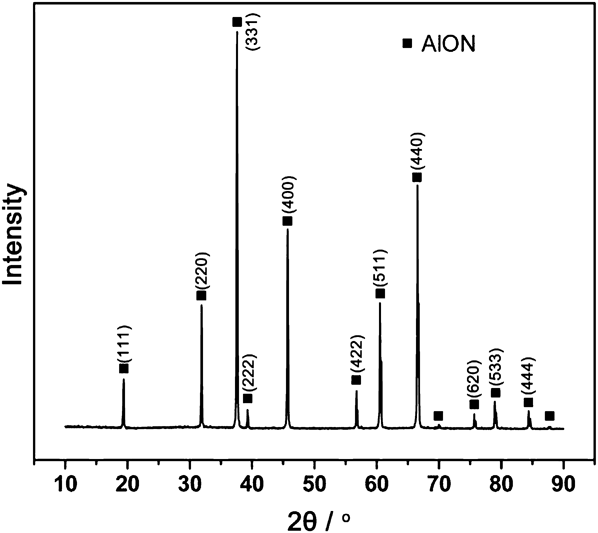
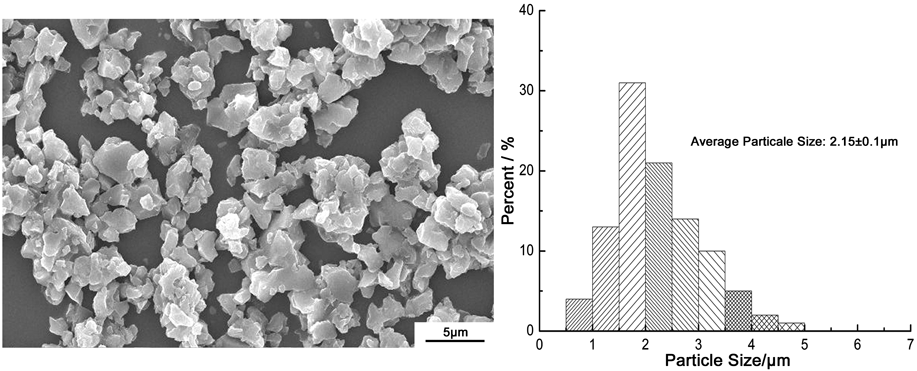
The XRD pattern of the powder synthesized by the aluminothermic reduction and nitridation method is shown in Fig. 1. It suggests that single-phase AlON can be achieved by heating the sample at 1700 °C for 3 h, which is at least 50 °C lower than traditional methods.Reference Bandyopadhyay, Rixecker, Aldinger, Pal, Mukherjee and Maiti7,Reference Zheng and Forslund9–Reference Li, Li and Yuan11 Micromorphology analyses using SEM (see Fig. 2) show that after ball milling for 24 h, the AlON powder appears to be well dispersed. The particle size analyzed from the SEM images suggests narrow distribution and an average particle size of 2.15 μm. Compared with traditional solid state synthesis methods,Reference Bachelard, Disson and Morlhon4,Reference Bandyopadhyay, Rixecker, Aldinger, Pal, Mukherjee and Maiti7 our technique enables a narrow size distribution, which may have a promising application potential on green body molding and sintering.
Powder x-ray diffraction patterns of single-phase AlON obtained at 1700 °C for 3 h.

SEM images and particle size distribution of the synthesized AlON powder.
B. Optical and mechanical properties of AlON samples
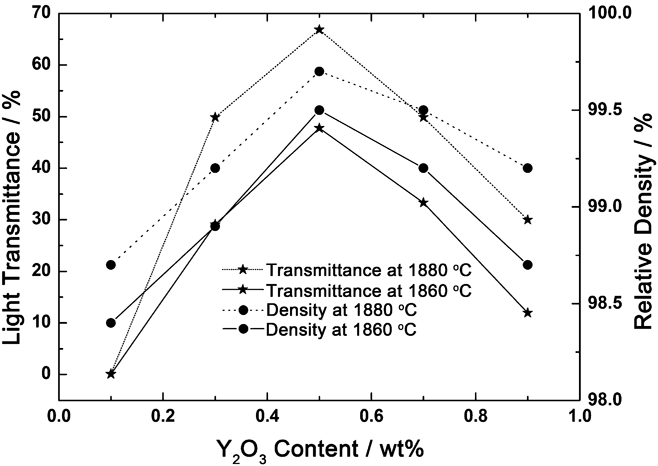
The photographs and in-line transmittances of the AlON samples prepared under different experimental conditions (Y2O3 addition from 0.1 to 0.9 wt%, and at 1860 and 1880 °C) are shown in Figs. 3 and 4, respectively. The transmittance of the samples varies significantly with respect to various Y2O3 contents. For both temperatures, samples with 0.5 wt% Y2O3 have the highest transmittance, whereas the AlON with 0.1 wt% additive has the lowest transmittance, reaching zero. Specifically, AlON prepared at 1860 °C with 0.5 wt% Y2O3 reaches the maximum transmittance of 50% at the wave length of 4.0 μm. It even reaches 65% for Y2O3/AlON made at 1880 °C. On the other hand, for the same amount of Y2O3, the sample’s transmittance increases as the sintering temperature is raised. Figure 5 presents the highest transmittance and relative density of each Y2O3/AlON sample as a function of the Y2O3 content. Interestingly, the sample with higher light transmission properties also preserves a higher density. This phenomenon is a strong indication that the sintering additive plays a crucial role during the sample densification process. Fine-tuning the additive content (Y2O3) and synthesis temperature may increase the sample quality and reduce production cost significantly.
A photograph of ceramic samples sintered under various conditions (upper: 1860 °C, lower: 1880 °C).
Transmittance of AlON ceramic samples as function of Y2O3 loading: (a) 1860 °C and (b) 1880 °C.
The highest transmittance and the relative density of AlON sample as a function of Y2O3 loading: (a) 1860 °C and (b) 1880 °C.
Table I lists the average values of testing hardness of all Y2O3/AlON samples. For both temperatures, the hardness of the samples increases as the amount of Y2O3 additive increases, reaches a maximum at about 0.5 wt% Y2O3 and then decreases, which suggests that the sample with the maximum density has the maximum transmittance, and the highest hardness. And for the same amount of Y2O3, the sample hardness increases as the sintering temperature is raised. Therefore, the details of the sintering process deserve further investigation, so that the densification could be tuned, resulting in further improvement of the hardness of AlON ceramics.
The mean Vickers hardness values (GPa) of AlON samples with different amounts of Y2O3 as sintering aids, at 1860 and 1880 °C.
C. Microstructure characterization of AlON samples
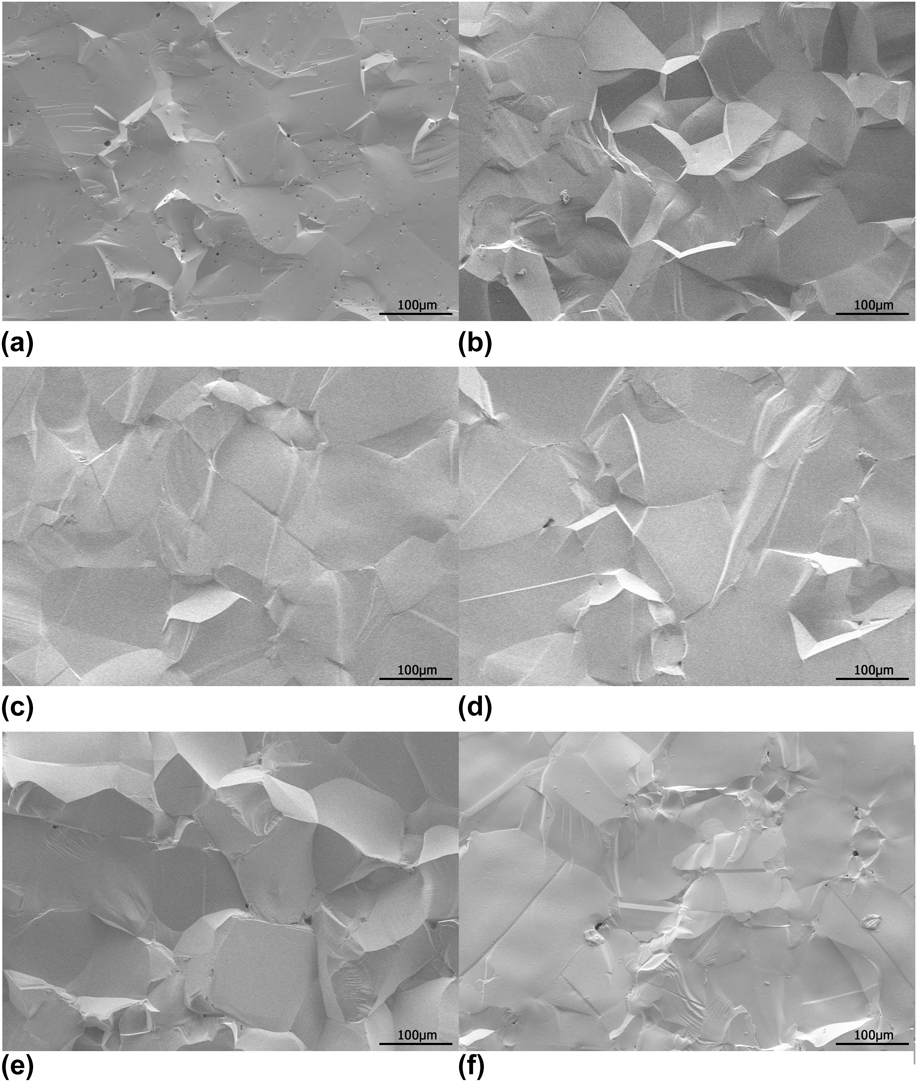
The images of cross-sectional microstructure of Y2O3/AlON samples are shown in Fig. 6. The amounts of sintering additives and sintering temperatures are labeled for each sample [see Figs. 6(a)–6(f)], respectively. The presence of significant amount of intergranular and intragranular pores for the sample with low Y2O3 doping (0.1 wt%) is a strong indication of an insufficient concentration of sintering aid. Interestingly, the sample porosity decreases significantly when the additive concentration reaches 0.3 wt%, which directly results in much better translucence with increasing density. Only countable intragranular pores can be found for AlON with 0.5 wt% Y2O3 at both 1860 and 1880 °C, which suggests that the sintering process has been enhanced significantly. Further increase of the sintering aids did not result in visible small intragranular pores within the grains; however, we do observe the existence of significant amount of large pores at the boundary of the grain. In addition, the grain size becomes larger due to excessive growth.
The cross-sectional microstructure of the samples: (a) 1880 °C, 10 h, 0.1 wt% Y2O3; (b) 1880 °C, 10 h, 0.3 wt% Y2O3; (c) 1880 °C, 10 h, 0.5 wt% Y2O3; (d) 1860 °C, 10 h, 0.5 wt% Y2O3; (e) 1880 °C, 10 h, 0.7 wt% Y2O3; and (f) 1880 °C, 10 h, 0.9 wt% Y2O3.
D. Sintering promoting mechanism of Y2O3 additive
In ceramic material processing, the appropriate type and amount of additive can strongly promote the sintering progress. The additive can enhance the sintering from the following aspects: (i) grain growth can be inhibited by the additive, which performs at the grain boundaries; (ii) ionic vacancies can be induced using additives with different valence states, which can promote sintering by enhancing the mass transport; (iii) the additives can produce liquid products on or near the grain boundaries, accelerating the migration velocity of the grain boundaries, thereby enhancing the sintering; and (iv) after forming a solid solution with the main phase, the additives with bigger atomic radius (than the main phase) can cause distortion of the crystal lattice, which could promote mass transport during the sintering process. Various studies have investigated the behavior and performance of the sintering additives in transparent AlON ceramic preparation.Reference Clay, Poslusny, Flinders, Jacobs and Cutler20–Reference Hartnett and Wahl23 MgO or LiF is usually introduced to produce cationic vacancies, while SiO2 or CeO2 is used to create anion vacancies. Y2O3 and La2O3 act as grain growth inhibitors. LiF, SiO2, or Y2O3 may also be used as liquid-phase-sintering aids in AlON ceramic preparation.Reference Takahashi, Sato, Ito and Akashi22–Reference Kim, Fun, Komeya and Meguro25 Previous reports suggest that Y2O3 sintering additive impacts AlON sintering from two aspects. First, Y2O3 is an effective grain growth inhibitor during sintering. It dissolves into AlON substance inhibiting rapid grain growth and eliminating pores by introducing grain boundary channels.Reference Medraj, Baik, Thompson and Drew24,Reference Kim, Fun, Komeya and Meguro25 The solid solution of Y2O3 and AlON can form the Y2O3–Al2O3–AlN ternary system at the grain boundaries that acts as a liquid-phase-sintering mechanism. This phenomenon will only happen when the sintering temperature is high enough.Reference Boey, Cao, Khor and Tok26–Reference Dong, Jain and Harmer28 Considering the liquification point of Y2O3–AlN–Al2O3 (at 1700 °C), and the melting points of YAG (Y3Al5O12), YAP (YAlO3), and YAM (Y4Al2O9), which are 1940, 1850 and 1760 °C, respectively,Reference Kim and Park29–Reference Lei, Wang and Zhao31 Y2O3 can produce a liquid phase at the grain boundaries to promote sintering. Both these mechanisms suggest that the amount of Y2O3 is crucial and can affect sintering significantly. At lower Y2O3 concentration, the grain growth inhibitor plays a dominant role. Therefore, the sample with lower Y2O3 presents more intragranular pores as the pore migration rate is lower than the boundary migration rate and the transmittance is very poor. As more Y2O3 is doped, the transmittance also increases (0.1–0.5 wt% Y2O3). In this region, the increase of Y2O3 can restrain the grain growth, inhibit the AlON grain boundary diffusion, reduce the grain boundary migration rate, help porosity eliminate from the interior of the grains, and increase the sample density and light transmission. In this study, 0.5 wt% Y2O3 is the optimal ratio for AlON sintering. In contrast, upon further increasing the ratio (0.5–0.9 wt%), the excessive Y2O3 remains at the grain boundaries and the liquid-sintering mechanism becomes dominant.Reference Dong, Jain and Harmer28 Subsequently, the liquid phase enhances the grain growth and causes the intergranular pores, which decreases the optical transmittance greatly.
On the other hand, compared to high-quality AlON products (the maximum light transmittance is about 81%),Reference Corbin2 the sample prepared in this work only reaches a light transmittance of 65%. This could be attributed to three potential reasons. First, the coarse particles (micron level) of AlON powder are not conducive. Recently, improved techniques were used for nanosized AlON fabrication,Reference Fukuyama, Nakao, Susa and Nagata13,Reference Lei, Wang and Zhao31 which can be in favor of AlON ceramic-sintering process. The second cause is attributed to the sintering process used. For the preparation of high-quality transparent ceramic, a long holding time and gentle heating and cooling rates are usually needed. In addition, hot isostatic pressing and postannealing are generally required.Reference Hartnett and Wahl23 However, in this work, both these factors did not satisfy high-quality AlON preparation. Finally, only Y2O3 was used as the sintering aid. According to previous reports, several sintering additives are usually codoped in the preparation of highly transparent AlON ceramic, such as Y2O3, La2O3, and BNReference Hartnett and Wahl23 or Y2O3, La2O3, and MgO.Reference Kim, Fun, Komeya and Meguro25 Further modification of these aspects may significantly improve the quality of the AlON ceramic products.
IV. CONCLUSIONS
AlON transparent ceramics were prepared by a two-step procedure. Single-phase AlON powder was first synthesized via the aluminothermic reduction and nitridation method at a relatively low temperature (1700 °C for 3 h). Then ceramic samples with different degrees of optical and mechanical properties were prepared by doping 0.1–0.9 wt% Y2O3, shaping to pellets and pressureless sintering at the relatively low temperatures of 1860 and 1880 °C. It is found that by increasing the amount of Y2O3, the hardness, density, and transmittance of the samples were first increased and reached the maximum (Vickers hardness 15.95 ± 0.17 GPa, relative density ∼99.9% and transmittance ∼65% at 1880 °C, respectively) with 0.5 wt% Y2O3, but subsequently decreased when more additives were added. The effect of Y2O3 on AlON densification can be interpreted by the grain-boundary-migration inhibition as well as the liquid-phase formation. The promotion extents and transparency can be modified by the amount of additive. In this work, 0.5 wt% Y2O3 was found to be the optimal ratio for AlON sintering. Our method is suitable to fabricate AlON ceramics despite the fact that further fine-tuning of the experimental parameters may be necessary to enhance its light transmission properties.
ACKNOWLEDGMENTS
This work was supported by the National Science Foundation of P. R. China under Grant Nos. 51002098 and 91326103, the Fund of Aeronautics Science (Grant No. 20100119003), and the Talent Introduction Program of Sichuan University of Science and Engineering (2013RC07). All analyses were done at the Analytical and Testing Center of Sichuan University.