Introduction
Mars has been examined for years by telescopes and although we have learned much about the geological characteristics and history of this planet, the gaps in our knowledge certainly exceed what we understand. In particular, the last decade of exploration has seen a huge revolution in the level of accessible detail about our neighbouring planet and its history. According to Ehlmann and Edwards (Reference Ehlmann and Edwards2014), this is due to surface observations with increasing spatial and spectral resolutions provided by the increasing capacities of orbital instruments and in-situ explorations and small-scale measurements by rovers and landers.
In addition, some of these records of Mars evolution are preserved in basaltic rocks and sediments (delivered to Earth as meteorites) bring a record of the history of this planet – from accumulation to initial differentiation and subsequent volcanism, until recently. Essentially, the minerals present in these materials can provide countless important information about the past of the red planet. Among them, it is possible to investigate the existence of water in the past of Mars.
Some geological indications suggest that in the past there may have been a large amount of liquid water on the red planet, similar to lakes or seas (Goldspiel and Squyres, Reference Goldspiel and Squyres1991). This type of environment could be related to some of the craters or depressions, which are observed today in the Martian surface (Scott et al., Reference Scott, Dohm and Rice1995). In these aqueous environments, its possible that precipitation of compounds of interest to Astrobiology has occurred, such as carbonates and minerals such as apatite and xenotime (Schaefer, Reference Schaefer1990). These materials could have been produced and survived in some areas of the planet, mixed with Martian regolith and with other components in the floor of the basin or below the Martian surface (Craddock and Maxwell, Reference Craddock, Maxwell, Squyres and Kasting1993).
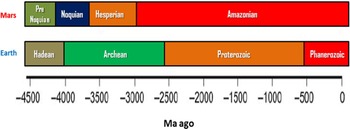
In this way, the existence of these minerals in Martian meteorites can help in the investigation and understanding of possible reservoirs of liquid water on or below the Martian surface. Furthermore, obtaining information like these is of fundamental importance to understand the hydrological cycle of Mars. Although there is a strong instability of liquid water on the surface of Mars today, the identification of such deposits could indicate that there were drastically different geological and climatic conditions in the planet's past. In general, each of these different evolutionary stages of the planet Mars are temporally related to historical periods called Noachian (>3.7 Ga), Hesperian (3.7–3.1 Ga) and Amazonian (<3.1 Ga), which are illustrated and can be compared with the evolutionary stages of the planet Earth in Fig. 1 (Hartmann and Neukum, Reference Hartmann and Neukum2001; Nimmo and Tanaka, Reference Nimmo and Tanaka2005; Cockell, Reference Cockell2015).
Geological timescale for Mars compared with Earth.

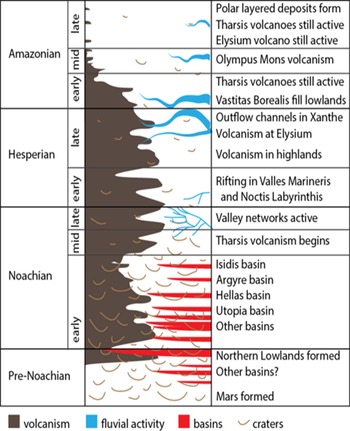
Among these minerals, the xenotime, a phosphate of rare earth elements, was found in the composition of Martian meteorites was in 2014 and was detected as inclusions with apatite (Liu et al., Reference Liu2016). This event could have deep relations with hydrothermal alterations and metamorphisms of the Martian crust, which could have been caused by possible impacts or magmatic activities that would have occurred during the Hesperian period (Ehlmann et al., Reference Ehlmann2011; Cockell, Reference Cockell2015). According to Liu et al. (Reference Liu2016), this would enable us to understand how the process of formation and geological evolution occurred on Mars. However, because the sample analysed is a Martian meteorite shergottite, this relation should be bound early in the Amazonian period of Mars (Fig. 2). Thus, the interest of using the Micro X-ray fluorescence (μXRF) technique in the meteorite Northwest Africa (NWA) 6963 is to obtain data and to investigate the possible presence of minerals that offer relevant information about Mars for Astrobiology (Brolly et al., Reference Brolly, Parnell and Bowden2018; do Nascimento-Dias et al., Reference do Nascimento-Dias2018; Nascimento-Dias et al., Reference Nascimento-Dias2018).
A schematic illustration of the geological time of Mars, containing processes of volcanism, river activity, basin and crater formation.

Materials and methods
Martian meteorite NWA 6963
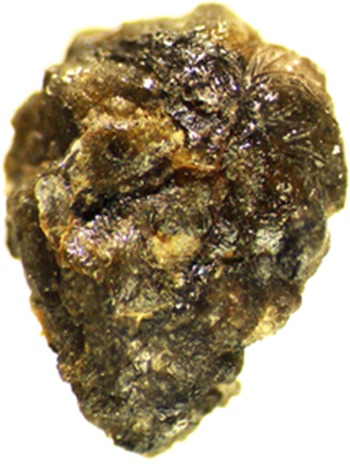
The sample analysed and studied in this research was a fragment 40 mg of the Martian meteorite NWA 6963 (Fig. 3), which is considered an igneous rock of basaltic origin, due to its mineralogical composition and texture characteristics. This meteorite was found in September 2011 in Morocco, more precisely in Guelmim-Es-Semara and is classified as an achondrite belonging to the group SNC (Shergottites, Nakhlatite and Chassignites), being recognized more specifically like a shergottite among the groups of meteors from red planet because of its chemical structure and attested as a meteorite from Mars due to the oxygen isotopes (Wilson et al., Reference Wilson, Agee and Sharp2012; Meteoritical Bulletin, 2017).
Fragment of meteorite used in this work.

For the development of this research, a fragment of this meteorite was acquired with Museum Jewels of Nature, which confirmed its mineralogical correspondence and textured description in the Meteoritical Bulletin.
Instrument of μXRF
The analyses of the elemental chemical composition present in the Martian meteorite NWA 6963 were carried out using a μXRF commercial System (M4 Tornado by Bruker-Nano). This system has a Rh anode X-ray tube, Polycapillary X-ray optics focus (spot sizes <25 µm for Mo-Kα) and XFlash silicon drift X-ray detector (energy resolution FWHM <135 eV at 250 000 cps for Mn-Kα and 30 mm2 active detector) (BRUKER, 2017). The automated scanning performed on the sample provided the detection of 20 chemical elements present at Martian meteorite, without the necessity of having been made suitable or prepared of the analysed sample, that is, in a totally non-destructive manner.
The development of the μXRF analysis in the sample was performed through standardized measures that were verified empirically. The main idea of this methodology was to obtain the best possible parameters to generate the results of this research. Thus, the scanning of μXRF in the NWA 6963 was done shortly after the acquisition of these parameters that followed as patterns throughout the entire sample sweep. The acquisition of the XRF spectrum was done in a vacuum of 20 mbar from parameters adjusted so that the measurements were taken in a standardized way. The parameters used were the current in 600 µA, voltage of 40 kV and in two cycles with a total duration of 2 h 10 min. The low Z XRF spectra were obtained using a 12.5 µm aluminium filter and to obtain the high Z XRF spectra the 630 µm aluminium filter was used. The use of the second filter has the purpose of attenuating the noise a bit mainly in the region above 6.40 keV.
Results
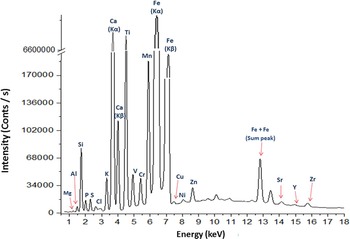
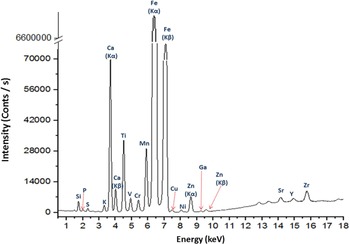
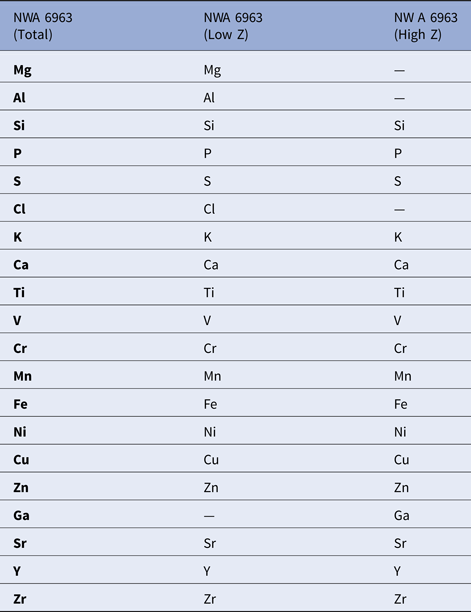
Figures 4 and 5 show the total X-ray fluorescence spectra of NWA 6963 meteorite, where each peak is related to its characteristic energy line Kα. Furthermore, Table 1 shows the comparative results of the low and high Z elemental composition obtained from NWA 6963.
Total spectrum of μXRF of low Z elements of the Martian meteorite NWA 6963.

Total spectrum of μXRF of high Z elements of the Martian meteorite NWA 6963.

Comparative table between the results of XRF obtained from NWA 6963

Discussion
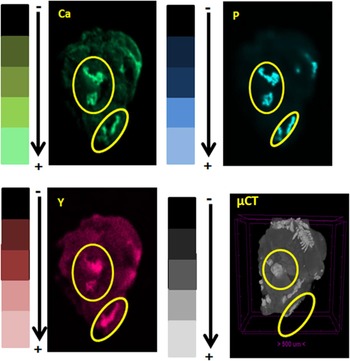
μXRF provided important information regarding the location of certain chemical elements, such as P, Ca and Y, which the combination between them have extreme relevance for the development of astrobiology research. Essentially, these elements may be forming 1, 2 or even 3 different minerals, since they were detected superimposed in certain regions. In general, Calcium (Ca) is an integral element of chemical compounds of some minerals, such as Calcite (CaCO3), Apatite [Ca5(PO4)3(OH,F,Cl)] and Merrilite [Ca9NaMg(PO4)7]. In this way, although they appear overlapping in the same region, it is possible to note that there may be more than one mineral (Fig. 6).
Coloured images representing the elemental chemical composition detected through μXRF.

Among the mentioned minerals, apatite, according to McCubbin and Jones (Reference Mccubbin and Jones2015) could be linked to a possible aspect of suitable conditions of Martian habitability. Essentially, this aspect is related to the synthesis of organophosphates, which is a key process required in prebiotic chemistry and for successful metabolic function. In addition, apatite is seen as one of the essential parameters for the search for H2O in our Solar System, because it is the only volatile mineral able to retain volatiles elements during thermal events or impact shocks in samples of extraterrestrial materials (Gross et al., Reference Gross, Filiberto and Bell2013; Tartèse and Anand, Reference Tartèse and Anand2013). It is important to highlight that on Earth apatite occurs in a wide range of geological configurations, such as in igneous and metamorphic rocks rich in carbonates.
Another relevant point is the detection of Y very close to the element P, which suggests the possible presence of Xenotime (YPO4) (Liu et al., Reference Liu2016). According to Liu et al. (Reference Liu2016), rare earth phosphate such as xenotime can be found in conjunction with minerals such as merrilite and apatite. Essentially, the formation of xenotime geological can be related to two types of processes, in which it could be or originated from phosphate fluids or formed by means of reactions of rocks in hydrothermal vents that had elevated temperatures >100 °C. Especially in the second case, xenotime precipitation by hydrothermal fluids has been a proposed mechanism of formation for apatite inclusions. In this case, the most common occurrence of xenotime is as clusters in apatite, with the possibility of finding merrilite nearby (Harlov et al., Reference Harlov, Hans-jürgen and Timo2002, Reference Harlov, Richard and Callum2011).
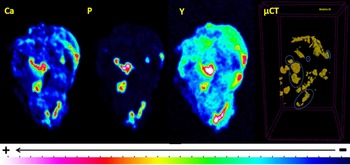
Thus, images were made from the normalized photon emission density of each detected element, through which it is possible to ascertain the distribution of these elements on the meteorite. In addition, it is noted that this distribution is not exactly the same throughout the sample or equally distributed among the three elements, as previously suspected (Fig. 7).
Coloured images represent the normalized density of each element (Ca, P and Y) detected through μXRF.

Among the mentioned minerals, calcite (CaCO3) is the most difficult to make any inference at the moment only through the results obtained by μXRF. The main reason is related to the restriction that the technique has of providing spectra only for elements with Z > 11. However, the possibility of the existence of this mineral as one of the possible constituents of the peculiar structure found in the Martian meteorite should not be ruled out.
Finally, traces of moderately and highly volatile trace elements such as Ti, Mn, Cu, Zn, Sr and Zr (Wolf et al., Reference Wolf, Compton and Gagnon2012) were also detected. However, due to the structural complexity and peculiarity of the material found embedded in the NWA 6963 meteorite, it is still difficult to infer with accuracy that chemical or mineral compounds are part of the material exactly, as was done with the Ca, P and Y presence inference detected by through the μXRF scan.
Conclusion
In general, the information obtained through the analysis of the results provided by μXRF showed to be relevant for Astrobiology. Essentially, this information presents important features about Mars’ geology and possible Mars evolutionary processes. It is possible to say that the results and the analyses carried out are mainly linked to two factors. First, the possibility of the presence of calcium phosphate in the NWA 6963 shergotitte, from which the presence of extraterrestrial apatite and/or merrilite could be suggested.
Moreover, the fact that Yttrium was detected in regions similar to that of Phosphorus may be an indication of the presence of xenotime in the Martian meteorite. This type of mineral may have relations with possible hydrothermal events, which could have occurred in the past of Mars. It is possible that this material has clustered aftershocks, impacts or through intrusions from more recent magmatic activities. In this way, it could be said that this mineral would have extremely relevant implications for Astrobiology, as it would be a way of indirectly suggesting evidence of hydrothermal fluid activity on the red planet.
Thus, the formation of xenotime and apatite, with or without the presence of merrelite in a sample of Martian meteorites could occur through a secondary process of metasomatism involving hydrothermal fluid, which would interact with the apatite. So if this is what happened, we would have a good inference about the existence of water in the recent past of Mars and perhaps have more details about habitable conditions in which life might have settled on the red planet. Finally, we can conclude that the results were extremely relevant for the study and future explorations on Mars, mainly because they show that these minerals can be important components of Martian geology, even locally.
Acknowledgements
Authorship acknowledges LIETA (UERJ), mainly the Dr. Marcelino do Anjos for the support with the μXRF used in this research. In addition, the authorship acknowledges and thanks CAPES. Finally, the authorship acknowledges everyone, which did part of this hard work to be real.