


Introduction
The purpose of this article is to offer a theory of lawmaking in multiparty presidential systems with different legislative institutions, then to apply this theory to explain lawmaking in the National Assembly (NA) of South Korea. It is difficult to develop a theory of lawmaking in South Korea because the party system and the legislative rules have varied since the 1987 democratization. While the two major parties have typically dominated the party system, minor parties, which have sporadically appeared and disappeared, have caused changes to the two-party system. Until the National Assembly reform in 2012, the NA was operated with majoritarian legislative rules, but the National Assembly Advancement Act (NAAA) enacted in 2012 changed the NA into a supermajoritarian institution. Therefore, a theory of lawmaking in South Korea needs to be sufficiently general to capture legislation in governments with different party systems and with different legislative rules.
Many Korean scholars argue that the norms for legislative decision making in the NA are consensual (Jeon Reference Jeon2011a, Reference Jeon2011b; Ka et al. Reference Ka, Cho, Choi and Sohn2008; Lee Reference Lee2002; O Reference O2004). If the NA operates with consensual decision making, there should be little variation in legislative productivity between unified and divided governments and before and after the adoption of the NAAA. Indeed, empirical studies have found little variation in the percentage of bills passed between unified and divided governments (Jeon, Reference Jeon2011a, Reference Jeon2011b; Ka et al. Reference Ka, Cho, Choi and Sohn2008; Lee Reference Lee2002; O Reference O2004). Further, scholars have found no evidence of an increase in legislative gridlock following the adoption of the supermajoritarian NAAA (Jeon Reference Jeon2015; Lee Reference Lee2015). If the NA operates with consensualism, then the majority and minority parties have the same legislative authority. If this is the case, why do political parties endeavor to win a majority? Why do they bother to change the legislative rules?
To answer these questions, I present a theoretical model that explains lawmaking in multiparty presidential systems with different legislative institutions. In this article, I view lawmaking institutions as rules that determine the identities of veto players as well as the order in which different players propose offers and react to them (Tsebelis Reference Tsebelis2002). I offer a theoretical model that combines Tsebelis's veto players theory and Krehbiel's pivotal politics theory. In the model, various institutional veto players and pivotal players are simplified into a smaller set of de facto veto players.
An analysis of the model yields the following results. First, under majoritarian legislative rule, controversial bills are more likely to be enacted in a unified government than in a divided government. Second, it is more likely for legislative gridlock to occur after the adoption of the supermajoritarian rule. Third, the multiparty presidential system could be more efficient in the production of laws than the two-party presidential system if there exists a centrist party large enough to contain median legislators and the filibuster pivot.Footnote 1 The important implication of the results is that the government types (unified versus divided governments), the legislative rules (majoritarian versus supermajoritarian rules), the party system (two-party versus multiparty systems), and the seat shares of parties do matter for lawmaking in the NA.
This article is organized as follows. First, I review the literature on lawmaking in South Korea. Second, I describe the legislative procedures that are followed in the NA. Third, I present a theoretical model to explain lawmaking in presidential systems with different party systems and legislative rules. Fourth, I derive theoretical results from the model and apply them to solve the puzzle about the nondifferential legislative performance between unified and divided governments in the NA. Fifth, I test the hypotheses derived from the model. Finally, I conclude with an explanation about how this article contributes to the understanding of law production in multiparty presidential systems, including South Korea.
Literature review
Since Mayhew (Reference Mayhew1991) found that there was no difference in the legislative productivity of the US Congress between unified and divided governments, there has been a theoretical and methodological debate about how to best explain and measure variations in Congress's legislative productivity. Some empirical studies dispute Mayhew's finding by showing that fewer new bills were enacted under divided governments (Coleman Reference Coleman1999; Binder Reference Binder2003; Chiou and Rothenberg Reference Fang-Yi and Rothenberg2003). Instead of engaging in the empirical debate, Krehbiel offered a theory that explains the lack of a difference in legislative productivity between unified and divided governments in terms of the supermajoritarian institutions of the US Congress.
Korean literature has also found conflicting results regarding the legislative performances of different types of governments. Many studies have shown that divided governments were on par with unified governments in terms of law production and other legislative activities (Jeon Reference Jeon2006; Lee Reference Lee2002; O Reference O2004). However, other studies found that unified governments were more productive than divided governments (Park and Park Reference Park and Park2003; Moon Reference Moon2014). Empirical studies have obtained mixed results, which is likely due to the fact that they analyzed different bills in different NAs. For example, O (Reference O2004) analyzed bills enacted between the 13th and 16th NAs that he subjectively chose as significant cases. In another study, Jeon (Reference Jeon2006) analyzed all bills enacted in the 17th NA.
The more fundamental problem with legislative studies in Korea is that scholars have been divided regarding the concept of legislative gridlock. Jeon defines legislative gridlock as “a state in which political parties cannot reach a consensus over controversial issues” (Reference Jeon2011b, 176). Thus, Jeon (Reference Jeon2011a) interprets majoritarian legislation via the Speaker's discharge procedure as evidence for legislative gridlock.Footnote 2 By contrast, Lee defines legislative gridlock as “a state where the majority cannot accomplish its agenda due to vehement resistance from minority parties to stall the majority party's moves to legislate bills” (Reference Lee2014, 16). While Jeon (Reference Jeon2011b) presented controversial bills passed by the majority party as evidence of gridlock, Lee offered controversial bills blocked by minority parties as evidence of gridlock.
Lee's (Reference Lee2014) definition of gridlock is consistent with the concepts offered by scholars in the US, who commonly define legislative gridlock as a state in which policies remain unchanged (Binder Reference Binder2003; Krehbiel Reference Krehbiel1998; Mayhew Reference Mayhew2005). Mayhew defines gridlock in terms of the failure to pass “landmark acts or laws” (Reference Mayhew2005, 80). Binder defines gridlock as “the share of salient issues on the nation's agenda that is left in limbo at the close of a Congress” (Reference Binder2003, 35). Krehbiel offers a concept of gridlock interval that defines it as a set of policies that “remain unchanged and thus drop straight down” (Reference Krehbiel1998, 42).
However, Korean scholars tend to understand legislative procedures from a normative point of view. Many scholars tend to believe that cooperative and consensual decision making is more legitimate than majoritarian decision making, which often involves the Speaker's discharge procedure. Jeon argues that “even though the Speaker's discharge procedure broke legislative gridlock, it causes more serious confrontation and conflict” between the government and opposition parties, and ultimately results in another stalemate (Reference Jeon2011b, 176). Jeon further argued that bills unilaterally passed by the majority party are “exceptional and anomalous” (Reference Jeon2011a, 61). Based on this logic, Jeon (Reference Jeon2011a) interprets majoritarian legislation via the Speaker's discharge procedure as serving as evidence for legislative gridlock.
It is not a concern of this article whether the Speaker's discharge procedure is normatively legitimate. From the analytical point of view, the passage of bills by the Speaker's discharge procedure implies that majoritarian rules govern lawmaking in the NA. Although many scholars have blamed the Speaker's discharge procedure as a cause of legislative gridlock, it is a legally guaranteed privilege for the majority party to break the gridlock. In addition, if the majority party attempts to bring bills out of a committee to the floor, it typically runs into opposition from minority parties; thus, the majority party cannot help invoking the Speaker's discharge procedure. Once the bills are put forth for votes on the floor, minority parties either vehemently block or refuse to participate in roll call votes. Regardless of the action taken by the minority parties, the majority party can pass controversial bills if it feels that it is imperative to pass them. Thus, the bills passed by the Speaker's discharge procedures should not be interpreted as evidence for gridlock, but they should instead be interpreted as evidence for majoritarian legislation.
Legislative procedures in the national assembly
According to Article 52 of the Korean Constitution, “bills may be introduced by a member of the National Assembly or the executive.” When a bill is introduced in the NA, the speaker reports it to the plenary session and refers it to a competent standing committee. After a bill has been examined, it is referred to the Legislation and Judiciary Committee for review of the legal terminology and phrases. Next, the bill is deliberated upon and approved by the majority of the plenary session of the NA. The president then either promulgates the bill passed by the NA within fifty days or vetoes it.
Article 54 of the National Assembly Laws stipulates that the committee shall “make decisions with the attendance of a majority of all committee members and by the concurrent vote of a majority of the members present.” Thus, committee decision rules are majoritarian according to the law, but consultative decision-making is a common practice. By simply doing nothing, the standing committee leaders of a minority party can prevent legislation from being brought to the House floor. Because it can make unwanted bills languish in the committee, a minority party can exert negative agenda-setting power even in committees dominated by the majority party.
The Legislation and Judiciary Committee examines the system and the wording of bills that are to be referred to the floor. Until the 16th NA, the party with the most seats took charge of the chairpersonship of the Legislation and Judiciary Committee. However, since the 17th NA, it has become common practice to allocate the chairpersonship to a second-place party. The negative agenda-setting power of a minority party has been further strengthened with this practice, because it can kill the bills brought to the Legislation and Judiciary Committee.
However, the majority party can circumvent the gate-keeping Legislation and Judiciary Committee. According to Article 85 of the National Assembly Act before the 2012 reform, the speaker may designate an examination period in a standing committee. If the committee “fails to complete the examination within the designated period without any justifiable grounds, he/she may refer it directly to the plenary session.” Because the speaker's party affiliation lies with the majority, their discharge power enables the majority party to force a bill out of any committee. Political parties offer two opposing interpretations of the speaker's discharge procedure based on their majority status: A party will use the procedure to break gridlock if it wins a majority, but it will then switch its stance if it fails to win a majority. A speaker exercising their discharge power typically prompts strong backlash from the minority parties.
The NAAA enacted in 2012 curbed the authority of the speaker by adding a clause of “expeditious processing of agendas.” According to Article 85-2, the speaker or the chairperson of the competent committee can bring a bill to expeditious processing with the consent of at least three-fifths of all incumbent National Assemblymen, or at least three-fifths of all incumbent members of the competent committee. The NAAA also granted filibuster powers to minority parties. Article 106-2 stipulates that the speaker shall implement the filibuster if a NA member desires debate on an item on the agenda referred to the plenary session; this filibuster has no time limit. A filibuster can be terminated with the votes of at least three-fifths of all incumbent NA members. Thus, the NAAA has the effect of replacing the previous majoritarian rules with new supermajoritarian rules.
Theory of lawmaking in South Korea
In this section, I model the legislative process as a game in which institutional veto players play by different legislative rules. In this model, I simplify various institutional veto players into a smaller set of de facto veto players. Krehbiel's (Reference Krehbiel1998) idea of pivotal players is useful for identifying de facto veto players in presidential systems. To explain the legislative mechanism of the supermajoritarian Congress in the US, Krehbiel offers two important concepts: the “veto pivot” and the “filibuster pivot.” If the president is more liberal than the median legislator, then the veto pivot is defined as “the legislator for whom his ideal point and all ideal points to his right make up exactly or just more than 2/3 of the legislature” (Reference Krehbiel1998, 23–24). In this case, the filibuster pivot is “the legislator for whom his ideal point and all ideal points to his left make up exactly or just more than 3/5 of the legislature” (Reference Krehbiel1998, 24).
In Krehbiel's model, autonomous lawmakers legislate in a one-dimensional policy space. However, there is little variation in roll call votes in the NA because party discipline is strong in South Korea. Moon (Reference Moon2011) finds that the party unity score (the percentage of party unity votes in which each member votes along with their party colleagues) of the governing party is around 95 percent, while those of the opposition parties are over 90 percent. Jeon (Reference Jeon2010) also argues that party loyalty in Korea is on par with that of parliamentary systems.
The strong discipline of the governing party results from the various institutional powers held by the president (Moon Reference Moon2013). Until 2001, the president held the chairmanship of their party as well as the exclusive power to nominate candidates. Although institutional reforms to weaken the president's control of the governing party were adopted in 2001, the president can still take extensive control of the governing party, because the faction that is loyal to them typically dominates party leadership positions. In a study measuring the legislative powers of the Korean president, Moon (Reference Moon2013) finds that there are only two authoritarian regimes (Brazil in 1988 and Chile in 1969) that outscored the legislative powers of the Korean president.
Therefore, I assume that individual members behave as a unitary actor following the direction of their party in South Korea.Footnote 3 I further assume that the median party, the veto pivot, and the filibuster pivot are the parties that include the median legislator, the veto pivot legislator, and the filibuster pivot legislator, respectively. The median party is the de facto agenda-setter because it can defeat any amendment proposed by other parties. The other parties can only take or leave a median party's bill because they cannot amend it.
Lawmaking in presidential systems can be modeled as a sequential game wherein the de facto agenda-setter (the median party) presents an offer to which the de facto veto players then react. First, if the median party proposes a bill, a minority party can decide to mount a filibuster against it. Second, if the minority party mounts the filibuster, the filibuster pivot decides whether or not to support the cloture. Third, if the filibuster pivot supports the cloture, the median party's bill goes to the president, who decides to either veto or sign the bill. If the president signs the bill, it becomes a law; if the president vetoes the bill, the veto pivot decides whether or not to override the veto. If the veto pivot overrides the veto, the bill becomes a law. In this game, the president has veto powers, but the veto pivot can overrule the presidential veto. Thus, the president has de jure veto powers, whereas the veto pivot is the de facto veto player. Similarly, any minority party can mount a filibuster against the majority party, but the filibuster pivot can overrule the filibuster. Thus, while de jure veto powers are granted to minority parties, the filibuster pivot is the de facto veto player.
Lawmaking in the two-party majoritarian legislature
Before the NAAA was adopted, the NA was a majoritarian legislature. In a majoritarian system, the majority party can invoke the Speaker's discharge procedure if it determines that the benefits of changing the status quo will exceed the costs resulting from any criticism from the opposition parties and the press. Because the median legislator belongs to the governing party in a unified government, the governing party is the agenda-setter. Further, the governing party is the veto pivot because the veto pivot legislator is part of the governing party in a unified government. Thus, the governing party is both the agenda-setter and the veto pivot. As a result, if the president controls the governing party, then the president is the de facto single veto player.
In a divided government, the opposition party that includes the median legislator is the agenda-setter. The president can veto the bills proposed by the median party. If the veto pivot legislator belongs to the governing party and the president controls the governing party, then the president is a de facto veto player against the agenda-setter. However, if the veto pivot legislator belongs to the opposition party, then the opposition party also gains the status of the veto pivot. In this case, because the opposition party is both an agenda-setter and the veto pivot, the opposition party is the single de facto veto player.
In Krehbiel's model, the distance between the veto pivot (VPV, hereafter) and the filibuster pivot (FPV, hereafter) is “the gridlock interval where, by definition, policies remain unchanged” (Reference Krehbiel1998, 42). Therefore, the width of the gridlock interval indicates the extent to which legislative gridlock occurs. It is negatively associated with legislative productivity (Reference Krehbiel1998, 47). Because the FPV did not exist before the NAAA was adopted, the gridlock interval in a divided government was the area between the governing party (VPV) and the opposition party (agenda-setter). The gridlock interval is equivalent to the unanimity core in the veto player theory. If the status quo is located inside the core, veto players cannot change the status quo.
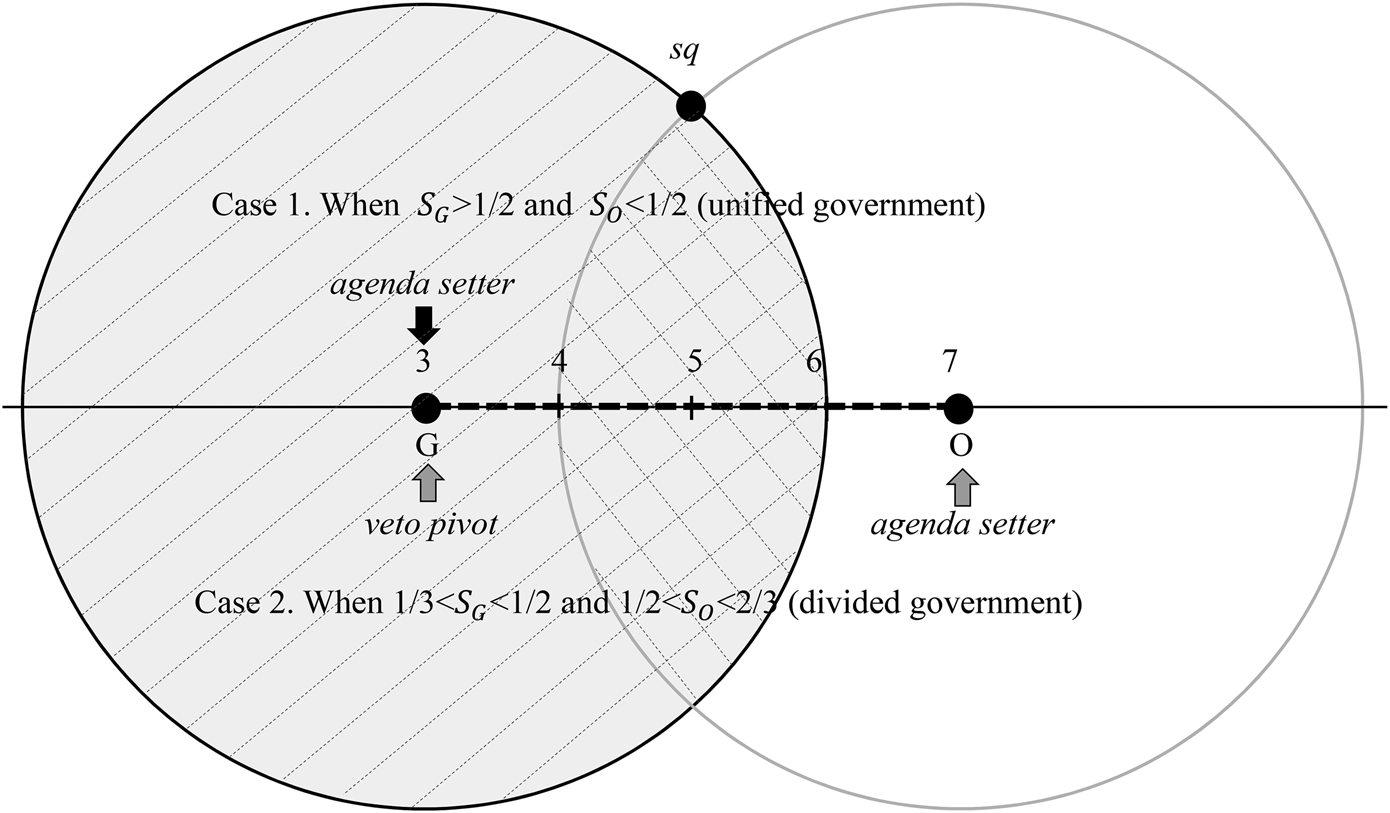
Figure 1 illustrates the de facto veto players in a two-party legislature with majoritarian rules. In the figure, two veto players are denoted by G (the governing party) and O (the opposition party). Each of the veto players has an indifference curve passing the status quo denoted by sq. Each veto player is indifferent between sq and the set of policies on its indifferent curve. It prefers the set of polices inside the indifference curve to sq. The winset of sq, denoted by W(sq), is a set of policies that can defeat sq. In Figure 1, S i denotes the seat share of party i.
Winset and Core of Two-Party Legislature with Majoritarian Rules

Figure 1 depicts two cases. Case 1 is similar to unified governments formed in the middle of the administrations of Roh Moo-hyun and Lee Myong-bak.Footnote 4 When S G>1/2 and S O < 1/2 (case 1 in Figure 1), G is the single de facto veto player. Therefore, the area inside of its indifference curve is W(sq), because G prefers all policies inside the curve to sq. In the figure, W(sq) of the unified government is indicated by the gray area. There is no core in the unified government because the governing party can change any policy without any checks from the opposition party.
Case 2 resembles the divided governments formed during the entirety of Kim Dae-jung administration, most of Roh Moo-hyun administration, and in the early Lee Myong-bak administration. When 1/3 < S G < 1/2 and 1/2 < S O < 2/3, O proposes a bill. Next, the president vetoes the bill if sq is closer to his or her ideal policy than the bill is. Because the VPV belongs to the governing party, G does not overrule the presidential veto. Thus, O cannot change sq if G does not agree. O and G prefer the set of policies that are inside the overlapping areas of the two indifference curves to sq. W(sq) of the divided government is the lens-shaped crossed area in Figure 1. The core is the line connecting G and O, and it is indicated by a thick broken line in Figure 1. If sq is located within the core, there is no winset, because the two indifference curves passing through sq do not overlap.
Figure 1 shows that a winset exists for the divided government. The set of policies in the lens-shaped area can be enacted not only in a unified government but also in a divided government; these are policies that are bipartisan or noncontroversial in nature. The policies that are included in G's indifference curve but not in O's indifference curve (the shaded area) can be enacted in a unified government but not in a divided government. These bills represent a difference in legislative productivity between unified and divided governments. Thus, to compare legislative productivity between the two types of governments, only controversial bills should be included in the comparison.
Lawmaking in the two-party supermajoritarian legislature
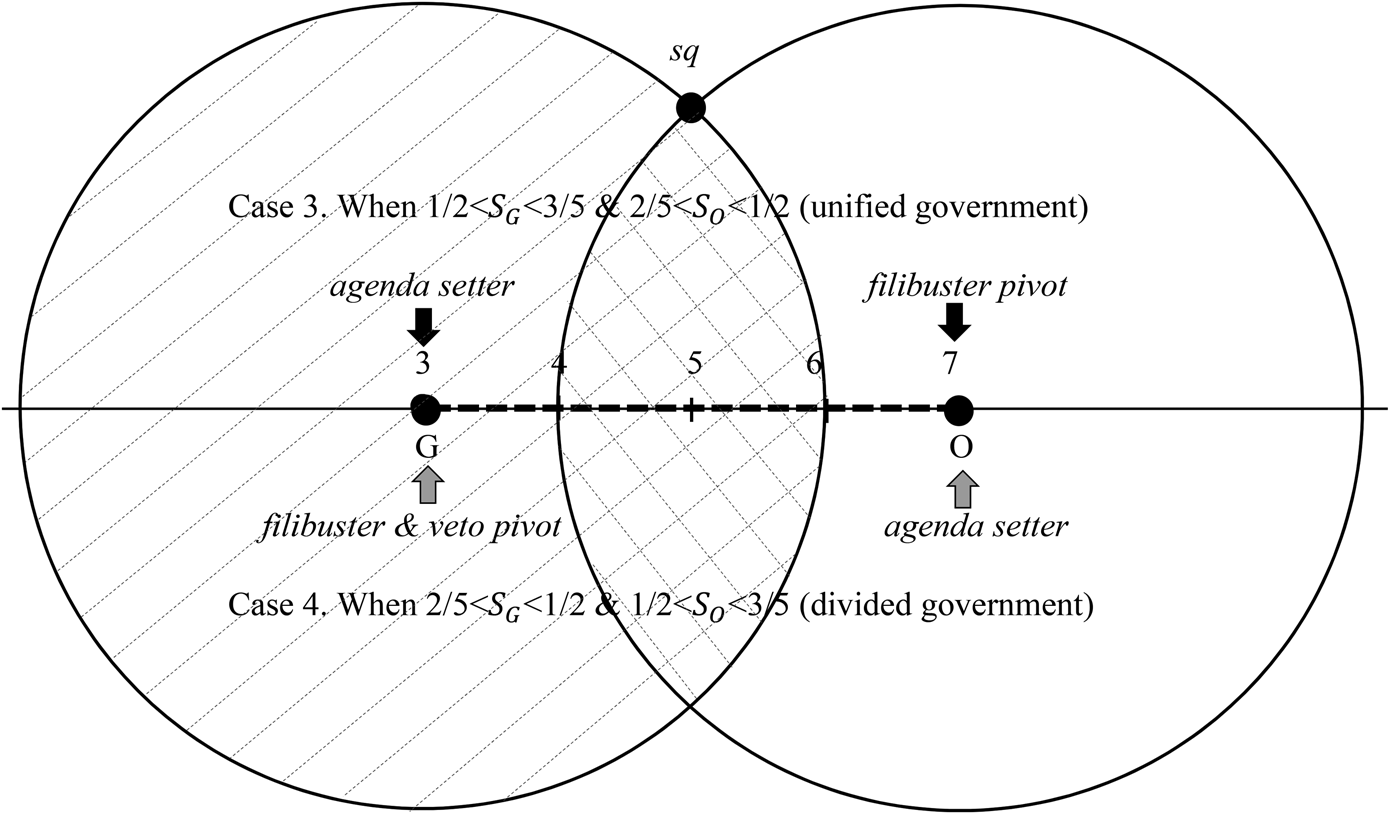
The NAAA shaped legislative rules supermajoritarian by adding the FPV. Figure 2 illustrates the de facto veto players in unified and divided governments ever since the NAAA came into effect. Case 3 resembles unified governments formed in the late Lee Myong-bak administration and in the early Park Geun-hye administration. When 1/2 < S G < 3/5 and 2/5 < S O < 1/2, G is the agenda-setter, and O is the FPV. Thus, the number of de facto veto players increases to two in the unified government.
Winset and Core of Two-Party Legislature with Supermajoritarian Rules

If 3/5 < S G, G becomes a single de facto veto player. However, unless 3/5 < S G, G cannot change sq without the consent of O. Whereas the winset was the large gray area inside of the indifference curve of G before the adoption of the NAAA in Figure 1, it shrinks to the lens-shaped crossed area in Figure 2. Bills that G can pass in a unified government in Figure 1 become controversial bills (bills in the shaded area) in Figure 2; these bills represent a difference in legislative productivity between majoritarian and supermajoritarian legislatures. Thus, to compare legislative productivity between majoritarian and supermajoritarian rules, only controversial bills should be included in the comparison. The size of the core was 0 in a majoritarian legislature, but it increases to the interval between G and O in a supermajoritarian legislature. Thus, in a supermajoritarian legislature, it becomes more difficult to change sq, and the likelihood of gridlock increases.
Case 4 represents a divided government in the supermajoritarian legislature, but it does not have an empirical case. When 2/5<S G<1/2 and 1/2<S O<2/3, O is the agenda-setter and G is the FPV. When 3/5<S O<2/3, O becomes the FPV as well as the agenda-setter. G loses the status of the FPV but maintains the status of the VPV. When 2/3<S O, O becomes a single de facto veto player by acquiring the statuses of all three veto players. Unless 3/5<S G or 2/3<S O, there are two de facto veto players regardless of the type of government. Thus, when there are two parties, legislative productivity is identical between unified and divided governments in the supermajoritarian NA. Krehbiel's explanation of nondifferential lawmaking between unified and divided governments of the US Congress also applies to the NA of South Korea since the enactment of the NAAA.
Lawmaking in the multiparty supermajoritarian legislature
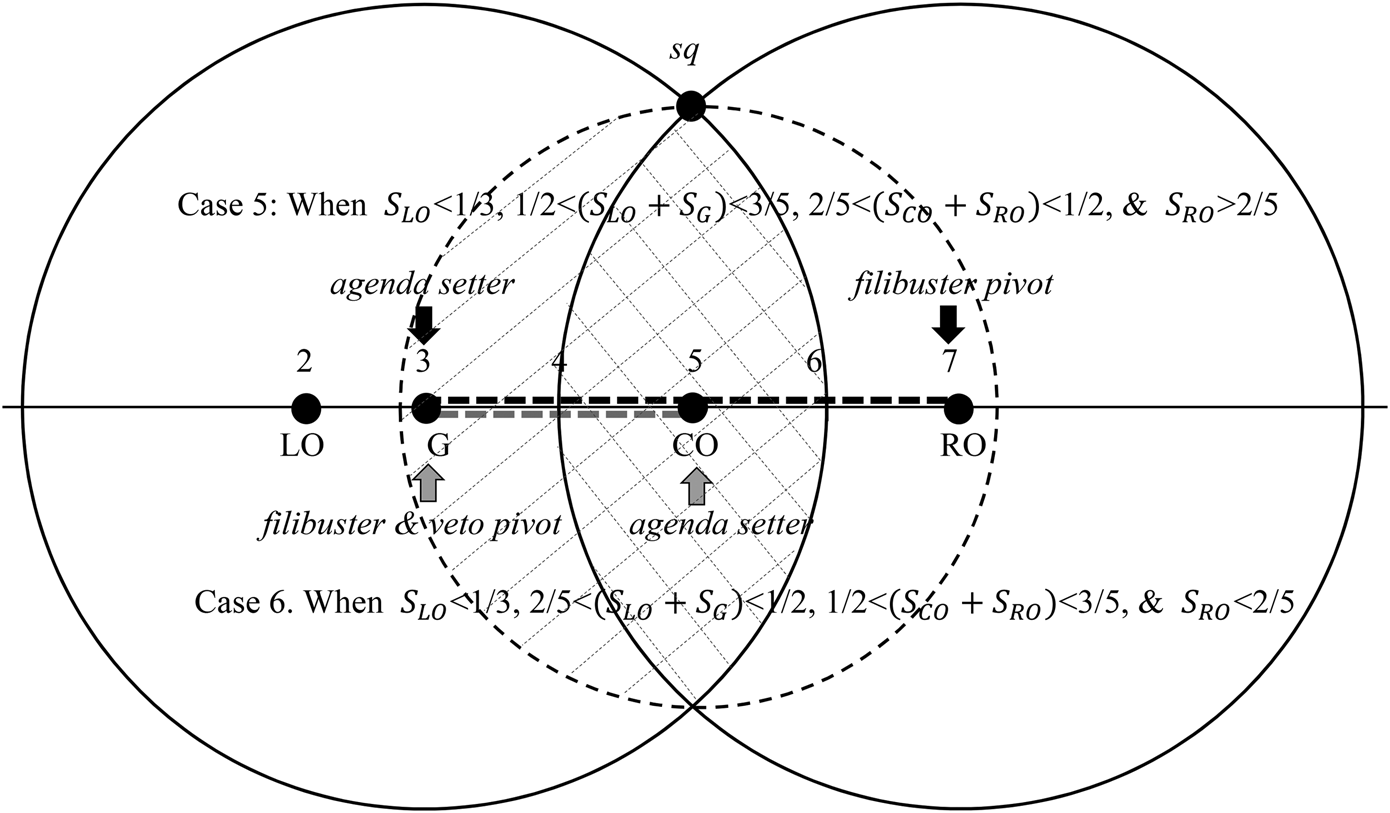
When there are more than two parties, the identity of the de facto veto players varies depending on the seat share and position of each party. Figure 3 depicts a four-party system consisting of the governing party (G), a leftist opposition party (LO), a centrist opposition party (CO), and a rightist opposition party (RO). Although there are twenty possible scenarios depending on the seat shares of the four parties and on legislative rules, only two cases are illustrated in Figure 3; the analytical results of the remaining eighteen cases are listed in Table 1 in the next section.
Winset and Core of Multiparty Legislature with Supermajoritarian Rules

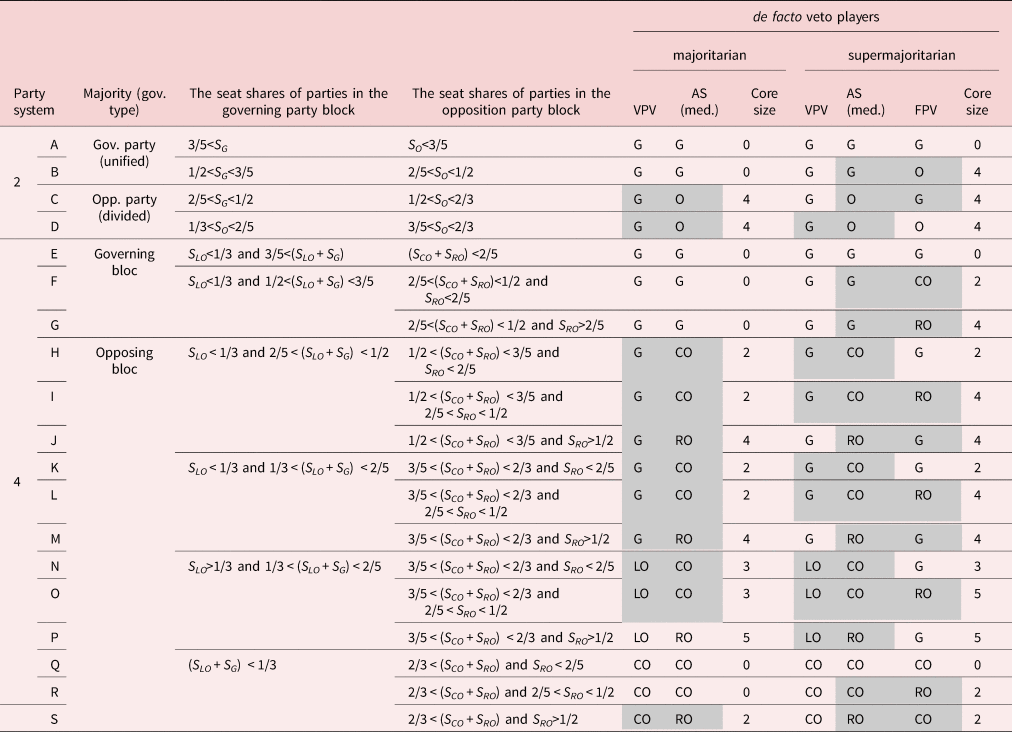
The Statuses of the Three Veto Players and the Sizes of the Cores

Note: VPV: veto pivot, AS (med.): agenda-setter and the median party, FPV: filibuster pivot
When S LO<1/3, 1/2<(S LO + S G)<3/5, 2/5<(S CO + S RO)<1/2, and S RO>2/5 (case 5), G maintains the status of the agenda-setter but loses the status of the FPV to RO. In this case, the winset shrinks substantially to the crossed thin lens-shaped area shown in Figure 3. The core is the interval between the agenda-setter and the FPV. This case is equivalent to the two-party system with supermajoritarian rules illustrated in Figure 2. When S LO<1/3, 2/5<(S LO + S G)<1/2, 1/2<(S CO + S RO)<3/5, and S RO<2/5 (case 6), G loses the agenda-setter status to CO, but it maintains the VPV status. Thus, the two de facto veto players are G and CO. The emergence of CO as the agenda-setter increases the size of the winset. Figure 3 shows that the winset increases from a thin lens to a thick lens as the agenda-setter changes from G to CO. The size of the core decreases from the interval between G and RO to that between G and CO.
Legislative gridrocks in different legislative instituions
Table 1 summarizes the identity of the agenda-setter and the de facto veto players that are yielded by different party systems and legislative rules. The gray cells contain the de facto veto players that constitute the core. Table 1 also presents the size of the core, which varies according to party systems and legislative rules. In the two-party system, supermajoritarian rules tend to cause legislative gridlock in unified governments. If the majority party fails to win a supermajority, then supermajoritarian rules increase the core size of unified governments from 0 to 4 (party system B); however, legislative rules do not affect the core size of divided governments (party systems C and D).
When two parties in the governing bloc win a majority in the four-party system, supermajoritarian rules tend to lead to legislative gridlock. In party systems F and G, supermajoritarian rules increase the size of the core; it increases more in party system G than party system F because the policy position of the FVP of party system G is located further from the governing party than that of the party system. When two parties in the opposition bloc win a majority, the size of the cores is identical between unified and divided governments across all party systems unless the extreme party (RO) in the opposition bloc wins a status of the FVP.
Table 1 includes several interesting results regarding the difference in the size of the core between the two-party and the four-party systems. When the governing party (or bloc) wins a majority in the majoritarian legislature, the increase in the number of parties does not affect the size of the core; the core is empty regardless of the number of parties. When the governing party (or bloc) wins a majority in the supermajoritarian legislature, a change in the party system from a two-party system to a multiparty system could decrease legislative gridlock. For example, party system F, in which the centrist party (CO) wins the FPV status, has a smaller core size than party system B, in which the rightist party (O) wins the FPV status.
When the opposition party (or bloc) wins a majority in the majoritarian or supermajoritarian legislature, the adoption of the multiparty system has various effects depending on the identity of the agenda-setters and the de facto veto players. If the parties at the extreme ends have large supporting bases, the size of the core is greater in the multiparty system (party systems O and P) than it is in a divided government of the two-party system (party systems C and D). If a centrist party has a supporting base that is large enough to secure the status of the median party and if the opposition party fails to win the status of the FPV, then the size of the core is smaller in the multiparty system (party systems H and K) than it is in a divided government of the two-party system. If there is too much electoral support for the main two parties in the two-party system to change the veto player status of the two parties in the multiparty system, then the size of the core does not change.
Table 1 also shows that a unified government is neither a necessary nor sufficient condition for the core to be empty. First, although the unified government is a sufficient condition for the empty core in the majoritarian two-party system (party systems A and B), the unified government is not a sufficient condition to generate an empty core in the supermajoritarian two-party system (party system B). Second, the unified government is not a necessary condition to generate an empty core in the multiparty system. The minority governing party can be a single de facto veto player in a divided government if it can win the median party status due to the peripheral parties present (party systems E, F, and G).
solving the puzzle of nondifferential lawmaking in the NA
Previous empirical studies have pointed to non-differential legislative performance between unified and divided governments as an indication of a consensual NA (Jeon Reference Jeon2006; Lee Reference Lee2002; O Reference O2004). However, Table 1 shows that there should be a difference in legislative productivity between unified and divided governments and between majoritarian and supermajoritarian rules. If this is the case, why do empirical studies obtain results that do not support the theoretical expectations?
The reason for the finding of non-differential legislative performance between unified and divided governments is that the empirical studies did not distinguish between controversial and noncontroversial bills. However, the factor that makes a difference in legislative performance between the type of government and between legislative rules is controversial bills (bills in the shaded areas in Figures 1, 2, and 3). Thus, to test the effects of different government types on legislative productivity, only controversial bills should be included in the analysis. For the same reason, only controversial bills should be used to compare legislative productivity between majoritarian and supermajoritarian rules.
Controversial and noncontroversial bills are respectively related to “position issues” and “valence issues” (Stokes Reference Stokes1963). The preferences of voters or parties over a position issue must be distributed over a set of alternatives. Although not all controversial bills are purely ideological, the preferences of parties are divided because those bills typically deal with position issues. By contrast, voters almost unanimously “evaluate positively” valence issues (Stokes Reference Stokes1963). Legislators support noncontroversial bills because most voters want them to be enacted. In South Korea, noncontroversial bills receive almost unanimous bipartisan support. By contrast, the opposition parties overwhelmingly oppose controversial bills that are almost unanimously supported by the majority party (Moon Reference Moon2011).
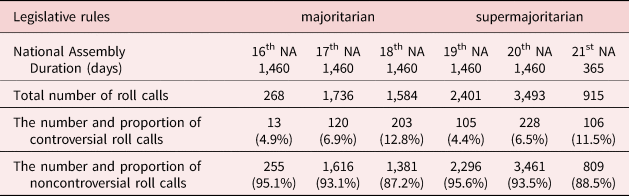
Controversial bills typically involve partisan voting in which “a majority of one-party votes opposite to the majority of another party” (Sabato and Ernst Reference Sabato and Ernst2007, 268). In South Korea, members of the opposition party either boycott roll call votes as a whole or do not cast ballots instead of casting “nay” votes. Table 2 presents the number and proportion of controversial bills (partisan bills that the majority of the governing party members supports but that a majority of the opposition party members opposes or abstains from voting, plus the bills for which the opposition party as a whole boycotts the vote).Footnote 5 As presented in Table 2, the proportion of bipartisan bills is around 90 percent, and there is little variance in the proportion of bipartisan bills across NAs. Given that bipartisan bills make up about 90 percent of enacted bills, comparing the number of enacted bills between unified and divided governments is roughly equivalent to comparing the number of bipartisan bills between the two types of government.
The Number and Proportion of (Bi)partisan Bills

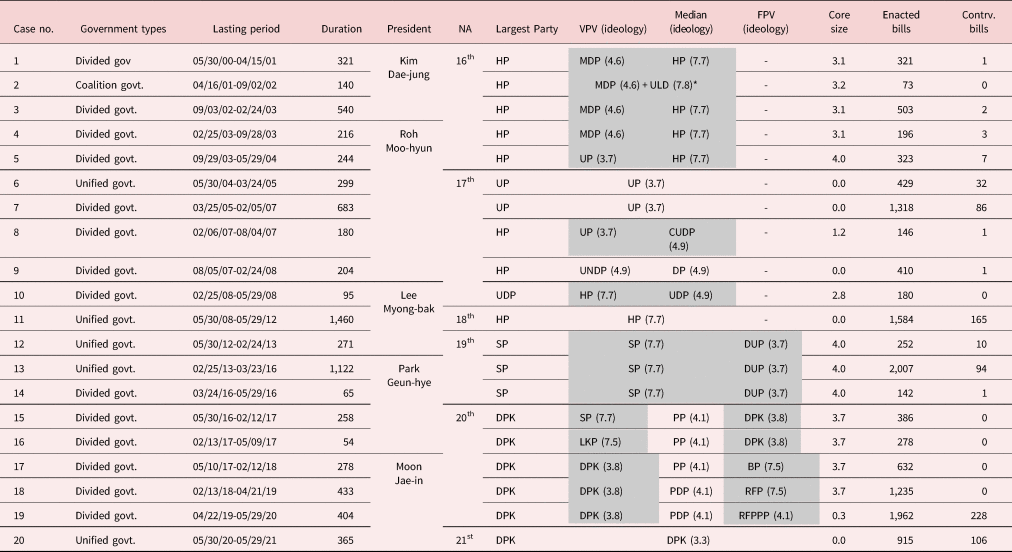
Table 3 lists the agenda-setters, the de facto veto players, and the size of the core, as well as the number of controversial bills enacted in each government type since the 16th NA. Twenty government types have been formed since the 16th NA. Data for the beginning and ending dates for each government type are available from Moon (Reference Moon2014). In Table 3, the cases with dark cells indicate the de facto veto players that constitute a core. The width of the interval connecting the positions of the de facto veto players is the size of the core. I measure the size of the core in terms of the distance between the ideological positions of the agenda-setter and the de facto veto player. To measure the ideological positions of the political parties, I used the data presented in Moon (Reference Moon2018), which were collected using various election surveys.Footnote 6 To measure the number of controversial bills enacted in each government, I calculated the number of controversial bills enacted during the duration of each government.
The de facto Veto Players, and the Sizes of the Cores of the 20 Government Types in the Seven Governments Since 2000

*A majority coalition government was formed by President Kim Dae-jung and the conservative party leader Kim Jong-pil. The core of the coalition government is the distance between the ideological positions of the parties participating in the government.
Note:
Conservative Parties: DJP (Democratic Justice Party), DLP (Democratic Liberal Party), NKP (New Korea Party), ULD (United Liberal Democrats), HP (Hannara Party), SP (Saenuri Party), LKP (Liberal Korea Party), United Future Party (UFP), BP (Bareun Party), RFP (Righteous Future Party)
Centrist Parties: PP (People Party), PDP (Party for Democracy and Peace), NA (New Alternatives), RFPPP (PP Faction of Righteous Future Party)
Liberal Parties: NCNP (National Congress for New Politics), MDP (Millennium Democratic Party), UP (Uri Party), CRDP (Centrist Reformists Democratic Party), CUDP (Centrist Unified Democratic Party), UNDP (United New Democratic Party), DP (Democratic Party), UDP (United Democratic Party), DUP (Democratic United Party), DPK (Democratic Party of Korea)
Table 3 presents two interesting scenarios. First, a divided government could have an empty core under majoritarian rules. For a government to have an empty core, it is not necessary for the governing party to win a majority, as it is sufficient for the governing party to win the status of the median party. For example, even though the UP lost its majority status, the government type still had an empty core because the UP is the median party (case 7). Second, a united government does not always have an empty core. Unless the governing party wins a three-fifths majority (case 20), the agenda setter and the FPV form a core larger than 0, even in a unified government with supermajoritarian rules (cases 12 and 13).
Empirical tests
According to the veto player theory, the size of the core is a necessary but not sufficient condition for law production (Tsebelis Reference Tsebelis2002). That is, the size of the core needs to be small to enact bills, but a small core does not guarantee the enactment of bills. For example, if the status quo is close to the ideal position of an agenda-setter, then the agenda-setter does not need to change the status quo, even when it can. In this case, the governing party does not enact any bills even when the core is empty. This implies that the relationship between the size of the core and the number of enacted controversial bills is heteroskedastic. Tsebelis pointed out that the existence of heteroskedasticity is a point in favor of the veto player theory, not against it (Tsebelis Reference Tsebelis2002, 172).
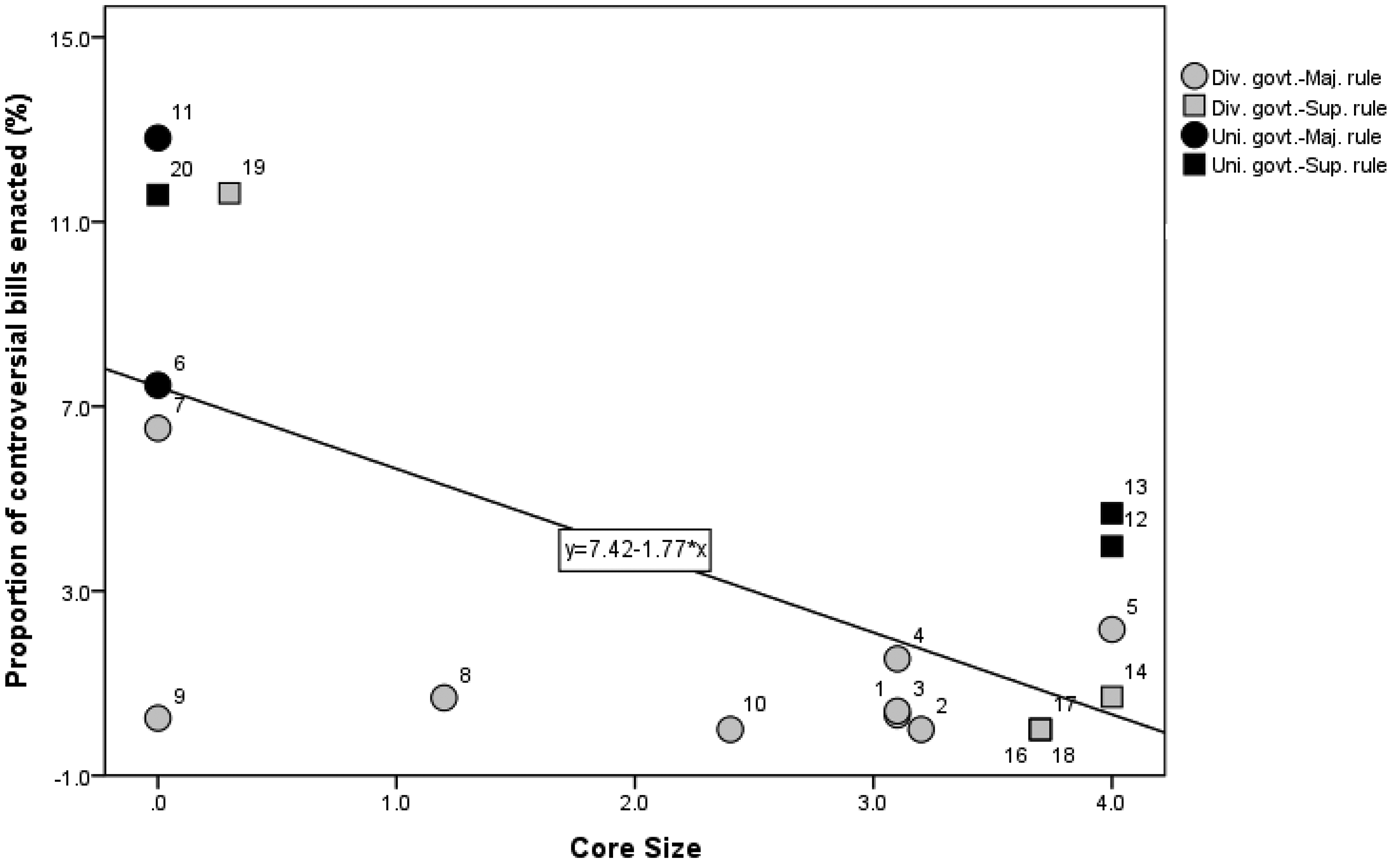
Figure 4 illustrates the relationship between the size of the core and the proportion of controversial bills in each government type in Table 3. The gray and black dots indicate cases for unified and divided governments, respectively. The circles and squares indicate cases for majoritarian and supermajoritarian rules, respectively. The negative slope of the two OLS lines indicates that it becomes more difficult to enact controversial bills as the core size increases. Figure 4 also shows that the relationship between the independent and dependent variables is heteroskedastic. The variation in the dependent variables is large for the cases with an empty core (cases 6, 7, 9, 11, and 20), but the variation is small for the cases with large cores.
The Core Size and the Proportion of Controversial Bills Enacted

A comparison between black and gray circles indicates that lawmaking in unified governments is more productive than that in a divided government when majoritarian rules are used. By contrast, comparing between black and gray squares shows that there is little difference in lawmaking between unified and divided governments when supermajoritarian rules are used. The location of the black and gray squares along the x-axis shows that supermajoritarian rules tend to produce large cores. Four squares have core sizes around 4, whereas only two squares have core sizes around 0; these two cases occurred when the moderate PP faction of the Righteous Future Party (those who had mostly defected from the DPK prior to joining the PP) won the status of the FPV at the end of the 20th NA (case 19) and when the DPK won the single veto player status in the 21st NA (case 20). With supermajoritarian rules, a divided government can be more productive (case 19) than a unified government (cases 12 and 13). Because a minority can check the majority party in a supermajoritarian legislature, what matters is not the type of government but the size of the core.
The statistical significance of the negative heteroskedastic relationship between the size of the core and the proportion of controversial bills can be tested by the following hypotheses.
HYPOTHESIS 1: As the size of the core increases, the proportion of enacted controversial bills decreases.
HYPOTHESIS 2: As the size of the core increases, the variation in the proportion of enacted controversial bills decreases.
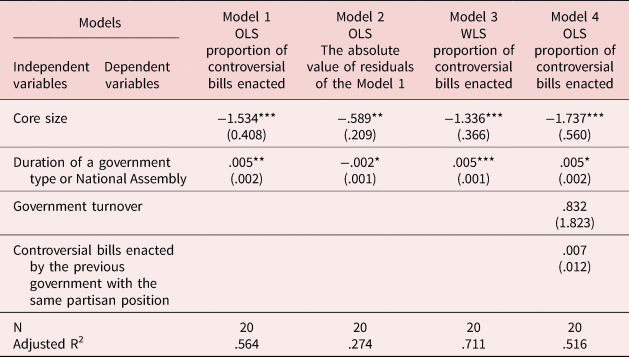
To test hypotheses 1 and 2, I analyze the following three models. In Model 1, I use the OLS (ordinary least squares) regression analysis to test hypothesis 1. In Model 2, I regress the size of the core on the absolute value of the residuals obtained from Model 1. In Model 3, I conduct the WLS (weighted least squares) regression analysis to correct the inefficient estimation of Model 1. Following Tsebelis (Reference Tsebelis1999, 600), I use the inverse of the square root of the predicted values from Model 2 as weights for a WLS estimation in Model 3. In these models, I control for the duration of the government types or NAs, because an assembly is more likely to pass more bills if the legislative period is longer.
The heteroskedastic relationship between the size of the core and the proportion of enacted controversial bills could result from the fact that veto players do not want to change the status quo even when the core is small simply because they are content with the status quo and have no motivation to change it. Veto players may be happy with the status quo when there is no government turnover. Veto players would also have no motivation to change the status quo if a previous government with the same partisan position had already enacted many bills. Thus, I control for veto players’ motivation to change the status quo. In model 4, I include a control for government turnover. If the government type in Table 3 is a government after a turnover, I coded it with a 1; otherwise, I coded it with a 0. I also control for the number of controversial bills enacted by the previous government with the same partisan position.
Table 4 presents the results of statistical analyses. The analyses of Models 1, 3, and 4 yield results supporting hypothesis 1: As the core size increases, the proportion of enacted controversial bills decreases. The result of analyzing Model 2 shows that hypothesis 2 is also supported: As the core size increases, the variation in the proportion of controversial bills decreases. Table 4 also shows that all four models yield a result indicating that a longer duration positively affects the production of partisan bills. However, two controls included in Model 4 do not have a significant effect on the proportion of enacted controversial bills.
The Effect of the Size of the Core on the Production of Partisan Bills

*p < 0.1; **p < 0.05; ***p < 0.01
Conclusion
Previous studies have interpreted the nondifferential legislative performance between unified and divided governments as an indication for a consensual NA (Jeon, Reference Jeon2011a, Reference Jeon2011b; Ka et al., Reference Ka, Cho, Choi and Sohn2008; Lee, Reference Lee2002; O, Reference O2004). However, the two major political parties endeavor to win majority status by any means necessary. If the legislative rules are consensual, why do parties struggle to gain such a majority? This article reveals that the nondifferential legislative performance between unified and divided governments does not necessarily imply that the legislative rules of the NA are consensual. If there is a large number of noncontroversial policies that the majority and minority parties both prefer to the status quo, then the number of noncontroversial bills that they legislate will not differ regardless of the type of government.
There are a couple of reasons for the misinterpretation of legislative rules in the NA. First, scholars have approached this matter normatively. Jeon (Reference Jeon2011a, Reference Jeon2011b) interprets controversial bills passed via the Speaker's discharge procedure as “exceptional and anomalous” although the legislation of controversial bills is to be compared between unified and divided governments. Second, scholars tend to disregard the complicated legislative mechanism in the presidential system. The seat share and the number of parties, legislative rules, and ideological positions altogether affect legislative performance in a combined manner. Therefore, a simple comparison of legislative performance between unified and divided governments and between different legislative rules could lead to an incorrect conclusion.
The veto player model presented in this article shows that the size of the core could be the same between unified and divided government if the legislative rules are supermajoritarian. The model also shows that a supermajoritarian legislature with some constellation of veto players (party systems E and Q in Table 1) could perform better than a majoritarian legislature with a divided government. For example, the Democratic Party that won 180 seats in the 21st NA election could realize its agenda in the supermajoritarian legislature because it was able to gain status as the single de facto veto player. Simply comparing the legislation of controversial bills between the 21st NA and the NAs that existed before the adoption of the NAAA would lead to a conclusion that a supermajoritarian legislature is more productive than a majoritarian one.
Finally, the veto player model of this article yields an important result regarding the relationship between party system and legislative performance. Mainwaring (Reference Mainwaring1993) argues that multiparty presidentialism is inimical to stable democracy because of an institutional configuration that produces immobilizing deadlock. However, Power and Gasiorowski (Reference Power and Gasiorowski1997) find that multiparty presidentialism does not diminish the likelihood of democratic survival in Third World countries. The veto player model reveals that what determines legislative gridlock is not the number of parties, but the location and identity of the agenda setter and the de facto players. The model shows that multiparty presidentialism could increase or decrease legislative gridlock depending on the particular constellation of the veto players.
Acknowledgement
I thank Stephan Haggard and anonymous readers for their useful comments on earlier versions.
This work was supported by the Research Grant of Ajou University (S-2021-G0001–00311).
Conflicts of Interest
The author declares none.
Woojin Moon is Professor of Political Science at Ajou University, South Korea. He has published articles in British Journal of Political Science (2004, 2006), Party Politics (2005), Electoral Studies (2015), and Korean Political Science Review (2013, 2014, 2017, 2018, 2019, 2020, 2021). He received his PhD in political science from the University of California, Los Angeles.