In January 1974, the first Editor of the Journal of Child Language, David Crystal, completed the opening editorial to Volume 1, Number 1, published in May of that year. He took note of “the remarkable increase in the number of scholars engaged in child research during the past decade” (1974, p. i). I entered the field at the beginning of that ‘past decade’, in 1960. It is evident that in the more than fifty years since then our theoretical and analytic tools have been repeatedly enriched and diversified. Other papers in this special fortieth anniversary issue will, no doubt, discuss aspects of these tools for the understanding of how language is learned. At the same time, our database has expanded dramatically. There is a synergistic relation between data and the refinement of theory and method. Underlying all of this progress is another series of developments that we now take for granted: the emergence of techniques for recording and storing speech and associated cognitive processes. Because I myself joined the modern research endeavor just as it was taking off, let me try to reconstruct what the world of child language research was like ‘before the beginning’ of JCL.
The history of science is as much a history of discoveries as it is a history of the tools that make discoveries possible. Just think of what Galileo could discover with a telescope, Leeuwenhoek with a microscope, Lawrence with a cyclotron. In our field there are three notable tools that have changed our understanding of child language development: the audio-recorder, the video-recorder, and the computer. These are everyday tools now. Undergraduates can make high-quality recordings of speech and gesture with lightweight, digital equipment – indeed, with any good smartphone; and they can use small portable computers to present stimuli, record responses, and store and process multimedia data. The only non-automated part of the task is the transcription and annotation of what has been recorded. We take our toolkit for granted, and so it is hard to imagine the tools we had in my ‘before-the-beginning world’ of the sixties. In fact, all we had – and this seemed revolutionary – were ‘portable’ tape-recorders , electric typewriters, and ditto machines for copying and distributing transcriptions. There were no Xerox machines, no Internet, no e-mail.
THE PORTABLE TAPE-RECORDER
Around 1960, portable tape-recorders became generally available, where ‘portable’ meant something like 20 pounds (8 kg). Standard equipment was the reel-to-reel Wollensak, with 7½ inch reels of two-track tape for monaural recording on each side of the reel. Child language researchers seized upon the opportunity to record children at home, and three projects emerged independently at the beginning of the decade: Roger Brown and Colin Fraser in Cambridge, Massachusetts; Martin Braine in Bethesda, Maryland; and Susan Ervin(-Tripp) and Wick Miller in Berkeley, California. All three studies dealt with early word combinations and grammatical morphology in English, and all three arrived at similar insights of emerging structures in two-word utterances in English (Braine, Reference Braine1963; Brown & Fraser, Reference Brown, Fraser, Cofer and Musgrave1963; Miller & Ervin, Reference Miller, Ervin, Bellugi and Brown1964). The history of science is full of such examples of independent research teams making use of new technology to ask new questions, arriving at similar conclusions.
For the preceding centuries all of the available child language data came from handwritten diary studies. In Levelt's masterful A history of psycholinguistics (2013), he observes: “Diary keeping became widely practiced by the end of the nineteenth century, with ever-developing standards of precision, objectivity, and comprehensiveness. The diary tool, the biographical method, would survive all theoretical and empirical hurdles up to and including the present day” (Levelt, Reference Levelt2013, p. 92). Indeed, many of us have continued to learn from careful observation of our own children's development. But the diary method has a number of inherent limitations. Of necessity, the entries are based on the observer's immediate memory of what the child had just said. Phonology and prosody cannot be precisely annotated or instrumentally checked. Input, dialog, physical context, eye-gaze, gesture, repetitions and false starts, timing – all of this vital information is almost entirely absent from the large and valuable diary literature of the eighteenth, nineteenth, and twentieth centuries. There is more attention to striking errors and analogical formations than to correct forms. And there are never enough examples to statistically track the emergence and change of forms over time. One must rely on the diarist's intuitions – often insightful – about the course of development.
The first extensive tape-recorded materials in the early sixties had an impact comparable to looking at an X-ray or peering into an electron microscope. I was fortunate to be a graduate student in Roger Brown's research group at the time, following the children called Adam, Eve, and Sarah in the literature. We had read many of the classic diary studies, but I do not think we were quite prepared for what we heard in hour-long recordings of child–adult interaction. Years later, in a Festschrift for Brown (Kessel, Reference Kessel1988), I reviewed my notes of 1962 and recalled that impact:
[W]hat is evident in those notes is a sense of wonder, the wonder that comes from looking at something for the first time, without knowing what you may find. In thinking back on that feeling, the closest intellectual and aesthetic experience I can compare it to is the amazement I felt in an introductory zoology lab when I cut open my first mouse and saw all its organs lying neatly in place. (Slobin, Reference Slobin and Kessel1988, pp. 10–11)
The new technology poured out hundreds of utterances per week or per month, gathered in repeated home visits. We quickly had more data – including speech to children – than in the entire diary literature. A larger database for an individual child over time allowed for tracking the emergence of particular forms – inflections, prepositions, auxiliaries, question words – leading to new theoretical issues. Were all irregular verbs over-regularized or only particular verbs? Was subject–auxiliary inversion mastered all at once or piecemeal? What was the relation between vocabulary size and acquisition of grammatical morphology? And so forth.
Tape-recordings and their transcriptions made it possible to study interaction, opening up new research questions, such as parental expansions, rephrasings, and corrections of child utterances. In the diary studies it was assumed that the child was exposed to the standard adult language, but caregiver speech in the transcripts looked rather different from adult discourse. By the end of the seventies Catherine Snow was able to look back, with some surprise, to the child-centered orientation of research and theory ‘before the beginning’: “Only ten years ago it was thought possible to study language acquisition without studying the language addressed to children. … Much more recently, psychologists and linguists interested in language acquisition have started studying the nature of the speech addressed to children” (Snow, Reference Snow, Fletcher and Garman1979, p. 363). Study of such speech moved the field beyond considerations of the child as an independent code-breaker equipped with linguistic input and a set of possibly innate strategies. Snow reviewed formal characteristics of child-directed speech and concluded that the most important factor in structuring how adults speak to children is “to talk so as to hold their attention and be understood” (p. 375). The tape-recorder had provided enough data to attend to frequency of occurrence of forms in discourse contexts. Snow concluded that “many of the features of speech addressed to children, such as the high frequency of questions, the provision of syntactic and semantic expansions on child utterances, result from the process of carrying on conversations with immature conversational partners” (p. 375).
THE VIDEO-RECORDER
For all of the richness and novelty of the audio-recording era, much critical information was missing. Investigators did their best to make ongoing notes during recording sessions or later, from memory, in the process of transcribing tapes. But there was no way to attend, simultaneously, to potentially relevant types of information such as objects in the environment and their locations relative to the interlocutors, gaze direction and eye-contact, gesture, and movements of participants. Consider the following 1962 segment of Brown's first subject, Adam, at 2;5·12, in CHAT format (http://childes.psy.cmu.edu/data/Eng-NA-MOR/). The comments were provided by Ursula Bellugi, who recorded and transcribed Adam's (CHI) interaction with his mother (MOT).
mot: put the trains back on the table.
*chi: put train ball (.) Mommy.
%act: reaching behind curtain
*mot: ball ?
*mot: where ?
*chi: right dere [: there].
*mot: can you get it ?
*chi: get it (.) yeah.
%act: crawling behind radiator
*chi: Adam get it.
%act: crawling behind radiator
*mot: I don't see a ball.
*chi: right dere [: there].
*mot: where ?
*chi: over dere [: there].
One would like to know, for example, what Adam does with his hand and eyes when he says “right dere”. We can figure out that he is looking for a ball that may be behind a curtain, behind a radiator. Where is the curtain in relation to the table and mother? Is there eye-contact between Adam and mother at any point during this sequence? Is Adam looking for a ball that can be put on a train when he says “put train ball”? Here we can at least make some guesses about context. But what about sequences like the following, from the same transcript, where there are no observer's comments and nothing that can be inferred from what mother says?
*mot: Adam (.) what are you doing ?
*chi: go hill.
*mot: you're going up the hill ?
*chi: puppy go hill.
*chi: Adam go hill.
*chi: puppy puppy puppy.
*chi: poor puppy.
Researchers in the sixties were chiefly concerned with word order and grammatical morphology. What mattered were things like omissions of inflections and prepositions (puppy go hill), word-order patterns (put train ball), auxiliaries and question forms (where keys go?), over-regularizations (breaked). Contextual notes were generally provided only as a clue to the child's intended reference. Those who were concerned with a fuller view of context developed various techniques to increase situational information. An assistant might sit on the margins and write notes roughly cued to ongoing speech. Later, when four-track portable tape-recorders appeared on the market, the non-participating observer might make simultaneous comments on the second track, speaking quietly into a second microphone, at some distance. Although the advantage of stereo recording of the participants was lost, the transcriber could listen to both tracks simultaneously and greatly enrich the transcription.
Such stopgap measures could be abandoned if sessions could be filmed, but sound films – though occasionally attempted for short episodes – were simply too expensive for child language research. The ‘portable’ video-recorder changed all of this for good. Again, ‘portable’ is in quotes. Lois Bloom (1970, 1973) was probably the first to make systematic, longitudinal video-recordings of child speech. But there was a price to pay back in the late sixties: child and mother had to go to a TV studio to be filmed in a rather artificial environment. Still, Bloom had sufficient new data of actions and situations to champion ‘rich interpretation’ – that is, to attribute referential and communicative intentions to the child. She argued that “it was possible to reach the semantics of children's sentences by considering nonlinguistic information from context and behavior in relation to linguistic performance” (Bloom, Reference Bloom1970, p. 10). The field had to look beyond syntax and morphology to semantics and, thereby, also to cognitive prerequisites (Slobin, Reference Slobin, Ferguson and Slobin1973).
SONY introduced the first domestic videotape-recorder (VTR) in 1965, and the Institute of Human Development at Berkeley acquired this equipment in 1966. It was at least sufficiently portable to make home recordings, but the procedure was much more cumbersome than audio-recording. The half-inch reel-to-reel recorder was bigger and heavier than a Wollensak tape-recorder, and there was a separate 9-inch monitor, a large video camera, a microphone, and a sturdy tripod, because the camera was too heavy and awkward for hand-held recording. The recorder weighed 46 pounds (20·9 kg) and the camera another 6 pounds (2·7 kg). All in all it took two or three people to carry four cases of equipment and set it up in a home. Filming had to be done from a fixed location, enhanced by an excellent zoom lens and a swivel base on the tripod. The tapes yielded rather grainy black-and-white images and, like audio-tapes, the only way to search and compare segments was by constant spooling back and forth, which strained the fragile magnetic tapes. But the multimedia images forever changed our ideas about child language acquisition.
At Berkeley, Susan Ervin-Tripp was a pioneer in taking this new equipment to homes, where she recorded family conversations. This window into everyday communication contributed to the development of the new field of sociolinguistics, extending the adult–child dyad to the family, and extending dialog to multiparty interactive discourse. In Ervin-Tripp's retrospective summary: “The term ‘sociolinguistics’ without hyphens was chosen by the Social Science Research Council (SSRC) to identify its new advisory committee. The name was an analog of psycholinguistics, the interdisciplinary field it had successfully brokered a decade earlier” (Ervin-Tripp, 1997, p. 61). Thus at the time of the first issue of JCL in 1974, both psycholinguistics and sociolinguistics were taking off as fledgling fields, nourished in the sixties by generous funding, revolutionary new equipment, and growing academic opportunities. And both fields had an interest in child language – what psycholinguists referred to as ‘acquisition’ and sociolinguistics as ‘socialization’.
Video-recording also opened up the world of sign language research, which began to flourish in the seventies. In a groundbreaking book published in 1979, Ursula Bellugi and Edward Klima brought together a great quantity of observation and insights gathered during the decade. It is striking, now, to read of the conception of deaf communication around the time of the emergence of JCL: “At the beginning of our research we did not even know whether ASL was an independent language in the sense in which linguists understand that concept, nor even precisely how that concept would apply in the case of gestures. … Nowhere was there any indication that this communication system might turn out to be a separate full-blown language” (Klima & Bellugi, Reference Klima and Bellugi1979, p. 4). Video was used both for documenting sign language and presenting experimental stimuli. Child signing was discussed at various points, but the first published overview of acquisition of a sign language, ASL, was in 1985, based mainly on research of the late seventies and early eighties (Newport & Meier, Reference Newport, Meier and Slobin1985). In the mid seventies Susan Goldin-Meadow and Heidi Feldman took video-recording equipment to the homes of deaf children of hearing parents, discovering the invention of language-like systems without exposure to language (Goldin-Meadow & Feldman, Reference Goldin-Meadow and Feldman1975). Studies of the acquisition of sign languages have been rare throughout the publication history of JCL. The first paper to use sign language data was an overview of the acquisition of several languages, spoken and signed (Levy, Reference Levy1997). ‘Before the beginning’, child sign language was still on a distant horizon.
It would be a long time before digitization and miniaturization would make it possible to systematically add video data to child language research. In 1974 the vast majority of research still relied on the audiotape-recorder for documenting speech, made easier by the advent of cassette recorders in the mid sixties. The first two articles in JCL using videotaped data were published in 1978, both of them using data gathered by Jerome Bruner and associates (Ninio & Bruner, Reference Ninio and Bruner1978; Ratner & Bruner, Reference Ratner and Bruner1978). The data were a longitudinal study of one mother–infant dyad, based on videos of free play between ages 0;8 and 1;6.
Systematic elicitation and hypothesis testing relied primarily on standard tools of psychological experimentation developed in the preceding era of behaviorism. It was only ‘after the beginning’ that other technological advances provided tools for precise measurement of response times, eye-movements, and eventually windows into the brain.
THE COMPUTER
‘Before the beginning’ the computer was far from an everyday tool in our field. In fact, in 1961 Sidney Lamb published an article in Language with the title, ‘The digital computer as an aid in linguistics’ (Lamb, Reference Lamb1961). It is hard to imagine today, but linguists had to be told what a computer was, how it worked, what it could be used for. Lamb, who was then at Berkeley, noted:
Dozens of colleges and universities now have medium-sized computers such as the IBM 650, and several campuses have larger machines. The best known of the large-scale digital computers are the IBM 704, 700, and 7090 systems, which are very similar to each other. Among the universities which have machines of this type are the Massachusetts Institute of Technology and the Universities of Michigan, Washington, and California (at both Berkeley and Los Angeles) … . (Lamb, Reference Lamb1961, p. 382)
Lamb was at pains to point out to linguists that computers were not just used for mathematical calculation. He laid out, in detail, the actual physical and functional structure of a computer, and explained how linguistic data could be coded and entered onto punched cards. The linguist would have to learn how to write computer programs, which Lamb explained, step-by-step, with many examples. He concluded by defining a field of ‘mechanolinguistics’, saying: “Virtually any kind of process involving the manipulation of material that can be expressed in writing is transformable into computer operations, provided only that someone specifies precisely and in detail what is to be done” (Lamb, Reference Lamb1961, p. 409). Nothing can better show the dramatically different world ‘before the beginning’ than Lamb's final encouragement that “interest is gradually increasing and the time may well come when computers will be as familiar to linguists as they are now to physicists and astronomers” (p. 412).
Of the three pioneering tape-recorded studies of early child language, only Ervin(-Tripp) and Miller, at Berkeley, made use of a computer. Braine, in Maryland, and Brown, in Massachusetts, relied on handwritten and typewritten transcripts. The time-honored and still irreplaceable tool is the human pattern-recognition capacity. Brown was convinced, as am I, that there is no mechanical substitute for careful reading of a transcript. But in his era any new hint of a pattern had to be tracked down by writing individual examples on endless pieces of paper and sorting and re-sorting them into promising categories and subcategories. It would take weeks, for example, to determine if a child made differential use of a particular inflection on individual verbs; and it would take far longer to try to detect interactions between auxiliaries, interrogatives, and negations. Susan Ervin-Tripp, always a pioneer, enlisted the help of the Berkeley computer center. Once the human pattern-detector had found promising patterns, the search for detailed patterns could be mechanized and quantified. When particular forms were identified as developmentally interesting, those forms could be marked by codes. For example, child utterances were coded to indicate tense, number, and so forth, and a programmer was employed to write a program that would list, for example, past tense verbs by child, by verb, and by age. This procedure was also time consuming. Each utterance and its code had to be entered on 80-character IBM punched cards, requiring hours at a large, noisy card punch machine. The typist could not easily see what was being typed and the output was all in upper-case letters. A stack of punched cards containing the programs was added to boxes of punched cards with data and the boxes had to be taken to a computer center, where they would be processed in the middle of the night when astronomers and physicists and other ‘real scientists’ were not using the equipment. The first output came from a card reader in the form of seemingly endless fan-fold paper for proof-reading. Errors had to be corrected by finding the offending punched card, retyping it, and re-inserting it into the correct place in its box. Finally, the corrected boxes of cards were taken to the computer center again, and a day or two later one would receive large volumes of larger fan-fold paper with the actual data. This was the procedure until the eighties. While Ervin-Tripp was pleased with the efficient searching and summarizing of large amounts of data, Brown despaired of the hours of non-intellectual labor involved. His studies of Adam, Eve, and Sarah (Brown, Reference Brown1973) made no use of the computer.
The era of mass-market home computers began in the late seventies, shortly after the first issue of JCL. Before then, all university computer work required some kind of time-sharing use of a mainframe machine, usually not at the same location as the researcher's desk. After that, desk-top personal computers revolutionized access and speed; researchers could see what they were typing and, eventually, make use of pre-packaged programs. Transcription and coding could be easily done anywhere – even in the field when computers became truly portable. In our era any interested student can quickly and easily carry out searches such as those that Ervin-Tripp designed and performed over the course of many months of work. The result, of course, has been a massive output of data and analysis. The CLAN programs of the Child Language Data Exchange System (CHILDES) streamline all of the searches and summaries that Brown had to do using slips of paper and a desk calculator. At the same time, statistical packages such as SPSS make it possible to precisely analyze and test patterns in both naturalistic and experimental data.
While personal computers became smaller and more efficient, research computers developed sufficient computational power to enable simulations of child language acquisition. A major impact in these directions was the rise of connectionism. But this was long ‘after the beginning’. In 1986 Rumelhart and McClelland published ‘On learning the past tense of English verbs’, opening a field that has continued to grow in diversity and complexity. Towards the end of the century, Cognition devoted a special double issue to ‘Computational approaches to language acquisition’ (1996, Volume 61, Numbers 1–2, 1–193); Elman, Bates, Johnson, Karmiloff-Smith, Parisi, and Plunkett (Reference Elman, Bates, Johnson, Karmiloff-Smith, Parisi and Plunkett1996) published Rethinking innateness: a connectionist perspective on development; and JCL devoted a review article and discussion to this approach (Rispoli, Reference Rispoli1999). Thus another unexpected consequence of the computational era has been to provide ever-more complex and interesting simulations of human learning and behavior. However, for the purposes of recreating the state of the field when JCL began, all of this lay in the future.
TRANSCRIPTION AND THE COMPUTER
In converting audiotaped speech to written documents, decisions had to be taken with regard to transcription format. Ervin-Tripp and Miller used a script format, making it easy to read down the page and get a sense of dialog, but making it difficult to study child and adult speech separately. Brown and Bloom opted for two columns – one for the child and one for the adult(s) – allowing for zigzag reading of dialog as well as independent reading of either column. There was some ideological discussion of whether the child or the adult should be given the prominence of the left-hand column. Later, when Ervin-Tripp recorded families or peer groups, she worked on a sort of musical score format with lines for each speaker. All of this made it clear that there could be no objective, neutral way of representing speech in print. In 1979 Elinor Ochs focused in on this problem in a chapter titled ‘Transcription as theory’. Ochs made it clear that “transcription is a selective process reflecting theoretical goals and definitions”, because “What is on a transcript will influence and constrain what generalizations emerge” (Ochs, 1979, pp. 44–45).
In the early years of JCL there was no standard transcription format in the field. In addition to the theoretical presuppositions that Ochs foregrounded, a necessary goal was to make transcripts that could be conveniently read by human beings. Therefore visualizability of data was a driving force. In the eighties the computer changed these goals. What is convenient for a computer to process is quite different from the constraints of the human eye. (See MacWhinney & Snow, Reference MacWhinney and Snow1985; MacWhinney, Reference MacWhinney2013, for a discussion of the history and theoretical issues of transcribing for human and computational processing.)
In the years 1981–1988 child language researchers gathered together to forge a common set of tools. MacWhinney and Snow presented the Child Language Data Exchange System to the field in a JCL article in 1985. They painted a graphic picture of the state of the field in the decade ‘after the beginning’:
The proliferation of transcript data has led to immense advances in specificity and accuracy of our science. It has also allowed us to see more clearly the limitations involved in current analytic techniques. As we begin to compare hand-written and typewritten transcripts, problems in transcription methodology, coding schemes, and cross-investigator reliability have become more apparent. But, just as these new problems have arisen, a new major technological opportunity has emerged. This opportunity is provided by the proliferation that is now occurring of microcomputers and microcomputer software. With microcomputer word-processing systems readily available to all researchers, it is easy to enter transcript data into computer files which may then be easily duplicated, edited, and analysed by standard data-processing techniques. The numbers of researchers entering their data in this fashion has grown exponentially over the last few years. (MacWhinney & Snow, Reference MacWhinney and Snow1985, p. 272)
We now have the CHILDES system (http://childes.psy.cmu.edu/), which is based on a standardized transcription format for speech along with coding lines for linguistic and contextual information. The computer can separately extract and analyze lines of child and caregiver speech, solving the problem of two-column transcription. (More recently, audio and video data have been made available in the archive.) Child language research has thus become an exceptional field in the language sciences, providing all interested researchers with both a standardized means of transcribing and analyzing data, and a massive and continually growing archive of child language materials in the universal format, available for new investigations.
THE GROWING CROSS-LINGUISTIC DATABASE AND THE COMMUNITY OF RESEARCHERS
In the sixties the community of scholars was small and it was possible to know most of the people working on child language in North America and much of Europe. In 1966 the linguist Charles Ferguson moved from the Center for Applied Linguistics in Washington DC to Stanford with the task of establishing a linguistics department there. And in 1967 he contacted child language researchers in the Bay Area and invited us to a half-day informal meeting to discuss common interests and the state of the field. I was there, and I remember Susan Ervin-Tripp and Martin Braine (visiting from the East) at the meeting, along with students and others whom I have forgotten. The point is that the field was small enough for a large segment of the North American research community to meet around one table and discuss research for a half-day. Eve Clark has gone on to record the next steps:
During the summer of the next year, 1968, the study of children's language acquisition was formally encouraged by the Social Sciences Research Council, which sponsored a set of workshops on ‘Language, society, and the child.’ They were organized and taught by Susan Ervin-Tripp, Charles A. Ferguson, John Gumperz, and Dan Slobin. The organizers offered two workshops on sociolinguistics (Ervin-Tripp, Gumperz), one on grammar (Slobin), and one on phonology (Ferguson). Overall, the general emphasis was on considering acquisition data from a variety of languages including Chinese, Finnish, Luo, Russian, Samoan, and Spanish, in addition to English. The following year, 1969, saw the resumption of Ferguson's initiative with the second Forum meeting, again focussed on informal presentations of ongoing research. (Clark, Reference Clark and Clark1993, p. xi)
The 1968 workshop was the result of an interdisciplinary field manual for “the cross-cultural study of the acquisition of communicative competence” (Slobin, Reference Slobin1967). The title reflects a broadening of interest from syntax to communication and from English to universals – but empirically based rather than a priori universals. Graduate students had taken the manual to the field in 1967 to study acquisition of English, Luo, Samoan, and Tzeltal, while other languages were studied in immigrant communities in the Bay Area. Cross-linguistic research was clearly in the air ‘before the beginning’. But the database was still limited. When I set out, in 1970, to survey the available literature on acquisition of languages other than English (Slobin, Reference Slobin and Dingwall1971, Reference Slobin, Ferguson and Slobin1973) I was able to find and read everything known about the acquisition of forty different native languages, including most of the Indo-European languages and representatives of fourteen other language families.
The community of scholars also grew slowly at first. In 1972 there was an international conference on child language acquisition in Florence where it was possible to come in contact with researchers in Western and Eastern Europe. David Crystal, in his introductory editorial to the first issue of JCL (Crystal, Reference Crystal1974), notes that the idea of the journal was formally endorsed at that conference. By 1974 there were already at least two cross-linguistic anthologies of child language (Bar Adon & Leopold, Reference Bar Adon and Leopold1971; Ferguson & Slobin, Reference Ferguson and Slobin1973). Thus at ‘the beginning’ in 1974, there was already an international community and some degree of interest in comparative acquisition research across languages.
I will not continue ‘beyond the beginning’ because the goal of this short paper is to set the stage at the time of the emergence of JCL. But, in closing, I do want to briefly present the trajectory of the journal's concerns with languages other than English. Overall, in the forty years of its publication, out of 1,421 articles presenting child language data, 69% of them deal with English. What I find encouraging – from the cross-linguistic point of view – is that this percentage has been steadily declining. Table 1 presents the percentage of articles including English as one of the data languages. This summary includes reports of bilingual or trilingual acquisition in which one of the languages was English, though the majority of the articles deal with monolingual acquisition.
Percentage of articles in JCL presenting data on the acquisition of English

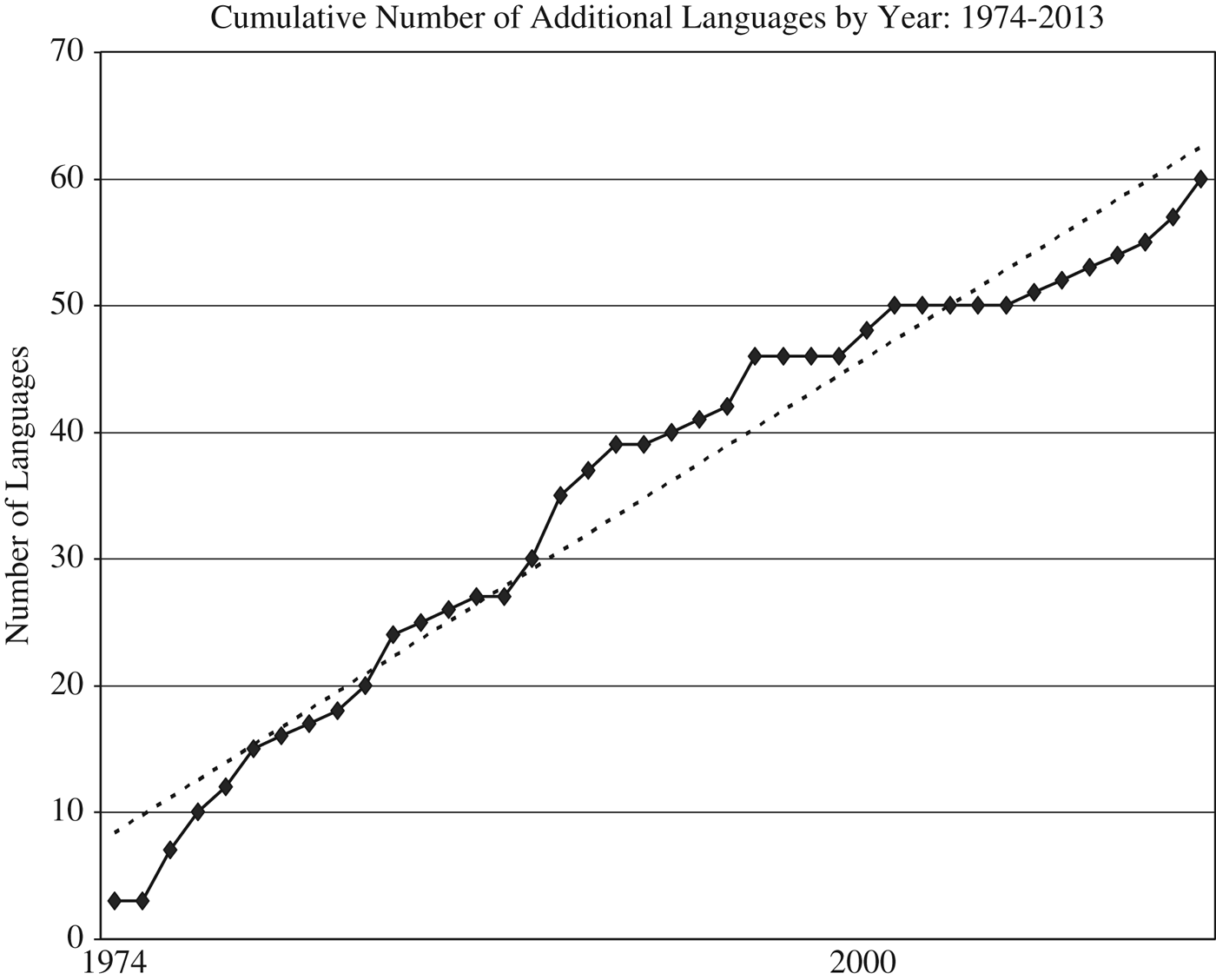
Linguistic diversity has continued to grow in the journal during this period. In almost every year of its publication, JCL has added one or more languages that had not been covered earlier. Figure 1 shows the continually ascending curve of cumulative additions to the stock of languages. This figure carries on the graph of 1974–1990 presented in Slobin Reference Slobin1992 (Figure 1.2, p. 3).
Cumulative number of articles dealing with new languages in JCL year-by-year, 1974–2013.

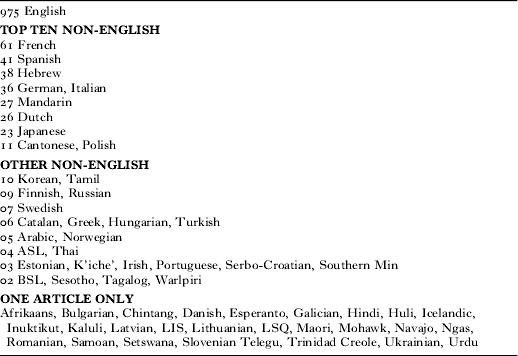
Table 2 ranks the languages in terms of number of articles containing acquisition data on the language. The ten highest-ranking languages show a good typological spread, including three major Indo-European groups (Germanic, Romance, Slavic), two Sino-Tibetan languages, and Japanese. Below that there is a scattering of languages with decreasing numbers of articles per language. There are twenty-seven languages represented by only one article each.
Rank order of languages by number of articles in JCL, 1974–2013
The diversity of languages reported in JCL is important, but it is still rather slim in relation to English, and for most languages there is very limited information. However, in our period – ‘after the beginning’ – there are numerous other sources of information on acquisition of the languages of the world. In addition to other journals in a number of countries, we have many dissertations and monographs. The five volumes of The crosslinguistic study of language acquisition (Slobin, Reference Slobin1985a, Reference Slobin1985b, Reference Slobin1992, Reference Slobin1997a, Reference Slobin1997b) present detailed documentation of the acquisition of twenty-eight languages from eighteen language groups, and the CHILDES archive continues to grow. Currently there are corpora from twenty-six languages from eighteen language groups. The twelve triennial meetings of the International Association for the Study of Child Language (http://www.iascl.org/), and an abundance of national associations and specialized meetings provide much more data, theory, and discussion. IASCL published an assessment and a prospectus for the use of corpora in a volume edited by Heike Behrens (Reference Behrens2007), titled Corpora in language acquisition research: history, methods, perspectives. The daunting future task will be to find patterns in this vastly expanded database, far beyond the state of the art ‘before the beginning’.
LINGUISTIC TYPOLOGY AS A RESEARCH TOOL
In pointing to the future, I would like to bring the field of typological linguistics into the consciousness of the child language research community. Attending to linguistic diversity is more than studying languages that fall into different groupings. Here I want to turn to my late colleague and friend, Melissa Bowerman, who had much to say about the relations between acquisition and typology. She, too, was formed ‘before the beginning’ and could have provided a special perspective on our fortieth anniversary overview. Her dissertation on Finnish child language, under Roger Brown's direction, was the first American dissertation on acquisition of a language other than English (Bowerman, Reference Bowerman1973). At the Max Planck Institute for Psycholinguistics in Nijmegen she coordinated psychologists and linguists to seek out new typological patterns in specific areas of acquisition, such as argument structure (Bowerman & Brown, Reference Bowerman and Brown2008) and verbs of placement (Bowerman, de León & Choi, Reference Bowerman, de León, Choi and Clark1995; Slobin, Bowerman, Brown, Eisenbeiss & Narasimhan, Reference Slobin, Bowerman, Brown, Eisenbeiss, Narasimhan, Bohnemeyer and Pederson2011). This work challenged prevailing assumptions of what is ‘natural’ in child language learning. More work of this kind is needed. In 2007 the two of us were asked to contribute a paper to Linguistic Typology on “interfaces between linguistic typology and child language research” (Slobin & Bowerman, Reference Slobin and Bowerman2007). In attempting to relate the two fields, we noted:
The point of using the crosslinguistic method in studying child language is … to disentangle candidate explanatory principles by studying the acquisition of contrasting language types. One important source of clues lies in information about which sorts of linguistic constructions and covariations are relatively easy or difficult for the child to master. Here, attention to typology is critical, since it provides us with a means of selecting appropriate languages for particular research goals. Most often, though, what developmentalists do in practice is to treat typology as a source of linguistic taxonomies, or structured catalogs of linguistic variables, rather than as a theoretical approach that can inform our research more deeply. (Slobin & Bowerman, Reference Slobin and Bowerman2007, p. 214)
We made a plea for more careful attention to linguistic differences between languages – a plea that bears repetition here:
Typological descriptions of languages enable today's developmental psycholinguists to intelligently choose languages for comparison. By way of contrast, almost all child language investigations of the nineteenth and early twentieth century were limited to European Indo-European languages, and even to this day, virtually every textbook, in every branch of American psychology, refers simply to ‘the child’, or ‘the individual’, or ‘people’, with no further nuances of language or culture. (Slobin & Bowerman, Reference Slobin and Bowerman2007, p. 215)
The past fifty years, from ‘before the beginning’ to ‘since the beginning’, have amply laid the groundwork for the big questions. We have the tools for collecting, archiving, and searching child language data and we have a large and growing database. Linguistic typology is another essential tool for acquisition theory. In order to build plausible models of child language acquisition we will need to know much more about the range of possible languages and the sorts of solutions that child learners attempt.