More than a decade ago, Lisa Rofel rightly remarked that the idea of spatial relations having the power to shape subjectivities had spurred an enthusiastic search for cross-cultural panopticons.Footnote 2 This essay, however, looks at the spatiality of ideological work, the production of which structures its very operation, not in the sense of a panopticon (of which we may be too familiarFootnote 3), but in subtle, naturalized ways of living in a community setting. How can we understand people orienting themselves and being oriented in the setting where radical spatial reorganizations take place? How the changing spatial representations shape subjectivities in general, and influence the ways people identify with the autocratic state propagating a particular discourse of modernity? Many previous studies on the changing representations of urban space have featured prominently the issues of power and modernity,Footnote 4 and yet, different lines of inquiry were pursued in the discussion of “modernity.”Footnote 5 In this essay, only one single aspect of this polysemic concept was examined, i.e., how the state purposefully inscribed a political discourse of modernity featuring a particular ideological telos of national destiny in the “social imaginary” of space.Footnote 6 The notion of ideological telos refers to the “modern” conception of time, or temporality, whereby time has a linear arrangement with a past, present and future. Such temporality is usually subject to the use (even abuse) of powerful groups in a relationship of unequal power.Footnote 7 Appropriated very often by the state, the modern idea of objective linear time can make people believe that the yet-to-be-realized future is something that can be planned for.Footnote 8
In the context of China, juxtaposing this linear temporality was very often the discourses on “progress,” “grand narrative (usually on societal transformation),” and “movement,” which were subject to the political, economic, or intellectual forces that accompanied insurgent technological developments. Clearly put by Duara, “modernity” was an intellectual movement that emphasized the use of “a discourse which structures the perception of the world not only cognitively through the categories of rationality and science, but also by means of such values as progress and secularism, which are often inseparably entwined with the former.”Footnote 9 In particular, the Chinese discourse of modernity as manifested in state-led projects usually attempts to propagate a particularistic vision of the future, like what has been inscribed in the official rhetoric of “rich and strong” (fuqiang) and “modernization” (xiandaihua) since the reforms were launched in the late 1970s.Footnote 10 More recently, Latham asserted in reform China that there existed a series of telologies, the “rhetoric of transition” (e.g., “constructing ‘socialism with Chinese characteristics’”) of which, though varying in content, all assumed that the whole country and its population were in transition from their present state to something better in the future.Footnote 11
In the subsequent discussion, the “state-led project of modernity” refers to a national campaign through which the state aims to purposefully introduce to its people a spatial social imaginary about a future (usually a rosy picture), as if the yet-to-be-realized horizon can be well anticipated or even foreseen. It is tantamount to an ideological means that propagandise (effectively or not) to the people a future towards which the whole nation is moving. Implicated in this definition is that rather than considering urban space and modernity as static things, this essay treats both as processes shaped by historically contingent political and economic environments.
Some unique features about the community under investigation—Cucumber Lane (Fanguanong)—are worth being mentioned in advance. Located in Zhabei District, Shanghai, it was one of the largest urban slums back in the pre-communist period (before 1949). It had had thousands of straw huts and shacks and sheltered nearly 20,000 poor peasant migrants.Footnote 12 In the mid-1960s, it was purposefully developed into a socialist “model community,” and was then widely recognized as a “thought education base” (sixiang jiaoyu jidi), in which residents conducted yiku sitian—a type of ideological work – not only for the locals but also for foreign visitors. Referring literally to “recalling past bitterness in order to savor the sweetness of the present,” yiku sitian aimed to contrast the real-life experiences on the part of poor people who had lived before the communist takeover with their “new lives” under the rule of the Chinese Communist Party (CCP). Through “speaking bitterness” (suku) in a public setting, the speaker, who then spoke of his or her past sufferings in the name of the revolutionary “proletariat class,” could “educate” his or her audience by giving them a real-life lesson in socialism and showing them how the proletarians had been turned into the “masters of society.”Footnote 13
Thus, central to the discussion was how the revolutionary residents of Cucumber Lane had negotiated with the ideological tropes inscribed in the spatial since the 1960s, which aimed to build up trust between the state and the residents on the future course of national development. Being focused were two historical junctures in which the spatial settings of Cucumber Lane were radically reorganized. The two spatial reorganizations exemplified two major state-led projects of modernity adumbrating a specific course of the national development of the time.
Present Spatiality of Cucumber Lane: Manipulating the Past through Space
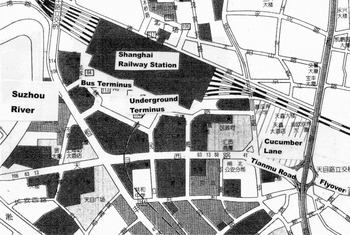
In the spatial imagination of the Shanghainese, Cucumber Lane was considered being located in the “lower corner” (xiazhijiao) of Shanghai even in the heyday of socialism. In the local dialect, the term symbolizes the low socioeconomic status of the place full of outmoded buildings, and poor and uncivilized residents.Footnote 14 This spatial feature was perhaps an important factor in the state's decision to turn Cucumber Lane into a celebrated “proletarian space” in the mid-1960s.Footnote 15 Unlike what its name implied, Cucumber Lane was neither a blind alley nor a short street. It was a fenced-residential area covering some 70,000 square meters. Being at one of the busiest traffic nexuses in Shanghai, it was located close to the Shanghai Railway Station, the subway and bus terminuses. Along its southern boundary were Tianmu Road and Tianmu Road Flyover, two major thoroughfares (Figure 1). At the time of fieldwork, it accommodated about 2,000 residents in 52 five-story residential blocks. According to the information provided by the Residents’ Committee, 20.5% of the residents were aged 60 or older.Footnote 16 It should be noted that the residentship of the community had been very stable since its 1960s transformation despite the rapid development in Shanghai across the 1990s.Footnote 17
Cucumber Lane and its adjoining areas.

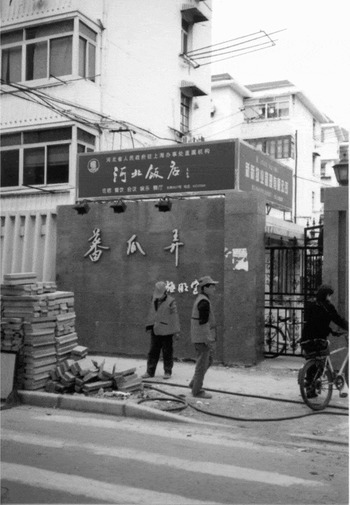
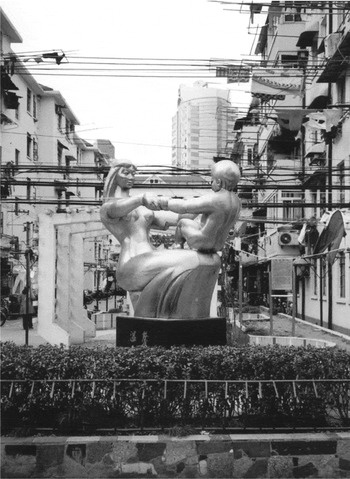
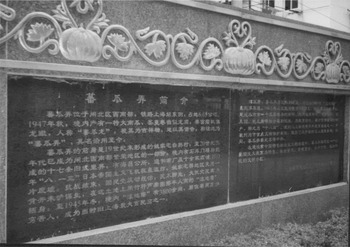
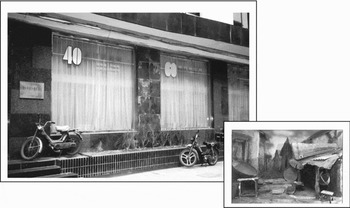
When entering Cucumber Lane through the front gate,Footnote 18 one would be immediately greeted by a metallic sculpture called “Warmth and Joy” (wenxing)—a mother facing her son and holding his hands. The statue was erected in 1996, when Cucumber Lane underwent major renovations in 1995–97, and was awarded the title of wenming xiaoqu, literally “civilized small community” in early 1997. This development was subsumed under a broader state-led project of modernity known as “spiritual civilization”. Residents agreed almost unanimously that the statue symbolized the idea that the love that the CCP had shown to the residents was comparable with the love of a mother for her son (Figure 3). Near the statue was a marble wall—also erected in 1997—on which the “official” history of Cucumber Lane was inscribed (Figure 4). Part of the inscription read as follows:
Cucumber Lane was formerly a natural village called Yaojiazhai, which formed at the end of the nineteenth century. In the 1920s, it became part of the prosperous region in the southwest part of Zhabei District. . . . During the August Thirteenth Incident in 1937, the Japanese imperialists launched waves of carpet-bombings. Yaojiazhai fell into ruins. After the Sino-Japanese War of Resistance ended [in 1945], people still led miserable lives under the counterrevolutionary authority of the Nationalist Party. Many people were forced to leave their hometown to seek a living in Shanghai. In this piece of land, people lived inside the “half a human high” [banrengao] gundilong [huts] built with reeds and bamboo. In the winter of 1945, there were some 3,800 gundilong housing over 20,000 poor people. It was one of the largest slums in Old Shanghai.
The front Gate (part).

The mother-and-son sculpture.

The marble wall.

After Liberation [in 1949], the residents of Cucumber Lane were reborn. Gundilong were removed and replaced with cottages. In 1965, the People's Government spent five million yuan renovating the shanty area of Cucumber Lane, and building the first new estate with five-story residential blocks. Inside the new-village, trees were planted everywhere. Social welfare facilities such as primary schools, kindergartens, and day nurseries were built. To educate the young generation, the new estate retained some old-style shanty huts [i.e., gundilong] called “shibajian” [literally, “eighteen huts”]. Cucumber Lane became one of the youth education bases of the Shanghai Municipality, and was evaluated as a “cultural object” [wenwu] under the special protection of the municipal authorities. Since then, it has attracted many groups of visitors and individual visitors. Consequently, Cucumber Lane enjoys a great deal of popularity among locals and foreigners.
In the process of developing socialism with Chinese characteristics, Cucumber Lane has now become a modern, civilized small community [wenming xiaoqu] characterized by patriotic education [aiguo jiaoyu], stability, tranquility, and convenience.
One should be reminded that in the last paragraph, the term “patriotic education” was used instead of “thought education,” “political education” or “class education,” which was widely used in Maoist political propaganda (a point to which I will return later). Besides, the much-quoted slogan of “socialism with Chinese characteristics” and the discourse related to “civility” (wenming) were two conspicuous reflections of the reformist ideology. Implicit in the description was that some of the political ideas that were conceived and came into vogue during the Maoist period were rendered “invisible” in space by being consciously changed or displaced with other ideas.
The most symbolic about the fading out of Maoist ideology was the disappearance of the “18 huts.” Throughout the course of my fieldwork, I was often told regretfully by elderly residents that had I come 4 years earlier, I would have been able to see the 18 real gundilong. In the mid-1960s, when some of the residents were able to move into the new flats installed with electricity, flush toilets and running water, they realized that it was “heaven” as compared to the homes they had lived in. This history of Cucumber Lane reflected how the gundilong had been used in thought education to show visitors the radical changes in their lives before and after Liberation.Footnote 19 The huts were pulled down, however, in 1995–96 to make space for a hotel and for a new building to house the Street Office. Although several gundilong had been exhibited inside a small museum located at the new Street Office building since then, the residents kept reminding me that those were “not as good as the old ones” as they were just replicas. Indeed, these fabricated gundilong were hardly of interest to visitors (Figure 5).
The Cucumber Lane museum (left) and the fabricated gundilong (right).

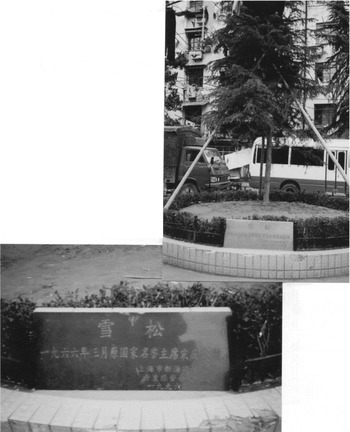
Perhaps the only spatial mark that was reminiscent of the Maoist past in Cucumber Lane was a slender, rather inconspicuous, pine tree. The tree was said to be donated in 1966 by Ms. Song Qingling, the wife of Dr. Sun Yatsen, the man widely regarded as “China's National Father.” However, the appearance of the tree was by no means consistent with its (past) political fame (Figure 6). Some residents recalled that two fractions of Red Guards once dashed into Cucumber Lane at the start of the Cultural Revolution around 1966–67. A fierce debate took place among the Red Guards on whether the tree should be removed. No one seemed to know how the debate was resolved, but they believed almost unanimously that the tree they had nowadays was not the one donated by Ms. Song. They remarked that the tree was just “too thin and weak” to be over 40 years old. The stele that illustrated the background of the tree was reproduced in 1996. Some residents even suspected that the original stele had been destroyed during the Cultural Revolution together with the “old” tree.
The tree said to be donated by Ms. Song Qing-ling and the Stele.

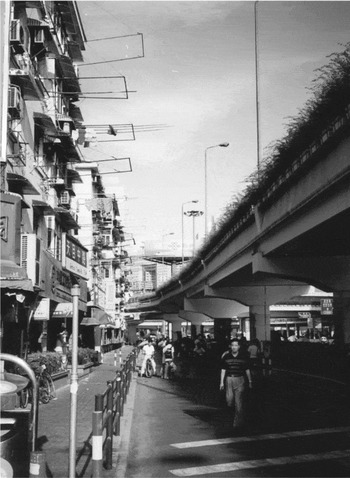
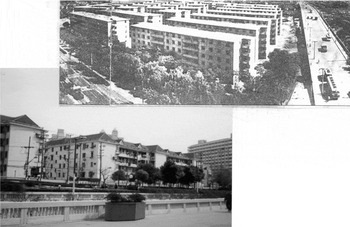
The monuments aside, the overall spatial appearance of Cucumber Lane also showed a disjunction with the Maoist regime (1949–76). For instance, there were more residential blocks built in the 1960s than can be seen today. The reason for this was that in 1995–96 the residential blocks at the “outermost layer” were demolished to build new roads and the Tianmu Road Flyover, which now encircle Cucumber Lane (Figure 7). What had made the present appearance of Cucumber Lane so different from that of the past, however, were the rooftops. They were changed “from-flat-to-slanted” (ping gai po) in 1997 (Figure 8). An official at the Street Office proudly told me that the cost of changing just the rooftop, i.e., 5 million yuan, equalled the amount spent on renovating the whole of Cucumber Lane in the mid-1960s.
Cucumber Lane (left) and the Tianmu road flyover (right).

Cucumber Lane in the 1960s (upper) (Source: Upper, Zhabei District Archives) and the present (below).

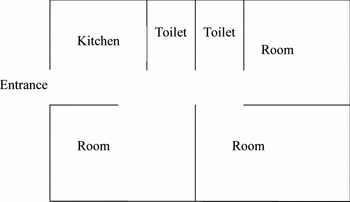
Although the shape of the residential block in Cucumber Lane varied, the interior design of the flats remained largely the same. Each residential block had four floors. On each floor, there were two or three doorways. Each doorway first led to a kitchen, then two toilets and three rooms (Figure 9). This design, which was conceived in the 1960s, placed a strong emphasis on collective living rather than on individual privacy. The sharing of a common kitchen (with a single sink, single water tap, and single water bill), and very often of the two toilets, aimed to foster a culture among the neighbours of mutual help, mutual understanding, as well as mutual surveillance.Footnote 20 A former “teacher” of the model community (63-year-old) once commented on the historical significance of the interior design; she said, “Chairman Mao believed that people from the same class would share the ‘same class feeling.’ It did work when Chairman Mao was alive. After he died, ‘class feeling’ no longer worked.” Indeed, daily disputes among different families over the use of kitchen space, and the water bills, had become so frequent in the mid-1990s that the municipal government changed the design of the kitchen by dividing the sink into three sections, with individual water taps and meters.
The floor plan of a flat in Cucumber Lane.

The above briefly introduced the background of Cucumber Lane, spatial and historical. It showed a revised (dis-)course of national development in the reformist era, reflected and worked out not only in the new ideological system of discourse but also in spatial re-organization. A series of state-led spatial strategies included setting up statues, erecting memorial markers (e.g., the marble wall), putting on rooftops, removing the 18 gundilong, building a new Street Office building, and changing interior settings (e.g., separating sinks). All indicated a conscious shift of national development such that the state tended to dissociate itself from the ideological raison d'etre of the Maoist past and to establish a new, more relevant, viable, and appealing doctrine for China's modernization.Footnote 21 In the following, the discussion would be focused on how the residents had been living through the two major spatial re-organizations.
A Thought Education Base in the 1960s: Foretelling the Proletarian Triumph
Alongside the Gonghe New Road bridge stands a group of residential blocks in plain color. They are the first 10 five-story blocks that marked the completion of the first phrase of the Cucumber Lane renovation project. The finished blocks occupy 19,600 square meters. The two blocks near Tianmu Road are in the shape of the Chinese character ‘one’ [i.e., “—”]; the other eight blocks were arranged like the shape of the cinquefoil [meihua]. The walls of the flats were as white as snow. Sunlight passes through the steel-framed windows, making the flats even brighter. Every flat is equipped with running water, electric lighting, and flush toilets; moreover, every kitchen has a supply of gas. The internal design of the flat is suited to the needs of families of various sizes. Almost all of the rooms face south; those facing north are mostly toilets and kitchens. (17th July 1964, Jiefang Daily [jiefang ribao])
Both in the reminiscences of the old residents and in the official discourse, gundilong was widely described in terms of its impoverishment, sordidness and maleficence. It was, after all, a symbol of “backwardness.” In their oral histories, gundilong was described as being “half a human high,” i.e., only waist-high; and people needed to bend down to enter. Gundilong were of two shapes: one was the more common semi-circular shape and the other was a triangular shape (renzixing, literally “the shape similar to the Chinese word ‘human’ ( )”). Thus, geometrically, gundilong were distributed like long semi-circular, or triangular, tubes lying on the ground with openings—the doorways—on the semi-circular or triangular surfaces. Once inside, one could only be comfortable either sitting, crouching, or lying, but one could not stand. Moreover, the ground inside the gundilong was muddy and humid. Residents often lamented that their feet were infected by the wastewater, causing them to become itchy, swollen, and even rotten. Having no special section for toilets in gundilong, residents used a bucket as a chamber pot. While being used, the “toilet” was usually surrounded by a piece of rotten wood, or tattered cloth, in order to preserve some privacy. Night soil was dumped directly into the gutters at the periphery of the community. Cooking was done outside the hut either in front of, or beside the doorway. The “stove” was essentially a hole dug on the ground with brushwood and grass picked up elsewhere for fuel. At night, Cucumber Lane was pitch-dark as almost no one there could afford electricityFootnote 22; and there were few who could afford to light candles.
In the Zhabei District History Gazette published in 1997, an appendix was devoted to the “official” history of Cucumber Lane. It records a verse that sarcastically describes the shape of gundilong:
Cucumber Lane is the “hole [may read: opening] of a culvert” [yingaudong].Footnote 23 When walking, one needs to bow three times in taking one step. It is not better than a pigsty.Footnote 24
One should be reminded that the gundilong in Cucumber Lane were less chaotically distributed than portrayed in this “official history.”Footnote 25 Oral evidence suggested that they were generally arranged in rows, with the doorways facing each other. There were at least two reasons behind such a relatively “organized” spatial arrangement. First, oral evidence showed that gundilong were not constructed randomly in Cucumber Lane but “managed” by local gangsters who rented and sold them. Indeed, there were businesses in Cucumber Lane that were related to the building of gundilong, and a number of residents (some of whose children were interviewed) were engaged in these businesses for a living. Second, hoodlums were active at that time. These local gangsters often extorted money from the residents to celebrate the birthday of the chieftain, or for important Chinese festivals, or for “whatever reasons they could make up.” All of this required the local “managers” to possess a systematic understanding of the residents; and an organized spatial arrangement of gundilong was obviously useful to them. The situation was like what a cultural geographer reminded us that spatiality was never as power-free as it looked; and one must constantly be aware of how relations of power and discipline were inscribed into the apparently innocent spatiality of social life.Footnote 26
After the communist takeover in 1949, some of the gundilong were pulled down and eventually replaced by cottages.Footnote 27 The residents said that they could live with “their backs straight” since then. In 1961, the state launched a reconstruction plan to rid Cucumber Lane of all gundilong and build five-storey concrete residential blocks in the localityFootnote 28; but the actual work of construction began until 1963. An official document at the Zhabei District Archives indicated that the blocks located at the centre of Cucumber Lane were arranged quincuncially resembling the petals of the cinquefoil (meihua)—like what was mentioned in the newspaper excerpt at the head of this section. No “official” reasons for such an arrangement could be identified, but the residents generally believed that it was to add an aesthetic dimension to the architectural design of the socialist “model community.” In traditional Chinese culture, the cinquefoil symbolizes intellectuality, virtuosity and high-mindedness.
Evidently, the transformation of Cucumber Lane into a socialist “model” was also related to the broader political and economic environments in the mid-1960s.Footnote 29 In fact, the first half of the 1960s was only characterized by a tremendous state effort to revitalize the dislocated economy from the effects of the over-ambitious campaign The Great Leap Forward (1958–60), and from the natural disasters and the withdrawal of Soviet technicians in the next few years. Shanghai, however, quickly recovered from the difficult times, and 1963 recorded 12.9% rise in industrial production in comparison with that of the previous year. This marked a growth for the first time in the past 3 years.Footnote 30 Having such a rather quick economic recovery, Shanghai became a desirable place to reaffirm both to the local populace and to the international community the viability, and even the superiority, of the Chinese approach to socialism. The transformation of Cucumber Lane seemed to play a role in boosting China's international image that became even more important because of the Sino-Soviet rupture during the early 1960s.
On 16 July 1964, a front-page article of the Xinmin Evening News (Xinmin wanbao) wrote:
At nine o'clock this morning, in Cucumber Lane, the sound of gongs and drums roared the sky. The air was filled with happiness. The first batch of 45 households no longer had to remain living in huts. They felt excited about moving into the flats inside the newly built five-story residential blocks.Footnote 31
The residents of the residential blocks located at the centre (or, the core) were overwhelmingly those who had been living in the gundilong. These “old residents” (lao jumin)Footnote 32 were regarded as “revolutionary” in the state propaganda, as they had been severely exploited under the former political regime. With regard to the other blocks that were subsequently built around the core is the “periphery,” residency was eventually extended to other “revolutionary masses,” including “advanced workers” and “model labourers” from the work units; cadres; and veteran soldiers of the People's Liberation Army.
To allow these “old residents” to live at the core, which was spatially organized after a high-toned cultural symbol of the cinquefoil, well-represented a political endeavour to show the wider public that the ideology of the state was to “elevate” the revolutionary image of those who were real proletarians in the former regime higher up than the other revolutionary masses. Drawing on the work of Lefebvre, such a “core-periphery” sociopolitical hierarchy and segregation could be considered being produced by imaginary and symbolic elements that served the interests of dominant sociopolitical groups.Footnote 33
Another imaginary and symbolic element that epitomized the uplift of social status of a subordinate people was the height of the residential blocks. A retired female resident (52-year-old), also a former Chief of the Residents’ Committee, said:
In the past, houses were generally very short—two stories high, at most. Now, of course, there are many high-rise buildings around, and this is no longer a case. But in the past, when people walked into Cucumber Lane, and looked up at us, we could tell from their eyes that they envied us very much. We all felt very proud to tell others our family [jia]Footnote 34 was here.
The height thus conjured up the social imaginary in space, symbolizing the “proletarian triumph” to be “legible”—a term borrowed from James ScottFootnote 35—not only by the residents but also by the wider public as well as by foreign visitors.
But the most powerful social imaginaries of all seemed to be inscribed in the 18 gundilong, symbolizing the grand national transition, from the “backwardness” of capitalism to “advanced” socialism.Footnote 36 Of particular importance was that such a spatial metaphor featured a clear “origin”—the backwardness, shabbiness, inferiority—i.e., the “common past” for both the residents and the country as a whole. It also foretold a legible future, i.e. a “common destiny,” of “advancement,” “cleanliness,” and “superiority,” symbolized in the spatial characteristics of the residential blocks—regimented, made of concrete, light in color, and large in size, with imposing entrances and uniform, regularly spaced window frames.
If the social imaginary conjured up among the wider public had successfully turned Cucumber Lane into a socialist “model” and brought them together with the discourse of modernity on the rosy national destiny, the residents who actually moved into the flats simply believed that they already exemplified the “triumph of the proletariat.” Thanks to the “superiority of socialism,” they could enjoy the most “advanced” flats of the city.
Inside the flat, it was common for two or three different households to need to share the kitchen and sanitary facilities. Despite the lack of concern for privacy, the spatial design signified a domestic sphere that was open and free, and forcefully disseminated the socialist ideals of equality, mutual help, and harmonious relations. The residents gladly accepted this arrangement, as it was, they said designed to enhance “mutual help” among neighbours. But some residents clearly admitted that on occasion, the spatial design also represented “mutual monitoring” among neighbours to boost political vigilance among the residents so that their politically incorrect thoughts and actions could quickly be seen, identified and rectified. Obviously, this “monitoring gaze” was in some sense parallel but not as powerful as the panopticon, under which the prisoner had no escape from the gaze of the tower guards. For more privacy, one could return to his or her room and close the door. But, this architectural structure could produce similar effects, especially during the fanatical period of Cultural Revolution. Many revealed that during that period they were very careful about their words when interacting with their neighbours in the shared area. At that time, they were expected to act “more revolutionary than common people” and be united in the cause of revolution. Any signs of “having the thoughts of petty bourgeois,” or simply “not acting revolutionary enough” could lead to political vituperation. As a result, they, like the “subjects” of the panopticon, assumed responsibility for self-discipline due to the highly visible, although very often unverifiable, political monitoring.
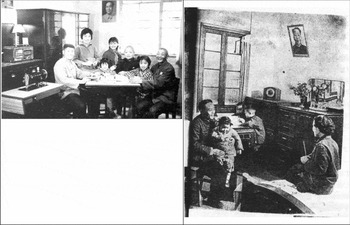
Another spatial metaphor that foretold national development towards the “triumph of the proletariat” was the birth of the “advanced family.” In the Maoist lexicon, “advanced family” generally referred to one that unreservedly subscribed to socialist doctrines; but it was also a notion that had been widely adopted in everyday discourse. In making use of the spatial characteristics of Cucumber Lane, the state used photos of the “advanced family” as a means of conjuring up the social imaginary of a glorious revolutionary future among the wider public. For example, one could refer to two photos used as propaganda during the Maoist period in Shanghai. The two photos were identified at the Zhabei District Archives (Figure 10). Both photos were said to have been taken in the flats of Cucumber Lane, and have been used as exhibits for visitors. They all presented a happy family with a projected domestic interior that was open and public, simple but satisfying, and that ultimately centred on an intimacy with the portrait of Chairman Mao. One may also consider that such emphasis on family with modern supplements (such as clocks, radios and sowing machines) in these illustrations represented a symbolic integration between traditional Chinese ideas of family and the “modern” egalitarian utopia based on relations of class.Footnote 37
Two happy families in Cucumber Lane (Source: Zhabei District Archives).

Elevated physically from living in the half-human high gundilong to “Shanghai's tallest public housing,” and symbolically to living in the “advanced” socialist ethos, the residents of Cucumber Lane truly felt that their “destined future,” “the triumph of the proletariat,” had come to an early fruition as they had already benefited from it before the whole country had! Able to chalk out vividly a specific course of national development with the pertinent allocation of resources (essentially the flats), the state-led re-organization of spatiality was highly successful in getting public support for the project of modernity.Footnote 38
A “Civilized Small Community” in the 1990s: Envisioning Civility
All of these [spatial] changes are for what!? Nothing! They have absolutely nothing to do with the lives of the residents!
– A 46-year-old resident, a CCP member.
When Deng Xiaoping, the reformist, came to power in 1978, his policies marked a radical overhaul of Mao's political directives. Deng placed economic progress above the Maoist ideology of class struggle and continual revolution. In his attempts to separate economics from politics–quite daring in the late 1970s—he urged the public to leave off the ideology of “continual revolution” and to “seek truth from facts.” Since the launching of reforms, the state has been selling off state-owned industries, actively soliciting foreign investment, privatising land, letting public utility institutions (such as hospitals) earn profits, cutting back on the military, and setting up Special Economic Zones.Footnote 39 All these measures were to ensure that the market economy flourishes. The once hard-faced motto of Maoist egalitarianism, which had exhorted China to “put politics in command,” gave way to a new form of “socialism” summed up by the new aphorism “To get rich is glorious.” Undeniably, the switch from a planned to a market-oriented economy had brought about not only a thrilling economic boom but also a general improvement in living standards. For instance, it had become common to hear residents—old and young—extol the improvement in their living standards since the 1990s.Footnote 40
But the increase in wealth should not make one overlook the emergence of festering social problems, such as unemployment, corruption and crime. The Residents’ Committee did not reveal the precise figures on the occupational structure of the residents, as the party branch secretary frankly told me the information of xiagang (literally, “stepping down from one's post”) was still politically sensitive. What she revealed was that almost all elderly residents were retired with pension benefits, and almost all middle-aged residents (i.e., aged 40 years old or above) had suffered or were still suffering from xiagang. My fieldwork confirmed her claim. In Shanghai, this near-homogeneity was not common in other communities, but, I surmised, because of the fact that the second-generation residents of Cucumber Lane were more likely than others to follow the typical socialist life-trajectory–first, education, then, danwei (work-units), then, xiagang. The middle-aged residents generally agreed that they tended to act more “conservatively” in the past as they were told by their parents and the state, to act “revolutionarily.” For instance, a 39-year-old resident who was laid off from a state-owned enterprise several years ago said that no one in his age-cohort thought that setting up a business was a good thing to do even after the CCP launched the reforms and opening in the late 1970s. While he knew that many other Shanghainese were venturing into innovative lucrative activities in the early 1980s, many in his generation felt more secure and even more content to work in the state-owned enterprises with their concomitant cradle-to-grave welfare benefits.
Understandably, most second-generation residents agreed that the problem of unemployment had been most serious. They were either laid off or made early retired without pension benefits. Although many of them were lucky enough to find new jobs in the market, these jobs were low-paid, required long working hours, and lacked welfare benefits. To them, the idea—“let some people get rich first”—had created not only a nouveaux riche who could enjoy a material wealth they had never dreamed of in the Maoist era but also a large number of low-skilled, low-educated workers sacked from money-losing state-owned enterprises, just like themselves.
Able to foresee the emerging social problems early in the 1980s, Deng issued a stern warning in the sixth plenary session of the 12th Central Committee of the CCP in September 1986. It was the first occasion that the phrase “spiritual civilization” (jingshen wenming) officially appeared.Footnote 41 This later proved to be an important principle in guiding the state project of modernity, or more exactly, of “modernization” in reform China. The “spiritual civilization” campaign marked the state endeavour to unite the people by arousing what is called, as observed by Zhao, their “consciousness of suffering” from disorder and humiliation in the hands of foreign powers and by “recapturing [for them] the past glory of the Chinese history.”Footnote 42 Smith also rightly observed that the campaign resonated “strongly with China's ancient self-image as ‘the land of ritual and right behavior’ (liyi zhi bang).”Footnote 43 Thus, rather than appealing to the shared proletarian past of people, the rhetoric of civility thematized a “common past” when Chinese (properly only ethnic Han people) proudly regarded themselves as the only “civilized” people; and people from foreign countries had been either brought to heel, or visited China to admire its sophisticated arts and crafts, and advanced technology.Footnote 44 And, through improving the “quality of people” (renmin de suzhi) towards “civilized” ends, China would recapture the glory it had once had in moving towards a bright future with economic success.Footnote 45 All of this constituted a new discourse of modernity in the 1990s to the effect that, by improving the civility of the people, which was “lacking,” China would progress towards—once again—a rosy future.Footnote 46
At the community level, the state designed a series of pilot projects to explore innovative ways of governance, including employing professional social workers in the Residents’ Committee and undertaking more democratic ways of electing the members of Residents’ Committees.Footnote 47 According to Pan, the official goal is to create a “small government; big society” with the implication for “a gradual diminishing role of the late socialist state in providing welfare services to the urban population.”Footnote 48
As in Cucumber Lane, the emerging discourse of modernity began to be translated into the visual representations of space in the mid-1990s. As learnt earlier from the marble wall inscription, terms that had a heavy Marxist/Leninist/Maoist flavour, such as “class education” and “thought education,” were replaced by terms trumpeting the traditional glory of the nation, such as “patriotism” and “patriotic education.” This change was in parallel with the well-expressed nostalgia of the “spiritual civilization” campaign for traditional Chinese cultural values, such as patriotism, respect for tradition, family, and authority.Footnote 49
The major spatial change at the community level under the “spiritual civilization” campaign indeed rested upon the award of “civilized small community,” or what was officially translated as “model quarter.”Footnote 50 In Shanghai, Cucumber Lane was among the first communities to be awarded this title in early 1997. To prepare for this award, a local cadre revealed that the government had undertaken a series of construction and renovation work since the end of 1995. Apart from what has been mentioned in passing (e.g., erecting statues and memorial markers), the construction work also included expanding the area of the greenery, decorating the rooftops with neon light, and repainting the walls of all residential blocks.
Juxtaposing the title “civilized small community” was the enforcement of a series of guidelines to “standardize” or “regulate” (guifanhua) their use of space. These changes and control of space echoed the state endeavour to create anew the social imaginary that symbolized a more “civilized” future with economic success. More concretely, these guidelines were meant to enforce the “Seven Nots”: “Not to spit; Not to litter; Not to damage public property; Not to damage the greenery; Not to jaywalk; Not to smoke in public places; and Not to speak foul language.” They were also meant to eliminate the “Six Disorderlinesses”: “Disorderly spitting and littering; Disorderly posting of advertisements; Disorderly construction of buildings; Disorderly selling of goods; Disorderly storage and accumulation of things [in public places]; and Disorderly hanging out of clothes.”Footnote 51
To enforce these guidelines were no longer the virtuous “old mothers” who had been living in the community, but former state workers employed from outside. These relatively younger Residents’ Committee members were considered as not truly “serving the people,” but working for a salary. They were widely recognized as but the administrative “legs” under the guidance of the base-level government.Footnote 52
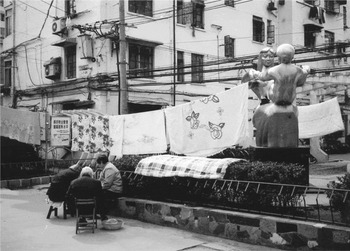
With the ultimate objective to improve the “quality of people,” the “civilized” guidelines were received with apathy and, on occasion, resisted. For instance, to dry clothes in the outdoor areas was classified as one of the “Six Disorderlinesses.” But when it was sunny (especially after several rainy days), clothes were hung virtually everywhere (Figure 11). In explaining this glaringly “uncivilized” behaviour, an old resident said, “I only dry my cloth in front of ‘the doorway of my family.’ How far can it be wrong!?”
Hanging out clothes.

Also forbidden under the new disciplinary system was gambling in the public area. “This rule affected residents most,” said another old resident, “as there were many old people around, they did not want to go anywhere, but played mahjong with neighbors. [. . .] Some [residents] queried what's wrong with playing mahjong just in ‘one's own place’ [ziji de difang]!?” At first glance, the open playing of mahjong had been effectively eliminated. But in summer time, the residents often set up their own moveable lighting facilities in the open area, and brought along their own drinks to play mahjong at night. Hoping to benefit from the cooler temperatures at night, they committed the “uncivilized” acts only when members of the Residents’ Committee who enforced the guidelines were off duty. These resistances could be referred to de Certeau's spatial “tactics,” which were employed by the weak to create their own trajectories through the spaces defined by powerful others.Footnote 53
Another spatial change worth being examined was the new rooftop. In a TV talk show (which I happened to watch during my fieldwork) that introduced the efforts of the municipal government to renovate the local community, a government official thematized the high technological value and economic value (5 million yuan) of the rooftop used in Cucumber Lane. The official reminded the audience that the American-made rooftops did not only function technologically as a good thermo-insulator for some residents but were also meant to benefit the whole populace of Shanghai due to its function to reduce the “fifth kind of pollution”—visual pollution—by international classifications. His remarks implied that the state was making progress in pushing community redevelopment programs to meet global standards, and Cucumber Lane was, at least, one of the exemplars.
Undoubtedly, many residents did think that the new rooftop as well as other spatial changes that were made in the 1990s had made Cucumber Lane look more beautiful, “high-class,” and even more “civilized.” But they were, in general, very unenthusiastic about the rhetoric of civility in guiding them to the destined future. Many muttered that the change was merely to embellish a façade (biaomian) without paying attention to the residents’ need for better interior designs.Footnote 54 One of my informants even remarked sarcastically: “It is just like a palace outside. Inside, it is like a trash can!” Many complained on the ground that should the government was willing to spend so much money on embellishing the façade, they should have transformed the flats into a “single-doorway-single-household” (dumen duhu) design. This commonly expressed wish essentially referred to a spatial arrangement in which different families did not have to share the single entrance as well as the kitchen and toilet; and each family became an individual household. Such design, according to the residents, would effectively give them more “privacy,” and save them from the everyday inconvenience and conflicts arising from sharing a toilet and kitchen with others.
Even the state changed the design of the kitchen with individual water taps and meters for each household, conflicts among neighbours had not disappeared. For instance, my informants were often displeased by their neighbours who occupied the common area of the flat, or messed it up. Other common disputes arose from differences in lifestyle; e.g., some residents were not used to flushing the toilet every time after they used it, causing unpleasant smells. But, the residents were well aware that their hope for dumen duhu would never be realized owing to the constraints of the old architectural design.
Former spatial arrangements based on the socialist ethos of openness, public and harmony had become a constant source of conflict. Fed up with the disputes over the neighbours’ daily practice of using the shared area, the son of my landlady (a 33-year-old civil servant) once told me:
Like the Hong Kong people [the author was from Hong Kong–mine], Shanghai people also expect to have more privacy at home. . . . I now want to earn enough money to move out of here. For example, you look at the newly built flats in Pudong. They are all spacious. [. . .] They are all dumen duhu. [. . .] Some are not very expensive, either.
The rising expectation for more residential privacy was inevitably related to the boom of the real-estate market since 1990.Footnote 55 The recent real estate development had made new high-class residential areas. While new public icons of the Shanghai's “upper corner,” such as the Hongqiao District and Pudong New Area, were subsequently developed, or transformed into uptown areas with modernized high-rise buildings,Footnote 56 Cucumber Lane was left behind in the “lower corner.”
The “socialist spiritual civilization,” like the discourse of “proletarian triumph,” attempted to inscribe an ideological trope in space as to represent a wilful societal transformation from its present state of backwardness and lack to a future characterized by advancement and progress.Footnote 57 But, unlike the spatial representation in the 1960s, the rhetoric of civility seemed to fail to inform the residents with a clear “common past” (like the 18 huts); nor it had impressed them with a specific course of national development. In fact, by failing to provide appropriate resources to meet the residents’ desire for up-to-standard space such as dumen duhu, the state as well as its unavailing attempts to construct a “civilized space” had met with resistance from the residents. One empirical indication was that the verbal use of such phrases “my family,” “my place” and “inside” had been increasing to the extent that individuals had come to lay claims on the spatial control of a given locality that had been publicly shared–a process Zhang called “informal privatisation of space” in her anthropological investigation of a marketplace in post-socialist China.Footnote 58 Such resistances featured the residents’ lack of faith that the state would serve the real needs of the people, like the quote that opened the head of this section. One consequence was that the residents, although still being able to benefit from the state-led projects somehow, were increasingly considering that their lives were largely their own–an idea that underpinned the residents’ carving for more residential privacy in the rampant development of “commodity housing.”
To end this section, an interesting note was worth being registered: The recent project of modernity also led to an increasing internal differentiation among the residents. In particular, conflicts increasingly arose along the fault line of the “untidy,” “dirty,” “impolite” and “poorly educated” “old residents” spatially distributed at the “core”; and the “tidy,” “clean,” “polite” and “better educated” others at the “periphery.” Despite being widely acclaimed as more “revolutionary” in the Maoist period, many households located at the “centre” were poorer and less educated than those living at the “periphery.” Simply speaking, the “old residents” were considered by other residents to be lacking the “civilized qualities.”
Discussions: Producing and Resisting Domination of the Modern Space
What lessons have we learnt from the story of Cucumber Lane discussed so far? More than a decade, social scientists have been interested in spatial dimensions of unequal social relations.Footnote 59 For instance, Lefebvre argued for the clandestine nature of modern power that mediated social relations emerging in a particular space.Footnote 60 He held that in neo-capitalist society, different sociopolitical interests and forces endowed space with different meanings, uses and values; which created, as Routledge elaborated, “various tensions and conflicts within society over the uses of space for individual and social purposes and the domination of space by the state and other forms of class and social power.”Footnote 61 Drawing on Lefebvre's work and others, Caldeira's study on the changing urban spatial landscape of Sao Paulo examined how space led to peculiar social hierarchy and segregation based on the disparity of wealth.Footnote 62
Most relevant to Cucumber Lane was perhaps the discussions put forward by Scott, who used several centrally-planned social-engineering projects as examples to illustrate how the planners, bureaucrats and scientists constructed heroic visions—the dominant logic—through space in the state attempts of “high modernism.” The development trajectory of Cucumber Lane represented the two attempts on the part of the state to inscribe a “logic,” a discourse of modernity on the community spatial landscape. Each of these attempts consciously manipulated the definition of the past and future through the manipulations of space, and to produce a specific ideological telos of national development of the time.
But, given the clandestine nature of (modern) power, and the imaginary and symbolic elements inscribed in the production of space, a question arose: will the existing spatial configuration and its hidden dominant sociopolitical interest and force prevail forever, and revolt by the users be unthinkable?Footnote 63 Lefebvre suggested that rather than passively experience spatiality, the users sought to change and (re)appropriate space which sooner or later caused the logic behind the represented space to lose its consistency.Footnote 64 To de Certeau, these resistances were understood as “tactics” which operated in isolated actions, blow by blow, and do “not have the options of planning general strategy and viewing the adversary as a whole within a district, visible, and objectifiable space.”Footnote 65 Shields once provided vivid examples of these resistive practices, including re-territorializations of space; abrogation of the private property system such as squatting in the context of Third World barrio communities; or denials of pragmatic conventions such as just sitting on the floor rather than using benches.Footnote 66 Offering another articulation of spatial resistance, Davis examined several Latino border communities in Southern California. Engaging in complex oppositions and assimilation with the dominant culture and politics, the Latinos have been actively creating its Latinized culture, including food, music and designs, which continue to oppose, and influence the mainstream of the U.S. city lives.Footnote 67
Yet, the resistances in Cucumber Lane were articulated in another way. In the 1960s, the dominant sociopolitical force—the state power—used all possible means to eliminate existing spatial differences or peculiarities, which managed to achieve harmony among users. The visions of the future assumed a swift and painless shift from capitalism to the socialist utopia. The spatial contrast between the 18 gundilong and the “advanced” residential blocks vividly portrayed this transition for the residents and the wider public. The residents came to share the same social imaginary symbolized by a series of socialist abstractions in space (such as “public and private” and “core and periphery”), which made them feel that they already exemplified the proletarian triumph, and that the whole country would follow suit. But such spatial homogenisation had awakened various tensions among the residents in the 1990s. Various “civilized” measures to suppress differences and heterogeneity in the use of space were only provoking resistive spatial practices among the residents. The residents began to lay claims on the spatial control of a given locality as “private.” Also observed was that the former dominant logic behind the representation of space began to lose its consistency along the fault line of “core” and “periphery.” This could be reflected in what a 46-year-old resident who was born in the community and had been living in the “peripheral” blocks complained:
The residential blocks at our side are better. We have been living peacefully with our neighbors. That is, ‘others are treated as if they were our guests’ [xiangjing rubin]. Those who live in block numbers 18, 22, and 24, for example, are different. They speak loudly in the public area. They litter all over the place. They expose their bodies in the outdoor area in summer.[. . .] They have disputes with their neighbors almost everyday.[. . .] They are also poorer, and many of their children have been laid-off.[. . .] We, originally coming from outside [i.e., not originally from Cucumber Lane], are of relatively better quality [suzhi].
Furthermore, it was well to note that the state–people relationship in Cucumber Lane did not imply the usual, simple juxtaposition of the state versus citizens in western societies. In reality, the residents were usually dealing with specific agencies mediating the tension between state orders and residents’ resistances. For instance, the Chief of the Residents’ Committee—who was responsible for drumming up the residents’ support for the state-led “spiritual civilization” campaign—admitted that their work had been more difficult due to, rather ironically, the “incivility” of people. She said:
We speak of ‘civility’ now, but the ‘quality’ [suzhi] of the people just cannot live up to it.. . . [For example,] [w]e tell them not to hang out their clothes outside; we tell them not to litter the public area; we tell them not to play mahjong.[. . .] Some [residents] just turn a deaf ear to what you say. Some even fiercely shouted at us and said: ‘Mind your own business! You do not live here’.
A 42-year-old laid-off worker was particularly discontent with the Residents’ Committee members who merely followed the state orders without concerning the real needs of the residents.
When I meet them, I greet them with a smile.[. . .] [But,] [t]hey are just picking on residents’ daily life practices. They are not really there to ‘serve the people.’ They are just following orders sent down from the top! [. . .] This clique of people just works for a salary. They are not residents of Cucumber Lane. They are from outside [i.e., not living in Cucumber Lane].
In the eyes of most residents, the members of the Residents’ Committee were merely state representatives rather than morally virtuous “revolutionary cadres”; they were “distant” and “self-interested” figures who impose unnecessary constraints on the everyday lives of the residents in the name of the state. Thus, the story of Cucumber Lane reflected that the state (and the state power) was not a homogenous, monolithic concept, but usually articulated through the complex relationship between the government agency and the people, through which conflicting interests between the “state” and its citizens were played out in complicated ways.Footnote 68
In fact, the recent spatial changes in Cucumber Lane evoked negative experiences among many residents, especially, the second-generation residents, who thought that the former state-led project of modernity had failed to deliver the future that was promised. Many of the residents interviewed who were now in their forties and fifties had complicated feelings about the Maoist past. Some felt deep discontent with the state; some were frustrated by the vagaries of the market situation but saw the reforms as “inevitable”; and some held a more positive view and see the reforms as a golden opportunity to pursue personal wealth.Footnote 69
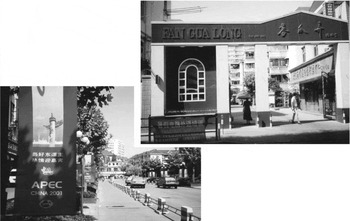
To end this essay, another interesting example seemed to be able to capture the crux of what have been saying: during my stay in Cucumber Lane, there was renovation work going on in the community. The appearance of the front gate had totally changed. One major difference was the recent insertion of the English romanization—pinyin—of Cucumber Lane alongside its Chinese characters. The outer walls of the residential blocks were repainted, the greenery was redecorated, and the streets around Cucumber Lane were festooned with colourful flags (Figure 12). Apart from a small number of elderly residents, no one seemed to be interested in these changes. Various versions of the following response from the 42-year-old resident whom I quoted earlier could be commonly identified during my fieldwork; she said, “They [the changes] are only for the conference of the Asia Pacific Economic Cooperation.[. . .] They [the state] want to show the foreigners some ‘pleasant-looking things’ [haokan de dongxi]. These changes are not for the residents!”
“Welcome the Guests from APEC”—a New Look for the road leading to Cucumber Lane (left) and a new look for the front gate (right).