INTRODUCTION
Learning disabilities (LDs) have been a central focus of neuropsychological research over the past 50 years. At least 18 of the 51 current and past Presidents of the International Neuropsychological Society (INS) published major research articles on LDs. Over this period, major developments in scientific understanding of LDs have had significant implications for assessment and intervention. These developments reflect a merger of disciplines and methods embraced by many neuropsychologists who work across the boundaries of disciplines. In this article, we present a brief historical context, summarize major scientific advances, and discuss their implications for practice. The bulk of research has focused on single-word reading difficulties, although research on other domains of LDs has been flourishing.
HISTORICAL CONTEXT
The hypothesis that difficulties learning to read, write, and do math have a neurobiological basis extends to the beginning of the previous century and is intertwined with the history of neurologically-based behavioral difficulties and attention-deficit/hyperactivity disorder (ADHD; Mahone & Denckla, in press). Early case summaries by ophthalmologists described reading difficulties in non-brain injured children as “word blindness” (Hinshelwood, Reference Hinshelwood1895). Orton (Reference Orton1928) used the term “dyslexia” to represent children who struggled to read and spell isolated words, attributed to disordered cerebral dominance for language. Kirk (Reference Kirk1963) used the term “learning disabilities” to refer to unexpected difficulties with academic skills secondary to language problems, but differentiated LDs from intellectual disabilities and behavior disorders.
Neuropsychology shares this historical context because 50 years ago assessment of brain-related functions was considered a primary basis for identifying LDs. The origin of the INS in 1967 began a heady period for neuropsychological research. Rourke (Reference Rourke1975) emphasized the importance of profile interpretations for inferring brain dysfunction in LDs. Benton (Reference Benton1975) identified eight neuropsychological correlates of reading difficulties, including finger agnosia, right–left confusion, auditory–visual integration (Belmont, Birch, & Belmont, Reference Belmont, Birch and Belmont1968), color naming difficulties based on alexia without agraphia (Geschwind & Fusillo, Reference Geschwind and Fusillo1966), and language problems. Denckla and Rudel (Reference Denckla and Rudel1974) developed rapid naming tests partly because of the color naming hypothesis. Benton hypothesized that the evidence pointed to a parietal lobe disorder that may be maturational, but not consistent with a developmental Gerstmann syndrome (Kinsbourne & Warrington, Reference Kinsbourne and Warrington1963). Satz and Sparrow (Reference Satz and Sparrow1970) tried to reconcile these hypotheses by attributing reading disabilities to a maturational lag in brain development.
Rutter and Yule (Reference Rutter and Yule1975) summarized epidemiological studies in which they differentiated children with “specific reading retardation” from “general backwards readers” because of a bimodal hump in the distribution of IQ and reading skills, differences in sex ratio, and signs of neurological dysfunction. Aptitude-achievement discrepancy methods for identification emerged and became a basis for public policy around the world. At a NATO-sponsored conference (Benton & Pearl, Reference Benton and Pearl1978), Rourke (Reference Rourke1978) refuted the maturational lag hypothesis, showing that neuropsychological deficits persisted. Vellutino (Reference Vellutino1978) argued that reading problems could be attributed to language difficulties, a view which now prevails. Doehring (Reference Doehring1978) characterized neuropsychological research on LDs as a “tangled web of behavioral research,” criticizing generalization to theories based on group comparisons of single variables in favor of multivariate approaches. This led to subtypes research in which profiles of neuropsychological tests were identified that presumably would lead to better understanding of the causes of LDs (Rourke, Reference Rourke1985). The impact of subtyping research culminated in research programs that focused on definition and classification and led to fundamental changes in how LDs are defined, de-emphasizing the importance of IQ (Morris & Fletcher, Reference Morris and Fletcher1988).
TRANSITION: THE INFLUENCE OF COGNITIVE NEUROSCIENCE
Against this background, contemporary cognitive and linguistic sciences emerged as experimental disciplines. The most significant influence on scientific understanding of LDs, other than the differentiation of academic skills and behavioral disorders, was the theory of speech processing as a segmented signal of phonological representations (Liberman Cooper, Shankweiler, & Studdert-Kennedy, Reference Liberman, Cooper, Shankweiler and Studdert-Kennedy1967) and the subsequent linkage of phonological awareness skills with the development of word recognition skills (Liberman, Reference Liberman1971). Consistent with investigations of Russian (Chirkina & Grigorenko, Reference Chirkina and Grigorenko2014) and European scientists (Snowling & Hulme, Reference Snowling and Hulme1994), these concepts revolutionized reading research.
Phonological awareness is a meta-cognitive understanding of the sound structure of speech. To learn to read, young children must link the orthographic patterns of written language to internal structures of speech to access the developing lexical system. Termed the alphabetic principle, this hypothesis has verification across languages that vary in the transparency of orthography and phonology (Ziegler & Goswami, Reference Ziegler and Goswami2005).
These discoveries were important for research on LDs because a specific cognitive skill, phonological awareness, was linked to decoding, a specific academic skill, with the same cognitive correlate explaining success and failure in reading. Academic skills are dimensional and represent normal variation in complex traits as opposed to discrete, qualitatively demarcated categories (e.g., Rutter & Yule, Reference Rutter and Yule1975). The dimensionality, as well as the complex phenotypic presentation of LDs, makes it difficult to reliably define individual cases into discrete categories (Ellis, Reference Ellis1984).
The differentiation of LDs into academic domains fueled an expansion of the research base from a focus on dyslexia, leading to a body of replicable research on cognitive correlates, and the neurobiological and contextual factors that related to six domains of LDs. Thus, LDs are separated into reading domains that occur at the level of the word (dyslexia) and at the level of text (reading comprehension). Math problems may be computational (dyscalculia) or involve problem solving, often word problems. Difficulties with written expression may involve basic skills needed for transcription (handwriting and spelling, dysgraphia) or for generating text in essays and stories. In any of these domains, a problem with a basic skill like word recognition, computation, or transcription will interfere with reading comprehension, math problem solving, or text generation (Pennington & Peterson, Reference Pennington and Peterson2015). Problems with these more complex skills are linked to domain-general higher-order language and attentional/executive skills that affect oral and written language. Although prototypes of each of these LDs can be clearly exemplified, the presentations are often comorbid, overlapping not only in the academic domains, but also with other disorders, such as ADHD and developmental language disorders (Fletcher et al., Reference Fletcher, Lyon, Fuchs and Barnesin press; Pennington, Reference Pennington2009).
CURRENT STATUS OF RESEARCH
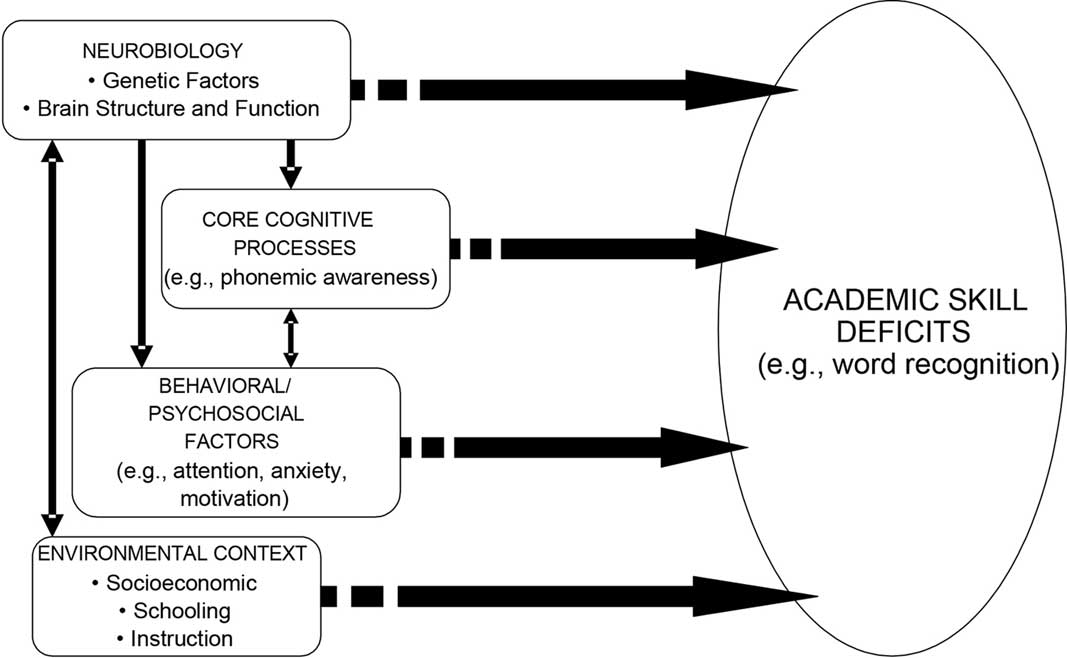
Over the past 25 years, international interdisciplinary research has mapped out relations of academic and cognitive skills, and related comorbidities, and helped establish a basis for effective intervention. In addition, research on brain structure and function and the genetics of LDs has taken advantage of new technologies. This research can be organized according to Figure 1 (Fletcher et al., Reference Fletcher, Lyon, Fuchs and Barnesin press), which shows the relations of academic skills, the primary defining attributes of LDs, with more proximal cognitive correlates, and behavioral traits (e.g., inattention, anxiety, motivation) that moderate the strong associations of cognitive and academic skills. The behavioral traits, such as ADHD, as well as overlapping academic and cognitive problems (e.g., processing speed; Willcutt et al., Reference Willcutt, Petrill, Wu, Boada, DeFries, Olson and Pennington2013), account for comorbidity (Pennington, Reference Pennington2006; Willcutt et al., Reference Willcutt, Betjemann, McGrath, Chhabildas, Olson, DeFries and Pennington2010; Reference Willcutt, Petrill, Wu, Boada, DeFries, Olson and Pennington2013). More distal neurobiological (neural and genetic) and contextual factors (home environment, instruction) also interact. In the next section, we describe major areas of research that make it possible to build this framework.
Framework representing different sources of variability that influence academic outcomes in children with learning disabilities. Copyright 2007 by Guilford Press. Reprinted with permission from Fletcher, J.M., Lyon, G.R., Fuchs, L.S., and Barnes, M.A. (Reference Fletcher, Lyon, Fuchs and Barnes2007). Learning disabilities: From identification to intervention. (1st and 2nd Eds.). New York: Guilford Press, p. 3.
Cognitive Correlates
Cognitive skills are systematically and differentially correlated with academic skills in the six domains of LDs. Classification research has shown that IQ is not predictive of LDs, especially in aptitude-achievement methods (Stuebing et al., Reference Stuebing, Fletcher, LeDoux, Lyon, Shaywitz and Shaywitz2002); other cognitive discrepancies have not been strongly linked to identification or intervention (Elliot & Grigorenko, Reference Elliott and Grigorenko2014). In contrast, working memory and processing speed deficits may be shared across different LDs as well as ADHD and help account for comorbidity (McGrath et al., Reference McGrath, Pennington, Shanahan, Santerre‐Lemmon, Barnard, Willcutt and Olson2011; Willcutt et al., Reference Willcutt, Betjemann, McGrath, Chhabildas, Olson, DeFries and Pennington2010; Reference Willcutt, Petrill, Wu, Boada, DeFries, Olson and Pennington2013).
Consistent with early work on phonological awareness, word-level LDs are marked by a conspicuous problem with the ability to phonologically represent written words. Phonological awareness is a strong predictor of success and failure in reading acquisition (Melby-Lervåg, Leyster, & Hulme, Reference Melby-Lervåg, Lyster and Hulme2012). Difficulties with rapid naming of letters and digits are also apparent, leading to the “double deficit” hypothesis in which children are differentiated according to whether they have problems with phonological awareness, rapid naming, or both (Wolf & Bowers, Reference Wolf and Bowers1999). The focus on rapid naming brought to the forefront the problem of many non–English-speaking children who struggle to develop automaticity and are slow, but not inaccurate readers. In more transparent languages, dyslexia is identified on the basis of timed reading and spelling assessments (Wimmer & Mayringer, Reference Wimmer and Mayringer2002). The phonological component is cross-linguistic, but higher for more opaque and lower for more transparent languages (Melby-Lervåg et al., Reference Melby-Lervåg, Lyster and Hulme2012).
In contrast, text level disorders are associated with vocabulary, listening comprehension, and attention/executive functions that lead to difficulty applying strategic knowledge for inferencing, comprehension monitoring, and creating a situation model of what the person is reading (Cain & Barnes, Reference Cain and Barnes2017). Specific reading comprehension disabilities are less frequent than word-level disabilities (Leach, Scarborough, & Rescorla, Reference Leach, Scarborough and Rescorla2003) and more likely in older children, who have mastered word-level skills, often appearing as a late emerging LD (Catts, Compton, Tomblin, & Bridges, Reference Catts, Compton, Tomblin and Bridges2012). In younger children, reading comprehension is constrained by decoding, which is a stronger predictor of reading comprehension; in older children, listening comprehension becomes the stronger predictor (Garcia & Cain, Reference García and Cain2014). Identifying reading comprehension difficulties depends in part on the age of the child and how comprehension is assessed (Keenan, Betjemann, & Olson, Reference Keenan, Betjemann and Olson2008). The key is that, in the absence of a word-level problem, the same cognitive, linguistic, and strategic difficulties are seen in comprehension of oral and written discourse (Stothard & Hulme, Reference Stothard and Hulme1992).
Some children have isolated word-level problems and no impairments in math, whereas others demonstrate specific math disabilities with no reading difficulties; yet comorbidity is common (Rourke & Finlayson, Reference Rourke and Finlayson1978; Willcutt et al., Reference Willcutt, Petrill, Wu, Boada, DeFries, Olson and Pennington2013). Similar to reading, the cognitive correlates vary with the domain of mathematical competency (calculation vs. problem solving) and the specific mathematical process assessed (algebra, fractions) (Geary, Reference Geary2005). Numerosity is variously defined, but can be understood as the representation of quantity and comparisons of magnitudes, and their symbolic extensions. Its unique relation to mathematics is not as strong as that of phonological awareness to word reading (Chen & Li, Reference Chen and Li2014). Working memory, attention, and phonological processing are related to LDs in computations and problem-solving, which also overlap. Math problem solving has been less studied than computational skills, but problems are more apparent with broader language and concept formation skills (Fuchs et al., Reference Fuchs, Fuchs, Hamlett, Lambert, Stuebing and Fletcher2008). Math development and instruction is hierarchical; like the relation of decoding to comprehension, basic skills predict more complex skills. Unlike the relation of phonological awareness and word reading, no single cognitive process stands out as a uniquely robust correlate of math LDs. These findings support Geary’s (Reference Geary2013) view that mathematics difficulties involve multiple cognitive processes that reflect more generalized cognitive resource difficulties.
Problems with spatial perception and executive functions have long been implicated in neuropsychological research on children with specific computational disabilities, especially if populations of children with congenital brain injury are included, such as spina bifida (Dennis Landry, Barnes, & Fletcher. Reference Dennis, Landry, Barnes and Fletcher2006). This association gave rise to the concept of nonverbal LDs (Rourke, Reference Rourke1989), but whether the nonverbal difficulties are strongly related to math or represent a syndrome has been questioned (Pennington, Reference Pennington2009).
In written expression, transcription problems are related to difficulties with fine motor skills, finger recognition and proprioception, and perceptual-motor skills (Berninger, Reference Berninger2004). Spelling is related to phonological awareness and is usually impaired in those with word level reading disability. For text generation, executive process that affect self-regulation and organization, as well as oral language skills are more involved (Berninger, Reference Berninger2004).
Genetic Factors
The advent of contemporary genetics methods has enormously influenced scientific understanding of LDs. This research takes three forms (Grigorenko, in press): (1) familial patterns, (2) twin studies, and (3) molecular genetics.
In a meta-analysis of familial patterns of reading difficulties, Snowling and Melby-Lervåg (Reference Snowling and Melby-Lervåg2016) found that if the threshold for dyslexia was placed above the 10th percentile using population norms, prevalence was 53% in children with an affected sibling or parent. If the reading cut point was below the 10th percentile, the prevalence was 34%. In samples with no family risk, prevalence rates were reduced and aligned more closely with the percentile threshold. Scerri and Schulte-Körne (Reference Scerri and Schulte-Körne2010) reported similar familial patterns in international comparisons despite variations in the orthography of the languages.
The seminal paper of DeFries and Fulker (Reference DeFries and Fulker1985) gave rise to statistical methods for studying twins and separating genetic and contextual influences on reading LDs. In a meta-analysis, 41–74% of the variance in reading achievement and up to 90% of the variance in reading-related processes (e.g., phonological awareness) could be attributed to genetic factors (Grigorenko, Reference Grigorenko2005). Summarizing six international twin studies, Olson, Keenan, Byrne, and Samuelsson (Reference Olson, Keenan, Byrne and Samuelsson2014) estimated the influence of genetic factors after first grade at 55–83%. Heritability estimates were lower before the onset of reading instruction; the contribution of genetic factors increased shortly after onset of schooling and with age.
Genetic factors interact with contextual factors and are higher at lower levels of reading ability (Hawke, Wadsworth, Olson, & DeFries, Reference Hawke, Wadsworth, Olson and DeFries2007) and lower in samples in which: (1) the parents are less educated (Friend, DeFries, & Olson, Reference Friend, DeFries and Olson2008); (2) there is greater economic disadvantage (Hart et al., Reference Hart, Soden, Johnson, Schatschneider and Taylor2013); (3) IQ scores are lower (Wadsworth, Olson, & DeFries, Reference Wadsworth, Olson and DeFries2010); and (4) the affected children attend poorer performing classrooms (Taylor, Roehrig, Soden Hensler, Connor, & Schatschneider, Reference Taylor, Roehrig, Soden Hensler, Connor and Schatschneider2010). There are reading-specific (Naples et al., Reference Naples, Chang, Katz and Grigorenko2009) and shared genetic contributions to multiple LDs and ADHD, which Plomin and Kovas (Reference Plomin and Kovas2005) labeled “generalist genes.”
Genome-wide linkage and association studies identify potential candidate genes, but their effects are small unless pooled together into genome-wide polygenic scores (Dudbridge, Reference Dudbridge2013). Twin research is most consistent with a common disorder-common variant model in which polygenetic inheritance is assumed and multiple genes exert small influences on indicators of reading or math performance. In contrast, in the common disorder-rare variant model, single rare variants with a large effect size account for findings from families with multiple, cross-generationally affected individuals. From these two types of studies, numerous candidate loci (i.e., regions of the genome potentially harboring dyslexia-related genes) and a dozen candidate genes for which structural variation may be associated with variation in reading and reading-related traits have been identified (Grigorenko, in press). These studies need expansion to incorporate more ethnic and socioeconomic diversity.
In other LDs, studies are fewer and are largely twin comparisons. Keenan, Betjemann, Wadsworth, DeFries, and Olson (Reference Keenan, Betjemann, Wadsworth, DeFries and Olson2006) and Tosto et al. (Reference Tosto, Petrill, Halberda, Trzaskowski, Tikhomirova, Bogdanova and Plomin2014) detected substantial genetic influences on both reading comprehension and listening comprehension; word recognition and listening comprehension contributed independent genetic influences on reading comprehension. Reading comprehension and mathematics share more genetic variance than word reading and mathematics (Harlaar, Kovas, Dale, Petrill, & Plomin, Reference Harlaar, Kovas, Dale, Petrill and Plomin2012). Genetic influences differ and vary with age for math calculation, problem solving, and fluency (Hart, Petrill, Thompson, & Plomin, Reference Hart, Petrill, Thompson and Plomin2009). Greven, Kovas, Willcutt, Petrill, and Plomin (Reference Greven, Kovas, Willcutt, Petrill and Plomin2014) observed a genetic correlation of math and ADHD that was greater for inattention than for hyperactivity/impulsivity. In written expression, spelling is as heritable as reading (Bates et al., Reference Bates, Castles, Coltheart, Gillespie, Wright and Martin2004). Heritability estimates are high (Olson et al., Reference Olson, Hulslander, Christopher, Keenan, Wadsworth, Willcutt and DeFries2013) for both sentence composition (0.72) and handwriting (0.79).
Few molecular genetic studies have examined LDs other than dyslexia. Most studies have examined the structural variation in dyslexia candidate genes in association with other LDs or related componential traits. There is evidence that these genes exert influences that are relevant to multiple LDs. A dyslexia-related locus on chromosome 15q has been linked to both spelling and reading (Schulte-Körne, Reference Schulte-Körne2001) as well as to short-term memory (Marino et al., Reference Marino, Citterio, Giorda, Facoetti, Menozzi, Vanzin and Molteni2007). The variation in the locus on 6p is associated not only with the variation in reading-related indicators, but also with indicators of language (Eicher et al., Reference Eicher, Powers, Miller, Mueller, Mascheretti, Marino and Gruen2014). Two of the candidate genes for dyslexia, KIAA0319 and ROBO1, appear to be relevant for language and mathematics abilities (Mascheretti et al., Reference Mascheretti, Riva, Giorda, Beri, Lanzoni, Cellino and Marino2014).
Neural Factors
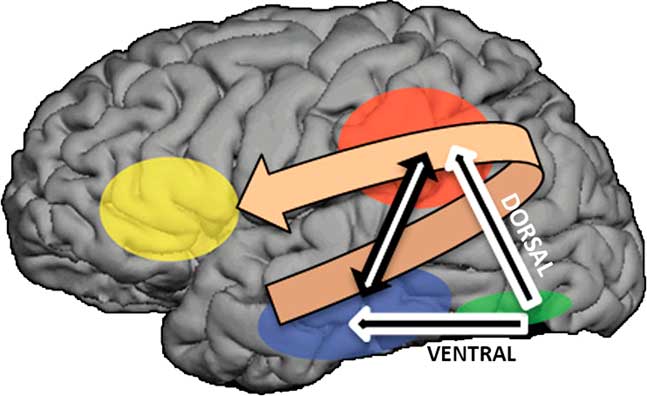
Significant understanding of the role of the brain in LDs has emerged because of the advent of noninvasive structural and functional neuroimaging. Following initial studies of adults using positron emission tomography (Rumsey et al., Reference Rumsey, Zametkin, Andreason, Hanchan, Hamburger, Aquino and Cohen1994) and a small series of postmortem cases (Galaburda, Sherman, Rosen, Aboitiz, & Geschwind, Reference Galaburda, Sherman, Rosen, Aboitiz and Geschwind1985), most studies have focused on dyslexia. The functional neuroimaging research converges in identifying a network of three left hemisphere regions that support proficient reading and are impaired in people with word-level disorders (Figure 2): underactivation of (1) a ventral stream involving the occipital region and posterior temporal lobe (occipitotemporal); (2) a dorsal stream involving the posterior portion of the superior and middle temporal gyri, extending into temporoparietal areas (temporoparietal); and (3) either underactivation or compensatory overactivation of the inferior frontal lobe (Dehaene, Reference Dehaene2009; Shaywitz et al., Reference Shaywitz, Shaywitz, Pugh, Fulbright, Constable, Mencl and Gore1998).
Neural network mediating word reading. The sublexical dorsal (temporoparietal) and lexical ventral (temporoparietal) components operate in parallel, connecting to the inferior frontal gyrus if subvocalization or articulation is involved and to the inferior temporal semantic regions for access to meaning. Courtesy Victoria Williams and Whitney Roper.
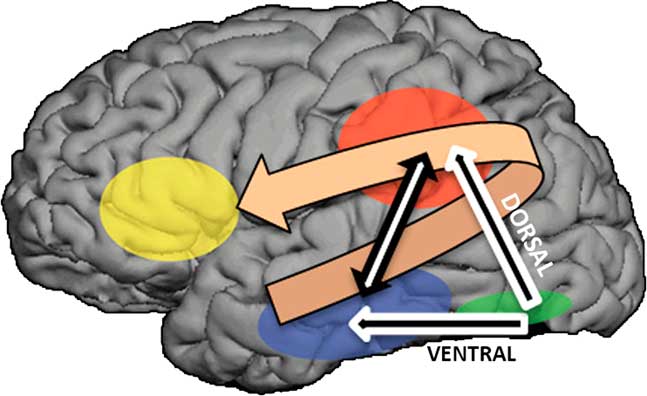
Supported by basic research on word recognition and acquired disorders of reading in dual route (Coltheart, Rastle, Perry, Langdon, & Ziegler, Reference Coltheart, Rastle, Perry, Langdon and Ziegler2001) and connectionist models (Taylor, Rastle, & Davis, Reference Taylor, Rastle and Davis2013), this network does not develop without explicit exposure to print. It is dependent on evolutionarily based networks for language and visual processing that allow the extraction of language from vision (Dehaene, Reference Dehaene2009; Seidenberg, Reference Seidenberg2017). The dorsal system is associated with a sublexical route to word meaning, consistent with the key role of phonological awareness and word reading. However, also critical is the reorganization of ventral systems that serve face and object processing into regions highly specialized for rapid visual processing of orthographic patterns in print (Vogel, Petersen, & Schlaggar, Reference Vogel, Petersen and Schlaggar2014). The fusiform gyrus has been conceptualized as a “word form” area that mediates immediate word recognition with direct access to semantic regions in the inferior temporal lobes (Dehaene, Reference Dehaene2009). Remarkably, this network appears to be universal across different languages and orthographies (Paulesu et al., Reference Paulesu, Démonet, Fazio, McCrory, Chanoine, Brunswick and Frith2001).
Findings are less consistent from structural than functional imaging studies because of smaller samples and variations in methods (Schultz et al., Reference Schultz, Cho, Staib, Kier, Fletcher, Shaywitz and Duncan1994). However, the rapid development of semi-automated software for processing structural MRI data is changing this state of affairs, with increasing alignment with fMRI research. The development of the ventral system is heavily dependent on exposure to print. In young children and illiterate adults, this system shows rapid reorganization with explicit instruction in reading (Castro-Caldas, Petersson, Reis, Stone-Elander, & Ingvar, Reference Castro-Caldas, Petersson, Reis, Stone-Elander and Ingvar1998; Dehaene, Cohen, Morais, & Kolinsky, Reference Dehaene, Cohen, Morais and Kolinsky2015). These factors have led to questions concerning whether word-level difficulties are products of print deprivation versus intrinsic neural deficiencies. Quantitative analyses of structural MRIs have shown reduced volume and thickness in the neural networks of preschoolers before the onset of formal reading instruction. These children, identified because of family histories, have been followed longitudinally with rough correspondence of structural and functional findings (Clark et al., Reference Clark, Helland, Specht, Narr, Manis, Toga and Hugdahl2014; Raschle et al., Reference Raschle, Becker, Smith, Fehlbaum, Wang and Gaab2017). The future of neuroimaging research lies with the capacity for multi-modal methods that co-register structural and functional modalities, linking with genetic studies associated with brain development, and eventually metabolic studies through spectroscopy (Rae et al., Reference Rae, Lee, Dixon, Blamire, Thompson, Styles and Stein1998).
For reading comprehension, bilateral activation of areas involving semantic processing in the anterior temporal lobes is a consistent feature of both listening and text comprehension (Ferstl, Neumann, Bogler, & Von Cramon, Reference Ferstl, Neumann, Bogler and von Cramon2008). Cutting et al. (Reference Cutting, Clements-Stephens, Pugh, Burns, Cao, Pekar and Rimrodt2013) compared children with reading comprehension LD (RCLD) to groups impaired in word reading and typically developing controls on tasks requiring reading of different kinds of words. In the dorsal and ventral pathways of the reading network, the typically developing and RCLD groups had similar activation patterns that were different from the group with word-level LDs. In contrast, the group with RCLD showed reduced deactivation of the left versus the right angular gyrus and reduced connectivity of the left inferior frontal, left hippocampal, and parahippocampal gyri, suggesting more effort in connecting words and meanings. In a structural MRI study comparing similar groups, Bailey, Hoeft, Aboud, and Cutting (Reference Bailey, Hoeft, Aboud and Cutting2016) found reduced gray matter in right frontal regions in adolescents with RCLD, consistent with their executive function problems.
Studies of children with math disabilities show atypical brain structure and connectivity in inferior parietal and temporo-parietal white matter (Matejko & Ansari, Reference Matejko and Ansari2015). Functional neuroimaging studies focus on simple numerical and magnitude processing, demonstrating a fronto-temporal neural network extending to three parietal circuits: inferior parietal, superior parietal, and intraparietal, which mediate different aspects of math proficiency. Involvement of different parts of this network varies depending on demands for verbal, number, and visual coding (Ansari & Lyons, Reference Ansari and Lyons2016). With age and expertise, activation is reduced and with greater automaticity, there is less reliance on frontal circuits (Rivera, Reiss, Eckert, & Manon, Reference Rivera, Reiss, Eckert and Menon2005). The network is characterized predominantly by increased activity in individuals with math LDs that is different from typically developing children in the degree and timing of activation (Iuculano et al., Reference Iuculano, Rosenberg-Lee, Richardson, Tenison, Fuchs, Supekar and Menon2015).
There are few neuroimaging studies of written expression. A meta-analysis (Planton, Jucla, Roux, & Démonet, Reference Planton, Jucla, Roux and Démonet2013) of 18 fMRI handwriting studies identified specific regions in the right cerebellum, left frontal superior and middle frontal gyri, and left intraparietal and superior parietal areas. Spelling studies show expected activation of frontal motor and planning regions, with overlap in reading areas involved in processing of orthographic patterns (Richards, Berninger, & Fayol, Reference Richards, Berninger and Fayol2009).
INTERVENTION
The evidence base for interventions for people with LDs is strong, reflecting accumulating evidence from large, randomized controlled trials. In a review of 100 years of reading research, Scammacca et al. (Reference Scammacca, Roberts, Cho, Williams, Roberts, Vaughn and Carroll2016) found that as studies get larger and more rigorous over time, effect sizes tend to diminish. However, even small effect sizes have clinically significant impacts. Intervention outcomes are not strongly related to IQ, economic disadvantage, or race (Morris et al., Reference Morris, Lovett, Wolf, Sevcik, Steinbach, Frijters and Shapiro2012).
Although a review of specific interventions is beyond the scope of this study (see Fletcher et al., Reference Fletcher, Lyon, Fuchs and Barnesin press; Swanson, Harris, & Graham, Reference Swanson, Harris and Graham2013), some general principles can be identified. Academic interventions are complex cognitive therapies that involve more than simply encouraging children to engage. For those who are struggling, instruction must be explicit (Fuchs, Fuchs, & Vaughn, Reference Fuchs, Fuchs and Vaughn2014). This means that the instructor purposefully and intentionally involves the learner in the material to be mastered, with direct explanations, modeling of skills and strategies, and opportunities for supervised practice. For promotion of automaticity, speeded practice is better than untimed practice, along with structured engagement in authentic experiences that supports practice in reading, math, and writing (Fuchs et al., Reference Fuchs, Fuchs and Vaughn2014). Comprehensive interventions that incorporate multiple instructional practices are more effective than skill-focused approaches. Thus, children with word-level difficulties need programs than not only teach decoding, but also focus on comprehension and automaticity (Mathes et al., Reference Mathes, Denton, Fletcher, Anthony, Francis and Schatschneider2005).
Children learn as much about math facts if they systematically practice for a short time within the context of a problem solving approach as they do when taught as an isolated skill (Fuchs et al., Reference Fuchs, Powell, Seethaler, Cirino, Fletcher, Fuchs, Hamlett and Zumeta2009). The keys are that the instruction is explicit, differentiated according to strengths and weaknesses in the academic domains (Connor, Morrison, Fishman, Schatschneider, & Underwood, Reference Connor, Morrison, Fishman, Schatschneider and Underwood2007), and delivered with sufficient intensity relative to the severity of the academic problem (Lovett, Lacerenza, Borden, Frijters, Steinbach, & DePalma, Reference Lovett, Lacerenza, Borden, Frijters, Steinbach and DePalma2000). Most effective interventions also incorporate a self-regulation component addressing the attention and organizational difficulties experienced by many with LDs (Graham, McKeown, Kiuhara, & Harris, Reference Graham, McKeown, Kiuhara and Harris2012).
Ineffective interventions involve approaches that are not explicit, often based on constructionist, discovery approaches (Seidenberg, Reference Seidenberg2017). In addition, instruction must focus on academic content (Pennington, Reference Pennington2009). Interventions that train isolated skills, such as working memory, low level auditory and visual processing, or other non-academic interventions based on training the brain or eyes, do not generalize to the academic domain (Melby-Lervåg, Redick, & Hulme, Reference Melby-Lervåg, Redick and Hulme2016).
A major question from neurobiological studies is the extent of plasticity in the neural networks that mediate reading and math. There are over 20 studies that pair functional neuroimaging before and after reading intervention, and a few studies in math (Fletcher et al., Reference Fletcher, Lyon, Fuchs and Barnesin press). In reading, studies show significant malleability in children who respond to the intervention, with essentially normalized changes reflecting increased activation of the dorsal and ventral systems depending on the task and (probably) the intervention. These changes are maintained in 1-year follow-ups. After math intervention, there is reduced activation and a generally better organized neural network with a reduction in hyperconnectivity (Iuculano et al., Reference Iuculano, Rosenberg-Lee, Richardson, Tenison, Fuchs, Supekar and Menon2015).
These indications of plasticity facilitate interpretation of a fundamental finding from intervention research, which is that better outcomes are associated with earlier intervention. When children are identified with basic reading and math difficulties early in development (before Grade 3), intervention efforts lead to greater automaticity (Fuchs et al., Reference Fuchs, Fuchs, Hamlett, Lambert, Stuebing and Fletcher2008; Lovett et al., Reference Lovett, Frijters, Wolf, Steinbach, Sevcik and Morrisin press). With later remedial efforts, automaticity is difficult to achieve (Torgesen et al., Reference Torgesen, Alexander, Wagner, Rashotte, Voeller and Conway2001), possibly because the ventral systems need considerable explicit exposure to print to process orthographic patterns rapidly (Dehaene, Reference Dehaene2009). Without this capacity, the person reads slowly and inefficiently, with excessive attention to word reading, which detracts from accessing the meaning of the text.
IMPLICATIONS FOR PRACTICE
Reflecting 50 years of progress, the utility of neuropsychological evaluations does not come from the capacity to infer cerebral dysfunction (Fletcher & Taylor, Reference Fletcher and Taylor1984). Rather, the utility comes from evaluations by individuals with an interdisciplinary knowledge base that situates the person in the context of development and contextual expectations (Waber, Reference Waber2010). In returning to Figure 1, the critical areas for assessment are academic skills, behavioral traits, and contextual factors. Whether extensive testing of cognitive processes is useful is hotly debated, with concerns about the value added by such assessments for intervention and identification when academic skills are measured (Burns et al., Reference Burns, Petersen-Brown, Haegele, Rodriguez, Schmitt, Cooper and VanDerHeyden2016; Stuebing et al., Reference Stuebing, Barth, Trahan, Reddy, Miciak and Fletcher2015; see exchange by Fletcher & Miciak, Reference Fletcher and Miciak2017 and Schneider & Kaufman, Reference Schneider and Kaufman2017). By assessing academic skills, behavioral traits, and contextual factors, neuropsychologists will have much of the information needed to identify and develop effective treatment plans for LDs.
It is well-known that static frameworks for identifying and treating LDs lead to unreliability in identifying individuals with LDs (Macmann, Barnett, Lombard, Belton-Kocher, & Sharpe, Reference Macmann, Barnett, Lombard, Belton-Kocher and Sharpe1989). An alternative uses a dynamic approach that focuses on intervention response over time and use of additional criteria for identification (low achievement and contextual factors) (Fletcher & Vaughn, Reference Fletcher and Vaughn2009). This approach integrates identification with treatment response, which would represent a sequential system in which decision errors can be corrected and intervention after screening is prioritized over identification (Fuchs & Fuchs, Reference Fuchs and Fuchs1998; Macmann et al., Reference Macmann, Barnett, Lombard, Belton-Kocher and Sharpe1989).
Assessment of strengths and weaknesses within achievement domains is critical for differentiated instruction, along with evaluation of behavioral factors that interfere with learning, such as ADHD, anxiety, and motivation (Fletcher et al., Reference Fletcher, Lyon, Fuchs and Barnesin press). It is critical that neuropsychologists understand the neurobiological basis of LDs and can differentiate the host of correlated factors that contribute to LDs. But in the end, the neuropsychologist must be able to understand effective interventions and prescribe them based on the severity of academic strengths and weaknesses of the child, and the behavioral traits that can interfere with learning, such as ADHD, anxiety, and inadequate instruction.
FUTURE DIRECTIONS
Many issues with LDs involve the need to translate and implement the findings from scientific research into education and to treat LDs as a public health problem that can often be prevented. Unfortunately, science is generally not a primary basis for decision making in education; political trends, experience, anecdotes, and similar bases for evidence prevail (Seidenberg, Reference Seidenberg2017). Scientists need to do a better job in translating their research, but in education, the role of science is not established despite significant translational efforts (Shavelson & Towne, Reference Shavelson and Towne2002).
The research base also needs to expand. One important issue is to understand the basis for individual differences in instructional response. More recent conceptualizations of LDs focus on the child’s response to instruction, viewing intractability or persistence as evidence of unexpectedness (Fuchs & Fuchs, Reference Fuchs and Fuchs1998; Vellutino et al., Reference Vellutino, Scanlon, Sipay, Small, Pratt, Chen and Denckla1996). This hypothesis is under active investigation from cognitive, genetic, and neuroimaging perspectives (Fletcher et al., Reference Fletcher, Lyon, Fuchs and Barnesin press).
There is also a need to improve identification and intervention research involving (a) the most severe cases, (b) the older cases, and (c) the more complex academic domains. Identification and intervention in adults with academic difficulties who may not have received intervention is poorly understood (Mapou, Reference Mapou2009). We do not know nearly enough about the neural, genetic, and cognitive bases of LDs in math, reading comprehension, and written expression, especially in inadequate responders. The role of cognitive processes in identification and intervention needs continued empirical research. Greater understanding will emerge through interdisciplinary research that questions what we know in a rigorous, scientific approach and seeks to integrate knowledge across domains. As was the case in the early 1970s, neuropsychologists can participate in this research, question their assumptions, and help change the face of practice in the next 50 years.
ACKNOWLEDGMENTS
The authors declare no conflicts of interest. Supported in part by a grant from the Eunice Kennedy Shriver National Institute for Child Health and Human Development, 1 P50 HD052117, Texas Center for Learning Disabilities. Dr. Grigorenko’s work supported in part by Grant 14.Z50.31.0027 from the Government of the Russian Federation. The content is solely the responsibility of the authors and does not necessarily represent the official views of the NICHD or the National Institutes of Health or the Russian Federation. The assistance of Jeremy Miciak, Paul Cirino, and Marcia Barnes are gratefully acknowledged.