

I. Introduction
Winemaking is probably one of the most complex technologies that produces consumption goods. It needs inputs over which there is little or no control (good weather conditions), initial endowments which can hardly be modified (soil, exposure of the slopes), inputs which take 20 to 30 years before producing good quality outputs (vines), manual operations (picking), mechanical operations (crushing, racking), delicate chemical processes (during fermentation) and specific storage conditions once the wine is bottled. There is usually little that can be done to correct an error in one of the various and delicate steps that extend over several years for every vintage. Wine is also the subject of many legends and production “secrets;” wine tasting adds to this aura of mystery with its esoteric vocabulary describing, under bizarre names, perfumes and appearance of wines.
The literature on wine tasting is large, but there is little on the economics of wine producing; in his 1989 paper, Orley Ashenfelter (Reference Ashenfelter1989) discusses wine auctions; the various issues of Liquid Assets, edited by Ashenfelter, discuss wines as an asset, while wine ratings is the main concern of most books like Alexis Lichine (Reference Lichine1963), Robert Parker (Reference Parker1985, Reference Parker1990), and many others. Nerlove (Reference Nerlove1992) estimates a demand function for Sweden and shows, among other things, that tasters' evaluations play an insignificant role in consumer choices, although quality, as defined by tasters, is associated with higher prices.
We are interested in disentangling the production technology, and in trying to quantify the impact of each of the many inputs (including weather conditions) and steps used in producing wine in one of the most renowned winemaking regions of France, Médoc and its well-known châteaux, like Mouton-Rothschild, Latour, Lafite-Rothschild and Margaux.
The database we use was painstakingly constructed by conducting interviews in 102 châteaux on characteristics of the vineyards, technologies used and prices of the vintages still sold by the château in 1990. We also collected data on weather conditions that prevailed during the years 1980 to 1989. We assumed that this would allow us to quantify the wine processing technology and to separate its effects from legend on the one hand, and from reputation effects on the other.
The paper is organized as follows. In Section II, we describe our data, based on interviews conducted in 102 châteaux. Sections III and IV are devoted to the making of Bordeaux wines; in Section III, we discuss both the technology and the results of a regression of wine prices on variables describing the technologies used. Technology and weather conditions only explain some 67% of the variance of prices; wines from Médoc (and some others, including Sauternes-Barsac) were graded in 1855, and this grading appears on the labels (First- to Fifth-Growth, Crus BourgeoisFootnote 1); obviously this is taken as a quality signal and may partly generate the price structure; in Section IV, we include these classification variables into the regression, and derive coefficients which summarize the effects of unobserved variables; they may also be rents captured by producers, and result from the official 1855 classification. Many wine critics have criticized this classification as not reflecting the qualities of currently produced wines, and propose other classifications.Footnote 2 In Section VI, we examine whether two such updated classifications, assumed to account for recent information on quality, have more power in explaining prices than the 1855 grading; the results show that “1855” still does better for most wines. Section VII concludes the paper.
Throughout the paper, the dependent variable of our regressions is the price of wine, assumed to reflect quality. The wines included in our sample are among the best known, longest existing, most often tasted, described and ranked; prices which do not represent quality (including scarcity) are unlikely to be sustainable for very long: as Lincoln seems to have said not all the people can be fooled all the time. Even for the wines of lesser quality included in Nerlove's (Reference Nerlove1992) sample (the majority of which clusters between $7 and $11), there is an association between quality, as defined by tasters' evaluation, and prices.
II. Data
Data on 102 châteaux of the Médoc region were collected during the winter and spring 1990–1991; each of the châteaux was visited individually, and a questionnaire was handed out with some thirty questions on types of soil, grape varieties, exposure of the vineyards, age of vines, picking techniques, vinification and élevage. The questions were “closed” to make quantification easy; some of the answers are quantitative (such as the proportions of grape varieties), but most of them are qualitative (and are represented by dummy variables), since they describe production techniques.
Each château was also asked to provide prices at which it was selling its different vintages, if possible from the last ten years (1980–1989). Some châteaux could give such prices for some vintages only, since they did not have all the wines from the ten last vintages in their cellars; in total, we collected 808 prices for the 102 châteaux. All prices are thus for wines of different vintages sold in late 1990 early 1991.
The Institut de Météorologie Nationale Française in Mérignac and Cissac provided data on weather (temperature, rainfall, hail, frost). We could only get hold of average data over the whole region and no data on the microclimate prevailing for each château. This is not too restrictive, since the region is barely 30 miles long and 5 miles wide.
The results discussed in the rest of the paper are based on equations in which the logarithm of prices (assumed to represent quality) is regressed on weather conditions as well as physical and technical characteristics of the individual châteaux. The equations are fitted by ordinary least squares; it proved difficult to use more sophisticated techniques (in order to take into account possible heteroskedasticities), since the number of chronological observations per château was not always the same: in some cases, ten price observations (i.e., prices over ten years) were available; in other cases, there were only five such observations. As a consequence, the standard deviations of the coefficients may be underestimated, and allowance should be made for this bias when interpreting the results.
III. The Making of Bordeaux Wines
In this section, we discuss the various steps that are usually thought to contribute to the quality of a wine. These can be classified as follows: weather conditions, soil, grape varieties, exposure of the slopes where vines are grown, age of vines, vinification and élevage, appellations (to take account of regional elements not captured otherwise), and aging of the wine.
The regression results that are described are based on 808 observations (102 châteaux), and include 54 variables (plus the intercept). The overall fit is good, given the nature of the data: the variables account for over 67% of the variance of (the log of) prices.
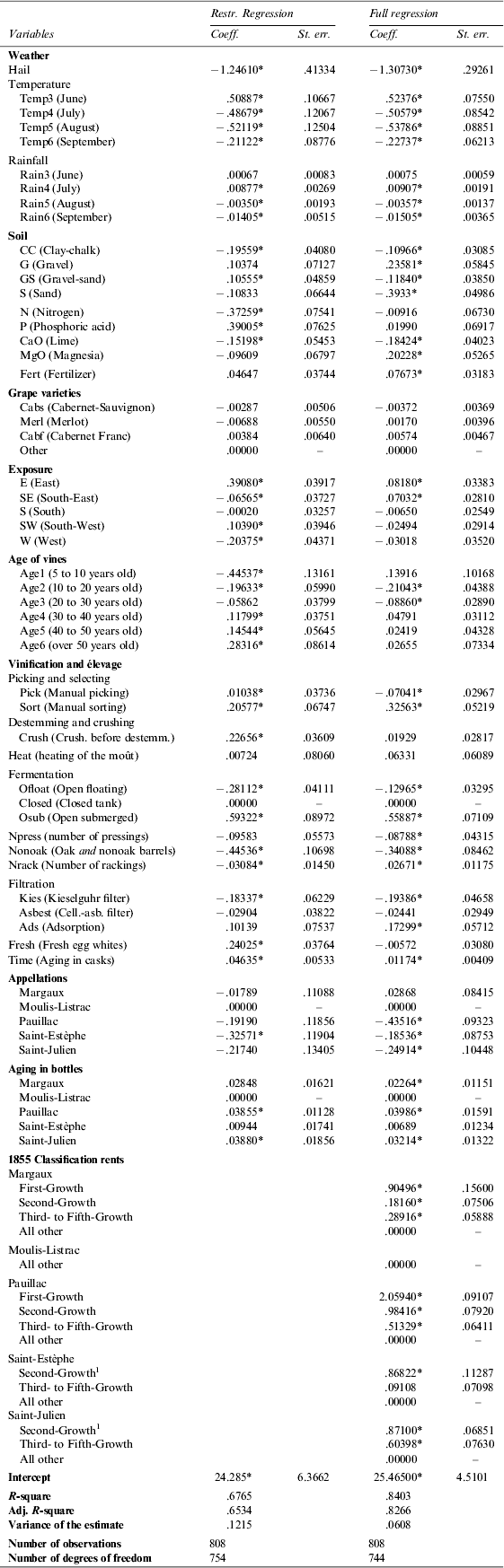
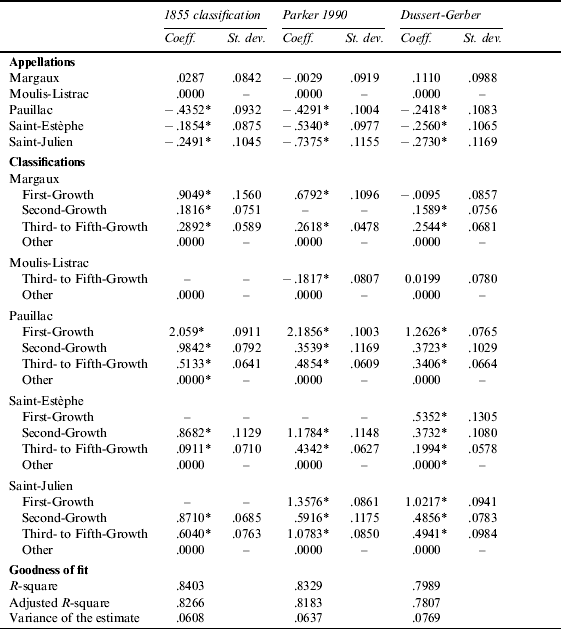
Each characteristic will be considered in turn, and the results of the regression including these characteristics will be described. The discussion is somewhat technical, but since we deal with rather elaborate production processes (especially in the vinification and élevage steps), there is hardly any other way to go. The regression results referred to in the text appear in Table 1, under the heading “restricted regression;” this regression does not include the influence on prices of the 1855 classification, which distinguishes so-called Growth-wines from others. The results of this second equation, the “full regression” will be discussed in Section IV.
Regression Results

* means significantly different from zero at the 5% probability level at least.
1 There are no First-Growth wines for Saint-Estèphe or Saint-Julien.
A. Weather
Red wine grapes are dormant between November and March and weather conditions are important between April and September only.Footnote 3 In the beginning of April, vines come into bud, and frost may still be a problem. This was observed only once, during seven days in 1984. The other problem in April is hail, which can cause widespread damage to the coming vintage and even to subsequent vintages.
Rain is useful between April and June, but the main determinants seem to be heat, sunshine and dry weather between mid-July and mid-September; harvesting usually starts after September 15; late harvesting (beginning of October) is the sign of previous poor weather conditions and leads to poor vintages.
Estimation results show that hail (the influence of which is captured by the variable Hail, measuring the number of days of hail in April) has a strongly negative and significant influence on prices. The results are less clear for heat (variables Temp3 to Temp6, measuring the difference between maximum temperatures and average maximum temperatures from June to September) and rainfall (variables Rain3 to Rain6, measuring the excess or deficit of rainfall with respect to average rainfall during the same months). More heat is useful in June, since it accelerates blossoming (Temp3 is positive); too much heat in July, August and September may have negative results (Temp4 to Temp6 are negative). In June and July, vines need rain (Rain3 and Rain4 are positive), while, later in the year, too much rain is bad, especially in September, before or during the harvest (Rain5 and Rain6 are negative). Note that all these variables (with the exception of Rain3) have an effect that is (in most cases very) significantly different from zero.
B. Soil
In the Médoc region, soils range from heavy clay to light gravels. One usually distinguishes four types of soil, present in various proportions: clay-chalky, gravelly, gravel-sandy and sandy. Some soils are better than others and deep gravel beds (like in Pauillac) seem to be the best, though there are outstanding wines produced in the much poorer gravel-sandy region of Margaux. Subtle differences in soil may lead to very different styles; however, “(soil) is not, as the Bordelais would have one believe, the only element necessary to make a great wine” (Parker, Reference Parker1985, p. 505).
Besides soil density, chemical composition also plays an important role; we singled out four chemical components thought to be essential: nitrogen, phosphoric acid, lime and magnesia. Though fertilizer is kept to a minimum, it is used to maintain the complex mineral and chemical equilibrium.
These various characteristics are measured by four soil variables (CC, G, GS and S for clay-chalk, gravel, gravel-sand and sand respectively, which take the value 1 if the type is present, 0 otherwise), four chemical components (N, P, CaO and MgO for nitrogen, phosphoric acid, lime and magnesia respectively, which are also dummy variables) and a last dummy variable Fert, equal to 1 when fertilizer is used.
The estimation results show that, as expected, gravelly and gravelly-sandy soils have a positive impact, while sandy and clay-chalky soils have a negative (and, for the latter significant) impact. Nitrogen and phosphoric acid have the expected sign,Footnote 4 and their effect is significantly different from zero. Lime and magnesia are “bad” (significantly so for lime). Finally, fertilizing has also a positive (but not significant) influence, since it appears to be used sparingly, and only when really needed.
C. Grape Varieties
Médoc wines result from a combination of five varieties of grapes used in varying proportions: Cabernet Sauvignon (40 to 85%), Merlot (5 to 45%), Cabernet Franc (0 to 30%), Petit Verdot (3 to 8%) and Malbec, in small proportions (less than 2%). These varieties ripen and are harvested at different times; weather conditions at certain moments may thus influence some vineyards more than others, in accordance with the grape varieties used. Clearly, each variety has its own influence on the characteristics of wines: Cabernet Sauvignon is poor in sugar, the richest in tannin, and allows wines to age; Merlot, the first to ripen is less tannic and richer in sugar than Cabernet Sauvignon; this makes the association of both varieties very attractive. Cabernet Franc ripens earlier than Cabernet Sauvignon, adds bouquet and tends to produce lighter wines; Petit Verdot ripens late (and is therefore used only in small proportions), is very tannic and rich in sugar, adding alcohol to the wine; Malbec is being replaced more and more by Merlot, with which it shares the same qualities. It is worth noting that grape varieties may lead to different outcomes according to the type of soil on which they are grown.
Grape varieties are represented by four variables (Cabs, Merl, Cabf, Oth for Cabernet Sauvignon, Merlot, Cabernet Franc and OtherFootnote 5) measuring the excess (or deficit) of the proportion used by the château with respect to the average use by the 102 châteaux. None of the variables has a significant influence: small variations in grape varieties do not seem to matter too much.
D. Exposure
Though Parker (Reference Parker1985) does not discuss exposure, we included it among our variables. Slopes exposed to the East and the Southeast are protected from Western winds, dominant in the region; moreover, the rising sun quickly dries the dew, and reduces the risk for grapes to go rotten. Western slopes are usually closer to the river Garonne, and are more likely to have a gravelly soil; moreover, there is light reflection from the river over the slopes.
These characteristics are represented by dummy variables, which take the value 1 if the château possesses slopes with a given exposure. We included five variables, E, SE, S, SW and W for Eastern, Southeastern, Southern, Southwestern and Western exposures respectively.Footnote 6 Estimation results show that especially Eastern and to a lesser extent, Southwestern exposures have a significant positive effect; Western slopes are bad, while other exposures have small (and not significantly different from zero) negative effects.
E. Age of Vines
Old vines produce less, but a wine of better quality; Mouton-Rothschild vines are, on average, 43 years old; so are the vines at Lafite-Rothschild, another Pauillac First-Growth. At first sight, age does not seem to be necessary: Pichon Lalande, classified as a First-Growth by Parker, has vines the average age of which is 22 years only.
The age of the vines is represented by six dummy variables, Age1 to Age6, which take the value 1 if vines of Agei are present, and the value 0 otherwise.Footnote 7, Footnote 8 Despite the preceding remarks, the six coefficients clearly point out that age matters a lot: they are negative for young vines, and monotonically increase, as the vines get older. All the coefficients are strongly significant.
F. Vinification and Élevage
We now follow the production process through the eight steps distinguished by Parker (Reference Parker1985): (1) picking (and selecting), (2) destemming and crushing, (3) pumping into fermentation tanks, (4) fermenting of grape sugar into alcohol, (5) macerating or keeping the grape skins and pips in contact with the grape juice for additional extract and color, (6) pressing and racking or transferring the wine to small barrels (or tanks) for the secondary (malolactic) fermentation to be completed, (7) putting the wine in oak barrels for aging and (8) bottling the wine.
(1) Picking and selecting
Harvesting usually starts after September 15 and may take as long as three weeks. Manual picking is disappearing, since it costs more and may take too long; automatic picking is faster, allows thus to harvest at the right maturity, but may damage grapes and mix more stems than needed. In most cases, both methods are used, but some châteaux still resort to manual picking exclusively; a dummy variable Pick is defined which takes the value 1 if only manual picking is used. As expected, it has a positive effect on prices, which is however not significantly different from zero.
Whether the picking is manual or not, grapes must be selected (this is called triage): damaged, unripe or rotten berries must be eliminated, before the crushing process. Most châteaux instruct their pickers to eliminate unhealthy grapes; some châteaux still sort grapes by hand, after the picking. In such cases, a dummy variable Sort takes the value 1. The results show that its coefficient is positive, and significantly so.
(2) Destemming and crushing
In most châteaux, crushing the berries and destemmingFootnote 9 is done simultaneously in a machine called fouloir égrappoir. Some vineyards still use the older technique of crushing before destemming. A dummy variable Crush takes the value 1 when this is the case (and 0 otherwise); as expected, its effect is positive, and significant.
(3) Pumping into fermentation vats
The partially crushed berries are then pumped into vats and fermentation can start. Several chemical decisions have to be made at this point; these consist in: adding sulfite (sulfitage has many complex effects and is practiced by all châteaux); chaptalizing (chaptalization, i.e., adding sugar, increases the alcohol content and is used by most châteaux, when needed); acidifying or deacidifying (acidification and deacidification are not practiced, and only seldom allowed); adding yeast (levurage) is used to start the fermentation process if it does not happen spontaneously; used by all châteaux). Since all vineyards proceed in the same way, there was no way to capture the possible effects of these chemical steps.
(4) Fermenting of grape sugar into alcohol
Several types of tanks are used: oak, cement and stainless steel. During fermentation, temperature has to stay within tight bounds, usually between 25° and 30 °C: fermentation does not start if the temperature is too low, while acetic bacteria may grow and natural yeasts will be destroyed (and stop fermentation) if temperature gets too high. This severe monitoring is easier to achieve in stainless steel tanks, by running cool water over the outside of the tanks; in the two other cases (oak and concrete tanks), wine must be run through cooling tubes; oak vats, on the other hand, are more natural and allow wood components to mix with the wine. Since most châteaux use stainless steel, we did not include the variables in our regressions.
The crushed grapes are in some cases mixed with heated moût; this step, represented by the variable Heat (a dummy which takes the value 1 if heating is used) is supposed to free coloring and some other components; this step appears to have no significant influence.
During fermentation, skins, stems and pips rise to the top of the tank and form a solid cap (the chapeau), which must be kept moist by pumping the wine juice over it (remontage). Three techniques are available to achieve this: open tank with floating marc (represented by a dummy variable Ofloat); closed tank (a dummy not included, since only one of the techniques is being used); open tank with submerged marc (variable Osub). The first technique allows a contact with air that may oxidize (and infect) the wine, and it needs a remontage. Both problems are avoided with the third technique; with the second one, oxidation is avoided, but since temperature may increase too much, a remontage (and thus, a contact with air) may be needed. This is clearly reflected in our results, which very significantly rank the three techniques, showing that the third one is the best.
(5) Maceration
After the alcoholic fermentation is completed, the wine is macerated with the skins during one to two weeks. The length of this period is crucial for the wine, but since most châteaux do more or less the same, we did not include the variable.
(6) Pressing and racking
After steps (4) and (5) which constitute the cuvaison, the wine is separated from its lees (lie and marc); the free-run juice (vin de goutte) is the wine of better quality; the remainder is then pressed one or several times, resulting in press-wine (vin de presse) which is more pigmented and tannic than the free-run juice. Some press-wine (the proportion depends on the year and the château) is then blended with the free-juice to adjust color and tannin.
Several types of presses exist, but have no influence on the quality of the wine. Quality is however negatively influenced by the number of pressings; to test this, we constructed a variable Npress which takes the value 1 if there is only one or two pressings, and the value 0 if there are more; the regression coefficient is negative and almost significantly different from zero. Note that this should not be taken as evidence against too many pressings since, even when more than two pressings are performed, only a small percentage (which varies over the vintages) of the press-wine is blended and the number of pressings has no real bearing on quality.Footnote 10
(7) Aging in barrels and racking
The young wine is then transferred to 225 liter barrels (where the alcoholic fermentation may be pursued) and the secondary (or malolactic) fermentation, which adds roundness and character, starts and lasts for three to five months.
Most châteaux use (a mix of old and newFootnote 11) oak barrels; some Crus Bourgeois use both oak barrels and tanks. When this is the case, the variable Nonoak takes the value 1. The coefficient is, as expected, strongly negative and statistically different from 0.
Aging in barrels varies between 12 and 24 months (depending on the vintage), during which a number of steps have to be taken.
First, the wine evaporates and produces carbon dioxide; this empties the casks, which have to be refilled every week (ouillage); all châteaux carry out this step.
Secondly, the wine is racked (soutirage) several times during the first year, to separate the clear wine from the lees (lie) which have fallen to the bottom of the cask; we introduced a variable Nrack representing the number of rackings; the coefficient which it picks is negative and significant at the 5% level: this is contrary to what is expected, since more rackings should increase quality, at the risk, however of oxidizing the wine through contact with air.
Thirdly, all châteaux carry out a procedure, which cleans the wine from, suspended matter; this is the fining of the wine (collage) that is achieved with egg whites, fresh or not. A variable Fresh, which takes the value 1 when fresh egg whites are used, captures the influence; as is seen in Table 1, freshness has a strong positive effect.Footnote 12
The number of months during which the wines age in barrels may vary. The regression coefficient associated with this variable (Time) is positive and significantly so. Each extra month adds approximately 5% to the price of a wine.Footnote 13
(8) Bottling the wine
In January following the vintage, most châteaux carefully select the wine which is going to be bottled under the château's name, while the remainder will be sold under secondary labels, or in other ways. At the same time, wines resulting from different vines are blended (assemblage). Since these two steps are impossible to quantify (and because they are used in most places) they are not included in our analysis.
Before bottling takes place, wines are filtered,Footnote 14 in order to remove solid matters. There are two filtration techniques that proceed mechanically (one uses kieselguhr, the other cellulosic-asbestos filtering components); a third process proceeds by adsorption. The particularity is that adsorption needs one of the two other processes, while each of the mechanical processes can be used on its own. To represent this technology, we introduce three dummy variables: Kies, Asbest and Ads which take the value 1 if the technique is used, 0 otherwise. The effect of kieselguhr filtration alone is significantly negative; asbestos filtering has a slightly negative, but insignificant, effect; the use of adsorption (necessarily associated with one of the other two processes) yields better results, especially when associated with asbestos filtration.Footnote 15
G. The Influence of Appellations
In the preceding sections, we tried to describe and analyze as many technical and other characteristics as possible; most of them had a significant influence on the price (quality) of the wine. In this section, we assume that there may be characteristics which describe the region of production (appellations), and which have not been adequately taken into account before. These are simply dummy variables, which take the value 1 if the château belongs to a specific region (Margaux, Moulis-Listrac, Pauillac, Saint-Estèphe and Saint-Julien), and 0 otherwise. Except for Saint-Estèphe, the coefficients are not significantly different from 0, but they are all negative (with respect to Moulis-Listrac chosen as reference). Clearly, this does not imply that the price (quality) of a Moulis is higher than the price of a Pauillac, but that, if all other characteristics (vines, soil, techniques, etc.) were the same, Moulis-Listrac châteaux would be able to charge higher prices for their wines. Are they more efficient, or do they simply benefit from the reputation of their prestigious Haut-Médoc neighbors, which allows them to slightly overprice the qualities implied by their characteristics?
H. Aging in Bottles
To determine how age influences prices, we introduced for every appellation a variable that takes the value 1990-t, where t goes from 1989 to 1980; the variable simply gives the age of the wine, relative to the vintage year. Since one of the variables has to be excluded for collinearity reasons (here Moulis-Listrac), the annual growth rates of prices captured by the regression coefficients are relative to the growth rate of Moulis-Listrac prices, assumed to be zero. As is seen from Table 1, all the coefficients are positive, implying that aging adds more to prices of Margaux, Pauillac, Saint-Estèphe and Saint-Julien than to prices of Moulis-Listrac wines. Only the coefficient for Saint-Estèphe is not significantly different from 0. Wines that take most value in aging are, as expected, those from the Pauillac region (+4% per year); these are followed by Saint-Juliens (+3.9%) and Margaux (+2.8%).
IV. The Effects of the 1855 Classification
In 1855, the wines of Médoc were classified; at that time, 60 châteaux were selected and classified as First to Fifth-Growth on the basis of their quality; the only change since was made in 1973, when Mouton-Rothschild was elevated to a First-Growth wine (See Appendix 1 for the classification). We now examine whether, beside all the characteristics discussed above, classification matters. To test this, we have run a second regression (the “full regression” of Table 1), where we have included variables representing, at least in part, this classification. More precisely, we have distinguished four classes: First-Growths, Second-Growths, Third- to Fifth-Growths and all other wines (Crus Bourgeois and unclassified),Footnote 16 and this for each of the regions. When a wine belongs to one of these subclasses (class times region), a specific dummy variable takes the value 1. This adds ten dummy variables to the previous regression.
As can be seen from the results in Table 1 (“full regression”), the fit has been made dramatically better, since now 84% of the variance of prices is explained, compared to 67% in the previous one. The two regressions can easily be compared using a standard F-test statistic:
 $$[(SSR {\mbox {-}} SSF)/p]/[SSF/(n {\mbox {-}} p {\mbox {-}} q)]$$
where SSF and SSR represent the residual sum of squares of the full and the restricted equations respectively, n is the number of observations, p the number of variables left out of the restricted equation and p+q, the number of variables in the full equation.
Under the usual assumptions (normally and identically distributed residuals), this ratio is distributed like F, with p and n−p−q degrees of freedom. The computed F, with p=10 and n−p−q=744 degrees of freedom is equal to 76.3, while the tabulated value is equal to 2.5 at the 1% probability level.Footnote 17 The classification variables add thus very significantly to the explanation of prices.
And indeed, all the coefficients (with the exception of Third- to Fifth-Growth Saint-Estèphe) are positive and very significantly different from zero. The technical variables described earlier are far from explaining the differences in qualities (prices) and most classified châteaux are able to benefit from the title of nobility they were given in 1855. These differences may however also be attributed to technical aspects which are not part of the rather simple technology that is described by our variables; it is certainly the case that there is more work, care and genius put into Mouton-Rothschild than into a Cru Bourgeois, and the effect captured by the dummies cannot exclusively be interpreted as pure rents accruing to some châteaux as a mere consequence of the 1855 classification.
The wines from Pauillac illustrate that differences may be large; the mere fact that Mouton-Rothschild, Lafite-Rothschild and Latour are First-Growth adds 2.0594 to the logarithm of the price, i.e., it permits the three châteaux to multiply their prices by 7.8, with respect to a Cru Bourgeois from the same region, all other things being equal.
First-Growths are able to do better than Second-Growth, Second-Growth do better than Third- to Fifth-Growths and the latter do better than Crus Bourgeois. There is one exception for Margaux, where the order between Second and Third- to Fifth-Growths is inversed. Even if the differences seem to be high in absolute value (especially for First-Growth Pauillac's), the order just described is the one to expect.
Note that addition of the classification variables changes some of the technical coefficients discussed in the previous section: it mainly affects the soil and the age of vines effects, as well as the signs of the Pick, Nrack and Fresh coefficients. The classification is thus not fully exogenous, but is obviously partly explained by characteristics of the vineyards in 1855.
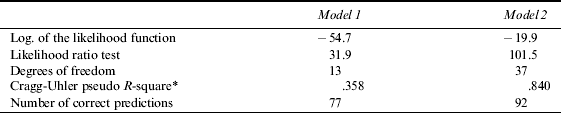
To test this, we ran binomial probit analyses,Footnote 18 in which the dichotomous dependent variable takes the value one for a 1855 classified wine, and zero otherwise. In a first model, the explanatory variables are assumed to represent the endowment of the châteaux at the time the classification was set up: soil characteristics and exposure (in principle the 1855 endowment, though some changes may have happened since); all other variables (grape varieties, age of vines, vinification) are likely to have undergone changes over the 135 years;Footnote 19 these are only added in a second model.
The results of these two regressions are summarized in Table 2. The first model shows that the 1855-endowment (soil and exposures) is able to account for 77 right predictions, on a total of 102 cases. In the second model, the number of right predictions is 91.Footnote 20 A likelihood ratio test shows that the second model is significantly superior to the first (the quantity −2log(L 2–L 1) distributed like χ 2 with 24 degrees of freedom is equal to 69.5).
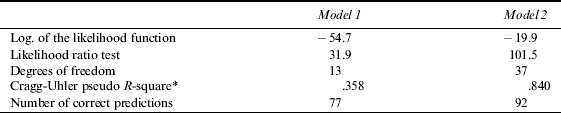
This analysis leads to several conclusions. The (assumed) 1855 endowment has, as expected, a high discriminatory power in classifying Growth-wines. This power is significantly enhanced when variables describing today's technological processesFootnote 21 are introduced; here one is led to argue that causality is reversed: the châteaux that were classified in 1855 (on the basis of their prices), work harder to maintain their reputation and produce first-class wines.
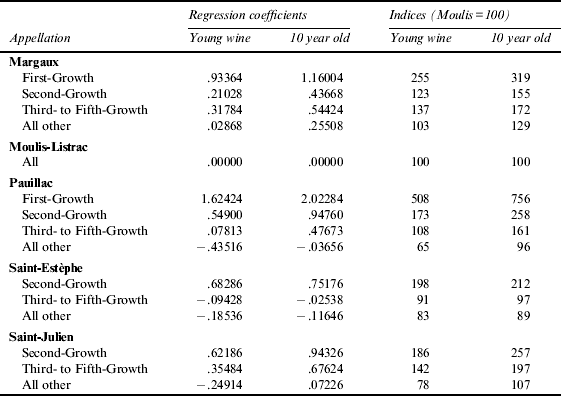
In order to compare the different wines, we must take into account both the appellation and the classification effects, so that all châteaux can be ranked with respect to the reference, a Cru Bourgeois from Moulis-Listrac; to do this, we have to add the coefficients taken by the appellation and the classification effects; thus, comparing a First-Growth Pauillac with a Moulis-Listrac, implies adding −.43516 (appellation effect of Pauillac) to 2.05940 (First-Growth effect of a Pauillac) and compare this with 0 (Cru Bourgeois from Moulis-Listrac). These computations are presented in Table 3, both for a young wine (age 0) and a ten year-old wine, the coefficient of which is obtained by adding 10 times the “aging in bottle” effect. The coefficients are also transformed into indices with, as basis, 100 for a Moulis-Listrac.
Total “Rents” Captured by the Various Châteaux Young and 10 year old wines
Though age has differential effects on the various appellations, the ranking for young wines and ten year-old wines is practically the same; this is obviously due to the fact that rents resulting from aging (which are in fact mainly due to the content in tannin) are roughly equivalent for all wines, at least within a ten-year span.
V. Summarizing the Making of Wine
In this section, we summarize and try to understand which factors explain the quality (price) of Médoc wines. To do this, we start with the full regression, then delete the various factors (i.e., all the variables defining these factors) one at a time: climate, soil, grape varieties, exposure of the vineyards, age of the vines, wine making technique (here we distinguish the steps which take place before fermentation starts – such as picking, sorting and crushing the grapes - and the steps which take place during and after fermentation in casks), appellations, classification and aging in bottles. Standard analysis of variance techniques (see (1) above) will suggest what is important, and what is less so. Obviously, this does not mean that the factors that contribute less are not meaningful: they may be part of a production process and are therefore unavoidable (obviously, there is no wine without soil!), or they may contribute jointly with other factors.Footnote 22
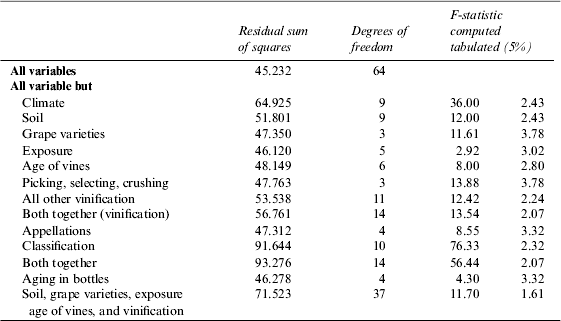
The results of the various analyses of variance are reproduced in Table 4, which gives the residual variance of each regression, the number of degrees of freedom picked up by the variables which are left out (the restricted model), and compares the computed F-statistic with the tabulated value at the 5% probability level.
Importance of the Factors. Analyses of Variance
As had already been pointed out earlier, the 1855 classification of wines into Growths is extremely important: it is in fact, the single factor which explains most; there is little doubt that classification partly captures the influence of missing variables (mainly qualitative: the “art” of winemaking), but obviously it also allows producers to seek rents, as suggested in Section IV.
The fact that climate constitutes the second more important set of variables will come as no surprise: there are good and bad vintages, that depend almost solely on the weather, and there is no need to comment on this any further.
Soil, grape varieties (though none of the variables in the group has a significant influence in Table 1) and vinification, both mechanical and chemical, come next. These are followed by appellations and the age of vines.
Then comes aging in bottles; and this is quite surprising since aging is so thoroughly discussed in books and by wine critics. One of the reasons for this may be due to the functional form chosen for the relation, in which prices are assumed to grow exponentially with age (log p=α (1990−t)+other variables), while in fact, the dependence should be concave (quality goes through a maximum). We did not pursue this here, since we are dealing with relatively young wines (10 years old at most), and we assumed that, given the quality of the châteaux included in our sample, ten year-old wines have not always had time to reach their maturity.
Finally, there is exposure, the dropping of which does not even affect the results in a significant way.Footnote 23 The reason for this may be that most châteaux own hills with different exposures, and take this into account in deciding where to grow the various grape varieties (which ripen at different times) and in the blending of their wines.
It may be thought that, after all, technical variables (soil, grape varieties, exposure, age of vines, and vinification in general) have no strong influence. The last analysis of variance of Table 4 shows that, as expected, this is far from being the case.
VI. Is the 1855 Classification Outdated?
The 1855 classification probably started to be disputed as early as 1856. It never was officially revised, and the only change that has been made since was the upgrading, in 1973, of Mouton-Rothschild.
Every wine specialist sets up his own classification; obviously, there are many good reasons for which the qualities of the wines may have changed between 1855 and 1990; moreover, the tastes of wine connoisseurs, wine tasters and wine amateurs may also have evolved over more than a century, and a wine which was thought of as great in 1855 may not be perceived so in 1990.
An interesting question is thus to examine whether contemporary classifications, like those compiled by Lichine (Reference Lichine1963), Dussert-Gerber (1990) or Parker (Reference Parker1990)Footnote 24 are more prone to explain prices than the official 1855 classification. If Lichine or Parker is right, consumers will take the information into account and producers will be able (or forced) to pass on the increase (or decrease) of quality into prices. Then, such a classification should do better in explaining prices than the supposedly outdated 1855 classification.
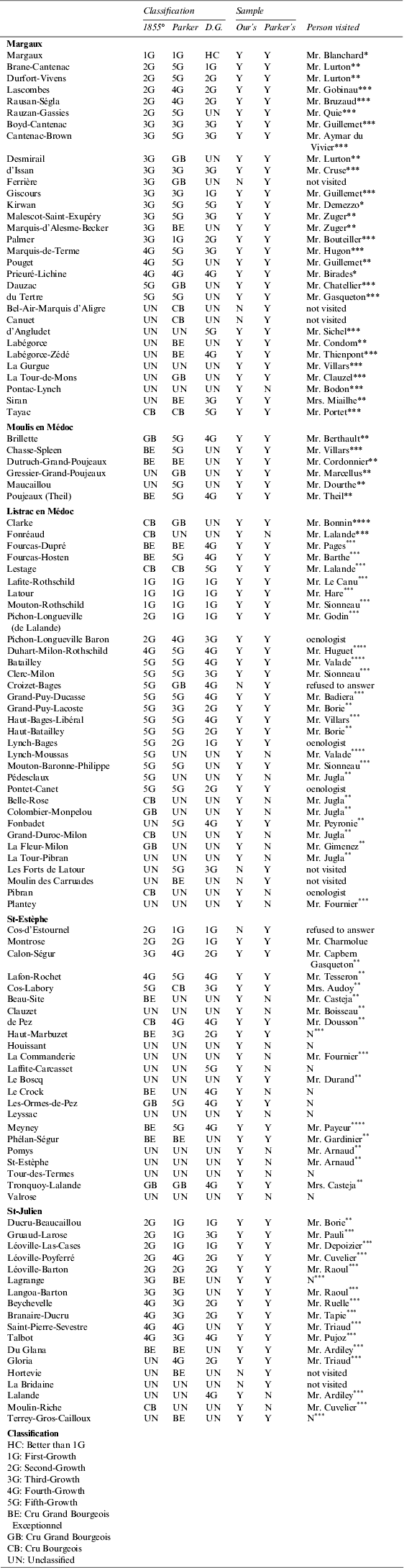
If the assumption on passing quality into prices is correct, one may simply run the same regression but with new definitions for the classification dummies, and verify which classification leads to the best fit. We considered the Lichine classification to be too old (1963) to deal with 1980–1990 wines, and performed the computations with Dussert-Gerber's and Parker's classifications, which are both given in Appendix 1, and can be seen to be quite different from the 1855 classification.Footnote 25 The estimated coefficients for appellations and classifications as well as some summary statistics of the three regressions appear in Table 5.
Comparison of Three Wine Classifications
* means significantly different from zero at the 5% probability level at least.
There is only one “inversion” in the 1855 classification: Third- to Fifth-Growth Margaux are more expensive than Second-Growths; such anomalies appear three times in both Parker's and Dussert-Gerber's classifications, implying that there exist discrepancies between qualities (as defined by Parker or Dussert-Gerber) and prices. The 1855 classification leads also to the best fit (highest R-squareFootnote 26); however, while Parker's performance is quite close to that of the official classification, Dussert-Gerber's is much worse. It is thus tempting to conclude that, broadly speaking, the 1855 classification is still the one that is implicitly accepted by consumers.
Though there is no other choice when one has to compare more than two non-nested models, one may also compare the 1855 classification with either Parker or Dussert-Gerber, by embedding the competing models within a more general model:
 $$y = Z\gamma + X_0 \beta _0 + X_a \beta _a + u,$$
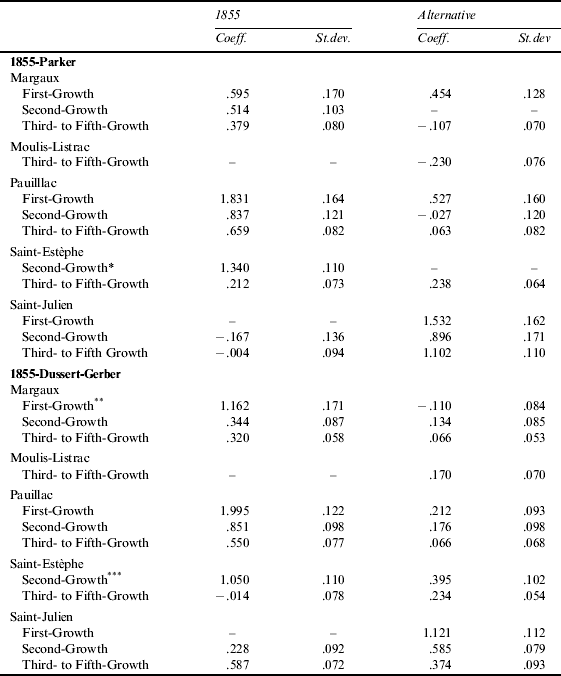
where Z is the matrix of technical variables, common to both the 1855 and the alternative model, X 0 is the matrix containing the 1855 classes and X a the one containing the alternative classification. One then tests whether the alternative classification adds to the older one (or vice-versa), i.e., H 0: β a=0 (H 0′:β 0=0). As is well known, such nesting may lead to reject both H 0 and H 0′, and this is precisely what happens here for both pair-wise comparisons, as is shown in Table 6.Footnote 27
Embedding 1855 and the Alternative Model

Therefore, other criteria have to be taken into account, and indeed, the regression coefficients on the classification variables in model (2) may give indications. When there are only two classes and the two classifications are fully disjoint, it is easy to check that if classification 0 (resp. a) is the correct one, β a (resp. β 0) will be equal to zero and β 0–β a will be positive (resp. negative). In situations that are less simple (more then two classes and classifications which are not fully disjoint), the sign of β 0–β a may still help in deciding which classification to choose.
Table 7 displays the results, and, given the comments which precede, shows that Saint-Juliens and Third- to Fifth-Growth Saint-Estèphes are obviously misclassified in the 1855 classification (and this is corrected both by Parker and Dussert-Gerber); Dussert-Gerber seems also to be doing better by upgrading some Moulis-Listrac wines.
Coefficients in the Embedded Models
* Montrose, the unique 1855 Second-Growth in our sample is also classified as such by Parker. **Dussert-Gerber classifies Château Margaux as HC; we assimilated to a First-Growth. ***Montrose is classified as a (unique) First-Growth by Dussert-Gerber. Since it is the only wine classified as Second-Growth in 1855, there is no variable corresponding to it in the D-G classification.
We then proceeded as follows:
(1) We replaced the 1855 Saint-Julien classification and the 1855 Third- to Fifth-Growth Saint-Estèphe classification by Parker's and kept unchanged the remainder of the 1855 classification; embedding then the rest of Parker's classification and testing H0: β a=0 leads to and F-value of 5.9, which is still significant, but much lower than the corresponding value of 16.8 in Table 6.
(2) Alternatively, we adopted Dussert-Gerber's classification for Saint-Julien First and Second Growths, for Saint-Estèphe Third- to Fifth-Growths and for Moulis-Mistrac Third- to Fifth-Growths; embedding then the rest of Dussert-Gerber's classification gives an F-value of 4.9, significant, but also much lower than the corresponding value of 16.2 in Table 6.
Both Parker and Dussert-Gerber seem thus to be right in correcting the 1855 classification for Saint-Juliens and Third- to Fifth-Growth Saint-Estèphes, mainly by upgrading; Dussert-Gerber also correctly upgrades some wines from Moulis-Listrac. On the other hand, none of them adds much by shifting Pauillac and Margaux wines for which the 1855 classification seems, by and large, still to be holding.
VII. Conclusions
Weather conditions are, as is often thought, the most important factor that contributes to quality, though the production technologies and the characteristics of the vineyards are far from being negligible in explaining differences across origins.
Reputation effects also convey very strong signals, and (almost) all châteaux mention that they were classified in 1855. Though First and Second-Growths wines should have a strong incentive to be more precise by signaling their rank, most châteauxFootnote 28 only mention their grading as “Grand Cru Classé en 1855,” without the rank. There is little doubt that they assume consumers to know “who is who,” and probably find inelegant and superfluous to give details.
Like in art, where names of painters are important, the label of a wine is obviously part of its “quality” which is passed on into its price. But why does the 1855 grading provide a better explanation of prices than more recent ratings?
One may think this to be the consequence of poorly informed consumers, whose unique information is the label. This is unlikely however: consumers of such expensive wines seek for more signals, and these are readily available in well-publicized books and journals. Clearly, consumers believe that the 1855 classification conveys more information than the ratings of wine specialists who, anyway, keep contradicting each other.
We are tempted to conclude that the 1855 classification still provides the quality signal. Together with the fact that 85% of the variance of (the log of) prices set by 100 among the best châteaux over 10 years can be explained by observable factors, seems to raise questions on the role of wine tasting specialists. After all, perhaps their unique contribution is (and should be) to keep producers on their toes: most wines classified in 1855 seem still to deserve their rank, while some wines from Saint-Julien, Saint-Estèphe and Moulis-Listrac which were either not classified or poorly ranked in 1855 have been moved up, and rightly so, by recent classifications. This is also in agreement with the suggestion made in Section IV, that châteaux which were classified in 1855 do their best not to move down the ladder.
Postscript April 2013
This paper was presented in 1992 at the Vineyard Data Quantification Society (VDQS) Verona Conference and received the First Prize Domini Veneti, that included 80 bottles of a nice (but very heavy) Amarone. The paper was translated into Italian, and the Cantina Sociale Valpolicella Negrar, of which Giuseppe Gaburro—at the time president of VDQS—was the chairman, published both the English and Italian versions in the form of a small and informal but very nice-looking booklet in 1993. Otherwise, the paper was never published, but, from time to time, I receive an email asking me to send it, and Stuart Landon and Constance Smith (1998) were among the few who were kind enough to cite it.
Among the members of the jury who gave the prize let me cite in alphabetic order: Orley Ashenfelter, whom I was meeting for the first time, plus a few VDQS old timers, Françoise Bourdon, Danielle Meulders (one of the judges of the 2012 Princeton Tasting), Marie-Claude Pichery (chair of the jury), Henri Serbat (the inventor of the VDQS), plus a few people who I did not know. The number of people in the jury (about 20) was larger than the number of those who came to listen to the paper when I gave it.
My co-authors are Muriel Monzak and Andras Monzak. Muriel, an economics student who wrote her last year's paper on this topic with me, became a pharmacist. Andras, her father, traveled at the time from one Haut-Medoc vineyard to the next, collecting (at the time, unpublished) data and buying wine. The only treat in my life of a beautiful Château Margaux served with Pauillac lamb.
1992 is a long time ago, a time at which I probably did not know—at least I do not remember whether I knew this or not—that the 1855 Bordeaux classification was based on the prices that wines fetched at the time (e.g., Markham, Reference Markham1998). The same was true for the classification of wines from the Mosel (Ashenfelter and Storchmann, Reference Ashenfelter and Storchmann2010).
I found a couple of papers, plus a 2012 Ph.D. Dissertation chapter (On the causality, cause and consequence of returns to organizational status: Evidence from the grands crus classés of the Medoc) that went much deeper than my coauthors and I were able to go. We used prices as dependent variable to try to see whether the 1855 classification was still up-to-date, and concluded that “consumers believe that the 1855 classification conveys more information than the ratings of wine specialists who, anyway, keep contradicting each other.” This is also the conclusion drawn by Landon and Smith: “the empirical evidence indicates that consumers consider a long-term reputation for quality to be a better signal of current quality than the more recent quality movements … The 1855 classification [is still] a very successful predictor of quality.” Kugler and Kugler (Reference Kugler and Kugler2010) reach a similar conclusion for Bordeaux wines sold in Switzerland.
Thompson and Mutkoski (Reference Thompson and Mutkoski2011) strongly disagree with that view. Their findings are based on ratings by Robert Parker (The Wine Advocate), Stephen Tanzer (International Wine Cellar) and Wine Spectator for vintages from 1970 to 2005. They conclude that “more than half of the 61 wines classified growths [in 1855] are misclassified, with some châteaux moving as many as three tiers upward or downward compared to the historical classification.” Mike Steinberger (Reference Steinberger2005) titles his paper in Slate Magazine “How the most important rankings in wine became irrelevant.”
The Liv-ex Bordeaux classification compiled by the British internet and phone-based wine exchange (London International Vintners Exchange) in March 2009, and revised in 2011 mimics the 1855 classification which was based on prices. It finds large (relative) differences between 1855 and 2011: Lynch Bages (a second growth), for instance, gains 38 positions, while Rauzan Gassies (a fifth growth) loses 40 positions between the two price lists.
In his, by all accounts, excellent first chapter of his dissertation, Malter (Reference Malter2012) concludes that “returns accrue mostly to the very elite and are relatively small at the lower echelons of the status hierarchy.” But this quote is far from giving him full justice. Read his chapter. You will learn a lot about industrial organization and well-done econometrics. Obviously, a young man, but already a very wise one also: “Classifications,” he writes, “have always been debatable.”
There is also a growing debate about “terroir,” which has obvious links with the above paper. Gergaud and Ginsburgh (Reference Gergaud and Ginsburgh2010) for red Bordeaux (the same as those analyzed in this paper), as well as Cross, Plantiga and Stavins (2011) for wines from Oregon, show that terroir does not explain much. Ashenfelter and Storchmann (Reference Ashenfelter and Storchmann2010) show that the inverse holds for wines from the Mosel valley.
Appendix 1
List of Wines and their Classification
Appendix 2
Misclassifications