Suicide among young people has emerged as an important public health issue worldwide. According to the World Health Organization (2019), suicide is the second leading cause of death following road injury among 15–29-years-olds globally. In the United States, suicide risk in young people has continued to increase (Hedegaard et al., Reference Hedegaard, Curtin and Warner2018). The National Youth Risk Behavior Surveys (Centers for Disease Control and Prevention, 2018) showed that in 2017, 17.2% of high schoolers seriously considered attempting suicide, 13.6% made a suicide plan, and 7.4% attempted suicide. Among youth who have experienced the death of a parent, there is elevated risk of suicide ideation and attempts (Adam et al., Reference Adam, Lohrenz, Harper and Streiner1982; Jakobsen & Christiansen, Reference Jakobsen and Christiansen2011; Lewinsohn et al., Reference Lewinsohn, Rohde and Seeley1996; Rostila et al., Reference Rostila, Berg, Arat, Vinnerljung and Hjern2016). These youth are also at risk for suicide death (Agerbo et al., Reference Agerbo, Nordentoft and Mortensen2002; Brent et al., Reference Brent, Perper, Moritz, Liotus, Schweers, Balach and Roth1994; Guldin et al., Reference Guldin, Li, Pedersen, Obel, Agerbo, Gissler and Vestergaard2015; Wilcox et al., Reference Wilcox, Kuramoto, Lichtenstein, Långström, Brent and Runeson2010). A population-based register study found that adolescents who lost one biological parent to death showed increased risk of suicide attempts, and the risk almost doubled if both parents died (Jakobsen & Christiansen, Reference Jakobsen and Christiansen2011).
In suicide prevention, there is growing interest in “upstream” interventions that target risk and protective factors early in life and have cascading effects to reduce suicide risk later in adulthood (Reider & Sims, Reference Reider and Sims2016; Wyman, Reference Wyman2014). A number of studies suggested the promise of universal or selective preventive interventions during childhood/adolescence to exert cross-over effects in reducing suicide risk in early adulthood (Connell et al., Reference Connell, McKillop and Dishion2016; Hawkins et al., Reference Hawkins, Kosterman, Catalano, Hill and Abbott2005; Kerr et al., Reference Kerr, DeGarmo, Leve and Chamberlain2014; Sandler et al., Reference Sandler, Tein, Wolchik and Ayers2016; Wilcox et al., Reference Wilcox, Kellam, Brown, Poduska, Ialongo, Wang and Anthony2008). Because of the importance of understanding an intervention’s targets that are responsible for its positive effects (Glenn et al., Reference Glenn, Franklin and Nock2015), intervention studies with long-term follow-ups of youth provide an opportunity to investigate the developmental cascading pathways (Masten & Cicchetti, Reference Masten and Cicchetti2010) through which the targeted behaviors that were modified by the intervention can lead to a chain of positive effects across domains or systems over the course of development. For example, Connell et al. (Reference Connell, Shaw, Wilson, Danzo, Weaver-Krug, Lemery-Chalfant and Dishion2019) showed that children in the Family Check-Up (vs. controls) had greater growth rates in inhibitory control from age 2 to 7.5 which were subsequently, negatively associated with suicidal thoughts/attempts at age 10.5–14. No research has been conducted yet to examine the cascading pathways through which an early preventive intervention reduced suicide risk in early adulthood.
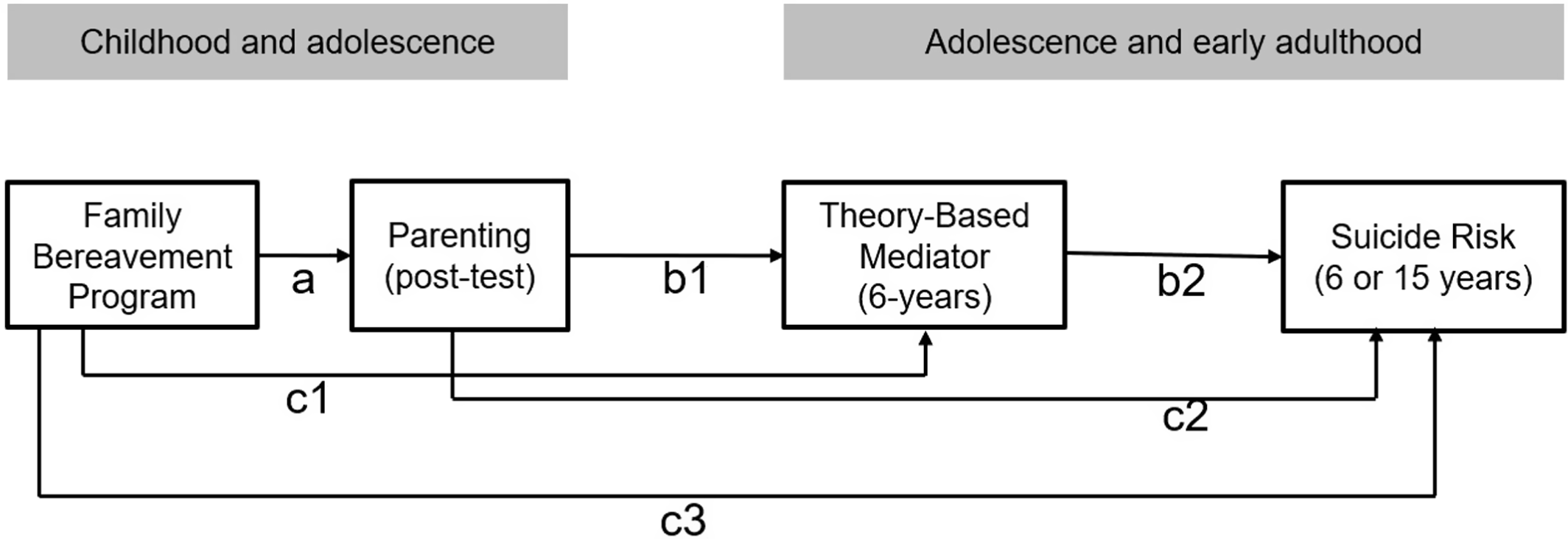
The current study focused on the cascading effects of an “upstream” early preventive intervention for parentally bereaved youth, the Family Bereavement Program (FBP), on reducing suicide risk. The FBP is a family-based, parenting-focused preventive intervention designed to reduce mental health problems in parentally bereaved youth. Prior work that used an intent-to-treat (ITT) analysis found that the FBP reduced suicide risk at the 6 and/or 15 years follow-ups (Sandler et al., Reference Sandler, Tein, Wolchik and Ayers2016), but the cascading pathways through which the FBP yielded such positive effects remain unknown. The design of the FBP was based on a contextual resilience theoretical framework (Sandler et al., Reference Sandler, Wolchik and Ayers2008) which describes the hypothesized effect of the intervention to impact a proximal outcome (e.g., parenting) which in turn impacts distal outcomes to be prevented (e.g., internalizing/externalizing behaviors in youth). To elucidate the cascading pathways through which the FBP reduced suicide risk in early adulthood, the current study tested a three-path cascade model with two mediators (Taylor et al., Reference Taylor, MacKinnon and Tein2008; see also Brown et al., Reference Brown, Zang, Benhamou, Taylor, Bryan and Yarvis2019; Norr et al., Reference Norr, Allan, Reger and Schmidt2018; Figure 1). The model tests whether program-induced improvement in one targeted protective factor – effective parenting at posttest (M1) – has cascading effects on a more proximal mediator at 6 years follow-up (M2), which lead to reductions in suicide risk at 6 or 15 years follow-up. The model specifies the causal chain of mediated effects in which the program influences M1 (“a” in Figure 1) which subsequently influences M2 (b1) that affects suicide risk (b2), while controlling for the effect of the program on M2, the effect of the program on suicide risk, and the effect of M1 on suicide risk (c1, c3, and c2, respectively; see Taylor et al., Reference Taylor, MacKinnon and Tein2008).
A conceptual model.

Research has not yet investigated whether program-induced improvement in effective parenting would lead to reduced suicide risk many years later. Effective parenting (M1, the first mediator in Figure 1) is an important target of the FBP because prior FBP studies as well as other studies of the long-term effects of parenting-focused prevention programs have found support for the role of effective parenting as a mediator of long-term program effects. For example, prior analyses showed that strengthened parenting at posttest mediated the FBP’s effects to reduce internalizing and externalizing behaviors of girls at the 11 months follow-up (Tein et al., Reference Tein, Sandler, Ayers and Wolchik2006). In addition, a review found that strengthened parenting mediated the long-term effects (over 3 years or longer) of parenting-focused preventive interventions in reducing externalizing (7 studies), internalizing (3 studies) and substance use/abuse problems (6 studies; Sandler et al., Reference Sandler, Ingram, Wolchik, Tein and Winslow2015).
There are many possible mediators (M2, the second mediator in Figure 1) that could explain the effects of parenting during childhood/adolescence on suicide ideation and attempts during adolescence/early adulthood. Current theories of suicide point to psychological processes including aversive self-views (Baumeister, Reference Baumeister1990), perceived burdensomeness, and thwarted belongingness (Joiner, Reference Joiner2005), as well as pain, connectedness, and hopelessness (Klonsky et al., Reference Klonsky, May and Saffer2016). There are also empirical data that suggested the relations of parenting to these factors (e.g., Love & Durtschi, Reference Love and Durtschi2021). In addition, meta-analytical studies have identified numerous risk factors for suicide ideation and attempts such as prior suicide ideation/attempts, hopelessness, and depression (e.g., Franklin et al., Reference Franklin, Ribeiro, Fox, Bentley, Kleiman, Huang and Nock2017).
In the current study, for the more proximal mediator that explains the effect of parenting on suicide risk, we selected six factors at the 6 years follow-up because of their linkage with suicide risk and parenting in the contexts of bereavement and the theory of FBP: aversive self-views, caregiver connectedness, peer connectedness, complicated grief, emotion suppression, and depressive symptoms. Our selection was based on (i) theories of suicide (i.e., aversive self-views, see Baumeister, Reference Baumeister1990; connectedness, see Joiner, Reference Joiner2005, and Klonsky et al., Reference Klonsky, May and Saffer2016), (ii) hypothesized developmental cascades within the FBP’s theoretical framework (e.g., emotion suppression as a target of the FBP), (iii) the context of bereavement (e.g., depression and complicated grief in bereaved individuals), and (iv) limitations of using a secondary dataset (other factors such as hopelessness or burdensomeness were not assessed in the dataset). Below, we review the relevant literature on parenting as an important protective factor and an immediate target of FBP. We then discuss the theory and empirical evidence that support each of the six mediators linking to both parenting and suicide risk.
Parenting as a protective factor targeted by the FBP
We propose that the FBP’s effects to strengthen parenting at posttest would be the first mediator in the developmental cascade (Figure 1). There are considerable correlational studies suggesting that effective parenting is negatively associated with suicidal thoughts and attempts of children and adolescents (Gallagher & Miller, Reference Gallagher and Miller2018). Illustratively, in a nationally representative sample, Kuramoto-Crawford et al. (Reference Kuramoto-Crawford, Ali and Wilcox2017) found that parent-child connectedness during ages of 11–18 was associated with decreased risk of having suicidal thoughts during adolescence and early adulthood. The FBP was designed to strengthen caregivers’ parenting based on evidence that parenting is a protective factor for multiple mental health outcomes of bereaved children, and prior research demonstrated the efficacy of the program to strengthen parenting (Sandler et al., Reference Sandler, Ayers, Wolchik, Tein, Kwok, Haine and Griffin2003). Effective parenting is characterized by a positive, warm, and supportive parent-child relationship and the uses of consistent discipline (Sandler et al., Reference Sandler, Schoenfelder, Wolchik and MacKinnon2011). In the context of parentally bereaved families, effective parenting of the caregiver also requires open communication about feelings, being responsive to the child’s loss-related needs (Saldinger et al., Reference Saldinger, Porterfield and Cain2004), as well as decreasing the child’s exposure to negative events (e.g., family conflicts). The FBP teaches caregivers tools to enhance parenting practices in these areas (Sandler et al., Reference Sandler, Ayers, Wolchik, Tein, Kwok, Haine and Griffin2003).
Theory-based proximal mediators associated with suicide risk
We investigated six factors as the second mediator in the developmental cascade linking the effect of strengthened parenting to reduced suicide risk (Figure 1). First of all, several theoretical perspectives suggest aversive self-views, caregiver connectedness, and peer connectedness as proximal mediators of suicide risk. First, Baumeister (Reference Baumeister1990) proposed the escape theory of suicide, which highlights the central role of aversive self-views in suicidal behaviors. The theory proposes that suicide attempts occur as an escalation of one’s desire to escape from aversive self-awareness and the related negative affect. Such aversive self-views can be related to attributing one’s current stressful circumstances to the self as being “incompetent, dislikeable, guilty or otherwise bad” (Baumeister, Reference Baumeister1990, p. 91). From a different perspective, Joiner (Reference Joiner2005), in his Interpersonal-Psychological Theory of Suicide, focused on the interpersonal domain to explain why people desire to die. Specifically, thwarted belongingness and perceived burdensomeness together lead to suicidal thoughts whereas capacity for suicide is the key for making a suicidal attempt. Finally, Klonsky et al. (Reference Klonsky, May and Saffer2016) highlighted that pain (due to a myriad of factors such as negative thoughts, emotions, sensations, and experiences) and hopelessness can lead to suicidal thoughts, which may be worsened by a lack of social connectedness. Social connectedness for bereaved adolescents/young adults includes caregiver and peer connectedness. Klonsky et al.’s (Reference Klonsky, May and Saffer2016) model is inclusive of the constructs from both Baumeister’s and Joiner’s theories. There is evidence suggesting that parentally bereaved youth experience elevated levels of aversive self-views and social disconnectedness. For example, bereaved children were found to show higher social withdrawal, lower peer-attachment, as well as lower self-esteem and self-efficacy than non-bereaved children up to 2 years postdeath (Brent et al., Reference Brent, Melhem, Masten, Porta and Payne2012; Worden & Silverman, Reference Worden and Silverman1996).
Given the context of bereavement and the theory underlying the FBP, we also examined three interrelated variables as additional proximal mediators: complicated grief, depressive symptoms, and emotion suppression. Most bereaved young people are resilient, but some experience prolonged grief reactions or complicated grief. These individuals have difficulty accepting and adapting to the death, show apparent withdrawal of attention from ongoing life, and often experience pain and hopelessness because of the loss of a parent. Most research on complicated grief is with adults. Melhem et al. (Reference Melhem, Porta, Shamseddeen, Walker Payne and Brent2011) found that 10.4% of children/adolescents showed high complicated grief nearly 3 years after parental death, and it was predicted by prior history of depression. A few studies have found that grief was associated with elevated risk for suicidal thoughts and attempts in young people (Melhem et al., Reference Melhem, Moritz, Walker, Shear and Brent2007; Prigerson et al., Reference Prigerson, Bridge, Maciejewski, Beery, Rosenheck, Jacobs and Brent1999; Sandler et al., Reference Sandler, Tein, Zhang, Wolchik and Thieleman2021). Consistent with Joiner’s theory, Hill et al. (Reference Hill, Kaplow, Oosterhoff and Layne2019) showed that grief was associated with thwarted belongingness, which was further associated with suicidal thoughts in adolescents. Depressive symptoms are considered a risk factor of suicide in adolescents and young adults (Evans et al., Reference Evans, Hawton and Rodham2004; Gili et al., Reference Gili, Castellví, Vives, de la Torre-Luque, Almenara, Blasco and Roca2019) and in bereaved youth (Brent et al., Reference Brent, Melhem, Donohoe and Walker2009). Prior findings that the FBP reduced internalizing problems suggested the plausibility of depressive symptoms as a proximal mediator in the cascading pathway (Sandler et al., Reference Sandler, Gunn, Mazza, Tein, Wolchik, Kim and Porter2018). Finally, emotion suppression is a maladaptive emotion regulation strategy that involves attempts to conceal emotion-expressive behaviors (Gross & Cassidy, Reference Gross and Cassidy2019). A meta-analysis showed that emotion suppression has an overall small effect on depressive symptoms and anxiety in youth (Schäfer et al., Reference Schäfer, Naumann, Holmes, Tuschen-Caffier and Samson2017). Emotion suppression was also found to mediate the FBP’s effect to reduce externalizing problems at the 11-month follow-up (Tein et al., Reference Tein, Sandler, Ayers and Wolchik2006). A previous study with adolescents seeking emergency services found that emotion suppression mediated the relation between history of adverse events and suicide thoughts and attempts (Kaplow et al., Reference Kaplow, Gipson, Horwitz, Burch and King2014).
Conceptualization of the three-path model
The model proposes that FBP effects to strengthen effective parenting (i.e., positive parent-child relationships and consistent discipline) during childhood/adolescence (age of 6–18 years) would show cascading effects of reducing suicide risk via the proximal mediators. There are several reasons why the FBP’s effect to strengthen effective parenting might reduce the development of aversive self-views and improve caregiver and peer connectedness during adolescence and young adulthood (age of 12–24 years). Effective parents use encouragement, guidance, and discipline to support their children in developing a positive sense of self (Koepke & Denissen, Reference Koepke and Denissen2012) as reflected in higher self-esteem and age-appropriate developmental competencies. Research has found that high quality of parenting was positively associated with adolescent’s self-esteem (Bulanda & Majumdar, Reference Bulanda and Majumdar2009; Huey et al., Reference Huey, Laursen, Kaniušonytė, Malinauskienė and Žukauskienė2020) and views of their competence and social acceptance (Putnick et al., Reference Putnick, Bornstein, Hendricks, Painter, Suwalsky and Collins2008). Effective parenting during childhood/adolescence is also thought to provide a foundation for the formation of secure attachment to significant adult figures and peers during adolescence/adulthood which are of particular importance in bereaved young people (Brewer & Sparkes, Reference Brewer and Sparkes2011). During adolescence and young adulthood, the need for independence and autonomy may change the relationship dynamics with their surviving caregiver, but a sense of caregiver connectedness continues to be important especially when it comes to bereavement-related support (e.g., Saldinger et al., Reference Saldinger, Porterfield and Cain2004). Research has also found that effective parenting was associated with the development of positive peer relationships (Dekovíc & Meeus, Reference Dekovíc and Meeus1997) and that poor parenting was associated with hostility toward friends (Allen et al., Reference Allen, Hauser, O’Connor and Bell2002).
There is also research to support the relations between effective parenting and the other proximal mediators that were examined. Research has shown that effective parenting was associated with lower levels of intrusive grief thoughts (an aspect of complicated grief; Wolchik et al., Reference Wolchik, Ma, Tein, Sandler and Ayers2008) and internalizing problems (Haine et al., Reference Haine, Wolchik, Sandler, Millsap and Ayers2006; Schoenfelder et al., Reference Schoenfelder, Sandler, Wolchik and MacKinnon2011) in parentally bereaved youth. Effective parenting also mediated the effects of the FBP on internalizing problems at the 11-month follow-up (Tein et al., Reference Tein, Sandler, Ayers and Wolchik2006). Furthermore, in their cross-sectional study, Shapiro et al. (Reference Shapiro, Howell and Kaplow2014) found that greater warmth in mothers’ communication was associated with lower maladaptive grief and depression. A number of meta-analyses demonstrated the association between parenting and childhood depressive symptoms, although most studies were cross-sectional (McLeod et al., Reference McLeod, Weisz and Wood2007; Pinquart, Reference Pinquart2017). Balan et al. (Reference Balan, Dobrean, Roman and Balazsi2017) found the association between poor parenting practices (e.g., inconsistent discipline) and emotion suppression in adolescents.
Theoretically, caregivers can help bereaved children to cope with postdeath changes and support the child to have a continued bond with the deceased parent, which may facilitate the grieving process. As suggested by Shaver and Tancredy (Reference Shaver, Tancredy, Stroebe, Hansson, Stroebe and Schut2001), individuals who experience sensitive and responsive parenting are securely attached and they tend to seek and benefit from social support following loss. They can also move flexibly between the “loss-oriented” (e.g., having intrusive thoughts) and “restoration-oriented” (e.g., attending to new things in life) processes of bereavement (Stroebe & Schut, Reference Stroebe and Schut2010), which is critical for adaptive grief reactions. Theoretically, parental warmth and support of youth’s emotions may signal to youth that sharing their emotions is constructive, and equips them with strategies to appropriately regulate their emotions (Eisenberg et al., Reference Eisenberg, Cumberland and Spinrad1998; Gottman et al., Reference Gottman, Katz and Hooven1996). In socializing children’s emotions, parenting practices that are characterized by responsiveness and consistency can reduce children’s physiological arousal levels in stressful situations, which further supports children to develop their understanding of emotions and capacities to down-regulate negative emotions, reducing risk of depressive symptoms (Eisenberg et al., Reference Eisenberg, Cumberland and Spinrad1998). If youth’s emotions are not met with acceptance and warmth, sharing emotions may be seen as an unpleasant experience, reinforcing expressive suppression (Gottman et al., Reference Gottman, Katz and Hooven1996). Also, effective parenting may provide children a sense of secure attachment and facilitate adaptive emotion regulation in children, and thus it may have an impact on children’s emotion suppression (Gross & Cassidy, Reference Gross and Cassidy2019).
The current study
The goal of the current study is to analyze a secondary dataset (from a randomized trial of the FBP) to examine the developmental cascading pathways through which the FBP had effects in reducing suicide risk. A prior study has shown that parentally bereaved youth (age of 8–16 years) and their caregivers who were randomized into the FBP (vs. a literature control condition) showed improved parenting at posttest (Sandler et al., Reference Sandler, Ayers, Wolchik, Tein, Kwok, Haine and Griffin2003; a path, Figure 1). We tested six cascade models separately, in which the theory-based mediators were aversive self-views, caregiver and peer connectedness, complicated grief, depressive symptoms, and emotion suppression. We hypothesized that each of the six proximal mediators (measured at the 6 years follow-up) would mediate the association between program-induced improvement in parenting and suicide risk (b1 and b2 paths) and that the effect of FBP on suicide risk would become non-significant after including the mediator in the model. We did not formulate specific hypotheses on the relative magnitude of the mediation effects. Using the 15 years follow-up data on suicide risk outcome would allow a temporal lag between the second mediator and outcome (b2 path, Figure 1), however, the low endorsement rate of suicide ideation/attempts at the 15 years follow-up (4.9%) in this secondary dataset may produce unstable estimates in logistic regression models (e.g., Cai et al., Reference Cai, Parast and Ryan2010). Thus, we chose to focus on the combined 6 and 15 years follow-up data on suicide risk as the binary outcome variable, that is, endorsement of suicide ideation/attempts at either 6 or 15 years follow-ups (endorsement rate 11.6%).
Methods
Participants
The sample was 156 families including 244 children/adolescents aged 8–16 years at the start of the study (M = 11.39; SD = 2.43); 53% of the youth were male. The racial and ethnic characteristics were: 67% non-Hispanic Caucasian, 16% Hispanic, 7% African American, and 10% others. Median family income was between $30,001–$35,000. The caregivers who participated in the study were mother (63%), father (21%), or an adult who was not a parent (e.g., aunt, grandparent; 16%). The causes of parental death were illness (67%), accident (20%), and homicide or suicide (13%).
Procedures
The procedure including sample recruitment, eligibility criteria, random assignment, program and control description, and assessment is fully described in previous publications (Sandler et al., Reference Sandler, Ayers, Wolchik, Tein, Kwok, Haine and Griffin2003, Reference Sandler, Ayers, Tein, Wolchik, Millsap, Khoo and Coxe2010, Reference Sandler, Gunn, Mazza, Tein, Wolchik, Kim and Porter2018) and is briefly presented here. Families were recruited from community agencies and media advertisements. Eligibility criteria were: the parent had died between 4 to 30 months prior to the study, the child was between 8 and 16 years of age, and family members were not currently receiving other mental health services. Families were considered ineligible to participate in the study if the children or their caregiver endorsed suicide thoughts and had a plan; these families were referred to treatment. Following the baseline assessment (an in-home interview administered by trained staff), families were randomly assigned to the FBP (n = 90 families with 135 children) or a literature control group (n = 66 families with 109 children). The FBP is a 12-session group-based program that was comprised of separate groups for caregivers and children/adolescents, as well as two family sessions. The control condition consisted of three books about grief that were sent to both the caregiver and children/adolescents at 1-month intervals.
Four additional assessments were administered to caregivers and their children: posttest (3 months postbaseline) and 11 month (14 months postbaseline), 6 years, and 15 years follow-ups. Data from baseline, posttest, and the 6 years and 15 years follow-ups were used in this study. At the 15 years follow-up, data were obtained from key informants whom the young adults nominated as a person who knows them best (e.g., surviving caregiver, friend, or spouse). All study procedures were approved by the University Institutional Review Board. Informed consent from caregivers and young adults (aged 18 years and above) and assent from youth (under 18 years) were obtained.
Measures
For all mediator and suicide risk outcomes, we included the baseline measure of the same variable as the covariate for controlling the stability of the variable. When no such measure was collected, we selected a proxy variable, described below, that was conceptually closely related to the variable.
Distal outcome
Suicide risk The measure of suicide risk included items on suicidal thoughts, suicidal attempts, as well as self-harm. This composite consists of factors that are associated with death by suicide rather than indicators of high suicidality.
At the 6 years follow-up, caregivers reported on 2 items using the Child Behavior Check List (CBCL; age < 18 years; Achenbach, Reference Achenbach1991a, Reference Achenbach1991b) or Young Adult Behavior Check List (YABCL; age > 18 years; Achenbach & Rescorla, Reference Achenbach and Rescorla2003): “Deliberately harms self or attempts suicide” (endorsement rate 1.5%; 3/206) and “Talks about killing self” (2.9%; 6/206). At the 6 years follow-up, caregiver-report (0.5%; 1/201) and self-report (1.0%; 2/200) were also collected using an item from the Diagnostic Interview Schedule for Children (Shaffer et al., Reference Shaffer, Fisher and Lucas2004) “Thoughts of death, suicide ideation, suicide attempt or plan.” At both of the 6 years and 15 years follow-ups, self-report on 2 items from the Youth Self Report (Achenbach, Reference Achenbach1991b; age < 18 years) or Young Adult Self Report (Achenbach & Rescorla, Reference Achenbach and Rescorla2003; age > 18 years): “I deliberately try to hurt or kill myself” (6 years, 2.4%, 5/207; 15 years, 0%, 0/181), “Talk about killing self/I think about killing myself” (6 years, 5.3%, 11/207; 15 years, 1.7%, 3/181). At the 15 years follow-up the key informants reported on 2 items from the YABCL: “Deliberately harms self or attempts suicide” (1.3%, 2/157) and “Talks about killing self” (3.8%, 6/157). Each of these items asked about suicidal thoughts or attempts during the past month for all measures except for the key informant’s report which had a time frame of the past 6 months. At baseline and the 6 years follow-up, endorsement was mostly from self-report than caregiver-report. At the 15 years follow-up, endorsement by the key informant was somewhat higher than self-endorsement. Across reporters, the number of cases in which both self and the other reporter (caregiver or key informant) endorsed suicide risk (i.e., concordance) was 19, 2, and 1, at baseline, 6 years, and 15 years follow-up assessments, respectively. A dichotomous variable of suicide risk was created to indicate endorsement of suicide risk from any reporter. As described previously in Sandler et al. (Reference Sandler, Tein, Wolchik and Ayers2016), at the 6 years follow-up, the endorsement rate was 6.4% (7/109) for FBP and 14.1% (14/99) for control; at the 15 years follow-up, the rate was 1.9% (2/103) for FBP and 8.6% (7/81) for control. After combining the data at the 6 years and 15 years follow-ups, the rate of endorsing suicide risk at 6 or 15 years follow-ups was 6.7% (9/123) for FBP and 15.6% (17/101) for control.
At baseline, caregiver reported on 2 items from the CBCL (Achenbach & Rescorla, Reference Achenbach and Rescorla2001): “Deliberately harms self or attempts suicide” (2.5%; 6/241); and “Talks about killing self” (5.8%; 14/243); and youth reported on an item from the Child Depression Inventory (CDI; Kovacs, Reference Kovacs1992), “Think about killing self” (27.1%; 66/244). For the baseline covariate, combined self-report and caregiver-report data were used such that baseline suicide risk was coded as 1 (31.1%; 76/244) if any of the items was endorsed or 0 (68.9%) if none of the items was endorsed. The FBP (42/135) and control group (34/109) had comparable endorsement rates at baseline.
Posttest mediator
Parenting was measured at baseline and posttest via multiple methods and reporters. Caregiver-child relationship was reported by caregivers and children using separate versions of the following scales: (1) Acceptance (16 items, e.g., “You saw [target child]’s good points more than his/her faults/[Your caregiver] saw your good points more than your faults”) and Rejection (16 items, e.g., “You were not very patient with [target child]/[Your caregiver] was not very patient with you”) subscales of the Child Report of Parenting Behavior Inventory (CRPBI; Schaefer, Reference Schaefer1965); (2) A 7-item scale on family routines that was modified from Jensen et al. (Reference Jensen, James, Boyce and Hartnett1983) (e.g., You/[your caregiver] had some time each day for just talking with [target child]/you); (3) A 5-item scale on stable positive events in the family during the past month (Sandler et al., Reference Sandler, Wolchik, Braver and Fogas1991) (e.g., “Your family got together with relatives for good times”). In addition, children reported on a 10-item Sharing Emotions with Parents Scale (e.g., “[Your caregiver] really cares for you when you feel bad”) to assess children’s perception that their caregiver understands their feelings. Caregivers reported on how they dealt with the expressions of their own negative emotions in the presence of their children on the 6-item Talk with Reassurance subscale of the Parents Expression of Emotion Questionnaire (e.g., “If you are worried about financial problems, how likely is it that you would tell [target child] that you are concerned about your financial situation but let him/her know that you have a plan to deal with it”). Moreover, caregiver-child relationships were assessed through behavioral observation. Caregiver-child dyads completed a 12-min family interaction task during home assessments where they discussed two family issues selected from the Parent Issues Checklist (Prinz et al., Reference Prinz, Foster, Kent and O’Leary1979). Caregivers’ behaviors were video-taped and rated by trained coders, with a focus on the caregiver’s positive affective tone and attention (i.e., back channeling and head nodding; Griffin & Decker, Reference Griffin and Decker1996). Interrater reliability was acceptable (Cohen’s κ > .77).
Consistent discipline was assessed by the following scales: (1) Caregiver- and child-reports on the Inconsistency of Discipline subscale (8 items, e.g., “You/[your caregiver] sometimes allowed [target child]/you to do things you/he or she said were wrong”) of the CRPBI; (2) An adapted version of the Parent Perception Inventory (Hazzard et al., Reference Hazzard, Christensen and Margolin1983) assessed caregiver’s uses of positive reinforcement (8 items, e.g., “How often did [your caregiver] compliment you?”); (3) Caregivers completed an adapted version of the Discipline Follow-Through subscale of the Oregon Social Learning Center (1991)’s Discipline Scale (9 items, “How often did you get angry when you punished [target child]?”).
The Cronbach’s αs (when appropriate) of these scales were all acceptable in the sample (> .74). All scales have demonstrated adequate validity in previous research. A measurement model of effective parenting based on these measures was tested previously (Kwok et al., Reference Kwok, Haine, Sandler, Ayers, Wolchik and Tein2005) which consists of caregiver- and child-reported caregiver-child relationship, discipline, and observed caregiver-child relationship during video-taped family interactions. Specifically, a second-order model of parenting was estimated with five first-order factors: (1) child report of caregiver-child relationship; (2) parent report of caregiver-child relationship; (3) behavioral observation of caregiver-child relationship; (4) child report of discipline; and (5) parent report of discipline. The model fit the data adequately (Kwok et al., Reference Kwok, Haine, Sandler, Ayers, Wolchik and Tein2005). In this study, composite scores of effective parenting (averages of Z scores of each measure) were created and used in the analyses.
Theory-based mediators at the 6 years follow-up
Aversive self-views In the secondary dataset, three scales are relevant to aversive self-views. Mastery was assessed using a 7-item scale (Pearlin & Schooler, Reference Pearlin and Schooler1978) (e.g., “There is really no way I can solve some of the problems I have”, reversely coded) and three additional items developed for the FBP project (“I am sure that the future will include more bad things”, “I cannot control what will happen to me”, and “There is no sense in trying hard to make my future better”, all reversely coded). Items were rated on a 4-point scale (1 = strongly disagree, 4 = strongly agree). Cronbach’s α was .81. Identity was assessed using the 12-item Identity subscale of the Psychosocial Maturity Inventory (Greenberger, Reference Greenberger1984) (e.g., “I can’t really say what my interests are”, reversely coded) anchored on a 4-point scale (1 = strongly agree, 4 = strongly disagree). Cronbach’s α was .87. Self-esteem was assessed using the 10-item Rosenberg Self Esteem Scale (Shevlin et al., Reference Shevlin, Bunting and Lewis1995) (e.g., “All in all, I am inclined to feel that I am a failure”, reversely coded). The items were rated on a 4-point scale (1 = strongly agree, 4 = strongly disagree). Cronbach’s α was .89.
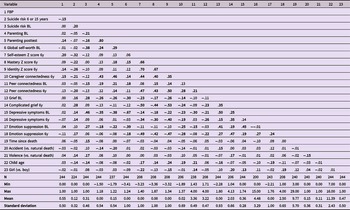
Z scores of the three scales were calculated (see Table 1 for descriptive statistics). Bivariate correlations showed that the measures were highly correlated (rs = .66–.70). Thus, we used these three measures for a latent factor to assess aversive self-views. In structural equation modeling analysis, we multiplied each Z score by −1 such that higher scores indicate lack of mastery, lack of identity, and lack of self-esteem, respectively. As suggested by reviewers, we also created an observed variable by averaging the Z scores and computed our hypothesized model using the observed variable of aversive self-views (see Online Supplemental Figure 1) which shows consistent results.
Descriptive statistics and intercorrelation matrix of study variables

Note: 6y = 6 years follow-up; BL = baseline; FBP = Family Bereavement Program. Correlation coefficients in bold are statistically significant (α < .05).
For the baseline covariate, we used the 6-item Global Self Worth subscale from the Self Perception Profile for Children (Harter, Reference Harter1982). Children/adolescents chose one of two statements (e.g., “Some kids are often unhappy with themselves but other kids are pretty pleased with themselves”) as being most like them and then rated the extent to which the statement represents them (“very much like this” or “somewhat like this”). The Cronbach’s α was .80.
Peer connectedness was measured at baseline and the 6 years follow-up using the peer subscale of the Coatsworth Competence Scale (Coatsworth & Sandler, Reference Coatsworth and Sandler1993). It has 7 items anchored on a 4-point scale (1 = very much like you, 4 = not at all like you) (e.g., “Compared to other people your age, you have lots of friends”). The Cronbach’s αs were .63 at pretest and .61 at the 6 years follow-up.
Caregiver connectedness at the 6 years follow-up was assessed by a total of eight measures that are part of the measures of effective parenting at baseline and posttest: (1) child- and caregiver-reports on the Acceptance and Rejection subscales of the CRPBI, (2) child- and caregiver-reports on family routines, (3) child- and caregiver-reports on positive reinforcement, (4) caregiver-report on the Talking with Reassurance subscale, and (5) child-report on the Sharing Emotions with Parents Scale. The Cronbach’s αs of these scales in the sample were all acceptable (> .81). We used confirmatory factor analysis to test a latent factor of caregiver connectedness with the eight indicators. We co-varied child- and caregiver-reports of family routines and specified the four caregiver-reported measures to be correlated with each other. The model fit the data well: χ2 (13) = 15.01, CFI = 1.00, RMSEA = 0.03, SRMR = 0.02. We calculated the composite of Z scores of these measures for the analyses of the hypothesized cascade model. Baseline effective parenting as described above was used as the baseline covariate.
Emotion suppression was measured at baseline and the 6 years follow-up using the Active Inhibition Scale (Ayers et al., Reference Ayers, Sandler, Twohey, Ollendick and Prinz1998; Dodd et al., Reference Dodd, Hill, Alvis, Rooney, Layne, Logsdon and Kaplow2020) which was developed for the FBP project. This 10-item scale asks about respondents’ conscious effort to avoid revealing emotions to another (e.g., “You’ve tried to hide any bad feelings that you’ve had”). Each item was rated on a scale from 1 = “a lot like you” to 4 “not at all like you”. Scores were calculated such that higher scores indicated greater levels of inhibition. The Cronbach’s αs were .89 at both time points. Research has shown evidence supporting the reliability and validity of this scale (Dodd et al., Reference Dodd, Hill, Alvis, Rooney, Layne, Logsdon and Kaplow2020).
Complicated grief At the 6 years follow-up, a 24-item scale, adapted from the Inventory of Complicated Grief with consultation from the scale’s author (Prigerson et al., Reference Prigerson, Maciejewski, Reynolds, Bierhals, Newsom, Fasiczka and Miller1995), was used to assess complicated grief reactions in the past month (e.g., preoccupation with thoughts of the deceased, crying, searching and yearning for the deceased, disbelief about/being stunned by the death). Items included “To what extent do you feel like the future holds no meaning or purpose without your [deceased]?”, “Do you ever have trouble accepting the death?”, and “Do memories of your [deceased] ever upset you?”. The Cronbach’s α was .91 in the sample.
At baseline, grief was measured using two measures. The Present Feeling Subscale of the Texas Revised Inventory of Grief (TRIG; Faschingbauer et al., Reference Faschingbauer, Zisook, DeVaul and Zisook1987; α = .89) (e.g., “I still cry when I think of my [deceased]”) and the 8-item scale Intrusive Grief Thoughts Scale (IGTS; Program for Prevention Research, 1999; α = .88) (e.g. “I think about the death when I don’t want to”). The IGTS assesses the frequency of intrusive, negative or disruptive grief-related experiences in the past month. An item of the TRIG (e.g., “No one will ever take the place of my [parent] who died”) and an item of IGTS (e.g., “How often have you had bad dreams related to your [parent’s] death?”) were dropped due to high skewness or kurtosis. Scores on the two measures were highly correlated (r = .69). A composite score of the average of the Z scores was used as a baseline covariate for complicated grief.
Depressive symptoms were assessed at the 6 years follow-up using the adolescent- or young adult-report based on the Module C of the Diagnostic Interview Schedule for Children (Shaffer et al., Reference Shaffer, Fisher and Lucas2004). The interview was computer-assisted and the questions were about symptoms during the past year.
For the baseline covariate, we used the 27-item CDI (Kovacs, Reference Kovacs1992). Each item requires that the child select one of three statements that represent different levels of depression that have occurred in the last 2 weeks such as “I am sad once in a while”, “I am sad many times,” and “I am sad all the time.” Items are scored from 0 to 2. The α was .87.
Analysis
Given the potential problem of rare events in logistic regression models that examine predictors of a binary outcome variable (i.e., unstable estimation, e.g., Cai et al., Reference Cai, Parast and Ryan2010), for hypothesis testing we chose to use combined data of suicide risk at the 6 and 15 years follow-up for the suicide risk outcome variable, which is a higher endorsement rate of suicide ideation/attempts in the secondary dataset (11.6%) relative to the endorsement rate at the 15 years follow-up (4.9%). Specifically, data from the 6 and 15 years follow-up were combined so that suicide risk was coded as 1 (=Yes; 11.6%, 26/224) if any of the items at the 6 or 15 years assessments was endorsed or 0 (=No; 88.4%) if none of the items were endorsed. As supplementary analyses, we also tested the hypothesized models using the 15 years follow-up suicide risk outcome data which satisfied the criterion of time precedence between the mediator and the outcome.
Descriptive statistics (n, Min, Max, M, SD) and bivariate correlations are shown in Table 1. Mplus 8 (Muthén & Muthén, Reference Muthén and Muthén2017) was employed for the analyses. The ITT main effect of the FBP on suicide risk (without mediators) has already been examined previously (Sandler et al., Reference Sandler, Tein, Wolchik and Ayers2016) and in the current paper we did not test the main effect separately from our mediation models. We conducted structural equation modeling that used logistic regressions for the binary dependent variable of suicide risk. A total of six models were estimated, one for each of the 6 years follow-up mediators. Because we tested three-path mediation models with a binary outcome, we used the joint significant test, which suggests that if each of the a, b1, and b2 paths (Figure 1) is statistically significant, then there is evidence supporting the mediated effects (Taylor et al., Reference Taylor, MacKinnon and Tein2008). Simulation studies showed that the joint significant test method for detecting two-path or three-path mediation controls Type I error well and has good statistical power, comparable to both percentile and bias-corrected bootstrap methods (MacKinnon et al., Reference MacKinnon, Lockwood, Hoffman, West and Sheets2002; Taylor et al., Reference Taylor, MacKinnon and Tein2008). In the model, the effects of the FBP on each 6-year mediator (c1) and on suicide risk (c3) as well as the effect of parenting at posttest on suicide risk (c2) were also controlled for (Figure 1). The models adjusted for time since death, cause of parental death, child age and gender, parenting at baseline, suicide risk at baseline, and the corresponding baseline measure of each theory-based mediator at 6 years follow-up. All analyses controlled for the family clustering effect due to multiple youth within the same families, using a sandwich estimator (Muthén & Muthén, Reference Muthén and Muthén2017).
As shown in Table 1, several study variables had missing data (ranging from 0.4% to 18%). Little’s MCAR tests showed that assumption of missing completely at random on study variables was not rejected (ps > .05). Missing data was handled with Full Information Maximum Likelihood estimation. Of note, no data was collected at follow-up assessments on whether there was any loss of participants due to suicide.
Results
Results of the bivariate correlations (Table 1) showed that each of the indicators of the theory-based mediators at 6 years follow-up was weakly to moderately correlated with suicide risk in the expected direction. Each of the six models contained similar number of participants who had no missing data on study variables (ns = 201, 202, 195, 199, 195, 200, respectively, for the models of self-aversive self-views, caregiver-connectedness, peer-connectedness, complicated grief, depressive symptoms, and emotion suppression).
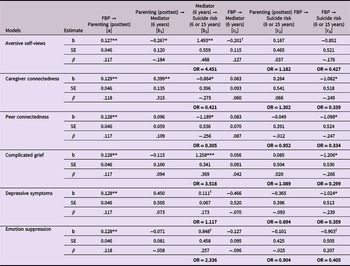
As shown in Table 2, consistent with previous findings, the first path from FBP to parenting at posttest was statistically significant in all models (ps < .01; first column in Table 2); families who were randomized into the FBP showed higher levels of effective parenting at posttest relative to controls. In two of the six models, we found significant mediated pathways, in which FBP-induced improvement in effective parenting at posttest was related to the 6 years follow-up mediator (second column in Table 2) which was in turn related to suicide risk (third column in Table 2). First, effective parenting at posttest was associated with reduced aversive self-views at the 6 years follow-up, unstandardized coefficient b = −0.267, SE = 0.120, p < .05, standardized coefficient β = −.184, and aversive self-views were associated with increased suicide risk at 6 or 15 years follow-up, b = 1.493, SE = 0.559, p < .01, β = .488, Odds Ratio (OR) = 4.451. Note that in this model the factor loadings of the latent construct of aversive self-views ranged between 0.79 and 0.85. Second, effective parenting at posttest was associated with caregiver connectedness at the 6 years follow-up, b = 0.399, SE = 0.135, p < .01, β = .315, which was subsequently associated with reduced suicide risk at 6 or 15 years follow-up, b = −0.864, SE = 0.396, p < .05, β = −.275, OR = 0.421.
Estimated regression coefficients of the six three-paths mediation models
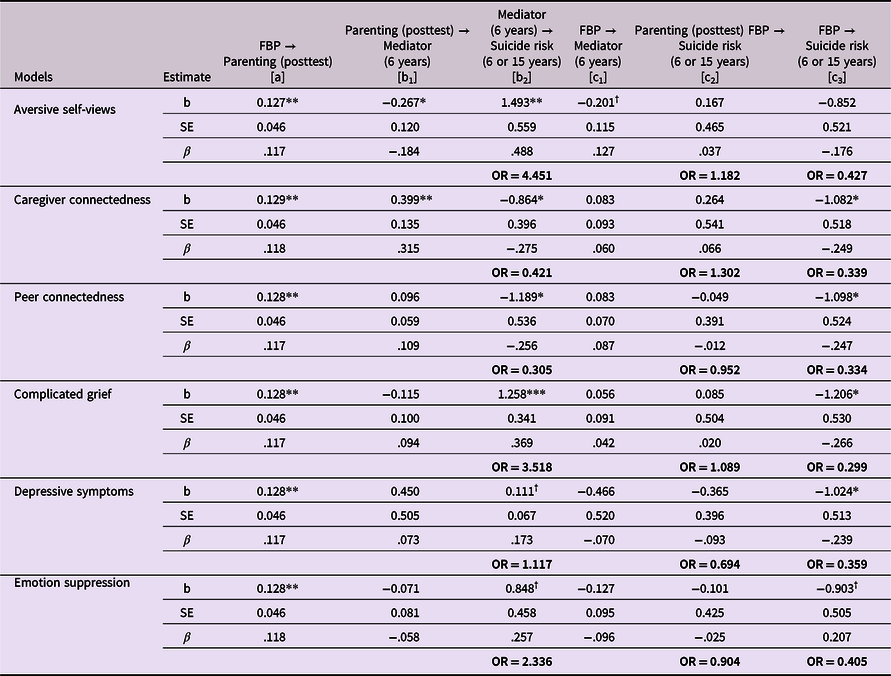
Note: † p ≤ .10, * p < .05, ** p < .01, ***p < .001. b = unstandardized coefficients; FBP = Family Bereavement Program; OR (in bold) = odds ratio for the binary outcome variable (suicide risk at 6 or 15 years follow-up); SE = standard error of the unstandardized coefficient; β = standardized coefficients.
In the other four models, FBP-induced improvement of parenting at posttest was not significantly associated with the mediator (peer connectedness, complicated grief, depressive symptoms, and emotion suppression) at the 6 years follow-up (ps > .05). Although the joint significance test did not support a conclusion of mediation in these models, two interesting relations were found regarding factors associated with suicide risk such that complicated grief (b = 1.258, SE = 0.341, p < .001, β = .369, OR = 3.518) and peer connectedness (b = −1.189, SE = 0.536, p < .05, β = −.256, OR = 0.305) were significantly associated with reduced suicide risk in the expected directions in separate models.
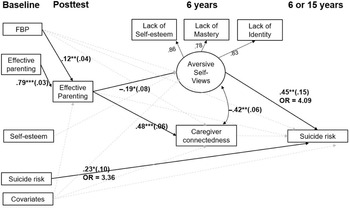
As a post hoc analysis, we conducted a cascade model that included both aversive self-views and caregiver connectedness (Figure 2). This model had similar number of participants who had no missing data (n = 196) compared with the other six mediation models. Results showed that the mediation effect of aversive self-views on the association between program-induced strengthened parenting and suicide risk remained significant, above and beyond the mediation effect of caregiver connectedness. That is, controlling for the correlation between aversive self-views and caregiver connectedness as well as the indirect path from parenting at posttest to suicide risk via caregiver connectedness at the 6 years follow-up, program-induced improvement in parenting at posttest was associated with reduced aversive self-views at the 6 years follow-up (b = −0.272, SE = 0.120, p < .05; β = −.191), which were in turn significantly related to reduced suicide risk at 6 or 15 years follow-up (b = 1.409, SE = 0.574, p < .05, β = .452, OR = 4.093). On the other hand, after controlling for the mediation effect of aversive self-views, caregiver connectedness was not significantly associated with suicide risk. See Online Supplemental Figure 1 for the model with an observed (vs. latent) variable of aversive self-views.
Standardized estimates of a cascade model with aversive self-views and caregiver connectedness. Covariates are time since death, type of death, child age, child gender. The regression coefficients of covariates and the correlations of the variables at baseline are not shown. Dotted lines are not statistically significant (α > .05). OR = odds ratio. Standard error are shown in parentheses. *p < .05, **p < .01, ***p < .001.

Finally, as supplementary analyses, we estimated six cascade models separately using the 15 years data of suicide risk as the outcome variable. The results are presented in Online Supplementary Table 1. The cascading pathways of the caregiver-connectedness model were supported, such that FBP-induced improvement in parenting at posttest was associated with increased caregiver-connectedness at 6 years follow-up, which was associated with reduced suicide risk at the 15 years follow-up. We caution that these findings should not be considered reliable estimates because of the potential rare events problem in logistic regression models, as mentioned above. Nevertheless, these findings may inform future studies.
Discussion
The current study investigated a three-path mediation model to reveal how program-induced improvement in effective parenting reduced suicide risk at 6 or 15 years after the program. The findings add to correlational data on the association between parenting and suicide risk (Kuramoto-Crawford et al., Reference Kuramoto-Crawford, Ali and Wilcox2017) by using an experimental design to show that improved parenting following the FBP during childhood/adolescence led to reduced aversive self-views and enhanced caregiver connectedness during adolescence/early adulthood, which led to reduced suicide risk in early adulthood. There are studies that used single mediator analyses to reveal how a preventive intervention or treatment may prevent suicide by modifying a risk or protective factor, but little research exists on how developmental cascades including multiple mediators lead to reductions in suicide risk over developmental periods. These studies were based on adult samples and used short periods of follow-ups (Brown et al., Reference Brown, Zang, Benhamou, Taylor, Bryan and Yarvis2019; Gewirtz et al., Reference Gewirtz, DeGarmo and Zamir2016; Norr et al., Reference Norr, Allan, Reger and Schmidt2018). To our awareness, this is the first study to show a chain of mediated effects of a parent-focused prevention program designed for at-risk youth to exert cascading effects in reducing suicide risk in early adulthood. Although peer competence, complicated grief, depressive symptoms, and emotion suppression did not significantly mediate the effects of parenting on suicide risk, peer connectedness and complicated grief were each associated with suicide risk in expected directions. The theoretical and intervention implications of the findings are discussed below.
The finding that aversive self-views mediated the cascading effects of the FBP and effective parenting on suicide risk is consistent with research concerning the important role of parent-child relationships in the development of self-esteem (Bulanda & Majumdar, Reference Bulanda and Majumdar2009; Huey et al., Reference Huey, Laursen, Kaniušonytė, Malinauskienė and Žukauskienė2020), sense of mastery (Moilanen & Shen, Reference Moilanen and Shen2014) and a mature identity (Koepke & Denissen, Reference Koepke and Denissen2012). Aversive self-views involve multiple distinguishable facets. Our latent construct consisted of measures of self-esteem, mastery, and identity (due to the use of a secondary dataset), which reflected the degree to which the young people viewed themselves as being inadequate and unworthy, low in agency, and lacking in a meaningful identity. The finding on aversive self-views is also consistent with the escape theory of suicide (Baumeister, Reference Baumeister1990) which proposes that suicidal behavior is an attempt to escape from aversive affect caused by negative attributions about the self and being unable to block out awareness of negative self-views. The Three-Step Theory (Klonsky et al., Reference Klonsky, May and Saffer2016) with its focus on the role of pain and hopelessness in suicidal thoughts is also relevant to the current findings. Although the current study did not directly test the specific processes proposed in these theories, the latent construct of aversive self-views would likely lead to the painful negative affective state and sense of hopelessness that both theories posit as leading to suicidal behaviors. Because aversive self-views were concurrently assessed with suicide risk at 6 years, the direction of causality cannot be inferred (Cole & Maxwell, Reference Cole and Maxwell2003). Further, although prior studies have provided evidence of the prospective relations between these factors with suicide ideation and attempts (Glenn et al., Reference Glenn, Kleiman, Deming, Franklin and Nock2018), additional evidence is needed to replicate the finding that these variables are prospective mediators of intervention effects on suicide risk. Finally, these findings also encourage future researchers to examine how the relations between aversive self-views and suicide risk may be mediated through more proximal processes such as through negative self-attributions (Baumeister, Reference Baumeister1990), pain, or hopelessness (Klonsky et al., Reference Klonsky, May and Saffer2016).
Reductions in suicide risk were also mediated through a pathway from strengthened parenting at posttest to caregiver connectedness 6 years later. From a developmental perspective, the participants transitioned from childhood/adolescence into adolescence/young adulthood, where the caregiver-child relationships involve a greater level of independence and autonomy (Erikson, Reference Erikson1968; Koepke & Denissen, Reference Koepke and Denissen2012). The finding that caregiver connectedness was related to lower suicidal risk indicates that positive attachment to the surviving parent may be a protective factor for suicide in bereaved adults. Indeed, caregiver connectedness may protect overall adjustment after parental death (Brewer & Sparkes, Reference Brewer and Sparkes2011). However, when the latent construct of aversive self-views was accounted for in the model, the effect of caregiver connectedness on suicide risk was no longer statistically significant. Possibly the effect of caregiver connectedness on suicide risk reflects variance shared with aversive self-views (rs = −.44∼ −.36). There may be a dynamic process of mutual influence between young people’ self-views and their relationships with their caregiver throughout development. In particular, there may be a possible serial effect of a four-path mediation model, in which program-induced improvements in parenting are associated with subsequent caregiver-connectedness as youth develop into early adulthood, which in turn is associated with their self-views that are predictive of suicide risk later. Future replication studies are needed to confirm these serial effects.
Our hypothesis that program-induced improvements in parenting would lead to higher peer connectedness 6 years later was not supported. We speculate that there may be an indirect rather than direct effect of parenting on peer connectedness. Prior research has found that effective parenting had an indirect effect on the development of peer connectedness through several factors, such as reduced externalizing problems (Wolchik et al., Reference Wolchik, Tein, Winslow, Minney, Sandler and Masten2020) and increased ego resilience (Swanson et al., Reference Swanson, Valiente, Lemery-Chalfant and O’Brien2011). Alternatively, it may be that our measure of peer competence might not have captured peer connectedness sufficiently. The measure of peer competence also had a relatively low reliability. Future research may consider alternative measures of peer connectedness. For example, Wyman et al. (Reference Wyman, Pickering, Pisani, Rulison, Schmeelk-Cone, Hartley and Brown2019) utilized network analyses and found that lower peer network integration and cohesion increased suicide risk of high schoolers.
The finding that complicated grief at the 6 years follow-up was related to suicide risk is consistent with prior findings (Hill et al., Reference Hill, Kaplow, Oosterhoff and Layne2019; Prigerson et al., Reference Prigerson, Bridge, Maciejewski, Beery, Rosenheck, Jacobs and Brent1999; Sandler et al., Reference Sandler, Tein, Zhang, Wolchik and Thieleman2021). However, strengthened parenting at posttest was not associated with complicated grief at the 6 years follow-up. It may be that there are indirect effects of parenting on grief that were not examined in the current study. For example, research found that parenting was associated with children’s coping efficacy and sense of security (Wolchik et al., Reference Wolchik, Ma, Tein, Sandler and Ayers2008), each of which might influence long-term grief. Alternatively, it may be that parenting was related to specific dimensions of grief not captured in a unidimensional measure of complicated grief (see also Sandler et al., Reference Sandler, Tein, Zhang, Wolchik and Thieleman2021). Prior research has identified specific dimensions of grief that may be more closely related to parenting and suicide risk, such as intrusive grief thoughts or existential grief (Kaplow et al., Reference Kaplow, Layne, Oosterhoff, Goldenthal, Howell, Wamser-Nanney and Pynoos2018; Sandler et al., Reference Sandler, Ayers, Tein, Wolchik, Millsap, Khoo and Coxe2010). Given that the FBP had a significant effect to reduce intrusive grief thoughts at posttest and 6 years later (Sandler et al., Reference Sandler, Ayers, Tein, Wolchik, Millsap, Khoo and Coxe2010), it may be that the effects of the program on intrusive grief thoughts mediated the effects on complicated grief. It may also be that the FBP has an effect on complicated grief via parental psychopathology or parental grief, which was not the focus of this paper.
Depressive symptoms did not mediate the relation between program-induced improvements in effective parenting and suicide risk. FBP-induced improvement in parenting did not have an effect on depressive symptoms. Neither were depressive symptoms related to suicide risk. Depression is considered one of the risk factors of suicidal behaviors by many health-related professional organizations. Also, there are numerous studies linking depression to suicidal behaviors (Evans et al., Reference Evans, Hawton and Rodham2004; Franklin et al., Reference Franklin, Ribeiro, Fox, Bentley, Kleiman, Huang and Nock2017; Gili et al., Reference Gili, Castellví, Vives, de la Torre-Luque, Almenara, Blasco and Roca2019; Goldston et al., Reference Goldston, Daniel, Erkanli, Reboussin, Mayfield, Frazier and Treadway2009) including research in bereaved samples (Prigerson et al., Reference Prigerson, Bridge, Maciejewski, Beery, Rosenheck, Jacobs and Brent1999). However, the overall predictive strength of depression on suicide is moderate at best (e.g., OR = 2.45, see Franklin et al., Reference Franklin, Ribeiro, Fox, Bentley, Kleiman, Huang and Nock2017). It may be that the extreme levels of pain and hopelessness associated with clinical depression are primarily responsible for the relations between depression and suicide risk. It may also be that specific aspects of depression are responsible for increasing risk for suicide in parentally bereaved youth. For instance, a meta-analysis study found that anhedonia (or lack of motivation) was significantly associated with suicidal thoughts when controlling for depression (Ducasse et al., Reference Ducasse, Loas, Dassa, Gramaglia, Zeppegno, Guillaume and Courtet2018).
The finding that emotion suppression was not significantly related to suicide risk contradicted Kaplow et al.’s (Reference Kaplow, Gipson, Horwitz, Burch and King2014)’s study which showed that emotion suppression and suicide risk were correlated in adolescents seen in the emergency room. Those seen in emergency rooms may have experienced higher levels of acute stress whereas bereaved youth in the current study experienced parental death many years earlier when they were assessed at the 6 years follow-up. The effects of the maladaptive strategy of emotion suppression may have been more salient for those assessed during an emergency room visit than those who were assessed during a scheduled interview.
The findings of this study have significant implications for the development of upstream prevention of suicide, which modifies risk or protective factors earlier in development to provide protection from suicide risk at later developmental periods (Reider & Sims, Reference Reider and Sims2016; Sareen et al., Reference Sareen, Isaak, Katz, Bolton, Enns and Stein2014; Wyman, Reference Wyman2014). It is notable that neither parenting nor caregiver connectedness has been commonly studied as protective factors for suicide risk over the past 50 years (Franklin et al., Reference Franklin, Ribeiro, Fox, Bentley, Kleiman, Huang and Nock2017). Further, aversive self-views that involve low self-esteem and lack of identity/mastery have not received much attention but might be an important risk factor for suicidal thoughts and behaviors in early adulthood (e.g., Rasmussen et al., Reference Rasmussen, Dyregrov, Haavind, Leenaars and Dieserud2015). Bereaved children are an important population for upstream suicide prevention because they are at increased risk for suicide thoughts/attempts and suicide death. The current findings add to research that has supported the FBP’s positive effects in reducing suicide risk (Sandler et al., Reference Sandler, Tein, Wolchik and Ayers2016) by identifying parenting as part of the processes that account for the effects. Effective parenting following the FBP mediated program effects on more proximal correlates of suicide risk 6 years later (aversive self-views and caregiver connectedness), suggesting that when the program is disseminated, parenting needs to be preserved as a core component of the intervention. The fact that other studies have also shown reductions in suicide risk via parenting-focused interventions (Connell et al., Reference Connell, McKillop and Dishion2016; Vidot et al., Reference Vidot, Huang, Poma, Estrada, Lee and Prado2016) indicates that promoting effective parenting may be an important part of upstream suicide prevention for other populations in addition to bereaved youth. Upstream prevention programs can be integrated into systems of care in multiple settings (e.g., schools, clinics, hospitals). Community-based services tend to produce smaller effects to reduce suicidal behaviors than those delivered in clinical settings when looking at suicidality outcomes alone (Hofstra et al., Reference Hofstra, Van Nieuwenhuizen, Bakker, Özgül, Elfeddali, de Jong and van der Feltz-Cornelis2020). However, if the overall benefits of upstream prevention programs to reduce mental health and substance use problems are also considered in addition to its benefits to reduce suicide risk, such programs are likely to have a positive cost-benefit ratio that is equal to or better than more targeted suicide prevention strategies (Brent, Reference Brent2016). As suggested by the 2012 National Strategy for Suicide Prevention (Office of the Surgeon General, 2012), a broad range of interventions can be used for suicide prevention including clinical and community services that target mental and substance use disorders.
There are several limitations that need to be noted. First, the FBP was not designed to study suicide, and thus suicide risk was assessed with items from standardized scales of mental health problems to assess suicidal thoughts and attempts rather than measures designed specifically to assess suicide behaviors. The use of selected items to assess suicide thoughts or attempts is not unusual, particularly in secondary data analyses of longitudinal datasets that were not originally designed to study suicide (e.g., Connell et al., Reference Connell, McKillop and Dishion2016; Gewirtz et al., Reference Gewirtz, DeGarmo and Zamir2016). However, future research that includes commonly used measures of suicidal thoughts and attempts would be necessary. Also, our study did not differentiate suicidal thoughts and attempts, which are two sequential but distinct aspects of suicide risk (Klonsky et al., Reference Klonsky, May and Saffer2016). Further, the fact that families of suicidal children/adolescents were not eligible to participate in the FBP’s trial and the items asking about suicide risk were based on past month (except for key informants’ report which was past 6 months) may have an impact on the endorsement rates of suicide risk in the sample. The endorsement rate was 31.1% at baseline, however, many years later the rates were quite low in the current sample. Studies with larger sample size or a longer time frame (e.g., suicide risk during the past year or lifetime) may detect higher rates which would provide higher statistical power for detecting associations between risk/protective factors and suicide risk. We combined the 6- and 15 years follow-up data on suicide risk as a way to address the limited endorsement rate in the sample, as mentioned above, which resulted in partial concurrency between the more proximal mediators and suicide risk outcome that precludes drawing inferences about the direction of causality between these variables. Future prospective studies are needed to address this limitation. In addition to the directions for future research already discussed, it would be valuable to examine other possible cascading pathways through which the FBP reduced suicide risk. Such models might include reduced grief or psychopathological symptoms and increased self-efficacy in caregivers.
Overall, the study makes an important contribution by elucidating the pathways through which the FBP reduced suicide risk. Our findings identified processes that mediated the relation between program-induced improvements in parenting and suicide risk, thus advancing understanding of how the well-documented important resource of high-quality parenting protects bereaved youth. It is worth noting that the implication of our findings should not be to blame the parents, because parenting is not easy especially in the context of bereavement. Yet, with evidence-based tools provided by interventions such as the FBP, caregivers can become a transdiagnostic resilience resource for their children, leading to reduced risk for suicide in addition to reduced prolonged grief and mental health problems (Sandler et al., Reference Sandler, Ayers, Tein, Wolchik, Millsap, Khoo and Coxe2010a, Reference Sandler, Ma, Tein, Ayers, Wolchik, Kennedy and Millsap2010b). When viewed from this perspective, the findings call for more work to identify ways to successfully support bereaved parenting as a pathway to promoting the well-being of bereaved children.
Supplementary material
The supplementary material for this article can be found at https://doi.org/10.1017/S0954579421001474.
Acknowledgements
Support for this research was provided by National Institute of Mental Health Grant R01 MH49155 to evaluate a preventive intervention for bereaved families. Na Zhang’s work was supported by a National Research Service Award in Primary Prevention by the National Institute on Drug Abuse T32DA039772. Irwin Sandler’s work was supported by New York Life Foundation. Jenn-Yun Tein’s work was supported by grants from the National Institute on Drug Abuse (2R01DA09757). Jenn-Yun Tein’s and Sharlene Wolchik’s work was also supported by the Eunice Kennedy Shriver National Institute of Child Health and Human Development (R01HD094334). A portion of this work was presented at the annual meeting of the Society for Prevention Research in 2020 which was held virtually.
Conflicts of interest
None.