Implications
Silvopastoral systems in the dry tropics relate to environmental benefits and can improve animal welfare. When an intensive silvopastoral system (ISS) was compared with a monoculture, foraging time decreased while rumination time increased. Furthermore, cattle grazing in the silvopastoral system walked shorter daily distances to obtain food. These results suggest that the increased forage availability and shade found in a silvopastoral system modify behaviours and consequentially decrease the energy cost related to the activity. The energetic resources that become available can favour protein and fat synthesis, which could improve production variables and generate economic benefits.
Introduction
Intensive silvopastoral systems for grazing cattle in tropical regions represent a feasible alternative to minimize the environmental costs normally associated with monoculture systems (MS) (Food and Agriculture Organization, 2007), such as deforestation, erosion, loss of biodiversity and emissions of greenhouse gases (Galindo et al., Reference Galindo, Williams, González-Rebeles, Zarza, Avila-Flores, Olea-Pérez and Suzán2016). In addition, there is compiling evidence that, when compared with MS, cattle welfare in ISS is improved; for example, animals grazing in ISS in the tropics travel distances ten times shorter and use 60% less energy to forage when compared with cattle in MS (Cuartas Cardona et al., Reference Cuartas Cardona, Naranjo Ramírez, Tarazona Morales and Barahona Rosales2013). In addition, the presence of trees and vegetation cover in ISS reduces body temperature (Paciullo et al., Reference Paciullo, de Castro, de Miranda Gomide, Maurício, Pires, Müller and Xavier2011), which has a positive effect on heifers’ body condition (Mancera et al., Reference Mancera, Zarza, de Buen, García, Palacios and Galindo2018), and increases the frequency of non-agonistic interactions in the herd (Améndola et al., Reference Améndola, Solorio, Ku-Vera, Améndola-Massiotti, Zarza and Galindo2016). Although artificial shade in an MS could also improve animal welfare by diminishing heat stress and increasing comfort, the shade of trees is considered the most effective, as it provides protection from sunlight combined with cooling when moisture evaporates from leaves (Armstrong, Reference Armstrong1994; Blackshaw and Blackshaw, Reference Blackshaw and Blackshaw1994) and for these characteristics, it is considered the best method to alleviate heat stress (Bucklin et al., Reference Bucklin, Turner, Beede, Bray and Hemken1991).
In terms of cattle’s diet, legumes, which are a consistent part of silvopastoral systems in the Latin American tropics, provide high CP content which maximizes feed intake by transforming CP into readily fermentable nitrogen to be utilized by the rumen microorganisms and promote optimal growth (Flores et al., Reference Flores, Stobbs and Minson1979).
Daily foraging, ruminating, and resting times and their distribution during the day adjust to food quality and availability, as well as to climatic conditions (Dunbar et al., Reference Dunbar, Korstjens and Lehmann2009). For example, when forage is scarce and dispersed, animals try to maintain their food intake by increasing foraging time (Bailey et al., Reference Bailey, Gross, Laca, Rittenhouse, Coughenhour, Swift and Sims1996), first at the cost of reducing free resting time (a buffer when the emergence of compensatory behavioural strategies is required; Dunbar et al., Reference Dunbar, Korstjens and Lehmann2009). On the other hand, rumination time increases when cattle have a high forage intake, and if the diet contents have high NDF and ADF (Welch and Smith, Reference Welch and Smith1970; Metz, Reference Metz1975). In terms of climate, diurnal temperature plays a big role in the distribution of foraging and resting patterns. Under optimal forage conditions and when environmental temperatures exceed the animal’s thermo-neutral zone, foraging activity decreases as the weather becomes warmer (Tucker et al., Reference Tucker, Rogers and Schütz2008). Cattle foraging during midday in hot and humid conditions is an indicator of limited food availability when foraging overnight is restricted (Lyons and Machen, Reference Lyons and Machen2000). These animals may be making efforts to meet their nutrient requirements and experiencing heat stress, which leads to higher energy demands for maintenance (Beede and Collier, Reference Beede and Collier1986).
Due to the benefits related to the use of ISS, increasing knowledge on the trade-offs that cattle make to balance their demands in different production systems is important. However, the use of silvopastoral systems in tropical areas is still limited and the study of ISS may entail challenges such as the lack of experimental repetitions to reach definite conclusions. Despite these disadvantages, pilot studies on this area can potentially increase our understanding of cattle’s behaviour and welfare in an ISS environment, compared with an MS, encouraging the further development of alternative and environmental friendly livestock systems. Therefore, the aim of the present pilot study was to compare foraging, ruminating, idling and lying behaviours, and mean travelled distances of cattle grazing in an ISS and in an MS in relation to forage availability, seasonal variations, mean travelled distance and temperature humidity index (THI) of the grazing paddocks. We hypothesize that cows in the MS will show extended foraging times and travelled distance in the paddock, as well as decreased lying times during resting and ruminating, compared with the ISS where shade and forage is more accessible.
Material and methods
Pilot study area, animals and management
The present study was conducted in the municipality of Mérida, state of Yucatán, Mexico. The climate in the region is a tropical sub-humid Awo (i´) gw´´ (García, Reference García1988), the average annual temperature is 28°C and annual precipitation ranges between 700 and 1100 mm, with most rainfall occurring in the summer. Two dual-purpose cattle production systems, hereafter referred as treatments, were selected for this study; the MS farm was located at the Faculty of Veterinary Medicine and Animal Science in the Autonomous University of Yucatan (20°51' N, 89°37' W). This paddock was dominated by a grass monoculture of Cynodon nlemfuensis (stargrass) without live fences. The ISS farm was located in Dzununcán, Yucatan (20°50' N, 89°39' W). This system was dominated by the grasses C. nlemfuensis and Megathyrsus maximus (guinea grass), and trees species: Leucaena leucocephala (leucaena; at high density, used as source of high-protein cattle fodder), as well as Brosimum alicastrum, Ceiba pentandra, Piscidia piscipula, Bursera simaruba and Lysiloma latisiliquum (used as live fences). Systems altitude was 10 m.a.s.l, and they were located 5.5 km apart from each other.
In each system, eight crossbred non-lactating heifers Bos indicus×Bos taurus from the unit herd (from 85 cows in the MS, and 92 cows in the ISS) were selected. The number of animals depended largely on the disposition of property owners to allow behavioural observations and the number of heifers that experimenters were able to effectively monitor in extensive conditions. In addition, the selection was made to get a smaller homogenous herd of one-and-a-half-year-old animals in each system, weighing between 280 and 300 kg. All animals were sourced from the National Autonomous University of Yucatan, thus making genetic variations between herds minimal. Three paddocks of 29±0.01 ha from each system were chosen to be foraged by the heifers during both seasons. In the ISS paddocks, the tree density varied from 31.0 to 155.1 trees per hectare, and the tree shadow coverage fluctuated between 309.4 and 591.8 m2/paddock; paddocks in the MS had no shade (Améndola et al., Reference Améndola, Solorio, Ku-Vera, Améndola-Massiotti, Zarza and Galindo2016). Animals followed a rotational grazing scheme of 4 days in each paddock per season (12 foraging days/season). According to standard management conditions of the region, the following procedure was conducted in each of the three paddocks of each system, and in both seasons: herds were introduced into the paddock at 0730 h and were moved to fenced pens at 1530 h. Heifers reminded in the fenced pens from 1530 to 0730 h of the next day. At paddocks and pens, heifers had water available ad libitum.
Forage availability
A characterization of forage availability was made in each paddock 2 days before animals were introduced. In MS paddocks, a visual cover estimation of stargrass was made (Murphy and Lodge, Reference Murphy and Lodge2002), within 20 square frames (1×0.5 m); in the ISS, an estimation was made within 50 square frames (1×2 m) due to higher variability in stargrass cover. Grass was collected in 12 of the squares (5 cm above the ground) to determine dry matter (DM) content (in a forced air oven at 100°C during 24 h). We estimated available forage mass (kg DM/ha) following Lantinga et al. (Reference Lantinga, Neuteboom and Meijs2004). From 12 subsamples we estimated the morphological composition of leaf, stem and dead material in terms of DM (by manual separation; Whalley and Hardy, Reference Whalley and Hardy2000).
In ISS paddocks, we estimated leucaena mass on offer as the product of plant density and individual plant DM. Density was estimated as the number of plants in 20 transects of 5 m each (Whalley and Hardy, Reference Whalley and Hardy2000). Transects were systematically distributed in the paddocks. For DM estimations per plant, we sampled 10 plants by cutting green leaves and stems (with diameters <4 mm; Carranza-Montaño et al., Reference Carranza-Montaño, Sánchez-Velásquez, Pineda-López and Cuevas-Guzmán2003) at about 5 cm from the ground to simulate grazing bites, as reported by other authors (Santana and McDowell, Reference Santana and McDowell1996; Ravetto Enri et al., Reference Ravetto Enri, Renna, Probo, Lussiana, Battaglini, Lonati and Lombardi2017); DM estimations were made from 10 sub-samples. With manual separation techniques, which included the exclusion of inedible parts such as rotten grass and thick wooden pieces, we estimated the proportion of green leaf and stem from sub-samples. In addition, in ISS paddocks, we estimated guinea grass mass offered as the density of plants per individual DM. Plant density was measured counting the number of plants in 20 square frames (2×2 m; Whalley and Hardy, Reference Whalley and Hardy2000), systematically distributed in the paddocks. Forage mass per plant was estimated by cutting leaves and stems from 10 plants (20 cm above the ground). From each sample, a sub-sample was taken (~300 g each) for determination of morphological composition and DM determination. For both systems in each season, available forage mass, morphological composition, paddock areas, number and live weight of heifers, days at paddocks and daily herbage allowance (kg DM of green leaf daily available per each 100 kg of live weight; Hodgson et al., Reference Hodgson, Clark and Mitchell1994) were estimated and expressed as percent of live weight.
Climatic conditions
Environmental temperature (°C) and relative humidity (%) were registered each hour between 0700 and 1500 h on each day, with a meteorological station Vantage Vue (Davis Instruments Corporation, Hayward, CA, USA), located within the perimeter of the paddocks. Wet bulb temperature (Tw; °C) was estimated as follows (Stull, Reference Stull2011):
 $$\eqalignno{ & {\rm Tw} \; \hskip1.5pt {\equals} \hskip1.5pt \; \ {\rm T}\,{\rm atan}\left( {0.151977\left( {{\rm RH}\,\% \; \hskip1.5pt {\plus} \hskip1.5pt \; 8.313659} \right)^{{1\,/\,2}} } \right)\;\cr &\hskip23pt {\plus}\; \hskip1pt {\rm atan}\left( {{\rm T\; {\plus} \; RH}\,\%\,} \right)\;-\hskip1.1pt \;{\rm atan}\left( {{\rm RH}\,\%\,1.676331} \right) \cr & \hskip23pt {\plus} \hskip1pt 0.00391838\left( {{\rm RH}\,\%\,} \right)^{{3\,/\,2}} \;{\rm atan}\left( {0.023101{\rm RH}\,\%\,} \right) \; \cr &\hskip22pt {\minus}\; \hskip1pt 4.686035 $$
where T is the dry temperature (°C) and RH% is relative humidity (%).
A THI was generated with the following equation (McDowell et al., Reference McDowell, Hooven and Camoens1976):
 $${\rm THI}\;{\equals} \; 0.72\left( {{\rm T}{\plus}{\rm Tw}} \right){\plus}40.6$$
Behavioural observations
Heifers’ behaviour was recorded by the same observer in both systems in the dry and rainy seasons. A period of 2 weeks before the observations, a process of habituation to the observer was carried out. Observations were made during the time heifers spent in the paddocks (0730 to 1530 h). Each herd was observed for a total of 192 h (8 h/d, 12 days each season). Using scan sampling every 15 min (Martin and Bateson, Reference Martin and Bateson2007), we recorded the following behaviours per individual: foraging (heifers were grazing or browsing in the paddock), ruminating (heifers chewing the cud), idling (inactive; heifers resting without grazing or ruminating, either laying or standing and without walking) and posture while ruminating and idling (standing or lying). In addition, percentages of grass species ingested were obtained by calculating the total number of recordings in which animals were seeing foraging a given species and expressing it as a percentage of the total foraging events. This technique has been used by other authors investigating grazing behaviour in natural pastures to provide descriptive measurements of grass consumption (Sanon et al., Reference Sanon, Kaboré-Zoungrana and Ledin2007).
Travelled distances
To calculate the distances travelled daily by heifers in each system/season, we recorded the geographic location of each individual heifer every 15 min using a GPS (Garmin eTrex Vista®, Olathe, KS, USA) that had a measurement accuracy of 3 m. To record measures, the experimenter positioned the GPS on the right side of the head. Animals were habituated to experimenters approaching to carry out observations and they were not visibly disturbed. We calculated distances travelled each 15 min by heifer with the package ‘geosphere’ and the functions ‘distm’ and ‘fun=distHaversine’ from the R software (Hijmans, Reference Hijmans2014). The distances obtained were finally added up to obtain the daily distances travelled by each heifer. With these results, we estimated the average distance heifers travelled per system and season in 12 days (4 days/3 paddocks).
Data analysis
Due to the lack of a greater number of ISS in the area, traditional statistical analysis did not permit the use of data from unreplicated experiments in this pilot study; however, statistical tests were used to better comprehend and describe the biological phenomenon observed. As well, descriptive statistics (mean±standard deviation) for climatic conditions and forage availability were presented to illustrate environmental differences between the ISS and the MS. Daily foraging, ruminating, idling and lying times per heifer were estimated adding up the frequency (from scan samplings) occurring within a day, and multiplying them by 15 min (time interval between observation scans). For each heifer, we estimated the average of behaviours on the 12 observation days in each system/season (4 days per each of three paddocks). Daily times were compared between systems using t tests, and within systems between seasons using paired t tests.
To describe daily foraging patterns in relation to THI, for each heifer on each day, the time spent foraging per hour was calculated as the sum of the foraging frequency (within four consecutive scan samplings) multiplied by 15 min. For each heifer/hour, we averaged the foraging time of 24 days of observation (4 days per each of three paddocks, per two seasons). For each heifer, we estimated the slope of the linear relationship between the THI (registered during each observation hour everyday) and the foraging time per hour; slopes were compared between systems with a t test. To compare travelled distances within a single system between seasons, paired t tests were utilized. To explore differences in travel distances between systems within the same season, t tests were used. All analysis and graphs were carried out with the program R (Version 3.2.3; R Development Core Team). Normality was visually assessed using the Shapiro–Wilk test. The variables duration of rumination and lying bouts, and total time standing and lying were not normally distributed. These variables were returned to normality using the arcsine square root transformation. Data are reported as mean±standard error.
Results
Forage availability and climatic conditions
Daily herbage allowances of green leaf in the dry and rainy seasons for the MS and the ISS were 1.86% and 3.64% in the MS, and 14.40% and 24.51% in the ISS. Forage mass in the MS was 78% lower than in the ISS in the rainy season (t=−5.07, df=2.03, P=0.03; n=3) and tended to decrease in the dry season by 76% (t=−3.13, df=2.01, P=0.08; n=3). In the ISS, heifers grazed 11% of the time on stargrass, 43% on leucaena and 46% on guinea grass, whereas in the MS, heifers grassed only on stargrass. Original quantities with the corresponding percentages have been summarized in Table 1.
Forage mass and morphological composition in monoculture system (MS) and intensive silvopastoral system (ISS)

DM=dry matter.
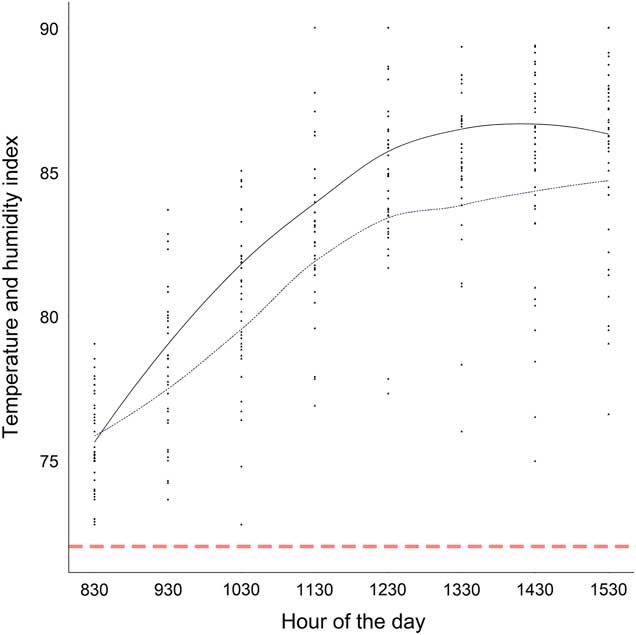
In the MS the average environmental temperature, relative humidity, and THI were 33.24±4.11°C, 61.24±12.59%, and 83.77±4.10, respectively. Average environmental temperature, relative humidity and THI in the ISS were 30.58±3.12°C, 76.07±8.44%, and 81.98±3.45, respectively. Descriptively, higher THI was registered in the MS compared with the ISS, ( P<0.001) although the effect of the season on the THI was not significant (P=0.89). THI increased with the hour of the day (P<0.001), reaching its highest at 1530 h (Figure 1).
(Colour online) Changes in the temperature and humidity index (THI) throughout the day (0830 to 1530 h). The lower line corresponds to the intensive silvopastoral system, whereas the upper line corresponds to the monoculture system. The red dashed horizontal line represents the threshold of heat stress for cattle (Ravagnolo and Misztal, Reference Ravagnolo and Misztal2002). y-axis starts at an initial value of 70.

Foraging, ruminating, idling and lying times
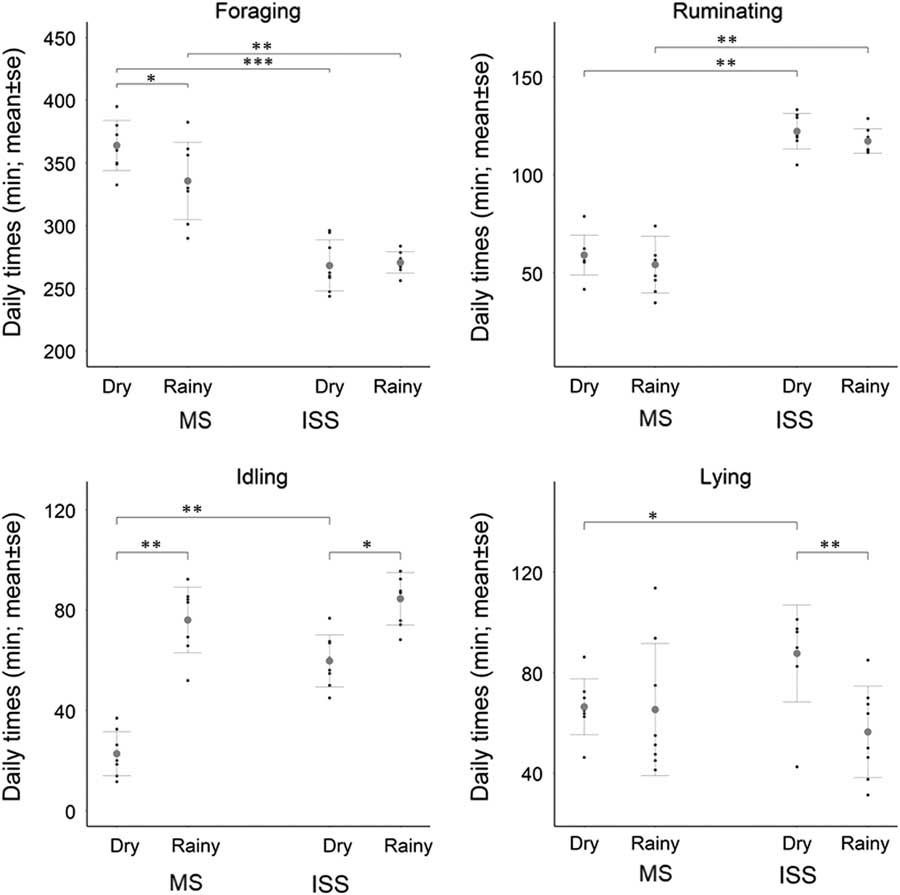
Heifers in the MS spent on average 350±5 min foraging, 57±1 min ruminating, and 66±9 min idling per day at the paddock between 0730 and 1530 h; while idling or ruminating, heifers spent 49±0.2 min lying. In the ISS, heifers spent on average 269±0.5 min foraging, 120±1 min ruminating, and 72±4 min idling per day at the paddock during the same period; while idling or ruminating heifers spent on average 72±5 min lying. In both seasons, daily foraging times were longer in the MS than ISS (P<0.001 during the dry season; P<0.01 during the rainy season). Within the MS, daily foraging times were longer during the dry than the rainy season (P<0.05). No seasonal differences were detected in the ISS (P=0.76; Figure 2). Daily ruminating times did not differ between seasons within each system (MS: P=0.36; ISS: P=0.25) but were significantly longer in the ISS than in the MS during both seasons (dry: P<0.01; rainy: P<0.01; Figure 2). In both systems, idling times were significantly longer during the rainy season than during the dry season (MS: P<0.01; ISS: P<0.05). In the ISS heifers spent significantly more time idling than heifers in the MS during the dry season (P<0.01), but not during the rainy season (P=0.17; Figure 2).
Mean daily time (between 0730 and 1530 h) that heifers (n=8) spent (a) foraging, (b) ruminating, (c) idling and (d) lying during the dry and rainy season in the Monoculture System (MS) and the intensive silvopastoral system (ISS), *P<0.05, **P<0.01, ***P<0.001. y-axis of foraging and lying graphs start at an initial value of 200 and 20, respectively.

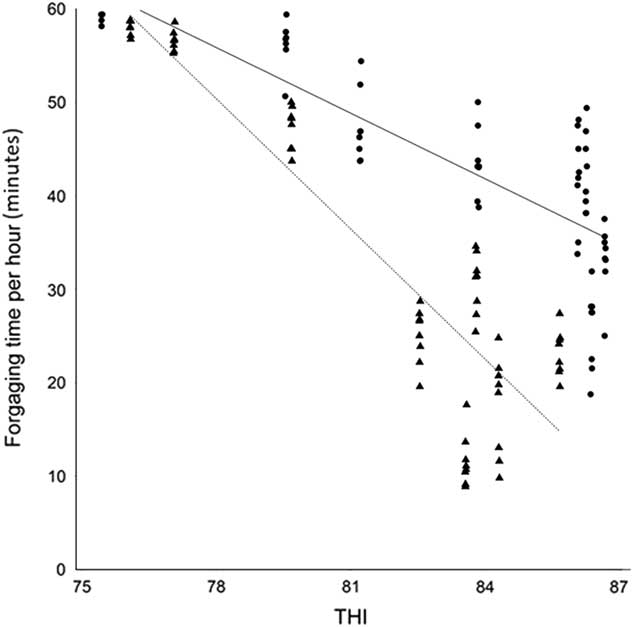
Only during the dry season, heifers of the ISS spent significant more time lying than heifers of the MS (P< 0.05 during the dry season; P=0.45 during the rainy season). Within the ISS, heifers spent significantly more time lying during the dry than during the rainy season (P<0.01); differences between seasons in the MS were not significant (P=0.10; Figure 2). As the THI increased, heifers in both systems decreased foraging times. The decrease in foraging times in relation to THI was significantly higher in the ISS than in the MS (mean slope and standard error per eight cows per system: −4.64±0.34 in the ISS, and −2.34±0.22 in the MS; P<0.001; Figure 3).
Change in foraging time per hour by an increase in the temperature and humidity index (THI). The lower line and triangles represent the intensive silvopastoral system (n=64; eight observations per eight heifers), and the upper line and circles represent the monoculture system (n=64; eight observations per eight heifers). y-axis starts at an initial value of 0.

Travelled distances
Heifers in the MS system tended to travel longer distances during the dry season (998.98±7.11 m) than the rainy season (751.65±38.72 m) (P=0.065). In the ISS, the travelled distances did no differ between dry and rainy seasons (dry: 804.62±31.31 m; rainy: 572.95±42.77 m; P=0.23). When comparing between systems, heifers tended to travel more in the MS system than ISS the dry season but not during the rainy season (dry: P=0.065; rainy: P=0.29).
Discussion
Due to the reduced number of ISS in Yucatan and the distance between the ISS and MS, which could account for differences on regional environmental features that affect the behaviour of individuals, we acknowledge that our ability to draw general conclusions is limited. Despite of this, our pilot study provides useful information on how the environmental conditions of an ISS can influence cattle behaviour and differ from an MS. Furthermore, as ISS are also related with increased biodiversity and environmental services (Galindo et al., Reference Galindo, Williams, González-Rebeles, Zarza, Avila-Flores, Olea-Pérez and Suzán2016), as well as improvements on animal welfare and economic sustainability for producers; there is an increasing need to generate scientific knowledge to support and develop these alternative systems. For those reasons, we believe that despite its limitations, this pilot study is an important contribution that will motivate rigorously scientific research in the future.
Foraging behaviour in intensive silvopastoral systems v. monoculture systems
Consistent with our main hypothesis, we observed differences in daily foraging time between systems during both seasons; heifers in the MS foraged longer than heifers in the ISS. Foraging times were longer in the dry than in the rainy season in the MS. Although results on DM intake are not given in the present paper, longer foraging times may have observed as a compensatory response to low DM intake. Usually, cattle offset low DM intake by increasing foraging times to maintain daily intake (Da Silva et al., Reference Da Silva2008). In this respect, forage mass and daily herbage allowance in terms of the green leaf was lower in the MS than in the ISS during both seasons and in the MS during the dry than in the rainy season. Low green leaf mass tends to reduce bite mass (g /bite), and consequently, DM intake (Da Silva et al., Reference Da Silva2008).
Low CP content in the diet also limits DM intake by reducing ruminally degradable CP, microbial growth, fermentation activity, and cell wall digestibility (Dove, Reference Dove1996). Stargrass was the only forage source available in the MS, while heifers in the ISS mainly foraged leucaena and guinea grass. Crude protein content of stargrass (11% to 13%, Sanginés-Garcı́a et al., Reference Sanginés-Garcı́a, Ku-Vera, González-Valencia and Ramón-Ugalde2003) is lower compared with that of leucaena (29%, Barros-Rodríguez et al., Reference Barros-Rodríguez, Sólorio-Sánchez, Ku-Vera, Ayala-Burgos, Sandoval-Castro and Solís-Pérez2012). Therefore, evidence suggests that longer foraging times could be a compensatory response to a reduction on daily forage allocation in terms of green leaf and the reduction on CP intake.
In both seasons, ruminating times were longer for heifers in the ISS than in the MS. Higher NDF and ADF content relates to longer rumination times (Welch and Smith, Reference Welch and Smith1970). NDF content in stargrass (69.2%; Barros-Rodríguez et al., Reference Barros-Rodríguez, Sólorio-Sánchez, Ku-Vera, Ayala-Burgos, Sandoval-Castro and Solís-Pérez2012) is higher than in guinea grass (62.7%; Barros-Rodríguez et al., Reference Barros-Rodríguez, Sólorio-Sánchez, Ku-Vera, Ayala-Burgos, Sandoval-Castro and Solís-Pérez2012) and leucaena (37.2%; Barros-Rodríguez et al., Reference Barros-Rodríguez, Sólorio-Sánchez, Ku-Vera, Ayala-Burgos, Sandoval-Castro and Solís-Pérez2012). Likewise, the content of ADF is lower in leucaena (23.9%; Sandoval-Castro et al., Reference Sandoval-Castro, Anderson and Leaver2000), than in the other grasses (35.8% to 36.8% in stargrass; Sandoval-Castro et al., Reference Sandoval-Castro, Anderson and Leaver2000; 36.3% in guinea grass; Nasrullah et al., Reference Nasrullah, Niimi and Kawamura2003). Considering that MS heifers only ingested stargrass with high NDF and ADF content, rumination was expected to be longer in the MS compared with ISS, where heifers consumed larger quantities of guinea grass and leucaena. However, there was a higher daily forage allocation in terms of green leaf in the ISS that is related to higher DM intake despite of shorter foraging times. Higher daily DM intake is also related to longer rumination times (Metz, Reference Metz1975). Therefore, an extended rumination period in ISS could be a result of grazing in an environment where abundant forage is present despite of the NDF and ADF values of forage.
Idling time, during the dry season was longer in the ISS than in the MS. In both systems, heifers had longer free resting time during the rainy season. These results may be related to a compensatory increase in foraging time in the MS, in response to low forage availability (Korstjens et al., Reference Korstjens, Lehmann and Dunbar2010) during the dry season, at the cost of reducing free resting time (Dunbar et al., Reference Dunbar, Korstjens and Lehmann2009). This compensatory strategy is also supported by the foraging time per hour in relation to THI. Despite the bias included due to restricted paddock time, which could cause increased DM intake in both systems (Westwood, Reference Westwood2011), the lowest foraging time per hour in the ISS (23% of the time foraging) occurred at periods with the highest THI (85). In contrast, MS heifers foraged 68% of the time when the THI was at its highest value. It has been observed before that when offered high-quality forage at high quantities, foraging activity is affected by temperature, humidity and solar radiation, but not by the access of shade (Tucker et al., Reference Tucker, Rogers and Schütz2008). As night foraging was prevented, the foraging strategies in the MS were adjusted to respond mainly to forage access, thus favouring the search for food even under high THI conditions. Future studies need to investigate if the decrease in foraging time observed here has a causal relationship with THI despite foraging natural patterns.
Heifers in the MS also tended to travel longer distances during the dry than in the rainy season, and the distances travelled in the MS were longer than those observed in the ISS during the dry season. A longer travelled distance in tropical areas is related to an increased activity cost (Cuartas Cardona et al., Reference Cuartas Cardona, Naranjo Ramírez, Tarazona Morales and Barahona Rosales2013). Despite the differences of activity under different THI values for MS and ISS, heifers were exposed to climatic conditions that exceeded the threshold of heat stress for Holstein cattle in both systems (THI>72; Ravagnolo and Misztal, Reference Ravagnolo and Misztal2002), which we have used as an example due to the absence of a heat stress threshold for Zebu×European breeds. Hence, it is possible that all heifers experienced heat-stress. Nonetheless, the compensatory behaviours observed for MS heifers (increased foraging time and travelled distances under high THI conditions) indicate that the negative effects of heat-stress could be higher for heifers in this system, compared with ISS, despite the possible increased DM intake in both systems due to restricted paddock times (Westwood, Reference Westwood2011). Heat-stress is associated with lower milk production (Kadzere et al., Reference Kadzere, Murphy, Silanikove and Maltz2002) and decreased growth rates (West, Reference West2003). Thus, the possibility of lower productivity for cows in the MS system is higher than for those grazing in the ISS, even when both groups were likely to experience heat stress. The production outcomes of cows in ISS and MS systems need to be further evaluated.
Heifers on the ISS had longer lying times than those in the MS during the dry season. For cattle, it is well recognised that lying while resting is a high priority behaviour, but most of the studies have been carried out indoors where space and substrate are an important constraint on this behaviour (Færevik et al., Reference Færevik, Tjentland, Løvik, Andersen and Bøe2008). Studies in extensive grazing conditions have shown that cattle prefer to rest in a standing posture when temperature and humidity are high, even after being prevented from lying for a 12-h period (Schütz et al., Reference Schütz, Cox and Matthews2008). It has been suggested that resting while standing is an adaptation to hot environments, as it works as a cooling strategy by increasing the air flow over the body surface (Schütz et al., Reference Schütz, Cox and Matthews2008). Therefore, our results are consistent other studies studying grazing cattle under high temperature and humidity (Tucker et al., Reference Tucker, Rogers and Schütz2008; Schütz et al., Reference Schütz, Cox and Matthews2008). Moreover, we suggest that cow comfort while resting was similar between systems and that in tropical grazing systems lying time is not a sensitive indicator of cattle’s welfare due to the cooling advantages of standing while resting. It is possible that heifers’ needs in the ISS were better satisfied. We did not measure variables such as DM intake, weight gain or health indicators such as body condition; therefore, our interpretation must be viewed with caution as it is based on indirect evidence and further studies comparing the variables named above in MS and ISS in the tropics are needed.
Methodological considerations for further research
This study represented a pilot attempt to evaluate differences between an ISS and an MS. In addition to the statistical limitations, there are methodological considerations that need to be addressed in future studies. First, in this research eight crossbred B. indicus×B. taurus non-lactating heifers were utilized. Zebu×European cattle breeds are prevalent in the Mexican tropics due to their improved ability to live in environments with high temperatures and humidity, as well as their resistance to parasites (Segura-Correa et al., Reference Segura-Correa, Magaña-Monforte, Aké-López, Segura-Correa, Hinojosa-Cuellar and Osorio-Arce2017). Therefore, animals’ breed was representative of the livestock systems in the tropics. Likewise, we evaluated a dual-purpose system, which is prevalent in 78% of Tropical America (Rojo-Rubio et al., Reference Rojo-Rubio, Vázquez-Armijo, Pérez-Hernández, Mendoza-Martínez, Salem, Albarrán-Portillo, González-Reyna, Hernández-Martínez, Rebollar-Rebollar and Cardoso-Jiménez2009). In this system, calves remain with their mothers until weaning, (150 to 156 kg) and at this stage, females are destined to milk production whereas males are sold for beef production (McDowell, Reference McDowell1996). In our study heifers were weaned at 8 months old and remained grazing in pastures 10 months before the beginning of the experiment. Therefore, our procedures were consistent with dual – purpose management in the tropics. In additionally, the physiological state of the cows, particularly lactating status, can affect grazing behaviour; for instance, lactating individuals increase their forage intake by 19% compared with non-lactating individuals grazing the same swards (Gibb and Orr, Reference Gibb and Orr1997). These differences could affect behavioural observations; however, in this experiment we used only non-lactating heifers, thus eliminating the cofounding effects of this physiological characteristic. In the future, further experiments need address foraging behaviour of cows in different physiological states grazing in ISS and MS, as this could affect grazing frequency and plant preference.
The number of animals in this pilot study was restricted to owners’ disposition and experimenters’ ability to monitor individuals in an extensive system. Heifers (n=8) were considered as the experimental unit and were individually measured each 15-minute during scan samplings. Each hour contained four scan samplings, thus having a total of 32 scan samplings per heifer per day (8 h of observation per day). Considering a total of 12 experimental days, each heifer represented 384 data points per season (768 observations per cow in total). Taking multiple samples from each experimental unit in field experiments is often desirable as it increases the precision of estimations (Hurlbert, Reference Hurlbert1984). However, to avus pseudoreplication, multiple samples need to be analysed using means to compare effects and not taking each measurement individually(Hurlbert, Reference Hurlbert1984). For our analysis, we used t test to compare mean and explore differences in heifers’ grazing behaviour, thus being consistent with this approach and increasing our statistical power. Nonetheless, comparative mensurative experiments (where a property of the system is measured at two locations to find differences between them in certain variable) also require appropriate dispersion of the replicate of samples or measurements in space and time (Hurlbert, Reference Hurlbert1984). Therefore, we consider that an increment in the number of groups of animals, rather than animals per se, could have benefited the outcomes of our study. Having more than one group of heifers would also increase the number of subdivisions for rotations (three paddocks of 29±0.01 ha from each system in our current study) as well as a spatial dispersion in each system, thus providing a better interpretation of the effect of each system on grazing behaviour.
In addition to possible improvements to our experimental design, our reliance on direct behavioural observations could be debated. Direct observation of grazing animals has several advantages, such as simplicity, few equipment requirements and easiness; however, disadvantages include difficulty in determining species and quantities of plants consumed, and problems with accuracy and precision related to the degree of training of the observer and the complexity of the plant community (Soder et al., Reference Soder, Gregorini, Scaglia and Rook2009). In addition, when detail on bite and mastication rates and sizes is necessary, the use of electronic grazing recorders, such as jaw switches, pressure sensors, microphones, accelerometers and electromyography could improve the quality of measures depending of the specific goals (Andriamandroso et al., Reference Andriamandroso, Bindelle, Mercatoris and Lebeau2016). As this pilot study aimed to compare grazing behaviours, mean travelled distances and THI in an ISS v . an MS, direct observations were suitable and sufficient as our focus was not to explore grazing behaviour at different levels. Nonetheless, the use of grazing recorders should not be discarded in the future.
As well as the use of direct observation, behavioural observation time can also influence research outcomes. In this study, animals were taken to paddocks to graze from 0730 to 1530 due to farm routines that were unlikely to change. It has been established that the major grazing events occur near sunrise and sunset with the latter having greater intensity and longer duration (Gibb et al., Reference Gibb, Huckle and Nuthall1998; Taweel, Reference Taweel2004), and that the grazing events at night represent a small percentage of daily grazing time and DM intake (O’Connell et al., Reference O’Connell, Giller and Meaney1989). Therefore, it would have been an advantage to include dusk and dawn times in our behavioural observations. Nonetheless, as sunrise and sunset events were close to the hours animals were taken in and out of the paddocks, we believe that we achieved a good representation of grazing behaviour despite farm routines. It is true that restricted time in the paddocks can affect DM intake (Westwood, Reference Westwood2011); however, animals in both systems were taken to pastures for the same periods, thus eliminating possible variability in behavioural patterns in relation to different restriction regimes. Further studies need to include sunrise and sunset hours, or alternatively, maintain similar paddock restriction schedules if deemed necessary due to farm practices.
Another possible inclusion to this type of studies is night-time behavioural observations. Animals without shade tend to graze more at night to compensate for reduced feed intake during the day (Fisher et al., Reference Fisher, Roberts and Matthews2002; Kendall et al., Reference Kendall, Nielsen, Webster, Verkerk, Littlejohn and Matthews2006). Thus, night observations in an ISS and an MS where animals spend day and night in the paddock would be meaningful and the appropriate nigh vison equipment, such as IR cameras, should be included. Night observations were not included in this study, as animals did not spend nights in the paddocks. As restricted access to paddocks is a common practice to protect animals from inclement weather conditions as mentioned by Kennedy et al. (Reference Kennedy, McEvoy, Murphy and O’donovan2009) or to improve grazing efficiency (Pérez-Ramírez et al., Reference Pérez-Ramírez, Delagarde and Delaby2008), our study is relevant to current farm practices and further studies should include night time evaluations when applicable.
Lastly, to improve observations in further studies, other techniques could be considered. For instance, the measurement of C4 and C3 isotopes is an indicator of diet composition in grazing animals, as browsing material (trees, shrubs and forbs) have a different, non-overlapping, distinct carbon composition compared with grass (Smith and Epstein, Reference Smith and Epstein1971). Carbon isotopes can be analysed in faeces and hair samples, with faeces reflecting short-term dietary composition and hair reflecting diet over a longer period (Sponheimer et al., Reference Sponheimer, Robinson, Ayliffe, Passey, Roeder, Shipley, Lopez, Cerling, Dearing and Ehleringer2003). In our study, foraging was defined as a combination of both grazing and browsing as our interest was focused on the total time animals spent ingesting plant material. Nonetheless, analysing these isotopes in future experiments could reveal more detail on animals’ diet selection. Likewise, this study discussed the quality of the forage available, which may differ from the quality of the material ingested. In this case, the inclusion of faecal chemical composition, in which features such as nitrogen and fibre content are analysed, could help elucidate the real quality of cattle diet (Wang et al., Reference Wang, Wang, Li, Seastedt, Liang, Wang, Sun, Liang and Li2018). Previous work has reported that the faeces of browsers have higher nitrogen content than that of grazers (Codron et al., Reference Codron, Lee-Thorp, Sponheimer, Codron, De Ruiter and Brink2007), which would allow to recognize browsing from grazing and analyse the amount of protein ingested in studies comparing ISS and MS. Fibre content can also determine important dietary aspects; for instance, deficiency in NDF (related to low contents of faecal NDF) generates an increased risk of acidosis and reduce feed efficiency, whereas high NDF (observed in high faecal fibre content) could cause BW loss and lower milk and protein production (Lean et al., Reference Lean, Golder and Hall2014). As diet quality determines productivity variables, it is important to include this analysis in the future.
Improvements in the measurement of animals’ location and travelled distances should also be considered. In our study, we recorded the geographic location of each individual heifer every 15 min using a GPS that the experimenter positioned on the right side of the head to obtain distances travelled in 8 h. Although practical and easy to perform, this methodology does not allow to distinguish zig-zag travelling or the times animals returned to the same position, which may incur in the measurement of reduced distances in combination with the GPS accuracy (±3 m). An option to improve distances measured is the use of GPS collars in combination with accelerometers (which allow the measurement of speed and distance). These devices record movements on detail at fine temporal scales for large periods of time, make real time or near-real time tracking on rangelands and identify changes on behaviour associated with welfare concerns (Bailey et al., Reference Bailey, Trotter, Knight and Thomas2017). Likewise, soil analysis is also a possible improvement for future research. Our study did not include the analysis of soil characteristics; however, experimenters reported similar kind of soil in both systems with a slightly stonier soil in the ISS, which can promote the presence of shrubs such as those from the genus leucaena (Piedras, Reference Piedras1992). Soil analysis can identify characteristics that can be relatable to other paddock systems in the tropics, thus allowing us to replicate similar results in other areas.
The aim of our study was not to compare the production advantages of an ISS and an MS. However, is important to highlight the importance of productive and economic outcomes of systems associated with trees; for example, ISS have been proven to have a higher and better distribution of biomass throughout the year, leading to increased stocking rates and meat production per area (Cuartas Cardona et al., Reference Cuartas Cardona, Naranjo Ramírez, Tarazona Morales, Murgueitio Restrepo, Chará Orozco, Ku Vera, Solorio Sánchez, Flores Estrada, Solorio Sánchez and Barahona Rosales2014). Likewise, a positive correlation between body condition and tree coverage has been observed in this type of systems (Mancera et al., Reference Mancera, Zarza, de Buen, García, Palacios and Galindo2018), and dairy heifers have shown a higher BW gain per heifer and per area in a ISS compared with a MS (Paciullo et al., Reference Paciullo, de Castro, de Miranda Gomide, Maurício, Pires, Müller and Xavier2011), which could be more than 70% for animals with access to leucaena (plant genus of trees and shrubs) compared with animals consuming only native or improved pasture (Jones and Bunch, Reference Jones and Bunch1995). In terms of meat quality, ISS systems associated with leucaena produce meat that can be equated to that of feedlot production in terms of slaughtering weight and age, fat thickness, meat colour and marbling score (Shelton and Dalzell, Reference Shelton and Dalzell2007). Similarly, the nutrients of meat produced in ISS is comparable with that produced in other systems, as it is high in protein and low in fat (Corral et al., Reference Corral, Solorio, Rodríguez and Ramírez2011). It is also worth noticing that although implementation costs of ISS systems associated with timber are higher, economic returns are also increased compared with monocultures, with additional revenues for timber sale (Solarte et al., Reference Solarte, Cuartas, Naranjo, Uribe and Murgueitio2011). Therefore, there are not only environmental and animal welfare advantages to the adoption of ISS, but potential increase of economic revenue due to improved production, which in turn could increase the farmers’ quality of life (Broom et al., Reference Broom, Galindo and Murgueitio2013).
Conclusions
Despite its limitations, our pilot study suggests that ISS contribute to an improvement of cattle welfare indicators. In contrast to the ISS, the absence of tree shade and forage availability in the MS contributed to an increase in the time heifers invested foraging and walking while searching for food. As resting time increases, better welfare conditions for grazing cattle are generated in systems with greater vegetation complexity. Furthermore, improved welfare could promote higher productive performance in ISSs compared with MSs in the tropics, where the THI determines several aspects of cattle grazing behaviour.
Acknowledgements
This project was funded by the Prosperity Fund, Foreign Commonwealth Office (FCU-UK), through the British Embassy in Mexico, and the programme PAPIIT-UNAM (grant no. RV200715). This study is part of Karen F. Mancera’s postdoctoral project, supported by the postdoctoral scholarship programme UNAM-DGAPA at the Faculty of Veterinary Medicine – UNAM.
Declaration of interests
The authors declare that they have no conflict of interest.
Ethics statement
Procedures were approved by National Autonomous University of Mexico’s Institutional Subcommittee for the Care and Use of Experimental Animals (SICUAE) of the Faculty of Veterinary Medicine (FMVZ).
Software and repository data resources
None of the data were deposited in an official repository.