Introduction
Dicamba, an auxin-type herbicide, has generally concerned soybean growers due to its tendency to move off target, cause injury, and reduce yield (Auch and Arnold Reference Auch and Arnold1978). Recently, dicamba has gained registration for over-the-top use in soybean; it was previously registered for use in corn (Zea mays L.), grain sorghum (Sorghum bicolor L.), various small grains, pastureland, and as a preplant burndown in several crops. In addition, dicamba-resistant cotton (Gossypium hirsutum L.) and soybean trait technologies have been developed through advancements in biotechnology and are commercially available (XtendTM, trademark of Monsanto, St Louis, MO). It is important to note that while advancements in weed control technology are needed, proper stewardship must be the highest priority (Norsworthy et al. 2012, Reference Norsworthy, Barber, Scott, Bond, Steckel and Reynolds2015).
Previous research has outlined the potential damage herbicides such as dicamba can cause to soybean (Norsworthy et al. Reference Norsworthy, Barber, Scott, Bond, Steckel and Reynolds2015). More specifically, research has documented that dicamba drift onto non–dicamba resistant soybean can cause many negative effects, such as reduced growth, fewer seeds per pod, lower seed quality, maturity delays, and pod malformation (Andersen et al. Reference Andersen, Clay, Wrage and Matthees2004; Auch and Arnold Reference Auch and Arnold1978; Griffin et al. Reference Griffin, Bauerle, Stephenson, Miller and Boudreaux2013; Kelley et al. Reference Kelley, Wax, Hager and Riechers2005; Wax et al. Reference Wax, Knuth and Slife1969; Weidenhamer et al. Reference Weidenhamer, Triplett and Sobotka1989). This injury, while potentially detrimental to soybean at all growth stages, tends to be exacerbated when the drift event occurs during reproductive growth stages, resulting in larger yield reductions (Barber et al. Reference Barber, Norsworthy and McCown2016; Griffin et al. Reference Griffin, Bauerle, Stephenson, Miller and Boudreaux2013). To compound this problem, concerns with off-target movement and tank contamination of dicamba have increased dramatically since the deregulation of dicamba-resistant crops by the USDA (Barber Reference Barber2016). As a result, research devoted to studying dicamba-related effects on sensitive crops has greatly expanded. In one such example, Barber et al. (Reference Barber, Norsworthy and McCown2016) reported that dicamba drifting onto reproductive soybean will affect the seed produced and offspring will subsequently display auxinic symptomology when planted the following season.
Improper stewardship, poor user education, and application errors are some of the ways herbicides can move off target and injure adjacent production systems (Maybank et al. Reference Maybank, Yoshida and Grover1978; Yarpuz-Bozdogan Reference Yarpuz-Bozdogan2011). Although new herbicides can present potential problems in terms of drift, they are also needed as a result of the challenges weeds continue to place on current production systems. Florpyrauxifen-benzyl (Rinskor™ Active, Dow AgroSciences, Indianapolis, IN) represents a new herbicide under development that will represent the second herbicide in a new structural class of synthetic auxins. Florpyrauxifen-benzyl exhibits unique herbicidal characteristics for a synthetic auxin by providing broad-spectrum, POST control of broadleaf, grass, and sedge species at low use rates (≤30 g ai ha−1). The addition of the compound to the U.S. rice (Oryza sativa L.) marketplace will provide an alternative site of action with its unique binding site, therefore providing an additional resistance management tool in rice (Epp et al. Reference Epp, Alexander, Balko, Buysse, Brewster, Bryan, Daeuble, Fields, Gast, Green, Irvine, Lo, Lowe, Renga, Richburg, Ruiz, Satchivi, Schmitzer, Siddall, Webster, Weimer, Whiteker and Yerkes2016). However, as with any existing or newly developed herbicide, the potential for physical, off-target movement exists. More specifically, within Arkansas, it is common for soybean fields to be located adjacent to rice fields. This occurrence results from soybean frequently being grown as a rotational crop with rice and suggests that the potential for off-target movement of rice herbicides such as florpyrauxifen-benzyl onto soybean exists.
Little is known about how reproductive soybean will behave in response to florpyrauxifen-benzyl. Therefore, the purpose of this research was to determine the potential for florpyrauxifen-benzyl to injure reproductive soybean and soybean offspring relative to dicamba. It was hypothesized that florpyrauxifen-benzyl would injure reproductive soybean similar to dicamba and both herbicides would have similar negative effects on the subsequent offspring. The objectives of this research were to (1) evaluate and compare reproductive soybean injury and yield following applications of florpyrauxifen-benzyl or dicamba across various concentrations and reproductive growth stages and (2) determine whether low-rate applications of florpyrauxifen-benzyl or dicamba to soybean in reproductive stages would have similar effects on the offspring produced by the affected plants.
Materials and Methods
Soybean Sensitivity to Florpyrauxifen-benzyl during Reproductive Development
A field experiment was conducted during 2014 and repeated in 2015 at the University of Arkansas–Agricultural Research and Extension Center (AAREC) in Fayetteville, AR (36.0977745° N, 94.17998829° W). The soil in the experiment included a mix of Captina silt loam (fine-silty, siliceous, active, mesic Typic Fragiudults) and a Leaf silt loam (fine, mixed, active, thermic Typic Albaqults). In both years, fields were prepared through disking and cultivating before planting. Each experimental plot contained four rows, resulting in an overall plot size of 3.7-m wide by 7.62-m long. In both years, a glyphosate-resistant soybean (Asgrow®, trademark of Monsanto) cultivar was planted. ‘AG4730’ was planted on June 20, 2014, and ‘AG4933’ was planted on May 1, 2015. Soybean was planted approximately 2-cm deep at 296,000 seed ha−1 using a tractor-mounted 7200 MaxEmerge planter (John Deere, Waterloo, IA). Plots were irrigated four to six times using an overhead lateral irrigation system and kept weed free using standard soybean production practices typical for the region (Scott et al. Reference Scott, Barber, Boyd, Norsworthy and Burgos2014).
All herbicide treatments were applied to the two center rows with a CO2-pressurized backpack sprayer outfitted with 110015 AIXR flat-fan nozzles (Teejet Technologies, Springfield, IL) calibrated to deliver 143 L ha−1 at 4.8 km h−1. The experiment was arranged as a randomized complete block design with a three-factor factorial treatment structure and four replications. Factor A consisted of soybean growth stage: either florpyrauxifen-benzyl or dicamba was applied at the R1, R2, R3, R4, or R5 growth stage. The second factor, factor B, consisted of the herbicide treatment: either florpyrauxifen-benzyl or dicamba (Clarity®, trademark of BASF, Research Triangle Park, NC) was applied. Factor C consisted of the rate of florpyrauxifen-benzyl or dicamba used: 0, 1/20, or 1/160 of the 1X rate of dicamba at 560 g ae ha−1 or florpyrauxifen-benzyl at 30 g ai ha−1 was applied at the appropriate growth stage. In this experiment, applications at reproductive stages included: R1, applied at beginning bloom (one open flower at any node on main stem); R2, at full bloom (open flower at one of two uppermost nodes on the main stem); R3, at beginning pod development (pod length ≥0.48 cm at one of four uppermost nodes one the main stem); R4, at full pod development (pod length ≥1.9 cm at one of four uppermost nodes on the main stem); and R5, at beginning seed development (seed length ≥1.9 cm inside a pod at one of the four most uppermost nodes on the main stem); all according to Purcell et al. (2014).
Visible estimates of soybean injury were collected at 14 and 28 d after treatment (DAT) on a scale of 0% to 100%, where 0 represented no injury and 100 represented complete crop death. In addition, soybean plant heights were collected at 14 and 28 DAT by measuring the distance from the ground to the tip of the topmost fully expanded leaf from 5 plants within each plot. At maturity, the two center rows of the four-row plot were harvested using a small-plot combine and adjusted to 13% moisture content. Immediately following harvest, a subsample containing 150 seeds was collected from each plot and sent to the Arkansas State Plant Board Seed Lab in Little Rock, AR, for germination tests. The remaining seeds from each plot were stored at 10 C for replanting the following year in the experiment to evaluate offspring.
Offspring
A field experiment was conducted during 2015 and repeated in 2016 at the AAREC located in Fayetteville, AR. In both years, fields were prepared as described for the previous experiment. Each experimental plot contained a single row of soybean, resulting in an overall plot size of 0.9-m wide by 7.62-m long. As mentioned, a subsample of the seed collected from the previous experiment (conducted in 2014 and 2015) was taken out of storage and sent to the Arkansas State Plant Board Seed Lab in Little Rock, AR, for germination and an accelerated aging test. To test for germination potential, 100 soybean seeds were subjected to warm (≥26 C), moist conditions for a period of 10 d to determine their potential for uniform emergence and development. The accelerated aging test placed the seed under stressful conditions, including high temperature (≥32 C) and humidity (80%) for a period of 11 d and was meant to estimate the longevity of seed and predict stand establishment. Following laboratory tests, seeds were then taken out of storage and planted in the field on June 4, 2015, and June 14, 2016. Soybean seeds were planted at a 2-cm depth at 150 seeds plot−1 in a plot measuring 0.9-m wide by 7.62-m long using a tractor-mounted four-row cone planter. Plots were irrigated four to six times using an overhead lateral irrigation system and were kept weed free throughout the season.
The experiment was arranged as a randomized complete block design with a three-factor factorial treatment structure and four replications (as described earlier). Soybean plant density was determined for each plot by counting the number of emerged plants 14 d after planting (DAP). Visible estimates of soybean injury and soybean plant height were also collected at 14 and 28 DAP using the previously described methods. At maturity, soybean seed from each single row plot was harvested using a small-plot combine, and seed weights were adjusted to 13% moisture content.
Statistical Analyses
All data, except for yield, were presented as a percent of the nontreated check for the response parameters collected. Data were subjected to ANOVA in JMP (JMP Pro 12, SAS Institute, SAS Campus Drive, Cary, NC) using the MIXED procedure, with years analyzed together and replication included as a random variable. Means were separated using Fisher’s protected LSD (α=0.05)
Results and Discussion
Soybean Sensitivity to Florpyrauxifen-benzyl during Reproductive Development
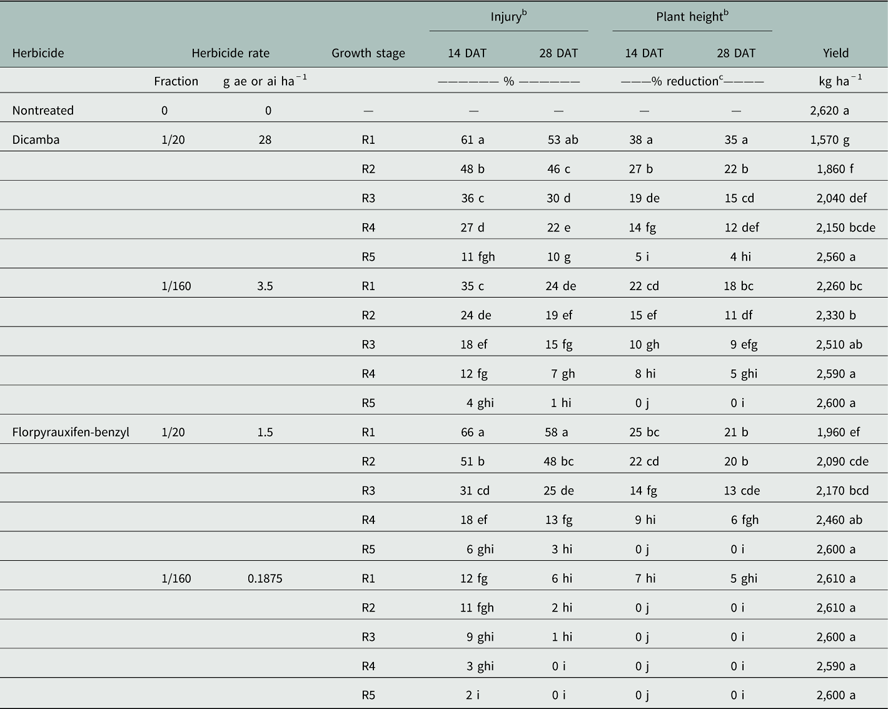
Soybean symptomology to dicamba primarily displays itself as cupping of leaves, stunting, and pod malformation (Andersen et al. Reference Andersen, Clay, Wrage and Matthees2004; Griffin et al. Reference Griffin, Bauerle, Stephenson, Miller and Boudreaux2013; Weidenhamer et al. Reference Weidenhamer, Triplett and Sobotka1989). In contrast, when soybean is exposed to low rates of florpyrauxifen-benzyl, it displays blistering, leaf and stem epinasty, and reduced growth (R Miller, personal observation). At 14 DAT, visible soybean injury from the 1/20X rate of florpyrauxifen-benzyl and dicamba ranged from 6% to 66% across all five reproductive growth stages evaluated (Table 1). A similar trend was also observed at 28 DAT, with the 1/20X rate of dicamba causing 3% to 58% injury across all five growth stages. However, the highest injury typically appeared at early reproductive stages, with visible injury becoming less prominent as growth stage progressed from R1 to R5. Barber et al. (Reference Barber, Norsworthy and McCown2016) reported similar results, with visible soybean injury from dicamba being reduced as reproductive growth stage advanced toward maturity. This occurrence could be attributed to increased absorption and translocation of the auxin herbicides at an early reproductive growth stage (R1) compared with later exposure (R5) (Devine Reference Devine1989; Wanamarta and Penner Reference Wanamarta and Penner1989). Injury from the 1/160X rate of the herbicides was reduced relative to the 1/20X rate, resulting in injury ranging from 2% to 35% at 14 DAT and 0% to 24% at 28 DAT.
Soybean injury, plant height reduction, and seed yield as affected by drift rates of dicamba or florpyrauxifen-benzyl applied at various reproductive growth stages combined over years.Footnote a

a Means within columns followed by different letters are significantly different using Fisher’s protected LSD (α=0.05).
b Abbreviation: DAT, days after treatment.
c Nontreated control measured 72 and 86 cm, 78 and 88 cm, 83 and 89 cm, 86 and 94 cm, and 89 and 98 cm at 14 and 28 DAT for R1, R2, R3, R4, and R5, respectively.
As described previously, exposure to low rates of dicamba or florpyrauxifen-benzyl can reduce soybean growth. Soybean that received no herbicide treatment measured 72 and 86 cm, 78 and 88 cm, 83 and 89 cm, 86 and 94 cm, and 89 and 98 cm at 14 and 28 DAT for R1, R2, R3, R4, and R5, respectively (unpublished data). Soybean plant height after 1/160X of dicamba at R5, 1/20X of florpyrauxifen-benzyl at R5, or 1/160X of florpyrauxifen-benzyl at R2 through R5 was not significantly different from the untreated at 14 or 28 DAT. However, soybean plant height was significantly reduced 5% to 38% and 4% to 35% from 1/20X dicamba across all reproductive stages at 14 and 28 DAT, respectively (Table 1). High drift rates (1/20X) of florpyrauxifen-benzyl also reduced soybean plant height 9% to 25% and 6% to 21% across R1 to R4 stages at 14 and 28 DAT, respectively. Norsworthy (Reference Norsworthy2004) reported similar results, with later applications of glyphosate onto nonresistant soybean tending to produce lower soybean height reductions than earlier applications, likely due to soybean already reaching maximum height before treatment. In addition to soybean growth stage, drift rate of the herbicides also impacted the severity of soybean plant height reduction. In general, both herbicides tended to cause less height reduction at the lower drift rate (1/160X) compared with the high rate (1/20X). Previous research also reported lower rates of auxin herbicides having less of an impact on soybean plant height (Al-Khatib and Peterson Reference Al-Khatib and Peterson1999; Griffin et al. Reference Griffin, Bauerle, Stephenson, Miller and Boudreaux2013).
Soybean seed yields after application of dicamba and florpyrauxifen-benzyl were reduced compared with the nontreated (2,620 kg ha−1) when they were applied at the 1/20X rate from R1 though R4 (Table 1). In addition, the 1/160X rate of dicamba also caused 15% and 11% yield reductions following applications at R1 and R2, respectively. No yield reductions were observed with the 1/160X rate of florpyrauxifen-benzyl across all reproductive growth stages evaluated.
Offspring
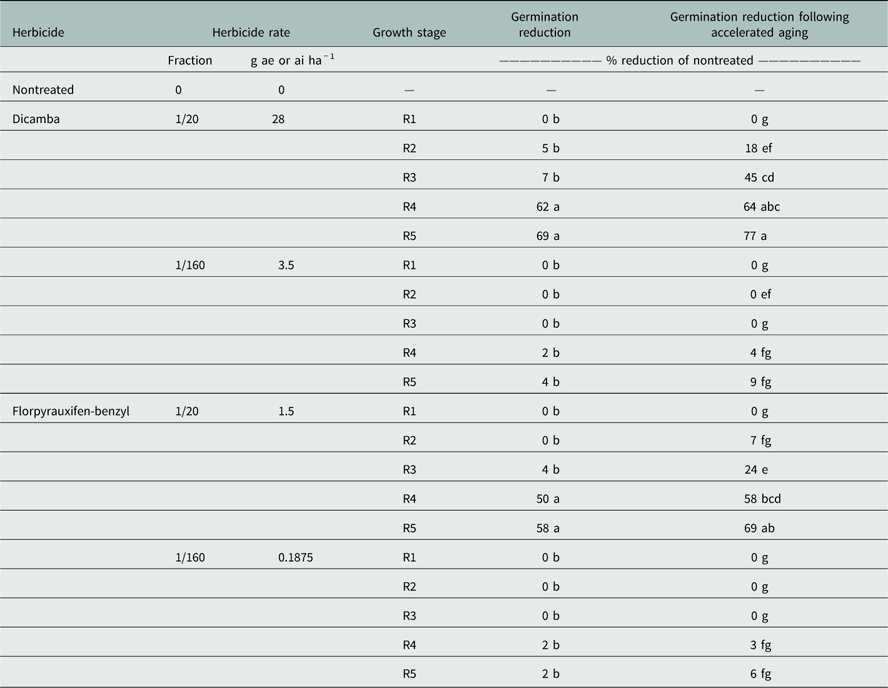
Germination of the seeds from soybean plants treated with dicamba and florpyrauxifen-benzyl was negatively affected (Table 2). For both herbicides, the 1/20X rate applied at the R4 (62% dicamba, 50% florpyrauxifen-benzyl) and R5 (69% dicamba, 58% florpyrauxifen-benzyl) growth stages reduced germination of the offspring. Seed germination was not (P>0.05) affected by other herbicide rates and application timings. Accelerated aging increased germination reductions, with the 1/20X rate of dicamba causing 18% to 77% reduction when applied from R2 to R5. The high rate (1/20X) of florpyrauxifen-benzyl caused 24% to 69% germination reductions when applied from R3 to R5. All other rates and timings of the herbicides did not reduce germination following accelerated aging. Barber (Reference Barber2016) observed a reduction in seedling vigor when dicamba was applied to soybean plants in later reproductive growth stages. While both herbicides applied at the 1/20X rate at R4 and R5 reduced germination of offspring, only dicamba reduced germination of accelerated aged seed from plants treated at the R3 growth stage.
Soybean seed germination reduction and accelerated aging as affected by drift rates of dicamba or florpyrauxifen-benzyl applied at various reproductive growth stages combined over years. a , b

a Means within columns followed by different letters are significantly different using Fisher’s protected LSD (α=0.05).
b Nontreated had an average germination rate of 88% and 69% germination after accelerated aging.
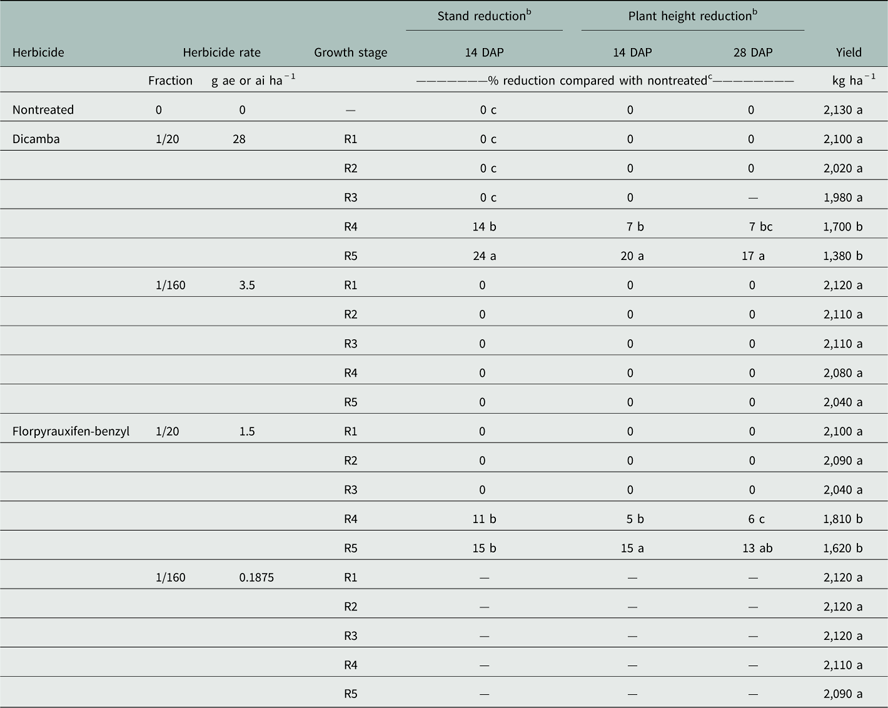
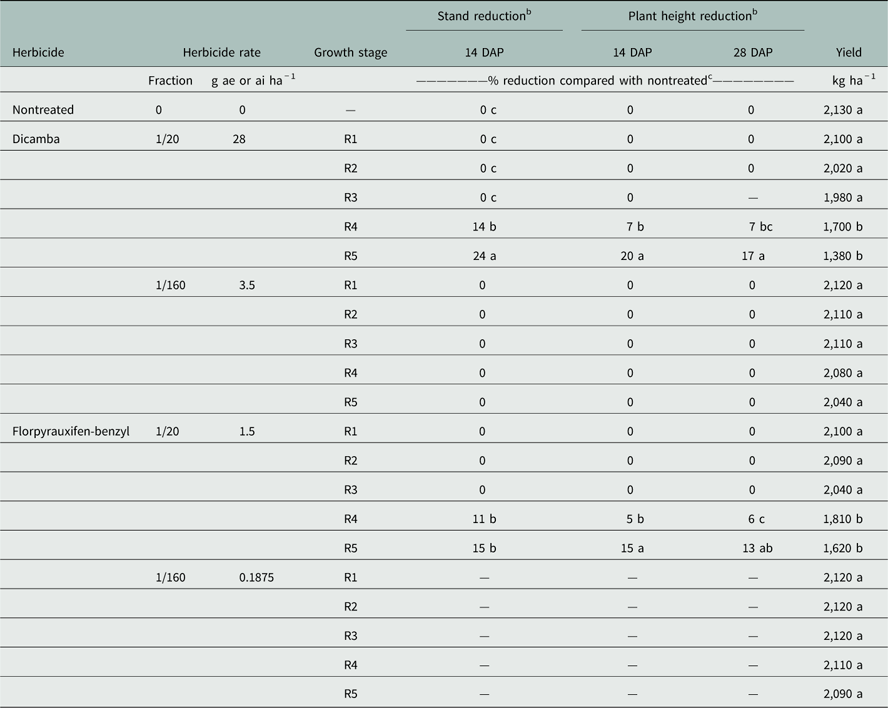
After seed from the parent plants that were treated the previous year was planted, soybean density and plant heights were not reduced compared with the nontreated when dicamba or florpyrauxifen-benzyl was applied at 1/160X across all soybean growth stages or at 1/20X from R1 through R3 and thus were excluded from the analysis (Table 3). Soybean density at 14 DAP was reduced for offspring originating from plants treated with 1/20X of either herbicide at R4 or R5 (14% and 24% for dicamba at R4 and R5, respectively; 11% and 15% for florpyrauxifen-benzyl at R4 and R5, respectively). Likewise, plant height of the offspring at 14 DAP was reduced by 1/20X of dicamba at R4 (7%) and R5 (20%) and by florpyrauxifen-benzyl at R4 (5%) and R5 (15%). Similar reductions were seen at 28 DAP. These findings match previous research, in that reduction in soybean plant height likewise translated into yield loss (Andersen et al. Reference Andersen, Clay, Wrage and Matthees2004; Auch and Arnold Reference Auch and Arnold1978; Griffin et al. Reference Griffin, Bauerle, Stephenson, Miller and Boudreaux2013; Kelley et al. Reference Kelley, Wax, Hager and Riechers2005; Wax et al. Reference Wax, Knuth and Slife1969; Weidenhamer et al. Reference Weidenhamer, Triplett and Sobotka1989). Dicamba applied at a rate of 1/20X at R4 and R5 resulted in 20% and 35% yield reduction, respectively. A similar reduction occurred when florpyrauxifen-benzyl was applied at R4 and R5 at the 1/20X rate, resulting in 15% to 24% yield loss.
Reduction in soybean offspring, stands and plant height, and seed yield as affected by drift rates of dicamba or florpyrauxifen-benzyl applied at various reproductive growth stages combined over years.Footnote a
a Means within columns followed by different letters are significantly different using Fisher’s protected LSD (α=0.05).
b Abbreviation: DAP, days after planting
c Nontreated control measured 144 per plot with heights of 13 and 20 cm at 14 and 28 DAP, respectively.
Conclusions and Practical Implications
Based on data from these experiments, soybean is sensitive to high drift rates (1/20X) of dicamba and florpyrauxifen-benzyl during later reproductive growth stages, and these herbicides could cause adverse effects in offspring. Therefore, it is concluded that florpyrauxifen-benzyl can injure reproductive soybean similar to dicamba and both herbicides can have similar negative effects on the subsequent offspring. To prevent this occurrence, several practices are recommended: (1) mitigate the likelihood of physical drift by following label restrictions, specifically proper wind speed, application speed, boom height, nozzle selection, and application volume (Maybank et al. Reference Maybank, Yoshida and Grover1978; Wolf et al. Reference Wolf, Grover, Wallace, Shewchuk and Maybank1992; Womac et al. Reference Womac, Goodwin and Hart1997; Yarpuz-Bozdogan Reference Yarpuz-Bozdogan2011); and (2) understand the sensitivity and subsequent risk of these herbicides when applying them and/or recommending their use near sensitive crops such as soybean. However, with the anticipated application timing for florpyrauxifen-benzyl being before flood establishment in rice (H Miller, personal communication), it is unlikely that applications would coincide with later reproductive development stages of soybean. Nevertheless, it is suggested that growers use caution when planting soybean adjacent to a rice field where florpyrauxifen-benzyl could be applied. Additional research is needed to determine the response of soybean under different conditions such as early- versus late-maturity groups, drilled versus bedded, and narrow versus wide row spacing.
Acknowledgments
Funding for this research was provided by the Arkansas Rice Promotion Board and Dow AgroSciences.