1. Introduction
In response to Language Teaching's commitment to making research about foreign language teaching and learning in peripheral contexts accessible to researchers elsewhere, this paper reviews 60 empirical studies on English language learning and teaching published in leading mainland Chinese journals from 2008 to 2011. English language education has undergone significant changes in China in the last decade as both the government and the public display steady enthusiasm for more and better English (Wu Reference Wu2001; Hu Reference Hu2002, Reference Hu2005; Hu Reference Hu2007). Language teachers, researchers and policy makers have made committed efforts to improving the effectiveness of English language teaching so that individuals can be better prepared linguistically for global participation and engagement (Hu Reference Hu2005). To this end, English was made a compulsory subject in primary schools in 2001 and pedagogical initiatives such as communicative language teaching and task-based instruction have been promoted as part of curriculum reforms at all educational levels (Wu Reference Wu2001; Hu Reference Hu2002, Reference Hu2005; Hu Reference Hu2007; Wen & Gao Reference Wen and Gao2007; Wang & Gao Reference Wang and Gao2008). These shifts have created a new momentum for Chinese researchers to explore how learners have been acquiring English language skills and how English language teachers have implemented the desired changes (Wu Reference Wu2001; Hu Reference Hu2002, Reference Hu2005).
In response to these shifts, Chinese teachers have been making tireless efforts to teach English in extremely diverse and often adverse conditions. In the meantime, researchers have been proposing and developing pedagogical initiatives to enhance learning, drawing on their own ingenuity and theories from sources such as international research on language learning and teaching. Most of these research efforts go unnoticed because they are documented in Chinese and are therefore not accessible to a wider international readership. Therefore, however limited this paper may be, we believe there is a need to take stock of these studies to ‘do justice to the efforts and perseverance millions of Chinese teachers and learners have exerted’ (Gu Reference Gu2002: 2).
Given the size of the country and the number of journals in China, as well as the limited space for this review, we limit our discussion to 60 empirical studies from leading mainland Chinese journals that are ‘characterized by systematic collection . . . of data’ (Gao, Li & Lü 2001: 3). Our modest aim is to show what empirical research has been carried out on language learning and teaching and how it has been conducted in China. Conceptual studies and non-empirical research reported in these journals may have significant consequences for language policy and curriculum development as well as for millions of language teachers and learners, and thus deserve to feature in reviews of this kind. However, conceptual arguments must be tested, verified and developed in empirical studies before they can meaningfully guide major language policy and curriculum initiatives. It was, therefore, crucial for this paper to focus on empirical research.
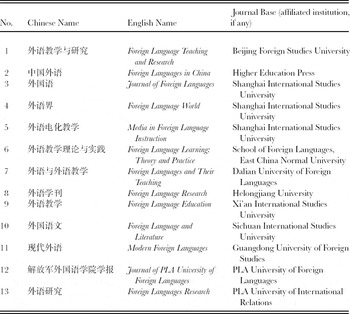
The review is inevitably subjective and arbitrary but we took various measures to minimize arbitrariness in our selection of empirical studies. First, we narrowed down the list of publications. For quality considerations, we restricted ourselves to journals listed in the China Social Citation Index (CSSCI): key journals in which university academics in China compete to publish their research. A total of 13 were identified (see Appendix). Almost all the journal articles examined in this paper are related to the English language since the number of empirical studies on other foreign languages is negligible in comparison. Although we had intended to identify and include high-quality empirical studies in the review process, we appreciate that publication is a highly contextualized process. In mainland Chinese journals, publications inevitably bear the imprint of circumstances and prevalent cultural practices within the Chinese academic community. For example, articles published in Chinese journals are usually short and have little description of the methodologies used. This limitation may prevent proper evaluation of the methodological rigor or quality of the empirical studies reviewed in this paper.
In the review process, we first identified empirical studies for review by reading the article abstracts and then carefully going through the methodological descriptions in each article. As a result, we identified 1,120 empirical studies, grouped into three categories: language learning and use, language pedagogy and language learners and teachers. Articles on language learning and use (552 in total) covered aspects of second language acquisition (SLA); in particular, those related to cognitive and metacognitive processes in language learning and features of Chinese learners’ language use. Articles on language pedagogy (446 in total) covered a variety of issues related to the teaching of English in China, including curriculum development, pedagogical approaches and assessment. The third group of articles (122 in total) was concerned with language learners and teachers, crucial stakeholders in the language learning and teaching process. These were empirical studies of characteristics of Chinese learners, such as their motivational orientation or learning styles. They also documented initiatives and efforts to train language teachers.
We classified the selected studies in terms of their methodological description and research topics. We then adopted a matrix of criteria for the selection of studies for inclusion in this paper, including methods, topics, research settings and research participants. All the articles covered in this paper were nominated by at least two members of the team, and we negotiated to further cut down the number of articles for inclusion. This selection helped us include studies on different topics conducted with a variety of participants in diverse settings.
In the following sections, we first comment on the strengths and weaknesses of the empirical studies identified in the review process. We then discuss the selected studies’ major claims and methodological approaches in three sections.
2. General observations on empirical studies in leading mainland Chinese journals
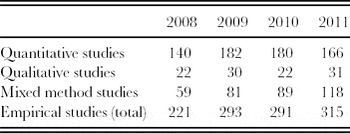
The methodological sophistication and close engagement with research issues displayed by our colleagues has been impressive. Leading Chinese journals have become receptive to empirical studies and are publishing increasing numbers of qualitative and mixed method studies (see Table 1). Chinese researchers have also been critically examining theories and concepts originating from other contexts.
Methodological trends (2008–2011) (n = 1,120)

As can be seen in Table 1, the methodologies used in the studies were diverse, with a substantial number of qualitative and mixed studies published during the review period. A combination of questionnaire, observation and in-depth interview approaches were evident in large-scale, nationwide studies (e.g. Gao, Zhou & Zhan Reference Gao, Zhou and Zhan2011). There was also experimentation with alternative methodologies such as Statistical Equation Modeling (SEM) (32 studies in total), Rasch analysis (ten studies), narrative inquiry (13) and ethnographic case studies (14). The methodological trend identified in the review process suggests that language learning and teaching research in China is moving away from ‘“positivism”, which perceives language learning/teaching as an objective “reality” to be scientifically studied, and “knowledge” thus attained to be absolutely true’ (Gao et al. Reference Gao, Li and Lü2001: 11).
In addition, we have noted a stronger engagement with research concepts and theories originating elsewhere, including attempts to test, modify or contextualize well-established theories generated by scholars in Western contexts. For instance, Yu & Liu (Reference Yu and Liu2009) explored the appropriateness of Oxford's (Reference Oxford1990) six-factor taxonomy of language learning strategy in the Chinese context and advanced a localized, four-factor taxonomy for language learning strategies. Other studies looked inward to research scholarship on language learning and teaching in China. For example, Liang & Qin (Reference Liang and Qin2009) reviewed studies related to genre theories published in selected Chinese academic journals from 1997 to 2006, in terms of their methodological choices and research focus. Huang & Tang (Reference Huang and Tang2011) analyzed the impact of 5,193 articles published in a leading journal (Foreign Language Research) on topics relating to language learning and teaching. Their analysis revealed that only a few articles were frequently cited while the majority were not cited at all.
Unfortunately, the rising number of empirical studies does not change the fact that the majority of articles in leading Chinese journals are not empirical. Some of these articles might have been based on empirical research but were excluded from our review process because we could not identify a clear methodological description. These journals still publish articles that read like ‘personal experiences and reflections [without] substantial literature review, purposeful research planning, details of operational procedure and solid data’ (Gao et al. Reference Gao, Li and Lü2001: 3). In addition, we found that most of the empirical studies are about teaching and learning English in tertiary settings and very few (42 out of 1,120) concerned primary or secondary schools. Even fewer (four out of 1,120) explored the learning and teaching of English among ethnic minority students. Given the diversity of language learners and educational settings in China, the many important debates about language policy, curriculum and pedagogy need to be supported by a collection of empirical studies rigorously conducted in a variety of educational settings.
We also observed that the influence of methodological positivism is still strong: few studies such as narrative inquiries have examined individual learners’ and teachers’ constructions of their experience. The majority of empirical studies either involved statistical analysis or examined language data ‘objectively’ through methods such as corpus analysis (197 studies in total). We have also noted that some of the empirical studies in these leading journals are questionable in terms of methodological rigor in comparison with those in international journals. For instance, we were struck by the number of ‘mixed-method’ studies and puzzled by the fact that some articles refer to data collected through only one method (e.g. Cao & Yu Reference Cao and Yu2009; Chen & Liu Reference Chen and Liu2010).
3. Language learning and use
Empirical studies of Chinese learners’ learning and use of English provide the insights we need to inform the development of appropriate language policies, curriculum and pedagogy. As revealed in the studies selected, Chinese researchers have directed their efforts towards exploring Chinese learners’ lexical and grammatical development. They also display a strong interest in the development of Chinese learners’ ability to use both written and spoken English productively, reflecting an increasing emphasis on communicative competence, particularly in the last two decades. Before we discuss individual studies in the sub-sections on Chinese learners’ lexical and grammatical development and features of their English usage, as well as learning methods and contexts, we believe the following broad patterns deserve mention:
1. Most of the studies selected endorse a notion of learners’ linguistic development as a linear, unidirectional progression towards native-like performance (e.g. Wen Reference Wen2009; Hu Reference Hu2010; Li Reference Li2010). In these studies, language learners’ first languages (L1s) are often regarded as a source of negative influence on their acquisition of English as foreign language (L2) (e.g. Lei & Wang Reference Lei and Wang2009; Cai & Yang Reference Cai and Yang2010; Li Reference Li2010).
2. There has been significant interest in verifying theories and hypotheses generated in other educational contexts (e.g. Cai & Yang Reference Cai and Yang2010; Hu Reference Hu2010; Tang & Xu Reference Tang and Xu2011). We found that some of the hypotheses tested in the studies were quite outdated in terms of their current applicability and others were not examined with appropriate methods. Nevertheless, we share the view that such theory- and hypothesis-testing studies are important, as they shed light on Chinese learners’ learning processes and generate empirical evidence to inform the development of appropriate language pedagogy in China.
3. Researchers favored particular methodological approaches to studying Chinese learners’ learning and use of English, such as corpus analysis (e.g. Cheng & He Reference Cheng and He2008; Wu & Xiao Reference Wu and Xiao2011). Researchers in this group of studies have also experimented with the use of innovative data collection methods or techniques (e.g. Li & Wei Reference Li and Wei2010; Liu & Pan Reference Liu and Pan2010; Ni, Reference Ni2010; Wu Reference Wu2010; Zhao & Zhang Reference Zhao and Zhang2010).
3.1 Lexical and grammatical development
One of the central concerns in this field has been learners’ acquisition of English competence, especially with regard to lexical and grammatical development. Some of the studies can contribute to theoretical development in the field of SLA. For instance, Zhang's (Reference Zhang2008) careful analysis of the participants’ acquisition of individual words in a nine-month longitudinal study revealed that acquisition did not occur in a linear manner and the participants’ levels of familiarity with particular words fluctuated over time. It is a pity that Zhang did not interpret her findings with reference to dynamic systems theory (Larsen-Freeman Reference Larsen-Freeman2006) as, in our view, these findings confirm an understanding of language learners’ vocabulary development as a dynamic complex process, which deserves further research. Showing a strong interest in how learners can be assisted in lexical development, research has examined the developmental features of their English lexis on a cross-sectional base. Wen's (Reference Wen2009) corpus-based study documented changes in register features of English major students’ spoken and written English over a four-year period in comparison with those of their native-speaking counterparts. This rigorous analysis has helped identify critical issues that need to be addressed pedagogically. Wen concludes that teachers should put more effort into fostering Chinese learners’ critical awareness of register differences and increasing their exposure to authentic spoken language input. Classroom-based research has looked at how Chinese learners’ lexical acquisition can be enhanced by pedagogical tasks. Experimental studies like that of Niu (Reference Niu2009) have revealed that simple combinations of tasks (e.g. reading with collaborative written or oral production tasks) can lead to significant changes in learning outcomes. As English teachers have been encouraged by curriculum reform to use a task-based instructional approach in teaching, they may undertake action research or reflective teaching projects on the use of learning tasks to formulate their pedagogical decisions.
The focus on the register features of Chinese learners’ lexical development in Wen (Reference Wen2009) is closely associated with their acquisition of grammatical knowledge. With a concern for Chinese learners’ grammatical development, research has explored various aspects of their understanding of the English language as a system. For instance, Zhao & Zhang's (Reference Zhao and Zhang2010) survey studied Chinese university students’ use of the English article, a common problem for native speakers of Chinese, whose L1 does not have an article system. What makes this study stand out from other empirical studies of Chinese learners’ grammatical development is that the researchers also conducted a follow-up interview to explore the processes underlying the participants’ use of articles. The interview data revealed that the participants’ errors might have been caused by their failure to understand their interlocutors’ intentions and the lack of relevant background information in the written test. These findings suggest that language teachers should not only teach grammatical forms, but also draw their students’ attention to programmatic functions and the context of communication. With a similar focus on learners’ grammatical acquisition, Zhang & Yang (Reference Zhang2009) analyzed the writing of English major students in the English Major Tests (Bands 4 and 8, 2004–2006) corpus to find out how they had been acquiring tenses. Like Zhao & Zhang (Reference Zhao and Zhang2010), they discovered that language teachers had to focus on pragmatic aspects of tenses in teaching, as the learners they studied displayed little awareness of the need to change tenses according to their intended meaning. Their analysis also revealed that the learners did not necessarily display proper use of tenses as they progressed in their learning of English, suggesting that learners’ linguistic development may not be linear or unidirectional (Larsen-Freeman Reference Larsen-Freeman2006).
Chinese researchers have also attempted, with varying success, to use and test alternative theoretical perspectives to examine learners’ lexical and grammatical development. Wu (Reference Wu2010) explored whether task involvement load affects language learners’ vocabulary acquisition, as hypothesized by Laufer & Hulstijn (Reference Laufer and Hulstijn2001). What makes Wu's (Reference Wu2010) study particularly interesting is that he used a user-behavior tracking technology to record non-major English students’ learning behaviors when completing tasks of different involvement loads. The technology allowed Wu to collect valuable information about learners’ behaviors in task completion, such as the number of target words clicked, clicking counts of each word and time spent on each word. The user-behavior tracking technology used may have wider applications in studies that value the collection of data about language learners’ observable behaviors, but do not have reliable means to collect such data. Hu (Reference Hu2010) used cognitive linguistic theories in his experimental study on how aspects of a predicate influence Chinese learners’ acquisition of it as a symbolic structure of form and meaning. While we share Hu's (Reference Hu2010) enthusiasm that cognitive linguistics can be used as an alternative research perspective in Chinese SLA research, we doubt whether the methodological approach in this inquiry can generate sufficient evidence to support his claim. The multi-factor experiment in the inquiry was actually a fill-in-the-blank test that involved English major students of different levels in the experimental group and native-English-speaking American college students in the control group. The methodological design in the study is also indicative of a linear and unidirectional view of linguistic development. Hu's efforts to advance cognitive linguistics may be better supported by a careful analysis of data from naturally occurring language use by Chinese learners.
While the primary focus in most studies has been on university students, Tang & Xu (Reference Tang and Xu2011) is one of the few that explored high school students’ acquisition of relative clauses in an attempt to test the noun phrase accessibility hierarchy and perceptual difficulty hypotheses. Tang & Xu used both think-aloud procedures and retrospective interviews to probe students’ production of relative clauses. That the hypotheses were confirmed in the inquiry is not particularly striking, but the study is unusual as it results from collaboration between a secondary school English teacher and an academic researcher from a research-intensive university. Therefore, we not only see hopeful signs of leading mainland Chinese journals publishing studies on primary and secondary education but also feel confident that academic research on language learning and teaching is likely to impact language pedagogy through such collaboration.
3.2 Features of Chinese learners’ English
While the studies reviewed above focused on Chinese learners’ lexical and grammatical development, the following explore linguistic features of their written and spoken English. Two are particularly important and may have significant methodological implications for documenting and exploring Chinese language learners’ English skills (Li & Wei Reference Li and Wei2010; Liu & Pan Reference Liu and Pan2010). Li & Wei (Reference Li2010) adopted a novel computing method for extracting contiguous phraseological units and tested its application in an analysis of the Jiaoda (Jiaotong University) English for Science and Technology (JDEST) corpus. Instead of using collocation statistics (one of the most frequently used software methods for calculation and corpus analysis), Li & Wei (Reference Li2010) argued that the probability-weighted average should be used to examine lexical cohesiveness. This was found to be more precise in extracting contiguous units in the study though its effectiveness in extracting non-contiguous units remained to be tested. It also requires further testing on the extraction of English texts other than those in the JDEST corpus, including natural language data. Nevertheless, the development of this new measure is expected to help researchers and teachers identify and address the problem of lexical cohesiveness in Chinese learners’ written English. Liu & Pan (Reference Liu and Pan2010) reported on a multimodal exploration of Chinese university students’ language use in group oral discussion. The researchers designed a set of non-verbal communication marking indexes and, using these, found that the participants’ oral performance and communication quality were affected by non-verbal communication problems such as reduced eye contact and unnatural gestures. They argued that a multi-modal corpus should be established, to inform oral English teaching and assessment.
While the above-mentioned studies developed instruments that can be used in promoting better written and spoken English, research has also sought to identify phonological features of Chinese learners’ spoken English. Cheng & He (Reference Cheng and He2008) analyzed an advanced English learners’ natural speech corpus to study the speakers’ segmental pronunciation errors. They identified the influence of the participants’ L1 as one of the likely causes of the segmental pronunciation errors. Wu & Xiao (Reference Wu and Xiao2011) examined the spoken English corpus collected for Public English Tests (PETS), designed for the general public in China. The researchers argued that some of the pronunciation errors might have been caused by L1 influences. Instead of focusing on segmental phonological features, Li (Reference Li2010) compared the identification of lax and tense vowels by Chinese students in Shanghai and British students in the UK. The findings showed that language teachers should not just focus on the length of vowels when helping Chinese learners identify lax and tense vowels, but should focus more on sound quality and help learners become aware of the necessity to adjust their vocal tract and produce vowels of appropriate quality. While the issues identified in the three studies are important for language teachers to address when teaching English pronunciation in China, we have reservations about whether all the features identified should be regarded as ‘errors’ or as features of emerging Chinese varieties of English. We also doubt whether it is reasonable to use native-speaker British students’ language performance as the standard against which to evaluate Chinese learners. It might be more appropriate to establish a standard of intelligible English for other Chinese learners on the basis of corpora of our best learners’ English.
3.3 Learning process, methods and contexts
The studies mentioned so far have focused primarily on Chinese learners’ spoken and written English. In this section, we draw attention to studies on their exposure to English input, especially reading and listening. These also reflect concerns about the contextual mediation of language learners’ pursuit of English competence, leading to questions about what constitute appropriate learning methods and language learning.
Addressing learners’ exposure to the target language, Ni (Reference Ni2010) conducted Structural Equation Modeling (SEM) analysis to examine the influence of affective factors on the amount of such exposure. Ni claimed that statistical modeling methods might help language teachers identify learners who are making an effort to learn the language on their own. SEM has become a popular research method in China (30 studies in the reviewed journals during the years 2008–2011), as complex statistical data can be mined to inform policy decisions in language education. However, we have reservations as to whether such data-mining analyses, as carried out by Ni, take the complexity of individual learners sufficiently into account. Although the percentage of those identified as unwilling to invest any effort in learning may remain constant through a certain period of time, it remains possible that individuals have shifting motivations for increasing or decreasing their exposure to the target language. Language teachers will still face the challenge both of motivating their learners and sustaining motivation during the learning process.
With regard to research on Chinese learners’ reading and listening, Peng & Tao (Reference Peng and Tao2009) and Sun & Li (Reference Sun and Li2008) deserve special mention for their research foci and methodological orientation. Peng & Tao (Reference Peng and Tao2009) examined the roles of word decoding, English language comprehension and cognitive ability in native Chinese-speaking children's English reading. They discovered that it was the children's word decoding and English language levels, not their cognitive ability, that significantly accounted for variance in reading. These results suggest that English teachers should focus on their pupils’ word decoding skills and English language comprehension to improve their English reading. As English has been promoted as a compulsory subject in Chinese primary schools, more studies like that of Peng & Tao are urgently needed to assist the development of appropriate language pedagogy. Since it is difficult to conduct research on language learners’ listening processes, Sun & Li (Reference Sun and Li2008) deserves particular attention; think-aloud and stimulated-recall procedures were used to explore Chinese university students’ use of strategies to overcome the difficulties they had in listening. Such studies are instrumental for teachers of listening in China to help language learners develop appropriate listening strategies.
What constitute ‘appropriate’ strategies can be a highly controversial research issue, due to the contextual mediation of the language learning process. Dai & Ding (Reference Dai and Ding2010) explored how text memorization influenced Chinese learners’ use of formulaic sequences in writing and their overall writing performance. The participants, who were asked to memorize all the English texts, significantly improved their writing and displayed a better command of formulaic sequences than those in the control group when their performances in the pre-test and immediate post-test were compared. In spite of the widespread reservations held by both language researchers and teachers about text memorization, these findings invite us to rethink what constitute ‘bad’ or ‘good’ learning methods for learners in particular contexts. In the meantime, we suggest it would have been useful for Dai & Ding (Reference Dai and Ding2010) to have conducted a delayed post-test to find out whether the participants benefited from text memorization in the long term.
Research has also displayed an awareness of the challenges that Chinese learners face when learning English, particularly with regard to the influences of their L1. Lei & Wang (Reference Lei and Wang2009) conducted cross-linguistic experiments to explore the bilingual syntactic representations of university students with unequal proficiency in English and Chinese. While it is important to document the developmental path of Chinese learners’ bilingual syntactic representations, preferably in longitudinal studies, it is questionable whether the researchers should regard the participants’ L1 as a source of negative influence. The studies mentioned so far used university students of largely Han Chinese ethnicity, but Cai & Yang (Reference Cai and Yang2010) explored the influences of Uyghur and Kazak secondary school pupils’ acquisition of Chinese (L2) on their learning of English (L3). They examined 414 pupils’ mother tongue, Chinese language and English examination results to test the following hypotheses: 1) pupils who have similar proficiency in their L1 and L2 have better L3 results than those who do not; 2) pupils’ L1, L2 and L3 results are correlated with each other; 3) these pupils are likely to use their knowledge of Chinese to acquire English. The results indicated that the first hypothesis was rejected by the analysis and the second was only partially confirmed in the inquiry. The third hypothesis was confirmed by a t-test of Uyghur and Kazak pupils’ English results as well as paired t-tests of their Chinese and English results. These findings indicate that the participants with high levels of L2 proficiency and a lower level of proficiency in their L1 were likely to have better L3 results. As a result, Cai & Yang argued that these findings contradict Cummins's (1979, cited in Cai & Yang Reference Cai and Yang2010) threshold hypothesis that the L3 achievements of balanced bilinguals (those who are equally proficient in L1 and L2) are superior to the achievements of those who are not equally proficient in L1 and L2. However, these findings need to be treated with great caution. It is probably too early to conclude that Cummins's threshold hypothesis was refuted in the study, since the participants were still in the process of developing their English competence. The study also has some worrying implications about ethnic minority pupils’ mother tongue development in China. It may not be wise to encourage them to concentrate on learning the national language and English at the expense of their mother tongues.
4. Language pedagogy
The studies on this theme that we have selected document a variety of initiatives designed and promoted to enhance Chinese learners’ learning of English, especially in tertiary settings. In these studies, the researchers reported on the integration of computer technology into language teaching and assessment. They also explored how English teachers incorporated new pedagogical content such as cultural understanding into language teaching and helped Chinese learners acquire capacities or skills for learning. Before discussing individual studies, we need to consider the following issues raised by this group of empirical studies:
1. It is in tertiary education that English teachers have been developing tailor-made programs for an increasingly diverse student population with varying experiences of learning English. These new curriculum initiatives have been proposed in response to the rapid expansion of the tertiary education sector, which means institutions are taking in more and more students with lower academic achievements than their predecessors (Xiang Reference Xiang2009). At the same time, as English is being promoted as a compulsory primary school subject, many university students may have already achieved the English levels set by the traditional college English curriculum before entering universities. These students require new curricula to meet their learning needs (e.g. Xiao Reference Xiao2008; Cheng Reference Cheng2011). As a result, intense efforts to develop programs specific to the needs of particular student groups will continue, in particular with regard to courses in English for Specific Purposes (ESP) (e.g. Jin Reference Jin2009; Liu, Zhu & Chang Reference Liu and Chang2009; Xiang Reference Xiang2009).
2. Pedagogical initiatives at the course level have been largely driven by computer applications, new learning objectives and course content (e.g. Pan Reference Pan2008; Tang Reference Tang2009; Wu & Liu Reference Wu and Liu2009; Zhang Reference Zhang2009). English teachers were also found to have attempted to integrate the new content (i.e. cultural understanding), objectives (i.e. language learners’ capacity for autonomous learning) and innovative technology into teaching (e.g. Shi Reference Shi2010; Huang Reference Huang2011).
3. Given the critical role of assessment in education in China, it is hardly surprising that there have been many empirical studies exploring how assessment can be effectively used to promote language learning: in particular, the learning of spoken and written English (e.g. Lü et al. Reference Lü, Song, Wang, Liu and Li2008; Zheng & Feng Reference Zheng and Feng2011). Technology again plays a critical role in helping English teachers assess millions of Chinese learners’ English language proficiency (e.g. Li et al. Reference Li, Yang, Feng, Wu, Chen and Hu2008). We have also noted attempts to pilot the use of alternative assessment methods such as portfolio assessment (e.g. Hong, Zhan & Zhao Reference Hong, Zhan and Zhao2011).
4. In most of the selected studies, researchers have demonstrated a fair command of their methodology. We suspect that some of these studies might have been conducted by teachers exploring their own professional practices (e.g. Shi Reference Shi2010; Yan Reference Yan2010; Huang Reference Huang2011). Studies reporting on research conducted within one institution (e.g. Jin Reference Jin2009) are less likely to have a significant impact on a large number of learners or teachers, so researchers working in different institutions should combine their research efforts on common issues.
4.1 Curriculum reforms
As mentioned earlier, empirical studies that have documented curriculum reforms have mostly taken place in tertiary settings, in response to the rapid expansion of higher education and enrollment of undergraduates with increasingly diverse prior learning experiences. Before implementing any programs tailor-made to students’ needs, it is important for language researchers and teachers to find ways to group newly registered university entrants according to their standard of English. Liu et al. (Reference Liu and Chang2009) contended that College English teaching departments in Chinese universities should consider students’ achievements in each language skill, such as reading and listening comprehension as documented in their examination results, when grouping them for teaching. They suggest that more discriminating grouping along these lines would increase students’ positive learning experiences in English classes. Cheng (Reference Cheng2011) outlines objections to a one-size-fits-all approach in the promotion of bilingual teaching and argues for the judicious use of English as a medium of instruction (MOI) to enhance students’ experience of learning English. These studies demonstrate that bilingual teaching is problematic if lecturers do not consider the linguistic features of particular courses (academic disciplines) when deciding to use English as an MOI. Further research is needed to explore crucial questions about whether Chinese university students benefit from having English as an MOI and how English-medium instruction can best be used to enhance their learning of subject content.
Curriculum reform has also been examined in universities attended by students of ethnic groups other than Han Chinese (Jin Reference Jin2009), tertiary vocational institutions (Xiang Reference Xiang2009) and postgraduate education settings (Xiao Reference Xiao2008). Jin (Reference Jin2009) addressed the critical question of whether curriculum reforms led to better English results in an Inner Mongolian university. By comparing the College English Test Band 4 results of those educated in the technology-enhanced curriculum with those of students in the traditional curriculum, Jin found that those in the new curriculum had achieved significantly better results: they were more satisfied with their learning experiences and paid more attention to their communicative competence in English. Xiang (Reference Xiang2009) reported a comprehensive investigation that evaluated the current English language curriculum in tertiary vocational institutions in Guangdong province. These institutions are relatively new, but are attended by almost half the tertiary students in China (Gao, Su & Hu Reference Gao, Su and Hu2006). Most were converted from technical/vocational secondary schools which used to prepare skilled frontline workers for manufacturing industries and clerical staff for the service sectors. These students’ English proficiency levels are lower than those in universities, and their linguistic goals are clearly defined, being determined by the vocational jobs that they are expected to take up upon graduation. Xiang's (Reference Xiang2009) team concluded that such institutions should abandon general proficiency English courses and instead develop skills-based English courses appropriate to their students’ professional needs. Like Xiang (Reference Xiang2009), Xiao (Reference Xiao2008) also suggested that Chinese universities allow postgraduate students to take courses according to their professional interests and English proficiency levels. The new postgraduate English curriculum should develop students’ practical English skills, such as professional writing and translation, and enlarge their vision and cultural understanding. Since similar proposals have been advanced in Chinese universities with regard to the College English curriculum reform (e.g. Liu et al. Reference Liu and Chang2009), we expect the development of ESP courses to continue, making the tertiary sector a happy hunting ground for various ESP initiatives and providing ideal sites for conducting ESP-related research.
4.2 Innovative pedagogical practices
In addition to efforts to improve pedagogical effectiveness at the program level, Chinese researchers have also examined how technology-enhanced pedagogical strategies can be employed to enhance language learning and improve students’ capacity for learning. These studies have often been conducted by English language teachers who initiated and documented their innovative teaching practices and studied the pedagogical process as experienced by English learners and teachers. For example, Zhang (Reference Zhang2009) conducted a survey of distance education participants on their experiences of computer-mediated language learning. Zhang found that the use of computer technology enhanced the participants’ interest in learning the language and encouraged them to be more effectively engaged with language input and output activities. In turn, these activities deepened their acquisition of declarative, procedural and strategic knowledge. The study identified a limitation of distance education programs: the lack of opportunities for participants to have oral conversations. With the advent of Web 2.0, more students will be able to conduct oral conversations in computer-mediated distance language education programs. This may explain why similar problems were not recorded in a more recent study of a cross-cultural distance learning context (Huang Reference Huang2011) which focused on language learners’ perceptions of the classroom environment. Huang not only surveyed students from universities on the Chinese mainland, Taiwan, Japan and Korea, but also interviewed them to obtain their feedback on the learning environments they experienced in the distance learning course. The results suggest that cross-cultural distance learning programs improved the participants’ learning and use of languages. Since all the participants in these courses were non-native speakers of English, it is a pity that Huang did not look at the participants’ English usage in the interactive learning process.
Apart from the application of new technology, researchers have studied other ways of developing language learners’ capacity for learning in China. Shi (Reference Shi2010) carried out an experimental study on developing autonomous learning capacity among science university students in web-based learning environments, with a focus on metacognitive strategy training. The data revealed that strategy training had limited impact on the participants’ strategy use, out-of-class learning and self-assessment behavior. Yan (Reference Yan2010) reported on her experimental efforts to implement a learner development program with a group of postgraduate students; the program had a significant impact on students’ out-of-class autonomous learning. Reflecting on the two studies, we find it hard to say what could have been done to further improve the impact of training on learning capacity, since both articles offered limited information on how the training sessions were conducted. A single training course cannot have much impact on adult learners. Therefore, we fully endorse Shi's (Reference Shi2010) reservation that language learners’ strategy development takes longer than the training period and its developmental process is mediated by various factors such as learners’ goals and orientations in learning English. More support measures, other than training courses, are needed to ensure that language learners further develop their capacity for strategic and out-of-class learning.
4.3 Culture and language teaching
Researchers have acknowledged the importance of teaching culture in English language programs at different educational levels. Drawing on in-depth interviews with experienced professionals in various organizations, Pan (Reference Pan2008) argued that the development of cultural communicative competence involves language learners undertaking multidisciplinary studies and practicing their skills in real-life situations. Huang (Reference Huang2009) explored the issue of adverse adaptation, that is, the adaptation made by host individuals towards short-term visitors and migrants. The questionnaire and interview data revealed that the participants’ overseas experience and education significantly influenced their adverse adaptation behaviors. Studies such as Huang (Reference Huang2009) support the development of teaching materials that can help Chinese learners understand how and why non-Chinese adjust their interaction behaviors in cross-cultural communication situations.
One of the most interesting issues in cross-cultural communication relates to learners’ understanding of the non-literal usage of language such as humor. Wu & Liu (Reference Wu and Liu2009) surveyed university students’ understanding of English humor by asking participants to rate the ‘funniness’ of short stories, including jokes and non-jokes. Since linguistic proficiency and cultural knowledge are crucial in appreciating humor, it is not surprising that the English major participants outperform the others in rating English jokes. The data suggest that females rated the ‘funniness’ of English jokes more accurately than males. Nevertheless, the female participants may not have a better sense of humor, but better linguistic and cultural knowledge. Like Wu & Liu, Tang (Reference Tang2009) examined Chinese learners’ cultural appreciation from a critical discourse perspective. Drawing on postcolonial cultural criticism, Tang investigated English learners’ interpretation of cultural hegemony in New York Times editorials. None of the learners’ written data reflected any recognition of the hidden cultural hegemony in the newspaper reports. Tang therefore suggested that language teachers develop critical appreciation of language and cultural western-centralism when teaching culture; it is equally important for teachers to foster critical thinking skills in general language courses.
4.4 Assessment reforms
In our examination-oriented learning culture, assessment has always been the focus of major language programs and curriculum reforms, as the form and content of assessment have a profound impact on how Chinese learners learn English. Substantial efforts have therefore also been put into reforming high-stakes language examinations, since reforms are unlikely to succeed without changing assessment practices. Given the rising importance of communicative competence in English language teaching, these reform efforts have centered around the questions of how communicative competence, especially oral English, can be assessed and how technology can be utilized in assessing a large number of examinees (e.g. Lü et al. Reference Lü, Song, Wang, Liu and Li2008). Alternative assessment methods have also been tried, to strengthen the links between learning, teaching and assessment (e.g. Hong et al. Reference Hong, Zhan and Zhao2011).
One of the most important issues in assessing communicative competence in English is the validity, reliability and operationalization of scoring scales. Lü et al. (Reference Lü, Song, Wang, Liu and Li2008) investigated the use of three scoring scales (analytic, holistic and item analytic) in oral English tests. Since live oral assessment in large-scale English tests involves a large number of examinees and a significant amount of training for assessors, Lü et al. (Reference Lü, Song, Wang, Liu and Li2008) concluded that the holistic scoring method is a manageable option that has comparatively high validity and reliability. The concern for high validity and reliability of oral assessment was echoed by He & Zhang (Reference Zhang2008), who used a multi-faceted Rasch Model to measure the sources and causes of score variation in oral assessment in the College English Test. The results confirmed that test-takers’ proficiency was the key factor in determining their oral assessment results. The authors also claimed that whether particular assessors are strict is not a decisive factor in examination results as a whole, even though evaluation bias had an impact on the test scores of individuals. Although He & Zhang argued that the Rasch model can be used to adjust test scores to enhance the reliability and validity of language assessment, we do not see this new statistical analytical procedure generating new insights. In addition, it would have been much more useful for He & Zhang to identify and minimize the impact of evaluation bias on test-takers’ examination results.
To ensure the validity and reliability of language proficiency assessment, researchers have also used computer technology as a solution to the shortage of qualified examiners and limited testing resources when administering communicative competence assessment tests to what is the largest group of examinees in the world. The studies selected record their efforts to integrate technology in high-stakes tests such as the College English Test (Bands 4 and 6). Li et al. (Reference Li, Yang, Feng, Wu, Chen and Hu2008) investigated the possibility of using machine scoring in College English oral testing. The results indicated that machine scoring has a higher validity than scoring carried out by teachers (who were not trained assessors) and differs little from that of expert assessors. With further refinement of the scoring technology, machine scoring could be beneficial in large-scale oral English tests because of its performance and efficiency. Like Li et al., Si (Reference Si2008) examined a large-scale implementation of a computer-aided diagnostic test for assessing business students’ proficiency in oral English. The students were satisfied with how their oral English was tested diagnostically and actually used the diagnostic feedback to improve their oral competence. As noted by Si, the diagnostic test still suffered from many technical problems such as how to simulate ‘authentic’ conversations between students and computers. Nevertheless, it is exciting to see that computer-aided oral diagnostic tests can be used to assess the oral English of a large number of students and play a significant role in integrating assessment into language teaching and learning.
In addition to these concerted efforts to develop the oral component of English assessment, research has addressed other components, including listening, writing and reading. Yan & Wang's (Reference Yan and Wang2008) experiment assessed the reliability and validity of constructive response questions in the listening comprehension component of the College English Test. Their results indicated that constructive response questions provided a better measure of the test-takers’ real listening comprehension levels. Yan & Wang therefore proposed that high-stakes examinations should have more of this type of question, a suggestion that many test developers have yet to adopt. Zheng & Feng's (Reference Zheng and Feng2011) inquiry compared the assessment comments of Chinese English teachers and native-speaker teachers on three student writing samples. They concluded that Chinese teachers should place more emphasis on appropriateness of language usage than on error correction. Hong et al. (Reference Hong, Zhan and Zhao2011) reported on an experimental use of portfolio evaluation of university students’ reading development, an innovative attempt to relate assessment practices to students’ learning. The results suggested that participants who used portfolio evaluation had made more significant improvement in reading competence than those who had used the traditional assessment method. The authors acknowledged the difficulty of promoting portfolio evaluation, but the positive results of the experiment led them to conclude that it is still worth the effort. More studies like theirs are needed to encourage English teachers to adopt alternative approaches to assessment.
5. Language learners and teachers
Researchers have paid increasing attention to the characteristics of language learners and language teachers’ professional development needs. They have explored how different factors mediate Chinese learners’ experiences of learning English. They have also considered how English teachers’ professional practices can be improved, since teacher educators and policy-makers have recognized that English language teachers ‘hold the key to the outcome of reform’ and of any efforts to improve the effectiveness of English language teaching (Wu Reference Wu2001: 192). We begin with three general observations about the studies described here.
1. The participants in these studies were mostly language learners and teachers in tertiary settings. There is a need for more empirical studies with a variety of learners and teachers in different settings, including primary and secondary schools or where students come from ethnic minority backgrounds.
2. These studies include some of the most rigorously conducted empirical research using multi-method or longitudinal designs (e.g. Wu Reference Wu2008; Guo & Wang Reference Guo and Wang2009; Zhou & Gao Reference Zhou and Gao2009; Zou Reference Zou2009; Gao et al. Reference Gao, Zhou and Zhan2011). Studies like those of Zhou & Gao (Reference Zhou and Gao2009) and Gao et al. (Reference Gao, Zhou and Zhan2011) should be commended for their collaborative efforts to capture the participants’ perceptions and experiences in multiple settings.
3. These studies include not only those with significant implications for language learners and teachers nationwide (Zou Reference Zou2009; Gao et al. Reference Gao, Zhou and Zhan2011) but also look at creative ways of investigating issues of emerging importance such as narrative inquiry into language learners’ identity development (e.g. Xiong Reference Xiong2009).
5.1 Language learners
The studies selected have examined the influence of a variety of learner characteristics, including motivation, identity, beliefs about and perceptions of language learning experiences and processes. Zhou & Gao (Reference Zhou and Gao2009) and Gao et al. (Reference Gao, Zhou and Zhan2011) used multiple data collection methods such as diary entries, semi-structured interviews and questionnaires in a large sample of university students (over 970 participants in five universities) across four years (Zhou & Gao Reference Zhou and Gao2009; Gao et al. Reference Gao, Zhou and Zhan2011). Zhou & Gao (Reference Zhou and Gao2009) produced a dynamic picture of motivational shifts among the first and second year students. For instance, they found that the participants had a growing intrinsic interest in learning the language and its culture and their shifting motivational strengths were associated with immediate achievements such as satisfactory examination results. Gao et al. (Reference Gao, Zhou and Zhan2011) focused on the impact of learning English on the participants in terms of identity changes in their third and fourth years of university studies. They found that the participants reported decreasing L1 proficiency levels, displayed positive attitudes towards some aspects of Western culture and became critical of their own. As a result, many of them were found to have suffered anxiety about their shifting cultural identities. Despite this, the participants revealed an even stronger intention to maintain and strengthen their own cultural identities. The researchers concluded that there was a need to strengthen L1 culture education to help English language learners develop bilingual identities.
Indeed, identity has recently become a crucial issue in language learning research in China and elsewhere. Chinese researchers are interested in the identities learners acquire as outcomes of their language learning efforts (e.g. Gao et al. Reference Gao, Zhou and Zhan2011) and in the developmental process of learner identity. For this reason, Xiong's (Reference Xiong2009) study of a Chinese bilingual's autobiographical account is unique in throwing light on a specific learner's identity construction process. Xiong outlined how this learner's language learning and identity construction were mediated by her parents, her school education and the ideological conflicts of the two social groups represented by the Chinese and English languages during the Cultural Revolution (1966–1976). The study depicted the struggle between the learner's dual identities as a proficient Chinese and English user, since the discourses prevalent at the time polarized the identities of Chinese and English users. Although Xiong (Reference Xiong2009) is an extreme case study and it is difficult to generalize its findings, it does show how important it is to recognize individuality and complexity in Chinese bilinguals’ identity construction.
Moving on from motivation and identity, another group of studies has explored language learners’ beliefs. Cao & Yu (Reference Cao and Yu2009) used a questionnaire and semi-structured interviews to survey the language learning beliefs of university students who were learning Japanese or Russian in addition to English. The participants were found to have had dynamic and shifting beliefs according to the number of years they had been studying, suggesting the need for longitudinal research, in line with Zhou & Gao (Reference Zhou and Gao2009) and Gao et al. (Reference Gao, Zhou and Zhan2011). Although Cao & Yu claimed that they had used interviews in the inquiry, their paper, surprisingly, does not contain any explicit reference to findings from the analysis of interview data. Zhong & Wang (Reference Zhong and Wang2008) surveyed non-English university students’ self-efficacy beliefs when learning English in multimedia contexts. They recommended that language teachers help under-achieving learners develop positive self-efficacy beliefs through experiences of successful learning and empower them with better learning strategies. Pan & Chen (Reference Chen2009) administered a questionnaire to university English major students from urban, suburban and rural backgrounds to seek causal explanations for failure and success in language learning. The study revealed how individual learners’ contextual background and prior experiences had mediated their perceptions of what had contributed to their language learning achievements. For instance, participants from rural backgrounds were most likely to attribute their success to their efforts, and those with urban backgrounds to their abilities. As the gap between the rich and poor widens in China, this study reminds researchers and teachers that learners from different socio-economic backgrounds may have significantly different beliefs about the learning of English.
Zhu (Reference Zhu2010) examined how cognitive styles and language aptitude, as well as beliefs, affect university students’ comprehension and production of relative clauses. The questionnaire data suggested that the participants’ relative clause test results significantly correlate with their language analytical capabilities and rote memory capacity (two components of language aptitude). Zhu argued that the findings supported the use of bottom-up, inductive approaches in teaching grammar. Chen & Liu (Reference Chen and Liu2010) found that non-English major students took only passive measures, such as waiting for help and evading the problem, to cope with their anxiety in the listening process. Like Zhu (Reference Zhu2010), Chen & Liu encourage language teachers to improve their students’ learning capabilities. The authors could have enriched their findings and strengthened their claims by including a thorough analysis of the interview data in the paper.
Instead of focusing on university students, Li & Ju (Reference Li and Ju2009) reported on a three-phase inquiry into pre-school English learners’ cognitive styles in learning English. The inquiry may have arisen from the authors’ attempts to resolve contradictory findings about the learners’ achievements and their cognitive styles in different studies. Their conclusion – that children of different cognitive styles can all have success in learning English – may not be surprising, but studies like this provide a vital source of professional knowledge for pre-school language teachers, as an increasing number of Chinese children are learning English in kindergartens or nurseries with under-trained teachers. More research is needed about young language learners so that teacher educators can train teachers effectively for this growing educational sector in China.
Li & Ju's study has implications for teacher development; the authors also suggested that it might not be advantageous to start learning English as early as possible. Although research on the ‘age factor’ has significant policy implications for when English should become compulsory, the scarcity of research on young learners in leading Chinese journals indicates that it might not have attracted much attention in terms of empirical studies, thus making Zhao & Zou (Reference Zhao and Zou2008) unique. These researchers analyzed well-known language education experts’ autobiographical accounts to explore their success, taking into account the age when they started learning a foreign language. The results suggest that those who started learning English later in life were more likely to be successful than those who started earlier.
5.2 Language teachers
Since language teachers play a crucial role in improving the effectiveness of language teaching, their professional practices and development should be priority issues in research. Unfortunately, empirical studies on language teachers in leading Chinese journals are few in number and most have been conducted in university settings.
One critical issue that has been examined in these studies is the need for ongoing investment in supporting teachers’ professional development. Wu (Reference Wu2008) is probably the first nationwide inquiry into university teachers’ professional development; the author used a questionnaire and interviews to survey the professional development of over 200 experienced university English teachers. She found that these teachers’ development went through stages of survival, consolidation and enhancement. In the first stage, the teachers were mainly concerned about survival in their new profession; in the consolidation stage they became more focused on how to teach and in the enhancement stage, worked on improving the impact of their teaching on students. Wu concluded that at least five years of exploratory and reflective classroom practice are needed before English teachers acquire a sound base for continuous professional development. Another important issue explored in these studies relates to language teachers’ adjustment to their new roles in response to the promotion of learner-centered language pedagogy and learner autonomy (Huang & Tang Reference Huang and Tang2011). Lei (Reference Lei2008) examined teachers’ roles in Computer Assisted Language Learning (CALL) settings and revealed that many language teachers in Chinese universities are faced with the challenge of technology-mediated language teaching. Through a combination of observation, survey and interview methods, Lei discovered that teachers were expected to assume multiple roles, such as course designers, developers, deliverers, organizers, assessors and learner developers. However, English teachers in Chinese universities are constrained by their life experience and circumstances: for example, they may not have enough experience of life to be well prepared for these roles (Yuan Reference Yuan2008). Student feedback plays an important mediating role in the development of teachers’ practical knowledge (Wang Reference Wang2011), so teachers may feel insecure about their professional practices. If these issues are not properly addressed, the wide variety of roles that language teachers are expected to take on (Lei Reference Lei2008) may become a serious challenge in their professional lives (Yuan Reference Yuan2008; Wang Reference Wang2011; Zhang Reference Zhang2011).
In a case study of five university teachers’ professional experiences, Zhang (Reference Zhang2011) discovered that the participants suffered emotional exhaustion, depersonalization and feelings of diminished personal accomplishment as a result of various conflicts in their professional lives. For instance, they were expected to invest heavily in their students’ learning process but their investment was undermined by demotivated and passive students who were reluctant to recognize their teachers’ efforts. Though limited in scale, Zhang's paper is arguably an honest account of university English teachers’ professional experiences and sheds light on the challenging conflicts that they have to cope with. Yuan (Reference Yuan2008), Wang (Reference Wang2011) and Zhang (Reference Zhang2011) all recognize the importance of contextual mediation for the development of Chinese teachers’ pedagogical beliefs and perceptions. While Yuan (Reference Yuan2008) emphasized the need to empower English teachers with positive experiences through professional development activities, it is important to note Cai's (Reference Cai2008) suggestion that English teachers need more help in achieving educational outcomes such as students’ autonomous language learning. Drawing on his survey and interviews with teachers in three universities, Cai (Reference Cai2008) concluded that teachers needed more autonomy in their professional practices so that they can respond more effectively to individual students’ needs and expectations. These studies support Wu's (Reference Wu2008) claim that teachers’ pursuit of professional excellence is a protracted and tortuous process.
There has also been interest in the influence of teachers’ behavioral characteristics on the pedagogical process. Lü, Zhang & Zhao (Reference Zhang and Yang2009) studied the mismatches between English teachers’ teaching styles and university students’ learning styles and found that teachers used pedagogical strategies that do not match their own learning styles. However, the teacher participants still needed to diversify their pedagogical strategies and develop a better understanding of students’ learning styles. Xie (Reference Xie2011) discovered in her study on classroom interactions that teachers needed to take students’ errors as learning opportunities and guide students in the learning process, once the teacher has a proper understanding of students’ prior knowledge. Xie's multi-perspective inquiry collected a variety of data including lesson observations and retrospective interviews with teachers and students. However, the article would have been even more interesting had she included teachers’ reflections on their feedback behaviors and their responses to students’ comments.
Unlike the studies described above, which focus on language teachers in Chinese universities, Zou (Reference Zou2009) and Guo & Wang (Reference Guo and Wang2009) examined critical issues in pre-service and in-service school teachers’ professional development in primary and secondary schools. Zou (Reference Zou2009), in a nationwide study of English language teacher education programs, presented a worrying picture of teacher education in China. In the inquiry, teacher educators were found to have largely failed as role models for pre-service teachers and to lack understanding of pre-service teachers’ professional knowledge structure and development. The teacher education programs were also found to have recruited students who were good at language but did not have a strong commitment to the teaching profession, thus affecting the morale of other students who were committed to teaching. The foreign language teacher education programs were found to have improper structures. For example, because language teacher education is marginalized as an unimportant subject area in the current academic hierarchy, teacher education programs often have very limited courses on pedagogical content knowledge. Zou's thorough analysis calls for an overhaul of current teacher education programs; properly designed programs would produce qualified and competent English teachers to meet the constantly increasing need for high standards of English language teaching in this country.
As if in response to Zou's (Reference Zou2009) call, Guo & Wang's (Reference Guo and Wang2009) case study showed how pre-service teachers’ professional development might be enhanced through reflective practices. Using their well-documented case of a pre-service teacher's teaching practice experience, Guo & Wang emphasized the importance of reflective practice in pre-service teachers’ professional development and argued that teacher education programs should incorporate courses that help pre-service teachers deal with practical issues such as understanding learners better and motivating them to participate in classroom activities. As for how in-service school teachers undertake pedagogical innovations, Chen's (Reference Chen2009) longitudinal case study of four secondary school teachers examined critical issues in the implementation of task-based instruction. Chen found that there was no coherent support system in the educational system to help teachers refine pedagogical theories and apply them to everyday practices. As a result, she proposed changes in the macro-contextual conditions such as high-stakes examinations to facilitate the implementation of task-based language teaching and suggested that teachers themselves work hard to update their professional knowledge and remove any negative influences coming from traditional ways of learning and teaching. To achieve this, reflective practices, as documented in Guo & Wang (Reference Guo and Wang2009), are a crucial way for both pre- and in-service teachers to pursue their professional development.
6. Conclusion
In the review process, we have identified notable achievements in Chinese scholarship on language learning and teaching research, especially empirical research. It is clear that China has already risen to be one of the major consumers and producers of language learning and teaching research. However, research reported in leading Chinese journals is still beset with problems and there is a pressing need for our Chinese colleagues to become ‘discerning’ consumers and producers of scholarly research (Perry Reference Perry2005). For this reason we believe leading journals in China have a significant role to play in promoting high quality empirical research, because of their profound influence on our colleagues’ academic research. We therefore conclude this paper by offering some suggestions to leading Chinese journals.
First, journals should publish more empirical studies that are relevant to major language education initiatives, especially on language learning and teaching in Chinese primary and secondary schools or in multilingual ethnic minority regions, since such research is needed to inform language pedagogy and teachers’ professional development. The multi-ethnicity of the Chinese nation means that research on relationships between ethnicity and language learning/teaching is also crucial.
Second, teams of researchers working in different institutions across the country have experienced the benefits of collaboration on critical aspects of language learning and teaching. Journals could give priority to team-authored studies of this kind, such as Gao et al. (Reference Gao, Zhou and Zhan2011) on Chinese university students’ motivation for learning English to promote intra- and inter-national research collaboration. At the same time, journals should also publish major review studies that systematically evaluate particular research topics and, indeed, a dedicated review journal publishing critical, systematic reviews of empirical research might be a welcome innovation.
Last but not least, we want to see such journals providing a discussion space for ongoing dialogues on research methodology. Such dialogues will have a cross-fertilization effect on scholarship and ensure the quality of the empirical studies published. We also hope that the newly founded Chinese Journal of Applied Linguistics will become one such platform, allowing Chinese and international researchers to critically monitor Chinese research scholarship and take it to new heights.
List of journals reviewed

Acknowledgements
We would like to thank Dr Graeme Porte for his support and the reviewers for their constructive comments on our original proposal for this survey. We are also indebted to Professors Gao Yihong and Liu Yi for their contribution in the early stages of this project. The contribution of the first two authors (Gao and Liao) to the article was partially supported by an Internal Research Grant (RG6/10–11R) at Hong Kong Institute of Education, while that of the third author (Li) was supported by the Program for Innovative Research in the University of International Business and Economics.
Xuesong (Andy) Gao is an Associate Professor in the Faculty of Education, the University of Hong Kong (Hong Kong SAR, China). His current research and teaching interests are in the areas of learner autonomy, sociolinguistics, vocabulary studies, language learning narratives and language teacher education. His major publications appear in journals including Applied Linguistics, English Language Teaching Journal, Journal of Multilingual and Multicultural Development, Language Teaching Research, System, TESOL Quarterly and World Englishes. He is an associate editor for The Asia Pacific Education Researcher and serves on the Editorial and Advisory Board for TESOL Quarterly.
Yanyi (Phoebe) Liao is a lecturer in the Department of Foreign Languages, South China Institute of Software Engineering, Guang Zhou University (Guangzhou, China). Her current research and teaching interests are in teaching methodologies, Chinese English and EIL (English as an International Language).
Yuxia Li received her Ph.D. in linguistics from Peking University and is now a lecturer at the School of International Studies, University of International Business and Economics (Beijing, China). Her research interests include second language learning, language and identity, discourse analysis and sociolinguistics. She has published journal articles and book chapters in these areas. Some of her key publications have appeared in books published by Multilingual Matters and major language learning journals in China and Asia.