Introduction
Corporatisation is currently understood by scholars as the process by which local and national governments create private-law companies (corporations) to carry out functions which they previously managed in-house or through public-law bodies and agencies. This process may or may not lead to the subsequent sale of some or all of the shares in the new company, privatisation being distinct from corporatisation. Today, the phenomenon is widespread, and ‘the literature overflows with explanations for this change in public sector organization’ (Christensen and Pallesen, Reference Christensen and Pallesen2001: 283–284), focusing in particular on the genesis and development of corporatisation in the domain of public services.
As such, corporatisation should be considered a policy instrument contributing to efficiency (Thynne, Reference Thynne2010) on the basis of the New Public Management (NPM) assumption ‘that the best, or even only, way to obtain better results from public-sector organizations is to adopt some sort of a market-based mechanism to replace the traditional bureaucracy’ (Peters, Reference Peters2001: 23). In accordance with this idea, corporatisation has been studied as part and parcel of the NPM phenomenon aimed at improving performance of public services, and numerous publications have analysed the transformation of public-owned firms into public–private partnerships (PPPs) and its impacts (Christensen and Lægreid, Reference Christensen and Lægreid2007; Grossi and Reichard, Reference Grossi and Reichard2008), sometimes including side-effects and unintended consequences (Hodge and Greve, Reference Hodge and Greve2009; Citroni et al., Reference Citroni, Lippi and Profeti2012).
Among such unexpected outcomes, many authors have found that corporatisation creates greater degrees of freedom for discretionary power and gives considerable room for manoeuvre to politicians. In this view, almost paradoxically, market-like instruments can be strategically exploited to strengthen – or at least to maintain – governments and the elected political class. The generalized political acceptance (and implementation) of corporatisation ‘in search of efficiency’ goes well beyond NPM’s performance arguments. As Christensen and Pallesen (Reference Christensen and Pallesen2001: 285) maintain, ‘politicians [will] prefer corporatisation and privatization to traditional public sector organization, if they can reap political benefits that outweigh the political costs involved’. These unexpected consequences of private-law companies are more visible in specific countries, like Italy, where the state’s political commitment has been contradictory and the legal framework has been redundant, creating opportunities for bottom-up interpretations by municipalities (see section ‘Beyond management instruments: municipal enterprises as opportunities for political “reinvention” in Italy’).
This article accepts this argument by pointing out that corporatisation may become a locus of politics, and especially political representation, whenever the companies can be shaped and used by both public and private stakeholders as political arenas in which to pursue political aims instead of economic ones. The initial hypothesis of this article is that corporatisation is not only a business-like managerial policy instrument; it also provides opportunities for political representation, so that a fashionable political framework inducing corporatisation in a managerialist direction may give rise to political arenas where local democracy is reshaped (Pollitt et al., Reference Pollitt, Van Thiel and Homburg2007).
In order to test this hypothesis against the more conventional NPM-efficiency arguments, after a short review of the literature in section ‘Political representation in municipal corporations: a theoretical background’, the article focuses on municipal corporations in Italy, providing data on
-
(a) The variety of local paths towards corporatisation and their rationales, considering the general features of private-law municipal companies, that is, their territorial distribution, financial resources, sectors of activity, territorial borders (see ‘Beyond management instruments: municipal enterprises as opportunities for political “reinvention” in Italy’ section). A pure managerial and instrumental use of corporatisation testifying to the search for more efficiency should be revealed by homogeneous recourse to private-law companies mainly, if not exclusively, in profitable market sectors (namely utilities) and by the size growth (both financial and territorial) of such companies to meet higher industrial and financial standards.
-
(b) The average composition of companies’ share capital, in terms of both numerical representation (‘heads’) and financial weight (‘shares’) of public, private, and ‘mixed’ shareholders (see ‘Municipal corporations as arenas of governance (and representation): public, private and “mixed” shareholders’ section). The argument that privatization is necessary in order to increase investments and reduce burdens on public budgets should be accompanied by significant amounts of private capital in the companies’ shareholdings.
-
(c) The various categories of actors that make up the public, private, or mixed quotas, respectively, and their presence in, and financial contributions to, the various public service sub-sectors (with a focus on local utilities, on the one hand, and social services on the other), in order to determine what kinds of arenas and interest representation, if any, are developing in the companies’ shareholdings [see ‘Municipal corporations as arenas of governance (and representation): public, private and “mixed” shareholders’ section].
-
(d) The criteria used to select board members, considering the composition of the Boards of Directors (BoDs) of six private-law companies (one for each region) operating in the public utilities sector (see ‘Who governs public services? Governance structure and members’ resources in six companies’ BoDs’ section). In this case, a genuine managerial attitude towards corporatisation should be accompanied by the predominance of boards of members with clear managerial and professional profiles.
The empirical evidence is drawn from an original dataset of all the 1335 private-law companies owned fully or partly by municipalities in a sample of six different regions selected over two dimensions in order to maximize variability and account for context diversity: (a) the territorial divide, crucial in the Italian case, among the North (the regions of Lombardy and Emilia Romagna), Centre (Tuscany and Latium), and South (Campania and Apulia); (b) the political orientation and stability of the regional political systems: three regions with traditionally stable political systems ‘dominated’ by the same ‘invulnerable’ political coalitions since the mid-1990s (Tuscany and Emilia Romagna – centre-left; Lombardy – centre-right); and three regions with less stable and more contestable political systems (although all three regions had a centre-left majority when we selected the six cases in 2008).
Political representation in municipal corporations: a theoretical background
In the past 20 years, corporatisation has received close attention from scholars in the social sciences at large, and especially in the literature on administrative reforms, which has explored the changing nature of the public administration on the eve of the 21st century. Since the early 1990s several studies have identified the spread of NPM ideas as the force behind corporatisation. In fact, relying on private-law companies instead of in-house mechanisms to manage and deliver local public services fits well with the ‘4Ms’ philosophy (maintain, modernize, marketize, and minimize the system: see Pollitt and Bouckaert, Reference Pollitt and Bouckaert2000) and its declared objectives: increasing flexibility through removing hierarchical coordination mechanisms; improving the efficiency and effectiveness of public intervention by introducing private style instruments; reducing the burden on public budgets; and distancing management from political roles.
Corporatisation thus stands at the crossroads between the development within the public administration of managerial strategies – for instance, the introduction of market-like policy tools, and a clear-cut separation between the roles of purchasers/regulators (public authorities) and providers (private and/or public firms) – and governments’ commitment to progressive privatization of formerly public enterprises. Although technically corporatisation only implies formal privatisation of municipal undertakings, that is, their transformation into private-law entities, in several European countries (in particular Italy, Germany, Spain, and France), this strategy has been increasingly paralleled with material privatization, that is, the partial divestment of public capital through involving private capital (Bel and Fageda, Reference Bel and Fageda2010; Wollmann and Marcou, Reference Wollmann and Marcou2010). Corporatisation and privatization in its two meanings are often intertwined in the pro-market rhetoric promoted by many supra-national organisations, such as the World Bank, in their guidelines to remedy the fiscal crisis of the state (O’Connor, Reference O’Connor1973), and with the lack of investments and innovation in public services, on the one hand, and the poor performance of many public undertakings, especially in the utilities sector, on the other (Calabrò, Reference Calabrò2011; Osborne, Reference Osborne2011).
According to other scholars, by contrast, the generalized political acceptance of the corporatisation ‘creed’ goes well beyond NPM’s efficiency and effectiveness arguments. And it also extends beyond the theoretical advantages associated with material privatization. Indeed, the unintended consequences and paradoxical effects of NPM-driven reforms (including the re-politicisation of managerial issues) have been emphasized by a number of empirical studies (see Hood and Peters, Reference Hood and Peters2004). The cost reduction and other benefits claimed by privatization supporters are rarely supported by sound empirical evidence in several domains (see Bel and Warner, Reference Bel and Warner2008 for a review on waste and water services); and concerns about regulatory issues have been raised by prominent policy analysts (Baldwin et al., Reference Baldwin, Cave and Lodge2011).
On this view, almost paradoxically, the development and use of market-like instruments in public administration may also be interpreted (and better understood) as a strategy to reinforce governments and the elected political class. This may happen for a number of reasons. First, the shift from old forms of public ownership as regulation to more modern forms of ownership and arm’s-length regulation makes governments ‘freer than previously to consider and select from a suite of organisational possibilities’ (Thynne, Reference Thynne2010: 5–6). Second, the recourse to private-law companies instead of public-law ownership may provide governments with ‘considerable freedom from close public oversight and control, legislative and otherwise’ (Thynne, Reference Thynne2010: 7). Moreover, the creation of free-standing legal entities gives governments greater discretion in deciding whether to restructure or partially divest companies’ share capital (eventually substituting previous costs with expected returns), to create inter-governmental collaborative ventures, or to establish PPPs or other forms of strategic alliance (Thynne, Reference Thynne2010).
Corporatisation may also be attractive because of the benefits that it offers to the political class, especially when elected politicians are ‘puzzling over’ (Heclo, Reference Heclo1974) supranational or national pressures for reform, or when they are faced by situations of short-term political uncertainty (and possibly failure), such as those caused by public finance shortages and administrative overloads (King, Reference King1975; Peters, Reference Peters1981). In such critical situations, the shift from direct public intervention to the creation of private-law companies at arm’s length from political power may seem appealing because it may enable politicians to distance themselves from potentially unpopular activities in a context of poor financial resources, thus avoiding responsibility and shifting the blame (Fiorina, Reference Fiorina1986) for policy errors or unsatisfactory services on to managers (Christensen and Pallesen, Reference Christensen and Pallesen2001; Yamamoto, Reference Yamamoto2004).
Furthermore, the creation of companies separated from the bureaucratic machine goes hand in hand with the establishment of new bodies (such as the companies’ BODs) whose members are selected and appointed by the governments. Amid an enduring and generalized crisis of legitimacy of political parties and other identity-based forms of representation (Katz and Mair, Reference Katz and Mair2002), this extension of ‘public office’ appointments may create enticing opportunities for politicians and party leaders to distribute selective incentives among their supporters/allies or within their own party (Pollitt et al., Reference Pollitt, Talbot, Caulfield and Smullen2005: 20). They can thus enhance their personal empowerment and develop new channels for recruitment of the political class.
Finally, corporatisation may also provide municipalities with opportunities to create or strengthen partnerships with other public institutions (public–public partnerships) or with different kinds of private actors (PPP) through joint shareholding. Besides the extreme flexibility, which characterizes municipal corporations in several European countries (e.g. Germany, Spain, France, as well as Italy), the growing success and development of mixed companies is probably one of the most interesting features shared by those countries. As several authors have pointed out (see e.g. Bel and Fageda, Reference Bel and Fageda2010), local governments view joint ownership via mixed companies as an appealing solution because it may be the optimal combination with which to mitigate the disadvantages of pure public ownership and full privatisation. In the local utilities sector, for example, private partners tend to be large firms with extensive know-how that conduct day-to-day operations, while local governments – and politicians – are able to retain some degree of control over the firm thanks to their status as shareholders. Company boards and shareholder assemblies may thus become hybrid arenas in which cooperation between public and private shareholders assumes a wide variety of forms, but all of which are different from both the institutional kinds of interests representation and informal practices of public–private bargaining.
It is with this literature in mind that we consider the Italian case. The next sections analyse the regulation and current diffusion, ownership structure, and managerial vs. political outlook of municipal corporations. The analysis will show the room for manoeuvre available to mayors, and the ways in which they have used it, thereby shedding light on the multi-faceted nature and drivers of so-called ‘municipal capitalism’ (Gavana et al., Reference Gavana, Osculati and Zatti2007).
Beyond management instruments: municipal enterprises as opportunities for political 'reinvention' in Italy
The shift from a conjectured instrumentality of private-law companies to their different and unexpected use for local policy and politics is particularly apparent in Italy, where the creation of private-like municipal companies has been progressively embedded in local ties by administrators, elites, and private players. This has been brought about by strong bottom-up influence and weak top-down steering due to fragmented legislation and the absence of coordination by the state in the implementation phase. In this section, we illustrate this context and the way in which corporatisation has taken place in Italy by considering: (a) the weak legal framework – which has never compelled corporatisation – that left room for manoeuvre, and (b) the implementation of corporatisation by the municipalities, which have made ample use of it in many forms and for many different policy-making purposes (e.g. inter-municipal cooperation, partial privatisation, administrative reform).
Weak top down legislation
Over the past one and a half centuries, three acts of parliament have dealt directly and explicitly with the regulation of municipal enterprises:
-
– law 103 of 1903 (Legge Giolitti), reforming local government and formally acknowledging so-called aziende municipalizzate (public-law municipal enterprises), municipal bodies (a) acting under the full responsibility of the municipality that established them, and (b) furnishing public utilities on behalf of that municipality;
-
– law 142 of 1990, again reforming local government and changing the status of aziende municipalizzate into aziende speciali, granting these greater autonomy in their budgeting procedures and their own legal personality, and imposing principles of effectiveness, efficiency, and budget balancing;
-
– law 127 of 1997 (Legge Bassanini bis), which, among other things, empowered municipalities to transform aziende speciali into private-law joint-stock companies (società per azioni), thus acknowledging full-fledged corporatisation.
None of these pieces of legislation appear decisive in explaining corporatisation: all three, in fact, sanctioned phenomena, which had already come about in practice (the creation of municipalizzate in the late 19th and early 20th centuries, the increasing autonomy and economic outlook of municipalizzate, and the transformation of a number of them into private-law companies in the early and mid-1990s); and none has forced municipalities to create municipalizzate or to transform them into joint-stock companies, they have only allowed them to do so.
In the absence of binding, overarching legislation on corporatisation, some impetus for creating municipal companies came from legislation on public services. Legislation on compulsory competitive tendering, independent regulation and purchaser/provider split, inter-municipal cooperation in service delivery, unbundling of service production processes, and full cost recovery have been on the agenda since the early 1990s. Moreover, norms favouring tendering or limiting recourse to in-house provision have been included in budget lawsFootnote 2 or other ‘omnibus’ bills.Footnote 3 All the norms approved, however, have either been disallowed by the Constitutional Court and subsequently revised, have left ample margins of manoeuvre at the local level, or have been repealed by a referendum. Numerous bills have also been discussed but never approved.Footnote 4
Sector-specific regulation has been more effective, although its overall effects have been piecemeal and incremental. Beginning in 1990 with the discussion on what would later become the ‘Galli’ law on the water sector (no. 36/1994), decrees 22 (‘Ronchi’, on waste disposal) and 422 (‘Burlando’, on public transport) of 1997, and decrees 79 of 1999 (‘Bersani’) and 164 of 2000 (‘Letta’) on electricity and gas, respectively, all followed. All these measures (to mention only the most important for each sector) have envisaged some form of separation between service delivery and regulation, partial or full cost recovery in service delivery, inter-municipal cooperation within ‘optimal territorial districts’, and the unbundling of activities to allow for varying degrees of liberalisation.
Not only is this normative structure rather complex: it is also the product of an ongoing process of reform, stop-and-go intervention, revision and correction of norms. Compulsory cooperation in ‘optimal territorial districts’, which was at the core of water and waste regulations, is now being dismantled by a norm contained in a budget law, which envisages regulation by provincial administrations as a less expensive alternative. Deadlines and obligations to switch to competitive tendering or to create regulatory bodies have been repeatedly postponed. Complex and ambiguous loopholes, as well as very weak monitoring and control by national authorities, have given municipalities large room for manoeuvre.
Strong bottom-up implementation
Within a contradictory and indecisive legal framework, Italian local governments have been very active in adapting to, and taking advantage of, weak regulation. Implementation has seen the bottom-up emergence of local strategies which systematically point to an ‘escape from public law’ towards a totally different set of rules. All this evidence testifies to a political use of companies instead of an economic one, and it shows the existence of a political space for representation which we investigate in the remaining sections.
In what follows, we describe the political characteristics of implementation in light of the diversity of local uses of private-law companies, and especially as regards:
-
– the increasing creation of private-law companies by municipalities from the bottom up without effective guidance or control by central or regional authorities;
-
– the uneven distribution of private-law companies across regions, demonstrating how pre-existing cultural and institutional factors – and not just efficiency-maximisation drives – have affected local policies in different parts of the country;
-
– the spread of corporatisation across a broad range of policy sectors, well beyond the expected mission of public utilities and involving policy sectors generally associated with the distribution of resources and ‘traditional’ bargaining between governments and private stakeholders (e.g. education, health, training);
-
– the fact that a conspicuous number of Italian municipalities do not invest large sums of money in corporations, but rather have a high propensity to invest small shares in numerous corporations endowed with limited capital, reducing the potential of each firm;
-
– the propensity by municipalities to use companies as tools for networking, through the establishment of public–public and PPPs in the form of joint-stock companies.
The creation of these companies is a widespread phenomenon in Italy, as well as in other European countries (see Wollmann and Marcou, Reference Wollmann and Marcou2010; Bortolotti et al., Reference Bortolotti, Scarpa and Pellizzola2009): a recent survey by the Court of Accounts (Corte, Reference dei Conti2010) counted 5860 bodies (companies or otherwise) fully or partially owned by 5928 Italian municipalities (out of about 8000), testifying to a constant increase in their number since the mid-1990s (see also Citroni et al., Reference Citroni, Lippi and Profeti2012). A more recent survey has recorded 5512 firms (Unioncamere, 2011), showing an increase from 4806 in 2003 to 4874 in 2005. Hence, although no legislative act has ever compelled local administrations to create municipal corporations, a tendency towards their greater use is quite clear.
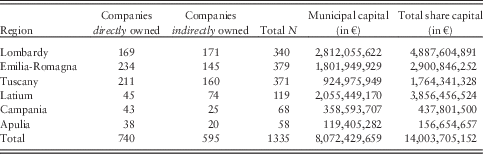
The importance of corporatisation is confirmed when we look more closely at municipal companies in the six regions in the dataset (Table 1): here we find 740 companies directly owned by municipalities and 595 companies indirectly owned by the same municipalities (i.e. owned at least partly by one or more of the previous 740 companies), whose share capital accounts for over 8 billion euros of municipalities’ money and more than 14 billion overall. In all, 41% are limited companies, 48% are joint-stock companies, and the rest are ‘consortia’ – that is, companies meant to provide goods and services only to the partners and not for the market. A large number of municipalities are involved in this system, with an average of 2.5 companies each, reaching an average of 9.5 companies for municipalities with more than 100,000 inhabitants (Citroni et al., Reference Citroni, Lippi and Profeti2012). This recourse to private-law companies totally or partially owned by municipalities is particularly high in Italy compared with other EU countries, paralleled only by Germany (Wollmann and Marcou, Reference Wollmann and Marcou2010).
The population of companies in the Citygov database – year: 2008

However, the large presence of municipal corporations and the dominance of market-oriented legal forms are not necessarily unequivocal indicators of the existence of a genuine private, market-oriented rationale behind the creation of private-law companies. Instead, several ‘signals’ seem to point in the opposite direction.
A first indicator that using such companies may respond to a wide range of specific local strategies, and not to a ‘given’ and consistent new paradigm for reform of administrative action, is the markedly uneven distribution of municipal corporations across the country, as our data show with reference to regions in the North (Lombardy and Emilia Romagna), Centre (Toscana and Latium), and South (Campania and Apulia) of Italy (Table 1): Southern municipalities, in fact, appear to make more limited use of such companies – and to contribute significantly smaller amounts of money – than do the Northern and Central municipalities. This is probably due to the persistence of the well-known cleavage between the political and administrative traditions of the Italy’s two macro-areas (see e.g.: Putnam, Reference Putnam1993; Fargion et al., Reference Fargion, Morlino and Profeti2006; Vassallo, Reference Vassallo2013).
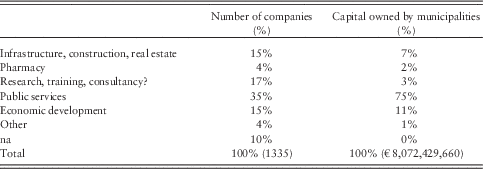
The strategic dimension of corporatisation is further confirmed by municipalities resorting to private-law companies for purposes well beyond those explicitly envisaged by the national legislative framework, that is, management and delivery of local utilities. In fact, corporations involved in the public services domain absorb 75% of the municipal share capital, but numerically they represent just 35% of the total, the remaining 65% being spread over many other sectors, such as research and training, economic development, infrastructures, housing, and so on (Table 2). It therefore seems that municipal political actors perceive corporatisation as a tool that is sufficiently flexible and convenient to govern most policy areas, and which if necessary can be adapted to local policy-making needs.
Fields of activity of municipal companies in the six regions (Citygov database, 2008)

Variations in local strategies of corporatisation, as well as indications on the ‘frail’ market dimension of many Italian municipal corporations, also emerge from descriptive statistics concerning municipal share capital (Table 3). Not only is the range between the minimum and maximum shares impressively wide, but the distribution is markedly asymmetrical and skewed towards lower values: in half of the cases (companies), in fact, municipal shares are less than €2665 (a little more than €33 for companies involved in public services) and the median value is much lower than the mean (both in general and in public services only), the latter being increased by a few but very large municipal shares contributed by the largest Italian cities.Footnote 5
Descriptive statistics on companies’ municipal shares (Citygov database, 2008)

Not surprisingly, the total amount of money that a municipality decides to contribute strongly co-varies with its size (r=0.94). What is more surprising, however, is that although the relation between ‘corporate attitude’ and municipal size remains positive and significant, it tends to weaken significantly if we consider the number of companies in which the municipality participates (r=0.18). These data, combined with those in Table 3, clearly show that a conspicuous number of Italian municipalities do not invest large sums of money in corporations, thus exhibiting a weak propensity for genuine market action; but, at the same time, they do not miss opportunities to play the ‘corporatisation game’, in a sort of ‘così fan tutti’ (thus do they all) fashion. This of course raises the difficult question of what the specific reasons may be.
The question becomes even more challenging if we consider that no less than 17% of the 740 companies directly owned by municipalities have been created by a single municipality, with no other partners involved in the share capital. Single-municipality companies are mainly used in the public services sector (22%), which may be partially explained by the existence of specific sub-sector regulations promoting the creation of private-law municipal companies (and pharmacies (33%), which represent a traditional field of municipal enterprise in Northern Italy) – but they are also important in sectors such as economic development (11%) and infrastructure (16%), two policy areas in which the municipality could have used an internal office for what it now does with a private-law company. This is an interesting figure which calls for closer attention and further qualitative research in order to determine the political reasons for this policy.
Municipal corporations are also used as a means to foster partnerships among public institutions, be they municipalities or other public partners such as Regions, Provinces, Chambers of Commerce, etc.: 32% of the 740 directly owned companies have several public partners, not private ones. This holds especially for local utilities, following a rationale related to the achievement of economies of scale and savings in management costs, and complying with specific requirements of inter-municipal cooperation set by the national regulations on specific services, such as water and waste management. Indeed, public–public partnerships are rather common also in other policy sectors (especially economic development, infrastructure, and research and training), with a significant proportion of companies (74%) resulting from inter-municipal cooperation either in its pure form or combined with the presence of other public partners. Indeed, as previous studies have demonstrated, corporatisation in itself is the main vehicle for inter-municipal cooperation in Italy. It is far more common and than institutional, formal arrangements (municipal associations, etc.) envisaged by national legislation on local government reform (Citroni et al., Reference Citroni, Lippi and Profeti2013).
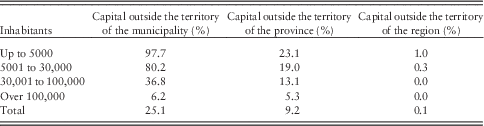
However, inter-governmental networks created through corporatisation are still largely local in nature. Although corporatisation may also serve as a new and flexible form of inter-municipal cooperation, only rarely do municipalities contribute money to, and buy shares in, companies located outside their provinces; and hardly ever do they own capital in companies that lie in regions different from their own. Table 4 shows that this is particularly the case of large municipalities, while at the other extreme the smaller ones find it very difficult to establish their own companies in their own territory. The most recurrent pattern of cooperation is thus a network with the largest municipality (usually the provincial capital) at the centre and neighbouring small and medium-sized municipalities gravitating around it, with predictable differences in their strategic attitudes towards corporatisation.
Share of capitals owned by municipalities in companies lying outside their terrirory (Citygov database, 2008)

Last, municipal corporations in Italy may also take the form of PPPs: over half of the companies in our database are PPPs, and although slightly under-represented in public services, they are widely employed in important fields such as research and training, economic development, and infrastructure. The opening of shareholdings to private actors is frequently justified by the need to enhance the efficiency of companies and to augment their capital. In other words, PPPs seem very attractive regardless of real financial benefit.
In sum, in light of these data we may say that corporatisation is primarily a strategy adopted by municipalities to ‘reinvent’ their policy-making style, to protect themselves against various ‘environmental’ challenges (scarcity of financial resources; increasing social demands; uncertain and contradictory national legislation on local autonomy, etc.), and to provide local administrators with room for manoeuvre (e.g., loosening controls exercised by the elected assemblies and the opposition parties) in their inter-institutional relations. In other words, Italian municipalities seem to have tailored the private-like instruments and rationales promoted by the paradigm of public administration to their needs, although case studies on specific companies operating in the local utilities sector (see e.g. Citroni et al., Reference Citroni, Giannelli and Lippi2008) suggest that the concrete outcomes of such a strategy are often far from those intended.
Municipal corporations as arenas of governance (and representation): public, private and ‘mixed’ shareholders
Private law companies have been extraordinary opportunities for local administrators to rearrange policy-making through corporatisation by stretching its functions well beyond its mission. As such, private-law companies have in practice become something other than pure and simple for-profit organizations or firms devoted to service delivery; they also become attractive places for bargaining and coalitions, recruiting élites among private and public milieus, and gaining consensus and support from key local stakeholders. Hence private-law companies can also be seen as arenas for governance and as additional (and far from procedurally democractic) places for representation.
In this section, we provide empirical evidence for this contention by analysing the composition of company boards. We identify emerging configurations that indicate whether and to what extent private-law companies are spaces for representation. A quantitative analysis of the composition of the Italian municipal companies’ share capital is the core of this section. The balance between the roles of public and private shareholders in assemblies is used to indicate representation. Tables 5–7 and Figure 1 present data on the ownership structures of the companies in the dataset.Footnote 6 All (11,000) shareholders have been classified as ‘public’ (municipalities, other public bodies, publicly owned companies, etc.), ‘private’ (private enterprises, banks, foundations, individuals, etc.), or ‘mixed’ (mixed, public–private companies or consortia).
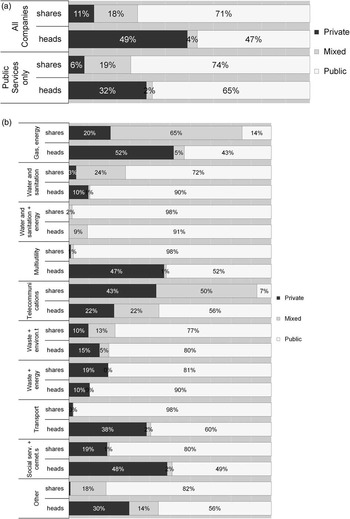
(a) Comparing shares and ‘heads’ in municipal corporations: % of shares and shareholders (Citygov database, 2008). (b) Comparing shares and ‘heads’ in municipal corporations (subsectors of public services): % of shares and shareholders (Citygov database, 2008).

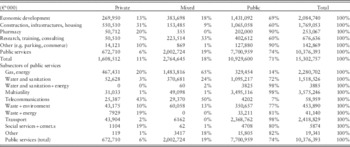
Private, mixed, and public capitals in municipal corporations: absolute values (1000 Euro) and % of shares (Citygov database, 2008)

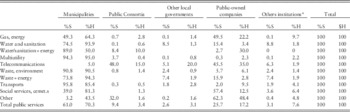
Public shareholders: % of shares (S) and heads (H) by sector of activity (Citygov database, 2008)

*Other institutions: municipal associations, chamber of commerce, public agencies, other types of local governments, mountain communities.
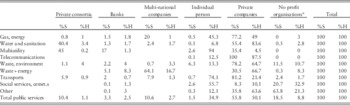
Private shareholders: % of shares (S) and heads (H) by sector of activity (Citygov database, 2008)

* No profit organisations: foundations, associations, clubs, committees, cooperatives, groups of interests.
Using this classification, we consider (a) the relative percentages of shares owned in municipal corporations by each category of shareholders, and (b) the relative percentages of ‘heads’, that is, of the number of shareholders falling in each category. While the ‘shares’ express the financial weight of the various shareholders, the ‘heads’ reflect their numerical representation within the companies’ shareholder assemblies. The distinction between these two dimensions is important because, although in joint-stock companies majority rules are based on shares and not on heads, a large numerical presence of private shareholders, even with minority shareholdings, may be of importance for the overall governance of companies (and for policy-making). This is for two main reasons: first, all shareholders participate in the appointment/election of the company’s board and its chairperson, second, participation in the shareholder assembly provides private actors opportunities to meet representatives of local governments, to bargain with them outside the conventional loci of representative democracy, and to consolidate their relationships with local institutions. The balance between public and private heads is thus important for understanding what kinds of decisional and representative arenas develop within companies, and the extent to which they differ from the ‘ordinary’ policy subsystems normally associated with the policy domains in which companies operate. For this reason, we shall complete our analysis of company shareholders by providing (c) a more specific description of who private and public partners are, and where they invest their money.
A matter of public money
Inspection of financial contributions to the companies’ share capital (Table 5) shows that municipal corporations are primarily a matter of public money: on average, about 71% of shares consist of public capital (10.9 billion euros), while private quotas amount to just 10.5% (1.6 billion euros), and quotas owned by ‘mixed’ entities to 18% (2.8 billion euros). The dominance of public shares is even higher in companies involved in the management and delivery of public services, where public capital amounts to 74% and private money to just 6.5%.
If we look at specific policy areas and different types of public service, we observe that the percentage of private capital is higher in some sectors, such as construction and infrastructure (31%) and, with regard to local utilities, telecommunications (43%) and gas and energy (20%) – that is, those public services most affected by European provisions to foster liberalization and free market competition. This does not imply, however, that municipalities and other public institutions are not interested in such domains: rather, they choose to invest in them indirectly, as demonstrated by the very high percentage of mixed shares (about 50% in telecommunication and 65% in gas and energy). By contrast, in water and sanitation services, waste management, and especially local transport and multi-utilities (both ‘pure’ multi-utilities and companies combining water or waste management with energy provision), the share capital is almost totally and directly controlled by public institutions, with a very residual weight of private funds (Table 5). These data show that municipalities have acted differently in different sectors. Water, waste management, and local transport are different from gas and energy provision: private investors appear to be more interested in the latter, while municipalities appear to want to maintain stronger direct control over the former.
The over-representation of private stakeholders
Analysis of public, private, and mixed shares is also interesting from another perspective: Figure 1a and 1b compare the percentages of shares owned by each category of owners (‘shares’) against the percentages of owners themselves (‘heads’). This comparison indirectly, but very effectively, describes the role of each category of actor and the average investment made by each of them.
Figure 1a shows that 49% of owners of all companies in the dataset are private subjects, but they only contribute 11% of the money. Public shareholders represent 47%, but they contribute 71% of the capital. Mixed companies count four times as much in money than they do in numbers: they are the ‘richest’, or somehow ‘most generous’, contributors.
The presence of private actors is particularly large not only in those sectors where their financial contribution is substantial, such as gas and energy (heads=51.7%) or social services (48.5%), but also in multi-utility companies (47%) and local transport (38.2%), where private shares amount to less than 2%. The only significant ‘anomaly’ is represented by telecommunication companies, where the percentage of private heads halves to 22.2% compared with the amount of private shares. But this exception does not invalidate the general tendency towards numerical representation of private actors greater than their financial weight. It should also be noted that, in some policy areas, the large amount of private heads is accompanied by a percentage of mixed heads which is particularly low if compared with the large amount of mixed shares. We may thus hypothesize, on the one hand, that mixed companies represent a sort of ‘safe’ for municipalities, since they enable them to diversify their shareholdings without increasing direct expenditure; and, on the other, that public–private corporations themselves are few but ‘rich’ players in some policy sectors (such as energy), so that they should be analysed as both actors in the corporatisation game and arenas for it.
Public and private shareholders
‘Public’, ‘private’, and ‘mixed’ capital are three broad labels that we use to distinguish among shareholders according to their ‘nature’. With reference to subsectors of local public services, Tables 6 and 7 show the different types of actors that make up such groups, and their financial and numerical importance within their respective categories.Footnote 7
Public shareholders
Since our analysis focuses on companies partly or totally owned by Italian municipalities, it is not surprising to find that municipalities are the leading actors among public shareholders for both financial contribution (70.3%) and numerical representation (61%), with peak values in multi-utilities, water and sanitation, waste management and local transport (see Table 6). Discrepancies between municipal heads and shares are largest in companies dealing with energy, water management, telecommunications, and social services, where municipalities are somewhat ‘over-represented’ compared with the limited amount of money that they directly put into the companies. As is clear from the last column of Table 6, municipalities invest in these sectors indirectly, through public-owned companies as well as through public consortia. Other categories of public actors, such as Regions, Universities, Provinces (other local governments), Mountain Communities and public agencies, do not participate significantly in public-service corporations (at least not with direct financing), nor do they find substantial numerical representation in them. Also public-law municipal enterprises, that is, the old municipal instruments for managing public services that have survived the wave of corporatisation, still represent 10% of public shareholders in water and sanitation services, notwithstanding their irrelevant financial contribution to that sector.
Private shareholders
As regards private shareholders (Table 5), private companies (joint-stock companies, LTD, etc.) form the majority in both financial and numerical terms: in fact, on average they account for 55.8% of private shares, with the highest percentages in telecommunications and transport, and they represent 50.1% of private shareholders sitting on the boards. The importance of local enterprises, at least in numerical terms, is also shown by the large presence of individuals (34.9% on average) forming the majority of private heads in several domains (multi-utilities, transports, and social services) in spite of their modest financial contributions. In companies delivering social services, a large amount of private capital comes from associations, cooperatives and foundations, while multi-national companies appear to be most interested in corporations that combine waste management with energy production and delivery. Private consortia, that is, groups of small-sized enterprises at the local level, concentrate their financial contributions in local companies delivering water and sanitation services and in multi-utility companies; and so do banks, which are often local and well entrenched in the community.
In light of this evidence, it may be argued that the presence of private shareholders in companies operating in specific sectors tends to overlap with the range of stakeholders normally involved in the governance of the corresponding policy areas. These become ‘parallel’ arenas in which public and private interests can interact away from prying eyes. In such arenas, consolidated networks of local public and private actors and traditional forms of interests intermediation are reshaped through new organizational arrangements (corporate governance mechanisms) and thanks to the frequent presence of new ‘market-oriented’ players, such as prominent mixed or private companies delivering public services (also at the national/transnational level). We may thus hypothesize that old and new forms of governance coexist in municipal corporations and generate new configurations in the domain of public services. However, aggregate data do not allow us to draw reliable inferences concerning the shapes that such configurations may take, and the resources that actors may spend to occupy central positions in the networks.
Who governs public services? Governance structure and members’ resources in six companies’ BoDs.
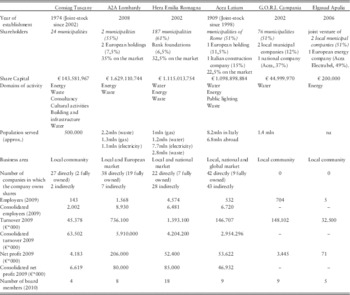
In order to shed light on the concrete forms taken by the governance of local utilities, and to analyse the variety of purposes pursued by Italian municipalities through participation in the corporatisation game, in this section we complete the picture sketched thus far by focusing on six particular municipal corporations. All six companies are involved in the management of local utilities, and they have been selected according to their importance in their respective regional contexts, so as to account for the variety of national experiences: six companies from six different regions, with different sizes and shareholding structures (see Table 8).
The six companies examined: basic data. Source: companies’ annual accounts and websites

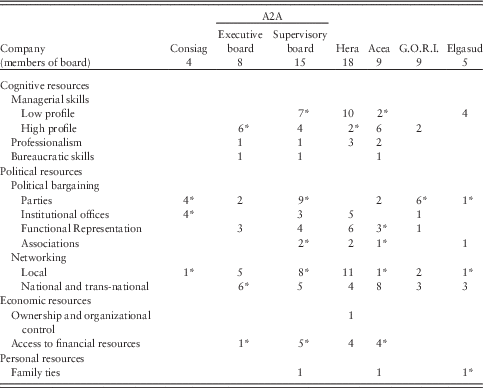
For the six companies, we examined the composition of their BODs (in office in the summer of 2011) and the biographies of their members, in order to identify their professional profiles and their resources. The latter were distinguished on the basis of a range of categories:
-
(1) Cognitive resources: (a) Managerial skills, that is, previous experience in the direction and management of various kinds of companies, which may be high or low according to the size and/or importance of such companies; (b) Professionalism, that is, specific jobs and expertise in professional fields such as law, economics, engineering, etc. (c) Bureaucratic skills, that is, competences relative to administrative procedures and bureaucratic matters. Cognitive resources, and in particular managerial skills, are hypothesized to provide the company with the know-how and expertise needed to succeed in service delivery and in their market activities. They are normally considered the ‘essence’ of a private-law company’s management.
-
(2) Political resources: (a) Political bargaining, that is, the consolidated ability to negotiate with public and private stakeholders. People who hold institutional offices, members of political parties, and prominent members of the various interest organizations and civil associations are usually supposed to possess such skills. (b) Networking, that is, the capacity of a person with multiple affiliations to connect different domains, to connect the company with other companies, and to facilitate exchanges of resources with other organizations. Political resources as a whole help companies maintain close ties with their market sector, the community, and the (local) political system.
-
(3) Economic resources: (a) ownership and organizational control, that is, the partial ownership or total control of one or more companies (e.g. private companies and individual owners). (b) Access to financial resources, that is, affiliation with banks or other credit organizations. The presence on the BoDs of members with resources of this kind may help the company gain direct access to financial resources and the credit system.
-
(4) Personal resources, that is, Family ties and kinship with local politicians or other prominent actors within the company’s environment. Obviously, the usefulness of this kind of resource for the company’s market activities is less immediate.
The analysis of the specific mixes of resources possessed by the BoD’s members can reveal which skills are privileged within the company and thus disclose the dominant rationale behind the company's activities. It may also help detect the existence of specific patterns of representation within municipal corporations. Table 9 shows the variety of resources possessed by the board members of the six companies examined. For each company, we ‘counted’ how many people had a specific resource on the basis of their biographies and CVs. Of course, individual members may have had more than one type of resource, which is why the ‘sum’ of resources is always much higher than the number of board members.
Resources of members of companies’ boards. Source: companies’ annual accounts and websites

* Resource owned by the President.
The overall picture, although limited to a small number of cases, suggests that three different kinds of arenas may develop within company boards, and in turn may express the different purposes for which private-law companies are created and used. These three arenas are a genuinely partisan one, an eminently local/territorial one, and a hybrid arena in which business and politics co-exist.
The partisan arena
In this case, the company’s board is made up of people from party organisations and/or local institutions, such as local party leaders, former mayors or councillors, etc. Consiag’s board exemplifies this kind of arena: all four members of the board belong to the same centre-left party (the Democratic Party, which governs all the municipalities that own the company), and they have previously held institutional offices in those municipalities. The board thus serves as a sort of ‘clearing house’ to compensate those leaving (deliberately or otherwise) their political careers, Furthermore, the board resembles an ‘inner circle’ dominated by the majority party and in which local politicians can negotiate strategies and decisions in the absence of control by other stakeholders and the political opposition, making use of private-like instruments to create and reproduce political consensus. GORI’s board may also be considered a partisan arena, although there are some differences with respect to Consiag. In this case, in fact, representation within the board is allotted among all the parties governing the municipalities that own the company, and party affiliation is combined with political resources of other kinds, such as networking with other companies (due to the presence of Acea among the company’s shareholders) and functional representation. A similar mix of party affiliation, networking, and functional representation also characterizes Hera’s board, on which local organisations play a particularly strong role.
The local/territorial arena
Hera’s board is also a good example of territorial representation. In fact, the company is owned by 187 municipalities located in the six provinces of Bologna, Modena, Ferrara, Forlì Cesena, Ravenna and Rimini, and its board is overly large (18 members!) to assure representation to all those provinces. The board’s members, except for the chairman (who is a top manager with substantial experience in prominent national and international companies operating in the utilities sector), have been politicians within local government, or have managerial experience within former municipal undertakings (transferred into Hera), or have worked in the local credit system. The composition thus reveals a complex mix of territorial cleavages and multiple affiliations, which provide the company with important links to the socio-economic environment, and at the same time guarantee representation to a wide array of local stakeholders.
The hybrid arena
Political resources are also important in the boards of companies such as Acea, A2a, and – to a lesser extent – Elgasud (indirectly controlled by Acea and Electrabel Ltd, a multi-national company operating in the energy sector), whose members possess relevant managerial skills. In these cases, the boards are composed of people with hybrid profiles combining long-standing and significant managerial experience in prominent national and international companies (often related to the public services sector) with other resources – professional, economic and political – enabling them (and the companies) to maintain useful linkages with both the local community and other companies operating in the same markets. These distinctive, hybrid configurations of the boards may provide the companies with opportunities to act on two different levels: they can attend to efficiency while keeping an eye on relationships with the local system of governance and politics.
In a diversified socio-economic and political context like Italy’s, differences among the three types of arenas intersect with the peculiar patterns of political and functional representation, which distinguish the six regions. For instance, in the South the criteria used to select board members seem to be personal and somewhat collusive (as shown in Table 9, e.g. the President of the Elgasud board is the brother-in-law of the mayor of Trani). There also seems to be a political parcelling rationale (e.g. all the political parties, from the centre-left to the extreme right, are represented on GORI’s board). By contrast, in the two regions of the so-called ‘red zone’ of the country (Tuscany and Emilia Romagna, where almost all the municipalities have been governed continuously by the centre-left, closer attention is paid to the inclusion of local stakeholders and to strengthening companies’ links with the local political systems. In Lombardy and Latium, instead, the presence of two large and strong municipalities like Milan and Rome among the shareholders makes the two companies A2a and Acea more prone to act as market players, albeit with different strategies. Probably due to proximity to the core of national politics, and to the presence of several members belonging to the Roman social and intellectual elite loyal to the various party leaders (and MPs), the mission of Acea’s board is more to gain political control over the national water and electricity markets, while the Milanese A2a’s mission is doubt wider and more oriented to the international market.
Two observations may be made to conclude this section – albeit with some caution given the small size of our sample. First, the profiles of board members are far from being purely managerial, even in companies such as Acea and A2A, which are prominent economic players in the national utilities market. Political resources are crucial in managing all companies, confirming the hypothesis that municipally-owned corporations are something other, or rather, something more, than sheer policy instruments to increase profits or to improve the efficiency and effectiveness of service delivery. Second, none of the six companies guarantees representation to all potential stakeholders in the local utilities domain, whether in the shareholder assemblies or on the BoDs, whether directly or indirectly. On the contrary, the BoDs consist of managers, representatives of the industry, and credit systems, party affiliates and political/administrative careerists, albeit with different degrees of importance and territorial influence. The networks behind the corporate management and provision of local utilities are thus highly exclusive, and may appear more ‘elitist’ than the ‘traditional’ democratic games based on interaction between local elected administrators and stakeholders. In corporate arenas like those examined in this article, in fact, trade unions as well as civil associations representing citizens/users (and often the opposition parties) are de facto excluded from any meaningful involvement in decision making, and in the implementation of services. Nor do they have the concrete possibility to control the policy process or to ‘sanction’ the decision makers. This of course raises fundamental questions as to the implications that such governance settings may have for both the vertical and horizontal dimensions of democratic accountability (Morlino, Reference Morlino1998). Consequently further analysis based on case-studies and different methodological instruments, such as in depth interviews and surveys of the actors involved in (and excluded from) the local corporate utilities system, is necessary.
Concluding remarks
The starting hypothesis of this article was that corporatisation is not only a business-like managerial policy tool; it also provides potential space for political representation. We accordingly argued that corporate boards can also be places for local representation and that, in the case of Italy, the private-law companies partially or totally owned by municipalities are attractive forums in which politicians, entrepreneurs and interest groups can arrange policies. Hence, the fashionable NPM framework inducing corporatisation in managerialist terms (market competition and flexibility instead of the 'command and control' chain) has given rise to political arenas where local power is reshaped under the guise of a managerialist strategy (Pollitt et al., Reference Pollitt, Van Thiel and Homburg2007). In light of the evidence, these 'new' corporations may be subsequently considered easy, prompt and autonomous arenas of representation, which have developed alongside the institutional procedures and assemblies of representative democracy (see ‘Beyond management instruments: municipal enterprises as opportunities for political “reinvention” in Italy’ section). In Italy, corporatisation has been described as a phenomenon widespread in the country, although it is characterized by heterodox implementation (e.g. municipalities as single owners of a joint stock company, multiple levels of indirect ownership, application in a variety of policy sectors other than public utilities). This feature reveals a widespread interest in private-law companies by municipalities, even if with a meaning distant from the stricter NPM interpretation. The evidence shows that corporations have been interpreted as multifaceted tools with which to reinvent policy-making and to protect local policies against environmental challenges.
As such, corporatisation has been stretched well beyond its original conception as a business-oriented managerial instrument. It has become a flexible way to achieve various different goals, including political representation. The variety of structures and strategies used have induced us to analyse how public stakeholders, like mayors, regard private-law companies as potential representative arenas into which they may ‘invite’ all those attractive because of their resources for policy-making (not necessarily directly concerning the policy issue of that company): money, expertise, networking, party membership. Accordingly, the board of the company may become an additional political space for coalitions and an unobtrusive place for bargaining. This fact gives private stakeholders a chance to be represented in a political arena external to democratic procedures and with very low cost in terms of the money to be invested (see ‘Beyond management instruments: municipal enterprises as opportunities for political “reinvention” in Italy’).
Indeed, the presence of private shareholders in companies operating in specific sectors tends to overlap with the range of stakeholders normally involved in the governance of the corresponding policy areas, thereby producing ‘parallel’ arenas in which public and private interests can interact. In such arenas, consolidated networks of local public and private actors and traditional forms of interest intermediation are reshaped through new organizational arrangements (corporate governance mechanisms) and thanks to the frequent presence of new ‘market-oriented’ players, such as prominent mixed or private companies operating in the delivery of public services. As such, municipalities are networked through private companies instituted by public organizations using public money to recruit private stakeholders in public policy.
Secondly, all these arenas are not immediately accessible from outside. Rather, they are largely closed and exclusive. Indeed, the companies' boards have become inviting spaces for an emergent and innovative élite made up of managers, party affiliates, and politico-administrative careerists, who are able to access the board by virtue of their cognitive, political, networking, economic, and personal resources (see ‘Who governs public services? Governance structure and members’ resources in six companies’ BoDs’ section). In so doing, they shape specific networks behind corporate management and the provision of local utilities, and are therefore more exclusive than the usual élites selected through procedural democratic games. This last evidence shows how corporatisation links businesspersons, professionals, and politicians able to share power on representative boards in which selected interests can be negotiated. Thus, corporatisation is a representative phenomenon also because these elites vary widely according to the territorial and political context and reproduce territorial, cultural and power cleavages: they are closed networks of co-interested stakeholders. Access to these arenas is denied to all the political or social actors that do not possess the necessary resources: citizens' civil associations, trade unions, and all the potential stakeholders not deemed attractive by mayors and the current members of the boards. Moreover, the private-law companies are only loosely coupled to their owners. Municipalities are not always able to monitor the performance of the companies, and information asymmetries may be important – especially if we consider that municipal companies often are important investors in other companies [see ‘Beyond management instruments: municipal enterprises as opportunities for political “reinvention” in Italy’ and ‘Municipal corporations as arenas of governance (and representation): public, private and “mixed” shareholders’ sections]. The only instrument with which the elected members of the municipal council can control the companies is a yearly report on their activities, with no effective access to key information on management, capital, strategies, or investments. For this reason, the private-law companies are relatively free in their strategic planning and formally unaccountable in the public realm of local democracy.
As a consequence, the company boards may be re-shaped in a local context at the same time as innovative and multiform policy making milieu as well as un-transparent and effective milieu to arrange politics. Unfortunately, these innovative arenas are powerful but exclusive. They are potentially able to make decisions and to be effective, but this happens without any direct democratic control, and far from any participation by actors without the above-mentioned resources. No representation of all potential stakeholders in the relevant domains is guaranteed: either in the shareholder assemblies or on the BODs, either directly or indirectly.
Finally, corporatisation may become an additional space for political representation, but, as observed in Italian case studies, it varies widely depending on the territorial and political context, and it reproduces territorial, cultural, and power cleavages. As shown in section ‘Who governs public services? Governance structure and members’ resources in six companies’ BoDs’, this emerging variety of Italian municipal capitalism indirectly generates different practices of companies as representative arenas ranging from a party system affiliation (partisan arena) to territorial representation in a local perspective (local arena), and also including the ‘perfect mix’ of national and local, businessmen, and politicians (hybrid arena).
Acknowledgments
The research underlying this article was carried out within the CityGov research project at the Social and Political Sciences Department of the University of Florence (Italy), and was made possible by funding by European Social Fund (ESF) through POR Regione Toscana in partnership with ANCI Toscana and Antos s.r.l. The authors would like to thank Bernard Barraqué, Carsten Herzberg, Patrick Le Galès and Yves Sintomer who hosted and animated proficuous discussions on previous versions of this article, as well as the anonymous reviewers who contributed to its improvement.