





Introduction
Representative democracy is no longer the only game in town; citizens are increasingly invited to participate in political decision-making via referenda and citizens’ assemblies (Hollander Reference Hollander2019; Paulis et al. Reference Paulis, Pilet, Panel, Vittori and Close2021), and non-elected experts, also referred to as ‘technocrats’, are increasingly appointed as ministers (Vittori et al. Reference Vittori, Pilet, Rojon and Paulis2023). Participatory democracy and technocracy are often presented as solutions to the ‘crisis of representation’ in established democracies, characterised by widespread distrust in national parliaments, political parties, and politicians (Armingeon and Guthmann Reference Armingeon and Guthmann2014; Catterberg and Moreno Reference Catterberg and Moreno2006; Mair Reference Mair2013).
Considering these developments, a growing body of research has studied citizens’ preferences for who should govern, also referred to as ‘process preferences’ (Hibbing and Theiss-Morse Reference Hibbing and Theiss-Morse2002). Some studies demonstrate widespread support for political decision-making by ordinary citizens (Bowler et al. Reference Bowler, Donovan and Karp2007; Dalton et al. Reference Dalton, Bürklin and Drummond2001; Gherghina and Geissel Reference Gherghina and Geissel2018, Reference Gherghina and Geissel2020; Rojon and Rijken Reference Rojon and Rijken2021), while others show strong support for governance by independent experts rather than politicians (Bertsou and Caramani Reference Bertsou and Caramani2020; Chiru and Enyedi Reference Chiru and Enyedi2022; Lavezzolo et al. Reference Lavezzolo, Ramiro and Fernández-Vázquez2022; Rapeli Reference Rapeli2016). These preferences are consequential because they shape citizens’ perceived legitimacy of the political system, compliance with policy outcomes, and democratic participation (Bengtsson and Christensen Reference Bengtsson and Christensen2016; Esaiasson et al. Reference Esaiasson, Gilljam and Persson2012; Gherghina and Geissel Reference Gherghina and Geissel2017). However, previous research on citizens’ process preferences is limited in several respects. First, most studies have measured support for ‘ideal-type’ models of government, centred on whether politicians, citizens, or experts should be the primary actors, rather than investigating support for combinations of actors. This approach overlooks the possibility that some citizens hold ‘mixed preferences’ for multiple actors, which better reflects the reality of policymaking in contemporary democracies, where citizens and experts are integrated as complements rather than as alternatives to decision-making by politicians (Fischer Reference Fischer2000; Lutz Reference Lutz2006; Setälä Reference Setälä2017). Second, from a methodological standpoint, previous research has typically compared citizens’ scores on separate additive scales representing support for different ideal-type models of government, instead of using a typological approach that distinguishes those who exclusively prefer one model from those who prefer a combination (König et al. Reference König, Siewert and Ackermann2022). Finally, although the literature covers a growing number of countries, most studies have not compared results across several countries while ensuring measurement equivalence, which undermines both the comparability and generalisability of their findings.
More broadly, the existing literature paints an inconsistent picture of citizens’ preferences for who should govern. Some studies portray publics as primarily supportive of participatory reforms, others emphasise demand for experts, while still others find continued attachment to representative actors. We argue that this apparent inconsistency may stem less from erratic public opinion than from the way process preferences have usually been studied: by isolating one actor at a time, by treating models of government as mutually exclusive ideal types, and by relying on country-specific studies with varying survey measures. If many citizens in fact hold mixed preferences for combinations of politicians, citizens, and experts, then seemingly contradictory findings may reflect different partial views of the same multidimensional attitudinal space rather than fundamentally incompatible conclusions.
To address these limitations, we conducted a comparative study of citizens’ preferences for who should govern in nine European countries. In each country, samples of approximately 1,500 respondents rated a 21-item battery on different political actors developed by Hibbing and colleagues (Reference Hibbing, Theiss-Morse, Hibbing and Fortunato2023). Using this dataset, we conducted a multi-group latent profile analysis (LPA), which identifies mutually exclusive preference types based on empirically grounded patterns of response. A distinct advantage of the multi-group LPA is that it ensures the comparability of preference types across countries while still allowing for preferences that may be specific to certain contexts (Goodman Reference Goodman, Hagenaars and McCutcheon2002; Kankaraš et al. Reference Kankaraš, Moors, Vermunt, Davidov, Schmidt, Billiet and Meuleman2018). We also compared the socio-demographic and attitudinal profiles of respondents assigned to each type.
Our LPA identified six profiles with interpretable preferences for who should govern, which exist across all nine countries but differ in prevalence. Only 4% of respondents support an ideal-type model, namely, the representative democrats, while the vast majority favour a combination of actors. About 30% express confidence in politicians, but most of these would also like greater involvement of either citizens (responsive democrats) or experts (responsible democrats). While some respondents are identified as participatory democrats, being the most favourable toward giving citizens more influence, they do not hold ideal-type preferences, as they also support the involvement of experts. Finally, three preference types lack strong theoretical or empirical grounding and merit further attention: moderates, stealth populists, and responsible democrats. Moderates, the most common type, are fairly negative toward politicians and mildly positive toward most alternatives without clearly prioritising any of them. Stealth populists support shifting power to both citizens and experts but oppose active citizen involvement in decision-making, suggesting a preference for an efficient system that citizens can control when necessary. Responsible democrats, by contrast, combine support for politicians and experts with a more elitist stance, favouring minimal involvement from ordinary citizens.
Models of government underpinning citizens’ process preferences
Research on citizens’ conceptions of democracy has expanded considerably over the last three decades. While some scholars study broader democratic values, others focus on citizens’ preferences for who should govern, often referred to as ‘process preferences’ (Hibbing and Theiss-Morse Reference Hibbing and Theiss-Morse2002). A major shortcoming of this literature is that it often measures support for ideal-type models centred on a single actor: elected representatives (i.e., representative democracy), ordinary citizens (i.e., participatory democracy), or independent experts (i.e., technocracy). Some studies only investigate support for one ideal type (Bertsou and Pastorella Reference Bertsou and Pastorella2016; Bowler et al. Reference Bowler, Donovan and Karp2007; Chiru and Enyedi Reference Chiru and Enyedi2022; Dalton et al. Reference Dalton, Bürklin and Drummond2001; Donovan and Karp Reference Donovan and Karp2006; Pilet et al. Reference Pilet, Bol, Vittori and Paulis2023; Rapeli Reference Rapeli2016; Rojon and Rijken Reference Rojon and Rijken2021), some compare support for different ideal types (Bengtsson and Mattila Reference Bengtsson and Mattila2009; Coffé and Michels Reference Coffé and Michels2014; Font et al. Reference Font, Wojcieszak and Navarro2015; Gherghina and Geissel Reference Gherghina and Geissel2020; Pilet et al. Reference Pilet, Vittori, Rojon and Paulis2024b), and others induce trade-offs between ideal types (Beiser-McGrath et al. Reference Beiser-McGrath, Huber, Bernauer and Koubi2022; Bertsou Reference Bertsou2022; Esaiasson et al. Reference Esaiasson, Gilljam and Persson2012; Gherghina and Geissel Reference Gherghina and Geissel2018; Van Severen et al. Reference Van Severen, Roets, Van Muylem, Alain Van Hiel and Wauters2024). The overwhelming measurement of process preferences through ideal types creates the impression that citizens only support being governed by one political actor, when they might instead support a combination of political actors, which we refer to as ‘mixed process preferences’. It is also at odds with the realities of contemporary democracies, wherein elected politicians often involve other actors in shaping policies (Fischer Reference Fischer2000). In this section, we build on previous research to develop expectations about profiles of citizens with ideal-type and mixed process preferences.
Ideal-type process preferences
Research on citizens’ process preferences has primarily focused on investigating support for representative democracy, participatory or direct democracy, and technocracy. The representative model, wherein political decisions are primarily taken by politicians elected to parliament, has been the most common form of government in established democracies. It builds on the idea that governing requires time, knowledge, and expertise that cannot reasonably be expected of ordinary citizens (Schumpeter Reference Schumpeter1943) and on the view that elected representatives are better positioned to pursue long-term goals that serve both present and future generations (Bengtsson and Wass Reference Bengtsson and Wass2010).
While trust in representative actors is declining across established democracies (Armingeon and Guthmann Reference Armingeon and Guthmann2014), recent studies suggest that some citizens still believe that politicians should remain the key actors in government. For example, Bowler’s (Reference Bowler2017) analysis of the 2012 European Social Survey shows that about 18% of respondents prefer a trustee style of leadership, where politicians act on what they believe is best for the electorate. These findings are corroborated by Gherghina and Geissel (Reference Gherghina and Geissel2018), who show that roughly a quarter of German citizens prefer politicians as decision-makers. We therefore expect that some citizens are ‘representative democrats’ who support an ideal-type model of government, attributing much greater importance to the role of elected representatives relative to other actors.
The participatory model, wherein ordinary citizens are given more opportunities to participate in shaping political decisions beyond elections, is the most frequently studied alternative to the representative model (Cain et al. Reference Cain, Dalton and Scarrow2006). According to the Cognitive Mobilisation Theory, the demand for more say in political decision-making is connected to increasing levels of political competence among contemporary publics, while the Political Disaffection Theory claims that it is connected to declining levels of confidence in representative actors and institutions (Dalton et al. Reference Dalton, Bürklin and Drummond2001). However, more recent studies suggest that participatory democracy is appealing to citizens who are both ‘engaged’ in and ‘enraged’ at politics (Bedock and Pilet Reference Bedock and Pilet2020; Rojon and Pilet Reference Rojon and Pilet2021).
Support for a participatory model of government is commonly measured with survey items on letting ordinary citizens take political decisions, for example through referenda or deliberative mini-publics. Studies conducted in several Western European democracies demonstrated that more than two-thirds of citizens are favourable towards the use of referenda for deciding on important political questions (Bengtsson and Mattila Reference Bengtsson and Mattila2009; Bowler et al. Reference Bowler, Donovan and Karp2007; Coffé and Michels Reference Coffé and Michels2014; Dalton et al. Reference Dalton, Bürklin and Drummond2001; Donovan and Karp Reference Donovan and Karp2006; Fernández-Martínez and Font Fábregas Reference Fernández-Martínez and Font Fábregas2018; Font et al. Reference Font, Wojcieszak and Navarro2015; Leininger Reference Leininger2015; Rojon and Rijken Reference Rojon and Rijken2021; Webb Reference Webb2013). In most of these studies, the idea of letting citizens decide is presented as an alternative to decision-making by elected representatives. We therefore expect that some citizens are ‘participatory democrats’ who support an ideal-type model of government attributing greater importance to ordinary citizens than to other actors.
The other frequently studied alternative to the representative model is technocracy, or government run by non-elected experts. In their study on Stealth Democracy, Hibbing and Theiss-Morse (Reference Hibbing and Theiss-Morse2002) argued that most Americans are not interested in playing a more active role in politics but would rather leave the decisions to independent experts and successful businesspeople. Independent experts are perceived as impartial and objective decision-makers relative to elected representatives who are more easily influenced by special interests. Support for experts is also rooted in frustration with persistent ideological struggles that are amplified by the processes of deliberation and compromise intrinsic to representative democracy (Caramani Reference Caramani2017).
Studies conducted in several European countries demonstrated widespread support for increasing the role of independent experts in government, which is a key element of what some scholars have referred to as ‘technocratic attitudes’ (Bengtsson and Mattila Reference Bengtsson and Mattila2009; Bertsou and Caramani Reference Bertsou and Caramani2020; Bertsou and Pastorella Reference Bertsou and Pastorella2016; Chiru and Enyedi Reference Chiru and Enyedi2022; Fernández-Vázquez et al. Reference Fernández-Vázquez, Lavezzolo and Ramiro2022; Lavezzolo et al. Reference Lavezzolo, Ramiro and Fernández-Vázquez2022; Rapeli Reference Rapeli2016; Rojon et al. Reference Rojon, Pilet, Vittori, Panel and Paulis2023). Citizens with technocratic attitudes are dissatisfied with representative actors and institutions and think that decisions should be taken by persons with superior skills and qualifications as opposed to ordinary citizens (Bertsou and Caramani Reference Bertsou and Caramani2020). We therefore expect that some citizens are ‘technocrats’ who support an ideal-type model of government, attributing much greater importance to the role of independent experts relative to other actors.
Taken together, these strands of research often appear to produce inconsistent findings. However, this may partly stem from the fact that many studies examine support for one governing actor at a time. While some citizens may indeed favour one actor over others, many do not treat these options as mutually exclusive. Citizens who favour greater involvement of ordinary people do not necessarily reject politicians, and those who support experts do not necessarily oppose democratic control. A combinatorial perspective therefore helps reinterpret previous findings as reflecting different combinations of preferences rather than competing models.
Mixed-preference types
Very few studies have investigated how citizens combine preferences for different political actors or have sought to distinguish between those with ideal-type preferences and those with mixed process preferences. Previous research from Belgium (Pilet et al. Reference Pilet, Talukder, Sanhueza and Rangoni2020) and the UK (Haesevoets et al. Reference Haesevoets, Verschuere and Roets2025) found that only between 10 and 30% of respondents are favourable toward only one actor, suggesting that most people hold mixed preferences. We therefore turn to the literature on different conceptions of government to develop expectations about how citizens combine preferences for politicians, citizens, and experts.
Many scholars have argued that participatory instruments such as referenda and deliberative mini-publics can address the shortcomings of representative democracy (Lutz Reference Lutz2006; Setälä Reference Setälä2017), particularly when they play an advisory role (Bedock and Pilet Reference Bedock and Pilet2020; Goldberg Reference Goldberg2021; Rojon et al. Reference Rojon, Rijken and Klandermans2020). Therefore, some people may see these instruments not as alternatives to representative democracy, but as tools to make elected officials more responsive to citizens (Bowler et al. Reference Bowler, Donovan and Karp2007) and thus favour a blend of representative and participatory democracy (Gherghina and Geissel Reference Gherghina and Geissel2017; Goldberg et al. Reference Goldberg, Lindell and Baechtiger2024; Schwaiger and Bächtiger Reference Schwaiger and Baechtiger2025). As argued by Hibbing and colleagues, ‘what [citizens] want is “attentive democracy,” an arrangement in which elites still make formal policy decisions but do so only after they have been in sustained, intimate contact with everyday people […]’ (Reference Hibbing, Theiss-Morse, Hibbing and Fortunato2023: 4). We therefore expect that some citizens are ‘responsive democrats’ expressing greater levels of support for being governed by both elected representatives and ordinary citizens relative to other actors.
Some scholars argue that technocracy complements rather than replaces representative democracy. Politicians are often experts themselves, and parties recruit ‘expert’ candidates (Vittori et al. Reference Vittori, Rojon, Pilet and Paulis2024). Research from several European countries demonstrated that citizens support expert involvement in policymaking but do not necessarily prefer when the decisions are taken by experts as opposed to politicians (Bertsou Reference Bertsou2022). The growing overlap between technocracy and representative democracy raises questions about the citizen’s role. Mair (Reference Mair2013) noted a shift from responsive government (accountability to voters) to responsible government (accountability to elites), with public engagement increasingly sidelined. Yet few studies explore whether citizens might prefer elite rule – political or technocratic – over citizen participation. One exception is Pilet and colleagues’ (Reference Pilet, Talukder, Sanhueza and Rangoni2020) study from Belgium, which identified a group of delegative democrats who are positive towards both politicians and experts but negative towards citizens. Drawing from Peter Mair’s distinction between responsive and responsible government, we therefore expect that some citizens are ‘responsible democrats’ expressing greater levels of support for being governed by both elected representatives and independent experts relative to other actors.
Finally, some scholars suggested an overlap between citizen- and expert-orientated conceptions of government by demonstrating that individuals scoring high on items emphasising a greater role for independent experts and businessmen also score high on support for referenda (Bengtsson and Mattila Reference Bengtsson and Mattila2009; Coffé and Michels Reference Coffé and Michels2014; Stoker and Hay Reference Stoker and Hay2017; Webb Reference Webb2013). An underlying tenet of Hibbing and Theiss-Morse’s stealth democracy is that although citizens do not want to be more involved in politics, they still want to be able to control government when necessary. In this regard, Stoker and Hay (Reference Stoker and Hay2017) link stealth democracy to populism, coining the ‘stealth populism’ concept to describe demands for a system that is efficient yet aligned with the general will. Similarly, other scholars noted an overlap between technocratic and populist attitudes, arguing that some citizens are techno-populists who desire government ‘of the people’ but ‘by the best’ (Fernández-Vázquez et al. Reference Fernández-Vázquez, Lavezzolo and Ramiro2022). Although technocracy and populism focus on different actors (the former on experts and the latter on the people), both are critical of representative actors and institutions. We therefore expect that some citizens are ‘stealth populists’ expressing greater levels of support for being governed by both ordinary citizens and independent experts relative to elected representatives.
In conclusion, we expect to identify at least six different process preferences. Three of these are ideal-type preferences centred around the role of only one actor, namely, representative democracy (politicians), participatory democracy (citizens), and technocracy (experts). The other three are mixed process preferences combining support for different actors, namely, responsive democracy (politicians + citizens), responsible democracy (politicians + experts), and stealth populism (experts + citizens).
Data and method
Sample
Most research on citizens’ process preferences is based on single-country studies which, together with the heterogeneity of survey items across studies, limits the potential for assessing whether similar preference types exist across borders or whether some preference types are country-specific (König et al. Reference König, Siewert and Ackermann2022). We therefore conducted a comparative study in nine European countries, including Austria, Belgium, Bulgaria, Czechia, Denmark, Finland, Greece, Ireland, and the Netherlands, using the same battery of items. Our country selection was guided by two considerations. First, we picked countries with varying levels of experience with participatory and technocratic decision-making arrangements. For example, referendums, citizens’ assemblies, and consensus conferences have influenced political decision-making to a greater extent in Ireland and Denmark (Dryzek and Tucker Reference Dryzek and Tucker2008; Farrell et al. Reference Farrell, Suiter and Harris2019), while technocratic ministers are more frequently appointed to government in Austria, Bulgaria, Czechia, and Greece (Vittori et al. Reference Vittori, Pilet, Rojon and Paulis2023). Citizens’ knowledge of and experience with alternative decision-making arrangements may influence their preferences for who should govern and how. For example, a multi-country study of European democracies demonstrated that citizens living in countries where technocrats were more frequently appointed to government expressed higher levels of support for being governed by experts (Semenova et al. Reference Semenova, Dowding, Kaiser and Di Biagio2025). Second, we sought to cover all parts of Europe: western, southern, northern, central, and eastern, as previous research has also pointed to regional differences in the practice of alternative decision-making arrangements. For example, Vittori and colleagues (Reference Vittori, Pilet, Rojon and Paulis2023) demonstrated that non-partisan experts play a greater role in the politics of Southern and Eastern European countries compared to in Northern and Western European countries.
The data were collected during winter 2021 – 2022 through a computer-assisted web interviewing survey administered to samples of approximately 1,500 respondents per country. The respondents were recruited from internet panels managed by Qualtrics and its survey partners. Through quota sampling procedures, Qualtrics provided country samples that are relatively well matched to the general population on age, gender, education, and region of residence (i.e., NUTS Level 1), with the exception that lower-educated respondents are slightly under-represented in some countries (see online Appendix I). Nonetheless, each country sample was weighted to ensure that the results were representative of the general population on the socio-demographic characteristics.
Variable measures
To measure citizens’ process preferences, we presented respondents with a 21-item battery composed of statements on the political role of multiple actors, which they rated on a 5-point scale ranging from ‘strongly disagree’ to ‘strongly agree’. The battery was originally developed by Hibbing and colleagues (Reference Hibbing, Theiss-Morse, Hibbing and Fortunato2023) to capture seven dimensions of citizens’ process preferences (see Table 1). This battery was selected, first, because it is the most comprehensive battery from the literature on citizens’ process preferences, and second, because previous research has shown that the items form similar dimensions across multiple European countries and are therefore suitable for cross-national comparison (Pilet et al. Reference Pilet, Vittori, Rojon and Paulis2024b).
Measurement of 21 survey items on how government should run

Table 1. Long description
A table with two columns and seven rows. The first column is labeled Dimension and the second column is labeled Statement. The table lists statements about the political roles and preferences of politicians, citizens, experts, non-political elites, political outsiders, and the importance of deliberation and compromise. Each row provides specific statements related to these dimensions.
Table 2 provides an overview of how each of the six profiles is expected to score on the different dimensions of the battery. Starting with the ideal-type preferences, representative democrats should express agreement with the statements on politicians’ capabilities, which were reverse-coded to match the positive orientation of all other statements. By contrast, they should express lower agreement with all other statements representing alternatives to politics as usual, except maybe those emphasising the need for elected officials to compromise and deliberate more – values that are central to representative democracy. Participatory democrats should agree with statements emphasising citizens’ capabilities and power to the people. They may also support increasing the influence of political outsiders ‘who have experienced real-world problems’, as such actors are seen as closer to ordinary citizens. Technocrats should express agreement with the statements on power to experts. However, they might also agree with the statements on increasing the power of people ‘who can’t benefit themselves’ or ‘with no previous governmental experience’, as technocracy emphasises the impartiality and independence of experts.
Expected scores of the six preference types
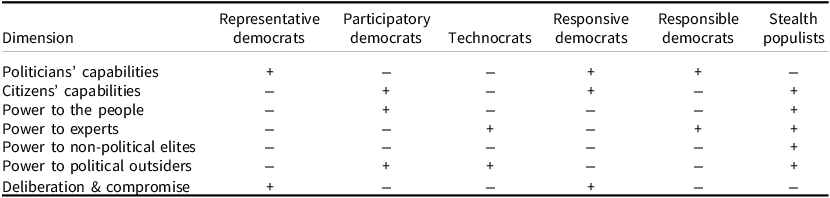
Table 2. Long description
A table with six columns and seven rows. The columns are labeled Representative democrats, Participatory democrats, Technocrats, Responsive democrats, Responsible democrats, and Stealth populists. The rows are labeled Politicians’ capabilities, Citizens’ capabilities, Power to the people, Power to experts, Power to non-political elites, Power to political outsiders, and Deliberation & compromise. Each cell contains a plus or minus sign indicating agreement or disagreement with statements related to the respective dimension. Notable trends include Representative democrats agreeing with politicians’ capabilities and deliberation & compromise, Participatory democrats agreeing with citizens’ capabilities and power to the people, Technocrats agreeing with power to experts, and Responsible democrats agreeing with politicians’ capabilities and deliberation & compromise.
Turning to the mixed preference types, responsive democrats should express similar levels of agreement regarding politicians’ capabilities, citizens’ capabilities, and compromise and deliberation, and lower levels of agreement with statements on shifting power away from elected representatives towards other kinds of actors. Responsible democrats should express similar levels of agreement regarding politicians’ capabilities and increasing the power of experts and lower levels of agreement with statements on involving ordinary citizens or political outsiders and the need for compromise and deliberation – values that clash with a more technocratic vision of politics (Caramani Reference Caramani2017). Stealth populists should similarly support increasing the power and influence of citizens, experts, and other non-political actors but show lower agreement with politicians’ capabilities and with the need for elected officials to compromise and deliberate more.
In addition to the 21 items, we also presented respondents with questions on a range of covariates that are frequently associated to citizens’ process preferences and may provide a better understanding of the factors leading to support for specific (combinations of) actors, namely, sex, age, education, political interest, political efficacy, trust in representative actors, left-right self-placement, and past political participation (Bedock and Pilet Reference Bedock and Pilet2020; Bengtsson and Mattila Reference Bengtsson and Mattila2009; Bowler et al. Reference Bowler, Donovan and Karp2007; Dalton et al. Reference Dalton, Bürklin and Drummond2001; Donovan and Karp Reference Donovan and Karp2006; Gherghina and Geissel Reference Gherghina and Geissel2018; Hibbing et al. Reference Hibbing, Theiss-Morse, Hibbing and Fortunato2023; Rojon and Rijken Reference Rojon and Rijken2021). We did not formulate specific hypotheses about the covariates associated with the preference types because we did not know which preference types would materialise in the data, and previous research has not connected these covariates to distinct groups of individuals. However, when interpreting the results, we refer to previous research on support for representative, participatory, and technocratic ideal-type models. Full details of the measurement and descriptive statistics of the covariates (including checks on respondents’ attentiveness) are provided in the online Appendix II.
Method
König and colleagues’ (Reference König, Siewert and Ackermann2022) systematic review of the literature on citizens’ preferences for democracy demonstrated that most studies deductively combine conceptually related survey items into separate indices using scaling methods. However, this approach does not take into consideration the possibility that citizens might express mixed preferences, i.e., scoring higher on more than one concept. LPA is a more inductive approach, enabling researchers to identify discrete groups or ‘profiles’ of individuals sharing similar patterns of response across multiple indicators (Goodman Reference Goodman, Hagenaars and McCutcheon2002). In our case, the profiles correspond to the different process preference types, while the indicators are the 21 process preference items.
Following the recommendations of Kankaraš and colleagues (Reference Kankaraš, Moors, Vermunt, Davidov, Schmidt, Billiet and Meuleman2018), we employed a multi-group LPA, which is particularly well suited to cross-national comparative research. First, it ensures the comparability of classes across countries by checking for measurement invariance, which means that the correspondence between the classes and indicators is similar across countries. Second, it allows the researcher to identify country-specific classes by testing for structural invariance, which consists of examining the extent to which the probability of belonging to a specific class depends on country membership.
The multi-group LPA is performed in three steps. First, we build the LP model that describes the associations between our 21 indicators and the preference types. This is done by determining the appropriate number of classes and assessing measurement invariance across countries by comparing models with different degrees of homogeneity. Considering measurement invariance establishes whether the preference types have largely the same meaning in all countries and accounts for any (minor) differences in the measurements across countries (Kankaraš et al. Reference Kankaraš, Moors, Vermunt, Davidov, Schmidt, Billiet and Meuleman2018). Second, respondents are assigned to classes based on posterior membership probabilities using proportional assignment.Footnote 1 Third, we estimate the effects of the covariates on class membership using a multinomial logistic regression with Vermunt’s (Reference Vermunt2010) correction for classification uncertainty.
Data cleaning and preparation were done in Stata (version 17.0, StataCorp LLC., College Station, TX, USA), while the analyses were carried out in LatentGold (version 6.0, Statistical Innovations, Belmont, MA, USA).
Results
The first step of building the LP model leads us to a partially homogenous nine-cluster model, meaning that we have identified nine different profiles that are similar (with respect to their preferences) across countries but more prevalent in some countries compared to others. We are confident that this is the best-fitting model for our pooled data because we have (a) examined the results separately by country to ensure that none of the profiles are missing from the cross-country model; (b) compared the statistical criteria for models with varying degrees of homogeneity to check for measurement invariance across countries; and (c) examined the mean scores of the different profiles on the 21 items to ensure that the preference types are both interpretable and sufficiently distinct from each other. See Appendix III for a detailed description of the model selection procedure.
As demonstrated by the coloured lines in Figure 1, three of the nine profiles (which represent under one-third of the pooled sample) scored very similarly on all 21 items in the battery, which suggests that they do not have clear preferences for who should govern and might therefore be considered survey trackers. Two of these profiles only appear to score differently on the statements about politicians’ capabilities because the answers were reverse coded to match the positive orientation of all other statements; otherwise, these profiles would be characterised by a straight line going from item 1 to item 21. As shown in Appendix IV, one of these profiles was considerably more likely to fail the attention checks in the survey, while the other two contradicted themselves by simultaneously declaring high trust in politicians and strong disagreement with statements about politicians’ capabilities. We therefore focus on the remaining six profiles with meaningful preferences in our analyses but provide further detail on the profiles of the survey trackers in Appendix IV.
Survey trackers.
Note: low responses on politicians’ capabilities in our analyses represent high responses in the original battery, as these items were reserve-coded to match the positive orientation of the other items in the battery.

Figure 1. Long description
Panel: A line graph with the horizontal axis labeled with various groups and concepts, including politicians’ capabilities, citizens’ capabilities, people power, unelected experts, scientists, doctors, businesspeople, military generals, religious leaders, real-world people, incorruptible people, outside government, deliberation, compromise, and ideological flexibility. The vertical axis is labeled with predicted scores ranging from 1 strongly disagree to 5 strongly agree. The graph includes multiple lines representing different political groups: Moderates, Participatory democrats, Stealth populists, Trackers 1, Trackers 2, Trackers 3, Representative democrats, Responsible democrats, and Responsive democrats. Each line shows the predicted scores for the respective groups across the different concepts. The lines vary in their trends, with some groups showing higher predicted scores for certain concepts and lower for others.
Having selected the best-fitting LP model, we now turn to describing the process preferences of the different profiles by comparing their estimated ratings of the 21 statements. The heatmap of scores in Table 3 facilitates comparisons between preference types through shading, with darker cells indicating higher levels of agreement with a statement. Mean scores above three (which corresponds to the ‘neither agree nor disagree’ category) are interpreted as indicating agreement with the statement in absolute terms (see boldfaced scores in Table 3), while those below are interpreted as disagreement. The shading in Table 3 demonstrates that all 6 preference types disagree with increasing the power of businesspeople, military generals, and religious leaders and agree with the need for elected officials to compromise and deliberate more and to be more ideologically flexible. We return to these statements in the discussion, as they do not provide much information about the preference types.
Heatmap of estimated scores
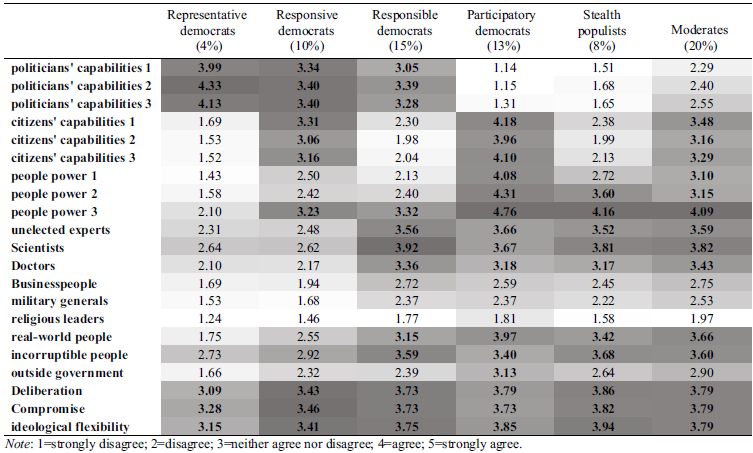
Table 3. Long description
The table presents estimated scores for various democratic profiles across multiple statements. It has 21 rows and 7 columns. The columns are labeled as Representative democrats (4 percent), Responsive democrats (10 percent), Responsible democrats (15 percent), Participatory democrats (13 percent), Stealth populists (8 percent), and Moderates (20 percent). The rows are labeled with different statements and categories such as Politicians’ capabilities, Citizens’ capabilities, People power, Unelected experts, Scientists, Doctors, Businesspeople, Military generals, Religious leaders, Real-world people, Incorruptible people, Outside government, Deliberation, Compromise, and Ideological flexibility. Each cell contains a numerical score representing the level of agreement with the corresponding statement. Notable trends include high agreement with statements related to compromise, deliberation, and ideological flexibility, and low agreement with statements related to increasing the power of businesspeople, military generals, and religious leaders.
For a more comprehensive characterisation of the preference types, we also describe the effects of our covariates on the probability of being assigned to each preference type alongside the concomitant profile’s preferences for how government should run. Table 4 presents the Multinomial (MNL) regression estimates of class belonging with effect coding parameters, meaning that each profile is compared to the entire set of profiles rather than a reference group. The MNL regression controls for differences in the effects of covariates across countries by including country-fixed effects. However, in Appendix V, we also provide the MNL regression estimates separately by country to determine whether the characteristics of the preference types are similar across countries or context-dependent.
MNL regression estimates of class membership (N = 15,575)
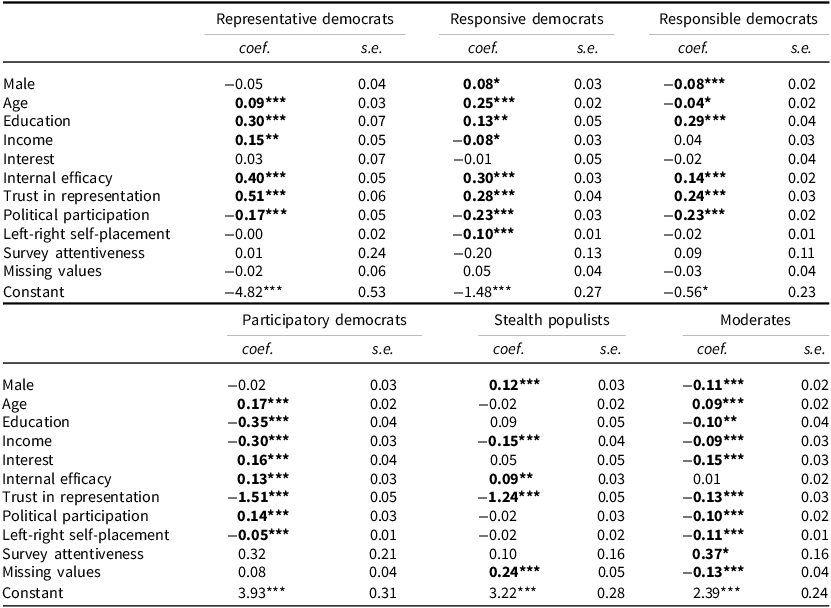
Table 4. Long description
The table presents regression estimates for various types of democrats and political orientations, including representative democrats, responsive democrats, responsible democrats, participatory democrats, stealth populists, and moderates. It has 15 rows and 7 columns. The columns are labeled as Representative democrats, Responsive democrats, Responsible democrats, Participatory democrats, Stealth populists, and Moderates. Each column contains coefficients (coef.) and standard errors (s.e.) for different variables. The rows are labeled with variables such as Male, Age, Education, Income, Interest, Internal efficacy, Trust in representation, Political participation, Left-right self-placement, Survey attentiveness, Missing values, and Constant. Each row provides the coefficient and standard error for each type of democrat and political orientation. Notable trends include significant coefficients for Age, Education, Income, Internal efficacy, Trust in representation, and Political participation across different types of democrats and political orientations.
Note: The model includes country-fixed effects.
P < 0.05* <0.01** <0.001***.
Representative democrats
As shown in Table 3, the smallest preference type, corresponding to only 4% of respondents, tends to agree with the statements on politicians’ capabilities (i.e., scoring close to four) and disagree with all other statements (i.e., scoring close to two), except for those on the need for elected officials to compromise and deliberate more (which they neither agree nor disagree with). The shading in Table 3 also shows that this preference type is the most positive about politicians’ capabilities and the most negative about increasing the power of any other actors. This preference type therefore corresponds to our expectations for the ‘representative democrats’ who support an ideal-type model of government attributing greater importance to the role of elected representatives relative to other actors. Pilet and colleagues’ (Reference Pilet, Talukder, Sanhueza and Rangoni2020) study of Belgian voters reported a similar share of representative democrats (3.3%).
The MNL regression estimates in Table 4 demonstrate that representative democrats are generally older, higher educated, satisfied with their incomes, confident in their ability to understand politics, trusting of representative actors and institutions, and politically inactive (compared to the average effect across all preference types). The positive effects of education, income, and efficacy suggest that representative democrats are higher-status individuals, supporting Social Dominance Theory’s central claim that higher-status individuals are more likely to prefer maintaining the status quo (Ceka and Magalhaes Reference Ceka and Magalhaes2020). The positive effect of age also aligns with previous research suggesting that older individuals are more risk-averse and therefore less likely to support political reform (Ahlfeldt et al. Reference Ahlfeldt, Maennig and Mueller2022). Finally, the positive effect of trust and the negative effect of participation suggest that representative democrats feel little need to engage in politics beyond voting, as they believe elected representatives are performing effectively. This finding is in line with previous research suggesting that people who think political decisions should be made by elected representatives are less likely to participate outside elections (Bengtsson and Christensen Reference Bengtsson and Christensen2016). The forest plots in Appendix V show that the effects of the covariates generally go in the same direction in most countries except Bulgaria.
Responsive democrats
The very small percentage of representative democrats could suggest that many people are dissatisfied with the current model of government. However, as shown in Table 3, there are two other preference types that (although less positive about politicians than representative democrats) are still positive about politicians in absolute terms (i.e., scoring above three on politicians’ capabilities). The first of these preference types, accounting for 10% of respondents, differs from representative democrats in that it tends to agree that citizens are competent enough to participate in political decision-making and should be able to take decisions via referenda (i.e., scoring above three on citizens’ capabilities and people power 3). However, this preference type resembles the representative democrats in its disagreement with statements about increasing the power of any actors besides politicians (i.e., scoring below three on power to people, experts, or other non-political actors). While confidence in citizens’ capabilities paired with reluctance to give citizens more power may seem contradictory, it aligns with Hibbing et al.’s (Reference Hibbing, Theiss-Morse, Hibbing and Fortunato2023) notion of ‘attentive democracy’, wherein politicians take decisions but only after sustained contact with citizens. It also supports the view that participatory democracy complements rather than replaces representative democracy (Lutz Reference Lutz2006; Setälä Reference Setälä2017). This preference type therefore matches our expectations for the ‘responsive democrats’ who prefer decision-making by politicians and citizens relative to other actors.
The results in Table 4 demonstrate that responsive democrats have many characteristics in common with representative democrats: they are older, confident in their ability to understand politics, trusting of representative actors and institutions, and politically inactive. These characteristics can explain their confidence in politicians’ capabilities and reluctance towards increasing the power of other actors. However, responsive democrats differ from representative democrats in that they are less satisfied with their incomes and more likely to identify as left-wing. The latter findings are in line with previous research demonstrating that support for giving citizens more influence over politics is greater among low-income individuals who are less well represented by political elites and among left-leaning individuals who are more inclined towards promoting inclusion and addressing inequalities (Dalton et al. Reference Dalton, Bürklin and Drummond2001; Fernández-Martínez and Font Fábregas Reference Fernández-Martínez and Font Fábregas2018; Pilet et al. Reference Pilet, Bedock, Talukder and Rangoni2024a; Traber et al. Reference Traber, Hänni, Giger and Breunig2022). Finally, while Table 4 also shows that responsive democrats are more often male and higher educated, the forest plots in Appendix V show that these effects are either inconsistent across countries (for age) or mainly caused by one country (for education).
Responsible democrats
We now turn to the third preference type which, although less positive about politicians than the representative democrats, still expresses agreement with the statements on politicians’ capabilities. As shown in Table 3, 15% of respondents are assigned to a preference type that resembles the representative democrats in its lack of confidence in citizens’ capabilities and lack of support for shifting power to citizens unless via referenda (i.e., only scoring above 3 on people power 3). However, this preference type differs from both the representative and responsive democrats in its support for increasing the power of experts, scientists, and doctors. This preference type therefore corresponds to our expectations of ‘responsible democrats’, who support governance by both elected representatives and independent experts while being more critical of citizens – a preference also found in Belgium (Pilet et al. Reference Pilet, Talukder, Sanhueza and Rangoni2020) and the UK (Haesevoets et al. Reference Haesevoets, Verschuere and Roets2025). The contrast with responsive democrats supports our conjecture, based on Mair’s (Reference Mair2013) work, that some prefer representatives who are accountable to citizens, while others prefer accountability to elites. As shown in Table 3, responsible democrats also tend to agree with the statements on increasing the power of people ‘who have experienced real-world problems’ or ‘who can’t benefit themselves’ (unlike the representative or responsive democrats). This could be connected to their demand for increasing the power of experts, who are perceived as impartial outsiders (Caramani Reference Caramani2017).
The effects of the covariates in Table 4 demonstrate that the profile of the responsible democrats shares much in common with those of the representative and responsive democrats: they tend to be highly educated, confident in their ability to understand politics, trusting of representative actors and institutions, and politically inactive. Their trust in representation and limited political engagement could explain their scepticism towards increasing the role of ordinary citizens (Bengtsson and Christensen Reference Bengtsson and Christensen2016). The positive effect of trust indicates, contrary to much of the literature (Bertsou and Caramani Reference Bertsou and Caramani2020; Bertsou and Pastorella Reference Bertsou and Pastorella2016; Chiru and Enyedi Reference Chiru and Enyedi2022), that the demand for involving experts is not necessarily rooted in dissatisfaction with politics. The positive effects of education and confidence in one’s ability to understand politics, however, are in line with the findings of previous research, demonstrating that the demand for experts is greater among those who are higher educated and more knowledgeable about politics (Bertsou and Caramani Reference Bertsou and Caramani2020; Pilet et al. Reference Pilet, Talukder, Sanhueza and Rangoni2020). Knowledgeable individuals have a greater appreciation for the complexity of political decision-making, which might explain their preference for involving experts, at the expense of broader public engagement (Anderson and Goodyear-Grant Reference Anderson and Goodyear-Grant2010). While Table 4 also shows that responsible democrats are more often female and younger, the forest plots in Appendix V show that these effects differ across countries, while the effects of the other covariates are consistent across countries.
Participatory democrats
The shading in Table 3 demonstrates that two preference types are more critical of politicians’ capabilities than the rest (i.e., scoring close to one or ‘strongly disagree’). The largest of these, corresponding to 13% of respondents, stands out as being more confident in citizens’ capabilities and more favourable towards shifting power towards citizens than all other preference types (i.e., scoring close to four or ‘agree’). In addition, they are also the most favourable towards empowering people ‘who have experienced real-world problems’ or ‘with no previous governmental experience’. We refer to these respondents as ‘participatory democrats’ because they are clearly the strongest advocates of a citizen-orientated model of government. However, they do not exactly match our expectations for a profile with ideal-type preferences because, as shown in Table 3, they also express agreement with statements on increasing the power of independent experts and scientists (i.e., scoring close to four or ‘agree’). Our findings therefore deviate slightly from those of Pilet and colleagues (Reference Pilet, Talukder, Sanhueza and Rangoni2020) in Belgium and Haesevoets and colleagues (Reference Haesevoets, Verschuere and Roets2025) in the UK, which do point towards a group of persons who clearly ascribe a dominant role to citizens.
Table 4 shows that participatory democrats are politically interested, confident in their ability to understand politics, and politically active, consistent with Cognitive Mobilisation Theory, which links demands for citizen participation to rising competence levels. However, Table 4 also shows that they are less educated, less satisfied with their incomes, and distrustful of representative actors and institutions, which aligns with the competing Political Disaffection Theory and its claim that the demand for participation is rooted in dissatisfaction with politics among disadvantaged groups (Dalton et al. Reference Dalton, Bürklin and Drummond2001). The profile of the participatory democrats is therefore aligned with more recent studies arguing that support for increasing the political role of ordinary citizens is greater among those who are both politically ‘engaged’ and ‘enraged’ (Bedock and Pilet Reference Bedock and Pilet2020; Rojon and Pilet Reference Rojon and Pilet2021). While Table 4 also shows that participatory democrats are more likely to identify as left-wing, the forest plots in Appendix V demonstrate that this effect is not consistent across countries, while the other covariates have similar effects across countries.
Stealth populists
Another preference type, comprising 8% of respondents, stands out as being more critical of politicians’ capabilities than others (i.e., scoring close to two or ‘disagree’ on these items) (see Table 3). This preference type resembles the participatory democrats in its negative view of elected representatives and its support for empowering both citizens and experts (i.e., scoring near four or ‘agree’ on people power 2 and 3, experts, and scientists). However, Table 3 shows that, unlike the participatory democrats, this preference type lacks confidence in citizens’ capabilities to take political decisions (i.e., scoring close to two on these items). This preference type therefore comes closest to our expectations for ‘stealth populists’ who are critical of politicians and would rather be governed by either experts or citizens. However, their attitudes towards the role of ordinary citizens are more nuanced than expected: stealth populists want to give citizens more control (for example, through referenda), but they do not think citizens can take political decisions. Although this may seem contradictory, it aligns with Hibbing and Theiss-Morse’s (Reference Hibbing and Theiss-Morse2002) concept of Stealth Democracy, which suggests that citizens prefer to delegate decision-making to experts rather than becoming directly involved while still retaining control over the system. Similar preference types were not found in other studies. However, Fernández-Vázquez and colleagues’ (Reference Fernández-Vázquez, Lavezzolo and Ramiro2022) and Bertsou and Caramani’s (Reference Bertsou and Caramani2020) studies identified a group of ‘techno-populists’ who support that decisions are made by experts but demand responsiveness to the will of the people.
Table 4 shows that stealth populists are more often male, less satisfied with their incomes, and distrustful of representation. Previous research on stealth democratic (Bengtsson and Mattila Reference Bengtsson and Mattila2009; Webb Reference Webb2013) and populist attitudes (Spierings and Zaslove Reference Spierings and Zaslove2017) also finds these attitudes more common among men and disadvantaged groups, who may feel threatened by modernisation and globalisation processes. Furthermore, Social Dominance Theory suggests that low-income persons are more likely to embrace alternatives to the status quo (Ceka and Magalhaes Reference Ceka and Magalhaes2020), which could explain why they are more likely to be stealth populists who support shifting power away from politicians towards either citizens or experts. The negative effect of trust in representation connects to the stealth populists’ lack of confidence in politicians’ capabilities and their preference for empowering citizens and experts. It is worth noting that (dis)trust has a much stronger effect on membership to the stealth populists than on membership to any other preference type, suggesting that their preferences are more firmly rooted in anti-politics. Table 4 also demonstrates that stealth populists are confident in their ability to understand politics, but the forest plots in Appendix V demonstrate that the effect of efficacy is not consistent across countries, while the effects of the other covariates go in the same direction in most countries.
Moderates
We finally turn to the last preference type, which also corresponds to the largest share of respondents (20%). Table 3 demonstrates that respondents assigned to this preference type are fairly negative about politicians’ capabilities (i.e., scoring just below three on these statements) and fairly positive about most alternatives (i.e., scoring just above three on all statements except those on increasing the power of businesspeople, military generals, and religious leaders). Table 3 also shows that, unlike the other preference types, they are balanced in their attitudes towards the roles of both citizens and experts (scoring between three and four on all statements about citizens’ capabilities, people power, and experts). We refer to them as ‘moderates’ because, compared to the other preference types, their attitudes are neither strongly critical nor strongly supportive of politicians, citizens, or experts, instead occupying a middle ground across all groups. Although we could not formulate expectations for such a preference type based on the literature, other studies have identified similar profiles. For example, Pilet and colleagues’ study in Belgium (Reference Pilet, Talukder, Sanhueza and Rangoni2020) found that 28% of respondents are ‘hybrid democrats’ who are slightly negative about politicians and slightly positive about both citizens and experts. Similarly, Haesevoets and colleagues’ (Reference Haesevoets, Verschuere and Roets2025) study in the UK found that the largest share of respondents (26%) belongs to a cluster that assigns equal decision-making authority to both experts and citizens and slightly less to politicians but is not the most punitive towards politicians.
Table 4 demonstrates that moderates are more often female, older, less educated, less satisfied with their incomes, politically inactive, and more likely to identify as left-wing. Women and less-educated and lower-income individuals are typically less well represented by political elites (Talukder and Pilet Reference Talukder and Pilet2021) and, in line with Social Dominance Theory, are more likely to seek alternatives to the status quo (Ceka and Magalhaes Reference Ceka and Magalhaes2020). This might explain why moderates, who support a greater role for both citizens and experts, are more likely to come from these groups. The finding that moderates are more likely to identify as left-wing may relate to literature suggesting that left-leaning individuals are more favourable towards political change (Van der Meer et al. Reference Van der Meer, Van Deth and Scheepers2009). Finally, the finding that moderates are less likely to participate outside elections may help explain why they do not prioritise increasing the role of ordinary citizens, since participation usually fosters an appetite for further participation (Goldberg Reference Goldberg2021). Although Table 4 also shows that moderates are less interested in politics and less trusting of representative actors, the forest plots in Appendix V indicate that these effects are not consistent across countries, whereas the other covariates display similar effects across most countries.
Comparing the distribution of preference types across countries
Although our model selection ensures that we are comparing similar preference types across countries, some preference types may be more prevalent in some countries relative to others. Figure 2 shows the proportion of respondents within each country assigned to a preference type. Important cross-national differences can be observed for all groups except the stealth populists, who represent between 5 and 10% in all countries. In Appendix VI, we provide further interpretation of descriptives reported in this section, based on country differences in political trust, perceived corruption, political participation, and technocratic traditions.
Share of respondents within each country assigned to a preference type (grouped by clusters).
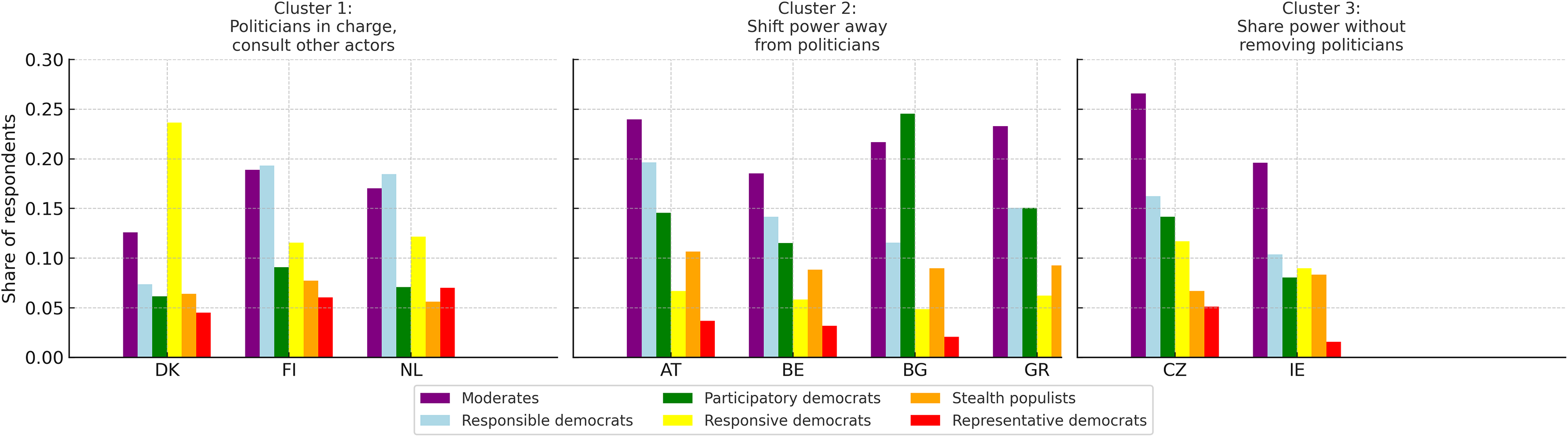
Figure 2. Long description
Panel A: A bar graph comparing the share of respondents in Denmark, Finland, and the Netherlands who prefer politicians in charge, consult other actors. The horizontal axis lists the countries D K, F I, and N L. The vertical axis represents the share of respondents, ranging from 0.00 to 0.30. The bars are grouped by preference types: Moderates, Participatory democrats, Responsible democrats, Responsive democrats, Stealth populists, and Representative democrats. Each preference type is represented by a different color. Panel B: A bar graph comparing the share of respondents in Austria, Belgium, Bulgaria, and Greece who prefer shifting power away from politicians. The horizontal axis lists the countries A T, B E, B G, and G R. The vertical axis represents the share of respondents, ranging from 0.00 to 0.30. The bars are grouped by preference types: Moderates, Participatory democrats, Responsible democrats, Responsive democrats, Stealth populists, and Representative democrats. Each preference type is represented by a different color. Panel C: A bar graph comparing the share of respondents in the Czech Republic and Ireland who prefer sharing power without removing politicians. The horizontal axis lists the countries C Z and I E. The vertical axis represents the share of respondents, ranging from 0.00 to 0.30. The bars are grouped by preference types: Moderates, Participatory democrats, Responsible democrats, Responsive democrats, Stealth populists, and Representative democrats. Each preference type is represented by a different color.
In general, the descriptive results in Figure 2 point to three clusters of countries. In Denmark, Finland, and the Netherlands, respondents are relatively more favourable towards models where politicians are in charge but pay more attention to either citizens or experts (i.e., representative, responsive, and responsible democrats). However, in Denmark, citizens prefer a more responsive democracy centred on citizens, while in Finland and the Netherlands, citizens prefer a more responsible democracy centred on experts. By contrast, respondents from these countries are less inclined towards models that would more drastically shift power towards citizens or other actors (i.e., participatory democrats, moderates, or stealth populists).
Bulgaria and Greece, and to a lesser extent Austria and Belgium, appear to form a second cluster that is relatively less inclined towards models in which politicians remain in charge and more inclined towards models that shift power to citizens or other actors. Respondents in these countries are less likely to be representative, responsible, or responsive democrats compared to those from other countries, except in Austria, where a sizeable share supports a responsible model in which politicians delegate more authority to experts. By contrast, respondents from this cluster are more likely to be moderates, participatory democrats, or stealth populists, with the caveat that Belgian respondents are somewhat less supportive of citizen empowerment or alternatives to politics as usual than those from Austria, Bulgaria, and Greece.
Finally, Czechia and Ireland fit into a third cluster in which citizens are the least inclined towards models that rely solely on politicians (i.e., representative democracy) or that exclude politicians entirely (i.e., stealth populism). Instead, respondents in these countries tend to favour some form of reform, either by expressing moderate preferences for a range of alternatives or by supporting models where politicians share more power and influence with citizens or experts (i.e., responsive, responsible, or participatory democracy).
Conclusion
In light of the ‘crisis of representation’ in established democracies, a growing number of studies have investigated public support for alternative models of government wherein political decisions are taken by experts or citizens as opposed to politicians. However, the research has mostly been conducted in siloes, with the majority of studies focusing on a single actor or inducing trade-offs between alternative decision-making arrangements. Many of these studies also rely on single-country data and different survey items, making it difficult to compare results across contexts. As a result, this approach has led not only to a fragmented but also to a seemingly inconsistent understanding of citizens’ preferences for who should govern. Because many studies examine support for one governing actor at a time, they can reach different conclusions about whether citizens primarily favour politicians, ordinary citizens, or experts.
To address these shortcomings, we conducted a multi-group LPA of citizens’ process preferences in nine European countries, based on a battery of 21 items (Hibbing et al. Reference Hibbing, Theiss-Morse, Hibbing and Fortunato2023). 31% of respondents appear to be ‘survey trackers’ who scored similarly on all items, while the remaining 69% are assigned to six different profiles with distinct and interpretable preferences for who should govern. Only 4% of respondents support an ideal-type model centred on one actor, namely, the representative democrats who reject all actors except politicians.
Two other profiles are also confident in politicians but would like to see an expanded role for either citizens or experts. Responsive democrats believe citizens should participate in political decision-making, yet they oppose transferring power to alternative actors, including both citizens and experts. Responsible democrats support strengthening the role of experts but are sceptical about giving citizens more influence. Representative, responsive, and responsible democrats share many traits. They are older, higher-status individuals who are trusting of representative actors and institutions and do not participate in politics beyond elections.
Two other profiles stand out as more critical of politicians. First, participatory democrats are the most supportive of giving citizens greater influence relative to politicians. However, contrary to expectations, they do not hold ideal-type preferences, as they also favour increasing the power of experts. Participatory democrats are both ‘engaged’ (e.g., more interested and more active in politics) and ‘enraged’ (e.g., distrusting of representative actors and institutions and belonging to marginalised socio-demographic groups). Second, stealth populists support shifting power away from politicians towards either citizens or experts. Paradoxically, and in line with the concept of Stealth Democracy (Hibbing and Theiss-Morse Reference Hibbing and Theiss-Morse2002), they do not believe citizens can make political decisions, suggesting a preference for a system with minimal citizen involvement but in which citizens can take control when necessary. Stealth populists tend to be low-income and politically distrusting, which helps explain their support for shifting power away from politicians.
Finally, the largest group of respondents (20%), whom we labelled as moderates, are neither the most nor the least critical of politicians and are somewhat open to most alternatives to representative democracy, without prioritising any single one. Moderates are more likely to belong to disadvantaged groups (e.g., women, lower-income, and less-educated individuals) and to identify as left-leaning, which helps explain their demand for political change, regardless of its form.
Taken together, these findings suggest that the apparent inconsistency in previous research may not reflect incoherent public opinion, but rather the fact that many citizens do not think in terms of mutually exclusive models of government. Instead, they combine support for different actors in ways that are obscured when research focuses on one ideal-type model of government. From this perspective, the contribution of this study is not only to identify additional preference types but also to help reconcile otherwise contradictory literature. A combinatorial approach therefore provides a more integrative framework for interpreting previous empirical findings.
Discussion
In this final section, we discuss how our findings connect to previous research on citizens’ preferences for who should govern, and we outline potential directions for future research. Our first takeaway is that most citizens hold mixed preferences for multiple actors, indicating that research should move beyond ideal-type models centred on a single actor. The few studies distinguishing mixed from ideal-type preferences reach similar conclusions (Haesevoets et al. Reference Haesevoets, Verschuere and Roets2025; König et al. Reference König, Siewert and Ackermann2022; Pilet et al. Reference Pilet, Talukder, Sanhueza and Rangoni2020). In our pooled sample of nine countries, only 4% of respondents appear to hold ideal-type preferences, namely, the representative democrats. The absence of profiles favouring ideal-type models centred on citizens or experts suggests that these actors should not be treated as mutually exclusive. Support for citizens and experts is widespread but clearly embedded in mixed models where these actors are expected to work either alongside each other or alongside politicians. Our findings concur with König and colleagues’ (Reference König, Siewert and Ackermann2022) review of the literature on democratic preferences, which argues that future research should adopt a ‘combinatorial approach’ that derives attitudinal types from multiple conceptions of democracy, rather than measuring support for each conception separately.
The second takeaway is that, despite widespread claims of a ‘crisis of representation’ (Mair Reference Mair2013), about 30% of respondents remain confident in elected representatives (i.e., representative, responsive, and responsible democrats), while only 21% strongly oppose being governed by them (i.e., participatory democrats and stealth populists). We believe that the current battery leads to underestimating the share of respondents who continue to support representative democracy and could therefore be improved. The items related to representative democracy refer only to politicians, without mentioning the role of political parties or parliament. Moreover, these statements describe politicians’ capabilities in a negative light, whereas the remaining statements are formulated positively, which may induce a negative bias towards politicians.
On the other hand, in most countries, except Denmark, Finland, and the Netherlands, the largest share of respondents expresses support for any alternative to politicians. This raises the question of whether such individuals might also be receptive to more authoritarian modes of governing. At the same time, a sizeable share of those who are most negative about politicians, i.e., stealth populists and participatory democrats, remain committed to democratic principles, at least in terms of participation and accountability to the people. Future research should therefore examine more closely those who completely reject representative actors and governing styles to determine what they see as the appropriate alternative and whether their preferences carry a potential ‘risk’ of authoritarian tendencies.
Another takeaway is the identification of three profiles that are not well grounded in previous research but nonetheless emerge across multiple countries and therefore merit further conceptual and empirical attention. The first of these are the responsible democrats. While previous research has mainly presented independent experts as an alternative to elected representatives, our results suggest that support for these two actors overlaps among a sizeable share of individuals. These individuals might be characterised as ‘elitists’ in the sense that they are favourable towards both political and scientific elites and are sceptical of involving ordinary citizens. The second of these are the stealth populists, who support shifting power away from politicians towards both citizens and experts. Previous research has shown that some individuals combine support for both expert- and citizen-orientated alternatives (Fernández-Vázquez et al. Reference Fernández-Vázquez, Lavezzolo and Ramiro2022). Our findings nuance this association by revealing that such individuals do not necessarily believe citizens should be more directly involved in political decision-making. We interpret this preference in line with Hibbing and Theiss-Morse’s (Reference Hibbing and Theiss-Morse2002) suggestion that people favour efficient and effective decision-making while still retaining veto power. However, future research might dig deeper into this preference type with more fine-grained attitudinal measures. The last underdeveloped profile is the moderates, who are somewhat negative towards politicians and somewhat positive towards most alternatives, without prioritising a specific one. This is the most common preference type in our study and in other combinatorial studies of citizens’ process preferences (Haesevoets et al. Reference Haesevoets, Verschuere and Roets2025; Pilet et al. Reference Pilet, Talukder, Sanhueza and Rangoni2020). But who are these respondents – citizens seeking change without a clear vision, or citizens who would like to see policymaking enriched by the involvement of multiple actors? Answering this question requires dedicated research.
While most studies on citizens’ preferences for who should govern focus on a single country, our study identified similar preference types across nine European countries. The fact that these profiles emerge across multiple contexts demonstrates that they are relatively stable and robust preference types which can be meaningfully compared across countries. At the same time, we observed important differences in their prevalence across countries, which, as further detailed in Appendix VI, could be explained by differences in political trust, perceived corruption, political participation, and technocratic traditions. In general, we identified three clusters of countries: one that supports models where politicians remain in charge but consult either citizens or experts (Denmark, Finland, and the Netherlands); a second that favours shifting power away from politicians towards other actors (Bulgaria, Greece, Austria, and Belgium); and a third that is less categorical about the role of politicians but open to experimenting with alternative arrangements (Czechia and Ireland). These clusters point to potential regional patterns in democratic preferences that may reflect the political contexts in which citizens are embedded. They also suggest that analysing countries at the cluster level, rather than individually, can be a fruitful way to understand why certain democratic models gain traction in some settings but not others.
Our final reflection relates to the reproducibility of Hibbing and colleagues’ battery. We selected this battery because it is the most comprehensive survey instrument for measuring citizens’ preferences for who should govern and because it captures comparable concepts across multiple European countries (Pilet et al. Reference Pilet, Vittori, Rojon and Paulis2024b). However, our results suggest that the battery could be improved in several ways. Introducing mixed-direction items, with both positive and negative formulations, could enhance the reliability of the battery by distinguishing between survey trackers (or respondents who rate all items similarly out of haste or fatigue) and respondents with genuine preferences.
There are also important differences in the subjects of the statements: some are about empowering different actors, some address how elected officials should govern, and others focus on the specific attributes of politicians and citizens. Including statements about the attributes of politicians and citizens may have implications for the number of profiles identified. For example, we might not have distinguished between responsive and participatory democrats had the battery not differentiated between citizens’ capabilities and citizens’ empowerment. Future research should therefore consider these alternative ways of measuring citizens’ process preferences and the implications of these measurement choices for the resulting profiles.
Furthermore, some items were evaluated uniformly by all respondents, suggesting that they do not contribute to distinguishing between different preferences for who should govern and could be reformulated in future research. For example, while statements on increasing the power of military generals, religious leaders, and businesspeople could be linked to support for an authoritarian model of government, they are not suitable in a European context, as none of the preference types in our nine-country study expressed support for these actors (see Table 3). Support for an authoritarian model might be better captured with items on the commitment of political leaders to democratic principles such as checks and balances or civil liberties (Graham and Svolik Reference Graham and Svolik2020). The results also show that most respondents agree with the statements on the need for more compromise, deliberation, and ideological flexibility among elected officials (see Table 3). This may be because the statements reflect universal democratic values, capture attitudes of low salience, or are too abstract for respondents to understand. These statements could be replaced with items that reflect scholarly and societal interest in fostering public deliberation among ordinary citizens through forums such as deliberative mini-publics (Warren and Gastil Reference Warren and Gastil2015). Support for deliberative mini-publics could be found among several preference types, as these forums typically bring together multiple stakeholders, including politicians, citizens, and experts.
Supplementary material
The supplementary material for this article can be found at https://doi.org/10.1017/S1475676526101601
Data availability statement
The dataset can be accessed via the SODHA registry (https://doi.org/10.34934/DVN/N9NDVL). The syntaxes for replication are included in the supplementary materials for the article.
Author contributions
Sebastien Rojon: Conceptualisation-Lead, Data curation-Equal, Formal analysis-Lead, Investigation-Lead, Methodology-Equal, Visualisation-Lead, Writing – original draft-Lead, Writing – review & editing-Lead; Jean-Benoit Pilet: Conceptualisation-Equal, Funding acquisition-Lead, Investigation-Equal, Writing – original draft-Supporting; Paulina Pankowska: Formal analysis-Equal, Methodology-Equal, Software-Equal, Writing – original draft-Supporting; Davide Vittori: Conceptualisation-Supporting, Data curation-Equal, Investigation-Supporting, Writing – original draft-Supporting; Emilien Paulis: Conceptualisation-Supporting, Data curation-Equal.
Funding statement
This research was made possible by funding received from the European Research Council under the European Union’s Horizon 2020 research and innovation programme (grant agreement No. 7726595).
Competing interests
The authors declare no competing interests.
Ethical standards
All respondents provided informed consent to participating in the survey and earned credits for a voucher or gift card as compensation for their participation. Prior to consenting, they were presented with a participant information sheet outlining the goals of the study, guaranteeing the anonymity of their participation and highlighting their rights to withdraw from the survey post-completion. The research design did not involve the manipulation or deception of participants, nor did it intervene in any political processes. The research was in full compliance with the European General Data Protection Regulation and formally approved by the Ethics Committee of the Faculty of Philosophy and Social Sciences at the Université libre de Bruxelles, Belgium.
Use of AI
Artificial intelligence tools (ChatGPT and associated AI-based applications) were used exclusively for the development and formatting of figures and tables included in the manuscript and appendix. All underlying data, analysis, interpretation, and written content were generated and verified by the authors. The authors take full responsibility for the accuracy and integrity of all materials presented.

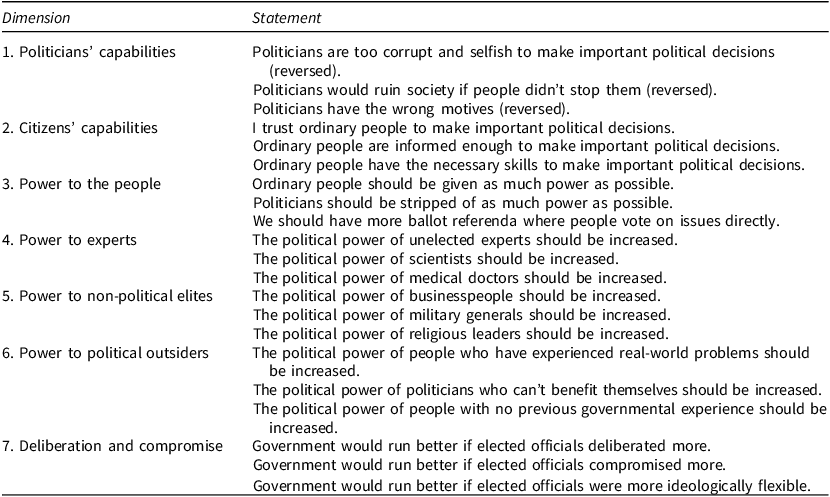
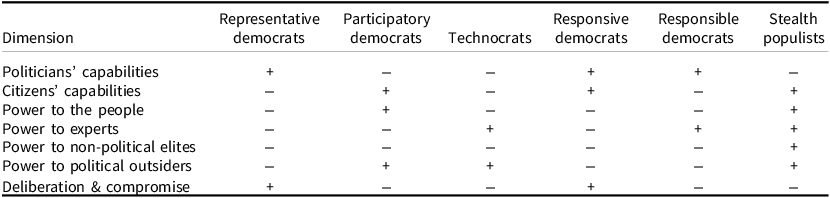

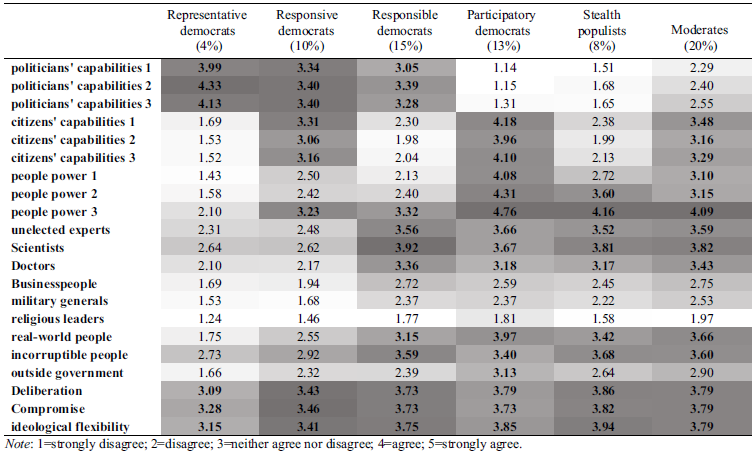
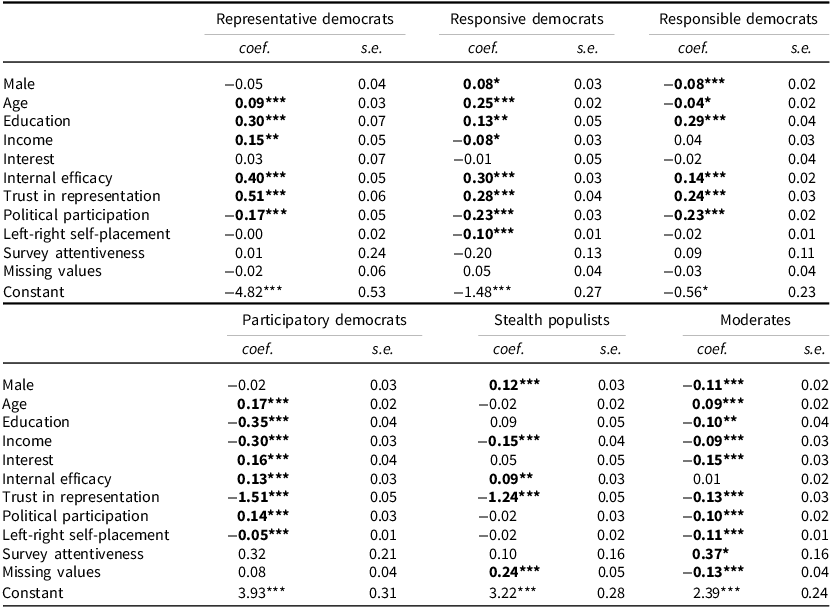


 Open access

