


As a Black girl in a house of woman‐being I wanted to see myself. I longed to cherish mirrored reflections, to understand naked brown girl flesh becoming itself.
—bell hooks, “Naked without Shame”
In artwork that often consists of either staged or appropriated photographs accompanied by text, contemporary African American artist Carrie Mae Weems frequently critiques the shaming of the black female body in American visual culture and offers counter‐hegemonic images of beauty to overcome shame. Women in her photographs often stand before mirrors as they reckon with issues of shame and questions of subjectivity. From the myth of Narcissus to Jacques Lacan's essay “The Mirror Stage,” the self's relation to the mirror has been a foundational metaphor for understanding subjectivity. Weems overthrows sexist and racist constructions of subjectivity and deploys the trope of the mirror to subvert culturally entrenched patterns of viewing African American femininity. In Weems's work, the mirror can act as a visual metaphor for psychoanalyst Helen Block Lewis's characterization of “the doubleness of experience of shame” (Reference Lewis and NathansonLewis 1987, 108). According to Lewis, the subject's own feeling of shame is felt simultaneously along with her inner visualization of how the other views her as shameful. As an introjection of the other, this inner visualization has an ambiguous status with respect to the subject: it is alien to the subject yet a part of her own psychical life. Similarly, Weems shows the ambiguous status of the shamed subject's reflection as she sees herself through the introjected shaming gaze of the other: a reflection that is both hers and alienating. Although in such a situation the mirror is an instrument of insecurity and shame, Weems shows that by looking again, the shamed subject can use the mirror as a stage for establishing black female subjectivity, a gaze of self‐love, and beauty. Through her tactical use of mirrors, Weems not only critiques the social shaming of the black female body, but also creates new affirming images of black female subjects. Weems's double use of mirrors echoes artist and critic Lorraine O'Grady's strategy (following Gayatri Spivak's critique of imperialism) of fighting to reclaim black female subjectivity on two fronts: “Critiquing them does not show who you are; it cannot turn you from an object into a subject of history … self‐expression is not a stage that can be bypassed. It is a discrete moment that must precede or occur simultaneously with the deconstructive act” (Reference O'Grady, Frueh, Langer and RavenO'Grady 1994, 157). Like the face and its reflection in the mirror, these two modes parallel each other in Weems's work.
I read Weems's work on these two fronts, the deconstructive and the affirming, using philosopher Kelly Oliver's models of social melancholy and the loving eye, respectively. Social melancholy occurs when the black female subject feels shame over her very being because she sees herself reflected through a pathological mirror of racism and sexism constructed by dominating culture's denigrating images of her race and her sex. The loving eye is, by contrast, a critical yet loving gaze that seeks to overcome stereotypes by seeing the other anew each time it looks. Oliver's theory is built on a notion of intersubjective mirroring that I use to understand the relationship between the subject and her own reflection in Weems's counter‐hegemonic images.
This article will elaborate on Weems's tactical use of mirrors to counter shame through a reading of four key works. The analysis of her series Not Manet's Type (1997) in the first section offers an overview of how the subject before the mirror can overcome shame by moving beyond what Oliver calls the pathology of recognition, that is, seeking the approval of the oppressive other. The second section, on her photograph Mirror, Mirror (1987–88), looks more closely at Weems's strategies for dismantling the other's shaming gaze and the social melancholy it elicits in subjects. The third section, on the photograph I Looked and Looked but Failed to See What So Terrified You (2003), demonstrates how Weems uses the mirror and the loving eye to counter shame by establishing a proud, beautiful image of black female subjectivity as the subject stands before the mirror. In a series of appropriated photographs titled From Here I Saw What Happened and I Cried (1995), addressed in the final section, Weems facilitates mirroring between shamed individuals depicted in those photographs and her viewers who can see themselves reflected in the glass over each image. In all these works that employ the mirror as an instrument to investigate subjectivity, Weems engages the topos of shame in order to reject it as a way of seeing the self and alternatively offers a way of seeing the self lovingly.
Not Manet's Type: Shame and Invisibility
Weems's Not Manet's Type [Fig. 1] is a series of five black and white photographs of a dressing table with a circular mirror. Reflected in the mirror is the artist standing, sitting, or lying on or around her bed in various states of undress. A curtain in the background covers a window above the bed. Under the first image is printed: “Standing on shakey [sic] ground / I posed myself for critical study / but was no longer certain / of the questions to ask.” In the remaining four images, it becomes evident that her critical study examines the role of the black female body in modern art history. Under the second image, the caption reads: “It was clear, I was not Manet's type / Picasso—who had a way / with women—only used me / & Duchamp never even considered me.” This sentence refers to the most canonical figures and artworks of European modernism: Manet's Olympia (1863, oil on canvas, Musée d'Orsay, Paris), a painting in which a black servant is relegated to the background in order to highlight a desired white courtesan; Picasso's Les Demoiselles d'Avignon (1907, oil on canvas, Museum of Modern Art, New York) in which the artist, a notorious womanizer, appropriated African mask imagery for his sexualized painting of prostitutes’ bodies; and the oeuvre of quintessential Dada artist Marcel Duchamp, who, for all his artistic sexual innuendo, never treated a black female body in his work. The black female body has been marginalized, denigrated, or ignored in modern art, the realization of which elicits the dejected look of the woman who, standing before a mirror, cannot find herself mirrored in art history.
Carrie Mae Weems, Not Manet's Type, 1997, five pigment ink prints, 30 x 18 inches (each). ©Carrie Mae Weems. Courtesy of the artist and Jack Shainman Gallery, New York.
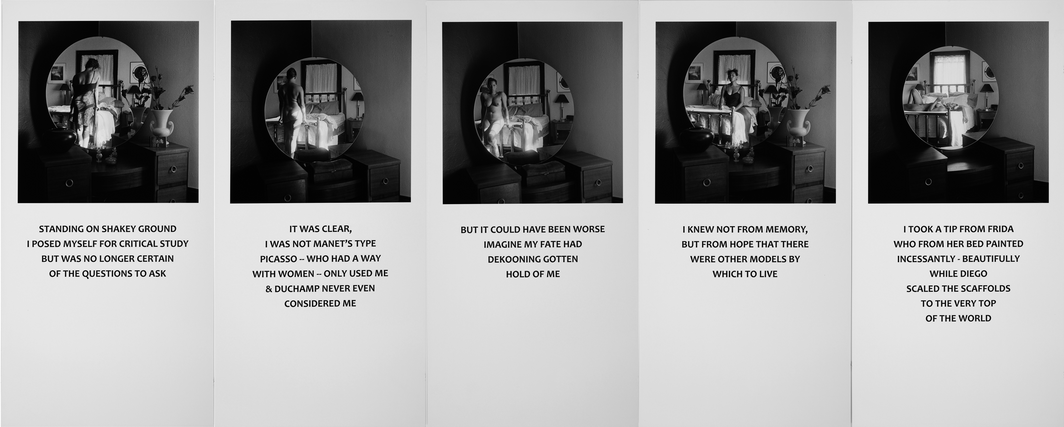
Significantly, Weems begins the sequence by juxtaposing a statement on the narrator's uncertainty about what to say with an image of her own body. Paraphrasing Lewis, Erica Johnson and Patricia Moran point out in their introduction to The Female Face of Shame that “shame is image‐dependent, bodily based, and speechless, experienced more as self than other affects” (Reference Johnson and MoranJohnson and Moran 2013, 6). It is also significant that this “critical study” takes place both before the mirror and in the bedroom. The mirror and the dressing table are common motifs in canonical images of beauty, for example, Velázquez's The Rokeby Venus (1647–51, oil on canvas, The National Gallery, London) or Boucher's The Toilette of Venus (1751, oil on canvas, Metropolitan Museum of Art, New York). Thus Weems's work asks: What is the place of the black female body not only in modern art but in Western constructions of beauty?
Carla Williams and Deborah Willis note in The Black Female Body: A Photographic History that the black female body is invisible in Western discussions of beauty, what Michele Wallace calls “invisibility blues” (Reference Williams and WillisWilliams and Willis 2002, 178). They point out that until the late nineteenth century, black women were rarely the primary subject of art in the West and were shown only as adjuncts to whites: exotic, servant, savage (2). Not Manet's Type refers to this invisibility of the black female body specifically in Manet's Olympia. O'Grady writes that “Olympia's maid, like all the other ‘peripheral Negroes,’ is a robot conveniently made to disappear into the background drapery” or what Judith Wilson calls “the legions of black servants who loom in the shadows of European and European‐American aristocratic portraiture” (Reference O'Grady, Frueh, Langer and RavenO'Grady 1994, 153; Reference O'Grady, Frueh, Langer and RavenWilson, quoted in O'Grady 1994, 153). By photographing the mirror rather than the figure directly in this series, Weems draws attention to the role of visibility and invisibility in shame. As philosopher Luna Dolezal notes, shame can be felt when one is too visible, that is, the object of another's gaze, but shame can also be felt—as in the case of Not Manet's Type—through invisibility, that is, exclusion from the dominant social group (Reference DolezalDolezal 2015, 80, 96–97). (Dolezal's example is Ralph Ellison's The Invisible Man.) What the narrator of Not Manet's Type seems to yearn for, at least initially, is what Dolezal calls “(in)visibility,” which “indicates that the subject is ‘visible’ in social relations, he or she is ‘in play,’ but at the same time, remains unremarkable: acknowledged as a social agent but not judged or objectified” (80–81). Underlying the narrator's yearning is an unrequited desire to be desired by the hierarchical other operative in shame (Reference Tomkins, Sedgwick and FrankTomkins 1995, 157), that is, to be regarded by an idealized other, in this case the canon of art history. Lewis explains that “in shame the ‘other’ remains ‘over‐idealized’ or powerful if only because s/he is admired by the self” (Reference Lewis and NathansonLewis 1987, 197). In Not Manet's Type, the narrator, a black female artist, desires to be part of the cultural canon she holds in high esteem.
However, by the end of the series of images, the narrator no longer depends on white male art history for validation. Her radical departure against shame begins in the penultimate scene: “I knew not from memory, / but from hope that there were other models by which to live.” Weems's protagonist begins to suggest that an affirming image of the black female body will not be found within existing art history, and that she will have to make it herself. Not Manet's Type echoes bell hooks's call: “Opposition is not enough. In that vacant space after one has resisted there is still the necessity to become—to make oneself anew” (Reference hookshooks 1990, 15). In making herself anew, the character liberates herself from needing to be recognized by the other who has excluded her. Oliver, reading Frantz Fanon, points out that the pathology of recognition follows the logic of oppression (Reference OliverOliver 2001, 29); recognition is in fact a symptom of oppression because the subject is caught in a losing battle of constantly comparing herself to the standards of the oppressor, who remains “not only the Other but also the master, whether real or imaginary” (Fanon quoted in Reference DolezalDolezal 2015, 91). Furthermore, shamed subjects lack the social authority to redefine the parameters defined by their oppressor (Reference DolezalDolezal 2015, 95). What is needed is not recognition, but power to create for oneself (Reference OliverOliver 2001, 39), the model for which the narrator finds in Mexican artist Frida Kahlo. In the final image, Weems's text reads: “I took a tip from Frida / who from her bed painted / incessantly—beautifully / while Diego / scaled the scaffolds / to the very top / of the world.” The narrator finds kinship with Kahlo, whose career was largely eclipsed in her lifetime by her husband, muralist Diego Rivera. Due to chronic physical ailments stemming from a bus accident when she was a teenager, Kahlo did frequently paint from bed. As we look into the mirror in this final image, we see the protagonist lying nude on the bed, eyes closed as if dreaming. A glimmer of hope at the possibility of making new self‐affirming images is metaphorically represented in the curtain behind her aglow with new light from outside.
The bedroom setting of Not Manet's Type not only resonates with canonical images of beauty, that is, numerous Venuses before the mirror, but more important, shows the impulse in shame to withdraw from the world because the world sees one as unworthy of love and a place in society (Reference Wurmser and NathansonWurmser 1987, 78; Reference Johnson and MoranJohnson and Moran 2013, 6) or in this case a place in art history. As Johnson and Moran observe, both psychologist Silvan Tomkins and psychoanalyst Leon Wurmser individually argue that “severe shaming damages one's desire to explore and to take interest in the world” (Reference Johnson and MoranJohnson and Moran 2013, 6). But this private space of retreat, free from the immediate onslaught of racist and sexist images, however much they weigh on the protagonist's psyche, is also by the end of the sequence a safe place to facilitate Weems's revolt. The subject's closed eyes suggest not so much an absence of the gaze, but a process of restructuring an inward gaze and re‐sensing her body. Similarly, in “Naked without Shame,” hooks recalls her solitary experience as an adolescent in her bedroom, discovering her body and searching for pride in it:
As a Black girl in a house of woman‐being I wanted to see myself. I longed to cherish mirrored reflections, to understand naked brown girl flesh becoming itself … how can there be images if we insist on remaining invisible, lost to the flesh? In search of glory, I find my body, I search it out standing naked in front of mirrors, watching and giving my body sight—visibility. I'm looking at my Black‐girl body, seeing it clearly, learning its trace, learning to place myself outside history, re‐inventing paradise, a garden of nakedness, a place where brown flesh can be known and loved. (Reference hooks and Shohathooks 1998, 66)
Both Weems and hooks counter the invisibility of the black female body by establishing its visibility before the mirror.
Mirror, Mirror: The “Doubleness of Experience of Shame” and Social Melancholy
By critiquing the invisibility of the black female body in art history and pointing the way to a new visible beauty, Not Manet's Type demonstrates that forging a new vision of black female subjectivity must occur on two fronts simultaneously: it requires dismantling shaming images and creating new affirming ones. Weems's staged black and white photograph Mirror, Mirror (1987–88) [Fig. 2] focuses on the first front.
Carrie Mae Weems, Mirror Mirror, 1987–88, gelatin silver print, 24 x 20 inches. 25 x 21 x 1 1/2 inches framed ©Carrie Mae Weems. Courtesy of the artist and Jack Shaiman Gallery, New York.
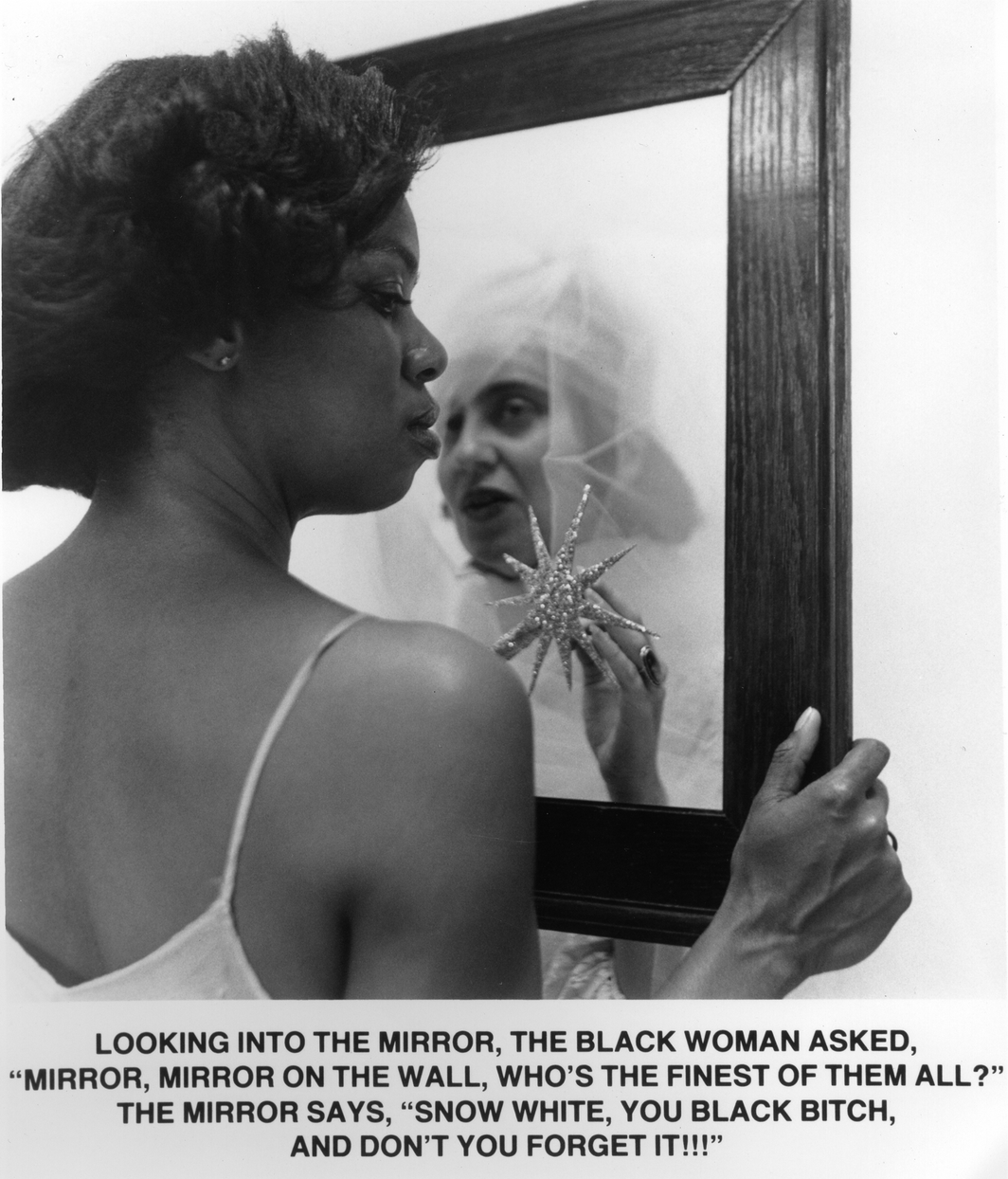
In the picture a black woman holds a wooden frame in front of her as if holding up a mirror. Her head is turned away, and her downcast eyes do not meet the gaze of the reflection. She looks embarrassed. In contrast to her black skin is the lighter skin of a fairytale woman on the other side of the frame, wearing a white tulle veil on her head and holding a sparkling star‐headed wand. Her contemptuous gaze bores into the woman's face. Weems's caption printed below this image indicates that this is the artist's retelling of Snow White before the mirror: “Looking into the mirror, the black woman asked, ‘Mirror, mirror on the wall, who's the finest of them all?’ The mirror says, ‘Snow White, you black bitch, and don't you forget it!!!’” In this section I argue that this work allegorizes the “doubleness of experience of shame” (Reference Lewis and NathansonLewis 1987) by representing the internalized shaming gaze of the other with an image of the shamer's face rather than the subject's own as she looks in the mirror. That internalized gaze induces the condition Oliver calls social melancholy.
The reflection calling the subject of Mirror, Mirror a “bitch” denigrates her as a woman, and in this context the “black” in “you black bitch” reads as a racist epithet. Weems's subject endures what Deborah King calls “multiple jeopardy” (building on Frances Beale's “double‐jeopardy”) (Reference KingKing 1988, 43), that is, she faces discrimination based on gender and race. King points out that multiple jeopardy is not merely additive, as if each form of discrimination could be fought one at a time; rather, they are intertwined and place the subject in a complicated position (47). Demonstrating this complexity, hooks has noted that both black men and white women can be oppressed or oppressor—that is, they can be victimized by racism and sexism, respectively, but they can also oppress black women through sexism and racism, respectively (hooks, cited in Reference ZabunyanZabunyan 2005, 171). Such is the case in Mirror, Mirror; despite the shared sex of the two figures, the white woman denigrates the black woman. If beauty in dominating Western culture is associated with whiteness and defined in contrast to nonwhiteness (Reference O'Grady, Frueh, Langer and RavenO'Grady 1994, 152), then the white woman in the mirror needs to keep the black woman in check and prevent her from thinking of herself as the finest in the land.
The response of the reflection elicits a feeling of shame in the subject for two reasons. First, as Tomkins points out, shame is often induced by the embarrassment of unmet expectation (Reference Tomkins and NathansonTomkins 1987, 165). When Weems's subject stands before the mirror and asks, “Who is the finest of them all?” she probably has the expectation that the mirror will answer, “Why, you are!” She expects a loving response, but instead receives a hostile one. Second, in order for the other's gaze to evoke shame, “the other must be an actual or potential source of positive affect, which is completely reduced by the contempt of the other” (Reference Tomkins, Sedgwick and FrankTomkins 1995, 157). Weems's subject is after all seeking the approval and recognition of the mirror, feeling a desire to be desired by the hierarchical other (157) (much like the protagonist in Not Manet's Type initially looking for herself in the canon of art history). What exactly does this contemptuous other in the mirror, whom the protagonist esteems so highly, represent? In the Snow White story, the magic mirror looks in all the land. As Weems's subject looks into all the land, into the realm of mainstream popular culture, she sees no affirming images of the black female body, that is to say, no (or few) positive reflections of bodies and faces like hers, rather only denigrating ones. The ubiquity of white Anglo culture means that Weems's subject cannot avoid white culture the way whites can avoid black culture (a point made by Maria Lugones and Elizabeth Spelman regarding the asymmetry between Latin American women in the United States and the Anglo world [Reference Lugones, Spelman, Kourany, Sterba and TongLugones and Spelman 1992, 388; Reference TongTong 2014, 225]); standing frozen, she seems trapped in a racist and sexist regime that does not allow her to see herself.
Oliver argues that when the only images that reflect one in popular culture are racist, sexist, ageist, classist, or homophobic, the effect is damaging to one's psyche and one feels a sense of shame over one's very being (Reference OliverOliver 2004, 112), a condition she calls “social melancholy.” Oliver writes:
Social melancholy is the inability to mourn the loss of a lovable self because there is no affirmation or acceptance of this lovable self within mainstream culture… . Insofar as both love and agency are necessary for a sense of self, let alone a sense of self‐worth, stereotypes attack the very sense of self of those oppressed; they attack one's subjectivity and agency.
Lacking socially acceptable words or symbols to discharge affects that have been excluded within mainstream culture, marginalized people are not only shamed and then silenced but also vulnerable to depression, a consequence of the inability to manifest or discharge affects in language. (123–24)
Weems's subject suffers from what Oliver calls “social melancholy” induced by shame. As Lewis notes, symptoms arise when shame (or guilt) are evoked and cannot be appropriately discharged (Reference Lewis and NathansonLewis 1987, 114). For Oliver, the discharge of affect is sublimation, that is, the ability to insert one's own voice into the social realm. Weems's subject cannot insert her voice—the reflection has the last word, leaving her speechless. Social oppression undermines the ability to sublimate and can lead to social melancholy. Following Lewis, Oliver links women's depression and shame and then extends that model to other oppressed groups (Reference OliverOliver 2004, 112). For Oliver, although depression can be personal, depression induced by oppression is misdiagnosed when read as an individual problem—it is a social one.Footnote 1
While the reflection in Mirror, Mirror represents the misrepresentation of the black female body in dominating culture, at the same time, if the subject is looking in a mirror, then ultimately she is seeing a reflection of herself, albeit through the racist and sexist gaze of the oppressor. As the subject sees the internalized racist and sexist gazes reflected back at her, she experiences what Lewis has famously described as the “doubleness of experience” of shame, that is, the subject's own feeling of shame and her simultaneous imagining of how the other views her as shameful (Reference Lewis and NathansonLewis 1987). Similarly, Tomkins refers to the play of external and internalized gazes as “two‐headed shame” or a “hall of mirrors” response created by the other's head, the subject's head, and the internalized other (Reference Tomkins, Sedgwick and FrankTomkins 1995, 154–55). With the defaming social gaze internalized, shame no longer requires an actual audience to judge its subject (Reference BartkyBartky 1990, 86; Reference Johnson and MoranJohnson and Moran 2013, 4); thus Weems's subject stands alone, looking in a mirror, and sees herself as the other does. As Dolezal summarizes: “The idea is that even when shame is not felt directly, it is permanently anticipated as one's identity is spoiled in the first instance. The socially marginalized subject can be characterized as a ‘shame subjectivity’ as a result of a set of structural social relations” (Reference DolezalDolezal 2015, 93).
Oliver argues that the pathological mirror of racism (and sexism) destroys ego and undermines agency (Reference OliverOliver 2001, 32–33). Drawing on the work of Fanon, she notes that this mirror, rather than empowering, reflects back powerlessness (Reference OliverOliver 2001, 33). The subject is unable to learn anything about the self from the contemptuous gaze of the other (Reference DolezalDolezal 2015, 97) seen in the mirror. The subject is instead caught in a vicious cycle of comparing herself to the oppressor's standards (hence the problem with the recognition model of subjectivity and Oliver's critique of it summarized in the previous section).
I Looked and Looked but Failed to See What so Terrified You: The Loving Eye as Correcting Mirror
A new mirror to replace the pathological mirror of racism and sexism is essential for the black female subject to know herself and move beyond seeking recognition from the gaze of the oppressor. As O'Grady writes, “For if the female body in the West is obverse and reverse [black and white], it will not be seen in its integrity—neither side will know itself—not until the non‐white body has mirrored itself fully” (Reference O'Grady, Frueh, Langer and RavenO'Grady 1994, 152; emphasis mine). In this section I show that this new self‐mirroring takes place in Weems's photograph I Looked and Looked but Failed to See What so Terrified You (2003) [Fig. 3].
Carrie Mae Weems, I Looked and Looked but Failed to See What so Terrified You (Louisiana Project series), 2003, digital print, 35 3/4 x 23 3/4 inches each 36 1/2 x 24 1/2 x 1 5/8 inches framed. ©Carrie Mae Weems. Courtesy of the artist and Jack Shainman Gallery, New York.
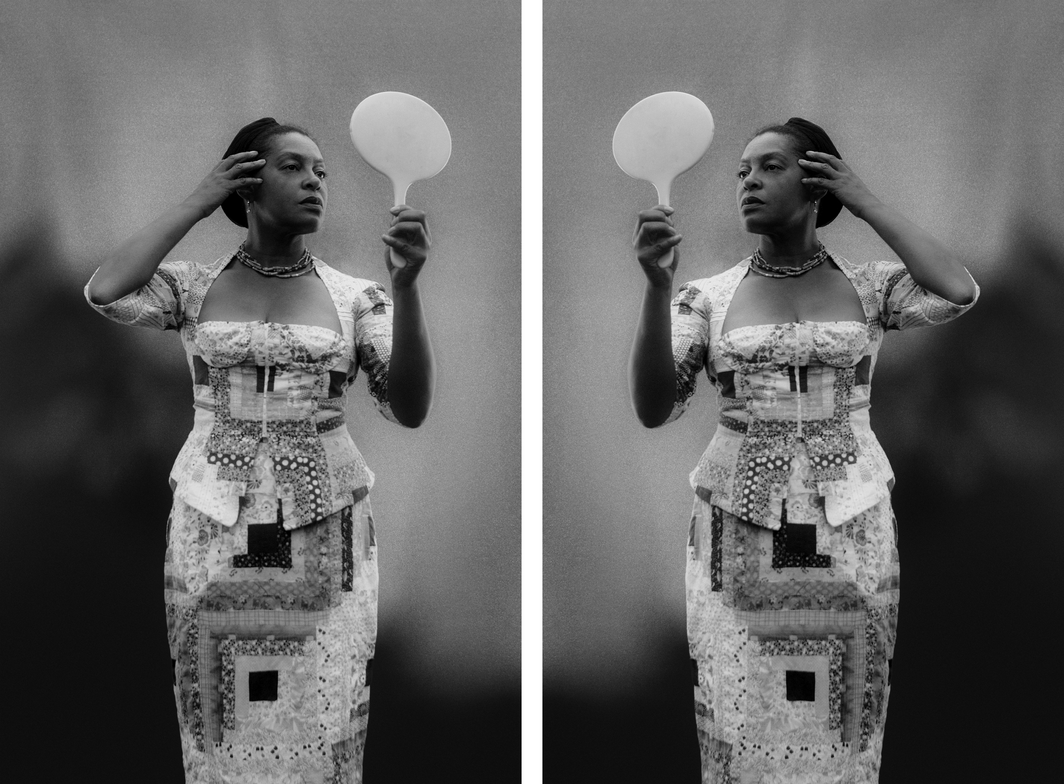
In the picture, the artist stands and holds a mirror up to her face. In contrast to the tentative poses of Not Manet's Type or Mirror, Mirror, in which the figure averted her gaze from her reflection, there is certainty and strength in Weems's posture, and she confidently looks at herself with eyes wide open. Following the prescription of Fanon and Oliver, Weems's character in I Looked and Looked … refuses to fall for the trap of seeking the oppressor's recognition. She now “looks and looks” and defiantly declares that she does not recognize the reflection in the pathological mirror of racism and sexism. Reclaiming her agency, she has forged a new black female subjectivity in which she “sees herself anew” (Reference hookshooks 1990, 15). This photographic image is printed along with a duplicate of itself flipped horizontally, so that the two prints mirror each other. The “doubleness of experience” of shame is fully expunged in this new mirroring and replaced with a doubling experience of beauty. From both sides of this mirror, we see Weems embracing a new pride to overcome shame and social melancholy. A text by Weems accompanying another set of images—a four‐panel portrait: Peaches, Liz, Tannikka, and Elaine (1988) illustrating Nina Simone's song “Four Women”—can be used to understand the defiant gaze in I Looked and Looked …:
really I am shocked. I mean the images of black women are just downright strange. In some cases the images are so monstrously ugly that they scare me! Indeed, if I were as ugly as American culture has made me out to be I'd hide my head like an ostrich in the sand. In some cases like that pickaninny or beautiful African queen mess. These images are so unlike me, my sisters or any other women I know—I didn't know it was supposed to be me. (Weems, quoted in Reference Willis and DelmezWillis 2012, 35)
Weems's I Looked and Looked … functions like Fanon's book Black Skin, White Masks, which he hoped would be a mirror for black readers, one that Oliver describes as a “correcting mirror” (Reference OliverOliver 2001, 39). Fellow traveling with both Weems's art and Oliver's theory, hooks writes: “I am moved by that confrontation with difference which takes place on new ground, in that counter‐hegemonic marginal space where radical black subjectivity is seen, not overseen by an authoritative Other claiming to know us better than we know ourselves” (Reference hookshooks 1990, 22).
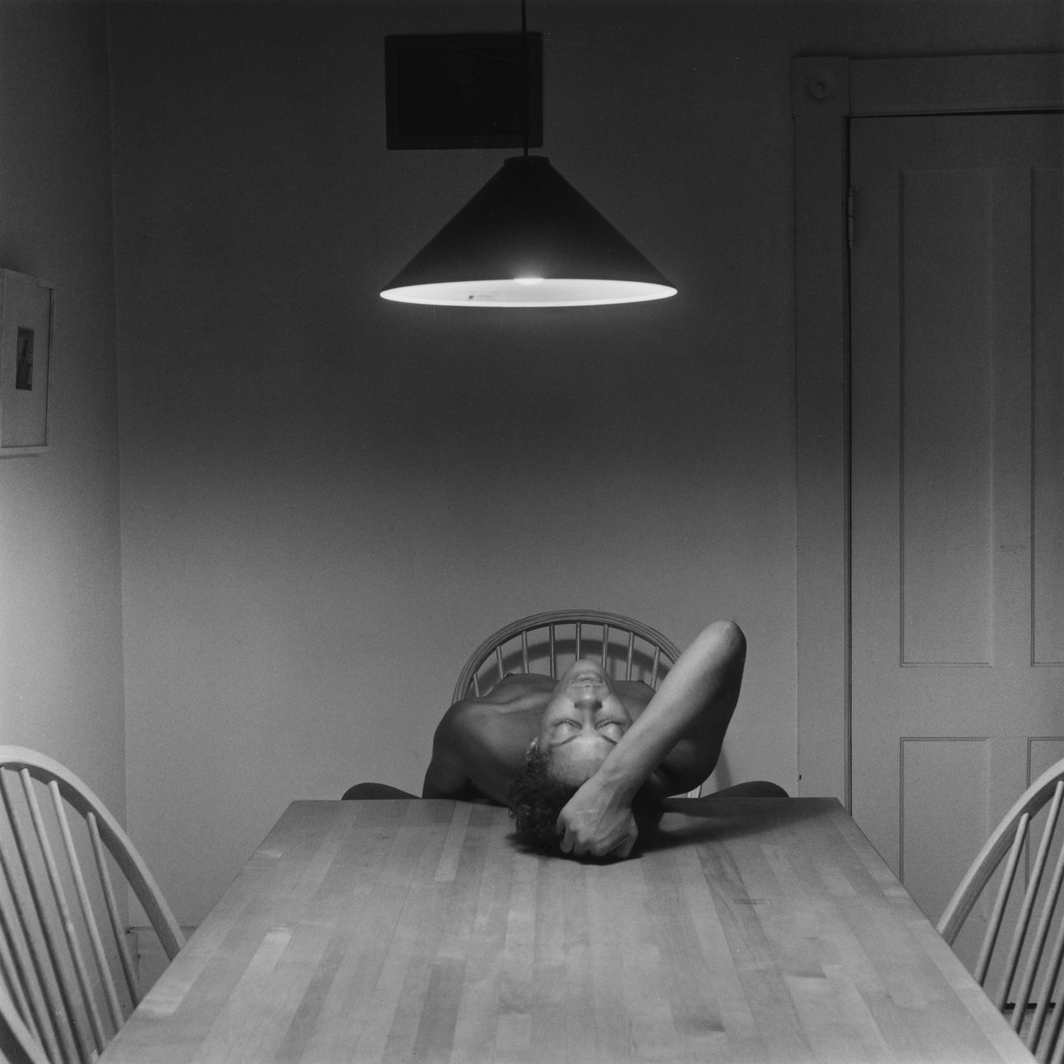
In I Looked and Looked … and in much of her work, Weems uses herself as a model; however, her work is not necessarily, or at least not exclusively, autobiographical. As curator Kathryn E. Delmez writes: “The figure is not meant to be a self‐portrait; rather, she represents Weems's alter ego or muse, a witness and guide leading the artist and viewer through the scene” (Reference Delmez and DelmezDelmez 2012, 9). Delmez here refers to Weems's first use of herself as a model in her Kitchen Table series (1990). In one staged photograph from that series, Untitled (Nude) (1990) [Fig. 4], a nude woman sits reversed in her chair alone in a kitchen. As she leans backward and rests the back of her head on the table, divine light from the lamp above cascades over her black skin. With eyes closed, knees spread, one arm reaching below, she savors a moment of autoerotic pleasure—discovering pride and joy in her body. By becoming a muse in both I Looked and Looked … and Untitled (Nude), Weems “others” herself. This distance between herself and the other offers her a space for a critical study of black female subjectivity that extends beyond self‐portraiture. This new other she creates replaces the racist and sexist other. The new other looks lovingly to the artist, and the artist looks lovingly to her, thus creating an intersubjective vision through which artist and muse mutually affirm each other. This new form of mirroring counters the social shaming of the black female body.
Carrie Mae Weems, Untitled (Nude), 1990, silver print, 28 1/4 x 28 1/4 inches. 28 15/16 x 28 15/16 x 1 1/2 inches framed ©Carrie Mae Weems. Courtesy of the artist and Jack Shainman Gallery, New York.
Weems's new intersubjective mirroring between artist and muse can be best understood using Oliver's notion of the loving eye. Rather than seeking to recognize and thereby fix an image of the other in one's mind, Oliver's loving eye is a critical eye that is always looking and looking again to see the other anew with the goal of creating “an ethics of love in order to avoid falling back into systems of domination, imperialism, sexism, racism and classism… . This process of loving, but with critical interpretation, opens up the possibility of working‐through rather than merely repeating the blind spots of domination” (Reference OliverOliver 2001, 209–10, 218). Oliver's loving eye contrasts with Lacan's model of vision in “The Mirror Stage,” which had hitherto been foundational in theories of subjectivity. On Lacan's analysis, the child's subjectivity—which is developed in the visual sphere by looking in the mirror—is split and alienated from the moment of its inception because he identifies with a specular other, exterior to himself, and a mere fragment of his whole image and whole being (Reference LacanLacan 1949/1977, 1–7).Footnote 2 Using herself as a muse, Weems constitutes herself as a subject before the mirror, but in a way counter to Lacan's description. Looking with a loving eye, the muse establishes a correcting mirror to reimagine the self. Oliver's work, like Weems's art, refutes Lacan's assertion that the mirroring gaze is necessarily alienating; in fact Oliver argues that an alienating gaze does not constitute subjectivity, but rather undermines it.
Oliver's loving eye is built on an intersubjective notion of mirroring, one that I am claiming is operative in Weems's relation to her self‐muse. The individual works of psychoanalysts Donald Winnicott and Heinz Kohut can help to articulate Oliver's position. Winnicott noted there is a mirror before the mirror of Lacan's mirror stage; this archaic mirror is the mother's smile (Reference WinnicottWinnicott 1971, 111–18), or, more generally, the smile of caretakers. When the infant smiles and her caretaker smiles back, she is validated as a subject. Kohut offered a similar model with his “mirroring self‐object,” which is a person “who responds to and confirms the child's innate sense of vigor, greatness and perfection … looking upon him with joy and approval” (Kohut and Wolf 1978, quoted in Reference Mitchell and BlackMitchell and Black 1995, 159–61). As psychologists Sandra Mann and Cheri Marmarosh write: “A healthy mirroring self object experience, such as being the gleam in the parent's eye, facilitates self‐esteem, ambitions, and the ability to assert oneself later in life” (Reference Mann and MarmaroshMann and Marmarosh 2014, 298). All of this is to say, innate intersubjective mirroring between child and caretaker forms the child's sense of self and self‐worth, or as Oliver states, we become subjects by virtue of our visual and dialogical relationships with others (Reference OliverOliver 2001, 18). If we extend the understanding of child–caretaker mirroring from Winnicott and Kohut into social mirroring, as Oliver does, and think of society's gaze as a parental one, Weems's art becomes a way of re‐parenting the black female subject, of offering a loving gaze to her instead of the denigrating one found in canonical art history or popular culture; Weems performs this mirroring with her own body, making herself a muse or other, an other who is not antagonistic to the self, but rather, validating. Furthermore, as a generalized muse rather than an individual self‐portrait, the artist's body becomes available to others, thus offering a model for seeing the black female body outside of the pathological mirror of sexism and racism.
In I Looked and Looked … Weems forges a new image of beauty (as the narrator at the end of Not Manet's Type had suggested could happen, by “Taking a tip from Frida”). Beauty is not the object of a male gaze in Weems's work, but rather, it is evidence of the empowering ability to love the self. Often the mirror, such as the handheld one Weems uses in I Looked and Looked …, becomes an apparatus of shame when used by women to compare themselves against impossible cultural assumptions about beauty that can infect the gaze of the female subject staring at her reflection. Sociologist Kjerstin Gruys responded to this societal pressure by avoiding mirrors altogether, an experience that she recounts in her book Mirror, Mirror, Off the Wall: How I Learned to Love My Body by Not Looking at It for a Year (Reference Gruys2013). Weems tries a different tactic: rather than avoiding the mirror, she looks into it and looks into it again, a point reinforced by the duplicate photographs mirroring each other—it is as if the first photograph embodies the “I Looked” of the title and the second embodies the “and Looked.” By looking and looking again, Weems directly engages in the kind of critical looking for which Oliver's loving eye calls.Footnote 3
From Here I Saw What Happened, and I Cried: Viewing with the Loving Eye
With her theory of the loving eye, Oliver claims that we have an ethical obligation to respond to other people and to make sure others have the ability to respond; this is because our own subjectivity exists owing to the time others spent looking and responding to us (Reference OliverOliver 2001, 15). In this section I show how Weems employs mirroring in From Here I Saw What Happened and I Cried (1995) [Fig. 5] as she asks her audience to extend a loving eye to others who were oppressed, shamed, and silenced in their lifetimes.
Carrie Mae Weems, Installation view of the exhibition “Pictures by Women: A History of Modern Photography (Part 2)” May 7, 2010–April 18, 2011. The Museum of Modern Art, New York, NY, USA. Digital Image © The Museum of Modern Art / Licensed by SCALA / Art Resource, NY.

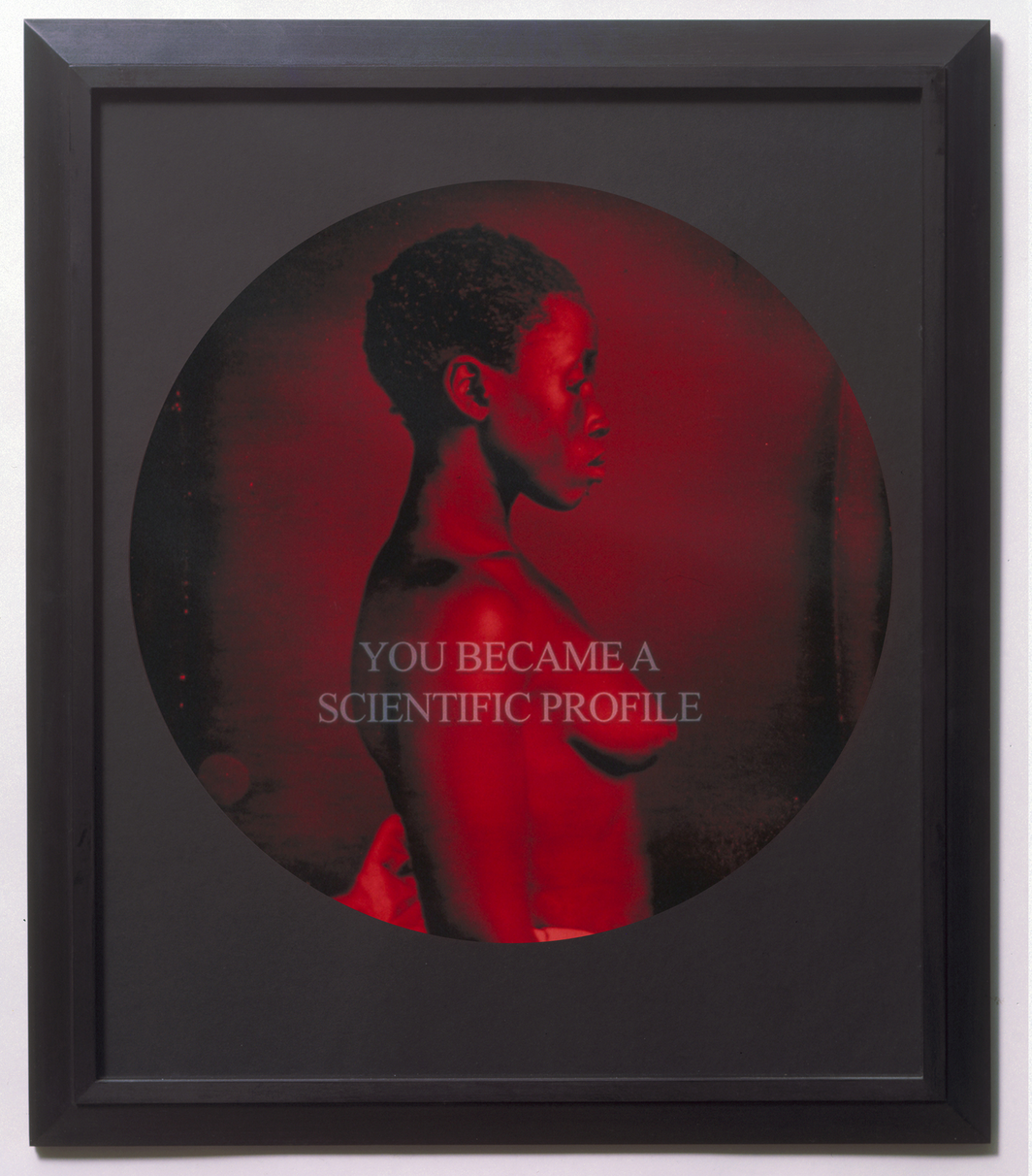
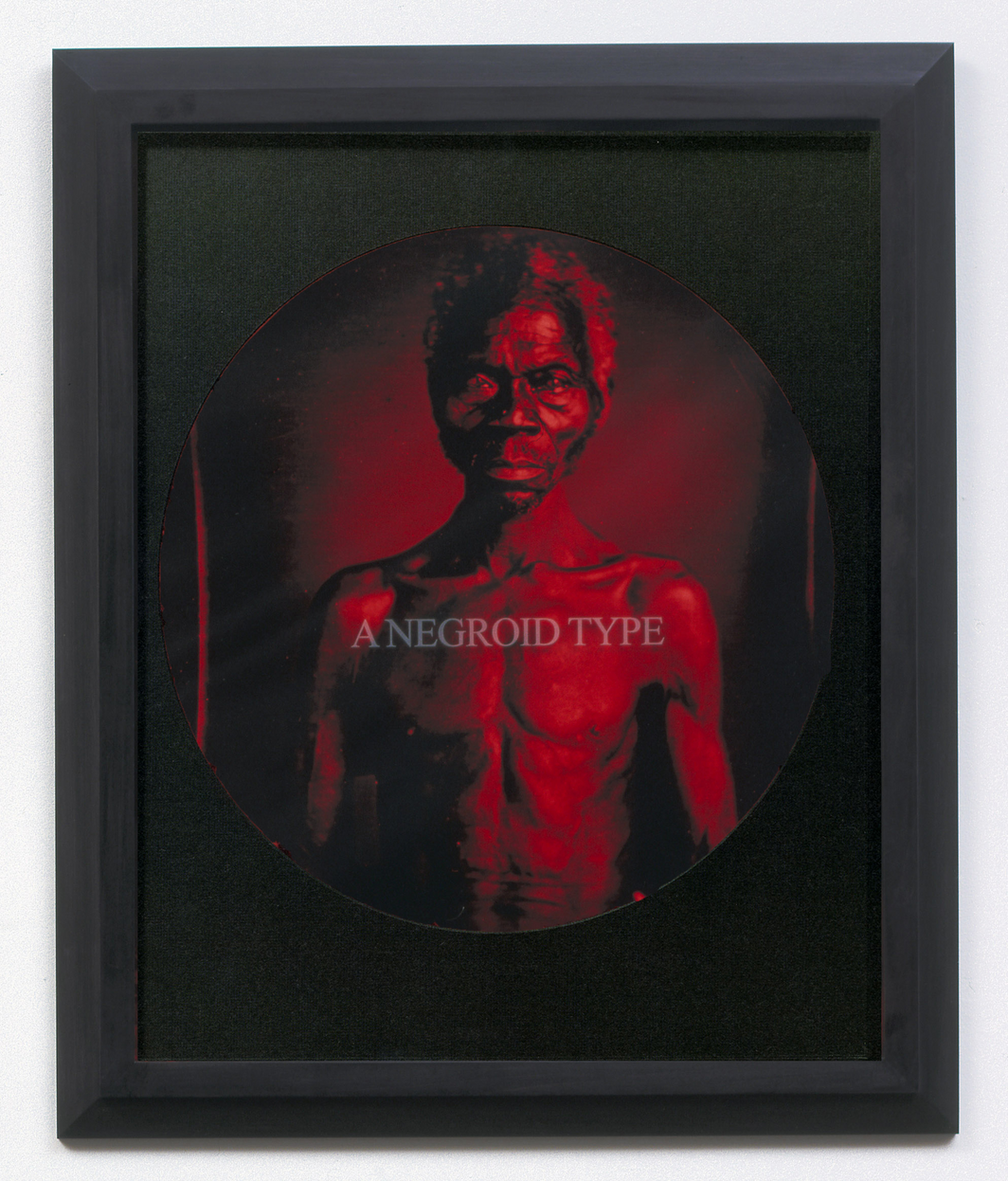
The work bears witness to the subjectivity of blacks who had been humiliated in American history, through a series of fourteen appropriated photographs enlarged, framed in black, and set behind glass with text sandblasted into the surface. The first and last pictures are the same: profile views of an African woman (Nobosodrou, a Mangbetu woman in the Belgian Congo, photographed by Leon Poirier and George Specht during the French Citroen Expedition through Africa, March 1925) and tinted blue by Weems. Etched on the glass of the first woman in blue are the words “From here I saw what happened” and on the last woman “and I cried.” The last woman is flipped horizontally so that the mirror images of this woman bookend and observe the remainder of the American photographs between them. Following the line of their gazes we see the cause of their sorrow in a series of pictures, roughly the same size and format as the blue ones but now colored red. The red pictures come from a variety of sources, but the first four [Fig. 6,Fig. 7,Fig. 8, andFig. 9] are from daguerreotypes taken in 1850 on behalf of Harvard natural scientist Louis Agassiz, who was looking for “proof” that African blacks and European whites were distinct species created separately (Reference WallisWallis 1995, 40). They show men and women who were enslaved on a South Carolina plantation; photographed against their will, they were shot from the waist up, bared and treated as mere property or specimens. Although shame and humiliation can both refer to an internal feeling, humiliation can also refer to the external act of the other that produces shame in the subject. The humiliating physical and psychological abuse of slavery, including the objectification of these four individuals before the camera, invokes shame visible on their faces.Footnote 4 In From Here I Saw What Happened … much of the worst humiliation in the series is done to women's bodies, showing Weems is concerned primarily—though not exclusively—with the multiple jeopardy of black female shame. In the original daguerreotypes, women are socially and sexually debased and their womanhood is targeted specifically, for example, by forcibly exposing breasts (Agassiz, in fact, had an explicit interest in the breasts) (Reference RaymondRaymond 2015, 37). King points out that in addition to enduring the same physical demands and punishments as black men under slavery, women suffered gender‐specific abuses, namely, institutionalized sexual slavery, rape, and the use of their reproductive and child‐rearing capacities as “capital” in a slave economy (Reference KingKing 1988, 47). The issue of black female shame is addressed in other images from the series as well.Footnote 5
Carrie Mae Weems, You Became a Scientific Profile, 1995–96, C‐print with sandblasted text on glass 26 1/2 x 22 3/4 inches. ©Carrie Mae Weems. Courtesy of the artist and Jack Shainman Gallery, New York.
Carrie Mae Weems, A Negroid Type, 1995–96, C‐print with sandblasted text on glass 26 1/2 x 22 3/4 inches. ©Carrie Mae Weems. Courtesy of the artist and Jack Shainman Gallery, New York.
Carrie Mae Weems, An Anthropological Debate, 1995–96, C‐print with sandblasted text on glass, 26 1/2 x 22 3/4 inches. ©Carrie Mae Weems. Courtesy of the artist and Jack Shainman Gallery, New York.

Carrie Mae Weems & a Photographic Subject, 1995–96, C‐print with sandblasted text on glass 26 1/2 x 22 3/4 inches. ©Carrie Mae Weems. Courtesy of the artist and Jack Shainman Gallery, New York.
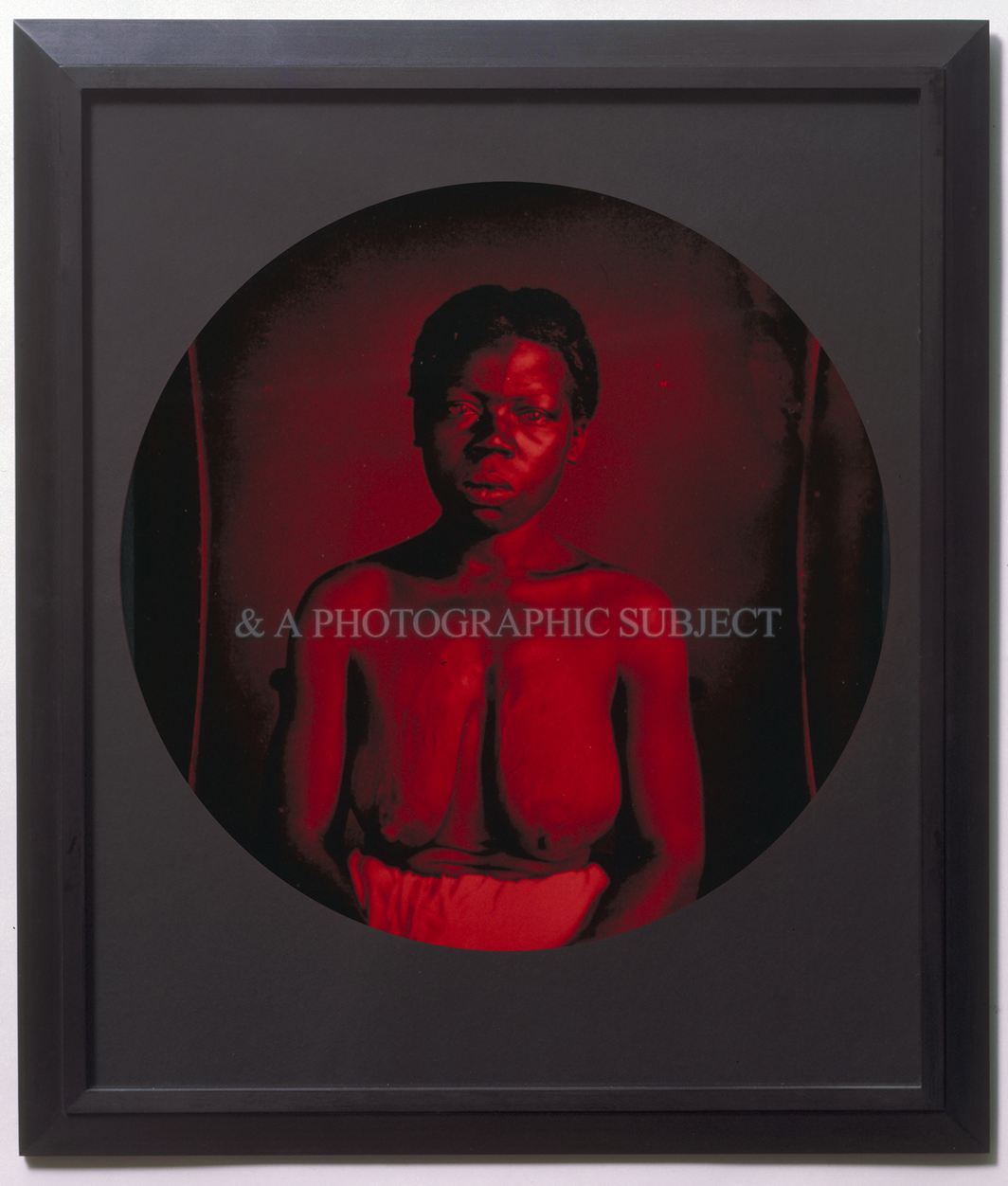
Weems placed a circular mat around each of her images, the aperture of which draws the viewer's attention to the role of vision in the shaming of these individuals and underscores Wurmser's claim that “the eye is the organ of shame par excellence” (Reference Wurmser and NathansonWurmser 1987, 67). Weems points out that these appropriated images in their original context were meant “to undercut the humanity of Africans and African‐Americans”; when looking at the photographs we see “how white America saw itself in relation to the black subject” (Weems, quoted in Reference Willis and DelmezWillis 2012, 33, 35). This idea is particularly significant because the daguerreotype itself is a mirrored plate; reflected over the image, the contemporary white viewer would have literally seen himself in relation to the black subject. Presenting the daguerreotypes now out of their original context, Weems asks the audience reflected in the glass over each image to look at these images again, seeing themselves in relation to these black subjects. As Delmez writes, “through the act of performance, with our own bodies, we are allowed to experience and connect the historical past to the present—to the now, to the moment. By inhabiting the moment, we live the experience; we stand in the shadows of others and come to know firsthand what is often only imagined, lost, forgotten” (Reference Delmez and DelmezDelmez 2012, 9).
The text plays a vital role in facilitating the audience's bodily performance. Across the glass of the four framed photographs is etched the sentence: “You became a scientific profile / a negroid type / an anthropological debate / and a photographic subject.” “You” in this sentence, insofar as it speaks on behalf of the people depicted, revitalizes these subjects by giving voice to those who had no voices in the moments the photographs were taken and bears witness to the injustices inflicted on them. In this way Weems tries to sublimate (in Oliver's sense of the term) on their behalf by inserting their voice into the social realm. The sentence does not read “He became an anthropological debate” or “she became a photographic subject” or “they became negroid types” in the distant third person; rather, as the viewer reads the words her interior voice speaks to the person whom she sees before her. Thus the viewer performs the restoration of subjectivity for these four individuals. The power of the “you” is generated by its juxtaposition with the images of the body, which provide an intimate connection to each person. In contrast to the small hand‐held daguerreotypes from which the images were appropriated, the viewer sees each person, nearly life‐sized, immediate, and standing before her, meeting her gaze. At the same time, “you” can also refer to the viewer reading, and thus the work can speak to its audience. “You” can speak to any viewer who identifies with the history of the black Americans depicted, but it also calls on all viewers to empathize with the shame and humiliation of these four individuals. As the viewer reads the text and sees her own body reflected in the glass and superimposed over a fellow person, the work poignantly asks, “What if this were you?” Weems said this is “a strategy I hope gives another level of humanity and another level of dignity that was originally missing in the photograph,” and she has “the hope that in the end our mutual humanity will be understood and raised” (Reference WeemsWeems 2010, n.p.).
The Contest for Beauty
In her effort to raise our mutual humanity, Weems offers new ways of seeing others and seeing the self. In the works of mirroring, Not Manet's Type, Mirror, Mirror, and I Looked and Looked …, Weems raised questions about beauty. Willis has argued that beauty is a central theme in Weems's work (Reference Willis and DelmezWillis 2012, 33), and as curator Thelma Golden points out, “Belying the myth that conceptual artists disdain the old‐fashioned notion of aesthetics, Weems has long been consumed and galvanized by the idea of beauty” (Golden, quoted in Reference Willis and DelmezWillis 2012, 33). Beauty cannot be divorced from politics in Weems's work, for social melancholy undermines the subject's ability to see herself as beautiful. Artist and philosopher Peg Zeglin Brand notes beauty is at the center of debate about the role of the female body in media, pornography, cosmetics, and exercise; and art beauty is not isolated from mass culture (Reference Brand and BrandBrand 2000, 3). Dominating culture has systematically tried to steal the black female subject's right to beauty through shaming practices, from Agassiz's denigration of the enslaved people in From Here I Saw What Happened … to the present‐day stereotypes in popular culture implied in Mirror, Mirror. hooks points out that for groups that have been denigrated as ugly by dominating culture, beauty becomes a counter‐hegemonic practice (Reference hookshooks 1990, 104–13). Whether with a vanity mirror, a magic mirror, or a handheld mirror, Weems shows that to counter shame, the mirror is a critical apparatus for the construction of black female subjectivity and beauty.
Beauty does not function in the service of objectification in Weems's work; rather, as in hooks's writing, it is the outcome of constructing self‐love when standing before the mirror. An objectifying gaze of sexism and racism undermines not only agency and self‐worth, as Oliver points out, but beauty as well. A loving gaze can restore beauty, that is, the gaze with which Weems's muse in I Looked and Looked … sees herself and the gaze with which viewers will hopefully see the individuals in From Here I Saw What Happened… . Weems's works of beauty begin to change the visual landscape of American culture and offer a new ideal. Instead of seeking recognition in the distorted reflection of the pathological mirror of racism and sexism, Weems enables black female subjectivity to be reflected in her photographs, such as I Looked and Looked… . Countering the denigrating stereotypes in dominating culture that serve to shame black female subjects, Weems forges a new image of black female beauty making it possible to “cherish mirrored reflections” (Reference hookshooks, 1990, 66).


