One of the most enduring debates in the field of Chinese politics centres on the elite political equilibrium in the Chinese Communist Party (CCP). On the one hand, scholars argue that Mao and other CCP leaders consistently sought to gain complete dominance over the Party. On the other hand, it is argued that factional politics at the top produces too much transaction cost such that no single faction can dominate. This debate has been the topic of much research and discussion in the past few decades. Clear historical examples can be brought to bear to support both sides.
This article offers a novel perspective on the debate by taking advantage of a quantitative data set recording the biographies of all Central Committee (CC) members from the first to the 16th Party Congress. In essence, we process this data set to derive an indicator of how influential the official heads of the CCP were in the CCP elite, as represented by the Central Committee, over time. We also compare the CC support base of the official heads of the Party with the CC support base of potential challengers. The results are quite striking: although the CC elite saw a period of consolidation during the Anti-Japanese War and the subsequent civil war, after the 1956 Eighth Party Congress not even Mao could maintain a dominant presence in the Central Committee.
This is not to say that the “winner takes all” school lacks empirical support. The Party secretary general enjoyed great influence over the CC elite when the CCP faced the gravest threats from external enemies. However, when these threats were overcome, the head of the Party lost his commanding presence relatively quickly. We also find consistent evidence that the official heads of the Party tried hard to eliminate challengers and to bolster their own faction through promotions and political struggle. Even today, both Jiang Zemin and Hu Jintao sought to introduce officials with whom they had previous ties into the CC presumably to bolster their own influence. Evidence, however, suggests that large-scale purges in the Party elite may have a self-defeating effect. Although the Cultural Revolution and the purge of Lin Biao wiped out the influence of Mao's potential rivals, Mao's own influence also retreated towards the end because he purged many officials with the deepest historical connections with him. In the following, we briefly recap the debate on elite political equilibrium, then give a description of the CC data and the way we derive our “PSGI” indicator, before presenting our findings.
The Debate
The debate on the political equilibrium in elite Chinese politics dates back to 1973 when Andrew Nathan published “A factionalism model for CCP politics” in The China Quarterly. In this seminal article, Nathan first develops a comprehensive model of a faction, which centres on the reciprocal exchanges between patron and clients that loosely hang on the formal institutions.Footnote 1 Arguing against the prevailing wisdom of the time, Nathan goes on to assert that factional politics gives rise to too much transaction cost such that no single faction can possibly gain complete dominance over the Party. In consequence, a “code of civility” emphasizing coexistence develops between the factions.Footnote 2
As can be expected, making such an argument just after the wholesale removal of Lin Biao's faction drew loud protests from China scholars who had been arguing that Communist politics was a game of “winner takes all.” The main rebuttal came from veteran China watcher Tsou Tang at the University of Chicago, who penned an essay refuting Nathan's model point by point.Footnote 3 Beyond attacking Nathan's factional model, Tsou strongly disagrees with his conclusion that a code of civility can ever develop between CCP elites. Tsou argues that because the Party faced severe external threats for much of its early existence, any cleavage between leaders must be settled through decisive victory by one side, otherwise external enemies would have taken advantage of the Party's internal division. Power in the CCP was then “monistic, unified, and indivisible.”Footnote 4
This debate persisted as scholars on both sides conducted in-depth historical research on elite and provincial politics to find support for the two arguments.Footnote 5 The debate was a difficult one to settle because after 1949, Mao behaved as if he wanted total control over the Party, purging many of his potential challengers.Footnote 6 At the same time, CCP politics also underwent periods of apparent tranquility, when top leaders co-operated with each other with little observable conflict. These periods, however, were repeatedly interrupted by episodes of intense fracas, which saw out-pourings of animosity between leaders. For example, as the literature converged towards institutionalization of the regime in the 1980s,Footnote 7 1989 occurred, which saw the sudden removal of the formal head of the Party by a group of retired cadres. Even into the 1990s, massive anti-corruption drives were interpreted as either routine house-cleaning or as signs of political purges.Footnote 8
The debate contains two core issues that this article seeks to address. First, could any leader in the CCP gain and sustain a dominant position in the Party elite? If so, we would tend to believe in Tsou Tang's perspective. Relatedly, is this dominance overwhelming when compared with the influence of a potential challenger in the Party? Second, were there signs that leaders systematically tried to improve their position by removing rivals and inducting followers into the Party elite? If so, it would be difficult to argue that a “code of civility” has developed between the top leaders. In the analysis below, we find that the Party elite consolidated to a great extent around its leader during its life-and-death struggle against both the KMT and the Japanese, as predicted by Tsou. However, we did not find that Mao and other top leaders could hold on to a dominant position after the end of the civil war. Thus, the “monism” in the Party was much less sticky than supposed by Tsou. However, instead of a “code of civility,” we consistently observe signs that top leaders tried to bolster their own relative influence in the Party elite, as represented by the Central Committee.
This debate on the elite political equilibrium in China is also germane to the current discussion on authoritarian power sharing. Recent works observe that most dictatorships in the post-war era have forums that share some power with the dictator.Footnote 9 Some authoritarian regimes even go as far as holding elections and tolerating opposition.Footnote 10 Existing work attributes the need for power sharing to external pressure or threats to the regime, in sharp contrast to Tsou Tang's expectation.Footnote 11 In our findings, however, Mao allowed more members of other factions into the Central Committee after external threats were eliminated, contrary to the expectation of these theories. Subsequent shocks to the regime, such as the 1989 Tiananmen protest, did not result in any additional power sharing by the faction of the Party secretary general. While it is not this article's place to draw any general conclusions based on findings in China, it certainly calls for more research on whether the organizational capacity of the ruling party and embedded institutions have an impact on dictatorships' ability to withstand shocks without resorting to power sharing.
The Data
The underlying data used in this article were collected by the authors to track the attributes and careers of all CC members from the First Party Congress (PC) to the 16th PC.Footnote 12 Although several existing data-sets track the careers of CC members, they are either qualitative data or focus only on CC members from one or a few PCs.Footnote 13 These efforts do indeed reveal important insights into the CC elite, but the pictures provided are snap-shots rather than a clear over-time view. Furthermore, we are aware of no quantitative data gathering effort that tracks the full careers of CC members through time. One difficulty that has plagued researchers is that senior cadres typically rotated through a series of positions – some of them held concurrently – in the course of their careers. Our project seeks to track these movements quantitatively so that a computer algorithm could be deployed to search for any subset within the CC elite. For example, if we want to locate CC members in 1966 who had been in the Fourth Field Army and also had worked in Sichuan province between 1949 and 1966, a good quantitative data set should allow us to use logical statements to search for these individuals instead of a laborious hand-search (only Deng Hua, it turns out).
Following Adolph's work on the careers of central bankers around the world, our database overcomes these difficulties by coding the position, start year and end year of nearly all the positions held by CC members throughout their careers.Footnote 14 In the resulting data, every row is a CC member. The columns record their basic demographic characteristics (gender, birth year, birth province and so on), but for jobs held by CC members, three columns are dedicated to each position: a numerical code to describe the position, start year and end year. Thus, even if a CC member had an extremely rich career with multiple concurrent positions, we only have to expand the number of columns to track it all.
With this conceptual breakthrough, we faced the challenge of laboriously coding the careers of over 1,600 full and alternate CC members while at the same time ensuring accuracy. We first developed a coding scheme, which assigns a numerical job code to nearly all significant positions in the CCP, the State Council, the military, the National People's Congress, the courts and so on. We then hired two research assistants to code the entire CC elite independently of each other. After they completed coding, they checked each other's work for inconsistencies. We then spent a long time adjudicating these inconsistencies. We finally had to conduct considerable historical research to clarify some inconsistencies and to fill in the missing data. The entire process took three years.
Factional Influence Indicator
To construct indicators of the absolute and relative influence of top leaders, we draw extensively from the literature on factions. To begin with, we were motivated to collect the Central Committee data on the assumption that the CC makes up the power elite in the Chinese political system. Although not all powerful figures are in the CC at any particular moment, most of them have served in the CC during the course of their careers. Our database allows us to trace their influence even after their retirement from the CC. Here, we are agnostic about whether CC members were “selectorates” capable of choosing the Party secretary general or were mere representatives of their factional patrons.Footnote 15 We only argue that the CCP power elite can be most comprehensively identified in the Central Committee.
Second, following a long tradition in the China studies, we presume that factional ties are formed on the basis of being born in the same province (tongxiang 同乡), being educated in the same school (tongxue 同学) and having common experience during the revolution or in a work unit after 1949 (tongshi 同事).Footnote 16 In the indicator we develop, we use a computer algorithm to search for CC members at a given moment who share the above ties with a top leader. Thus, by assumption, a leader with a wider range of experience is likely to enjoy more influence in the CC. Although by no means uncontroversial, this assumption generally adheres to the long-held intuition in the field that assigns weakness to leaders with narrow experience and strength to leaders with wide ranging experience, such as Deng Xiaoping or Hu Yaobang.Footnote 17
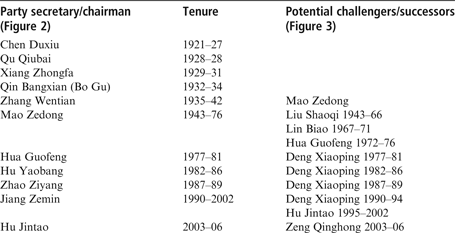
Armed with these assumptions, we designed a computer algorithm in Stata to look for CC members who share the background or experience of the formal head of the Chinese Communist Party from 1921 to 2006. For every year in that period, the algorithm first looks for members who served on the CC in that year. It then looks for serving CC members who shared characteristics with the formal head of the Party that year. If a serving CC member shared at least one experience or characteristic with the Party secretary general, that person is presumed to be a member of his faction. Table 1 outlines whom we identify as the formal heads of the CCP through time. For example, for 1942, the algorithm looks for serving CC members who shared some background or experience with Zhang Wentian. In 1943, however, the algorithm looks for serving CC members who shared experience with Mao Zedong because the March Politburo meeting had given Mao formal control over the Party.Footnote 18 Because this indicator only tracks the formal head of the Party, we call this the Party Secretary General Influence (PSGI) indicator.
Formal Heads of the CCP and Potential Challengers/Successors, 1921–2006

Note:
These dates are years used by the data set, which do not always match the actual year of ascension. As a rule, dates after September of a year are pushed forward to the subsequent year. This is done so we do not have overlapping leaders in a given year
Appendix A sets out the characteristics and experience we used to search for a leader's factional followers. We generally took into account birth province, university education and positions that top leaders held for more than one year as a basis of finding CC followers. Here, we provide a discussion of how we coded Mao, since his long reign over the Party dominates the PSGI indicator (1943–76). Coding Mao's early career was extremely challenging because he held a series of command positions in a constantly shifting Red Army organization. Fortunately, there was also underlying continuity throughout these organizational changes. First, Mao got his start as a revolutionary leader in Jinggangshan 井冈山, where he started one of the first communist base areas. Thus, we created a dummy variable for everyone who had guerilla experience in Jinggangshan in the late 1920s.
After Mao's Autumn Uprising forces joined Zhu De's Nanchang Uprising forces, they formed into the Red Fourth Army (Hong si jun 红四军), which later transformed into the Red First Corp (Hong yi juntuan 红一军团) in June 1930.Footnote 19 Although Mao was forced to relinquish command for brief periods, he remained closely tied to the unit and continued to command it through the Long March. Thus, instead of identifying all members of the Red Army as potential Mao followers, we only identify those who were officers in the Red Fourth Army or the Red First Corp before the end of the Long March. We also did not identify officers in other parts of the Red First Front Army (Hong yi fangmian jun 红一方面军) because it was an amalgamation of various units, only a part of which was the Red First Corp. At the end of the Long March, the Red First Corp merged with Peng Dehuai's Third Corp. Thus, it was no longer clear that the unit was Mao's personal domain.
Mao's other main position before the Long March was chairmanship of the Jiangxi Soviet. Although the CCP between 1931 and 1935 was dominated by the Three-Man Group headed by Otto Braun, Bo Gu and Zhou Enlai, Mao, having formed the Soviet, had more direct control over the administration of the Soviet.Footnote 20 Thus, we identified people who served in significant positions (chu level or above) in the Jiangxi Soviet as followers of Mao.Footnote 21 After the Long March, Mao was gaining de facto leadership over the entire Party. Beyond those who worked around him, Mao also had close personal contacts with those who attended the newly formed Anti-Japanese Military and Political University (AMPU, KangRi junzheng da xue, 抗日军政大学).Footnote 22 Especially in the early years of the AMPU, Mao “delivered a small lecture every three days and a major one every five days.”Footnote 23 Thus, in the period between 1936 and 1943, when Mao finally assumed formal leadership over the CCP, we identify all faculty and students of the main AMPU campus as his followers.Footnote 24 Finally, during the two Party Congresses that took place in the midst of the Cultural Revolution (Ninth and Tenth), Mao introduced a significant group of young mass representatives into the CC who otherwise had little revolutionary experience or institutional power.Footnote 25 These representatives were blindly obedient to Mao's teachings. To capture this dynamic during the Cultural Revolution, we also included CC members below the age of 40 between 1969 and 1976 as Mao followers.
Like any research approach, there are obvious flaws in deriving a quantitative indicator of leaders' influence in the CC. First, to the extent that CC membership reflected support enjoyed by the chairman or the PSG, it was often a lagging indicator since CC selection often took place after the real power struggle. This was particularly the case during the Cultural Revolution, when many purged cadres nominally remained in the CC until the 1969 Ninth PC. We fully acknowledge that someone's influence in the CC may just be a reflection of an underlying source of power rather than power itself. Here, however, we are only trying to show that CC influence is an important and sometimes lagging indicator of power.
A much more serious issue concerns measurement error. As Dittmer famously points out, “an objective basis for an affinity does not necessarily create one.”Footnote 26 Since we only have the objective basis of factional ties, there are bound to be measurement errors. Readers should be aware that this research is only valid if the guesses we make about factional ties are on average correct. Research on measurement error involving binary variables, such as factional ties, shows that a basic precondition for accepting the finding is that there has to be a positive correlation between the underlying truth and the measured binary variable.Footnote 27 Of course, since no one knows the complete truth (perhaps except for Mao himself), a part of this is taken on faith.Footnote 28 Beyond drawing on long-held wisdoms in the field about the bases of factional ties, we also employ three strategies to bolster confidence in our indicator.
First, we mitigate the measurement error problem by not recording job coincidences once a leader has become the Party secretary general or Party chairman. This is to exclude sycophants. As a leader entered high politics, opportunists inevitably emerged to make claims of loyalty in an attempt to receive favours. When the top leader needed their support during a political struggle, however, they may not be so reliable. The usual exceptions were the private secretaries of the top leaders, who often became indispensable members of their factions.Footnote 29 To compensate, we also record a variable tracking the private secretaries (mishu 秘书) of various top leaders in the Party, at least those who eventually became CC members.
Second, if we make a mistake by including a certain characteristic as the basis of someone's faction, would that mistake undermine our entire analysis? To convince ourselves that this would not be a serious problem, we took various characteristics out of a leader's algorithm to see what would happen, especially for broad categories like birth province where errors are expected to be more common. For example, since both Liu Shaoqi and Mao were born in the same province, we expect there to be some measurement error for Liu's factional indicator if we included Liu's native province as a basis of his faction. When we removed Hunan as a basis of Liu's faction, Liu's influence fell in the CC, as expected. However, we find that the new Liu factional indicator moves in the same directions through major political shocks (Seventh, Eighth and Ninth PCs) as the Liu factional indicator including birth province. Thus, although including Hunan natives distorted our estimate of the level of Liu's influence in the CC, we got very consistent sense of how Liu's influence changed over time. More formally, we also calculated the first difference of Liu's factional influence with and without Hunan and found that the first differences are correlated with each other at the 0.9 level. This suggests that the two indicators are basically parallel with each other. We conducted similar analyses on other leaders and found the same pattern. Thus, in the analysis below, we urge readers to be more sceptical when we make claims about the level of a leader's influence. We are, however, much more confident about tracking major changes in leaders' influence in the CC over time.
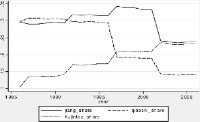
Finally, we conduct a basic analysis of contemporary politics to check that these indicators accord with our qualitative observations. In analysing the contemporary era, observers typically identify Qiao Shi 乔石 as a serious contender to Jiang Zemin until the 15th PC, when Jiang forced Qiao into retirement.Footnote 30 Qiao Shi is a giant in contemporary Chinese politics, groomed for the highest level as he took over the powerful Central Organization Department in 1983 and entered the Politburo as early as 1985 at the special national Party conference.Footnote 31 He was among those who dared to criticize Jiang directly for reacting too slowly to Deng's Southern Tour in 1992.Footnote 32 Meanwhile Jiang, despite a rich career in the economic bureaucracy and time as Shanghai Party secretary, did not enter the Politburo until the 13th PC in 1987. As shown in Figure 1, Qiao and Jiang had roughly the same level of influence in the CC in the late 1980s, with Qiao perhaps slightly ahead. At the 14th PC, however, Jiang pulled ahead of Qiao as he was formally anointed Deng's successor.
Share of Central Committee with Ties with Jiang Zemin, Qiao Shi and Hu Jintao, 1985–2007

Qiao Shi and some 32 CC members with ties to him were finally forced into retirement at the 15th PC.Footnote 33 These included Ren Jianxing, Qian Zhengying, Lu Feng and Ruan Chongwu. The divergence between Jiang and Qiao's influence at the 15th PC bolsters our confidence in the indicator. The indicator is not capturing a cohort effect since Jiang and Qiao are only two years apart in age. Thus, their factional followers should have had roughly the same age distribution and retired around the same time. Yet, the 15th PC saw Qiao's followers being removed wholesale, while Jiang's influence in the CC actually increased.
Figure 1 also records the steady rise of Hu Jintao's faction in the CC, starting in the mid 1980s when Hu Yaobang promoted a cohort of young officials to the Central Committee of the Communist Youth League.Footnote 34 The promotion of Hu Jintao into the Politburo Standing Committee at the 14th PC allowed those who had worked with him to enter the CC in a steady stream in subsequent PCs. Over time, observers identify individuals like Li Keqiang, Li Yuanchao, Song Defu and Zhang Baoshun as members of the Communist Youth League clique.Footnote 35 By the 16th PC, Figure 1 shows that Hu and Jiang had roughly the same level of influence in the CC. From everything that we know, our influence indicator provides a rough sense of the level of a leader's influence and a much more precise sense of when a leader's influence changes significantly.
What Was the Political Equilibrium?
The Party Secretary General Influence indicator tracks the influence of the formal heads of the Party. We fully acknowledge that in various periods there were more powerful figures in the Party than these individuals. However, part of the exercise is to see how these leaders held up to other powerful figures. An examination of our indicator through the 16 Party congresses reveals that after some initial hiccups in the 1920s, the Party consolidated to a large degree around its formal head during the period of struggle and great expansion between 1931 and 1956. However, although Mao held a dominant position in the Party for 13 years (1943–56), his tight grip diminished at the Eighth PC and further deteriorated into the Cultural Revolution. No formal leader of the CCP has come close to replicating Mao's elite influence in the late 1940s.
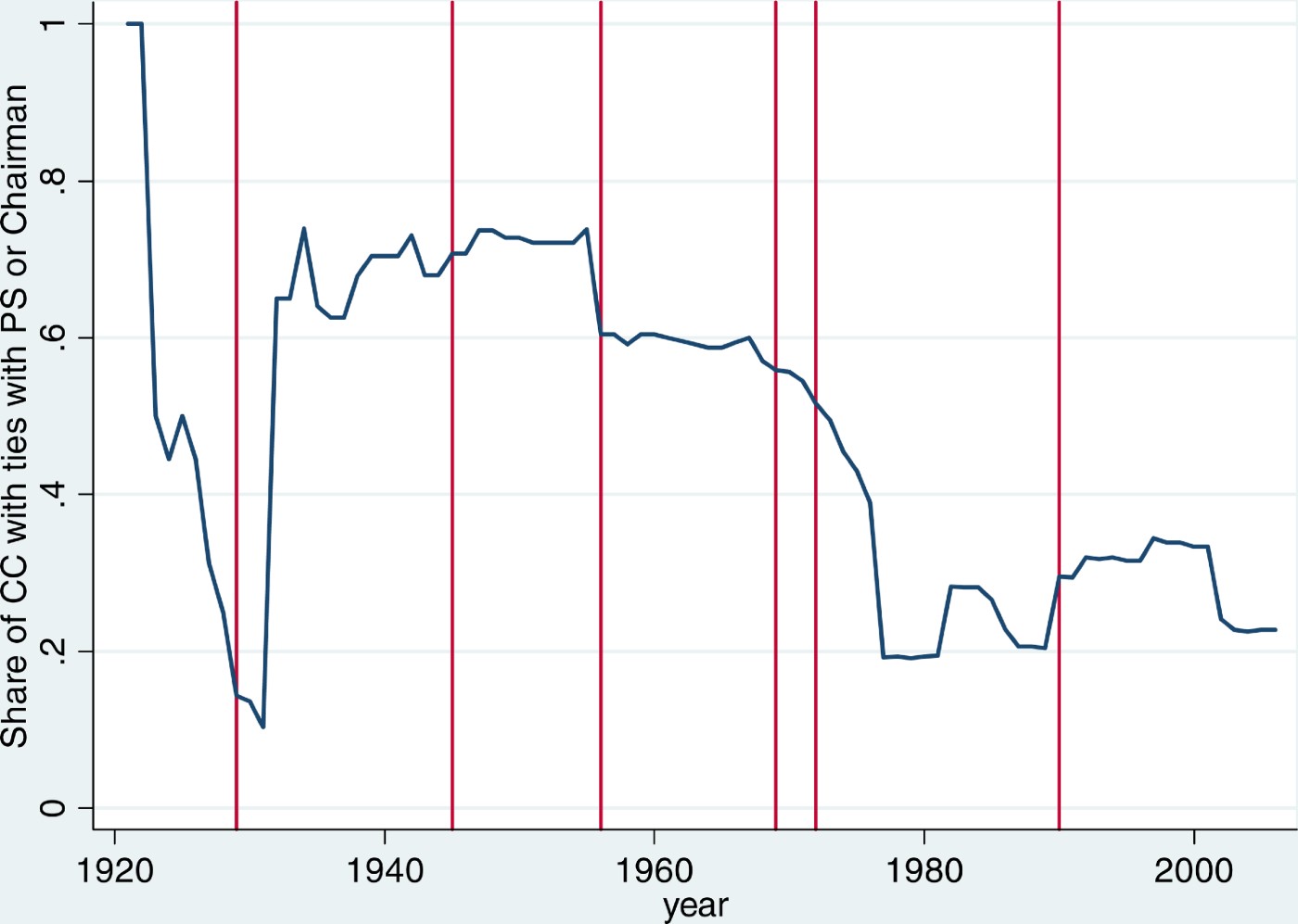
As Figure 2 reveals, the early CCP elite was quite homogenous. At the First PC in 1921, the elected members of the central bureau included Chen Duxiu 陈独秀, Li Da 李达 and Zhang Guotao 张国焘. Chen and Zhang shared Peking University ties, where the former was a professor and the latter was a student activist. Li Da and Chen Duxiu shared the experience of studying in Japan. The group was cosmopolitan and intellectual. At the Second PC in 1922, the group was mainly dominated by intellectuals with Peking University connections, including new CC members Gao Junyu 高君宇, Deng Zhongxia 邓中夏 and Li Dazhao 李大钊.
Share of Central Committee with Ties with the Party Secretary General or Chairman (PSGI)

Into the 1923 Third PC, significant heterogeneity was introduced, as Figure 2 shows. Although Mao Zedong 毛泽东 worked a short stint at the Peking University library under Li Dazhao, he was by no means an urbane intellectual. Newcomers Wang Hebo 王荷波, Zhu Shaolian 朱少连 and Xiang Ying 项英 were worker activists who did not even attend high school. At the 1925 Fifth PC, the newcomers were mainly intellectuals, but they were from all across China and had studied in Europe and Russia instead of Japan. As the Party diversified, Chen Duxiu simply could not adapt to its evolution from a movement of intellectuals to one dominated by workers and labour activists.Footnote 36
The May 30th anti-imperialist riots in 1925 saw the induction of thousands of workers and students into the Party.Footnote 37 This was augmented by the decision at the Fifth PC to develop Party organization further in labour unions and mass organizations. Thus, at the 1927 Sixth PC, many activists who took a leading part in the May 30th Movement were elevated into the CC. Gu Shunzhang 顾顺章, a labour activist at a tobacco factory, was typical of this cohort of new entrants.Footnote 38 Having received almost no formal education, Gu was nevertheless prized by the Party and the Comintern because he represented the future of the revolution, which at that time the CCP believed would lie in urban revolution. Unfortunately for the CCP, many worker activists from that cohort of new CC entrants defected from the Party in the next few years, including Gu himself.Footnote 39
The replacement of Chen Duxiu by Qu Qiubai 瞿秋白 in late 1927 did not boost the PSGI indicator. Like Chen, Qu was an intellectual who had little in common with the increasingly diverse CC body, which now included student activists from all across China and labour leaders. Qu was among the first batch of Soviet-trained cadres sent back to China, but many of his classmates were still matriculating in Moscow. The CC membership in this period was also highly unstable because of KMT “white terror” against the Communists and the concurrent defection of many top CCP leaders, which led to the arrest and execution of scores of senior cadres. Of the 22 new CC members at the Sixth PC, half were dead by 1931 after Gu Shunzhang's defection; three more died in the subsequent three years.
Qu's replacement by Xiang Zhongfa 向忠发, a labour activist from Wuhan, did not help the situation. As Figure 2 shows, the official head of the Party enjoyed the least influence in the CC under Xiang. Xiang was elevated to the top position by the Comintern at the Sixth PC convened in Moscow.Footnote 40 Before that, he had been a local labour leader with little contact with the rest of the Party. Thus, he had little in common with labour activists from other parts of China, including those from Guangdong or Shanghai. Similarly, he was not familiar with the Marxist intellectual core which still dominated the Party elite at the time. When he was promoted to the Politburo and rotated to Shanghai to “direct labour work” in late 1927, the other Politburo members excluded him from all the meetings, a clear sign of their distain for him.Footnote 41 Thus besides fellow Hubei natives, many of whom had also participated in the Hanyang strikes, Xiang had little influence over the rest of the Party. The CCP underwent one of its darkest periods with massive defections and betrayals in all the big cities and failed uprisings in the countryside. Halfway through his tenure, Xiang was little more than a figurehead as cadres trained in Moscow began to take over.
When Qin Bangxian 秦邦宪 officially took over the Party in late 1931 after Xiang Zhongfa's arrest by the KMT, several factors converged to elevate his influence in the CC. First, attrition eliminated many labour leaders from the CC. More important, Moscow learned from the mistake of Qu Qiubai and sent with Qin a cadre of “return Soviets” to serve in senior positions. These Soviet trainees, including Chen Yu 陈郁, Kang Sheng 康生, Wang Ming 王明 and Zhang Wentian 张闻天, became Qin's core support base in the subsequent two years. Having worked in the All China Labour Union and the Youth League headquarters in Shanghai, Qin was also not without revolutionary experience. Thus, during his brief term, the PSGI indicator recovered considerably.
In the subsequent two-and-a-half decades, our indicator shows that the official head of the Party enjoyed considerable support in the CCP elite. The consolidation of the political elite around its official head partly reflected the dire situation faced by the CCP in those years, necessitating the monism that Tsou observed.Footnote 42 After the 1935 Zunyi Conference, the compromise head of the Party, Zhang Wentian, maintained a strong support base within the CC by drawing from disparate elements in the Party elite. First, Zhang was perhaps the most cosmopolitan figure in the Party at that time, as he had studied overseas in France, the United States and the Soviet Union.Footnote 43 He thus had something in common with CC members who had studied overseas. Second, upon his return from Moscow, he worked in the propaganda department and the central secretariat in Shanghai with the likes of Zhou Enlai. He thus had the support of the urban revolutionaries at a time when the CC was still dominated by them. The third factor that helped Zhang was the remarkable stability of the CC elite during the severe traumas of the encirclement campaigns. During the Long March, when the Red Army shrank from over 80,000 to just a few thousand, not a single CC member died, which contrasted sharply with earlier periods when the KMT systematically hunted down top CCP officials.Footnote 44 Furthermore, although peasant fighters played a large role in the Party during the Jiangxi Soviet period, the Party learned not to change the elite composition too quickly. Thus, the equilibrium reached in the 1930s, which consisted of a mix of Soviet trainees, urban revolutionaries and early rural revolutionaries, was preserved until the Seventh PC in 1945.
When Mao took over as Party chairman in 1943, he had already spent over a decade nurturing his power through carefully cultivating allies, purging enemies and gaining control over ideology.Footnote 45 Thus he was able to maintain the commanding presence that Zhang had enjoyed. The conversion of return Soviets to his cause was particularly important in his ability to maintain a dominant presence in the CC. Wang Jiaxiang 王稼祥, for example, was sent from Moscow to support Qin Bangxian, but he ended up a Maoist after they served together in the Military Affairs Committee in the Jiangxi Soviet.Footnote 46 Likewise, internationalist Ren Bishi 任弼时 became an ardent Maoist after serving in various positions in Jiangxi. Thus, the apex of Mao's influence in the CC was at the beginning of his formal tenure as Party chairman. Between 1943 and 1956, Mao had some connection with roughly 70 per cent of CC members, suggesting dominance over the Party elite. Mao was never able to replicate this degree of influence in the CC.
The Eighth PC in 1956 was perhaps the most significant political event in the Mao era because its outcome probably influenced many later events. At the Eighth PC, Mao's dominant lead slipped significantly. One manifestation of his retreating influence was the removal of “Mao Zedong Thought” from the Party constitution at the congress.Footnote 47 Why did it happen? Between the Seventh PC in 1945 and the Eighth, the CCP grew from a movement of a few million to a ruling party with tens of millions of members. Moreover, whereas Mao promoted fellow guerilla fighters who had distinguished themselves in the 1930s at the Seventh PC, the prolonged struggle with the Japanese and the KMT cultivated many more impressive leaders and fighters for the Party. These included Tao Zhu 陶铸, Li Jingquan 李井泉, Hu Yaobang 胡耀邦 and Xiao Ke 肖克. They needed to be rewarded with CC membership, especially when they were taking up important positions in the new regime.
Who gained at the Eighth PC? Essentially, those who had front-line command during the Anti-Japanese War and the civil war such as Deng Xiaoping 邓小平and Lin Biao 林彪 were able to elevate many of their own lieutenants into the CC.Footnote 48 Although Deng and Lin were both Mao loyalists, the previous decade of commanding major units had given them opportunities to make connections with large groups of officers. Most important, although these junior officers knew that the leader of the Party was Mao, they themselves had no direct ties to him. Thus, although Mao supporters increased from 31 to 58 at the Eighth PC, Mao's relative influence in the CC declined because the CC had expanded from 42 to 96.
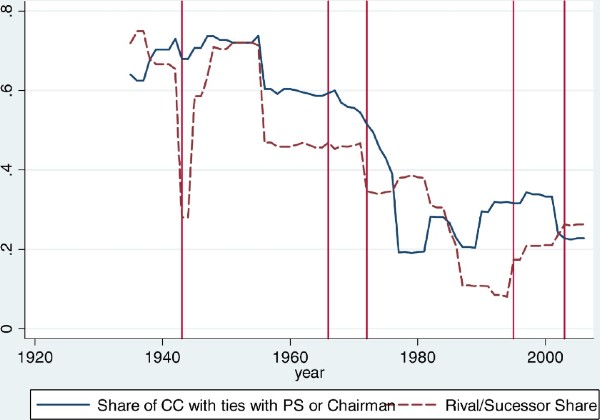
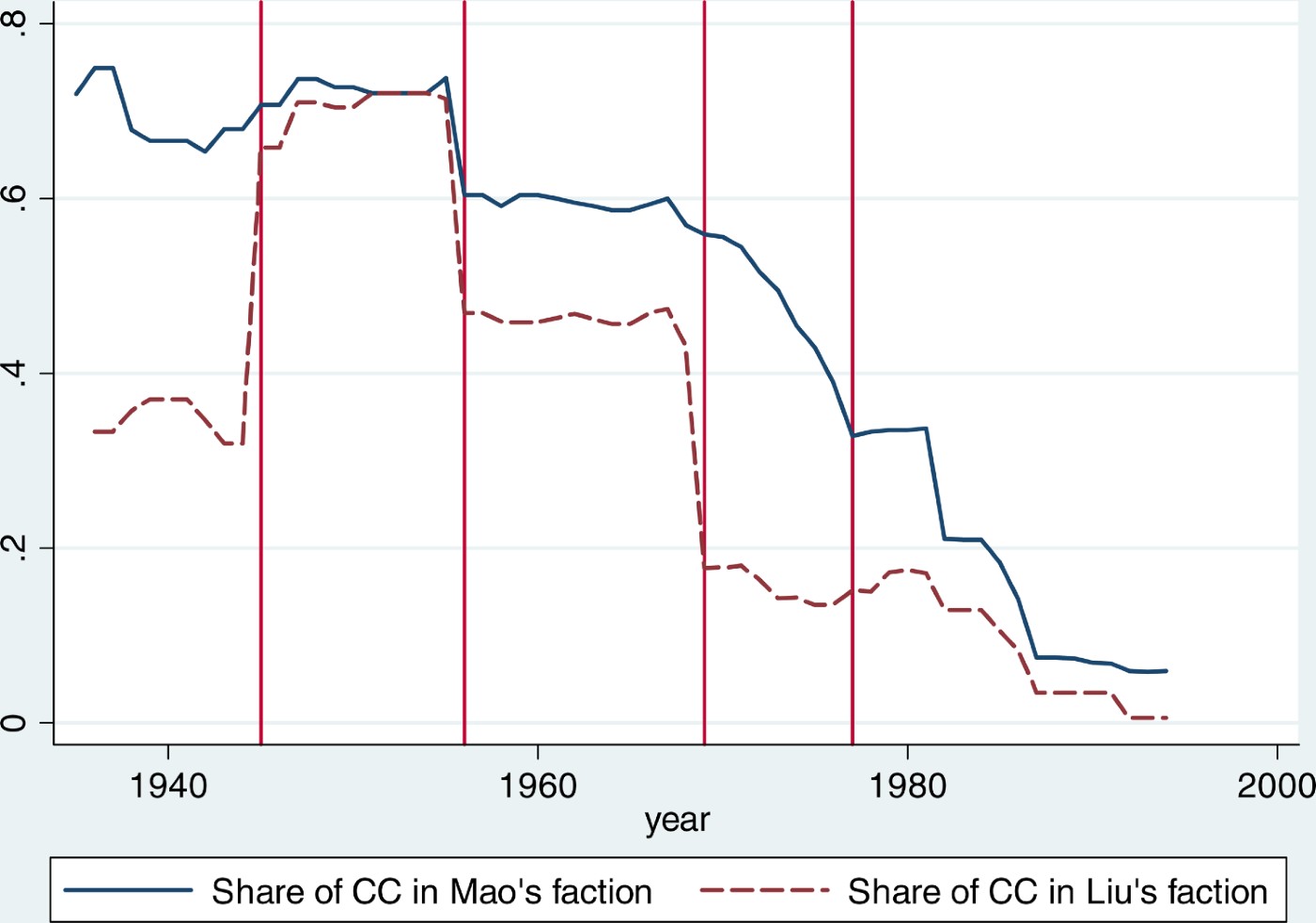
At this point, it may be instructive to examine Figure 3, which traces the influence of the official head of the Party relative to the key challenger/successor in the Party listed on Table 1. Figure 3 begins in 1935 because potential successors before that point were often chosen by Moscow with little consideration for the internal balance of power.Footnote 49 After the CCP lost contact with Moscow at the onset of the Long March, internal political balance began to exert a decisive influence on political outcomes. Before Mao took over in 1943, he was obviously the major challenger to Zhang's power, and Figure 3 shows that he consistently had roughly the same amount of influence as Zhang did in the CC, perhaps a bit more. After 1943, Liu Shaoqi became the heir apparent. At first, Liu did not have much in common with members of the Sixth CC, but his influence shot up rapidly at the Seventh PC (Figure 4). We do not believe this to be a coincidence. In the run-up to the Seventh PC, Mao put Northern Bureau veterans Peng Zhen 彭真 and An Ziwen 安子文 in charge of preparing a list of Central Committee members and alternate members.Footnote 50 Needless to say, several Northern Bureau cadres who had worked with Liu, including Peng Zhen 彭真, Bo Yibo 薄一波, Rao Shushi 饶漱石 and Lin Feng 林枫, were inducted into the CC for the first time at the Seventh PC. The sudden surge in Liu's influence in the CC elite was encouraged by Mao since Mao at that point considered Liu his most trusted ally.Footnote 51 Nevertheless, Liu took full advantage of Mao's blessing to stack the CC with his own followers. This action contrasts sharply with the view that Liu was a principled communist functionary.Footnote 52
Influence of the Party Secretary General Compared with Influence of Potential Challenger/Successor, 1935–2006

The Relative Influence of Mao Zedong and Liu Shaoqi in the Central Committee, 1935–1995

Returning to the Eighth PC, Figures 3 and 4 show that Liu Shaoqi's influence dropped much more than Mao's in 1956. Because of measurement error, we cannot say confidently how big the gap was, but the large disparity in our figure suggests that Mao might have intentionally prevented Liu from inducting more of his followers into the CC, perhaps even at the cost of allowing other factions to enlarge their presence. Mao had a high incentive to check Liu's power at the Eighth PC, since at that point Mao was considering retiring to the “second front.”Footnote 53 A more in-depth study of the Eighth PC would have to be conducted to clarify this issue.
Figure 4 then shows that Liu maintained a sizeable presence in the CC even after 1956. The start of the Cultural Revolution brought about the destruction of Liu's faction as his Northern Bureau followers were systematically removed from the CC at the Ninth PC (Figure 4). Liu's influence in the CC plummeted from over 50 per cent to below 20 per cent. Among those who had some ties with Liu, the only survivors at the Ninth PC were those who had worked with him in the New Fourth Army such as Chen Yi 陈毅, Deng Zihui 邓子恢 and Zhang Yunyi 张云逸 and those who had worked with him in the 1920s such as Xiao Jingguang 肖劲光.
Figure 3 shows that Liu's replacement as successor, Lin Biao, had roughly the same degree of influence in the CC as Liu had. At the same time, Mao's influence in the CC was showing a definite decline because of Cultural Revolution purges which eliminated many who had historical ties with him. Mao replenished his support base at the Ninth PC in 1969 by elevating more guerilla fighters into the CC, supplemented by an infusion of Red Guard and workers' representatives. Mao in fact vetoed Zhou Enlai's plan for a smaller CC and demanded the induction of mass representatives.Footnote 54 Our indicator suggests that Mao was aware of his slipping influence in the CC and wanted mass representatives to fill in the gap left by the purged cadres. Even so, his influence still declined after 1969.
The purge of Lin Biao saw a free-fall of Mao's influence in the CC, as shown in Figures 2, 3 and 4. The main reason was that Lin shared many followers with Mao as Mao was Lin's superior officer in Jinggangshan and in the Fourth Red Army. When Lin was purged, guerilla fighters with deep historical affinities with Mao, including Huang Yongsheng 黄永胜, Wu Faxian 吴法宪, Li Zuopeng 李作鹏 and Qiu Huizuo 邱会作, were also removed. The Lin Biao Affair also made Mao realize the danger of over-relying on the military, and at the Tenth PC in August 1973 he drastically reduced the number of People's Liberation Army CC members.Footnote 55 One effect was that many guerilla fighters who had established ties with Mao at Jinggangshan or at the AMPU were retired from the CC, leaving Mao with a mix of rehabilitated cadres such as Deng, civilian beneficiaries of the Cultural Revolution such as Yao Wenyuan 姚文元 and Wang Hongwen 王洪文, and peasant and worker representatives. Except for the remaining Army officers and some of the rehabilitated cadres, Mao in his last days did not share historical connection with much of the CC. This weakness greatly benefited Deng Xiaoping, who despite being rehabilitated in fits and starts, still enjoyed influence over roughly 30 per cent of the CC (Figure 3). He was, for example, able to form a new office in 1975 to do ideological battle with the Gang of Four.Footnote 56
When Mao's successor Hua Guofeng 华国锋 took over in 1976, he became the weakest Party secretary general since Xiang Zhongfa in the early 1930s (Figure 2). Worse still, the major force in the background was Deng Xiaoping, who was rehabilitated in the wake of Lin Biao's purge. Figure 3 shows clearly that Deng enjoyed a sizeable advantage over Hua in the CC in 1976. In fact, Deng's influence increased at the 1977 11th PC, when scores of his followers were introduced into the CC. These included Chen Guodong 陈国栋, Cheng Zihua 程子华, Liao Zhigao 廖志高, Lu Dadong 鲁大东, Luo Ruiqing 罗瑞卿, Xiao Hua 肖华, Ye Fei 叶飞 and Zhang Aiping 张爱萍. This accords with previous research which blames Hua's fall on his weak influence in the Party elite relative to Deng.Footnote 57 Although Deng ultimately did not become the Party secretary general, he chose someone with a relatively rich support base to be the Party's next leader, Hu Yaobang.
In the 1980s, a major puzzle that emerged was why Hu Yaobang and Zhao Ziyang dared to challenge Deng when he clearly had so much influence in the Party. One answer was that they both underestimated Deng's informal power.Footnote 58 A reason for this might have been that Deng's supporters were retiring from the CC in healthy numbers at the 12th PC. Zhao Ziyang, who took over after Hu's demotion in 1987, oversaw one of the most sweeping retirement drives of CC members at the 13th PC.Footnote 59 Many who retired at that time had historical ties with Deng, causing Deng's influence in the CC to plummet (Figure 3). This fact might have given Zhao the confidence to go against Deng's wishes in 1989. In particular, Zhao grossly underestimated the extent to which crucial decisions could still be made by Deng and members of the Central Advisory Committee. If that had indeed been Zhao's calculation, it was not as irrational as it seems from today's perspective.
Although many consider Jiang Zemin, Zhao's replacement after 1989, to be a relatively weak figure at the beginning, our indicator shows that he was probably more influential in the CC than Zhao was. One reason was that Jiang had risen through the ranks of the First Ministry of Machinery, which nurtured many senior officials who came to power in the late 1980s. Also, Shanghai was another nurturing ground for senior officials. Jiang's relatively high level of influence in the CC at the beginning of his tenure suggests that the elders thought very carefully about how effective he would be, in addition to his political loyalty.Footnote 60
Launching from a strong base, our indicator further shows that Jiang was very active in trying to bolster his influence in the CC at both the 14th and the 15th PCs (Figure 1). This accords with the observations by China watchers of an expansionist Jiang faction.Footnote 61 Also, Jiang's behaviour suggests that the expansion of influence in the CCP elite continues to occupy top leaders' attention in the contemporary period. Beyond aggressive expansion of influence, another reason for Jiang's success as the Party secretary general was Deng's declining influence. Unlike Hu Yaobang and to a lesser extent Zhao, the Deng that Jiang faced was much feebler because many of his followers had gone into retirement or had died. It is true that Jiang had challengers in Chen Xitong, Li Ruihuan and Qiao Shi, but none of them had significantly more influence than Jiang did (Figure 1). Hu Jintao, who became the heir apparent in the early 1990s, also showed himself to be a relatively weak figure during Jiang's rule, although he tried to bolster his influence at the 15th PC. Thus, with the blessing of a weakening Deng, Jiang gained the military's support and stayed in power.Footnote 62
After the 16th PC in 2002 Hu Jintao took the helm. Like Jiang, he probably tried to bolster his influence in the CC at the 17th PC. However, Hu's rule was challenged by a formidable combination of Jiang's remnant faction and Zeng Qinghong's princeling faction.Footnote 63 Figure 3 shows Zeng's influence to be equal to if not surpassing Hu's. When the data for the 17th PC becomes available, we can see whether Hu succeeded in bolstering his influence in the CC relative to Zeng Qinghong.
Conclusion
In the analysis above, we make use of a novel quantitative database tracking the careers of all CC members since the First Party Congress in 1921 to derive an indicator of the Party secretary general's influence in the Central Committee. We also derive an indicator of the influence enjoyed by potential challengers to the Party secretary general or chairman. This analysis seeks to address two core issues. First, did the official leaders of the Party consistently dominate the Central Committee? Second, did top CCP leaders observe a “code of civility” with each other? On the first question, we find that the Party elite was indeed quite consolidated when engaged in a life-and-death struggle with external enemies. However, after the establishment of the People's Republic, not even Mao could maintain overwhelming dominance in the Party. If we take into account the power of the challengers relative to that of the official leaders, as in Figure 3, the head of the Party enjoyed a resounding lead over his rivals and influenced the vast majority of CC members only between 1943 and 1945. By the Seventh PC, Liu Shaoqi's influence in the CC rivalled Mao's own. Our interpretation of the data suggests that the end of the civil war and the rapid enlargement of the CC at the Eighth PC rendered total domination by one faction impossible after that. Nevertheless, Mao tried very hard to replicate his earlier influence in the CC elite through purges and promotions. However, he was never able to consolidate his control over the Party elite again.
On the second question, if a “code of civility” means that top leaders would not disturb the balance of power by systematically expanding their influence in the CC, we do not see evidence that Chinese leaders adhered to such a code. The horrendous hollowing out of Liu's faction at the Ninth PC spoke against such a code. Even today, factional struggle continues to take place. When Jiang Zemin forced Qiao Shi into retirement at the 15th PC, he also engineered the retirement of dozens of Qiao's followers. Although contemporary leaders know they cannot replicate the power of Mao, they still try to stack the CC with their own followers.
If a “code of civility” means that Chinese leaders have learned to restrict the methods they use to gain the upper hand, we have certainly seen the diminution of Mao-era purges which saw the violent removal of scores of officials from the CC. The motivation for refraining from violence may not be one of reducing transaction costs. Large-scale, violent purges are no longer carried out because current leaders realize how self-destructive they can become. With the launch of a large purge, suspicion eventually falls on one's closest factional clients. For Mao, the Cultural Revolution saw the destruction of his own faction as he systematically removed those with whom he had the deepest historical ties. These purges led even a powerful leader like Mao to die a lonely death engulfed in suspicion.Footnote 64
Although this article provides additional analysis on an enduring debate in the China study field, it is merely the first step in a research agenda that seeks to test hypotheses about elite politics and elite political economy systematically. Having developed and presented an indicator of factional power in the CC, this same indicator can be used to explain a wide range of phenomena. To the extent that influence in the CC is a proxy of underlying power in the regime, this indicator can be used to explain instances of political instability. It can also be used to explore whether sudden declines in the Party secretary general's absolute or relative level of influence in the CC would prompt him to take drastic action to diminish his potential challengers' power, or whether his weakness would tempt potential challengers to usurp his power. Relatedly, the absolute and relative level of the secretary general's power may also explain the type of economic policies he favours. Perhaps a consolidated CC with a high level of support for the secretary general engenders policies which concentrate fiscal resources at the centre, whereas a low level of consolidation in the CC prompts the secretary general to pursue rentier strategies which redistribute fiscal and banking resources to provincial and army factional followers.Footnote 65 This indicator can also inform debates on state–society relations in China. For example, scholars have argued that protests in the 1980s had much to do with popular perception of elite division.Footnote 66 Using the PSGI indicator, we can test whether weak consolidation in the CC indeed increases the likelihood of protests in major urban centres. In sum, an indicator of elite power, even if imperfect, allows us to introduce new perspectives to supplement the rich qualitative research already in existence.
Appendix: Characteristics of Party Secretary General/Chairman Taken into Account when Constructing PSGI Indicator