


Witsuwit'en is a dialect of the Athabaskan language Witsuwit'en-Babine (also called Babine, Northern Carrier, Western Carrier, Babine/Witsuwit'en and the Bulkley Valley Lakes District language), a language of British Columbia, Canada. Readers who are at all familiar with Athabaskan languages will expect a language with highly intricate phonology and morphology, and they will not be at all disappointed. Hargus in fact points out that the morphology of Witsuwit'en is elaborate even by Athabaskan standards (p. 734), so this book should be a morphologist's delight. It is also a phonologist's delight.
The grammar covers major aspects of the phonetics, phonology and morphology of Witsuwit'en. As a grammar, it contains information on where the language is spoken, on previous research on the language, and on dialects, among other things. Following background information on these areas, the book is divided into four major sections, segmental phonetics and phonology, morphology and phonological structure, suprasegmental phonology and prefix case studies. Each section contains rich and detailed discussion and exemplification. These sections are followed by a brief conclusion and appendices that review historical phonology and introduce the writing system. The book ends with fifty pages of verb paradigms as well as two texts.
As I am writing this review for the journal Phonology, I will focus on a few aspects of Witsuwit'en grammar that are likely to be of particular interest to phonologists. Suffice it to say that the contribution of Witsuwit'en grammar to the field of Athabaskan studies is an enormous one. This is the first grammar of an Athabaskan language to include in-depth instrumental studies, and the depth of coverage in general is very impressive. The language is replete with properties that are of great potential interest to phonologists, and in the following pages I touch on just a few of these, to provide the reader with a flavour of what to expect.
1 Contributions to feature theory
Witsuwit'en grammar will be of interest to phonologists concerned with feature theory in many ways, and I focus on the contributions to the understanding of laryngeal features and issues of binarity here.
The distinctive features required to capture laryngeal contrasts have a long history of discussion in both the phonology literature and the Athabaskan literature. Hargus contributes to the discussion of laryngeal features from a number of perspectives, with particular attention to the type of feature system required and the nature of the features themselves.
Athabaskan languages are generally described as having voiceless unaspirated stops and affricates, voiceless aspirated stops and affricates, ejective stops and affricates, voiceless fricatives, voiced fricatives and sonorants. Hargus argues that for the obstruents Witsuwit'en has what we might call a split laryngeal system, with [spread glottis] and [constricted glottis] the distinctive features required to capture the contrasts in the stops/affricates, but [voice] the contrastive feature for fricatives. She argues explicitly that [spread glottis] is not a distinctive feature of voiceless fricatives, contrary to some claims in the literature (e.g. Vaux Reference Vaux1998).
The analysis of fricatives has consequences for arguments about featural specification in phonology. Hargus argues that the feature [voice] must be regarded as having ternary specifications: [+voice], [−voice] and [voice]. There is debate in the Athabaskan literature about whether fricatives are underlyingly voiced, voiceless or unspecified for voicing. The prime motivation for treating some fricatives as unspecified for voicing is that they participate in voicing alternations, with fricatives voiceless when word-initial and voiced when they are not word-initial, under certain conditions that are not relevant here. Most Athabaskan languages that show voicing alternations in fricatives also have invariant voiced fricatives, and based on this, it has been argued that fricatives are either underlyingly voiced (no alternations) or unspecified for voicing (and participate in voicing alternations). Hargus shows that in Witsuwit'en there are alternating fricatives (e.g. [cən], [-yən] ‘song’, where the hyphen indicates that the form is possessed, and preceded by other phonological material; note that [y] is considered to be a voiced palatal fricative) and fricatives that are always voiced, even in word-initial position (e.g. [yin] ‘moss’). Based on these facts alone, the analysis summarised above might be adopted. However, Hargus shows that there are non-alternating voiceless fricatives (e.g. [χas], [-χas] ‘fireweed’, where the voiced uvular fricative is expected in the possessed form under the analysis above). Hargus argues that the alternating fricatives are unspecified for voicing, while the invariant voiced fricatives are [+voice] and the invariant voiceless fricatives are [−voice]. This analysis introduces ternarity into the feature system, a type of featural specification that has been controversial since Stanley's important work (1967) arguing against the ternary use of feature specifications. Witsuwit'en offers grounds on which to pursue the study of ternarity. First, is the analysis involving ternarity a necessary one or are there alternative ways of accounting for the presence and absence of voicing alternations? Second, if it turns out that ternarity cannot be avoided, do the consequences that Stanley set out remain problematic? In general then, the patterning of Witsuwit'en fricatives is important for theories of featural specification.
Hargus addresses another aspect of distinctive feature theory, namely what features are required to capture natural classes. In particular, she argues that a feature that she calls [lowered larynx], following Trigo (Reference Trigo1991), is required in order to capture a fortis/lenis distinction in consonants that is realised as an effect on vowels. In a detailed phonetic investigation, Hargus finds that vowels are generally lower and/or backer following voiceless aspirated stops/affricates, glottalised stops/affricates and voiceless fricatives, but not after voiceless unaspirated stops/affricates, voiced fricatives and sonorants. These classes have been recognised in the literature on Witsuwit'en, with the former class called fortis and the latter lenis.
While the terms fortis and lenis are used in the Athabaskan literature, Hargus points out the similarity of the characteristics of the consonant classes defined by these features and the vowel classes created through the effect of the consonant on them to the feature [lowered larynx], proposed by Trigo (Reference Trigo1991). The fortis consonants are [−lowered larynx] and the lenis consonants [+lowered larynx]. Trigo (Reference Trigo1991) notes that, in addition to a lowered larynx, sounds in the [+lowered larynx] class have the following properties: tongue-root advancement, higher/fronter dorsal placement, dilated pharyngeal walls, raising of the velum, lack of nasalisation, (historically) voiced obstruents, ‘breathy voice’ (spread and/or slack vocal cords) and lower pitch; the non-lowered larynx class, on the other hand, involves a raised larynx, tongue-root retraction, lower/more retracted dorsal placement, contracted pharyngeal walls, lowering of the velum (without nasalisation), nasalisation, (historically) voiceless obstruents, ‘pressed voice’ (constricted vocal cords) and higher pitch. Trigo proposes that the feature [lowered larynx] may be realised in various ways, one possibility being that it is a consonantal feature that is implemented on adjacent vowels. This is, Hargus argues, the case in Witsuwit'en. The languages which have been argued to require this feature include members of the Austronesian, Nilotic, Mon-Khmer, Tibeto-Burman, Benue-Congo and Kwa families. The inclusion of Witsuwit'en expands the set of languages utilising the feature to North America.
Several points are of theoretical interest. First, within the Athabaskan language family, Witsuwit'en is the only language with this particular distinction. How might this feature have developed in the language, and why would it develop in Witsuwit'en but not in other related languages?
Second, there are implications for distinctive feature theory. I address two types of issues. Despite Trigo's work on [lowered larynx], its inclusion in the class of distinctive features remains uncertain. For instance, Hall (Reference Hall2007) does not include this feature in his recent discussion, nor has it made its way into introductory phonology textbooks (e.g. Odden Reference Odden2005). Hargus's work thus contributes to the evidence that a feature that groups together aspirated and ejective stops/affricates with voiceless fricatives is required. Whether the correct feature is [lowered larynx] remains an open question. One might further ask if [lowered larynx] is a distinctive feature in the usual sense that the term is used, or whether a language like Witsuwit'en provides evidence of an unnatural natural class, as defined by Mielke (Reference Mielke2005), and supports a theory of emergent rather than underlying features.
Assuming that such a feature is required, Hargus argues that the feature must be binary, on the basis of both synchronic and diachronic evidence. Synchronically, there is allophonic lowering/retraction after fortis consonants and the selection of prefix allomorphs depends in some cases on whether the context is fortis or lenis. Diachronically, front vowels were raised after [+lowered larynx] consonants and /u/ was lowered after [−lowered larynx] consonants. Since both values condition or conditioned changes, Hargus argues that both are required. Is this a necessary analysis? There is debate in the phonological literature on whether features are monovalent or bivalent (see Harris Reference Harris2007 for recent discussion), and Hargus's discussion of the feature [lowered larynx] in Witsuwit'en informs that debate. Would a monovalent feature analysis be possible, or does the existence of the Witsuwit'en processes, both synchronic and diachronic, require that a theory appealing to only monovalent features be abandoned?
Another point of theoretical interest that arises from the discussion of [lowered larynx] involves the historical development of the feature in Witsuwit'en. Recall that this feature is not found in other Athabaskan languages. Hargus argues that this feature developed through an historical pathway that required the feature [+spread glottis] on voiceless fricatives non-contrastively, and the presence of this feature served as a conduit for the [lowered larynx] specification. Synchronically, as above, the feature [voice] is distinctive for fricatives, and the feature [spread glottis] plays no distinctive role for fricatives. While Hargus examines how [lowered larynx] might have entered the language, her analysis rests on the assumption that the feature [spread glottis] was present to allow for the introduction of the [lowered larynx] feature on voiceless fricatives, but [lowered larynx] became distinctive for fricatives while [spread glottis] did not. Is this a reasonable pathway of change?
I have outlined briefly just a few of the very interesting consequences that Hargus' work on Witsuwit'en has for feature theory. Her discussion raises questions about what distinctive features are necessary, what values features can have, and how new features can be introduced into a system.
2 Phonological domains
Athabaskan languages richly exemplify word-internal domains, especially within the ‘verb word’, as is extensively discussed in the Athabaskan literature. In the literature on many other Athabaskan languages, several word-internal domains are argued for, defined largely on phonological grounds, e.g. phonotactics, phonological processes and canonical forms. Hargus reviews the types of evidence found in other Athabaskan languages for word-internal domains, and concludes that this cognate evidence in Witsuwit'en involves morpheme-specific phonology rather than general phonological phenomena. Word-internal domains are, she argues, morphologically defined in Witsuwit'en rather than phonologically defined.
Hargus presents evidence from a number of sources that the domain of word is reasonably well defined, and she takes this to be a phonological domain. Evidence for the left edge of this domain, Hargus's Prosodic Word, comes from a variety of phonological sources, including syllabification, stress and phonotactics, as well as from allomorphy. The right edge of the Prosodic Word is also well defined – there is a requirement that the final syllable be heavy, as well as a diphthongisation process that is restricted to the right edge, whether that right-edge morpheme is a root or a suffix. Thus phonological evidence exists that the verb word as a whole forms a Prosodic Word.
Looking within the verb word, Hargus argues that, within this Prosodic Word, consonant-final incorporated roots form independent prosodic words. Such a finding is interesting from a theoretical perspective, presenting a type of evidence that the Strict Layer Hypothesis, which requires strict dominance relations, must be violable, as argued by, for instance, Selkirk (Reference Selkirk, Beckman, Dickey and Urbanczyk1995).
In the Athabaskan literature, domains within the verb word have been proposed for a number of languages. One of these domains, the stem, present in all Athabaskan languages that have been studied, is morphological in nature, and Hargus presents a number of arguments for the stem domain in Witsuwit'en. She further argues for a second morphological domain within the verb word, the prefix domain. It is argued in the Athabaskan literature that for many of the languages the prefix domain can be subdivided into two phonological domains, usually labelled disjunct and conjunct. Hargus argues that the evidence for these domains in Witsuwit'en is scarce, consisting of allomorphy and morphologically conditioned phonology, but not unconditioned phonology. Thus allomorph selection plays a very important role.
The structure of the verb word in Athabaskan languages is of theoretical interest. It presents rich fodder for anyone interested in the relationship between phonology and morphology and the structure of the word. The nesting of a word within a word, as discussed above, might for some provide evidence that the verb word is syntactically rather than morphologically formed, and this book thus contributes to the debate about whether the verb word is a lexical or a syntactic object. In addition, Hargus argues for a substantial amount of morpheme-specific phonology; how to handle such phenomena is a topic of debate.
3 Consonant clusters
Another topic of general phonological interest involves the word-initial consonant clusters allowed in Witsuwit'en. These can consist of a nasal followed by an obstruent (e.g. [ndi] ‘this’, [tseɬ ɣil ndec] ‘rose-hip flower’) and a coronal fricative followed by a stop, affricate or nasal ([sqəy'] ‘blood’, [ɬq'əy] ‘one’, [smits'oq] ‘bird cherry’). In addition there are more complex clusters that are morphologically derived, as in [sdkwət] ‘it's been poked’, [ɬdɣeni] ‘soldiers’ (literally ‘those who kill each other’). Clusters that are unique to loanwords are also found (although these are not word-initial clusters). Hargus argues that the consonantal sequences in question are onset clusters, with evidence from stress indicating that the first consonant of these clusters is not syllabic. While some of these clusters are not unusual from a cross-linguistic perspective, the voiceless lateral–obstruent clusters strike me as being out of the ordinary. There has been much debate about the structure of s-obstruent clusters in the phonology literature (see, for instance, Goad & Rose Reference Goad, Rose, Kager, Pater and Zonneveld2004 for a recent review), and Witsuwit'en can be added to the list of languages where more detailed analysis is required to determine just what the relationship between the fricative and the following obstruent is. One might also ask whether Witsuwit'en lends support to theories that allow for level sonority clusters in onsets, or whether something else is going on in such clusters.
4 Stress
The placement of stress in Witsuwit'en is determined by a combination of phonological and morphological factors. From a morphological perspective, stress is attracted to stems in Witsuwit'en, as it is in many Athabaskan languages (see the overview in Rice & Hargus Reference Rice, Hargus, Hargus and Rice2005 for discussion). Three phonological factors are also important in Witsuwit'en: stress is attracted to initial syllables, stress is attracted to closed syllables and stress is attracted to peripheral vowels. While the first two phonological factors are quite common cross-linguistically, the third, with sensitivity to vowel quality, is less common. In an instrumental study, Hargus shows that the peripheral vowels (/i e a o u/) are longer phonetically than the central vowel (/ə/). There is also a length distinction among peripheral vowels in the language. Hargus proposes that the apparent quality distinction is actually one of quantity, proposing that the central vowel is a reduced vowel, while the peripheral vowels are full vowels, differing in terms of quantity, a property that is confirmed through instrumental studies. The long peripheral vowels are still longer, again a characteristic that is confirmed instrumentally. Hargus proposes that the distinction should be handled by treating the central vowel as monomoraic, with full vowels being regarded bimoraic, and long full vowels as trimoraic. This proposal allows for lexically trimoraic vowels, something that is not permitted in some theories of syllabification (see Zec Reference Zec2007 for some recent discussion). Again Witsuwit'en offers an interesting testing ground for aspects of phonological theory.
5 Morphological alternations: the D-effect
The book ends with three case studies of morphologically idiosyncratic alternations. In the remainder of this review I discuss just one of these, the well-known D-effect found in many Athabaskan languages. The D-effect combines a morpheme, usually specified as D, with a stem-initial consonant in many Athabaskan languages, typically creating stops/affricates from D+fricative sequences and [t'] from D+glottal stop sequences. With languages showing this patterning, D is not realised before coronal stops and, depending on the language, may or may not be realised before non-coronal stops. In some languages, however, D combines with glottal stop to produce [t'], but surfaces as [də], with a vowel, preceding other consonants.
Witsuwit'en has a different pattern than that found in the other languages in which the D-effect has been documented (see Lamontagne & Rice Reference Lamontagne and Rice1994 for a typology), described by Hargus as follows (p. 707).
(1)

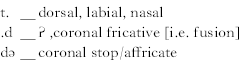
Hargus dubs this the Witsuwit'en pattern. It combines properties of two other patterns described in the typology proposed by Lamontagne & Rice (Reference Lamontagne and Rice1994), with D fusing the glottal stop and coronal fricatives, as in Navajo and Ahtna, but realised with a vowel before coronal stops/affricates, as in Koyukon, and as a syllable-final t before other non-coronal places of articulation and nasals, as in Ahtna.
What is particularly interesting from the perspective of morphologically idiosyncratic alternations is that there is a second pattern found in Witsuwit'en, one that is triggered by the final D of the 1st person dual subject morpheme. This pattern is like that found in Ahtna: no dV allomorph is found.
Hargus provides an Optimality Theory analysis of these two patterns, utilising the following constraints: Max-D, Dep-ə, NoCoda, *Complex, SharedFeatureConvention, Affricate/Coronal, *Geminate. She argues that in order to account for the Witsuwit'en pattern, the following ranking is required.
(2)
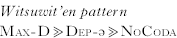
When the input is the 1st person dual prefix, a different ranking, the Ahtna pattern, is required.
(3)
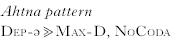
(In addition, the constraint *Complex is ranked differently in the Witsuwit'en and Ahtna patterns.) Basically, the Witsuwit'en ranking requires that the morpheme D be realised even if epenthesis is necessary to maintain it, while the Ahtna pattern eschews epenthesis.
While these are the two major patterns found in Ahtna, Hargus identifies further variation when other pre-stem D's are considered. The system is thus quite complex, with both across-morpheme and within-morpheme variation.
Hargus identifies two theoretical approaches that might be used to account for the different patternings of D-final morphemes in Witsuwit'en. First, a cophonology approach is a possibility, with different rankings of constraints to achieve the different patterns, as described above. Second, Hargus notes that what she calls a prespecification approach might be viable, with different representations of D depending on its patterning. While Hargus identifies these various possibilities, she does not attempt to argue between them. The reader interested in how to handle morphological idiosyncrasy will find a wealth of empirical material in this and other chapters of the book that could well inform arguments as to which approach, if either, is to be preferred. In addition, various possible analyses are laid out, with their empirical consequences carefully evaluated.
6 Summary
I have reviewed Witsuwit'en grammar: phonetics, phonology, morphology not as a grammar, but from the perspective of its contribution to phonology, from both an empirical and a theoretical perspective. To close, I would like to stress again the great value of this book as a grammar as well. As I said at the start of this review, Hargus takes tremendous care to provide detailed coverage of the language, with a richness of both discussion and exemplification. An Athabaskanist audience is extremely well served by this book, and it sets a very high standard for future work on Witsuwit'en in particular and on Athabaskan languages in general. An audience of phonologists is also extremely well served, and phonologists should pay attention to the book for the very interesting issues and challenges that it raises.


