Introduction
The genus Podocarpus L’Hér. ex Pers., nom. cons., is the largest genus of the family Podocarpaceae, itself the second largest conifer family after Pinaceae. It is also the most widely distributed genus of the family, with species found native in every continent except Europe. The largest concentrations of species are found in tropical and subtropical Asia and in South and Central America. Australasia also has numerous species, with Africa having the fewest. Many of its species are important timber trees, and many are threatened with extinction for this or a variety of other reasons such as habitat loss, particularly deforestation, or climate change.
Despite this, our understanding of the genus has long been hampered for want of a satisfactory definitive revision. No comprehensive revision of the genus, with full descriptions of all species, has appeared since the series of papers by Buchholz and Gray that appeared in the Journal of the Arnold Arboretum between 1948 and 1962, the contents of which are briefly reviewed later in this paper. The most recent work to deal with the whole genus (other than in books dealing with conifers as a whole) was by de Laubenfels (Reference de Laubenfels1985). This work was largely a conspectus of subgenera and sections and did not give full accounts of individual species other than those described as new. Many species of Podocarpus remain poorly known or understood and many pose identification problems in the field. Particularly among the Asian species, there are numerous instances of curious, very wide geographical disjunctions that are very difficult to explain and may be due to species concepts that are too broad, as in the case of Podocarpus spathoides de Laub. (Mill & Whiting, Reference Mill and Whiting2012).
The time is ripe, therefore, for another full revision of the genus Podocarpus to be undertaken. The present paper presents an overview of the taxonomic history of the genus and of research that has been undertaken on it. It is subdivided into nine time periods of 20–25 years each, from the 18th century to the present day. The paper concludes with a very general plan of the revision. It is intended that all subsequent papers in the series will appear in Edinburgh Journal of Botany.
Historical Review
General remarks
In Appendix III, part E1 of the International Code of Botanical Nomenclature (McNeill et al., Reference McNeill, Barrie, Burdet, Demoulin, Hawksworth, Marhold, Nicolson, Prado, Silva, Skog, Wiersema and Turland2006: 250), Podocarpus L’Hér. ex Pers. (Persoon, Reference Persoon1807) is listed as conserved nomenclaturally over the earlier name Podocarpus Labill. (Labillardière, 1806). Labillardière’s name was based on Podocarpus aspleniifolius Labill. which is now regarded as a species of Phyllocladus Rich. ex Mirb., Phyllocladus aspleniifolius (Labill.) Hook.f. (J. Hooker, Reference Hooker1845; Farjon, Reference Farjon2001). Persoon’s genus Podocarpus is conserved with P. elongatus L’Hér. ex Pers. as the type. Podocarpus L’Hér. ex Pers. is itself conserved over the earlier name Nageia Gaertn. (Gaertner, 1788) when the two genera are united, but in recent years, beginning with de Laubenfels (1969, as Decussocarpus; 1987, as Nageia), the consensus, backed up by molecular data as well as morphology, is to treat them as separate genera.
Authors of the 19th and most of the 20th centuries circumscribed Podocarpus much more widely than currently. Sections and other infrageneric ranks or groups that were recognised within Podocarpus, and within Dacrydium Sol. ex Forst., are now regarded as distinct genera. The generic segregation that led from the five or six genera recognised within Podocarpaceae (or its equivalent – often part of Taxaceae) to the 19 accepted today (e.g. Farjon, Reference Farjon2001) led to many changes in the circumscription of Podocarpus (de Laubenfels, Reference de Laubenfels1969 – Dacrycarpus de Laub., Decussocarpus de Laub. [now in part Retrophyllum C.N.Page]; de Laubenfels, Reference de Laubenfels, Aubreville and Leroy1972c – Parasitaxus de Laub.; de Laubenfels, Reference de Laubenfels1978b – Prumnopitys Phil. reinstated; Page, 1989 – Afrocarpus (J.Buchholz & N.E.Gray) Gaussen ex C.N.Page, Retrophyllum C.N.Page, Sundacarpus (J.Buchholz & N.E.Gray) C.N.Page).
The genus name Podocarpus was by very many early authors (and a few more recent ones such as Gaussen) treated as feminine. However, Art. 62.2 Ex. 3 of the International Code of Nomenclature for Algae, Fungi, and Plants (McNeill et al., Reference McNeill, Barrie, Buck, Demoulin, Greuter, Hawksworth, Herendeen, Knapp, Marhold, Prado, Prud’homme van Reine, Smith, Wiersema and Turland2012) requires it to be treated as masculine and in this paper I do so throughout regardless of the gender employed in the work being discussed. Where appropriate, the current name (but pending the revisions to come) of a taxon, where different, is inserted in square brackets following the name used in the work being discussed. The name of the section that contains the type of the genus is correctly Podocarpus sect. Podocarpus but virtually all the earlier literature uses Podocarpus sect. Eupodocarpus and that name has therefore been retained in the ensuing discussions of those works.
Eighteenth century
Species of Podocarpus began to be described in the 18th century, although not in that genus, which was not described until 1807. The earliest to have been described botanically was the Japanese species Podocarpus macrophyllus (Thunb.) Sweet, first described in the pre-Linnaean era as what were regarded as two distinct entities, Maki spuria and Maki foetens, by Kaempfer (1712), and in the genus Taxus L. as T. macrophylla Thunb. by Thunberg (1784). (Long before 1712, Christopher Columbus had observed Podocarpus in the Caribbean, as I shall point out in more detail in the second paper of this series.) Rumphius (1743) described Lignum emanum from the Moluccas (Indonesia); this is now called Podocarpus rumphii Blume. In 1789, the African species now known as Podocarpus elongatus (Sol.) L’Hér. ex Pers. (and the type of the genus Podocarpus) was independently described by Solander as Taxus elongatus Sol. in Aiton (Aug/Oct 1789) and by Lamarck (1789) as Taxus capensis Lam. Lamarck’s work did not appear until 19 October 1789 and thus it is almost certain that Solander’s name was published first and takes nomenclatural precedence. Podocarpus elongatus is a conserved name with a conserved type, its lectotype being Masson s.n. (BM) from South Africa (Leistner, Reference Leistner, Codd, de Winter and Rycroft1966). An old belief that its type, and therefore that of the whole genus, is a cultivated specimen of the Asian species Podocarpus chinensis Wall. ex J.Forbes is wrong, as was pointed out by Gray (Reference Gray1953b). At the very end of the 18th century, Thunberg (Reference Thomas1800) described Taxus latifolia Thunb. from the Cape of Good Hope – this is now known as Podocarpus latifolius (Thunb.) R.Br. ex Mirb.
Early nineteenth century (1800–1850)
Taxonomic works. – After what is now the type species of Podocarpus, P. elongatus L’Hér. ex Pers., was described (Persoon, Reference Persoon1807), there followed P. taxifolius Kunth in Humboldt et al. (1817), now Prumnopitys montana (Humb. & Bonpl. ex Willd.) de Laub. (de Laubenfels, Reference de Laubenfels1978b), and Podocarpus macrophyllus (Sweet, Reference Su, Wang, Chen, An, Zuo, Sun, Deng and Sun1818). In 1824, David Don described five new species of Podocarpus as part of his contribution to Lambert’s Genus Pinus (Don in Lambert, Reference Lambert1824) and Mirbel (Reference Mirbel1825) published five more species named by Robert Brown, only two of which [P. latifolius and P. spinulosus (Sm.) R.Br. ex Mirb.] remain in Podocarpus today. These were followed by new species from Richard (Reference Richard1826) and Blume (Reference Blume1827).
The next Podocarpus species to be described was the New Zealand totara, Podocarpus totara G.Benn. ex D.Don, formally described in the second edition of Lambert’s Genus Pinus, editio minor (Lambert, Reference Lambert1832) but first mentioned by George Bennett (1832: 508) in one of a series of articles describing the uses and wood qualities of various plants from New Zealand, some of which (like the totara) had not yet been botanically described at that time. Two other members of this very closely related species group were also described during this period: Podocarpus nivalis Hook. (W. Hooker, 1843h) and P. lawrencei Hook.f. (J. Hooker, Reference Hooker1845).
The first synthesis of the genus was by J. J. Bennett in Bennett & Brown (Reference Bennett and Brown1838). This gave a history of the genus up to that time and divided it into four sections. The first of these was unnamed and largely, but not entirely, corresponded to Podocarpus as circumscribed today, with 16 species listed under four geographical groups. The second section, Podocarpus sect. Taxoideae Benn., contained the single species Podocarpus spicatus R.Br. [Prumnopitys taxifolia (Sol. ex D.Don) de Laub.]. The third section, Podocarpus sect. Dacrydioideae Benn., corresponds to what is now the genus Dacrycarpus. The fourth section, Podocarpus sect. Dammaroideae Benn., contained the single species Podocarpus latifolius Wall. non (Thunb.) R.Br. ex Mirb. nec Blume, the correct name for which is now Nageia wallichiana. This sectional name was revived in the genus Nageia as N. sect. Dammaroideae (Benn.) R.R.Mill (Mill, Reference Mill2001).
W. J. Hooker (1842a,b, 1843a–i, 1844) published descriptions of several new species of Podocarpaceae in his Icones Plantarum and in the London Journal of Botany; of these, only W. J. Hooker (1842a,b, 1843h, 1844) described species of Podocarpus as now circumscribed. These were followed by more species from J. D. Hooker (Reference Hooker1845) and Siebold & Zuccarini (1846) as the genus began to grow ever larger.
The year 1847 is notable for the appearance of two important early works pertaining to Podocarpaceae: Blume’s treatment in the third volume of Rumphia (Blume, Reference Blume1847) and Endlicher’s Synopsis coniferarum (Endlicher, Reference Endlicher1847). Blume followed J. J. Bennett in recognising his sections Taxoideae, Dacrydioideae and Dammaroideae and proposed a fifth, Nageiae, that comprised Podocarpus nageia R.Br. [Nageia nagi]. He provided extended descriptions and colour plates of several species and short descriptions of about a dozen more, some of which were newly described.
More important was Endlicher’s Synopsis coniferarum. In this work, Endlicher proposed Ordo Podocarpeae, equivalent to the family Podocarpaceae as recognised today. This contained three genera, Podocarpus, Dacrydium and Microcachrys Hook.f. which was classed as a ‘genus dubium’. Endlicher enumerated 40 species of Podocarpus, dividing them between four groups: I. Nageia Endl., II. Eupodocarpus Endl., III. Stachycarpus Endl. and IV. Dacrycarpus Endl. Equivalent groups with identical typesetting and layout in his treatments of Pinus L. and Gnetum L. in the same work were formally awarded the rank of section but these groups in Podocarpus were not. Nor were they awarded any formal rank in the subsequent fourth supplement to his Genera plantarum (Endlicher, 1848) in which, in any case, he used Sectio for the primary divisions within his highest rank (Regio; and therefore his ‘Sectio’ is there equivalent to either Subkingdom or Division in today’s taxonomic hierarchy) and so these much lower categories cannot, in his Genera plantarum, also be sections. In both the main work (Endlicher, Reference Endlicher1837) and relevant supplement (Endlicher, 1848), Endlicher classified the conifers as Classis XXII Coniferae within Sectio V. Acramphibrya, Cohors I. Gymnospermae. Brizicky (Reference Brizicky1969) has argued that the infrageneric names in Endlicher’s Genera plantarum were rankless. Carrière (Reference Carrière1855), however, did regard Endlicher’s apparently unranked groups Nageia, Eupodocarpus, Stachycarpus and Dacrycarpus as being sections (see his synonymies: Carrière, Reference Carrière1855: 437, 443, 472 and 477 respectively), although he himself treated them as ‘tribus’ (see below). The earliest work that both accepted the names and definitely assigned sectional rank to the latter three groups appears to be that of Gordon (Reference Gordon1858) who, however, regarded Nageia as a separate genus. Endlicher’s group I. Nageia (five species) was equivalent to the genus Nageia Gaertn., group III. Stachycarpus contained one species now classified in Afrocarpus and four species now placed in Prumnopitys, while group IV. Dacrycarpus comprised two species of Dacrycarpus and one now regarded as a member of the genus Halocarpus Quinn. Group II. Eupodocarpus comprised 28 species, numbered 6–32 with no. 12 being used twice. Of these 28, ten were described as new. However, half of them have since been placed into synonymy of other species. A list very similar to that of Endlicher (Reference Endlicher1847), but giving only very brief details, was published by Lindley & Gordon (Reference Lindley and Gordon1850); it included 41 species within Podocarpus as circumscribed by them.
The year after the appearance of his Synopsis, Endlicher (1848) published the fourth supplement to his Genera plantarum. This contained a revised treatment of the conifers in which that of Podocarpus was similar to the Synopsis, but with the four rankless groups lettered a, b, c and d in boldface rather than given the roman numerals I, II, III and IV. As Brizicky (Reference Brizicky1969) has pointed out, it appears to be impossible to ascertain what rank(s) should be given to Endlicher’s infrageneric groups, of which there appear to be at least four different levels of rank in his 1848 work, denoted by roman numerals (as in Pinus, which had been given sectional rank in the 1847 Synopsis), boldface letters (as found in Juniperus L., Araucaria Juss. and Podocarpus), boldface roman numerals (as in Ephedra L.) and Greek letters (again in Ephedra).
Also in 1847 there appeared an apparently much less well known work by Horaninow (Reference Horaninow1847). Gymnosperms were regarded by Horaninow as the class Strobilanthae; within this, Horaninow recognised four ‘orders’: Pinopalmae, corresponding to cycads; Acerosae (pines and cypresses, Araucaria being included with the pines); Drupiferae (yews and podocarps); and Articulatae (Gnetaceae plus the angiosperm family Casuarinaceae which during this period was often thought to be a gymnosperm). Order Drupiferae comprised the two families Taxaceae and Podocarpaceae and Horaninow was apparently the first person to use the name Podocarpaceae for that family (op. cit.: 27). His concept of Podocarpaceae encompassed only the genus Podocarpus; Dacrydium and Phyllocladus were included in Taxaceae, probably because he stated (op. cit.: 29) that Podocarpaceae differed from Taxaceae by having anatropous ovules. The modern concept of the family includes genera with both anatropous ovules such as Podocarpus and orthotropous ones such as Dacrydium and Phyllocladus. Horaninow (Reference Horaninow1847) appears not to have accounted for Microcachrys at all. He believed that Podocarpus contained about 24 species.
Morphological studies. – Robert Brown appears to have been the first person (Brown, Reference Brown and Bennett1814) to have discovered what he regarded as the ‘true nature’ of the structure of the ‘cone’ of Podocarpus. He wrote, ‘certain plants of the order [Coniferae] are even furnished with a double cupula. This is most remarkable in Podocarpus, in which the drupa is formed of this external cupula, whose aperture exists not at the apex, but very near its base or point of insertion. The inner cupula in this genus is in every stage entirely enclosed in the outer and is in like manner inverted’. This appears to have been the earliest observation of the structure that specialists on the family now refer to as the epimatium (de Laubenfels, Reference de Laubenfels1992b; Tomlinson, Reference Thunberg1992; Tomlinson et al., Reference Tomlinson, Takaso, Owens and Rudall1997). Later workers such as Endlicher (1837; see next section) proposed alternative interpretations and the ‘true nature’ of the Podocarpus cone was to be a matter of controversy for years to come.
This period also saw some of the earliest work dealing with the structure of the reproductive organs of Podocarpus and other members of the family. There was particular controversy concerning the morphology of the ovule, whether it represented an inverted orthotropous structure as put forward by Robert Brown (Brown, Reference Brown and Bennett1814; Bennett & Brown, Reference Bennett and Brown1838) or an erect anatropous one as originally described by Endlicher in his Genera plantarum (Endlicher, Reference Endlicher1837: 262) although he later reversed this view and favoured that of Brown (Endlicher, Reference Endlicher1847, 1848).
Mid nineteenth century (1851–1875)
Taxonomic and horticultural works prior to De Candolle’s Prodromus. – The third quarter of the 19th century was notable for the publication of several encyclopaedic horticultural works on conifers: Carrière’s Traité général des Conifères in two editions (Carrière, Reference Carrière1855, Reference Carrière1867); Gordon’s Pinetum (Gordon, Reference Gordon1858, with Supplement in 1862, 2nd edition in 1875 with a reissue in 1879); Courtin’s Die Familie der Coniferen (Courtin, Reference Courtin1858); Henkel & Hochstetter’s Synopsis der Nadelhölzer (1865); Pinaceae by ‘Senilis’, the pseudonym of J. Nelson (Nelson, Reference Nelson1866); Hoopes’s Book of Evergreens (1868) and Charles de Kirwan’s Les conifères indigènes et exotiques, published in two parts in 1867 and 1868, the Podocarpaceae being treated in the second part (Kirwan, 1868). One of the greatest plant taxonomic works of all time, De Candolle’s Prodromus, was by now well under way and Parlatore’s treatment of Taxaceae for that work, including his account of Podocarpus, appeared in its 16th volume (Parlatore, Reference Parlatore and De Candolle1868a,Reference Parlatore and De Candolleb). This period also saw the initial discoveries of the wealth of plant life inhabiting the New Caledonia and Fiji archipelagos (Brongniart & Gris, Reference Brongniart and Gris1866a,Reference Brongniart and Grisb; Seemann, Reference Seemann1868) as well as accounts of the conifers of New Zealand (J. Hooker, Reference Hooker1853), Tasmania (J. Hooker, Reference Hooker1857) and the West Indies, particularly Cuba (Grisebach, Reference Grisebach1862a,Reference Grisebachb, Reference Grisebach1866), as well as miscellaneous other descriptions of new species (Lindley, Reference Lindley1851; Miquel, Reference Miquel1851).
In the fifth volume of Dietrich’s Synopsis plantarum (Dietrich, Reference Dietrich1852), Podocarpus was divided into four unnamed groups lettered a, b, c and d. The composition of these corresponded very closely to the four groups I. Nageia, II. Eupodocarpus, III. Stachycarpus and IV. Dacrycarpus of Endlicher (Reference Endlicher1847). Group b included only 26 species compared with Endlicher’s 28, the omissions being two Australian species. The reason why these were left out is unknown; neither was synonymised with another species.
The treatment of Podocarpus in the first edition of Carrière’s Traité général des Conifères (Carrière, Reference Carrière1855) was fairly similar to that of Endlicher (Reference Endlicher1847). Forty-eight species were enumerated and described, divided between four ‘tribus’ (tribes), Nageia, Eupodocarpus, Stachycarpus and Dacrycarpus. The use of ‘tribe’ as a rank between genus and species is contrary to the rules of the International Code of Botanical Nomenclature now in force (McNeill et al., Reference McNeill, Barrie, Burdet, Demoulin, Hawksworth, Marhold, Nicolson, Prado, Silva, Skog, Wiersema and Turland2006); consequently all these new combinations at the rank of ‘tribe’, based on Endlicher’s sections of the same names, were not validly published. ‘Tribe’ Eupodocarpus comprised 36 species of which two were described as new.
Courtin’s Die Familie der Coniferen (published Jun–Jul 1858) and the Pinetum of Gordon (Jun–Dec 1858) are important since they are the first works definitely to award sectional rank to the rankless groups that Endlicher erected within Podocarpus, namely Nageia, Eupodocarpus, Stachycarpus and Dacrycarpus. Courtin’s work treated all four at sectional rank, in the sequence listed above, whereas Gordon awarded full generic rank to Nageia and gave sectional rank to the other three, which he treated in the same sequence as Courtin. Unfortunately the exact publication date of either work is not known and they came out at approximately the same time. Courtin (Reference Courtin1858) treated 50 species, of which 36 were in section Eupodocarpus. Gordon (Reference Gordon1858) recognised 42 species in the genus, 35 of them in section Eupodocarpus. Courtin’s and Gordon’s works were very similar, although there are differences in the treatment of a few species. A much enlarged second edition of the Pinetum appeared in 1875 with a reissue in 1879. This is discussed below.
The Synopsis der Nadelhölzer by Henkel & Hochstetter (Reference Henkel and Hochstetter1865) adopted a four-section classification of Podocarpus. This was identical to the system of Endlicher (Reference Endlicher1847) except that Endlicher’s four rankless groups were all definitely awarded the rank of section including Podocarpus sect. Nageia for the first time. They recognised 36 species within Podocarpus sect. Eupodocarpus, none of them new, and 13 among the other three sections. A contemporary work, The Book of Evergreens (Hoopes, Reference Hoopes1868), listed 43 species of Podocarpus but gave detailed accounts of only three.
Very different in nature was the treatment of the conifers and ‘taxads’ by J. Nelson under the pseudonym ‘Senilis’ (Nelson, Reference Nelson1866). Nelson had no time for those whom he called ‘species-mongers’ and who in his estimation had grossly inflated the true number of species amongst the conifers. Podocarpus was by him divided into two sections that he named Calophyllus and Stachycarpus. Podocarpus sect. Calophyllus Nelson was equivalent to P. sect. Nageia of earlier authors and comprised just two species. Podocarpus sect. Stachycarpus encompassed the other three sections of Gordon, Henkel & Hochstetter and others or, in his own words, ‘what botanists have been pleased to define as twelve genera’. Within that group he recognised only 13 species, compared with the 40 or so of earlier but contemporary authors. Of those 13, only five are wholly referable to Podocarpus as now circumscribed with a further three comprising elements belonging to both Podocarpus and other genera.
One reason for this drastic reduction in species was the fact that Nelson deplored the efforts of those whom he referred to as ‘hair-brained speculators and pedantic systematists, and the small fry who followed their suit,–the species-mongers,’ [to whom] ‘are we indebted for heterogeneous and gratuitous assumptions, and unsustained and contradictory assertions, which have so obscured the classification and nomenclature of the firs and pines, that at the present time their classification is chaos and their nomenclature cant’ (Nelson, Reference Nelson1866: 20). Unfortunately, Nelson’s extreme lumping simply resulted in more chaos. The most extreme example in Podocarpus is the Australian endemic P. elatus R.Br. ex Endl., of which he wrote, ‘The same tree, more or less altered by soil, climate and altitude, has been found in Abyssinia, Cape of Good Hope, Brazil, Nepal and New Guinea; and it has been again and again re-introduced and re-christened; for it is to be found with such names as elongata, Lambertiana, laeta, nobilis, spicata, spinulosa, thevetiaefolia, and Thunbergii; their only differences being in the size, form or colour of their leaves’. Nelson’s circumscription of Podocarpus elatus was actually a mixture of at least nine good species of Podocarpus (including P. elongatus, the type of the genus!) and one species of Prumnopitys.
J. D. Hooker’s two accounts of the Coniferales of New Zealand and Tasmania were published in 1853 and 1857 respectively. In New Zealand he treated five species of Podocarpus, three of which have since been transferred to other genera. In Tasmania only Podocarpus alpinus R.Br. ex Hook. was treated; this (J. Hooker, Reference Hooker1857: 356) was the first valid publication of Brown’s epithet which had appeared in several other earlier publications but without meeting all the requirements for validation.
The second edition of Carrière’s Traité général des Conifères appeared in 1867. Apart from being a considerably enlarged and revised edition it contained a change in the treatment of the genus Podocarpus. Nageia which, in the first edition (Carrière, Reference Carrière1855), as well as in the works by Endlicher (Reference Endlicher1847) before it and Henkel & Hochstetter (Reference Henkel and Hochstetter1865) after it, had been the first of four rankless groups (Endlicher) or sections of Podocarpus, was raised to the level of genus, as had been done by Gordon (Reference Gordon1858). As in this author’s work, Podocarpus therefore was restricted to the remaining three sections with Podocarpus sect. Eupodocarpus containing 35 species.
In the same year, Sénéclauze (Reference Sénéclauze1867) published his monograph of conifers. Podocarpus was divided firstly into three ‘tribus’ corresponding largely to Podocarpus sensu stricto, Prumnopitys and Dacrycarpus – an identical division to that of Carrière (Reference Carrière1867). The first ‘tribu’, Podocarpus sensu stricto, was then divided into geographical groups, with seven [South] American species, four Australian, seven Asian and two from ‘Cap’ [South Africa]. For each species and variety, Sénéclauze gave a short description and these may prove of help when unravelling the true identity of some of the more obscure taxa such as Podocarpus curvifolius Carrière that are currently unplaced in lists such as Farjon (Reference Farjon2001).
Parlatore’s account of Podocarpaceae for De Candolle’s Prodromus. – The treatment of Podocarpus for De Candolle’s Prodromus by Parlatore (Reference Parlatore and De Candolle1868b) is an important landmark in the systematics of the genus. Parlatore followed the four-section Henkel & Hochstetter (Reference Henkel and Hochstetter1865) classification of the genus that had its roots in Endlicher’s Synopsis coniferarum. He enumerated 65 species in the genus, eight (three of them considered doubtful) in Podocarpus sect. Nageia, 45 (ten doubtful) in P. sect. Eupodocarpus, six in P. sect. Stachycarpus and six in P. sect. Dacrycarpus. Of the six he included in Podocarpus sect. Stachycarpus, two – 56. P. nivalis and 59. P. alpinus with its variety β lawrencii – are now classified within true Podocarpus and it is strange that he placed these in P. sect. Stachycarpus but included their near relative P. totara within P. sect. Eupodocarpus. His treatment is notable for containing the protologues of eleven new species assigned by him to Podocarpus; of these, however, only four remain in the genus as presently delimited. Unlike some of those who had gone before him, notably Carrière as noted by Williams (Reference Wikramanayake, Dinerstein, Louks, Olson, Morrison, Lamoreux, McKnight and Hedao2004), Parlatore’s treatment was backed up by the extensive collections he had seen in the herbaria of Florence, Geneva, London and elsewhere and which form the basis of his type material.
Post-Prodromus taxonomic and horticultural works. – Charles de Kirwan’s popular work (Kirwan, 1868) treated 30 species under Podocarpus in narrative style, area by area, beginning with those of eastern Asia and progressing via New Guinea, modern Indonesia, Australia and Africa, and finally to the South American and Caribbean species then known. A systematic list was also given at the end of the work. Compared with the contemporary works of Carrière (Reference Carrière1867) and Sénéclauze (Reference Sénéclauze1867), Kirwan’s is much less useful today although for some species such as Podocarpus chilinus [P. salignus D.Don] it does give dates of introduction that are of historical interest.
The second edition of Gordon’s Pinetum appeared in 1875 with a reissue in 1879 (‘1880’ on the title page). This treated 59 species in Podocarpus, 46 of them in section Eupodocarpus, eleven in P. sect. Stachycarpus and two ‘uncertain and little known kinds’, the first of them in fact a Dacrydium and the other a Dacrycarpus. Unlike Parlatore (Reference Parlatore and De Candolle1868b), Gordon (Reference Gordon1875) continued to retain Nageia as a separate genus. He apparently followed Parlatore (Reference Parlatore and De Candolle1868b) in including Podocarpus nivalis, P. alpinus and P. lawrencei in the circumscription of Podocarpus sect. Stachycarpus but gave full species rank to all three whereas Parlatore had regarded P. lawrencei as a variety of P. alpinus.
The early 1860s saw the first descriptions of species of Podocarpaceae from New Caledonia, which is famous today as a centre of gymnosperm diversity with 44 species, all of them save one cycad species being endemic to the island archipelago. Vieillard (Reference Veillon1862) described the first species of Podocarpus from the island, Podocarpus novae-caledoniae Vieill., for which a fuller description was given a few years later by Brongniart & Gris (Reference Brongniart and Gris1866a,Reference Brongniart and Grisb). Petrus de Boer (Reference de Boer1866) published a treatment of the conifers of the Indonesian archipelago; this included detailed descriptions of eleven species of Podocarpus sensu lato of which seven belong to the genus as currently delimited; most were accompanied by line drawings. Meanwhile, Grisebach (1862a,Reference Grisebachb, Reference Grisebach1866) published three important works on the flora of the West Indies including treatments of a number of Podocarpus species.
Morphological and other studies. – This period saw some of the earliest papers dealing with the biology of Podocarpus and the family Podocarpaceae in general. One of these was J. D. Hooker’s short paper (J. Hooker, Reference Hooker1854) in which he reported the discovery of what he called ‘spherical exostoses’ on the roots of, first of all, Podocarpus dacrydioides A.Rich. [Dacrycarpus dacrydioides (A.Rich.) de Laub.] and then of many other conifers, including Podocarpus (sensu lato?) itself. These are now known to be the nodules in which live the vesicular arbuscular mycorrhiza that are of widespread occurrence in the conifers other than Pinaceae. Thomas (Reference Sweet1863) studied the leaf anatomy of conifers and seems to have been the first person to observe transfusion tissue in the leaves of Podocarpus (cf. comment by Bertrand, Reference Bertrand1874); transfusion tissue as such was only described some years after Thomas’s paper, in Sciadopitys verticillata Siebold & Zucc. by von Mohl (1871a,b). Karsten (Reference Karsten1849) may also have observed transfusion tissue in Podocarpus prior to Thomas, as noted by Bernard (Reference Bernard1904), but a thorough search of Karsten’s text has failed to reveal the existence of the passage implied by Bernard. Favre (Reference Favre1865) published a note on the female cone of Podocarpus chinensis, concluding that the ovule was an erect, anatropous structure covered by a raphe that terminates in a chalazal extension, and enclosed by two integuments that are fused for almost their whole length. Geyler (Reference Geyler1867) performed one of the earliest studies on the phyllotaxis and stem architecture of conifers as a whole, publishing details for a number of Podocarpus species. Braun (Reference Braun1869) published a paper in which he described a monstrosity, or teratological form, of Podocarpus chinensis that displayed the transition from true leaves to ovuliferous scales. Bertrand (Reference Bertrand1874) published the first really detailed study on the anatomy of leaves and stems of Podocarpaceae, as part of a wider study of all the gymnosperms. Unusually (possibly indeed uniquely), Bertrand reduced the genus Dacrydium to a section of Podocarpus.
Late nineteenth century (1876–1900)
Taxonomic works. – The last quarter of the 19th century saw relatively little advancement in our knowledge of Podocarpus. Further new species were described by Hance (Reference Hance1883), Kirk (Reference Kirk1884, Reference Kirk1889), Colenso (Reference Colenso1884), Hemsley (Reference Hemsley1885, Reference Hemsley1896), Baker (Reference Baker1885), Masters (Reference Masters1892), Rendle (Reference Rendle and Carruthers1894), Bailey (Reference Bailey1899) and Franchet (Reference Franchet1899), many of which have since been transferred to other genera. The chief work to appear during this otherwise rather fallow period was the Revisio generum plantarum by Otto Kuntze, published in 1891. Kuntze reverted to using Podocarpus to apply to the genus Phyllocladus, as by Labillardière (1806), and used Nageia in place of Podocarpus L’Hér. ex Pers. As a result, he (Kuntze, Reference Kuntze1891: 800) made 65 transfers from Podocarpus to Nageia, as well as coining four new names to avoid homonymy and adopting ten previous transfers from Podocarpus to Nageia that had been made by Ferdinand von Mueller, Gordon and Kurz. Because of his nomenclatural viewpoint, Kuntze also made two reverse transfers from Phyllocladus to Podocarpus. Baillon (Reference Baillon1892) followed this nomenclature.
Morphological studies. – In the 1890s there also appeared Masters’ comprehensive survey of the morphology and anatomy of the Coniferae (Masters, Reference Masters1890) as well as the equally extensive treatise on the comparative anatomy of conifer cones by Radais (Reference Radais1894), together with a paper by van Tieghem (Reference Urban1891) erecting the new genus Stachycarpus Tiegh. for what had previously been called Podocarpus sect. Stachycarpus. The latter paper included leaf anatomical details of some 26 species of Podocarpus sensu lato, grouped systematically in accordance with their anatomical features. Small-leaved species such as Podocarpus totara and P. nubigenus Lindl. that lacked abundant transfusion tissue were separated from larger-leaved ones like P. neriifolius D.Don that possessed abundant transfusion tissue.
Early twentieth century (1901–1926)
Pilger’s taxonomic works. – The first quarter of the 20th century was marked by two more landmarks in the study of Podocarpus, Pilger’s accounts of the Taxaceae published in Engler’s Das Pflanzenreich (Pilger, Reference Pilger and Engler1903) and of Podocarpaceae in Engler’s Die natürlichen Pflanzenfamilien (Pilger, Reference Pilger and Engler1926). In between these two major works, as well as afterwards, Pilger also published various other, mainly short papers on Podocarpaceae which, prior to 1916, he included in Taxaceae (Pilger, Reference Pilger and Sodiro1904, Reference Pilger1905, Reference Pilger1913, Reference Pilger and Mildbraed1914, Reference Pilger1915, Reference Pilger1916a,Reference Pilgerb,Reference Pilgerc, Reference Pilger1923, Reference Pilger and Mildbraed1934, Reference Pilger1937).
In his Pflanzenreich monograph, Pilger (Reference Pilger and Engler1903) divided Taxaceae into three subfamilies, Taxaceae subfams. Podocarpoideae Pilg., Phyllocladoideae Pilg. and Taxoideae Pilg. Taxaceae subfam. Podocarpoideae was subdivided into the two tribes Pherosphaereae Pilg. (Pherosphaera W.Archer bis) and Podocarpeae (Microcachrys, Saxegothaea Lindl., Dacrydium, Podocarpus). Within Podocarpus, Pilger slightly modified the hitherto prevailing four-section classification, stemming from the work of Endlicher (Reference Endlicher1847), by removing Podocarpus ustus (Vieill.) Brongn. & Gris from P. sect. Dacrycarpus to a new, fifth section, Podocarpus sect. Microcarpus Pilg. He transferred several species from Podocarpus sect. Eupodocarpus to P. sect. Stachycarpus, which thereby was composed of ten species, corresponding to the genera Prumnopitys, Sundacarpus and Afrocarpus of today’s classifications (e.g. Farjon, Reference Farjon2001, Reference Farjon2010). Conversely he transferred Podocarpus nivalis and P. acutifolius Kirk from P. sect. Stachycarpus to P. sect. Eupodocarpus. Podocarpus sect. Eupodocarpus thereby comprised 41 species of which two were new.
The most significant of Pilger’s papers published between his treatments for Das Pflanzenreich and Die natürlichen Pflanzenfamilien was Pilger (Reference Pilger1916a), in which he proposed a new classification of the Taxaceae (sensu lato). He divided this family into three smaller ones, namely Podocarpaceae, Taxaceae sensu stricto (containing only Taxus L. and Torreya Arn.) and Cephalotaxaceae. Podocarpaceae itself was subdivided into four subfamilies with Podocarpus in subfamily Podocarpoideae (Pilg.) Pilg.
In his treatment of Podocarpaceae for Die natürlichen Pflanzenfamilien (Pilger, Reference Pilger and Engler1926), Pilger made a further modification to his classification of Podocarpus. Two subgenera were recognised: I. Stachycarpus (Endl.) Pilg. represented an elevation in rank of Podocarpus sect. Stachycarpus (Endl.) Gordon while the remaining four sections, Podocarpus sects. Dacrycarpus, Microcarpus, Nageia and Eupodocarpus, were placed in subgenus 2. Protopodocarpus Engl. The latter was first described by Engler in Engler & Prantl (1897: 21) and, since it contained the type of the genus, should correctly be referred to as Podocarpus subgen. Podocarpus. Within the latter subgenus some 45 species were listed. These were distributed more or less equally between two informal groups, A and B, depending on whether the female cones possessed two small bracts below the receptacle (group B) or not (group A). These groups broadly correspond to the two subgenera first delimited much later by de Laubenfels (Reference de Laubenfels1985), Podocarpus subgen. Foliolatus de Laub. (bracts present) and Podocarpus subgen. Podocarpus (bracts absent) with one very important difference: the four Afro-Madagascan species including Podocarpus elongatus (Sol.) L’Hér. ex Pers., the type of the genus, were all placed in group B (bracts present: i.e. corresponding to Podocarpus subgen. Foliolatus), rather than in group A (bracts absent: corresponding to Podocarpus subgen. Podocarpus). As the placement of these Afro-Madagascan species potentially affects the infrageneric nomenclature of the entire genus, the morphological basis of this classification by Pilger (Reference Pilger and Engler1926) needs very careful checking.
Other taxonomic and floristic works. – During this period there were also significant contributions to the taxonomy of the genus by other authors. Foxworthy (Reference Foxworthy and Merrill1907, Reference Foxworthy1911) published papers on the genus in the Philippines while Koorders & Valeton (Reference Koorders and Valeton1904, Reference Koorders and Valeton1915) gave synopses of the species of Java. Laurent (1915) published an important paper on the Podocarpus species of Madagascar, and Stapf provided an account of the Bornean species (Stapf, Reference Smith1914) as well as the first of his two treatments of African species (Stapf, Reference Stanley and Ross1917). Of the six species that Stapf (Reference Stanley and Ross1917) enumerated and comprehensively treated within Podocarpus in his account of the tropical African species, only P. milanjianus Rendle belongs to Podocarpus as circumscribed today; the others all belong to Afrocarpus. Compton (Reference Compton1922) provided a critical commentary on the gymnosperms of New Caledonia but there were no taxonomic novelties in Podocarpus. Meanwhile, Ignatz Urban, a contemporary of Pilger who also worked at Berlin, published three short notes on the Caribbean species of Podocarpus (Urban, Reference Ueno1920, Reference Ueno1922, Reference Urban1924).
Morphological and anatomical studies. – Bernard (Reference Bernard1904, Reference Bernard1907) published two papers on centripetal xylem in conifers. The first dealt with this tissue in the leaves while the second discussed it with respect to the reproductive organs. In the first paper he distinguished five types of leaf anatomy based on presence/absence of hydrostéreome (transfusion tissue), two of which were peculiar to what are now segregated as Nageia and Dacrycarpus. The other three types were found within Podocarpus sensu stricto: (i) no transfusion tissue, no transversely elongated parenchyma cells, little centripetal xylem [Podocarpus nubigenus, as well as Prumnopitys ferruginea (D.Don ex A.Cunn.) de Laub.]; (ii) no transfusion tissue, but very well developed centripetal xylem (Podocarpus elongatus); and (iii) centripetal xylem and transfusion tissue both well developed (several Asian and Australian Podocarpus species as well as what is now Afrocarpus falcatus (Thunb.) C.N.Page). The fact that Podocarpus nubigenus was found to differ in these characters from P. totara and P. alpinus is particularly interesting since all three are currently classified in the same section of the genus.
Some early papers on organogenesis of various species of Podocarpus were published at the start of the 20th century. Coker (Reference Coker1902) studied the gametophytes and embryo of what he called Podocarpus coriaceus Rich. although its true taxonomic identity is questionable since the sources of the material were Jamaica and in cultivation in South Carolina; Buchholz (Reference Buchholz1941) commented that at least the South Carolina material was probably Podocarpus macrophyllus and the Jamaican material was more likely to have been the same species since it too was cultivated. If that is true, Coker did not study Podocarpus coriaceus (which is endemic to the Lesser Antilles, although the name has also been misapplied to other species from the Caribbean and South America) at all and we cannot know for certain to which taxon or taxa his results really pertain. Jeffrey & Chrysler (Reference Jeffrey and Chrysler1907) examined Podocarpus polystachyus R.Br. ex Endl. as well as species now transferred to Dacrycarpus and Prumnopitys, while Burlingame (Reference Burlingame1908) studied Podocarpus nivalis and P. hallii Kirk [P. cunninghamii Colenso] as well as a third species that he surmised might be Podocarpus elongatus but which is best regarded as unidentified since that name was then frequently misapplied to Afrocarpus falcatus. Burlingame (Reference Burlingame1908) also provided a summary of the earlier work and stated that his own results were in the main confirmatory.
Hill & de Fraine (1908) studied the seedlings of Podocarpus chinensis and noted that each cotyledon had two vascular bundles which together form one pole of the diarch root, as in Gnetales. Interest in teratological forms and the like continued, with a paper on vivipary in Podocarpus by Lloyd (Reference Lloyd1902).
Several papers on aspects of the morphology of Podocarpus were published in quick succession in the following decade, by Stiles (Reference Stevenson, Jørgensen and Léon-Yánez1912), Gibbs (Reference Gibbs1912) and Sinnott (Reference Silva, Bittner and Sammes1913). Stiles’ paper was a general account of the morphology of the Podocarpaceae based on examination of living and herbarium material; ten species of Podocarpus (plus one unidentified) were studied. It was a culmination of a series of earlier papers on the family, of which that by Brooks & Stiles (Reference Brooks and Stiles1910) on Podocarpus spinulosus also falls within the scope of this review. That by Gibbs (Reference Gibbs1912) was a very careful histological study of various stages of development of the female strobilus; eight species of Podocarpus were sampled as well as some now removed to Nageia, Dacrycarpus and Prumnopitys. She came to the conclusion that Podocarpus, particularly the section Eupodocarpus, exhibited the most extreme reduction of the female cone within the family. The study by Sinnott (Reference Silva, Bittner and Sammes1913) likewise focused on the morphology and anatomy of the female cones; all the material used came from Australia and New Zealand and included five species of Podocarpus in the modern sense. The restriction to Australasian source material means that the full range of variation possibly present in cone structure was not explored but his paper is important in being the first detailed anatomical examination of the female cones of Podocarpus. About this time the first two of John Buchholz’s many papers appeared: a study on polycotyledony in conifers (Buchholz, Reference Buchholz1919: mainly Pinaceae, with Podocarpaceae only discussed briefly) and a general study of embryo development in conifers (Buchholz, Reference Buchholz1920) that discussed all major lineages including the podocarps.
Florin (Reference Florin1920) published one of the earliest studies on the cuticle morphology of gymnosperm leaves. Two species of Podocarpus, P. elongatus and P. coriaceus, as well as one each of Prumnopitys and Dacrycarpus, were described in detail.
Early mid twentieth century (1927–1947)
Taxonomic works. – The period that elapsed between Pilger’s Pflanzenfamilien treatment of Podocarpaceae in 1926 and the start of the revision of the genus Podocarpus by Buchholz and Gray from 1948 onwards (see next section) yielded relatively few works dealing with Podocarpus. Sixteen taxonomic novelties were published in the genus during this period (White, Reference Wasscher1933; Lundell, Reference Lundell1937; Pilger, Reference Pilger1937; Carabia, Reference Carabia1941; Chang, Reference Chang1941; Wasscher, Reference Vicuña-Miñano1941) but five have since been transferred to other genera (mostly Dacrycarpus). Stapf (Reference Stapf and Gibbs1933) published his treatment of Podocarpus for Flora Capensis. This contained comprehensive accounts of three species of Podocarpus from southern Africa together with treatments of three other species now regarded as members of Afrocarpus (Farjon, Reference Farjon2001, Reference Farjon2010).
By far the most significant work on the taxonomy of Podocarpus to appear during this period was the incredibly detailed revision of Podocarpus in the ‘Netherlands Indies’ published by Wasscher (Reference Vicuña-Miñano1941). The area covered corresponds approximately to modern Indonesia. Because of the Second World War it was not possible for Wasscher to study material in several important herbaria and consequently he was only able to examine limited materials from some adjacent areas such as eastern New Guinea, the Malay peninsula and the northern part of Borneo (then under British control), while examination of materials in Philippines herbaria was impossible. Nevertheless, in what is a considerable understatement, he commented that in his opinion ‘I believe this treatment of the genus Podocarpus is rather complete for the Netherlands Indies proper’. Indeed, for detail and depth of discussion his work remains unsurpassed today among studies on Podocarpus even though many more species have since been described from the region. As was then customary, Podocarpus was divided into several sections that correspond to independent genera in current classifications of the family. His classification of the genus was a modification of Pilger’s Reference Pilger and Engler1926 one and recognised the two subgenera Stachycarpus and Protopodocarpus although he commented (Wasscher, Reference Vicuña-Miñano1941: 361), ‘I doubt whether the subdivision into sub-genera is right. Perhaps we had better not distinguish any sub-genera, but only six equivalent groups which might be either sub-genera or sections’. Podocarpus subgen. Stachycarpus was represented in the area only by P. amarus Blume [Sundacarpus amarus (Blume) C.N.Page] while P. subgen. Protopodocarpus contained the other 24 species, divided among four sections. Three of these (Podocarpus sects. Dacrycarpus, Nageia and Eupodocarpus) had been recognised in Pilger’s Reference Pilger and Engler1926 classification but the remaining one, Podocarpus sect. Polypodiopsis C.E.Bertr., had not. This section corresponds to the genus Retrophyllum C.N.Page. Podocarpus sect. Dacrycarpus [= Dacrycarpus] included eight species (three new), P. sect. Nageia had two and P. sect. Polypodiopsis one species. The remaining 13 species were placed in Podocarpus sect. Eupodocarpus. One of them, Podocarpus salomoniensis Wasscher from the Solomon Islands, was described as new, as were seven varieties, one in P. polystachyus and the other six within P. neriifolius. Some of the latter are now regarded as distinct species.
Another worker whose output was adversely affected by the Second World War was J. P. Carabia, who published an account of the gymnosperms of Cuba (Carabia, Reference Carabia1941). These were principally species of Podocarpus in which he recognised five species from Cuba, two of them new. Carabia examined material in United States and Cuban herbaria but was unable to examine types or other specimens in European herbaria such as Berlin. Two years after he published his work, the Berlin herbarium (B) was bombed by Allied forces and much of it was destroyed and, although many of the numbers are duplicated in other herbaria, many collections cited by Pilger (Reference Pilger and Engler1903) will no doubt have been lost. Some types of Podocarpaceae at B have, however, survived and have been recently digitised and made available online.
Morphological and other studies. – The Edinburgh morphologist Orr (Reference Orr1937, Reference Orr1944) published two significant papers on the anatomy of conifer leaves. The earlier paper was a general study that concentrated on assessing the taxonomic value of various characters. The later paper (Orr, Reference Orr1944) was a comprehensive anatomical study of the leaves of the genus Podocarpus. Like all contemporary workers Orr treated Podocarpus in a broad sense including many species since transferred to Afrocarpus, Nageia, Prumnopitys, Retrophyllum and Sundacarpus. Among the species of Podocarpus sensu stricto, Orr noted for the first time that Podocarpus totara, P. nivalis, P. acutifolius, P. hallii, P. gnidioides and P. nubigenus all possessed the common ‘negative character’ of absence of accessory transfusion tissue in the leaves, a feature that set this group (now Podocarpus sect. Australis de Laub.) apart from the rest of the genus. He also noted that all the African species he studied possessed five resin canals, again a character that was not found elsewhere in the genus. He found that amongst the large group of Asiatic species (of which he examined material of 22), the occurrence of sclereids had some geographical correlation, sclereids being absent from all examined Philippine and Malay species but present in those from New Guinea and New Caledonia. In some species the hypoderm was continuous, in others discontinuous. Among Australasian species, Podocarpus drouynianus F.Muell. and P. spinulosus had a unique combination of leaf anatomical characters including a single resin canal and hypoderm interrupted between midrib and margin but continuous over the midrib itself. Thirteen species from Central and South America were examined; these all also had a single resin canal and, except for Podocarpus parlatorei Pilg. and P. salignus, a continuous hypoderm.
Buchholz continued his researches on the embryogeny of the Podocarpaceae, with papers on Podocarpus subgen. Stachycarpus (Buchholz, Reference Buchholz1936) and a general embryological study of the family (Buchholz, Reference Buchholz1941). In the earlier paper, one species still in Podocarpus was incidentally discussed. His later paper (Buchholz, Reference Buchholz1941) was concerned principally with Podocarpus, Nageia and Dacrycarpus although other genera of the family were also discussed. An important finding was that all the Central and South American Podocarpus species studied had very similar embryogeny but that this differed strongly from Australasian members of the genus such as P. totara and P. nivalis.
The final important paper to appear in the 1940s was Wilde’s study of conifer cones (Wilde, Reference Whiting1944). This proposed a new, evolutionary and morphological classification of the male and female cones of Podocarpaceae and introduced new terminology to describe their arrangement. This was based on internodal reduction. The apparently primitive state was termed ‘primary clusters’ which could be reduced to a single cone. Internodal reduction in the secondary vegetative branches could result in the formation of ‘secondary clusters’ of male cones, while internodal reduction in the primary vegetative branch could further aggregate these into ‘tertiary clusters’. Based on her studies of male cone evolution she hypothesised that Podocarpus drouynianus and P. nivalis were, of the species she studied, the most primitive. She noted strong similarities between Podocarpaceae and Araucariaceae in the nature and arrangement of the fertile branches, a significant finding in the light of today’s molecular phylogenetics work which places them as sister families. She also hypothesised that in Podocarpus (sensu lato including Prumnopitys etc.) there had been progressive sterilisation of the fertile branches, with the most primitive being those of Prumnopitys taxifolia and Prumnopitys andina (Poepp. ex Endl.) de Laub.
Later mid twentieth century (1948–1967)
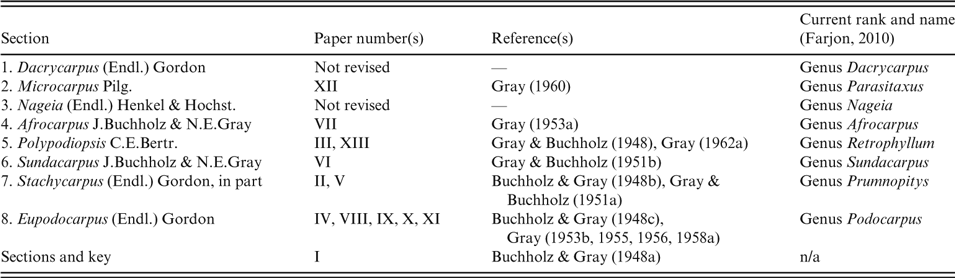
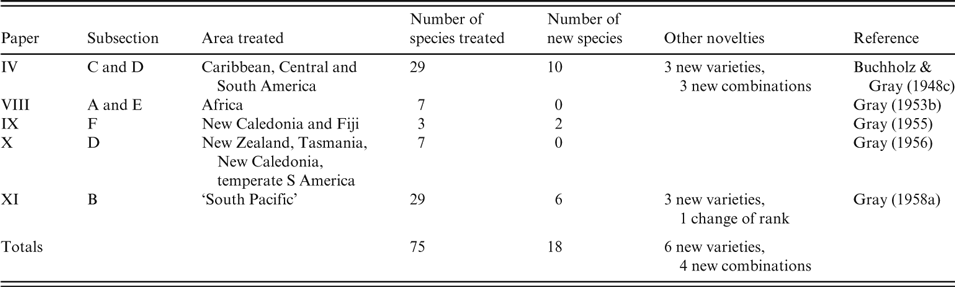
The taxonomic work of Buchholz and Gray. – Post-war research on Podocarpus and Podocarpaceae in general was dominated by the team of John Theodore Buchholz (1888–1951) and Netta Elizabeth Gray (1913–1970) who between them produced a series of papers between 1948 and 1962 in which the bulk of Podocarpus as then delimited was critically revised (Buchholz & Gray, Reference Buchholz and Gray1948a,Reference Buchholz and Grayb,Reference Buchholz and Grayc; Gray & Buchholz, Reference Gray and Buchholz1948, Reference Gray and Buchholz1951a,Reference Gray and Buchholzb; Gray, Reference Gray1953a,Reference Grayb, Reference Gray1955, Reference Gray1956, Reference Gray1958a, Reference Gray1960, Reference Gray1962a). The first three parts of their revision of Podocarpus were published in 1948 (Buchholz & Gray, Reference Buchholz and Gray1948a,Reference Buchholz and Grayb,Reference Buchholz and Grayc). The first instalment (Buchholz & Gray, Reference Buchholz and Gray1948a) set out their sectional classification, which was based largely upon a consideration of leaf anatomy. They followed the suggestion Wasscher had made earlier (1941: 361, quoted above) and abandoned the two subgenera recognised by Pilger (Reference Pilger and Engler1926). Instead they delimited eight sections, two of them new (Podocarpus sect. Afrocarpus J.Buchholz & N.E.Gray, P. sect. Sundacarpus J.Buchholz & N.E.Gray). These are listed in Table 1 together with the relevant paper number(s) and reference(s) and the current name and rank of the section. The remainder of this discussion will concern only the papers relating to Podocarpus as currently delimited, i.e. numbers IV, VIII–XI in the series (for references see Tables 1 and 2 and the following paragraph).
Sections of Podocarpus recognised by Buchholz & Gray (Reference Buchholz and Gray1948a). ‘Paper number’: I–XIII as given in the individual titles

Papers by Buchholz and/or Gray dealing with species of Podocarpus as now delimited. ‘Subsection’: in the sense of Buchholz & Gray (Reference Buchholz and Gray1948a)
In total, Buchholz and Gray treated 75 species of Podocarpus as currently delimited, of which 18 were described as new (Table 2). With additional papers (Buchholz, Reference Buchholz1949; Gray, Reference Gray and Yuncker1959) the two authors described 20 new species of Podocarpus during the course of their work, and recognised 77. Buchholz and Gray’s work was for the most part extremely careful and their revisionary series remains the standard reference for research on Podocarpus.
Other taxonomic and floristic works. – Buchholz and Gray were not the only workers on Podocarpus in the immediate post-war period. Ronald Melville of Kew published both a research paper (Melville, Reference Melville1955) and a floristic revision (Melville, Reference Melville, Turrill and Milne-Redhead1958) on the Podocarpaceae of East Africa. David de Laubenfels described the first of his many new species of Podocarpus (de Laubenfels, Reference de Laubenfels1960). His main works have appeared from 1970 onwards and are discussed in the following sections. Finally, Hu (1964) also described a new Podocarpus from Zhejiang, SE China in this period.
Floristic accounts of the family, or of Podocarpus in particular, appeared for many regions including the Cape peninsula (Adamson, Reference Adamson, Adamson and Salter1950), New South Wales (Anderson, Reference Anderson1956), Venezuela (Buchholz & Gray, Reference Buchholz, Gray and Steyermark1957; Veillon, Reference van Tieghem1962), New Caledonia (Sarlin, Reference Sarlin1954; Chevalier, Reference Chevalier1957), Guadeloupe (Questel, Reference Questel1951), Guatemala (Gray, Reference Gray1958b), Tonga (Gray, Reference Gray and Yuncker1959), New Zealand (Allan, Reference Allan1961), southern Africa (Breitenbach, 1965; Leistner, Reference Leistner, Codd, de Winter and Rycroft1966), China (Hu, Reference Hu1964), Taiwan (Li, Reference Li1963), tropical Africa (Lewis, Reference Lewis, Exell and Wild1960) and Mexico (McVaugh, Reference McVaugh1966), while Gray (Reference Gray1962b) published an account of the Podocarpus species cultivated in the United States.
Morphological and other studies. – It was in 1953 that David de Laubenfels, who later became so important as a student of the Podocarpaceae, published his first major paper (de Laubenfels, Reference de Laubenfels1953). This discussed the external morphology of conifer leaves, which he classified into four broad groups labelled Types I–IV. Leaves of Podocarpus and similar genera were classified as Type II, defined as being linear or lanceolate, bifacially flattened with a single vascular bundle. This was regarded as being the commonest type amongst living conifers. Shortly afterwards, Griffith (Reference Griffith1957) published a detailed account of the leaf anatomy and development of Podocarpus macrophyllus, focusing on the development of transfusion tissue.
Several more embryological studies were published during this period, especially by Doyle and co-workers (Doyle, Reference Doyle1945, Reference Doyle1954; Boyle & Doyle, Reference Boyle and Doyle1953, Reference Boyle and Doyle1954) but also by Brownlie (Reference Brownlie1953) who studied the New Zealand species.
Papers by Hair & Beuzenberg (Reference Hair and Beuzenberg1958) and Hair (Reference Hair and Gressitt1963) represent the earliest significant studies of cytology of Podocarpaceae. The paper published in 1958 in particular remains a standard reference for chromosome numbers although care must now be taken to ‘translate’ the names given into current nomenclature. Eight species of Podocarpus as now circumscribed were studied, the chromosome numbers of which ranged from 2n = 20 in Podocarpus latifolius to 2n = 38 in P. salignus which was later recorded as also having 2n = 40 (Hair, Reference Hair1966). Hair (Reference Hair1966) interpreted these as a reduction series, from 2n = 40 to 2n = 20. However, molecular phylogenetics research conducted within the last decade suggests that this is a simplistic view since taxa with identical chromosome numbers have originated more than once. The variation has been explained in terms of Robertsonian transformation but as yet it is not possible to determine whether the range in number has arisen through fusion, fission or a combination of both (Jones, Reference Jones1978, Reference Jones1998). Indeed the validity of the whole hypothesis that Robertsonian transformation is the explanation for the variation has recently been questioned (Murray & de Lange, 2011).
Knowledge of wood anatomy of Podocarpus and other members of the family advanced through the work of Greguss (Reference Greguss1951, Reference Greguss1955, Reference Greguss1957), Kaeiser (Reference Kaeiser1954), Patel (Reference Patel1967) and Tengnér (Reference Suzuki1967). Kaeiser (Reference Kaeiser1954) examined a particularly large number of samples – 186, belonging to nearly 80 species of Podocarpus sensu lato, c.50 of them belonging to Podocarpus as presently circumscribed – and her work must be regarded as one of the most comprehensive studies in terms of coverage. She adopted the six informal subsections A–F recognised within Podocarpus by Buchholz & Gray although she was unable to examine any material of subsection E (Podocarpus rostratus L.Laurent from Madagascar). She found that the other five sections were all homogeneous in nearly all characters she scored, except that piceoid pits were lacking in subsection A (all African species) and C (all American species) though present in subsections B (Asia and Pacific), D (equivalent to Podocarpus sect. Australis) and F (Pacific). Subsection F was also unique in totally lacking ray indentures and radial pits in the tracheids were not frequently twinned as in the other four subsections studied. Podocarpus could be distinguished from Sundacarpus and all species of Prumnopitys except P. andina by the presence of abundant xylem parenchyma. Greguss (Reference Greguss1955) described the wood of 13 species, all of them also examined by Kaeiser (Reference Kaeiser1954).
Palynological examination of the Podocarpaceae began in detail. Ueno (Reference Torres-Romero, Pinto and Lozano1960a) studied almost 40 species of Podocarpus (and 81 of the family as a whole), measuring various standard parameters. Pollen grains were assigned to ‘types’ according to the relative ratios of breadth, depth and height. Of twelve possible combinations, only seven were found in both the body and the cappa, with four of the seven being common to both. Body type was listed before cappa type in a style resembling a ratio, e.g. ‘3 : 9’ indicated body type 3 and cappa type 9. Combination ‘11 : 9’ was commonest in Podocarpus (22 species) followed by ‘3 : 9’ (11 species), ‘2 : 9’ (4), with single species having combinations ‘1 : 9’, ‘9: 5’, ‘11 : 1’ and ‘11 : 10’. Sometimes different samples of the same species had different combinations of types, e.g. Podocarpus alpinus had both ‘11 : 1’ and ‘1 : 9’, and species generally thought to be closely related in other respects also sometimes differed, e.g. Podocarpus drouynianus (‘3 : 9’) and P. spinulosus (‘11 : 9’). The significance of these ‘types’ and/or the data upon which they were based are therefore perhaps questionable. His second paper (Ueno, Reference Turner and Cernusak1960b) was a much more general survey of pollen grain biology and germination in gymnosperms. Erdtman (Reference Erdtman1957, Reference Erdtman1965) published descriptions, accompanied by photographs or diagrams, of the pollen of about 30 species still in Podocarpus.
Detailed phytochemical studies on the Podocarpaceae as a whole began about this time. The most active teams were based in New Zealand, particularly that headed by Cambie, which published at least 75 papers under the series title ‘Chemistry of the Podocarpaceae’ in a variety of journals including Australian Journal of Chemistry and Phytochemistry between 1962 and 1990. Some of the earliest papers concerned the identification of the chemical constituents of some of the New Zealand Podocarpus species such as P. totara (Cambie & Mander, Reference Cambie and Mander1962), P. hallii (Cambie et al., Reference Cambie, Simpson and Colebrook1963), P. acutifolius and P. nivalis (both Bennett & Cambie, Reference Bennett and Cambie1967), and so of potential taxonomic interest, but later papers were much more analytical and of little use in plant systematics. Nakanishi et al. (Reference Nakanishi, Koreeda, Sasaki, Chang and Hsu1966) isolated the insect moulting hormone ponasterone A from Podocarpus nakaii Hayata in Japan while simultaneously Galbraith & Horn (Reference Galbraith and Horn1966) published their initial discovery of 20-hydroxyecdysone (by them called crustecdysone) in Podocarpus elatus in Australia. These were the first discoveries of the group of steroidal compounds initially called phytoecdysones and now termed phytoecdysteroids, initially found in Podocarpaceae and subsequently in Taxaceae, ferns and angiosperms (Abubakirov, Reference Abubakirov1982).
This period was also marked by the publication of two key papers by Rudolf Florin, those on female reproductive organs (Florin, Reference Florin1954) and conifer distribution and biogeography (Florin, Reference Florin1963). The latter paper included a lengthy discussion (pp. 182–200) on the distribution of Podocarpaceae. In this Florin followed the Buchholz & Gray infrageneric classification of Podocarpus which at that time had only just been completed. He noted the primarily Asian distribution of Podocarpus subsect. B (equivalent to the bulk of present-day Podocarpus subgen. Foliolatus), the African distribution of subsections A and E (equivalent to Podocarpus subgen. Podocarpus sects. Podocarpus and Scytopodium), the primarily Australasian distribution of subsection D (= P. subgen. Podocarpus sect. Australis) and the exclusively American distribution of subsection C (the rest of Podocarpus subgen. Podocarpus). He hypothesised that the two big subsections, B and C, might both have had Australasian origins with B migrating into Asia and C into the Americas, and that the ancestor of the single species of subsection D in the Americas (Podocarpus nubigenus) may have reached there from Australasia via Antarctica. With modern techniques of phylogenetic and biogeographic analyses it is now possible to test these hypotheses rigorously although to date no such study has been performed for Podocarpus. During this period Florin (Reference Florin1958) also published a short paper on the systematics of the Podocarpaceae, covering aspects such as vegetative and reproductive morphology, embryology, cytology and relationships with other conifer families, particularly Taxaceae and Cephalotaxaceae (today recognised as a single family: Christenhusz et al., Reference Christenhusz, Reveal, Farjon, Gardner, Mill and Chase2011). This paper contained little about Podocarpus in particular.
Twentieth century (1968–1987)
Taxonomic works. – One person has dominated research on Podocarpaceae systematics, and the description of new taxa within Podocarpus, from the mid-20th century until the beginning of the 21st – David de Laubenfels. De Laubenfels took over the mantle from Buchholz and Gray (see preceding section) and in his first major paper (de Laubenfels, Reference de Laubenfels1969) began what was originally conceived as a revision, to be published in two parts, of nine genera of Podocarpaceae, four of them being newly segregated by him from Podocarpus. Only the first part of that revision, containing detailed accounts of six genera (Phyllocladus, Dacrydium, Falcatifolium de Laub., Dacrycarpus, Acmopyle and Decussocarpus), actually appeared in its intended form, although he did later account for the three remaining genera in briefer treatments (Parasitaxus as part of de Laubenfels, Reference de Laubenfels and Leroy1972b; Prumnopitys as de Laubenfels, Reference de Laubenfels1978b; and Podocarpus sensu stricto as de Laubenfels, Reference de Laubenfels1985). His 1969 paper is important for its removal from the genus, at last, of Podocarpus sects. Dacrycarpus, Nageia, Polypodiopsis and Afrocarpus as part of what he called (1969: 276) an attempt ‘to produce a more balanced treatment of the family’. Podocarpus sect. Dacrycarpus became an independent genus, Dacrycarpus, while the other three sections initially became the genus Decussocarpus although he was later obliged, by a change in the rules of the International Code of Botanical Nomenclature, to revert to the genus Nageia (de Laubenfels, Reference de Laubenfels1987). De Laubenfels also transferred Podocarpus sect. Sundacarpus J.Buchholz & N.E.Gray to Prumnopitys as a monospecific section (de Laubenfels, Reference de Laubenfels1978b). Subsequently, Page (1989) treated them all as independent genera [Nageia, Afrocarpus, Retrophyllum and Sundacarpus respectively], which remains their current status.
In 1972 de Laubenfels published two important floristic treatments of the gymnosperms of Madagascar (de Laubenfels, Reference de Laubenfels and Leroy1972b) and New Caledonia (de Laubenfels, Reference de Laubenfels, Aubreville and Leroy1972c). The former work was preceded by a precursor paper (de Laubenfels, Reference de Laubenfels1972a) in which two new Madagascan species of Podocarpus were described. His New Caledonian account treated seven species of which one was new.
De Laubenfels (1978a) next revised the conifers of the Philippines and described three new species of Podocarpus. Papers on the Podocarpus species of Ambon in the Moluccas (de Laubenfels, 1979) and New Guinea (de Laubenfels, Reference de Laubenfels1980) followed, with one new species being described in each. Next was a floristic revision of the Podocarpaceae of Venezuela (de Laubenfels, Reference de Laubenfels, Luces de Febres and Steyermark1982) in which three new species were described, then he described one new species from the Caribbean (de Laubenfels, Reference de Laubenfels1984a), and contributed accounts of each genus of Podocarpaceae occurring in the Pacific area, including Podocarpus (de Laubenfels, Reference de Laubenfels and Balgooy1984b), to Balgooy’s Pacific Plant Areas.
His revision of Podocarpus (de Laubenfels, Reference de Laubenfels1985) enumerated 94 species, of which eleven were new and one was an elevation to species rank of a former variety. The most notable feature of this paper, however, was his novel classification of the genus Podocarpus. Two subgenera were recognised, each with nine sections. Podocarpus subgen. Podocarpus contained 41 species while P. subgen. Foliolatus comprised the remaining 53. The subgenera were defined primarily on presence or absence of ‘foliola’ (small bracts) below the normally fleshy and coloured structure (the so-called ‘receptacle’) that subtends the ovule(s), and the presence or absence of a Florin ring around each stoma. Podocarpus subgen. Podocarpus (receptacle without subtending foliola; Florin rings present) contained all the South American and Afro-Madagascan species together with all those on New Zealand, while P. subgen. Foliolatus de Laub. comprised the Asiatic and Pacific representatives of the genus. Both subgenera are represented in New Caledonia and Australia. Subsequent research, including molecular phylogenetics, has borne out the validity of these subgenera as distinct taxa (see next section). However, the validity of the character of the subtending foliola of the receptacle that was the primary character used to separate the subgenera was soon called into question by Stoffberg (Reference Stockey, Frevel and Woltz1991b), who noted the occasional presence of one or two spreading foliola in Podocarpus latifolius (Thunb.) R.Br. ex Mirb., which de Laubenfels (Reference de Laubenfels1985) classified in Podocarpus subgen. Podocarpus sect. Podocarpus. Small bract-like structures at the top of the peduncle, but ± adnate to the receptacle rather than free from it and spreading, have also been observed in various South American species of Podocarpus subgen. Podocarpus by the present author, as will be noted in later papers of this series. Therefore another character, apart from Florin ring presence/absence, may need to be sought to delimit the two subgenera of de Laubenfels (Reference de Laubenfels1985) morphologically.
Whether or not all or any of the 18 sections of Podocarpus delimited by de Laubenfels should continue to be recognised, and if so how many and in what circumscriptions, is much more debatable. The sections were distinguished principally on vegetative characters, particularly those of the bud scales. Infrageneric taxa, and indeed genera and families, that are based primarily on vegetative features tend to have had a chequered history. Phyllocladus, for example, long kept separate from the rest of Podocarpaceae by virtue of its specialised phylloclades (cf. Keng, Reference Keng1973), has been found using molecular phylogenetic analyses to be nested within the family in a clade that also contains Lagarostrobos Quinn, Halocarpus Quinn, Parasitaxus, Prumnopitys and other genera (Conran et al., Reference Conran, Wood, Martin, Dowd, Quinn, Gadek and Price2000). Similarly, few of de Laubenfels’s sections within either subgenus of Podocarpus stand up to phylogenetic scrutiny. The species of Podocarpus in the Caribbean and Central America fall into four of the nine sections of P. subgen. Podocarpus (de Laubenfels, Reference de Laubenfels1985) and, of those sections with more than one species in the area, none was monophyletic (Stark Schilling, Reference Stapf and Prain2004). Conversely, several very closely related species from the Greater Antilles, that did form a monophyletic lineage, are currently classified in two different sections (Stark Schilling, Reference Stapf and Prain2004). Similar results can be obtained when almost any biogeographic area is considered. Detailed character scoring of a large number of characters – vegetative, reproductive and micromorphological – is currently under way in order to attempt a new infrageneric classification that will place morphology in the context of the available molecular data.
With 94 species recognised, de Laubenfels’s Reference de Laubenfels1985 paper represents a major landmark in the history of Podocarpus taxonomy. The constituent species of each section were keyed out and listed, with brief synonymy when thought necessary (34 instances out of the 83 previously described species). They were, however, not described in detail unless new to science. Consequently, although it introduced a novel infrageneric classification and described taxonomic novelties, de Laubenfels’s work is really a conspectus or catalogue raisonée, not a revision in the usually accepted sense of the term. Great care must be taken when reading the protologues of de Laubenfels’s species in his 1985 paper because although in most cases only the holotype is given, to validate the name, it has been discovered that in at least some instances the protologue was actually founded on the basis of many other specimens, and in at least one instance (Podocarpus spathoides de Laub.: Mill & Whiting, Reference Mill and Whiting2012) some of these specimens have subsequently been found not to belong to the taxon described.
The Gaussen school. – De Laubenfels was not, however, the only person to publish works on Podocarpaceae or the genus Podocarpus in the mid-20th century. Henri Gaussen, based at Toulouse, had for a long time been producing an encyclopaedic work entitled Les Gymnospermes actuelles et fossiles. This appeared as a large number of fascicles of the in-house publication Travaux du Laboratoire forestière de Toulouse. It had a very complex hierarchical construction of Tomes, Sections, Volumes (some divided into Parties), Fascicules and Chapitres, with each chapter of each fascicule being independently paginated. Thus, for an unambiguous citation, the tome, section, volume, part (if relevant), fascicule and chapter must all be given as well as the pagination. Having previously dealt with cycads, Ginkgo L., Pinaceae, Cupressaceae and Araucariaceae, in the early 1970s Gaussen reached the Podocarpaceae (‘les Podocarpines’). These were treated as fascicles XII, XIII and XIV of tome 2 vol. 1. Fascicle XII (Gaussen, Reference Gaussen1973) was a general introduction, fascicle XIII (Gaussen, Reference Gaussen1974) treated all genera except Podocarpus and fascicle XIV (Gaussen, Reference Gaussen1976) was an account of Podocarpus. Gaussen’s circumscription of Podocarpus was unique. As well as Podocarpus sensu stricto, it included Nageia and Retrophyllum as Podocarpus sects. Nageia and Polypodiopsis respectively but excluded the other sections Dacrycarpus and Stachycarpus which he treated (under those names) at generic rank, with Buchholz & Gray’s Podocarpus sect. Sundacarpus being treated as a section of Stachycarpus. Podocarpus sect. Afrocarpus was also excluded and raised to genus rank as ‘Afrocarpus Gaussen’ but he did not fulfil all the requirements of the International Code of Botanical Nomenclature then in force and his generic name, and all combinations within it, were not validly published: validation did not take place until the paper by Page (1989). Just why Gaussen excluded Afrocarpus but not Nageia or Retrophyllum from Podocarpus is unclear.
Gaussen’s work was very derivative, almost all illustrations being re-used from other publications, and described no new species. In separate papers, however, he did publish two new species from Madagascar. Gaussen’s colleague Woltz also named a new species, Podocarpus gaussenii Woltz, after him (Woltz, Reference Wilson and Owens1969, 1970) but that has been transferred to Afrocarpus. Gaussen and Woltz were particularly interested in the podocarps of Madagascar and published significant papers on their leaf anatomy (Woltz, Reference Woltz1973; Gaussen & Woltz, Reference Gaussen and Woltz1975), seedling anatomy and morphology (Woltz, 1970) and wood anatomy (Marguerier & Woltz, Reference Marguerier and Woltz1977). The latter paper was billed as being the ‘first part’ and covered only three species; a second part, that would have dealt with the other Madagascan Podocarpus species, was promised (Marguerier & Woltz, Reference Marguerier and Woltz1977: 158) but apparently never appeared. Woltz and other colleagues such as Ferré and Rouane also published more general papers on the seedling anatomy of the Podocarpaceae (Ferré et al., 1975, 1977) and on particular genera such as Saxegothaea and Sundacarpus.
Floristic works. – Floristic treatments of Podocarpus appeared for many parts of the world during this period. Apart from those for Madagascar, New Caledonia, Malesia, the Philippines, and Venezuela, all by de Laubenfels and discussed above, examples include accounts for Australia (Boland et al., Reference Boland, Brooker, Chippendale, Hall, Hyland, Johnston, Kleinig and Turner1984; Bennett, Reference Bennett, Marchant, Wheeler, Rye, Bennett, Lander and Macfarlane1987), China (Cheng & Fu, Reference Cheng and Fu1978), Tasmania (Curtis & Morris, 1975), Mozambique (Graça Silva, 1983), southern Africa (Palmer & Pitman, Reference Palmer and Pitman1972; Breitenbach, 1974; Palgrave, Reference Palgrave1977, Reference Palgrave1983), Fiji (Parham, Reference Parham1972; Smith, Reference Sinnott1979), Thailand (Phengklai, Reference Phengklai1973, Reference Phengklai1975), New Zealand (Salmon, Reference Salmon1980), and alpine New Guinea (van Royen, Reference Urban1979) as well as for the European Garden Flora (Nelson, 1986). John Silba’s two conifer works also appeared during this period. The first (International Census of the Coniferae: J. Silba, Reference Silba and de Silva1984) took the form of a checklist and was a precursor to the more detailed second one, the Encyclopaedia Coniferae (J. Silba, Reference Silba1986). Like Gaussen’s before him, Silba’s works of 1984 and 1986 were derived compilations with no new taxa within Podocarpus (although he did publish novelties later; see next section).
Morphological and other studies. – Morphological and/or anatomical studies were published concerning seedlings (Woltz, 1970, Reference Woltz1986; Ferré et al., 1975; Siqueira & Ferreira, Reference Sinclair, Mill, Gardner, Woltz, Jaffré, Preston, Hollingsworth, Ponge and Möller1987), vegetative shoots and leaves (Schoonraad & van der Schijff, Reference Schoonraad and van der Schijff1974, Reference Schoonraad and van der Schijff1975, South African species of Podocarpus and Afrocarpus; Woltz, Reference Woltz1973 and Gaussen & Woltz, Reference Gaussen and Woltz1975, Madagascan species; Kausik, Reference Kausik1975, Podocarpus brevifolius (Stapf) Foxw.; Ferré et al., 1977, New Caledonian species; Ho et al., Reference Ho, Chiu and Cheng1983, SE Asian species mainly from China; Offler, Reference Offler1984, Asia and New Guinea; Woltz et al., Reference Woltz1987, worldwide), female strobili (Jain, 1978, Podocarpus neriifolius; Morvan, Reference Morvan1968, Reference Morvan1971a,Reference Morvanb, Reference Morvan1973, 1975, P. macrophyllus) and wood (Greguss, Reference Greguss1972; Marguerier & Woltz, Reference Marguerier and Woltz1977; Suzuki, Reference Stoffberg1979; Diaz-Vaz, Reference Diaz-Vaz1986, Podocarpus nubigenus). The leaf anatomical study by Woltz et al. (Reference Woltz1987) examined 122 species of Podocarpaceae of which an unspecified number belonged to Podocarpus itself. They found that groups could be established based on anatomical characters of the midrib and associated structures such as resin canals. Various evolutionary series within the family were proposed, with some of them ending in so-called ‘over-evolved’ taxa that showed a reversal to the hypothesised ancestral condition.
Dodd & van Staden (1981) published a study of the germination and viability of the recalcitrant seeds of Podocarpus henkelii Stapf ex Dallim. & A.B.Jacks.
Alvin & Boulter (Reference Alvin and Boulter1974) published a paper describing a new controlled method to prepare gymnosperm cuticles for examination under the scanning electron microscope and this paved the way for a new field of study that in Podocarpaceae has proved extremely useful and informative although until very recently Podocarpus itself had scarcely been studied. Morvan (Reference Morvan1982, Reference Morvan1987) undertook studies of the epicuticular waxes of the leaves and strobili of Podocarpus macrophyllus.
Doyle & Brennan (Reference Doyle and Brennan1971a,Reference Doyle and Brennanb) published important work on cleavage polyembryony in conifers, with the Podocarpaceae being surveyed in the first of the two papers.
Vasil & Aldrich (Reference van Royen1973) studied the ultrastructure of the pollen in Podocarpus macrophyllus. Ueno (Reference Ueno1984, Reference Ueno1985a) continued his studies on gymnosperm pollen and published a more detailed account of Podocarpaceae pollen (Ueno, Reference Ueno1985b).
Phytochemical studies included papers on anthocyanins by Lowry (Reference Lowry1968), whose identification of delphinidin-3,5-diglucoside in Podocarpus polystachyus was the first record of any anthocyanin in Podocarpaceae. Other papers on anthocyanins in Podocarpaceae soon followed (Crowden & Grubb, Reference Crowden and Grubb1971; Lowry, Reference Lowry1972; Crowden, Reference Crowden1974). However, there have been very few subsequent studies, despite the obvious presence of anthocyanins in the receptacles and young leaves, and it would be interesting to determine whether the pigment characteristics of species with dark-coloured (violet, purple or blackish) receptacles are different to those with red ones such as Podocarpus nivalis. Norditerpene dilactones are widespread in the genus and are cytotoxic; these compounds have been named and isolated from many species from both subgenera of Podocarpus such as P. milanjianus (Hembree et al., Reference Hembree, Ching-Jer Chang, McLaughlin, Cassady, Watts, Wenkert, Fonseca and Paiva Campello1979, Reference Hembree, Chang, McLaughlin and Cassady1980), P. nubigenus (Silva et al., Reference Silba1973), P. purdieanus Hook. (Wenkert & Chang, Reference Vieillard1974), P. sellowii Klotzsch ex Endl. (Hembree et al., Reference Hembree, Ching-Jer Chang, McLaughlin, Cassady, Watts, Wenkert, Fonseca and Paiva Campello1979), P. salignus (Matlin et al., Reference Matlin, Prazeres, Mersh, Sanders, Bittner and Silva1982, Reference Matlin, Bittner and Silva1984a,Reference Matlin, Prazeres, Bittner and Silvab) and P. macrophyllus (Itô et al., Reference Itô, Kodama, Sunagawa, Takahashi, Imamura and Honda1968). The biflavones and other flavonoid compounds present in the genus were studied by Kumar Roy et al. (1987) and in New Zealand by Markham et al. (Reference Markham, Webby and Vilain1984, Reference Markham, Webby, Whitehouse, Molloy, Vilain and Mues1985). Research on phytoecdysteroids at first advanced rapidly, with these compounds being discovered in many members of the Podocarpaceae as well as in Taxaceae, ferns and some angiosperms. Compounds of this group identified in Podocarpaceae during this period included ponasterones B and C from Podocarpus nakaii (Nakanishi et al., Reference Nakanishi, Koreeda, Chang and Hsu1968), makisterones A, B, C and D from P. macrophyllus (Imai et al., Reference Imai, Hori, Fujioka, Murata, Goto and Nakanishi1968a,Reference Imai, Hori, Fujioka, Murata, Sasakawa and Nakanishib), and podecdysone B from P. elatus (Galbraith et al., Reference Galbraith, Horn, Middleton and Hackney1969).
Lastly, the first morphological cladistics analysis of conifer families was published (Hart, Reference Hart1987). This found only one unique character that united the family – the binucleate embryonal cell of the proembryo – although the presence of an epimatium was also found in all but two of the 15 genera studied (including Phyllocladus but treating Afrocarpus, Nageia and Retrophyllum within Decussocarpus and presumably including Sundacarpus within Prumnopitys, since that was the classification then prevailing). His work revealed nothing of the phylogeny within Podocarpus since it was concerned with the levels of family and genus only.
The past 25 years (1988–present)
Taxonomic works. – The first important taxonomic work on Podocarpus of the past 25 years was the revision of the family in Flora Malesiana by de Laubenfels (Reference de Laubenfels, van Steenis and De Wilde1988). This treated 30 species, none of which was new; however, unlike in his 1985 paper, all were fully described and mapped and some were also illustrated. Three further new Asiatic species (de Laubenfels & Silba, Reference de Laubenfels and Silba1988a) and one Brazilian species (de Laubenfels & Silba, Reference de Laubenfels and Silba1988b) were described very shortly afterwards.
De Laubenfels published several more short floristic papers in the early 1990s in which a total of five further new species of Podocarpus were described (Silba, Reference Silba1990 [without de Laubenfels’s permission: de Laubenfels, pers. comm. 2012]; de Laubenfels, 1991a,Reference de Laubenfelsb, Reference de Laubenfels1992a, Reference de Laubenfels1994). Since then he has also described one more species (de Laubenfels, Reference de Laubenfels2003) and elevated another to species rank (de Laubenfels, Reference de Laubenfels2005) giving a total of nine New Caledonian species, for all of which he provided a key in the later paper. However, there is currently some debate as to whether either or both of these two last-described species are distinct (Farjon, Reference Farjon2010; Jaffré et al., Reference Jaffré, Munzinger and Lowry2010).
Staszkiewicz (Reference Stark Schilling1988) published a paper on the Podocarpus species of the Antilles in which he used morphometrics as an aid to delimiting the taxa. He proposed a novel treatment of the species occurring on those islands that will be discussed in more detail in the second paper of this series.
Silba (Reference Silba1990) published a supplement to his 1984 and 1986 works discussed in the previous section. Unlike those it contained taxonomic novelties. Between this 1990 work and a later paper (Silba, Reference Silba2000), Silba described 14 varieties within ten species of Podocarpus, all of which were synonymised within their parent species by Farjon (Reference Farjon2001) but require proper evaluation of their status. Farjon (Reference Farjon1998, Reference Farjon2001) published two editions of a world checklist of conifers, in the later of which 107 species of Podocarpus were accepted. Silba (Reference Silba2008a,Reference Silbab, Reference Silba2009) described or validated two new species (Podocarpus ballivianensis Silba and P. tixieri Gaussen ex Silba) and a new subspecies of Podocarpus lawrencei, and the following year (Silba, Reference Silba2010) he published an updated version of his 1984 checklist of Podocarpus in which 108 species were listed; this contained 39 new subspecific combinations, many of these being elevations to subspecies of varieties that he had described in earlier publications. Since then Silba has published a new species from New Caledonia (Silba, Reference Silba and de Silva2014).
Treatments of Podocarpus appeared in two compendia of the world’s conifers, by Eckenwalder (Reference Eckenwalder2009) and Farjon (Reference Farjon2010). These recognised 82 and 97 species respectively. Both represent reductions from the 107 species that had been accepted by Farjon (Reference Farjon2001) and Eckenwalder’s treatment with its sometimes incomprehensibly broad species concept recognises three fewer than the 85 that de Laubenfels had enumerated in his 1985 revision of the genus. Farjon (Reference Farjon2010) lectotypified the names of several species for the first time and Farjon & Filer (Reference Farjon and Filer2013) mapped all species of Podocarpus accepted by them as part of a larger atlas of the world’s conifers.
Between 1996 and 2000, Bobrov and various Russian co-workers published a series of papers, mostly in obscure conference proceedings, on aspects of the systematics of various genera of Podocarpaceae, especially the smaller or more aberrant ones (Bobrov & Melikian, Reference Bobrov and Melikian1998b; Bobrov & Kostrikin, 1999), and particularly emphasising carpological characters. This work culminated in two papers (Bobrov & Melikian, Reference Bobrov and Melikian1998a; Melikian & Bobrov, Reference Melikian and Bobrov2000) outlining a new and radically different classification of the family. In the earlier paper, Podocarpus subgen. Foliolatus was raised to generic rank as Margbensonia Bobrov & Melikian. Twenty new combinations were made, far fewer than would actually be required were this classification to become generally accepted. That, however, has not been the case, except in the later paper by Melikian & Bobrov (Reference Melikian and Bobrov2000). Margbensonia was regarded as a synonym of Podocarpus by Farjon (Reference Farjon2010) and by Christenhusz et al. (Reference Christenhusz, Reveal, Farjon, Gardner, Mill and Chase2011). In the paper by Melikian & Bobrov (Reference Melikian and Bobrov2000), Podocarpaceae as circumscribed over the past 40 or so years was drastically carved up into 14 families spread over six orders. In their strict sense, the Podocarpaceae itself comprised only the four genera Podocarpus, Margbensonia, Afrocarpus and Sundacarpus. Subsequently Doweld (Reference Doweld2001) modified this arrangement somewhat, bringing all genera of ‘pre-Bobrov & Melikian’ Podocarpaceae together again as the class Podocarpopsida, which was divided into four orders and twelve families, with one order and three families of those erected by Melikian & Bobrov (Reference Melikian and Bobrov2000) being reduced to synonymy. Christenhusz et al. (Reference Christenhusz, Reveal, Farjon, Gardner, Mill and Chase2011) on the other hand regarded Podocarpaceae (in its usual circumscription, of 19 genera) and its sister family Araucariaceae as constituting the order Araucariales, which is the view accepted here.
Podocarpus macrophyllus in Japan has very recently been revised by Akiyama & Ohba (Reference Akiyama and Ohba2012) with notes on typification. Also very recently, the new species Podocarpus orarius R.R.Mill & M.Whiting has been described from the Solomon Islands (Mill & Whiting, Reference Mill and Whiting2012), segregated from P. spathoides after careful work involving morphology and cuticle micromorphology, while A. D. Silba & J. A. de Silva [= John Silba: see table of contents of Silba & de Silva (2014)] have described three new taxa (Silba & de Silva, 2013a,b, 2014) that require critical evaluation before acceptance.
Floristic works. – Floristic treatments appeared for Costa Rica (de Laubenfels, 1991a; Merello, Reference Merello, Hammel, Grayum, Herrera and Zamora2003), the Guianas (Stevenson & Zanoni, Reference Staszkiewicz1991), Ecuador (Stevenson, Reference Stark Schilling and Mill1999), Colombia (Torres-Romero, Reference Tomlinson, Braggins and Rattenbury1988), Bolivia (Martín, Reference Martín, Killeen, Emilia García and Beck1993), Peru (de Laubenfels, Reference de Laubenfels1991b, Reference de Laubenfels1994; Brako & Zarucchi, Reference Brako and Zarucchi1993; Vicuña-Miñano, Reference Vasil, Aldrich and Heslop-Harrison2005), Chile (Marticorena & Rodríguez, Reference Marticorena and Rodríguez1995), Argentina (Covas, Reference Covas1995), Australia (Stanley & Ross, Reference Siqueira and Ferreira1989, Queensland; Harden, Reference Harden1990, New South Wales; Hill, Reference Hill and McCarthy1998, whole continent), New Zealand (Eagle, Reference Eagle2006), China (Fu et al., 1999), Taiwan (Yang & Lu in Li & Keng, Reference Li and Keng1994), Cambodia, Laos and Vietnam (Hiêp & Vidal, Reference Hiêp and Vidal1996) and Japan (Yamazaki, Reference Woltz1995).
Enright & Ogden (Reference Enright, Ogden, Enright and Hill1995) published an important book on the ecology of the conifers of the southern hemisphere whose chapters contain much on the ecology of Podocarpus species, while Hill & Brodribb (Reference Hill and Brodribb1999) published a now-classic paper documenting the history of the southern hemisphere conifers. Much more recently a volume (Turner & Cernusak, 2011) has appeared containing twelve papers, some of a seminal nature, on the ecology of podocarps in tropical forests. Many of these papers deal with aspects of the ecology of various tropical species of Podocarpus. However, much still remains at best poorly known and often unknown, particularly in less well known areas such as New Guinea, the Indonesian archipelago and New Caledonia and in areas such as animal/plant interactions and dispersal biology.
Morphological and other studies. – Macêdo & Leite (Reference Macêdo and Leite1999) studied the leaf anatomy of Podocarpus lambertii Klotzsch ex Endl. while that of P. parlatorei was documented by del Fueyo (Reference del Fueyo1988). Del Fueyo (1989) also studied the wood anatomy of Podocarpus parlatorei, while the fungi associated with that species have been the subject of a long series of papers by Catania and co-workers (Catania, Reference Catania and Romero2005; Catania & Romero, 2001, 2005, 2006, 2008, 2009, 2010a,b). This is the only species of the genus for which such detailed information on mycological associations is available.
Stoffberg (Reference Stiles1991a,Reference Stockey, Frevel and Woltzb) published a pair of papers in which she developed studies begun in her two earlier papers (published under the name of Schoonraad: Schoonraad & van der Schijff, Reference Schoonraad and van der Schijff1974, Reference Schoonraad and van der Schijff1975) already mentioned. In the first paper (Stoffberg, Reference Stiles1991a) she provided valuable information concerning the initiation of female strobili in Podocarpus. In the second paper (Stoffberg, Reference Stockey, Frevel and Woltz1991b) she gave details of the initiation of the seed scale complex primordium, the nucellus and integument, and the epimatium. She regarded the integument of gymnosperms as being homologous with the outer integument of a bitegmic angiospermous ovule, on account of the subdermal origin of both. In that paper she also pointed out that free bracts or foliola were sometimes developed in Podocarpus latifolius of subgenus Podocarpus, thus contradicting de Laubenfels (Reference de Laubenfels1985) who regarded possession of that feature as unique to the other subgenus, Foliolatus.
The first paper on the cuticle micromorphology of Podocarpus as revealed by scanning electron microscopy appeared (Stockey et al., Reference Stevenson and Zanoni1998). This followed a series of papers by Stockey and her co-workers that had dealt with several other genera of the family. Lavalle (2000) also studied the cuticles of some South American species but using light microscopy. Until very recently these were the only modern papers dealing with the cuticle of living Podocarpus species. However, a paper on the cuticle micromorphology of the Caribbean and Central American species has recently been published (Stark Schilling & Mill, 2011) while Whiting (Reference Wenkert and Ching-Jer2009) studied a wide variety of species.
Studies on the ultrastructure and biochemistry of the seeds of Podocarpus henkelii were conducted by Dodd et al. (Reference Dodd, van Staden and Smith1989a,Reference Dodd, van Staden and Smithb) as a follow-up to their 1981 paper alluded to in the previous section. The ‘Gaussen school’ continued their studies on the seedling anatomy of Podocarpaceae (Rouane et al., Reference Rouane, Gondran and Woltz1988; Woltz, 1988).
The reproductive biology and cytoplasmic inheritance of Podocarpus totara was carefully unravelled (Wilson & Owens, Reference Wilde1999, Reference Williams2003) while more general aspects of Podocarpaceae reproduction were investigated by Tomlinson and co-workers (Tomlinson, Reference Thunberg1992, Reference Thunberg1994, Reference Tomlinson2000; Tomlinson & Takaso, Reference Tomlinson1998; Tomlinson et al., Reference Tomlinson, Harley, Morton and Blackmore1991, Reference Tomlinson, Takaso, Owens and Rudall1997). Nuclear magnetic resonance imaging techniques were used by Masson et al. (Reference Masson, Glidewell, Möller, Mill, Williamson and Bateman2001) to investigate the internal structure of the receptacle and seed of Podocarpus nivalis non-invasively as part of a more wide-ranging programme of research investigating the use of NMR as a tool to examine the internal anatomy of various podocarp ‘fruits’ particularly species of Afrocarpus and Prumnopitys.
Cytological work included a paper by Hizume et al. (Reference Hizume, Shiraishi and Tanaka1988) that reported the presence of sex chromosomes in Podocarpus macrophyllus. Later, Davies et al. (1997) studied the karyology of New Zealand species and Murray et al. (Reference Murray, Friesen and Heslop-Harrison2002) used fluorescent in situ hybridisation techniques on Podocarpus totara and four closely related species, all belonging to Podocarpus sect. Australis. Zhou & Gu (Reference Woltz, Gajardo and Ferreira2001) studied the karyomorphology of Podocarpus (including Dacrycarpus and Nageia) in China and found that the sections Podocarpus, Nageia and Dacrycarpus were each characterised by a different type of resting nucleus, so supporting their recognition as distinct genera. The three Podocarpus species investigated all had 2n = 38 but differed in the numbers of chromosome types (metacentrics, submetacentrics, subtelocentrics and telocentrics). Del Fueyo (1996, 1999) studied microsporogenesis, microgametogenesis and cone and ovule development in Argentinean species.
Abdillahi et al. (Reference Abdillahi, Stafford, Finnie and Van Staden2010) published an important summary of the phytochemistry of Podocarpaceae and its relation to ethnobotany and pharmacology. Other phytochemical discoveries included the occurrence of anthocyanins with neohesperidose as the sugar unit, apparently unique to Podocarpaceae (Andersen, 1989). A major review of the podolactone compounds so widespread in the family appeared (Barrero et al., Reference Barrero, Quílez del Moral, Herrador and Atta-ur-Rahman2003). This summarised the more than 70 such compounds that had been isolated from Podocarpus and related genera up until that time and their importance as biologically active compounds. There has also been renewed interest in the structure and functions of phytoecdysteroids and their potential applications as insecticides and in phytomedicine, with several recent important reviews (Dinan, Reference Dinan2001, Reference Dinan2009; Kubo, Reference Kubo2006; Dinan et al., Reference Dinan, Harmatha, Volodin, Lafont and Smagghe2009; Lafont & Dinan, Reference Lafont, Dinan and Smagghe2009; Fahrbach et al., Reference Fahrbach, Smagghe and Velarde2012) as well as a dedicated website, Ecdybase (www.ecdybase.org: Lafont et al., 2002 onwards).
Papers on the phylogenetics of the Podocarpaceae began to appear. The first was that by Kelch (Reference Kelch1997) who performed an analysis based purely on morphological data. He quickly followed this up with one combining the morphological data with evidence from 18S rDNA (Kelch, Reference Kelch1998). In the latter study, only two species of Podocarpus were studied and these did not form a clade, rendering Podocarpus paraphyletic. Later studies by Conran et al. (Reference Conran, Wood, Martin, Dowd, Quinn, Gadek and Price2000) and Sinclair et al. (Reference Silba2002), however, sampled more species and in both sets of analyses Podocarpus was monophyletic with the two subgenera moderately to strongly supported. Muller et al. (Reference Muller, Barker and Mill2004) focused on the African species of Podocarpus and Afrocarpus while Su et al. (2004) performed a Bayesian analysis with rather low sampling within Podocarpus. Since 2011 three important papers on the molecular phylogenetics of Podocarpaceae have appeared (Biffin et al., Reference Biffin, Conran, Lowe, Turner and Cernusak2011, Reference Biffin, Brodribb, Hill, Thomas and Lowe2012; Knopf et al., Reference Knopf, Schulz, Little, Stützel and Stevenson2012). Biffin et al. (Reference Biffin, Conran, Lowe, Turner and Cernusak2011) sampled about 90 species of the family including 31 Podocarpus using two chloroplast genes (matK and rbcL) and nuclear ITS2, while the following year (Biffin et al., Reference Biffin, Brodribb, Hill, Thomas and Lowe2012) they published a phylogenetic tree of Podocarpaceae based on an even larger sample (56 species), this time based on three chloroplast genome subunits, rbcL, partial matK and trnL-F. However, Biffin et al. (Reference Biffin, Brodribb, Hill, Thomas and Lowe2012) did not discuss this phylogeny in detail since the paper in which it was published (as an electronic data supplement) was primarily concerned with leaf evolution in the family. In both their papers, and in that by Knopf et al. (Reference Knopf, Schulz, Little, Stützel and Stevenson2012), the two subgenera of Podocarpus formed robust clades. The sampling by Knopf et al. (Reference Knopf, Schulz, Little, Stützel and Stevenson2012) was still more comprehensive and covered 183 accessions of 145 taxa, 77 of which were species of Podocarpus. Their paper is the most definitive molecular phylogenetic analysis of Podocarpus to date.
Using rbcL, nr ITS1 (rather than ITS2 as in Biffin et al., Reference Biffin, Conran, Lowe, Turner and Cernusak2011) and the NEEDLY intron, they obtained a well-resolved topology that was supported by their analyses of morphology and leaf anatomy and was well correlated with geographical distribution. The paper by Knopf et al. (Reference Knopf, Schulz, Little, Stützel and Stevenson2012) was the only paper of these three to discuss the results obtained in a taxonomic context. Once again both subgenera were strongly supported, as were various smaller subclades within each. The composition of the subclades conflicted with the sectional classification of de Laubenfels (Reference de Laubenfels1985) in many cases. For example, the New Caledonian species, which de Laubenfels (Reference de Laubenfels1985) classified in four different sections of Podocarpus subgen. Foliolatus, formed a monophyletic group. Other unexpected apparent relationships were found in Podocarpus subgen. Podocarpus. These will be discussed in more detail in the taxonomic revisions.
Within the past few years, population genetics or phylogeographic techniques have been employed to unravel the phylogenetic history of particular species of Podocarpus. Examples include Podocarpus matudae Lundell (Ornelas et al., Reference Ornelas, Ruiz-Sánchez and Sosa2010), P. nubigenus (Quiroga & Premoli, Reference Quiroga and Premoli2010), P. parlatorei (Quiroga & Premoli, Reference Quiroga and Premoli2007, Reference Quiroga and Premoli2013; Quiroga et al., Reference Quiroga, Pacheco, Malizia and Premoli2012), P. salignus (Allnutt et al., Reference Allnutt, Courtis, Gardner and Newton2001) and the Podocarpus latifolius/milanjianus species complex of tropical and southern Africa (Muller et al., Reference Muller, Barker and Mill2004). No similar studies appear yet to have been undertaken for any of the species of Podocarpus subgen. Foliolatus although our understanding of some of them (particularly P. neriifolius and the P. macrophyllus/P. chinensis complex in China and Japan) would benefit from them.
Plan of the Revision
As mentioned in the historical review above, the emerging consensus view from molecular phylogenetic studies is that although the two subgenera of Podocarpus, subgenera Podocarpus and Foliolatus, are strongly supported, the many sections delimited within them by de Laubenfels (Reference de Laubenfels1985) do not all withstand phylogenetic scrutiny. Consequently, this revision will adopt the subgenera but, initially, not the sections. Instead, species will be revised within geographic areas, with each part devoted to a single geographic area and the species in each part treated alphabetically. Rather than use political boundaries it has been decided to adopt the World Wildlife Fund’s bioregional classification, in which the world is classified into a small number of large areas called bioregions which are then subdivided into 867 smaller subunits called ecoregions, arranged in 14 biomes. Although published accounts of these units in book form do not yet exist for the whole world, they do for South America (Dinerstein et al., Reference Dinerstein, Olson, Graham, Webster, Primm, Bookbinder and Ledec1995), Africa (Burgess et al., Reference Burgess, Hales, Underwood, Dinerstein, Olson, Itoua, Schipper, Ricketts and Newman2004) and the Indo-Pacific region (Wikramanayake et al., Reference White2000) and these together account for almost all of the areas of the world inhabited by species of Podocarpus.
Podocarpus subgen. Podocarpus will be revised first, then Podocarpus subgen. Foliolatus. The first part to appear will deal with the species of Podocarpus subgen. Podocarpus of the Caribbean Islands. The next part will treat the species of Central America. Subsequent parts will deal with the remaining South American species, the African and Madagascan species, and the Australasian species of subgenus Podocarpus. The species of Podocarpus subgen. Foliolatus will then be revised. Broadly speaking, the later parts of the revision will deal with the species of New Caledonia, New Guinea, the rest of Malesia, and mainland Asia. Once all species have been revised, it will then be possible to construct a new sectional classification, which will be the subject of the final part. A small number of species occur in more than one bioregion (the most widely distributed species is Podocarpus neriifolius which in its current circumscription extends from Nepal to Fiji although that could change after revision). In such cases the species will be treated more than once, with description and specimen citations applicable to the area being covered. However, papers will as far as possible be structured to minimise such overlaps.
Each species account will contain, as well as synonymy, typification of accepted names and all synonyms, etymologies of the accepted name and all synonyms, a full description and citation of all specimens seen, and any taxonomic and/or nomenclatural notes, paragraphs summarising what is known about many aspects of the biology of the species. These include (in order): vernacular names (with countries where used indicated); a paragraph summarising key distinguishing features; and notes on phenology, distribution, bioregion(s) and ecoregion(s) where present, ecology (including habitat, altitude, and associated species), plant–plant interactions, mycological associations, plant–animal interactions, IUCN conservation status (the current assessment, or one proposed in the species account) and any uses.
Acknowledgements
I thank the anonymous reviewers for their valuable comments and Dr David Middleton for his editorial input, that have helped to improve this paper. The Royal Botanic Garden Edinburgh is supported by the Scottish Government Rural and Environment Science and Analytical Services Division.