Introduction
Depression is among the most common later-life psychiatric illnesses. Functional impairment, number of comorbidities, and mortality are greater in elderly individuals with major depression (Alexopoulos, Reference Alexopoulos2005). Functional impairment and mortality are also significantly increased in older individuals, who do not meet the strict criteria for the diagnosis of depression, but have depressive symptoms (Fu et al., Reference Fu, Lee and Chen2003; Cuijpers et al., Reference Cuijpers, de Graaf and van Dorsselaer2004).
Depression in late life is less prevalent in Taiwan (clinically relevant symptoms, 26.0–34.8%; major depressive disorder, 0.8–6.1%) than in Western countries (major depression, 0.9–42%) (Weissman et al., Reference Weissman1996; Liu et al., Reference Liu1997; Lu et al., Reference Lu, Liu and Yu1998; Chong et al., Reference Chong2001; Tsai et al., Reference Tsai, Yeh and Tsai2005; Djernes, Reference Djernes2006; Liao et al., Reference Liao2012). The breadth of reported ranges is related to methodological differences, including the application of diagnostic criteria, measurement tools, and sampling procedures. In addition, study regions were limited in most previous studies (Liu et al., Reference Liu1997; Lu et al., Reference Lu, Liu and Yu1998; Chong et al., Reference Chong2001). Thus, previous reports may not represent the actual prevalence of late-life depression in Taiwan. In addition, the risk factors for minor and major depression may differ (Beekman et al., Reference Beekman, Deeg, van Tilburg, Smit, Hooijer and van Tilburg1995), and the rate of antidepressant treatment is very low in elderly populations (Beekman et al., Reference Beekman, Deeg, Braam, Smit and Van Tilburg1997; Cole et al., Reference Cole, Bellavance and Mansour1999). These issues have not been assessed thoroughly in Asian populations.
In this study, we estimated the point prevalence and antidepressant treatment rates of minor and major depression in a nationwide representative cohort in Taiwan. As the identification of factors associated with late-life depression is required to explore possible etiologies, define high-risk groups, and develop strategies for the detection, prevention, and treatment of this condition, we included a variety of risk factors (i.e. disability, comorbidities, poor objective and self-perceived health, sleep disturbance preceding depression, female gender, and bereavement) in our analysis (Cole and Dendukuri, Reference Cole and Dendukuri2003). We, hypothesized that both major and minor depression disorders are associated with underlying physical conditions, social support, and life events; however, the magnitudes of the associations might be different.
Methods
Sample
The ongoing, population-based Healthy Aging Longitudinal Study (HALST) investigates determinants of late-life well-being in Taiwan. A representative sample of community-dwelling adults aged ≥55 years was recruited from both urban and rural areas in each of the northern, central, southern, and eastern regions of Taiwan. We selected a regional hospital for further clinical examinations per catchment area except that only one hospital for both urban and rural areas in the eastern region was included, because it is a relatively sparsely populated region. Based on the household registry archive, a recruitment roster for all residents living within about a 2-km radius of this regional hospital was obtained. The residents were stratified by age group, gender, and education level. Approximately, 3000–3500 residents in each catchment area were systematically randomly selected based on the distribution of gender and education level of the general population. The older adults (≥65 years of age) were over-sampled (70% for those ≥65 years and 30% for those in 55–64 years) to ensure a sufficient number of the elderly from different socio-demographic backgrounds. A total of 22,563, residents were included in the initial recruitment roster. In the first wave of the HALST (2009–2013), 6,968 of them could not be located, while 8,610 individuals refused participation. As a result, 6,985 participants were recruited (44.8% participation rate). Given the main study objectives are to investigate the determinants of healthy aging, individuals (n = 1,321) with the following conditions were excluded after the recruiting interview: highly contagious infectious diseases, terminal chronic illnesses, and severely impaired hearing, speech, or cognition (Mini-Mental State Examination (MMSE) score <16); and those who were bedridden, institutionalized, hospitalized, or too frail to stand or ambulate. Consequently, 5,664 elderly adults were enrolled in the HALST study (Hsu et al., Reference Hsu2016). Because, 29 participants had missing Center for Epidemiological Studies Depression Scale (CES-D) scores, 5,635 participants were included in data analysis.
All study participants underwent a home interview and received physical performance assessments by clinician and laboratory examinations in one of local hospitals. The home interview required 90–120 minutes to complete the standardized questionnaires, whereas the clinical examination needed approximate 120 minutes to complete. A total of 15 interviewers underwent training and were intensively supervised. A routine call-back interview for quality and reliability control was performed for approximately 8% of randomly selected study participants. The ethics committee of Taiwan's National Health Research Institutes approved this study.
Definition of major and minor depression
The 20-item CES-D was used to measure depressive symptoms, such as depressed mood, poor appetite, worthlessness, and feeling lonely, etc. (Radloff, Reference Radloff1977). This instrument has been used widely in community-based samples of older adults, and has demonstrated good psychometric properties in samples of elderly individuals (Lewinsohn et al., Reference Lewinsohn, Seeley, Roberts and Allen1997; Fu et al., Reference Fu, Lee and Chen2003). Total CES-D scores range from 0 to 60, with scores ≥16 indicating clinically significant levels of depressive symptoms (Radloff, Reference Radloff1977). Further studies showed that the optimal cut-off point ranged from 12 to 21 (Lewinsohn et al., Reference Lewinsohn, Seeley, Roberts and Allen1997; Lyness et al., Reference Lyness, Noel, Cox, King, Conwell and Caine1997). In Taiwan, the sensitivity and specificity of the CES-D scale using a cut-off point of 15 were 92.0% and 91.0%, respectively (Chien and Cheng, Reference Chien and Cheng1985). To be consistent with international studies, the cut-off point in the present study was based on a CES-D score ≥ 16.
The mood module of the Primary Care Evaluation of Mental Disorders (PRIME-MD), a brief diagnostic tool designed for non-psychiatric health professionals (Spitzer et al., Reference Spitzer1994), was administered to respondents with CES-D scores ≥16. Interviewers recorded responses on a structured form. Diagnoses made using the PRIME-MD, including major depressive disorders, follow the fourth edition, text revision of the Diagnostic and Statistical Manual of Mental Disorders (DSM-IV-TR). Major depressive disorder was defined as the presence of at least five out of nine depressive symptoms. The positive predictive value and specificity of PRIM-MD was 80% and 98%, respectively (Spitzer et al., Reference Spitzer1994). Minor depression was defined as the presence of all clinically relevant depressive symptoms without fulfillment of the strict diagnostic criteria for major depression (Beekman et al., Reference Beekman, Deeg, Braam, Smit and Van Tilburg1997). The criterion validity of the PRIME-MD mood module for major depression was good.
Assessment of depression predictors
Socio-demographic characteristics, medical conditions, physical and cognitive functions, lifestyle, social support networks, and life events have been identified as predictors of depression in elderly individuals (Cole et al., Reference Cole, Bellavance and Mansour1999; Djernes, Reference Djernes2006). In the present study, data on participants’ age, gender, marital status, employment status, living situation, and education level were utilized. Educational level was classified as none (illiterate), low (≤primary school), or high (>primary school). Participants’ area of residence (urban/rural) was also characterized.
Respondents were asked to self-report chronic medical illnesses, including cardiovascular disorders (hypertension, diabetes mellitus, dyslipidemia, cerebrovascular disease, and heart disease), and non-cardiovascular diseases (asthma, chronic pulmonary disease, malignancy, peptic ulcer, chronic liver disease, chronic renal disease, parkinsonism, hip fracture, osteoporosis, anemia, gout, cataract, and spinal cord disorder). The presence of pain symptoms was defined by participants’ reporting of any mild or greater musculoskeletal pain. Those reporting ≥5 episodes of difficulty falling asleep, sleep interruption, early awakening, and/or daytime drowsiness per month were considered to have sleep disturbance. Data on antidepressant and benzodiazepine use were also collected. The accuracy of medication use was assessed by checking prescription bags.
The MMSE (Folstein et al., Reference Folstein, Folstein and McHugh1975) was used to assess cognitive function, with scores ≤23 considered to indicate cognitive impairment. Disability was measured using the Barthel Index (activities of daily living) and the Lawton–Brody scale (instrumental activities of daily living). Participants who were unable to perform ≥1 tasks independently were considered to be disabled. Based on body mass index (BMI), participants were classified as underweight (BMI <18.5 kg/m2), normal weight (18.5 ≤BMI < 24 kg/m2), or overweight (BMI ≥24 kg/m2).
Data on the following lifestyle factors were included in the present analysis: current use of cigarette, alcohol, or betel nut, and physical inactivity (defined as <1.5 h exercise/week). Social support networks were assessed based on the number of interpersonal contacts over the past year; poor social support was defined as ≤1 episode of contact with neighbors, relatives, or friends per month. Information about the following life events within the past year was solicited from participants and used in analysis: being a victim of a catastrophe or crime, change in economic status (e.g. retirement, unemployment, and financial crisis), change in health status (e.g. new diagnosis of diabetes or cancer), death of a family member or friend, increased care burden on family, residential move, and relationship problems (divorce, separation, and conflict with family member or neighbor).
Statistical analysis
Descriptive statistics were calculated for characteristics of the sample. The prevalence rates of minor and major depression were estimated. Results are presented as means ± standard deviations for continuous variables and frequencies (n (%)) for categorical variables. Differences in characteristics among individuals with no, minor, and major depression were assessed using the Kruskal–Wallis and χ2 2 tests.
Risk factors for minor and major depression were explored using multinomial logistic regression analysis. Given the limited case number of major depression for studying up to 26 variables, we conducted two separate univariate logistic regressions and included only the variables with p-value < 0.1 in the final multinomial model. Multinomial logistic regression analyses were then conducted to compare the group of non-depressed individuals with those with minor or major depression. Factors associated with major or minor depression were selected in a stepwise manner. In addition, we explored factors associated with antidepressant or benzodiazepine use, including depression severity and all variables listed above among patients with minor and major depression. Statistical significance was determined using 95% CIs or a p-value less than 0.05. SAS version 9.3 (SAS Institute, Cary, NC, USA) was used for all analyses.
Results
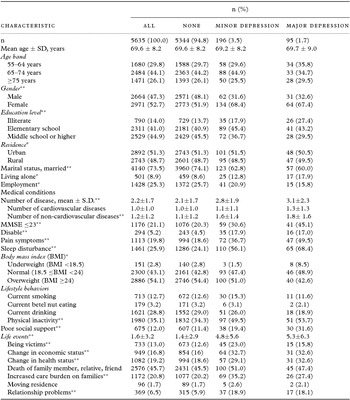
The point prevalence of clinically relevant depressive symptoms in the study sample was 5.2% (minor depression, 3.5%; major depression, 1.7%). Table 1 summarizes the demographic characteristics of the study groups and risk factors for depression. In general, minor and major depression were more likely in women, individuals who were illiterate, living alone, unemployed, having poor social support, or experiencing of more negative life events in the past years; and/or participants with more somatic symptoms or medical illness, including non-cardiovascular chronic diseases, pain symptoms, sleep disturbance, physical inactivity, cognitively impairment, or disability. Respondents who were married and those who were overweight were less likely to have depression than those individuals who were single or widowed and those who were underweight or normal weight, respectively.
Baseline characteristics of total respondents and subgroups by depression status

Kruskal–Wallis test or χ2 2 test was conducted to detect the differences among three groups (None, Minor depression, and Major depression).
*p value <0.05.
**p value <0.001.
a Urban: City: Taipei, Changhua, Kaohsiung, and Hualien; Rural: Miaoli, Yangmei, Shoufeng, and Chiayi.
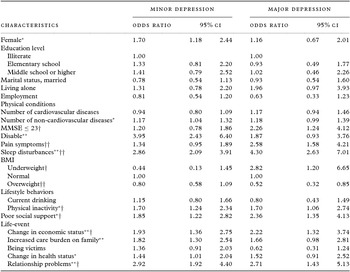
Relative risk factors for major and minor depression are presented in Table 2. Minor depression was associated significantly with female gender, presence of non-cardiovascular diseases, disability, sleep disturbance, physical inactivity, poor social support, and negative life event, including change in economic or health status, increased care burden on family, and relationship problems. Major depression was associated significantly with cognitive impairment, pain symptoms, sleep disturbances, underweight, physical inactivity, poor social support, changes in economic status, and relationship problems. Age, education level, residence, marital status, living along or not, employment, or substance (tobacco, alcohol, and betel nut) use were not associated with major and minor depression.
Factors associated with minor and major depression

* p value <0.05.
**p value <0.001 for minor depression.
†p value <0.05.
††p value <0.001 for major depression.
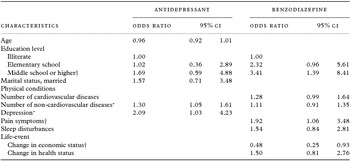
The prevalence rates of antidepressant use were 1.9%, 11.2%, and 20.0% for no, minor, and major depression groups, respectively; and they were 9.6%, 21.9%, and 30.5% with respect to these three groups for benzodiazepine use. Antidepressant use was positively associated with the major depression and the number of non-cardiovascular diseases. Benzodiazepine use was associated with a high education level and pain symptoms (Table 3).
Factors associated with antidepressant or benzodiazepine treatment among all depressive patients (n= 291)

* p value <0.05.
**p value <0.001 for antidepressant treatment.
†p value <0.05.
††p value <0.001 for benzodiazepine treatment.
Discussion
Prevalence of depression in Taiwan
The prevalence rates of minor and major late-life depression in this sample were much lower than reported previously for elderly individuals in Taiwan (Liu et al., Reference Liu1997; Lu et al., Reference Lu, Liu and Yu1998; Chong et al., Reference Chong2001; Tsai et al., Reference Tsai, Yeh and Tsai2005). This discrepancy may be attributable to sampling schemes, differences in depression definitions, or measurement tools. First, most previous studies enrolled community residents without exclusions of severe illness, physical disability (Liu et al., Reference Liu1997; Lu et al., Reference Lu, Liu and Yu1998; Chong et al., Reference Chong2001; Tsai et al., Reference Tsai, Yeh and Tsai2005), or cognitive impairment (Liu et al., Reference Liu1997; Lu et al., Reference Lu, Liu and Yu1998; Chong et al., Reference Chong2001), thus resulting in a much higher estimate of depression prevalence rate than that in our study. Second, the use of different assessment instruments in particular limits the ability to compare our findings with those of previous studies. The Chinese version of the Geriatric Depression Scale, which could be more sensitive than CES-D (Williams et al., Reference Williams, Pignone, Ramirez and Stellato2002), was used in two studies; the estimated prevalence rates of clinically relevant depressive symptoms were 27.5% and 34.8%, respectively (Lu et al., Reference Lu, Liu and Yu1998; Tsai et al., Reference Tsai, Yeh and Tsai2005). Liu et al. (Reference Liu1997) first screened participants using the Geriatric Depression Scale (26% positive results), then conducted semi-structured interviews to diagnose depressive disorder (13%) and major depression (6.1%). Using the Geriatric Mental State Schedule–Automated Geriatric Examination for Computer-Assisted Taxonomy (GMS-AGECAT), a semi-structured interview-based instrument, (Chong et al., Reference Chong2001) estimated that the prevalence rates of minor and major late-life depression in southern Taiwan were 15.3% and 5.9%, respectively. The use of psychiatric interviews and application of strict diagnostic criteria often results in a lower prevalence rate than obtained using questionnaire-based interviews. In turn, use of the GMS-AGECAT results in a higher estimated prevalence of depression compared with the use of DSM-III-R or DSM-IV diagnostic criteria (Djernes, Reference Djernes2006). Our two-stage survey method, consisting of questionnaire-based screening followed by PRIME-MD administration, resulted in the rigorous definition of depressive disorders, thereby reducing the prevalence rate. Third, our response rate (44.8%) was lower than achieved in previous studies (Liu et al., Reference Liu1997; Chong et al., Reference Chong2001). Non-participants were more likely to be female, aged ≥75, with primary school education or living in rural areas (Table S1, available as supplementary material attached to the electronic version of this paper at www.journals.cambridge.org/jid_IPG). In addition, non-response may be associated with psychopathological problems. Therefore, the prevalence of depression in our study might be under-estimated. Finally, 1.9% of non-depressed participants used antidepressants and 9.6% used benzodiazepine. Although these drugs may be prescribed for non-depressive conditions, such as anxiety disorder, obsessive–compulsive disorder, or sleep disturbance, the classification of these individuals as non-depressed may have resulted in the overlooking of subthreshold or remitted depression.
Recent results from the Taiwan Psychiatric Morbidity Survey indicate that 1.2% of individuals aged ≥18 years and 0.8% of those aged >40 years in the country's general population have major depressive disorder (Liao et al., Reference Liao2012). These low prevalence rates are likely due to the use of the World Mental Health Survey of the World Health Organization Composite International Diagnostic Interview, a rigorous diagnostic instrument. In addition, the study did not focus on the geriatric population, and the sample of elderly individuals may have been insufficient for accurate estimation of the prevalence of late-life depression. Prevalence rates of depression in Taiwan and other Asia Pacific regions are generally lower than those in Western countries (Weissman et al., Reference Weissman1996; Chiu, Reference Chiu2004), perhaps attributable to the pervasiveness of stoicism in Asian cultures (Compton et al., Reference Compton1991; Liao et al., Reference Liao2012). However, functional impairment is more severe among individuals with major depressive disorder in Taiwan compared with those in other countries (Liao et al., Reference Liao2012). These findings imply that only those with the most severe forms of depression have been detected. As severe impairment appears to be likely among individuals with minor depressive disorders in this population, this group deserves more clinical attention.
Risk factors
The risk factors for depression identified in this study are compatible with those identified in previous studies (Cole et al., Reference Cole, Bellavance and Mansour1999; Djernes, Reference Djernes2006). Female gender is still a risk factor in elderly individuals. Lack of association between gender and major depression in multiple regression analysis might be due to small case number of major depression. The association between age and late-life depression remained inconclusive. In this study, we found no association between age and depression, which were in line with previous studies in Taiwan (Liu et al., Reference Liu1997; Chong et al., Reference Chong2001).
Medical illness is one of the most important risk factor for depression. In this study, we found number of non-cardiovascular diseases was associated with minor depression; however, cardiovascular disease was not. Such findings might be against vascular hypothesis of late-life depression (Butters et al., Reference Butters2008). There were several possible explanations for these negative associations. Severity of cardiovascular diseases was not included in our analysis. The status of cardiovascular disease was based on patients’ self-reports, which might not be correct. In addition, the composite cardiovascular diseases might not actually reflect the effect of individual cardiovascular disease on the risk of depression. The etiology of late-life depression is multifactorial; thus, vascular lesion might be a minor cause; therefore, a larger sample size is necessary to confirm these findings.
We found cognitive impairment, underweight, pain symptoms, and sleep disturbances were strongly associated with major depression. Our findings were consistent with studies showed patients with cognitive impairment exhibited more depressive symptoms (Lyketsos et al., Reference Lyketsos, Lopez, Jones, Fitzpatrick, Breitner and DeKosky2002). Possible pathophysiologic link between depression and cognitive impairment includes elevated inflammatory cytokines, cerebrovascular lesions, and impaired social function (Butters et al., Reference Butters2008). It should be noted that the accuracy of MMSE among illiterates is questionable. The cut-off point of 23 might produce a high false positive rate and low specificity among participants with a low education level. Alternative cognitive tests might be added in the follow-up assessment. Patients with chronic pain symptoms commonly suffered from depressive symptoms (Averill et al., Reference Averill, Novy, Nelson and Berry1996). Sleep disturbance was also a predictor of future depression (Livingston et al., Reference Livingston, Blizard and Mann1993). However, the significance of these findings is likely inflated, as these characteristics may be manifestations of depressive symptoms. The causality of these associations should be investigated further.
Of note, we found overweight was associated with a reduced risk of major depression. The association between body weight and depression varied across countries (Luppino et al., Reference Luppino2010). Our findings were compatible with previous longitudinal epidemiological studies demonstrated that overweight is inversely associated with depression in Taiwan (Kuo et al., Reference Kuo, Lin, Chen, Chuang and Chen2011).
Stress-vulnerability models posit that depression can be the result of interactions between individual vulnerability and negative life events. We found poor social support was associated with depression; however, marital status or living alone was not in multiple regression analyses. These factors might be correlated with each other. Social support network might be the best predictor for depressive symptoms. Based on a comparative analysis of risk factors, Beekman et al. (Reference Beekman, Deeg, van Tilburg, Smit, Hooijer and van Tilburg1995) proposed that major late-life depression is rooted more often in personal vulnerability, whereas minor depression develops more often in response to stressful events. Our results partially support these hypotheses. We found poor social support was more strongly associated with major depression than minor depression. In contrast, adverse life events, such as increased care burden on family, change in health status, and/or relationship problem, were more likely to be associated with minor depression.
The rate of antidepressant treatment was low in the present study; consistent with previous results (Beekman et al., Reference Beekman, Deeg, Braam, Smit and Van Tilburg1997), we found that about 11.2% of patients with minor depression and 20.0% of patients with major depression received treatment. The low rate of antidepressant use may reflect the under detection of depression or patients’ concerns about the adverse effects of these drugs. Patients with more comorbid non-cardiovascular diseases might consult health professionals more frequently, thus, increasing the likelihood of being detected and treated with antidepressant. Although antidepressants are more effective than placebo in treating late-life major depression, their effect sizes are moderate (Nelson et al., Reference Nelson, Delucchi and Schneider2008). The effectiveness of such treatment for minor depressive disorders remains questionable (Barbui et al., Reference Barbui, Cipriani, Patel, Ayuso-Mateos and van Ommeren2011). As a result, patients with minor depression were less likely to receive antidepressant treatment. Whether depressive patients without antidepressant use received an alternative treatment, such as psychotherapy or lifestyle interventions, remained unclear. The clinical course and outcomes for those without antidepressant treatment warrant further investigations in follow-ups. On the other hand, benzodiazepine use was more common than antidepressant use, indicating that the psychiatric symptoms, such as anxiety and insomnia were detected by physicians in this population. We found benzodiazepine use was also more prevalent in higher educated study participants, perhaps it is because these people consulted health professionals more often than the others to report psychiatric symptoms.
Study strengths and limitations
To our knowledge, this study of late-life depression involved the most comprehensive and representative nationwide large sample in Taiwan to date. A fairly rigorous two-stage survey method was used to identify late-life depression. Differences in risk factors between minor and major depression and prevalence of antidepressant use were thoroughly explored.
However, the study has several limitations. First, the HALST cohort consisted of community-dwelling older adults and excluded those with severe illness, cognitive impairment, and severe frailty. Thus, the results of the present study cannot be generalized to elderly individuals with severe medical illnesses. Second, the response rate was low (44.8%), which might be due to the time-consuming comprehensive interview and health examination. Thus, our estimates might not reflect the actual prevalence rates in the elderly population in Taiwan. Third, the use of cross-sectional data prevented us from examining temporal relationships or inferring causal links between depression and risk factors. Finally, the study data may have been affected by recall bias, especially because depressed individuals tend to remember and report negative things. This bias may have led to overestimation of the relative risks of factors associated with depression.
Conclusions
The overall prevalence rate of minor and major depression among community-dwelling healthy elderly individuals in Taiwan was 5.2% in the present study. The identification of high-risk subgroups with multiple risk factors would aid the early detection and treatment of late-life depression. The rate of antidepressant use was quite low; however, we found that the use of benzodiazepines in elderly individuals is prevalent in Taiwan. Future studies are warranted to examine inadequate prescription and develop strategies to prevent it.
Conflict of interest
None.
Description of authors’ roles
Chi-Shin Wu: study concept and design, data interpretation, and manuscript preparation; Shu-Han Yu: data acquisition and study design; Chun-Yi Lee: data analysis and interpretation; Han-Yun Tseng: data acquisition and interpretation, and manuscript preparation; Yen-Feng Chiu: obtaining funding, data acquisition, study concept and design, data analysis and interpretation, and manuscript preparation; Chao Hsiung: obtaining funding, data acquisition, study design, and manuscript review.
Acknowledgments
We thank all of the HALST participants and members of the HALST study group. This work was supported by the grants PH-97~106-SP-01, PH-101~106-PP-04 from the National Health Research Institutes (NHRI) in Taiwan. The NHRI had no role in the design, analysis, or writing of this paper.
Supplementary material
To view supplementary material for this article, please visit https://doi.org/10.1017/S1041610217000199