1. Introduction
The wide range of possible investigations provided by surface waves propagating at the interface between a plasma and a dielectric (or a vacuum) has invigorated the field, resulting in a long history of research (Trivelpiece & Gould Reference Trivelpiece and Gould1959; Kaw & McBride Reference Kaw and Mcbride1970; Vukovic Reference Vukovic1986; Stenflo Reference Stenflo1996). The early study of surface waves in a plasma-filled cylinder was carried out by Trivelpiece and Gould, restricted to electrostatic surface waves and cold plasmas (Trivelpiece & Gould Reference Trivelpiece and Gould1959). After their pioneering work, much information on the properties and propagation characteristics of surface waves has been accumulated (Trivelpiece Reference Trivelpiece1967; Aliev, Schlüter & Shivarova Reference Aliev, Schlüter and Shivarova2000; Polo, Mackay & Lakhtakia Reference Polo, Mackay and Lakhtakia2013; Girka, Girka & Thumm Reference Girka, Girka and Thumm2014). The effects of finite temperature, density inhomogeneity (Kaw & McBride Reference Kaw and Mcbride1970), collisions between particles (Tigik, Ziebell & Yoon Reference Tigik, Ziebell and Yoon2016), dusty media with the presence of non-spherical grains (Lee & Jung Reference Lee and Jung2018), quantum plasma (Li et al. Reference Li, Wu, Yang and Chu2014), etc., on the propagating structure of surface waves are some examples and they have attracted great interest since plasmas in nature and laboratories have boundaries in some way. The stability analysis of plasma waves in a variety of confined configurations has been extensively investigated (Shokri Reference Shokri2000; Mishra & Dey Reference Mishra and Dey2018; Shokri & Rukhadze Reference Shokri and Rukhadze2019). Since much research on damping has been done for volume waves, we are motivated to conduct an analysis of the collisional damping of surface ion-acoustic waves propagating on the boundary of a plasma. For low-frequency ion-acoustic waves, the ion collisions may provide a significant role in the damping of the waves. Electron collisions may only be important for high-frequency electron plasma waves (Banks et al. Reference Banks, Brunner, Berger, Arrighi and Tran2017).
In this work, an analysis of damping for ion-acoustic waves is conducted for weakly ionized plasmas by considering the collisions between ions and neutral particles. In partially ionized astrophysical plasmas, ion–neutral collisions are known to be the most important component of wave dissipation at the presence of neutrals (Kumar & Roberts Reference Kumar and Roberts2003; Leake, Arber & Khodachenko Reference Leake, Arber and Khodachenko2005). Ion–neutral collisions are also important for heating of ions in the presheath and sheath regions of a bounded plasma (Oksuz, Atta Khedr & Hershkowitz Reference Oksuz, Atta Khedr and Hershkowitz2001; Claire et al. Reference Claire, Bachet, Stroth and Doveil2006). Without ignoring the ion thermal motion, the effect of ion temperature on the collisional damping can be seen in the result. After we obtain the analytic form for the damping rate by adopting the mirror reflection boundary condition for the sharp boundary, we show that the total damping rate is the result of the addition of a collisional damping rate caused by the ions to a collisionless Landau damping rate arising from wave–particle interactions.
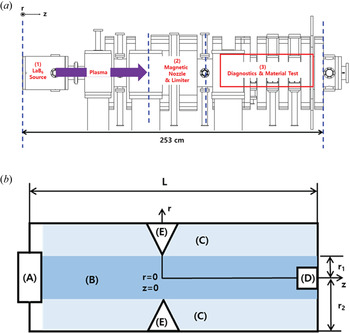
The analytic solution of the decay rate is applied to the experimental results of Divertor Plasma Simulator-2 (DiPS-2), developed as a linear plasma device for the study of a presheath region of tokamak plasma wall using probe technology (Chung Reference Chung2012). Recently, DiPS has been upgraded and experimental simulation with LaB6 cathode plasma source was conducted to obtain the following parameters for argon plasma: plasma density ${n_e}\sim {10^{11}}- {10^{13}}\;\textrm{c}{\textrm{m}^{ - 3}}$ , ${T_e}\sim 1- 20\;\textrm{eV}$
 , ${T_i}\sim 0.2\;\textrm{eV}$
 and working neutral pressure ${P_n} = 1- 50\;\textrm{mTorr}$
 (Kang et al. Reference Kang, Bae, Park, Lee and Chung2020). Applicability of collisional and collisionless damping mechanisms would be addressed by utilizing the approximate analytic solutions.
2. Collisional and collisionless damping rates
We consider a longitudinal wave, particularly the low-frequency ion-acoustic mode existing in an isotropic plasma with ${T_i} \ll {T_e}$ , where ${T_i}$
 and ${T_e}$
 are the temperatures of electrons and ions, respectively. In such a case $({T_i} \ll {T_e})$
 with wave frequencies in the range $k{v_{Ti}} \ll \omega \ll k{v_{Te}}$
 , the collisional modification of the low-frequency ion-acoustic oscillations can be made on the longitudinal dielectric permittivity. Here, ${v_{Te}}$
 and ${v_{Ti}}$
 are the thermal speed of electrons (e) and ions (i), respectively, defined by ${v_{Tj}} = \sqrt {2{T_j}/{m_j}}$
 (j = e, i). When particle collisions are not too frequent, under the condition ${\nu _c} \ll \omega$
 and $|\omega + i{\nu _c}|\ll k{v_{Te}}$
 , where ${\nu _c}$
 is the collision frequency, the longitudinal dielectric permittivity is given by (Alexandrov, Bogdankevich & Rukhadze Reference Alexandrov, Bogdankevich and Rukhadze1984)

where ${\omega _{p\alpha }} = \sqrt {4\mathrm{\pi }{n_\alpha }{e_\alpha }/{m_\alpha }}$ is the plasma frequency of particle species $\alpha$
 (= e, i). For the frequency range of the ion-acoustic wave, (2.1) can be reduced to (Shokri & Rukhadze Reference Shokri and Rukhadze2019)

If the plasma is weakly ionized, the collision frequency ${\nu _c}$ can be replaced by the ion–neutral collision frequency (ion friction).
The semi-bounded plasma considered in this work is isotropic and is assumed to occupy the half-space region defined by $x \ge 0$ , bounded by vacuum $(x < 0)$
 . We only consider a mirror reflection of the incident plasma particles at the sharp boundary surface $(x = 0)$
 . Under this condition, the plasma particles undergo a specular reflection from the boundary surface and then the small perturbation of distribution function ${f_1}$
 satisfies the boundary condition (Barr & Boyd Reference Barr and Boyd1972)

Such specular reflection condition is needed to solve the perturbed Vlasov equation and to obtain the electromagnetic fields near the plasma–vacuum interface. It is well established that the dispersion relation for surface waves can be obtained by evaluating the dispersion equation derived by applying the general electrodynamic boundary conditions and by matching the surface impedance of the bounded plasma and that of the vacuum half-space (Alexandrov et al. Reference Alexandrov, Bogdankevich and Rukhadze1984). By applying the general electrodynamic boundary condition, i.e. the continuity of the tangential component of the electric and magnetic fields for the plasma–vacuum interface, $x = 0$ , and by equating the plasma surface impedance and the vacuum surface impedance, the dispersion equation for an electromagnetic surface wave can be obtained. In the electrostatic limit, the dispersion equation for surface waves is reduced to

where ${k_\parallel }( = {k_z})$ and ${k_ \bot }( = {k_x})$
 are the parallel and the perpendicular components of the wave vector $k( = \sqrt {k_x^2 + k_z^2} )$
 , respectively. The component ${k_y}$
 has a translational invariance in the y–z surface (at $x = 0$
 ) and is set to zero for simplicity.
When damping of a wave is weak, expanding $D(\omega ,{k_\parallel })$ is a useful way to find a dispersion relation. Let $\omega = {\omega _r} + \textrm{i}\gamma$
 , where ${\omega _r}$
 is the real part and $\gamma$
 the imaginary part. In addition, we write (2.2) as ${\varepsilon _L} = {\varepsilon _r} + \textrm{i}{\varepsilon _i}$
 with ${\varepsilon _r}$
 and ${\varepsilon _i}$
 being the real and the imaginary parts of the dielectric permittivity, respectively, and we assume that $\varepsilon _r^2 \gg \varepsilon _i^2$
 . Then, it can be formulated succinctly by expanding $D(\omega ,{k_\parallel })$
 as

Note that $D(\omega ,{k_\parallel })$ can be expanded itself about $\omega = {\omega _r}$
 , under the condition ${\omega _r} \gg |\gamma |$
 , to give

which leads the damping rate in the familiar form:

where ${D_r}({\omega _r},{k_\parallel }) = {\rm Re} [D({\omega _r},{k_\parallel })]$ and ${D_i}({\omega _r},{k_\parallel }) = {\mathop{\rm Im}\nolimits} [D({\omega _r},{k_\parallel })]$
 .
The wave frequency can be now obtained by evaluating ${D_r}({\omega _r},{k_\parallel }) = 0$ . Plugging the real part of ${\varepsilon _L}$
 ,

into the integral in ${D_r}({\omega _r},{k_\parallel })$ , we then obtain the following expression for ${D_r}({\omega _r},{k_\parallel })$
 :

where

The integral in (2.10) can be evaluated in the complex ${k_ \bot }$ plane using Cauchy's integral theorem. Picking up the residue at the pole ${k_ \bot } = \xi$
 , we obtain the following result for the surface ion-acoustic wave for ${\omega _r} < {\omega _{pi}}$
 :

where ${\lambda _{De}} = {v_{Te}}/{\omega _{pe}}$ is the electron Debye length. As expected, the wave frequency is linearly proportional to the parallel wavenumber, i.e. ${\omega _r}/{\omega _{pi}} \approx {k_\parallel }{\lambda _{De}}$
 , in the limit of long parallel wavelength, and becomes a constant, i.e. ${\omega _r}/{\omega _{pi}} \approx 1/\sqrt 2$
 , in the limit of short parallel wavelength. This spectral feature satisfies well the property of surface waves.
We now proceed to the derivation of damping rate for the wave. We restrict our calculation to the case in which an analytic solution is possible. The manipulation of integrals in (2.5) including collision is a mathematical challenge. Therefore, we use an approximation called the transverse truncation method to evaluate the dispersion integral in the imaginary part of (2.5). According to the constraint of the dielectric permittivity $|{\varepsilon _i}/{\varepsilon _r}|\ll 1$ and the transverse truncation method which is known as the weak contribution of the perpendicular component ${k_ \bot }$
 of the wave vector to the function ${\varepsilon _i}/{\varepsilon _r}$
 near the interface, i.e. ${[{\varepsilon _i}({\omega _r},k)/{\varepsilon _r}({\omega _r},k)]_{{k_ \bot } = 0}}$
 can be applied to extract the physical information on the imaginary part ${D_i}$
 . Hence, the condition of the smallness of ${\varepsilon _i}/{\varepsilon _r}$
 provides a very novel method and is useful for surface wave calculations, especially for surface waves propagating in semi-bounded plasmas. Near the sharp boundary, the transverse truncation method can be employed to construct ${D_i}({\omega _r},{k_\parallel })$
 by physical reasoning in the form

After substituting expressions for ${\varepsilon _r}$ and ${\varepsilon _i}$
 , we obtain

where ${\nu _{in}}$ is the neutral–ion collision frequency.
Therefore, the damping rate for the surface ion-acoustic mode in the weakly ionized plasma is finally derived as

The damping rate $\gamma$ given by (2.14) predicts that surface ion-acoustic waves disturbed by small perturbations are always damped since $\gamma$
 is always negative for any value of parameters. The damping rate consists of two parts: Landau damping (collisionless) and collisional dissipation of the wave. This is easy to see if we take the two extremes: long parallel wavelength (small parallel wavenumber) and short parallel wavelength (large parallel wavenumber) limits. In the long parallel wavelength limit, i.e. ${k_\parallel }{\lambda _{De}} \to 0$
 , (2.14) is reduced to

which further can be written as $\gamma \approx{-} \sqrt {\mathrm{\pi }/2} {k_\parallel }{\lambda _{De}}\omega _{pi}^2/{\omega _{pe}} \propto {k_\parallel }$ . Therefore, the collisional part (the term with ${v_{in}}$
 ) is neglected and the remainder conforms to the characteristics of the conventional Landau damping for the long parallel wavelength wave. In the short parallel wavelength limit, however, if we take ${k_\parallel }{\lambda _{De}} \to \infty$
 , (2.14) becomes

which implies that the dynamic role of collisions dominates damping of the wave. Therefore, the damping rate is almost constant because of weak plasma dispersion in a large-wavenumber region where the wave frequency is nearly constant $({\omega _r} \approx {\omega _{pi}}/\sqrt 2 )$ .
Figure 1 illustrates the dependence of collision frequency on the dissipation of the ion-acoustic surface wave in the weakly ionized plasma. In this figure, the damping rate $\gamma$ , the parallel wavenumber ${k_\parallel }$
 , the collision frequency ${\nu _{in}}$
 and the electron plasma frequency ${\omega _{pe}}$
 are scaled to the dimensionless physical quantities as follows: $\bar{\gamma } \equiv \gamma /{\omega _{pi}}$
 , ${\bar{k}_\parallel } \equiv {k_\parallel }{\lambda _{De}}$
 , ${\bar{\nu }_{in}} \equiv {\nu _{in}}/{\omega _{pi}}$
 and ${\bar{\omega }_{pe}} \equiv {\omega _{pe}}/{\omega _{pi}}$
 , respectively. The absolute value of $\bar{\gamma }$
 is plotted in figure 1. As can be seen, the magnitude of $\bar{\gamma }$
 decreases with an increase of the ion–neutral collision frequency ${\bar{\nu }_{in}}$
 . As ${\bar{k}_\parallel }$
 increases, the collision frequency is mainly responsible for the damping rate.
Damping rate for the surface ion-acoustic wave in the weakly ionized plasma as a function of ${\bar{k}_\parallel }( = {k_\parallel }{\lambda _{De}})$ for various ion–neutral collision frequencies: ${\bar{\nu }_{in}} = 0$
 (collisionless; solid line), $1.9 \times {10^{ - 4}}$
 (dash-dotted line), $9.5 \times {10^{ - 4}}$
 (dashed line) and $1.9 \times {10^{ - 3}}$
 (dotted line).

3. Application to divertor simulator
Figure 2 depicts a schematic of DiPS-2, a divertor simulator, with geometrical production of a bounded presheath. In figure 2, the core plasma (B) of radius ${r_1}$ is produced along the axial direction (z coordinate) and is bounded by the edge plasma (C). In a series of recent experiments with a LaB6 direct current plasma source and argon plasmas, the plasma parameters under normal operation conditions were obtained as follows: ${n_e}\sim {10^{10}}\;(\textrm{edge})- {10^{12}}\;(\textrm{core})\;\textrm{c}{\textrm{m}^{ - \textrm{3}}}$
 , ${T_e} = 1\;(\textrm{edge})- 10\;(\textrm{core})\;\textrm{eV}$
 , ${T_i} = 0.1\;\textrm{eV}$
 and ${P_n} = 1- 50\;\textrm{mTorr}$
 (Kang et al. Reference Kang, Bae, Lho and Chung2017, Reference Kang, Bae, Park, Lee and Chung2020). The theory discussed in § 2 deals with the simplest problem of surface waves travelling along the boundary of plasma with sharp inhomogeneity. A similar situation is a magnetically confined plasma in a controlled thermonuclear fusion device where the plasma is separated from the vessel wall. Hence, our result can be applied to investigate the characteristics of the core plasma bounded by the edge plasma of DiPS-2. In DiPS-2 experiments, the ion–neutral collision frequency is also measured for argon plasmas under various conditions. When the discharge current $({I_d})$
 was 10 A and the neutral temperature $({T_n})$
 was 300 K, the plasma density, the temperatures and the electron Debye length were measured as ${n_e} = 2.2 \times {10^{11}}\;\textrm{c}{\textrm{m}^{ - 3}}$
 , ${T_e} = 3.7\;\textrm{eV}$
 , ${T_i} = 0.2\;\textrm{eV}$
 and ${\lambda _{De}} = 3.04 \times {10^{ - 3}}\;\textrm{cm}$
 , respectively. In this case, the ion–neutral collision frequency was found as ${\nu _{in}} = 23\;\textrm{kHz}$
 . Various values of collision frequency with different plasma parameters of the core plasma are summarized in table 1.
(a) A diagram of Hanyang University DiPS-2: (1) LaB6 cathode direct current discharge region; (2) magnetic nozzle region (B < 3.5 kG); and (3) diagnostics region (B < 1.5 kG). (b) A schematic diagram of DiPS-2: A, LaB6 cathode; B, core plasma; C, edge plasma; D, tungsten; E, limiter; L, DiPS-2 length = 253 cm; r 1, core plasma radius/limiter size = 2.5 cm; r 2, wall radius = 12 cm.

Plasma parameters at the core region of DiPS-2 argon plasma.

Now, the wave frequency and the damping rate can be estimated using (2.9) and (2.14) with the DiPS-2 parameters. We consider two circumstances by giving the values of the parallel wavenumbers as follows: ${k_\parallel }\,\, = \,\,0.1\lambda _{De}^{ - 1}$ for the long parallel wavelength case and ${k_\parallel }\,\, = \,\,10\lambda _{De}^{ - 1}$
 for the short parallel wavelength case. These values correspond to the collisionless Landau damping and the collisional damping of the wave, respectively. For the case of ${n_e}\,\, = \,\,2.2 \times {10^{11}}\;\textrm{c}{\textrm{m}^{ - 3}}$
 , ${T_e} = 3.7\;\textrm{eV}$
 , ${\nu _{in}} = 23\;\textrm{kHz}$
 , the frequency and the damping rate of the long parallel wavelength wave are calculated as ${\omega _r} = 9.30 \times {10^6}\;\textrm{rad}\;{\textrm{s}^{ - 1}}$
 and $\gamma \,\, = \,\, - 4.46 \times {10^4}\;\textrm{rad}\;{\textrm{s}^{ - 1}}$
 , respectively. For those of the short parallel wavelength wave, we obtain ${\omega _r} = 6.60 \times {10^7}\;\textrm{rad}\;{\textrm{s}^{ - 1}}$
 and $\gamma \,\, = \,\, - 9.07 \times {10^3}\;\textrm{rad}\;{\textrm{s}^{ - 1}}$
 . As discussed in § 2, the dependence of collisions on the dissipative process is important only for the short parallel wavelength limit. Table 2 shows more examples with other parameters.
Wave frequency and damping rate with DiPS-2 parameters.

aThe long parallel wavelength limit corresponds to the collisionless Landau damping of the wave.
bThe short parallel wavelength limit corresponds to the collisional damping of the wave.
4. Summary
The collisional damping of the surface wave in the range $k{v_{Ti}} \ll \omega \ll k{v_{Te}}$ is investigated for weakly ionized plasmas by comparing the collisionless Landau damping with the collisional damping assuming that the ratio of ion temperature to electron temperature is very small and the wave frequency is much larger than the ion–neutral collision frequency. It is found that the collisionless Landau damping, $\gamma \,\, \approx \,\, - \sqrt {\mathrm{\pi }/2} {k_\parallel }{\lambda _{De}}\omega _{pi}^2/{\omega _{pe}}$
 , is dominant for the waves with small parallel wavenumbers, and the collisional damping, $\gamma \approx{-} {\nu _{in}}/16$
 , prevails for the waves with large parallel wavenumbers. The theoretical calculation was applied to the experimental results obtained using DiPS-2. Although the wavelength should be specified, the collisionless and collisional damping rates are estimated as $\gamma ={-} 4.46 \times {10^4}$
 for ${k_\parallel } = 0.1\lambda _{De}^{ - 1}$
 and $\gamma ={-} 9.07 \times {10^3}$
 for ${k_\parallel } = 10\lambda _{De}^{ - 1}$
 , respectively, with the parameters of DiPS-2 core plasma such as ${n_e} = 2.2 \times {10^{11}}\;\textrm{c}{\textrm{m}^{ - 3}}$
 , ${T_e} = 3.7\;\textrm{eV}$
 , ${\nu _{in}} = 23\;\textrm{kHz}$
 . The result of theoretical calculation and its application to DiPS-2 experimental results should be helpful to understand the characteristics of waves propagating on the boundary of confined plasmas such as the edge plasma of a fusion device or solid-state plasma whose surface structure is defined by a crystal lattice. Although the estimations in this work are limited to DiPS-2 experiment, it is suggested to conduct experimental measurement of decay rates that can be compared with the analytical decay rates found in this work.
Acknowledgements
Editor William Dorland thanks the referees for their advice in evaluating this article.
Funding
The work was supported by a National Research Foundation of Korea (NRF) grant funded by the Korean Government (NRF-2019M1A7A1A03088471).
Declaration of interests
The authors report no conflict of interest.
Data availability
The data that support the findings of this study are available upon reasonable request from the authors.