In his Rhapsody in Blue (1924) and Concerto in F (1925), George Gershwin sought to represent the United States as a melting pot by combining stylistic elements that signified Americans of different races.Footnote 1 More specifically, he made productive use of qualities commonly understood as “white” or “black”: white bundled with ideas of “symphonic” and “classical” music, “Europe,” “harmony,” and “highbrow culture,” and black with “jazz,” “Africa,” “rhythm,” and “lowbrow entertainment.”Footnote 2 A binary conception of separate white and black races, each connected to distinct musical tropes, was widely taken for granted in the 1920s in the United States, guiding the reception of Gershwin's compositions as “hybrids.” The American conception of hybridity, with its racial background and overtones, is also implicit in the categorical terms applied to Rhapsody in Blue and Concerto in F, such as “symphonic jazz” and “highbrow jazz.”Footnote 3
Bill Finegan, who wrote for Tommy Dorsey and Glenn Miller before forming the Sauter-Finegan Orchestra with Eddie Sauter, arranged Rhapsody in Blue in 1942 (for Miller) and Concerto in F in 1952 (for the Sauter-Finegan Orchestra).Footnote 4 As a kind of musical analysis, Finegan's treatments suggest that techniques central to popular forms were foundational to Gershwin's longer “highbrow” works. Finegan heard Rhapsody in Blue and Concerto in F as popular music rather than as exceptional “symphonic jazz” hybrids. However, categories of “classical music” and “jazz” continued to guide the reception of Finegan's arrangements, pointing to the persistent ideas about race embedded in Gershwin's pieces.
Gershwin, Jazz, and Race in the 1920s
Gershwin's Rhapsody in Blue, premiered in 1924, is one of the most enduring and successful American compositions, and is primarily known today for its place in the repertoire of symphony and pops orchestras. However, Rhapsody in Blue has undergone many different arrangements since its inception. The commonly played full orchestra setting by Ferde Grofé is only one of many versions of the piece. The arrangement first presented to the public was, rather, an orchestration for Paul Whiteman's band, also by Grofé, from a two piano version written by Gershwin.Footnote 5 The premiere of this arrangement in Whiteman's heavily hyped “Experiment in Modern Music” concert of 1924 at Aeolian Hall, with Gershwin at the piano, was a high point of Whiteman's career and a huge boost for Gershwin's.Footnote 6
The 1924 Aeolian Hall concert program began with the “True Form of Jazz,” represented by the Original Dixieland Jazz Band's “Livery Stable Blues,” and climaxed with Rhapsody in Blue (“A Rhapsody in Blue” in the original program).Footnote 7 Whiteman exploited the taboo appeal of playing music widely associated with popular entertainment and African Americans in a concert hall mostly patronized by wealthy white elites, with boasts such as “the first jazz concert that was ever given in the sacred halls of a symphonic hall”—although black composers and performers were absent from the concert, along with any mention of the black origins of jazz.Footnote 8 For his part, Gershwin promoted his melting-pot vision of America by explicitly incorporating and combining elements that represented the “richness” of American life, including jazz and classical signifiers attached predominately to the band and the piano, respectively.Footnote 9
Concerto in F was a similar inclusive expression of Americanness, but with even bolder classical and jazz signifiers.Footnote 10 On one hand, Gershwin decided to compose a full-blown concerto (rather than a lightweight rhapsody) within the “standard three-movement form, used by European composers from Mozart to Rachmaninov,” placing the piece more firmly in the realm of classical music.Footnote 11 On the other hand, he drew on the blues more explicitly than he had in Rhapsody, especially in the second movement, which was originally titled “Song (Blues).”Footnote 12 Blues harmonies open Rhapsody in Blue, but a full-fledged blues scheme (a 16-bar blues) and melody open Concerto in F. Furthermore, Gershwin treats the material according to blues conventions, repeating the melodies as strains and the chord progressions as cycles. Multi-strained blues compositions, such as those published in W. C. Handy's collection Blues: An Anthology, are precisely the sort of blues with which Gershwin would have been familiar.Footnote 13
The reception of Gershwin's use of classical and jazz gestures occurred in a time in the United States when the division of human beings into separate races was still largely taken for granted and dominated by a black-white opposition.Footnote 14 Discrete musical styles, gestures, and commercial “genres” and markets (such as “race” and “hillbilly” records) were linked to discrete racial categories, despite the intertwined histories and shared repertoires of Americans.Footnote 15 The critical assessment of Rhapsody in Blue as a “hybrid” combination of classical music and jazz is connected to the racial concept of hybridity, which originally allowed for the possibility of “interbreeding” between different races while maintaining the separateness of the racial categories themselves.Footnote 16 Some, such as Gershwin, saw race and class mixing as the unique, unquestionably positive hallmark of American society and culture. But others, such as Constant Lambert (who called works that followed Rhapsody in Blue “the hybrid child of a hybrid”) characterized Gershwin's works as hybrids to mean dilutions of classical, jazz, or both.Footnote 17
In the 1920s, the racial associations of jazz and jazz styles were contested terrain. Jazz was widely understood as a black music, and many musicians and writers asserted jazz as an authentic black music, rooted in African American practices and practitioners, but some critics associated jazz with Jews, lower social classes, and lowbrow entertainment in general, and others, such as Gershwin, claimed jazz as the collective product of all Americans.Footnote 18 To make his point, Gershwin had to argue against the widespread associations of jazz and African Americans, writing, “In speaking of jazz there is one superstition . . . which must be destroyed. This is the superstition that jazz is essentially Negro. . . . Jazz is not Negro but American.”Footnote 19 He mapped his idea of “America” onto jazz, stating, “When jazz is played in another nation, it is called American. When it is played in another country, it sounds false. Jazz is the result of the energy stored up in America. . . . Jazz has contributed an enduring value to America in the sense that it has expressed ourselves.”Footnote 20 Jazz was “the voice of the American soul,” which was “black and white . . . all colors and all souls unified in the great melting pot of the world.”Footnote 21 Rhapsody in Blue, which placed jazz gestures within a larger context of many other developing and emerging US styles, helped make his case. Regarding the piece, he stated, “I heard it as sort of a musical kaleidoscope of America—of our vast melting pot, of our incomparable national pep, our blues, our metropolitan madness.”Footnote 22
Gershwin's ideology, reflected in his melting-pot compositional style, can be situated in a larger context of the ambiguous racial position of Jewish Americans in the 1920s and their close living and working relationships with African Americans. Language about the Jewish or “Hebrew” race (from both Jews and non-Jews) was commonplace.Footnote 23 “Jews” were mostly understood in the United States as limited to the Jews of Eastern European descent who immigrated in massive numbers in the late nineteenth and early twentieth centuries, and who, along with the African Americans participating in the Great Migration, changed the demographics of northern cities in an extremely short span of time.Footnote 24 This Jewish race existed between black and white, linked to blackness and European otherness, and shaped by centuries of antisemitic rhetoric.Footnote 25 The racial status of Jews in the 1920s also complicates interpretations of Gershwin's compositions and performances as simply “white,” and helps contextualize the debates over his status as an authentic representative of jazz (for example, at the piano in the 1924 performance of Rhapsody in Blue).
Jews (in Europe and the United States), like African Americans, engaged their racial position in different ways in relation to their diverse social situations and backgrounds. Some, including Franz Boas and Melville Herskovits, were at the forefront of arguing against racialized categories of humanity.Footnote 26 The racial term “melting pot” itself specifically connects to Israel Zangwill's extremely influential play, premiered in 1908, about a Jewish New York composer named David Quixano who is writing an “American Symphony” and in love with Vera Revendal, a Russian Gentile woman. In the play, Quixano proclaims, “America is God's Crucible, the great Melting-Pot where all the races of Europe are melting and re-forming! . . . Germans and Frenchmen, Irishmen and Englishmen, Jews and Russians—into the Crucible with you all! God is making the American.. . . [T]he real American has not yet arrived. He is only in the Crucible, I tell you—he will be the fusion of all races, perhaps the coming superman. Ah, what a glorious Finale for my symphony—if I can only write it.”Footnote 27 Rhapsody in Blue and Concerto in F extended a melting-pot myth for white ethnics geared towards the possibility of immigrant assimilation and racial and social mobility in the New World, and went a long way in positioning jazz as an expressive space in which this dream might be located.Footnote 28
Since Rhapsody in Blue and the Concerto in F were designed to communicate melting-pot ideals, it follows that Gershwin exploited the white and black associations of various stylistic elements. But his particular combination of jazz, blues, and classical music signifiers drew attention and raised eyebrows, because these signifiers were associated with categories that many thought should stay separate; not everyone shared Gershwin's positive outlook on American hybridity and the melting pot. Virgil Thomson, for example, wrote famously in 1935 that Gershwin's “oversophisticated commercial background . . . commonly known as Tin Pan Alley . . . is developed out of all proportion to what is justified by the expressive possibilities of its musical material. That material is straight from the melting pot. At best it is a piquant but highly unsavory stirring-up-together of Israel, Africa, and the Gaelic Isles.”Footnote 29
Gershwin's project of a musical melting pot set the stage for a heterogeneous style of American composition rooted in popular forms crossing racial categories, but it also embedded a paradox. By combining racially marked classical and jazz signifiers to accomplish his vision, Gershwin reinforced the white and black associations of the gestures he employed and perpetuated the prevailing societal ideas about separate races connected to distinct forms of musical expression. Rhapsody in Blue and Concerto in F managed to both transcend and perpetuate the racialization of classical and jazz styles.
Finegan's Arrangement of Rhapsody in Blue in the 1940s
Schiff calls the Glenn Miller Orchestra “in many ways the cultural heir to Whiteman.”Footnote 30 The description is apt. Both bands were white jazz orchestras, hugely successful financially but criticized for being dilutions of authentic jazz, and both bands specialized in highly organized arrangements with little room for improvisation. In 1939, the Miller Orchestra even replaced Whiteman on the Wednesday night Chesterfield radio program on CBS.Footnote 31 The repertoires of the two organizations both had syncopated arrangements of classical pieces, even sharing some of the same material, such as “Song of the Volga Boatmen.”Footnote 32 Finegan gave Rhapsody in Blue a characteristic Miller treatment, turning the familiar melodic material into a vehicle to briefly spotlight two soloists (Bobby Hackett on cornet and Tex Beneke on tenor saxophone).
Finegan's version of Rhapsody in Blue highlights some of the jazz and popular music signifiers in Gershwin's original: syncopation, blues harmony, and forms based on melodic strains. By amplifying these aspects and reconfiguring them in his arrangement for Miller, and by shortening the piece and changing the instrumentation, Finegan successfully created a mainstream swing-band piece that erased the racially identified jazz-classical “melting pot” mixture of the premiere.
Syncopation strongly signified “jazz” in the 1920s.Footnote 33 Like other jazz gestures that Gershwin incorporated, syncopation was simultaneously considered a black rhythmic device and a symbol of universality for Gershwin and his audience. Gershwin wrote that “jazz . . . in its essence . . . is no more Negro than is syncopation, which exists in the music of all nations,” demonstrating that rhythm, syncopation, and jazz were already linked and firmly attached to ideas of blackness in the minds of his readers.Footnote 34 And as Finegan emphasized in his arrangement, syncopation continued to be received as a particular feature of jazz in the 1940s.
Example 1 shows the prominent syncopation at the opening of Gershwin's Rhapsody in Blue, heard in the accented offbeats in the second and third bars of the melody (on D-flat, F, A-flat, and F).
Opening melody to Rhapsody in Blue (1st clarinet).

Example 2 illustrates how Finegan retains these syncopations and adds more in his arrangement of Gershwin's opening motive. The eighth notes are all played with a swing rhythm (indicated with a dotted eighth–sixteenth rhythm, but performed with more of a triplet subdivision), and in the last part of the phrase, Finegan adds to the number of accented offbeats, anticipating the attacks.
Opening melody to Rhapsody in Blue, Finegan arrangement (1st trumpet).

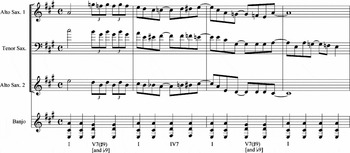
Finegan also draws attention to Gershwin's extensive use of blues harmony in Rhapsody in Blue. As Example 3 shows, the second note of one iteration of the opening melody is supported by the common blues chord that combines the major triad, a flatted seventh, and the minor third of the chord above (sometimes called the dominant seventh sharp-nine chord). The following note, the flatted ninth, is also an essential component of blues harmony. In fact, the combination of a “dominant seventh” chord (major triad + flatted seventh, regardless of function), with a flattened or sharpened ninth (or both) has a singular name in modern jazz harmony: the “alt” chord.Footnote 35 Furthermore, the 7(flat-9) here is part of the eight-position “Trouble in Mind” scheme, a common blues chord progression. The use of three saxophones and a banjo in the mix heightens the jazz and dance-band qualities of the harmony; these timbres, although somewhat buried in the later orchestral arrangement, are especially prominent in the Whiteman recording of 1927 and the recording of Maurice Peress's re-creation of the 1924 concert.Footnote 36
An iteration of the opening Rhapsody in Blue melody in both Grofé's orchestral and jazz band arrangements (concert pitch); mm. 77–80 in the orchestral score. George Gershwin, Rhapsody in Blue (New York: New World Music, [1924] 1942); George Gershwin, Rhapsody in Blue (Gershwin 50th Anniversary Edition) (Secaucus, N.J.: Warner Brothers, Reference Gershwin1987).

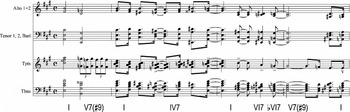
Example 4 shows Finegan's adaptation of this melody, with full orchestration. Every instrument in the big band is playing some part of the chord progression, stressing the V7(flat-9) chord with a fortissimo dynamic level. Furthermore, Finegan extends the harmony by adding a VI7 and flat-VI7 walkdown to the second V7(flat-9), and by delaying the final I chord, which adds a strong element of syncopation.
Finegan adaptation of opening Rhapsody in Blue melody. Transposed to A major from the original G-flat major for comparative purposes, and imploded onto four staves. Bill Finegan, arr., “Rhapsody in Blue,” unpublished transcription, rec. 1942.

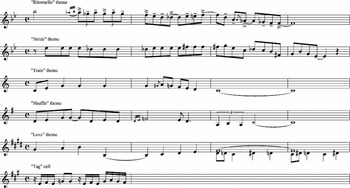
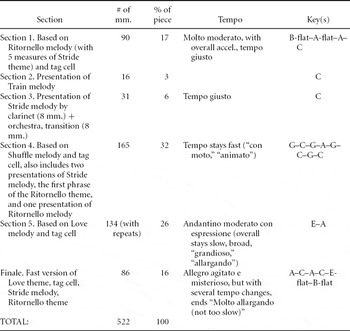
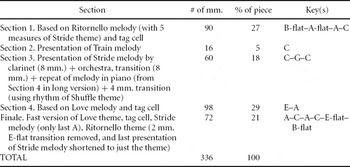
Forms based on melodic strains, another hallmark of popular music, govern the structure of Rhapsody in Blue. Schiff identifies five themes and one “tag cell” that comprise the piece's main melodic material (see Example 5).Footnote 37 Each theme contains an accompanying, contrasting bridge melody (not shown in Example 5), and some, such as the “Love theme,” also incorporate required contrapuntal melodies. Table 1 outlines the division of the full version of Rhapsody in Blue into five main sections, each connected to one of these themes. The tag cell is presented in a variety of ways throughout the piece as development material. The finale brings together a number of the themes.
Five themes and tag cell used in Rhapsody in Blue (based on Schiff, Gershwin, 13–19).

Form of full orchestra Rhapsody in Blue, [1924] 1942. Percentages have been rounded to the nearest integer.

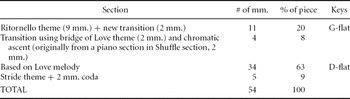
Whiteman and Gershwin recorded two abridged versions of the piece, once in 1924 and once in 1927, the latter condensed to 8′46″ and featuring Gershwin on the piano.Footnote 38 As Table 2 shows, the 1927 recording is condensed in a number of ways. Almost the entire Shuffle section is gone; only some of the Stride elements from that section remain, along with the ending transition in the piano part (which only retains the rhythm of the Shuffle theme). Only three minutes long, Finegan's paraphrase of Rhapsody in Blue is shorter than either of those arrangements, and as Table 3 shows, it is almost entirely built on the Love theme.Footnote 39
Form of Whiteman/Gershwin recording (Whiteman, Music for Moderns, [1927] 2000) from author's transcription.

Form of Finegan's arrangement of Rhapsody in Blue, as played by Glenn Miller and his Orchestra, from author's transcription. Available on Glenn Miller, Glenn Miller: The Popular Recordings (1938–1942), RCA Bluebird 9785 (3 CDs), 1989; and Glenn Miller, The Complete Glenn Miller and his Orchestra: 1938–1942, Bluebird 61015 (13 CDs), 1991.

Finegan shortened Rhapsody in Blue by cutting out entire sections related to various themes. Finegan kept the decision made in earlier arrangements to cut the Shuffle theme and to transform the Stride theme from a self-contained melody into a setup for the famous ending. Finegan, faced with a three-minute time limit, also cut the entire Train section as well, until all that essentially remained of Rhapsody in Blue was the Love melody with an introduction and coda. In each version, the Love melody is the essence of the piece and the section altered the least. The Love theme also stood on its own as the theme song for the Whiteman band.Footnote 40
Finegan's focus on the Love melody connects to a typical treatment of popular forms, where the last melodic strain was often the most memorable and where many interpreters first looked for material. When interpreting Gershwin's songs, musicians often pick up the final sections and turn them into cycles, discarding the rest.Footnote 41 The Love melody's position as the last melodic strain of the piece makes it the focal point of the original and a natural choice for Finegan's arrangement.
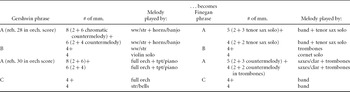
The Love melody follows a 44-bar (14+8+14+8) ABAC form.Footnote 42 As Table 4 shows, Finegan adjusted the A sections to nine measures each, making them closer in length to the eight-bar B and C sections. He cut the countermelody sections in half; his choice not to discard them implies that he considered them essential to the overall integrity of the composition. The harmony in Finegan's version is consistent with Gershwin's original, the chord symbols for the Miller rhythm section being nearly identical to the chord symbols used for the banjo accompaniment in the original orchestration.Footnote 43 Gershwin's harmonic approach held up well for an early 1940s sound, and Finegan's harmonic modifications were minimal additions of sixths or ninths to the major or minor sevenths indicated by Gershwin.
Comparison of Gershwin and Finegan versions of Love melody.

Rhapsody in Blue's attachment to forms based on melodic strains is also related to the question of hybridity.Footnote 44 The bond between composition and classical music, associated with Europe, is powerfully connected to the idea of an autonomous composer-as-genius whose long works adhere to an internal logic.Footnote 45 This attitude informed the famous criticism that Leonard Bernstein leveled: “[T]he Rhapsody is not a composition at all. It's a string of separate paragraphs stuck together—with a thin paste of flour and water.”Footnote 46 Although Bernstein strikes an ambivalent tone in the original essay, and he actually professes his love and admiration for Gershwin's music, his struggles with Gershwin as a composer (italics in original) are clearly connected to his uncertainties regarding Gershwin's ability to create a long-form composition that unfolds logically from beginning to end—and which is not long simply because it is a series of many short things.
Describing Gershwin's longer compositions, such as Rhapsody in Blue, as hybrid combinations of jazz and classical music can be related to this particular notion, expressed by Bernstein, of long- and short-form composition as two fundamentally different processes. Finegan, on the other hand, did not seem to view long and short compositions as separate. He heard the melodies of Gershwin's concert compositions and placed them in a short-form context, without apologizing or equivocating over Gershwin's grasp of long forms. Regarding his later take on Concerto in F, he remarked, “Ed Sauter and I always liked Gershwin's music . . . good melodies always, and [Concerto in F] is full of them.. . . I stated some of the melodies, a condensation of the thing, to get some of the good melodies on record.”Footnote 47
Finegan's three-minute gloss also used the standard instrumentation of the Glenn Miller Orchestra and the trademark “Miller style” sound that consisted of two alto saxophones and two tenor saxophones under a lead clarinet, his choices conforming to Miller's demand for stylistic uniformity.Footnote 48 In the original 1924 Aeolian Hall concert, the jazz band and the rhapsodic piano opposed each other, propelling the performance. But Finegan's arrangement highlighted the jazz and popular elements of Rhapsody in Blue and removed the instrumental tension. Similarly, Grofé's unabridged full orchestra arrangement, with the buried or omitted saxophones and banjo part, emerged as the standard version of the piece. In contrast to Gershwin's combining disparate signifiers to represent American's diverse social and musical landscape, these two versions settled back into separate spheres that reinforced social boundaries.
Finegan's Arrangement of Concerto in F in the 1950s
In the band he formed in 1952 with Eddie Sauter, the Sauter-Finegan Orchestra, Finegan indulged his desires to experiment and buck convention in ways he could not when writing for the conservative Miller Orchestra. The Sauter-Finegan Orchestra featured such unusual instruments as harp, timpani, piccolo, oboe, bass clarinet, and kazoos. Through live sound mixing, Sauter and Finegan amplified softer timbres and created unique textures.Footnote 49 The band's repertoire included originals next to arrangements of Prokofiev (“Midnight Sleighride,” based on the “Troika” of Lieutenant Kijé), and various “Americana,” including Sousa (“The Thundisbreak,” based on “The Thunderer”), “Camptown Races,” and “Yankee Doodle.”Footnote 50 In 1952, the Sauter-Finegan Orchestra recorded Finegan's arrangement of Concerto in F, although it did not appear on record until Concert Jazz, released in 1955.Footnote 51 Gershwin's Concerto in F thrives on even more striking, and more seamless, combinations of jazz and classical qualities than his Rhapsody in Blue, and the same can be said of Finegan's treatments of these two pieces.
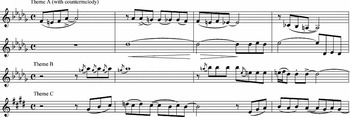
Structurally, Finegan's arrangements of Rhapsody in Blue and Concerto in F are almost identical three-minute distillations: the introduction is drawn from the very beginning of the piece and the rest focuses on the melodic material presented in the final strain of the original (Theme C in Concerto in F, as Example 6 shows). The final strain, which had the most important position in Finegan's arrangement of Rhapsody in Blue, was even more crucial to the multi-strained blues and ragtime compositions upon which Gershwin directly drew for the second movement of Concerto in F. In response to demands for longer forms, primarily from dancers, composers in these styles created pieces that linked together melodic strains of varying tempi and quality with a final strain that was easily extendable, usually through repetitions of various sorts.Footnote 52
Incipits of themes in the second movement of Concerto in F.

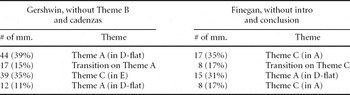
Again comparable to his treatment of Rhapsody in Blue, Finegan shortened Concerto in F by trimming whole melodic sections: in this case, Theme B and everything associated with it. Finegan switched the order of appearance for Themes A and C, starting and ending with Theme C and using Theme A as a sort of bridge. If Theme B and the cadenzas are eliminated from the Gershwin score, and if Finegan's introduction from the first movement and brief conclusion are omitted from his arrangement, the order of events is quite similar, as are the proportions of time devoted to melodic development and transitions (see Table 5).
Form comparison of Concerto in F. Proportions in Gershwin score with Theme B and piano cadenzas eliminated. Gershwin information from Concerto in F, for Piano and Orchestra, ed. F. Campbell-Watson (New York: New World Music Corp, [Reference Gershwin and Campbell-Watson1927] 1942); and Finegan information from author's transcription of Sauter-Finegan Orchestra, “Concerto in F,” Concert Jazz, RCA Victor LPM-1051, 1955.

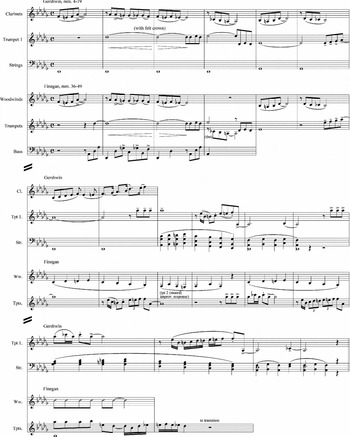
Example 7 illustrates other aspects of Finegan's arrangement that emphasize the jazz and blues characteristics of Gershwin's original. The bassist plays accented upbeats (m. 37), bringing out the element of syncopation, a rhythmic device as powerful and complex in the 1950s as in the 1920s. And whereas Gershwin used just one muted trumpet to play the blues melody, Finegan placed two muted trumpets in a call-and-response relationship.
Comparison of Theme A in Gershwin score and Finegan arrangement of Concerto in F. The second clarinet and bass clarinets are omitted from Gershwin's score. The piano and percussion are omitted from the Finegan transcription, and only the highest woodwind note is indicated.

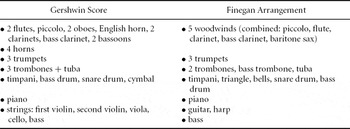
Following Gershwin's lead, Finegan also played up the classical music elements of Concerto in F. He kept the idea of using lush, elaborate transitional material between themes, resulting in a piece that unpredictably avoids conventional song forms. And perhaps most important, Finegan used instruments that had strong orchestral associations (see Table 6). Woodwinds such as flutes and clarinets, although strongly linked with the concert hall, have always been staples in jazz bands, but timpani and harp much less so, and their use in the 1950s Sauter-Finegan Orchestra had unquestionable classical music and highbrow connotations.
Comparison of instrumentation in Gershwin score and Finegan arrangement of Concerto in F.

Finegan's emphasis on Gershwin's jazz and classical signifiers set the stage for a reception of the Sauter-Finegan Orchestra in terms of racial categories. Critics and audiences had some difficulty considering the Sauter-Finegan Orchestra to be a jazz ensemble. Many record reviews, liner notes, and anecdotes discussed the group's unusual instrumentation and spare use of improvisation. The instrumentation, “a palette of orchestral colors beyond those in the conventional '40s big band” was a constant sticking point; critics and journalists spilled a fair amount of ink praising, explaining, or condemning the use of orchestral instruments by the band, and audiences were often confused.Footnote 53 Finegan told me, “The appearance of the band would turn off dancers. They'd say, ‘How can you dance to a harp?’ And, we had a tuba and we had a percussion section . . . people would see that and think how can you dance to that? . . . It didn't look right.”Footnote 54 A dancer once heckled the trombonist Sonny Russo with, “Why don't you guys play something we can dance to?” Russo responded, “Why don't you dance something we can play to?”Footnote 55
Furthermore, Finegan's Concerto in F, like much of the Sauter-Finegan repertoire, left little room for the improvisational contributions of individual soloists. In the 1950s, signifiers of “composition” and “improvisation” (“ad libbing”) had increasingly powerful associations with the worlds of classical music and jazz, and changing ideas of whiteness and blackness, respectively.Footnote 56 The problematic but persistent distinction hinges on the notion that in classical music, which is “composed,” the performers play only what is indicated on a written page by the composer; the acceptable range of interpretive strategies is limited and the performer is rarely allowed the freedom to develop her or his ideas on the spur of the moment. “Composed” classical music's opposite is “improvised” jazz, in which a composer is understood as prescribing relatively little in advance, and in which the players are encouraged to make substantial creative contributions during the course of performance.Footnote 57
In the 1950s, the lack of improvisational room in the Sauter-Finegan Orchestra repertoire made critics and disc jockeys hesitant to place the group within the jazz category. In a Down Beat review of The Sons of Sauter-Finegan (1955), an LP on which musicians from the Sauter-Finegan Orchestra “soloed” on “loose ‘head’ arrangements,” Nat Hentoff raved about the musicians' performance outside of Sauter's and Finegan's writing, in which “each man's expressivity has been constricted by the gimmicky, heavily pretentious book of the band.”Footnote 58 Calling the Sauter-Finegan compositions “pretentious” implies that Sauter and Finegan had highbrow ambitions that crossed some imaginary line for jazz musicians, who should be naturally and intuitively expressive.Footnote 59 The term “constricted” suggests a broad split of jazz and freedom on one side, and composition and restriction on the other, assuming that the members of the Sauter-Finegan Orchestra would not find pleasure in playing challenging, heavily arranged pieces.Footnote 60 Small groups with an emphasis on improvisation had become representative of jazz ensembles, making the Sauter-Finegan Orchestra a square peg. As Sauter said in 1980, “They asked us to make a small band record, because critics loved small bands, in those days particularly. I think the critics pushed this way and that's one of the reasons for the rise of rock; that's one reason, there are others. They didn't like the big bands; they still don't.”Footnote 61
An even more direct criticism came in a Down Beat review by Jack Tracy of Concert Jazz. After decrying “all the tricks and sounds and gimmicks that can be coaxed from the pens of Ed and Bill,” Tracy tried to find a few improvisations worth mentioning. Finally, he concluded, “To title this Concert Jazz is stretching a point.”Footnote 62 Sauter and Finegan felt that they had to defend their judicious use of improvisation, even writing an op-ed for Down Beat in 1952, in which they argued that the “[role] of ad lib solos in modern popular music has been greatly overemphasized,” and that soloists were often “too extrovert[ed]” rather than responsible to the composition as a whole. They mentioned Duke Ellington as one example of a composer who knows how to properly and effectively incorporate “ad libs.”Footnote 63 Jazz styles had taken on heightened associations with constructions of race, augmented by the emergence of the categories of rock ‘n’ roll and rhythm ‘n’ blues. Bebop, an increasingly taken-for-granted label, was seen as a black anti-assimilationist style, “which at once reclaimed jazz from its brief cooptation by white ‘swing’ bandleaders like Paul Whiteman and made any future dilution that much harder.”Footnote 64 Writing in 1968, H. F. Mooney explicitly mapped whiteness onto the music of swing bands and the Sauter-Finegan band:
Soon [Benny] Goodman hired the white Eddie Sauter to develop a rich, very “white” symphonic sound which caught public fancy so well that Sauter developed it further into the “progressive” sound of the highly acclaimed Sauter-Finnegan [sic] band of the early 1950s. Seen in retrospect, the very popular orchestral tendencies of the entire period between 1920 and 1950, from Paul Whiteman down to the progressive and “west coast” movements which looked back at him with scorn, reflected the demand of the urban middle class for a highly refined, quasi-“classical” jazz.Footnote 65
With jazz increasingly associated with small groups and heavily improvisational performance styles in the 1950s, describing and marketing the music of the Sauter-Finegan Orchestra must have been especially thorny.Footnote 66 In light of the changing ideas about jazz and classical music, RCA-Victor titled Concert Jazz years after the pieces were recorded, selling the group's music as a jazz-classical hybrid as part of a marketing strategy intended to head off difficulties in selling the music.Footnote 67 The liner notes to their first LP, New Directions in Music, state:
When [Sauter and Finegan] finally got together in 1952 there were some serious doubts about their chances for success. Even their closest friends and supporters were aware that their music might prove uncommercial.. . . The typical music business reaction to the Sauter-Finegan direction in popular music is summed up in the words of the music editor of one of the country's leading slick magazines. The editor, a man accustomed to evaluating the most erudite forms of music, listened to Midnight Sleighride and asked, “Shouldn't this be on the Red Seal [RCA's classical] label? What I mean is, is the average record buyer willing to sit down and give this music the attention it deserves?”Footnote 68
Selling the Sauter-Finegan Orchestra as a hybrid mixture of classical music and jazz made sense in the context of the 1950s, but Finegan bristles at the idea that their music was a self-conscious hybrid or crossover: “We didn't set out to [mix classical music and jazz] at all. We just wanted to do good tunes and that was not our motivation.. . . That's sort of an opinion after the fact. We never even thought about those things when we were writing things and making music. That all came after the fact.”Footnote 69
Finegan's interest in Americana, stylistic experimentation, and compelling melodies attracted him to Rhapsody in Blue and Concerto in F as points of departure for his own open-ended vision of “good tunes,” removed from the limitations of labels. He extended Gershwin's conception of American music as a space for combining a wide variety of styles and materials, not limited by racial categories, and based in popular music forms. At the same time, the reception of Finegan's arrangements along the lines of racially marked categories of “classical music” and “jazz” demonstrated how relationships of musical gestures to notions of separate white and black races are embedded in Gershwin's works. Finegan's arrangements are only two among many vibrant interpretations of these multifaceted works, attesting to the continuing power and appeal of Gershwin's complex representations of American society.