In October 1911, republican revolutionary forces overthrew the Qing dynasty and by March 1912 had established the Republic of China (different from the communist People's Republic of China founded in 1949). Leaders of the revolution, like Sun Yat-Sen, advocated for modernizing China and supported women's rights. When news that the provisional republican government had enfranchised women reached the United States, most white Americans were shocked. (As would slowly become clear, the political situation in China was more complicated, with individual provinces given the choice about enfranchising women and allowing them to serve in office.)Footnote 1 Americans' ideas about the Chinese people included a number of stereotypes such as their unfitness for democratic governance, their “slavish” nature, and their “queer” gender roles in which Chinese men with their queues were seen as feminine and Chinese women with bound feet were cowed and subservient. Moreover, as of the 1882 Chinese Exclusion Act, Chinese people were heavily restricted from immigrating to the United States and barred from naturalized citizenship.Footnote 2 The idea that a nation whose people were so foreign that they were blocked from citizenship in the United States would have seemingly more modern ideas about women's rights than the United States shocked Americans.
Chinese communities in the United States, however, were well aware of the conversations about the role of women in modern China. When Dr. Sun traveled the United States on speaking and fundraising tours, women often shared the stage with him, advocating for women's rights.Footnote 3 Women were members of the Tong Meng Hui or Revolutionary Alliance, and followed events in China closely. As U.S. newspapers reported, women and men of the Chinese diaspora joined the celebrations of the new nation in Chinatowns across the country and across the world.Footnote 4
During early 1912 as Americans learned about the role of women in the revolution and the new Chinese republic, they suddenly “discovered” that a number of Chinese suffragists lived in their cities. Wanting to hear more about what was happening in China, white suffragists invited them to speak at meetings across the country including in Portland, Oregon; Cincinnati, Ohio; Boston, Massachusetts; and New York City. The Chinese and Chinese American suffragists agreed wanting to celebrate their nation's success, but also hoping to dispel stereotypes of China that led to restrictive immigration laws as well as prejudice and sometimes violence against their communities in the United States.Footnote 5
The surprising nature of what was happening in China, the media's interest in stories that would sell papers, and suffragists’ masterful public relations campaigns resulted in a rich visual archive about Chinese and Chinese American women in this moment of the suffrage struggle.Footnote 6 For a brief time, the transnational nature of suffrage conversations was highly visible as was the suffrage activism of women in U.S. Chinese communities. Although the Republic of China soon fell into civil unrest, the memory of the Chinese suffragists in the revolution remained alive in the suffrage movement for several years. Chinese women, however, were often positioned as part of the “foreign” movement, even when they were American citizens. While white Americans' focus faded, Chinese and Chinese American women remained politically active in their communities.Footnote 7
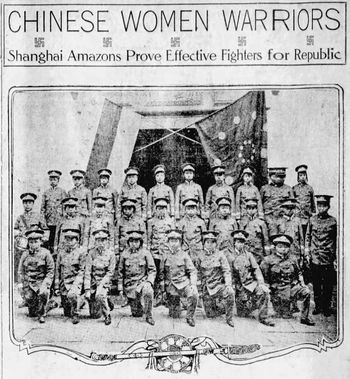
Chinese Women Warriors (Los Angeles Express, Mar. 2, 1912). Citizenship in the United States was gendered and the idea that men could fight for the nation endowed them with special rights (martial citizenship), including the right to vote, was a powerful one. Americans were therefore fascinated by women performing military duty and ran stories about the Chinese “woman's brigade” or “Amazons,” who participated in the Chinese Revolution. (They discussed women fighting in the Mexican Revolution in similar ways.) The Chinese women used their actions to demand suffrage in their new nation. American suffragists used their example to counter the idea that women could not have marital citizenship. American antis suggested this inversion of gender roles was unnatural, which combined with racial stereotypes to question the femininity of women of color.Footnote 8

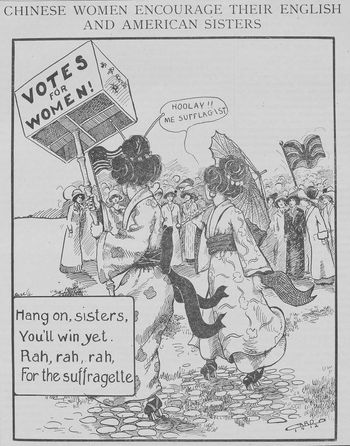
Chinese Women Encourage Their English and American Sisters. (Courtesy of Schlesinger Library, Radcliffe Institute, Harvard University, Cambridge, MA). When news that Chinese women had been enfranchised reached the United States, white suffragists felt “glad, but irritated, too” because it inverted ideas about American superiority. Suffragists seized the moment to emphasize the role reversal and advocate for suffrage in the United States. They did this quite visibly, with several articles in the Woman's Journal, including this cover from March 1912. It reveals the transnational nature of suffrage conversations and suggests that Chinese women were leading the global suffrage movement. The cover also reveals a casual racism portraying the Chinese suffragists speaking in pidgin English, but also depicting them in Japanese kimonos and geta (traditional Japanese clogs), suggesting that some Americans were unclear of the differences between Asian countries.Footnote 9

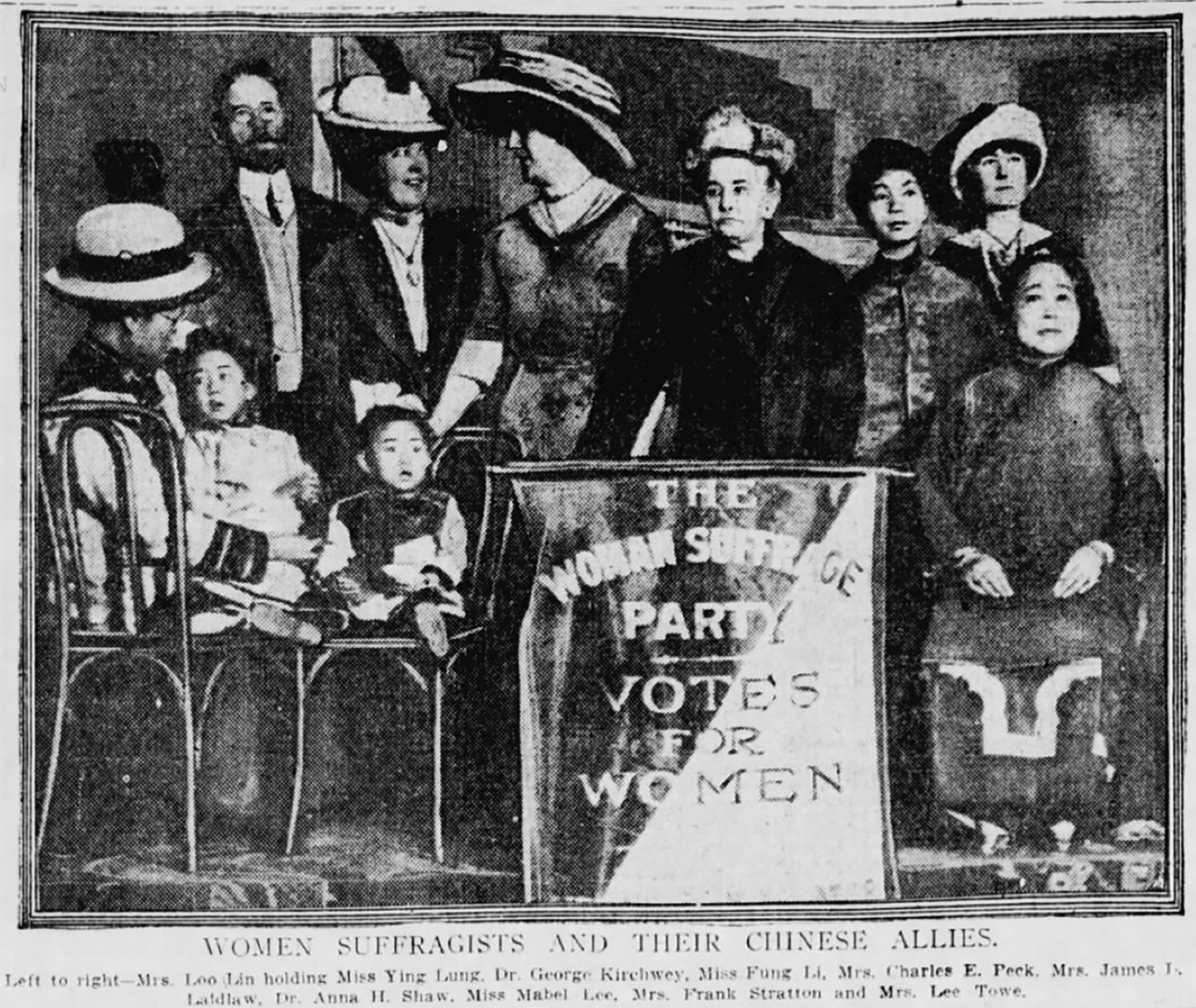
Chinese Talk Suffrage (New York Tribune, Apr. 11, 1912). It was hard for suffragists and especially suffragists of color to control images. But, when Chinese women spoke to white suffragists, they were able to present themselves as they wished to be seen. At the New York City meeting between major suffrage leaders and the suffragists from Chinatown in 1912, Mrs. Pearl Loo wore “a smart sailor suit”; and while Mabel Lee and her mother, Lee Lai Beck, wore more recognizably “Chinese” clothing, though Mabel's was a modern coat. Some women, like Mabel Lee, also shared studio photos with the press. Interestingly, when posing for photographs at group events, Chinese women often included their children as they did here and also at a Portland, Oregon, suffrage meeting, which received much press coverage.Footnote 10

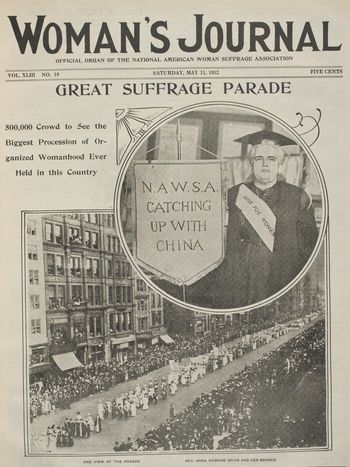
Great Suffrage Parade (Courtesy of Schlesinger Library, Radcliffe Institute, Harvard University, Cambridge, MA). Organizers of the 1912 New York City parade centered Chinese suffragists in public by asking Mabel Lee to ride in the opening cavalcade that led the parade. They also invited suffragists from Chinatown to march in the body of the parade. They proudly carried the new flag of the Republic of China and a banner stating, “Light from China,” rejecting the usual stereotypes of Chinese backwardness. NAWSA hoped to shame white American men by symbolically placing white women behind Chinese women. The organization's president, Anna Howard Shaw, followed the Chinese suffragists carrying the sign: “NAWSA Catching Up With China.” She was also featured on the cover of the Woman's Journal seen here. Shaw continued to invoke the image of China as ahead of the United States on women's issues by taking her banner on a national speaking tour that summer.

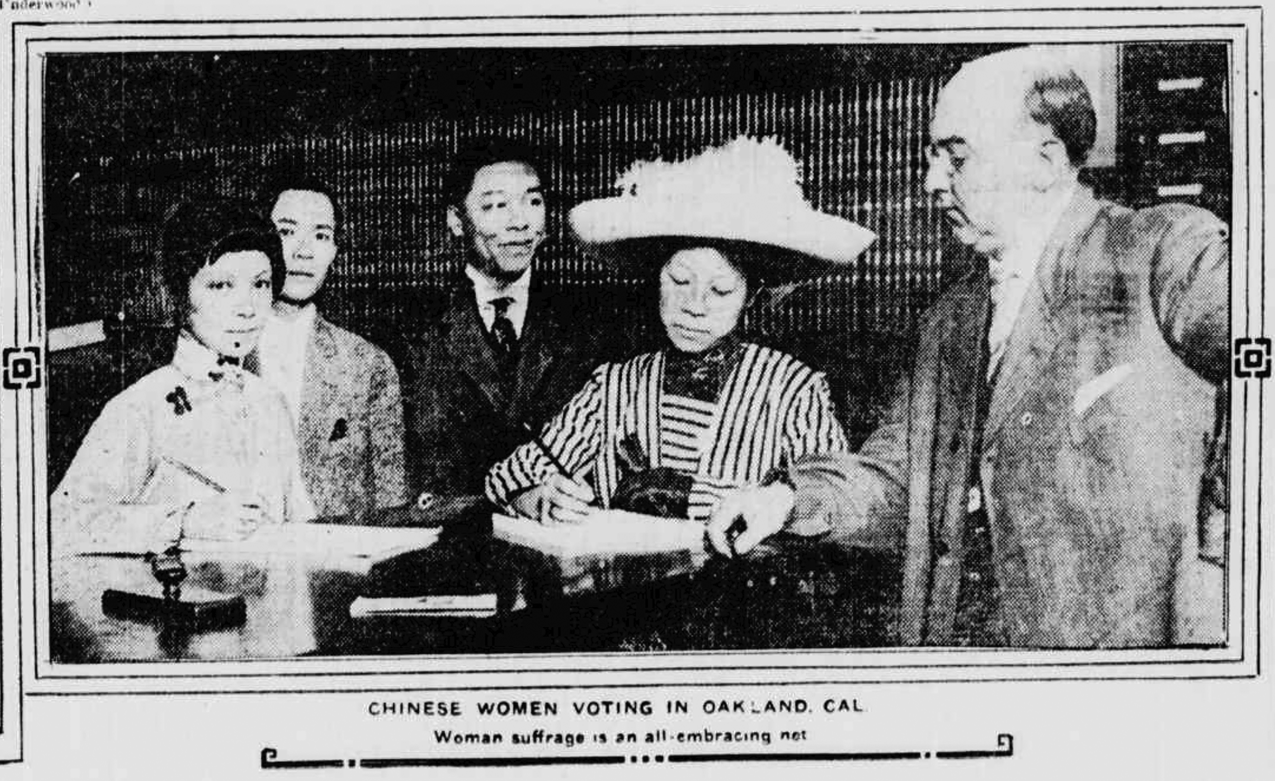
Chinese Women Voting in Oakland, California (New York Daily Tribune, Dec. 17, 1911). While Chinese immigrants could not become naturalized citizens, those born in the United States held birthright citizenship. This included a number of Chinese American women in California, which enfranchised women in a special election in October 1911. In subsequent elections, some of those women were eligible to vote. The press ran articles describing their experiences, often linking them to the events in China by describing the American women as supporters of the Republic or planning to go to China to teach. Many were young, well-educated, and stylish, like the Oakland women portrayed here. Myra Lee of Los Angeles, whose picture in a fashionable hat circulated widely, was said to be the first Chinese American woman registered in California. Miss Tie Leung reportedly drove her Flanders motor car to the polls to cast her ballot in San Francisco.Footnote 11

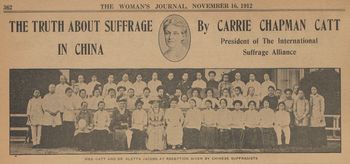
The Truth about Suffrage in China (Courtesy of Schlesinger Library, Radcliffe Institute, Harvard University, Cambridge, MA). Chinese suffragists remained in the news in the fall of 1912 when Carrie Chapman Catt, president of the International Woman Suffrage Alliance, visited China on her world tour and described the trip in her diaries and interviews. She visited the Canton (Guangdong) Provincial Assembly and observed women serving as legislators. She also met with suffragists in Shanghai and Nanking (Nanjing), including Tang Qunying, leader of the “women's army.” Catt was impressed, noting that many suffragists were college students (some who had studied in the United States) and described them as well-spoken and intelligent. She used this photograph of a Shanghai meeting held in honor of her and her traveling companion, Dr. Aleta Jacobs, to illustrate an article describing the Chinese women's struggles for equal rights to an American audience (the original photo is in Catt's albums held at Bryn Mawr).

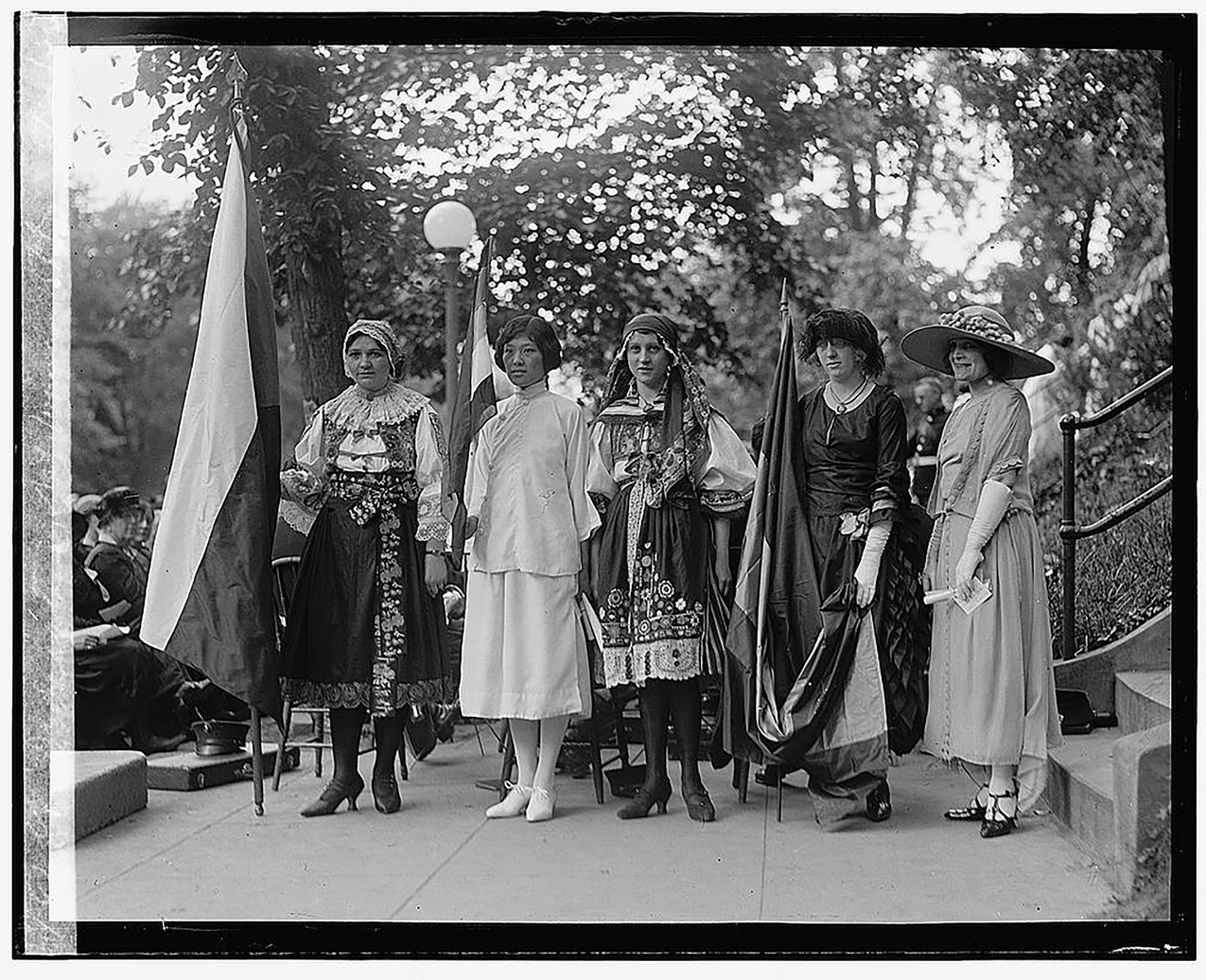
Foreign Representatives Who Participated in Dedication Ceremonies at National Women's Party, May 1922 (Courtesy of the Library of Congress Prints and Photographs Division, Washington, DC). According to the Washington Post, the women here are (left to right) “Mrs. Harriet Getting of Czechoslovakia; Miss Betty Sze, of China; Miss Josephine Kline, of Prague, Slovakia; Mme. de Ballivian, of Bolivia; and Miss Vina Stepanek, of Czechoslovakia.” As Katherine Marino has demonstrated, after 1920, the National Woman's Party more explicitly turned to international organizing.Footnote 12 But because the Chinese diplomatic legation was located in Washington, DC, women connected to it had long been engaged in suffrage conversations. For example, one participated in the 1913 national suffrage parade on a float in the “World Wide Movement for Suffrage” section.Footnote 13 Here a woman is misidentified as the Chinese minster's daughter, Betty Sze, but it is likely Betty's cousin Miss Wai Ling Sze, a senior at George Washington University, who participated in the dedication of the National Woman's Party headquarters in 1922 where she carried the flag of the Republic of China. Wai Ling Sze had also spoken at the February 1921 conference where the NWP reorganized after the ratification of the Nineteenth Amendment.Footnote 14