Introduction
Evidence has been mounting that physical activity can play an important role in preventing and mitigating many of the decrements associated with biological ageing (Viña et al., Reference Viña, Rodriguez-Mañas, Salvador-Pascual, Tarazona-Santabalbina and Gomez-Cabrera2016). As such, physical activity has become one of the key weapons in the fight against what is commonly known as the burden of ageing and meeting physical activity recommendations is now a key target of government strategies to improve health outcomes throughout the lifecourse (World Health Organization (WHO), 2010; Department of Health, 2011).
Statistics show that physical activity participation rates of older adults are low, which may suggest that people are less likely to take up or remain physically active as they get older (Hallal et al., Reference Hallal, Andersen, Bull, Guthold, Haskell and Ekelund2012). We note that recent attempts to explain ‘inactivity’ focus on the determinants and correlates of physical activity, as well as barriers to its participation (Kosteli et al., Reference Kosteli, Williams and Cumming2016). These tend to focus on the individual, with rather superficial exploration of social factors. We argue that this understanding of physical activity as a health-related behaviour masks the complex interplay of factors in which people's lives are conducted and decisions about their lives made. In the process this work risks reinforcing neoliberal public health discourse where individuals are expected to take responsibility for their health (Brown and Baker, Reference Brown and Baker2012). To overcome these deficits, we propose a different approach and conceptualisation. In what follows we present how the ‘problem’ of physical activity is constructed and dealt with in the literature. We then suggest that physical activity can be reconceptualised as a career whose emergence takes place within the structural, discursive and cultural features of society. This process involves the physical and emotional labour of learning to contend with one's body over one's lifetime, put to the test by a series of staging posts, twists and turns. The impact on identity is also considered. We will conclude with reflections on the implications of this alternative approach to physical activity for our understandings of what it is like to be old in contemporary society.
Physical activity as lifestyle
In the latter half of the 20th century our approach to the active body was completely transformed. Since the 1980s there has been an interesting confluence of two processes: research into the health benefits of physical activity as well as the increasing popularity of physical activities and the commodification of fitness (Maguire, Reference Maguire2002). By the 1980s there was a mass uptake of physically active pursuits such as running, cycling and club fitness (Stone, Reference Stone2004; Maguire, Reference Maguire2008; Tulle, Reference Tulle2008). As such, the fit body became an indicator of a successful (middle-class) lifestyle (Howell and Ingham, Reference Howell and Ingham2001). At policy level, the teaching of physical activity in schools shifted its focus to encouraging lifelong participation (Green, Reference Green2002).
On the science side, increasing volumes of epidemiological research from the 1990s onwards have linked physical activity with various markers of physical and mental health (see e.g. Bauman, Reference Bauman2004; Warburton et al., Reference Warburton, Nicol and Bredin2006). This prompted the development of physical activity guidelines which provided recommended levels of physical activity to achieve health benefits and placed physical activity at the forefront of public health policy throughout the developed world. Since their first iteration in the United States of America in 1995, physical activity guidelines have been updated, amended and revisited in line with scientific discoveries (e.g. WHO, 2010; Department of Health, 2011). Nevertheless, global figures suggest that one-third of adults do not meet current recommended levels of physical activity (Hallal et al., Reference Hallal, Andersen, Bull, Guthold, Haskell and Ekelund2012).
In response to this, research turned to developing interventions that would get people active. Reinforcing neoliberal ideology, that one should take responsibility for one's health, these tended to target inactivity at an individual level. Popular models, such as the environmental (Thompson et al., Reference Thompson, Aspinall and Roe2014) and ecological models (Owen et al., Reference Owen, Healy, Matthews and Dunstan2010), recognise that individual behaviour needs to be understood within a broader framework, taking account of the social, policy and physical context in which people make decisions. However, these tend to place the individual at the nexus of concentric circles of influences. What prevails is a deficit model according to which individuals are blamed for their failure to meet official physical activity recommendations (e.g. Chodzko-Zajko et al., Reference Chodzko-Zajko, Proctor, Singh, Minson, Nigg, Salem and Skinner2009; WHO, 2010). By implication, this failure of motivation is cast as a constitutive characteristic of older age, and by extension, older people. Furthermore, the tone of the literature is mostly exhortative, adopting a stick and carrot approach. The stick is the risk of falling, disease or obesity and the carrot is the promise of better health, restored function and improved wellbeing. Thus, interventions tend to target the motivation deficit among older people (Clark, Reference Clark1999). The carrot is clearly not appealing enough, and to make it more enticing experimentations with a range of incitements to physical activity, largely advice, monitoring and the promise of company and even enjoyment, are promoted (Spirduso et al., Reference Spirduso, Francis and MacRae2005).
So far, there has been little evidence that interventions informed by these models are effective at the population level. Long-term adherence remains problematic (van der Bij et al., Reference van der Bij, Laurant and Wensing2002; Hawley-Hague et al., Reference Hawley-Hague, Horne, Skelton and Todd2016; Pettigrew et al., Reference Pettigrew, Burton, Farrier, Hill, Bainbridge, Airey, Lewins and Hill2019). As Foster et al. (Reference Foster, Hillsdon, Thorogood, Kaur and Wedatilake2005) noted, most interventions last no longer than 12 months, meaning that their impact on long-term engagement in physical activity is relatively unknown. The unusual context of physical activity interventions also leads to questions regarding what happens post-intervention, with some questioning the ecological validity of existing findings (Hagger and Weed, Reference Hagger and Weed2019). In addition, physical activity interventions have produced mixed findings, with Heath et al. (Reference Heath, Parra, Sarmiento, Andersen, Owen and Goenke2012) and Artinian et al. (Reference Artinian, Fletcher, Mozaffarian, Kris-Etherton, Van Horn, Lichtenstein and Meininger2010) noting that interventions are culturally determined. This emphasises the importance of acknowledging the wider social and cultural context in which physical activity occurs. Yet very few interventions have explored these.
To understand the processes involved in ‘being active’ there is a need to shift the focus away from individual motivation (Phoenix and Bell, Reference Phoenix and Bell2019) and take seriously the broader context in which physically active practices occur. Bercovitz (Reference Bercovitz2000: 24) has argued that ‘the “problem” of sedentarianism’ is socially constructed, with ideas about what it means to be active dictated by what scientific data are deemed important by researchers at the time. In addition, variation in the measurement of physical activity (self-report versus objective) also raises questions about the validity of claims about population activity levels. It appears that to be considered ‘active’ individuals must meet the recommended guidelines. Thus, across the world people may be active, just not ‘active enough’.
Currently, social scientists have taken up the mantle of critically evaluating existing knowledge on health promotion (Dionigi and Gard, Reference Dionigi and Gard2018). The evidence from the social sciences is that we should understand physical activity as a social practice embedded in a nexus of factors, including the different social worlds in which people live their lives, which promote or limit physical activity (Guell et al., Reference Guell, Shefer, Griffin and Ogilvie2016). Furthermore, as others have argued (Phoenix and Orr, Reference Phoenix and Orr2017; Phoenix and Bell, Reference Phoenix and Bell2019), how we move our bodies in later life is subjected to fluctuations driven by a confluence of factors: the activities themselves and their physical demands, the weather, life events, caring responsibilities, a range of external factors and, of course, the vagaries of the body itself. Fluctuations in what they refer to as ‘the possibility of movement’ are the result of different rhythms coming into contact (rhythms of life, of ageing bodies [see also Nettleton, Reference Nettleton2013], of the activities themselves, of the external world) and demanding responses. These writers show clearly that a key feature of our capacity and our inclination to move is that it is unstable and precarious, prone to interruptions. Thus, negotiating physical activity as a healthy practice is complex, a balancing act with other health practices (e.g. eating and drinking), rather than a simple, linear engagement in response to the exhortation to be more active. Physical activity occurs as people negotiate their roles and relationships as they age. This can facilitate as well as hinder. Meaning can be found in physical activity in different ways. We agree with Phoenix and Orr (Reference Phoenix and Orr2017) that we must go beyond ideas around motivation and healthy lifestyle.
We want to add to this rich scholarship in several ways: our focus will be on the lifecourse, bringing to the fore the affordances or threats to physical activity, whether it starts early in the lifecourse or late (Griffin, Reference Griffin2017). We will also take the longer historical range into consideration, the conditions in which people put themselves into movement. What seems normative behaviour or normal embodiment at a point in time can become deviant later and vice versa (Eichberg, Reference Eichberg2011). What we want to draw attention to is that we are subjected to synchronic and diachronic forces which cut across time and shape how we envisage our lives being led as we age and how we live in and with our bodies. Therefore, to deal with these complex processes, we propose using the concept of ‘career’ as a heuristic device to uncover these forces and the vagaries of physical activity engagement across the lifecourse.
The complexities of career making
The concept of career has been used in sociology, including in the field of sport. Our own reworking of the concept of career includes processes which need to be made more explicit than has previously been done, so that we can understand the conditions in which a successful career is more likely to emerge and develop. For this, we are influenced by Bourdieusian sociology as it provides us with the opportunity to focus on the embodied nature of physical movement and the structural and cultural context in which careers can be allowed to emerge, both as initial disposition and as a practice that develops over time. Physical activity can be understood as a social field because, as Bourdieu (Reference Bourdieu and Nice1984) has shown, the propensity to be physically active has a class orientation. It also reflects norms associated with gender (Semerjian, Reference Semerjian2018), age (Palmer et al., Reference Palmer, Tulle and Bowness2018) and ethnicity (Victor, Reference Victor2018), influencing whether and how we take part in physical activity. Thus, individuals are embedded in a range of norms with which they must contend. Furthermore, physical activity engages with the body. The body can be conceptualised as physical capital (Bourdieu, Reference Bourdieu1978) because it manifests the value conferred on different body types as well as being an entity on which to work to acquire value. The latter infers a level of instrumental reflexivity on the part of social actors (e.g. wishing to lose weight or to become more muscular) as a practice of social distinction that demonstrates one's social location. The propensity to deploy such instrumental rationality is worthy of investigation. The body is also where our social location or habitus is made manifest through the internalisation of dispositions during socialisation. Dispositions inflect our orientation to our body, both in the choices we are more likely to make to put it in movement and how we come to sense it.
At this point, we need to acknowledge the agency of the social actor (his or her ability to make individual decisions); and the historical but also biographical effects which modulate life trajectories. These considerations, as has been argued by others such as Alexander (Reference Alexander1995), are not well accounted for in Bourdieu's theoretical framework. Bourdieu does show that our social location affects our dispositions for social action. But this does not necessarily account for how people deal with social change nor with how people contend with demands for them to change their dispositions (Tulle, Reference Tulle2017) or how they justify their practices (Boltanski and Thévenot, Reference Boltanski, Thévenot and Porter2006). This is what we mean when we posit that our dispositions to physical activity lie at the confluence of diachronic and synchronic forces (Tulle, Reference Tulle2017; Palmer et al., Reference Palmer, Tulle and Bowness2018). The concept of career enables us to bridge the gap between structure and agency.
In its original formulation, the concept of career captures the objective as well as subjective aspects of occupation (Becker, Reference Becker1963; Faulkner, Reference Faulkner1974; Braude, Reference Braude1975). Subjective careers involve the individual's movement through their own biography (McHugh, Reference McHugh1968), constituting what Becker (Reference Becker1952) highlights as horizontal movement, one in which subjective experience can change without a change in objective career markers such as rank or income.
In sport, the concept of career has been fruitfully used by Stevenson (Reference Stevenson1990, Reference Stevenson2002) to understand the socialisation of elite athletes into sporting competition. This work is a reminder that sport is akin to an occupation, with pay scales, a status hierarchy and rules which operate vertically over time. The occupational setting itself acts as a culture from which athletes derive their identity. Thus, athletes are subjected to a process of ‘conversion’. Moving from professional sport to sport as a leisure pursuit, Stebbins (Reference Stebbins2014: 4) coined the concept of serious leisure which he defines as ‘the systematic pursuit of an amateur, hobbyist, or volunteer activity’. As well as identifying three types of leisure careers (amateur, hobbyist, volunteer), Stebbins (Reference Stebbins2014: 28) describes how the use of serious leisure leads to the creation of a ‘fulfilment career’, one which develops alongside a changing relationship to leisure activities. An individual may progress from a ‘dabbler’ to a ‘devotee’, travelling through a ‘leisure career’ (Stebbins, Reference Stebbins2014: 37). In conjunction with this process, a ‘subjective career’ emerges (McHugh, Reference McHugh1968). This work demonstrates that the concept of career can be applied to non-remunerated activities where an emphasis is on vertical progression as the dabbler progresses to devotee. What is also implied is that careers have an objective start and end, often beginning in youth and ending in retirement from participation.
In considering the physical activity careers of older people, we can look to research on Masters sport. The accounts of Stevenson (Reference Stevenson2002) and Heuser (Reference Heuser2005) demonstrate some of the similarities that Master athlete careers share with younger athletic careers. For example, the stages of both types of career involved an introduction to the sport and a process of identification with the sport. However, their work also highlights the substantially different context in which these careers begin and evolve. As Stevenson (Reference Stevenson2002) notes, Masters athletes had to engage in ‘seekership’ to find their sport, whilst Heuser (Reference Heuser2005) demonstrates that Masters lawn bowlers faced physical retirement but not social retirement. When exploring participation in Masters sport, Dionigi (Reference Dionigi, Phoenix and Tulle2015) refers to different trajectories with some ‘continuers’ playing sport their whole life, other participants exhibiting a more intermittent relationship to sport and physical activity, or yet others who begin participating late in life. Hénaff-Pineau (Reference Hénaff-Pineau2018) has demonstrated how engagement in physical activity reflects prevalent forms of socialisation into normative embodiment, gender norms, public policy and lifecourse norms. We have also previously identified physical activity participation as functional, sporting or performative in relation to the different meanings that social actors themselves attach to their practice (Palmer et al., Reference Palmer, Tulle and Bowness2018). What is emerging is that physical activity careers can take a variety of forms.
Our theoretical synthesis enables us to unlock questions to help capture the complexities and ambiguities of physical activity participation. For if one emanates from a social location that does not encourage the development of certain dispositions, what would be the conditions for these dispositions to be acquired at another point in the lifecourse when norms of physicality are changing which might coincide with the time that the body itself loses physical capital? Are they the same dispositions? How does one then progress from disposition to a sustained engagement with the type of physical capital that inheres in that physical activity practice? How is that engagement achieved in practice? Therefore, conceptualising the accomplishment of physical activity as a career which takes place in a specific social, cultural and historical context, which has become favourable to it, has prompted the following research questions:
(1) How do people embed the disposition to be physically active and how do they maintain it across the lifecourse?
(2) How has the recent reconstruction of physical activity as a health behaviour affected people's dispositions and actual practices?
Methodology
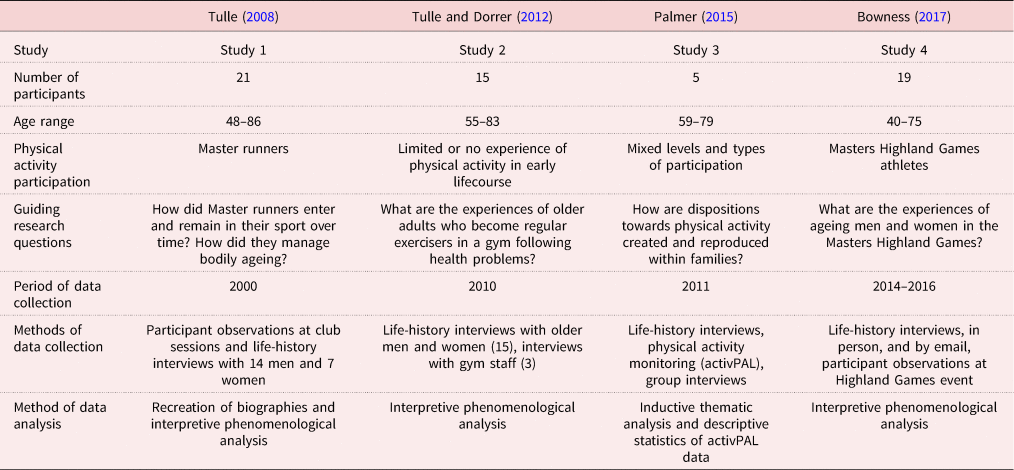
The analysis presented below is drawn from four studies by Tulle (Reference Tulle2008), Tulle and Dorrer (Reference Tulle and Dorrer2012), Palmer (Reference Palmer2015) and Bowness (Reference Bowness2017) (summarised in Table 1). Each study explored older adults’ experiences of being physically active. Studies 1 and 4 included social actors who had successfully become physically active and had remained so over several years, whilst Studies 2 and 3 included people whose physical activity practices had lapsed or exhibited wide fluctuations. The wide age range in Studies 1 and 4 can be explained by the fact that entry into Master sport is set at age 40. These informants are chronologically still relatively young. However, they are deemed too old to take part in mainstream sport and are therefore forced to contend with physiological ageing.
Overview of the four case studies used in this paper.

By using four sources of data, each including its own sub-cultural logic of practice, we aim to reveal the complexities of becoming physically active and the fragility of maintaining a physical activity career. In all four projects life-history interviews were used to reflect on the process of becoming physically active (Plummer, Reference Plummer2001; Tulle, Reference Tulle2008), identifying personal, emotional and embodied dimensions of being active or otherwise. What makes our approach to life-history interviews distinctive is they were also designed to bring to light the broader, i.e. structural, context in which the urge to be physically active or the resistance to physical activity had arisen.
Analysis of each data-set took place within an interpretivist epistemology with the focus on making visible underlying structures as they were manifested in the accounts and claims of research participants (Silverman, Reference Silverman2013). We brought together the individuals’ biographies and physical activity careers that we had recreated before we began this process of analytical and theoretical synthesis.
The process of recreating biographies in each study had proved remarkably productive, drawing our attention to ‘career contingencies’ (Prus and Irini, Reference Prus and Irini1980) that older adults must negotiate to maintain a physical activity career throughout the lifecourse. For the current analysis, we compared biographies across the four studies to see whether we could detect the triggers and barriers to the achievement of a longstanding physical activity career across distinctive samples. We then returned to the transcripts to map out the social, cultural and structural forces which enabled these careers to emerge and develop or, in some instances, to remain undeveloped. Our discussions synthesised the findings of each study, producing thematic similarities but also demonstrating exceptional cases (as in the work of Phoenix and Orr, Reference Phoenix and Orr2017). This process roughly follows what Heidegger ([1927] Reference Heidegger, Macquarrie and Robinson1962) referred to as the ‘hermeneutic circle’, a process by which the interpretation of smaller parts adds to a collective whole. This involved a back and forth between emergent themes, significant exceptions and case study-specific nuance. From our synthetic analysis, three themes or career processes were identified: (a) discovery and athletic awakening; (b) remaining in the field as reflexive practice; and (c) the materiality of a physical activity career.
Findings
Discovery and athletic awakening
Often, the first contact with physical activity occurs in childhood through play or physical education. However, as Stevenson (Reference Stevenson, Coakley and Donnelly1999: 82) points out, ‘just because someone is introduced to a sport, or indeed any sort of involvement, it does not mean that they will necessary or inevitably become committed to it’. Nevertheless, early experiences of being physically active can shape dispositions to physical activity that endure throughout the lifecourse. These early experiences can lay the foundations of a physical activity career, as the experiences of this man and woman from Study 3 illustrate:
Eh it's gone with me all through my life really, I mean when I go back to school where there was a lot of physical activity and I've been in various clubs of one kind and another which has involved some physical activity, eh as the years have gone on it has dwindled [sigh]. (Donald, male (M), 68)
I love dancing I've always loved dancing em … when I was young I was very sporty swimming … you know running tennis netball and that was the school of course but eh I normally was very active anyway. (Mary, female (F), 71)
These early experiences equipped these informants with a degree of physical capital needed to undertake a wide range of sports. They also provided them with a phenomenological understanding of what it feels like to put the body into movement, which may be an important influence in continuing or returning to physical activity later in life. However, not everyone has positive early experiences of physical activity in early life, as a woman from Study 4 exemplifies:
Do you have any history of sports when you were younger? Say at school or?
Nope, I was the fat girl who always got picked last in gym class, I hate to say that but that's what it was, but I do not have that background in athletics at all. (Anna, F, 47)
Anna's experience shows how low levels of physical capital at school meant that her initial engagement with physical activity was negative, with peers failing to value the physical capabilities of those not exhibiting symbolically valued bodies. In contrast to Donald and Mary, Anna lacked physical competency, with lifelong consequences on her own perceived capability to be active. Physical competency can therefore act to legitimise practice, which can turn an initial encounter with sport or physical activity into a more solid disposition to be active. Commensurately, the absence of physical competency may deter the creation of a physical activity disposition.
For some, such as Elaine (Study 3, F, 62), who walks regularly, there is no clear initiation as she claims: ‘I've always just walked everywhere.’ Others note how their social class shaped their sport participation. For example, working-class men had to contend with restricted spaces of legitimation. Thus, as a working-class lad, Harry (Study 1), who did not start running until the age of 35, does not recall being able to find physical expression in athletics:
running never actually took off until the TV because I don't know anybody that done 1500 metres and … it is just … for a working person [my emphasis] it was always football. It is sad when you think about it. I mean there must have been a lot of kids that were fast runners, but they didn't go to the right school and get the right education. (M, 55)
Women have also encountered barriers. Betty (Study 1) engaged in track and field as a youngster but early on encountered restrictions in how much effort she could legitimately display:
Cross-country at that time was not a long, long distance. It is quite interesting to see how women are now allowed to run … I mean I have indeed run a marathon but how you are allowed to run a marathon now because when I was young the most that we were allowed to run was three and a half miles. So that was long distance for me. (F, 67)
Not only do people have to have an encounter with an activity, the context in which this activity acts as a space of legitimation is also important. In the above example, the club provides a safe space for people to train and develop their practice, but it can also reflect and rehearse stereotypes about women's physical strength. In addition, these clubs themselves also reflect the prevailing class structure, thus Betty came from a middle-class habitus. The track and field female athletes in Study 1 demonstrate that they were only able to pursue a physical activity career because of the coming together of a range of factors manifested in one key attribute: the possession of ‘natural aptitude’ (Tulle, Reference Tulle2008), which predisposed them to sport and competence but also had to be kept in check. Athletics was the perfect locale for natural aptitude to be displayed appropriately. Working-class female bodies had no such space of legitimation in which their natural aptitude could be discovered (Tulle and Dorrer, Reference Tulle and Dorrer2012; Tulle, Reference Tulle2018).
Despite negative experiences in childhood, Anna (Study 4) eventually found a pathway to sport later in life:
So how did you first get started?
Erm, got into Facebook there was a Facebook conversation going on and somebody got into a conversation about the Highland Stillhouse Pub back home in Oregon, and one of the guys was an athlete, make sure you come watch us at the Portland Highland Games, and I went and watched and was working out and doing some stuff, why don't you come throw with us. ‘I can't do that, why would I do that’, he convinced me to start throwing so I started practising with some of the people who were on this field today, and they've become amazing friends and wonderful teachers and very patient with those of us who are not the best athletes already anyway. (Anna, F, 47)
In Anna's case, her early experiences and lack of physical capital continued to influence her perceived ability to be an active person. She needed favourable conditions to become a ‘late bloomer’ (Dionigi, Reference Dionigi, Phoenix and Tulle2015), namely a more empowering social environment, the support of peers, the discovery of physical capital and, we surmise, a certain amount of deliberation.
Remaining in the field as reflexive praxis
Physical activity careers tend to form a winding path rather than a clear trajectory, and they are contingent. They must occur within the context of everyday life, working around family and occupational roles that change as life progresses. They are also modulated by wider social structures. Very few participants reported uninterrupted physical activity careers, with participants across all studies describing the dropping in and out of physical activities across their lives. Breaks and transitions were highly contextual. For example, one Highland Games athlete (Study 4) described the specific situation that led to his return to Masters sport:
I was a Division III college shot-putter and won a couple of conference titles and a state championship. I threw until I was roughly 26, competing in various meets around the east. I was good, but far from great. When I turned 40, a recently graduated thrower from my alma mater contacted me and asked me why I stopped throwing and if I would be interested in throwing again. I was recently divorced, and without a whole lot of entertainment funds, so I took him up on his offer, and we started to train hammer throw together … I then discovered Masters Track and Field, and competed in those meets, including the indoor and outdoor national championships. (Barry, M, 47)
Barry had a long gap in his sporting career. His return to sport and his transition to Highland Games were facilitated by others, but also required a personal commitment to re-engage a disposition towards sport. Many participants in Studies 2, 3 and 4 described breaks in their physical activity careers that corresponded with major changes in their lives, such as having children, getting married, retirement or, as they got older, caring for/loss of a spouse. Donald (Study 3) demonstrates this well:
I was exceptionally fit then and that continued through into the start of my working life I was in a judo club and did a fair bit of hill walking so I had all that going on … and then I got married! So, it's my wife's fault [laughs] no since then again pressures of work the time just wasn't there and if I did have any time I wanted to chill out I didn't want to do exercise and I just became lazier it's as simple as that. (M, 68)
Returning to these physical practices, or new ones, requires an act of deliberation to re-ignite a disposition towards such activities. Other participants spoke about the changing nature of physical activity as they wrestled with competing demands of work and family life, and how this had changed over the years. For example, some with active jobs meant that they felt a loss of physical activity when they retired and sought out new opportunities to be active. Similar to the findings of Dionigi et al. (Reference Dionigi, Fraser-Thomas and Logan2012), family life also shaped physical activity practices, with many of the participants describing how raising a family involved being active with their children. In some cases, as a child's physical activity developed, the importance of a parent's physical activity became secondary, as exemplified in Jacob's account (Study 4):
My family is all supportive of my athletic endeavours. When the kids were younger, they attended all of my games. Now that they are coming into their own, we often have to split up for all of our individual contests. I try to put them before myself as they are young and impressionable. I do not want them to think I find my activities more important than theirs. For this reason, I see my involvement in the future of HG's [Highland Games] being reduced somewhat to accommodate the increase in their activity. I think I will always continue to strive for the Master's World Championships as long as I am able to throw. That is much more than a great competition, but an opportunity to see friends of mine from all over the world at least once a year. (M, 45)
Whilst often posing as a barrier to physical activity careers, (grand)children occasionally provided a new opportunity to be active. Elaine (Study 3) explains:
obviously when the children were younger you'd be playing more football or running around the park with them or going for a race with them or something like that, but I still do it with the grandchildren now you know so it keeps me going (F, 62)
Elaine's engagement with physical activity was intricately tied into her family structure. These barriers can prove challenging to a physical activity career in later life. Yet many do continue in sport and physical activity in a variety of guises. For those engaged in Masters sport, parenting poses a competing logic to that of a particular sport. In Jacob's (Study 4) and Donald's (Study 3) cases, the logic of being a good father or husband challenged the specific logic of their involvement in the Highland Games, judo or hill walking. To be successful at managing both, a reflexive approach that juggles occupational and parental obligations, as well as the ageing body, is required. The ageing of the body, both physiologically and phenomenologically, can also affect physical activity careers.
The materiality of a physical activity career
Alongside the changing roles along the lifecourse encountered above, the body itself must be contended with. Physiological ageing, injuries and illness occupy a noteworthy but rarely highlighted place in the shaping and durability of physical activity careers. They can place the sporting or physical activity career at risk by forcing retirement or, at the very least, a substantial shift in activity. Our findings suggest different situations: (a) the discovery of new modes of training that enable them to prolong their career fruitfully; (b) having to consider major changes, perhaps even retirement; and (c) taking up physical activity following ill-health.
Elspeth's (Study 1) training was transformed as she got older. Far from slowing down, she has begun incorporating weight training as an act of injury prevention and bodily maintenance. This contrasts with the light-touch training she had been brought up with:
Well it has improved … it is getting harder actually! I mean I started off … I never … I did no weights at all at that time, I would do running. I would do a lot of my running on the machine in the winter, so I would do longer runs. You know on the machine instead of going out. And then I would do sprints and hill runs. As I say a lot of it is running and then I would come down to the track and do the runs, but it has gradually increased. I mean I started weights last year, last winter and I was doing structured runs on the machine … I am doing a lot of weights and a lot of running but I am doing hill running and fartlek runs. It is a lot of stress endurance stuff at the moment and then down at the track I am doing reps … you know so… (F, 59)
Elspeth has become a reflexive actor, calling upon expertise to help quantify the body and organise a regime of self-intervention. Another example comes from Matthew (Study 4):
more and more so I have less and less pain as I compete but again as I've gotten older I spend less and less time lifting heavy weights pushing and I spend more and more time massaging stretching honouring my body, so I go after more quality of movement don't push myself for force generation, does that make sense you know as an athlete you know what I'm saying. (M, 51)
Both athletes engage in bodily reflexivity to ward off potential issues, a process that Rich and Miah (Reference Rich and Miah2017: 87) refer to as ‘rendering the body knowable’. However, this is not possible for all athletes and many are faced with major changes. Ben (Study 1), a long-distance runner, was diagnosed with arrhythmia and could no longer run for long periods of time. This has forced him to move to orienteering:
You know I have got a problem and I have accepted that. It is something that is going to limit what I do athletically. (M, 58)
For Charlotte (Study 4), emergent injury problems have led her to swap activity:
Errm since I have consulted a little bit more about the knee, knowing what the treatment algorithm is, my knee is not in any way to me a candidate for surgery for a knee replacement or anything like that, my back has had better days … it probably was a factor in me moving away from powerlifting, I say I have retired from powerlifting again for me the fun factor wasn't there right now and that's why I officiate at it, so I can stay with the sport and I don't have to feel as though I have to beat myself up training for it. (F, 56)
Thus, in both cases sport itself provides people with an element of agency that can help mitigate the disappointments of having to retire by offering alternative modes of engagement to protect identity. Outside the confines of the logic of sport, this can become trickier. Norrie (Study 2) had a long history of athletics and sport, including representing his country in track and field. Later in life he was diagnosed with osteoarthritis in both ankles. He therefore sought help with this, to contain the pain but also in the hope that he could maintain some of his physical activities, such as hillwalking. The diagnosis and the pain made him quite depressed. His help-seeking brought little comfort:
Norrie: …and then one day they said, ‘well we can't do anything more for you, we can't do anything more for you’. They would just send me off.
ET: Do they know that you are physically active and stuff like that. Was that of interest to them?
Norrie: No, they didn't care. (M, 71)
The health-care professional provided little support to salvage some of his physical activity career. He was therefore left to his own devices to find ways of coping with his condition. In general, all the research participants who had forged a long career and had developed high levels of physical capital were committed to remaining in the field of athletics in one form or another, some operating on the border between symptom management and exacerbation. A strong identification with the field appeared to be necessary to overcome the fragility of the body brought on by injury or illness. When this is missing, the career can become even more precarious.
For the physically active grandparents interviewed in Study 3, health was deeply embedded in their physical activity experiences. Indeed, for some it was a primary reason for participating. An example comes from Jim (Study 3):
I would just think physical activity is relating to health at the end of the day and I think physical activity is a must in everybody's life. (M, 79)
However, the terms of their participation are quite different to those of the athletes we have highlighted above. For many of the older grandparents in Study 3, the focus on health was related to their own prior experiences. Two men had been ‘prescribed’ physical activity for heart conditions. Doing physical activity whilst experiencing health issues had its own demands, as Donald (Study 3) points out:
Donald: …I was put into a cardiac exercise class, which finished and then they promoted me to one on a Monday night which is much more aerobic.
VP: Mmhmm.
Donald: And I'm finding that very tough, being overweight doesn't help but eh with the arthritis in the joints and that is a painful experience. (M, 68)
For Graeme (Study 2), it is the fear of over-exertion which led him to refuse to comply with the demands by the gym instructors of working at a specific heart rate:
Nika: You think you might be doing yourself some damage?
Graeme: Well I do believe that you can overwork as well as not work at all. (M, 75)
Being physically active to prolong life does not on its own provide the logic of bodily maintenance that sport does: it does not address the issue of pain, the fear of over-exertion or, as Phoenix and Bell (Reference Phoenix and Bell2019) noted, the rhythms of the body in response to pain, tiredness or mood.
Discussion
This paper aimed to demonstrate that physical activity can be reconceptualised as a career. We were prompted to do this by the apparent failure to increase physical participation rates among older people as informed by largely health-focused approaches to low physical activity participation among older adults. We contend that the health imperative in physical activity risks encouraging promises about ill-health and ageing which are unfulfillable, precisely because the level of physical engagement required to prolong life, and prevent ill-health, is not easily within reach. Becoming and remaining physically active in later life is a process which is much more complex and fragile than has been made evident in some of the biomedical literature. By synthesising data from four data-sets we captured the experiences of those who have successfully embedded sport or physical activity in their lives as well as those of others who are finding it more difficult to do so or to maintain a regular physical activity practice. This allowed us to identify the key components (dispositions, legitimation and contingencies) of physical activity careers, uncovering the work required by older adults to engage in physical activity practice at levels which would match or exceed current guidelines.
The concept of career is not meant to be normative: it is a heuristic device which makes explicit what it takes to become and remain physically active. Previous research (Hénaff-Pineau, Reference Hénaff-Pineau2009; Dionigi, Reference Dionigi, Phoenix and Tulle2015; Palmer et al., Reference Palmer, Tulle and Bowness2018) has shown that becoming and remaining physically active takes many forms and can take place at different points across the lifecourse. However, typologies of physical activity in later life overlook the dynamic processes which enable these different modalities to emerge on a day-to-day basis, as Phoenix and Bell (Reference Phoenix and Bell2019) have shown and over a longer range. Utilising the concept of career, we can unpack the conditions in which an individual is physically active and how these are mediated by the structural, discursive, cultural and historical features of society, as well as temporality and embodiment. We suggest that a physical activity career is rarely linear or stable, and unlike athletic careers, for example, the goal itself is not always particularly clear in advance. Nevertheless, as one develops a physical activity career, there are notable stages, namely the development of dispositions towards being active, legitimation of practice and dealing with contingencies.
Beginning a physical activity career is not straightforward. Like Stevenson's (Reference Stevenson2002) and Heuser's (Reference Heuser2005) description of athletic careers, an introduction to physical activity will not necessarily result in a physical activity career. Individuals must have or develop a disposition towards being active. The latter, as we have demonstrated, may be influenced by class, gender or age, and are key to an individual's ‘deepening engagement’ (Stevenson, Reference Stevenson2002) with physical activity practices. Despite this, a disposition alone may not even be enough for a career to flourish. Physical activity practices must be viewed as a legitimate practice, which may be reinforced through, for example, clubs, sporting sub-cultures or public health messages.
Once a physical activity career is established, maintaining it requires work and, we argue, deliberation. Physical activity must be reconciled within people's everyday lives. These ‘career contingencies’ (Prus and Irini, Reference Prus and Irini1980) act as barriers that require the development of reflexive capacities that allow an individual to negotiate life changes and maintain an identification with a specific practice; meaning that at different points of the career, physical activity practices must be reinforced as legitimate. For those whose physical activity practices related to their identity and were immersed in sporting sub-cultures, this process was less complex as they found legitimation in the logic of practice itself (Bourdieu, Reference Bourdieu and Nice1984). Nevertheless, they still needed a reflexive approach to practice.
This reflexive approach to career contingencies also applies to the body. A physical activity career requires a functioning body to begin with. Injuries and illness pose a threat to functionality. The knowledge of one's body is often attached to the logic of a specific practice. For example, runners explored body management techniques that allowed them to continue running. But the older active person also must manage changes in their body as they age. The ageing body is itself a career contingency that requires a reflexive approach. Just as Bourdieu's (Reference Bourdieu1978, Reference Bourdieu and Nice1984, Reference Bourdieu1993) work recognises class-based differences in orientations towards the body, we recognise that ageing can contribute to changing orientations to the body, most notably through an increased self-awareness of the body's fragility. Therefore, maintaining a physical activity career requires a cultivation of the body, one that fosters an instrumental relationship to the body. That is, the physically active body becomes a body of rigid discipline.
These acts of self-discipline may find legitimation in the promotion of physical activity for older adults within a public health discourse. For some of our participants, health featured prominently in their accounts. However, it is worth noting that those who discussed being active for health did so based on their own personal experiences of ill-health and they placed barriers on how much effort they were prepared to submit themselves to. For older adults with longstanding physical activity careers, health was not a primary reason for remaining active; in fact, some of the older athletes resisted the public health discourse.
Finally, the historical conditions in which we develop physical activity dispositions alter over time and within our lifetime. The challenge is not just to get started but to adapt or re-interpret our practice to our own unspooling biographies as they themselves are continually shaped by changing norms and values. Thus, an early disposition to physical activity has proven useful for some (by recognising oneself as physically adept early on in life). The reconstruction of sport and physical activity as a health-giving practice in their adult lives can provide legitimacy for pursuing sport into later life. This historical shift may facilitate access for women who had been socialised in times when normative feminine embodiment privileged passivity. Older individuals may also find legitimacy in health promotional discourses that challenge negative stereotypes about ageing. But we found that health is not a sufficient condition for sustained participation unless there is a willingness to submit oneself to the disciplining inherent to the practice itself over a long period of time (logic of practice), thus transcending the health imperative. Ironically, this disciplining of the body can be at odds with persistent social and cultural norms. In other words, shedding these normative constraints is a lifelong process of negotiation. Motivation is thus not simply a property of the individual, but an outcome of being integrated in the logic of practice.
Conclusion
What emerges from our reflections is that sustained physical activity participation is not that different from sport participation in its requirements that participants enter a logic of practice which provides legitimation and ultimately leaves an imprint on identity. In turn, the health imperative which drives the turn to physical activity has helped reconstruct sport as more than athletic endeavour, thus helping prolong sporting careers. Physical activity as a health-related practice has helped transform norms of embodiment, especially among older men and women, acting as a new imaginary of old age. It has also produced new spaces for pleasure and enjoyment (Phoenix and Orr, Reference Phoenix and Orr2014). However, fulfilling WHO recommendations on physical activity requires an investment of time; a deliberate, time-consuming and disciplinary orientation to the body which is akin to an emergent form of life (Rose, Reference Rose2007). It is precisely the temporality of physical activity which makes it vulnerable to interruptions, the materiality of changed embodiment, the vagaries of life and historical change.
Thus, we argue that current arrangements to promote physical activity as a new form of life are unlikely to yield increased physical activity participation in a short period of time. If we consider individual variations in dispositional capital, we conclude that what is needed is a correspondingly rich offering in physical activity initiatives which reconstruct movement as liberation from culturally enforced passivity and from alienated embodiment. This conclusion chimes with that of Boulton et al. (Reference Boulton, Horne and Todd2018), who call for a plurality of practices offered to older adults. We are also inspired by an orientation to physical activity that treats the person as ‘a subject with a personal and situated body that should be used to manage and develop one's emotional life’ (Svendsen and Svendsen, Reference Svendsen and Svendsen2017: 489). We also need to recognise the limitations of the promise of physical activity – physical activity is about risk reduction. It is not a substitute for addressing the structural factors which produce health and age inequalities. Lastly, we need to respect immobility among those whose choice it is, either as an intellectual or existential positioning.
Acknowledgements
Our thanks go to the anonymous reviewers whose evaluations led us to improve this paper.
Author contributions
All authors have made an equal contribution to the writing of this paper.
Financial support
The original research projects which contributed to this analysis were funded by doctoral funding from Glasgow Caledonian University (Studies 1, 3 and 4) and the Nuffield Foundation (Study 2).
Conflict of interest
The authors declare no conflicts of interest.