Introduction
The UK armed forces have defined minimum health requirements for entry into service. This includes specific guidance on pre-existing ENT conditions, as presented in this article. Understanding these standards can help both primary care practitioners and ENT surgeons to give realistic advice to those patients who express an interest in joining up.
ENT conditions make up a significant number of preclusions and rank third by specialty. Rhinosinusitis, nasal deformity and hearing loss were the most common conditions affecting recruitment in a study conducted in the Singapore air force.Reference Ng1
In some instances, management decisions can have an impact on a patient's subsequent fitness to serve. Therefore, knowledge of the entry requirements may help ENT practitioners to treat conditions to facilitate entry into the forces, or to avoid embarking on an operation or treatment that may condemn a potential recruit to permanent exclusion on medical grounds.
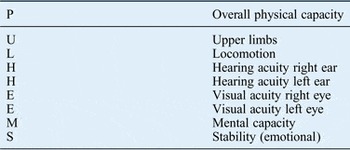
Medical entry standards were introduced by the military during the Second Boer War (1899–1902).Reference Fletcher2 These standards have been refined over the years resulting in the latest ‘PULHEEMS’ system, which was first introduced in 1948 as a more thorough assessment of physical and mental capacity.Reference Fletcher2 This system provides an occupational assessment of an individual's health in a series of domains, together with an overall assessment of level of fitness for service. The ‘H’ in ‘PULHEEMS’ represents the domain of hearing; other ENT conditions are captured by the overall grade. The assessment is made during an entry medical examination, and is used as a screening tool to exclude those whose health may limit their ability to fulfil a military role.Reference Braithwaite, Nicholson, Thornton, Jones, Simpson and McLoughin3–6
Materials and methods
The authors examined the medical and occupational literature,4–6 and interviewed military otolaryngology advisors to ascertain ENT-specific entry criteria for the British Army, Royal Navy and Royal Air Force.
Results
The ‘PULHEEMS’ system (Table I) grades an individual's medical fitness for employability in the military. Each letter of the acronym corresponds to a particular area of assessment. A numerical score based on set standards is assigned to each category, which allows the examiner to determine the overall physical capacity (‘P’) grade.
‘PULHEEMS’ scoring system acronym breakdown

The current otolaryngological minimum entry requirements for UK military services are described below, presented as lists of standards and conditions that would preclude a potential candidate from service.
Hearing loss
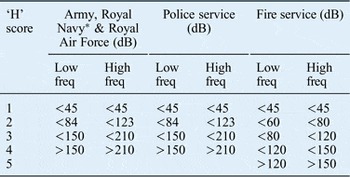
Hearing is measured via a pure tone audiogram, and is split into low and high frequencies. The low frequencies are measured at 0.5, 1 and 2 kHz, and the high frequencies are measured at 3, 4 and 6 kHz. An ‘H’ (hearing) score is then calculated based on these measurements.
An ‘H’ score of H2 or better is required for both ears. This is the equivalent of: (1) low frequency hearing loss no greater than 84 dB, summated over 0.5, 1 and 2 kHz; and (2) high frequency hearing loss no greater than 123 dB, summated over 3, 4 and 6 kHz.
Tables II and III compare the military hearing recruitment standards with those of the civilian services.7–9

A score is awarded if both low frequency and high frequency standards are achieved; otherwise, the worse score is awarded. The standard is cumulative; for example, if hearing thresholds at 0.5, 1 and 2 kHz were 10 dB each, that would represent a cumulative total of 30 dB, falling into an ‘H’ score of H1 (<45 dB) for low frequency. *In order to achieve an ‘H’ score of H1 for the Royal Navy, a recruit must not have more than 30 dB deficit at 6 kHz, or 20 dB at any other frequency. Freq = frequency

Patients requiring hearing aids or cochlear implants are excluded from military recruitment. Patients with unilateral hearing loss are also rejected.
General exclusions
These include: existing or past history of malignancy, granulomatosis with polyangiitis, narrowing of the airway sufficient to limit exercise tolerance, and persistent facial nerve palsy.
Ears
Exclusions related to the ears include recurrent or persistent otitis externa, and recurrent acute otitis media (individuals are considered if the last episode was more than one year prior to entry, the tympanic membrane has healed, and hearing is within range with normal tympanometry results). Those with a perforated tympanic membrane will also be excluded (individuals are considered if it has been over three months since myringoplasty surgery was performed, the tympanic membrane is intact, and hearing is within range with normal tympanometry results). In addition, patients with grommets will be excluded (individuals are considered if it is more than six months after grommet extrusion, provided the tympanic membrane has healed, and hearing is within range with normal tympanometry results). Those with active chronic otitis media will also be excluded (individuals are considered if the disease is inactive, they have been discharged from ENT, the tympanic membrane has healed, and hearing is in range with normal tympanometry results). Mastoidectomy is another cause for exclusion (individuals are considered if it has been over two years since surgery, the tympanic membrane has healed, and hearing is within range with normal tympanometry results). Other conditions for exclusion include: deformity of the external ear sufficient to interfere with wearing hearing protection or communication headsets, myringitis, otosclerosis and Ménière's disease.
Nose
Exclusions related to the nose include: nasal deformity sufficient to interfere with the use of face masks and breathing apparatus (individuals are considered following reconstructive surgery); recurrent epistaxis (i.e. more than one episode per week for longer than three months) (individuals are considered if they have been free from epistaxis for over six months); hereditary haemorrhagic telangiectasia; chronic rhinosinusitis requiring medication (military occupational health assessment is required); and current or past nasal polyposis.
Throat
Exclusions related to the neck include: adenoid hypertrophy (individuals are considered following adenoidectomy); obstructive sleep apnoea/hypopnoea; cleft lip or palate (individuals are considered if the condition is successfully treated); active or past respiratory papillomatosis; and open tracheostomy (individuals are considered if the trachea has healed).
Discussion
Our armed forces often operate in arduous and remote environments, long distances from tertiary medical services such as ENT. It is therefore essential that individuals are healthy in order to reduce risk to themselves and others.4–6
Medical screening has two aims. Firstly, it aims to identify candidates with conditions that may impair their effectiveness. In combat, these impairments may mean the difference between life and death, not only for the individual, but also for their colleagues who may have to expose themselves to danger saving or compensating for the individuals. Secondly, it aims to identify conditions that require ongoing treatment not readily available outside the UK. An individual may have an acceptable performance level with a particular aid or medicine, but a ‘worst case scenario’ should be appreciated when deciding on their medical fitness. The question that would have to be satisfied is: if the individual's aid or medicine were to be temporarily unavailable, as may occur in a remote foreign country, would the individual still maintain an adequate performance level? If the answer to this question is ‘no’, then there is a strong case for exclusion on medical grounds.
The majority of ENT entry standards are based around three core domains. The prospective candidate must have sound hearing, a good airway and ENT anatomy compatible with military equipment.
Communication is essential to military effectiveness at all levels in the command structure. This could be via a radio, face-to-face or listening for enemy movements. In civilian circumstances, unilateral deafness is not a cause of major disability, with recruitment into the police service still possible.7 In combat, however, localising quiet sounds can be of paramount importance.Reference Cain10 Hearing aid users are precluded from joining the military because technical maintenance for their device is not always available during operations abroad. Conversely, to avoid disability discrimination, the police and fire service will assess individuals with hearing aids on a case-by-case basis, with practical tests designed to accurately reflect requirements of the job.11
The requirement of an adequate airway is fairly self-evident owing to the physical demands of the job. The final principle mentioned, regarding ENT anatomy compatible with military equipment, is an area for debate, with most cases dealt with on an individual basis. Most equipment is sourced by the military in huge procurement deals. This equipment is suitable for the majority of individuals, but not all. The most common pieces of equipment specific to ENT that are required to fit are a full-face respirator, ear canal hearing protection and pinna-mounted communication devices. A patient with an anatomical variation not compatible with this equipment warrants preclusion unless corrected.4–6
Certain ENT conditions mean preclusion regardless of treatment, usually because adequate treatment does not exist. Diseases in this category include malignancy, autoimmune vasculitis, facial nerve palsy, Ménière's disease, hereditary haemorrhagic telangiectasia and nasal polyposis.
Recurrent ear infections and nose bleeds are accepted provided they are in remission with a low chance of relapse. This has to be demonstrated with a disease-free period prior to the screening assessment.
Surgical intervention has the advantageous ability to permanently cure a condition, often with the additional benefit of no long-term follow-up management required. Individuals excluded on the basis of unsatisfactory hearing or anatomical variations that would affect breathing and equipment fitting can be recruited following successful surgery provided the hearing and breathing requirements are met. Myringoplasty, tympanoplasty, mastoidectomy, septorhinoplasty, cheiloplasty and adenoidectomy can all be used to treat hearing loss and ventilation obstruction, enabling individuals to be eligible for inclusion.
• The UK armed forces operate in arduous and remote environments
• Medical screening during recruitment ensures personnel are fit to operate in these environments
• ENT conditions are a common reason for medical preclusion
• Treatments can facilitate or inhibit entry
• This paper aims to arm ENT specialists with knowledge of these conditions to effectively counsel and manage potential UK armed forces recruits
Importantly, surgery also has the potential to cause exclusion. Grommets, iatrogenic chronic tympanic membrane perforation, breathing problems or nasal deformity following nasal surgery can all result in exclusion on medical screening.
It may be inappropriate to offer surgery to treat a disease based purely on occupational reasons. In these cases, it is likely an individual would fail for the underlying disease anyway. For mild conditions, where an individual already satisfies the minimum functional standards required, a detailed discussion with the patient and extra thought should be given before embarking on a surgical intervention that has the potential to inhibit one's ability to join the military.
If a clinician has uncertainty about the implications of ENT pathology and management on a patient's prospect of joining up, advice can be sought from a recruiting office.4–6 If doubt arises from the entry medical examination, final arbitration may come from a referral to military occupational health or ENT consultants.Reference Braithwaite, Nicholson, Thornton, Jones, Simpson and McLoughin3
Conclusion
Members of the armed forces are required to be physically and mentally fit to operate abroad in arduous environments. Individuals cannot be dependent on medicines and devices such as hearing aids to achieve entry standards, as they can fail and can be difficult to repair or replace.
Patients aiming to join the armed forces may seek occupational advice and treatment from ENT specialists.Reference Braithwaite, Nicholson, Thornton, Jones, Simpson and McLoughin3 It is therefore important that these specialists have knowledge of ENT-specific military requirements in order to offer appropriate advice for fully informed decision making.12 Limited medical literature exists on ENT occupational factors that restrict recruitment into the UK armed forces. Most ENT specialists will face a military occupational enquiry; therefore, this paper should serve as a useful reference.