Introduction
In his paper on the internal morphology of seeds, Martin (Reference Martin1946) placed the lateral embryo adjacent to the broad embryo at the base of his family tree of seed phylogeny, which suggests that he thought these two kinds of embryos were related and not very evolutionarily derived. However, Poales is the most recent order of monocots, and the Poaceae, which is the only family with a lateral embryo, is the most advanced family in the order (Givnish et al., Reference Givnish, Zuluaga, Spalink, Gomez, Lam, Saarela, Sass, Iles, de Sousa, Leebens-Mack, Pires, Zomlefer, Gandolfo, Davis, Stevenson, dePamphilis, Specht, Graham, Barrett and Ané2018). Thus, it does not seem reasonable that the lateral embryo should be placed at the base of a family tree of seed phylogeny. However, the phylogenetic position of a family or order does not necessarily tell us if a particular trait is advanced. For example, underdeveloped embryos (i.e. small with organs that must grow inside the seed prior to germination) have long been considered to be ancestral by plant taxonomists (Bessey, Reference Bessey1915; Hutchinson, Reference Hutchinson1926; Takhtajan, Reference Takhtajan1954[1958]; Thorne, Reference Thorne1963; Grushvitzky, Reference Grushvitzky and Borriss1967; Cronquist, Reference Cronquist1968; Stebbins, Reference Stebbins1974), but they occur throughout the angiosperms, including advanced orders such as the Dipsacales (Baskin et al., Reference Baskin, Hidayati, Baskin, Walck, Huang and Chien2006).
Thus, two general questions arise. (1) What is the relationship of the lateral embryo to other kinds of embryos in the monocots, especially to those in the families in the order Poales? (2) Was Martin (Reference Martin1946) correct in placing the lateral embryo next to the broad embryo and near the base of the family tree of seed phylogeny? To answer these questions, we evaluated the parts of the lateral embryo (i.e. scutellum, cotyledonary sheath, coleoptile, mesocotyl, root and coleorhiza) and the seed in which it occurs in relation to embryos and seeds of monocots in general and in Poales in particular. For the various families of monocots, information was compiled on the presence (or not) of endosperm, starch in endosperm, aleurone layer, coleoptile, coleorhiza and compact cotyledon and on kind of embryo. For families in Poales, information was compiled on kind of embryogenesis, and for Poales families with a lateral or broad embryo information was collected on germination morphology. Our broad objective was to evaluate the lateral embryo in relation to other kinds of embryos in monocots and thereby gain insights into its potential evolutionary relationships.
Embryo in seeds of monocots
If the embryo in a monocot seed is differentiated, i.e. has organs, it has one cotyledon compared to two cotyledons in seeds of basal angiosperms and eudicots (hereafter dicots), e.g. Arabidopsis thaliana, whose embryo development has been studied extensively (Radoeva et al., Reference Radoeva, Vaddepalli, Zhang and Weijer2019). The stem apical meristem is initiated between the cotyledons in dicot embryos, but it is formed on the ventral side of the embryo in monocots such as grasses, with the cotyledon on the dorsal side adjacent to the endosperm. A monocot embryo has one plane of bilateral symmetry, while a dicot embryo has two (Juguet, Reference Juguet1993; Chandler et al., Reference Chandler, Nardmann and Werr2007). Monocot embryos lack a stereotypical pattern of cell division, which makes it impossible to trace the origin of the cotyledon and other organs back to specific precursor cells in the early embryo (Itoh et al., Reference Itoh, Nonomura, Ikeda, Yamaki, Inukai, Yamagishi, Kitano and Nagato2005; Chandler et al., Reference Chandler, Nardmann and Werr2007).
There are six kinds of embryos in seeds of monocots: broad (no organs but differentiates a shoot and shoot pole, i.e. germination is bipolar), capitate, lateral, linear fully developed, linear underdeveloped and undifferentiated (no organs and germination is unipolar) (Table 1). At seed maturity, capitate, lateral, linear fully developed and linear underdeveloped embryos have organs, but broad and undifferentiated embryos do not. After the epicotyledonary sector of the organless broad embryo is pushed outside the seed, a shoot apex and the root pole are initiated, thereby producing a typical seedling with a root and a shoot. However, the undifferentiated monocot embryo does not produce a typical seedling per se. For example, in the case of orchids, the germinated seed produces a protocorm that subsequently gives rise to (adventitious) roots and a stem (Stoutamire, Reference Stoutamire1964).
Embryo and seed characteristics of monocot familiesa

+, yes; −, no; ±, yes and no; ?, not known; P, perisperm. Embryogenesis: A, asterad; C, caryophyllid; Ch, chenopodial; O, onagrad; S, solanad. Kind of embryo: L-f, linear fully developed; L-ud, linear underdeveloped; (M), macropodous linear fully developed embryo; undif., undifferentiated. Taxonomy follows (http://www.mobot.org/mobot/research/apweb/orders/poalesweb.htm, 12 January 2021).
a Sources of information: Johansen (Reference Johansen1950), Dahlgren and Clifford (Reference Dahlgren and Clifford1982), Dahlgren and Rasmussen (Reference Dahlgren, Rasmussen, Hecht, Wallace and Prance1983), Dahlgren et al. (Reference Dahlgren, Clifford and Yeo1985), Grayum (Reference Grayum1987), Pereira (Reference Pereira1987), Johri et al. (Reference Johri, Ambegaokar and Srivastava1992), Tillich (Reference Tillich1992, Reference Tillich1994, Reference Tillich, Rudall, Cribb, Cutler and Humphries1995, Reference Tillich1996, Reference Tillich, Wilson and Morrison2000, Reference Tillich2003a,Reference Tillichb, Reference Tillich2007, Reference Tillich2014), Fernando and Cass (Reference Fernando and Cass1996), Takhtajan (Reference Takhtajan1997), Kubitzki (Reference Kubitzki1998), Simão et al. (Reference Simão, Scatena and Bouman2006), Martins et al. (Reference Martins, Pütz, Novembre, Piedade and Glória2011), Sokoloff et al. (Reference Sokoloff, von Mering, Jacobs and Remizowa2013), Bose and Paria (Reference Bose and Paria2015), Yan et al. (Reference Yan, Wang, Zhao, Zhao and Liu2017), Baskin and Baskin (Reference Baskin and Baskin2018), Baskin and Baskin, unpublished embryo database.
b Families of Poales are listed in the order provided by the APG website (http://www.mobot.org/mobot/research/apweb/orders/poalesweb.htm, 21 November 2020).
c A minute or no coleoptile.
The broad and lateral embryos are found only in Poales with the broad embryo in eight families and the lateral one only in the Poaceae (Table 1). Two families (Cyperaceae and Juncaceae) in Poales have a capitate embryo, and this kind of embryo also occurs in some members of the Alismatales, Arecales, Commelinales, Dioscoreales, Liliales and Zingiberales. A linear fully developed embryo occurs in two families (Typhaceae and Bromeliaceae) in Poales and also in the Alismatales, Arecales, Asparagales, Commelinales, Liliales, Pandanales and Zingiberales. A linear underdeveloped embryo occurs in one family (Thurniaceae) of Poales and in the Acorales, Alismatales, Arecales, Asparagales, Commelinales, Dioscoreales, Liliales and Pandanales. Undifferentiated embryos are not known in Poales, but they occur in the Asparagales (Orchidaceae), Dioscoreales (Burmanniaceae, Thismiaceae), Liliales (Corsiaceae), Pandanales (Triuridaceae) and Petrosaviales (Petrosaviaceae). Thus, although five kinds of embryos are found in Poales, only the broad and lateral embryos are unique to this order.
Lateral embryo
Martin (Reference Martin1946) classified seeds into 12 types based primarily on characteristics of the embryo and its position in the seed. With regard to the lateral embryo, he wrote ‘Embryo basal-lateral or lateral, inclined to expand in the plane of the periphery; small to half or rarely larger. This type includes only the Gramineae but it represents much diversity in embryo size. The name Basal applies well to a majority of the grass genera though Peripheral might seem more suitable for those with expanded embryos’.
Martin included the broad and lateral embryos in his list of ‘phylogenetic orphans’ because he concluded that their ancient parental origins had disappeared. In Martin's key for seed types, we learn that the lateral embryo is ‘evident from the exterior’ of the seeds and that seeds have starchy endosperm.
The grass seed with its lateral embryo is technically a diaspore consisting of a seed with the pericarp of the fruit adnate to it. Also, other structures such as the palea, lemma and glumes may be attached, depending on the species (Dahlgren et al., Reference Dahlgren, Clifford and Yeo1985). The dispersal/germination unit is called a caryopsis or grain, and it is found only in grasses. Inside the caryopsis (hereafter seed), we find endosperm with an outer aleurone layer and an embryo consisting of a scutellum, coleoptile, coleorhiza, shoot-born root, leaf primordia, mesocotyl and collar (base of the hypocotyl) that may produce rhizoids and/or a scale-like extension called the epiblast (Brown, Reference Brown1960; Tillich, Reference Tillich, Wilson and Morrison2000, Reference Tillich2007).
According to Maheshwari (Reference Maheshwari1950), the embryo of Poaceae differs from that of other monocots (e.g. in embryogenesis cells in tiers l and l′ give rise to the scutellum, which grows and pushes other structures to the side of the embryo), and it deserves special attention. Indeed, the grass embryo has received much attention, especially since the grass seed with its stored food is a major source of calories for humans and other animals (Li and Berger, Reference Li and Berger2012). Research on embryos and seeds of Poaceae began in the late 1600s (Brown, Reference Brown1960), became rather intense in the early to mid-1800s (e.g. De Jussieu, Reference De Jussieu1839; Schleiden, Reference Schleiden1839) and still continues. Current research involves not only the mechanisms of seed and embryo development but also functional attributes of food storage and use by the seedling, including how each process is regulated by genes (e.g. Cheng et al., Reference Cheng, Khan, Qiu, Li, Zhou, Zhang, Guo, Zhu, Peng, Sun, Li, Korban and Han2012; Li et al., Reference Li, Li, Dunwell and Zhang2012; Xu et al., Reference Xu, Zhang and Xue2016).
In Reference Souèges1924, Souéges published the results of his studies on the embryology of Poa annua, clearly showing that seeds of this species had the Asterad type of embryogenesis (see below). However, although there was an early understanding of the basic embryology of the grass embryo controversy raged for about 150 years as to what the various parts of the grass embryo were equivalent to in the embryo of other monocots (Avery, Reference Avery1930; Maheshwari, Reference Maheshwari1950; Natesh and Rau, Reference Natesh, Rau and Johri1984).
Scutellum
Controversy about the scutellum has been especially important, since this part of the embryo is unique to the Poaceae (Brown, Reference Brown1960; Rudall et al., Reference Rudall, Stuppy, Cunniff, Kellogg and Briggs2005). There have been many opinions as to what the scutellum is compared to the parts of the embryo in other monocots. The scutellum has been equated to the cotyledon (Goebel, Reference Goebel1905; Coulter, Reference Coulter1915; Arber, Reference Arber1925; Avery, Reference Avery1930; Shuma and Raju, Reference Shuma and Raju1991), cotyledon and coleoptile (Shuma and Raju, Reference Shuma and Raju1991), embryonic leaf blade (Cocucci and Astegiano, Reference Cocucci and Astegiano1978) and lateral outgrowth of the young axis (De Jussieu, Reference De Jussieu1839). Guignard and Mestre (Reference Guignard and Mestre1970) concluded that the scutellum is a ‘cotyledonary leaf’ that has evolved into a haustorium-like structure. Tillich (Reference Tillich2007) referred to the scutellum as the ‘haustorial cotyledon hyperphyll (scutellum) laterally attached to the copious endosperm’, and Ritchie et al. (Reference Ritchie, Swanson and Gilroy2000) described it as ‘the highly modified cotyledon of monocots’. Using molecular markers, Nardmann et al. (Reference Nardmann, Zimmermann, Durantini, Kranz and Werr2007) concluded that the adaxial root–shoot axis plus the coleoptile and the abaxial scutellum of the grass embryo are separate domains. During embryo development, no ZmWOX gene activity was found in the grass scutellum, but much ZmWOX gene activity occurred in the shoot/root axis of the grass embryo and the embryo of A. thaliana. Based on their ZmWOX data, the authors concluded that the scutellum is an organ in the embryo of grasses but not in the embryo of dicots.
Endosperm and aleurone
The endosperm is present in mature seeds of all families of Poales; in all families of Arecales, Commelinales, Dioscoreales, Liliales and Pandanales; and in all families of Asparagales except Orchidaceae (Table 1). Seeds of Acoraceae, which is the earliest-branching extant monocot family (Duvall et al., Reference Duvall, Learn, Eguiarte and Clegg1993; Soltis et al., Reference Soltis, Gitzendanner and Soltis2007), have both perisperm and endosperm (Grayum, Reference Grayum1987), while seeds in the Araceae, Asparagaceae, Cannaceae, Centrolepidaceae, Costaceae, Heliconiaceae, Marantaceae, Musaceae, Strelitziaceae and Zingiberaceae have endosperm and/or perisperm. Except for Tofieldiaceae and some Araceae and Scheuchzeriaceae, seeds of the Alismatales do not have endosperm, and various families in this order, including Alismataceae, Butomaceae (Arber, Reference Arber1920), Cymodoceaceae (McMillian, Reference McMillan1981; Caye and Meinesz, Reference Caye and Meinesz1986), Hydrocharitaceae (Kuo and Kirkman, Reference Kuo and Kirkman1992; Kuo et al., Reference Kuo, Long and Coles1993), Posidoniaceae (Belzunce et al., Reference Belzunce, Navarro and Rapoport2005), Potamogetonaceae (Arber, Reference Arber1920), Ruppiaceae (Goebel, Reference Goebel1905) and Zosteraceae (Gibbs, Reference Gibbs1902; Taylor, Reference Taylor1957), have massive (macropodous) hypocotyls with large reserves of starch.
Depending on the family, endosperm contains starch, oil, protein and/or hemicellulose. Dahlgren et al. (Reference Dahlgren, Clifford and Yeo1985) considered the presence of copious amounts of starch in the endosperm of monocots to be a derived condition. Starchy endosperm is found in at least some members of 48 monocot families, and all families of Poales have starchy endosperm (Table 1). The outmost layer of starchy endosperm in seeds of Araceae (Alismatales) and in various families of Arecales, Asparagales, Commelinales, Dioscoreales, Liliales, Pandanales, Poales and Zingiberales (Table 1; Werker, Reference Werker1997) differs from the inner layers of endosperm, and it is called the aleuron layer. The name for this layer comes from the fact that its cells are filled with protein-rich aleurone grains (Buttrose, Reference Buttrose1963).
The aleurone layer is well studied in the Poaceae. The inner layers of endosperm cells undergo programmed cell death, but the cells in the aleurone layer remain alive as seeds mature (Becraft, Reference Becraft2007; Becraft and Yi, Reference Becraft and Yi2011). During the germination of grass seeds, hydrolytic enzymes secreted by the aleurone cells break down the starch and protein stored in the dead endosperm cells. This highly controlled process is initiated when the embryo releases gibberellin (GA) after seeds imbibe water. GA subsequently activates cells in the aleurone layer that produce the hydrolases necessary for the release of stored food in the endosperm, making an energy source available for seedling growth (Ritchie et al., Reference Ritchie, Swanson and Gilroy2000). According to these authors, the scutellum also produces hydrolytic enzymes, and it transports sugars, amino acids and inorganic ions to other parts of the embryo.
Cotyledonary sheath and coleoptile
Depending on the plant family, the cotyledonary sheath is long or short, and it may be open or closed and if closed may have a coleoptile. The cotyledonary sheath encloses the root–shoot axis, and as it elongates it ‘carries’ the axis outside the seed. A coleoptile is a tubular structure ‘produced by meristematic activity of the marginal tissue of the cotyledonary sheath’ that covers the cotyledonary node and thus protects the shoot (Tillich, Reference Tillich2007). If the coleoptile is long, elongation of the cotyledonary sheath may not occur, and the shoot is inside the coleoptile. Depending on the taxon, a coleoptile may or may not be present. Seeds of Poaceae have a very short cotyledonary sheath and a well-developed coleoptile.
In our survey, a coleoptile was found to be present in 21 families of monocots (Table 1). In Poales, a coleoptile is present in the Poaceae, Ecdeiocoleaceae, Joinvilleaceae, Cyperaceae and in some members of the Restionaceae and Typhaceae. Tillich (Reference Tillich, Wilson and Morrison2000) considered the coleoptile to be a derived character.
A compact cotyledon has a short cotyledonary sheath that is not elongated and thus lacks a coleoptile; it is completely enclosed by the seed coat. A compact cotyledon was found to be present in 31 families (Table 1), and in Poales it occurs in the Flagellariaceae, Eriocaulaceae, Mayacaceae and Rapateaceae and may, or may not, be present in the Ecdeiocoleaceae, Xyridaceae and Bromeliaceae. Tillich (Reference Tillich, Wilson and Morrison2000, Reference Tillich2007) considered a compact cotyledon to represent the ancestral state among the five kinds of cotyledons in monocots. Thus, in Poales we find both the ancestral compact cotyledon and the derived state, i.e. a long cotyledon with a coleoptile. The derived state is found in Poaceae with a lateral embryo and in Joinvilleaceae with a broad embryo, but both the derived and ancestral states are found in Ecdeiodoleaceae with a broad embryo.
Mesocotyl
The mesocotyl in a grass seed is the part of the embryo axis between the point of attachment of the scutellum and the base of the coleoptile (Raju and Steeves, Reference Raju and Steeves1998). The mesocotyl is tubular and white, and it elongates during seed germination if the seed is located below the soil surface, thereby pushing the coleoptile up through the soil (Andrews et al., Reference Andrews, Douglas, Jones, Milburn, Porter and McKenzie1997; Niu et al., Reference Niu, Hao, Wu and Wang2020). However, elongation of the mesocotyl ceases when it is exposed to light at the soil surface (Mas and Verdú, Reference Mas and Verdú2016; Niu et al., Reference Niu, Hao, Wu and Wang2020). Although the mesocotyl is not restricted to the Poaceae, it has a limited distribution among monocots. A mesocotyl occurs in seeds of the Cyperaceae (Tillich, Reference Tillich2007), Cartonema in the Commelinaceae and in some species of Dasypogonaceae and Marantaceae (Watson and Dallwitz, Reference Watson and Dallwitz1992 onwards).
Root and coleorhiza
The root in a grass embryo originates from the meristem of the cotyledonary node, and thus it is adventitious (Guignard, Reference Guignard1975; Cocucci and Astegiano, Reference Cocucci and Astegiano1978). According to Tillich (Reference Tillich2007), the tip of this shoot-born root often, but not always, ‘stimulates cell elongation in the peripheral tissue of its mother organ, thus enabling this tissue to grow out forming a structure like the finger of a glove, the coleorhiza around the young root’. Thus, a coleorhiza is a covering around the first root, and this root comes from the shoot and thus it originates endogenously. In some monocots, a root is initiated at the root pole of the embryo, and this is an exogenous root and not covered by a coleorhiza.
A coleorhiza is found in at least some members of 17 families (Table 1). The Poaceae have a well-developed coleorhiza, and Tillich (Reference Tillich2007) commented that the ‘root pole [of Poaceae] is located at the distal tip of this coleorhiza, but there is no trace of an exogenously initiated primary root’. Other monocot families that lack a primary root are Eriocaulaceae, Lemnaceae [=Lemnoideae in the Araceae] and Zosteraceae, and some members of the Bromeliaceae, Araceae, Hydrocharitaceae and Marantaceae (Tillich, Reference Tillich, Rudall, Cribb, Cutler and Humphries1995). The Eriocaulaceae, Bromeliaceae, Hydrocharitaceae, Maranthaceae, Zosteraceae and some members of the Araceae do not have a coleorhiza (Table 1). Tillich (Reference Tillich, Rudall, Cribb, Cutler and Humphries1995) concluded that the absence of a primary root is an advanced condition in monocots.
Variation in the lateral embryo
There is variation in the lateral embryo of grasses, starting with size. For example, the embryo of festucoids (tribes Agrostideae, Aveneae Chlorideae, Festuceae, Hordeae and Phararideae) is smaller than that of panicoids (tribes Andropogoneae, Maydeae and Paniceae) (Reeder, Reference Reeder1957). This author also found several morphological differences that have taxonomic relevance. (1) The coleoptile is inserted above (vs at the same) level as the divergence point of vascular tissues entering the scutellum (panicoids vs festucoids). (2) A cleft (vs no cleft) is present between the lower part of the scutellum and coleorhiza (panicoids vs festucoids). (3) A small outgrowth called the epiblast is present (vs absent) on the embryo opposite the scutellum (festucoids vs panicoids).
Embryogenesis of lateral and broad embryos
In Poales, there are two types of embryo formation: asterad and onagrad. According to Dahlgren and Rasmussen (Reference Dahlgren, Rasmussen, Hecht, Wallace and Prance1983), ‘either the Asterad or possibly the Onagrad type of embryology must be regarded as ancestral in monocotyledons’. In Asterad and Onagrad embryogenesis, the initial division of the zygote is transverse resulting in the formation of a terminal (ca) and basal (cb) cell. The basal cell divides transversely to form two cells (m, ci), and the terminal cell divides longitudinally to form two cells (the q tier). At this stage, the proembryo has a total of four cells in three tiers (Johansen, Reference Johansen1950; Johri et al., Reference Johri, Ambegaokar and Srivastava1992). In the Asterad type of embryogenesis, cells derived from both the basal and terminal cells are important in embryo formation, while in the Onagrad type only those from the terminal cell are important (Johri et al., Reference Johri, Ambegaokar and Srivastava1992).
Families in Poales with Asterad embryogenesis include Bromeliaceae, Eriocaulaceae, Flagellariaceae, Joinvilleaceae, Poaceae, Rapateaceae, Typhaceae and Xyridaceae; the type of embryogenesis has not been determined for the Anarthriaceae, Ecdeiocoleaceae and Thurniaceae (Table 1). Thus, Asterad embryogenesis occurs in the Poaceae with a lateral embryo and in the Eriocaulaceae, Rapateaceae and Xyridaceae and with a broad embryo. We will consider embryogenesis of the lateral and broad embryos.
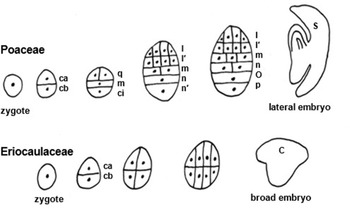
In embryogenesis of the Poaceae, the terminal (ca) cell gives rise to cell tiers l and l′, and the basal (cb) cell gives rise to tiers m, n, o and p (Johansen, Reference Johansen1950; Deshpande, Reference Deshpande1976) (Fig. 1, top). Using Eragrostis unioloides as an example, cells in tier l divide rapidly and form the cotyledon/scutellum; l′, stem apex, first leaf and upper and lower parts of the coleoptile that grow until they meet with the lower part growing faster than the upper part; m, hypocotyledonary axis; n and o, radicle, root cap, coleorhiza and epiblast; and p, suspensor (Deshpande, Reference Deshpande1976). The scutellum is the fastest growing part of the embryo, and it overgrows the other tiers of cells and the structures derived from them, pushing them to the side of the embryo (Shuma and Raju, Reference Shuma and Raju1991).
Diagram of the early stages in Asterad embryogenesis of the lateral embryo of Poaceae (top) and the broad embryo of Eriocaulaceae (bottom). ca, terminal cell from the division of zygote; cb, basal cell from the division of zygote; C, cotyledonary sector of embryo; S, scutellum.

Most studies of embryogenesis in families with a broad embryo have been done on species of Eriocaulaceae (Smith, Reference Smith1910; Patel and Patel, Reference Patel and Patel1964; Begum, Reference Begum1968; Monteiro-Scanavacca and Mazzoni, Reference Monteiro-Scanavacca and Mazzoni1978; Arekal and Ramaswamy, Reference Arekal and Ramaswamy1980; Ramaswamy et al., Reference Ramaswamy, Swamy and Govindappa1981; Ramaswamy and Arekal, Reference Ramaswamy and Arekal1981, Reference Ramaswamy and Arekal1982a; Scatena et al., Reference Scatena, Menezes and Stützel1993). A broad embryo is small, lens-shaped and has no organs or only incipient differentiation (Ramaswamy and Arekal, Reference Ramaswamy and Arekal1982b; Takhtajan, Reference Takhtajan1997; Baskin and Baskin, Reference Baskin and Baskin2018). Embryogenesis of the broad embryo in Eriocaulaceae begins with a transverse division of the zygote, and the ca and cb cells undergo a vertical division, resulting in a quadrant of cells (Fig. 1, bottom). Then, the four cells undergo a division to produce an octant of cells; however, tiers l, l′, m, n, o and p are not formed. As further cell division occurs in the 8-celled broad embryo, derivatives of ca that give rise to the cotyledonary sector of the embryo are more active than those from the cb cell that give rise to the epicotyledonary sector of the embryo. The more rapid growth of the cotyledonary than of the epicotyledonary sector of the embryo results in a bell-shaped embryo with a relatively wide cotyledon. A suspensor is not formed (Smith, Reference Smith1910).
Germination morphology of seeds with lateral and broad embryos
The first thing to emerge from a grass seed during germination is the coleorhiza, which is subsequently ruptured by an emerging adventitious root (Eichemberg and Scatena, Reference Eichemberg and Scatena2013). In some species, two or more roots are in the coleorhiza (Tillich, Reference Tillich2007). Next, the coleoptile emerges, and after it has elongated the first leaf grows from the pore at the top of the coleoptile (Wiedenroth et al., Reference Wiedenroth, Wernicke and Hoffman1990).
Germination of seeds with a broad embryo has been studied most extensively in the Eriocaulaceae (Clarke, Reference Clarke1859; Hare, Reference Hare1950; Ramaswamy et al., Reference Ramaswamy, Swamy and Govindappa1981; Corredor et al., Reference Corredor, Escobar and Scatena2015). In the Eriocaulaceae, the narrow (epicotyledonary) end of the embryo is pushed to the outside of the seed due to linear growth of the cotyledon. During/after germination, the basal part of the cotyledon remains inside the seed and functions as a haustorium. After the epicotyledonary sector of the broad embryo is outside the seed, a shoot apex and the root pole are initiated perpendicular to the cotyledon (Ramaswamy et al., Reference Ramaswamy, Swamy and Govindappa1981). A primary root/radicle does not develop, and the shoot-borne root is enclosed by a coleorhiza (Tillich, Reference Tillich2007). There is no coleoptile. The first leaf overtops the shoot apex (Ramaswamy et al., Reference Ramaswamy, Swamy and Govindappa1981), and Tillich (Reference Tillich2007) refers to it as a ‘scale-like cataphyll’.
The Xyridaceae also have Asterad embryogenesis and a broad embryo. During germination, the cotyledon elongates and pushes the epicotyledonary sector of the embryo to the outside of the seed. Depending on the species, part, or all, of the cotyledon remains inside the seed and acts as a haustorium. If part, or all, of the cotyledon emerges, it becomes photosynthetic. From the cells outside the seed, a hypocotyl, primary root and leaves are initiated (Rudall and Sajo, Reference Rudall and Sajo1999; Tillich, Reference Tillich2007). Little is known about the germination morphology of seeds of other families with broad embryos, i.e. Anarthriaceae, Centrolepidaceae, Mayacaceae, Rapateaceae and Restionaceae. However, seedlings of these five families do not have a coleorhiza, and all of them except Restionaceae lack a coleoptile. The presence/absence of a coleoptile in seedlings of Restionaceae depends on the species (Tillich, Reference Tillich2007).
Studies are needed on the germination morphology of Ecdeiocoleaceae. The seedling morphology studies by Tillich (Reference Tillich2007) revealed that after the epicotyledonary sector of the broad embryo in Joinvilleaceae emerges, coleoptile, coleorhiza and shoot-borne (adventitious) root are initiated, which are structures to be found inside a grass seed before it germinates. Tillich (Reference Tillich2007) argued that embryos of Ecdeiocoleaceae form a coleoptile, but this has not been confirmed. We also do not know if the embryo of the Ecdeiocoleaceae forms a coleorhiza around a shoot-born root. Although the large lateral embryo of grasses with well-defined organs is very different from a broad embryo with no organs, in both kinds of seeds a structure (scutellum in Poaceae and broad cotyledonary end of embryo in the seven families with a broad embryo) remains in the seed and acts as a haustorium.
Relationship between broad and lateral embryos
Although Martin (Reference Martin1946) does not explain why he placed the lateral embryo next to the broad embryo at the base of his family tree of seed phylogeny, the evidence from studies of embryogenesis and morphology suggests that he was correct in placing the two kinds of embryos next to each other. The broad embryo in Joinvilleaceae and/or Ecdeiocoleaceae and the lateral embryo of Poaceae have a coleoptile, coleorhiza, starchy endosperm, aleurone layer and Asterad embryogenesis.
The Poaceae and its lateral embryo have three morphological features in common with families with a broad embryo and Asterad embryogenesis. (1) The cotyledon is derived from the terminal (ca) cell resulting from the first division of the zygote. (2) The cotyledon end of the embryo is larger than the end that produces the root–shoot axis. (3) A radicle is not formed, and the first root is shoot-borne. In many respects, the embryo is grass seeds can be imagined as a broad embryo that has ‘germinated’, but the small seedling is still inside the seed. Dahlgren et al. (Reference Dahlgren, Clifford and Yeo1985) concluded that ‘The Avena-type embryo [lateral] may be derivable from a Xyris-like type [broad]; it is lateral to the endosperm and asymmetrical’.
The graminids consist of the Flagellariaceae, Joinvilleaceae, Ecdeiocoleaceae and Poaceae (Givnish et al., Reference Givnish, Ames, McNeal, McKain, Steele, dePamphilis, Graham, Pires, Stevenson, Zomlefer, Briggs, Duvall, Moore, Heaney, Soltis, Soltis, Thiele and Leebens-Mack2010; McKain et al., Reference McKain, Tang, McNeal, Ayyampalayam, Davis, dePamphilis, Givnish, Pires, Stevenson and Leebens-Mack2016; Hochbach et al., Reference Hochbach, Linder and Röser2018). Michelangeli et al. (Reference Michelangeli, Davis and Stevenson2003) resolved Ecdeiocolea as sister to Poaceae and Joinvillea as sister to Ecdeiocoleaceae and Poaceae. Givnish et al. (Reference Givnish, Ames, McNeal, McKain, Steele, dePamphilis, Graham, Pires, Stevenson, Zomlefer, Briggs, Duvall, Moore, Heaney, Soltis, Soltis, Thiele and Leebens-Mack2010) concluded that ‘Flagellariaceae, Joinvilleaceae and Ecdeiocoleaceae are successively sister to ever-narrow subsets of the graminids, with Ecdeiocoleaceae sister to Poaceae’. However, there are differences of opinion about relationships within the graminids. For example, McKain et al. (Reference McKain, Tang, McNeal, Ayyampalayam, Davis, dePamphilis, Givnish, Pires, Stevenson and Leebens-Mack2016) placed Joinvilleaceae and Ecdeiocoleaceae in a clade sister to the Poaceae. Regardless of the final conclusion about relationships within the graminids, Poaceae with a lateral embryo is closely associated with families with a broad embryo, i.e. the Flagellariaceae, Joinvilleaceae and Ecdeiocoleaceae.
A consideration of the relationship between the broad and lateral embryos leads to questions regarding relative time of family origin of the Poaceae and families with broad embryos. Givnish et al. (Reference Givnish, Zuluaga, Spalink, Gomez, Lam, Saarela, Sass, Iles, de Sousa, Leebens-Mack, Pires, Zomlefer, Gandolfo, Davis, Stevenson, dePamphilis, Specht, Graham, Barrett and Ané2018) dated the divergence of monocots from the Ceratophyllum-eudicot linage at 136.1 Ma, i.e. in the Early Cretaceous. These authors placed the stem and crown nodes of Poales at 124 and 120 Ma, respectively. Families in Poales had the oldest average stem age (105.6 Ma), while those in the Zingiberales had the youngest (43.3 Ma).
The embryo characteristics of the ancestor of Poaceae are not known, but there is some evidence from studies on the time or origin of monocot families that the broad embryo (e.g. Flagellariaceae, Joinvilleaceae) may have preceded the lateral embryo in the evolutionary history of monocots. According to the work of Bouchenak-Khelladi et al. (Reference Bouchenak-Khelladi, Muasya and Linder2014), the mean time of origin (at the 95% confidence interval) of the graminids is Flagellariaceae, 95.3 Ma; Joinvilleaceae, 76.7 Ma; Poaceae, 68.9 Ma; and Ecdeiocolaceae, 36.7 Ma. The time of origin of Eriocaulaceae and Xyridaceae with broad embryos and Asterad embryogenesis is 64 and 63 Ma, respectively. The time of origin of families with broad embryos and Onagrad embryogenesis is Mayacaceae, 82.4 Ma; Restionaceae, 71.2 Ma; and Centrolepidaceae, 31.2 Ma (Bouchenak-Khelladi et al., Reference Bouchenak-Khelladi, Muasya and Linder2014).
Where on the family tree of seed phylogeny?
An acknowledgement of a relationship between the broad and lateral embryos does not resolve the question as to where these types of embryos belong on the family tree of seed phylogeny (Table 2). Taxonomists have long used information on embryo size and the presence (vs absence) of endosperm in evaluating the phylogenetic relationships of flowering plants. For example, Bessey (Reference Bessey1915) in his dictum No. 22 about the phylogenetic taxonomy of flowering plants said ‘The endospermous seed is primitive and lower, while the seed without endosperm is derived and higher’. Furthermore, his dictum No. 23 says ‘Consequently, the seed with a small embryo (in endosperm) is more primitive than the seed with a large embryo (in scanty or no endosperm’.
Summary of points considered in evaluating the placement of the lateral embryo on Martin's (Reference Martin1946) family tree of seed phylogeny in relation to the other kinds of monocot embryos

Martin (Reference Martin1946) seems to have adhered to Bessey's dicta and thus placed seeds with relatively small embryos and much endosperm (rudimentary, capitate, broad and lateral) at the base of his family tree of seed phylogeny and those with large (spatulate, bent and investing) embryos and no endosperm at the top of the tree. Since the length of the broad and lateral embryos is relatively short compared to the length of the seed (i.e. low embryo:seed ratio) and have a large amount of endosperm, we agree with Martin that they are not highly advanced, according to Bessey's dicta for angiosperms, and belong at or near the base of his tree. However, unless we consider the Poaceae and, in particular, the lateral embryo in light of other monocot families and their embryos we may miss important relationships/insights about the lateral embryo in relation to other monocot embryos.
There are various examples of scientists concluding that the Poaceae are the most advanced monocots. Bessey (Reference Bessey1915) suggested that the Poaceae were ‘the highest [most advanced] of the monocotyledons’. He made this suggestion after noting that the Poaceae have elongated stems with nodes, long narrow leaves, a spreading arrangement of spikelets and a one-cell tricarpellary pistil with one ovule, and members of this family produce a distinctly different fruit, i.e. the caryopsis. Takhtajan (Reference Takhtajan1980) placed the Liliales at the base and Poales at the top of class Liliidae. Dahlgren and Rasmussen (Reference Dahlgren, Rasmussen, Hecht, Wallace and Prance1983) listed five derived states of Poaceae: reduced perianth, unilocular pistil with one ovule, cell walls laid down obliquely during embryogenesis, dry indehiscent fruits with testa and pericarp adnate and embryo lateral to endosperm. In his consideration of the origin and stages of the development of monocotyly, Juguet (Reference Juguet1993) concluded that the Poaceae were the furthest away from the original stock.
The early work of Boyd (Reference Boyd1931) helps explain how the lateral embryo differs from the embryo in other monocots. She studied the morphology of seeds and seedlings in various families of monocots and found trends of increasing embryonic development before germination, with the grass embryo being the most highly developed. The orientation of embryo organs inside the seed is related to how the seed germinates. If the root–shoot axis of the embryo inside the seed is at an obtuse angle, e.g. Bromeliaceae (Boyd, Reference Boyd1931) and Cyperaceae (Juguet, Reference Juguet1993), germination occurs in two phases. One, the cotyledon elongates due to cell expansion and the shoot–shoot axis emerges from the seed, leaving the cotyledon, or at least part of it, inside the seed. In monocot seeds with a capitate, linear fully developed or linear underdeveloped embryo, the root–shoot axis is enclosed by a cotyledonary sheath that elongates, thereby ‘carrying’ the axis outside the seed (Tillich, Reference Tillich1996, Reference Tillich2007). Two, on the outside of the seed, the root–shoot axis becomes orientated in a straight line, which is at a right angle with the cotyledon inside the seed (Boyd, Reference Boyd1931). However, in the grass embryo, the root–shoot axis is in a straight line at the time of seed maturation. Thus, germination of a grass seed consists of emergence of the coleorhiza and coleoptile with no re-orientation of the root–shoot axis after it is outside the seed.
Clearly, the broad embryo undergoes the two stages of germination described by Boyd (Reference Boyd1931), and from a germination morphology perspective it is less advanced than the lateral embryo. Tillich (Reference Tillich2007) commented that ‘The embryo [of grasses] in a ripe caryopsis resembles a resting seedling rather than an embryo’. Kellogg (Reference Kellogg2000) emphasized the accelerated embryo development in relation to seed development in grasses and noted that the grass embryo not only has apical meristems and several leaves but also a vascular system. Compared to the lack of organs in seeds of some Poales such as those with a broad embryo, the well-formed lateral embryo in grass seeds represents a heterochronic change (Kellogg, Reference Kellogg2000).
Seedlings from seeds with a lateral embryo have an advantage over those from seeds with a broad embryo. During the germination process, a well-developed (adventitious) root and shoot emerge from seeds with a lateral embryo, but only meristematic tissue emerges from seeds with a broad embryo. Thus, there is a ‘waiting period’ before a root and shoot are produced by a germinating seed with a broad embryo. The well-developed embryo and rapid germination of grass seeds may help to explain why the Poaceae have been so successful and now grow in a wide range of habitats from tropical to cool-temperate and Arctic regions of the earth (Linder, Reference Linder1987; Linder and Rudall, Reference Linder and Rudall2005). Also, there has been high species diversification in grasses with the repeated evolution of C4 photosynthesis (Kellogg, Reference Kellogg2000; Givnish et al., Reference Givnish, Zuluaga, Spalink, Gomez, Lam, Saarela, Sass, Iles, de Sousa, Leebens-Mack, Pires, Zomlefer, Gandolfo, Davis, Stevenson, dePamphilis, Specht, Graham, Barrett and Ané2018).
Martin (Reference Martin1946) depicted the lateral embryo on his family tree of seed phylogeny as a small projection from the base of the tree, and this projection is adjacent to the broad embryo that is a part of the base of the tree. However, the lateral embryo projection is only 21.3% the height of the longest branch on the tree, suggesting that Martin considered the lateral embryo to be relatively non-advanced. Martin has monocots with differentiated embryos in three categories on the tree: linear, capitate and lateral. He did not distinguish between linear fully developed and linear underdeveloped. Of these three kinds of embryos, linear embryos have the highest position on the tree. Interestingly, Martin selected a mixture of monocot and eudicot families to represent the linear embryo on his tree.
In addition to the advanced germination morphology of grass seeds compared to that of other monocot seeds, grass seeds lack a primary root and compact cotyledon, which are derived traits (Tillich, Reference Tillich, Wilson and Morrison2000, Reference Tillich2007). Further, three of the derived traits of monocot embryos/seeds, as discussed above, are present in the lateral embryo of the Poaceae: coleoptile, coleorhiza and starchy endosperm (Table 1). A coleoptile, coleorhiza and starchy endosperm also are found in embryos/seeds of Joinvilleaceae, which have a broad embryo. Embryos/seeds of Ecdeiocoleaceae have a coleoptile and starchy endosperm and possibly a coleorhiza, but this has not been documented. However, this combination of characteristics does not consistently occur in other families of monocots (Table 1). In the Asparagaceae and Iridaceae with both linear fully developed and linear underdeveloped embryos, a coleoptile, coleorhiza and starchy endosperm may be present or absent, depending on the species. In the Commelinaceae with a capitate embryo, coleoptile and coleorhiza may be present or absent, and starchy endosperm is present. In the Zingiberaceae with a capitate or linear fully developed embryo, a coleoptile and coleorhiza may be present or absent, and starchy perisperm and endosperm are present.
Conclusion
Based on the advanced germination morphology of grasses, the lack of a primary root and compact cotyledon and the presence of a coleoptile, coleorhiza and starchy endosperm in the embryo/seed, the lateral embryo should occupy a position higher than the board, capitate, linear fully developed and linear underdeveloped embryos of monocots. Further studies, however, are required to evaluate the relationship between the broad, capitate, lateral, linear fully developed and linear underdeveloped embryos and the macropodous (linear) embryo of the Alismatales and the undifferentiated embryo of the monocots Burmanniaceae, Corsiaceae, Orchidaceae, Petrosaviaceae, Thismiaceae and Triuridaceae.
Conflict of interests
None declared.