Non-technical Summary
This paper discusses the geological history of the seasnail genus Euthria in the eastern Atlantic, Mediterranean, and Paratethys, an inland sea that existed in central-eastern Europe during the Middle Miocene, around 15 million years ago (Ma). The genus has a long geological history dating back to the Eocene, around 47 Ma. Recent studies showed that since the Oligocene, around 44 Ma, it increased in geographic range and in numbers of species. However, despite being present in many locations in this vast territory, a lot of its species were found only in restricted areas. This paper reviews the fossil record of Euthria in the western Iberian Pliocene of the Mondego Basin of Portugal. Two new species are described—Euthria galopimi n. sp. and Euthria lockleyi n. sp.—both endemic, i.e., occurring only in the study area. They both have a larval shell that suggests that these seasnails did not spend a significant amount of time in the plankton as larvae in the early phase of their life. The importance of this mode of larval development to understand their restricted geographical distribution is discussed. Despite being represented by numerous species in the eastern Atlantic and Mediterranean in the past, today a single species of Euthria occurs in the Mediterranean, and it is not present in more northern Atlantic waters. As with other seasnail groups that require warm water, the northern distribution limit of Euthria in the Atlantic has shifted southward since at least the Pliocene, around 3 Ma, due to decreasing temperatures.
Introduction
The genus Euthria Gray, Reference Gray and Gray1850 (Tudiclidae, Buccinoidea) boasts a relatively long geological history, stretching back to the Eocene. Notably, Cossmann (Reference Cossmann1901, p. 119) documented three Euthria species in the Eocene deposits of the Paris and Loire basins of northern and northwestern France. Two species are mentioned from the Lutetian of the Paris Basin: Euthria decipiens Deshayes, Reference Deshayes1864 and Euthria douvillei Cossmann and Pissarro, Reference Cossmann and Pissarro1911 (Le Renard and Pacaud, Reference Le Renard and Pacaud1995; Pacaud and Le Renard, Reference Pacaud and Le Renard1995). Euthria decipiens lacks the typical angulation of the columella at the siphonal canal of typical Euthria species, and we exclude it from the genus (see Cossmann and Pissarro, Reference Cossmann and Pissarro1911, pl. 37, fig. 181-1). Similarly, Euthria douvillei Cossmann and Pissarro, Reference Cossmann and Pissarro1911 is unrelated to Euthria due to its prominent spiral sculpture (see Cossmann and Pissarro, Reference Cossmann and Pissarro1911, pl. 37, fig. 181-2). However, Euthria reducta Cossmann, Reference Cossmann1897 from the Bartonian of the Loire Basin might be an early Euthria (see Cossmann, Reference Cossmann1897, pl. 6, figs. 19, 20), which would place the origin of the genus at around 40 million years ago (Ma).
The next unequivocal European records of Euthria representatives emerge from the Atlantic lower Oligocene deposits of the Paris Basin of France (Cossmann, Reference Cossmann1901). The genus already exhibits a significant presence and diversity in the French Atlantic upper Oligocene of the Aquitaine Basin (Lozouet, Reference Lozouet2021), becoming widespread in fossil assemblages of Neogene age across the European Atlantic Frontage (Peyrot, Reference Peyrot1928, Reference Peyrot1938; Van Dingenen et al., Reference Van Dingenen, Ceulemans and Landau2017; Landau et al., Reference Landau, Ceulemans and Van Dingenen2019a; inter alia), the Proto-/Mediterranean (Bellardi, Reference Bellardi1873; Brunetti and Della Bella, Reference Brunetti and Della Bella2016; Landau and Harzhauser, Reference Landau and Harzhauser2024; inter alia), and the Paratethys (Hoernes and Auinger, Reference Hoernes and Auinger1890; Harzhauser and Landau, Reference Harzhauser and Landau2024; inter alia).
Beets (Reference Beets1986, p. 92), who regarded Euthria as a subgenus of Buccinulum Deshayes, Reference Deshayes1830, identified two primary geographical groups within the extant species of these taxa. He proposed that both groups trace their origins back to the early Cenozoic, the first one spanning from Western and Central Europe to the Indo-Western Pacific region, reaching Japan, and extending across the Mediterranean to the eastern and southern Atlantic, encompassing the region around southern Africa. The second group, existing within a similar chronological range, is centered in the Australo-Tasmanian-New Zealandic realm, possibly indicating a distinct ancestry.
By contrast, Rolán et al. (Reference Rolán, Monteiro and Fraussen2003), who treated Euthria and Buccinulum as autonomous taxa on the basis of radular morphology, slight conchological differences, present-day geographic separation, and different geological record, recognized four main geographical areas of occurrence of Euthria–Buccinulum gastropods, which they also treated as “radiations”: (1) an area of radiation of Buccinulum around New Zealand; (2) a typical Euthria radiation along the coasts of the Indian Ocean; (3) a third area around New Caledonia, and finally, (4) the East Atlantic Euthria–Euthriostoma area of “after” radiation, separated from the main group (i.e., from the group in area 2) following the demise of the marine seaway between the Mediterranean Sea and the Indian Ocean in the Middle Miocene. This paper is focused on this last group of representatives of Euthria, occurring in the Mediterranean Sea and the eastern Atlantic, extending its range southward to Angola (Schoenherr and Rolán, Reference Schoenherr and Rolán2017), with a notable center of diversity around the Cape Verde Islands, where more than 22 endemic species have been described (Rolán et al., Reference Rolán, Monteiro and Fraussen2003; Fraussen and Swinnen, Reference Fraussen and Swinnen2016). The determination of whether these “Area 4” species are congeneric with those of the Indo-West Pacific groups falls outside the scope of this paper. It is worth noting that there are no molecular data yet available to shed light on the relationships between these distinct “radiations.”
Herein we will examine the biodiversity of Euthria from the fossil record of the Pliocene of western Iberia, from the Cenozoic Mondego Basin of Portugal, and discuss the diversity and the endemicity of the group in the European Atlanto-Mediterranean Neogene.
Geological and paleoenvironmental setting
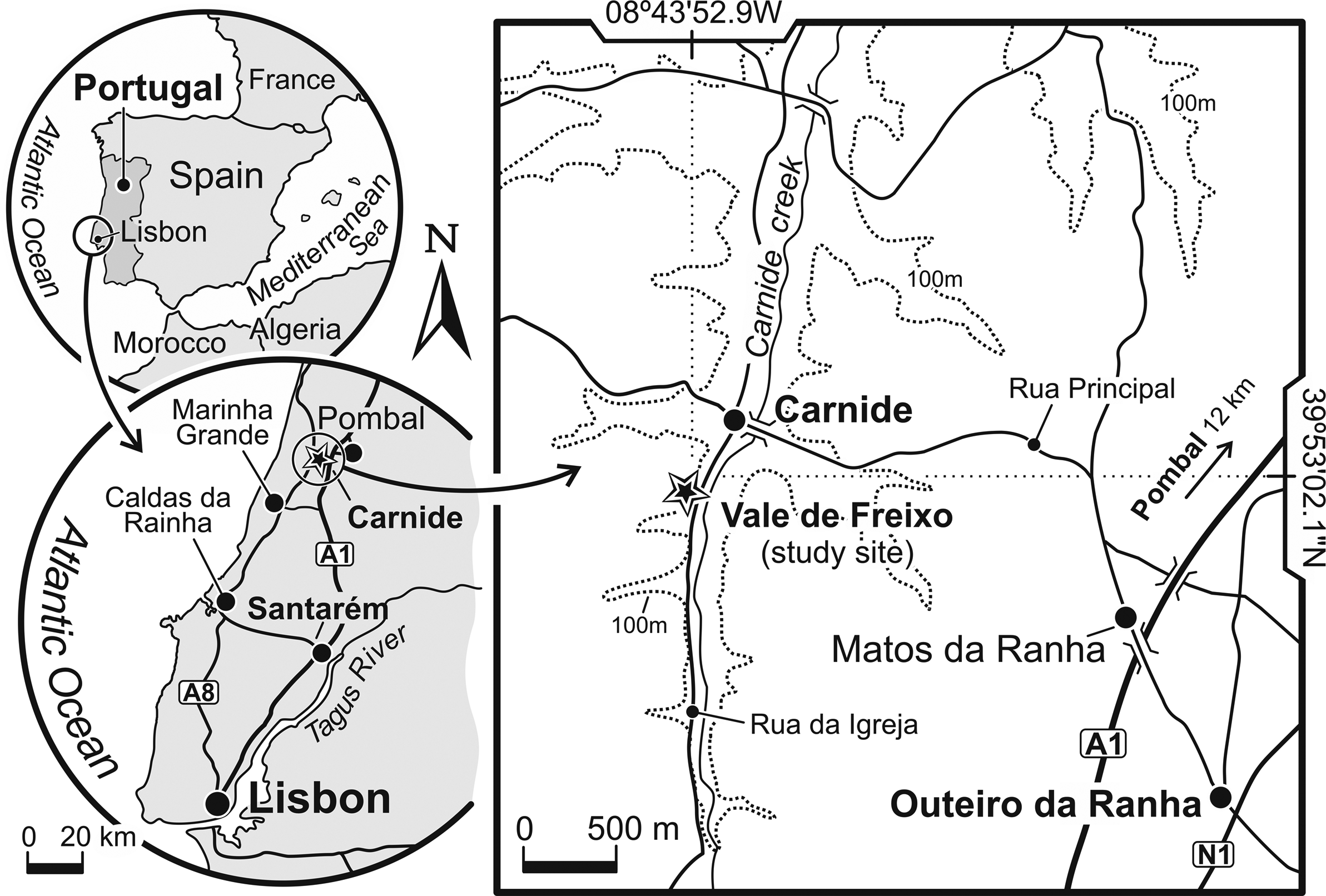
The specimens under investigation originate from the Pliocene deposits of Vale de Freixo. This locality is situated in west-central Portugal, specifically in the Pombal region, with geographic coordinates 39°53’02.1"N, 8°43’52.9"W. The sedimentary sequence exposed at this site spans the Miocene to Pliocene and is part of the Cenozoic Mondego Basin well represented in the Caldas da Rainha, Marinha Grande, and Pombal region (Fig. 1). The basal fossiliferous Pliocene conglomerate and sands at the study site correspond to the initial transgressive beds of the Carnide Formation (Cachão, Reference Cachão1990; Diniz et al., Reference Diniz, da Silva and Cachão2016).
Location of the Pliocene Vale de Freixo locality in the Pombal area of west-central Portugal.

The calcareous nannofossil assemblage within the basal sands has been assigned to the biozone CN12a of Okada and Bukry (Reference Okada and Bukry1980). On the basis of these and of fossil gastropods, these basal transgressive beds were attributed to the uppermost Zanclean to lower Piacenzian (Cachão, Reference Cachão1990; da Silva et al., Reference da Silva, Landau, Domènech and Martinell2010; Diniz et al., Reference Diniz, da Silva and Cachão2016). The molluscan assemblage of Vale de Freixo, as well as all the known marine Pliocene Atlantic molluscan records of the Mondego Basin in the broader Caldas da Rainha, Marinha Grande, and Pombal, correlate to the Mediterranean Plio-Pleistocene Molluscan Unit 1 (MPPMU1), former MPMU1 (Mediterranean Pliocene Molluscan Unit 1) as defined by Monegatti and Raffi (Reference Monegatti and Raffi2001) for the Mediterranean (da Silva et al., Reference da Silva, Landau, Domènech and Martinell2010). For a comprehensive understanding of the geographical location, general geological context, and stratigraphy of the Vale de Freixo site, along with additional references, refer to da Silva et al. (Reference da Silva, Landau, Domènech and Martinell2006, Reference da Silva, Landau, Domènech and Martinell2010), Diniz et al. (Reference Diniz, da Silva and Cachão2016), or Dell’Angelo et al. (Reference Dell’Angelo, Landau, da Silva and Sosso2022).
The present-day Caldas da Rainha, Marinha Grande, and Pombal region, at the very end of the Zanclean and the onset of the Piacenzian, was occupied by a shallow-marine environment with normal salinity and warm waters, somewhat shielded from the direct influence of the open Atlantic Ocean (Nolf and da Silva, Reference Nolf and da Silva1997; da Silva et al., Reference da Silva, Landau, Domènech and Martinell2010). According to molluscan data, during the mid-Pliocene, sea surface temperatures (SSTs) along the western Iberian coast at approximately 40ºN latitude, the latitude of Vale de Freixo, had subtropical characteristics. They were comparable to present-day temperatures recorded along the coasts of western Africa at the latitude of Cape Blanc (Morocco/Mauritania, 21ºN), that is, with maximum mean monthly SSTs (MMSSTs) of around 23.5ºC in September and minimum MMSSTs of 19ºC in January–March (da Silva et al., Reference da Silva, Landau, Domènech and Martinell2010).
The fossil assemblage from the basal beds of the Carnide Formation at Vale de Feixo suggests a marine infralittoral environment, less than 24 m deep, with a sandy, bioclastic substrate, in which the gastropods were the most diverse group, although not the most abundant (da Silva, Reference da Silva2001, Reference da Silva2002), followed by the bivalves (Dollfus and Cotter, Reference Dollfus and Cotter1909, for the Caldas da Rainha, Marinha Grande area; Pimentel, Reference Pimentel2018, for the Vale de Freixo site), and the polyplacophorans (Dell’Angelo and da Silva, Reference Dell’Angelo and da Silva2003; Dell’Angelo et al., Reference Dell’Angelo, Landau, da Silva and Sosso2022).
The Pliocene gastropod assemblage of the Caldas da Rainha, Marinha Grande, and Pombal region was investigated by da Silva (Reference da Silva2001). The study scrutinized and incorporated all Portuguese Pliocene records known to date, including those of Cox (Reference Cox1936, Reference Cox1941), Zbyszewski (Reference Zbyszewski1959), and Brébion (Reference Brébion1971, Reference Brébion1974), and documented a total of 165 species, with 155 of them represented in the Vale de Freixo assemblage.
The western Iberian fauna represented in the Pliocene Mondego Basin fossil assemblage was part of the Pliocene French-Iberian subtropical Province of da Silva and Landau (Reference da Silva and Landau2007) and Landau et al. (Reference Landau, da Silva, Van Dingenen and Ceulemans2019b). It included about 45 thermophilic genera, such as Xenophora Fischer von Waldheim, Reference Fischer von Waldheim1807, Cypraecassis Stutchbury, Reference Stutchbury1837, Distorsio Röding, Reference Röding and Fried Bolten1798, Bolinus Pusch, Reference Pusch1837, Cymbium Röding, Reference Röding and Fried Bolten1798, Marginella Lamarck, Reference Lamarck1799, Persicula Schumacher, Reference Schumacher1817, Granulina Jousseaume, Reference Jousseaume1888, Solatia Jousseaume, Reference Jousseaume1887, Conus s.l., Strioterebrum Sacco, Reference Sacco1891, and Sveltia Jousseaume, Reference Jousseaume1887. However, it lacked the typical tropical indicators common in coeval Mediterranean faunas (e.g., Thetystrombus Dekkers, Reference Dekkers2008 and diversified Terebridae and Conidae, and so on, after Monegatti and Raffi, Reference Monegatti and Raffi2001).
Materials and methods
The study material was obtained from search sampling conducted in the dark gray sand “Bed 3” of the basal Pliocene sequence at Vale de Freixo. For a stratigraphic log of the sequence, please refer to Dell’Angelo et al. (Reference Dell’Angelo, Landau, da Silva and Sosso2022).
Abbreviations
We use the following: hp = height of the protoconch; dp = diameter of the protoconch; pc = protoconch.
Repositories and institutional abbreviations
Types, figures, and other specimens examined in this study are deposited in the following institutions: National Museum of Natural History and Science of the University of Lisbon, Portugal (MNHN/UL), and Natural History Museum Vienna, Austria (NHMW).
Systematic paleontology
Superfamily Buccinoidea Rafinesque, Reference Rafinesque1815
Family Tudiclidae Cossmann, Reference Cossmann1901
Genus Euthria Gray, Reference Gray and Gray1850
Type species
Fusus lignarius Chiaje [= Euthria cornea (Linnaeus, Reference Linnaeus1758)]; original designation by Gray (Reference Gray and Gray1850, p. 67), subsequently Murex corneus Linnaeus, Reference Linnaeus1758 fixed as type species by Petit (Reference Petit2012, p. 99) under Art. 70.4. Present-day, Mediterranean Sea.
Euthria galopimi new species
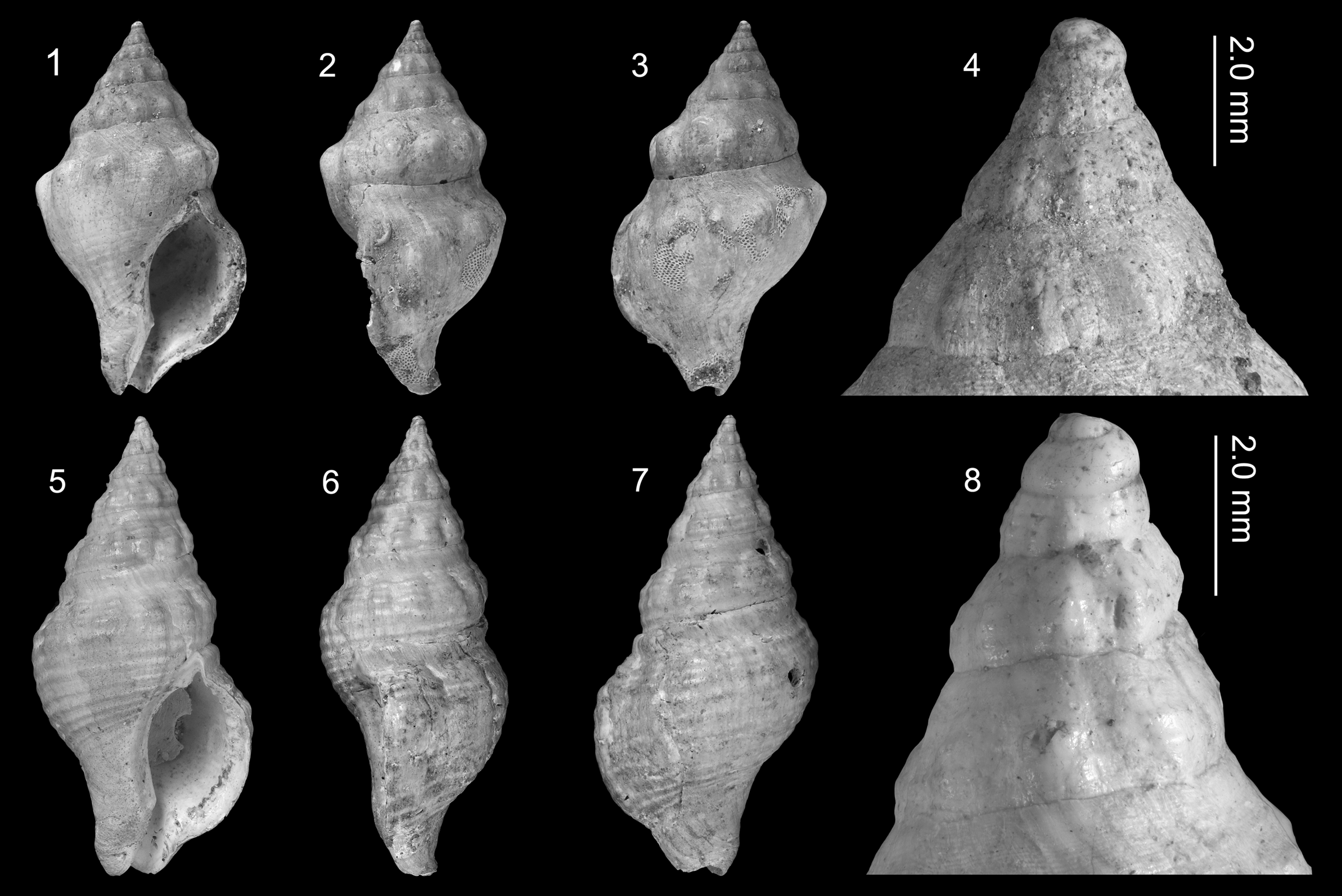
(1–4) Euthria galopimi n. sp., holotype NHMW 2018/0331/0174, height 35.8 mm, width 18.1 mm: (1) apertural view; (2) lateral view; (3) dorsal view; (4) detail of the protoconch. (5–8) Euthria lockleyi n. sp., holotype MNHN/UL.917, height 47.1 mm, width 23.1 mm: (5) apertural view; (6) lateral view; (7) dorsal view; (8) detail of the protoconch. All specimens from the Vale de Freixo locality, Pombal area, Portugal. Carnide Formation, Pliocene, uppermost Zanclean to lower Piacenzian.

Holotype
Holotype NHMW 2018/0331/0174, height 35.8 mm, width 18.1 mm.
Diagnosis
Euthria species with a small- to medium-sized shell for genus, broad biconic profile, protoconch of two whorls with large nucleus, teleoconch sculpture consisting of broad ribs developed below shoulder on spire whorls, reduced to 10 tubercles placed at strong shoulder on last whorl, fine spiral treads over entire surface, weak cords over base, outer lip weakly lirate within.
Occurrence
Pliocene eastern Atlantic, western Iberian coasts; Mondego Basin (Portugal), uppermost Zanclean to lower Piacenzian (this paper).
Locus typicus
Vale de Freixo site, near the village of Carnide, Pombal municipality, west-central Portugal.
Stratum typicum
Carnide Sandstone Formation, basal fossiliferous gray sands, “Bed 3” in Gili et al. (Reference Gili, da Silva and Martinell1995) and Dell’Angelo et al. (Reference Dell’Angelo, Landau, da Silva and Sosso2022, text-fig. 2).
Description
Shell small- to medium-sized for genus, solid, relatively broad, squat biconic; apical angle ~60°. Protoconch small, of just over two smooth convex whorls with large nucleus (approximately hp = 1.5 mm, dp = 1.5 mm). Junction with teleoconch delimited by beginning of axial sculpture. Teleoconch of 5.5 whorls separated by weakly impressed undulating suture. First teleoconch whorl bearing 10 broad axial ribs, roughly equal in width to interspaces. Later spire whorls with broad, steep, weakly concave subsutural ramp, weakly delimited by rounded shoulder placed below mid-whorl, periphery at abapical suture. Ribs subobsolete over subsutural ramp, broad and rounded below, weakening toward suture. Spiral sculpture composed of extremely fine, crowded spiral threads covering the entire surface. Last whorl 73% of total height, with broad concave subsutural ramp, roundly angled at prominent shoulder, convex below, strongly constricted at base, fasciole rounded, moderately delimited; ribs reduced to 10 large, rounded tubercles at shoulder; fine spiral threads over surface, slightly broader spiral cords over base, strengthening abapically. Aperture 51% of total height, ovate; anal canal marked by small notch; siphonal canal moderate length and width, open, bent to left and slightly recurved; outer lip concave below subsutural ramp, roundly angled at shoulder, weakly lirate within. Columella broadly and evenly excavated, bearing small fold at upper end of siphonal canal. Columellar callus narrow, hardly thickened, moderately delimited without parietal pad or denticle.
Etymology
Named after António Marcos Galopim de Carvalho (b. 1931), Portuguese geologist and Neogene bryozoan paleontologist at the Department of Earth Sciences of the Faculty of Sciences of the University of Lisbon, Portugal, and Director of the National Museum of Natural History and Science of Lisbon in the late twentieth and early twenty-first centuries. In the 1990s, his geoconservation efforts were crucial for the creation, among others, of the Dinosaur Tracks of Ourém–Torres Novas Natural Monument, also known as the Galinha Quarry track site.
Materials
Known from holotype only.
Paleoecology
Epibenthic vagile gastropods living in coastal infralittoral subtropical marine environments (estimated maximum MMSST of ~23.5ºC in September and minimum MMSST of 19ºC in January–March; da Silva et al., Reference da Silva, Landau, Domènech and Martinell2010) of normal salinity and sandy, bioclastic substrates. Gastropods with paucispiral protoconch with a large nucleus suggesting non-planktotrophic larval development.
Remarks
Despite the plethora of Euthria Gray, Reference Gray and Gray1850 species in the European Neogene, this species differs from all its congeners in its broad biconic profile, broad axial ribs reduced to large tubercles on the last whorl, and the fine crowded spiral threads that cover the entire surface. Euthria presselierensis Landau, Ceulemans, and Van Dingenen, 2019 (Landau et al., Reference Landau, Ceulemans and Van Dingenen2019a) from the Tortonian of northwestern France is similar in its rather squat biconic profile but differs in having the tubercles at the shoulder of the last whorl much weaker, the siphonal canal is longer and narrower, and the outer lip is denticulate within. None of the congeners described from the Paratethyan or Mediterranean Neogene basins can be usefully compared. Neither can any of the extant Cape Verde species illustrated by Fraussen and Swinnen (Reference Fraussen and Swinnen2016). Rolán et al. (Reference Rolán, Monteiro and Fraussen2003, fig. 36) illustrated an unusual tubercular morphotype of E. cornea (Linnaeus, Reference Linnaeus1758) from Turkey. This specimen does not seem to be fully adult (height 29.2 mm as opposed to average adult height of ~55 mm), is slenderer and has more numerous and smaller tubercles at the shoulder.
Euthria lockleyi new species
Reference da Silva2001 Buccinulum aduncum (Bronn, Reference Bronn1831 [sic]); da Silva, p. 371, pl. 16, figs 1, 2 [non Euthria adunca (Bronn, Reference Bronn1831)].
Holotype
Holotype MNHN/UL.917, former VFX.03.384 specimen in Carlos Marques da Silva Vale de Freixo (VFX) Pliocene PhD collection, height 47.1 mm, width 23.1 mm.
Diagnosis
Euthria species with a small- to medium-sized shell for genus, fusiform, protoconch of 2.25 whorls with large nucleus, teleoconch sculpture consisting of 10 ribs fading on penultimate whorl, obsolete on last whorl, overrun by five spiral cords on spire whorls, secondaries intercalated over subsutural ramp and mid-whorl on last whorl, outer lip with 14 lirate denticles within, columella with weak abapical fold and small bifid parietal denticle.
Occurrence
Pliocene eastern Atlantic, western Iberian coasts; Mondego Basin (Portugal), uppermost Zanclean to lower Piacenzian (this paper).
Locus typicus
Vale de Freixo site, near the village of Carnide, Pombal municipality, west-central Portugal.
Stratum typicum
Carnide Sandstone Formation, basal fossiliferous gray sands, “Bed 3” in Gili et al. (Reference Gili, da Silva and Martinell1995) and Dell’Angelo et al. (Reference Dell’Angelo, Landau, da Silva and Sosso2022, text-fig. 2).
Description
Shell medium-sized for genus, solid, bucciniform¸ apical angle 45.8°. Protoconch mammillate, of 2.25 smooth convex whorls with large nucleus (hp = 1.67 mm, dp = 1.71 mm). Junction with teleoconch delimited by prosocline scar. Teleoconch of six whorls separated by weakly impressed undulating suture. First teleoconch whorl bearing 10 broad, opisthocline axial ribs, slightly wider than their interspaces, overrun by five spiral cords. Abapically, broad subsutural collar strengthens, concave subsutural ramp poorly delimited by weak shoulder, convex and somewhat swollen lower half of whorls. Axial ribs weaken and broaden abapically, fading on second half of penultimate whorl; adapical cord forms collar, next cord over ramp weaker, shoulder and fourth cord stronger, fourth strongest forming periphery, fifth cord partly covered by subsequent whorl; two secondary spirals appear over subsutural ramp above and below primary cord on penultimate whorl. Sinuous growth lines most strongly developed over subsutural ramp, crowded spiral threads covering entire surface. Last whorl 72% of total height, with relatively broad, rounded subsutural collar, convex subsutural ramp delimited by shoulder cord, evenly convex below, moderately constricted at base; fasciole broad, flattened, poorly delimited; axials obsolete; spiral sculpture of low, rounded cords prominent, single weaker primary cord flanked by single secondary on either side over subsutural ramp, 10 primary cords over mid-whorl and base, narrowing but becoming sharper abapically, single secondary intercalated between primaries just below level of insertion of outer lip; cords flattening over neck, obsolete over fasciole. Aperture 46% of total height, ovate; anal canal marked by deep notch; siphonal canal moderate length, relatively narrow, open, bent slightly to left and slightly recurved; outer lip thickened, with beveled edge, weakly angled at shoulder, bearing 14 denticles at inner edge, extending as lirae deep within aperture. Columella broadly and evenly excavated, bearing weak fold at upper end of siphonal canal and small bifid parietal tooth. Columellar callus narrow, moderately thickened, moderately well delimited.
Etymology
Named after Martin G. Lockley (1950–2023), Welsh Mesozoic dinosaur paleoichnologist at the University of Colorado at Denver and later professor emeritus. In the 1990s, his involvement was paramount for the development of the budding Portuguese dinosaur ichnology and the creation of the Dinosaur Tracks of Ourém–Torres Novas Natural Monument, also known as the Galinha Quarry track site. He was also a good friend.
Materials
Known from holotype only.
Paleoecology
Epibenthic vagile gastropods living in coastal infralittoral subtropical marine environments (estimated maximum MMSST of ~23.5ºC in September and minimum MMSST of 19ºC in January–March; da Silva et al., Reference da Silva, Landau, Domènech and Martinell2010) of normal salinity and sandy, bioclastic substrates. Gastropods with paucispiral protoconch with a large nucleus suggesting non-planktotrophic larval development.
The cause of death of the type-specimen animal was most likely a lethal attack by a carnivorous gastropod as the shell shows two borings assigned to the ichnogenus Oichnus Bromley, Reference Bromley1981. These bioerosion structures are commonly attributed to predatory actions of naticid and muricid gastropods. The Vale de Freixo assemblage contains several such gastropods that could have carried out this predatory act, for example, Cochlis raropunctata (Sasso, Reference Sasso1827), a naticid, and Bolinus brandaris torularius (Lamarck, Reference Lamarck1822), a muricid. A specimen of Crepidula unguiformis Lamarck, Reference Lamarck1822 can be seen preserved in situ well within the last whorl of the buccinoid specimen, as seen in Figure 5, showing that this E. lockleyi shell was occupied postmortem. This shows that it must have been lying on the substrate for a protracted period before being buried, to allow occupation by organisms with cryptic behavior such as C. unguiformis.
Remarks
This specimen was originally assigned to Euthria adunca (Bronn, Reference Bronn1831), to which it is closely related, by da Silva (Reference da Silva2001). However, judging from the series of shells of that species illustrated by Brunetti and Della Bella (Reference Brunetti and Della Bella2016, fig. 5A–F), the Portuguese exemplar differs in having fewer teleoconch whorls (six versus nine to 10; fide Brunetti and Della Bella, Reference Brunetti and Della Bella2016) and narrower and lower axial ribs that fade earlier in ontogeny; the spiral cords are fewer, broader with secondaries intercalated only over the subsutural ramp, and one secondary just below mid-whorl, whereas in E. adunca there are more numerous and finer cords over the ramp on the last whorl, and below the shoulder they are finer and more numerous, and of alternating strength. The character of the outer lip is similar in both species that bear lirate denticles; however, the shells of E. adunca also bear a row of seven to eight tubercles on the columella, absent in the Portuguese species, which has a smooth columella between the bifid parietal tooth and the abapical fold delimiting the siphonal canal. Last, in E. lockleyi, the siphonal canal is considerably shorter. One specimen of E. adunca illustrated by Brunetti and Della Bella (Reference Brunetti and Della Bella2016, fig. 5C) from the lower Pleistocene Calabrian of Italy shows a similarly short siphonal canal. It is unclear whether the canal is complete in this specimen as the authors do not remark on this and describe the canal in E. adunca as “lungo, leggermente ripiegata a sinistra [long, slightly recurved and bent to the left]” (Brunetti and Della Bella, Reference Brunetti and Della Bella2016, p. 13). Nevertheless, the other differences discussed in the preceding apply.
Paratethyan specimens historically identified as E. adunca in the literature (Hoernes and Auinger, Reference Hoernes and Auinger1890; Nikolov, Reference Nikolov1994; Bałuk, Reference Bałuk1995, inter alia) are not conspecific and were recently described as E. brunettii Harzhauser and Landau, Reference Harzhauser and Landau2024. They differ from the Portuguese specimen in their slenderer fusiform rather than bucciniform profile, extremely weak spiral sculpture, and long siphonal canal.
Of the extant species, in having a regularly conical spire, predominant strong spiral sculpture, axials obsolete on the last whorl, and a short siphonal canal, Euthria lockleyi n. sp. is most closely similar to E. darwini Monteiro and Rolán, Reference Monteiro and Rolán2005 from Boavista and Sal Islands in the Cape Verde Archipelago, but that species has smaller shells, showing a more regularly conical spire, with a more superficial suture and less shouldered whorls, and the siphonal canal is a little longer.
Discussion
Protoconch morphology, environmental constraints, and larval development
The morphological features of the gastropod larval shell, or protoconch, offer valuable insights into the developmental strategies of both extant and extinct gastropod species. In Euthria, this is no exception. While these features may exhibit variations across different families, there are consistent traits associated with planktotrophic protoconchs in gastropods with feeding planktonic larvae and non-planktotrophic ones (i.e., those with non-feeding larvae). Representatives of species with planktotrophic development often display a distinctive high, multispiral conical protoconch comprising two to nine whorls.. By contrast, non-planktotrophic species typically exhibit a paucispiral protoconch consisting of 0.5 to two smooth whorls (e.g., Jackson, Reference Jackson1974; Stanley, Reference Stanley1979; Jablonski, Reference Jablonski1986; Vendetti, Reference Vendetti2007). As a general rule, species with short larval phases are less likely to disperse widely and tend to form genetically isolated populations, leading to species that are geographically restricted and geologically short-lived, whereas planktotrophic development prevents genetic isolation and leads to species with a greater geographic range and geological longevity (Jackson, Reference Jackson1974; Stanley, Reference Stanley1979; Jablonski, Reference Jablonski1986). Conversely, planktotrophy—in larvae with longer planktic phases—diminishes genetic isolation, being associated with species with expanded geographic distribution and geological longevity (Jackson, Reference Jackson1974; Stanley, Reference Stanley1979; Jablonski, Reference Jablonski1986).
It is widely accepted that the predominant direction of evolutionary change in mode of development is from species with planktotrophic larvae to those with non-planktotrophic development. Moreover, it is thought to be rare or practically impossible for planktotrophic larvae to evolve from non-planktotrophic ones without being obviously distinct from their planktotrophic ancestor (Collin, Reference Collin2004; Collin et al., Reference Collin, Shishido, Cornejo and Lesoway2021). Non-planktotrophic development has evolved independently on multiple occasions (Ponder and Lindberg, Reference Ponder and Lindberg1997), and when this happens, those characters involved in feeding and swimming in the ancestral planktotrophic form are often reduced or lost in benthic nonfeeding larvae or in direct developers (Collin, Reference Collin2004). This pattern of evolution in mode of development is biased in the direction from planktotrophic to non-planktotrophic (Strathmann, Reference Strathmann1985; Hart, Reference Hart2000) and is widely considered irreversible (Collin et al., Reference Collin, Chaparro, Winkler and Véliz2007).
All extant Atlantic and Mediterranean Euthria species show rather bulbous protoconchs with 1.25 to 2.5 whorls (Rolán et al., Reference Rolán, Monteiro and Fraussen2003). These characteristics suggest non-planktotrophy. However, we have not found any papers on present-day Euthria gastropods confirming this conclusion by direct observation.
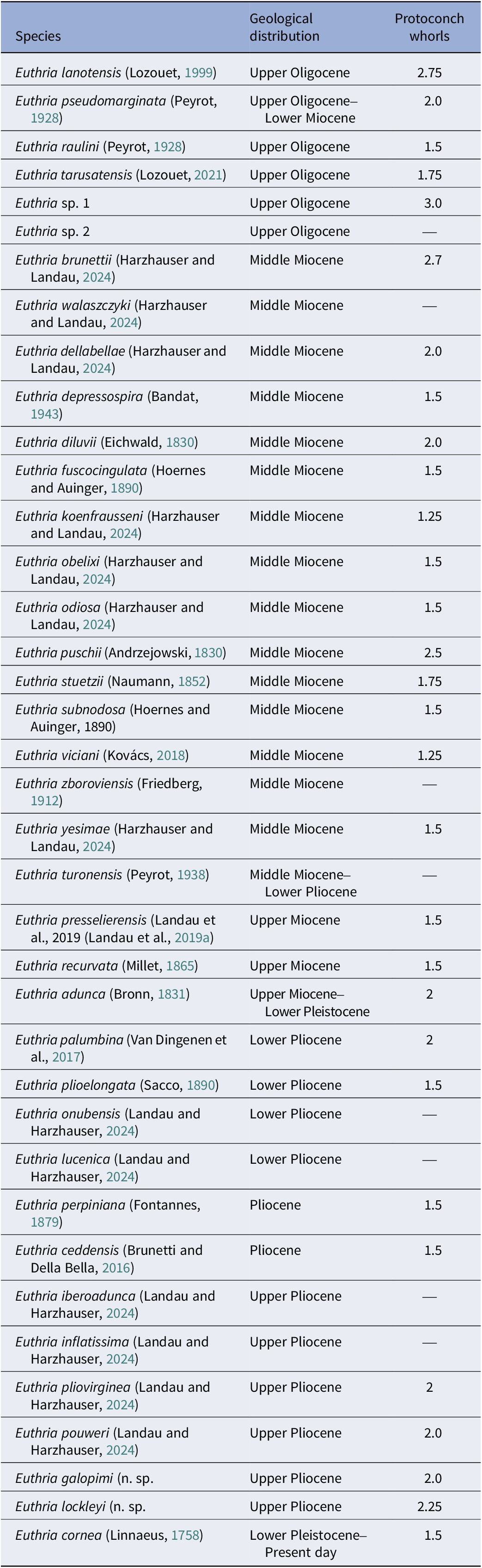
Euthria species documented in the European Neogene fossil record have recently been the subject of comprehensive reviews with protoconch data and, in some cases, illustrations (Lozouet, Reference Lozouet1999, Reference Lozouet2021; Van Dingenen et al., Reference Van Dingenen, Ceulemans and Landau2017; Landau et al., Reference Landau, Ceulemans and Van Dingenen2019a; Harzhauser and Landau, Reference Harzhauser and Landau2024; Landau and Harzhauser, Reference Landau and Harzhauser2024; hoc opus: summary Table 1). Among the species investigated, only the French Atlantic E. pseudomarginata Peyrot, Reference Peyrot1928, spanning the upper Oligocene to Lower Miocene of the Aquitaine Basin, the Euthria sp. 1 as identified by Lozouet (Reference Lozouet2021) from the upper Oligocene of the French l’Adour Basin, and E. brunettii Harzhauser and Landau, Reference Harzhauser and Landau2024, originating from the Middle Miocene Paratethys, exhibit shells featuring characteristics suggestive of planktotrophic development, namely, tall multispiral protoconchs with small nuclei.
Euthria species in Oligocene–Pliocene European assemblages that have recently been reviewed and their protoconchs reliably described and/or illustrated, their geological distribution, and number of protoconch whorls. Data from Lozouet (Reference Lozouet1999, Reference Lozouet2021), Van Dingenen et al. (Reference Van Dingenen, Ceulemans and Landau2017), Landau et al. (Reference Landau, Ceulemans and Van Dingenen2019a), Harzhauser and Landau (Reference Harzhauser and Landau2024), Landau and Harzhauser (Reference Landau and Harzhauser2024)

These data suggest that Euthria evolved away from its primitive planktotrophic mode of development no later than the Late Miocene. Similar shifts away from planktotrophy during the Late Miocene to the present are documented in various gastropod genera within European present-day faunas. Landau and Harzhauser (Reference Landau and Harzhauser2024) reported a similar loss of planktotrophy in Aplus De Gregorio, Reference De Gregorio1885 (Buccinoidea, Pisaninae) from the Pliocene to the present, and possibly in Colubraria Schumacher, Reference Schumacher1817/Cumia Bivona e Bernardi, Reference Bivona e Bernardi1838 (Buccinoidea, Colubrariidae), two genera distinguished solely by the presence of paucispiral protoconchs in the latter.
Puillandre et al. (Reference Puillandre, Sysoev, Olivera, Couloux and Bouchet2010) reported a gradual loss of planktotrophy, inferred from protoconch morphology, in the deep-water gastropod genus Bathytoma Harris and Burrows, Reference Harris and Burrows1891 (Conoidea, Borsoniidae) in the western Pacific. Protoconch characteristics varied across time: Eocene Bathytoma species exhibited protoconchs with 3.5–4.5 whorls, Oligocene species had 3.0–3.5 whorls, Pliocene ones showed 3.0 whorls, and contemporary species, now limited to the Indo-Pacific, display protoconchs with 1.5 whorls and a large nucleus. Notably, all but one present-day species exhibits restricted distributions. In the same family Borsoniidae, Landau and Harzhauser (Reference Landau and Harzhauser2022b) documented the loss of planktotrophy in Asthenotoma Harris and Burrows, Reference Harris and Burrows1891 from the Miocene to the Pliocene. Furthermore, Landau et al. (Reference Landau, Harzhauser and Giannuzzi-Savelli2022, p. 161) described a similar trend for Clathromangelia di Monterosato, Reference di Monterosato1884 (Conoidea, Raphitomidae) from the Middle Miocene to present. Within the genera Clavatula s.l. Lamarck, Reference Lamarck1801, Perrona Schumacher, Reference Schumacher1817, and Tomellana Wenz, Reference Wenz and Schindewolf1943 (Conoidea, Clavatulidae), some upper Oligocene (Lozouet, Reference Lozouet2021) and Miocene (Harzhauser et al., Reference Harzhauser, Landau and Janssen2022) species exhibited multispiral protoconchs. Contrastingly, species from the Pliocene to the present showed paucispiral protoconchs (Landau and Harzhauser, Reference Landau and Harzhauser2022a).
Within the Mediterranean Raphitomidae Bellardi, Reference Bellardi1875, Oliverio (Reference Oliverio1996) and Giannuzzi-Savelli et al. (Reference Giannuzzi-Savelli, Pusateri and Bartolini2018) proposed a speciation event during the early Pleistocene, leading to the emergence of species pairs exhibiting either planktotrophic or non-planktotrophic development. Oliverio (Reference Oliverio1996) also identified similar species pairs in gastropod genera such as Alvania Risso, Reference Risso1826, Rissoa Desmarest, Reference Desmarest1814, Vitreolina di Monterosato, Reference di Monterosato1884, Columbella Lamarck, Reference Lamarck1799, Nassarius Duméril, Reference Duméril1805, Mangelia Risso, Reference Risso1826, and Haedropleura Bucquoy, Dautzenberg, and Dollfus, Reference Bucquoy, Dautzenberg and Dollfus1883, suggesting a widespread occurrence of this phenomenon among Mediterranean prosobranchs. He considered the Pleistocene climatic deterioration a potential trigger for this phenomenon. Moreover, Oliverio (Reference Oliverio1996) noted that during phases of low sea level, the isolation of the western and eastern subbasins of the Mediterranean resulted in distinct developments. The gastropods of the western subbasin exhibited higher planktotrophy, while in the eastern subbasin they predominantly displayed non-planktotrophic development. This divergence underscores the impact of historical sea-level fluctuations on the reproductive strategies of Mediterranean prosobranch gastropods.
The presence of such species pairs in Euthria was not identified during this study. However, it is posited that the underlying forces fostering the loss of planktotrophy, whether manifested spatially (as seen in Raphitoma, Alvania, Rissoa, and so on) or chronologically (as observed in Euthria, Aplus, Colubraria, and so on), remain consistent. The isolation of populations, as discussed by Oliverio (Reference Oliverio1996), has occurred multiple times for Paratethyan species, driven by pronounced, geodynamically amplified fluctuations in relative sea levels (Harzhauser and Piller, Reference Harzhauser and Piller2007; Kováč et al., Reference Kováč, Hudáčková, Halásová, Kováčová and Holcová2017). Furthermore, the loss of planktotrophy during the Pliocene correlates with the onset of a global cooling trend (Westerhold et al., Reference Westerhold, Marwan, Drury, Liebrand and Agnini2020), akin to the Pleistocene event described by Oliverio (Reference Oliverio1996). The decline in sea surface temperatures appears to have exerted stress on the larvae of certain gastropods, prompting a shift to a non-planktotrophic mode of development in species of genera such as Asthenotoma, Bathytoma, and Euthria. Concurrently, numerous planktotrophic species became extinct. The limited dispersal capabilities of the non-planktotrophic species ultimately gave rise to endemic radiations among Euthria in the Cape Verde Archipelago (Fraussen and Swinnen, Reference Fraussen and Swinnen2016). This phenomenon is exemplified by the genus Lautoconus di Monterosato, Reference di Monterosato1923, which underwent an extraordinary endemic radiation, boasting nearly 50 species confined exclusively to this southern Macaronesian archipelago. Notably, the species of this genus also adopted non-planktotrophic development as their reproductive strategy (Duda and Rolán, Reference Duda and Rolán2005).
The impact of water temperature on development strategy is commonly referred to as Thorson’s (Reference Thorson1950) rule, which posits that higher latitudes and lower temperatures promote lecithotrophy and larger eggs, while planktotrophic species will thrive in tropical waters. Numerous studies have examined and verified Thorson’s rule for prosobranch gastropods, including works by Thorson (Reference Thorson1950), Picken (Reference Picken1980), Clarke (Reference Clarke1992), Gallardo and Penchazadhe (Reference Gallardo and Penchaszadeh2001), Collin (Reference Collin2003), and Pappalardo et al. (Reference Pappalardo, Rodríguez-Serrano and Fernández2014). However, during the Miocene and Pliocene, the Paratethys, the Mediterranean, and the adjacent Atlantic region were notably situated at lower latitudes, falling outside the traditional scope of Thorson’s rule. Nonetheless, the presumed loss of planktotrophy due to the decline of SSTs in the Central Paratethys and the Mediterranean Sea during this period might have been influenced by similar mechanisms.
Diversity and endemicity in Neogene to Recent Euthria
Today, Euthria is present in the Mediterranean Sea and the eastern Atlantic, extending down to Angola (Schoenherr and Rolán, Reference Schoenherr and Rolán2017), exhibiting a remarkable center of diversity around the Cape Verde Islands, where more than 22 endemic species have been identified (Rolán et al., Reference Rolán, Monteiro and Fraussen2003; Fraussen and Swinnen, Reference Fraussen and Swinnen2016). Endemicity along the West African coast is not as extreme as in the Cape Verde Archipelago, with Euthria annegretae Schroenherr and Rolán, Reference Schoenherr and Rolán2017 from Angola. The realization of the diversity of the genus coupled with local high endemism in present-day faunas has occurred only relatively recently. Rolán (Reference Rolán1987) provided the first comprehensive overview, identifying Euthria cornea (Linnaeus, Reference Linnaeus1758) in the Mediterranean and seven species from the Cape Verde Islands, one left in open nomenclature. Fraussen (Reference Fraussen1999) echoed this assessment, listing the same number of Atlanto-Mediterranean species while introducing six new Western Indo-Pacific species. Subsequent studies have consistently underscored the genus’s highly endemic character in the Cape Verde Archipelago (Rolán et al., Reference Rolán, Monteiro and Fraussen2003; Monteiro and Rolán, Reference Monteiro and Rolán2005; Fraussen and Swinnen, Reference Fraussen and Swinnen2016). In this context, the reason for the presence of only one species in the present-day Mediterranean, Euthria cornea (Linnaeus, Reference Linnaeus1758), exhibiting a remarkable degree of variability in shell morphology remains unclear. This becomes particularly perplexing considering that all fossil and remaining extant species exhibit relatively limited intraspecific variation in shell morphology. Despite being highly variable in shell shape and widely distributed in the Mediterranean, preliminary molecular data on E. cornea do not suggest the presence of more than one species (P. Bouchet, personal communication, 2024).
Today, E. cornea inhabits marine environments of normal salinity at depths ranging from 5 to 30 m, predominantly on rocky substrates. There is no available literature indicating that E. cornea has adapted to successfully exploit alternative habitats, such as muddy, sandy, or brackish environments. This observation is further reinforced by personal accounts (K. Fraussen, personal communication, 2024). It is reported to be a carnivorous scavenger (Syrides, Reference Syrides2019), feeding primarily on polychaetes and gastropods (Taylor, Reference Taylor1987). This species exhibits significant variability; axial sculpture may fade early in ontogeny or strengthen on later whorls with the development of tubercles at the shoulder. Moreover, variation in adult shell shape and size is much more marked than in any of its extant congeners (see Fraussen and Swinnen, Reference Fraussen and Swinnen2016). While certain forms can be attributed to distinct provenances, more frequently, specimens with diverse shapes and color patterns coexist (K. Fraussen, personal communication, 2024). Euthria cornea possesses a protoconch consisting of 1.5 whorls with a bulbous apex characteristic of non-planktotrophic development (Brunetti and Della Bella, Reference Brunetti and Della Bella2016, fig. 4D). Its geological history extends back only to the early Pleistocene, Calabrian. Furthermore, in the Mediterranean and in the Iberian shores of the Gulf of Cadiz, it occurs at the northern limit of its water temperature tolerance range, in the present-day subtropical Mediterranean–Moroccan Province (sensu Raffi et al., Reference Raffi, Stanley and Marasti1985; da Silva and Landau, Reference da Silva and Landau2007), given that Euthria is a relatively thermophilic genus.
Therefore, it is likely that E. cornea evolved from a Mediterranean Pliocene ancestor, and it appears to be the only species to have survived to the present day in the Mediterranean and the adjacent Atlantic coast of southern Portugal. However, the reason E. cornea should have become so abundant, variable, and widespread in that region today is unclear. It is important to emphasize that non-planktotrophic development does not preclude dispersal, yet E. cornea is confined mostly to the northern part of the Mediterranean–Moroccan Province. Nevertheless, as far as we are aware, molecular confirmation that all Mediterranean E. cornea records pertain to a single species is currently lacking.
Similarly, the recognition of both the diversity and the endemicity of the genus in the European fossil record has also emerged rather recently. Brunetti and Della Bella (Reference Brunetti and Della Bella2016) revised the Plio-Pleistocene biodiversity of the genus from Neogene basins of northern Italy, documenting four species from the Pliocene (Euthria perpiniana [Fontannes, Reference Fontannes1879], E. plioelongata [Sacco, Reference Sacco1890], E. ceddensis Brunetti and Della Bella, Reference Brunetti and Della Bella2016, E. adunca [Bronn, Reference Bronn1831]). In the past, many Neogene records of these species have been misassigned to the extant E. cornea, although it has a confirmed geological record dating back only to the early Pleistocene Calabrian, occurring only in the Mediterranean and on the northern shores of the Gulf of Cadiz (Brunetti and Della Bella, Reference Brunetti and Della Bella2016).
In their review of the Atlantic Upper Miocene and Lower Pliocene gastropod fossil record from the Loire Basin in northwestern France, Landau et al. (Reference Landau, Ceulemans and Van Dingenen2019a) reported two Euthria species from the Tortonian Assemblage I of Van Dingenen et al. (Reference Van Dingenen, Ceulemans, Landau and da Silva2015) (Euthria presselierensis Landau, Ceulemans, and Van Dingenen, Reference Landau, Ceulemans and Van Dingenen2019a, and E. recurvata [Millet, 1865]), both exclusive to this assemblage and endemic to the Neogene Ligerian Gulf (sensu Landau et al., Reference Landau, da Silva, Van Dingenen and Ceulemans2020). In addition, they identified two species within the Zanclean Assemblage III (Euthria palumbina Van Dingenen, Ceulemans, and Landau, Reference Van Dingenen, Ceulemans and Landau2017, exclusive to Assemblage III, and E. turonensis Peyrot, Reference Peyrot1938, both endemic to the Ligerian Gulf but the later also known from the Middle Miocene Langhian in the Loire Basin).
Lozouet (Reference Lozouet2021) examined the Buccinoidea from the Atlantic upper Oligocene of southwestern France, revealing a similar level of endemicity. He identified six species documented exclusively from the Chattian Oligocene and the uppermost Chattian and Lower Miocene of the l’Adour Basin (E. lanotensis Lozouet, Reference Lozouet1999, E. pseudomarginata Peyrot, Reference Peyrot1928, E. raulini Peyrot, Reference Peyrot1928, E. tarusatensis Lozouet, Reference Lozouet2021, alongside two species left in open nomenclature).
Revision of Euthria in the Middle Miocene Paratethyan assemblages showed the genus to be not only diverse, represented by 14 species, but also highly endemic, with all species restricted to the Paratethys (Euthria brunettii Harzhauser and Landau, Reference Harzhauser and Landau2024, E. walaszczyki Harzhauser and Landau, Reference Harzhauser and Landau2024, E. dellabellai Harzhauser and Landau, Reference Harzhauser and Landau2024, E. depressospira Bandat, Reference Bandat1943, E. diluvii [Eichwald, Reference Eichwald1830], E. fuscocingulata [Hoernes and Auinger, Reference Hoernes and Auinger1890], E. frausseni Harzhauser and Landau, Reference Harzhauser and Landau2024, E. obelixi Harzhauser and Landau, Reference Harzhauser and Landau2024, E. odiosa Harzhauser and Landau, Reference Harzhauser and Landau2024, E. puschii [Andrzejowski, Reference Andrzejowski1830], E. stuetzii [Naumann, Reference Naumann1852], E. subnodosa [Hoernes and Auinger, Reference Hoernes and Auinger1890], E. viciani Kovács, Reference Kovács2018, and E. zboroviensis Friedberg, Reference Friedberg and i Lódkonogi1912). In the same work, Harzhauser and Landau (Reference Harzhauser and Landau2024) realized that the specimens from the Serravallian Middle Miocene Karaman Basin of Turkey assigned to Euthria curvirostris (de Grateloup, Reference de Grateloup1845) by Landau et al. (Reference Landau, Harzhauser, İslamoğlu and da Silva2013) did not represent that species, but a new endemic one described as E. yesimae Harzhauser and Landau, Reference Harzhauser and Landau2024.
A study of the genus from the westernmost Mediterranean lower Piacenzian Upper Pliocene Estepona Basin assemblages of southern Spain (Landau and Harzhauser, Reference Landau and Harzhauser2024) resulted in similar findings; the genus was diversified and highly endemic, represented by five species (Euthria iberoadunca Landau and Harzhauser, Reference Landau and Harzhauser2024, E. inflatissima Landau and Harzhauser, Reference Landau and Harzhauser2024, E. pliovirginea Landau and Harzhauser, Reference Landau and Harzhauser2024, E. pouweri Landau and Harzhauser, Reference Landau and Harzhauser2024, and one left in open nomenclature). In that paper, the authors also realized that the specimens from the Lower Pliocene Atlantic Guadalquivir Basin of southwestern Spain reported under the name Euthriofusus cf. E. virgineus (de Grateloup, Reference Deshayes1832 [sic]) by Landau et al. (Reference Landau, da Silva and Mayoral2011) do not correspond to Euthria virginea (de Grateloup, Reference de Grateloup1833). Instead, they represent another endemic: Euthria onubensis Landau and Harzhauser, Reference Landau and Harzhauser2024. Similarly, those identified as E. cornea (Linnaeus, Reference Linnaeus1758) also represent an endemic species, E. lucenica Landau and Harzhauser, Reference Landau and Harzhauser2024.
Molluscan endemicity in the Pliocene of Western Iberia
Thus, for each revisited Neogene basin, an endemic assemblage of Euthria species emerged. This prompted the authors to re-evaluate material from the Upper Pliocene (lower Piacenzian) Mondego Basin of Portugal, with an emphasis on the Vale de Freixo fossil assemblage. Unfortunately, gastropod fossils with larger shells are scarce in these deposits. Nonetheless, two Euthria species are represented. Due to the scarcity of material, only one well-preserved specimen of each is so far known, but considering the genus’s morphological traits and biogeographical context discussed earlier, their formal description is crucial as it addresses a gap in knowledge concerning its biodiversity along the Pliocene European Atlantic frontage. The Mondego fossil assemblage is the only Pliocene record known along the European Atlantic coast between the Ligerian Basin in northwestern France (Landau et al., Reference Landau, da Silva, Van Dingenen and Ceulemans2020) and the Guadalquivir Basin of southwestern Spain (Landau et al., Reference Landau, da Silva and Mayoral2011), being paramount for testing the emerging scenario of a diverse yet highly endemic gastropod group in Neogene Atlanto-Mediterranean faunas.
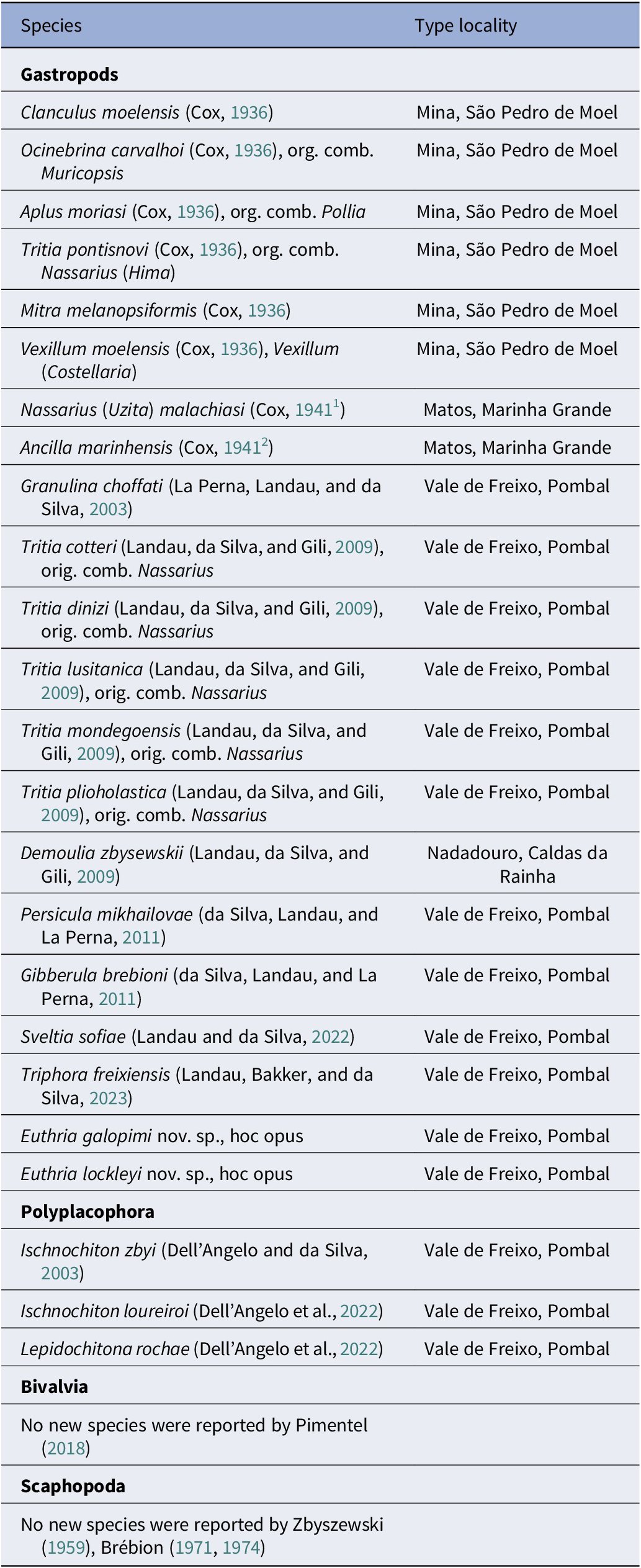
Until recently, few endemic mollusks have been recognized from the Pliocene of the Mondego Basin. In the past century, a handful of new species were described from the localities of Mina, São Pedro de Moel, and Matos, Marinha Grande region by Cox (Reference Cox1936, Reference Cox1941). However, in recent years the revision of various groups has led to the description of new taxa, suggesting that about 12% of the gastropod species are endemic to the Mondego Basin Pliocene and 25% of the Polyplacophora (Table 2).
Molluscan species described as new and known only from the Pliocene of the Mondego Basin fossil assemblages of west-central Portugal, endemics.

1 Considered subjective junior synonym of T. turrita (Borson, Reference Borson1820) by Landau et al. (Reference Landau, da Silva and Gili2009).
2 Considered subjective junior synonym of Amalda elongata (Deshayes, Reference Deshayes1830) by Landau and da Silva (Reference Landau and da Silva2006).
Conclusions
The reexamination of the Euthria gastropods from the Pliocene of West Iberia, from Mondego Basin (Portugal), resulted in two new species being described, both represented by a single, well-preserved specimen. In these specimens, the protoconchs are well preserved, suggesting non-planktotrophic development. The new species are known only from the type locality (i.e., they are, so far, endemic).
These new results are in line with the pattern that has come to light in recent years as the result of the reappraisal of the biodiversity and the biogeography of Neogene Euthria from the Atlanto-Mediterranean region, namely, from the Miocene and Pliocene of the Loire Basin, northwestern France, in the northeastern Atlantic, to the Miocene of the Paratethyan basins, and of the Karaman Basin, Turkey, in the Eastern Proto-Mediterranean, including many other locations along the Atlantic and Mediterranean coasts of Europe. According to this biogeographic scenario, Euthria is a diversified group distributed over an extremely wide geographical area, not only in the Atlanto-Mediterranean region but extending as far as the Indian Ocean and reaching the western Pacific. At the same time, however, locally it displays a high degree of endemicity. In general, using a concept more commonly used in sociology to date, this biogeographical duality could be described as glocal because it simultaneously exhibits contrasting global and more local attributes. In opposition to the wide geographical distribution of the genus, the more localized endemic character of its species, as suggested by the morphology of their protoconchs, is probably related to the mostly non-planktotrophic type of larval development that emerged during the Miocene in the Atlanto-Mediterranean Euthria species.
In the eastern Atlantic, today, the northern limit of Euthria warm-water gastropods extends only as far north as the northern shores of the Gulf of Cadiz, with only one species, Euthria cornea, known to occur in what is now the Mediterranean–Moroccan Molluscan Province. No representatives of the group are known from the colder Franco-Iberian Province to the north, diversifying in the southern tropical Mauritano–Senegalese Province, with an endemic diversity hotspot around Cape Verde. Euthria was well represented in the Late Miocene to Early Pliocene of the Ligerian Gulf of northwestern France (Mio-Pliocene European–West African Province, sensu da Silva and Landau, Reference da Silva and Landau2007) and in the Pliocene of the Mondego Basin of western Iberia (Pliocene French-Iberian Province). None of the Oligo-Pliocene Euthria species represented in the European fossil record have survived to the present day. Only E. cornea, with a fossil record dating back to the early Pleistocene, persists in the Mediterranean and the northern Gulf of Cadiz.
In conclusion, as for other warm-water gastropod groups, as well as for thermophilic bivalves and polyplacophorans, it is now clear that in the Atlantic, the northern distribution limit of the gastropod genus Euthria has experienced a southward shift since at least the Early Pliocene as a consequence of Plio-Pleistocene cooling events that resulted in decreasing SSTs.
Acknowledgments
We thank K. Fraussen of Aarschot, Belgium, for his comments and advice that greatly improved this paper. We thank G.J. Vermeij (University of California) and an anonymous reviewer for their valuable comments and suggestions. This work was partially funded by the Portuguese Fundação para a Ciência e a Tecnologia (FCT) I.P./MCTES through national funds (PIDDAC) – UIDB/50019/2020 (https://doi.org/10.54499/UIDB/50019/2020), UIDP/50019/2020 (https://doi.org/10.54499/UIDP/50019/2020).
Competing interests
The authors declare none.