Introduction
The assessment of quality of life (QOL) following personal injury is becoming increasingly commonplace. It is a component of rehabilitation across a broad spectrum of conditions. For instance, it has found application in persons with spinal cord injury (Wilson, Forchheimer, Heinemann, Warren, & McCullumsmith, Reference Wilson, Forchheimer, Heinemann, Warren and McCullumsmith2016), musculoskeletal injury as well as chronic pain (Schrier, Schrier, Geertzen, & Dijkstra, Reference Schrier, Schrier, Geertzen and Dijkstra2016), hearing impairment (Alamgir et al., Reference Alamgir, Turner, Wong, Cooper, Betancourt, Henry and Packer2016), non-catastrophic motor vehicle accident injury (Gopinath et al., Reference Gopinath, Elbers, Jagnoor, Harris, Nicholas, Casey and Cameron2016) or head injury (Williamson et al., Reference Williamson, Elliott, Bogner, Dreer, Arango-Lasprilla, Kolakowsky-Hayner and Perrin2016). The focus of this paper is on the assessment of QOL in relation to the World Health Organisation's EUROHIS-Quality of Life scale (EUROHIS-QOL) (Schmidt, Muhlan, & Power, Reference Schmidt, Muhlan and Power2005).
The EUROHIS-QOL is an eight-item index that is increasingly being used as a brief measure of QOL in rehabilitation (Athanasou, Reference Athanasou2015; Schiavolin et al., Reference Schiavolin, Quintas, Ferroli, Acerbi, Brock, Cusin and Raggi2015; Snell, Siegert, Surgenor, Dunn, & Hooper, 2016). The measure's popularity has been attributed to its brevity, resulting in substantially lower participant burden, and seemingly favourable psychometric properties, including adequate internal consistency of scores and evidence for convergent and discriminant validity (da Rocha, Power, Bushnell, Fleck, Reference Da Rocha, Power, Bushnell and Fleck2012; Schmidt et al., Reference Schmidt, Muhlan and Power2005; Snell et al., 2016). Despite its ostensible psychometric adequacy, there are some concerns about the EUROHIS-QOL.
A notable concern is the dimensionality of EUROHIS-QOL data, namely whether item responses follow a strictly unidimensional structure or a multifactorial structure consistent with the dominant multidimensional perspective on QOL. Another issue is whether the measurement structure is invariant across key demographic characteristics, such as gender. Absent of measurement equivalence across known groups, the comparison of mean levels of QOL is fraught with interpretational difficulties (i.e., the proverbial comparison of apples with oranges). Yet, another concern is evidence for differential item functioning (DIF) across key demographic characteristics, including gender and age (da Rocha et al., Reference Da Rocha, Power, Bushnell and Fleck2012; Snell et al., 2016).
The purpose of the present study is to further examine the validity of EUROHIS-QOL data in a sample of compensable accident victims following personal injury. We first examine the latent structure of EUROHIS-QOL scores. Competing strictly unidimensional, complex unidimensional, and two-factor models are tested. We also examine the measurement and structural invariance of the retained structure across gender. Finally, we examine latent mean differences in QOL across age, employment status, and psychiatric severity, and extend these analyses to investigate DIF, using multiple-indicator-multiple-causes (MIMIC) models.
Literature and Theoretical Overview
The EUROHIS-QOL is a rapid-form adaptation of the 26-item World Health Organization (WHO) Quality of Life Instrument-Abbreviated Version (WHOQOL-BREF) and 100-item WHOQOL-100. The EUROHIS-QOL contains a subset of the items included in the WHOQOL-BREF and WHOQOL-100, and, in this regard, shares a conceptual basis with these longer form instruments. The instruments are conceptually predicated on the theoretical view of QOL as subjective and multidimensional. QOL is subjective to the extent that it reflects an individual's evaluation of his or her position in life with respect to current needs, goals, and standards. This perspective also posits that QOL is multidimensional, encompassing distinct, but related, physical, psychological, social, and environmental domains (Skevington, Lofty, & O'Connell, Reference Skevington, Lotfy and O'Connell2004). The physical domain refers to individuals’ perceptions of their physical health, including mobility, medication-dependence, energy, quality of sleep, capacity for work, levels of pain, and the ability to perform normal daily activities. The psychological domain involves individuals’ perceptions of their mental well-being, including both cognitive (e.g., levels of concentration and thinking) and affective (e.g., positive and negative feelings) states. The social relationships domain refers to individuals’ perceptions of personal relationships, levels of social support, and sexual activity. The environmental domain involves individuals’ evaluations of salient features of the environment, including financial resources, accessibility and quality of health care, physical safety and security, quality of the home environment and transport, and participation in and opportunities for recreational activities.
The EUROHIS-QOL provides coverage of the content domain of QOL in line with this dominant multidimensionality perspective. For instance, Items 3 and 4 are designed to measure perceptions of energy and the ability to perform daily activities, respectively, which constitute, in part, the physical QOL domain. Item 5 is intended to measure self-esteem as a core facet of psychological QOL, and Item 6 is intended to measure satisfaction with personal relationships, partially reflecting the social relationships domain. Two items (viz., Items 7 and 8) are designed to index the financial resources and home environment facets, respectively, of the environmental QOL domain. Although the EUROHIS-QOL only provides partial coverage of the QOL content domain, it adheres to the multidimensional perspective espoused by dominant theoretical views on QOL. In addition to indexing the four domain-specific dimensions, similar to the WHOQOL-BREF, the EUROHIS-QOL includes two items (viz., Items 1 and 2) that measure general or global QOL.
Although the EUROHIS-QOL is inherently predicated on a multidimensional perspective, the instrument was designed to yield only a general QOL factor. Indeed, the espoused method of scoring the instrument, in which item scores are aggregated to form a single QOL index, assumes a strictly unidimensional structure. However, extant evidence is largely inconsistent with strict unidimensionality of the scores. For instance, Snell et al. (2016) reported that a strictly unidimensional structure did not fit the EUROHIS-QOL data in a sample of patients following joint replacement surgery. Similarly, Schmidt et al. (Reference Schmidt, Muhlan and Power2005) found that a strictly unidimensional structure provided an unacceptable fit to EUROHIS-QOL data collected across 10 countries, and da Rocha et al. (Reference Da Rocha, Power, Bushnell and Fleck2012) found no support for strict unidimensionality of the data across six countries.
Absent of evidence for strict unidimensionality, measurement models positing the multidimensionality of EUROHIS-QOL data have been examined. For example, Snell et al. (2016) found support for a correlated two-factor structure with distinct (a) general health and functioning and (b) psychosocial well-being dimensions of QOL. da Rocha et al. (Reference Da Rocha, Power, Bushnell and Fleck2012) reported a well-fitting one-factor structure, with seven correlated uniquenesses specified ex post facto, which is suggestive of multidimensionality. Although the theoretical rationale for these correlated uniquenesses was not fully elaborated by da Rocha et al., some of these parameters may be theoretically meaningful.
In the construction of the EUROHIS-QOL, items were chosen to represent all domains as per the multidimensional perspective on QOL. However, some domains were represented by two items (i.e., physical and environmental) whereas others were represented by single items (i.e., psychological, social). Items from the same domain are likely to have higher correlations than items from different domains over and above correlations that can be accounted for by the general QOL factor (Perera, Reference Perera2015a). In a one-factor model, this systematic residual covariation can only be expressed through correlated uniquenesses. For instance, the correlated uniqueness between Items 3 and 4, measuring energy and activity, respectively, may reflect systematic residual covariation attributable to the unmodelled physical domain. Likewise, the correlated uniqueness between Items 7 and 8, measuring finances and home environment, respectively, may reflect systematic covariation beyond the general QOL factor due to the unmodelled environmental domain. Although this construct-relevant multidimensionality should almost always be modelled via substantive factors, with only two items for the physical and environmental constructs, a model with these two substantive factors in addition to the general QOL dimension would be under-identified. Thus, in the present study, we continue to model this construct-relevant multidimensionality via correlated uniquenesses to facilitate the appropriate decomposition of item variance. Taken together, the evidence reviewed herein suggests that a comparison of unidimensional, correlated two-factor, and complex one-factor – with two correlated uniquenesses representing construct-relevant multidimensionality-models will be important in clarifying the latent structure of the EUROHIS-QOL data.
Another model that may be an appropriate representation of the EUROHIS-QOL data is the complex one-factor model, accounting for construct-relevant multidimensionality, with additional correlated uniquenesses accounting for parallel item wording effects. Across five items (i.e., Items 2, 4, 5, 6, and 8), item stems are near-identical (viz., “How satisfied are you with. . .?”), potentially generating a construct-irrelevant, yet systematic, source of covariance in the items. This construct-irrelevant multidimensionality should be distinguished from the construct-relevant multidimensionality illuminated above to the extent that the former concerns non-substantive sources of systematic variance (Morin, Arens, & Marsh, Reference Morin, Arens and Marsh2015). To account for this expected methodological artefact due to the parallel wording effects, we specified a further 10 correlated uniquenesses involving these items.
QOL is related to a range of factors including sex, age, employment, and psychological difficulties. Findings regarding sex effects in QOL are somewhat equivocal. Although some studies have reported sex differences in QOL (Rollero, Gattino, & de Piccoli, Reference Rollero, Gattino and De Piccoli2014), including in specific conditions, such as cardiac disease (Emery et al., Reference Emery, Frid, Engebretson, Alonzo, Fish, Ferketch and Stern2004) and diabetes (Unden et al., Reference Unden, Elofsson, Andreasson, Hillered, Eriksson and Brismar2008), other studies have reported null effects of sex (Hagedoorn, Buunk, Kuijer, Wobbes, & Sanderman, Reference Hagedoorn, Buunk, Kuijer, Wobbes and Sanderman2000; Skevington, Reference Skevington2010). Cherepanov, Palta, Fryback, and Robert (Reference Cherepanov, Palta, Fryback and Robert2010) argued that these inconsistencies reflected demographic and economic differences and pointed out that most studies control for sex rather than study it as an independent variable. Furthermore, Perera, Izadikhah, O'Connor, and McIlveen (Reference Perera, Izadikhah, O'Connor and McIlveen2016) note that most studies of gender differences in QOL are based on manifest variable analytic methods (e.g., t-tests). These methods assume, but cannot test for, the strict invariance of item responses across gender. Absent of strict invariance, mean differences across gender are largely unintelligible. In the present study, we examine gender differences in QOL in the context of examining the measurement and structural invariance of responses.
For age, although recent evidence is suggestive of no significant effects on QOL (Fassio, Rollero, & Piccoli, Reference Fassio, Rollero and Piccoli2012; Tartaglia, Reference Tartaglia2013), this may be due to the almost exclusive examination of linear age effects. Yet, a number of developmental theories posit non-linear change in conceptually analogous constructs, such as well-being and satisfaction, across the lifespan (Brim & Kagan, Reference Brim and Kagan1980; Super Reference Super1980). In line with this view, there is evidence for a U-shaped association between age and QOL (Perera et al., Reference Perera, Izadikhah, O'Connor and McIlveen2016) as well as closely related constructs, including well-being (Blanchflower & Oswald, Reference Blanchflower and Oswald2008), characterized by a mid-life nadir. This nadir may be explained in terms of unmet aspirations (Schwandt, Reference Schwandt2016), conflict between the family and work domains (Frone, Russell, & Cooper, Reference Frone, Russell and Cooper1997), and the management of emotion experience inherent in successful ageing (Perera et al., Reference Perera, Izadikhah, O'Connor and McIlveen2016). In the present study, we test for linear and quadratic effects of age on QOL.
Finally, employment status and psychiatric difficulties are also implicated in QOL. Well-being, which is conceptually related to QOL, has been related to employment status in retrospective studies (Kauhanen & Natti, Reference Kauhanen and Natti2015) and, as expected, is inversely associated with unemployment (Sirgy, Reference Sirgy2012). In the current study, we examine differences in QOL across employed clients, those not employed post-accident, and those reporting returning to work post-accident but not currently working. For psychiatric difficulties, a link with QOL is conceptually plausible insofar as many of the symptoms of distress (e.g., fatigue, insomnia, concentration problems, psychomotor agitation, and negative feelings), or the absence thereof, constitute part of the content domain of QOL. This is underpinned by considerable evidence showing moderate-to-strong negative relations of QOL with psychological difficulties across diverse patient samples (see van Leeuwen, Kraaijeveld, Lindeman, & Post, Reference Van Leeuwen, Kraaijeveld, Lindeman and Post2012). In the present study, we test differences in QOL across patients with major, minor, and no reportable psychiatric difficulties.
Aims of the Study
In summary, the present study seeks to examine the validity of the EUROHIS-QOL data in a sample of compensable accident victims following personal injury. First, the latent structure of the EUROHIS-QOL scores is examined. Strictly unidimensional, complex unidimensional, and two-factor models are tested. The measurement and structural invariance of the retained structure across gender are also examined. In addition, we examine latent mean differences in QOL across age, employment status, and psychiatric severity. These latter analyses are extended to investigate DIF, using MIMIC models.
Method
Participants
The sample comprised 251 referrals (32.4% female) who were aged from 18 to 64 years (M = 39.1, SD = 11.1). The cases comprised 45% motor vehicle accidents (all percentages rounded), 33% work-related injuries, and 22% general liability claims (e.g., medical negligence). The time since the personal injury ranged from 1 to 33 years (median = 3 years).
Some 31% had not been admitted to hospital whereas around 62% had undergone surgery or been admitted to hospital for other treatment (6%). The breakdown of the major injuries using the official Australian Bureau of Statistics (2008) categorization was <1% chronic or recurring pain that restricts everyday activities, 2% disfigurement or deformity, 10% head injury, 6% incomplete use of arms or fingers, 3% incomplete use of legs, 2% loss of sight, 7% nervous or emotional conditions, 67% general restriction in physical activities or physical work, and 2% treatment for other long-term conditions. Just over one-third had a disc injury (36%) and 8% had a whiplash injury. No psychiatric problems were identified in 37% of the group but 24% had a minor adjustment problem and 39% had a major psychiatric issue. In some instances, these were co-morbid conditions.
The average level of years completed in school was 10.7 years (students in Australia are permitted to leave school in Year 10). Just under half (48%) had no formal post-school qualification; more than one-third had a trade certificate (35%); 7% had the equivalent of a community college diploma; and around 10% had a degree. The participants comprised 73 who had never worked, 66 who had worked following the accident but were not currently working, and 112 who had returned to work and were working at the time of assessment.
The majority of the referrals were from city areas (73%), and this is in keeping with the general distribution of the population. Around one-fifth (19%) were from areas of high employment but most (50%) were from areas with quite low employment.
Instrument
The EUROHIS-QOL was administered as part of a vocational assessment for economic loss. The instrument comprises eight items, responded to on a five-point Likert-type scale, with varying response anchors. In most instances, it was administered orally and the patient pointed to the response category. Despite its brevity, the Cronbach alpha for the eight-item scale score in this study was 0.83. Other item statistics (e.g., item inter-correlations) and a complete confidential dataset are available from the author upon request.
Procedure
Participants were referred for a vocational assessment as part of the medico-legal evaluation of a compensable claim. In almost all instances, there was greater than 10% whole person impairment, as this is the statutory threshold for claims. Participants underwent an assessment that comprised a structured educational, vocational, social, and medical history. This was accompanied by physical assessments (e.g., grip strength, back-leg-pull strength, manual dexterity), a mental status assessment, literacy, aptitude assessment where required and vocational interest assessment. Consent forms were completed prior to the interview and the patient's understanding was confirmed before the interview proceeded.
Data Analyses
Statistical analyses were conducted in three phases. First, confirmatory factor analyses of the EUROHIS-QOL data were performed: (a) the strictly unidimensional model was characterized by all items loading onto a single QOL factor; (b) the two-factor model was specified in line with Snell et al. (2016), with Item 1 to 5 specified to load on a general functioning factor, Item 5 to 8 specified to load onto a psychosocial well-being factor, and the correlation between the general health and psychosocial well-being factors freely estimated; (c) for the one-factor model accounting for construct-relevant psychometric multidimensionality, all items were specified to load onto a single QOL dimension (furthermore, correlated residuals were specified between Items 3 and 4 and Items 7 and 8); and (d) finally, for the one-factor model accounting for both construct relevant and irrelevant (i.e., method artefacts) multidimensionality, as per the previous specification, all items were specified to load onto the QOL factor with correlated residuals specified between Items 3 and 4 and Items 7 and 8 (in addition, correlated residuals were specified amongst Items 2, 4, 5, 6, and 8 to account for the proposed parallel item wording effects).
The second phase of the analysis involved multiple-group (MG) tests of full measurement and structural invariance across gender, based on the model retained in the first phase of the study. The MG tests were conducted in line with Millsap and Tein's (Reference Millsap and Yun-Tein2004) taxonomy of invariance tests for models based on ordered polytomous data (see Perera, Reference Perera2015b; Perera & Ganguly, Reference Perera and Ganguly2016). This taxonomy of invariance tests includes the sequential testing of configural invariance, and the invariance of item factor loadings, thresholds, uniquenesses, factor variance (and covariances), and factor means (Perera, McIlveen, Burton, & Corser, Reference Perera, McIlveen, Burton and Corser2015).
The final phase of the analysis involved tests of latent mean differences across age, including both linear and quadratic terms, employment status, and psychiatric status. These analyses were conducted in a MIMIC framework, which should be preferred over MG modelling for between-group comparisons where group sample sizes are small (Perera, Reference Perera2015b). As there was no meaningful zero value for the observed range of values for age, the variable was centred on its grand mean. The MIMIC modelling involved the specification of two models as follows: (a) a structurally saturated model with paths from L-age, Q-age, employment status (operationalized as two dummy coded variables with ‘unemployed’ as the baseline category), and psychiatric status (operationalized as two dummy coded variables with ‘no psychiatric problems’ as the baseline category) to all item indicators but not the latent variables; (b) a threshold-invariant model with paths from the covariates to the latent variables but not indicators. No appreciable degradation in the fit of the threshold invariant model against the saturated model is indicative of support for the invariance of item thresholds. Thus, mean differences can be interpreted as attributable to differences on the latent means and not DIF.
Analyses were conducted using Mplus 7.4 (Muthén & Muthén, Reference Muthén and Muthén1998–2015). All solutions were estimated using robust diagonal weighted least squares, with a mean-and-variance-adjusted test statistic, operationalized as the WLSMV estimator in Mplus. Model fit assessment was inclusive and involved the evaluation of fit indices, parameter estimates, alternative models, and parameters estimates. As the χ 2 can be oversensitive to minor model misspecifications given even moderate-sized samples and contains a restrictive hypothesis test (i.e., exact fit), three approximate fit indices were considered: RMSEA < 0.050 and 0.080 for close and reasonable fit; Comparative fit index (CFI) and Tucker–Lewis Index (TLI) > 0.900 and 0.950 for acceptable and excellent fit, respectively (Marsh, Hau, & Wen, Reference Marsh, Hau and Wen2004). For nested model comparisons, because the adjusted χ 2 difference (MD Δχ 2) test appropriate for the WLSMV estimator also tends to be sensitive to even trivial differences, changes in the CFI (ΔCFI) and RMSEA (ΔRMSEA) were primarily used. A decrease in the CFI and increase in the RMSEA of less than 0.010 and 0.015, respectively, are indicative of support for a more restrictive model (Chen, Reference Chen2007; Cheung & Rensvold, Reference Cheung and Rensvold2002).
Results
Latent Structure
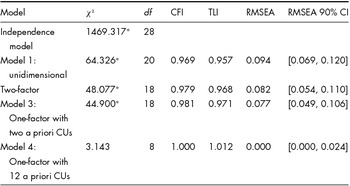
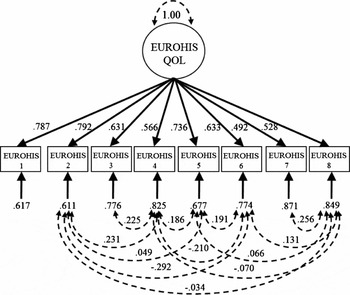
Table 1 shows the results of the tests of the measurement structures. The test of the strictly unidimensional and two-factor structures yielded mixed fit indices. Although the CFI and TLI were indicative of good fit, the RMSEA exceeded the commonly used cut-off of 0.080 for inferring reasonable fit. The one-factor model with two a priori correlated uniqueness provided a reasonable-to-good fit to the data. The one-factor model with 12 correlated uniquenesses provided a perfect fit to the data, and, notably, an appreciable improvement in fit relative to the three alternative structures. Parameter estimates from this retained model are shown in Figure 1. The single QOL dimension was well-defined with largely moderate to strong item loadings (λ = 0.492–0.792, M = 0.646). Notably, seven of the 12 a priori correlated uniquenesses were non-trivial and significant, including the two correlated residuals representing construct-relevant multidimensionality due to the presence of unmodelled QOL subdomains.
Model Fit Indices for the Competing Measurement Models

Note: N = 251. df = degrees of freedom; CFI = comparative fit index; TLI = Tucker–Lewis index; RMSEA = root-mean-square error of approximation; 90% CI = 90% confidence interval for the RMSEA. *p < 0.001.
The retained one-factor model with correlated uniquenesses representing construct relevant and irrelevant multidimensionality.

Gender Invariance
For the conduct of the multi-group gender invariance tests, responses to two EUROHIS-QOL items (i.e., item 3 and item4) had to be collapsed from their original five-category response scales into four categories, as cross-tabulations revealed empty cells for these items involving the highest category of response (Perera, Reference Perera2015b). Models based on ordered polytomous data, estimated under WLSMV, require the same number of response categories over subgroups for the computation of polychoric correlations. To ensure that no results were biased as a result of this recoding, we replicated all results with items 3 and 10 recoded. However, only the multi-group gender invariance tests are based on the recoded items as reported here.
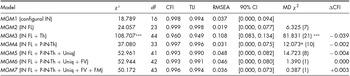
Table 2 shows the fit statistics for the gender invariance models. The configural invariance model provided an excellent fit to the data. This baseline model was compared to the more parsimonious model of weak invariance in which item loadings were constrained to equality across the male and female subgroups. The test of this model resulted in an excellent fit to the data in absolute terms, and notably, no decrement in fit relative to the configural model. Interestingly, the TLI and RMSEA increased and decreased, respectively, suggesting that the gain in parsimony via the imposition of equality constraints on the loadings outweighs any loss in fit. The weak invariance model was then compared to a model of strong invariance with additional equality constraints imposed on the item thresholds. This more restrictive model provided a poor fit to the data in absolute terms and, relative to the weak invariance model, showed an appreciable degradation in fit, suggesting threshold non-invariance.
Fit Statistics for the Multiple-Group Models of Gender Invariance

Note: ***p < 0.01 df = degrees of freedom; MD χ 2 = change in χ 2 relative to a more complex model computed using the Mplus DIFFTEST function; ΔCFI = change in comparative fit index; MGM = multiple-group model; IN = invariance; P-IN = partial invariance; FL = factor loadings; Th = Thresholds; Uniq = uniquenesses. aThe nested model comparison is between MGM4 and MGM2.
Given this evidence for threshold non-invariance, or monotonic DIF, we conducted tests of partial threshold invariance (Byrne, Shavelson, & Muthén, Reference Byrne, Shavelson and Muthén1989). Based on ex post facto modification indices, we identified 11 thresholds across five items that contributed most to model misfit, and freed these parameters in a stepwise fashion. The test of the final partial threshold-invariance model resulted in an excellent fit to the data and no statistically significant decrement in fit relative to the weak factorial invariance model. At the same absolute level of the QOL dimension, all thresholds for Item 3, thresholds 2 and 3 for Item 4, and the first two thresholds for Item 5 were systematically higher in females than males. Contrariwise, the final threshold for Item 6 and thresholds 2, 3, and 4 for Item 7 were systematically higher in males than females. With evidence of partial threshold invariance, we tested a model of strict invariance with additional equality constraints imposed on the item uniquenesses. The test of this model resulted in an excellent fit to the data and no significant degradation in fit relative to the partially invariant threshold model. Furthermore, evidence was obtained for the invariance of the factor variance and factor mean across gender (see Table 2).
Latent Mean Differences over Age, Employment Status, and Psychiatric Severity
Latent mean differences in QOL and threshold invariance across L-age, Q-age, employment status, and psychiatric severity were examined in MIMIC models. The test of the saturated model resulted in an exact fit to the data, χ 2 (8) = 7.839, p = 0.449, CFI = 1.000, TLI = 1.001, RMSEA = 0.000 (0.000, 0.073). The threshold-invariant model provided an acceptable fit to the data, χ 2 (50) = 93.854, p < 0.001, CFI = 0.967, TLI = 0.949, RMSEA = 0.059 (0.040, 0.077); however, the model fitted the data appreciably worse than the saturated model, MD χ 2 (42) = 85.589, p < 0.001, indicating the presence of threshold non-invariance. Based on ex post facto modification indices, we identified five direct effects of the covariates on item indicators that contributed most to model misfit, suggesting monotonic DIF, and freed these parameters in a step-wise manner. At the same level of the latent trait, thresholds for Item 4 were systematically higher, and thresholds for items 6 and 7 were systematically lower, as a function of increasing age. Thresholds for item 7 were also systematically higher for clients who reported retuning to work post-accident but not currently working relative to those who reported not working at all. Thresholds for Item 7 were systematically lower for participants currently working as compared with those who reported not working at all post-accident. The test of the final partially threshold-invariance MIMIC model resulted in a perfect fit to the data, χ 2 (45) = 43.799, p = 0.523, CFI = 0.1.000, TLI = 1.002, RMSEA = 0.000 (0.000, 0.040), and, notably, no significant decrement in fit relative to the saturated model, MD χ 2 (37) = 35.939, p = 0.518.
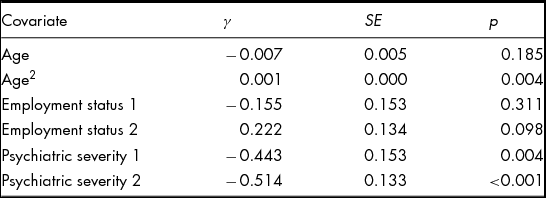
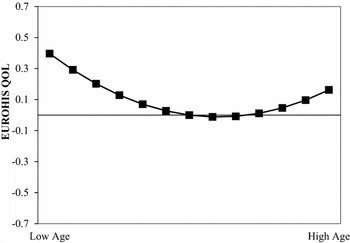
Table 3 shows parameter estimates from the retained partial threshold-invariance MIMIC model. Although there was no significant linear effect of age, a significant quadratic age effect was found. The curvilinear association is shown in Figure 2. Consistent with expectations, a curvilinear U-shaped change in QOL was observed as a function of increasing age, with initial decreases in QOL, up to the lowest level at approximately 42 years, followed by increases in QOL. In addition, significant effects of psychiatric severity on QOL were obtained, such that clients with both minor and major psychiatric problems reported lower QOL than those with no psychiatric problems. For employment status, a marginally significant effect was obtained, such that clients currently employed scored higher on QOL than those not working post-accident. Clients reporting returning to work post-accident but not currently working did not significantly differ on QOL as compared with those who had not worked at all post-accident.
Parameter Estimates from the Retained Partial Threshold Invariance MIMIC Model

Note: N = 251; γ = unstandardized effect of covariate on QOL; SE = standard error associated with unstandardized effect; p = p-value.
Plotted curvilinear regression line between age and QOL based on the final partial threshold invariance MIMIC model.

Discussion
The present research has aimed to examine the latent structure of EUROHIS-QOL responses in a sample of compensable accident victims following personal injury. We also tested the full measurement and structural invariance of EUROHIS-QOL scores across gender, and examined latent mean differences in QOL as a function of age, employment status, and psychiatric severity. The findings of the study show that the EUROHIS-QOL data are best represented by a complex one-dimensional structure, with all eight items loadings on a substantive QOL factor and 10 correlated residuals representing construct relevant and irrelevant psychometric multidimensionality in the test item scores. The results of this study also show partial invariance of the EUROHIS-QOL data over gender, with some evidence of DIF. Furthermore, evidence was obtained for significant effects of age and psychiatric severity on QOL and marginally significant effects of employment status.
The complex one-factor model supported in the present study accommodates the general QOL factor posited to underlie the EUROHIS-QOL as well as additional sources of multidimensionality. Conceptually, the complex one-factor model suggests that there is a dominant QOL factor underlying the data as has previously been found with the EUROHIS-QOL as well as data obtained from theoretically congruous measures, such as the WHOQOL-BREF (Perera et al., Reference Perera, Izadikhah, O'Connor and McIlveen2016). In addition to this dominant QOL factor, the complex one-factor model indicates that there are multiple sources of construct relevant and irrelevant multidimensionality underlying the data. The first source of psychometric multidimensionality reflects systematic covariation in the items due to the presence of physical and environmental domains of QOL beyond the general QOL factor. As these dimensions are construct-relevant, it is nearly always better to model them as substantive factors in, for instance, a bifactor model. Indeed, Perera et al. (Reference Perera, Izadikhah, O'Connor and McIlveen2016) found support for a bifactor model with one general QOL factor and four specific factors, corresponding to the subdimensions of QOL based on the WHOQOL-BREF data. However, with only two items for each of the physical and environmental domains, these substantive factors would be under-identified in the bifactor model.
The second source of psychometric multidimensionality is construct irrelevant. This multidimensionality is attributable to the presence of parallel wording amongst five items, generating systematic covariation amongst the items above and beyond the general QOL factor. The specification of correlated uniquenesses is much more suited to accounting for item wording effects than substantive factors (Morin et al., Reference Morin, Arens and Marsh2015). Nevertheless, in the present study, the specification of correlated uniquenesses to control for both item wording effects and substantive factors allowed for the appropriate partitioning of construct-relevant and irrelevant item variance. Indeed, though eschewed in the methodological literature (Schweizer, Reference Schweizer2012), the use of correlated uniquenesses to partial out the influence of item wording effects and control for the presence of substantive factors given insufficient item indicators for factor identification minimizes confounding of variance attributable to the substantive QOL factor with variance from other sources. The construct relevant and irrelevant sources of psychometric multidimensionality identified are the reason why strict unidimensionality of the EUROHIS-QOL data has not been supported in prior work as was the case in the present research.
MG tests of the invariance of the complex one-factor solution across gender supported partial measurement equivalence. Support was found for the invariance of factor loadings, suggesting that the extent to which the EUROHIS-QOL items reflect the QOL factor is comparable across gender. However, tests of the invariance of item thresholds revealed non-invariance for a number of parameters. Eleven thresholds across five items were found to be non-invariant, which is suggestive of monotonic DIF. At equivalent levels of the QOL dimensions, Items 3, 4, and 5 were found to be systematically more difficult for females than males. Items 6 and 7 were found to be systematically more difficult for males than females. The gender DIF reported herein is more prevalent than that found in the previous work on the EUROHIS-QOL (see e.g., da Rocha et al., Reference Da Rocha, Power, Bushnell and Fleck2012; Schmidt et al., Reference Schmidt, Muhlan and Power2005). Nevertheless, the results suggest that gender influences how individuals respond to items, irrespective of their underlying levels of the latent trait, which has been found with the WHOQOL family of instruments (Krägeloh et al., Reference Krägeloh, Kersten, Billington, Hsu, Shepherd, Landon and Feng2013). On the basis of the partially invariance measurement structure, support was found for the equivalence of the factor variance and mean across gender. The invariance of factor means across gender converges with previous evidence indicating no substantive gender differences in QOL. However, as the equivalence of item thresholds is an important pre-requisite to valid mean comparisons at a latent level, we urge caution in the interpretation of these results given the findings of some non-invariant threshold parameters.
Evidence for threshold non-invariance was also found in the MIMIC models of age, psychiatric severity, and employment status effects. Specifically, four items were found to function differently across age and one item across employment status, holding levels of QOL constant. Comparable findings of DIF have been observed in previous studies (da Rocha et al., Reference Da Rocha, Power, Bushnell and Fleck2012; Schmidt et al., Reference Schmidt, Muhlan and Power2005). On the basis of partial threshold invariance, we proceeded with tests of latent mean differences. Support was found for the effects of age and psychiatric severity on QOL, and a marginally significant effect of employment status. For age, a curvilinear effect on QOL was obtained. This effect is characterized by initial decreases in QOL, reaching the lowest point at approximately 42 years, followed by increasing QOL. The effect converges with the curvilinear age – QOL association obtained in Perera et al. (Reference Perera, Izadikhah, O'Connor and McIlveen2016) based on data drawn from the WHOQOL-BREF. Furthermore, the quadratic age effect converges with several studies yielding evidence for a midlife nadir in measures of life quality and well-being. Several theoretical explanations have been proposed to explain the midlife nadir, such as hedonic adaptation (Frey & Stutzer, Reference Frey and Stutzer2002; Schwandt, Reference Schwandt2016) and the developmental plateau in the lifespan–lifespace theory of development (Super, Reference Super1980).
For psychiatric severity, as expected, clients with major and minor psychiatric problems reported lower QOL than those with no psychiatric concerns. This finding is consistent with previous research showing that QOL consistently negatively associates with psychological distress across community (Chou et al., Reference Chou, Chou, Lin, Su, Ou-Yang, Chien and Chen2004) and patient samples (Engin, Uguz, Yilmaz, Özdemir, & Mevlitoglu, Reference Engin, Uguz, Yilmaz, Özdemir and Mevlitoglu2008; Trompenaars Masthoff, Van Heck, Hodiamont, & De Vries, Reference Trompenaars, Masthoff, Van Heck, Hodiamont and De Vries2005). Finally, for employment status, clients currently working reported marginally higher QOL than those not working post-accident. This finding is consistent with previous research showing positive effects of employment on life quality (Blalock, McDaniel, & Farber, Reference Blalock, Mcdaniel and Farber2002; Fabian, Reference Fabian1992) and has been attributed to greater access to financial resources as well as the social support, daily structure, meaning, and the development of work-based role identity that may emerge from engagement in employment (Jahoda, Reference Jahoda1979, Reference Jahoda1981).
Limitations
We note a few limitations to this research that serve to quality interpretations of the present findings and provide directions for future research. First, though a notable strength of the study is the recruitment of a sample of people with personal injury referred for vocational assessment, the small size of the sample, as well as recruitment from a single practise, limits representativeness of the sample and, by extension, the generalizability of the present results. Future research would do well to examine the replicability of the factor structure and results concerning invariance and DIF in larger and more diverse samples. This replicability analysis is especially important as QOL instruments have been shown to vary across populations (Perera et al., Reference Perera, Izadikhah, O'Connor and McIlveen2016). A second limitation is the use of MIMIC models to investigate latent mean differences in QOL across age, employment status, and psychiatric severity. MIMIC models are typically used to investigate latent mean differences and (DIF) when predictors are continuous, and even in the case where predictors are categorical and sample size is small (Perera, Reference Perera2015b). However, these models assume, but cannot directly test for, the invariance of factor loadings, residual variances, and the factor variance–covariance matrix. Hybrid MG-MIMIC models would foster the assessment of these assumptions but require sizeable samples to ensure sufficient observations in each cell of the MG design.
Recommendations
Notwithstanding these limitations, the findings of the present study have notable implications for researchers and practitioners. The EUROHIS-QOL is an efficient measure of QOL, which is likely to be useful in clinical and research settings with limited test administration time. However, common practises amongst researchers and practitioners of computing total scores should be viewed with some caution in light of the present results. Specifically, as strict unidimensionality was not supported in this study as in previous research, the computation of a total QOL score, via aggregating item scores, would confound variance related to the general QOL factor with the construct-relevant and irrelevant sources of psychometric multidimensionality identified in the item data. Although replication of the complex one-factor structure retained in this study is required before definitive guidelines on scoring or modelling EUROHIS-QOL data are provided, we offer some tentative recommendations. For researchers working with the EUROHIS-QOL, modelling the data in a latent variable framework where the multiple sources of construct relevant and irrelevant multidimensionality can be accounted for provides an elegant analytic solution. For practitioners who typically work with manifest variable methods, if proceeding with the computation of a total EUROHIS-QOL score, it would be worthwhile qualifying client data with the acknowledgement that the EUROHIS-QOL data are inherently multidimensional and discuss implications for reliability and validity emerging from the aggregation of item scores (Perera, Reference Perera2015b). With reference to personal injury assessment, Athanasou noted:
These questionnaires and scales may still be used as a useful standardized approach but reported descriptively instead of using scores. They are brief enough to be able to be summarized in a few key sentences that will provide a more accurate indicator than a score. The approach provides a clinical rather than a psychometric rehabilitation assessment. (2016, p. 48)
Furthermore, evidence for the non-invariance of item thresholds or monotonic DIF across gender limits enthusiasm for measure; however, further study in larger samples from different populations is required to determine whether the gender DIF observed is systematic or idiosyncratic to the present study.
Conclusion
In summary, the current study has made important advances is validating the EUROHIS-QOL data in a sample of compensable accident victims following injury. Yet, there remain some concerns about the measure, which researchers and practitioners should heed in their use of the instrument. The study has shown that EUROHIS-QOL scores are best represented by a complex one-factor structure that statistically accounts for the coexistence of (a) common variation in items due to the underlying QOL factor, (b) construct relevant multidimensionality due to presence of substantive subdimensions of QOL above and beyond the general QOL dimension, and (c) construct irrelevant multidimensionality attributable to item wording effects. The research also demonstrated that the retained measurement structure was partially replicable across gender, with evidence for several non-invariant item thresholds. Furthermore, the research yielded evidence for a U-shaped effect of age on QOL and replicated previous work showing effects of psychiatric severity and employment status on QOL. However, these results should be qualified by the observation that that threshold non-invariance was found for several items as a function of age and employment status.
Funding
This research received no specific grant from any funding agency in the public, commercial, or not-for-profit sectors.
Conflict of Interest
None.