Introduction
Individuals with a non-heterosexual orientation are at increased risk for depression, anxiety, suicidality and substance abuse (Cochran & Mays, Reference Cochran and Mays2000; Sandfort et al. Reference Sandfort, de Graaf, Bijl and Schnabel2001; Cochran et al. Reference Cochran, Sullivan and Mays2003). This increased risk can be attributed to social stigma, discrimination, social exclusion and in some localities, the criminalisation of non-heterosexual behaviours (Meyer, Reference Meyer1995; Otis & Skinner, Reference Otis and Skinner1996; Mays & Cochran, Reference Mays and Cochran2001). These issues increase vulnerability for poor mental health outcomes; particularly at the time individuals begin to disclose a non-heterosexual orientation (Remafedi, Reference Remafedi1999). Other factors attributed to increased mental ill health risk in non-heterosexual populations include exposure to childhood and lifetime sexual/physical abuse or physical assault (Friedman et al. Reference Friedman, Marshal, Guadamuz, Wei, Wong, Saewyc and Stall2011).
Many community-based studies do not differentiate between homosexual and bisexual orientations (Cochran & Mays, Reference Cochran and Mays2000; Sandfort et al. Reference Sandfort, de Graaf, Bijl and Schnabel2001, Reference Sandfort, Bakker, Schellevis and Vanwesenbeeck2006; Cochran et al. Reference Cochran, Sullivan and Mays2003; Chakraborty et al. Reference Chakraborty, McManus, Brugha, Bebbington and King2011; Fredriksen-Goldsen et al. Reference Fredriksen-Goldsen, Emlet, Kim, Muraco, Erosheva, Goldsen and Hoy-Ellis2013; Woodhead et al. Reference Woodhead, Gazard, Hotopf, Rahman, Rimes and Hatch2016). Whilst Jorm et al. (Reference Jorm, Korten, Rodgers, Jacomb and Christensen2002) identified those with a homosexual orientation at slightly elevated risk for mental ill health and poorer wellbeing outcomes than heterosexual respondents, it was those with a bisexual orientation who were at considerably greater risk of poorer mental health outcomes. Similarly, bisexual women have reported poorer mental health and greater psychological distress than lesbians (Colledge et al. Reference Colledge, Hickson, Reid and Weatherburn2015). It may be that the purported adverse effects of non-heterosexual orientation on health outcomes could be driven primarily by those with a bisexual orientation. This increased risk for bisexual people has been attributed to non-acceptant attitudes of bisexual orientation from both heterosexual and homosexual communities, which increases their marginalised social position, leading to relatively lower levels of available social resources (Rosario et al. Reference Rosario, Schrimshaw, Hunter and Braun2006; Hsieh, Reference Hsieh2014). The purported vulnerability for those of a bisexual orientation is not always consistent however. For example, whilst bisexual women were more likely to report suicidal ideation and attempts, this finding was not confirmed amongst bisexual men (Swannell et al. Reference Swannell, Martin and Page2016). In contrast, Pakula & Shoveller (Reference Pakula and Shoveller2013) identified gay and bisexual men at increased risk for poor mental health and wellbeing outcomes, but not for women.
Few studies have examined the long-term risk associated with different non-heterosexual orientations in large population surveys (Ross et al. Reference Ross, Bauer, MacLeod, Robinson, MacKay and Dobinson2014). Many studies utilise data from cross-sectional observational community surveys focus only on either one sex (Koh & Ross, Reference Koh and Ross2006), or on non-heterosexual children and teenagers as they transition into adulthood (Needham, Reference Needham2012). We are unaware of any population studies that have examined the long-term risk of sexual orientation in those with a bisexual orientation on mental health outcomes throughout young and middle adulthood. The current paper therefore seeks to estimate the long-term mental health outcomes associated with non-heterosexual orientation. Using data from the Personality and Total Health (PATH) Through Life Study (Anstey et al. Reference Anstey, Christensen, Butterworth, Easteal, Mackinnon, Jacomb, Maxwell, Rodgers, Windsor, Cherbuin and Jorm2012), we extend earlier analyses of the cross-sectional association with bisexual orientation (Jorm et al. Reference Jorm, Korten, Rodgers, Jacomb and Christensen2002) and examine the long-term risk of baseline sexual orientation on mental health outcomes at 4- and 8-year follow-up. We then consider the degree to which change or stability in sexual orientation is associated with mental health. Previous findings suggest that transitions are periods of increased vulnerability to poor mental ill-health, whilst stable non-heterosexual identities are not (Everett, Reference Everett2015). Owing to the longitudinal design of the PATH study, we are able to quantify the extent transition from baseline sexual orientation is associated with poorer mental health outcomes. Conversely, we can also examine those participants with stable sexual orientation to determine whether those with stable non-heterosexual orientations are at increased risk of poorer mental health outcomes in comparison with those who report stable heterosexual orientation.
Methods
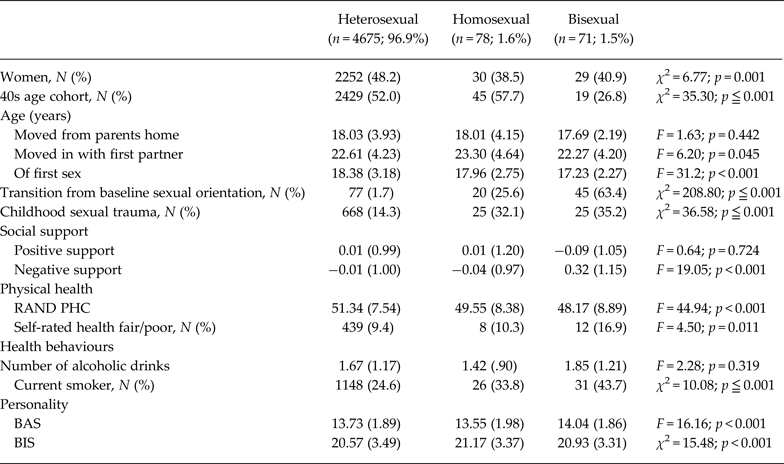
Participants were drawn from the PATH project, a large community survey from Canberra and the neighbouring town of Queanbeyan, Australia, that comprises three narrow age-cohorts aged 20–24, 40–44 and 60–64 at baseline. A full description of the study design has been reported (Anstey et al. Reference Anstey, Christensen, Butterworth, Easteal, Mackinnon, Jacomb, Maxwell, Rodgers, Windsor, Cherbuin and Jorm2012). Briefly, PATH was established in 1999 to describe the health and wellbeing of randomly selected individuals from the electoral rolls; voting is compulsory in Australia. Results presented here concern data from waves 1 to 3 for the youngest and mid-aged adult cohorts, who were aged 20–24 (n = 2353) and 40–44 (n = 2499) years at baseline. Participants were assessed in their own homes and asked to complete a questionnaire under the supervision of a professional interviewer. At each wave, participants received a full description of the study and provided written informed consent. The study was approved by the Human Research Ethics Committee at the Australian National University. Socio-demographic characteristics are detailed in Table 1 and comparison of differences between sexual orientation groups are discussed in the opening section of the ‘Results’ section.
Socio-demographic descriptive statistics by age and gender cohorts at baseline

Measures
Sexual orientation
Sexual orientation was derived from a question, which asked participants which sexual orientation group they identified with: Heterosexual (reference category for analyses), Homosexual and Bisexual. Across the three waves, the prevalence of sexual orientation groups was consistent. Amongst females in the 20s age cohort, between 1.3 and 1.8% were homosexual and between 1.3 and 2.7% were bisexual, whilst for males the prevalence of homosexual orientation ranged from 1.0 to 2.0% and between 0.9 and 1.8% for bisexual orientation. Amongst females in the 40s age cohort, between 2.0 and 2.2% were homosexual and between 0.8 and 1.2% were bisexual, whilst for males the prevalence of homosexual orientation ranged from 1.6 to 2.0% and between 0.8 and 1.5% for bisexual orientation.
Sexual orientation was stable. In the 20s age cohort, 99.5% of heterosexual, 78.0% of homosexual and 56.2% of bisexuals reported stability in their sexual orientation. In the 40s age cohort, 99.4% of heterosexual, 87.6% of homosexual and 81.5% of bisexuals reported stability in their sexual orientation. Baseline sexual orientation was unrelated to attrition.
Mental health
The Goldberg Depression and Anxiety Scale (Goldberg et al. Reference Goldberg, Bridges, Duncan-Jones and Grayson1988) comprises 18 items that list symptoms of depression and anxiety. Participants responded ‘yes’ or ‘no’ to whether they experienced any of these symptoms in the past month/4 weeks. The scale reports high sensitivity to Diagnostic and Statistical Manual of Mental Disorders (DSM) diagnoses of depression and anxiety (Goldberg et al. Reference Goldberg, Bridges, Duncan-Jones and Grayson1988). We computed total scores for these scales to approximate depressive and anxiety symptomology.
Covariates
We adjusted for a number of health, personality, quality of life and demographic variables, which are known to be associated with mental health outcomes and could account for purported associations between sexual orientation and mental health (Cochran & Mays, Reference Cochran and Mays2000; Sandfort et al. Reference Sandfort, de Graaf, Bijl and Schnabel2001; Jorm et al. Reference Jorm, Korten, Rodgers, Jacomb and Christensen2002; Cochran et al. Reference Cochran, Sullivan and Mays2003; Chakraborty et al. Reference Chakraborty, McManus, Brugha, Bebbington and King2011; Woodhead et al. Reference Woodhead, Gazard, Hotopf, Rahman, Rimes and Hatch2016). Several covariates were time-varying, i.e. they were assessed at each measurement occasion, and these included personality, social support, physical health and health behaviours. Personality was controlled for using the BIS–BAS, measure of behavioural activation and inhibition, with total scores for separate BAS and BIS (Carver & White, Reference Carver and White1994). Physical Health was adjusted for using the continuous Short Form-12 Physical Health Component Score that was computed following the RAND scoring (Hays et al. Reference Hays, Sherbourne and Mazel1993), and a binary indicator for Self-Rated Health (Reference: Excellent/Very Good/Good v. Fair/Poor). Health behaviours were adjusted for using indicators of Smoking status (Reference: Not Current Smoker v. Smoker) and Alcohol consumption (centred at 1–2 drinks/day). Social Support was estimated from a factor analysis of the Schuster Social Support Scale (Schuster et al. Reference Schuster, Kessler and Aseltine1990) which assessed family, partner and friend negative and positive support. Two factors were extracted reflecting positive and negative support. A number of covariates did not vary over the study period and related to the experience of important life events, which included age first moved away from the parental home, age first moved in with first partner, and age of first sex. A measure of traumatic life events was also included which asked whether a respondent had ever been sexually molested or raped in their life (Reference: No v. Yes).
Statistical analyses
For our first aim, we implemented a series of generalised estimating equation (GEE) models to examine the longitudinal risk of baseline sexual orientation on mental health outcomes at follow-up, 4 and 8 years post-baseline observation. GEE models extend on the general linear model adjusting for correlated or clustered observations with a robust sandwich variance estimator that provides marginal or population-averaged expectations as a function of model covariates (Liang & Zeger, Reference Liang and Zeger1986). Models were estimated in a hierarchical approach. First, we estimated unadjusted risk for baseline sexual orientation. In a second step, we adjusted for wave of observation, age and gender cohort. In a third step, we adjusted for a range of covariates that included social, demographic, physical health and personality characteristics. For our second aim, we then replicated our second and third steps in our GEE hierarchical approach by introducing a covariate for transition from baseline sexual orientation in order to estimate the effect of transition on mental health risk. For our final aim, we used GEE to examine the long-term mental health risk associated with stable sexual orientation. We report: (1) the unadjusted risk for stable non-heterosexual orientation groups and (2) the risk after adjusting for all covariates. All GEE models were estimated with a Negative Binomial distribution and Logit Link for both Goldberg Depression and Anxiety outcomes. GEE models were estimated with both unstructured and exchangeable working correlation matrices; with no substantial differences in model estimates we report the estimates from the exchangeable working correlation matric. The outcomes are interpreted in terms of an incidence risk ratio (IRR). All continuous covariates were mean-centred to baseline.
Results
Differences in health, health behaviours, personality and life events between sexual orientation groups
Socio-demographic characteristics by sexual orientation are displayed in Table 1. In comparison with those who identified as heterosexual, homosexual respondents moved in with partners at older ages (β = 0.69 (s.e. = 0.31) p = 0.026), and reported higher BIS (β = 0.84 (s.e. = 0.24) p < 0.001) and lower BAS (β = −0.29 (s.e. = 0.13) p = 0.032). Bisexual respondents had first sex at earlier ages (β = −1.15 (s.e. = 0.22) p < 0.001), higher negative support (β = 0.31 (s.e. = 0.07) p < 0.001) and BAS (β = 0.48 (s.e. = 0.14) p = 0.001). Both homosexual and bisexual respondents reported worse physical health (homosexual respondents: β = −1.90 (s.e. = 0.53) p < 0.001; bisexual respondents: β = −3.26 (s.e. = 0.57) p < 0.001). There were smaller proportions of women who reported homosexual (χ 2 = 9.12; p = 0.003) and bisexual (χ 2 = 4.64; p = 0.031) orientation, and smaller proportions of 40s reported a bisexual orientation (χ 2 = 67.38; p < 0.001). In comparison with heterosexual respondents, there were greater proportions of those with either a homosexual or bisexual orientation who reported transition from their baseline sexual orientation (homosexual orientation: χ 2 = 70.26; p < 0.001; bisexual orientation: χ 2 = 347.73; p < 0.001), history of sexual trauma (homosexual orientation: χ 2 = 33.44; p < 0.001; bisexual orientation: χ 2 = 40.35; p < 0.001) poor self-rated health (homosexual orientation: χ 2 = 4.32; p = 0.038; bisexual orientation: χ 2 = 4.79; p = 0.029) smoking (homosexual orientation: χ 2 = 5.44; p = 0.020; bisexual orientation: χ 2 = 14.94; p < 0.001).
Long-term risk of non-heterosexual sexual orientation with mental health and wellbeing outcomes
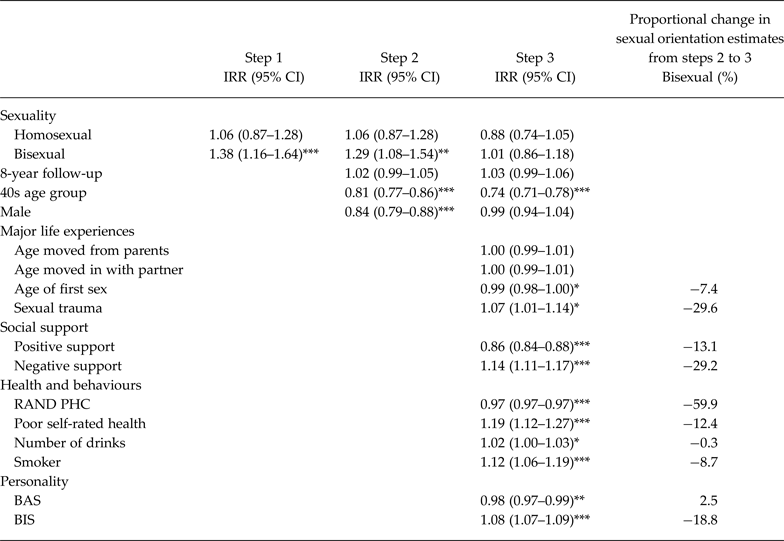
Long-term risk of baseline sexual orientation on mental health outcomes at 4- and 8-year follow-up are reported in Tables 2 and 3. In terms of depression, there was no long-term risk associated with homosexual orientation. A risk for increased number of depressive symptoms was associated with bisexual orientation, which was partially attenuated when adjusted for age and gender and fully attenuated in the fully adjusted model. Age and gender differences were consistently reported with lower depressive symptoms in the older age cohort and amongst males. In the fully adjusted models, effects for age of first sex, sexual trauma and alcohol consumption reported statistically significant effects that only just reached statistical significance (p = 0.05). Given the sample size, we emphasise the stronger risk associated with social support, physical health and smoking status.
Sexual orientation risk for depression
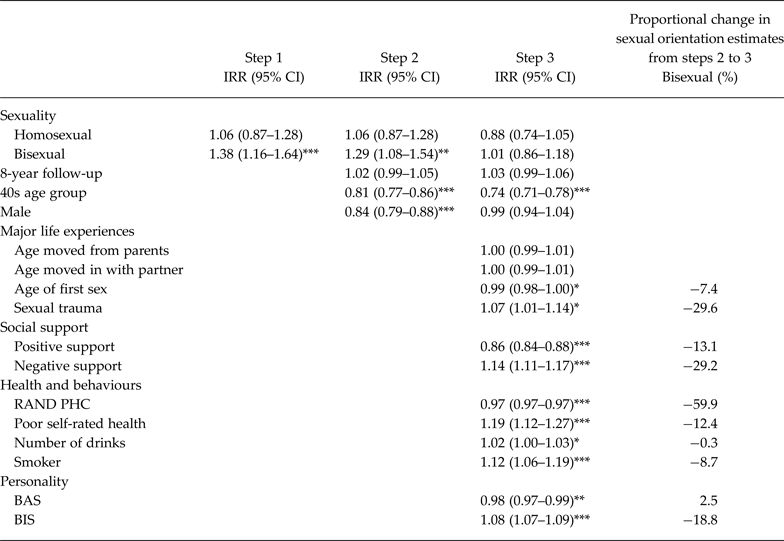
*p < 0.05; **p < 0.01; ***p < 0.001. Step 1 = Sexual Orientation only; Step 2 = Step 1 plus time, sex and age covariates; Step 3 = Step 2 plus Major Life Experiences, Social Support, Health and Behaviours and Personality. RAND PHC: Rand computed physical health component score. Poor Self-Rated Health (Reference: Excellent/Good Self-Rated Health). Smoker (Reference: Current non-smoker). BAS: Behavioural Activation Scale score. BIS: Behavioural Inhibition Scales score. Note: Interactions between baseline sexuality and time, age and gender were not significant.
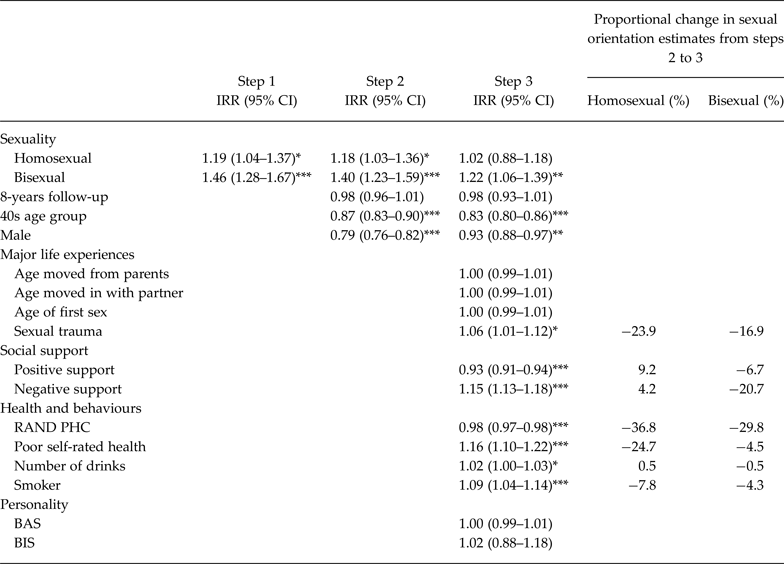
Sexual orientation risk for anxiety

*p < 0.05; **p < 0.01; ***p < 0.001. Step 1 = Sexual Orientation only; Step 2 = Step 1 plus time, sex and age covariates; Step 3 = Step 2 plus Major Life Experiences, Social Support, Health and Behaviours and Personality. RAND PHC: Rand computed physical health component score. Poor Self-Rated Health (Reference: Excellent/Good Self-Rated Health). Smoker (Reference: Current non-smoker). BAS: Behavioural Activation Scale score. BIS: Behavioural Inhibition Scales score.
In terms of anxiety, both homosexual and bisexual orientations were associated with the long-term risk for increased anxiety symptoms. However, the effect for homosexual orientation only just reached statistical significance and was fully attenuated in the fully adjusted model. In contrast, the effect of bisexual orientation on anxiety risk whilst partially attenuated, remained substantive. As with the analysis of depression, age and gender differences were reported, indicating fewer anxiety symptoms in the older age cohort and amongst males, although any gender differences were fully attenuated in the fully adjusted model. As for depression risk, risk of sexual trauma and alcohol consumption again yielded statistically significant effects that only just reached statistical significance (p = 0.05) in the fully adjusted models. Again, we highlight the more substantive risks associated with social support, physical health and smoking status. We note that comparison of the effect sizes between sexual orientation and the covariates suggests that bisexual orientation is still a comparatively significant and substantive driver of anxiety symptoms. No statistically significant interactions between sexual orientation and time, age and gender were reported for either depression or anxiety, suggesting that the effects of sexual orientation were consistent over time, and between age and gender cohorts.
As the covariates attenuated so much of the mental health risk associated with sexual orientation, we examined the extent to which those covariates introduced in step 3, which were significantly related to depression or anxiety, impacted on the sexual orientation estimates reported in step 2. We did this by comparing the unstandardised mental health estimates for each non-heterosexual orientation group in step 2 (adjusted for time, gender and age) with the change in estimate after adjusting each covariate from step 3 separately. The difference was then expressed in terms of % change in the unstandardised mental health estimates reported between steps 2 and 3. For the risk of depression and anxiety associated with bisexual orientation, most of the risk was attenuated by adjusting for physical health, sexual trauma and negative support. For example, physical health accounted for just under a 60% decline in the bisexual orientation risk for depression (see Table 2). These factors similarly accounted for much of the attenuation of anxiety risk for those with a homosexual orientation (see Table 3). Since there was no unadjusted risk of depression for homosexual orientation we did not compute this proportion change for this sexual orientation group in terms of depression.
Impact of sexual orientation transition on mental health risk
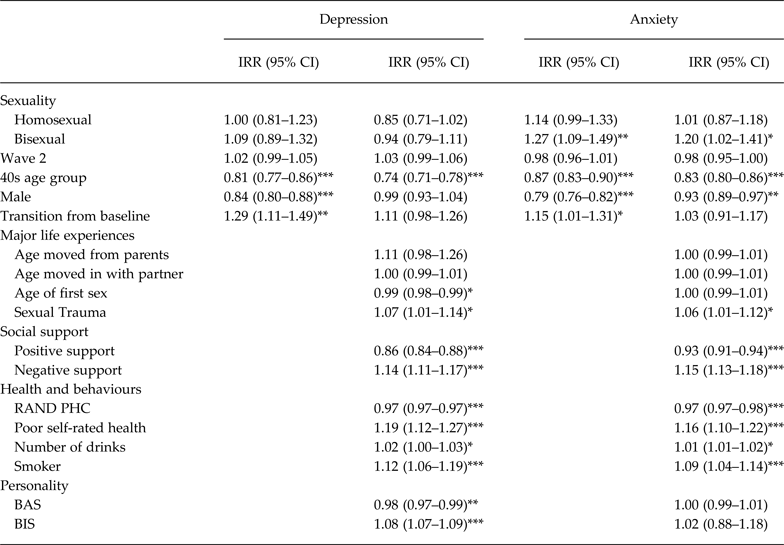
With the longitudinal nature of the PATH dataset, we examined the extent to which reported transition from baseline sexual orientation was associated with risk for depression and anxiety (Table 4). The unadjusted risk of bisexual orientation for depression (see Table 2) was fully attenuated by the experience of a transition (IRR = 1.31 (95% CI 1.13–1.52) p < 0.001). Similarly, the unadjusted risk for anxiety (see Table 3) was fully attenuated for homosexual (IRR = 1.15 (95% CI 0.99–1.33) p = 0.062) and partially attenuated for bisexual orientation (IRR = 1.32 (95% CI 1.13–1.55) p < 0.01). The experience of a transition was itself a notable risk for increased depression (IRR = 1.29 (95% CI 1.11–1.49) p < 0.01) and anxiety (IRR = 1.15 (95% CI 1.01–1.31) p < 0.05) (Table 4). However, risk associated with transition was then fully attenuated in the fully-adjusted models for both depression and anxiety. As with our previous analyses, it was clear that the specific risks of sexual orientation and transition from baseline orientation were again accounted for by poor physical health (increase of 88.2% in estimated risk), negative support (increase of 34.4% in estimated risk) and sexual trauma (increase of 27.4% in estimated risk) which attenuated most of the risk of depression for bisexual orientation, although the impact of positive social support (decline of 61.8% in estimated risk) was also identified as protective for mental health risk. With regards to anxiety, risk associated with homosexual orientation was attenuated by the presence of positive support (decline of 109.2% in estimated risk), but with poor physical health (increase of 78.8% in estimated risk), sexual trauma (increase of 45.1% in estimated risk) and negative support (increase of 37.3% in estimated risk) increasing risk. Less of the risk associated with bisexual orientation was attenuated in the final model for anxiety, but again poor physical health (increase of 16.7% in estimated risk), negative support (increase of 11.1% in estimated risk) and sexual trauma (increase of 7.5% in estimated risk) accounted for most of this attenuation for sexual orientation risk.
Impact of sexual orientation transition on risk of baseline sexual orientation on depression and anxiety

*p < 0.05; **p < 0.01; ***p < 0.001. Step 1 = Sexual Orientation only; Step 2 = Step 1 plus time, sex and age covariates; Step 3 = Step 2 plus Major Life Experiences, Social Support, Health and Behaviours and Personality. RAND PHC: Rand computed physical health component score. Poor Self-Rated Health (Reference: Excellent/Good Self-Rated Health). Smoker (Reference: Current non-smoker). BAS, Behavioural Activation Scale score. BIS, Behavioural Inhibition Scales score. Note: Interactions between baseline sexuality and time, age and gender were not significant.
Differences in mental health risk between stable sexual orientation groups
Finally, we undertook a set of analyses to establish the long-term risk of stable baseline sexual orientation. We did this by comparing the risk for those individuals who reported stable non-heterosexual orientation with those individuals who reported stable heterosexual orientation over the study period. In comparison with those with a stable heterosexual orientation, there was no risk for increased depression for those who reported stable homosexual (IRR = 1.09 (95% CI 0.87–1.38) p = 0.459) or bisexual (IRR = 1.11 (95% CI 0.84–1.47) p = 0.478) orientation. There was a marginal increased risk of anxiety for those who reported both stable homosexual (IRR = 1.22 (95% CI 1.03–1.43) p = 0.021) or bisexual (IRR = 1.34 (95% CI 1.07–1.67) p = 0.011) orientation in comparison with those who reported a stable heterosexual orientation. However, these risks were fully attenuated in the fully-adjusted models. The homosexual orientation risk was attenuated by positive support (decline of 62.8% in estimated risk), poor physical health (increase of 53.3% in estimated risk), sexual trauma (increase of 73.8% in estimated risk) and negative support (increase of 74.2% in estimated risk). Similarly, the bisexual orientation risk was attenuated by positive support (decline of 9.1% in estimated risk), sexual trauma (increase of 11.4% in estimated risk), poor physical health (increase of 8.3% in estimated risk) and negative support (increase of 5.7% in estimated risk).
Discussion
The importance of our study is that it allowed us to estimate the long-term mental health risk of homosexual and bisexual orientation over an 8 year period in early and middle adulthood. In comparison with heterosexual respondents, those with a homosexual orientation were at increased risk for anxiety but not depression, although the risk for anxiety was fully attenuated in fully-adjusted models. Those with a bisexual orientation were at higher risk of both increased depressive and anxiety symptomology, although the risk for depression was fully attenuated in adjusted models. The risk for anxiety amongst those with a bisexual orientation was partially attenuated, with almost half of the unadjusted risk accounted for in the fully-adjusted model. Many population studies that investigate the mental health risk of non-heterosexual orientations amongst young/middle-aged adults, fail to discriminate between homosexual and bisexual orientations (Cochran & Mays, Reference Cochran and Mays2000; Sandfort et al. Reference Sandfort, de Graaf, Bijl and Schnabel2001; Cochran et al. Reference Cochran, Sullivan and Mays2003; Chakraborty et al. Reference Chakraborty, McManus, Brugha, Bebbington and King2011; Woodhead et al. Reference Woodhead, Gazard, Hotopf, Rahman, Rimes and Hatch2016). This is a significant limitation of the literature base since the findings from our study indicated greater risk attributed to a bisexual orientation. Our results are in line with an existing literature base drawn from cross-sectional studies of younger aged adults and amongst school and college-aged (Jorm et al. Reference Jorm, Korten, Rodgers, Jacomb and Christensen2002; Hsieh, Reference Hsieh2014; Colledge et al. Reference Colledge, Hickson, Reid and Weatherburn2015). As with previous studies (Everett, Reference Everett2015), our findings identified transitions as periods of increased vulnerability for poor mental ill-health, whilst stable non-heterosexual identities were not strongly associated with increased mental ill-health risk. The adverse effect of orientation transition was also attenuated by other risk factors.
Our findings emphasise the importance of longitudinal data to estimate long-term mental health risk associated with sexual orientation. Specifically, our findings extend prior cross-sectional associations, which identified a bisexual orientation as at increased risk for poor mental health outcomes (Jorm et al. Reference Jorm, Korten, Rodgers, Jacomb and Christensen2002) and we can conclude that a bisexual orientation remains a long-term risk for increased anxiety in fully conditioned models. One argument that has been proffered to explain this phenomenon is that having neither a clear heterosexual nor homosexual orientation is itself a substantial stressor, increasing risk for poor mental health (Jorm et al. Reference Jorm, Korten, Rodgers, Jacomb and Christensen2002). The capacity to follow a large sample of individuals over several years also permitted us to quantify the extent to which a sexual orientation transition, or conversely stable non-heterosexual orientation, confers risk for poor mental health. The impact of a transition from baseline sexual orientation attenuated most of the risk attributable to baseline sexual orientation and was a substantive risk factor itself although as with the longitudinal risk, the impact of transition was attenuated by other known risk factors. We therefore conclude that all things being equal, there is no long-term risk of anxiety or depression amongst those with a homosexual orientation or depression for those with a bisexual orientation.
There is however a need for qualification relating to our statement of ‘all things being equal’. A number of differences in mental health risk factors were reported between hetero and non-heterosexual orientations. There is a likelihood that things are not equal between those of different sexual orientations. In comparison with those of a heterosexual orientation, participants of a non-heterosexual orientation were more likely to be male, younger, reported earlier age of first sexual encounters, to have experienced some sexual trauma, to have poor physical health, and to be smokers, with worse physical health and health behaviours. These findings are in line with the current literature base (Friedman et al., Reference Friedman, Marshal, Guadamuz, Wei, Wong, Saewyc and Stall2011; Green & Feinstein, Reference Green and Feinstein2012; Woodhead et al. Reference Woodhead, Gazard, Hotopf, Rahman, Rimes and Hatch2016). Importantly, many of these mental health risk factors are, to some extent, modifiable. Unfortunately, the 4-year gap in measurement occasion in the PATH study precludes us from examining the precise impact of negative social support interactions may play in increasing the impact of sexual orientation transition at the period in which they occur. However, factors such as social support and physical health are modifiable and addressing these issues may further reduce the adverse impact of identifying with a non-heterosexual orientation, particularly a bisexual orientation.
We recognise a number of limitations, which need to be considered. Whilst the proportion with a non-heterosexual orientation in PATH is consistent with other population estimates (Cochran & Mays, Reference Cochran and Mays2000; Mays & Cochran, Reference Mays and Cochran2001; Sandfort et al. Reference Sandfort, de Graaf, Bijl and Schnabel2001; Swannell et al. Reference Swannell, Martin and Page2016; Woodhead et al. Reference Woodhead, Gazard, Hotopf, Rahman, Rimes and Hatch2016) this proportion is still very low. However, model estimates for each sexual orientation group consistent in unadjusted and adjusted models suggesting that estimation is robust to the unbalanced group numbers. As a consequence of these low proportions of non-heterosexual orientation, an examination of the experiences of transitions of different sexual orientation group and in the specific wave they occurred is not feasible. This is an important area for future consideration; we note that only 15.3 and 36.7% of those with homosexual and bisexual orientations, respectively, reported a change from their baseline sexual orientation, although most of the change for bisexual orientation was not unsurprisingly reported by the younger 20s cohort. This emphasises the need for further longitudinal studies of adult development to consider sexual orientation as a dynamic set of behaviours and attitudes and not fixed by early adulthood. Further discrimination of differences between age cohorts needs further elucidation. Finally, we recognise that Canberra is the national capital with higher levels of education and socio-economic status reflecting the relatively large proportion of government and university employees. We cannot assume that our findings are ubiquitous throughout Australia, nor indeed to other national populations.
To conclude, we have identified no risk for depression attributable to homosexual orientation, whilst risk for bisexual orientation was fully attenuated in adjusted models. Both homosexual and bisexual orientations were initially identified as associated with risk for anxiety, although the effect for homosexual orientation was fully attenuated, and for bisexual orientation partially attenuated, in adjusted models. We conclude that whilst bisexual orientation remains associated with long-term risk for anxiety sexual orientation is not itself a major long-term risk factor for mental health outcomes. Rather it is other contextual factors, which explain most of the mental health risk associated with non-heterosexual orientation.
Acknowledgements
We thank Kaarin Anstey, Helen Christensen, Andrew MacKinnon, and Simon Easteal, Patricia Jacomb, Karen Maxwell, Kristine Koh and the PATH interviewers.
Financial Support
PATH has been supported by the Australian National Health and Medical Research Council (NHMRC grant numbers 973302, 179805, 350833 and 157125). This manuscript was supported by the Australian Research Council Future Fellowship to PB; and a National Health and Medical Research Fellowship to AFJ. The findings and views reported in this paper are those of the author(s) and not those of the original studies or their respective funding agencies.
Conflict of Interest
None.
Ethical Standards
The authors assert that all procedures contributing to this work comply with the ethical standards of the relevant national and institutional committees on human experimentation and with the Helsinki Declaration of 1975, as revised in 2008.
Availability of Data and Materials
Details regarding access to PATH data and documentation can be found at http://crahw.anu.edu.au/research/projects/personality-total-health-path-through-life.