

That is why the care, the offerings, the prayers, the ceremonies, everything is a condition without which the universe would not exist.
They are irreplaceable means for its preservation and development:
the upbringing or reproduction of life is the way of being of the Mixtec man [and woman].
Without nurturing the regeneration of life will be interrupted.
Men and women raise not only human beings,
but also the fields, plants, animals … which simultaneously raise them.
—Ignacio Ortíz Castro Reference Ortíz Castro2006Coloniality of Power and Racialization of the World
The critique of the European paradigm of rationality/modernity is indispensable.
Even more urgent.
—Anibal Quijano Reference Quijano2007aThe multiple crisis that is an inherent part of capitalist modernity has reached unsustainable levels in all areas of life on the planet. Since the last century, criticism of this system has already been forceful. Thinkers such as Aimé Cesaire and Frantz Fanon, to mention two of the most relevant from the colonized territories, showed the hidden side of modernity, evidencing the effects of colonialism and its persistence in the racialization of the world population (Cesaire Reference Césaire1950/2006; Fanon Reference Fanon1961/1986).
In this sense, critical thought on this continent has been of vital importance, providing key elements for thinking the reality of Abya Yala through a critique of modernity.Footnote 3 Throughout the twentieth century, important ideas and reflections were generated to question the impact of modernity in these latitudes.Footnote 4 Authors such as Felipe Guamán Poma de Ayala, Pablo González Casanova, Guillermo Bonfil Batalla, Silvia Rivera Cusicanqui, and Enrique Dussel, and a long list of other thinkers whom it would be impossible to mention, demonstrate the richness of critical production elaborated from Abya Yala (González Reference González Casanova1969; Guamán Reference Guamán Poman de Ayala and García1980; Rivera Reference Rivera Cusicanqui1984; Bonfil Reference Bonfil Batalla1994; Dussel Reference Dussel1994).
In this text, I will focus on the concept of coloniality of power developed by Aníbal Quijano. The coloniality of power was organized and established in America based on the idea of “race” as a factor for social classification and identification (Quijano Reference Quijano, Castro-Gómez and Grosfoguel2007b). From this notion, the colonizers redefined the identity of the native peoples of this continent. By naming them “Indians,” they imposed a category that homogenized them, stripping them of their own identities as Ñuu Savis, Nahuas, Quechuas, or Mapuches. As the Mexican anthropologist Guillermo Bonfil Batalla also stated, despite their cultural and linguistic diversity, indigenous people were unified under one name: “Indians” (Bonfil Reference Bonfil Batalla and Pereyra1980). As a colonial identity, this notion was negatively constructed in relation to the identity of the colonizer, imposing, from the beginning, a global classification of the world that names colonized peoples as inferior by nature.
The idea of “race” established a dichotomous and hierarchical construction of the world, in which some populations were considered fully human, and others bestialized and dehumanized. Adolfo Gilly has argued that the right to rule and the deep root of inequalities are related to the construction of “a subalternity that is not centered on the wage relationship, but on the racial and colonial matrix” (Gilly Reference Gilly2006, 117; my translation). This racial domination denies the reality of the dominated and exploited population.
Quijano insists on the existence of a pattern of power imposed in the course of colonization, and that will have as fundamental axes:
a) the existence and continuous reproduction of new historical identities; b) the hierarchical, unequal, and dominant relationship between “European” and “non-European” identities, in each sphere of economic, social, cultural, intersubjective, and political power; c) the institutions and mechanisms of societal domination, especially those of a subjective and political nature, designed and oriented, above all, toward the preservation of the new historical foundation of social classification, the birthmark of the American historical experience, reproduced and imposed on the whole world, in the course of the expansion of Eurocentric colonial capitalism. (Quijano Reference Quijano1998, 230; my translation)
This colonial classification permeated all areas of life of colonized peoples, stripped of their ways of life, interpretation, and relationship with the world, conceived since then as invalid and backward.
To explain this process of colonial classification, Quijano develops the concept of coloniality of power as a necessary and permanent element of the process of colonization that began in 1492. The coloniality of power is not synonymous with colonialism. The latter establishes a relationship of direct political, social, and cultural domination by Europeans over the conquered peoples of all continents. Quijano argues that though colonialism “seems a matter of the past,” the coloniality of power refers to the present, and is based on practices and logics of extermination, which during the first fifty years of colonization, meant murder of around thirty-five million inhabitants (Quijano Reference Quijano2007a, 170). As Gilly states, the extermination also included their histories and cultures:
Early in the century following the conquest, the Indigenous population of Mesoamerica was less than ten percent of the initial population when the European invasion began. Annihilated by disease, war, exploitation in mines, exile, and, above all, by the destruction of their world, the loss of the meaning of life, loneliness, humiliation, sadness. An Indigenous document from 1531 expresses these feelings: “Thus it is said, thus it is told, that this Marquis [Hernán Cortés] will steal our lands; and will designate places for us to form new towns. To what places will we be taken? Where will they put us? Sadness is too close to us.” (Gilly Reference Gilly2006, 108–9; my translation)
The extermination of millions of people, and the destruction of knowledge developed over centuries of civilization, has been the main characteristic of this colonial system. The denial of the ability to think, to create, to live according to their own ontology has been a fundamental mechanism in sustaining the idea of racial superiority. These hierarchies insist on shaping the way of thinking, feeling, and living on a planetary level.
The coloniality of power, which continues even after the independence of our countries, has been:
a product of systematic repression, not only of the specific beliefs, ideas, images, symbols, or knowledge that were not useful to global colonial domination. … The repression fell, above all, over the modes of knowing, of producing knowledge, of producing perspectives, images, and systems of images, symbols, modes of signification, over the resources, patterns, and instruments of formalized and objectivized expression, intellectual or visual. It was followed by the imposition of the use of the rulers’ own patterns of expression, and of their beliefs and images with reference to the supernatural. These beliefs and images served not only to impede the cultural production of the dominated, but also as a very efficient means of social and cultural control, when the immediate repression ceased to be constant and systematic. (Quijano Reference Quijano2007a, 169)
The coloniality of power operates through several mechanisms that hide its persistence. The desire of Europeanization has become one of its more durable consequences. That is why it does not refer only to racial classification, but to a broader phenomenon that permeates sexual access, collective authority, work, subjectivity/intersubjectivity, and the production of knowledge from within intersubjective relationships (Lugones Reference Lugones and Mignolo2008, 20). The coloniality of knowledge, as Edgardo Lander states, is another face of coloniality, key to the imposition of colonial/modern/capitalist/racist reason (Lander Reference Lander2011), as well as the coloniality of gender (Lugones Reference Lugones and Mignolo2008), the coloniality of being (Maldonado Reference Maldonado Torres2008), and the coloniality of nature (Albán and Rosero Reference Albán Achinte and Rosero2016).
Modern/colonial rationality, written in fire and blood, is the foundation of colonization and all the forms of coloniality that imposes, as Quijano argues, a universal paradigm of knowledge and relationship between humanity and the rest of the world (Quijano Reference Quijano2007a). This produces a new social classification that fragments the colonized worlds and their ways of feeling, thinking, doing, and living.
Coloniality of Gender and the Fragmentation of Communal Life
The coloniality of gender is a concept of Argentine thinker María Lugones, who proposes the existence of a colonial/modern gender system (Lugones Reference Lugones and Mignolo2008, 17), which, together with the coloniality of power, of being, and of knowledge, subdues subaltern “men” and “women” in all areas of existence.
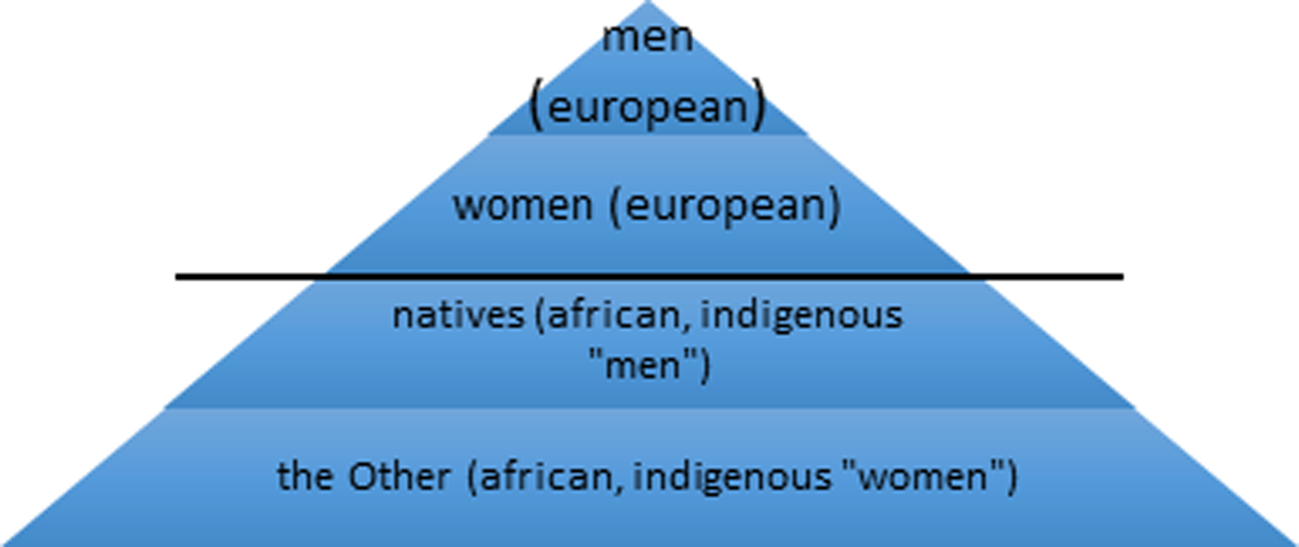
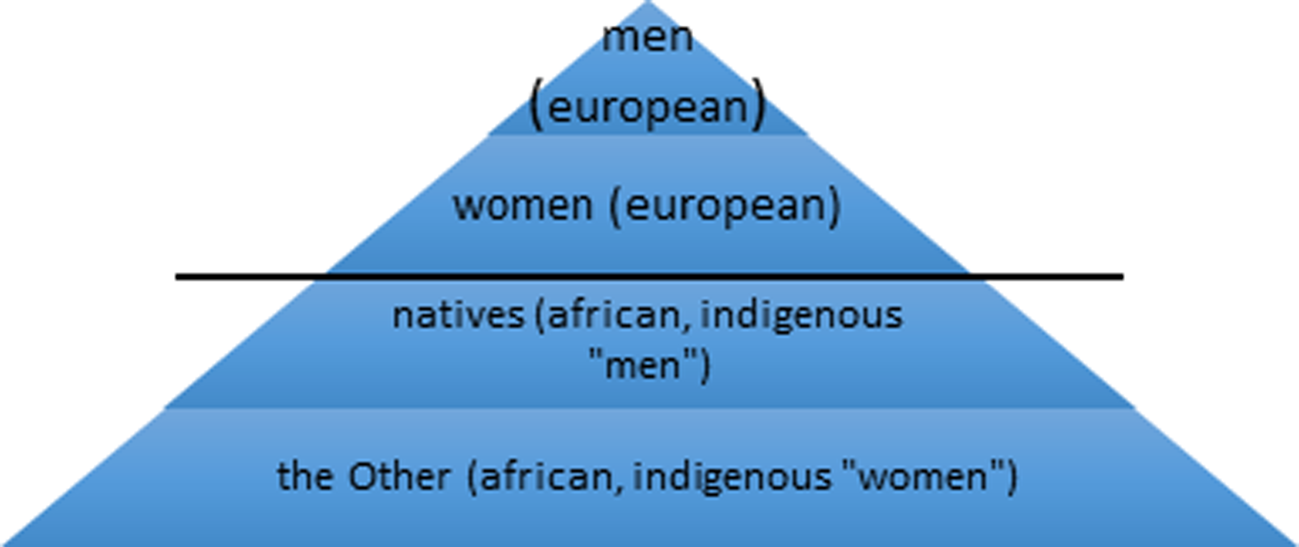
Lugones points out that Quijano based his reflections on a hegemonic interpretation of gender, which makes a more complex reworking of his approach necessary (19). She recognizes the significance of Quijano's treatment of the idea of “race,” and suggests that the notion of “gender” should also be considered as a colonial construction. Lugones is also inspired by the reflections of the Yorùbá thinker Oyèronké Oyěwùmí, who states, “any discussion of hierarchy in the colonial situation, in addition to employing race as the basis of distinctions, should take into account its strong gender component” (Oyěwùmí Reference Oyěwùmí1997, 122). For this reason, Oyěwùmí affirms that when gender is incorporated, the two hierarchical and racial categories of colonizer and colonized are duplicated in four categories:
The construction of the colonial/modern gender system was characterized by the hierarchical dichotomization of the population. Colonized “women” were in the worst place in this system. Unlike European women, Yorùbá “women” faced gender subordination without any racial privilege: “Thus, the unenviable position of European women became theirs by imposition, even as European women were lifted over Africans because their race was privileged … females became subordinated as soon as they were ‘made up’ into women—an embodied and homogenized category” (Oyěwùmí Reference Oyěwùmí1997, 153). Thus in the European system of sexual hierarchy, females were inferior beings and subordinate to males.
Lugones and Oyěwùmí agree that the creation of the category “women” was one of the first accomplishments of the colonial state (124). Colonization was a process of racialization, gendering, and therefore hierarchizing that degraded colonized females as an indispensable component of its project. The category woman, without further specification, does not make sense or has a racist sense, to the extent that it refers to the dominant group of that category, that is, bourgeois, white, and heterosexual women. This makes invisible and denies the brutalization, abuse, and dehumanization that the coloniality of gender implies (Lugones Reference Lugones and Mignolo2008, 25).
Capitalist colonization introduces gender differences where previously they did not exist (31–32). The violent imposition of such differences subordinated colonized women in all areas of life, insofar as gender was not an organizing principle before Western colonization, as Oyěwùmí also posits. According to Lugones, in any case, gender would have been interpreted in an egalitarian, nondichotomous, and nonhierarchical way by some colonized societies (32).
Colonial construction of gender. The middle line represents the separation between the human and the nonhuman. Author elaboration.
Breny Mendoza agrees with these approaches and points out:
It would only be with the intrusion of Western colonial power that these genderless societies would succumb to a hierarchy based on a notion of gender that is bound to bodies, compulsively dimorphic, patriarchal, heteronormative, and homophobic. From that moment on, gender and race became powerful instruments of destruction of the colonized society, dividing and fracturing it from within. (Mendoza Reference Mendoza2014, 50; my translation)
Since colonization, women have been defined in relation to men, the norm. From then on, women were those who did not have penises or the power to participate in the public arena. None of this was true for Yorùbá “women” prior to English colonization (Lugones Reference Lugones and Mignolo2008, 34). According to Oyěwùmí, “One tradition that was exported to Africa during this period was the exclusion of women from the newly created colonial public sphere. … The very process by which females were categorized and reduced to ‘women’ made them ineligible for leadership roles” (Oyěwùmí Reference Oyěwùmí1997, 123–24).
The subordination and exclusion of females from the newly created colonial public sphere was also the result of the imposition of the patriarchal colonial state (Oyěwùmí Reference Oyěwùmí1997, 123–25; Lugones Reference Lugones and Mignolo2008, 34) in such a way that “the transformation of state power to male-gender power was accomplished at one level by the exclusion of women from state structures. This was in sharp contrast to Yorùbá state organization, in which power was not gender-determined” (Oyěwùmí Reference Oyěwùmí1997, 125). Women were “ineligible for leadership roles.” This situation, with its strong biological basis, was a novelty, without precedent in the precolonial stage.
Colonial patriarchy, configured in the land of the colonizer, did not recognize the female leaders among the peoples who, like the Yorùbá, were being colonized (124). Two processes were crucial in the case of English colonization in Africa (Lugones Reference Lugones and Mignolo2008, 35): the imposition of racial classification, which subordinated African populations, and the degradation of anafemales.Footnote 5 The latter spread very widely, ranging from exclusion from leadership roles, the loss of title to land, and other important spaces of common life.
The degradation of “women” meant a profoundly violent rupture in the organization of communal life. The consolidation of the colonial state implied the exclusion of women from public life, when previously they had played important and diverse roles in the organization of their societies. The colonizing campaign proposed the destruction of the multiple communal ties on which the life of the peoples was sustained. Fragmenting, dividing, and cutting all ties that could generate community became a crucial element in the subjugation of these peoples.
The fragmentation and hierarchization of colonized worlds implied the prohibition of the set of ancestral means that made life possible in those territories, including ways of speaking, dressing, celebrating, relating to the earth, food-production, forms of government, healing, and thought. Everything was prohibited and persecuted by different means, such as the imposition of Judeo-Christian religion, education, laws, and new traditions.
Strategies of invention and engendering traditions imposed by colonization privileged males, to the detriment of females, practically absent from public life, or whose presence was exceptional. The coloniality of gender implied that the history between colonized and colonizers was written from the male point of view, turning women into anomalies, if they ever appeared.
Gender was not an organizing principle of colonized societies. There were no social categories such as “men” and “women,” derived from an elaboration of anatomical characteristics, since these distinctions did not constitute the basis of their construction and elaboration.
The Catholic religion played a central role in the imposition of the colonial/modern gender system, through the patriarchalization of the religiosity of colonized peoples, imposing the veneration of a male god, in the image and likeness of white men, considered his sons. This perspective strengthened the hierarchical structure that privileged male colonizers, assigning their women the role of fragile and submissive mothers, saints, and purity, while subordinating colonized peoples, especially females, who did not share the characteristics of those women. At the same time, they denied the forms of spirituality of the dominated peoples, which were in relation with Pachamama, care, and the reproduction of life in relation to the cosmos and everything that exists.
Land ownership was another important factor in this colonial process. “Another landmark of European penetration of indigenous societies, whether in Africa or in the Americas, was the commercialization of land” (Oyěwùmí Reference Oyěwùmí1997, 142). By becoming a commodity to buy and sell, land, previously collective, became private property. In this transition, the first to be dispossessed were Indigenous “women.” Earlier, each member of the community was guaranteed access to land. This explains why gender cannot be considered as a determining category in regulating access to land in every society and at all times. The transformations in land ownership that affected women exist only from the early colonial period (143–44).
The “distribution of land” by the British or Spanish crown reinforced the notion of land ownership: “The idea that persons occupying land had a right of ownership must have turned many a family property into private property, usually male-owned” (144). When they were deprived of access to land, women's abilities to grow, produce, and commercialize food independently were also affected, since they now depended on their parents, husbands, caciques, or their masters to access a piece of land.
Oyěwùmí also explains that the customary law-production process favored a reinvention of traditions that affected colonized “women,” preventing them from participating in the definition and administration of the new forms of justice. The colonial government excluded “colonized women” as officials. Before European colonization, the exercise of an occupation, or access to power, depended on lineages regulated by age, not by sex (146–49).
The distinctions related to wage labor were also prominent elements of the coloniality of gender. Men were considered as workers unlike women, whose work, fundamental for the reproduction of the community, was made invisible. The notion that only men participate, work, know how to govern, and make decisions is a colonial construction. The colonial gaze that makes invisible, denies, and delegitimizes the work of “women” is the result of a process that for 527 years and until today in Abya Yala has made the work of racialized “women” be seen as secondary and irrelevant.
Without racialization and without the subordination of “women,” colonialism and coloniality would not have been possible. Since Western colonial intrusion, colonized societies were hierarchized by “race” and “gender.” Both notions enabled the imposition of an androcentric perspective of the world that deeply threatened the web of life among colonized peoples.
One Fragmented World [Un Solo Mundo Fragmentado]
The modern colonial world is a bifurcated world—a world cut in two, “a field of diverse yet interchangeable oppositions between White and Black, good and evil, superiority and inferiority, civilization and savagery, intelligence and emotion, rationality and sensuality, self and Other, subject and object.”
Abdul Jan Mohammed (as cited in Oyěwùmí Reference Oyěwùmí1997, 199).Colonial rationality is the basis of the multiple separations or fragmentations of “reality,” as Lander states (Lander Reference Lander2011, 17). One of the characteristic separations of the Western tradition is the Judeo-Christian distinction between God (the sacred), man (the human), and nature. Jan Beating explains it: “God created the world, so the world itself is not God and is not to be considered to be sacred. It is tied also to the idea that God created man in his own image and elevated him above all other creatures on earth, giving him the right … to intervene in the course of events on earth” (Beating Reference Beating and Weeramantry1993).
This logic of separation is directly related to the classification of the world into colonized/colonizers, or human/nonhuman, and it had a crucial moment during the Enlightenment, when it was legitimized not by the Judeo-Christian religion, but by the sciences. The subject–object, mind–body, and reason–world separations were manifested in multiple areas of social life. The hierarchical dichotomy between reason and world implies that understanding the world is no longer a matter of harmony with the cosmos. From the modern perspective, the world is a nonliving mechanism, devoid of spirit, whose understanding is reached through the concepts elaborated by reason. The purpose of these distinctions lies in the elaboration of a knowledge that is not embodied, not contextualized, and therefore, objective and universal (Lander Reference Lander2011, 19). According to Sylvia Marcos, Mesoamerican Indigenous thought was based on different assumptions:
Body and spirit, matter and mind, are not understood as mutually exclusive entities. They are interpreted as a continuum, whose ends are complementary, “opposite” poles, flowing toward each other. Thus, theory could not be done without a body, without action, and without practices.
For Mesoamerican thought in general, and to Maya thought in particular, the body is not opposed to the mind. It is not defined as biological data or immanent materiality. Nor is it understood as a border between the being and the world. [Therefore] in the traditions of organized Indigenous women, the body takes on very different characteristics from those of the modern anatomical or biological body. (Marcos Reference Marcos and Millán2014, 24; my translation)
These separations are built on the classifications that serve as the foundation of the modern colonial order. The idea of European superiority, more advanced than the “rest” of the world, emerged from within that system, according to a linear temporality in which the colonized peoples were seen as backward and archaic. It is, in other words, the denial of simultaneity between colonized and colonizing peoples (Johannes, as cited in Lander Reference Lander2011, 20). This denial will be reinforced by a radically exclusive universality that denies and prohibits everything that exists outside the modern canon.
According to Lander, modern colonial reason is supported by four basic presuppositions:
1) the universal vision of history associated with the idea of progress (from which the hierarchical classification of all peoples and historical experiences is built); 2) the “naturalization” of the human condition and the historical social relations of liberal-capitalist society; 3) the naturalization or ontologization of the multiple separations typical of said society; 4) the necessary superiority of knowledge produced by that society (science) over any other knowledge. (Lander Reference Lander2011, 26; my translation)
The construction of the separation between subject and object, superiority and inferiority materialized in the Conquest as a fact of nature rather than of society. The relations of domination/subordination and command/obedience were established from 1492 and were consolidated during the colonial period that persisted in subsequent oligarchic republics, the wars of independence, and to this day are a fundamental part of the colonial, racial matrix of capitalist modernity (Gilly Reference Gilly2006).
From its origins, modern colonial rationality sought to impose, in each area of social life, the notion of the existence of one fragmented world [un solo mundo fragmentado], and this rationality tried to impose this idea in all areas of social life. This one world would subdue the rest of the worlds, eliminating them, given their “irrationality,” “savagery,” “barbarism,” “backwardness,” “underdevelopment,” simple remnants of a past that must be overcome in order to advance toward progress. According to the modern colonial order, only European rationality is valid and thus can contain “subjects” (Quijano Reference Quijano2007a). Hence, “modernity does not always mean Enlightenment and reason, but quite the opposite. Modernity can also come, as it came to these lands in the sixteenth century, as a curse and a fall, as a disaster and a loss” (Gilly Reference Gilly2006, 102; my translation). Modern colonial rationality poses “a world incomprehensible to Indigenous reason, meaningless, made of sound and fury. This reason, in reality, was never completely adapted or subdued” (110; my translation).
From its dichotomous and hierarchical logic, Western rationality builds the separation between society and nature, where the latter was represented as an inert object to be exploited. Without this fundamental distinction, capitalist colonialism would have been impossible.
In the ontologies of the Indigenous peoples of Abya Yala, these separations do not exist. The body is not separate from the spirit, nor is the mind from the body. That is why you pray by dancing and you dance by praying. The body is imbricated with the earth and connected in turn with the four directions of the universe, and with the sun, the moon, the water, and the wind. This set of multiple relationships is the basis of the functioning of everything that exists.
Relational ontologies recognize the existence of different worlds, breaking the anthropocentric approach of modern/colonial/Western ontology that places the human as the only being of value. These ontologies radically depart from the core ideas of Western modernity, organizing and cultivating their own models of understanding the world. Relational ontologies’ basis is in the idea that “everything that exists … has agency and will of its own. And although hierarchies exist, they do not necessarily follow the human (culture)/nonhuman (nature) division” (Blaser and de la Cadena Reference Blaser and de la Cadena2009, 7; my translation).
Indigenous ontologies are radically different from Cartesian principles. Indigenous knowledge is not based on separation, but on the relational logic between all existing worlds. For this reason, modernity is not the horizon of meaning for the struggles of the Indigenous peoples of this continent. On the contrary, they pose a radical critique of the way of “life” of capitalist modernity:
[W]hen movements led by Indigenous peoples appear, what is questioned is not only the logic of capitalism, the neoliberal model, or the actions of transnational companies, but modernity as a whole. This is only possible due to the profound awareness of communal life conception of our peoples, from which modernity appears as a fundamental problem. (Bautista Reference Segales and José2018, 13; my translation)
The Indigenous peoples of the continent have deeply and forcefully questioned the system that, since 1492, has exploited peoples and nature. Today we know that this exploitation systematically produces the poverty and death of human beings, as well as the destruction and death of nature (Bautista Reference Segales and José2018).
Indigenous epistemologies and ontologies are very different ways of understanding and inhabiting worlds, because they recognize the relationship between everything that exists. In the struggle for the re-existence of these worlds, the role of Indigenous “women” is essential.
The Struggles of Indigenous Women in Abya Yala from Worlds in Relation
In our worldviews we are beings emerged from the earth, water, and corn. Of the rivers, the ancestral custodian is the Lenca people, also protected by the spirits of the girls, who teach us that giving our lives for the defense of rivers is, in many ways, giving our lives for the good of humanity and of this planet. Like every threatened river in the world, the Gualcarque River is calling us. We must go. Mother Earth, militarized, fenced off, poisoned, where elemental rights are systematically violated, demands that we act. We must build societies capable of coexisting in a fair, dignified way, and for life. Let's join together with hope to defend and take care of the blood of the earth and its spirits.
Berta CáceresFootnote 6Unlike the relational thinking of the Indigenous peoples of the continent, the colonial world is based on the conviction of the existence of one world [Un Solo Mundo] (Law, cited in Escobar Reference Escobar2015, 97). This conviction is possible due the articulation between colonialism and the various modalities of coloniality: of power, gender, knowledge, being, and nature.
As we have already pointed out, the presumption of the existence of one world is the fundamental basis of modern Western thought. It is a fragmented world and not a world in relation, based on a dualistic ontology that separates the human and the nonhuman, nature and culture, individual and community, “us” and “them,” mind and body, the secular from the sacred, reason and emotion (Escobar Reference Escobar2015, 93). Faced with this dualistic ontology, there are the so-called relational ontologies (Blaser Reference Blaser2010; Blaser and de la Cadena Reference Blaser and de la Cadena2009; Escobar Reference Escobar2015), based on the conviction of a deep interconnection between the world of plants, animals, things, people, and earth beings (de la Cadena Reference de la Cadena2015). This notion is the substance of the feeling-thinking-acting [sentipensaractuar] of the Indigenous peoples of Abya Yala.
These ways of enacting the world, inseparable from their relational ontologies (Blaser Reference Blaser2010), constitute, in my opinion, the key to thinking about the struggles of Indigenous women on the continent. The system that has hierarchized life and dehumanized the majority of the planet insists on imposing a capitalist, liberal, and individualistic representation of the world. Faced with this intention, Indigenous “women” constantly and permanently rebel together with their peoples and from their territories. In rejection of rational politics (Blaser Reference Blaser2010), the defense of the reproduction of life as a whole has become the fundamental axis of the struggles of Indigenous peoples in defense of the land-territory. In this scenario, the role of Indigenous “women” is fundamental.
As they have stated, Indigenous “women” are involved in a series of struggles for life, inscribed in the framework of ontological conflicts that go beyond rational politics, that is, conflicts in which different ways of making worlds are interrupting and interfering with each other (Blaser Reference Blaser2010).
Inquiring about the causes and processes that systematically alter communal relations, such as racialization, as well as the subordination of colonized women, and other ways of understanding and living in relation is an essential part of the commitment to decolonization in its many forms.
The nonfragmented struggle of Indigenous women in defense of the land-territory is a profound contribution to decolonization. Faced with a panorama in which all forms of life on the planet are seriously threatened, the decolonial project of Indigenous women is of great relevance, since it is not reduced to the decolonization of gender, as the Zapatista women propose:
And you know well that it was not always a man who exploited me, robbed me, humiliated me, beat me, despised me, and killed me. Many times it was a woman who did that to me and still happens. (Enlace Zapatista 2018; my translation)
Indigenous women, who have been racialized by heteronormative, patriarchal, racist capitalism, fight for the defense of the land-territory and against the violence they face as Indigenous “women.” At the same time, they resist the destruction of the relational worlds of which they are a part. These processes of destruction and annulment of the other, be they people, animals, plants, knowledge, ways of understanding and creating the world permanently, threaten life, and in the face of this danger, Indigenous women together with their peoples, communities, or ayllus are fighting multiple battles.
Liberal feminist theory, based on the logic of the liberal subject thought of as self-contained and individual, posits that the achievement and objective and ultimate goal of every woman is independence and individualization, outside of the collective (Marcos Reference Marcos and Millán2014, 25). However, the struggle of Indigenous “women” and their peoples, throughout colonial history, has arisen from an alternative, communal, and collective conception of life [concepción nosótrica de la vida], as in the case of the Tojolabales from the south of Mexico (Lenkersdorf Reference Lenkersdorf2001, 23–26).
The struggle of Indigenous women for the defense of their territories expresses the way in which community women understand life. And in this sense, their struggle implies the defense of their own rights, which is not separate from their struggle as part of a collectivity. The struggle for rights as Indigenous women is not separate from the struggle for the existence of all worlds in relation without which re-existence is not possible, and this implies questioning:
the mechanisms that communities create and develop for the daily invention of life, and thus confront the reality imposed by the hegemonic project. From the colony to the present day, the existence of Afro-descendant (and colonized) communities has been silenced, subordinated, or negatively represented. Re-existence points toward the displacement of the established logics, to search in the depths of Indigenous and Afro-descendant cultures for the clues of organizational, ritual, aesthetic, and food-production forms that enable dignifying life: reinventing it to remain in transformation. (Albán Reference Albán Achinte2011, 204; my translation)
For this reason, the struggle of community “women” is not based on a logic that prioritizes demands, since it implies the defense of everything that enables coexistence in the web of life.
Like their ties with white and mestizo women, the relationship with Indigenous men is marked by the coloniality of gender, and its consequences have been denounced from within the communities. However, the demands of community women are not limited exclusively to gender violence, because, as Aura Cumes has stated, “aspiring for Indigenous women to fight only as women implies imposing a female condition that does not correspond to them, since their gender conditions are created, not only against Western patriarchy, but also against a colonial system” (Cumes Reference Cumes and Millán2014, 78; my translation).
The struggles of Indigenous and peasant women raise alliances with the men of their community, as expressed by the women of the Ejército Zapatista de Liberación Nacional, in the voice of Captain Irma:
Our struggle is necessary so that our peoples and our country will be free. And not only for women, but for all the people who always live humiliated. … We are already tired, we do not want to live like animals, we do not want to be always told what to do or what not to do. Today more than ever, we must fight together so that one day we will be free. We will win sooner or later, but we will win. (Captain Irma 1994; my translation)
Indigenous women have denounced gender violence as one of the problems that afflicts their communities, although they have also pointed out that it is not the only or the main form of violence they face; they face multiple forms that are not explained solely by their being women. This is what Zapatista women in Chiapas have pointed out since 1994: “Because I experienced contempt, humiliation, mockery, violence, beatings, deaths, for being a woman, for being Indigenous, for being poor, and now, for being a Zapatista” (Captain Irma 1994; my translation).
The Zapatistas are not the only ones who have denounced multiple oppressions. Meli Wixan Mapu, a Mapuche organization, has expressed that:
Mapuche women have fulfilled a transcendental role. Together with the Konas, we have fought the transnational forestry and hydroelectric companies. We are fighting to recover our mother earth (ñuke mapu), alongside men, children, and youth. We are part of this popular struggle, and that is why today we are persecuted by the Chilean state. We demand the legitimate rights of women and the Mapuche people. (Organización Mapuche Reference Espinosa, Gómez and Ochoa2014; my translation)
The fight is for the defense of life and everything that exists, because everything has a heart, not only humans, as the Maya Tojolabales express it:
[F]or the Tojolabales, human society is not the only possible society, because there is nothing that does not have yaltzil [heart] … the heart is a source of life. And it is also characterized by the ability to think … the “thought” does not refer to reasoning, but to the ability to relate to each other, with dignity and respect to live in community. (Lenkersdorf Reference Lenkersdorf2008, 106; my translation)
The Indigenous peoples of the Ecuadorian Amazon are opposed to the capitalist ideology of development that imposes mega-extractive projects. The defense of the jungle is inspired by Sumak Kawsay. This notion posits the care of life, the good life in relation to everything that exists; it is a relationship of respect to the Pachamama and Yakumama (Mother Water). In the words of the Sapara women of the Ecuadorian Amazon, Sumak Kawsay implies “a caring life within our territory.”Footnote 7
Sumak Kawsay is also diversity: all the diversity of a town, the plants, the animals, the lagoon, the wind to bathe, to gain energy and strength to overcome laziness. It is the harmonic ensemble of the communities, the plants, the trees, el colchón de agua Footnote 8, because if there is no harmony, there is no Sumak Kawsay. For the Quichua “women” of the Ecuadorian Andes, if there is no community with everything, with the animals, with the birds, and with the plants, there is no harmony. That is why they affirm that the oil companies that have arrived in their territories are a threat to Sumak Kawsay and their towns are in danger.
For the Amazonian men and women who defend the jungle:
Sumak Kawsay is the life of everything, of the chacra, the river that comes down from the mountains, of the little trees that are very important, of the animals that accompany our little trees … the little trees are like a person who supports many wild animals, many ayllus. La Selva is our house for all of us together. All these ayllus are made up of both animals and humans, all living beings, we all have ayllus. To be well, to have a Sumak Kawsay we have to be well in the community, our communities are in la selva and here we have everything, the animals, as well as other communities. … So that would be a buen vivir for us, living in harmony with each other.
The animals are also organized like us, like humans, they are also organized by ayllus, there are some that live in the water, there are some that live in la selva, in the forest. So, in everyday life, we, the human ayllus, relate to each other, but also with all the ayllus that exist in the territories. So that is for us Sumak Kawsay. Footnote 9
Indigenous women and their peoples throughout this continent search for relationships of reciprocity. The earth gives to the people and the people also give to the earth. Whether in ceremonies or in daily life, earth is celebrated and thanked, and in this way the bond that enables the web of life is sustained. The bond is also strengthened through work, festivity, and coexistence. This reciprocal and relational thinking between everything that exists differs from modern/colonial androcentrism, because it is from a wide horizon of multiple relationships that make the existence of different worlds possible. Interrelation is the basis of existence (Lajo Reference Lajo2006, 120).
Women, who belong to these worlds in relation, know the importance of strengthening communal ties. For that reason, they fight to defend it and renew it. Community women collectively rebel and resist the threat that capitalist modernity represents for this plurality of worlds, without which life would be impossible.
Final Reflection
Mother Water, when the lagoons are destroyed, where will their owners go? Where will the spirits go? Mama YacuFootnote 10, don't they understand that you are a living being?
La hija de la laguna. Documentary. (Cabellos Reference Cabellos2015; my translation).
Sentipensar, the struggles of Indigenous women in Abya Yala from the worlds in relation, based on the coloniality of power and the coloniality of gender, is an exercise that seeks to link some of the approaches made by Indigenous women in different parts of the continent, when they face megaprojects that threaten to deprive them of their lands-territories, their knowledge, as well as their ways of life in these ancestral territories. These megaprojects endanger the ayllu of birds, fish, trees, and spirits that also coexist in the territories. The women of these territories face these threats by undertaking nonfragmented, complex struggles, inspired by the diversity of beings and relationships. In this sense, the resistance is carried out together with the boys, girls, youth, men, and the elderly of the community, as well as with the guardian spirits of the hills, the lagoons, and the springs. The struggles of these women resort to rituals, sacred ceremonies, and to shamans and people of knowledge.
The struggles of Indigenous community women deeply question modern colonial ontology, so contrary to the relational ontologies of their peoples, deeply rooted in the web of life, since everything has life. These struggles go beyond the demand for individual and human rights. The human is not the measure of all things, but just one more of the threads of the web of life. The fight is for the preservation of all the worlds that are necessary for the existence of the community, since there is a consciousness that recognizes that “all living beings depend on each other for their existence, and intertwine in an immense weave that continuously evolves” (Ingold as cited in Escobar Reference Escobar2016, 18; my translation). The objective is not to achieve the “humanity of the colonizer,” sustained by the coloniality of power, gender, knowledge, being, and nature. The project seeks to reconstitute and strengthen various ways of being, sentipensar, and creating worlds in relation to the pluriverse.
Carmen Cariño is a Ñuu Savi activist and student at the Escuelita Zapatista. She has a degree in sociology, a Master's in rural development, and a PhD in anthropological sciences from the Universidad Autónoma Metropolitana, Mexico. She is a professor-researcher at the Universidad Autónoma Metropolitana-Azcapotzalco and member of the Grupo Latinoamericano de Estudios, Formación y Acción Feminista (GLEFAS).
Alejandro Montelongo González is a decolonial educator and activist who graduated in sociology and has a Master's degree in social sciences and humanities from Universidad Autónoma de Aguascalientes. Gonzalez currently works as a temporary professor in the Department of Sociology and Anthropology at Universidad Autónoma de Aguascalientes.
Translator's Note: In the case of the literal quotes of sources in Spanish for which a previous translation into English was not identified, I translated them and so indicated. In the case of the literal quotes from sources in Spanish for which it was possible to identify an original version or previous translation to English, I transcribed them directly from said texts.