The steamship Circassian anchored off the southern tip of New York City just before dawn on the morning of 30 November 1859. Among the 281 immigrants and travelers on board was the young Dutch violinist Jacques Oliveira.Footnote 1 Just twenty-three years old, he had traveled from his native Amsterdam by way of England and Ireland with both career and family in mind. Opportunities must have seemed endless as he looked out on the teeming city of nearly one and half million.Footnote 2 Through the 1850s, immigrants had poured into New York, taking rough work in the city's factories and dockyards.Footnote 3 Oliveira would find employment in the city's theaters and concert rooms, performing as a soloist in a variety show, with an opera company, and with a minstrel troupe. His world would be that of the popular culture of the day. But with the country on the brink of war, the adventure ahead of him would be determined largely by events beyond his control. After a year, he would make his way south, settling in New Orleans, where his wife, Miriam Carillon, had lived and where his in-laws still resided. In New Orleans, Oliveira would become a leading figure in the largely European musical community and may have been on the verge of wider recognition when cholera and yellow fever returned to the city in the summer of 1867. The thirty-one-year-old was about to set off on a concert tour when he fell ill. The community mourned his death that summer but soon forgot his contributions to music.
The lives of Louis Moreau Gottschalk, Patrick Gilmore, Adelina Patti, and other celebrated musicians working in the United States during the 1860s have been widely explored. Oliveira's activities, his successes and struggles, offer a different, and more typical, perspective: that of the working immigrant musician. By following Oliveira's career, we discover the place of the instrumentalist in the theater—a role that offered the soloist few choices. The reception of Oliveira's performances reveals how attitudes toward popular culture were shaped by a cultural hierarchy and provides insights into the place of the violin in the music of the United States. With his move to New Orleans, we explore that city's years of war and occupation from the point of view of a musician. Despite wartime hardships, New Orleans was a bastion of hope for Oliveira, as it was for many fellow performers. Through Oliveira's eyes, we see a rich musical life supported by the local francophone community and by immigrants from many parts of Europe.Footnote 4
In examining Oliveira's short career, I have made use of all of the standard resources of historical research: census data, city directories, chronicles, memoirs, diaries, and especially the newspapers of the time. Many of the sources require careful consideration. Advertisements were infamous for their invention, and census data too are suspect. Oliveira's life in New Orleans is especially problematic because much has been lost. We have no photographs of him or of his family. Also absent are published writings, compositions, letters, and diaries—sources that would allow Oliveira to speak in his own voice. The result is sometimes called a “doughnut biography.” Oliveira being absent, we explore around him, revealing him through the events of his time and place and through the diverse cast of characters with whom he interacted, from P. T. Barnum and Tom Thumb in New York to a collection of highly talented but now-forgotten immigrant musicians in New Orleans.
Amsterdam to New York
For most New Yorkers, the coming war was still only distant thunder in the fall of 1859. The increasing hostilities between North and South did little to diminish the city's appetite for entertainment. The season offered something for every class and income group. At the upper end, the Academy of Music hosted a season of grand opera that featured in November sixteen-year-old Adelina Patti making her debut in the title role of Donizetti's Lucia di Lammermoor. Also at the Academy, the New York Philharmonic gave five concerts, while chamber music and solo recitals took place in smaller halls and churches. Theatrical performances often reached across class lines. Most popular in the fall of 1859 were Dion Boucicault's Dot and Smike—adaptations of the works of Charles Dickens (based on the novella Cricket on the Hearth and the novel Nicholas Nickleby, respectively) and both staged by Boucicault at the Winter Garden.Footnote 5 The minstrel show was as popular as ever, and Bryant's Minstrels that fall had a new walkabout called “Dixie.” Oliveira himself would later take part in minstrel show performances, showing an adaptability driven by necessity.
It was both financial need and family connections that brought Oliveira to New York. His family had fallen on hard times and earned what seems to have been a modest living through music. His father, Abraham Oliveira (1811–55), was an impresario, and his uncle, Joseph Oliveira (1816–60), served as cantor at Amsterdam's famous Portuguese Synagogue. With a stipend from the city government, Jacques traveled to Belgium to study the violin.Footnote 6 A review published in the Musical World on 24 December 1859 reported that Oliveira had studied with Kreutzer and at the Brussels Conservatory, before gaining “some reputation in France and Holland.”Footnote 7 We do not know how long his studies lasted. On settling again in Amsterdam, he married Miriam Carillon, a young woman who would be his connection to the United States. Carillon came from a family that was well known in the city's Sephardic Jewish community. Her father, Benjamin Cohen Carillon, had studied at the Portuguese Israelite Seminary Ets Haim. Following his marriage to Rebecca Levy, in 1836, and the subsequent birth of Miriam, about a year later, the family had set off on what would be a nomadic life. By the time of her return to Amsterdam in the late 1850s, Miriam had lived at least briefly in London, New York, Suriname, the Danish West Indies, Jamaica, and New Orleans.Footnote 8
Oliveira's opportunity to immigrate to the United States came through the U.S. impresario P. T. Barnum (1810–91). Barnum arrived in Europe in 1857 on a lecture tour, hoping to pay off the huge debts he had incurred through a failed business venture. During the tour he scoured Europe for new talent to present at his American Museum on Broadway. He sometimes traveled in the company of his famous protégé Charles Sherwood Stratton (the diminutive entertainer better known as Tom Thumb, 1838–83), who was giving his own performances. Barnum had managed Thumb from the time he was a child, helping to make him one of the most famous personalities of the era. His act, given two and sometimes three times each day, comprised singing, telling stories, doing impersonations, and generally charming his audiences. Thumb normally performed in a small company that included musicians and singers, and, in 1858, he added Oliveira to the cast.Footnote 9 Oliveira seems to have been well received in his secondary role. During his performances at the Free Trade Hall, the Manchester Times noted, “During the change of character on the part of the General, we had some very talented violin playing from a Senor Jacques Oliveira, pupil of M. Charles De Beriot, Conservatoire, Brussels. This gentleman gave evidence of great command over the instrument, accompanied by a good tone as well as expression.”Footnote 10 When, in Liverpool, Thumb's departures from the stage became the source of some criticism, one writer responded:
Surely no one can be impatient whilst listening to such a marvelous performer on the violin as Senor Oliveira. He almost makes the instrument speak. His rendering of the Carnival of Venice almost rivals the performance of Picco on the pastoral tibia. In the imitation of the warbling of feathered songsters, the tones of the wind and of the stringed instruments bear a striking similarity. The mechanical ability of the artist is most surprising, and it is impossible that such ability could be exercised if it were not inspired by a deep-seated appreciation of the music which he interprets with so much feeling and expression.Footnote 11
The writer goes on to talk briefly about the other artists on the bill without mentioning any by name. We have no accounts from audience members. Evidently they received Oliveira enthusiastically, because the shrewd Barnum decided to bring him to New York.
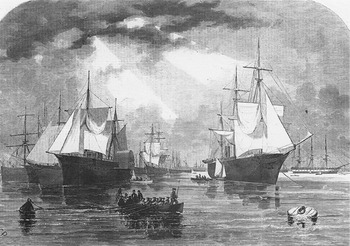
Tom Thumb ended his British tour in late June 1859 and returned to the United States in a comfortable cabin on board the S.S. City of Washington.Footnote 12 Oliveira departed five months later traveling in far less agreeable conditions. He sailed on 12 November from the port of Galway, on Ireland's west coast, traveling with Miriam and their one-year-old son, Abraham, on the S.S. Circassian (see Figure 1). The ship's manifest shows the family of three crossing the Atlantic in steerage. In what were at best cramped and difficult conditions, “Professor” Oliveira appears to have been the only professional, with most of the family's traveling companions listed as laborers, spinsters, and widows.Footnote 13 After a two-week crossing of the Atlantic and a brief stop at St. John's, Newfoundland, the Circassian arrived off New York's Battery just before dawn on 30 November.Footnote 14
The S.S. Circassian (right, foreground): the vessel on which the Oliveiras arrived in New York, traveling in steerage from Galway, Ireland, by way of St. John's, Newfoundland. Engraving published in Harper's (December 1862) after the British steamer was captured while trying to circumvent the blockade.

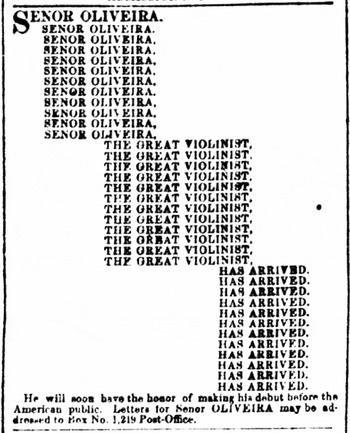
Barnum seems to have been well prepared for Oliveira's arrival. On 1 December 1859, he placed a large advertisement on the front page of the New York Herald that read: “Señor Oliveira, The Great Violinist, Has Arrived.”Footnote 15 In smaller print, the notice advised readers of the post office box to which they should address their letters to Oliveira. The same notice also appeared a few days later in the Tribune (see Figure 2). It was a clever bit of promotion intended to draw attention to the U.S. debut of the young violinist, who was then known in the United States only through reports of Thumb's successes abroad.Footnote 16 Barnum may have been hoping to create the sort of buzz that surrounded Henri Vieuxtemps's recent North American tour. To make the violinist appear more glamorous, he presented him as a Spaniard and changed his name from Isaac to Jacques.Footnote 17 Oliveira seemed prepared to stay in character. In both the log of the Circassian and in the 1860 census he is identified as Spanish.Footnote 18 Occasionally, we find him billed as “principal violinist to the Queen of Spain”—the sort of “humbug” promotion for which Barnum was well known and to which the public was unlikely to have given much thought.Footnote 19
“Señor Oliveira, The Great Violinist, Has Arrived,” New York Tribune, 6 December 1859. P. T. Barnum had placed an identical version of this advertisement on the front page of the New York Herald on 1 December 1859, the day after Oliveira, unknown in the United States, had landed in New York.

Barnum arranged for Oliveira to make his debut with the Drayton Parlor Opera Company, a troupe that he had also contracted with while in Europe. The company, comprising just two principal performers, the U.S.–born baritone Henri Drayton and his British wife Susanna Lowe, specialized in one-act operettas created especially for them by contemporary composers such as Edward Loder and Joseph Duggan. The Draytons had also been performing in London and on a tour across Britain when recruited by Barnum. They arrived in the United States late that summer of 1859 and opened in October at the French Theatre (585 Broadway) to favorable reviews and full houses. That fall, they settled into a longer season at Hope Chapel, a former religious assembly hall at 718–720 Broadway, below 8th Street.Footnote 20 It was there that Oliveira made his U.S. début on 12 December 1859, performing Charles de Bériot's highly operatic Violin Concerto No. 1 in D Major, op. 16.Footnote 21
Barnum's methods seem to have alienated some New Yorkers. Even before Oliveira's first performance with the Draytons, the Clipper noted that he had been “ostentatiously announced as the great violinist of the age” and retorted that “‘The greatest violinist’ ought to draw” on his own, as Ole Bull had done while touring North America, and not as part of the Draytons’ show.Footnote 22 After the first performance, drawing attention to the practice of changing an artist's name, the same publication reported: “Signor Oliveira (probably Mr. Oliver) fiddled for the first time in this country at the Drayton entertainment last week. He is said to be a pretty good fiddler, but not so great as those ‘preliminary notices’ cracked him up to be.”Footnote 23 It was fair to suspect performers of taking more exotic names, as the Clipper had assumed Oliveira had done (and as Henry Drayton did). But as the practice was widespread, for the influential New York Clipper to focus on it rather than the performance suggests its editor may have had some other dispute with Barnum.
Other newspapers were more favorable. The New York Tribune wrote of Oliveira's “pure, delicious, delicate tone” and his “exquisite feeling.”Footnote 24 The New York Times devoted almost all of its review of the Draytons’ 12 December performance to Oliveira's début, providing one of the most thorough discussions of his playing available and offering insights into the musical tastes of the era. It begins with an assessment of his skills:
Signor Oliveira plays a smooth, slow passage with infinite grace, and with true perception of its vocal significance. In other words, he sings—which is the perfection of all instrumental performance. Beneath this is a depth of mechanical execution which has been sounded by all the great artists who have visited our shores and fathomed by many who are now resident citizens, and unpretending teachers or executants. Signor Oliveira possesses good facility and coolness, which is the consciousness of strength.Footnote 25
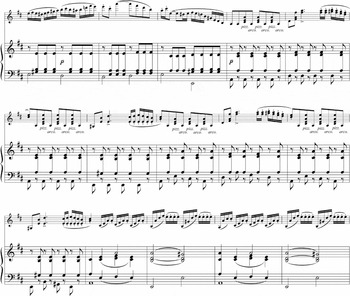
While possessing “coolness” may seem an odd compliment, in pairing it with “good facility” the writer drew attention to Oliveira's technical skills rather than suggesting that he played in a dispassionate manner. The main thrust of the paragraph appears simply to be that he had a solid technique and produced an attractive (“singing”) tone. The writer then points out what he considers to be some of Oliveira's failings: “But whilst he sings on his violin better than any other artist who has visited us, he lacks precision, clearness and elegance, in all his tours de force.” And—perhaps contradicting his earlier comments—the writer describes what was seen to be some of the violinist's more theatrical techniques: “We would caution Signor Oliveira against the superfluous splendor of trying to play the violin with one hand; a simple variation twitch with one hand horribly on the four strings, with the other and bow hand ostentatiously lazy, may be curious, but it is not at all pleasing. Besides, with a player who produces so exquisite a tone, we do not want to have the bow idle a single minute.” The critic was likely unfamiliar with de Bériot's Concerto No. 1, an early, single-movement work owing much to Paganini in its virtuosity. At several points the composer calls on the performer to use left-hand pizzicato (see Example 1).
Charles de Bériot, Concerto No. 1 in D major (mm. 134–148). One of three passages that call on the soloist to alternate between pizzicato and arco playing (Mainz: Schott, ca. 1830).

In closing, the New York Times’ critic noted that Oliveira's reception had been “of the heartiest kind” and that he was undoubtedly a “valuable acquisition” for the Draytons.Footnote 26 More interestingly, he predicted that Oliveira would “make his mark as a sentimentalist rather than as a first-class executant.” This was not necessarily a harsh criticism. Audiences, the writer noted, would “appreciate [Oliveira] all the more for this distinction, for the public loves to be appealed to in music as in rhetoric.” There is in this statement the expression of a nineteenth-century understanding of sentiment, one that a recent source describes as “feeling and thought in association as distinguished from pure thought and instinctual emotion.”Footnote 27 Sentiment had long been used as a literary device, most notably by Dickens.Footnote 28 Although still closely associated with the novel, it had also found its way into the popular parlor songs of the era.Footnote 29 Without words, a violinist may have communicated sentimentality through the use of vibrato, portamento, or rubato, or by imitating the sound of the human voice. It seems likely also that the theatrical context in which Oliveira played prepared audiences’ expectations. Sentimentality was at least an element in the Draytons’ performances. In a review published shortly before Oliveira's arrival, the New York Times described the music of one of the Draytons’ works, Ne're Too Late to Mend, as being “dashed with a strong and acceptable vein of English sentimentalism.”Footnote 30 In his role as soloist, Oliveira would have been expected to complement the Draytons. He needed to be theatrical.
Although the public appreciated sentimentality in music, critics were careful to place instrumental performances in context. As the Musical World reported that December, “His style would be condemned by the classical musician, but Senor Oliviera [sic] will always please a general audience, as he has tone, sentiment and dexterity.”Footnote 31 The critic of the Musical World did not elaborate on what might constitute a classical performance. No doubt it had something to do with tradition and training as well as with performance contexts and repertoire. During his 1857–58 North American concert tour with Thalberg, Vieuxtemps aimed to please several types of listener. He played potboilers like Paganini's variations on the Carnival of Venice, as well as Beethoven sonatas and his own compositions.Footnote 32 On the other hand, with Carl Bergmann and Theodore Eisfeld sharing the conducting duties that season, the New York Philharmonic repertoire consisted almost exclusively of works by Austro-German composers.Footnote 33 These were the works that would be the yardstick by which a solo violinist would be measured. The place of such a musical hierarchy in the United States in the nineteenth century was the subject of debate in the 1980s and 1990s.Footnote 34 With more information easily available to us now, it is clear that a significant divide between classical and popular music (or style) existed in New York of the 1850s, and it likely shaped the careers of younger instrumentalists such as Oliveira, just setting out to establish their reputations. The summer after his New York debut, he was billed as “one of the most talented and classical violinists in the world,” but any effort to redefine his image as a sentimental Spaniard would be limited by the opportunities of the time.Footnote 35
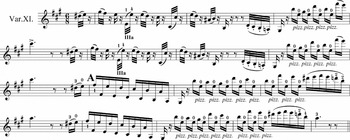
Whatever Oliveira's hopes may have been, throughout his first year in the United States he found himself performing a narrow repertoire determined by the tastes and expectations of his audiences. Usually they expected to hear Carnival of Venice, the extravagant 1829 Paganini showpiece based on the Neapolitan song “O mama, mama cara.”Footnote 36 Following the sixteen-measure tune, Paganini presents twenty variations of steadily increasing technical complexity. Like the theme, all twenty variations are sixteen measures in length, in 6/8 time, and in the key of A major, which allows the accompanist or orchestra to simply repeat the same harmonies and stay out of the soloist's way. The theatricality of Carnival (see Example 2) made it perfectly appropriate for the venues in which Oliveira was playing, perhaps especially when he was taking part in minstrel shows, as he would soon do. Although audiences seemed never to tire of hearing the piece, critics, on the other hand, had run out of things to say about it. The critic for the Musical World commended Oliveira for performing Paganini's showstopper “with exquisite delicacy,” despite its being “so easy to exaggerate, and so difficult to keep humor within the bounds of good taste.” The critic of the Brooklyn Eagle, who appreciated Oliveira's playing and referred to him as an “attractive addition” to the Draytons’ company, complained about the repertoire: “We have known every note of [the Carnival of Venice] these twenty years, have heard it—we are afraid to say how many times, we know all the gyrations, all the agonies that cat gut and horse hair are capable of importing to it; from the faintest squeak to the dolefullest bass growl that can be extracted from the instrument.”Footnote 37 Oliveira may have agreed with the writer, but his audiences expected to hear it and undoubtedly would not have the patience for a Beethoven sonata.
One of twenty progressively difficult variations from Niccolò Paganini's variations on The Carnival of Venice, op. 10, ca. 1850 (Mainz: B. Schott's Söhne, n.d.), a work that Oliveira performed nearly every night during his first year in the United States.

Oliveira remained with the Draytons for several months. Throughout the early winter they performed at Hope Chapel in Manhattan, at Washington Hall and the Odeon in what is now the Williamsburg section of Brooklyn, and at other venues around New York. From there, they traveled to Philadelphia at the end of January and then on to Baltimore and Washington, D.C.
By the middle of March, Barnum had brought Oliveira back to New York to perform between acts of The Octoroon; or, Life in Louisiana, Dion Boucicault's controversial new play about racial politics in the South. Boucicault had staged the premiere at the Winter Garden Theater on 5 December 1859. It then played at the Bowery Theatre before opening at Barnum's American Museum in February.Footnote 38 Barnum had hoped with this production to repeat his success of 1853, when he staged Henry J. Conway's adaptation of Harriet Beecher Stowe's sentimental novel Uncle Tom's Cabin (with a happy ending).Footnote 39 Slavery was by this point the subject of more intense debate than it had been in 1853. Boucicault's original production had opened at the Winter Garden on 5 December, just three days after the execution of the radical abolitionist John Brown. On 27 February, during the play's run at the American Museum, Abraham Lincoln made his famous speech at New York's Cooper Union in which he argued against allowing slavery in new U.S. territories. The plot of Boucicault's play revolves around efforts to prevent the sale of the Peyton family's plantation, Terrebonne, and its slaves. Barnum brought Oliveira in to perform between the second and third acts of the play and perhaps in adding a new element sustain ticket sales a little longer.Footnote 40 Given the violinist's reputation as a sentimentalist, it might seem more than a coincidence that Barnum chose to employ him in this production. He appeared on stage following the scene in which the heroines, George Peyton and Zoe (the daughter of George's deceased uncle and a mixed-race slave), have just sacrificed the opportunity of being together for the good of the slaves. Although no record of what Oliveira played seems to have survived, his presence in this context does in itself tell us some of the importance of music in the theater and of the many ways in which an instrumental soloist might eke out a living.
When The Octoroon closed, Oliveira rejoined Tom Thumb's company, which had taken up residence at Hope Chapel after the Draytons’ departure. With Oliveira and the pianist, Schreiner, the company gave two ninety-minute shows each day (the first beginning at 3 p.m. and the second at 7:30 p.m.). Thumb sang, danced, and impersonated Napoleon Bonaparte, Frederick the Great, a Highland Chieftain, and others—all in full costume. He had been doing the same act for nearly twenty years, so critics wrote little about him. Advertisements provide little information on other parts of the performances or what Oliveira and Schreiner played. In June the two musicians set out with “the General” on a route similar to that of the Draytons: to Williamsburg, then to Paterson and Hoboken, New Jersey, and then on to Boston in the early summer for a season at Bumstead Hall, a small venue located beneath Music Hall.
While in Boston Oliveira made another move, this time recruited by Hooley and Campbell's Minstrels, who were then appearing at the Boston Museum.Footnote 41 Instrumental performances had long played a role in the minstrel show, and solos for violin were nearly as common as those for banjo.Footnote 42 Oliveira would have played during the concert portion of the show. This genteel section of the performance, featuring comic and sentimental songs, had gained prominence through the 1850s and was aimed especially at women and the middle class.Footnote 43 Oliveira's participation in the company's performances appears to have been successful and appreciated. On their return to New York for a short season at 585 Broadway, the New York Clipper reported “Signor Oliveira, the celebrated solo violinist [to be] a capital addition” to the Hooley and Campbell troupe.Footnote 44
After a few more out of town engagements, the troupe returned to New York for a fall-winter season at Niblo's Saloon (568 Broadway). This hall was not a saloon in the current sense of the word, but a concert venue and the sister institution of the more famous Niblo's Garden. Occupying a prime location on Broadway at Prince Street, Niblo's Saloon hosted a series of short-term tenants and special events. Louis Moreau Gottschalk had made his New York debut there in 1853; Sigismund Thalberg and Henri Vieuxtemps had performed there together in 1857.Footnote 45 Hooley and Campbell's choice of venue tells us something of how the minstrel show had become middle-class entertainment. Their cast that fall included some of the leading entertainers of the time, among them the comedian Billy Birch, the political satirist James Unsworth, and the female impersonator Theodore d'Ameli (known simply as Eugene). The company featured burlesques on many of the current events of the day, among them the fervent reception that New Yorkers were giving Britain's Prince of Wales on his visit to the city. Oliveira remained with Hooley and Campbell for two months, probably playing just one piece each evening. His name remained in their advertisements until 27 October 1860, when he set off for New Orleans with plans to rejoin the Draytons, who were now touring the South, and to meet his in-laws, the Carillons.
New Orleans
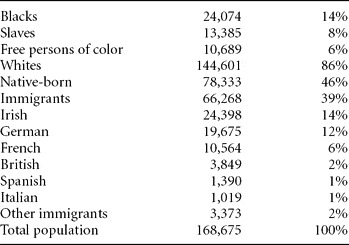
Established by the French in 1718, New Orleans had somehow thrived despite several changes of administration, periodic outbreaks of cholera and yellow fever, and frequent floods.Footnote 46 By 1860 New Orleans was the fifth largest city in the United States (see Table 1). It was also among the most culturally diverse, with blacks (both free and enslaved) making up fourteen percent of the total population and whites (86 percent) divided almost equally between native born and immigrants (see Table 2).Footnote 47 Although a part of the United States for more than five decades, the city was still sharply divided both linguistically and culturally, with strong ties to European culture. The city's great love of music helped to provide employment for hundreds of musicians, most of whom were Europeans. As Lawrence Gushee has discovered, of the 222 musicians enumerated in the 1870 census, 80 percent were foreign born.Footnote 48 Dancing and opera provided their livelihoods, especially at the famous Théâtre d'Orléans and, starting in the fall of 1859, at the New Opera House (later known as the French Opera House) at the corner of Bourbon at Toulouse streets. Over the next decade, despite the effects of the war and occupation, musicians would still be drawn to the city. Oliveira arrived at the worst of times but rose quickly within the close-knit musical community, pursuing a career far different from that which he led in New York.
The five largest cities in the United States (ca. 1858–62). Source: Anderton et al., The Population of the United States (New York: Free Press, 1997)

New Orleans Population (1860 Census). Source: Donnald McNabb and Louis E. “Lee” Madère, Jr., A History of New Orleans, http://www.madere.com/history.html#015

Oliveira's in-laws, the Carillons, had settled in New Orleans in the late 1840s, finding a large but not particularly pious Jewish community.Footnote 49 The Sephardic congregation known as Nefutzoth Yehudah (Dispersed of Judah) had been founded in 1845 and in 1850 consecrated a synagogue in the former Christ Church, on Canal Street at Bourbon.Footnote 50 In 1857 the congregation moved to a new synagogue on Carondelet Street, between Julia and St. Joseph Streets, reported to be the most costly in the country.Footnote 51 We are not sure how Miriam Oliveira's parents earned a living in New Orleans. During the 1850 census, the forty-year-old Carillon was recorded as a “Jewish clergyman,” residing in Ward 4 with his wife and six children. The enumerator also recorded that he was “insane,” an assessment made earlier by Carillon's own father and perhaps corroborated by his erratic behavior.Footnote 52 After disappearing from the city directories in the 1850s, the family was in financial trouble when it reappeared in 1860.Footnote 53 We have no information on how much Miriam Oliveira knew of her parents’ situation when she and Jacques set out for New Orleans.
Traveling south on the steamer James Adger, the Draytons had departed at least two weeks ahead of Oliveira, expecting him to meet them in New Orleans.Footnote 54 From Charleston, South Carolina, the Draytons crossed over land to New Orleans, where on 19 November they opened a three-week engagement at the Academy of Music, on St. Charles Avenue, next door to the famous St. Charles Theatre. Given Oliveira's departure from New York at the end of October 1860, he and Miriam should have arrived in New Orleans in early November. Setting off on the eve of the 1860 election, with the country on the brink of civil war, they may have encountered difficulties. Within weeks of Abraham Lincoln's election, the southern states began to secede from the Union.Footnote 55
Given the political situation, the Draytons had less competition than usual but also less success than they might have expected. In their New Orleans advertisements, they appealed to French-speaking operagoers, alluding to the newly popular form of French opera by billing themselves as the “Opéra Bouffe Anglais.”Footnote 56 Other advertisements noted that during the intermission audiences could look forward to hearing Henri Drayton's interpretation of “La Marseillaise,” “as sung by him in Paris during the Revolution of 1848.”Footnote 57 The added attraction seems not to have diverted the attention of the French-language press, which was firmly focused on events at the New Opera House and only acknowledged the Draytons’ presence.Footnote 58 Expecting Oliveira to arrive, and perhaps having heard from him, the Draytons listed the violinist in their advertisements on 24 November, and again six days later, but it is unclear if he arrived in time to perform.Footnote 59 The company then traveled to Baton Rouge for a five-night engagement during which only on the closing night did Drayton advertise Oliveira's participation.Footnote 60
Whether or not he had arrived in time to perform with the Parlor Opera Company, Oliveira did arrive in Louisiana, and he remained there after the Draytons returned to New York in the early days of January 1861. Advertising himself as “Violinist to Her Majesty the Queen of England,” Oliveira staged a concert in the courthouse of the town of Plaquemine, just south of Baton Rouge, on 5 February 1861, with a local pianist known as Herr Kepler.Footnote 61 Two months later, the war began, and we lose sight of the Oliveiras until October when Miriam, now in the state of Georgia, gave birth to a child named for her father and husband, Benjamin Jacques Oliveira.Footnote 62
By the early months of 1862, the Oliveiras eventually settled in a New Orleans that was far different from the city they set out for in the autumn of 1860. Over the course of 1861, the Federal blockade had caused the city's economy to collapse.Footnote 63 At the same time, the city's population tumbled as some 20,000 men enlisted in the army and were redeployed to other parts of the Confederacy.Footnote 64 Then, in the spring of 1862, New Orleans fell to the invading Union forces, which occupied the city for the next three years. The city's citizens were governed first by the sometimes-ruthless General Benjamin Franklin Butler, whom they came to call “the Beast.” His tenure as commander lasted seven months, and at some point during this time the Oliveiras, now a family of four, arrived in the city.
In the summer of 1862, Oliveira made what seems to have been his first appearance before a New Orleans audience. The event was a benefit concert for the composer and conductor Eugène-Prosper Prévost. Like many New Orleans residents, Prévost had decided to leave rather than take an oath of allegiance to the Union. After more than two decades as director of the Théâtre d'Orléans, he had chosen to return to his native France.Footnote 65 The concert took place on 26 July at the New Opera House, and despite the participation of many of the city's leading singers it appears not to have been very successful. In its review, l'Abeille de la Nouvelle-Orléans drew attention to the many seats now empty due to death, and especially to the absence of many young men.Footnote 66 The same review discussed the appearance of several performers, among them Oliveira:
We have yet to talk about Mr. Jacques Oliveira whose wonderful bow helped to make Saturday's concert a true musical pageant. All those who heard him were able to judge that we have not exaggerated. In the seventh concerto of Bériot, where he was perfectly accompanied by the musicians of the orchestra, in the air from “Pré aux clercs,” for solo violin, and in Sainton's fantasy on themes from Donizetti's Lucretia Borgia, Mr. Oliveira displayed all the qualities of a talent of the first order. Soul, refinement, a wonderful facility in difficult passages, remarkable accuracy, all are found in this artist, whom we do not hesitate to place among the greatest violinists of our time.Footnote 67
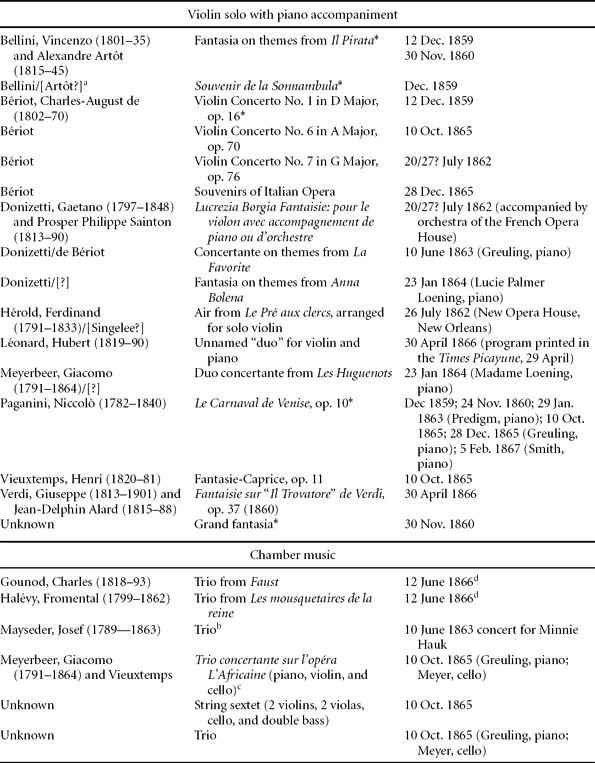
In the opening sentence of the passage quoted above, the writer gives the impression that Oliveira was unfamiliar to the newspaper's readers. Through his repertoire, however, he established himself within New Orleans's francophone community (see Table 3). In addition to the works of de Bériot, he added familiar operatic material. The extract from Ferdinand Hérold's highly popular 1832 opera was quite possibly the fantasy published by the Belgian composer Jean-Baptiste Singelee (1812–75).Footnote 68 The fantasia on Donizetti's Lucretia Borgia was composed by the French violinist Prosper Philippe Sainton (1813–90). After seemingly endless performances of the Carnival of Venice for New York theater audiences, the warm reception given him in New Orleans for performing the music he was trained to play must have seemed a revelation to Oliveira. For the first time since arriving in the United States, he would be playing at concerts rather than appearing as a novelty act in theatrical performances.
Jacques Oliveira's repertoire
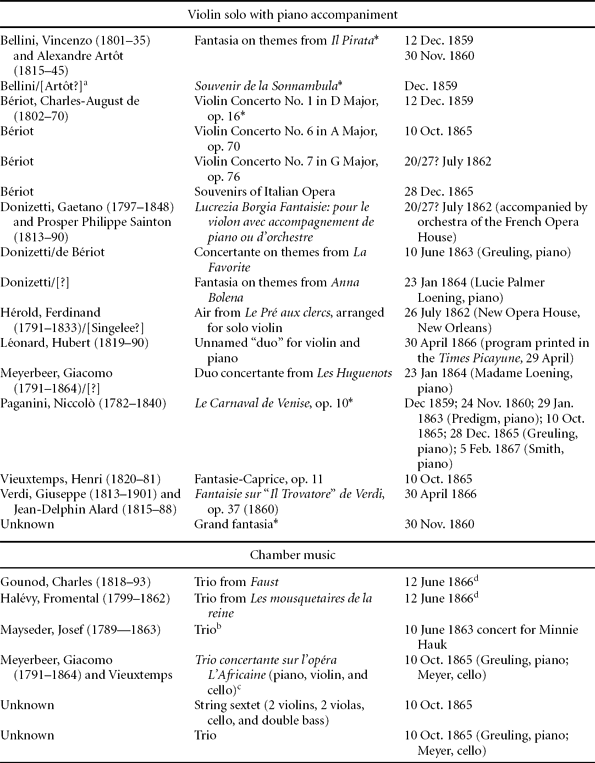
* Performed before arriving in New Orleans (as well as after)
a This was possibly Souvenirs de Bellini, op. 4. (1849), a popular work by Alexandre Artôt, but also might have been Fantasia on Themes from Bellini's “La Sonnambula” (1855) by Henryk Wieniawski (1835–80).
b The Austrian violinist and composer and conductor Josef Mayseder appears to have completed four trios for piano, violin, and cello. He published his Trio in B-flat, op. 34, in 1820, and his Piano Trio No. 4 in G major, op. 59, in 1843. The program of the concert for Minnie Hauk on 10 June 1863 at the Opera House was published in the Times-Picayune the day before but did not specify which Mayseder trio that Greuling, Oliveira, and Louis Meyer were to perform.
c The Trio was first performed April 1865, and in September of that year arias from the opera were sung at another concert in New Orleans.
d Performance at the Odd Fellows' Hall in New Orleans with Greuling and Meyer canceled due to Oliveira's ill health.
Oddly, then, the first paid performance we have a record of was much like jobs Oliveira had in New York. In January 1863 he received support from the New Orleans Bee and at least a temporary paying job at the Varieties Theatre. The manager of this Gravier Street venue, Lewis Baker, presented English-language dramas. In a notice that read much like those in New York, on 20 January 1863 the Bee informed readers that Oliveira would be performing between acts at the Varieties:
We think that the performances at the Varieties, varied and interesting as they are, would be enhanced, as we have before observed, by the occasional introduction of some of the chef d'oeuvres of operatic music. Mr. Baker has connected with his theatre a talented performer on the violin—Mr. Oliveira—and we would again express the hope that he will make the public more familiar with that gentleman's rare abilities. Let us have “The Carnival of Venice” again by all means and in bringing Mr. Oliveira forward Mr. Baker will confer a favor on those who delight in the noble art of music.Footnote 69
The writer may have seen in Oliveira something of Carlo Patti, Adelina Patti's brother who had served as violinist and music director at the Varieties until he enlisted in a Tennessee regiment in 1861. The same day as the notice appeared, the advertisement for the Varieties announced the evening's entertainment to be the “Romantic Psychological drama, in 5 acts and 5 tableaux, The Corsican Brothers.”Footnote 70 Although presented in English, Baker would have hoped this adaptation from the novel of Alexandre Dumas, père, would attract both an English- and a French-speaking audience. We have no evidence of the production's success, what payment Oliveira might have received, or how he felt about the repertoire. It was, nevertheless, a job that helped to raise his profile on both sides of Canal Street, and it came at a time when opportunities to perform were few and the family's financial need greater than ever.Footnote 71
The close of 1862 had brought some positive developments to New Orleans. Many people were pleased to see the much-reviled General Butler replaced as commander of the Department of the Gulf by General Nathaniel P. Banks, who arrived in December with his wife, Mary Palmer Banks. With the change, the people of New Orleans began to accept their fate and the likely outcome of the war.Footnote 72 Musical activity began to increase, and Oliveira's name appeared more frequently in New Orleans newspapers, although most often in connection with benefit concerts. On 29 January 1863, Oliveira took part in a farewell concert at the New Opera House for an actor named Julien, an event that brought together members of the city's German theater and French Opera performers. Accompanied by Auguste Predigam, Oliveira was billed as performing Vieuxtemps's Carnaval de Venise.Footnote 73 Presumably these were the same variations he had been performing for several years. Vieuxtemps's name still had great drawing power in New Orleans. Older citizens may well have remembered his 1844 visit to the city, during which, as during his shorter stay in 1858, he played Paganini's Carnival of Venice.Footnote 74 The popularity of the piece may have been one of the things audiences in both the North and South had in common. In addition to it, Oliveira would most often play works adapted from French opera, as his repertoire increasingly reflected the tastes of European New Orleans.
After his engagement at the Varieties Theatre and several concert appearances, Oliveira quickly assumed a prominent place in New Orleans's musical life. By the middle of 1863, Oliveira's name was frequently listed among a group comprising mostly francophones and immigrants from diverse backgrounds. Together, they supported charities and other musicians. He performed several times with Minnie Hauk (1851–1929), a young soprano then studying in New Orleans with the Spanish-born musician Gregorio Curto.Footnote 75 The first of these performances was Hauk's debut recital, in June 1863. Here Oliveira played in a trio with the pianist Phillip Greuling and the cellist Louis Meyer, two German immigrants with whom he would frequently perform.Footnote 76 His circle also included several women instrumentalists. Among them was the ambitious young French pianist Octavie Romey. She had taken part in the concert on 26 July 1862, playing Louis Moreau Gottschalk's Jerusalem, fantasie triomphale, op. 13, and Maurice Strakosch's Grand fantasie sur des motifs de ‘Lucia di Lammermoor.’ New Orleans-raised Lucie Palmer, a pianist who was usually billed as Madame Loening, was another collaborator.Footnote 77 Political sentiment united some of these musicians. As we have seen, some chose to leave New Orleans rather than pledge their support for the Union. Palmer's German-born husband, George Loening, published at least two pro-Confederate compositions in 1861.Footnote 78 After New Orleans surrendered to Union troops, music publishing faced the same rules of censorship as newspapers and other publications under Federal administration, as A.E. Blackmar, New Orleans's most active music publisher, discovered. In 1862 Greuling worked briefly as an engraver for Blackmar, producing, among other works, La Hache's Improvisation on the Favorite Air My Maryland and Improvisation on the Bonnie Blue Flag. Their publication would lead to Blackmar's arrest but did not force him out of business.Footnote 79 As late as 1864, he published two pro-South pieces by Romey.Footnote 80 But with the occupation, censorship, and the dismal economy, musicians had few opportunities to publish. Oliveira is not known to have performed or published compositions of his own.
While presses remained tightly controlled, the new commander in New Orleans, General Banks, took a more moderate approach to administering the city in an effort to win the support of its residents. Lawrence Gushee has shown how these reforms had a direct effect on musicians’ livelihoods, as the administration issued “some 150 licenses for balls, private parties, and soirées” in the first ten weeks of 1864.Footnote 81 The return of carnival season coincided with the lead-up to gubernatorial elections, and Banks made ample use of music in his attempt to turn New Orleans to the Union side, bringing in Patrick Gilmore and his band to help whip up excitement. On 26 January, General Banks and his wife hosted a soirée or promenade concert at the New Opera House intended to bring together the city's elites. Gilmore's band supplied the music, and Oliveira was a featured soloist. Politics being foremost on the minds of journalists reporting on the event, there appears to be no record of what was played.Footnote 82 Three nights later, Oliveira took part in another concert with Gilmore's band. This one, at Lyceum Hall, was reported to be a farewell concert for a child performer known as Little Clara Fisher.Footnote 83 Other events were still in the works.
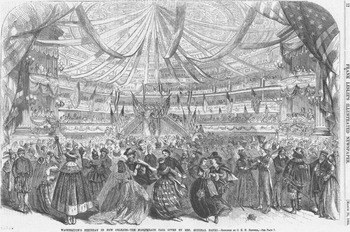
Banks was keeping Gilmore in town for much bigger events planned for a few weeks later. Celebrations marking Washington's Birthday, on 22 February, took on more than the usual political overtones as Banks selected the holiday to hold a gubernatorial election. Gilmore's band played a morning concert on Canal Street supported by a battery of cannons. They opened with “Hail Columbia” and closed nearly two hours later with a medley of national airs punctuated by artillery fire. That evening, with Banks's candidate, Michael Hahn, declared victorious, the general's wife celebrated in New Orleans style: She hosted a masquerade ball at the New Opera House (see Figure 3). For Hahn's inauguration on 4 March, Gilmore gave a “Monster Concert” in an illuminated Lafayette Square, with a band of 300 or possibly more and a chorus of several thousand school children singing “The Star Spangled Banner,” “Hail Columbia,” and other national songs, as well as the Anvil Chorus from Il Trovatore.Footnote 84 The event clearly provided Gilmore with the model he would repeat on an even grander scale in Boston in 1869 and again in 1872.
With music performed by Patrick Gilmore's musicians, Unionists celebrate Washington's Birthday and the election of Michael Hahn as Louisiana governor with a costume ball at the New Orleans French Opera House on 4 March 1864. Drawing by C. E. H. Bonwill in Frank Leslie's Newspaper, 26 March 1864.

Oliveira's participation in concerts with Patrick Gilmore leads us to consider what his political views may have been. We should not assume that he was a Unionist. He had children to feed, and these were paying jobs. On the subject of the war, Rosen has described the Jewish community as divided, with the old families firmly committed to the Confederacy, but the recent arrivals much less so.Footnote 85 James K. Guthheim, rabbi of the Dispersed of Judah, left New Orleans rather than take the oath of allegiance to the Union that was required of public figures.Footnote 86 As with so many aspects of Oliveira's life, we simply have no evidence of his political views, only knowledge of his environment and of some of his activities.
Following Gilmore's departure, Oliveira remained busy. He took part in several concerts at the Opera House, and in September he announced his own Grand Concert of vocal and instrumental music, which took place at St. Alphonse Hall. He and the pianist Greuling staged a benefit concert marking the tenth anniversary of the founding of the Institution for the Benefit of Jewish Widows and Orphans. With the return of Mardi Gras celebrations in 1865, they co-conducted the orchestra of the Varieties Theatre at a masquerade ball held at the St. Charles Theatre.Footnote 87 Life seemed to be returning to normal, and although the war would soon be over, difficult times continued. That summer, his two-year-old daughter Sarah died, possibly from cholera or yellow fever.Footnote 88 Oliveira's name does not appear in the newspapers again until autumn, when on 10 October he and Greuling gave the first in a planned series of chamber concerts at the Opera House. The Times-Picayune published two separate reviews on 12 October. The first described Oliveira's interpretations as “superior in feeling, style, and artistic treatment,” while deploring that “there was not a larger house last evening to hear the splendid music,” and expressing the hope that the concert would be repeated.Footnote 89 In addition to the chamber works he had played with Greuling and Meyer, Oliveira played solo pieces by de Bériot and Vieuxtemps, and gave a by now rare performance of Paganini's Carnival. In its second review, the Times-Picayune commented on the relative merits of these works, stating that the de Bériot “pleased us most, as superior in feeling, style, and artistic treatment by both composer and performer to the fantaisie by Vieuxtemps and the burlesque, though striking Carnival. The latter is a feat of musical gymnastics, not of music.”Footnote 90 The comments recall those published in the Brooklyn Daily Eagle of several years earlier. Perhaps simply out of respect for the violinist, the Times-Picayune ended its review by conceding that the piece had been “wonderfully well executed. Oliveira possesses remarkable dexterity, accuracy and delicacy combined with brilliancy, and true musical feeling. He was applauded warmly and twice called out.” Oliveira and Meyer gave their next concert on the other side of Canal Street, at the Odd Fellows’ Hall on 27 December. We have no evidence of its success or of what was played at this large venue. If it were filled it would have been a lucrative venture, but that seems unlikely.
Most of the performances through 1866 were benefits, raising money for widows, orphans, and departing musicians. The war's end did little to prevent 1866 from being a generally miserable year for New Orleans. Political and racial tensions, rising steadily since the war's end, exploded in the Riot of 30 July 1866.Footnote 91 Cholera and yellow fever returned with a vengeance, together claiming 5,195 lives between 1866 and 1867.Footnote 92 The dire mood of the city put many musicians and entertainers in an especially desperate financial position. In 1866 fires destroyed both the grand Odd Fellows’ Hall, on 5 July, and the historic Théâtre d'Orléans, on 7 December. Some performers returned to New Orleans hoping to recapture their earlier success in the city. Duprez and Benedict's Minstrels opened to a good house at the St. Charles Theatre on 5 September 1866, but attendance quickly dropped off. A review published in the Times-Picayune on 10 September summed up the situation of many at the time: “the entertainment offered seems to have been selected with a view to attract a good share of the amusement seekers who have remained in the city, despite the warm weather, cholera and the dull season.”Footnote 93 Later the same month, the steamer Evening Star left New York en route to New Orleans with nearly 300 passengers, among them a theatrical troupe destined for the Academy of Music and a full French opera company, only to sink in a hurricane off the coast of Georgia.Footnote 94
We have few details on how Oliveira made a living during this time. Undoubtedly, he did some teaching, but that profession was no longer as lucrative as it had been before the war. Under better conditions, he might have been employed as a cantor, as his uncle had in Amsterdam. The war, however, had greatly reduced religious services and opportunities for musicians to play a professional role in the church or synagogue. The reappearance of the New Orleans City Directory in 1867, showing the family living in a poor district, provides the best evidence of the their financial situation.Footnote 95
Through 1866 and into 1867, Oliveira soldiered on, finding new collaborators and opportunities to perform. On 10 May 1866, he began a series of concerts with the contralto Madame Fleury-Urban at the French Opera House. A brief note in the Picayune that day reported the performers to be “the finest contralto of the land, assisted by our favorite violinist, Signor Oliveira.” Advertisements for a concert at the Odd Fellows’ Hall on 12 June list Oliveira's planned contributions as being Vieuxtemps's Fantaisie-Caprice, op. 11, and, along with Greuling and Meyer, two operatic transcriptions for piano trio: Halévy's Les Mousquetaires de la Reine and another from Gounod's Faust. In its review, the critic of the Picayune simply noted that Oliveira had been unwell and did not perform.Footnote 96 Increasingly he was unable to perform due to an illness that newspapers mentioned but did not identify. Oddly, given the difficulties of life in New Orleans, in the early months of 1867, he found a new performing partner in Gustave Smith, a forty-year-old French pianist and organist who had recently arrived by way of Montréal.Footnote 97 From January 1867 Smith became increasingly active in organizing and performing at concerts, including several with Oliveira in February and March. Together, they staged a benefit concert for the newly established German Protestant Orphan Asylum in the Grand Salle of the Moresque Building and a benefit for the Germania Männerchor in the Lyceum Room at City Hall. In April they announced plans for their own “parlor concert” series at Lyceum Room. Only one performance, on 23 May, seems to have taken place. Benefit concerts for flood victims caused some to be postponed, and Oliveira's ill health interrupted others.
The Daily Picayune announced Oliveira's death on 19 June 1867, claiming only that it had followed “a long and lingering illness.”Footnote 98 It also noted that the funeral would take place at the home of the thirty-one-year-old violinist. Later that month notices appeared in the newspapers informing readers that a benefit concert would be held by local musicians at the Opera House to raise money for Oliveira's widow and children.Footnote 99 The German Society organized the concert, recruiting among others Gustave Smith, the French-born conductor Gustave Collignon, and the vocalist Mme. Fleury-Urban, with whom Oliveira had planned that month to perform in Texas. The New Orleans Bee printed an announcement urging the public to support the cause, noting that “M. Oliveira was a popular artist in this city, and as he asked little for himself during his life, we hope that his widow and his children may reap some slight reward from their father's skill as a violinist. Let us give them a full house tonight. The programme is a good one.”Footnote 100 The public responded by filling the Opera House.Footnote 101 With this, the printed record of Oliveira's place in music comes to an end.
Epilogue
Miriam Oliveira remained in New Orleans and survived her husband by fifty-two years.Footnote 102 She did not remarry. She invested the benefit money in a “fancy goods” store on Camp Street in what is now downtown New Orleans. In 1870 she was living with her three children and her younger sister, Rachel.Footnote 103 In 1900, at the age of 62, she was living with her second son, Benjamin, and his family on Terpsichore Street in New Orleans.Footnote 104 The elder son, Abraham Oliveira, and his sister, Eva, had married in 1891 and 1893, respectively. All three of Oliveira's surviving children remained in New Orleans. None appears to have been involved in music professionally. Having suffered through the economic hardship of the 1860s, they knew too well of the risks that came with a life in music.
In New York, Oliveira had found steady employment and a warm reception. With Tom Thumb, the Draytons, and Hooley and Campbell's Minstrels, he performed nearly every night. The middle-class and lower middle-class audiences that attended these performances responded to his virtuosity and the “singing” quality critics frequently cited in reviews of his playing. His success came partly from a broad appreciation of the instrument. In its review of his U.S. debut, the New York Times referred to the violin as being “unquestionably the favorite instrument of our public.”Footnote 105 At a time when audiences sought sentimentality, his violin helped to fill seats.
Mid-nineteenth-century theater audiences, however, had little interest in what they termed classics. In New York, they seemed to expect Paganini's Carnival and little else. The limitations of Oliveira's popular success in New York appeared very quickly. He had made his debut with de Bériot's First Concerto, and in his first performances he also played fantasies on popular operas of the time. This repertoire differed little from that of Vieuxtemps on his most recent visit to North America. The main difference was the type of audience he was able to play before. Soloists arriving from Europe with established reputations, such as Vieuxtemps, Bull, and Camillo Sivori, embarked on concert tours. The unknown Oliveira had traveled in steerage, played in theaters, and become known to northern audiences as a sentimentalist.
Yet Oliveira had achieved more than most. Despite the popularity of their instrument, few violinists made careers as soloists in the Americas. Even with his famous name, Carlo Patti had turned to conducting to make a living, as did Theodore Thomas and the English violinist Henry C. Cooper, who had settled in New York in 1857. Among the small number of violinists who managed to pursue international concert careers while residing primarily in North America was the French-American Camilla Urso and the Belgian Frantz Jehin Prume. In the 1860s, they were exceptions.Footnote 106 Oliveira had the benefit of Barnum's support, but it led to only more theater appearances. By the end of his first year in New York, he likely sensed the obstacles before him.
Despite the financial hardships the family faced, New Orleans's musical traditions made it the natural place for Oliveira to pursue his career. This cosmopolitan culture had for decades attracted immigrant musicians, who found employment and sophisticated audiences. Whereas many of New Orleans's citizens sought refuge elsewhere during the war and Reconstruction, European musicians would continue to make the city their home. Oliveira had a ready audience among New Orleans's francophone population. His Belgian training and Franco-Belgian repertoire served him well as he brought out works by contemporary composers such as Prosper Philippe Sainton, Hubert Léonard, and, of course, de Bériot. These works, and his interpretations of them, enabled Oliveira to integrate into the larger European community. In the 1860s, Europeans of different backgrounds—French, Spanish, and German, Protestant, Catholic, and Jewish—mixed easily, as we see repeatedly from by their participation in each other's benefit concerts. Within this cosmopolitan world, Oliveira acclimatized better than most, crossing ethnic, linguistic, and religious lines. He appears never to have drawn attention to his Dutch origins. Even in New Orleans, the newspapers continued to refer to him as Signor or Señor Oliveira—U.S. newspaper writers seemed not to differentiate between the Italian and Spanish titles. Only in reporting news of Oliveira's death, does the Daily Picayune of 19 June 1867 refer to the violinist as a “native of Amsterdam, Holland.”