Implications
This study was conducted to evaluate the inclusion of essential oils in starter feed and/or milk replacer for dairy calves as alternatives to the use of antibiotics for disease control and/or growth promotion in response to their prohibited use in animal feed in the European Union (Official Journal of the European Union, 2003). These antimicrobial effects may result in neonatal diarrhea reduction, improved rumen development, enhanced calf performance and overall a decrease in calf mortality rates.
Introduction
Antibiotics are often used in ruminant nutrition aiming to manipulate rumen fermentation and minimize the growth of microorganisms that are known to reduce performance and increase morbidity and mortality rates. Various antibiotics are forbidden in the European Union, owing to the allegation of possible bacteria development of resistance and food security concerns. Currently, there is no definitive scientific data that supports bacterial resistance as a result of the use of antibiotics in animal production. However, alternatives are needed for animal production to be optimized, maintaining the animal health and welfare, minimizing environmental risks and ensuring food safety. Faced with these impasses, the scientific community has been looking for new compounds that may be used as alternatives to antibiotics.
Recent literature shows that plant secondary metabolites are alternatives to modulate ruminal fermentation (Calsamiglia et al., Reference Calsamiglia, Busquet, Cardozo, Castillejos and Ferret2007; Macheboeuf et al., Reference Macheboeuf, Morgavi, Papon, Mousset and Arturo-Schaan2008); control microorganisms present in the intestine (Bampidis et al., Reference Bampidis, Christodoulou, Florou-Paneri and Christaki2006) and improve overall animal performance (Hill et al., Reference Hill, Aldrich, Schlotterbeck and Bateman2007; Chester-Jones et al., Reference Chester-Jones, Steiner, Watkins, Taylor, Ziegler, Raeth-Knight and Golombeski2010). These compounds are considered Generally Recognized as Safe according to the Food and Drug Administration, by virtue of being safe for human consumption.
The most common health problem in dairy calf rearing systems is the occurrence of diarrhea and the consequent high mortality, morbidity and poor performance. Therefore, the reduction of intestinal pathogenic microorganisms may improve animal health, well-being and animal performance. Etiological microorganisms responsible for diarrhea in calves may be modulated by essential oils (EOs), as it was observed for piglets (Manzanilla et al., Reference Manzanilla, Perez, Martin, Kamel, Baucells and Gasa2004). Among the effects observed for supplemented animals are improved feed digestion and efficiency, maintenance of beneficial intestinal microflora and inhibition of pathogenic microorganisms (Durmic and Blache, Reference Durmic and Blache2012). Hill et al. (Reference Hill, Aldrich, Schlotterbeck and Bateman2007) studied the effect of EOs in milk replacer and observed increases in starter feed intake and better feed efficiency in dairy calves. Similar results were observed by Chester-Jones et al. (Reference Chester-Jones, Steiner, Watkins, Taylor, Ziegler, Raeth-Knight and Golombeski2010), including the reduction of intestinal disorders.
Moreover, EOs may effect rumen development due to their effect on microorganism populations and subsequent change in the rumen fermentation profiles. However, changes in short chain fatty acids (SCFA) profile are variable, depending on dose and specific EO evaluated (Busquet et al., Reference Busquet, Calsamiglia, Ferret and Kamel2006; Castillejos et al., Reference Castillejos, Calsamiglia, Ferret and Losa2007). On the other hand, ammonia-N concentration decreased in response to EOs supplementation in vitro (Busquet et al., Reference Busquet, Calsamiglia, Ferret and Kamel2006; Macheboeuf et al., Reference Macheboeuf, Morgavi, Papon, Mousset and Arturo-Schaan2008) or in vivo (Benchaar et al., Reference Benchaar, Petit, Berthiaume, Ouellet, Chiquette and Chouinard2007; Giannenas et al., Reference Giannenas, Skoufos, Giannakopoulos, Wiemann, Gortzi, Lalas and Kyriazakis2011). These changes in rumen SCFA and ammonia-N insert are a consequence of modulation of the rumen microorganism populations. Giannenas et al. (Reference Giannenas, Skoufos, Giannakopoulos, Wiemann, Gortzi, Lalas and Kyriazakis2011) observed a decrease in counts of ammonia-hyper producing bacteria (AHP), while counts of cellulolytic bacteria and protozoa were not affected by EOs supplementation.
The objectives of the current study were to evaluate the use of a commercial blend of EOs, incorporated in milk replacer and starter feed in relation to improvements in fecal scores and the overall performance of the young dairy calves, as well as the effects of these oils on ruminal fermentation and microbial population.
Material and methods
A total of 30 newborn and colostrum-fed Holstein calves were individually housed at the experimental calf facility of the Department of Animal Science of the ‘Luiz de Queiroz’ College of Agriculture. Calves received 6 l of milk replacer daily (Sprayfo Violet® 20% CP : 15%EE, 12.5% solids; Sloten of Brazil Ltd, Santos, SP, Brazil), divided into two meals (0700 and 1800 h), and had free access to water and starter feed. Calves were randomly assigned by birth weight to one of the three treatments as follows: (1) control with no EOs supplementation (C); (2) supplementation of 400 mg/kg EO blend in the milk replacer (MR) and (3) supplementation of 200 mg/kg EO blend in the milk replacer and 200 mg/kg EOs blend the starter feed (MRS). The composition of the milk replacer and starter feed are summarized in Table 1. The starter feed was formulated according to National Research Council (2001) guidelines. EOs were blended into the starter feed using a ‘Y’ mixer (Lucato, Limeira, SP, Brazil). Individual doses of EO blend were mixed in the milk replacer at feeding time. The EO blend (Activo®, GRASP, PR, Brazil) was composed of a combination of several microencapsulated EO: carvacrol, cineole, cinnamaldehyde, pepper oil resin and mannanoligosaccharide as a vehicle.
Chemical composition of starter feed and milk replacer

EO=essential oils; DM=dry matter.
1 Sprayfo Violeta Sloten of Brazil Ltda., Santos, São Paulo, Brazil.
The starter feed was supplied ad libitum and every morning the refusals were weighed so as to obtain the daily starter feed intake. After abruptly weaning calves at 8 weeks of age, calves received starter concentrate and coastcross hay (Cynodon spp.) ad libitum until the 10th week of age.
Calves were weighed weekly, before the morning milk feeding, on a mechanical balance (ICS-300; Coimma Ltd, Dracena, SP, Brazil) and measurements of withers height, heart girth and hip width were taken. Every morning feces were scored for fluidity, color, consistency and odor, as described by Larson et al. (Reference Larson, Owen, Albright, Appleman, Lamb and Muller1977).
From the 2nd week of age fecal samples were collected for lactic acid bacteria (LAB) and Enterobacteria counting, after serial dilution with distilled water (10−1 to 10−10). LAB were counted using Petri plates with nutrient agar Man Rogosa Sharper (Becton, Dickson and Company, MD, USA) (Kawakami et al., Reference Kawakami, Yamada, Nakanishi and Cai2011). Samples were placed in closed jars containing anaerobic condition generator (ANAEROBAC; Probac Bacteriological Products of Brazil Ltda., São Paulo, SP, Brazil) in a biochemical oxygen demand (BOD) incubator Model TE-402 (Tecnal, Piracicaba, SP, Brazil) at 32±1°C for 48±3 h. For Enterobacteria counts, Petrifilm plates (3M® Brazil; Sumaré, SP, Brazil) were used and samples were incubated at 32.5±1°C in BOD incubator Model TE-402 for 24±2 h. After the incubation period, counting proceeded by considering the areas with red colonies with yellow and/or red colonies with gas bubbles, with or without yellow borders positive for Enterobacteria.
From the 2nd week of life, ruminal fluid samples were collected weekly, using an oro-esophageal tube and a vacuum pump, with care to avoid saliva contamination. Samples (50 ml) were filtered through an appropriate cloth tissue and pH was immediately measured (TEC-5; Tecnal, Piracicaba, SP, Brazil). Samples were frozen for later analyses of SCFA and ammonia-N. Samples were centrifuged at 15 000× g (Universal 320R; Hettich, Tuttlinger, German) for determination of SCFA, carried out as described by Palmiquist and Conrad (Reference Palmiquist and Conrad1971); and ammonia-N nitrogen concentration by the method of Chaney and Marbach (Reference Chaney and Marbach1962), adapted for a biochemistry automatic reader (SBA-200; CELM, Barueri, SP, Brazil) using a 540 nm absorbance filter.
The quantification of cellulolytic and amylolytic bacteria were performed using mineral solution (Goshe, Reference Goshe1987) supplemented with 1% carboxymethylcellulose and soluble starch (Cromaline Fine Chemicals Ltd, Diadema, SP, Brazil). Plates were placed in anaerobic jars and incubated in BOD incubator (TE-402) at 38°C until the appearance of colonies. The methodology for quantification of protozoa used was an adaptation of the proposal by Dehority (Reference Dehority1977). After sample filtration, 500 µl of rumen contents was added to 500 µl of 18.5% formaldehyde solution and then 2 ml of dye solution (formaldehyde 35% NaCl, methyl green and water) to give a solution of 1 : 5 in the final product. Counts were done using MacMaster-like chamber in a binocular microscope (Bioval, Jiangbei, China). Blood samples were taken weekly, 2 h after morning feeding, Via jugular venipuncture using vaccum tubes containing sodium fluoride and potassium ethylenediaminetetraacetic acid. Samples were centrifuged at 2000× g (20 min at 4°C) and plasma stored until analysis. Specific enzymatic kits were used to analyze plasma concentrations of glucose (Glicose HK Liquiform – Ref.: 85; Labtest Diagnóstica S.A., Belo Horizonte, MG, Brazil) and β-hydroxybutyrate (BHBA, RANBUT – Ref.: RB1007, Randox Laboratories, Crumlin, UK) in an automatic biochemistry system (SBA-200, CELM, São Paulo SP, Brazil).
Starter feed and hay were periodically sampled, dried at 55°C and ground through a 1-mm mesh for dry matter (DM), ash, EE and CP determination according to Association of Official Analytical Chemists (2000). CP was determined by combustion (Dumas method), using a N analyzer by LECO, model FP-528 (St. Joseph, MI, USA) and CP was calculated by multiplying results by 6.25; free-ash NDF and ADF and lignin were determined, according to the method of Van Soest et al. (Reference Van Soest, Robertson and Lewis1991), using sodium sulfite and thermo stable amylase when required; and N-NDF and N-ADF were determined according to Licitra et al. (Reference Licitra, Hernandez and Van Soest1996). The total digestible nutrients values were calculated according to the equation proposed by Weiss (Reference Weiss1993) and non-fiber carbohydrates as suggested by Hall et al. (Reference Hall, Jennings, Lewis and Robertson2000).
Statistics
Performance and plasma metabolites data were analyzed as repeated measures by the PROC MIXED of SAS according to the model (1) below. Data for fecal or rumen microorganisms counts were also performed by the model (1) after transformation to log 10. Significance was adopted for values of P<0.05 for all parameters:
 $$Y_{{ijk}} =\mu {\plus}T_{i} {\plus}B_{j} {\plus}W_{k} {\plus}T_{i} W_{k} {\plus}E_{{ijk}} $$
where Y ijk is the response variable, µ the overall mean, T i the treatment effect, B j the block effect, W k the age effect and E ijk the residual effect.
Results and discussion
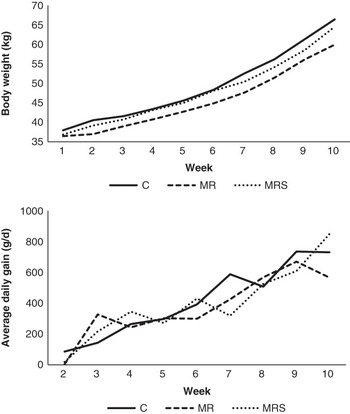
The starter feed intake, BW and daily weight gain were not affected by treatments (P>0.05). There was an interaction between treatment and age for the starter feed intake (P<0.05); however, this interaction was not observed for the treatments in the same week of life of the calves (Table 2). As might be expected, the age effect was significant (P<0.0001) for the starter feed intake, since there is an increased need to consume more nutrients as animals age (Figure 1). Manzanilla et al. (Reference Manzanilla, Perez, Martin, Kamel, Baucells and Gasa2004) supplemented piglets with EO blend (0, 150 and 300 mg/kg) and observed similar results, with no difference for BW or daily weight gain.
Starter feed intake (g/day), according to week of age, of calves supplemented with an essential oils (EOs) blend. C=control; MR=400 mg/kg EOs in milk replacer, MRS=200 mg/kg EOs in milk replacer and 200 mg/kg in the starter feed.

Average starter intake, BW, average daily gain and gain of body measurements of calves supplemented with an essential oils (EO) blend

C=control; MR=400 mg/kg of EO in milk replacer; MRS=200 mg/kg of EO in milk replacer and 200 mg/kg of EO in starter feed; T=treatment effect; A=age (week) effect; T×A=treatment and age interaction effect.
1 A total of 10 animals/treatment during 70 days of life.
Starter feed intake is negatively related to the liquid diet volume (milk or milk replacer) fed (Davis and Drackley, Reference Davis and Drackley1998). The starter feed intake increased over the weeks (Figure 1), but from the 6th week the shape of the curve changed with a dramatic increase from the 8th week. Data shows that the EO blend had no effect on acceptance of liquid or solid diet, suggesting that, if there was a change in palatability, it was not deleterious to feed intake. Even though supplementation with EO blend did not affect (P>0.05) BW and average daily gain (Figure 2), there was a significant effect of age for these variables (P<0.0001; Table 2), which progressively increased until the 10th week of life. The weight gain values are similar to those found by Ferreira and Bittar (Reference Ferreira and Bittar2011), in similar housing and climate conditions, when additives to improve the overall performance of dairy calves were tested.
BW (kg) and average daily gain (g/day), according to week of age, of calves supplemented with an essential oils (EOs) blend. C=control; MR=400 mg/kg EOs in milk replacer, MRS=200 mg/kg EOs in milk replacer and 200mg/kg in the starter feed.

Body measurement gains (withers height, heart girth and hip width) were also not affected by supplementation with the EO blend (Table 2). However, since calves were growing, there was a significant age effect (P<0.0001) for all measures. Observed body measurements are slightly lower than those found by Ferreira and Bittar (Reference Ferreira and Bittar2011), with sodium propionate supplementation as an alternative to antibiotics in similar experimental conditions.
The average fecal scores (fluidity, color, consistency and odor) were not affected by EO supplementation (P>0.05), which was unexpected. However, the age of the calves had a significant effect (P<0.0001) in changes of fecal scores of calves (Table 3), with decreasing scores after the 4th week of age. According to Larson et al. (Reference Larson, Owen, Albright, Appleman, Lamb and Muller1977), when the animal has diarrhea, score for fluidity is higher than 2.5 (considering a 1 to 4 scale). During week 4, calves in group MR (400 mg/kg of EO blend on milk replacer) exceeded the score of 2.5 (Figure 3). Bampidis et al. (Reference Bampidis, Christodoulou, Florou-Paneri and Christaki2006) observed no differences for fecal scores of dairy calves supplemented with neomycin (2.58) or with oregano EO (2.67). According to Durmic and Blache (Reference Durmic and Blache2012), the EO may assist in the maintenance of the intestinal flora balance, minimizing cases of diarrhea in animal husbandry. The supplementations of EO blend by different routes were not associated to any score of color, odor or consistency. The number of days that calves showed fluidity fecal score above 2.5 was not affected by EO blend supplementation (P>0.5). However, the age effect was observed (P<0.0001), with a reducing number of days as calves’ aged, until reaching score 0 in weeks 9 and 10. The average total days with diarrhea was also not different among treatments (P>0.5), with 13, 15 and 14 days for the control, EO on replacer milk and EO in the total diet, respectively.
Fecal scores of fluidity, according to week of age, of calves supplemented with an essential oils (EOs) blend. C=control; MR=400 mg/kg EOs in milk replacer, MRS=200 mg/kg EOs in milk replacer and 200 mg/kg in the starter feed.

Mean values of fecal scores and counts of intestinal microorganisms of calves supplemented with an essential oils (EO) blend

C=control; MR=400 mg/kg of EO in milk replacer; MRS=200 mg/kg of EO in milk replacer and 200 mg/kg of EO in starter feed; T=treatment effect; A=age (week) effect; T×A=treatment and age interaction effect.
1 A total of 10 animals/treatment during 70 days of life.
2 Scale of score and fecal components by Larson et al. (Reference Larson, Owen, Albright, Appleman, Lamb and Muller1977): (1) normal-firm but not hard, (2) soft-does not hold form, (3) runny-spreads easily and (4) devoid of solid matter.
Control treatment had lower number of calves with score higher than 2.5 (67%) as compared with calves supplemented via liquid diet (90%) or Via solid and liquid diet (80%); in addition, the fecal score and the scores of severity of diarrhea tended to be very low compared with non-supplemented calves. One possible explanation for these results is an adverse effect caused by EO in the calves’ intestinal tract. Durmic and Blache (Reference Durmic and Blache2012) reported that EO may be associated with reduced enzyme activity and changes in the anatomy and physiology of the intestinal lining epithelium, contributing therefore, to the development of intestinal problems.
The evaluated intestinal flora (Table 3) showed no significant difference in response to supplementation of EO in either route of supply (P>0.05). The comparison between the beneficial microorganisms (LAB) and the harmful ones (Enterobacteria) helped in the conclusion that the intestinal flora of the calves was predominantly populated by bacteria that helps maintain balance and normal functioning of the intestine. The count of LAB was about 7.0 log 10 colony-forming units (CFU/gDM), while the count of Enterobacteria was 4.5 log 10 CFU/gDM (Table 4). These results confirm the fecal scores results discussed, since only the calves that received EO in a liquid diet had fecal score (fluidity) above 2.5 on the 4th week of age (Figure 3). Similar to the results of the fecal scores, the Enterobacteria counts were affected only by the age effect (P<0.0001), with decreasing counts as calves’ aged.
Mean values of pH, ammonia nitrogen (ammonia-N) and short chain fatty acids (SCFA) of calves supplemented with an essential oils (EO) blend

C=control; MR=400 mg/kg of EO in milk replacer; MRS=200 mg/kg of EO in milk replacer and 200 mg/kg of EO in starter feed; T=treatment effect; A=age (week) effect; T×A=treatment and age interaction effect.
1 A total of 10 animals/treatment during 70 days of life.
Despite the decreased counts of LAB over the weeks, this reduction was much smaller when compared with the decrease in the Enterobacteria counts. As a whole, the microbial flora tends to decrease or stabilize with the immune system and animal development. It was observed that the LAB counts were almost constant up to 6 weeks and decreased thereafter while at this point Enterobacteria were in higher concentration. That occurred probably because of the control action that Lactobacillus strains have on Escherichia coli. From week 6, both groups of microorganisms had reduced counts, indicating stability of the intestinal tract flora, which may be confirmed by fecal characteristics, since at the 6th week fluidity scores were lower than 2 for supplemented calves.
There were no differences in ruminal parameters that might have been reflected in calf performance or rumen development. Rumen pH were not affected by treatments (P>0.7) or the age of the calves (P>0.1; Table 4). SCFA, the fermentation end products, are highly correlated with starter intake. After weaning, calves showed a significant increase in starter feed intake, which resulted in similar response for the SCFA concentrations, as well as for the acetate to propionate ratio (C2 : C3; Table 4). The main SCFA (acetate, propionate and butyrate) concentrations were significantly higher (P<0.0001) after weaning. However, the SCFA concentrations were not affected by EO supplementation (P>0.05). Although all SCFA increased as calves’ aged, with increasing starter intake, and consequent rumen development, propionate had a higher increase in concentration, which reduced the C2 : C3 ratio at weaning. Similar results were found by Benchaar et al. (Reference Benchaar, Petit, Berthiaume, Whyte and Chouinard2006) when dairy cows supplemented with EO blend (2 g/day) containing thymol, eugenol and limonene and total SCFA, propionate, butyrate or C2 : C3 ratio were not affected. In subsequent studies, Benchaar et al. (Reference Benchaar, Petit, Berthiaume, Ouellet, Chiquette and Chouinard2007) supplemented dairy cows with a smaller dose (0.75 g/day) of the same EO blend, with no significant effects on rumen fermentation profile. Apparently, EO at the doses tested in the present study were not able to modulate the rumen fermentation.
The ammonia-N concentrations were altered with the EO blend supplementation (P<0.05). Calves receiving EO in the total diet (MRS) presenting significantly higher (P<0.05) concentrations than calves not supplemented or supplemented only Via liquid diet (Table 4). These results disagree with the results found in dairy sheep by Giannenas et al. (Reference Giannenas, Skoufos, Giannakopoulos, Wiemann, Gortzi, Lalas and Kyriazakis2011), where the concentrations of ammonia-N decreased with EO supplementation. The EO are recognized as a modulator of the nitrogen metabolism in the ruminal environment, reducing the deamination and also the population of AHP. Busquet et al. (Reference Busquet, Calsamiglia, Ferret and Kamel2006) observed significant decrease of ammonia-N concentration with increasing dose of EO tested in vitro (32.2 mg/dl in the control group and 11.6 mg N/100 ml at the dose of 3.000 mg/l). Macheboeuf et al. (Reference Macheboeuf, Morgavi, Papon, Mousset and Arturo-Schaan2008) conducted in vitro studies with different EO doses in sheep ruminal fluid and the ammonia-N concentration varied depending on the EO doses. The cinnamaldehyde, cinnamon EO, was the only one responsible for raising the concentrations of ammonia-N in a 3 mM EO dose. In the current study, the concentration of ammonia-N for the treatment with EO supply on milk replacer and starter feed (MRS) was high from week 2 and has remained high until the end of the experiment at week 10, as compared with the other treatments.
Counts of protozoa, cellulolytic and amylolytic bacteria were not affected by the addition of EO in the diet of dairy calves (Table 5). In studies conducted by Benchaar et al. (Reference Benchaar, Petit, Berthiaume, Ouellet, Chiquette and Chouinard2007), high producing dairy cows supplemented with EO had counts of ruminal microorganisms similar to the data observed in this present study. The cellulolytic bacteria were not affected by supplementation and maintained count values similar to the control group. The same was observed for protozoa. However, cellulolytic bacteria and protozoa counts were affected as calves’ aged (P<0.05). Protozoa counts increased progressively as animals’ aged and ate more starter feed. After weaning, at the 8th week of life, when there is a sharp increase in starter intake (Figure 1), there is also an increase in protozoa counts. Protozoa use bacteria as the main source of amino acids and nucleic acids, and engulfment occurs more intensively in diets rich in grains (Russell, Reference Russel2002).
Mean values of rumen amylolytic bacteria, cellulolytic bacteria and protozoa counts of calves supplemented with an essential oils (EO) blend

C=control; MR=400 mg/kg of EO in milk replacer; MRS=200 mg/kg of EO in milk replacer and 200 mg/kg of EO in starter feed; T=treatment effect; A=age (week) effect; T×A=treatment and age interaction effect.
1 A total of 10 animals/treatment during 70 days of life.
The counts of cellulolytic bacteria showed fluctuation, and with the increasing consumption of starter feed, there was a decrease in counts of these microorganisms. This occurred probably due to the reduced pH that affects the growth viability of microorganisms that degrade fiber. Even though the lowest average pH was higher than 5.0, it is possible that even lower pH have occurred during other periods of the day. The growth of amylolytic bacteria was constant over the weeks, and after weaning there was a slight drop in growth. These data do not agree with the study of Anderson et al. (Reference Anderson, Nagaraja, Morrill, Avery, Galitzer and Boyer1987), where the average proportion of amylolytic bacteria from total anaerobic bacteria tended to increase over the weeks. According to Beharka et al. (Reference Beharka, Nagaraja, Morrill, Kennedy and Klemm1998), amylolytic microorganisms are more tolerant to variations in pH and therefore do not undergo oscillations like the cellulolytic bacteria.
The low and very variable (SEM=56 g) concentrate intake during the 1st weeks of life, associated with the EO dose tested, may have decreased the opportunity to show its effect on microbial rumen population. Data suggest that a higher dose should be used for dairy calves so a change in rumen flora and consequent change in fermentation profile, which may affect positively rumen development, should be tested.
Glucose plasma concentrations were not affected (P>0.5) by EO supplementation (107.21, 105.74 and 102.93, respectively, for C, MR and MRS), and observed values are in agreement with the literature (Shingu et al., Reference Shingu, Hayashi, Touno, Oshibe, Kushibiki, Oda, Katoh and Obara2007). During the first 2 to 3 weeks of age calves exhibit a high capacity for glucose utilization, because the rumen is not developed, so the SCFA can not be used as the primary energy source. According to Quigley et al. (Reference Quigley, Caldwell and Sinks1991) plasma glucose values are higher during the period when the calf has the liquid diet as the main source of nutrients, as compared with weaned calves. Glucose concentrations were high during the 1st weeks (100 to 140 mg/dl), but decreased progressively until reaching values similar to those observed in adult ruminants (70 to 80 mg/dl; Figure 4). After weaning the main source of energy comes from SCFA produced by ruminal microbiota stimulated by the consumption of solid feed.
Plasma glucose (mg/dl) and β -hydroxybutyrate concentration (mmol/l), according to week of age, of calves supplemented with an essential oils (EOs) blend. C=control; MR=400 mg/kg EOs in milk replacer, MRS=200 mg/kg EOs in milk replacer and 200 mg/kg in the starter feed.

Another plasma metabolite highly correlated to starter intake and consequently to rumen development is the BHBA (Quigley et al., Reference Quigley, Caldwell and Sinks1991). Plasma BHBA concentrations were also not altered (P>0.5) in response to EO supplementation (0.14, 0.14 and 0.19, respectively, for C, MR and MRS). According to Quigley and Bernard (Reference Quigley and Bernard1992), BHBA plasma concentrations before weaning are lower than 0.2 mmol/l, as observed in this study (Figure 4). However, BHBA concentrations were affected by age (P<0.0001), with increasing values from 0.15 mmol/l at week 8 to 0.50 mmol/l at week 10, featuring rumen development of these calves at weaning time.
Conclusion
The EO blend supplementation, in doses and routes used, had no effect on performance or improved health of dairy calves, with no decrease on the incidence of diarrhea. However, the intestinal flora of calves contained a higher proportion of beneficial microorganisms, leading to the conclusion that EO did not adversely affect the intestinal microbial population. The ruminal and blood parameters were not negatively affected by supplementation; yet, caused no beneficial effect on the performance or rumen development. EOs are considered promising replacements for antibiotics. However, dose and the routes of EO supply deserve more studies.
Acknowledgments
The authors wish to express their appreciation for the financial support provided by the Fundação de Amparo à Pesquisa do Estado de São Paulo (FAPESP) as scholarship; and GRASP® Company for the tested essential oils supply.