Mares' colostrum and milk constitute food products of unique nutritional properties used more and more frequently as natural pharmacological agents to assist the treatment of various diseases of thegastrointestinal tract, including chronic inflammatory conditions of the intestinal wall epithelium in Crohn's disease, of the immune system, neurodermatosis and psoriasis (Kahle, Reference Kahle2001; Ellinger et al. Reference Ellinger, Linscheid, Jahnecke, Goerlich and Enbergs2002; Orlandi et al. Reference Orlandi, Goracci and Curadi2003; Fökel et al. Reference Fökel, Schubert, Kaatz, Schmidt, Hipler, Vogelsang and Jahreis2007). To a considerable extent they owe their dietary and salubrious properties, to their fat composition which depends, among other factors, on the level of nutrition, the lactation period as well as the breed of horse (Doreau & Martuzzi, Reference Doreau, Martuzzi, Miraglia and Martin-Rosset2006; Pikul & Wójtowski, 2008). Numerous publications deal with fatty acid profiles of different, highly specialized horse breeds e.g., Breton, Boulonnais, Haflinger, Hungarian Draught, Wielkopolska and Thoroughbred (Csapó et. al. Reference Csapó, Stefler, Martin, Makary and Csapó-Kiss1995; Kny, Reference Kny1998; Orlandi et al. Reference Orlandi, Goracci and Curadi2002; Pikul & Wójtowski, Reference Pikul and Wójtowski2008). However, until now there have been no publications discussing the fatty acid composition of milk of primitive horse breeds closest to their wild ancestors.
The primitive Konik horse (Equus caballus gmelini Ant.) is the only primitive horse breed originating directly from wild horses called Tarpans. From their wild ancestors, Konik horses inherited exceptional endurance, resistance to diseases and adaptability to hard conditions of life (Vetulani, Reference Vetulani1925, Frąckowiak & Komosa, Reference Frąckowiak and Komosa2006). The domestic population of Konik horses (conservation breeding) is estimated at 450 mares and 110 stallions, of which 8% are kept under free-roaming conditions.
The aim of this study was to characterize the fat content and composition of colostrum and milk of primitive Konik mares during six months of lactation, depending on different numbers of foals and mares' age and to discuss several parameters that could be of interest in realtion to human nutrition.
Material and Methods
Animals, feeding and milk sample collection
The experiment was carried out on milk obtained from 12 mares of the Konik breed kept under stable conditions at the Experimental Station of the Polish Academy of Sciences in Popielno (Białowieska Primeval Forest, East-North Poland). Mares foaled during the period from March to May. The average bodyweight was 364 kg (±6·2 kg, se) and the body condition score ranged from 3·5 to 4·0 (measured on a 0–5 scale). All the experimental animals were reared under identical environmental conditions. Until May, mares were kept in stables with an outdoor yard, whereas from the beginning of May until the end of October, they were kept on pasture (paddocks). After foaling, until the beginning of May, mares were fed about 5–6 kg hay and about 1·5 kg oats. From the middle of May until the end of October mares remained on pasture, feeding on green forage only. Foals were also kept on the paddock near their mothers. Mares were hand-milked, without oxytocin injection. Colostrum was collected twice: the first time during the period from 18 to 24 h after foaling and the second time, from 42 to 48 h post partum. Milk for analyses was collected in the amount of 80–120 ml a day. Milk samples were collected from the first to the sixth month of lactation, always twice i.e., on the 5th and 6th day of each month from each mare individually, at 4-week intervals. Mares were always milked at the same time of the day i.e., between 8.00 and 9.00, 1 h after separating foals from their mothers. During milking, foals remained in visual and tactile contact with their mothers.
Experimental procedures
Fat content as well as fatty acid composition were determined in the collected samples of colostrum (n=24) and milk (n=144). Fat from colostrum and milk was extracted by the standard procedure of Folch et al. (Reference Folch, Lees and Sloane-Stanley1957) using a mixture of chloroform and methanol in a ratio of 2:1. Fatty acid methylation was performed according to the transesterification method by Kramer et al. (Reference Kramer, Fellner, Dugan, Sauer, Mossoba and Yurawecz1997). The identification with fatty acid standards and quantitative determination of individual fatty acids in crude fat was conducted in a Hewlett Packard 5890 GC with HP Chem software, and a flame-ionization detector and DB-23 column, which was covered with a polar stationary phase of 50% cyanopropyl-methylpolysiloxane, 60 m in length, 0·25 mm in diameter and 0·25 μm thick. The separation was performed at pre-programmed temperature: 130°C for 1 min; 130–170°C at 6·5 deg C/min; 170–215°C at 2·75 deg C/min; 215°C for 12 min; 215–230°C at 20 deg C/min and 230°C for 3 min. Other parameters were: carrier gas (He) pressure, 125 kPa (18 psi); split sample injector (50:1); injector temperature, 220°C; and detector temperature, 240°C. Flow rate of the carrier gas was to 25 cm/s. Atherogenic (AI) and thrombogenic indices (TI) were calculated using equations described by Ulbricht & Southgate (Reference Ulbricht and Southgate1991) :


Where MUFA=monounsaturated fatty acids.
In the equations, the 14:0 fatty acid is considered to be 4-times more atherogenic than the other fatty acids; thus a coefficient of 4 has been assigned to it. Polyunsaturated (PUFA) n-6 and MUFA have been assigned coefficients of 0·5 since they are less antiatherogenic than PUFA n-3, which has been assigned a coefficient of 3.
Statistical analysis
Results were processed by the GLM procedure of SAS (SAS®, version 6.12, 1996). The following effects were included in the analyses of variance:the effect of the type of milk: colostrum and milk (1, 2); stage of lactation: day (1, 2) or month (1 to 6); number of foals: (1, 2); age of mare: (1, 2). Differences between animals were not significant. Differences between means were determined with the Duncan test and significance was declared at P<0·05.
Results
Fat content of colostrum and milk
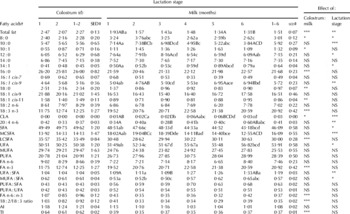
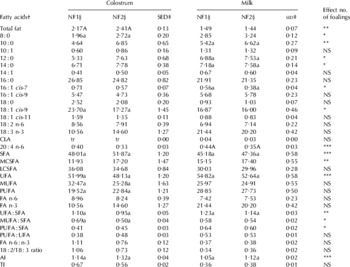
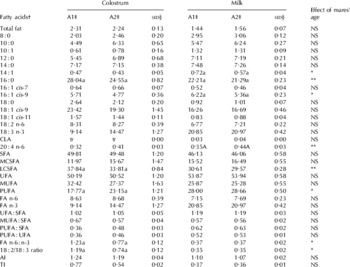
The content of fat in mares' colostrum was statistically significantly higher than in milk (Table 1). Mares' milk collected in the 5th and 6th months of lactation contained significantly less fat than milk produced in the 1st month of lactation. Statistically significantly more fat was found in colostrum collected from mares that had foaled more than 5 times in comparison with mares that had foaled fewer times (Table 2). The number of foalings did not have a statistically significant influence on fat content in mares' milk. The age of the examined mares i.e., mares older than or younger than 10 years, failed to have a statistically significant effect on fat content either in the colostrum or milk (Table 3).
The fat content (g/100g) and fatty acid profile (% of fatty acids) of mares' colostrum during two lactation days and milk during six lactation months

† Fatty acids=SFA (saturated fatty acids)=sum of MCSFA+LCSFA; MCSFA (middle-chain saturated fatty acids),=sum of 8:0+10:0+12:0; LCSFA (long-chain saturated fatty acids),=sum of 14:0+16:0+18:0; UFA (unsaturated fatty acids)=total sum of MUFA+PUFA; MUFA (monounsaturated fatty acids)=sum of 10:1+14:1+16:1 cis-7+16:1 cis-9+18:1 cis-9+18:1 cis-11; PUFA (polyunsaturated fatty acids)=sum of 18:2+CLA+18:3; FA n-6 (fatty acids)=sum of 18:2+20:4; FA n-3 (fatty acids)=18: 3; AI=atherogenic index calculated using equation described by Ulbricht & Southgate (Reference Ulbricht and Southgate1991) ; TI=thrombogenic index calculated using equation described by Ulbricht & Southgate (Reference Ulbricht and Southgate1991)
‡ sed=Standard error of difference across treatment means
Differences between means in rows marked with the same letters are statistically significant at: capital letters P<0·01, small letters P<0·05
Other differences are statistically significant at *p<0.05, **p<0.01, ***p<0.001, NS, not significant

The influence of mares' age on fat content (g/100g) and fatty acid profile (% of total fatty acids) of mares' colostrum and milk

† For abbreviation key, see Table 1
‡ A1, †† A2=Mares age (††A1⩽10 years, n=5; †† A2>10 years, n=7)
§ sed as for Table 1
Fatty acid profile of colostrum
The analysis of fatty acid composition of colostrum obtained from experimental mares shows that saturated fatty acids constituted nearly 50% of all determined fatty acids (Table 1), of which acid 16:0 was found in the highest quantities (about 26%). The proportion of middle-chain saturated fatty acids constituted about 14% and the dominant acids in this group were 14:0, 12:0 and 10:0. No short-chain saturated fatty acids were detected in the colostrum. Most of the unsaturated fatty acids in colostrum were monoenoic acids, primarily the 18:1 cis-9. PUFA constituted a considerable (about 21%) proportion of fatty acids in colostrum, of which 18:3 was the dominant acid. The ratio of the n-6 family fatty acids to those of the n-3 family in colostrum was about 0·9 and this can be attributed mainly to the proportion of 18:2 and 18:3 acids. Out of the 16 detected fatty acids, statistically significant differences were observed between colostrum and milk for 6 acids, namely 8:0, 16:0, 18:0, 18:1 cis-11, 18:3 and conjugated linoleic acids (CLA). Calculated AI and TI values in mares' colostrum were 1·21 and 0·62, respectively.
Fatty acid profile of milk during six lactation months
A significant effect of lactation period on fat composition was found for the ratio of the following seven fatty acids: 8:0, 10:0, 12:0, 14:1, 16:1 cis-9, CLA and 20:4 (Table 1). Saturated fatty acids constituted approx. 45% of all fatty acids found in mares' milk, of which approximately 30% were long-chain acids, with 16:0 predominating (about 22%) followed by 14:0 (over 7%). No short-chain saturated fatty acids were detected in mares' milk. Unsaturated fatty acids made up about 55% of all fatty acids found in mares' milk, of which MUFA constituted about 25%, with 18:1 cis-9 constituting over 16%. PUFA constituted over 8% of all fatty acids in mares' milk. This group of acids was dominated by 18:3 (approx. 21%) and 18:2 (nearly 7%). Fatty acids from the n-3 family made up nearly 21% of all fatty acids. The ratio of n-6 to n-3 acids, on average, amounted to 0·37. Mean AI and TI values in mares' milk were 1·08 and 0·37, respectively. With the lengthening of the lactation period, the proportion of saturated acids (mainly medium-chain length) decreased statistically significantly, while that of 14:1 and 16:1 cis-9 acids increased. This resulted in an increase in the ratio of unsaturated fatty acids (including MUFA) to saturated fatty acids.
Effect of the number of foalings on fatty acid profile in colostrum and milk
Colostrum from mares that had foaled fewer than 5 times, contained statistically significantly less 8:0 and more 18:1 cis-9 than colostrum from mares with a higher number of foalings (Table 2). In colostrum from mares with fewer than 5 foalings, the ratio of saturated acids to PUFA was smaller than in colostrum from mares with a higher number of foalings. In addition, calculated AI was also lower. The number of foalings had a statistically significant effect on proportions of 10:0, 12:0, 14:0, 16:1 cis-7 and 20:4. Milk from mares that had given birth to fewer than 5 foals contained statistically significantly less middle-chain saturated fatty acids, such as 10:0, 12:0 and 14:0 and more unsaturated fatty acids than milk produced by mares with more foalings. As for colostrum, also in milk the calculated AI value was lower.
Effect of mares' age on fatty acid profile in colostrum and milk
Age of the examined mares of up to 10 and over 10 years had a statistically significant influence on the proportion of the 16:0 in colostrum and 14:1, 16:0, 16:1 c9 and 20:4 acids in milk (Table 3). In colostrum collected from mares up to 10 years of age, the proportion of 16:0 was higher and that of PUFA lower than in colostrum collected from older mares. Colostrum of younger mares was characterized by a higher ratio of n-6 to n-3 acids, primarily 18:2 to 18:3, compared with colostrum produced by older animals. Milk obtained from mares younger than 10 years contained higher proportions of 14:1, 16:0 and 16:1c9 and less 20:4 than milk from the second age group.
Discussion
There is limited published information on fat content in mares' colostrum. As with other animal species, colostrum contains more fat than milk does. The present results are similar to those in literature, although the absolute fat content in colostrum collected from mares of the Konik breed differs from that of other breeds (Smoczyński & Tomczyński, Reference Smoczyński and Tomczyński1982; Csapó et al. Reference Csapó, Stefler, Martin, Makary and Csapó-Kiss1995; Salimei et al. Reference Salimei, Varisco and Rosi2002; Pikul & Wójtowski, 2008).
Results of fat content analysis during the entire lactation period are sometimes difficult to interpret owing to changes in feeding during the course of lactation, which interfere with the effect of lactation stage. However, it may be assumed that fat content decreases until the 3rd month of lactation, then it remains stable or decreases slightly until the 6th month (Brzeski & Kulisa, Reference Brzeski and Kulisa1979; Hoffman et al. Reference Hoffman, Kronfeld, Herbein, Swecker, Cooper and Harris1998; Mariani et al. Reference Mariani, Summer, Martuzzi, Formaggioni, Sabbioni and Catalano2001; Pikul & Wójtowski, Reference Pikul and Wójtowski2008). Milk fat content is highly variable during this period, but the general trend based on pooling of literature data is an inverse function of lactation stage (Doreau & Martuzzi, Reference Doreau, Martuzzi, Miraglia and Martin-Rosset2006).
In our investigations, the observed changes in milk fat content of the Konik breed mares during the entire lactation period were similar to those in the literature, although the total fat content in milk of mares of this breed was considerably higher than that reported by Tomczyński et al. (Reference Tomczyński, Roman and Szybińska1999). This may be attributed to different methods of fat acquisition from the milk of mares, as well as changes in feeding regimes for mares, introduced in recent years. Similar differences in fat content were reported in milk of Wielkopolska breed mares (Tomczyński et al. Reference Tomczyński, Roman and Szybińska1999; Pikul & Wójtowski, 2008).
Genetic effects have seldom been studied. Csapó et al. (Reference Csapó, Stefler, Martin, Makary and Csapó-Kiss1995) found no difference in fat composition between Breton, Boulonnais, Haflinger and Hungarian Draught mares. However, differences were reported by Pelizzola et al. (Reference Pelizzola, Contarini, Povolo and Giangiacomo2006) who compared milk obtained from Haflinger, Quarter horse, Sella and Salto, and Rapied Heavy Draft breed mares. The Quarter horse breed, as compared with the other investigated breeds, exhibited distinctive characteristics such as a high main constituent content and a high percentage of essential linoleic and linolenic fatty acids. Differences in the basic composition of fatty acids in milk collected from mares of Arab, Małopolska and Huculska breeds were also reported by Kulisa (Reference Kulisa1977). In both of the latter studies, the authors failed to show any influence of lactation period on the composition of milk fatty acids, similarly to Hoffman et al. (Reference Hoffman, Kronfeld, Herbein, Swecker, Cooper and Harris1998), who investigated the composition of fatty acids in milk of Thoroughbred mares. Differences in the ratio of 18:2 to 18:3 acids as well as linoleic acid (LA)/alpha-linolenic (ALA) to saturated/unsaturated fatty acids in milk of Thoroughbred and Haflinger mares were reported by Orlandi et al. (Reference Orlandi, Goracci and Curadi2002). Those researchers found a significant increase in the proportion of 18:3 with the lengthening of the lactation period in the case of Thoroughbred mares. In their subsequent investigations conducted on milk of Haflinger mares, Orlandi et al. (Reference Orlandi, Goracci and Curadi2003) showed that fatty acids found in highest amounts during lactation were 16:0, 18:1 and 18:3. The content of 18:2 was significantly lower on the 105th day of lactation in comparison with milk obtained on the 30th day of lactation. A statistically significant effect of lactation period on changes in the proportions of 18:2 and 18:3 in milk from mares of the Wielkopolska breed were reported by Pikul & Wójtowski (Reference Pikul and Wójtowski2008). As lactation progressed, the proportion of 18:2 decreased, while that of 18:3 increased. In our experiments on milk of Konik mares no statistically significant effect of lactation period on changes in the contents of 18:2 and 18:3 was found. At the same time, it should be emphasized that the ratio of 18:2/18:3 in the fat of milk from Konik mares was over 6-times lower than in the milk of Wielkopolska breed mares (Pikul & Wójtowski Reference Pikul and Wójtowski2008). This is the result of a considerably higher content of 18:3 and a lower content of 18:2 in milk of Konik mares in comparison with the milk of Wielkopolska breed mares. The most likely cause of this was the different feeding regime adopted for those mares. The above results are similar to those obtained by Csapó et al. (Reference Csapó, Stefler, Martin, Makary and Csapó-Kiss1995) and Hoffman et al. (Reference Hoffman, Kronfeld, Herbein, Swecker, Cooper and Harris1998) but differ from data presented by Orlandi et al. (Reference Orlandi, Goracci and Curadi2002, Reference Orlandi, Goracci and Curadi2003).
The present results indicate that saturated fatty acids in milk of Konik mares constitute almost 50% of fatty acids, with such long-chain acids as 16:0 and 14:0 and middle-chain 10:0 and 12:0 acids predominating. Mares' milk, similarly to human milk, is characterized by a lower proportion of saturated fatty acids than cows' milk. In the total amount of fatty acids, unsaturated fatty acids constituted approximately 54%, of which 25% was MUFA, among which 18:1 cis-9 constituted 16%. The percentage of MUFA in mare's milk was lower than in human milk and similar to that in cows' milk. PUFA in mares' milk made up over 28% of total fatty acids. The 18:3 (about 21%) and 18:2 (up to 7%) fatty acids were dominant in this group. LA and ALA fatty acids are required in human nutrition as they cannot be produced by the human body and may be extremely important for formula-fed infants. One of the main arguments used when recommending mares' milk is its high content of polyunsaturated fatty acids of the n-3 family. However, owing to its high price, the consumption of significant amounts of ALA from mares' milk is limited (Doreau & Martuzzi, Reference Doreau, Martuzzi, Miraglia and Martin-Rosset2006).
Results for the ratio of n-6 to n-3 fatty acids in milk of Konik mares are quite interesting. The ratio for colostrum was determined as 1, while that for milk was 0·4 and the value of this ratio was influenced by neither lactation period nor the number of foalings. However, it changed with the season of milk production by mares. It was significantly higher in milk from mares in the period from March to May than in June to November. These changes can also be related to dietary variations. The ratio of fatty acids belonging to these two families is influenced by changes in the contents of 18:2 (n-6) and 18:3 (n-3) fatty acids. This ratio in our investigations was considerably lower than that reported by Orlandi et al. (Reference Orlandi, Goracci and Curadi2002, Reference Orlandi, Goracci and Curadi2003) and this can be attributed to a much lower percentage share of the 18:3 n-3 acid.
Fatty acids can promote or prevent atherosclerosis and coronary thrombosis based on their effects on the serum cholesterol and low density lipoprotein-cholesterol concentrations (Ulbricht & Southgate, Reference Ulbricht and Southgate1991). The equations proposed by Ulbricht & Southgate (Reference Ulbricht and Southgate1991) for the atherogenic (AI) and thrombogenic indices (TI) indicated that 12:0, 14:0 and 16:0 are atherogenic and that 14:0, 16:0 and 18:0 are thrombogenic. The n-3, n-6 and MUFA are anti-atherogenic and antithrombogenic. High and equilibrate essential fatty acid content together with low AI (1·08) and TI (0·37) observed in our study, indicate the immune modulatory properties of mares' milk. AI values recorded in our study are higher and those of TI lower than in milk of donkeys, for which their respective values are 0·89 and 0·73 (Chiofalo et al. Reference Chiofalo, Azzara, Picollo, Liotta and Chiofalo2005) and also distinctly lower than in cows' milk (cows were fed a basal diet containing 44% forage and 56% concentrate mix), for which these values amount to 2·51 and 1·86, respectively (Allred et al. Reference Allred, Dhiman, Brennand, Khanal, McMahon and Luchini2006). Values of these indices do not change significantly during the course of lactation.
Conclusions
Significant differences were demonstrated between colostrum and milk of mares of the Konik breed in terms of fat content as well as the composition of selected fatty acids. A significant effect was demonstrated for lactation stage and number of foalings on fat content as well as fatty acid composition. Milk from Konik mares is characterized by a high content of PUFA, primarily 18:3 (n-3) and 18:2 (n-6), low ratios of n-6 to n-3 fatty acids as well as low values of AI and TI. Mares of the Konik breed can be used to produce milk containing fatty acids having nutritional and extra-nutritional properties. Moreover, milk of mares of the Konik breed consists of 10·6% total solids, including 1·9% total protein (1·0% casein and 0·7 whey proteins), 1·5% fat, 6·8% lactose and 0·4 ash. Their size, low environmental requirements and character traits, facilitating their utilization in horse-riding lessons for children and teenagers, as well as hippotherapy for children with developmental deficits, together with their potential milk-producing purpose, will probably promote enhanced interest of breeders in increasing the population of Konik horses in Poland.
This research was supported by the Polish Ministry of Education and Science (Grant No. 2 PO6Z 070 27).