Introduction
Diagnostic categorization and the development of diagnostic criteria that allow clinicians to differentiate between healthy and pathological mental processes and behavior are an essential part of medical science. Especially in a discipline such as psychiatry, where diagnoses are usually formed by careful assessment of behavior and subjective reports of abnormal experiences by the patient, precise diagnostic criteria are necessary to allow optimal diagnosis and subsequent treatment. The currently most widely used diagnostic manuals are the Tenth Edition of the International Statistical Classification of Diseases and Related Health Problems (ICD-10) and the Fifth Edition of the Diagnostic and Statistical Manual of Mental Disorders (DSM-5). 1 – 3 These form the base of psychiatric diagnosis in most parts of the world. Since their first appearance, both manuals have been revised and newly issued numerous times, reflecting the change of classifications for specific conditions that are considered pathological over time. While the release of a new version of ICD (ICD-11) is still awaited over the next few years, DSM-5 was issued in May 2013, thus likely representing the most up-to-date diagnostic categorization of mental disorders.
Bipolar disorders form a group of psychiatric disorders that primarily present with episodes of hypomania or mania and episodes of major depression. 1 , 3 , Reference Phillips and Kupfer 4 With an estimated lifetime prevalence of about 1% and a relapse rate of around 60% within 2 years, it is a common psychiatric disorder that needs complex management and therapeutic intervention.Reference Merikangas, Akiskal and Angst 5 – Reference Bauer, Pfennig, Severus, Whybrow, Angst and Möller 9 Making an accurate diagnosis can be difficult at times, especially regarding the diagnosis of bipolar II disorder in a patient with a (first) major depressive episode.Reference Phillips and Kupfer 4 , Reference Severus and Bauer 10
Issued in May 2013, the DSM-5 now comprises several changes regarding the diagnosis of bipolar disorders compared to the previous edition. 3 , Reference Severus and Bauer 10 , Reference Angst 11 Some of these changes have been subject to criticism right after the release, while others have been welcomed by both clinicians and researchers.Reference Severus and Bauer 10 , Reference Angst 11 Concordance with the ICD-10 appears only to some extent, and since both diagnostic manuals are used internationally, important differences are worth highlighting.
Bipolar and Related Disorders in DSM-5
Changes in DSM-5
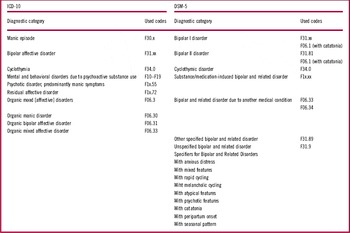
In DSM-5, “Bipolar and Related Disorders” represents a distinct chapter, located between “Schizophrenia Spectrum and Other Psychotic Disorders” and “Depressive Disorders.” As stated at the beginning of the chapter in DSM-5, this order was chosen to reflect the often discussed overlap in terms of symptomatology, family history, and genetics in these groups of disorders. 3 The chapter “Bipolar and Related Disorders” comprises the diagnostic categories of bipolar I disorder, bipolar II disorder, cyclothymic disorder, substance/medication-induced bipolar and related disorder, bipolar and related disorder due to another medical condition, other specified bipolar and related disorder, and unspecified bipolar and related disorder (refer to Table 1).
Diagnostic categories for bipolar and related disorders in ICD-10 and DSM-5

The presumably most important change compared to DSM-IV appears to affect the diagnostic criteria for manic and hypomanic episodes. Considering criterion A (“gate questions”), a hypomanic or manic episode now not only requires persistently elevated or irritable mood, but also an abnormally and persistently increased goal-directed activity or energy. 3 , Reference Angst 11 Obviously, this makes diagnosis more restrictive and some patients formerly diagnosed with bipolar disorder may now be allocated to a newly introduced subthreshold group, which has been subject to criticism.Reference Angst 11
Another very important point, which has also been discussed by other authors, is the change of exclusion criteria for diagnosis of bipolar I and bipolar II disorder.Reference Angst 11 , Reference Terao and Tanaka 12 The transition from a major depressive episode to a manic or hypomanic episode during antidepressant treatment (eg, medication, electroconvulsive therapy, bright light therapy) can now serve as a diagnostic criterion for bipolar I or bipolar II disorder, provided the symptoms persist at a fully syndromal level beyond the effect of the treatment. 3 , Reference Angst 11 , Reference Terao and Tanaka 12 This appears a wise decision, given the fact that induction of hypomanic or manic symptoms by antidepressant treatment is rather a sign of bipolarity in the patient than a side effect of the treatment.Reference Terao and Tanaka 12 , Reference Dumlu, Orhon, Özerdem, Tural, Ulaş and Tunca 13
The former diagnosis of a bipolar I disorder, mixed episode, which asked for concurrent fulfillment of criteria for manic and major depressive episode, cannot be applied anymore. Instead, a new specifier “with mixed features” has been introduced in DSM-5. This can be applied to patients who meet full criteria for a manic or hypomanic episode, but also present with depressive features. 3 It appears important here to mention the fact that the specifier “with mixed features” can also be applied to patients suffering from (unipolar) major depressive disorder who present with hypomanic or manic symptoms. This appears problematic because of the questionable diagnostic validity and the fact that these patients likely need mood stabilizing medication to achieve a satisfying clinical outcome.
Another new specifier usable for bipolar and related disorders is “with anxious distress,” which clinicians can apply to patients with symptoms of anxiety that are not included in the diagnostic criteria for bipolar and related disorders. 3
The last important change seems to be the inclusion of specific diagnostic conditions in the category of other specified bipolar and related disorders, which now allow better categorization of patients with symptoms of bipolar disorders that do not meet all required criteria for a full diagnosis of bipolar I or bipolar II disorder. 3 , Reference Severus and Bauer 10 , Reference Angst 11 DSM-5 acknowledges the formal categorization of subthreshold bipolar conditions (eg, short-duration hypomanic episodes or hypomanic episodes with insufficient symptoms), which likely reduces the number of patients formerly diagnosed with bipolar disorder not otherwise specified (“NOS-group”).Reference Angst 11
Diagnostic categories for bipolar and related disorders in DSM-5
Bipolar I disorder
As mentioned above, DSM-5 now comprises 7 main diagnostic categories. Contrary to the classical concept of manic-depressive disorder, the diagnosis of bipolar I disorder in DSM-5 only requires the occurrence of a manic episode. Neither a hypomanic nor a major depressive episode is an absolute prerequisite. A manic episode in DSM-5 must present with features of both (1) elevated, expansive, or irritable mood and (2) increased goal-directed activity or energy, and these symptoms must be present in the patient for at least 1 week. Furthermore, at least 3 of 7 other symptoms and marked functional impairment are necessary to allow the diagnosis. As already described, the episode can, but does not have to, be accompanied by major depressive or hypomanic episodes. 3 Again, it is important to highlight that a manic episode that appears during antidepressant treatment (eg, medication, electroconvulsive treatment, bright light therapy) and persists at a fully syndromal level beyond the physiological effect of that treatment is now considered as evidence for a bipolar I disorder. 3 The diagnosis of a bipolar I disorder can be further categorized regarding the severity and specific concurrent features of the clinical presentation. 3
Bipolar II disorder
According to DSM-5, the diagnostic category of bipolar II disorder requires at least 1 distinct episode of hypomania and 1 distinct episode of major depression in a patient’s lifetime. It is also highlighted at the beginning of the chapter that bipolar II disorder is no longer considered a milder version of a bipolar disorder. 3 This appears to be of particular importance for daily psychiatric practice. The less restrictive exclusion criteria also now allow clinicians to diagnose bipolar II disorder when hypomania appears during antidepressant treatment, which is expected to increase the prevalence of bipolar II disorder.Reference Angst 11
Cyclothymic disorder
Cyclothymic disorder in DSM-5 represents a diagnosis that can be applied to patients who experience at least 2 years (for children, 1 full year) of hypomanic and depressive periods that never meet the criteria for an episode of mania, hypomania, or major depression. During these 2 years, the symptoms must be present for at least half the time, and the patient must not be without symptoms more than 2 months at a time. 3
One problem that clinicians often face is that consumption of substances (including medication) and medical conditions can be associated or lead to symptoms resembling those of (other) bipolar and related disorders. DSM-5 accounts for this with the diagnostic categories of substance/medication-induced bipolar and related disorder and bipolar and related disorder due to another medical condition.
Other specified bipolar and related disorder
The diagnostic category of other specified bipolar and related disorder allows for categorization of patients who present with symptoms that do not meet the full criteria for the bipolar and related disorders described above. By using this diagnostic category, the clinician must communicate the specific reason for the presentation not meeting the criteria. This has been praised by some authors, as it formally acknowledges the existence of subthreshold bipolar disorders and avoids allocation of a great proportion of patients to the formerly used vague category of bipolar disorder not otherwise specified (“NOS”).Reference Angst 11 Examples that are given in DSM-5 include “short-duration hypomanic episodes (2–3 days) and major depressive episodes,” “hypomanic episodes with insufficient symptoms and major depressive episodes,” “hypomanic episode without prior major depressive episode,” and “short-duration cyclothymia (less than 24 months).” 3
Unspecified bipolar and related disorder
The diagnostic category of unspecified bipolar and related disorder applies to patients presenting with bipolar and related symptoms that do not meet the full criteria for any of the bipolar and related disorders described above, and where a clinician chooses no further specification why a patient’s clinical presentation does not meet the required criteria.
Bipolar affective disorder and related disorders in ICD-10
In ICD-10, bipolar disorder is categorized in the group of mood (affective) disorders. Disorders with bipolar-like presentation, such as those due to substance use or another medical condition, can be found in the categories of mental and behavioral disorders due to psychoactive substance use and organic mood (affective) disorder 1 (see Table 1). ICD-10 distinguishes between manic episode, bipolar affective disorder, depressive episode, recurrent depressive disorder, persistent mood (affective) disorder (including cyclothymia and dysthymia), other mood (affective) disorders, and unspecified mood (affective) disorder. 1 Unlike DSM-5, ICD-10 thus provides distinct categories for single hypomanic or manic episodes and a single manic episode is not sufficient to warrant a diagnosis of bipolar disorder. 1 ,2
The diagnostic criteria for mania without psychosis in ICD-10 require mood to be predominantly elevated, expansive or irritable and definitely abnormal for the individual for at least 1 week, plus at least 3 of 9 other symptoms. 1 , 2 Diagnosis of bipolar affective disorder in ICD-10 requires at least 2 episodes of affective disorder, with at least 1 of them being (hypo)manic.
As in DSM-5, ICD-10 also takes into account the type (manic, depressive, mixed) and severity (mild, moderate, severe) of the current affective episode, but provides distinct diagnostic categories for this. It appears important to highlight that ICD-10 does not explicitly discriminate between bipolar I disorder and bipolar II disorder. However, bipolar II disorder can be coded as “other bipolar affective disorder.” Furthermore, ICD-10 provides the distinct diagnostic category of bipolar affective disorder, currently mixed episode, for patients who present with a mixture or a rapid alternation of hypomanic, manic, and depressive symptoms. 1 , 2
Discussion: What Are the Differences Between DSM-5 and ICD-10?
DSM-5 and ICD-10 clearly share many commonalities regarding diagnostic categorization of bipolar and related disorders. They both acknowledge the existence of a distinct bipolar disorder, which more or less represents a modern view of the classic manic-depressive disorder. However, there are some differences that are important to consider (see Table 2).
Differences between ICD-10 and DSM-5 regarding bipolar and related disorders

A major difference is in regard to the taxonomies used within the diagnostic systems. DSM-5 summarizes bipolar and related disorders in one chapter, while ICD-10 puts them in the chapters of mood (affective) disorders, behavioral disorders due to psychoactive substance use, and organic mood (affective) disorder. Both classifications discriminate between bipolar disorder and unipolar depression, but represent this in different ways. However, none takes into account the occurrence of unipolar mania.Reference Angst and Grobler 14 This appears a major shortcoming in both systems, since there is growing scientific evidence for the existence of unipolar mania.Reference Angst and Grobler 14
DSM-5 has more restrictive criteria for a manic episode than ICD-10. This may have important implications for clinical practice and scientific investigation. As Severus and BauerReference Severus and Bauer 10 have pointed out, it might have the advantage of lowering the probability of false positive diagnoses and therefore help to avoid unnecessary psychopharmacological treatment. However, it leads to the problem that there might be patients who are diagnosed with mania or bipolar disorder in ICD-10 but must be allocated to a subthreshold group in DSM-5.
Another major difference is the fact that DSM-5 allows for the diagnoses of bipolar I disorder and bipolar II disorder, while ICD-10 does not make such an explicit distinction. This appears to be a major shortcoming in the classification of bipolar disorders in ICD-10, as it does not take into account the spectrum of clinical symptomatology in patients with bipolar disorders.
Furthermore, patients who present with their first episode of mood (affective) disorder can be diagnosed with a distinct category in ICD-10, such as (hypo)manic episode or depressive episode. DSM-5 does not make this distinction. In fact, a manic episode is sufficient to warrant a diagnosis of bipolar I disorder in DSM-5.
The last important difference concerns the possibility to include details of a patient’s clinical presentation. DSM-5 allows for the use of specifiers, which intends to allow better categorization and easier communication among clinicians. ICD-10 takes into account some features that might be present in patients with bipolar disorders, such as psychosis or episodes with mixed features. However, this is far less extensive than the specifiers in DSM-5.
Two particular specifiers in DSM-5 warrant detailed discussion. The first is the newly introduced specifier “with anxious distress.” This allows clinicians to diagnose patients with symptoms of anxiety that are not part of the main diagnostic criteria for bipolar disorders. ICD-10 lacks this feature, despite its clinical relevance.Reference Stratford, Cooper, Di Simplicio, Blackwell and Holmes 7 The second specifier in DSM-5 is “with mixed features,” allowing characterization of patients with bipolar disorder and both manic and depressive symptoms. This new specifier can be considered an important improvement for research and clinical practice on bipolar disorders, as it is less restrictive for diagnosing mixed features than the former DSM-IV-TR criteria.Reference Shim, Woo and Bahk 15 However, the fact that DSM-5 also allows the use of this specifier for (unipolar) major depressive disorder remains questionable. ICD-10 provides a distinct diagnostic category for this specific condition (bipolar affective disorder, current episode mixed) and also has relatively liberal diagnostic criteria.
As a final remark, one should keep in mind that there are more than 20 years between the release of ICD-10 and DSM-5. Some of the differences described might in fact resolve when the new issue of the ICD (ICD-11) is published.Reference de Dios, Goikolea, Colom, Moreno and Vieta 16
Conclusion
DSM-5 and ICD-10 show some concordance for the diagnosis of bipolar and related disorders. However, there are marked differences regarding nosology, criteria for manic episodes and bipolar disorders, distinction of types of bipolar disorders, and the degree of details in categorization. Some of these differences may resolve within the few next years with the appearance of ICD-11.
Disclosures
Dietmar Winkler has the following disclosures: Angelim, speaker’s bureau, speaker’s fee; Bristol Myers Squibb, speaker’s bureau, speaker’s fee; Novartis, speaker’s bureau, speaker’s fee; Pfizer, speaker’s bureau, speaker’s fee; Servier, speaker’s bureau, speaker’s fee. Alexander Kaltenboeck does not have anything to disclose. Siegfried Kasper has the following disclosures: Angelini, speaker’s bureau, honoraria; AOP Orphan Pharmaceuticals AG, speaker’s bureau, honoraria; Austrian National Bank (OENB), consultant/advisory board and speaker’s bureau, honoraria; AstraZeneca, consultant/advisory board and speaker’s bureau, honoraria; Bristol-Myers Squibb, consultant/advisory board and speaker’s bureau, grants, research support, and honoraria; Eli Lilly, consultant/advisory board and speaker’s bureau, grants, research support, and honoraria; German Research Foundation, consultant/advisory board, honoraria; GlaxoSmithKline, consultant/advisory board and speaker’s bureau, grants, research support, and honoraria; Janssen, consultant/advisory board and speaker’s bureau, honoraria; Lundbeck, consultant/advisory board and speaker’s bureau, grants, research support, and honoraria; Neuraxpharm, speaker’s bureau, honoraria; Novartis, consultant/advisory board, grants, research support, and honoraria; Pfizer, consultant/advisory board and speaker’s bureau, grants, research support, and honoraria; Pierre Fabre, speaker’s bureau, honoraria; Schwabe, consultant/advisory board and speaker’s bureau, honoraria; Servier, consultant/advisory board and speaker’s bureau, grants, research support, and honoraria; Supervisory Boards of Universities, consultant/advisory board, no financial compensation was received.