INTRODUCTION
Aboriginal whale hunting has been viewed by anthropologists as a specialized marine mammal hunting adaptation that provided dietary and material resources, and served as a symbol of prestige and status (Lantis Reference Lantis1938; Drucker Reference Drucker1955; Collins Reference Collins1996; Monks et al. Reference Monks, McMillan and Claire2001; Colten Reference Colten2002; Monks Reference Monks2011). Along the Pacific coast of North America, whale hunting was long believed to have been practiced primarily by central Northwest Coast tribes such as the Nuu-Chah-Nulth (Nootka) on British Columbia’s Vancouver Island and the Makah and Quinault along the Washington coast (Drucker Reference Drucker1939:84, Reference Drucker1955:16; Goddard Reference Goddard1945:59; Kroeber and Barrett Reference Kroeber and Barrett1960:125–6; Underhill Reference Underhill1978:32; Hajda Reference Hajda1990:507; Silverstein Reference Silverstein1990:536–7; Lyman Reference Lyman1991:76–7).
Recent research on the southern Pacific Northwest Coast is changing such perspectives (see Aikens et al. Reference Aikens, Connolly and Jenkins2011:215; Moss Reference Moss2011:114–5), including analysis of ethnohistorical sources from Oregon coast tribes that describe whale hunting (Sanchez Reference Sanchez2014) and archaeological evidence from the Par-Tee site (35CLT20) in the form of a humpback whale (Megaptera novaeangliae) phalanx with an embedded elk (Cervus elaphus) bone harpoon point (Losey and Yang Reference Losey and Yang2007). On Haida Gwaii, Acheson (Reference Acheson1998) interpreted concentrations of whale bones recovered from two sites (FaTt22a and FaTt9), dating between 1140±80 and 980±65 to 300±75 14C yr BP respectively, as indicative of whale hunting or scavenging. As in the case of Par-Tee, the Haida Gwaii evidence suggested the existence of a more widespread “modest” whaling tradition beyond the ethnographically recognized whaling regions (see Acheson Reference Acheson2005:320; Fitzhugh and Kennett Reference Fitzhugh and Kennett2010:73). These data suggest that some opportunistic whale hunting may have occurred on the northern Oregon coast and Haida Gwaii centuries before European contact. However, whale bones are often used for a variety of structural, technological, ritual, and other purposes, and concentrations of whale bones found in coastal archaeological sites can result from opportunistic scavenging of whale carcasses or bones from local beaches. As we show in the following, some questions also remain about the age of the whale bone and the harpoon tip embedded in it from the Par-Tee site (Sanchez Reference Sanchez2014:31).
This article reports on high-resolution accelerator mass spectrometry (AMS) 14C dates for samples taken from the humpback whale phalanx from the Par-Tee site and the elk bone harpoon point embedded in it. It is important to provide a more secure and reliable 14C age estimate for these materials because they have major implications for our understanding of whaling and maritime adaptations along the Pacific coast of North America. Our research highlights the importance of reanalyzing and reinterpreting previously excavated museum collections (Colten Reference Colten2015) as new data and technologies become available and to minimize further impacts on archaeological deposits where extensive collections already exist.
PREVIOUS RESEARCH AND SITE CONTEXT
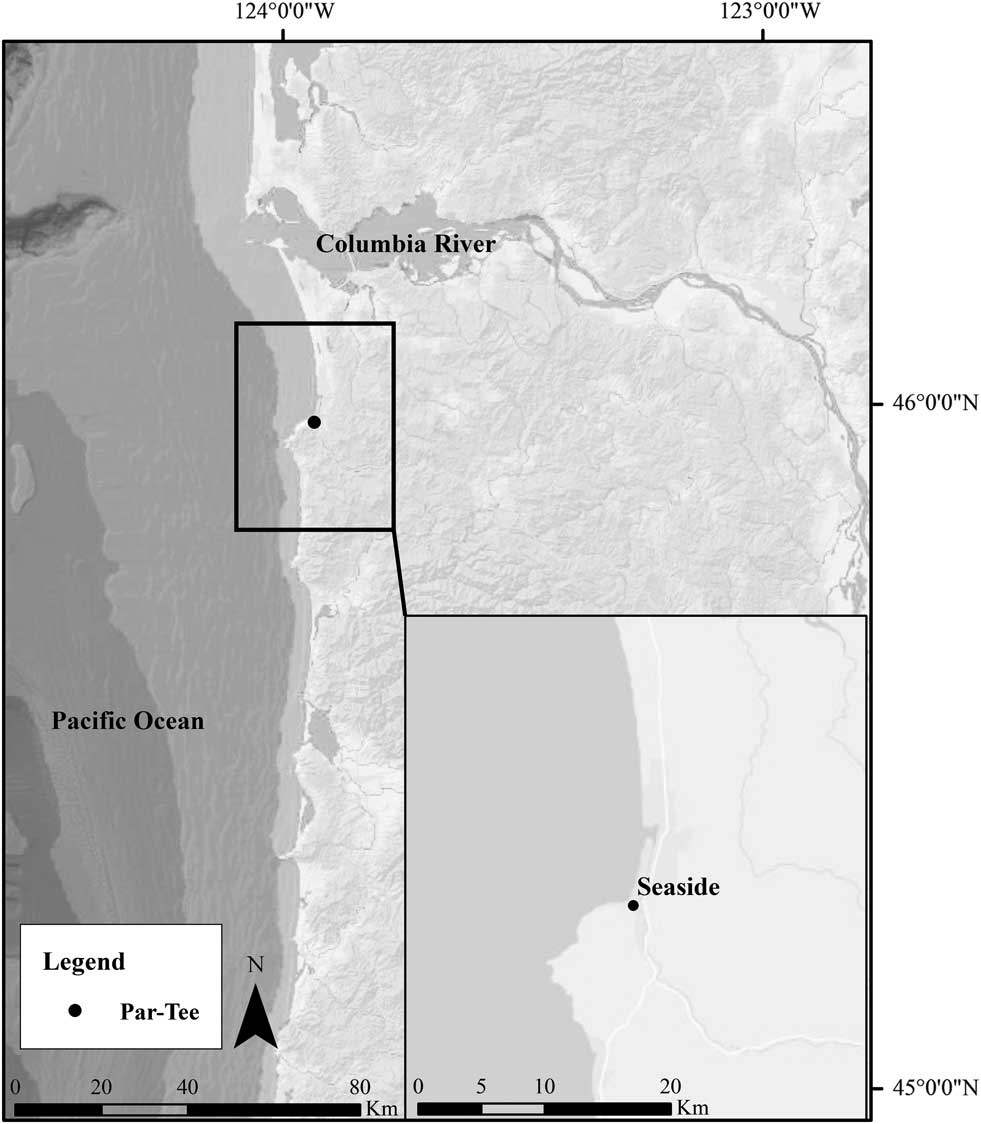
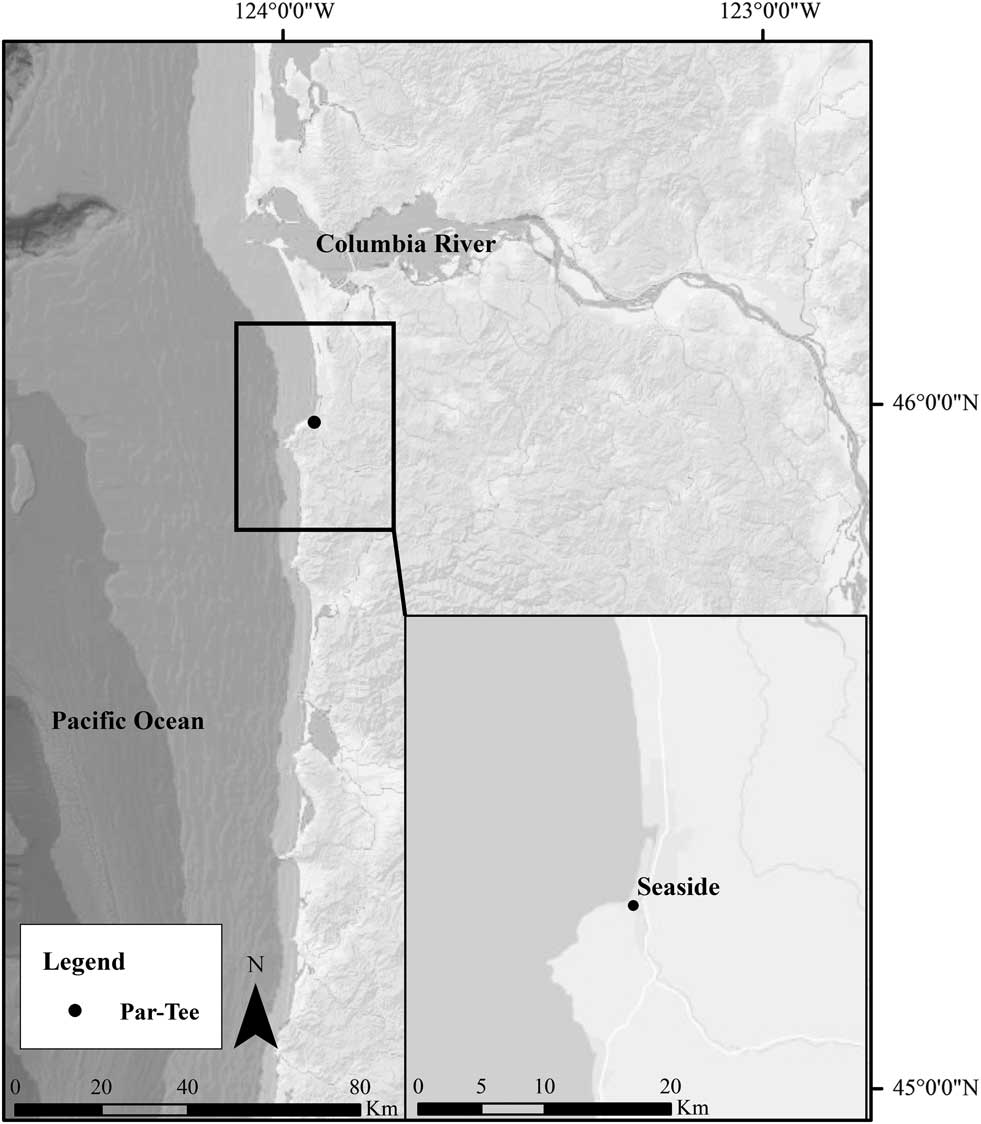
The Par-Tee (35CLT20) site is located south of the mouth of the Columbia River, near the southern end of the Clatsop Plains (Figure 1). Because of the large-scale excavations conducted by Phebus and Drucker (Reference Phebus and Drucker1973, Reference Phebus and Drucker1979), the site is important for the study of prehistoric occupations in the Pacific Northwest Coast of North America. Excavations are estimated to have produced half of all the artifacts collected during controlled excavations on the Oregon coast—along with a very large faunal assemblage—which provides a substantial collection of materials to address a variety of anthropological questions (Lyman Reference Lyman1991:23; Losey and Power Reference Losey and Power2005:4; Colten Reference Colten2015:2). The Par-Tee site and two roughly contemporaneous sites located nearby, Palmrose (35CLT47) and Avenue Q (35CLT13), have provided information regarding changes in coastal geomorphology and fauna, a relatively large (6 m×18 m) rectangular house structure, marine mammal hunting and fishing practices, and an elaborate industry marked by zoomorphic, anthropomorphic, and other decorated objects rivaling early artistic assemblages along the Pacific Northwest Coast (Connolly Reference Connolly1992; Erlandson et al. Reference Erlandson, Tveskov and Byram1998:9, 2015; Colten Reference Colten2002, Reference Colten2015; Losey and Power Reference Losey and Power2005; Losey and Yang Reference Losey and Yang2007; Sanchez Reference Sanchez2014).
Overview of the northern Oregon coast and Seaside, Oregon (inset map) with location of the Par-Tee site at the southern extent of the Clatsop Plains.
Excavation of the Par-Tee site was conducted by a Smithsonian anthropologist and collections assistant, George Phebus, avocational archaeologist Robert Drucker, and numerous Oregon Archaeological Society volunteers from 1968 to 1977 (Losey and Yang Reference Losey and Yang2007:662; Moss and Losey Reference Moss and Losey2011:177–8). The late-Holocene village site is a shell midden deposit, heavily disturbed by relic collectors and by the removal of shell for road fill prior to controlled excavation. Unfortunately, the site continues to be disturbed by relic collectors.
Excavations by Phebus and Drucker in the site remnants included 256 test units 5×5 ft wide dug in 1-ft arbitrary stratigraphic levels, with sediments screened over ¼-inch mesh sieves (Phebus and Drucker Reference Phebus and Drucker1973:4, Reference Phebus and Drucker1979; Colten Reference Colten2002:17, Reference Colten2015:254; Losey and Power Reference Losey and Power2005:4). Conventional radiometric 14C dating suggested that Native American occupation of Par-Tee occurred between approximately 350 BC and AD 1150 (Colten Reference Colten2002:17; Arbolino et al. Reference Arbolino, Ousley and Bubniak-Jones2005:13; Losey and Yang Reference Losey and Yang2007:663). Analysis of a sample of the site fauna identifiable to species suggests that elk and sea otter (Enhydra lutris) are the most common terrestrial and marine vertebrates, respectively (Colten Reference Colten2002:20, Reference Colten2015:9–10; Losey and Yang Reference Losey and Yang2007:663). The excavations also produced a sizeable collection of cetacean remains, suggesting that the site occupants may have engaged in whale hunting (Colten Reference Colten2002, Reference Colten2015). Sanchez (Reference Sanchez2014) also identified ethnohistorical descriptions of whale hunting by northern Oregon coast tribes, specifically the Tillamook and Clatsop, although these may all have occurred after European contact.
Cetacean bones are relatively common at the Par-Tee site. Whale bone is used for a variety of technological purposes and physical evidence for the hunting of large whales is limited to the humpback whale phalanx with elk bone harpoon tip embedded in it. Colten (Reference Colten2015) analyzed a sample of the Par-Tee faunal collection, identifying the remains of numerous marine mammals, including minke whale (Balaenoptera acutorostrata) and other large cetacean bones too fragmented to classify further, smaller cetaceans (Phocoena phocoena, Stenella attenuata, Tursiops truncata), pinnipeds (Callorhinus ursinus, Eumetopias jubatus, Phoca vitulina, Zalophus californianus), and sea otter (Enhydra lutris). Wellman et al. (Reference Wellman, Rick, Rodrigues and Yang2015) analyzed 187 whale bones from Par-Tee identifiable to a specific element, including ancient DNA (aDNA) extracted from 30 bones. Their aDNA analysis of successfully amplified samples determined that 60.7% of the analyzed specimens were from gray whales (Eschrichtius robustus), followed by humpback (32.1%), minke (3.6%), and orca (Orcinus orca, 3.6%). Wellman et al. (Reference Wellman, Rick, Rodrigues and Yang2015) documented cutmarks and other evidence of butchery or bone modification, but no further unequivocal evidence for whale hunting (i.e. strike marks or embedded points). According to Colten (Reference Colten2015), the large whale bones from Par-Tee may represent scavenging or opportunistic hunting by the site inhabitants.
Analysis of wood charcoal samples found near the whale phalanx and embedded artifact produced 14C ages of 1195±80 and 1295±70 yr BP, with a calibrated age range of cal AD 620–990 (Arbolino et al. Reference Arbolino, Ousley and Bubniak-Jones2005:84; Losey and Yang Reference Losey and Yang2007:664). DNA testing conducted by Losey and Yang (Reference Losey and Yang2007) on the harpoon point suggested that it was made of elk bone and the aDNA recovered from it matched samples recovered from unmodified elk bone in the site collection, suggesting that the harpoon was manufactured and used locally.
Although previous work at the Par-Tee site has provided probable evidence for whale hunting on the northern Oregon coast prior to European contact, the age of the whale phalanx and elk bone harpoon point have never been determined directly. Instead, the chronology of the apparent whale hunting event is based on dates obtained from unidentified charcoal samples collected from the same level in adjacent test units. In Pacific Northwest rainforests, trees can live for many centuries and drift logs were a common source of fuel, so dates on unidentified charcoal can be offset significantly by the “old wood” effect (Schiffer Reference Schiffer1986; Kennett et al. Reference Kennett, Ingram, Southon and Wise2002). The excavators of the Par-Tee site also identified the remnants of a semi-subterranean house pit and expressed concerns about site disturbance and sample contamination (Phebus and Drucker Reference Phebus and Drucker1973:9, Reference Phebus and Drucker1979). Stratigraphic reversals have also been noted in excavation units (Colten Reference Colten2015:4). Finally, the site was excavated primarily by amateur archaeologists in 12-inch arbitrary levels, so additional evidence for stratigraphic disturbance or discontinuities between units may have gone unnoticed (see Colten Reference Colten2015:4).
METHODS AND MATERIALS
The whale bone and elk bone harpoon tip are housed in the Department of Anthropology at the Smithsonian Institution’s National Museum of Natural History. Both the whale bone and the elk bone artifact were sampled by Torben Rick, using sterile surgical blades to remove 500–1000 mg of bone material and taking advantage of already broken or damaged areas of the specimen. These samples were sent to the Human Paleoecology and Isotope Geochemistry Laboratory at Pennsylvania State University (PSU), where bone collagen was extracted and purified using the modified Longin method with ultrafiltration (Brown et al. Reference Brown, Nelson, Vogel and Southon1988; Hoggarth et al. Reference Hoggarth, Culleton, Awe and Kennett2014).
At PSU, samples (200–400 mg) were demineralized for 24–36 hr in 0.5N HCl at 5°C, followed by a brief (<1 hr) alkali bath in 0.1N NaOH at room temperature to remove humates. The pseudomorph was rinsed to neutrality in multiple changes of nanopure H2O, and then gelatinized for 10 hr at 60°C in 0.01N HCl. Gelatin solution was pipetted into precleaned Centriprep® 30 ultrafilters (retaining >30 kDa molecular weight gelatin) and centrifuged three times for 30 min, diluted with nanopure H2O and centrifuged three more times for 30 min to desalt the solution. More detailed ultrafilter cleaning methods are described in McClure et al. (Reference McClure, Puchol and Culleton2010:28–9). Ultrafiltered collagen was lyophilized and weighed to determine percent yield as a first evaluation of the degree of bone collagen preservation. Carbon and nitrogen concentrations and stable isotope ratios were measured at the PSU Light Isotope Laboratory with a Costech EA (ECS 4010), Thermo Finnigan Conflo IV gas handling device, and a Thermo Finnigan Delta V analyzer. Sample quality was evaluated by % crude gelatin yield, %C, %N, and C:N ratios before AMS 14C dating. C:N ratios for the samples were 3.17 and 3.18, indicating good collagen preservation (DeNiro Reference DeNiro1985; Van Klinken Reference Van Klinken1999).
14C samples (~2.5 mg) were combusted for 3 hr at 900°C in vacuum-sealed quartz tubes with CuO wire and Ag wire. Sample CO2 was sent to W.M. Keck Carbon Cycle AMS facility at the University of California, Irvine, where it was reduced to graphite at 550°C using H2 and a Fe catalyst, with reaction water drawn off with Mg(ClO4)2 (Santos et al. Reference Santos, Southon, Druffel-Rodriguez, Griffin and Mazon2004). Graphite samples were pressed into targets in Al boats and loaded on the target wheel for AMS analysis. 14C ages were corrected for mass-dependent fractionation with measured δ13C values (Stuiver and Polach Reference Stuiver and Polach1977), and compared with samples of Pleistocene whale bone (background, >48 14C kyr BP), late Holocene bison bone (~1850 14C BP), late AD 1800s cow bone, and OX-1 oxalic acid standards.
RESULTS: DATING AND CALIBRATION
AMS 14C measurements of the purified collagen sample from the elk bone harpoon produced an age of 1555±20 yr BP (PSU-5972/UCIAMS-137938), with isotopic values typical of a terrestrial herbivore (δ13C: –24.3‰ VPDB; δ15N: 3.4‰ Atm N2). Calibrating this date with the IntCal13 calibration data (Reimer et al. Reference Reimer, Bard, Bayliss, Beck, Blackwell, Bronk Ramsey, Buck, Cheng, Edwards, Friedrich, Grootes, Guilderson, Haflidason, Hajdas, Hatté, Heaton, Hoffmann, Hogg, Hughen, Kaiser, Kromer, Manning, Niu, Reimer, Richards, Scott, Southon, Staff, Turney and van der Plicht2013) in OxCal v 4.2.3 (Bronk Ramsey Reference Bronk Ramsey2009) gives a 95.4% credible interval of cal AD 430 to 555. This age range is ~200 to 500 yr older than the dates reported previously for charcoal samples from roughly comparable levels in adjacent test units (Losey and Yang Reference Losey and Yang2007:664). This confirms that the humpback whale was harpooned a millennium or more before European contact.
AMS 14C measurements of purified bone collagen from the humpback whale phalanx produced an age of 2120±15 14C yr BP (PSU-5971/UCIAMS-137937) and stable isotope values consistent with an omnivorous marine mammal (δ13C: –15.2‰ VPDB; δ15N: 14.7‰ Atm N2). Correcting and calibrating this date is more complicated than the procedures used for the elk bone harpoon date, in part because the migration and feeding patterns of humpback whales takes them through waters of differing 14C age (Calambokidis et al. Reference Calambokidis, Steiger, Straley, Herman, Cerchio, Salden, Urban, Jacobsen, von Ziegesar, Balcomb, Gabriele, Dahlheim, Uchida, Ellis, Miyamura, Ladron de Guevara, Yamaguchi, Sato, Mizroch, Schlender, Barlow and Quinn2001; Straley et al. Reference Straley, Quinn and Gabriele2009; Filatova et al. Reference Filatova, Witteveen, Goncharov, Tiunov, Goncharova, Burdin and Hoyt2013). We used two methods to estimate the reservoir offset (ΔR) in the whale bone. The first assumes the harpoon and the whale bone are contemporary and treat them as a closely associated marine/terrestrial pair. Taking the marine model age (Marine13; Reimer et al. Reference Reimer, Bard, Bayliss, Beck, Blackwell, Bronk Ramsey, Buck, Cheng, Edwards, Friedrich, Grootes, Guilderson, Haflidason, Hajdas, Hatté, Heaton, Hoffmann, Hogg, Hughen, Kaiser, Kromer, Manning, Niu, Reimer, Richards, Scott, Southon, Staff, Turney and van der Plicht2013) corresponding to the calibrated age of the elk and subtracting that from the apparent (conventional) age of the whale bone, the mean offset is 210±36 14C yr (Stuiver et al. Reference Stuiver, Pearson and Braziunas1986; Kennett et al. Reference Kennett, Ingram, Erlandson and Walker1997). An alternative Bayesian method places the two dates in a Phase model in OxCal, calibrates each with the respective marine or terrestrial curve, and allows ΔR (using the Delta_R command) to vary uniformly between 150 and 300 14C yr. The posterior estimate is 220±37 14C yr, similar to the first estimate using the traditional method. Calibrating the whale bone age estimate with the mean of these two values (215±37 14C yr) provides an estimated 95.4% calendar age range of AD 400–610, similar to the range for the elk bone harpoon. These ΔR values are similar to values reported by Dyke et al. (Reference Dyke, McNeeley and Hooper1996) for bowhead whale (Balaena mysticetus) bones from Canadian eastern Arctic waters (~200 14C yr) and by Dumond and Griffin (Reference Dumond and Griffin2002) for a beluga whale (Delphinapterus leucas) bone from the Bering Sea (200±64 14C yr).
We also corrected and calibrated the 14C date for the whale bone by estimating a regional ΔR for the whale based on modern migration and feeding patterns of humpback whales off the Oregon coast. This method is similar to determining a ΔR for an area such as the Santa Barbara Channel by averaging the ages of multiple samples of pre-bomb marine organisms (e.g. marine shells) of known age—although ΔR values can also fluctuate through time (Kennett et al. Reference Kennett, Ingram, Erlandson and Walker1997). Today, and presumably in the past, humpback whales range widely in the North Pacific, generally feeding in northern waters during summer then migrating south to give birth in tropical waters. The North Pacific currently has three largely discrete (and genetically distinct) humpback populations: (1) a northern population that feeds primarily in Gulf of Alaska waters and winters near Hawaii; (2) another northern population that winters off Japan and the Ryukyu Islands; and (3) a population that feeds off southern British Columbia, Washington, Oregon, and northern California, wintering off the Pacific coast of Mexico (Calambokidis et al. Reference Calambokidis, Steiger, Straley, Herman, Cerchio, Salden, Urban, Jacobsen, von Ziegesar, Balcomb, Gabriele, Dahlheim, Uchida, Ellis, Miyamura, Ladron de Guevara, Yamaguchi, Sato, Mizroch, Schlender, Barlow and Quinn2001). If these patterns held true in the past, a whale harpooned off the northern Oregon coast should have fed primarily in marine waters north of San Francisco Bay to British Columbia. In the 14CHRONO Marine Reservoir Database (http://calib.qub.ac.uk/marine/), 38 calculated ΔR values from this region have a mean value of 373±80 14C yr, ranging from 200±40 to 510±50 14C yr. Calibrating the AMS 14C date for the whale bone using the mean value results in an estimated calendar age range of AD 460–815, a broader range that overlaps significantly with that of the elk bone harpoon, but could also be more than 250 yr younger.
Although both the AMS 14C dates are consistent with the general chronology of the Par-Tee site, the date on well-preserved collagen extracted from the elk bone harpoon tip provides the most reliable age for the whale hunting event. At AD 430–555, the calibrated calendar age range of the elk bone harpoon sample is ~200–500 yr older than the age range of nearby charcoal samples reported by Losey and Yang (Reference Losey and Yang2007).
CONCLUSIONS
Currently, the Par-Tee site provides the only archaeological evidence for the prehistoric hunting of large whales along the Oregon coast. The new AMS 14C dates indicate that the occupants of the Par-Tee site participated in whale hunting as early as AD 430–555, more than a millennium before the first known European contact in the area during the mid-to-late 17th century AD (see Erlandson et al. Reference Erlandson, Losey and Peterson2001). Our results support the arguments of Losey and Yang (Reference Losey and Yang2007) and Wellman et al. (Reference Wellman, Rick, Rodrigues and Yang2015) that prehistoric opportunistic whale hunting occurred along the Oregon coast. Ethnohistoric accounts suggest that such practices continued, at least occasionally, into early historic times (Sanchez Reference Sanchez2014). Whale bones from archaeological contexts can provide suitable samples for 14C dating, but special attention needs to be paid to characterizing variable reservoir effects for migratory species (Mangerud et al. Reference Mangerud, Bondevik, Gulliksen, Hufthammer and Høisæter2006) and the potential use of old whale bone for technological or other purposes, essentially creating an “old bone effect.” For the whale phalanx from the Par-Tee site, these problems were minimized by the clear association of an embedded elk bone harpoon tip that could be more precisely dated and calibrated.
The Par-Tee site was excavated using relatively crude methods (e.g. 1-ft excavation levels and ¼-inch mesh) compared to modern standards, but the large scale of the excavation and the systematic collection of artifacts and faunal remains make the assemblage valuable for understanding the cultural and ecological history of the Oregon coast and the broader Pacific coast of North America, including the biogeography of cetaceans and other marine mammals (see Lyman Reference Lyman2011; Erlandson et al. Reference Erlandson, Braje, DeLong and Rick2014). As we have demonstrated, preservation of bone at the site is good and bone tools and faunal remains can be reliably AMS 14C dated. We hope our efforts will inspire further study of this large and highly significant site collection, which can be used to address a variety of important anthropological and ecological questions related to the native cultures and natural environments of the Pacific Northwest Coast generally and Oregon specifically. We also hope it will inspire archaeologists, ecologists, and other scientists to make greater use of archaeological collections housed in museums and other repositories.
ACKNOWLEDGMENTS
The authors thank the University of Oregon, Department of Anthropology for supporting this project via grant funds, and the Smithsonian National Museum of Natural History (NMNH), especially James Krakker, Teresa Hsu, and Hannah Wellman for their assistance with accessing the collections and for acquiring the samples used in this study. Faunal remains and artifacts from the Par-Tee site are housed at the NMNH, where they are available for further study. Funding to DJK and BJK for chronological work and general lab support from the NSF Archaeometry Program (BCS-1460369). Finally, we are grateful to the anonymous reviewers and the editors of Radiocarbon for constructive feedback and guidance that helped improve this paper.