

Tertiary curriculum focusing on Indigenous Australian perspectives have emerged in Australia in response to recommendations around the development of graduate attributes related to Indigenous cultural competence (Universities Australia, 2011). These recommendations are a response to literature highlighting the importance of such action in closing the gap between Indigenous and non-Indigenous outcomes (Indigenous Higher Education Advisory Council (IHEAC), 2006; Nakata, Reference Nakata2007). A wealth of Australian literature has detailed various effects of such curriculum, broadly finding that students developed both their knowledge of Indigenous ways of doing and knowing, but also gained insight into their own values, beliefs, behaviours and biases (e.g. Jackson, Power, Sherwood, & Geia, Reference Jackson, Power, Sherwood and Geia2013; Kickett, Hoffman, & Flavell, Reference Kickett, Hoffman and Flavell2014). While encouraging, a good deal remains unknown about the efficacy of the learning experience, in terms of shifting attitudes and preparedness to work in Indigenous health settings, and theoretical mechanisms involved. Systematic review of evaluations of interventions focused on developing the capacity for engaging with Indigenous populations in health contexts (Clifford, McGalman, Bainbridge, & Tsey, Reference Clifford, McCalman, Bainbridge and Tsey2015) highlights both the lack of such evaluations in Australia, and issues with methodological rigor. Simply, while developing health students preparedness to work within Indigenous health contexts is paramount, no explicit evaluation of pre to postcurriculum changes nor testing of possible underlying mechanisms, has occurred. In this paper, we review literature on student preparedness in the Indigenous health context, before discussing transformative learning (Mezirow, Reference Mezirow2000) as a theoretical framework to understand the process of preparing students in this context. We then present results of a pre/postevaluation of (1) students’ attitudes and preparedness and (2) the role of transformative learning across both measurements. We conclude with discussion on the nature of the relationship between transformative learning and changes to student attitudes and preparedness throughout the learning experience, and implications of findings to the development of offerings within the Indigenous studies health curriculum space.
Students enter Australian undergraduate education with diverse beliefs about, and experiences with, Indigenous Australians. Previous research suggests that, upon commencing university study, students’ attitudes towards Indigenous people and interactive experiences with culturally diverse people are predictive of their self-reported preparedness to work with Indigenous Australians in health care settings (Bullen, Roberts, & Hoffman, Reference Bullen, Roberts and Hoffman2017). While important to understand, from an outcome-based perspective, it is perhaps more important to understand how knowledge, attitudes and capabilities change during the course, and the processes that underlie this change.
Student Preparedness for Working in Indigenous Health Settings
A body of literature suggests student preparedness to work with potentially stigmatised groups can be strategically improved through the targeting of attitudes in curriculum (e.g. Happell & Gough, Reference Happell and Gough2007; Sedgwick & Yonge, Reference Sedgwick and Yonge2008). Local to the Indigenous Australian context, previous literature has demonstrated that curriculum designed to both change student perspectives towards Indigenous Australians and improve preparedness to work in Indigenous health settings may have a positive effect. However, studies relevant to this context have generally focused on either qualitative student responses to the curricular intervention (e.g. Ranzijn, McConnochie, Day, Nolan, & Wharton, Reference Ranzijn, McConnochie, Day, Nolan and Wharton2008), or discriminatory attitudes (Pedersen & Barlow, Reference Pedersen and Barlow2008). There have been two exceptions to this trend. First, Paul, Carr, and Milroy (Reference Paul, Carr and Milroy2006) measured final-year medical students’ preparedness to work in Aboriginal health settings following a newly remodelled Aboriginal health curriculum, using data from two separate cohorts (cohort 1, 2003; cohort 2, 2004). The study examined differences between the two cohorts at different time points, leaving open the possibility of significant confounding factors in the posited effects of the curriculum. Further, no explicit measures of attitudes towards Indigenous Australians were taken. Second, Thackrah and Thompson (Reference Thackrah and Thompson2013) explored the efficacy of curriculum intended to prepare students to work in Indigenous health contexts, while considering the influence of attitudes towards Indigenous Australians upon entry to the unit of tertiary study. However, while the study adopted a pre-/post-measurement methodology, it was limited to nursing and midwifery students, with an acknowledged small sample size limiting further generalisation of findings. In short, very few Australian-based quantitative studies have used pre–post intervention measures to ascertain the effect of curriculum designed to change student attitudes towards Indigenous Australians and prepare these students to work in Indigenous health settings — that is, curriculum aligned with closing the gap between Indigenous and non-Indigenous health outcomes.
Outside of Australia, there is a significant body of literature around curriculum addressing race and racial diversity contextually aligned with the amelioration of race relations and outcomes of minority racial groups within specific locales. Meta-analyses by Denson (Reference Denson2009) and Bezrukova, Spell, Perry, and Jehn (Reference Bezrukova, Spell, Perry and Jehn2016) indicated that curricular interventions with a focus on racial diversity are effective in improving both student understandings of diversity and also reducing discriminatory attitudes and behaviours. There are methodological, demographic and theoretical differences between the Australian studies and those found within either of the meta-analyses. Perhaps, most significant is that the vast majority of the studies included in the meta-analyses are external to the Australia context. This is important to note because while broad parallels exist in terms of the historical experiences, and current understandings of race and racism, there are also significant differences between Australia and other countries that suggest that approaches, principles and practices may not be simply retrofitted onto the Australian Indigenous context.
Transformative Learning
One posited mechanism for change in diversity attitudes in educational settings is through transformative learning (Biermann & Townsend-Cross, Reference Biermann and Townsend-Cross2008; Kickett et al., Reference Kickett, Hoffman and Flavell2014; Page, Reference Page2014). Transformative learning can be defined as ‘learning that transforms problematic frames of reference — sets of fixed assumptions and expectations (habits of mind, meaning perspectives, mindsets) — to make them more inclusive, discriminating, open, reflective and emotionally able to change’ (Mezirow, Reference Mezirow2003, p. 58). Transformative learning is based upon tenets of openness and willingness to consider the views, experiences, beliefs and perspectives of others and self, and advocates the value of empathic listening and understanding when doing so (Mezirow, Reference Mezirow2003). Despite an almost purely qualitative evidence base, Mezirow's transformative learning theory is one of the preeminent theories of adult learning (Taylor, Reference Taylor2007).
There is some evidence to support the adoption of transformative learning within the Australian Indigenous context. A postgraduate curricular offering over 1 day with a team of Indigenous facilitators explored Indigenous issues delivered via Mezirow's transformative framework (Jackson et al., Reference Jackson, Power, Sherwood and Geia2013), with student responses strongly supporting the value of such a transformative pedagogical model of learning within an Indigenous studies context. Notably, the majority of the Australian students within the study had prior experience educationally within Indigenous studies, and openly stated the value of this particular experience above and beyond earlier ‘nontransformative’ offerings. Existing qualitative and descriptive research on the curriculum that is the focus of this research (an Indigenous cultures and health unit for first-year health science students in an Australian university) suggests that some students do indeed have transformative experiences throughout, and as a result of, the unit (e.g. Flavell, Thackrah, & Hoffman, Reference Flavell, Thackrah and Hoffman2013; Thackrah & Thompson, Reference Thackrah and Thompson2013). However, findings were generally based on student evaluations upon completion of the unit, and were not specifically analysed using Mezirow's transformative learning framework.
While Mezirow (Reference Mezirow1978; Reference Mezirow1994) suggested 10 steps leading to perspective transformation (see Table 3), he has stated that not all are mandatory in the transformative process. Indeed, there is evidence that some of these links in the transformational ‘chain of events’ may loom larger than others, at least in tertiary curriculum and pedagogical models. Brock (Reference Brock2010), in one of relatively few quantitative studies around Mezirow's precursory steps to perspective transformation (there are others, e.g. Glisczinski, Reference Glisczinski2007; King, Reference King2009), suggested that the more of these steps to transformation were remembered (and thus by implication experienced), the more likely the student reported transformation, with a disorienting dilemma, trying on new roles, and critical reflection the most commonly experienced.
While there is on-going critique of elements of Mezirow's theory (e.g. Merriam, Reference Merriam2004; Newman, Reference Newman2014), this theory provides testable hypotheses in relation to the steps of transformative learning. The key points of differentiation between previous research and the current study are the explicit use of Mezirow's framework as an explanatory tool for changes that students may experience and the use of a pre–post design. This will provide a rigorous test of the applicability of Mezirow's theory to the Indigenous education context.
Aims and Hypothesis
The current study is the second phase of a broader research project examining the development of undergraduate health students’ cultural capabilities. Phase 1 examined students’ attitudes towards Indigenous Australians, and preparedness to work in Indigenous health settings at the time of entry to the university. The aim of this second phase was to examine changes in these attitudes over the course of the semester. Second, we aimed to examine whether self-reports of experiencing Mezirow's (Reference Mezirow1978) precursor steps to transformative learning predicted attitudinal change. Understanding whether and how transformative learning influences student outcomes has significant implications for institutions implementing courses focused around Indigenous perspectives, knowledge and diversity, particularly with regard to how these courses are implemented at first-year level and beyond, in the context of developing graduate attributes around cultural capability and intercultural understandings.
We first hypothesized that attitudes towards Indigenous Australians and preparedness to work within Indigenous health settings would be statistically significantly improved from the start to the end of the semester. Second, we hypothesised that after controlling for baseline attitudes and preparedness, the number of precursor steps to transformative learning self-reported would significantly predict changes in attitudes towards Indigenous Australians and preparedness to work within Indigenous health settings.
Method
The Learning Context
The context of this study is an Indigenous cultures and health unit at an Australian metropolitan university. This is a first-year core unit for all undergraduate students within the health faculty, developed in response to human rights initiatives such as Closing the Gap (Marmot, Friel, Bell, Houweling, & Taylor, Reference Marmot, Friel, Bell, Houweling and Taylor2008). Diverting from previous ‘ways of doing’, it represents an acknowledgment that tertiary institutions have historically ignored both the diversity of historical and cultural experiences, and thus the associated health outcomes, of Indigenous populations, in their provision of educational experiences (Grote, Reference Grote2008).
This unit examines Indigenous populations — local, national and global — exploring the diversity and historical and contemporary experiences of each, while focusing on developing students understanding of these in the context of the effects on Indigenous health and health care. It is taught predominantly by Indigenous tutors, reflecting the recognition of the value and effectiveness of both a personal, relational pedagogical approach, exposure to Indigenous perspectives and voices and interaction with Indigenous people (Pedersen & Barlow, Reference Pedersen and Barlow2008; Ranzijn et al., Reference Ranzijn, McConnochie, Day, Nolan and Wharton2008).
Structurally, the unit was developed upon theoretical foundations of intercultural competency (Flavell et al., Reference Flavell, Thackrah and Hoffman2013; Kickett et al., Reference Kickett, Hoffman and Flavell2014) and Mezirow's (Reference Mezirow2000) theory of transformative learning. Importantly, the latter theoretical basis was intentionally built into the unit from conception with attempts to facilitate outcomes in Mezirow's theoretical context via specific structural milestones, each purposefully situated at two key points throughout the semester (Weeks 5 and 10), and each reflecting potentially critical incidents considered likely to raise a dilemma for students. The aim of this structure was (1) to allow students to develop some comfort within a typically uncomfortable learning space prior to their being required to engage in often challenging conversations and learning around particularly uncomfortable material (i.e. Week 5’s exploration of past policies and practices affecting Indigenous Australians) and (2) to facilitate a space for students to work interprofessionally with peers on a case study (i.e. Week 10’s case study of an Indigenous man removed from family and community, and now experiencing significant health issues). Both weeks are highly confronting and challenging, and require an application of the accumulation of learning (both personal and formal in nature) across the semester.
Course expectations are that students will develop the capacity for critical reflexivity, instigated via an intentionally challenging and often confronting context based on contemporary and historical material. Further reflecting its conceptual origins in, and adherence to, Mezirow's transformative learning theory, the unit is designed to facilitate via a culturally immersive experience the development of capacity of students ‘to transform negative assumptions, stereotypes and frames of reference through self-reflection and discussion in a safe learning environment’ (Taylor et al., Reference Taylor, Durey, Bullen, Mulcock, Kickett and Jones2014, pp. 47).
The unit's assessment model has a heavy focus on critical reflection (posited as a key component of Mezirow's theory), is intentionally aligned with the unit's learning structure, and is designed to facilitate a space for students to explore and critically reflect upon the challenging material about the history of Australia and Indigenous cultures, and more importantly, in relation to and about themselves.
Importantly, the unit's conceptual origins acknowledge the significant challenge of effecting genuine transformation in Mezirow's theoretical context (i.e. a reintegration into one's life of reformulated beliefs, values and perspectives towards culturally diverse people and groups), noting that it is unlikely that culturally capable health practitioners will be created within the space of a single-semester first-year unit (Snyder, Reference Snyder2008; Sonn, Reference Sonn2008; Taylor et al., Reference Taylor, Durey, Bullen, Mulcock, Kickett and Jones2014). Early qualitative evaluation of the unit's intended transformative model suggests the early development of more culturally capable health practitioners through the shifting and transforming of existing perspectives held, facilitated by increasing awareness and sensitivity to diverse cultural experiences through critically reflexive practice focused on values, beliefs and attitudes towards Australian Indigenous people and society (Flavell et al., Reference Flavell, Thackrah and Hoffman2013; Kickett et al., Reference Kickett, Hoffman and Flavell2014). Finally, there is an expectation within the unit that it act as the foundation for later curriculum, in terms of knowledge acquisition and accumulation, and as a catalyst for early shifts in perspective around Indigenous Australians and culture.
Participants
Participants were students enrolled in a large Australian university Faculty of Health Sciences interprofessional first-year core unit on Indigenous cultures and health. Students from 22 disciplines across the Faculty of Health Sciences were represented in the sample. At Time 1, participants were 1175 students (275 males, 897 females and 3 unspecified). Of the 1175 students, 133 were international students and 15 students identified as Indigenous Australians. The ages of participants ranged from 17 to 59 years (Mean = 21 years; SD = 5.8 years).
At Time 2, of 614 student respondents, 336 were able to be matched and linked via a code to their data at Time 1. Of these 336 students (63 males, 273 females), the majority were domestic (n = 301), with 35 international students and 5 students identifying as Indigenous Australians. The ages of participants ranged from 17 to 54 years (Mean = 21.5 years; SD = 6.0 years). The Time 1 and Time 2 data for these 336 students forms the dataset for all further analyses presented.
Materials
A questionnaire was developed comprising measures of attitudes towards Indigenous Australians, preparedness to work in Indigenous health settings, transformative learning and student demographics.
Attitudes Towards Indigenous Australians
The Attitudes towards Indigenous Australians measure (ATIA, Pedersen, Bevan, Walker, & Griffiths, Reference Pedersen, Bevan, Walker and Griffiths2004) was developed specifically to measure attitudes towards Indigenous Australians. The 18 questionnaire items reflect both ‘old-fashioned’ and more modern conceptions of racism. An example item is Urban Aboriginal people are not real Aboriginal people. Participants respond to each statement via a Likert scale ranging from 1 (disagree strongly) to 7 (agree strongly), with a higher score indicating greater negative attitudes towards Indigenous Australians. In this sample, the measure had high internal consistency (α = .91).
Preparedness to Work in Indigenous Health
The Impact of the Aboriginal Health Undergraduate Curriculum questionnaire (IAHUC, Paul et al., Reference Paul, Carr and Milroy2006) was developed to measure the impact of Aboriginal health curriculum on undergraduate students. Originally consisting of 24 items across four key areas of Aboriginal health, the current study used Bullen et al.’s (Reference Bullen, Roberts and Hoffman2017) revised measure, developed following factor structure and internal consistency testing, along with amendments to five-scale items to ensure institution- and degree-neutral language and to contextualise the items to a future tense. The revised measure comprises four discreet subscales: Aboriginal health as a social priority (α = .62), perceptions of the adequacy of Aboriginal health services (α = .58), student preparedness to work in the Aboriginal health context (α = .83) and future commitment to Indigenous health (α = .83).
Learning Activities Survey
Brock's (Reference Brock2010) adaption of King's (Reference King1997) Learning Activities Survey (LAS) was used to measure perspective transformation experiences in the learning environment. The measure consists of 13 items and participants select as many as are applicable to their learning experience. An example question is I had an experience that caused me to question the way I normally act. The measure is scored by counting the number of statements endorsed.
Demographics
Single items were used to measure participant's age, gender, student type (domestic or international), cultural background and study discipline at Time 1.
Procedure
This study was approved by university Human Research Ethics Committee. Students were invited to participate in this study during their first tutorial and again after 10 weeks of study. Week 1 was chosen as the point immediately prior to exposure to the content of the unit, a time when students were generally presumed to have very little knowledge on the subject matter and had typically had minimal exposure to Indigenous Australians and culture. Week 10 was chosen due to the proximity to semester completion, the placement of necessary course material, and resultant generally high attendance. By this time, students had covered the unit's core material and had considerable time to critically reflect across the semester via the unit's assessment model. Tutors left the room during questionnaire administration to ensure students did not experience any coercion to participate. Questionnaires took approximately 10–15 minutes to complete. Data was entered into SPSS (v.22) for analysis. At Time 1, there were less than 1% of responses with missing data on items of either of the two key measures of attitudes and preparedness. However, students were able to select ‘No Answer’ as a response on both measures, and these were more frequently selected — response frequencies hovered between 5% and 10% on individual items. In general, high numbers of ‘No Answer’ responses were on items that might be considered controversial (e.g. Urban Aboriginal people tend to be pretty hostile). At Time 2, the extent of any missing data (formally missing or ‘No Response’ selected) was proportionally less than at Time 1. Formally missing values comprised less than 1% of all responses across any individual item. The proportion of ‘No Response’ answers was between 1% and 5% across all items. At Time 2, ‘No Response’ was selected proportionately more on the attitudes (ATIA) measure than on preparedness (IAHUC), the latter with no particular differentiation of response regardless of item wording. For the purposes of this analysis, student responses of ‘No Answer’ were converted to missing values. Finally, missing values were imputed using Expectation Maximisation, preserving intervariable relationships.
Results
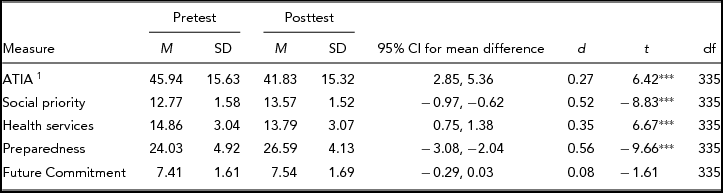
Table 1 provides descriptive scale statistics for Time 1 (pretest) and Time 2 (posttest). Paired sample t-tests with an alpha of .01 were conducted to compare differences between the time points (Table 1). On average, student attitudes towards Indigenous Australians improved by 4.11 points (Cohen's d = 0.27, a small effect size), student perceptions of Indigenous health as a social priority increased by 0.79 points (Cohen's d = 0.52, a medium effect size), student perceptions of the adequacy of health services for Indigenous Australians decreased by 1.07 points (Cohen's d = 0.35, a small effect size) and student self-reported preparedness improved by 2.56 points (Cohen's d = 0.56, a medium effect size). There was no significant change in students’ future commitment.
Descriptive Statistics and t-tests of Time 1 and Time 2 Attitudinal and Preparedness Variables

*** p < .001; 1Attitudes towards Indigenous Australians.
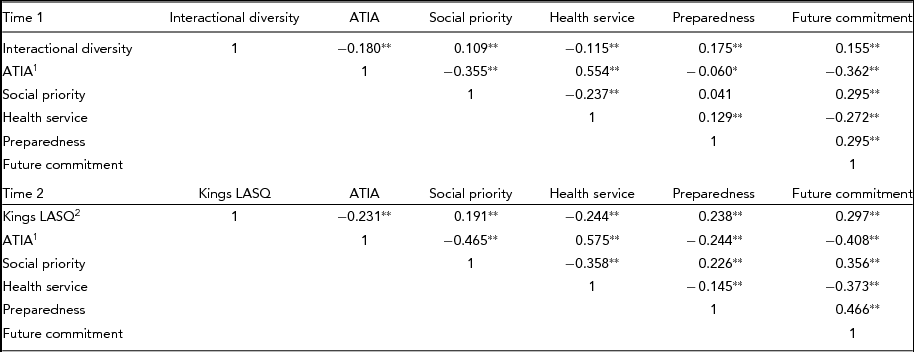
To assess the size and direction of the linear relationships between the key variables of interest, bivariate Pearson's product-movement correlation coefficients (r) were calculated (Table 2).
Pearson Correlation Matrix among Scale Scores at Time 1 and 2

*p < .05; **p < .01; 1Attitudes towards Indigenous Australians; 2Learning Activity Survey Questionnaire.
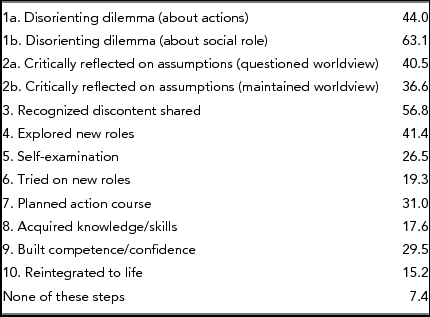
Across Kings LASQ, 311 students selected at least one of Mezirow's precursor steps to transformative learning, with 25 students not identifying with any of the precursor steps. Students reported a mean of 4.21 precursor steps. Table 3 outlines the frequency of Mezirow's precursor steps selected by students.
Percentage of Students Selections Across Each of Mezirow's Precursor Steps

Experiences of a disorienting dilemma was the most prevalent precursor step, with preeminence placed upon social roles (63.1%), as opposed to a dilemma around personal actions (44%). Critically reflecting on assumptions was selected by over three quarters of respondents, with slightly more questioning their worldviews (40.5%) than maintaining previously held beliefs (36.6%). Many respondents also recognised a shared discontent throughout their learning experience (56.8%), with some exploring new roles (41.4%), though not necessarily trying these roles on in a practical sense (19.3%).
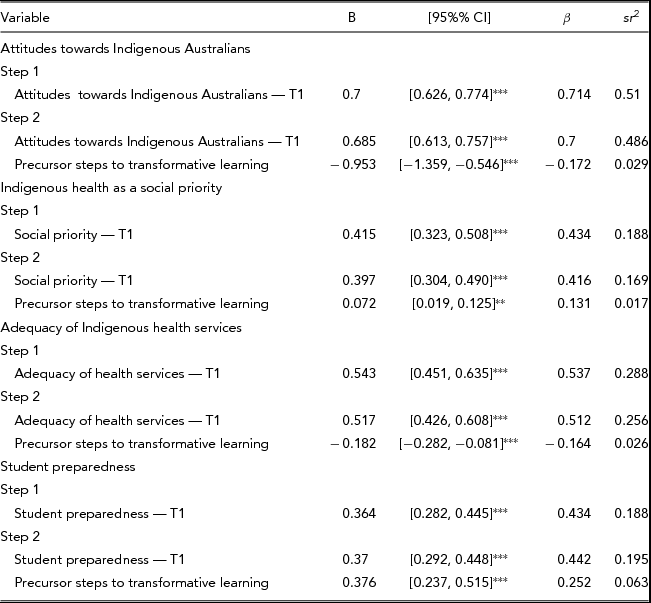
We conducted a series of hierarchical multiple regressions using the number of precursor steps as the independent variable to estimate the proportion of variance accounted for by transformative learning steps after controlling for Time 1 scores across the four Time 2-dependent variables where statistically significant change occurred. Unstandardised (B) and standardised (β) regression coefficients and squared semipartial (part) correlations (sr 2) for each predictor on each step of each hierarchical multiple regression analysis are reported in Table 4.
Unstandardised (B) and Standardised (β) Regression Coefficient, and Squared Semipartial Correlations (sr 2) For Each Predictor Variable on Each Step of Hierarchical Multiple Regressions

***p < .001; **p < .01.
Attitudes towards Indigenous Australians
On step 1, pretest ATIA scores accounted for a significant 51% of the variance in posttest ATIA scores, R 2 = .51, F (1, 334) = 347.50, p < .001. On step 2, the number of precursor steps to transformative learning accounted for an additional 2.9% of the variance in attitudes towards Indigenous Australians, ΔR 2 = .029, F (1, 333) = 21.25, p < .001, f 2 = 0.03 (small effect). In combination, the two predictor variables explained 53.9% of the variance in Time 2 attitudes towards Indigenous Australians, R 2 = .539, adjusted R 2 = .537, F (2, 333) = 194.91, p < .001.
Social Priority
On step 1, pretest measures of perceptions of Indigenous health as a social priority accounted for a significant 18.9% of the variance in posttest scores, R 2 = .189, F (1, 334) = 77.70, p < .001. On step 2, the number of precursor steps to transformative learning accounted for a significant additional 1.7% of the variance in student perceptions of Indigenous health as a social priority, ΔR 2 = .017, F (1, 333) = 7.04, p = .008, f 2 = .017 (small effect). In combination, the two predictor variables explained 20.6% of the variance in perceptions of Indigenous health as a social priority, R 2 = .206, adjusted R 2 = .201, F (2, 333) = 43.07, p < .001.
Health Service
On step 1, pretest measures of perceptions of the adequacy of health services for Indigenous Australians accounted for a significant 28.9% of the variance in posttest measurement, R 2 = .289, F (1, 334) = 135.63, p < .001. On step 2, the number of precursor steps to transformative learning accounted for a significant additional 2.6% of variance, ΔR 2 = .026, F (1, 333) = 12.73, p < .001, (f 2 = .027) (small effect size). In combination, the two predictor variables explained 31.5% of the variance in perceptions of the adequacy of health services for Indigenous Australians, R 2 = .315, adjusted R 2 = .311, F (2, 333) = 76.56, p < .001.
Preparedness
On step 1, pretest measures of student preparedness to work in Indigenous health settings accounted for a significant 18.8% of the variance in posttest measurement, R 2 = .186, F (1, 334) = 77.55, p < .001. On step 2, the number of precursor steps to transformative learning accounted for a significant additional 6.3% of the variance in preparedness, ΔR 2 = .063, F (1, 333) = 28.2, p < .001, f 2 = .067 (small effect). In combination, the two predictor variables explained 25.2% of the variance in student preparedness and ability to work in Indigenous health, R 2 = .252, adjusted R 2 = .247, F (2, 333) = 56.03, p < .001.
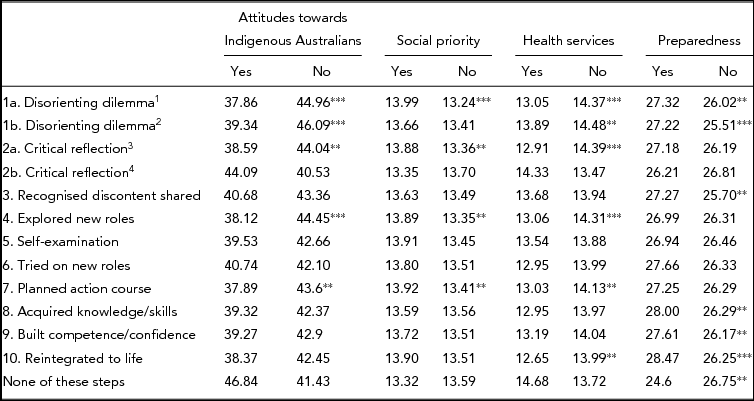
Given that hierarchical multiple regression analysis demonstrated a predictive relationship between the number of precursor steps selected and posttest scores after controlling for pretest scores, independent sample t-tests were also conducted across each of the four dependent variables to determine whether differences existed on each scale depending on whether a precursor step was reported or not. Table 5 outlines results for each precursor step at a conservative alpha level of .01.
Results of t-tests for Time 2 Measures of Each Dependent Variable by Precursor Steps

**p <.01; ***p < .001; 1about actions; 2about social role; 3questioned worldview; 4maintained worldview.
There were statistically significant differences between students who did and did not complete a particular step, across a range of Mezirow's precursor steps. The experience of a disorienting dilemma (about both actions and social roles), critical reflection (and questioning one's own worldview), the exploration of new roles, and planning a course of action were the most common differentiators.
Finally, an independent sample t-test (α = .05) was conducted to compare differences between participants who completed Time 1 only (M = 48.14, SD = 16.70) and those who completed Time 1 & 2 (M = 45.82, SD = 15.61). Students completing Time 1 only had significantly more negative attitudes towards Indigenous Australians, t(1173) = 2.2, p = 0.028, two-tailed, d = 0.14 (very small effect size). There was no statistically significant difference in preparedness to work in Indigenous health settings between groups.
Discussion
The current study examined whether first-year undergraduate health students’ attitudes towards Indigenous Australian culture and people, and their levels of preparedness to work within Indigenous health settings would improve across a single semester course. Students reported small, but significant decreases in negative attitudes towards Indigenous Australians and perceptions of the adequacy of health services for Indigenous Australians, and increases in perceptions of Indigenous health as a social priority and perceptions of preparedness to work in Indigenous health. No change was found in future commitment to Indigenous health. Overall, these findings indicated that completing the Indigenous studies health unit was effective in producing small changes in self-reported student attitudes towards Indigenous Australians, and preparedness towards working in Indigenous health settings, at least for those students who continued to attend tutorials towards the end of semester.
This study also examined whether, and which of, Mezirow's precursor steps to transformative learning played a role in effecting change across attitudes towards Indigenous Australian culture and people, and their levels of preparedness to work with, and engage in, Indigenous health settings. The results indicated the more precursor steps students reported experiencing, the more likely they were to report positive changes on each of the measures, with the exception of future commitment to Indigenous health. These findings provide support for transformative learning as the mechanism through which changes in attitudes and preparedness can occur, and validate the findings of transformative learning experiences reported in this unit in previous research (Flavell et al., Reference Flavell, Thackrah and Hoffman2013; Kickett et al., Reference Kickett, Hoffman and Flavell2014; Thackrah & Thompson, Reference Thackrah and Thompson2013). Further, these findings support Brock's (Reference Brock2010) suggestion that the number of steps to transformation experienced and remembered were predictive of transformative experiences, extending that study's findings within a business education discipline to an Indigenous studies unit within health sciences. Experiencing a disorienting dilemma, critically reflecting on and questioning ones worldview, exploring new roles, and planning a course of action were the steps associated with more positive attitudes towards Indigenous Australians, perceptions of Indigenous health as a social priority and perceptions of preparedness to work in Indigenous health, and decreased perceptions of the adequacy of health services for Indigenous Australians. Disorienting dilemmas, critical reflection and trying on new roles were the most commonly reported transformative steps in previous research (Brock, Reference Brock2010), and this concordance across studies suggests areas on which future curriculum can focus.
Taken in combination, these results suggest that there are some steps within transformative theory that may lead to potentially transformative experiences, with consequent shifts in attitudes towards Indigenous Australians, and an increased preparedness, understanding and commitment to work within Indigenous health settings. More specifically, the results suggest that when students in Indigenous studies health courses experience a contextualised dilemma about their actions and roles in society, critically reflect on their own worldview, explore new roles in terms of ways of being and plan a course of action towards this, their attitudes towards Indigenous Australians become more positive, and their general preparedness to work in Indigenous health settings increases.
The precursor step to transformative learning most commonly selected was critical reflection on assumptions, with nearly 80% of students stating they had done so at some point during the study period. Students who questioned their worldviews had more positive attitudes towards Indigenous Australians than those who did not, supporting the idea that an examination of, and potential shift in, personal epistemic foundations can have an impact in terms of how one views oneself and others. However, this finding needs to be treated with caution as the individual step analyses did not control for preexisting levels of attitudes. Noting this interpretive caveat, the findings align with Mezirow's own writings around the influence of critical reflection (Mezirow, Reference Mezirow1990), and other literature, both quantitative (e.g. Brock, Reference Brock2010) and qualitative (e.g. Jackson et al., Reference Jackson, Power, Sherwood and Geia2013; Thackrah & Thompson, Reference Thackrah and Thompson2013). While the majority of transformative learning literature is qualitative in nature, the relatively scarce quantitative data available does appear to support critical reflections preeminence as the key in individual transformation of perspective.
While these results are encouraging, and appear to reflect the intent of the unit to facilitate the beginning of a process of student perspective transformation in terms of attitudes towards Indigenous Australians and preparedness to work in Indigenous health settings, it should be noted that approximately half of the original cohort did not attend the Week 10 class where the second stage of data collection occurred. It is possible that the results may have differed if these students were included in the analyses presented here. While the reason for their absence in this class is unknown, and reduced student attendance is common across disciplines (Massingham & Herrington, Reference Massingham and Herrington2006), we can speculate that there may be lingering perceptions of irrelevance when it comes to learning about Indigenous people and issues (McDermott & Sjoberg, Reference McDermott and Sjoberg2012) and resistance, or at least ambivalence, to the Indigenous studies classroom in a health context, something also related to attitudes and their suppression (Costarelli & Gerlowska, Reference Costarelli and Gerłowska2015). Analysis of differences between students who completed questionnaires at Time 1 and those who completed both Time 1 and 2 also suggest that Time 2 attendees held different perspectives about Indigenous culture and people at the start of the unit. It is possible that students who were no longer attending by Time 2 were not interested in the prospect of transformative experiences (Snyder, Reference Snyder2008).
Within this study, the lower proportion of students reporting experiencing later precursor steps (from step 5 to step 10) reflects previous reports (Thackrah & Thompson, Reference Thackrah and Thompson2013). Lack of practical engagement with Indigenous people (beyond tutors) during the unit may limit the potential of attitudinal change and preparedness to work in Indigenous health settings. This raises issues around when and where students may adopt and enact new roles in a practical sense, highlighting the need for continuing exposure to increasingly refined models of learning that facilitate an ongoing transformative process. Thus, there is a need to build upon first-year offerings, and effectively scaffold the transformative experience across years, from developing basic capabilities of reflexivity and cultural capabilities, before moving onto the culmination of truly critically reflexive entry level practitioners (Thackrah & Thompson, Reference Thackrah and Thompson2013). Further, this model complements the proposed structure of Indigenous studies curriculum in terms of the stated intention for transformative learning, a process that appears to have been commenced at the first-year level within the unit at the heart of this study.
Facilitating a Mezirow'ian disorienting dilemma early in the educational experience facilitates the early emergence of critical reflective capabilities (to varying degrees). This is particularly salient when considering the value and importance placed upon critically reflexive practitioners in most disciplinary graduate attributes. It is possible that some students are not cognitively or psychologically equipped to deal with matters underpinned by deep moral and ethical foundations such as the historical injustices and future wellbeing and health outcomes of Indigenous Australians. While our results are encouraging, they highlight the need for curricular opportunities beyond first year, this on-going ‘stimulation of the “transformative experience” suggested elsewhere’ (Brock, Reference Brock2010).
Further research is required into how “entry” to these precursor steps is induced. Do certain factors shape student experiences of Mezirow's precursor steps, and thus transformative potential? Notably, Ranzijn et al. (Reference Ranzijn, McConnochie, Day, Nolan and Wharton2008) suggest pedagogical factors (e.g. cultural background of educators, rapport development, methods of engagement and the classroom context) as providing students with a unique opportunity to traverse “difficult” terrain — elements attested to elsewhere (e.g. Hollinsworth, Reference Hollinsworth2016; Kickett et al., Reference Kickett, Hoffman and Flavell2014). Of interest, student feedback across many of these studies also suggests an experience and depth of both teaching and learning qualitatively different from nontransformative pedagogical approaches.
There are limitations to this study that temper our confidence in the findings. First, the study was conducted within a single university; as such, the findings may not be generalisable to health science students in other universities. Second, students self-reported across each of the measures, leaving open the possibility of socially desirable responding, based upon students’ understanding of ‘correct’ answers developed over the unit's duration. While this cannot be fully discounted, we argue that socially desirable responding was already likely to be present at the time of first administration of the measures (see Bullen, Roberts, & Hoffman (2017) for a discussion of demand characteristics, response biases and democratic racism associated with self-report measures of attitudes relating to Indigenous Australians). Perhaps, further mitigating this point, many students were quite willing to provide qualitative comments related to their experiences, and not necessarily positive, thus suggesting openness to responding honestly. Indirectly related, a further limitation is the difference between those who completed Time 1 only (group 1), and those who completed Time 1 and Time 2 (group 2). It is possible that, despite the very small effect size, group 1 declined in attendance due to their more negative attitudes, thus introducing further bias into the analysis results. Finally, this study lacked a control group, making it difficult to unambiguously attribute observed changes in student attitudes and preparedness to the Indigenous studies health unit. However, the associated qualitative comments from students suggest that the content and importantly, the process of learning, were key factors in shifts in student perspectives. Regardless, future research would benefit from the use of a control group, preferably of students enrolled in a course similarly focused on diversity and health, but not specifically on Indigenous Australian culture and issues (Cole, Case, Rios, & Curtin, Reference Cole, Case, Rios and Curtin2011).
These results also raise questions around the nature of transformation itself — what is transformation, and where does it begin and end? Do Mezirow's theory and steps adequately describe transformative experiences, or are they best aligned with a specific context, intention and boundaries within this intercultural space? We suggest that this is perhaps best answered by notions of specificity. In the current study, the transformative context is bounded by the specific intentions of the unit itself; that is, intentions to begin — not complete — movement towards cultural capability via the transformation of ‘negative assumptions, stereotypes and frames of reference’ (Taylor et al., Reference Taylor, Durey, Bullen, Mulcock, Kickett and Jones2014). As such, transformation at a first-year level may be, and probably should be expected to be, simply that — early yet fundamental experiences of the disorienting dilemma, the catalyst for future change, with opportunities for transformation of attitudes, beliefs and ultimately behaviours arising through learning models that explicitly encompass discourse and the development of critically reflexive capacity. Accordingly, any shifts in student attitudes and consequent preparedness during this point of their academic lives should be interpreted as the student moving into the process of transformative learning, as opposed to having completed a transformation in Mezirow's theoretical sense — that is, where an integration into one's life of often starkly differentiated perspectives, values and beliefs has occurred.
Conclusion
In summary, this study suggests that health students’ experiences within educational environments with a pedagogically transformative focus and intention are capable of effecting small but significant quantitatively measurable shifts in students, both attitudinally towards Indigenous Australians and in terms of preparing students for working in Indigenous health settings. Transformative learning — the shaking up of students personal epistemic and ontological foundations — appears key to facilitating this shift, something extending beyond purely cognitive learning models, and venturing into the realm of affective learning. By facilitating a space for students to explore the interface between Indigenous Australia and themselves, courses focused on Indigenous health and perspectives provide the beginning of a transformational experience enabling and positioning students to play a part in the future of Indigenous health.
Acknowledgments
We gratefully thank all the individuals who volunteered their time to assist with data collection for this research project, and the many coordinators and tutors for granting us access to their classrooms to administer the research surveys.
Financial Support
The authors would like to acknowledge the contribution of an Australian Government Research Training Program Scholarship in supporting this research.
Conflicts of Interest
None.
About the Authors
Jonathan Bullen is a Nyungar (Wardandi) man from the south-west of Western Australia. He is Learning Designer, Indigenous Curriculum & Pedagogy within Curtin Teaching and Learning. Prior to this, Jon was co-unit coordinator of an award-winning large-scale interprofessional health unit. His Ph.D. research focuses on the elements underpinning, and outcomes from, transformative pedagogies.
Lynne Roberts is a Wadjella living in Western Australia. She is an Associate Professor in the School of Psychology and Speech Pathology at Curtin University. Lynne is an Australian Teaching Fellow and Chair of Curtin Academy. Her research interests include higher education research and she has published widely on teaching and learning topics.